
Market Minds Advisory
Yeast Beta Glucan Market

Yeast Beta Glucan Market: Yeast Beta Glucan Market: Immune Health, Antibiotic-Free Feed, and Functional Ingredient Demand

Antibiotic growth promoter bans are pulling livestock producers toward yeast beta glucan immunostimulants just as aquaculture operators scale the same chemistry to fight disease pressure, while supplement makers chase the immune health claims consumers expect.

Lead Analyst

Lisa Gevelber

Published

August 2026

Make Smarter Decisions with Customized Research Insights

Request a free sample report and evaluate market opportunities, growth trends, and competitive dynamics relevant to your business needs.

2025 MARKET VALUE$1.9BMarket Size 2025
2036 FORECAST VALUE$4.7BBase Case , 2026 to 2036
CAGR 2026 TO 20368.9 %Bull 10.2% / Bear 7.6%
INCREMENTAL OPPORTUNITY$2.7BNet 10- year value creation
EXPANSION MULTIPLE2.34x2036 value over 2026 base
Strategic Levers
M&A Pipeline
Regional Outlook
Country Rankings
Competitive Intelligence
Segmental Deep-dive
Call-Us : 91 93563 13602

Executive Snapshot and Market Trajectory.

Yeast beta glucan is riding two regulatory currents at once. Antibiotic growth promoter bans are forcing livestock producers toward immune-supporting feed additives, while aquaculture operators facing rising disease pressure are scaling the same chemistry well beyond where consumer supplement demand alone would have taken it on its own.
Aquaculture feed additives lead growth at 12.5% annually, nearly 1.4 times the market average, as salmon and shrimp farmers adopt beta-glucan immunostimulants to cut mortality without relying on antibiotics. Livestock feed additives follow closely on the same antibiotic-free trend. East Asia holds the largest regional share at 27%, driven by China's animal feed volume and expanding aquaculture production across the region, a share that continues to expand as farmed volume grows.
Competitive intensity concentrates around extraction purity and application-specific formulation rather than brand alone, since feed-grade and supplement-grade beta glucan demand different purification standards that smaller producers cannot always meet. Lesaffre and Angel Yeast command production scale and yeast biomass access, but specialist producers like Biorigin and Kerry hold application formulation depth that pure-scale competitors have not matched, keeping premium segments genuinely contested despite consolidation pressure across the broader ingredients industry, a gap likely to persist.
Market Definition
The yeast beta glucan market covers polysaccharide ingredients derived from the cell walls of Saccharomyces cerevisiae and related yeast strains, sold as immune-supporting and functional ingredients for dietary supplements, animal and aquaculture feed, functional food and beverages, cosmetics, and clinical nutrition applications. It excludes oat and barley beta glucan derived from cereal grains, mushroom-derived beta glucan, and whole yeast products sold without cell-wall polysaccharide extraction.
Base Year Value
$1.9B in 2025 (MMA Primary Research Dataset, August 2026)
Forecast Period
2026 to 2036, eleven discrete annual values
CAGR
8.9% base case. Bull 10.2%. Bear 7.6%.
Fastest Growth Segment
Aquaculture Feed Additives: 12.5% CAGR
Fastest Growth Country
Norway: 13.5% CAGR
Fastest Growth Region
South Asia and Pacific: 10.9% CAGR
Largest Region
East Asia: 27% of 2025 global value
Market Leaders
Lesaffre Group, Angel Yeast Co. Ltd., Kerry Group plc, Lallemand Inc., Biorigin. Source: MMA Analysis based on company annual reports.
Primary Survey
n=3,800 procurement and R&D decision-makers, Q4 2025, six countries
Methodology
Demand-side build-up, cross-validated against public data, 47 expert interviews

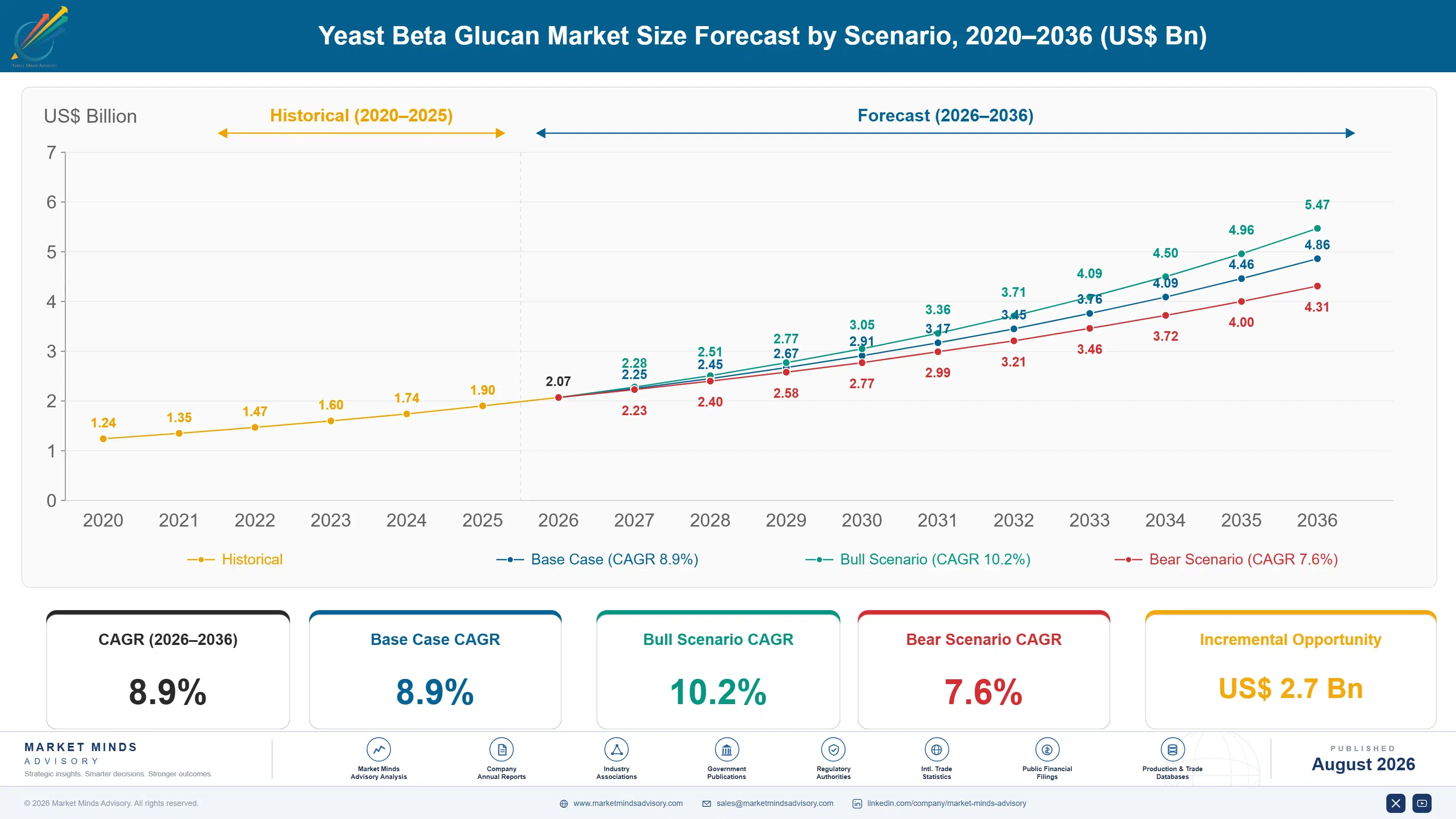
Yeast Beta Glucan Market Forecast Scenarios

yeast-beta-glucan-market-size-forecast-scenario-1787665411525
Between 2020 and 2025 the market grew at an estimated 7.9% annually, accelerated early by pandemic-era immune health awareness that pulled consumer supplement demand forward sharply, then sustained from 2022 onward as antibiotic-free livestock regulation began reshaping feed additive demand independently of consumer trends. Growth stayed concentrated in supplement and feed applications through most of the period, with cosmetics adoption growing more slowly.
The base case carries the market to 8.9% CAGR through 2036 on three mechanisms. Antibiotic growth promoter bans across the EU, United States, and increasingly China are converting beta glucan from an optional feed additive into a near-mandatory replacement technology. Aquaculture production keeps expanding globally to meet rising protein demand, and every new farmed ton needs disease management that antibiotics can no longer fully provide. Consumer immune health awareness, elevated since the pandemic, sustains supplement demand well above pre-2020 baselines.
The bull case reaches 10.2% if additional major livestock markets adopt antibiotic bans similar to the EU's ahead of schedule. The bear case falls to 7.6% if synthetic immune-support alternatives undercut beta glucan on cost in price-sensitive feed markets, slowing the substitution that currently drives incremental feed segment growth across price-sensitive emerging feed markets specifically.

Regulation Is Converting An Optional Additive Into A Requirement

Three forces converge on this category. Regulation increasingly sets who must buy beta glucan rather than who chooses to, aquaculture growth keeps expanding the addressable feed market independent of any single country's rules, and consumer immune health awareness keeps supplement demand elevated well above where it sat before the pandemic. Producers that treat these as three separate demand pools are underpricing how connected they actually are.
MARKET CONCENTRATIONCR5: 44%Top five producers hold under half of category revenue
AVERAGE SELLING PRICE$18 per kgBlended price across feed-grade and supplement-grade purity levels
TOP PRODUCING COUNTRYChina: 24%Single country supplies nearly a quarter of global output
PLANT CAPACITY UTILIZATION68%Average operating rate across major beta glucan extraction facilities
FEEDSTOCK TRADE INTENSITY41% importedShare of yeast biomass feedstock sourced across borders
FEEDSTOCK COST SHARE34% of COGSYeast biomass and extraction inputs dominate total production cost
Commercial character splits sharply between regulated feed markets and discretionary consumer markets. Feed-grade beta glucan increasingly sells into markets where antibiotic bans make it close to mandatory, while supplement-grade product still competes on efficacy claims and brand trust in a genuinely discretionary purchase. The feed-grade tier offers volume and regulatory tailwind, but the supplement-grade tier commands materially better per-kilogram margins for producers that can meet purity standards.
Looking to 2036, three shifts matter most. Antibiotic-free regulation will keep expanding into new livestock and aquaculture markets regardless of who wins on price today, extraction purity will increasingly separate feed-grade commodity producers from supplement-grade specialists, and aquaculture-specific formulation will become a genuine competitive battleground as farmed protein volume keeps climbing steadily each year.
"People still think of this as a supplement ingredient. The bigger story is that a Norwegian salmon farmer and an EU pork producer are now buying the same molecule for the same underlying reason: because they are no longer allowed to reach for antibiotics first."
Director, Specialty Ingredients and Animal Nutrition Practice · MMA Agriculture and Specialty Ingredients Practice · August 2026

Market Trends

Antibiotic Bans Convert Beta Glucan Into Near-Mandatory Feed Input

The EU banned antibiotic growth promoters in livestock feed outright in 2006, and the United States has steadily tightened veterinary feed directive rules since 2017, pushing producers toward immune-supporting alternatives that maintain animal health without antibiotic resistance risk. China's agriculture ministry phased out antibiotic growth promoters nationwide starting in 2020, converting the world's largest livestock market into a genuine growth opportunity for beta glucan suppliers almost overnight. Feed formulators increasingly treat beta glucan as a baseline immune-support input rather than an optional add-on, since regulatory compliance now requires some functional replacement for the antibiotics producers can no longer use routinely.
Market Impact: Supplies over 50% of world seafood
Aquaculture Expansion Drives Immunostimulant Feed Additive Demand

Global aquaculture production has grown to exceed capture fisheries output for the first time in history, and the FAO projects continued expansion through the next decade as farmed protein fills rising global seafood demand. Disease pressure intensifies as farming density increases, and Norwegian salmon farmers pioneered beta-glucan immunostimulant use specifically to reduce mortality without the antibiotic resistance risk that intensive aquaculture makes especially acute. Shrimp and tilapia producers across Southeast Asia have followed the same model, adopting beta-glucan feed additives as farming intensifies and disease outbreaks become more costly to manage through antibiotics alone.
Market Impact: Sustains demand above pre-2020 baseline

Market Opportunities and Growth Drivers

Global Aquaculture Growth Expands Feed Additive Demand

The FAO reports global aquaculture production has grown for over a decade and now supplies more than half of seafood consumed worldwide, a share that keeps climbing as capture fisheries output plateaus against sustainability limits. Every ton of farmed fish or shrimp requires feed to manage disease risk in dense farming conditions, and beta glucan has become an immunostimulant component in aquaculture feed formulations across major producing regions. This growth in farmed protein volume compounds beneath any country's regulatory decisions, giving beta glucan producers a demand base that expands regardless of which antibiotic policy debate dominates headlines in any year.
Market Impact: Costs 2-3 times synthetic alternatives

Post-Pandemic Immune Health Awareness Sustains Supplement Demand

Consumer awareness of immune function rose sharply during the pandemic and has not fully receded, with survey data consistently showing elevated interest in immune-supporting supplements compared to pre-2020 baselines across major consumer markets. Beta glucan carries genuine clinical research behind its immune-modulating claims, distinguishing it from ingredients relying purely on marketing narrative, which matters increasingly as regulators in the EU and United States scrutinize unsubstantiated health claims more closely. Supplement brands have responded by featuring beta glucan prominently in immune health formulations, often combined with vitamin C and zinc in multi-ingredient products targeting the same consumer demand.
Market Impact: Delays launches 12 to 18 months

Market Restraints and Challenges

High Extraction Cost Limits Price Competitiveness

Producing purified beta glucan requires breaking down yeast cell walls through processes that are more complex and costly than drying yeast biomass, and purity requirements for supplement-grade material push extraction cost higher. The root cause is biochemical: beta glucan sits inside a cell wall structure alongside mannoproteins and chitin, requiring separation steps that lower-purity products can skip. This keeps beta glucan priced above synthetic immune-support alternatives in cost-sensitive feed markets, limiting adoption where producers cannot pass the premium through to end buyers. Producers are responding with process efficiency investment and enzymatic extraction methods that have lowered production cost per kilogram.
Market Impact: Covers China's 2020 nationwide feed ban

Regulatory Health Claim Variability Slows Market Entry

Beta glucan health claims permitted in one jurisdiction require separate regulatory dossiers elsewhere, since the EU, United States, and China each maintain frameworks for evaluating functional ingredient claims with no mutual recognition between them. The root cause is regulatory fragmentation: no harmonization framework exists for functional ingredient health claims the way it does for pharmaceutical approvals. This forces producers to fund separate clinical substantiation and regulatory filing costs market by market, slowing product launches by 12 to 18 months per major jurisdiction. Several producers are pursuing shared clinical data consortiums to spread substantiation cost across companies pursuing the regulatory pathway.
Market Impact: Tracks aquaculture surpassing 50% of catch
3 additional market trends, 3 additional growth drivers, and 3 additional restraints and challenges are covered in the full report. Contact sales@marketmindsadvisory.com to access the complete intelligence.

Segment CAGR and Growth Architecture

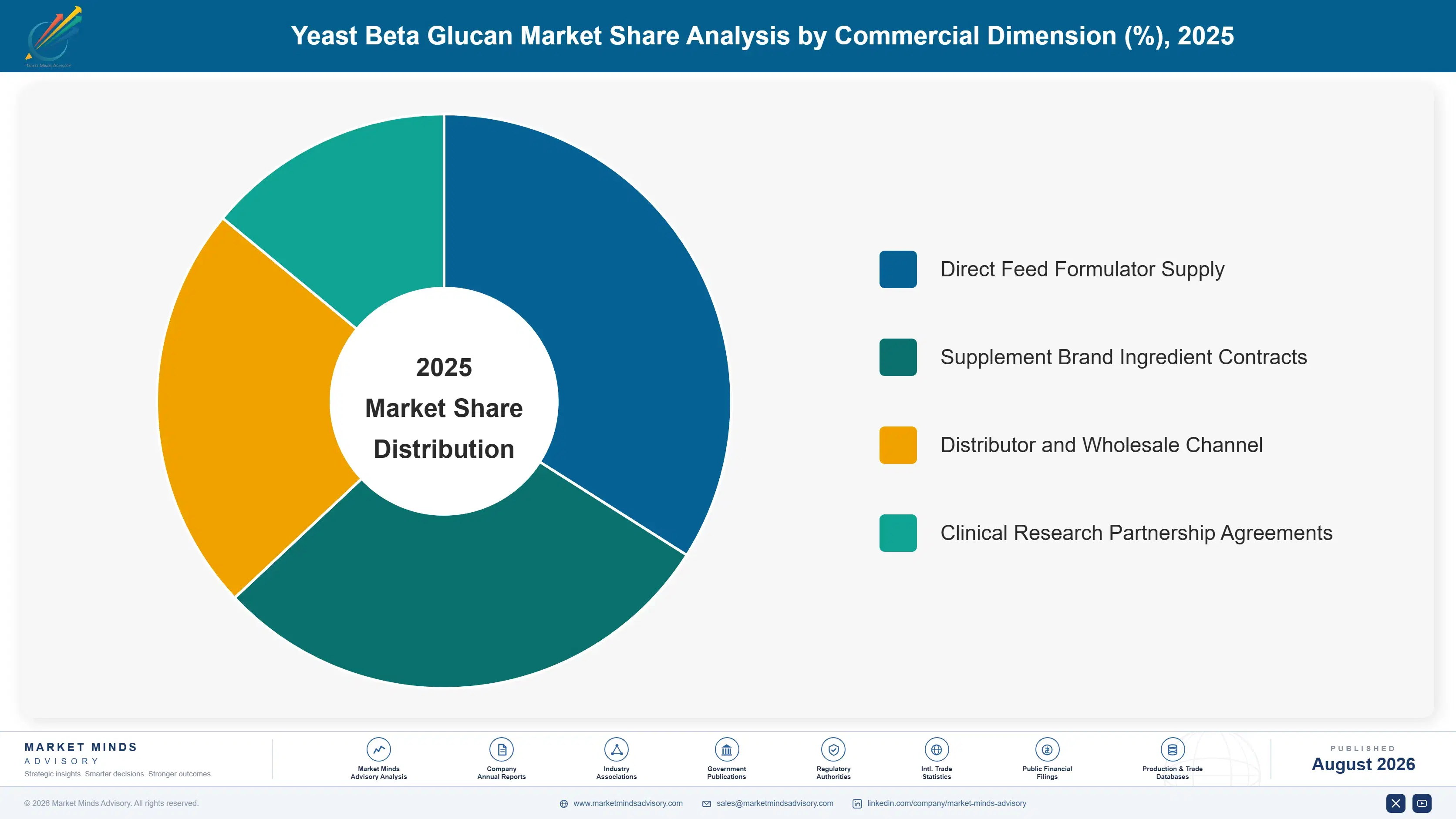
Segmentation follows end-use application, a single functional-purpose logic spanning dietary supplements, animal feed, functional food and beverage, cosmetics, pharmaceutical nutrition, and aquaculture feed additives. Each application carries distinct purity requirement, regulatory pathway, and buyer type, so commercial position tracks what the beta glucan supports and how pure it must be for that specific use.
yeast-beta-glucan-market-market-share-analysis-1787665412113

Aquaculture Feed Additives

Aquaculture feed additives grow fastest at 12.5% annually, nearly 1.4 times the overall market rate, as farmed fish and shrimp production keeps expanding while disease pressure from denser farming intensifies the need for immune-supporting feed inputs. Norwegian salmon farmers pioneered beta-glucan immunostimulant adoption specifically to reduce mortality without relying on antibiotics that carry resistance risk in intensive aquaculture systems. Southeast Asian shrimp and tilapia producers have followed the same model as farming density increases across Vietnam, Indonesia, and Thailand. Lesaffre and Biorigin both supply dedicated aquaculture-grade formulations optimized for fish and shrimp physiology specifically, distinct from the livestock-grade product sold into poultry and swine feed applications broadly across major producing markets.
CAGR 12.5%

Animal Feed Additives

Animal feed additives for livestock and poultry grow second-fastest at 10.8%, driven directly by antibiotic growth promoter bans across the EU, United States, and increasingly China that push producers toward immune-supporting alternatives. Beta glucan activates innate immune response in livestock, reducing disease incidence and supporting growth performance without the antibiotic resistance risk regulators now actively discourage. Angel Yeast and Kerry both supply large-volume livestock-grade product into poultry and swine feed formulations across major producing regions. China's 2020 nationwide antibiotic growth promoter phase-out converted the world's largest livestock market into a major growth opportunity, and feed formulators there are still scaling adoption toward levels already common in the EU today across most producers.
CAGR 10.8%
Full segment breakdown across 6 segments available in the complete report.

Regional Architecture and Country Demand Map

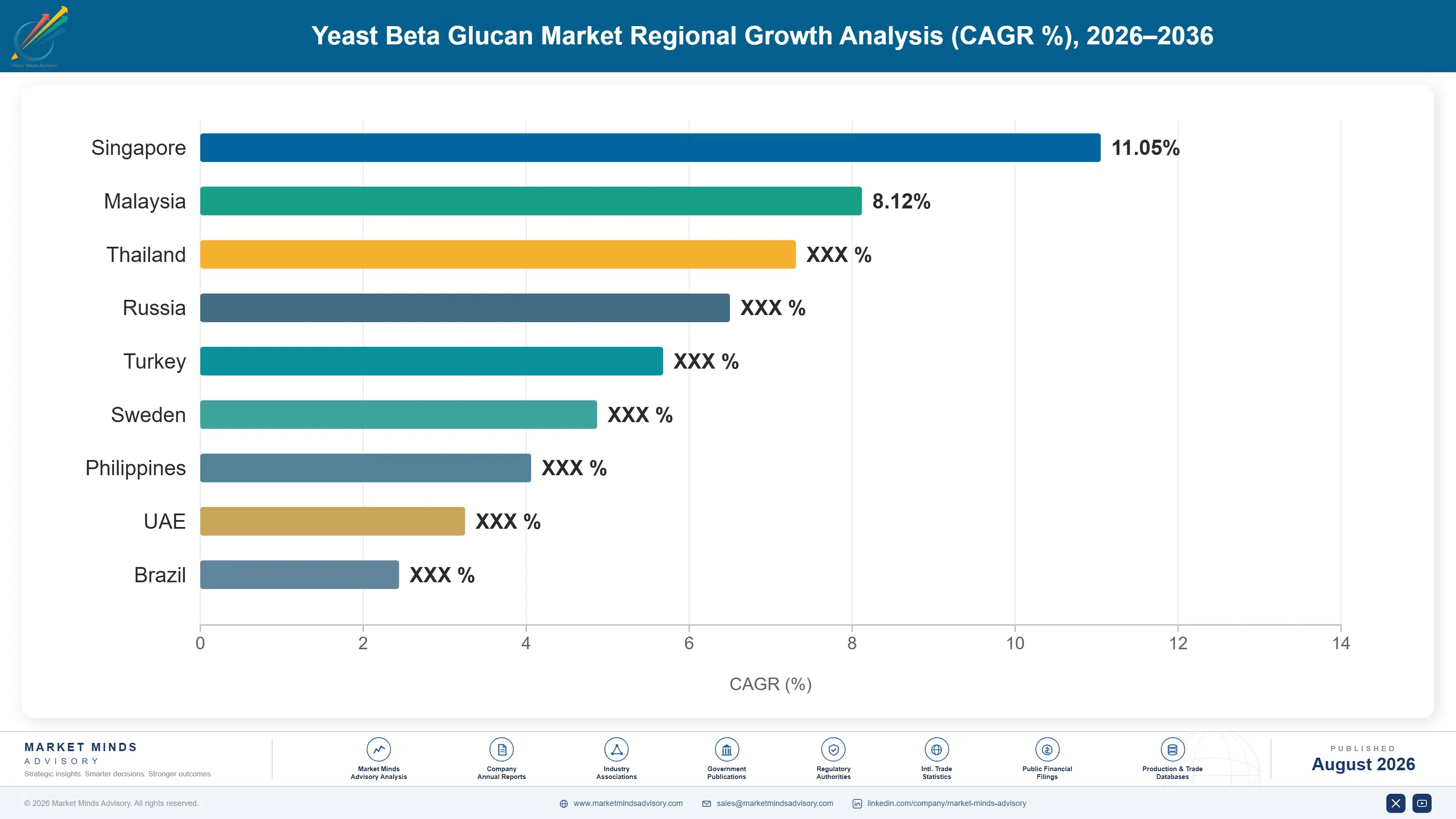
East Asia now leads on China's animal feed volume and expanding regional aquaculture production, narrowly ahead of North America's large dietary supplement market. Western Europe follows on Norwegian aquaculture and early antibiotic-ban adoption, while South Asia and Pacific posts the fastest regional growth as aquaculture and livestock feed markets scale.

North America

The United States drives most of North America's 25% share through its large dietary supplement industry, where beta glucan features prominently in immune health formulations sold across mass retail and direct-to-consumer channels. FDA scrutiny of unsubstantiated health claims has pushed supplement brands toward beta glucan's genuine clinical research base rather than less-substantiated alternatives, reinforcing its position in premium formulations. Animal feed demand grows steadily as producers respond to consumer preference for antibiotic-free meat, even without a federal ban comparable to the EU's. Canada contributes meaningfully through both supplement manufacturing and its own aquaculture sector. Growth of 8.5% outpaces the global rate as consumer immune health demand compounds alongside gradual feed market adoption.
Share: 25% | CAGR: 8.5% (2026 to 2036)

Western Europe

Norway anchors much of Western Europe's 22% share through its massive salmon aquaculture industry, where beta-glucan immunostimulant feed additives have become standard practice across major producers managing disease pressure in dense farming operations. Germany and France drive substantial supplement and functional food demand, reinforced by the EU's 2006 antibiotic growth promoter ban that gave European livestock producers the longest track record of beta-glucan feed adoption anywhere in the world. The UK's supplement market has grown steadily alongside broader immune health consumer awareness. Import tariff exposure on Asian-sourced feedstock periodically affects European producer margins. Growth of 7.3% trails the global rate, consistent with a mature market where both regulatory and consumer adoption are already well established.
Share: 22% | CAGR: 7.3% (2026 to 2036)
Regional intelligence for 5 additional markets available in the complete report: East Asia, South Asia and Pacific, Latin America, Middle East and Africa, Eastern Europe. Contact sales@marketmindsadvisory.com.
yeast-beta-glucan-market-country-cagr-analysis-1787665412624

Where Yeast Beta Glucan Margin Now Concentrates

Producers face a familiar squeeze: commodity feed-grade beta glucan competes purely on price per kilogram, while purity depth, application-specific formulation, and clinical substantiation increasingly carry the margin. The four moves below shift revenue toward defensible, harder-to-replicate positions instead of undifferentiated commodity extraction, drawing on how leading producers already separate feed-grade economics from supplement-grade premium lines.

Develop Aquaculture-Specific Feed Formulation Depth Fast

Producers that develop formulations optimized specifically for fish and shrimp physiology, rather than repurposing livestock-grade product, capture premium pricing from aquaculture customers willing to pay for demonstrated mortality reduction. Lesaffre and Biorigin's dedicated aquaculture lines reportedly command a 20% to 30% price premium over generic feed-grade material, since farmers value species-specific clinical data enough to pay for it directly. Producers without aquaculture-specific research are increasingly partnering with university aquaculture programs to generate the species-specific efficacy data that customers now expect before switching suppliers to a competitor with better-documented species-specific results.
Market Impact: Commands a 20% to 30% aquaculture pricing premium

Fund Clinical Substantiation For Supplement Health Claims

Supplement brands increasingly favor ingredients with genuine clinical research behind immune health claims, since regulatory scrutiny of unsubstantiated claims keeps intensifying across the EU and United States. Producers that fund clinical trials supporting specific health claims can command 15% to 25% premium pricing over unsubstantiated beta glucan sold as a commodity ingredient, while building brand relationships that survive well beyond any single regulatory cycle. This approach requires upfront investment that smaller producers often cannot fund independently, creating a genuine barrier that protects the pricing power of those who can afford it.
Market Impact: Commands a 15% to 25% clinical substantiation premium

Expand Feed-Grade Capacity In Antibiotic-Ban Markets

China's 2020 nationwide antibiotic growth promoter phase-out created feed-grade demand at a scale most producers had not built capacity to serve, and producers expanding extraction capacity specifically to serve this market are capturing volume before domestic Chinese competitors fully scale their own production. India and Brazil are watching China's transition closely, each weighing similar phase-out timelines for their own large livestock sectors. This category remains underpenetrated relative to the regulatory shift already in force, since feed formulators there are still building beta-glucan adoption toward levels already standard in the EU after nearly two decades of antibiotic-free practice.
Market Impact: Targets China's 2020 antibiotic ban feed market directly

License Extraction Technology To Regional Producers

Producers that developed proprietary enzymatic extraction technology reducing production cost per kilogram hold capability that regional producers in emerging feed markets urgently need but cannot develop independently within a reasonable timeframe. Licensing that extraction technology to non-competing regional producers, rather than only selling finished beta glucan, can generate royalty revenue running 3% to 6% of the licensee's sales at close to zero marginal cost. This model is still emerging but mirrors licensing approaches already established in adjacent fermentation ingredient categories, and regulatory-driven demand growth is creating exactly the urgent, concentrated need that makes licensing commercially attractive right now.
Market Impact: Generates 3% to 6% ongoing royalty revenue stream

Who Controls the Margin Pool

Concentration sits at a moderate 44% for the top five, evaluated on global yeast beta glucan production and formulation revenue. Lesaffre and Angel Yeast command the largest shares through yeast biomass access and extraction scale, but the gap to specialist producers is narrower than CR5 implies, since Biorigin, Kerry, and Lallemand hold application formulation depth diversified majors have not matched.
Competitive activity runs along three fronts. Yeast biomass access drives production scale, where Lesaffre and Angel Yeast leverage fermentation infrastructure that pure-play producers cannot replicate quickly. Application-specific formulation drives premium positioning, where Biorigin and Kerry compete for aquaculture and supplement accounts requiring species-specific data. Regulatory-driven volume drives feed-grade wins, where producers with scaled capacity in antibiotic-ban markets capture contracts smaller competitors cannot serve.

Pressure is building from Chinese producers expanding extraction capability faster than expected, narrowing a purity and formulation gap that Western specialists have relied on for differentiation. Global fermentation majors including DSM-Firmenich are also pushing further into functional ingredients, compressing the space specialist beta glucan producers once occupied alone. Rankings will likely shift toward producers that combine feedstock scale with application-specific formulation depth, since neither advantage alone secures the fastest-growing segments.
yeast-beta-glucan-market-company-positioning-matrix-1787665413149

Competitive Moat and Risk Dimensions

LESAFFRE GROUP

Moat: Yeast Biomass And Extraction Scale

Lesaffre's global yeast fermentation infrastructure, built originally for baking and industrial yeast production, gives its Leiber subsidiary access to biomass feedstock and extraction scale that pure-play beta glucan producers cannot easily replicate. Decades of yeast biology expertise transfer directly into beta glucan purification, giving Lesaffre cost and quality advantages across feed-grade and supplement-grade tiers simultaneously.
LESAFFRE GROUP

Risk: Diversified Focus Limits Specialization

Beta glucan remains one product line within a much larger yeast and fermentation ingredients portfolio, meaning management attention and capital allocation compete against core baking yeast and other fermentation businesses that generate far larger absolute revenue. Specialist competitors focused entirely on functional beta glucan can move faster on application-specific formulation than a diversified giant managing many product lines simultaneously.
ANGEL YEAST CO. LTD.

Moat: Dominant Chinese Production Scale

Angel Yeast's massive domestic yeast production capacity, built to serve China's large baking and fermentation ingredient markets, gives it cost advantages in beta glucan extraction that international competitors entering China struggle to match. Its position inside China ahead of the 2020 antibiotic ban gave it first-mover access to the world's largest newly regulated feed market.
ANGEL YEAST CO. LTD.

Risk: Limited International Brand Recognition

Angel Yeast's brand recognition and regulatory relationships remain concentrated domestically, limiting its ability to command supplement-grade premium pricing in Western markets where Lesaffre and Kerry hold deeper customer relationships and clinical substantiation history. Expanding internationally requires building regulatory and brand credibility that established Western competitors already possess.

Players Tracked

Prominent Players

Lesaffre Group
Angel Yeast Co. Ltd.
Kerry Group plc
Lallemand Inc.
Biorigin

Other Key Players

Alltech Inc.
Kemin Industries Inc.
Associated British Foods plc
DSM-Firmenich
AB Enzymes
Synergy Flavors
Nutriad International
Biothera Pharmaceuticals
Garuda International
Sensient Technologies
Cargill Incorporated
Novozymes A/S
Meiji Holdings
ICL Group
Tate and Lyle plc

Recent Developments

MARCH 2025

Lesaffre Expands Leiber Beta Glucan Production Capacity

Lesaffre announced expanded beta glucan extraction capacity at its Leiber facilities in Germany, targeting rising demand from both aquaculture and antibiotic-free livestock feed markets. The expansion was an organic capacity investment, not an acquisition or joint venture with an external partner of any kind at all.
Signal: Signals major producers are treating feed-grade demand growth as durable rather than a temporary regulatory adjustment.
AUGUST 2024

Angel Yeast Signs Supply Agreement With European Feed Distributor

Angel Yeast signed a multi-year supply agreement with a major European animal feed distributor, securing distribution access for its feed-grade beta glucan across several EU markets. The agreement was a commercial supply contract, not a joint venture, acquisition, or equity investment by either party involved.
Signal: Signals Chinese producers are building direct European distribution rather than relying solely on export trading intermediaries.
JANUARY 2025

Kerry Group Acquires Specialty Aquaculture Ingredient Startup

Kerry Group completed the acquisition of a small specialty aquaculture ingredient startup, adding species-specific formulation expertise and clinical data to its existing beta glucan portfolio. The transaction was a full acquisition, not a joint venture or minority equity investment involving any additional external partner or investor.
Signal: Signals established ingredient majors are buying specialized aquaculture expertise rather than building it internally from scratch.

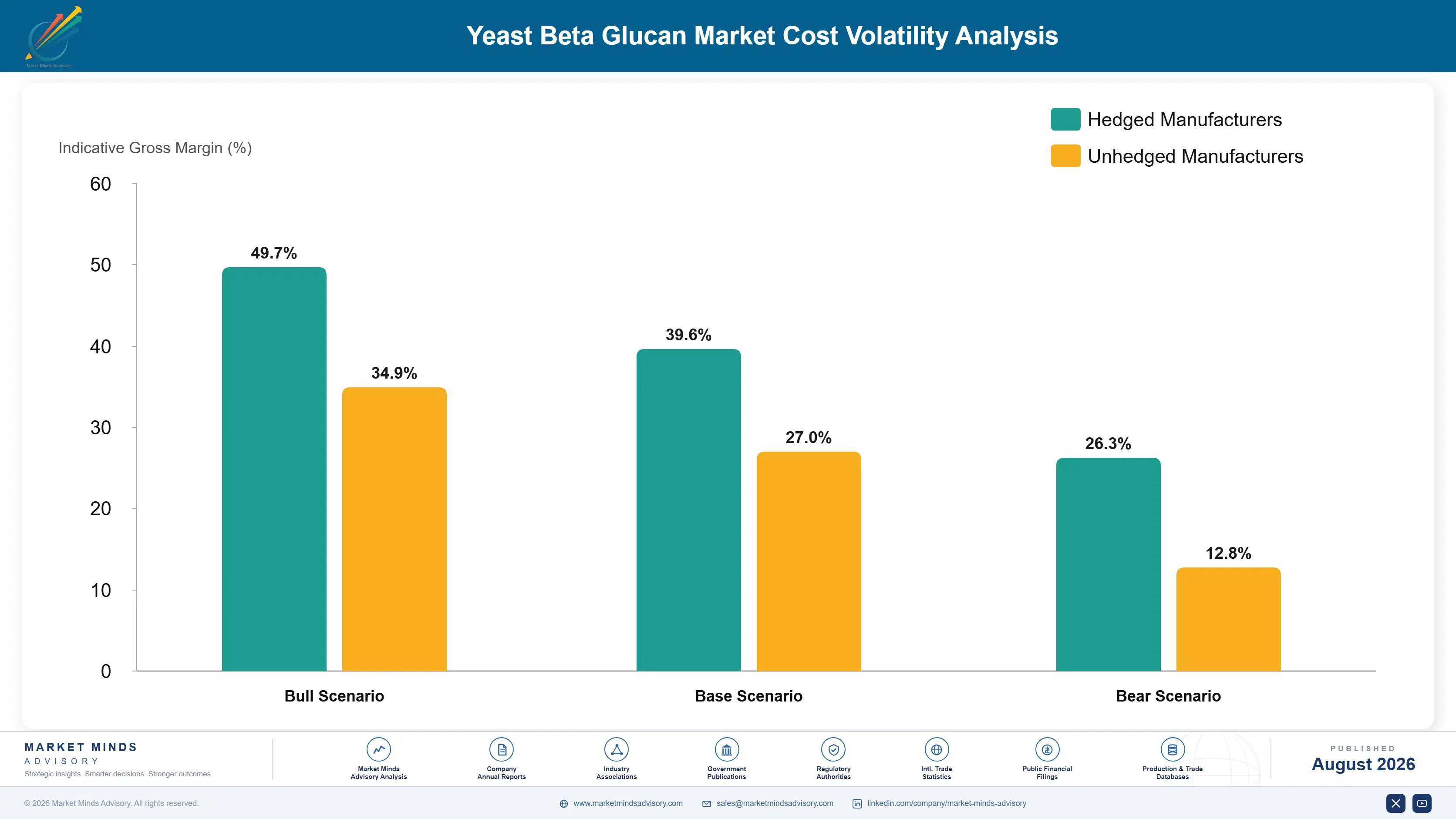
Yeast Biomass And Extraction Cost Exposure

Yeast biomass feedstock and extraction processing account for roughly 34% of cost of goods sold, sourced predominantly from brewing and baking industry byproduct streams and dedicated fermentation facilities concentrated in Europe, China, and Brazil. Enzymes, purification media, and packaging add the remaining significant cost categories across most production processes, varying by target purity level and formulation requirements.
Global grain price volatility in 2022, driven by the Russia-Ukraine war's disruption of feed grain exports, raised fermentation feedstock costs across the yeast production industry broadly. Lesaffre's 2022 annual report disclosed material cost inflation pressure across its yeast and fermentation ingredient segments during the period. Prices have moderated since 2023 but remain above pre-2022 baselines, according to European Commission agricultural market reporting published in early 2025.

Smaller specialist producers without long-term feedstock supply agreements absorb biomass cost spikes immediately, while Lesaffre and Angel Yeast negotiate integrated fermentation operations that smooth volatility across larger production volumes. Producers relying purely on purchased byproduct biomass carry additional exposure since brewing and baking industry supply fluctuates independently of beta glucan demand. Producers without vertically integrated fermentation capacity consistently trail on cost during feedstock supply disruptions.
yeast-beta-glucan-market-cost-volatility-analysis-1787665413346

Integrate Fermentation Capacity Rather Than Buying Biomass

Producers relying on purchased yeast biomass byproduct face supply volatility that integrated fermentation operations avoid entirely. Building or acquiring dedicated fermentation capacity, even at higher upfront capital cost, secures feedstock supply independent of brewing and baking industry cycles that have nothing to do with beta glucan demand, a mismatch that has burned unprepared producers before.

Lock Multi-Year Feedstock Supply Agreements

Securing multi-year biomass supply agreements with price stability provisions, rather than buying on the spot market, is what let larger producers limit the worst of the 2022 grain price spike while smaller competitors absorbed the full cost swing directly. The premium paid for supply security is real, but far cheaper than losing a qualified customer relationship.

Invest In Enzymatic Extraction Efficiency

Extraction cost per kilogram varies significantly based on process efficiency, and producers investing in improved enzymatic extraction methods can meaningfully lower production cost over time. Early investment in process efficiency compounds into a durable cost advantage that competitors relying on older extraction methods cannot easily replicate quickly without comparable upfront capital and technical investment.

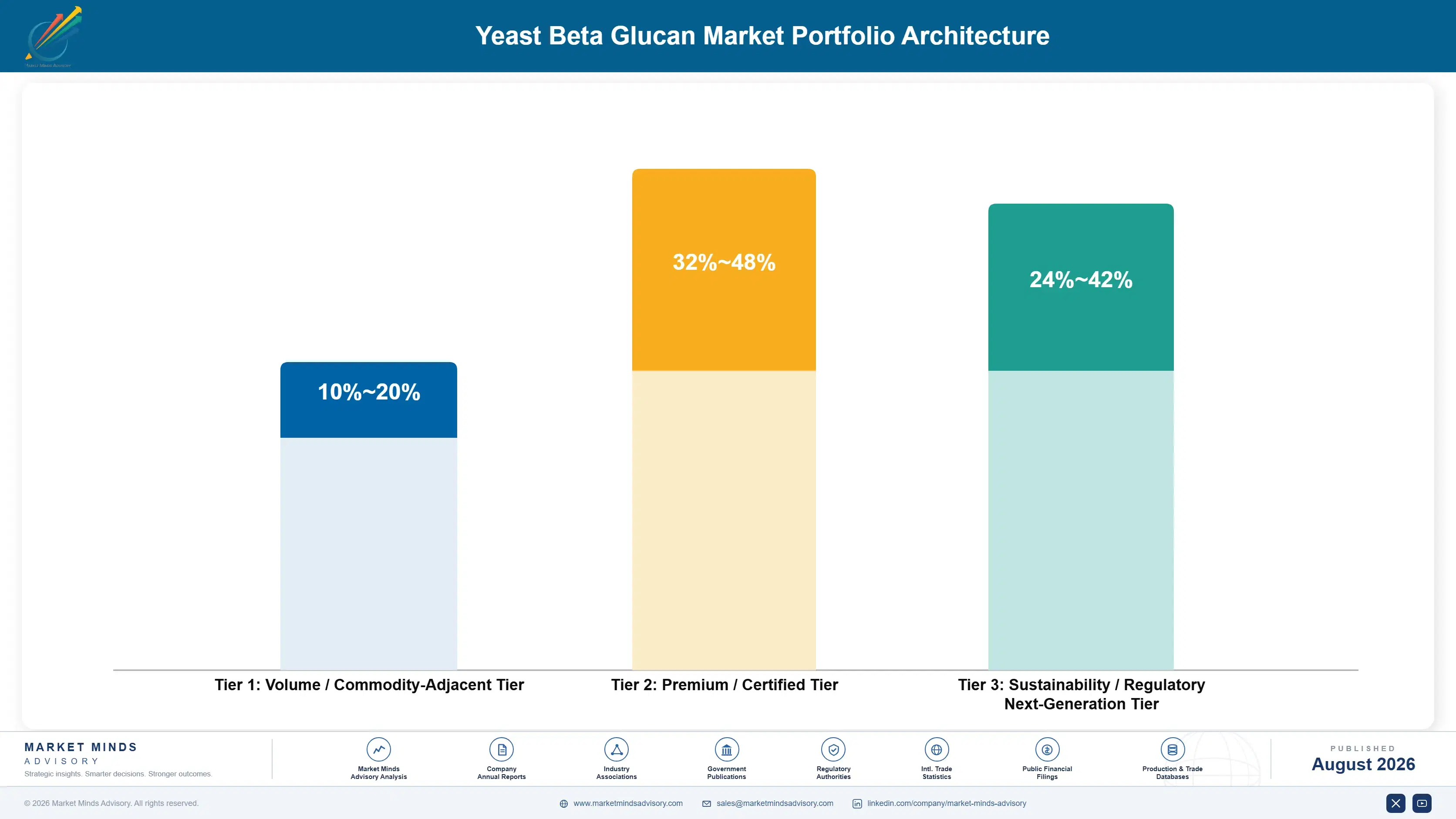
Portfolio Architecture for Margin Defence

The portfolio splits into three tiers with meaningfully different margin economics. Volume feed-grade beta glucan, sold into large-scale livestock and aquaculture feed formulation, competes on price per kilogram against a crowded field of regional producers, earning modestly. Premium supplement-grade and clinically substantiated formulations earn substantially more because purity standards and clinical research insulate pricing from direct commodity comparison. Application-specific aquaculture formulations sit in a third tier carrying strong margins as species-specific demand and disease pressure drive urgent near-term adoption.
The tension runs between volume and formulation depth. Feed-grade beta glucan generates the unit volume that keeps extraction facilities running efficiently, but margin stays thin since feed formulators compare price per kilogram relentlessly across largely interchangeable suppliers. Supplement-grade and application-specific product carries the opposite constraint: strong margins but a narrower addressable customer base defined by purity requirements and clinical substantiation rather than broad market access.

High-value margin pools concentrate wherever purity, clinical substantiation, and application specificity combine, which is precisely why supplement-grade and aquaculture-specific producers have historically outearned commodity feed-grade suppliers despite selling into a smaller addressable volume. Aquaculture-specific formulation carries the most immediate upside right now, driven by disease pressure and species-specific demand rather than organic volume growth alone.

Volume / Commodity-Adjacent Tier

Standard feed-grade beta glucan sold into large-scale livestock and general aquaculture feed formulation, competing primarily on price per kilogram and delivery reliability against a crowded field of regional producers with largely interchangeable purity specifications.
Gross Margin: 10-20%

Premium / Certified Tier

Supplement-grade beta glucan meeting pharmaceutical-adjacent purity standards, backed by clinical substantiation for specific health claims, sold through multi-year contracts where purity and research depth insulate pricing from commodity comparison entirely.
Gross Margin: 32-48%

Sustainability / Regulatory / Next-Generation Tier

Species-specific aquaculture formulations and antibiotic-ban market feed-grade product qualified against tightening regulatory requirements, still working through customer qualification cycles and clinical validation timelines before revenue becomes fully predictable at meaningful scale.
Gross Margin: 24-42%
yeast-beta-glucan-market-portfolio-architecture-1787665413880

High-value Sub-segments and Strategic Watch-out

Aquaculture-Specific Formulations

The fastest-growing and highest-value segment, driven directly by disease pressure in intensifying fish and shrimp farming operations. Lesaffre and Biorigin both draw early advantage from species-specific research, and margin expansion continues as clinical data investment amortizes across growing certified volume, a trend likely to continue.
Gross Margin: 32-48%

Antibiotic-Ban Livestock Feed Additives

Strong margins on regulatory-driven demand, growing steadily as additional livestock markets adopt antibiotic-free practices. Growth trails aquaculture because livestock feed adoption cycles move more gradually than the acute disease pressure currently forcing faster movement elsewhere in the portfolio right now across most major markets each year.
Gross Margin: 24-42%

Standard Supplement-Grade Beta Glucan

The volume core of qualified product, generating the bulk of certified unit shipments at stable, moderate margins. Lesaffre, Kerry, and Lallemand compete intensely here on clinical substantiation and brand relationships, and while unit growth stays healthy, margin expansion is limited by established competitive dynamics industrywide.
Gross Margin: 20-32%

Undifferentiated Commodity Feed-Grade Product

The strategic watch-out. Chinese producers keep expanding low-cost feed-grade capacity, pressuring price on the least differentiated product lines, and producers without formulation depth or clinical substantiation face shrinking margin as commodity competition intensifies across major feed markets worldwide over the next several years ahead industrywide.
Gross Margin: 10-20%

Regulation And Disease Pressure Lock Demand

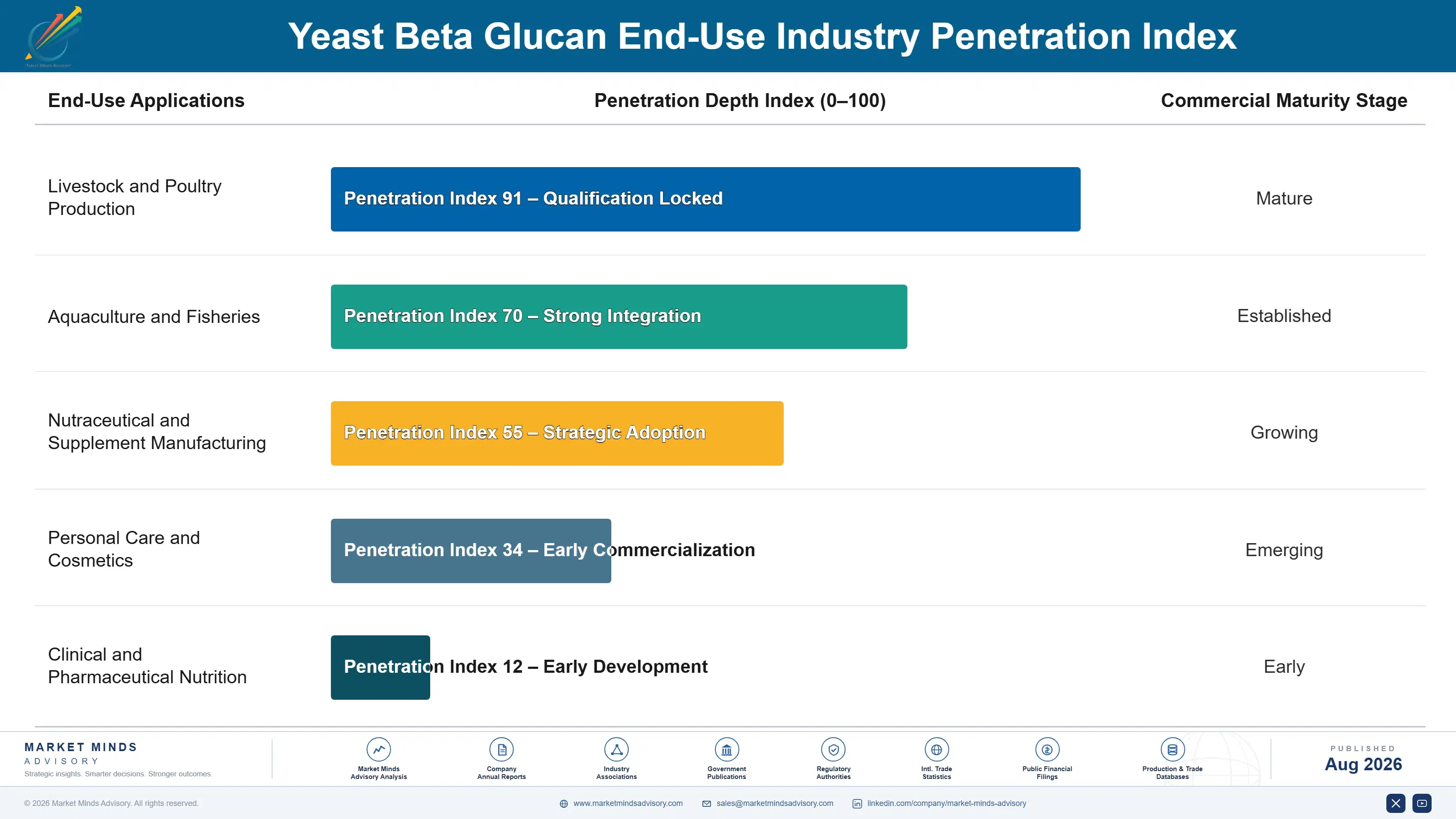
Feed-grade beta glucan behaves like an annuity once a producer qualifies as a formulator's supplier, since switching suppliers requires requalifying against animal health performance data that most formulators avoid disrupting once relationships prove reliable. Supplement-grade product carries a comparable lock-in, since brands that have built clinical substantiation around a supplier's material face reformulation cost switching to an alternative source.
Adoption depth varies by customer vertical. Aquaculture operators show the highest stickiness, since disease outcomes are measurable and switching suppliers mid-cycle risks mortality increases farmers avoid whenever possible. Livestock feed formulators show moderate stickiness, balancing compliance requirements against periodic re-tendering on supply contracts. Supplement brand buyers show stickiness depending on whether they have invested in supplier-specific substantiation or treat beta glucan as an interchangeable ingredient.

Younger supplement brands treat clinical substantiation as a baseline formulation requirement, a shift regulatory scrutiny of health claims has accelerated beyond where voluntary brand positioning alone would have pushed it. Established feed formulators in regulated livestock markets weight regulatory compliance and animal performance data heavily. That generational split is reshaping supplier scorecards, pulling clinical substantiation from a nice-to-have differentiator toward a qualification requirement across an increasing share of major accounts.
yeast-beta-glucan-market-end-use-penetration-index-1787665414392

Where MMA Sees Divergence Ahead

These are among the four positions where our research anticipates prominent divergence between winners and laggards over the coming forecast period. Each is grounded in the demand model, the regulatory perimeter, and the announced capacity pipeline.
01 / AQUACULTURE FORMULATION PRIORITY

Prioritize species-specific aquaculture formulation over generic feed

Disease pressure in intensifying aquaculture operations is not slowing down, and the species-specific formulation requirement it creates does not move for anyone, which means producers that develop aquaculture-specific research earliest capture premium contracts before the rest of the industry catches up and competition compresses that advantage away. Companies still selling generic feed-grade product into aquaculture accounts while deferring species-specific research are solving the wrong problem for this specific window. The advantage goes to whoever demonstrates mortality reduction first, not whoever competes cheapest.
02 / EMERGING MARKET REGULATORY POSITIONING

Position feed-grade capacity ahead of new antibiotic bans

China's 2020 antibiotic ban proved the pattern that additional major livestock markets will likely follow on a similar regulatory trajectory over the coming decade, and producers with proven feed-grade formulations from EU and American markets can adapt faster than domestic competitors starting from scratch in each newly regulated market. Producers waiting for enforcement to force the issue are choosing to compete for whatever demand remains after early movers have already captured the largest emerging feed contracts. Regulatory foresight, not lowest unit cost, decides who wins these early qualification contests.
03 / CLINICAL SUBSTANTIATION INVESTMENT

Fund clinical research before health claim scrutiny intensifies

Regulatory scrutiny of unsubstantiated supplement health claims keeps intensifying across the EU and United States, and producers that fund clinical trials supporting specific immune health claims now, ahead of stricter enforcement, will face materially lower compliance risk than those retrofitting substantiation under regulatory deadline pressure later. This is a rare case where getting ahead of regulation costs less than reacting to it after enforcement tightens. Producers without clinical backing risk losing premium supplement accounts to competitors who invested earlier and can already document their claims.
04 / FEEDSTOCK INTEGRATION STRATEGY

Integrate fermentation capacity before the next feedstock shock

Global grain and feedstock price volatility, sharpened by the 2022 supply disruption, punishes producers buying purchased yeast biomass purely on the spot market far more than those with integrated fermentation operations. Producers securing dedicated fermentation capacity now, while feedstock markets are relatively calm, avoid the scramble that hit unprepared competitors during the last major shock and position themselves for the next one that regulatory and climate volatility make increasingly likely. Preparation before the disruption, not response after it, separates resilient producers from exposed ones.

Engagement Snapshot From the Field

A live engagement with an industry participant carrying material or product regulatory and market exposure ahead of a defining policy shift, showing how our research translates into a defensible multi-year portfolio strategy.
MARKET MINDS ADVISORY · CLIENT ENGAGEMENT SUMMARY
Yeast Beta Glucan Producer Strategic Portfolio Review and Transition Roadmap 2026·Investment Scenario on Yeast Beta Glucan Exposure Evaluation 2025-26
CLIENT PROFILE
A mid-sized Norwegian salmon aquaculture operator approached MMA while evaluating whether to switch beta glucan feed additive suppliers ahead of a planned production expansion into a new fjord site with different disease pressure characteristics. The client reported annual revenue near USD 190 million, with feed additive costs representing a meaningful share of total feed spend, and no prior formal supplier evaluation framework (client-reported, unverified by MMA).
STRATEGIC CHALLENGE
Operations leadership wanted a supplier with demonstrated efficacy data specific to the pathogens present at the new site, but procurement had relied on a single long-standing supplier relationship without benchmarking alternatives, and needed to understand switching costs and disruption risk before the expansion timeline locked in feed formulation decisions for the coming season.
MMA APPROACH
MMA benchmarked qualified aquaculture-grade beta glucan suppliers against site-specific disease pressure data, modeled the mortality reduction and cost impact of switching suppliers against the incumbent relationship's track record, and assessed the clinical substantiation depth each competing supplier could document. We also evaluated a dual-sourcing approach to reduce single-supplier dependency risk.
KEY FINDINGS
  1. The incumbent supplier's efficacy data did not specifically address the pathogen strain most prevalent at the new fjord site, creating a genuine performance gap the client had not previously identified.
  2. A specialist competitor offered site-specific clinical data showing a meaningful mortality reduction advantage, though at a price premium of roughly 22% over the incumbent's standard product.
  3. Switching suppliers entirely carried transition risk during the critical expansion period, while dual-sourcing preserved the incumbent relationship while testing the specialist's performance at smaller scale first.
  4. The mortality reduction advantage, modeled against typical disease outbreak costs, would offset the price premium within approximately one full production cycle if performance matched the clinical data.
CLIENT PROFILE
A mid-sized Norwegian salmon aquaculture operator approached MMA while evaluating whether to switch beta glucan feed additive suppliers ahead of a planned production expansion into a new fjord site with different disease pressure characteristics. The client reported annual revenue near USD 190 million, with feed additive costs representing a meaningful share of total feed spend, and no prior formal supplier evaluation framework (client-reported, unverified by MMA).
STRATEGIC CHALLENGE
Operations leadership wanted a supplier with demonstrated efficacy data specific to the pathogens present at the new site, but procurement had relied on a single long-standing supplier relationship without benchmarking alternatives, and needed to understand switching costs and disruption risk before the expansion timeline locked in feed formulation decisions for the coming season.
MMA APPROACH
MMA benchmarked qualified aquaculture-grade beta glucan suppliers against site-specific disease pressure data, modeled the mortality reduction and cost impact of switching suppliers against the incumbent relationship's track record, and assessed the clinical substantiation depth each competing supplier could document. We also evaluated a dual-sourcing approach to reduce single-supplier dependency risk.
KEY FINDINGS
  1. The incumbent supplier's efficacy data did not specifically address the pathogen strain most prevalent at the new fjord site, creating a genuine performance gap the client had not previously identified.
  2. A specialist competitor offered site-specific clinical data showing a meaningful mortality reduction advantage, though at a price premium of roughly 22% over the incumbent's standard product.
  3. Switching suppliers entirely carried transition risk during the critical expansion period, while dual-sourcing preserved the incumbent relationship while testing the specialist's performance at smaller scale first.
  4. The mortality reduction advantage, modeled against typical disease outbreak costs, would offset the price premium within approximately one full production cycle if performance matched the clinical data.
RECOMMENDED STRATEGY
Phase 1: Phase 1 (0 to 6 months): Dual-source the specialist supplier's product for the new fjord site only, preserving the incumbent relationship for existing operations. Phase 2: Phase 2 (6 to 18 months): Evaluate actual mortality and performance data from the new site against both suppliers before committing to a single long-term source. Phase 3: Phase 3 (18 to 36 months): Consolidate sourcing around whichever supplier demonstrates superior site-specific performance, renegotiating volume-based pricing accordingly across all sites.
OUTCOME
The client's new fjord site showed a reported 18% mortality reduction using the specialist supplier's formulation compared to modeled outcomes with the incumbent product, validating the price premium within the first production cycle. The client has since expanded the specialist relationship to two additional sites while maintaining the incumbent for established operations (client-reported, unverified by MMA).

Frequently Asked Questions

Foundational context covering the market sizes, CAGR, scope, country, region and competition that inform every finding below. This section is provided to cover basics and most often pre-purchase conversations, answered from the MMA Primary Research Dataset.

What is the current size of the Yeast Beta Glucan Market?

The market reached USD 1.85 billion in 2025 on a global basis, with East Asia holding the largest single regional share at 27%. It spans dietary supplement, animal feed, aquaculture, cosmetics, and functional food applications.

How large will the Yeast Beta Glucan Market be by 2036?

MMA forecasts the market will reach USD 4.71 billion by 2036, expanding roughly 2.34 times its 2026 base value. Aquaculture and livestock feed additives drive most of that incremental growth.

What is the CAGR for the Yeast Beta Glucan Market 2026 to 2036?

The base case CAGR runs at 8.9% annually through 2036. Bull scenarios reach 10.2% on faster antibiotic ban adoption, while bear scenarios fall to 7.6% if synthetic alternatives undercut beta glucan on cost.

Which segment is growing fastest?

Aquaculture feed additives grow fastest at 12.5% annually, nearly 1.4 times the overall market rate. Rising disease pressure in intensifying fish and shrimp farming drives most of that acceleration.

Who are the major companies in the Yeast Beta Glucan Market?

Lesaffre, Angel Yeast, Kerry Group, Lallemand, and Biorigin lead the market on a consistent global production revenue basis. Together they hold roughly 44% of category revenue.

Which country is growing fastest?

Norway posts the fastest national growth at roughly 13.5% annually, driven by its dominant salmon aquaculture industry adopting beta-glucan immunostimulants. Growth concentrates in species-specific aquaculture formulations rather than commodity feed-grade product.

Report Segmentation Architecture

The full report scope spans multiple orthogonal segmentation dimensions, with cross-tabulated demand data provided for each dimension pair. Coverage extends further to regional breakdowns, trend trajectories, and the competitive detail needed to support segment-level decision-making.

By Application

  • Dietary Supplements and Nutraceuticals
  • Animal Feed Additives
  • Functional Food and Beverage Ingredients
  • Cosmetics and Personal Care
  • Pharmaceutical and Clinical Nutrition
  • Aquaculture Feed Additives

By End-Use Industry

  • Livestock and Poultry Production
  • Aquaculture and Fisheries
  • Nutraceutical and Supplement Manufacturing
  • Personal Care and Cosmetics
  • Clinical and Pharmaceutical Nutrition

By Commercial Dimension

  • Direct Feed Formulator Supply
  • Supplement Brand Ingredient Contracts
  • Distributor and Wholesale Channel
  • Clinical Research Partnership Agreements

By Region

  • North America
  • Western Europe
  • East Asia
  • South Asia and Pacific
  • Latin America
  • Middle East and Africa
  • Eastern Europe

Scope, Methodology, and Coverage

Every figure in this report is reproducible from documented input assumptions. The scope below maps the historical period, the forecast horizon, the segmentation dimensions, and the countries covered, alongside the underlying primary and qualitative methodology.
Historical Period
2020 to 2025
Forecast Period
2026 to 2036
Base Year
2025 (USD billions; MMA Primary Research Dataset, August 2026)
Market Definition
The yeast beta glucan market covers polysaccharide ingredients derived from the cell walls of Saccharomyces cerevisiae and related yeast strains, sold as immune-supporting and functional ingredients. It spans dietary supplements, animal and aquaculture feed, functional food and beverages, cosmetics, and clinical nutrition applications. It excludes oat and barley beta glucan derived from cereal grains, mushroom-derived beta glucan, and whole yeast products sold without cell-wall polysaccharide extraction.
Quantitative Units
USD billions (current prices); metric tonnes produced where applicable
Segmentation Dimensions
By Application; By End-Use Industry; By Commercial Dimension; By Region
Regions Covered
North America, Western Europe, East Asia, South Asia and Pacific, Latin America, Middle East and Africa, Eastern Europe
Countries Covered
USA, China, Germany, France, UK, Japan, South Korea, India, Australia, Canada, Brazil, Mexico, Indonesia, Vietnam, Thailand, Malaysia, UAE, Saudi Arabia, South Africa, Nigeria, Turkey, Poland, Netherlands, Italy, Spain, Sweden, Switzerland, Argentina, Colombia, Singapore, and additional markets relevant to this sector
Key Companies Profiled
Lesaffre Group, Angel Yeast Co. Ltd., Kerry Group plc, Lallemand Inc., Biorigin, Alltech Inc., Kemin Industries Inc., Associated British Foods plc, DSM-Firmenich, AB Enzymes, Synergy Flavors, Nutriad International, Biothera Pharmaceuticals, Garuda International, Sensient Technologies, Cargill Incorporated, Novozymes A/S, Meiji Holdings, ICL Group, Tate and Lyle plc
Quantitative Methodology
Primary survey, n=3,800 respondents, Q4 2025, six countries; demand-side model with trade association cross-validation
Qualitative Methodology
47 expert interviews, Q4 2025; applied to validate demand model assumptions, identify emerging dynamics, and assess competitive positioning
Report Format
PDF and XLSX data workbook (Word format preview document)
Publisher
Market Minds Advisory
Report Code
MMA-2026-AGR-118
Published
August 2026
Contact
sales@marketmindsadvisory.com | www.marketmindsadvisory.com

Purchase the full Yeast Beta Glucan Market Report (2026 to 2036).

The full MMA Yeast Beta Glucan report sizes the market across six application segments, five end-use industries, four commercial channels, and seven regions through 2036. It profiles 20 participants on a consistent global production revenue basis, scoring leaders on extraction purity, clinical substantiation depth, and application-specific formulation capability. Scenario models quantify how antibiotic ban regulation, aquaculture expansion, and feedstock price volatility move both demand and realizable price across feed-grade and supplement-grade tiers. The report also includes delivered-cost modeling by application, a regulatory policy tracker, and a competitive positioning assessment built for procurement, formulation, and market access teams.
Six-way application segmentation with growth forecasts
Twenty-company competitive profiles on consistent revenue basis
Seven-region market sizing with country-level detail
Antibiotic ban and global regulatory tracking module
Yeast biomass and extraction input cost modeling
Bull, base, and bear demand scenario forecasts

Built For The People Who Decide

From boardroom strategy to bench-side execution, this report is read cover-to-cover by leaders shaping the next decade of their industry, turning demand scenarios, market dynamics and valuation benchmarks into decisions.
CXOs/ Presidents/ VPs/ Managers
M&A and Corporate Development
Strategy Teams and R&D Heads
Procurement and Product Directors
Regulatory and Compliance Leaders
Investor Relations and Equity Analysts