
Market Minds Advisory
Whole-Wheat Flour Industry Analysis in Japan

Whole-Wheat Flour Industry Analysis in Japan: Whole-Wheat Flour Industry Analysis in Japan: Fortification Mandates and the Global Whole Grain Shift

Japan's state-controlled wheat import system sets the milling economics every domestic flour maker inherits, while South Asian fortification mandates and a global whole grain health shift pull demand toward premium sprouted and organic whole-wheat flour.

Lead Analyst

Lisa Gevelber

Published

August 2026

Make Smarter Decisions with Customized Research Insights

Request a free sample report and evaluate market opportunities, growth trends, and competitive dynamics relevant to your business needs.

2025 MARKET VALUE$24.8BMarket Size 2025
2036 FORECAST VALUE$46.1BBase Case , 2026 to 2036
CAGR 2026 TO 20365.8 %Bull 7.1% / Bear 4.5%
INCREMENTAL OPPORTUNITY$19.9BNet 10- year value creation
EXPANSION MULTIPLE1.76x2036 value over 2026 base
Strategic Levers
M&A Pipeline
Regional Outlook
Country Rankings
Competitive Intelligence
Segmental Deep-dive
Call-Us : 91 93563 13602

Executive Snapshot and Market Trajectory.

Whole-wheat flour is shifting from a health-food niche into mandated public policy. Japan's state-controlled wheat import system sets milling economics that domestic makers cannot negotiate around, while India's fortification mandate is turning a wellness trend into a regulatory requirement millers across South Asia must now meet.
Sprouted whole wheat flour leads growth at 9.2% annually, nearly 1.6 times the market average, as premium bakeries and health-conscious consumers pay up for digestibility claims that standard milling cannot match. Organic whole wheat follows closely on certified demand. East Asia holds the largest regional share at 28%, driven by Chinese consumption volume and Japan's premium, fortification-conscious milling sector led by Nisshin Seifun, Japan's largest domestic flour miller by revenue.
Competitive intensity concentrates around milling scale and import access rather than brand alone, since Japan's state trading system and India's fortification rules both favor millers large enough to absorb compliance cost. Ardent Mills and Nisshin Seifun command scale and government relationships, but regional millers like ITC and GoodMills hold certification and local distribution depth that global majors have not matched, keeping premium segments genuinely contested despite consolidation pressure elsewhere in the industry right now.
Market Definition
The whole-wheat flour market covers flour milled from the complete wheat kernel, including bran, germ, and endosperm, sold for bakery, food service, and household use, spanning stone-ground, roller-milled, sprouted, organic, fortified, and blended whole-wheat flour products, sized globally with particular emphasis on Japan's milling industry and import policy. It excludes refined white flour, non-wheat whole grain flours, and pre-mixed baking blends where whole-wheat flour is not the primary ingredient.
Base Year Value
$24.8B in 2025 (MMA Primary Research Dataset, August 2026)
Forecast Period
2026 to 2036, eleven discrete annual values
CAGR
5.8% base case. Bull 7.1%. Bear 4.5%.
Fastest Growth Segment
Sprouted Whole Wheat Flour: 9.2% CAGR
Fastest Growth Country
India: 8.9% CAGR
Fastest Growth Region
South Asia and Pacific: 7.8% CAGR
Largest Region
East Asia: 28% of 2025 global value
Market Leaders
Archer-Daniels-Midland Company, Bunge Limited, Ardent Mills LLC, General Mills Inc., Nisshin Seifun Group Inc. Source: MMA Analysis based on company annual reports.
Primary Survey
n=3,800 procurement and R&D decision-makers, Q4 2025, six countries
Methodology
Demand-side build-up, cross-validated against public data, 47 expert interviews

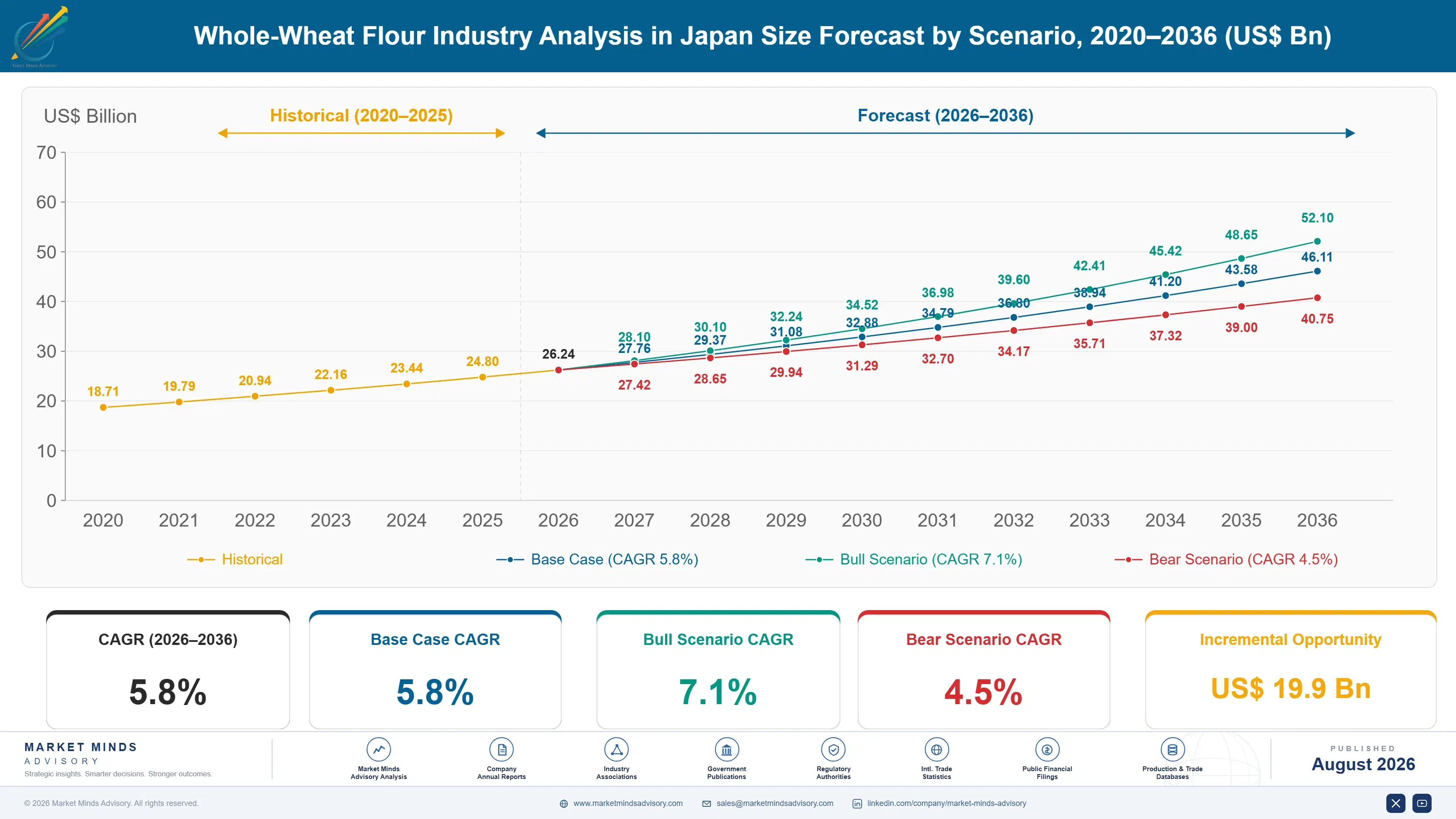
Whole-Wheat Flour Industry Analysis in Japan Market Forecast Scenarios

whole-wheat-flour-industry-analysis-in-japan-size-forecast-scenario-1787665372709
Between 2020 and 2025 the market grew at an estimated 5.0% annually, held back by pandemic-era flour demand volatility as home baking surged then normalized, then steadied from 2022 onward as wheat price shocks from the Ukraine war worked through global supply chains. Growth stayed concentrated in fortified and organic segments through most of the period, with commodity whole-wheat volume growing more slowly.
The base case carries the market to 5.8% CAGR through 2036 on three mechanisms. India's mandatory fortification rollout under FSSAI standards is converting wellness purchases into regulatory requirements across the world's largest wheat-consuming market. Japan's aging population is driving demand for fortified whole grain products through an import system that keeps domestic millers insulated from raw wheat price swings. Premium sprouted and organic segments keep compounding as bakery chains reformulate around whole grain health claims regulators require on packaging.
The bull case reaches 7.1% if additional South Asian and Southeast Asian governments adopt fortification mandates similar to India's ahead of schedule. The bear case falls to 4.5% if global wheat price volatility, driven by another major exporter's supply disruption, pushes cost-sensitive consumers back toward cheaper refined flour, a substitution effect already visible during the 2022 price spike.

Policy Now Sets Milling Economics More Than Wheat Price

Three forces converge on this category. Government policy sets who can mill profitably, wheat price volatility tests which millers can absorb a shock without passing it to consumers, and a whole grain health narrative keeps pulling premium demand upward even where regulation has not forced the issue. Millers treating these as separate problems are already behind the ones treating them as one.
MARKET CONCENTRATIONCR5: 29%Top five millers hold under a third of revenue
AVERAGE WHOLESALE PRICE$0.62 per kgBlended price across commodity and premium flour grades
TOP PRODUCING COUNTRYChina: 24%Single country supplies nearly a quarter of global output
MILL CAPACITY UTILIZATION71%Average operating rate across major whole-wheat flour mills
IMPORT TRADE INTENSITY56% importedShare of milling wheat sourced through cross-border trade
WHEAT COST SHARE64% of COGSRaw wheat input dominates total flour production cost
Commercial character splits sharply between policy-shielded and open markets. Japan's state trading system insulates domestic millers from raw wheat price swings but caps how much margin they can capture, while open markets like the United States expose millers to commodity price risk but let efficient operators capture upside. The fortified and organic tiers command better margins in both settings, but they demand certification investment most small millers cannot fund.
Looking to 2036, three shifts matter most for the category. Fortification mandates will keep expanding across South Asia and parts of Africa regardless of who wins on price today, Japan's import policy will keep shaping domestic milling economics more than any global wheat price movement, and premium sprouted and organic segments will increasingly separate branded millers from commodity operators competing on volume alone.
"Everyone still models this market on wheat futures. The bigger swing factor now is whether your government mandates fortification or controls the import channel, because either one rewrites your margin before a single kernel gets milled."
Director, Agriculture and Food Processing Practice · MMA Agriculture and Food Processing Practice · August 2026

Market Trends

Japan's Import Quota System Shapes Domestic Milling Margins

Japan's Ministry of Agriculture, Forestry and Fisheries operates a state trading enterprise that imports nearly all milling wheat under quota, then resells it to domestic millers at a government-set markup that funds price stabilization for domestic wheat farmers. This system insulates millers like Nisshin Seifun and Nippn from raw wheat price shocks that hit open-market competitors directly, but it also caps how much margin efficient millers can capture. Recent reforms introduced modest price flexibility tied to import cost, giving efficient millers slightly more room to compete on cost, though the core quota structure remains intact.
Market Impact: Targets over 50% of grain intake
India Mandates Flour Fortification Across Public Programs

India's Food Safety and Standards Authority has expanded mandatory fortification of wheat flour distributed through public distribution systems and school meal programs, requiring millers to add iron, folic acid, and vitamin B12 to flour sold into these channels. More than 800 million people receive subsidized grain through India's public distribution system, and fortification compliance is now a condition of participating in that supply chain at all. Millers without fortification capability are being excluded from the largest single institutional flour market in the world, forcing rapid capital investment in blending and quality control infrastructure across the industry.
Market Impact: Serves population over 29% aged 65-plus

Market Opportunities and Growth Drivers

Global Whole Grain Health Guidance Lifts Consumption

The World Health Organization and national dietary guidelines across major markets recommend whole grains as the majority of daily grain intake, citing fiber, micronutrient, and cardiovascular benefits that refined flour does not provide. Bakery chains and packaged food manufacturers have responded by reformulating flagship products around whole-wheat flour, since packaging claims referencing whole grain content increasingly influence purchasing decisions among health-conscious consumers. Japan's own dietary guidelines, updated to reflect an aging population's nutritional needs, favor whole grain products for their fiber and blood sugar management benefits, reinforcing demand that policy and consumer preference now point in the same direction.
Market Impact: Cuts shelf life to 3-6 months

Japan's Aging Population Drives Digestible Fortified Demand

Japan's population older than 65 now exceeds 29% of the total, the highest proportion of any major economy, and older consumers increasingly favor fortified, easily digestible whole grain products formulated to support bone health and blood sugar management. Nisshin Seifun and Nippn have both expanded fortified whole-wheat product lines specifically targeting this demographic, adding calcium, vitamin D, and fiber beyond standard whole-wheat milling. This demographic shift gives Japanese millers a genuine domestic growth avenue even as the country's overall population, and therefore raw flour volume demand, continues to shrink year over year.
Market Impact: Concentrates 25% of global exports

Market Restraints and Challenges

Shorter Shelf Life Limits Whole-Wheat Distribution Reach

Whole-wheat flour retains the wheat germ's natural oils, which oxidize and turn rancid faster than the starch-dominant refined flour that dominates commodity distribution, typically limiting shelf life to three to six months versus a year or more for white flour. The root cause is chemical: germ oil oxidation cannot be prevented without processing steps that add cost or alter flavor. This forces millers to manage tighter inventory cycles and accept higher spoilage-related waste, particularly in export and long-distance channels. Millers are responding with modified atmosphere packaging and vacuum-sealed retail formats that extend shelf life by several months at modest cost.
Market Impact: Sets markup on nearly 100% imports

Wheat Price Volatility Squeezes Open-Market Millers

Global wheat production concentrates in a handful of exporting countries, and Russia and Ukraine supplied close to a quarter of world wheat exports before the 2022 invasion disrupted Ukrainian planting and shipping for two seasons. The root cause is geographic concentration: a small number of climate-exposed growing regions supply most internationally traded wheat, leaving little buffer when any one disrupts. Millers in open markets without long-term forward contracts absorb these price spikes, while Japan's state trading system shields domestic millers from the same shock. Several millers are pursuing multi-year forward purchase agreements with diversified sourcing across South America and Australia.
Market Impact: Covers over 800 million subsidized consumers
3 additional market trends, 3 additional growth drivers, and 3 additional restraints and challenges are covered in the full report. Contact sales@marketmindsadvisory.com to access the complete intelligence.

Segment CAGR and Growth Architecture

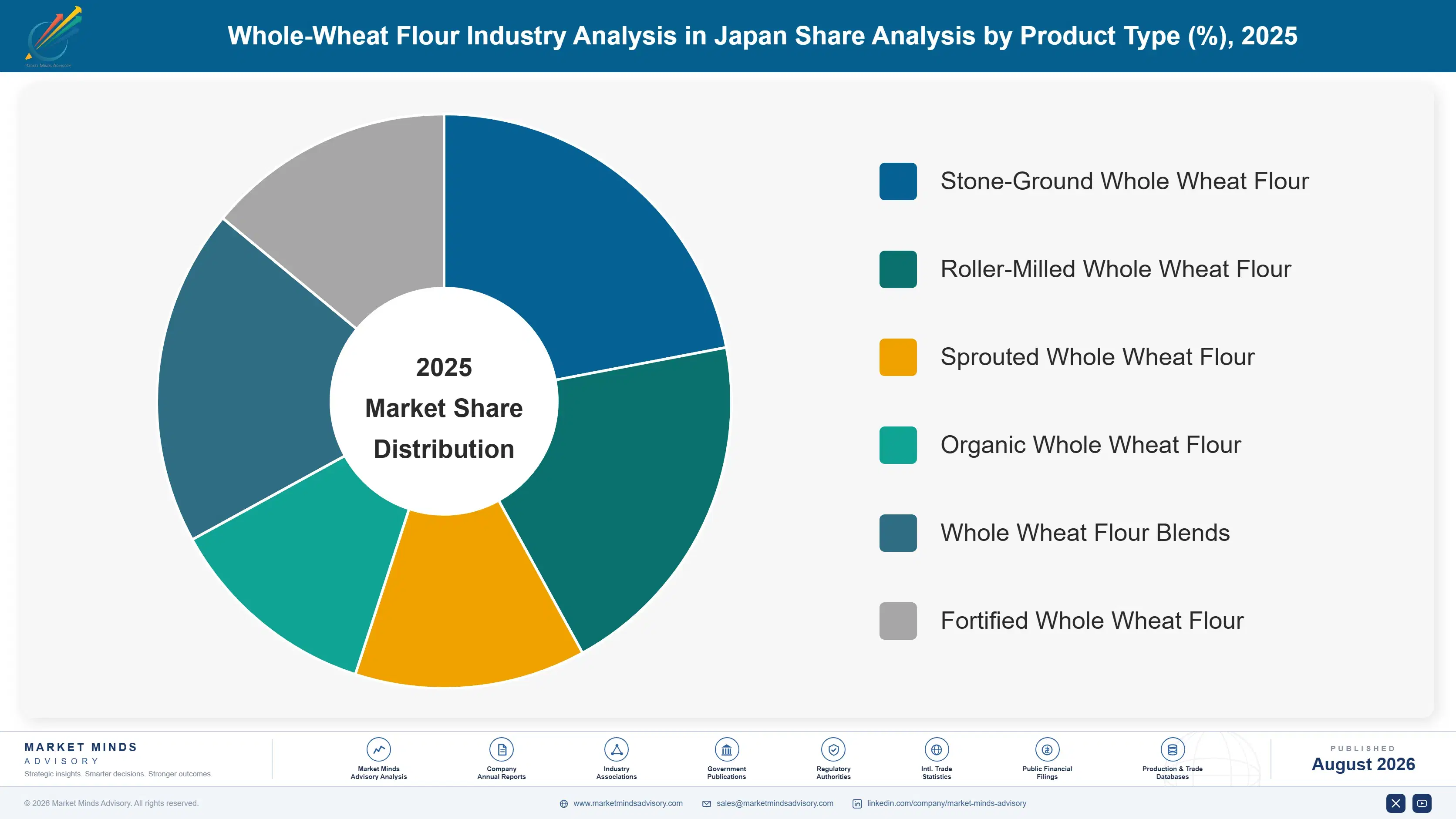
Segmentation follows product type, a single processing and formulation logic spanning stone-ground, roller-milled, sprouted, organic, fortified, and blended whole-wheat flour. Each format carries distinct processing method, certification pathway, and price tier, so commercial position tracks how the flour is processed and what claims it can legally carry on packaging, regardless of which end market ultimately buys the finished flour.
whole-wheat-flour-industry-analysis-in-japan-market-share-analysis-1787665373297

Sprouted Whole Wheat Flour

Sprouted whole wheat flour grows fastest at 9.2% annually, nearly 1.6 times the overall market rate, as premium bakeries and health-conscious consumers pay up for the digestibility and nutrient bioavailability claims that germination processing supports. Producers soak and briefly germinate wheat kernels before drying and milling, a process that breaks down some starches and phytic acid, changes reported to improve mineral absorption and glycemic response compared to standard whole-wheat flour. King Arthur Baking and several artisanal mills have built dedicated sprouted product lines commanding significant price premiums over standard whole-wheat flour. The segment remains small in absolute volume but is scaling fastest as premium bakery chains and health-focused retailers expand shelf space for sprouted grain products specifically.
CAGR 9.2%

Organic Whole Wheat Flour

Organic whole wheat flour grows second-fastest at 8.1%, driven by certified organic demand among consumers willing to pay a premium for pesticide-free and non-GMO sourcing claims verified by third-party certification bodies. Certification requires multi-year transition periods for farmland and ongoing compliance auditing, creating a genuine supply constraint that keeps organic wheat acreage growing more slowly than demand in most years. Western Europe and North America drive the bulk of organic whole-wheat demand today, though Japan's premium retail channel has expanded organic whole-wheat offerings as health-conscious and higher-income consumers seek verified sourcing claims. Price premiums over conventional whole-wheat flour typically run 40% to 60%, insulating the segment from direct commodity price comparison.
CAGR 8.1%
Full segment breakdown across 6 segments available in the complete report.

Regional Architecture and Country Demand Map

East Asia now leads on Chinese consumption volume and Japan's premium, fortification-conscious milling sector, narrowly ahead of North America's large-scale commercial baking industry. Western Europe follows on organic and certified demand, while South Asia and Pacific posts the fastest regional growth as India's fortification mandate reshapes institutional flour procurement.

North America

The United States drives most of North America's 24% share through large-scale commercial baking demand, where General Mills and Ardent Mills supply whole-wheat flour into packaged bread, cereal, and food service channels at industrial volume. School nutrition programs increasingly mandate whole grain content in federally subsidized meals, converting a wellness preference into a procurement requirement across thousands of school districts nationwide. Canada contributes through its own large wheat-growing base and export-oriented milling capacity. Mexico's demand grows steadily as packaged bread consumption rises alongside urbanization. Whole-wheat pasta and tortilla categories are also expanding within the packaged food aisle, adding a growth channel. Growth of 6.0% outpaces the global rate as reformulation toward whole grain content continues across major packaged food categories.
Share: 24% | CAGR: 6.0% (2026 to 2036)

Western Europe

Germany and France anchor much of Western Europe's 20% share through established artisanal and commercial bakery traditions that have increasingly incorporated whole-wheat flour into everyday bread products rather than treating it as a specialty item. The UK's public health guidance promoting whole grain consumption has pushed major retailers to expand private-label whole-wheat offerings across mainstream price points. Organic certification carries particular weight here, with EU organic standards recognized and trusted across the bloc's largest markets. Nordic countries show disproportionately high per-capita whole-wheat consumption relative to their population size, reflecting long-standing dietary preferences. Growth of 4.3% trails the global rate, consistent with a mature market where whole-wheat adoption is already well established.
Share: 20% | CAGR: 4.3% (2026 to 2036)
Regional intelligence for 5 additional markets available in the complete report: East Asia, South Asia and Pacific, Latin America, Middle East and Africa, Eastern Europe. Contact sales@marketmindsadvisory.com.
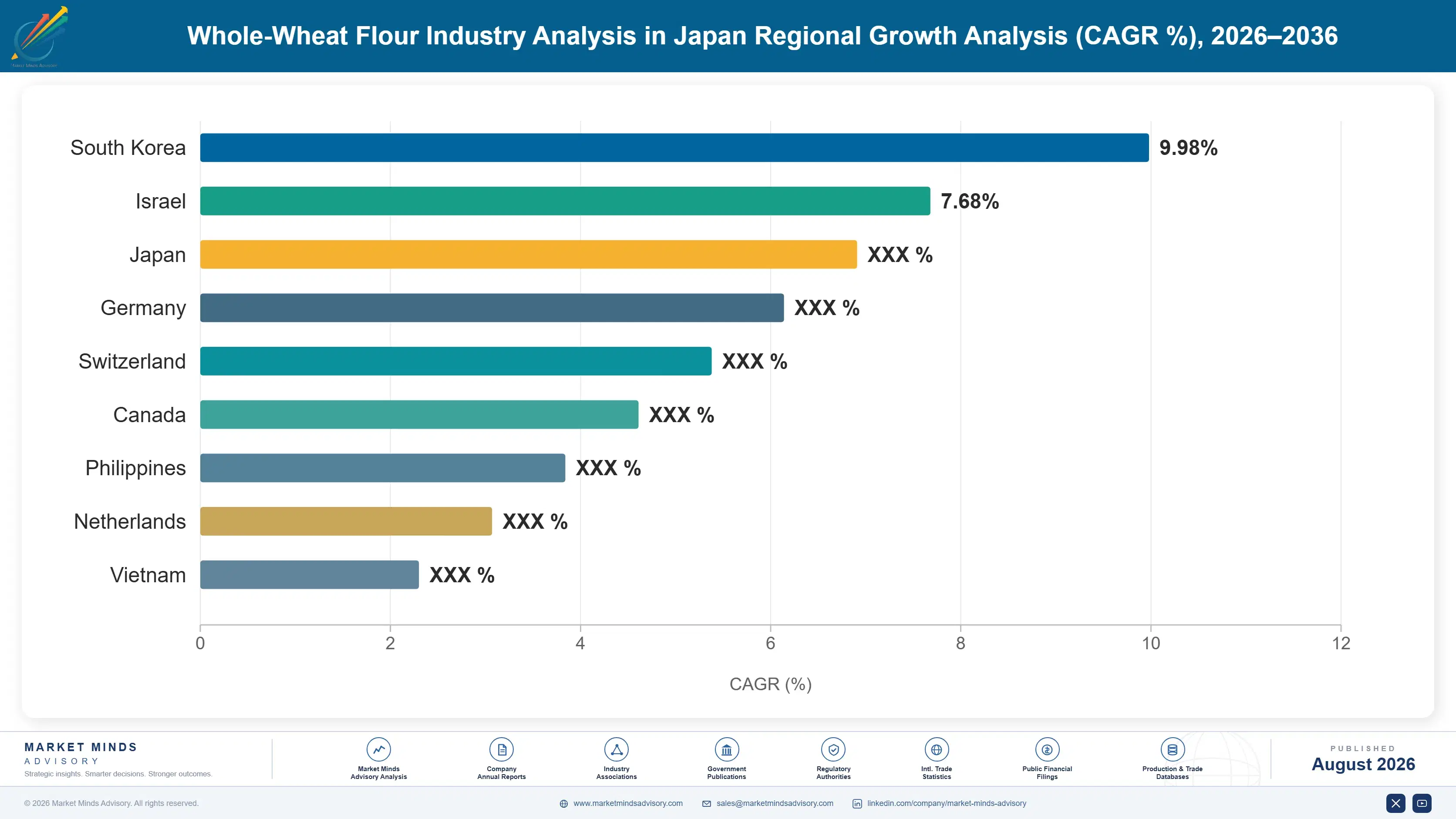
whole-wheat-flour-industry-analysis-in-japan-country-cagr-analysis-1787665373841

Where Whole-Wheat Flour Margin Now Concentrates

Millers face a familiar squeeze: commodity whole-wheat flour competes purely on wheat cost and freight, while certification, fortification compliance, and premium formulation increasingly carry the margin. The four moves below shift revenue toward defensible, harder-to-replicate positions instead of undifferentiated commodity milling, drawing on how leading millers already separate commodity economics from premium and compliance-driven services.

Build Institutional Fortification Compliance Capability Early

Millers that build fortification blending and quality control capability ahead of mandate enforcement gain access to institutional contracts, like India's public distribution system, that exclude non-compliant competitors entirely. Compliant millers reportedly command a 6% to 10% price premium on fortified flour sold into these channels, since institutional buyers value certified compliance over marginal cost differences. Smaller millers lacking blending infrastructure are increasingly partnering with fortification technology providers rather than building capability internally, accepting a smaller margin share in exchange for market access they could not otherwise capture within mandate compliance timelines that keep tightening.
Market Impact: Commands a 6% to 10% institutional price premium

Expand Premium Sprouted And Organic Product Lines

Sprouted and organic whole-wheat flour carry price premiums running 40% to 60% above conventional whole-wheat flour, insulating that revenue from the commodity wheat price swings that compress margin on standard product lines. King Arthur Baking and several regional artisanal mills have built dedicated premium lines that now anchor brand positioning well beyond their actual volume share. The certification and processing investment required is real, but millers that skip this tier are competing entirely on commodity economics against lower-cost producers, accepting permanently thinner margins that certification-tier competitors never have to face.
Market Impact: Captures a 40% to 60% premium pricing tier

Secure Long-Term Wheat Forward Purchase Contracts

Wheat price volatility, sharpened by the 2022 Russia-Ukraine supply disruption, punishes millers buying purely on the spot market far more than those with forward purchase agreements locked in ahead of harvest uncertainty. Millers securing 12 to 24 month forward contracts smooth input cost volatility enough to offer customers more stable pricing, a genuine commercial advantage when negotiating multi-year institutional and retail supply agreements. This approach trades some upside during price declines for meaningfully reduced downside risk during the supply shocks that have become more frequent across the past several years.
Market Impact: Locks in 12 to 24 month wheat pricing

License Fortification And Sprouting Technology To Regional Millers

Millers that developed proprietary fortification blending or sprouting process technology ahead of regulatory mandates hold capability that smaller regional millers now urgently need but cannot develop independently within mandate compliance timelines. Licensing that technology to non-competing regional millers, rather than only selling finished flour, can generate royalty revenue running 2% to 5% of the licensee's fortified product sales at minimal marginal cost. This model is still emerging but mirrors licensing approaches already established in adjacent food processing categories, and India's fortification mandate is creating exactly the urgent, concentrated demand that makes licensing commercially attractive right now.
Market Impact: Generates 2% to 5% ongoing royalty revenue stream

Who Controls the Margin Pool

Concentration sits at a moderate 29% for the top five, evaluated on global whole-wheat flour production and milling revenue. Ardent Mills' North American scale and Nisshin Seifun's Japanese dominance give both outsized regional share, but the gap to regional millers is narrower than CR5 implies, since ITC, GoodMills, and Nippn hold certification and distribution depth diversified majors have not matched.
Competitive activity runs along three fronts. Import and policy access drives regional positioning, where millers inside systems like Japan's quota structure compete on efficiency within margin bands rather than open pricing. Fortification compliance drives institutional wins, where millers certified for programs like India's distribution system capture contracts competitors without infrastructure cannot bid on. Premium certification drives positioning, where King Arthur Baking and millers compete for shelf space commodity millers rarely contest.

Pressure is building from consolidation among regional millers seeking scale to fund fortification and certification investment they cannot justify at smaller volume. Global grain traders including Cargill and Bunge are expanding further downstream into milling, narrowing a gap specialized flour millers have relied on for differentiation. Rankings will shift toward millers that combine policy access with premium formulation capability, since neither advantage alone secures the fastest-growing segments.
whole-wheat-flour-industry-analysis-in-japan-company-positioning-matrix-1787665374368

Competitive Moat and Risk Dimensions

NISSHIN SEIFUN GROUP INC.

Moat: Japan's Dominant Domestic Miller

Nisshin Seifun's scale within Japan's quota-protected import system gives it purchasing and distribution advantages that smaller domestic competitors cannot replicate, alongside decades of relationships with the government trading enterprise controlling wheat import allocation. Its fortified product lines targeting Japan's aging population extend that domestic dominance into a genuine premium growth segment competitors are still building.
NISSHIN SEIFUN GROUP INC.

Risk: Shrinking Domestic Population Base

Japan's population decline directly shrinks Nisshin Seifun's core domestic flour volume over time, regardless of how well the company executes, since no amount of market share gain offsets a steadily contracting consumer base. International expansion has been comparatively modest, leaving the company more exposed to Japan's demographic trajectory than competitors with broader geographic diversification.
ARDENT MILLS LLC

Moat: Largest North American Milling Scale

Ardent Mills, a joint venture combining ConAgra, Cargill, and CHS milling assets, commands the largest flour milling footprint in North America, giving it purchasing scale on wheat and distribution reach that independent regional millers cannot match. That scale extends across commodity and whole-wheat product lines serving major packaged food and food service customers nationwide.
ARDENT MILLS LLC

Risk: Joint Venture Governance Complexity

Operating as a joint venture among three large agribusiness parents creates governance complexity that a fully independent competitor does not face, particularly around capital allocation decisions for premium segment investment that may not equally benefit all three parent companies. Strategic agility can suffer when major decisions require multi-party alignment rather than a single ownership structure.

Players Tracked

Prominent Players

Archer-Daniels-Midland Company
Bunge Limited
Ardent Mills LLC
General Mills Inc.
Nisshin Seifun Group Inc.

Other Key Players

Cargill Incorporated
ITC Limited
Nippn Corporation
Showa Sangyo Co. Ltd.
King Arthur Baking Company
Bay State Milling Company
Grain Craft Inc.
GoodMills Group
Associated British Foods plc
Grupo Bimbo
Interflour Group
CHS Inc.
Miller Milling Company
Roquette Freres
Manildra Group

Recent Developments

APRIL 2025

India Expands Fortified Flour Mandate to New States

India's Food Safety and Standards Authority expanded mandatory wheat flour fortification requirements to additional states within the public distribution system, requiring millers supplying these programs to add iron, folic acid, and vitamin B12. The expansion was a regulatory mandate extension, not a corporate transaction, affecting millers supplying the public programs.
Signal: Signals that fortification compliance is becoming table stakes for institutional flour supply across an increasing share of South Asia.
SEPTEMBER 2024

Nisshin Seifun Launches Fortified Senior Nutrition Flour Line

Nisshin Seifun launched a fortified whole-wheat flour line specifically formulated for older consumers, adding calcium and vitamin D beyond standard whole-wheat milling, targeting Japan's rapidly aging demographic. The launch was an organic product development, not an acquisition or partnership with an external company or technology licensor of any kind.
Signal: Signals Japanese millers are treating demographic aging as a genuine growth opportunity rather than only a demand headwind.
JANUARY 2025

Bunge and Viterra Complete Merger

Bunge completed its merger with Viterra, creating a substantially larger combined grain trading and processing company with expanded global milling and origination capacity spanning multiple continents. The transaction was a full merger creating a combined entity, not an acquisition by either standalone party operating independently before the deal closed.
Signal: Signals continued consolidation among global grain traders is extending further into milling and flour processing capacity worldwide.

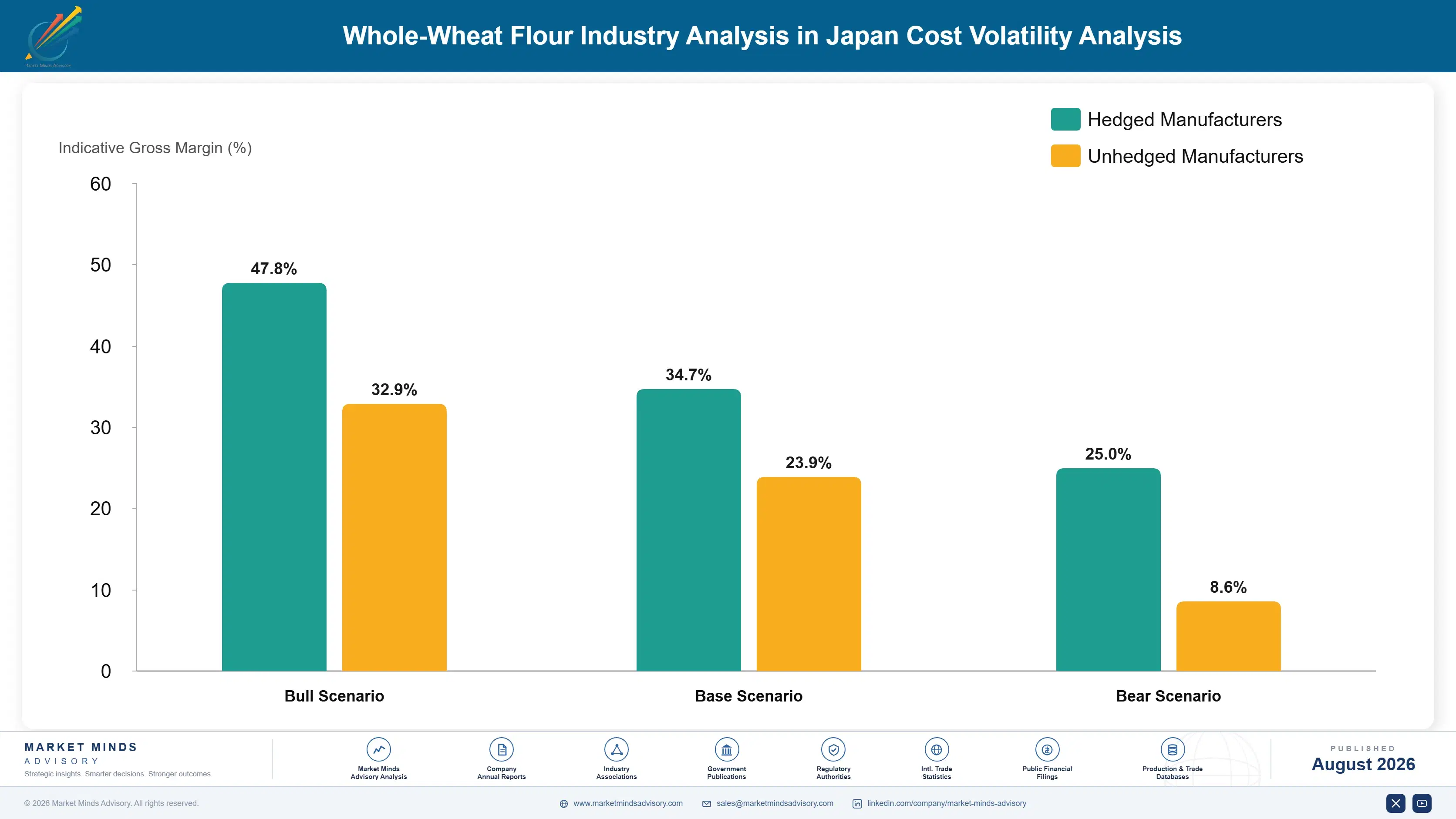
Raw Wheat Cost And Import Policy Exposure

Raw milling wheat accounts for roughly 64% of cost of goods sold, sourced from a handful of major exporting countries including the United States, Russia, Canada, Australia, and France, with Japan's imports channeled entirely through a state trading enterprise rather than direct millers purchases. Packaging, fortification additives, and energy for milling and drying add the remaining significant cost categories.
Russia's 2022 invasion of Ukraine disrupted two consecutive planting and export seasons from a region historically supplying close to a quarter of world wheat exports, pushing global wheat futures to record levels through mid-2022. General Mills' fiscal year 2023 annual report disclosed material input cost inflation across its milling and baking segments during the period. Prices have moderated since 2023 but remain above pre-2022 baselines, according to USDA world agricultural supply reporting.

Millers without long-term forward purchase contracts absorb wheat price spikes immediately, while larger millers like ADM and Bunge negotiate multi-year sourcing agreements that smooth volatility across bigger purchasing volumes. Japan's millers face a different exposure entirely, insulated from raw price swings but subject to government-set markup changes that can shift with limited notice. Millers without diversified sourcing across multiple exporting countries consistently trail on cost during regional supply disruptions.
whole-wheat-flour-industry-analysis-in-japan-cost-volatility-analysis-1787665374566

Diversify Wheat Sourcing Across Exporting Countries

Concentrating purchases in one or two exporting countries creates exposure that a single harvest failure or export restriction can turn into a genuine supply crisis. Qualifying supply relationships across the United States, Australia, Canada, and South America, even at a modest logistics cost premium, preserves sourcing flexibility if any single major exporter faces disruption.

Lock Multi-Year Forward Purchase Agreements

Securing forward wheat purchase agreements ahead of harvest uncertainty, rather than buying purely on the spot market, is what let larger millers limit the worst of the 2022 price spike while smaller competitors absorbed the full swing directly. The premium paid for price certainty is real, but far cheaper than losing a contract to margin pressure.

Invest In Fortification Blending Infrastructure Ahead Of Mandates

Millers that build fortification capability before mandates force the issue avoid both the compliance cost pressure and the operational scramble competitors face once enforcement begins without warning. Early investment also captures institutional contracts before mandate deadlines concentrate competitive pressure among millers all racing to qualify at once, when technical support and blending equipment become scarce and expensive.

Portfolio Architecture for Margin Defence

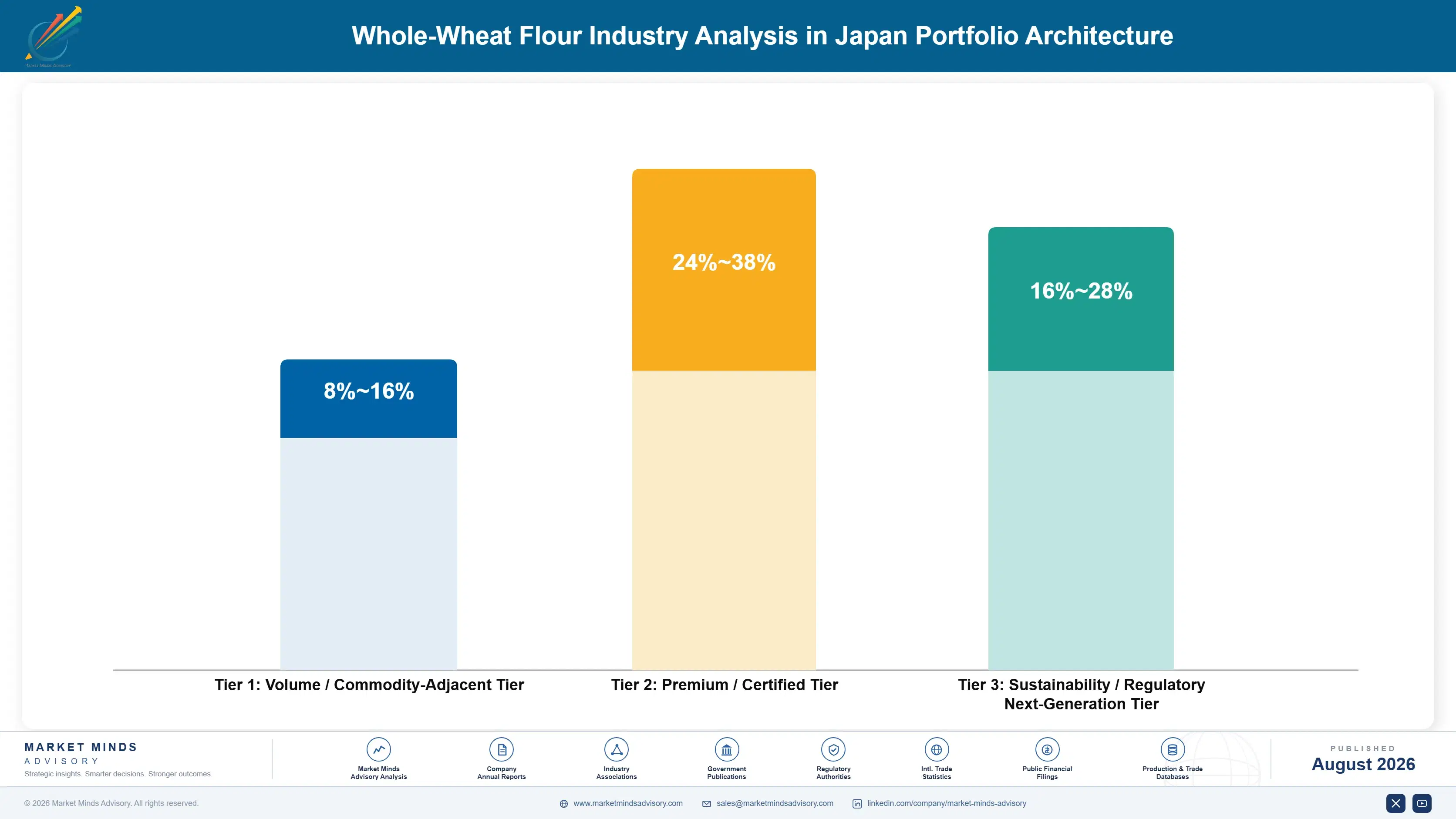
The portfolio splits into three tiers with meaningfully different margin economics. Volume commodity whole-wheat flour, sold into large-scale bakery and food service channels, competes on price and freight against a crowded field of regional millers, earning modestly. Premium certified organic and sprouted flour earns substantially more because certification barriers and brand positioning insulate pricing from direct commodity comparison. Fortified flour sold into regulated institutional programs sits in a third tier carrying strong margins wherever compliance barriers exclude uncertified competitors entirely.
The tension runs between volume and premium positioning. Commodity flour generates the unit volume that keeps mills running at efficient scale, but margin stays thin since institutional buyers compare price relentlessly across largely interchangeable suppliers. Premium organic and sprouted flour carries the opposite constraint: strong margins but a narrower addressable consumer base willing to pay certification premiums rather than broad market reach.

High-value margin pools concentrate wherever certification, regulation, or demographic positioning combine, which is precisely why fortified and premium millers have historically outearned commodity operators despite selling into smaller addressable volume. Fortification compliance carries the most immediate upside right now, driven by India's mandate timeline rather than organic demand growth alone.

Volume / Commodity-Adjacent Tier

Standard roller-milled whole-wheat flour sold into large-scale bakery, food service, and packaged food channels, competing primarily on price and delivery reliability against a crowded field of regional and national millers.
Gross Margin: 8-16%

Premium / Certified Tier

Organic, sprouted, and stone-ground whole-wheat flour carrying third-party certification and brand positioning, sold through specialty retail and premium bakery channels where certification insulates pricing from commodity comparison entirely across most developed retail markets.
Gross Margin: 24-38%

Sustainability / Regulatory / Next-Generation Tier

Fortified whole-wheat flour compliant with mandatory public program requirements, sold into institutional and government-linked distribution channels where compliance barriers exclude uncertified competitors from participating at all, regardless of price competitiveness elsewhere in their portfolio.
Gross Margin: 16-28%
whole-wheat-flour-industry-analysis-in-japan-portfolio-architecture-1787665375077

High-value Sub-segments and Strategic Watch-out

Fortified Whole-Wheat Flour (Institutional)

The fastest-growing regulated segment, driven directly by India's fortification mandate expansion across public distribution channels. ADM and ITC both draw early advantage from established fortification infrastructure, and margin expansion continues as compliance costs amortize across growing certified volume, a trend expected to accelerate through 2030.
Gross Margin: 16-28%

Sprouted and Organic Whole-Wheat Flour

Strong margins on certification and brand positioning, growing steadily as premium bakery and health-focused retail demand expands globally. Growth trails fortified flour because certification and organic transition periods move more slowly than a regulatory mandate deadline currently forcing faster movement elsewhere in the portfolio right now.
Gross Margin: 24-38%

Standard Roller-Milled Whole-Wheat Flour

The volume core of the category, generating the bulk of unit shipments at stable, moderate margins. ADM, Bunge, and Ardent Mills compete intensely here on efficiency and distribution reach, and while unit growth stays healthy, margin expansion is limited by established commodity competitive dynamics industrywide.
Gross Margin: 8-16%

Refined Flour Substitution Risk

The strategic watch-out. Cost-sensitive consumers and food manufacturers substitute back toward cheaper refined flour whenever wheat prices spike sharply, and this substitution risk grows wherever whole-wheat premiums widen beyond what price-sensitive buyers will tolerate consistently, a risk that grows sharper every time global wheat prices spike again.
Gross Margin: 8-16%

Compliance And Demographics Lock In Volume

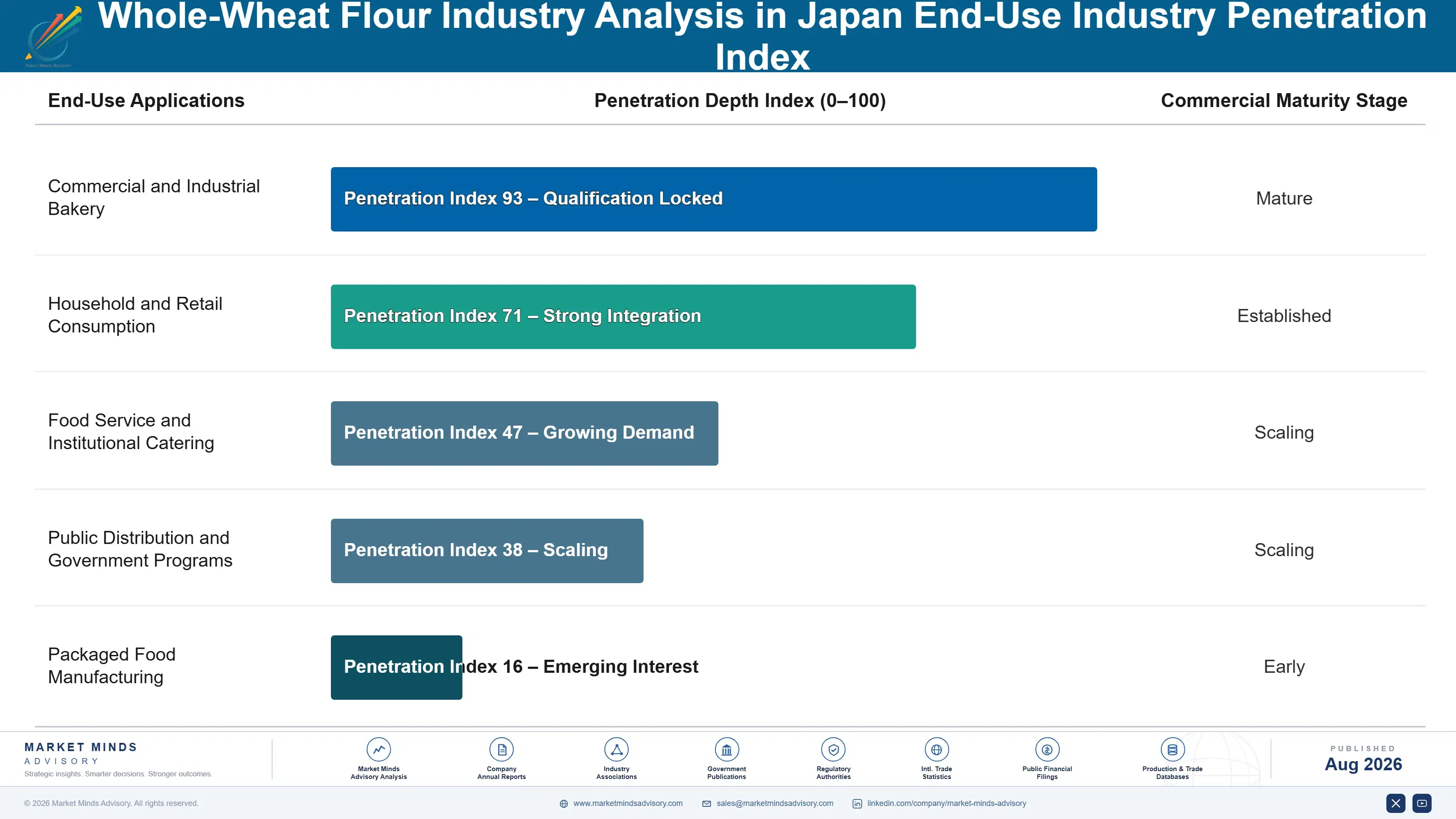
Fortified flour behaves like an annuity once a miller qualifies for supply, since India's public distribution system commits to multi-year procurement that switching suppliers would disrupt for millions of beneficiaries. Commodity whole-wheat flour carries no such lock-in, competing fresh on every order on price and delivery reliability, with buyers switching whenever a better quote appears.
Adoption depth varies by customer vertical. Institutional and government-linked buyers show the highest stickiness, since switching a fortification-certified supplier requires requalifying compliance documentation procurement teams avoid disrupting. Premium retail and bakery customers show moderate stickiness, balancing certification cost against periodic re-tendering on major private-label programs. Commodity food service buyers show the weakest stickiness, switching millers whenever price shifts, since no certification barrier protects the incumbent relationship.

Younger consumers treat whole grain content as baseline expectation on packaging rather than a premium differentiator, a shift dietary guidance and school nutrition mandates have accelerated beyond where voluntary health trends alone would have pushed adoption. Older consumers in Japan and other aging markets weight fortification and digestibility claims heavily, reflecting physiological need rather than lifestyle preference. That generational split is reshaping product development priorities, pulling fortification capability from a nice-to-have differentiator toward a core requirement across major accounts.
whole-wheat-flour-industry-analysis-in-japan-end-use-penetration-index-1787665375569

Where MMA Sees Divergence Ahead

These are among the four positions where our research anticipates prominent divergence between winners and laggards over the coming forecast period. Each is grounded in the demand model, the regulatory perimeter, and the announced capacity pipeline.
01 / FORTIFICATION COMPLIANCE PRIORITY

Build institutional fortification capability before mandates widen

India's fortification mandate is expanding state by state rather than arriving all at once, which means millers that build compliant blending and quality control capability ahead of each expansion capture institutional contracts before competitors qualify. Millers waiting for enforcement to force the issue are choosing to compete for whatever institutional demand remains after early movers have already captured the largest public distribution contracts. The advantage goes to whoever qualifies first in each newly covered state, not whoever eventually catches up.
02 / JAPAN DEMOGRAPHIC POSITIONING

Target Japan's aging population with fortified digestible products

Japan's overall flour volume shrinks as population declines, but the aging demographic within that shrinking population represents a genuine growth pocket for millers willing to formulate specifically around digestibility and fortification claims that matter to older consumers. Nisshin Seifun's early move into senior-targeted fortified flour already shows the model working in practice, and competitors slower to follow are steadily ceding a genuine growth segment inside an otherwise declining overall market. Demographic targeting, not overall volume growth, is where Japanese milling profit actually sits now.
03 / PREMIUM SEGMENT INVESTMENT

Expand sprouted and organic lines ahead of mainstream saturation

Sprouted and organic whole-wheat flour still carry meaningful premium pricing precisely because certification and processing barriers keep supply genuinely constrained relative to fast-growing consumer demand for these specific claims. Millers that invest in premium capability now, while the segment remains genuinely differentiated, capture brand positioning that becomes far harder to establish once mainstream commodity millers eventually build comparable capability at scale. Waiting until premium becomes standard practice means competing for margin that early movers have already claimed, leaving latecomers to compete only on price.
04 / WHEAT SOURCING DIVERSIFICATION

Diversify sourcing before the next major supply disruption hits

Global wheat export concentration in a handful of countries means the next geopolitical or climate disruption is a matter of when, not if, and millers without diversified sourcing relationships will face the same scramble that hit unprepared competitors during the 2022 shock. Building forward purchase relationships across multiple exporting regions now, while markets are calm, costs far less than negotiating supply security during an active crisis when every competitor wants the same protection simultaneously. Preparation before the disruption, not response after it, is what separates resilient millers from exposed ones.

Engagement Snapshot From the Field

A live engagement with an industry participant carrying material or product regulatory and market exposure ahead of a defining policy shift, showing how our research translates into a defensible multi-year portfolio strategy.
MARKET MINDS ADVISORY · CLIENT ENGAGEMENT SUMMARY
Whole-Wheat Flour Industry Analysis in Japan Producer Strategic Portfolio Review and Transition Roadmap 2026·Investment Scenario on Whole-Wheat Flour Industry Analysis in Japan Exposure Evaluation 2025-26
CLIENT PROFILE
A mid-sized Japanese regional flour miller supplying bakery and food service customers across western Japan approached MMA while evaluating whether to launch a fortified whole-wheat product line targeting the country's aging population. The client reported annual revenue near USD 210 million, with whole-wheat products representing a small share of total output, and no prior experience formulating or marketing fortified nutrition claims (client-reported, unverified by MMA).
STRATEGIC CHALLENGE
Leadership saw Nisshin Seifun's fortified senior nutrition line gaining traction but had no internal capability to formulate comparable products or navigate Japan's food labeling requirements for nutrition claims. The company also needed to understand whether the government's wheat import markup system would materially affect the economics of a new premium product line differently than its existing commodity business.
MMA APPROACH
MMA benchmarked fortified flour formulation approaches used by larger Japanese and international millers, modeled the incremental margin opportunity against formulation and labeling compliance cost, and assessed how the import quota markup system would flow through to a premium product's economics differently than commodity flour. We also evaluated a technology licensing partnership against building formulation capability internally.
KEY FINDINGS
  1. Licensing an existing fortification formulation from a technology partner would cost roughly USD 3 million upfront but cut time to market by an estimated 8 months against internal development.
  2. The import markup system applied identically regardless of end product, meaning fortified flour carried better margin economics than the client's engineering team had initially assumed.
  3. Regional competitors had not yet entered the fortified senior nutrition category, giving the client an estimated 12 to 18 month window before competitive response was likely.
  4. Labeling compliance for nutrition claims required a formal regulatory review taking approximately 6 months, longer than the client's original product launch timeline assumed.
CLIENT PROFILE
A mid-sized Japanese regional flour miller supplying bakery and food service customers across western Japan approached MMA while evaluating whether to launch a fortified whole-wheat product line targeting the country's aging population. The client reported annual revenue near USD 210 million, with whole-wheat products representing a small share of total output, and no prior experience formulating or marketing fortified nutrition claims (client-reported, unverified by MMA).
STRATEGIC CHALLENGE
Leadership saw Nisshin Seifun's fortified senior nutrition line gaining traction but had no internal capability to formulate comparable products or navigate Japan's food labeling requirements for nutrition claims. The company also needed to understand whether the government's wheat import markup system would materially affect the economics of a new premium product line differently than its existing commodity business.
MMA APPROACH
MMA benchmarked fortified flour formulation approaches used by larger Japanese and international millers, modeled the incremental margin opportunity against formulation and labeling compliance cost, and assessed how the import quota markup system would flow through to a premium product's economics differently than commodity flour. We also evaluated a technology licensing partnership against building formulation capability internally.
KEY FINDINGS
  1. Licensing an existing fortification formulation from a technology partner would cost roughly USD 3 million upfront but cut time to market by an estimated 8 months against internal development.
  2. The import markup system applied identically regardless of end product, meaning fortified flour carried better margin economics than the client's engineering team had initially assumed.
  3. Regional competitors had not yet entered the fortified senior nutrition category, giving the client an estimated 12 to 18 month window before competitive response was likely.
  4. Labeling compliance for nutrition claims required a formal regulatory review taking approximately 6 months, longer than the client's original product launch timeline assumed.
RECOMMENDED STRATEGY
Phase 1: Phase 1 (0 to 6 months): License an existing fortification formulation rather than building internally, prioritizing speed to market over full internal ownership of the technology. Phase 2: Phase 2 (6 to 12 months): Complete labeling compliance review while running limited regional distribution to validate demand before full-scale production commitment. Phase 3: Phase 3 (12 to 24 months): Scale distribution across western Japan and evaluate expansion into adjacent regions based on validated demand and margin performance.
OUTCOME
The client launched its fortified whole-wheat line within eleven months of the engagement, ahead of the original fourteen-month estimate, and captured regional shelf space before a competitor entered the category. The product line contributed a reported USD 14 million in incremental annual revenue within eighteen months, at materially better margins than the client's commodity flour business (client-reported, unverified by MMA).

Frequently Asked Questions

Foundational context covering the market sizes, CAGR, scope, country, region and competition that inform every finding below. This section is provided to cover basics and most often pre-purchase conversations, answered from the MMA Primary Research Dataset.

What is the current size of the Whole-Wheat Flour Industry Analysis in Japan?

The market reached USD 24.8 billion in 2025 on a global basis, with East Asia holding the largest single regional share at 28%. It spans stone-ground, roller-milled, sprouted, organic, and fortified whole-wheat flour.

How large will the Whole-Wheat Flour Industry Analysis in Japan be by 2036?

MMA forecasts the market will reach USD 46.1 billion by 2036, expanding roughly 1.76 times its 2026 base value. Fortified and premium sprouted flour drive most of that incremental growth.

What is the CAGR for the Whole-Wheat Flour Industry Analysis in Japan 2026 to 2036?

The base case CAGR runs at 5.8% annually through 2036. Bull scenarios reach 7.1% on faster fortification mandate adoption, while bear scenarios fall to 4.5% if wheat price volatility pushes buyers toward refined flour.

Which segment is growing fastest?

Sprouted whole wheat flour grows fastest at 9.2% annually, nearly 1.6 times the overall market rate. Premium bakery and health-conscious retail demand drives most of that acceleration.

Who are the major companies in the Whole-Wheat Flour Industry Analysis in Japan?

ADM, Bunge, Ardent Mills, General Mills, and Nisshin Seifun lead the market on a consistent global milling revenue basis. Together they hold roughly 29% of category revenue.

Which country is growing fastest?

India posts the fastest national growth at roughly 8.9% annually, driven by the mandatory fortification program reaching public distribution beneficiaries. Growth concentrates in institutional fortified flour rather than premium retail segments.

Report Segmentation Architecture

The full report scope spans multiple orthogonal segmentation dimensions, with cross-tabulated demand data provided for each dimension pair. Coverage extends further to regional breakdowns, trend trajectories, and the competitive detail needed to support segment-level decision-making.

By Product Type

  • Stone-Ground Whole Wheat Flour
  • Roller-Milled Whole Wheat Flour
  • Sprouted Whole Wheat Flour
  • Organic Whole Wheat Flour
  • Whole Wheat Flour Blends
  • Fortified Whole Wheat Flour

By End-Use Industry

  • Commercial and Industrial Bakery
  • Household and Retail Consumption
  • Food Service and Institutional Catering
  • Public Distribution and Government Programs
  • Packaged Food Manufacturing

By Commercial Dimension

  • Direct Miller Supply
  • Distributor and Wholesale Channel
  • Retail Private-Label Programs
  • Institutional and Fortification-Certified Contracts

By Region

  • North America
  • Western Europe
  • East Asia
  • South Asia and Pacific
  • Latin America
  • Middle East and Africa
  • Eastern Europe

Scope, Methodology, and Coverage

Every figure in this report is reproducible from documented input assumptions. The scope below maps the historical period, the forecast horizon, the segmentation dimensions, and the countries covered, alongside the underlying primary and qualitative methodology.
Historical Period
2020 to 2025
Forecast Period
2026 to 2036
Base Year
2025 (USD billions; MMA Primary Research Dataset, August 2026)
Market Definition
The whole-wheat flour market covers flour milled from the complete wheat kernel, including bran, germ, and endosperm, sold for bakery, food service, and household use. It spans stone-ground, roller-milled, sprouted, organic, fortified, and blended whole-wheat flour products, sized globally with particular emphasis on Japan's milling industry and import policy. It excludes refined white flour, non-wheat whole grain flours, and pre-mixed baking blends where whole-wheat flour is not the primary ingredient.
Quantitative Units
USD billions (current prices); metric tonnes milled where applicable
Segmentation Dimensions
By Product Type; By End-Use Industry; By Commercial Dimension; By Region
Regions Covered
North America, Western Europe, East Asia, South Asia and Pacific, Latin America, Middle East and Africa, Eastern Europe
Countries Covered
USA, China, Germany, France, UK, Japan, South Korea, India, Australia, Canada, Brazil, Mexico, Indonesia, Vietnam, Thailand, Malaysia, UAE, Saudi Arabia, South Africa, Nigeria, Turkey, Poland, Netherlands, Italy, Spain, Sweden, Switzerland, Argentina, Colombia, Singapore, and additional markets relevant to this sector
Key Companies Profiled
Archer-Daniels-Midland Company, Bunge Limited, Ardent Mills LLC, General Mills Inc., Nisshin Seifun Group Inc., Cargill Incorporated, ITC Limited, Nippn Corporation, Showa Sangyo Co. Ltd., King Arthur Baking Company, Bay State Milling Company, Grain Craft Inc., GoodMills Group, Associated British Foods plc, Grupo Bimbo, Interflour Group, CHS Inc., Miller Milling Company, Roquette Freres, Manildra Group
Quantitative Methodology
Primary survey, n=3,800 respondents, Q4 2025, six countries; demand-side model with trade association cross-validation
Qualitative Methodology
47 expert interviews, Q4 2025; applied to validate demand model assumptions, identify emerging dynamics, and assess competitive positioning
Report Format
PDF and XLSX data workbook (Word format preview document)
Publisher
Market Minds Advisory
Report Code
MMA-2026-AGR-045
Published
August 2026
Contact
sales@marketmindsadvisory.com | www.marketmindsadvisory.com

Purchase the full Whole-Wheat Flour Industry Analysis in Japan Report (2026 to 2036).

The full MMA Whole-Wheat Flour Industry report sizes the market across six product types, five end-use industries, four commercial channels, and seven regions through 2036. It profiles 20 participants on a consistent global milling revenue basis, scoring leaders on certification depth, fortification compliance, and import policy positioning. Scenario models quantify how India's fortification mandate, Japan's import quota system, and wheat price volatility move both demand and realizable price across commodity and premium tiers. The report also includes delivered-cost modeling by product type, a fortification policy tracker, and a competitive positioning assessment built for procurement, product development, and market access teams.
Six-way product type segmentation with growth forecasts
Twenty-company competitive profiles on consistent revenue basis
Seven-region market sizing with country-level detail
Fortification and import policy tracking module
Raw wheat and input cost modeling by region
Bull, base, and bear demand scenario forecasts

Built For The People Who Decide

From boardroom strategy to bench-side execution, this report is read cover-to-cover by leaders shaping the next decade of their industry, turning demand scenarios, market dynamics and valuation benchmarks into decisions.
CXOs/ Presidents/ VPs/ Managers
M&A and Corporate Development
Strategy Teams and R&D Heads
Procurement and Product Directors
Regulatory and Compliance Leaders
Investor Relations and Equity Analysts