
Market Minds Advisory
Vehicle Control Unit (VCU) Market

Vehicle Control Unit (VCU) Market: Vehicle Control Units: Architecture Consolidation, Software Ownership and the Two Wheeler Volume Nobody Counts

Controller counts per vehicle keep falling while unit values keep rising, which means this market grows in money and shrinks in parts, and almost every forecast built on unit volume gets it backwards.

Lead Analyst

David Horsley

Published

August 2026

Make Smarter Decisions with Customized Research Insights

Request a free sample report and evaluate market opportunities, growth trends, and competitive dynamics relevant to your business needs.

2025 MARKET VALUE$3.6BMarket Size 2025
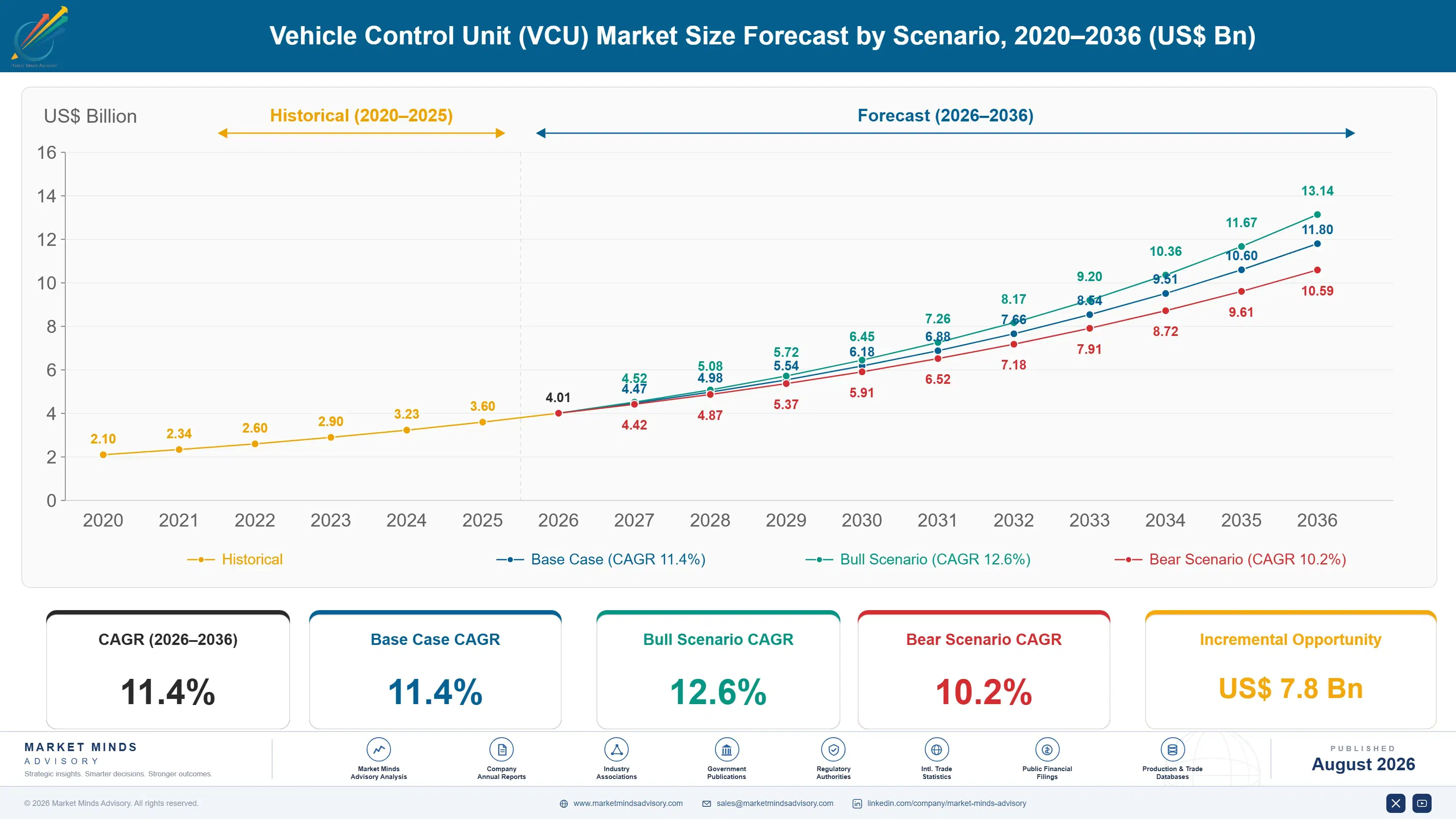
2036 FORECAST VALUE$11.8BBase Case , 2026 to 2036
CAGR 2026 TO 203611.4 %Bull 12.6% / Bear 10.2%
INCREMENTAL OPPORTUNITY$7.8BNet 10- year value creation
EXPANSION MULTIPLE2.94x2036 value over 2026 base
Strategic Levers
M&A Pipeline
Regional Outlook
Country Rankings
Competitive Intelligence
Segmental Deep-dive
Call-Us : 91 93563 13602

Executive Snapshot and Market Trajectory.

The vehicle control unit decided who gets to build cars. Combustion vehicles spread control across dozens of units, each supplied with its own software, and the carmaker integrated them owning none of it. A VCU makes vehicle level torque, thermal and energy decisions instead. Nobody outsources that willingly for long.
That is why every serious electric programme has tried to bring this software in house and why most went back to a supplier. Writing safety rated real time control code is a discipline the industry spent forty years buying rather than building, and functional safety approval takes around 26 months from a standing start. Vehicle motion domain controllers now grow fastest at 17.1%, half again the market rate of 11.4%, on that mechanism.
Architecture is collapsing inward at the same time. Discrete controllers get absorbed into domain controllers and then into zonal compute, removing roughly 18 kilograms of wiring harness and dozens of parts. Each step cuts unit count and raises unit value, so the market grows in money and contracts in volume. Meanwhile electric two and three wheelers need a controller too, at around 28 dollars a unit.
Market Definition
Electronic control units performing vehicle level coordination of powertrain, energy, thermal and motion functions in electrified vehicles, covering discrete powertrain control units, standalone integrated vehicle control units, vehicle motion domain controllers, central compute zonal architectures, and low cost microcontroller based controllers. Measured at supplier selling value including hardware and embedded software. Engine management units for combustion vehicles, infotainment and cockpit controllers, standalone battery management electronics and driver assistance domain computers are excluded.
Base Year Value
$3.6B in 2025 (MMA Primary Research Dataset, August 2026)
Forecast Period
2026 to 2036, eleven discrete annual values
CAGR
11.4% base case. Bull 12.6%. Bear 10.2%.
Fastest Growth Segment
Vehicle Motion Domain Controllers: 17.1% CAGR
Fastest Growth Country
India: 19.6% CAGR
Fastest Growth Region
South Asia and Pacific: 13.6% CAGR
Largest Region
East Asia: 30% of 2025 global value
Market Leaders
Bosch, Continental, Denso, Vitesco Technologies, BYD. Source: MMA Primary Research Dataset, July 2026.
Primary Survey
n=3,800 procurement and R&D decision-makers, Q4 2025, six countries
Methodology
Demand-side build-up, cross-validated against public data, 47 expert interviews

Vehicle Control Unit (VCU) Market Forecast Scenarios

vehicle-control-unit-vcu-market-trends-size-forecast-scenario-1787641430133
The five years to 2025 were dominated by a supply crisis and an architecture argument running at the same time. Semiconductor allocation stopped production lines worldwide and forced redesign around whatever parts existed, accelerating consolidation nobody had planned yet. Several in house software programmes were announced, delayed and quietly returned to suppliers. The 10.4% historical rate reflects electrification volume rather than any architectural progress.
The 11.4% base case rests on three mechanisms. Domain consolidation continues moving functions from discrete controllers into fewer, more valuable units, which raises revenue per vehicle even as part counts fall. Software content keeps rising toward and beyond 46% of unit value, and software carries margins hardware never did. And electric two and three wheeler production across India, China and Southeast Asia keeps expanding at volumes that dwarf passenger car unit counts entirely.
The 12.6% bull case turns on zonal architectures reaching mainstream vehicle platforms rather than remaining a premium and new entrant feature, which would reprice content per vehicle substantially. The 10.2% bear case is electrification pace: hybrid extension and slower battery vehicle adoption in Western markets both push VCU content growth out by several years without removing it.

The Unit That Decides How a Car Drives

A combustion car distributed its intelligence deliberately. Dozens of control units each handled one function, each came from a supplier with its own embedded software, and the carmaker integrated them into something that worked without owning a line of the code. Electrification removed that arrangement, because deciding how much torque to send where, when to recuperate and how to manage thermal load are vehicle level questions rather than component ones.
TOP FIVE CONCENTRATION54%Combined unit shipments held by the largest suppliers
CONTROLLERS PER VEHICLE3.2Average control units remaining in a vehicle after consolidation
HARNESS MASS SAVING18 kgWiring weight removed by moving to zonal architecture
SOFTWARE CONTENT SHARE46%Portion of unit value attributable to embedded software
TWO WHEELER UNIT PRICEUSD 28Typical controller cost in an electric two wheeler
SAFETY CERTIFICATION TIMELINE26 monthsDevelopment time to reach automotive functional safety approval
So the VCU became the part that defines the driving experience, and carmakers noticed. Every major electric programme has attempted to bring this software in house, and most returned to suppliers after discovering that safety rated real time control is a discipline requiring around 26 months to reach functional safety approval even with experienced people. The industry spent forty years buying that capability.
Architecture is consolidating in parallel and the commercial effect is frequently misread. Controller count per vehicle has fallen toward roughly 3.2 as functions move into domain and zonal units, removing around 18 kilograms of harness. Unit value rises faster than count falls, with software near 46% of that value, so revenue per vehicle grows while parts shipped decline.
"Carmakers keep announcing they will own the software and keep coming back. The uncomfortable truth is that functional safety is a culture rather than a skill, and you cannot hire one of those in eighteen months."
Director, Automotive Electronics and Electrification Practice · MMA Automotive Electronics Practice · August 2026

Market Trends

Domain Consolidation Raises Value While Cutting Part Count

Functions previously handled by separate powertrain, thermal and energy controllers are moving into single domain units, and from there toward zonal architectures where compute sits centrally and zone controllers handle local input and output. Controller count per vehicle has fallen toward roughly 3.2 while removing around 18 kilograms of wiring harness. Vehicle motion domain controllers grow at 17.1% against a market rate of 11.4%, fastest in the market. The commercial consequence is that revenue per vehicle rises while units shipped fall, which is the opposite of how most automotive component forecasts are constructed.
Market Impact: Controllers cost 28 dollars each
Software Content Overtakes Hardware in Unit Value

Embedded software now accounts for roughly 46% of vehicle control unit value and continues rising as functions consolidate and calibration complexity grows. That shift changes the commercial model fundamentally, since software carries margins hardware never approached and can be updated after the vehicle ships rather than being fixed at production. Suppliers building software licensing and update revenue alongside the physical unit are constructing a business automotive electronics has never had. Those still pricing per part are watching the valuable half of their own product migrate onto somebody else's income statement.
Market Impact: Certification takes 26 months minimum

Market Opportunities and Growth Drivers

Electric Two and Three Wheelers Dwarf Passenger Car Volumes

Electric two and three wheeler production across India, China and Southeast Asia runs at unit volumes that exceed passenger electric vehicle output by a wide margin, and every one of those vehicles needs a controller. Price is the entire difference: around 28 dollars against several hundred for a passenger car unit, which requires a completely different engineering and sourcing approach. India grows at 19.6%, faster than any country covered, on exactly this volume. Suppliers built around automotive grade cost structures cannot compete here without a separate product line and frequently a separate organisation.
Market Impact: Counts fall toward 3.2 per vehicle

Functional Safety Certification Blocks Carmaker Insourcing

Reaching automotive functional safety approval for vehicle level control software takes around 26 months from a standing start, and that assumes experienced engineers and mature development processes already in place. Carmakers announcing in house software capability have repeatedly discovered that hiring software engineers does not produce a safety culture, which is built through decades of field experience and documented process. Several major programmes were delayed and returned to suppliers. The barrier protects incumbents more effectively than any technical advantage, and it is not eroding at any observable rate. Field history cannot be purchased anywhere.
Market Impact: Allocation halted 8 million vehicles

Market Restraints and Challenges

Falling Unit Counts Undermine Volume Based Business Models

Controller count per vehicle has fallen toward roughly 3.2 as consolidation proceeds, and suppliers whose manufacturing, pricing and commercial models assume unit volume face a shrinking parts count even as content value rises. The root cause is that consolidation is genuinely good engineering, reducing weight, wiring, failure points and assembly labour simultaneously, so nothing stops it. Commercially this rewards suppliers holding the consolidated position and strands those supplying functions being absorbed. Responses include moving up the architecture ladder, building software revenue, and accepting a smaller number of considerably larger platform wins.
Market Impact: Removes 18 kilograms of harness

Semiconductor Dependency Remains Unresolved Across the Industry

Vehicle control units depend on microcontrollers, power semiconductors and memory produced by a small number of manufacturers on process nodes those manufacturers have limited interest in expanding, since automotive volumes are modest against consumer electronics. The root cause is that automotive qualification requires long product lifetimes and wide temperature ranges that constrain node choice. Allocation crises stopped vehicle production entirely once already. Suppliers respond with multi source qualification, longer inventory positions and direct foundry agreements, all of which cost working capital and none of which removes the dependency. Automotive volumes stay small against consumer demand.
Market Impact: Software reaches 46% of value
3 additional market trends, 4 additional growth drivers, and 2 additional restraints and challenges are covered in the full report. Contact sales@marketmindsadvisory.com to access the complete intelligence.

Segment CAGR and Growth Architecture

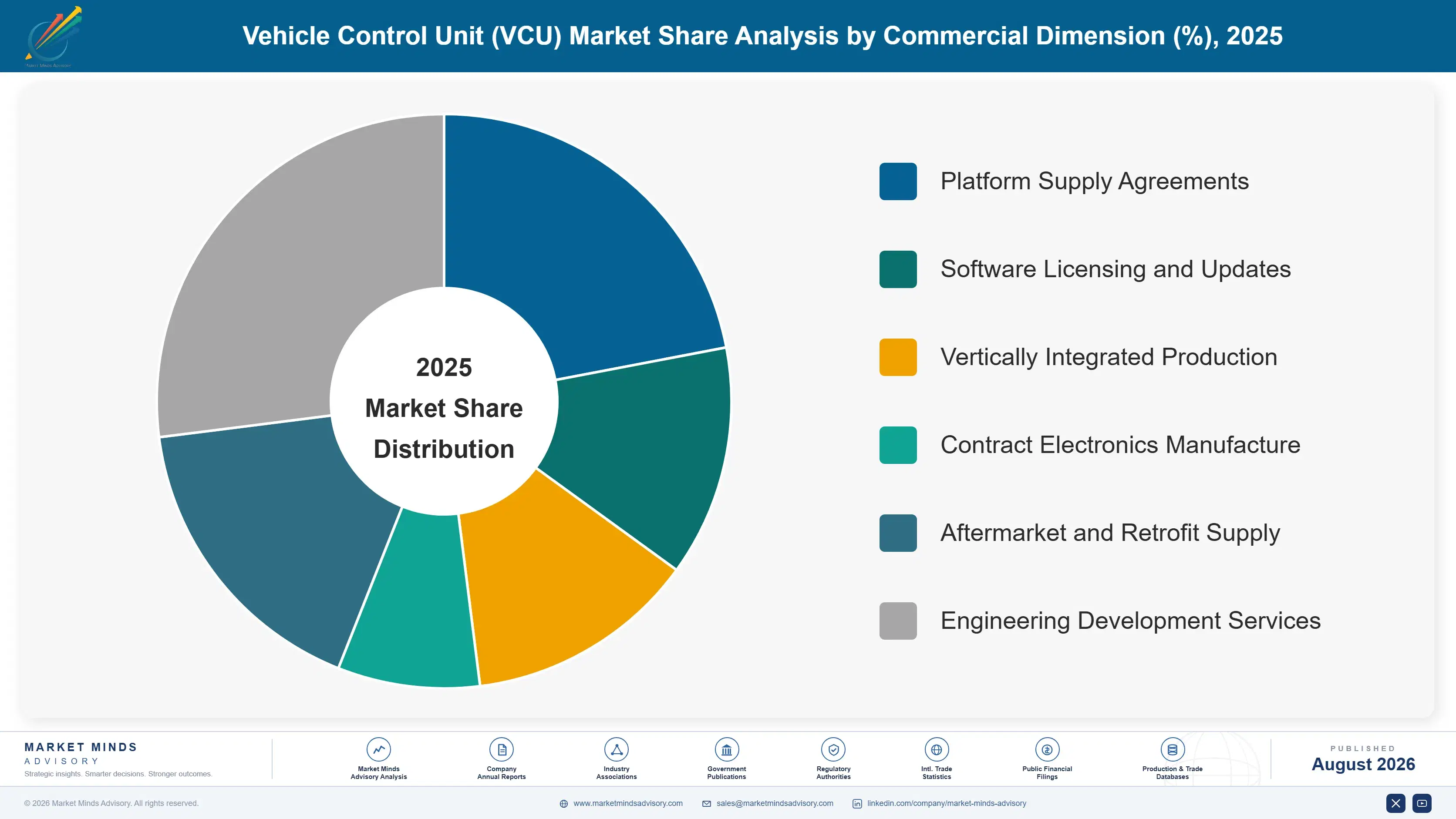
Segmentation follows control architecture, since architecture decides how many units a vehicle needs, what each is worth and who writes the software inside it. Five architectures cover the field, from a discrete powertrain controller to a zonal compute platform. Growth follows consolidation upward and cost downward at the same time. Both directions matter commercially now.
vehicle-control-unit-vcu-market-trends-market-share-analysis-1787641430665

Vehicle Motion Domain Controllers

Single units coordinating powertrain, braking, steering and chassis functions that previously sat in separate controllers, making vehicle level decisions about how torque and force reach the road. At 17.1% this is the fastest growing architecture in the market, half again the market rate of 11.4%, and it is where the driving experience is actually defined. Consolidating these functions removes controllers, wiring and failure points while raising the value of what remains considerably. The engineering difficulty is functional safety across combined domains, since a fault now affects more systems than it would in a discrete architecture. That complexity is precisely what keeps carmaker insourcing programmes returning to suppliers. Calibration effort across combined domains is substantial too.
CAGR 17.1%

Central Compute Zonal Architectures

Platforms placing high performance compute centrally with zone controllers handling local input and output, which removes point to point wiring and around 18 kilograms of harness from a typical vehicle. Growth of 14.8% is second fastest in the market, concentrated in new entrant platforms and premium programmes where the architecture could be designed rather than retrofitted. Retrofitting an existing platform is close to impossible, since the wiring, the supplier relationships and the software all assume distributed control. That is why adoption tracks new platform launches rather than model year updates, and why the transition will take a full product cycle across most established carmakers. Harness savings alone justify the architecture on cost grounds.
CAGR 14.8%
Full segment breakdown across 5 segments available in the complete report.

Regional Architecture and Country Demand Map

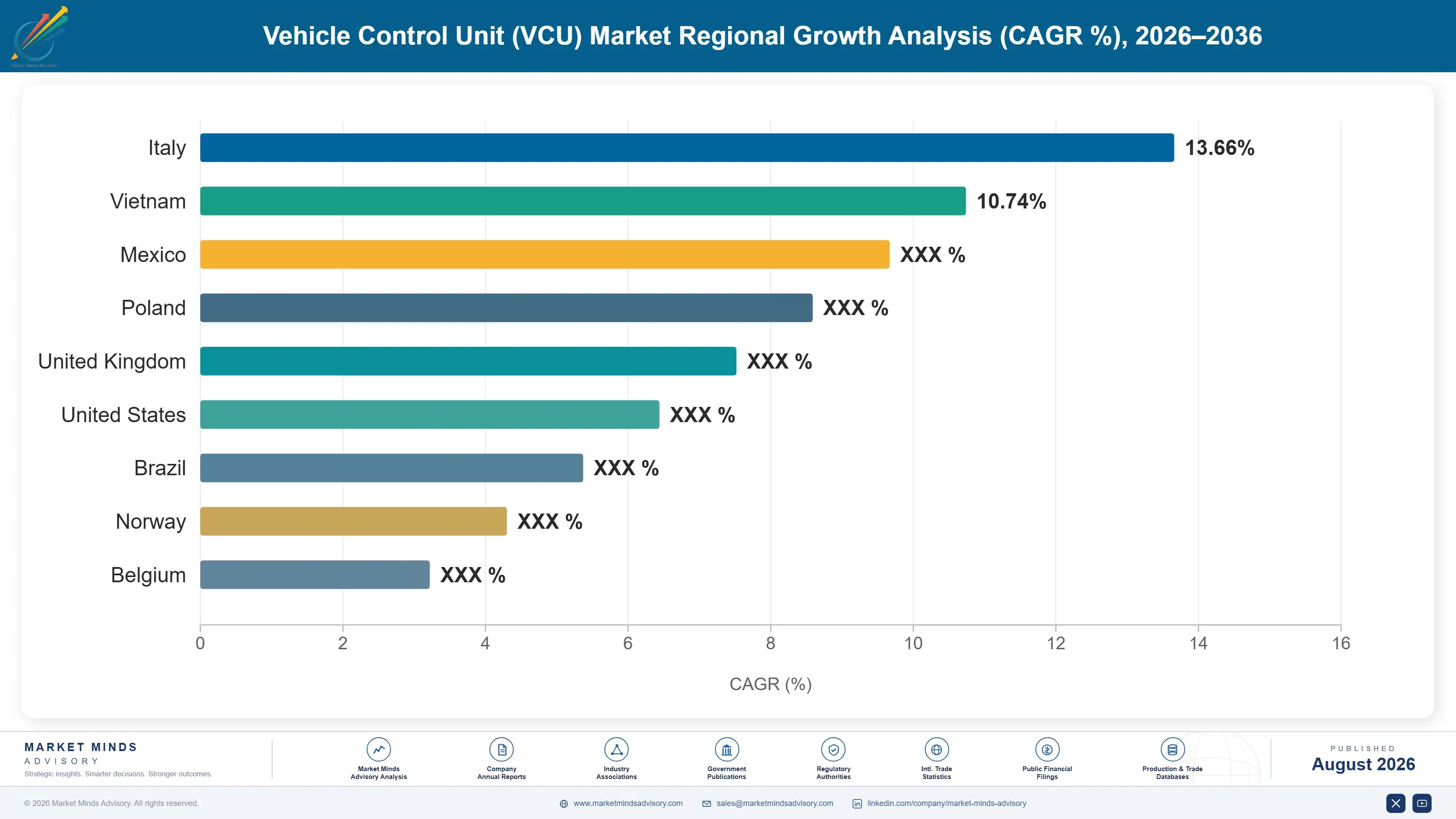
East Asia holds the largest share at 30%, driven by Chinese electric vehicle production and by domestic controller manufacture that supplies most of it. Western Europe follows on premium content. India grows fastest of any country covered at 19.6% on two wheeler volume. Software content rises everywhere.

East Asia

Production volume rather than content value gives this region its 30% share. China builds the majority of the world's electric vehicles and domestic suppliers provide most of the controllers inside them, at cost positions and development timelines that Western tier one suppliers have found genuinely difficult to match. Vertical integration is also unusually deep, with several Chinese vehicle manufacturers designing and building their own control units rather than buying them. Japanese and Korean suppliers hold strong positions globally on quality and functional safety reputation built over decades. Regional growth of 12.4% reflects continued Chinese production expansion alongside architecture consolidation raising content per vehicle steadily. Vertical integration is unusually deep here.
Share: 30% | CAGR: 12.4% (2026 to 2036)

Western Europe

Content value rather than volume explains this 24% share. European premium vehicle programmes carry higher controller content and more advanced architectures than mass market equivalents anywhere, and German suppliers hold engineering positions in vehicle level control established across generations of combustion and now electric platforms. Several European carmakers announced in house software organisations and have quietly returned substantial scope to suppliers after functional safety timelines proved longer than planned. Regulatory requirements around type approval and cybersecurity add development burden that favours established suppliers. Growth of 9.8% is the lowest of the seven regions, reflecting slower electrification volume against rising content per vehicle. Type approval requirements favour established suppliers considerably. Content per vehicle keeps rising.
Share: 24% | CAGR: 9.8% (2026 to 2036)
Regional intelligence for 5 additional markets available in the complete report: North America, South Asia and Pacific, Latin America, Middle East and Africa, Eastern Europe. Contact sales@marketmindsadvisory.com.
vehicle-control-unit-vcu-market-trends-country-cagr-analysis-1787641431214

Where Content Value Actually Accumulates

Nothing here is won on unit volume, because consolidation is removing controllers even as content value rises. Value accrues to whoever holds the consolidated architecture position, whoever captures software revenue rather than part revenue, and whoever can build to a two wheeler cost point. Four routes carry weight, and only one of them is a hardware argument.

Move Up the Architecture Ladder Before Consolidation Arrives

Controller count per vehicle has fallen toward roughly 3.2 and continues falling, which means a supplier holding a discrete function is supplying something scheduled for absorption into somebody else's unit. Vehicle motion domain controllers grow at 17.1% against a market rate of 11.4% because that is where the functions are going. Winning the consolidated position takes a full platform cycle to arrange and cannot be done reactively once a carmaker has selected an integrator. Suppliers still selling discrete controllers on price are optimising a position that disappears at the next platform renewal.
Market Impact: Grows 17.1% while unit counts fall toward 3.2

Price Software Separately From the Physical Unit

Embedded software now represents roughly 46% of vehicle control unit value and continues rising, yet most supply agreements still price a part and treat the code as included. That arrangement hands the most valuable and most updatable half of the product away at hardware margins. Licensing, update subscriptions and feature activation revenue all exist commercially in adjacent industries and almost nowhere in automotive electronics. Suppliers restructuring agreements to separate the two have built revenue streams that continue after the vehicle ships, which no part number ever did. Nobody else has moved yet.
Market Impact: Captures the 46% software share of unit value

Build a Genuinely Separate Two Wheeler Product Line

Electric two and three wheeler volumes across India, China and Southeast Asia exceed passenger electric vehicle production by a wide margin, and each needs a controller costing around 28 dollars rather than several hundred. That cost point cannot be reached by simplifying an automotive product, since the engineering assumptions, qualification regime and supply chain all differ. India grows at 19.6%, faster than any country covered, and domestic manufacturers have taken most of it. Reaching this volume requires a separate organisation rather than a derivative product from the existing one. A derivative product will not reach it.
Market Impact: Serves controller volume priced near 28 dollars each

Defend on Functional Safety Rather Than on Features

Reaching automotive functional safety approval for vehicle level control software takes around 26 months from a standing start with experienced engineers already in place, and carmakers attempting to insource have repeatedly discovered that hiring developers does not produce a safety culture. Several major European programmes were delayed and returned scope to suppliers. That barrier protects incumbent positions more reliably than any feature advantage, and it shows no sign of eroding. Suppliers should be selling process maturity and field history rather than capability lists, since that is what actually decides the outcome.
Market Impact: Insourcing requires a 26 month minimum development timeline

Who Controls the Margin Pool

Concentration is high and shifting. The top five hold 54% of unit shipments and associated software revenue, the basis applied consistently here, though the composition has changed considerably as Chinese suppliers and vertically integrated vehicle manufacturers took positions that did not exist a decade ago. Bosch leads on breadth across architectures and geographies, with the gap to challengers reflecting functional safety process depth rather than any hardware advantage.
Competition runs on three fronts. Established tier one suppliers compete for consolidated architecture positions on functional safety history and platform integration capability, which are decade long relationships rather than tenders. Chinese domestic suppliers compete on development speed and cost, frequently delivering in half the timeline Western suppliers quote. Two and three wheeler controller suppliers compete in an entirely separate market on a cost structure automotive suppliers cannot reach.

Rankings will move as zonal architectures reach mainstream platforms, since that transition selects integrators for a full product cycle rather than a model year. Vertical integration is the other pressure point: several vehicle manufacturers now design their own control units, and each one that succeeds removes a customer permanently rather than temporarily.
vehicle-control-unit-vcu-market-trends-company-positioning-matrix-1787641431736

Competitive Moat and Risk Dimensions

BOSCH

Moat: Functional Safety Process Depth

Decades of documented development process and field failure history across vehicle control applications produce a functional safety position that cannot be assembled by hiring, and carmakers assessing risk on a platform lasting a decade weigh that heavily. Breadth across architectures also means consolidation moves functions within the portfolio rather than away from it.
BOSCH

Risk: Chinese Development Speed

Domestic Chinese suppliers routinely deliver controller programmes in around half the timeline established suppliers quote, and China builds most of the world's electric vehicles. Competing on process rigour against competitors matching quality at twice the pace is a difficult argument to keep winning, particularly with carmakers whose platform cycles have shortened considerably.
BYD

Moat: Vertical Integration Advantage

Designing and building control units for its own vehicles removes the specification negotiation, integration testing and margin layer that separate suppliers and carmakers, which compresses development timelines dramatically. Control decisions can also be optimised against a battery and motor the same company designed, which a supplier working to a specification cannot match.
BYD

Risk: Limited External Customer Base

Capability developed for internal use serves a single customer, and competing vehicle manufacturers are understandably reluctant to buy vehicle level control software from a direct competitor. That caps the addressable market at own production volume, however large, and forfeits the scale economics a merchant supplier builds across many programmes.

Players Tracked

Prominent Players

Bosch
Continental
Denso
Vitesco Technologies
BYD

Other Key Players

ZF Friedrichshafen
Aptiv
Marelli
Valeo
Hitachi Astemo
Mitsubishi Electric
LG Electronics
Hyundai Mobis
Panasonic Automotive Systems
UAES
Shenzhen Inovance Technology
Tesla
Magna International
Sensata Technologies
Nidec

Recent Developments

FEBRUARY 2025

European carmaker returns control software scope to supplier

A major European vehicle manufacturer transferred substantial vehicle control software scope back to a tier one supplier after an in house programme missed functional safety milestones repeatedly. The company retained application layer development while returning safety critical base software, which several competitors have arranged on similar terms.
Signal: Insourcing announcements keep converting into supplier partnerships once the real functional safety timelines become clear internally
JUNE 2025

Indian manufacturer launches low cost two wheeler controller platform

An Indian electronics manufacturer launched a vehicle controller platform designed specifically for electric two and three wheelers at a cost point global tier one suppliers have not attempted, targeting production volumes that exceed regional passenger vehicle output considerably. The design uses commercial rather than automotive grade components where regulation permits.
Signal: The largest controller volume anywhere sits at a price point automotive suppliers were never built to reach
OCTOBER 2025

New platform launches with fully zonal electrical architecture

A vehicle manufacturer launched a platform built on zonal architecture from first principles, reporting substantial wiring harness reduction and a controller count well below comparable conventional platforms. The architecture was designed rather than retrofitted, which the company identified as the reason established competitors cannot replicate it quickly.
Signal: Zonal architecture has to be designed into a platform because retrofitting distributed control is effectively impossible

What a Controller Costs to Build

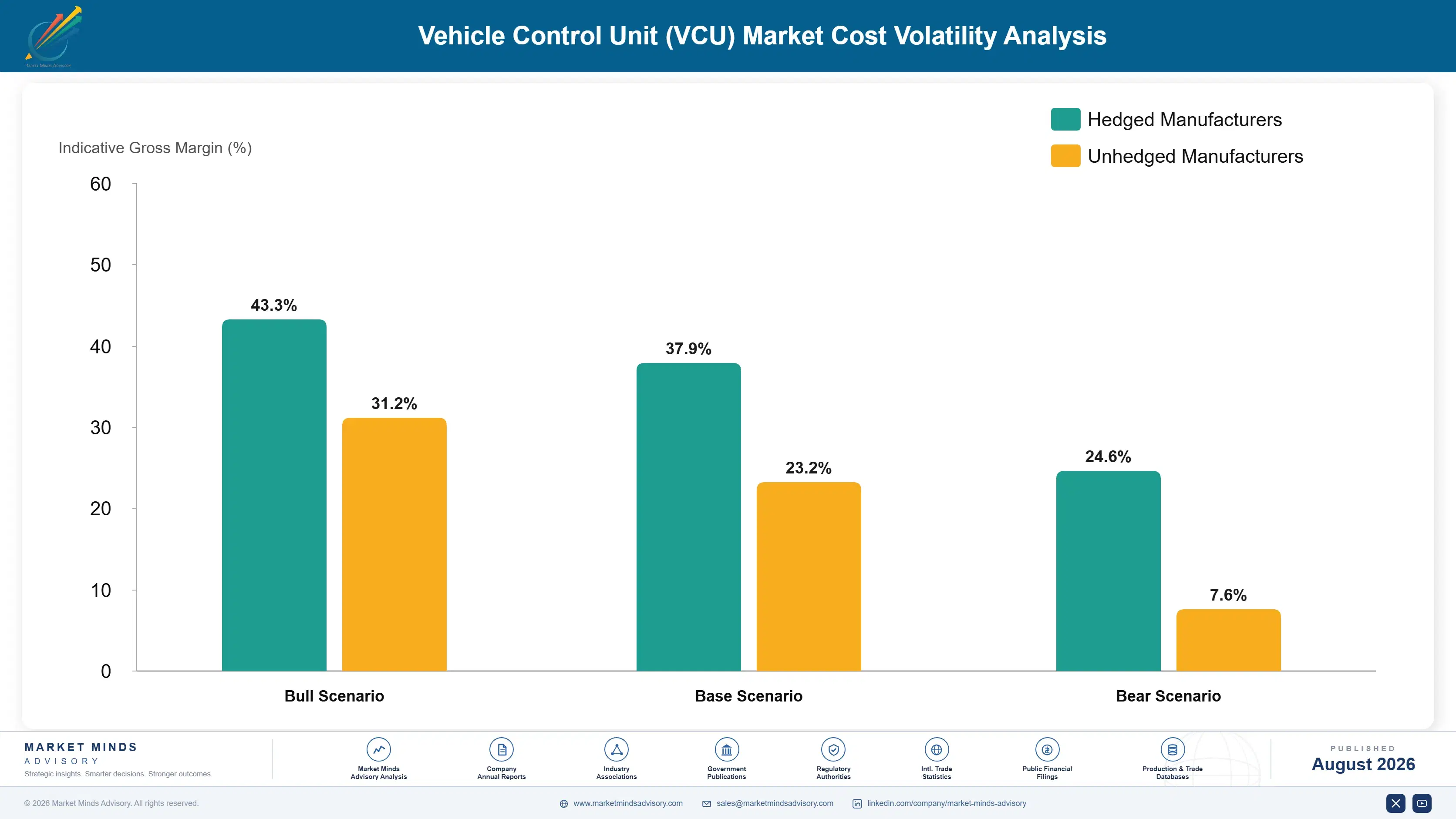
Semiconductor content dominates the bill of materials completely. Microcontrollers, power devices, memory and analogue components account for roughly 58% of hardware cost of goods on a vehicle control unit, with printed circuit board assembly, housings and connectors covering the remainder. Automotive qualified semiconductors come from few manufacturers in Europe, Japan, Taiwan and the United States, and alternatives take years to qualify.
Semiconductor allocation was the defining event of the period and it stopped vehicle production entirely. Automotive volumes are modest against consumer electronics, so when capacity tightened the industry sat low in priority and lost millions of vehicles. Company annual reports across the supply base documented the disruption. Prices rose and several suppliers redesigned controllers around whatever components could be obtained. Expediting costs multiplied simultaneously across the whole supply base.

Exposure divides by qualification breadth rather than by scale. A supplier holding multiple qualified sources for critical devices weathered the allocation crisis with production intact, while single sourced designs stopped. Automotive qualification requires long lifetimes and wide temperature ranges that constrain node selection, so alternatives are limited. Two wheeler controllers escape much of this using commercial grade components, which is one reason they cost around 28 dollars.
vehicle-control-unit-vcu-market-trends-cost-volatility-analysis-1787641431933

Qualify multiple sources for every critical semiconductor

Single sourced designs stopped production during allocation while multi sourced ones continued, and the difference was decided years earlier at design stage rather than during the crisis. Qualification requires engineering effort and validation that nobody prioritises when supply is comfortable. Suppliers maintaining alternatives through stable years delivered while competitors quoted unacceptable lead times. Nobody prioritises it while supply feels comfortable.

Design for component substitution at the board level

Layouts accommodating alternative package outlines and pin configurations allow substitution without a full redesign, which is what turns a six month crisis into a six week one. The cost is board area and some engineering discipline during layout. Suppliers adopting this after the last allocation event carry options competitors would need a design cycle to match.

Contract foundry capacity directly for critical devices

Automotive volumes sit low in foundry priority because they are small against consumer demand, and no amount of relationship management changes that during a shortage. Direct capacity agreements, sometimes with prepayment, secure allocation that ordinary purchasing does not. The working capital cost is real and the alternative is halting vehicle assembly lines, which settles the argument quickly for most boards.

Portfolio Architecture for Margin Defence

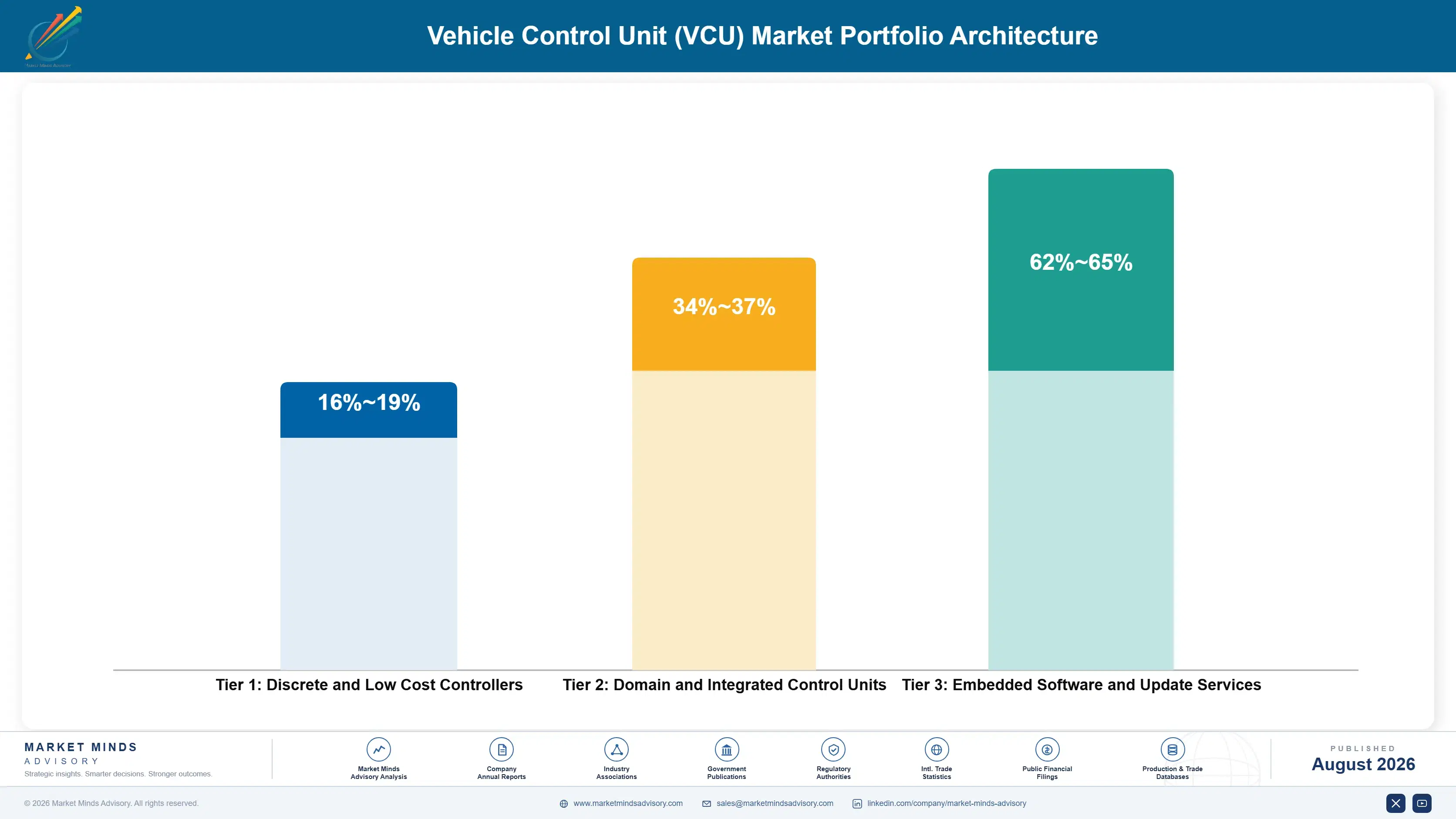
Margin architecture follows position on the consolidation ladder. Discrete controllers earn commodity margins in a shrinking population, since the functions inside them are scheduled for absorption elsewhere. Domain controllers earn considerably better on integration complexity and functional safety burden. Software content, now roughly 46% of unit value, earns best of all and continues after the vehicle ships, which no hardware line has ever managed.
The tension is between the volume that fills a factory and the value that justifies the engineering. Two and three wheeler controllers at around 28 dollars ship in enormous numbers at thin margins on a completely separate cost structure. Passenger vehicle domain controllers ship in far smaller numbers at high value. A supplier attempting both from one organisation generally fails at the cheap end, since automotive assumptions carry cost that market cannot absorb.

High value pools concentrate in consolidated domain and zonal positions and in separately priced software, both of which resist the commoditisation happening beneath them. Everything supplying a discrete function is supplying something that a competitor is currently designing out of the next platform. That is an uncomfortable place to hold a large installed position, and several suppliers are in exactly that position now.

Discrete and Low Cost Controllers

Single function powertrain controllers and two wheeler units built to cost points measured in tens of dollars. Volume is substantial and the functions inside the automotive versions are being absorbed into somebody else's domain controller.
Gross Margin: 16-19%

Domain and Integrated Control Units

Consolidated units coordinating powertrain, thermal, energy and motion functions under combined functional safety requirements. Margin holds because integration complexity and safety burden are genuinely difficult, which is what keeps insourcing programmes returning.
Gross Margin: 34-37%

Embedded Software and Update Services

Separately licensed control software, calibration, update delivery and feature activation revenue continuing after the vehicle ships. Margin is the best available and the revenue recurs, which no automotive part number has ever done.
Gross Margin: 62-65%
vehicle-control-unit-vcu-market-trends-portfolio-architecture-1787641432429

High-value Sub-segments and Strategic Watch-out

Vehicle Motion Domain Controllers

The fastest growing architecture at 17.1% and the position that defines how a vehicle actually drives, which is why carmakers keep trying to own it. Combined domain functional safety is the difficulty, and it is precisely what returns insourcing programmes to suppliers. Ownership of it is contested.
Gross Margin: 34-37%

Central Compute Zonal Architectures

Second fastest at 14.8% and concentrated in platforms designed around it rather than retrofitted, since existing wiring and supplier arrangements assume distributed control. Adoption tracks new platform launches, which means the transition takes a full product cycle. Established carmakers need a full platform renewal first.
Gross Margin: 38-41%

Low Cost Microcontroller Controllers

Growing at 12.2% on electric two and three wheeler volumes that exceed passenger vehicle output, at around 28 dollars a unit. Automotive suppliers cannot reach that cost point by simplifying an existing product, and domestic manufacturers have taken the volume. A separate organisation is required rather than a derivative product.
Gross Margin: 16-19%

Discrete Powertrain Control Units

Growing at only 3.2% and holding functions actively being designed out of the next platform generation by competitors selling consolidation. A large installed position here looks like security and is closer to a countdown running against the platform cycle. Installed position here offers less security than it appears to.
Gross Margin: 16-19%

How Platform Wins Actually Pay

Revenue here arrives on a platform cycle rather than a purchase order. Winning a vehicle control position commits a supplier to production across a platform lasting seven to ten years, with volumes that ramp, plateau and decline on a curve visible from the start. That makes each win an annuity and each loss a decade long absence, which is why selection is exhaustive.
Stickiness depends on architectural position. A supplier holding a consolidated domain controller is embedded in vehicle level behaviour that took years to calibrate, and replacing it means revalidating everything it touches. A discrete controller supplier is replaceable at the next platform, and frequently is. Software positions are stickiest of all, since calibration and field learning accumulate in code that nobody wants to recreate from a specification document.

The buyer has changed more than the product. Selection once ran through a purchasing organisation comparing part prices against a specification an engineering team had written. It now runs through vehicle architecture teams deciding which supplier will effectively define how the vehicle drives, with purchasing involved but no longer deciding. Suppliers built for annual price negotiations are calling on people who no longer decide.
vehicle-control-unit-vcu-market-trends-end-use-penetration-index-1787641432924

Where Content Value Is Won

These are among the four positions where our research anticipates prominent divergence between winners and laggards over the coming forecast period. Each is grounded in the demand model, the regulatory perimeter, and the announced capacity pipeline.
01 / ARCHITECTURE LADDER POSITION

Discrete controllers are somebody else's design target

Controller count per vehicle has fallen toward roughly 3.2 and keeps falling, which means every discrete function currently supplied is scheduled for absorption into a domain controller a competitor is designing right now. Vehicle motion domain controllers grow at 17.1% against a market rate of 11.4% because that is exactly where those functions are going. Winning the consolidated position requires a full platform cycle to arrange and cannot be done reactively once a carmaker has already selected its integrator for the next generation.
02 / SOFTWARE REVENUE SEPARATION

Half the product is being given away free

Embedded software now accounts for roughly 46% of vehicle control unit value and continues rising, yet most supply agreements price a part number and treat the code as included in it. That hands away the most valuable half of the product at hardware margins, and the half that can generate revenue after the vehicle has already shipped. Licensing, update subscription and feature activation models exist commercially everywhere else and almost nowhere in automotive electronics, which is a gap the suppliers moving first will not leave open long.
03 / LOW COST LINE SEPARATION

Two wheeler volume needs a separate organisation

Electric two and three wheeler production across India, China and Southeast Asia exceeds passenger electric vehicle output by a wide margin, and each vehicle needs a controller costing around 28 dollars rather than several hundred. That cost point cannot be reached by simplifying an automotive product, because the qualification regime, component grades and underlying engineering assumptions all differ fundamentally. India grows at 19.6%, faster than any country covered anywhere, and domestic manufacturers have already taken almost all of that volume.
04 / SAFETY CULTURE DEFENCE

Insourcing fails on process, not on talent

Reaching automotive functional safety approval for vehicle level control software takes around 26 months from a standing start even with experienced engineers and mature processes already in place. Carmakers announcing in house capability have discovered repeatedly that hiring software developers does not produce a safety culture, and several major European programmes were delayed before returning scope to suppliers. Selling documented process maturity and field failure history defends positions far more reliably than any feature comparison, and that barrier is not eroding.

Engagement Snapshot From the Field

A live engagement with an industry participant carrying material or product regulatory and market exposure ahead of a defining policy shift, showing how our research translates into a defensible multi-year portfolio strategy.
MARKET MINDS ADVISORY · CLIENT ENGAGEMENT SUMMARY
Vehicle Control Unit (VCU) Producer Strategic Portfolio Review and Transition Roadmap 2026·Investment Scenario on Vehicle Control Unit (VCU) Exposure Evaluation 2025-26
CLIENT PROFILE
A tier one automotive electronics supplier producing discrete powertrain and thermal control units for European and North American vehicle programmes. Annual revenue in the control unit business was approximately 890 million dollars (client-reported, unverified by MMA), with 78% from discrete single function controllers. No domain controller position had been won and embedded software was priced as part of the hardware.
STRATEGIC CHALLENGE
Two customers had announced zonal architectures for their next platform generation, which would absorb functions the client currently supplied into units it did not build. Management wanted to know how much revenue was genuinely at risk and over what timescale, and whether to compete for domain positions or defend discrete supply. The commercial team believed the transition was further away than the engineering team did.
MMA APPROACH
MMA modelled revenue at risk platform by platform against announced architecture roadmaps and actual programme timing rather than against stated intentions. Domain controller competitive requirements were assessed against the client's functional safety and integration capability. Forty-seven expert interviews with vehicle architecture leads, purchasing managers and functional safety specialists established how integrator selection actually happens and when.
KEY FINDINGS
  1. Roughly 61% of current control unit revenue sat on platforms scheduled for architecture consolidation within two product cycles, considerably more than management had assumed.
  2. Integrator selection for domain positions occurred 4 years before start of production, meaning two of the client's target platforms had already been decided without it.
  3. Embedded software represented roughly 44% of the value the client delivered and generated no separately identified revenue in any customer agreement examined.
  4. Vehicle architecture leads in 36 of the 47 interviews named functional safety history as the decisive selection criterion, ahead of both cost and technical capability.
CLIENT PROFILE
A tier one automotive electronics supplier producing discrete powertrain and thermal control units for European and North American vehicle programmes. Annual revenue in the control unit business was approximately 890 million dollars (client-reported, unverified by MMA), with 78% from discrete single function controllers. No domain controller position had been won and embedded software was priced as part of the hardware.
STRATEGIC CHALLENGE
Two customers had announced zonal architectures for their next platform generation, which would absorb functions the client currently supplied into units it did not build. Management wanted to know how much revenue was genuinely at risk and over what timescale, and whether to compete for domain positions or defend discrete supply. The commercial team believed the transition was further away than the engineering team did.
MMA APPROACH
MMA modelled revenue at risk platform by platform against announced architecture roadmaps and actual programme timing rather than against stated intentions. Domain controller competitive requirements were assessed against the client's functional safety and integration capability. Forty-seven expert interviews with vehicle architecture leads, purchasing managers and functional safety specialists established how integrator selection actually happens and when.
KEY FINDINGS
  1. Roughly 61% of current control unit revenue sat on platforms scheduled for architecture consolidation within two product cycles, considerably more than management had assumed.
  2. Integrator selection for domain positions occurred 4 years before start of production, meaning two of the client's target platforms had already been decided without it.
  3. Embedded software represented roughly 44% of the value the client delivered and generated no separately identified revenue in any customer agreement examined.
  4. Vehicle architecture leads in 36 of the 47 interviews named functional safety history as the decisive selection criterion, ahead of both cost and technical capability.
RECOMMENDED STRATEGY
Phase 1: Phase one: bid domain controller positions on platforms with selection still open, since integrator choice happens 4 years before production starts. Phase 2: Phase two: restructure agreements to price software separately, since roughly 44% of delivered value currently generates no identified revenue at all. Phase 3: Phase three: treat discrete controller revenue as declining rather than stable, since 61% sits on platforms already scheduled for consolidation.
OUTCOME
The client won a domain controller position on one of three targeted platforms and restructured software pricing across two major customer agreements within eighteen months. Software now generates separately identified revenue for the first time, and discrete controller revenue is being managed as a declining asset rather than defended as a stable one (client-reported, unverified by MMA).

Frequently Asked Questions

Foundational context covering the market sizes, CAGR, scope, country, region and competition that inform every finding below. This section is provided to cover basics and most often pre-purchase conversations, answered from the MMA Primary Research Dataset.

What is the current size of the Vehicle Control Unit (VCU) Market?

The market was valued at 3.6 billion dollars in 2025, covering discrete, integrated, domain and zonal vehicle control architectures including embedded software. It reaches an estimated 4.01 billion dollars during 2026.

How large will the Vehicle Control Unit (VCU) Market be by 2036?

MMA forecasts 11.80 billion dollars by 2036, an increase of 7.79 billion dollars over the 2026 base. That represents an expansion multiple of 2.94 times across the forecast period.

What is the CAGR for the Vehicle Control Unit (VCU) Market 2026 to 2036?

The base case compound annual growth rate is 11.4%, with a bull case of 12.6% and a bear case of 10.2%. Zonal architecture adoption and electrification pace separate those scenarios.

Which segment is growing fastest?

Vehicle motion domain controllers grow at 17.1%, half again the market rate of 11.4%, as functions consolidate from discrete units. Central compute zonal architectures follow at 14.8%.

Who are the major companies in the Vehicle Control Unit (VCU) Market?

Bosch, Continental, Denso, Vitesco Technologies and BYD lead on unit shipments and associated embedded software revenue worldwide. Together they account for 54% of the market.

Which country is growing fastest?

India grows fastest at 19.6%, on electric two and three wheeler production running at volumes that exceed regional passenger vehicle output by a wide margin.

Report Segmentation Architecture

The full report scope spans multiple orthogonal segmentation dimensions, with cross-tabulated demand data provided for each dimension pair. Coverage extends further to regional breakdowns, trend trajectories, and the competitive detail needed to support segment-level decision-making.

By Control Architecture

  • Discrete Powertrain Control Units
  • Standalone Integrated Vehicle Control Units
  • Vehicle Motion Domain Controllers
  • Central Compute Zonal Architectures
  • Low Cost Microcontroller Based Controllers

By End-Use Industry

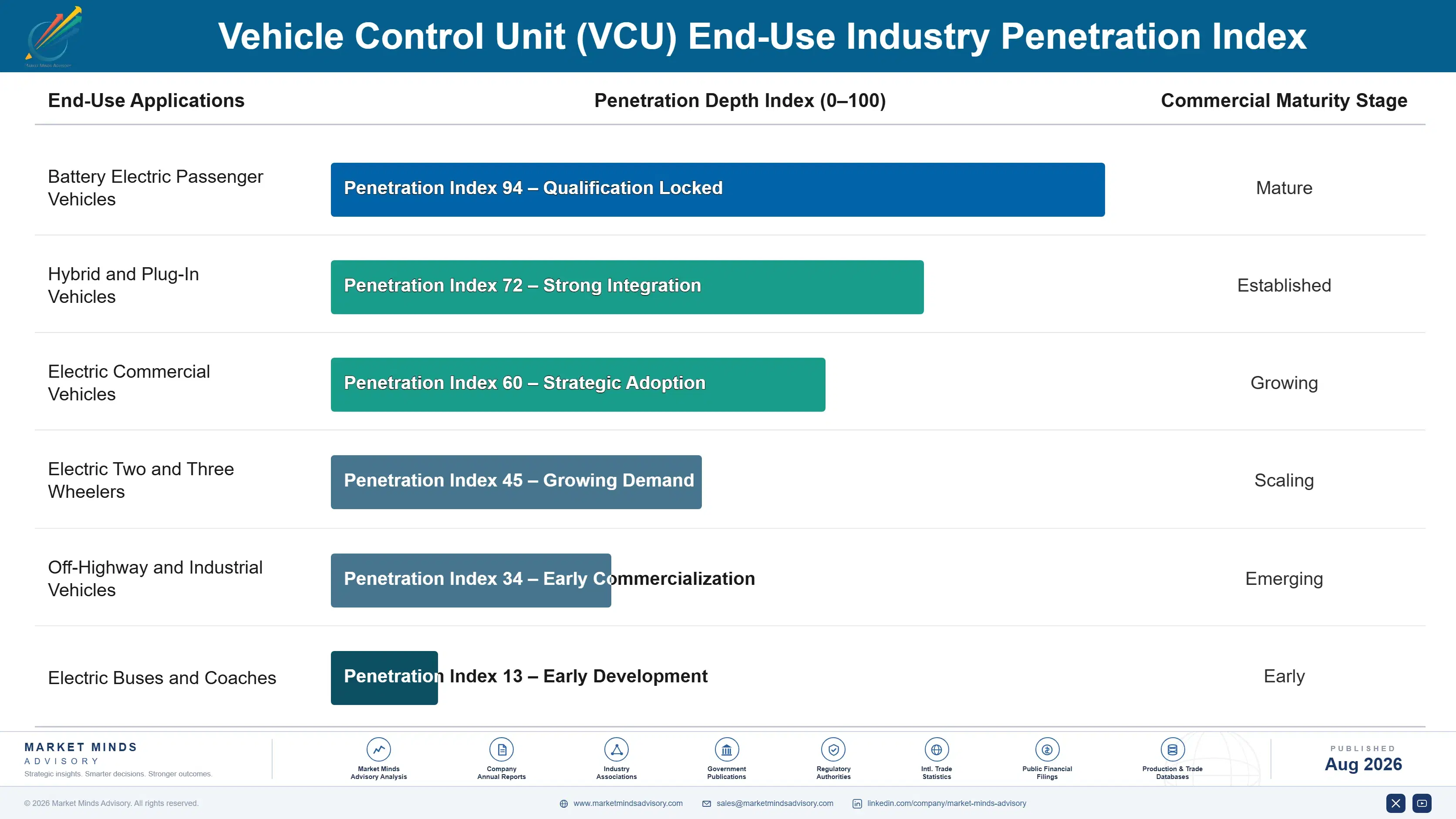
  • Battery Electric Passenger Vehicles
  • Hybrid and Plug-In Vehicles
  • Electric Commercial Vehicles
  • Electric Two and Three Wheelers
  • Off-Highway and Industrial Vehicles
  • Electric Buses and Coaches

By Commercial Dimension

  • Platform Supply Agreements
  • Software Licensing and Updates
  • Vertically Integrated Production
  • Contract Electronics Manufacture
  • Aftermarket and Retrofit Supply
  • Engineering Development Services

By Region

  • North America
  • Western Europe
  • East Asia
  • South Asia and Pacific
  • Latin America
  • Middle East and Africa
  • Eastern Europe

Scope, Methodology, and Coverage

Every figure in this report is reproducible from documented input assumptions. The scope below maps the historical period, the forecast horizon, the segmentation dimensions, and the countries covered, alongside the underlying primary and qualitative methodology.
Historical Period
2020 to 2025
Forecast Period
2026 to 2036
Base Year
2025 (USD billions; MMA Primary Research Dataset, August 2026)
Market Definition
Electronic control units performing vehicle level coordination of powertrain, energy, thermal and motion functions in electrified vehicles worldwide, covering discrete powertrain control units, standalone integrated vehicle control units, vehicle motion domain controllers, central compute zonal architectures, and low cost microcontroller based controllers. Measured at supplier selling value including hardware and embedded software. Engine management units for combustion vehicles, infotainment and cockpit controllers, standalone battery management electronics, driver assistance domain computers and charging equipment are excluded from scope.
Quantitative Units
USD billions (current prices); units shipped; USD per unit by control architecture and vehicle class
Segmentation Dimensions
Control architecture; end-use industry; commercial dimension; region
Regions Covered
North America, Western Europe, East Asia, South Asia and Pacific, Latin America, Middle East and Africa, Eastern Europe
Countries Covered
China, Japan, South Korea, Taiwan, Germany, France, Italy, Sweden, United States, Canada, Mexico, Brazil, India, Vietnam, Indonesia, Australia, Poland, Hungary, Morocco, Saudi Arabia
Key Companies Profiled
Bosch, Continental, Denso, Vitesco Technologies, BYD, ZF Friedrichshafen, Aptiv, Marelli, Valeo, Hitachi Astemo, Mitsubishi Electric, LG Electronics, Hyundai Mobis, Panasonic Automotive Systems, UAES, Shenzhen Inovance Technology, Tesla, Magna International, Sensata Technologies, Nidec
Quantitative Methodology
Primary survey, n=3,800 respondents, Q4 2025, six countries; demand-side model with trade association cross-validation
Qualitative Methodology
47 expert interviews, Q4 2025; applied to validate demand model assumptions, identify emerging dynamics, and assess competitive positioning
Report Format
PDF and XLSX data workbook (Word format preview document)
Publisher
Market Minds Advisory
Report Code
MMA-2026-AUT-103
Published
August 2026
Contact
sales@marketmindsadvisory.com | www.marketmindsadvisory.com

Purchase the full Vehicle Control Unit (VCU) Market Report (2026 to 2036).

The full report treats the vehicle control unit as the component that decides how a car drives, which is why carmakers keep trying to own it and keep returning to suppliers when functional safety timelines become clear. It sizes all five control architectures independently through 2036, models revenue at risk from consolidation platform by platform, and separates hardware from embedded software value at segment level. Regional chapters cover all seven regions, with two and three wheeler controller volumes assessed separately from passenger vehicle content. Competitive profiling covers 20 participants on one consistent unit shipment basis.
Five control architectures sized independently through 2036
Consolidation revenue risk modelled platform by platform
Hardware and embedded software value separated at segment level
Two and three wheeler volumes assessed separately from passenger vehicles
Functional safety timelines mapped against insourcing programme outcomes
Twenty participants profiled on one consistent shipment basis

Built For The People Who Decide

From boardroom strategy to bench-side execution, this report is read cover-to-cover by leaders shaping the next decade of their industry, turning demand scenarios, market dynamics and valuation benchmarks into decisions.
CXOs/ Presidents/ VPs/ Managers
M&A and Corporate Development
Strategy Teams and R&D Heads
Procurement and Product Directors
Regulatory and Compliance Leaders
Investor Relations and Equity Analysts