
Market Minds Advisory
Veggie Chips Market 2024-2034: Trends and Growth Insights

Veggie Chips Market 2024-2034: Trends and Growth Insights: Veggie Chips: Health Halo Economics, Frying Yield Losses and the Pulse Base That Survives the Panel

A beetroot crisp fried in sunflower oil carries almost the same fat per gram as a potato crisp, so the vegetable is a colour and a name rather than any nutritional change at all.

Lead Analyst

Lisa Gevelber

Published

August 2026

Make Smarter Decisions with Customized Research Insights

Request a free sample report and evaluate market opportunities, growth trends, and competitive dynamics relevant to your business needs.

2025 MARKET VALUE$6.8BMarket Size 2025
2036 FORECAST VALUE$14.6BBase Case , 2026 to 2036
CAGR 2026 TO 20367.2 %Bull 8.4% / Bear 6.0%
INCREMENTAL OPPORTUNITY$7.3BNet 10- year value creation
EXPANSION MULTIPLE2.00x2036 value over 2026 base
Strategic Levers
M&A Pipeline
Regional Outlook
Country Rankings
Competitive Intelligence
Segmental Deep-dive
Call-Us : 91 93563 13602

Executive Snapshot and Market Trajectory.

This is snacking's most successful health halo and almost none of it survives a nutrition panel. A root crisp fried in sunflower oil carries roughly 94% of the fat a potato crisp does per gram. The vegetable supplies colour and a name, and the shopper buys permission rather than nutrition.
The pulse products are genuinely different. A chickpea or lentil chip delivers around 6.4 grams of protein per serving because the base is a legume rather than a starchy root, which means it survives the comparison root crisps fail. Legume and pulse chips grow at 10.8%, half again the market rate of 7.2%, while kale chips, once the category's purest health statement, now grow at 4.2% and are quietly disappearing.
The operational problem is frying. Beetroot and parsnip carry high and variable sugar content, so they caramelise and burn at potato frying temperatures, and roughly 23% of product is rejected for colour variation. That yield loss rather than raw material cost explains the 58% retail premium, and it explains why the category loses facings whenever a retailer reviews a range on velocity. Facings go elsewhere.
Market Definition
Vegetable based savoury snack chips sold at retail and foodservice, covering root vegetable crisps, sweet potato chips, legume and pulse chips, kale and leafy vegetable chips, vegetable flour extruded snacks, and vegetable straws and puffs. Measured at retail selling value across bagged, multipack and sharing formats. Potato crisps, corn tortilla chips, fruit chips, popcorn, extruded corn snacks and vegetable crisps sold as ingredients are excluded.
Base Year Value
$6.8B in 2025 (MMA Primary Research Dataset, August 2026)
Forecast Period
2026 to 2036, eleven discrete annual values
CAGR
7.2% base case. Bull 8.4%. Bear 6.0%.
Fastest Growth Segment
Legume and Pulse Chips: 10.8% CAGR
Fastest Growth Country
India: 13.6% CAGR
Fastest Growth Region
South Asia and Pacific: 9.4% CAGR
Largest Region
North America: 30% of 2025 global value
Market Leaders
PepsiCo, Kellanova, Calbee, General Mills, Utz Brands. Source: MMA Primary Research Dataset, July 2026.
Primary Survey
n=3,800 procurement and R&D decision-makers, Q4 2025, six countries
Methodology
Demand-side build-up, cross-validated against public data, 47 expert interviews

Veggie Chips Market Forecast Scenarios

veggie-chips-market-trends-growth-size-forecast-scenario-1787641411851
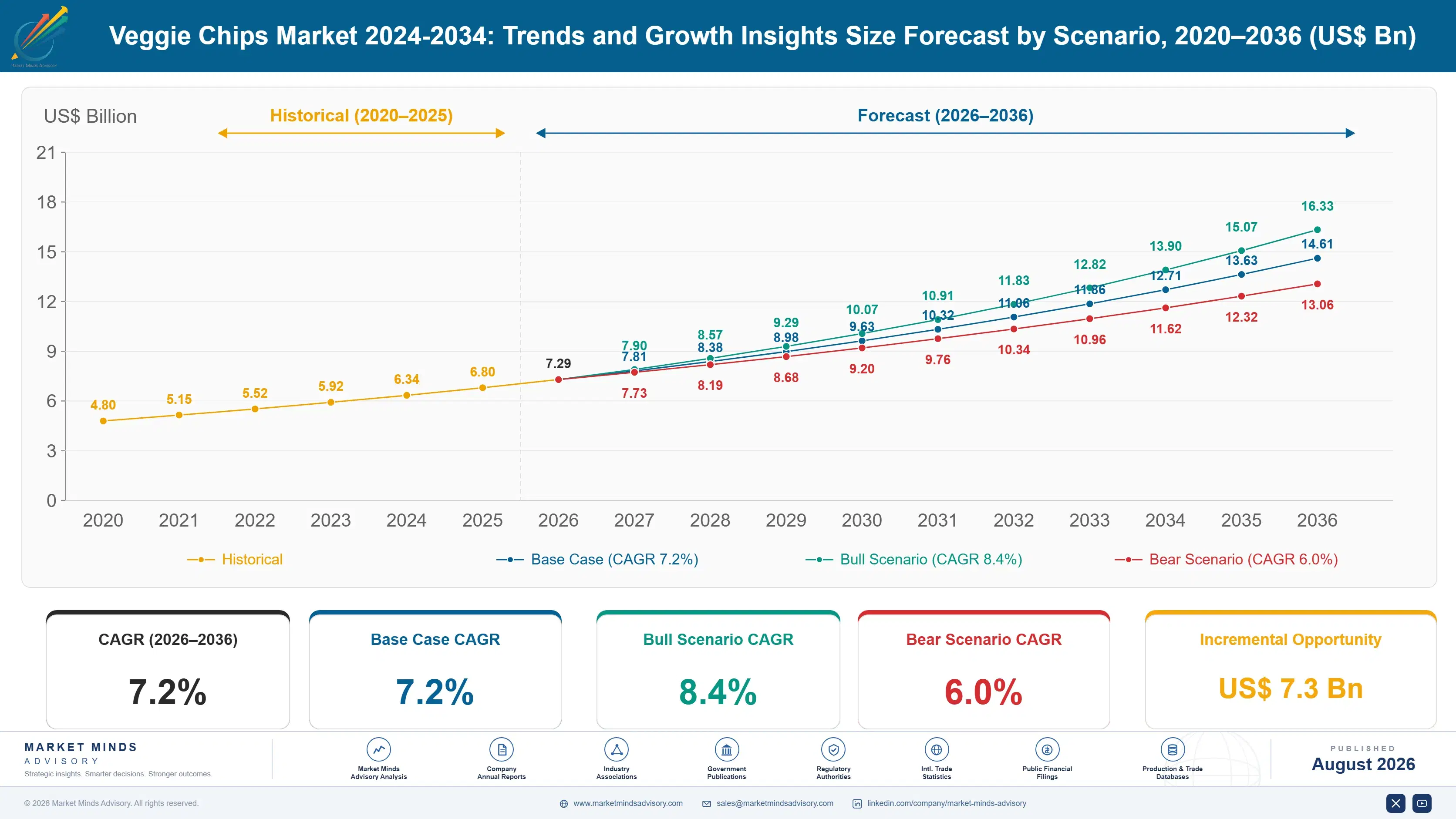
The five years to 2025 sorted the category into things that survive a nutrition panel and things that do not. Kale chips and similar health positioned products peaked and declined as shoppers examined labels, while legume bases grew steadily. Root crisps held on colour and occasion. The 6.2% historical rate averages one part expanding and another contracting.
The 7.2% base case rests on three mechanisms. Protein positioning keeps moving volume toward legume and pulse bases, since a snack claiming health benefit now has to demonstrate one on the back of the pack. Extruded vegetable flour formats deliver lower fat than any fried product and cost less to make, which suits both the claim and the margin. And Indian and Southeast Asian pulse snacking traditions are being branded for modern retail.
The 8.4% bull case turns on vacuum frying delivering genuine fat reduction at commercial scale, which would let the largest part of the category make a claim it cannot. The 6.0% bear case is retail range review: at roughly a third of the velocity of a potato facing, veggie chips lose shelf space whenever a category manager looks at rate of sale.

Where the Vegetable Is Mostly a Colour

The health claim does not survive examination and the category grew anyway. A beetroot or parsnip crisp fried in oil carries around 94% of the fat a potato crisp does per gram, because the frying medium rather than the vegetable determines most of the nutritional outcome. Shoppers appear to understand this and buy regardless, which suggests the product sells permission rather than nutrition.
TOP FIVE CONCENTRATION38%Combined retail volume held by the largest snack manufacturers
FAT CONTENT PARITY94%Root crisp fat content relative to conventional potato crisps
PRICE PREMIUM OVER POTATO58%Retail uplift per hundred grams against standard crisps
FRYING YIELD LOSS23%Product rejected for colour variation during root vegetable frying
SHELF VELOCITY RATIO0.3xRate of sale relative to a comparable potato facing
LEGUME PROTEIN CONTENT6.4gProtein per serving in a typical pulse based chip
Legume bases are the exception and the growth. A chickpea or lentil chip delivers roughly 6.4 grams of protein per serving, which is a genuine difference rather than a repositioning, and it survives the panel comparison that root crisps lose. Kale chips took the opposite route, positioning entirely on health and offering little beyond a leafy vegetable fried in oil, and that segment has been contracting for several years.
Frying is the hidden operational problem. Beetroot, parsnip and carrot carry high and variable sugar content, so they caramelise before they crisp at temperatures suited to potato, and roughly 23% of output is rejected for colour variation across a batch. That rework funds the 58% retail premium rather than any raw material scarcity.
"The category solved a marketing problem and never solved a frying problem. Roughly a quarter of the beetroot going into the fryer never reaches a bag, and that number is doing far more to set the shelf price than the beetroot ever did."
Director, Snacks and Consumer Foods Practice · MMA Food Service and Consumer Foods Practice · August 2026

Market Trends

Pulse Bases Take Share From Fried Root Formats

Legume and pulse chips deliver roughly 6.4 grams of protein per serving against negligible amounts in a fried root crisp, which is the difference between a claim that survives label scrutiny and one that does not. Growth runs at 10.8% against a market rate of 7.2%, fastest in the market, and it comes substantially at the expense of formats positioned on health without delivering it. Kale chips grow at 4.2% and are losing distribution steadily. Shoppers reading nutrition panels have effectively repriced the category, rewarding the products that can defend a front of pack statement.
Market Impact: India grows at 13.6% annually
Extrusion Replaces Frying to Deliver Real Fat Reduction

Vegetable flour extruded formats puff under pressure rather than frying in oil, which produces a genuine fat reduction rather than a repositioned one and costs less to manufacture at the same time. Growth of 9.4% is second fastest in the market. Texture is the constraint, since extruded products deliver a crisp bite that differs noticeably from a fried slice and shoppers expecting a crisp notice immediately. Manufacturers have responded by positioning extruded formats as a distinct product rather than as a substitute, which works better commercially than pretending the difference is not there.
Market Impact: Protein claims lift velocity 24%

Market Opportunities and Growth Drivers

Traditional Pulse Snacking Moves Into Branded Retail

Chickpea, lentil and gram flour snacks have been eaten across India and Southeast Asia for generations, sold loose or through informal channels rather than in branded packs. Modern retail expansion is converting that consumption into packaged formats with nutrition panels, shelf life and brand identity attached. India grows at 13.6%, faster than any market covered, and the raw material supply, processing knowledge and consumer familiarity all already exist. Western manufacturers entering these markets are competing against domestic brands with a considerable head start on both formulation and taste expectation. Local taste expectation matters greatly.
Market Impact: Velocity runs at 0.3 times potato

Protein Claims Replace Vegetable Claims on Front of Pack

Front of pack messaging across the category has shifted from naming a vegetable to stating a protein figure, because a vegetable name no longer carries an implied nutritional benefit with shoppers who read the panel. Legume bases delivering around 6.4 grams per serving can make that statement and fried root formats cannot. Retailers have reallocated facings toward products supporting a quantified claim, since those move faster than positioning alone achieves. That shift punishes exactly the formats the category was originally built around and rewards bases nobody was marketing five years ago.
Market Impact: Frying rejects 23% of output

Market Restraints and Challenges

Shelf Velocity Loses Facings at Every Range Review

A veggie chip facing sells at roughly a third of the rate a comparable potato crisp facing achieves, and category managers reviewing a range on rate of sale reach the obvious conclusion. The root cause is that the category is an occasional purchase for most households rather than a routine one, and no amount of marketing converts an occasional buyer into a weekly one at a 58% price premium. Manufacturers respond by fighting for margin based rather than velocity based allocation, and by moving into food to go and multipack formats where the comparison is less direct.
Market Impact: Pulse chips deliver 6.4g protein

Root Vegetable Frying Rejects Nearly a Quarter of Output

Beetroot, parsnip and carrot carry sugar content that varies by variety, season and storage duration, so slices caramelise unpredictably and roughly 23% of output is rejected for colour variation. The root cause is agronomic rather than operational, since a processor cannot control the sugar profile of a delivered crop and blanching only partly compensates. Commercially the rework is what funds the retail premium. Responses include vacuum frying at lower temperatures, sugar profile specification in grower contracts, and optical sorting after frying rather than before it. None of it removes the underlying agronomic variability entirely.
Market Impact: Cuts fat content by 42%
3 additional market trends, 4 additional growth drivers, and 2 additional restraints and challenges are covered in the full report. Contact sales@marketmindsadvisory.com to access the complete intelligence.

Segment CAGR and Growth Architecture

Segmentation follows product base, since the base decides whether a nutritional claim survives the panel, how the product is manufactured and what it costs. Six bases cover the category, from a fried beetroot slice to an extruded vegetable flour puff. Growth follows nutritional credibility and manufacturing yield rather than any flavour preference. Positioning no longer carries anything.
veggie-chips-market-trends-growth-market-share-analysis-1787641412434

Legume and Pulse Chips

Chips built on chickpea, lentil, black bean and other pulse flours, delivering roughly 6.4 grams of protein per serving from the base itself rather than from fortification. At 10.8% this is the fastest growing base in the category, half again the market rate of 7.2%, and the reason is that the claim survives inspection. A shopper reading a panel finds genuine protein and fibre rather than a vegetable name attached to a fried starch. Manufacturing is easier than root frying, since pulse doughs are formed and cooked under controlled conditions with none of the sugar variability that rejects a quarter of root output. Taste development remains the constraint. Seasoning does most of the work on flavour here.
CAGR 10.8%

Vegetable Flour Extruded Snacks

Vegetable and pulse flours puffed under pressure and heat rather than fried, producing a genuine fat reduction of roughly 42% against fried equivalents at lower manufacturing cost. Growth of 9.4% is second fastest in the category, and the format answers the criticism the whole category faces about frying medium determining the nutritional outcome. Texture is the honest difficulty: an extruded puff eats differently from a fried slice and shoppers expecting a crisp notice immediately. Manufacturers positioning these as a distinct product rather than as a substitute perform considerably better than those implying equivalence. Extrusion lines also run faster and generate almost no rejected output. Cost per bag is the lowest anywhere in this category.
CAGR 9.4%
Full segment breakdown across 6 segments available in the complete report.

Regional Architecture and Country Demand Map

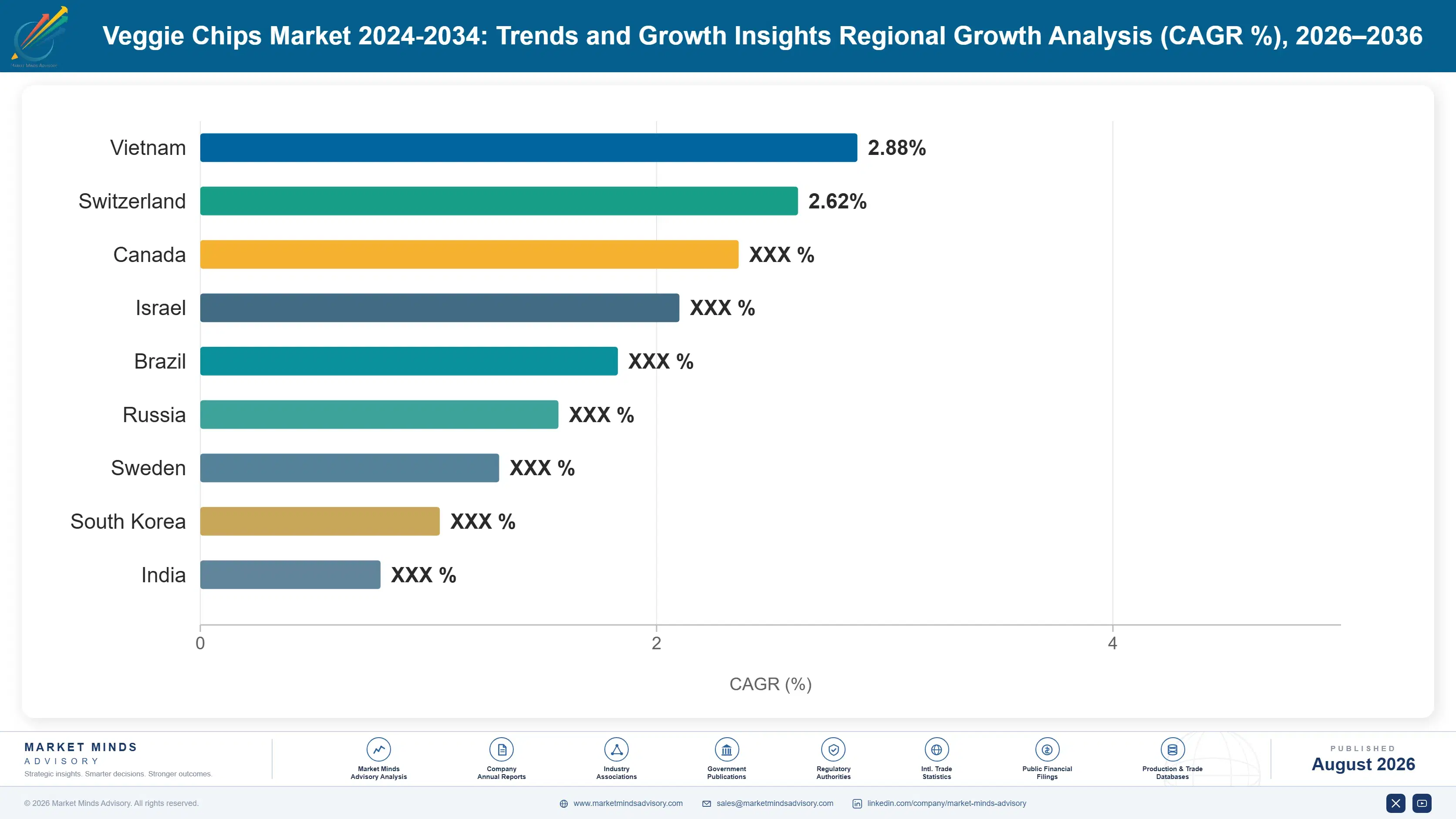
North America holds the largest share at 30%, where the category was created and remains most developed. Western Europe follows at 24% on premium positioning. India grows fastest of any market covered at 13.6%, converting traditional pulse snacking into branded retail. Panel credibility decides facings everywhere.

North America

The category was invented here and this 30% share reflects that head start more than any current advantage. American shoppers adopted vegetable crisps as a premium snacking occasion earlier than anywhere, and the health halo positioning that built the category worked longer here before nutrition panel scrutiny caught up with it. Legume and pulse bases are growing fastest, supported by strong domestic pulse production across the northern plains and Canada. Retail range reviews have become considerably less forgiving, and several established brands have lost facings to potato crisps on velocity comparisons. Growth of 6.6% reflects a mature market where the growth now comes from base substitution rather than from category expansion.
Share: 30% | CAGR: 6.6% (2026 to 2036)

Western Europe

Premium positioning rather than volume gives this region its 24% share. British and Dutch consumers adopted root vegetable crisps as a premium sharing format, frequently at price points well above the 58% category premium, and specialist brands built substantial businesses on provenance and variety claims. German adoption skews toward extruded and baked formats consistent with wider health snacking preferences there. Southern European markets remain dominated by potato and continue to treat vegetable crisps as an imported novelty. Frying expertise across the region is deep, with several specialist manufacturers achieving reject rates below the category average. Growth of 5.6% is the lowest of the seven regions, reflecting a mature premium position with limited remaining headroom.
Share: 24% | CAGR: 5.6% (2026 to 2036)
Regional intelligence for 5 additional markets available in the complete report: East Asia, South Asia and Pacific, Latin America, Middle East and Africa, Eastern Europe. Contact sales@marketmindsadvisory.com.
veggie-chips-market-trends-growth-country-cagr-analysis-1787641412965

Where This Category Actually Earns

Nothing here is won on a vegetable name, because shoppers now read the panel and find a fried starch. Value accrues to whoever delivers a claim that survives inspection, whoever fixes the frying yield problem, and whoever reaches populations that already eat pulse snacks. Four routes carry weight, and two of them are manufacturing rather than marketing.

Move the Base to Something That Delivers Protein

A fried root crisp carries roughly 94% of the fat a potato crisp does per gram, which means the health positioning that built this category fails the moment a shopper turns the pack over. Legume bases deliver around 6.4 grams of protein per serving and grow at 10.8% against a market rate of 7.2% for exactly that reason. Retailers have reallocated facings toward products supporting a quantified front of pack claim, since those move measurably faster. Reformulating toward pulse bases also removes the frying yield problem, which is an unusually clean commercial trade.
Market Impact: Delivers 6.4 grams of protein in each serving

Attack the Frying Reject Rate Directly

Roughly 23% of root vegetable output is rejected for colour variation, caused by sugar content that varies with variety, season and storage rather than by any process fault. That rework funds most of the 58% retail premium and none of it reaches the consumer as value. Vacuum frying at lower temperatures, sugar profile specification written into grower contracts and optical sorting after frying each recover meaningful yield. A processor cutting rejects by half improves margin more than any pricing action available, and competitors cannot easily see it happening. Nobody outside the plant sees it happen.
Market Impact: Recovers half of the 23% currently rejected output

Convert Traditional Pulse Snacking Into Branded Packs

Chickpea, lentil and gram flour snacks have been eaten across India and Southeast Asia for generations through loose and informal channels, and modern retail expansion is packaging that consumption for the first time. India grows at 13.6%, faster than any market covered, with raw material supply, processing knowledge and taste expectation all already established locally. Western entrants face domestic brands with a substantial head start on formulation and on what the product should taste like. Partnership or acquisition reaches this demand faster than building a range from a Western formulation base.
Market Impact: Captures the 13.6% Indian national market growth rate

Fight for Margin Allocation, Not Velocity Allocation

A veggie chip facing turns at roughly a third the rate a potato facing does, and every range review conducted on rate of sale reaches the same conclusion about which product deserves the space. The counter argument is margin per facing rather than units per facing, since the 58% premium means fewer packs generate comparable cash. Manufacturers that arm category managers with margin per linear metre data retain space that velocity comparisons remove. Food to go and multipack formats also sidestep the direct shelf comparison entirely. Data wins that argument, not advocacy.
Market Impact: Defends facings against 0.3 times the potato velocity

Who Controls the Margin Pool

This market is fragmented for a snacking category. The top five hold 38% of retail volume, the basis applied consistently here, with the remainder spread across regional specialists and premium brands holding strong positions in individual markets. PepsiCo leads through distribution reach and multipack presence rather than through any product advantage, and the gap to challengers reflects shelf negotiating weight more than formulation.
Competition runs on three fronts. Large snack manufacturers compete for facings against their own potato brands, which is an internal allocation question as much as an external one. Premium specialists compete on provenance, variety and frying quality in markets where shoppers pay for it. Legume and pulse brands compete on nutrition panel content against everybody, and they are the ones taking share.

Rankings will shift with base composition rather than with brand building. A large manufacturer converting its range toward pulse bases would answer the panel criticism that has been eroding the category's positioning for years. The other pressure point is Indian and Southeast Asian branded pulse snack manufacturers, who hold formulation depth and cost positions Western brands entering those markets cannot approach.
veggie-chips-market-trends-growth-company-positioning-matrix-1787641413489

Competitive Moat and Risk Dimensions

PEPSICO

Moat: Shelf Negotiating Weight

Scale across the entire salty snack category gives negotiating leverage in range reviews that a specialist brand simply cannot bring, which matters enormously for a product turning at a third the velocity of a potato facing. Multipack and food to go distribution also reaches occasions where the direct shelf comparison against conventional crisps never happens at all.
PEPSICO

Risk: Internal Facing Competition

Every veggie chip facing won comes at the expense of a potato brand the same company owns, which creates an internal allocation problem specialists never face. Given the velocity difference, the commercially rational answer is frequently to give the space to potato, and that logic has repeatedly limited investment behind the vegetable range.
CALBEE

Moat: Vegetable Snack Manufacturing Depth

Decades of vegetable snack production for a Japanese market where these formats are ordinary rather than premium have built frying and formulation capability that Western manufacturers approached far more recently. Reject rates and colour consistency on root vegetable frying reflect accumulated process knowledge rather than equipment, and that knowledge is genuinely difficult to acquire quickly.
CALBEE

Risk: Western Health Positioning Gap

Products developed for a market that never sold them on a nutritional claim carry no protein or fat reduction story when they enter Western retail, where shoppers now read the panel before buying. Competing against legume bases growing at 10.8% requires a reformulation the existing manufacturing base was not designed to produce.

Players Tracked

Prominent Players

PepsiCo
Kellanova
Calbee
General Mills
Utz Brands

Other Key Players

Hain Celestial
Rhythm Superfoods
The Real Good Food Company
KP Snacks
Intersnack Group
Lorenz Snack-World
Haldiram's
Bikanervala
ITC Limited
Want Want China
Orion Corporation
Nongshim
Snack Brands Australia
Simple Mills
Amica Chips

Recent Developments

FEBRUARY 2025

Retailer range review removes vegetable crisp facings on velocity

A major grocery retailer reduced vegetable crisp facings across its salty snack fixture following a range review conducted on rate of sale, reallocating the space to conventional potato crisps. Brands affected argued margin per linear metre rather than units, and the retailer partially reinstated facings in premium format stores only.
Signal: Velocity based range reviews will remove this category from shelf wherever nobody argues margin per metre instead
MAY 2025

Manufacturer commissions vacuum frying line for root vegetables

A European vegetable crisp manufacturer commissioned a vacuum frying line operating at lower temperatures, targeting the colour variation that rejects a substantial share of root vegetable output at conventional frying temperatures. The company cited yield recovery rather than fat reduction as the primary commercial justification for the investment.
Signal: Yield recovery pays for process investment that any fat reduction claim alone could never justify commercially
SEPTEMBER 2025

Indian branded pulse snack producer expands modern retail distribution

An Indian snack manufacturer expanded branded pulse based snack distribution across modern retail formats nationally, packaging products previously sold loose through traditional channels. The company holds formulation depth and raw material access that international entrants approaching the same consumers cannot readily match. Formulation depth is the advantage.
Signal: Traditional pulse snacking is being branded by domestic companies well before Western entrants arrive at all

What a Bag Actually Costs

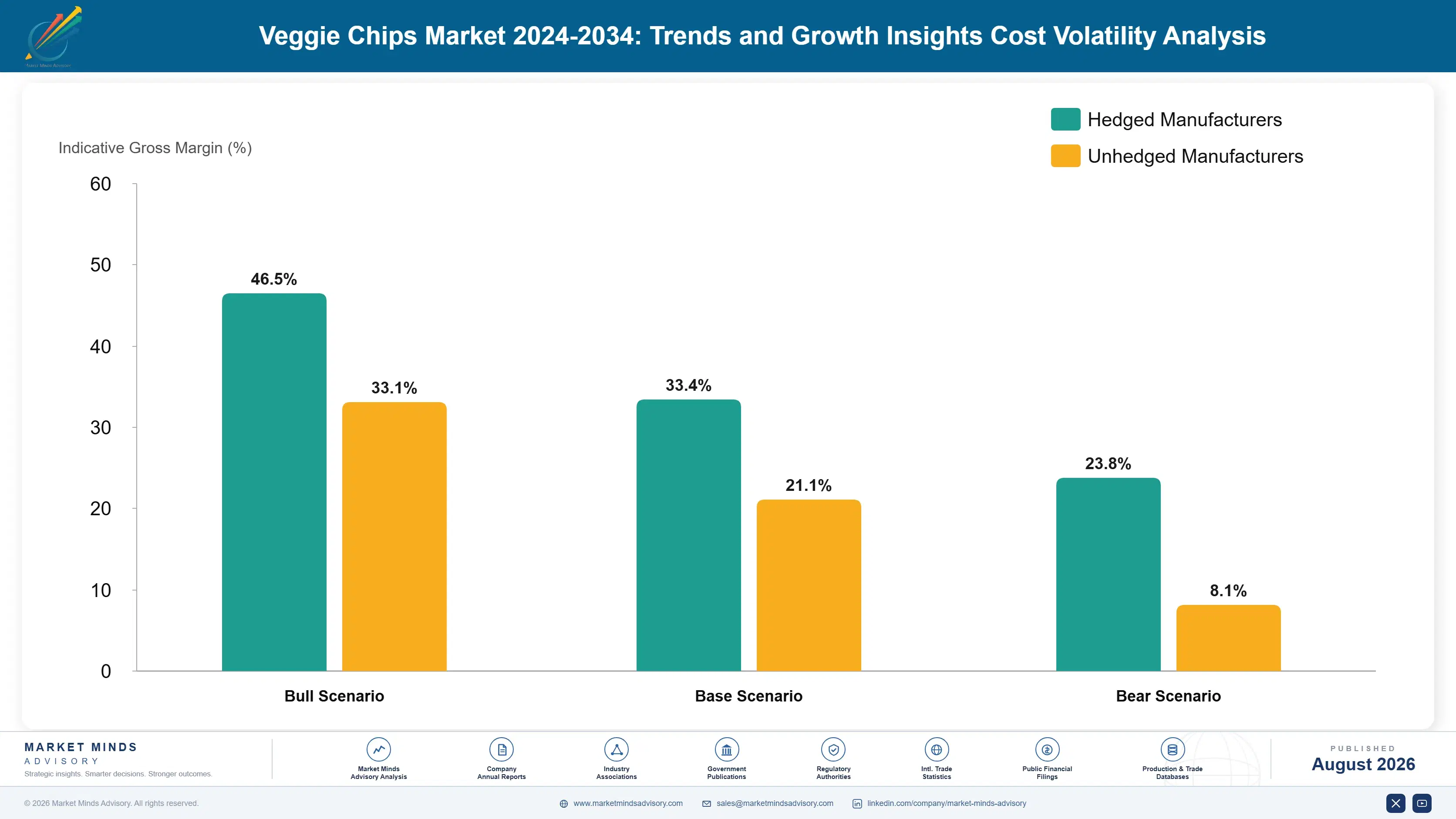
Frying oil and raw vegetable together dominate the cost structure. Sunflower, rapeseed and high oleic oils account for roughly 29% of cost of goods on a fried root product, and the raw vegetable a further 24% before any reject allowance is applied. Sunflower oil comes principally from Ukraine, Russia and Argentina, root vegetables from domestic and Northern European growers, and pulse flours from Canadian, Indian and Australian processors.
Sunflower oil pricing moved violently after 2022 when Black Sea export disruption removed a substantial share of global supply from the market within weeks. Manufacturers switched to rapeseed and high oleic alternatives at cost and reformulation effort, and USDA reporting documented the oilseed movements. Energy costs rose simultaneously, which matters disproportionately when frying. Pulse flour pricing has been comparatively stable, which is one more reason legume bases have gained.

The reject rate is the exposure nobody outside the industry sees. Roughly 23% of root output fails colour inspection, so a processor pays for raw material, oil and energy on product that never reaches a bag. A pulse or extruded operation rejects a small fraction of that. Manufacturers weighted toward fried root formats carry both the oil exposure and the yield loss.
veggie-chips-market-trends-growth-cost-volatility-analysis-1787641413687

Specify sugar profile in grower contracts

Colour variation during frying traces back to sugar content that varies by variety, season and storage duration, and none of it is visible on delivery without testing. Contracts specifying variety and storage, with testing at intake, reduce the variation reaching the fryer. Growers accept the constraint where a premium is attached, which is cheaper than rejecting a quarter afterwards.

Install optical sorting after frying rather than before

Colour defects appear during frying rather than on the raw slice, so inspection before the fryer catches almost nothing that matters. Optical sorting on the exit belt removes defective product before packing and generates data on which crop batches and settings produce the problem. That feedback loop is worth more over time than the sorting itself.

Dual qualify frying oils before the next supply shock

Black Sea sunflower disruption caught manufacturers with single oil specifications and forced reformulation under time pressure, which is the worst moment to do it. Qualifying rapeseed and high oleic alternatives in advance converts a crisis into a switching decision. Qualification costs little in a stable period and cannot be rushed in an unstable one.

Portfolio Architecture for Margin Defence

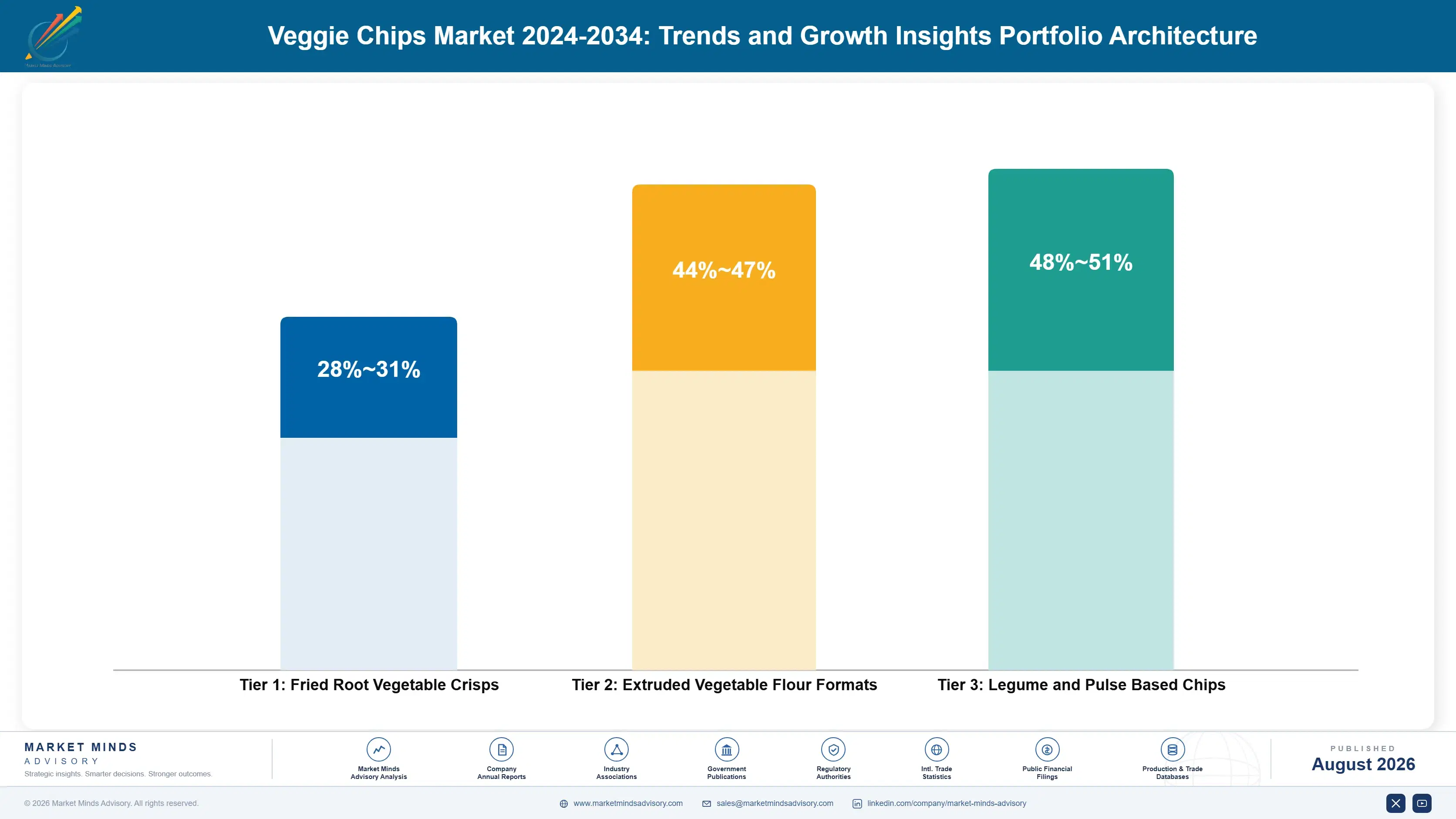
Margin architecture follows manufacturing yield far more than it follows positioning. Fried root formats carry the highest raw material and oil cost and lose roughly 23% of output to colour rejection, which is why the 58% retail premium produces ordinary rather than exceptional margins. Extruded formats cost least to make and reject almost nothing. Legume bases sit between the two on cost and command the strongest claim, which is the best combination available.
The tension is that the format shoppers recognise is the one that earns worst. Root vegetable crisps built this category and remain what most people picture, while carrying the yield loss, the oil exposure and a health claim that fails inspection. Pulse and extruded formats earn better and look less like what a shopper came to buy. Reformulating toward them means teaching a category what it now is.

High value pools concentrate in pulse based products supporting a quantified protein claim and in extruded formats delivering genuine fat reduction at low manufacturing cost. Everything fried in oil and named after a root carries the reject rate, the oil volatility and a positioning the panel undermines.

Fried Root Vegetable Crisps

Beetroot, parsnip and carrot formats carrying high oil and raw material cost alongside roughly a quarter of output rejected for colour variation. The retail premium funds the rework rather than reaching the margin line in any meaningful way.
Gross Margin: 28-31%

Extruded Vegetable Flour Formats

Puffed formats manufactured at low cost with almost no rejected output and a genuine fat reduction claim behind them. Margin holds because manufacturing yield is high and the nutritional statement survives shopper inspection of the pack.
Gross Margin: 44-47%

Legume and Pulse Based Chips

Pulse flour products delivering genuine protein content from the base rather than from fortification, supporting a front of pack claim retailers reward with facings. Margin is the best available and manufacturing avoids the root frying yield problem entirely.
Gross Margin: 48-51%
veggie-chips-market-trends-growth-portfolio-architecture-1787641414194

High-value Sub-segments and Strategic Watch-out

Legume and Pulse Chips

The fastest growing base at 10.8% and the only one whose nutritional claim survives a shopper turning the pack over. Manufacturing also avoids the sugar variability that rejects roughly a quarter of root vegetable output, which makes the economics as good as the positioning. Both halves work together.
Gross Margin: 48-51%

Vegetable Flour Extruded Snacks

Second fastest at 9.4% and the cheapest format to manufacture, with genuine fat reduction of around 42% against fried equivalents. Texture differs noticeably from a fried slice, which is best addressed by positioning it as a distinct product rather than as any substitute. Cost per bag is lowest here.
Gross Margin: 44-47%

Root Vegetable Crisps

Growing at 5.4% and carrying the category's recognition alongside its worst economics, since roughly 23% of output is rejected and fat content nearly matches potato crisps. It remains what shoppers picture when they hear the category name, which is now working against it. Recognition is now a liability.
Gross Margin: 28-31%

Kale and Leafy Vegetable Chips

Growing at only 4.2% and losing distribution steadily, since it positioned entirely on health while offering a leafy vegetable fried in oil. It was the purest expression of the halo the category was built on, and it is disappearing first for exactly that reason. Nobody is defending it.
Gross Margin: 34-37%

How Shoppers Return to This Shelf

Purchase frequency is the structural weakness here. A veggie chip facing turns at roughly a third the rate of a comparable potato facing, because this is an occasional purchase for most households rather than a routine one. At a 58% premium no marketing converts an occasional buyer into a weekly one, so growth comes from more households buying occasionally.
Stickiness varies by why the household bought. Shoppers buying for a genuine dietary reason, whether protein, gluten avoidance or pulse preference, return with routine frequency and behave like a staple buyer. Shoppers buying on health positioning return until they read the panel. Shoppers buying for sharing occasions return seasonally and reliably, a smaller but far more predictable pattern.

The decision moved from the front of the pack to the back of it. Purchases were once driven by a vegetable name and an implied benefit that required nothing to substantiate it. Shoppers now compare protein, fat and ingredient count against the potato crisps sitting beside them on the same fixture, and a fried root crisp at 94% of potato fat content loses that comparison. Brands built on positioning are being read rather than believed.
veggie-chips-market-trends-growth-end-use-penetration-index-1787641414690

Where This Category Rewards Effort

These are among the four positions where our research anticipates prominent divergence between winners and laggards over the coming forecast period. Each is grounded in the demand model, the regulatory perimeter, and the announced capacity pipeline.
01 / BASE REFORMULATION PRIORITY

A vegetable name no longer implies any benefit

A fried root crisp carries roughly 94% of the fat a potato crisp does per gram, which means the positioning that built this entire category fails the moment a shopper turns the pack over and reads it. Legume bases deliver around 6.4 grams of protein per serving and grow at 10.8% against a market rate of 7.2% precisely because that claim survives inspection. Reformulating toward pulse bases also removes the frying yield problem entirely, which makes it an unusually clean commercial decision to take.
02 / FRYING YIELD RECOVERY

A quarter of the beetroot never reaches a bag

Roughly 23% of root vegetable output is rejected for colour variation caused by sugar content varying with variety, season and storage rather than by any process fault anybody controls. That rework funds most of the 58% retail premium and delivers no value whatever to the consumer paying it. Vacuum frying, sugar profile specification in grower contracts and optical sorting after the fryer each recover meaningful yield, and halving the reject rate improves margin more than any pricing action available in this category.
03 / TRADITIONAL MARKET ACCESS

Pulse snacking already exists where growth is fastest

India grows at 13.6%, faster than any market covered, because chickpea, lentil and gram flour snacks have been eaten there for generations and modern retail is simply packaging that consumption for the first time. Raw material supply, processing knowledge and taste expectation are all established locally, which removes the development burden a Western entrant carries entirely. Domestic brands hold a substantial head start on formulation, so partnership or acquisition reaches this demand considerably faster than building a range from scratch ever would.
04 / SHELF ALLOCATION ARGUMENT

Argue margin per metre before the range review

A veggie chip facing turns at roughly a third the rate of a comparable potato facing, and any range review conducted on rate of sale reaches the obvious conclusion about which product should hold the space. The counter argument is margin per linear metre rather than units per facing, since a 58% premium means fewer packs generate comparable cash for the retailer. Manufacturers that arm category managers with that data retain space, and those that arrive afterwards with a velocity problem do not.

Engagement Snapshot From the Field

A live engagement with an industry participant carrying material or product regulatory and market exposure ahead of a defining policy shift, showing how our research translates into a defensible multi-year portfolio strategy.
MARKET MINDS ADVISORY · CLIENT ENGAGEMENT SUMMARY
Veggie Chips 2024-2034: Trends and Growth Insights Producer Strategic Portfolio Review and Transition Roadmap 2026·Investment Scenario on Veggie Chips 2024-2034: Trends and Growth Insights Exposure Evaluation 2025-26
CLIENT PROFILE
A premium vegetable crisp manufacturer producing fried root vegetable formats for retail across seven European markets, with roughly 82% of volume in beetroot, parsnip and carrot. Annual revenue was approximately 140 million dollars (client-reported, unverified by MMA). No pulse or extruded capability existed in the production estate, and facings had been reduced at two major retail customers.
STRATEGIC CHALLENGE
Volume had been flat for three years while legume based competitors grew, and two retailers had cut facings following range reviews conducted on rate of sale. Management wanted to know whether to defend the premium root position, add a pulse range, or invest in frying yield. The technical team and the commercial team each favoured a different answer entirely.
MMA APPROACH
MMA modelled contribution by format including reject rates rather than on nominal recipe cost, which had never been done at product level. Shopper research measured purchase decisions against nutrition panel content on the fixture. Forty-seven expert interviews with category managers, shoppers and frying process specialists established what drives facing allocation and what actually causes colour rejection.
KEY FINDINGS
  1. True contribution on root formats was 34% below recipe cost modelling once reject rates were included, which had never appeared in any product profitability analysis.
  2. Category managers in 31 of the 47 interviews said margin per linear metre would have retained facings, and no supplier had presented that figure to them.
  3. Shoppers comparing panels chose pulse based products roughly 3 times more often than root crisps when a protein figure appeared on front of pack.
  4. Sugar profile testing at intake predicted 71% of colour rejection, meaning most of the loss was traceable to crop specification rather than to frying settings.
CLIENT PROFILE
A premium vegetable crisp manufacturer producing fried root vegetable formats for retail across seven European markets, with roughly 82% of volume in beetroot, parsnip and carrot. Annual revenue was approximately 140 million dollars (client-reported, unverified by MMA). No pulse or extruded capability existed in the production estate, and facings had been reduced at two major retail customers.
STRATEGIC CHALLENGE
Volume had been flat for three years while legume based competitors grew, and two retailers had cut facings following range reviews conducted on rate of sale. Management wanted to know whether to defend the premium root position, add a pulse range, or invest in frying yield. The technical team and the commercial team each favoured a different answer entirely.
MMA APPROACH
MMA modelled contribution by format including reject rates rather than on nominal recipe cost, which had never been done at product level. Shopper research measured purchase decisions against nutrition panel content on the fixture. Forty-seven expert interviews with category managers, shoppers and frying process specialists established what drives facing allocation and what actually causes colour rejection.
KEY FINDINGS
  1. True contribution on root formats was 34% below recipe cost modelling once reject rates were included, which had never appeared in any product profitability analysis.
  2. Category managers in 31 of the 47 interviews said margin per linear metre would have retained facings, and no supplier had presented that figure to them.
  3. Shoppers comparing panels chose pulse based products roughly 3 times more often than root crisps when a protein figure appeared on front of pack.
  4. Sugar profile testing at intake predicted 71% of colour rejection, meaning most of the loss was traceable to crop specification rather than to frying settings.
RECOMMENDED STRATEGY
Phase 1: Phase one: introduce sugar profile testing at intake and specification in grower contracts, since it predicts 71% of colour rejection before frying. Phase 2: Phase two: present margin per linear metre to category managers ahead of range reviews, since 31 of 47 said it would have retained facings. Phase 3: Phase three: add a pulse based range within two years, since shoppers choose panel credible products roughly 3 times more often.
OUTCOME
The client introduced intake testing within one season and reject rates fell materially in the following production year. Facings were restored at one of the two retailers after margin data was presented, and a pulse range launched the year after now contributes a growing share of revenue at better margins than the root business (client-reported, unverified by MMA).

Frequently Asked Questions

Foundational context covering the market sizes, CAGR, scope, country, region and competition that inform every finding below. This section is provided to cover basics and most often pre-purchase conversations, answered from the MMA Primary Research Dataset.

What is the current size of the Veggie Chips Market?

The market was valued at 6.8 billion dollars in 2025, covering root, sweet potato, legume, leafy, extruded and puffed vegetable snack formats. It reaches an estimated 7.29 billion dollars during 2026.

How large will the Veggie Chips Market be by 2036?

MMA forecasts 14.61 billion dollars by 2036, an increase of 7.32 billion dollars over the 2026 base. That represents an expansion multiple of 2.00 times across the forecast period.

What is the CAGR for the Veggie Chips Market 2026 to 2036?

The base case compound annual growth rate is 7.2%, with a bull case of 8.4% and a bear case of 6.0%. Panel credible reformulation and retail range reviews separate those scenarios.

Which segment is growing fastest?

Legume and pulse chips grow at 10.8%, half again the market rate of 7.2%, because they deliver genuine protein from the base. Extruded vegetable flour formats follow at 9.4%.

Who are the major companies in the Veggie Chips Market?

PepsiCo, Kellanova, Calbee, General Mills and Utz Brands lead on retail volume across their distribution networks worldwide. Together they account for 38% of the market.

Which country is growing fastest?

India grows fastest at 13.6%, as modern retail converts generations of traditional chickpea, lentil and gram flour snacking into branded packaged formats with nutrition panels attached.

Report Segmentation Architecture

The full report scope spans multiple orthogonal segmentation dimensions, with cross-tabulated demand data provided for each dimension pair. Coverage extends further to regional breakdowns, trend trajectories, and the competitive detail needed to support segment-level decision-making.

By Product Base

  • Root Vegetable Crisps
  • Sweet Potato Chips
  • Legume and Pulse Chips
  • Kale and Leafy Vegetable Chips
  • Vegetable Flour Extruded Snacks
  • Vegetable Straws and Puffs

By End-Use Industry

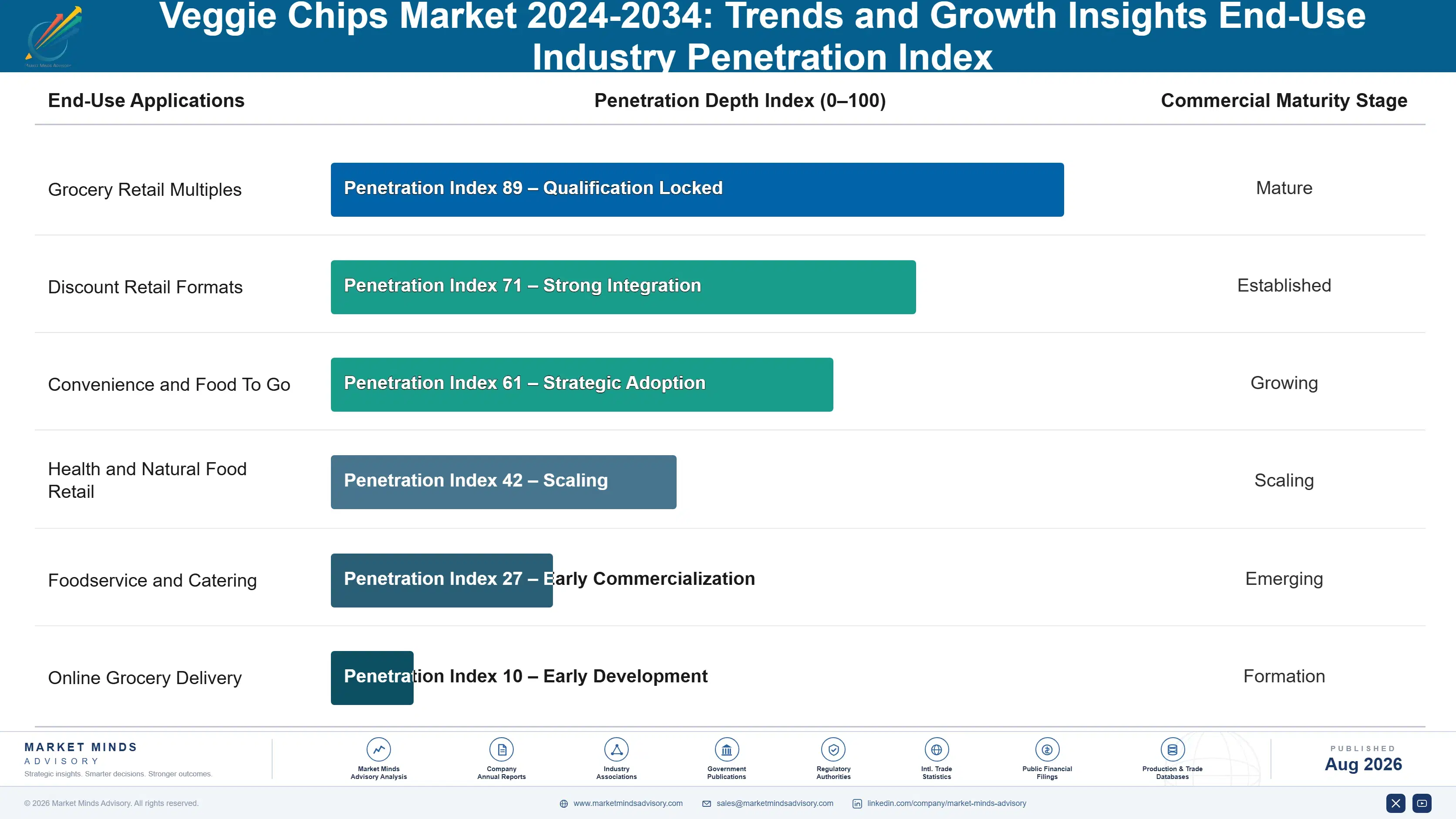
  • Grocery Retail Multiples
  • Discount Retail Formats
  • Convenience and Food To Go
  • Health and Natural Food Retail
  • Foodservice and Catering
  • Online Grocery Delivery

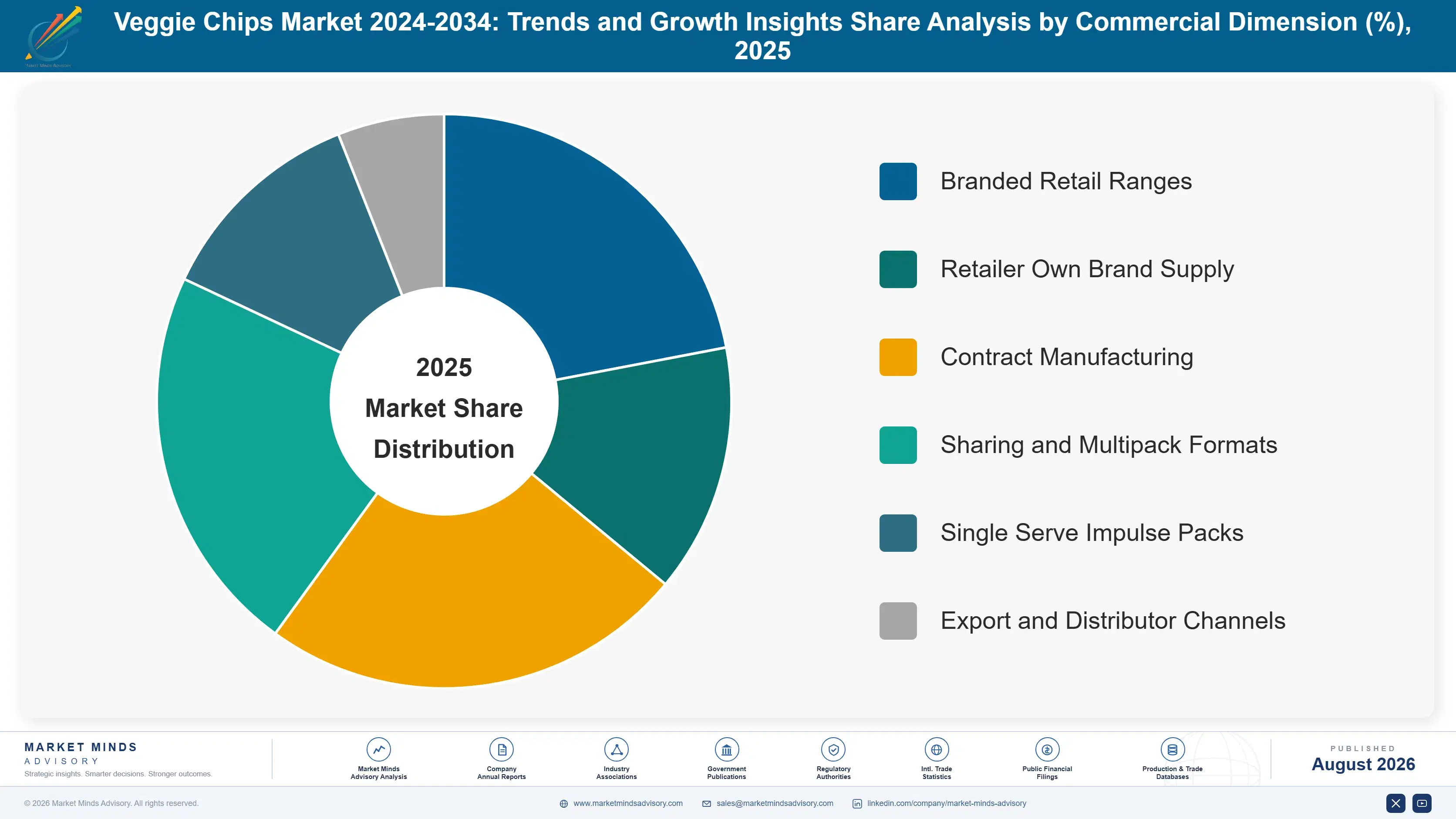
By Commercial Dimension

  • Branded Retail Ranges
  • Retailer Own Brand Supply
  • Contract Manufacturing
  • Sharing and Multipack Formats
  • Single Serve Impulse Packs
  • Export and Distributor Channels

By Region

  • North America
  • Western Europe
  • East Asia
  • South Asia and Pacific
  • Latin America
  • Middle East and Africa
  • Eastern Europe

Scope, Methodology, and Coverage

Every figure in this report is reproducible from documented input assumptions. The scope below maps the historical period, the forecast horizon, the segmentation dimensions, and the countries covered, alongside the underlying primary and qualitative methodology.
Historical Period
2020 to 2025
Forecast Period
2026 to 2036
Base Year
2025 (USD billions; MMA Primary Research Dataset, August 2026)
Market Definition
Vegetable based savoury snack chips sold through retail and foodservice worldwide, covering root vegetable crisps, sweet potato chips, legume and pulse chips, kale and leafy vegetable chips, vegetable flour extruded snacks, and vegetable straws and puffs across bagged, multipack and sharing formats. Measured at retail selling value. Potato crisps, corn tortilla chips, fruit chips, popcorn, extruded corn snacks, nuts and seeds, and vegetable crisps sold as manufacturing ingredients are excluded from scope.
Quantitative Units
USD billions (current prices); tonnes sold; USD per hundred grams by product base and format
Segmentation Dimensions
Product base; end-use industry; commercial dimension; region
Regions Covered
North America, Western Europe, East Asia, South Asia and Pacific, Latin America, Middle East and Africa, Eastern Europe
Countries Covered
United States, Canada, United Kingdom, Netherlands, Germany, France, Spain, Italy, Japan, China, South Korea, Taiwan, India, Thailand, Vietnam, Australia, Brazil, Mexico, Israel, Poland
Key Companies Profiled
PepsiCo, Kellanova, Calbee, General Mills, Utz Brands, Hain Celestial, Rhythm Superfoods, The Real Good Food Company, KP Snacks, Intersnack Group, Lorenz Snack-World, Haldiram's, Bikanervala, ITC Limited, Want Want China, Orion Corporation, Nongshim, Snack Brands Australia, Simple Mills, Amica Chips
Quantitative Methodology
Primary survey, n=3,800 respondents, Q4 2025, six countries; demand-side model with trade association cross-validation
Qualitative Methodology
47 expert interviews, Q4 2025; applied to validate demand model assumptions, identify emerging dynamics, and assess competitive positioning
Report Format
PDF and XLSX data workbook (Word format preview document)
Publisher
Market Minds Advisory
Report Code
MMA-2026-AGR-204
Published
August 2026
Contact
sales@marketmindsadvisory.com | www.marketmindsadvisory.com

Purchase the full Veggie Chips Market 2024-2034: Trends and Growth Insights Report (2026 to 2036).

The full report treats veggie chips as a category whose health positioning fails a nutrition panel, since a fried root crisp carries almost the same fat per gram as a potato crisp and shoppers have started reading the pack. It sizes all six product bases independently through 2036, models contribution including frying reject rates rather than on nominal recipe cost, and quantifies the facing allocation argument against potato velocity. Regional chapters cover all seven regions, with traditional pulse snacking traditions assessed separately from Western health positioning. Competitive profiling covers 20 participants on one consistent retail volume basis.
Six product bases sized independently through 2036
Contribution modelled including frying reject rates by format
Facing allocation argument quantified against potato crisp velocity
Traditional pulse snacking assessed separately from Western positioning
Nutrition panel purchase decisions measured through shopper research
Twenty participants profiled on one consistent volume basis

Built For The People Who Decide

From boardroom strategy to bench-side execution, this report is read cover-to-cover by leaders shaping the next decade of their industry, turning demand scenarios, market dynamics and valuation benchmarks into decisions.
CXOs/ Presidents/ VPs/ Managers
M&A and Corporate Development
Strategy Teams and R&D Heads
Procurement and Product Directors
Regulatory and Compliance Leaders
Investor Relations and Equity Analysts