
Market Minds Advisory
Vegetable Dicing Machines Market

Vegetable Dicing Machines Market: Vegetable Dicing Machines: Yield Economics, Blade Consumption and Cut Quality Measured in Shelf Life

Raw vegetables are roughly 66% of processed product cost, so a two point yield improvement is worth more than the machine that delivers it, which is why processors replace equipment that still works.

Lead Analyst

Lisa Gevelber

Published

August 2026

Make Smarter Decisions with Customized Research Insights

Request a free sample report and evaluate market opportunities, growth trends, and competitive dynamics relevant to your business needs.

2025 MARKET VALUE$0.6BMarket Size 2025
2036 FORECAST VALUE$1.2BBase Case , 2026 to 2036
CAGR 2026 TO 20365.8 %Bull 7.0% / Bear 4.6%
INCREMENTAL OPPORTUNITY$0.5BNet 10- year value creation
EXPANSION MULTIPLE1.76x2036 value over 2026 base
Strategic Levers
M&A Pipeline
Regional Outlook
Country Rankings
Competitive Intelligence
Segmental Deep-dive
Call-Us : 91 93563 13602

Executive Snapshot and Market Trajectory.

A dicing machine is bought once and then buys blades forever. Roughly 58% of builder revenue arrives after the machine is installed, through knife assemblies consumed every 180 running hours, because dicing a carrot dulls steel and nothing anyone has tried stops it doing so.
The reason blade condition matters is not maintenance discipline. A dull knife tears rather than cuts, and a ragged surface browns, leaks and loses roughly three days of chilled shelf life against a clean one. Cut quality in this business is measured in days at the far end of a distribution chain, which is a considerably more expensive number than the blade that produced it. Nobody buys a machine to save on blades.
Everyone assumes automation drives this market and yield actually does. Raw vegetables account for around 66% of processed product cost, so a machine producing two points more usable product than the one beside it pays for itself before the automation argument is even made. Waterjet systems grow fastest at 8.7%, half again the market rate of 5.8%, because a waterjet has no blade to dull across a shift.
Market Definition
Machines used to dice, cube and portion vegetables in commercial and industrial food processing, covering centrifugal dicers, belt fed dicers, waterjet cutting systems, vision guided robotic dicing cells, rotary knife dicers, and foodservice bench dicers. Measured at builder selling value including machines, knife assemblies and spare parts. Slicing and shredding equipment without dicing capability, meat and protein cutting machines, peeling and washing lines, and packaging equipment are excluded.
Base Year Value
$0.6B in 2025 (MMA Primary Research Dataset, August 2026)
Forecast Period
2026 to 2036, eleven discrete annual values
CAGR
5.8% base case. Bull 7.0%. Bear 4.6%.
Fastest Growth Segment
Waterjet Cutting Systems: 8.7% CAGR
Fastest Growth Country
Mexico: 10.2% CAGR
Fastest Growth Region
South Asia and Pacific: 8.0% CAGR
Largest Region
Western Europe: 26% of 2025 global value
Market Leaders
Urschel Laboratories, Marel, JBT Corporation, Kronen, TOMRA Systems. Source: MMA Primary Research Dataset, July 2026.
Primary Survey
n=3,800 procurement and R&D decision-makers, Q4 2025, six countries
Methodology
Demand-side build-up, cross-validated against public data, 47 expert interviews

Vegetable Dicing Machines Market Forecast Scenarios

vegetable-dicing-machines-market-trends-size-forecast-scenario-1787641393339
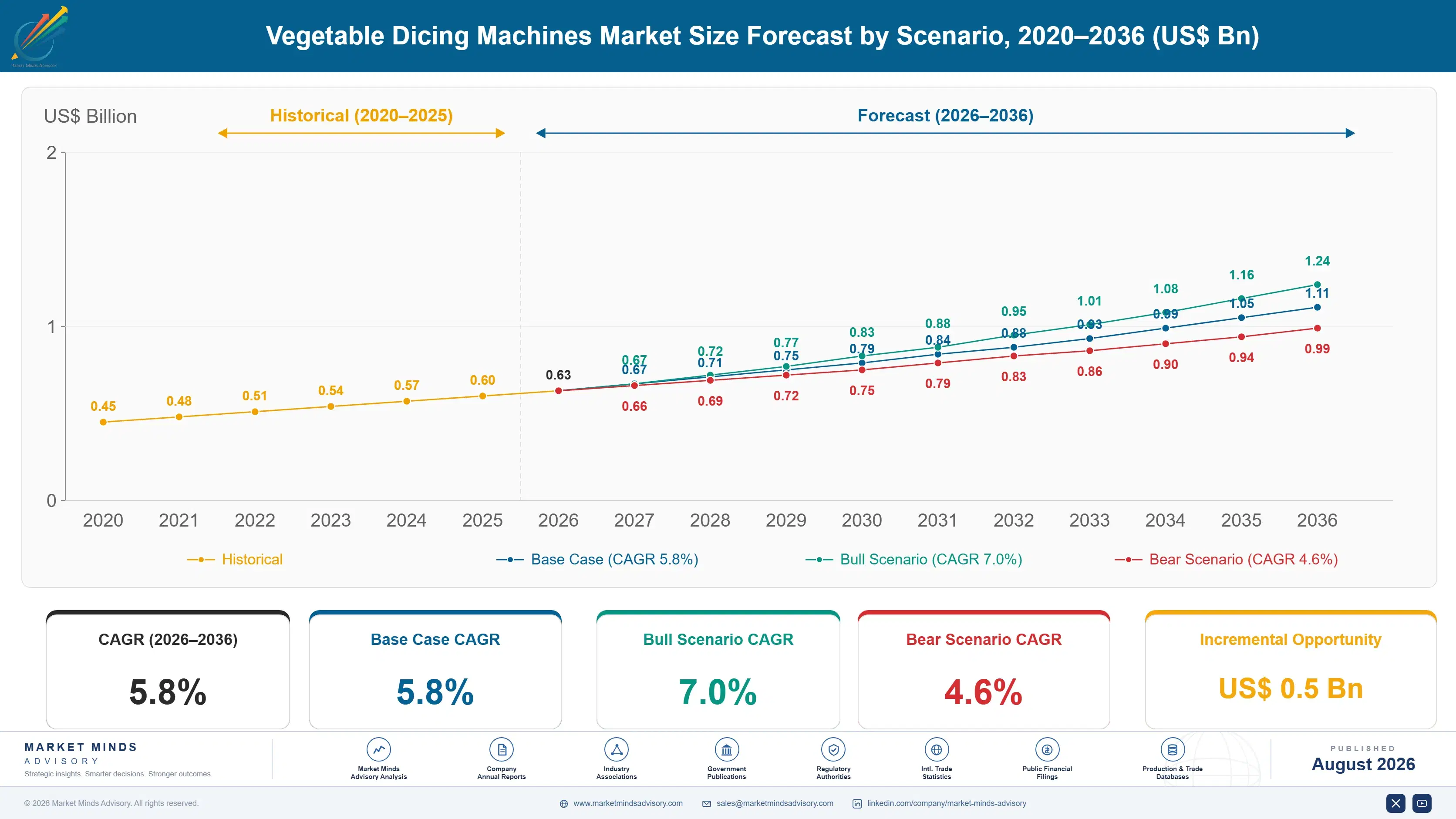
The five years to 2025 were shaped by labour cost rather than by any change in food demand. Processors across developed markets faced wage inflation and recruitment difficulty at once, which moved manual portioning onto machines previously hard to justify. Fresh cut volumes grew throughout, since convenience formats held up. The 4.6% historical rate reflects substitution of labour rather than category growth.
The 5.8% base case rests on three mechanisms. Yield improvement continues driving replacement of working equipment, because raw vegetables are around 66% of processed product cost and a two point gain outweighs the capital cost of the machine delivering it. Waterjet and vision guided systems keep taking high value and irregular product that mechanical blades damage. And fresh cut processing capacity keeps expanding in Mexico, Eastern Europe and Southeast Asia, serving markets that import prepared vegetables rather than processing them domestically.
The 7.0% bull case turns on vision guided robotic cells reaching a price point mid sized processors can justify, which would open a customer base currently priced out entirely. The 4.6% bear case is capital deferral: machines last around 14 years and a processor under margin pressure runs equipment past its optimal replacement point without anything breaking.

Where Yield Beats Throughput Every Time

The capital sale is not the business. Roughly 58% of builder revenue arrives afterwards through knife assemblies, impellers and wear parts consumed across a machine life of around 14 years, and knife sets need exchanging every 180 running hours or so. Builders defend the parts stream fiercely, because a processor buying blades from a third party removes most of the value in the relationship.
TOP FIVE CONCENTRATION42%Combined machine shipments held by the largest builders
RAW MATERIAL COST SHARE66%Portion of processed product cost sitting in vegetables
BLADE REPLACEMENT INTERVAL180 hoursTypical running time before knife assemblies require exchange
PARTS REVENUE SHARE58%Portion of builder revenue arriving after the machine
MACHINE SERVICE LIFE14 yearsTypical working life before a processor replaces equipment
SHELF LIFE GAIN3 daysAdditional chilled life from a clean cut surface
Blade condition matters for reasons that have nothing to do with maintenance culture. A dull knife tears plant tissue instead of severing it, and a ragged cut surface oxidises faster, leaks cell fluid and supports microbial growth. That costs roughly three days of chilled shelf life against a clean cut, measured at the far end of a distribution chain where three days decides whether a pack sells or gets marked down.
Yield is the argument that actually sells machines. Raw vegetables account for around 66% of the cost of a processed product, so a dicer producing two points more usable output than the one beside it generates a return that dwarfs any labour saving. That is why processors replace equipment still working perfectly well.
"Builders present throughput figures and processors listen politely. The number that closes the sale is what percentage of the carrot leaves the machine as a saleable cube, and almost nobody leads with it."
Director, Food Processing Equipment and Automation Practice · MMA Industrial Equipment and Machinery Practice · August 2026

Market Trends

Waterjet Cutting Removes the Blade From the Equation

A waterjet has nothing to dull, so cut quality does not degrade across a shift the way a mechanical knife does, and it handles cooked potato, avocado, mushroom and other soft or irregular product that blades tear rather than cut. Growth runs at 8.7% against a market rate of 5.8%, fastest in the market. The trade is real: waterjet throughput is considerably lower and energy consumption higher, which makes it uneconomic on carrots and onions where volume decides everything. It wins on high value product where a damaged cut costs more than the electricity does.
Market Impact: Two yield points outweigh 100% cost
Vision Guided Cells Bring Yield Optimisation to Irregular Product

Camera guided robotic dicing cells assess each piece before cutting, adjusting the cut pattern to the actual shape rather than to an assumed one, which recovers usable product that fixed geometry machines send to waste. Growth of 7.6% is second fastest in the market and the argument is entirely yield, worth more than any labour saving in a business where raw material is 66% of product cost. Cost currently limits adoption to large processors handling premium product. The technology also handles mixed product streams that would require separate lines otherwise.
Market Impact: Mexico grows at 10.2% annually

Market Opportunities and Growth Drivers

Yield Improvement Justifies Replacing Working Equipment

Raw vegetables account for roughly 66% of processed product cost, which makes a two point yield improvement worth more than the capital cost of the machine delivering it within a single season. That produces replacement behaviour most capital equipment markets never see, with processors retiring machines that run perfectly well because a newer one wastes less carrot. Builders that quantify yield in a trial installation close sales that throughput comparisons never would. The processors most willing to replace early are those handling premium product where the raw material cost share runs higher still.
Market Impact: Threatens 58% of builder revenue

Fresh Cut Processing Capacity Expands Into Export Hubs

Prepared and fresh cut vegetable processing continues concentrating in countries with agricultural output, lower labour cost and proximity to consuming markets, and each new facility specifies a full complement of dicing capability from a standing start. Mexico grows at 10.2%, faster than any country covered, supplying prepared produce into North America. Polish and Spanish capacity serves Western Europe on the same logic, and Vietnamese and Thai facilities serve East Asian markets. Greenfield installations select equipment without displacing anything, which is a considerably easier sale than a replacement. Specification happens at design stage.
Market Impact: Machines last 14 years typically

Market Restraints and Challenges

Third Party Blade Supply Erodes the Parts Annuity

Roughly 58% of builder revenue arrives after the machine through knife assemblies and wear parts, and independent manufacturers now produce compatible blade sets for most established dicer platforms at meaningful discounts. The root cause is that a knife is a geometry rather than a technology, and once a machine has been in the field for a decade the geometry is well understood by anybody willing to measure it. Commercially this attacks the most profitable revenue a builder holds. Responses include proprietary mounting systems, coated blade formulations and service agreements bundling parts with performance guarantees.
Market Impact: Waterjet grows 8.7% annually

Long Machine Life Makes Replacement Cycles Deferrable

A well maintained dicer runs for around 14 years and frequently longer, and a processor under margin pressure simply keeps running it, since nothing breaks and the yield argument requires believing a projection. The root cause is that the loss from an ageing machine is invisible on any operating statement, appearing as waste that has always been there rather than as a fault. Builders respond with trial installations that measure yield directly against the incumbent machine, which converts an abstract argument into a number a plant manager can verify in a week.
Market Impact: Recovers 4% additional usable yield
3 additional market trends, 4 additional growth drivers, and 2 additional restraints and challenges are covered in the full report. Contact sales@marketmindsadvisory.com to access the complete intelligence.

Segment CAGR and Growth Architecture

Segmentation follows machine type, since type determines which products can be cut, what yield is achievable and how much of the revenue arrives afterwards as blades. Six types cover the field, from a centrifugal dicer handling carrots at volume to a waterjet with no blade at all. Growth follows product value rather than throughput.
vegetable-dicing-machines-market-trends-market-share-analysis-1787641393923

Waterjet Cutting Systems

High pressure water streams cutting product without any mechanical contact, which means nothing dulls across a shift and cut quality at hour eight matches hour one. At 8.7% this is the fastest growing type in the market, half again the market rate of 5.8%, and the advantage concentrates on soft, cooked and irregular product that mechanical blades tear rather than sever. Cooked potato, avocado, mushroom and prepared fruit all cut cleanly where a knife destroys them. The trade is throughput and energy: waterjet runs considerably slower and consumes far more power, which rules it out on carrots and onions where volume decides the economics entirely. Parts revenue is lower, since there are no blades to replace.
CAGR 8.7%

Vision Guided Robotic Dicing Cells

Camera systems assessing each piece before cutting and adjusting the pattern to actual shape rather than to assumed geometry, recovering product that fixed pattern machines send to waste. Growth of 7.6% is second fastest in the market and the case is entirely yield, which matters enormously when raw vegetables are around 66% of product cost. Recovery gains of roughly four points are achievable on irregular product, and that is worth more than any labour saving the cell also delivers. Capital cost currently restricts adoption to large processors handling premium product, though component pricing continues falling. Mixed product streams that would otherwise need separate lines also run through a single cell.
CAGR 7.6%
Full segment breakdown across 6 segments available in the complete report.

Regional Architecture and Country Demand Map

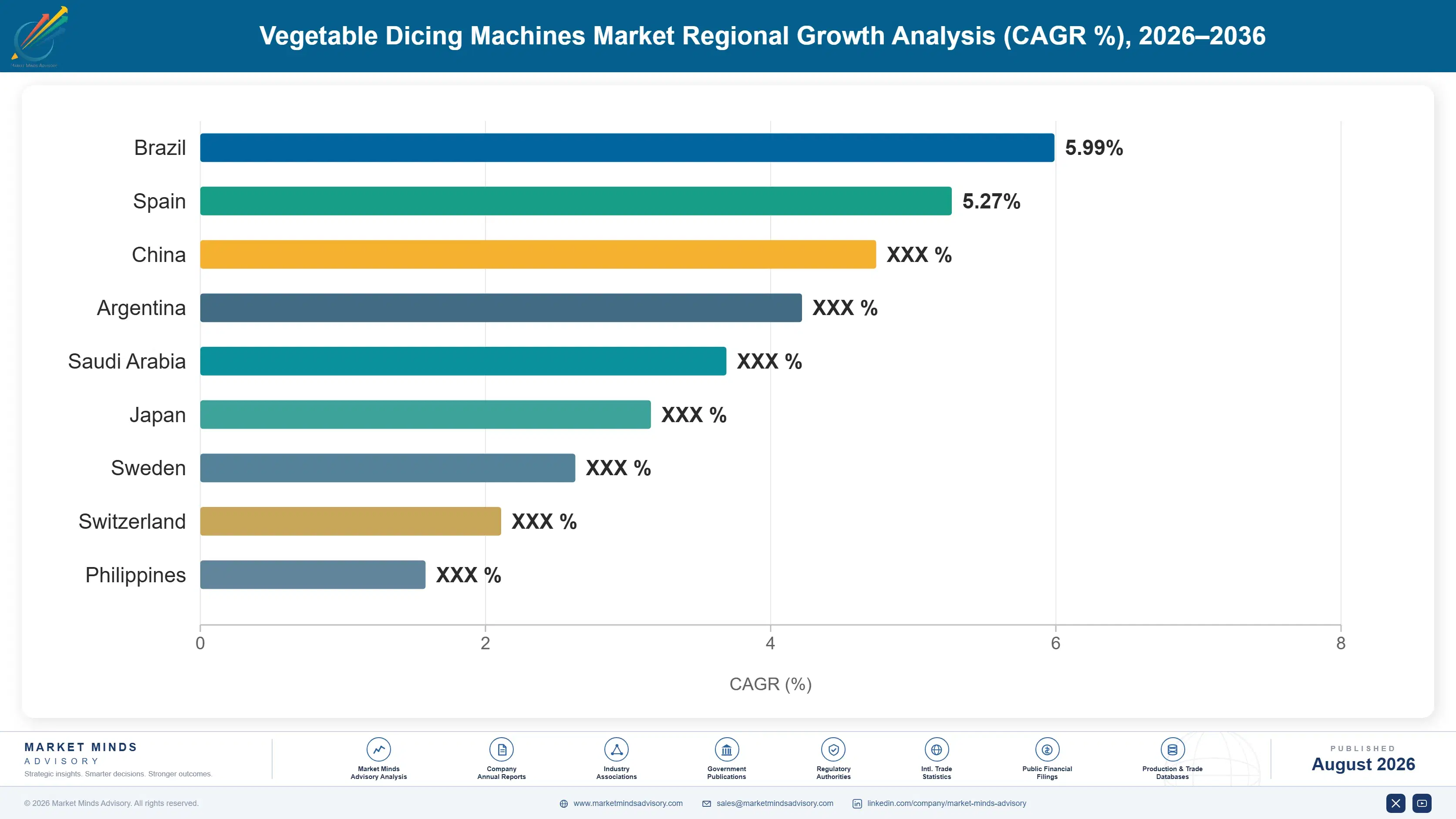
Western Europe holds the largest share at 26%, combining the deepest machine building base with high processing intensity. North America follows on scale and East Asia on volume. Mexico grows fastest of any country covered at 10.2%, on export processing capacity. Blade revenue follows the installed base.

Western Europe

Machine building depth as much as processing volume gives this region its 26% share. Dutch, German and Italian builders supply dicing equipment worldwide and hold engineering positions established over generations, which means regional revenue includes export manufacturing as well as domestic installation. Spanish and Italian processing serves fresh cut and prepared vegetable demand across the continent, with Spanish capacity in particular growing on export supply northward. Dutch processors operate some of the most automated fresh cut lines anywhere. Labour cost pressure has driven yield focused replacement across the region for several years. Growth of 4.2% is the lowest of the seven, reflecting a mature installed base and deferred capital in a difficult margin period.
Share: 26% | CAGR: 4.2% (2026 to 2036)

North America

Scale rather than automation leadership explains this 25% share. American fresh cut and prepared vegetable processing operates at considerable volume, particularly in California, Arizona and the Salinas Valley, and food safety requirements following past contamination events have raised standards for cut surface quality and equipment cleanability substantially. Processors here replace on yield arguments readily, since raw material cost share is high and produce pricing volatile. Canadian processing is smaller and concentrated in Ontario and British Columbia. Much of the equipment installed is imported from European and American specialist builders rather than produced regionally. Growth of 5.2% reflects steady replacement alongside modest capacity addition. Food safety standards raise cut quality requirements considerably.
Share: 25% | CAGR: 5.2% (2026 to 2036)
Regional intelligence for 5 additional markets available in the complete report: East Asia, South Asia and Pacific, Latin America, Middle East and Africa, Eastern Europe. Contact sales@marketmindsadvisory.com.
vegetable-dicing-machines-market-trends-country-cagr-analysis-1787641394466

Where Builders Actually Make Money

The machine sale is not where the return sits, and throughput is not what closes it. Value accrues to whoever proves yield in a trial installation, whoever defends the blade stream against compatible parts, and whoever gets specified into a greenfield line before anything exists to displace. Four routes carry weight, and only one involves selling a machine.

Prove Yield in the Customer's Own Plant

Raw vegetables are roughly 66% of processed product cost, so two points of additional usable output pays for a machine inside a season, and no throughput comparison produces a number of that size. Trial installations measuring yield directly against the incumbent machine convert an abstract projection into something a plant manager verifies within a week. Builders that invested in trial fleets and measurement capability close replacement sales on equipment that still runs perfectly well. Those presenting specification sheets are competing on the one dimension processors care least about, which is an expensive habit.
Market Impact: Two yield points beat 100% of machine cost

Defend the Blade Stream Before Compatibles Arrive

Roughly 58% of builder revenue arrives after the machine through knife assemblies exchanged every 180 running hours, and independent manufacturers now produce compatible sets for most established platforms at meaningful discounts. A knife is a geometry rather than a technology, and after a decade in the field that geometry is understood by anyone willing to measure it. Proprietary mounting systems, coated formulations that genuinely extend interval, and service agreements bundling parts with performance guarantees all work. Doing nothing loses the most profitable revenue in the business slowly and permanently. Doing nothing is the expensive option.
Market Impact: Protects the 58% of revenue arriving after installation

Get Specified Into Greenfield Export Processing Lines

Mexico grows at 10.2%, faster than any country covered, and Polish, Vietnamese and Thai capacity follows the same export processing logic, with each new facility specifying a full complement of equipment from a standing start. A greenfield line displaces nothing and faces none of the resistance a replacement meets, and the specification is written to the standards of the retail customer rather than the host country. Builders present when a project is being designed take the whole line. Those arriving after commissioning are selling replacements fourteen years later. Design stage presence decides everything.
Market Impact: Captures the 10.2% Mexican processing capacity growth rate

Sell Waterjet Where a Blade Would Destroy the Product

Waterjet systems grow at 8.7% against a market rate of 5.8% because they have nothing to dull, and they cut cooked potato, avocado, mushroom and prepared fruit cleanly where a mechanical knife tears. Throughput is considerably lower and energy consumption higher, which rules the technology out on carrots and onions where volume decides everything. Positioning it against high value and soft product rather than against general dicing avoids a comparison it loses. Builders offering both technologies and directing customers correctly hold accounts that single technology competitors keep losing. Directing customers correctly retains accounts.
Market Impact: Grows 8.7% on high value soft product lines

Who Controls the Margin Pool

Concentration is moderate and technology specific. The top five account for 42% of machine shipments and associated parts revenue, the basis applied consistently here, with the remainder spread across specialist builders holding strong positions in individual product categories or geographies. Urschel leads in centrifugal dicing with an installed base and a blade franchise built over decades, and the gap there reflects accumulated field experience rather than any current technical advantage.
Competition runs on three fronts. Established builders compete for replacement sales on demonstrated yield, service response and parts availability, which is a plant level relationship rather than a procurement one. Waterjet and vision guided specialists compete on capability with products mechanical dicers handle badly. Compatible parts manufacturers compete purely on price against a blade stream worth more than the machines themselves.

Rankings will move with vision guided pricing rather than with mechanical improvement. If camera guided cells reach a price mid sized processors can justify, the yield argument that currently sells premium machines gets answered by a different technology entirely. The other pressure point is Chinese domestic building, which serves the largest processing base in the world at price points Western builders have not attempted.
vegetable-dicing-machines-market-trends-company-positioning-matrix-1787641394997

Competitive Moat and Risk Dimensions

URSCHEL LABORATORIES

Moat: Installed Base Blade Franchise

Decades of machine placements across vegetable processing worldwide generate a knife assembly stream consumed every 180 running hours, and the field data accumulated across that base informs cutting geometry no competitor can replicate quickly. Processors also standardise on one platform for parts and training reasons, which makes displacement a plant wide decision rather than a machine level one.
URSCHEL LABORATORIES

Risk: Compatible Parts Erosion

Independent manufacturers now produce compatible knife sets for widely deployed platforms at meaningful discounts, and a blade is a geometry that anyone can measure after a decade in the field. Since roughly 58% of builder revenue arrives through parts, that competition attacks the most profitable line in the business rather than the least.
TOMRA SYSTEMS

Moat: Vision and Sorting Integration

Optical sorting capability developed across food processing applies directly to vision guided dicing, where assessing each piece before cutting recovers yield fixed geometry machines waste. That imaging and algorithm depth took years to build in adjacent applications and transfers without needing to be developed again for this one.
TOMRA SYSTEMS

Risk: Capital Cost Ceiling

Vision guided cells currently price beyond what mid sized processors can justify, which restricts the addressable base to large operations handling premium product. Growth of 7.6% comes from a narrow customer set, and reaching the wider market requires component costs to fall further than any commercial decision can accelerate.

Players Tracked

Prominent Players

Urschel Laboratories
Marel
JBT Corporation
Kronen
TOMRA Systems

Other Key Players

FAM Stumabo
Turatti Group
Sormac
Nilma
Brunner-Anliker
Hallde
Robot Coupe
Treif Maschinenbau
Holac Maschinenbau
Emura Food Machine
Nantsune
Dadaux
Sammic
Electrolux Professional
Hobart

Recent Developments

MARCH 2025

Builder launches coated knife assembly extending replacement interval

A dicing equipment builder introduced a coated knife assembly claiming substantially longer running life than standard steel before exchange becomes necessary. The launch was positioned as a processor cost saving while also making compatible third party blades a less attractive substitute for accounts using the proprietary format.
Signal: Extending the blade interval defends a parts annuity considerably better than any pricing response could manage
JUNE 2025

Mexican fresh cut facility commissions fully specified dicing line

A prepared produce processor commissioned a new fresh cut facility in Mexico supplying North American retail, specifying a complete dicing complement to the standards of its retail customer rather than to local practice. Greenfield projects of this kind select equipment without displacing any incumbent installation.
Signal: Greenfield export capacity is where new equipment gets specified without ever competing against anything already installed
SEPTEMBER 2025

Processor trial demonstrates measurable yield gain over incumbent machine

A European vegetable processor published results from a side by side trial showing measurable usable yield improvement from a replacement dicer against equipment still operating within specification. The trial converted a projection into a verified number, and the processor proceeded with replacement across multiple lines.
Signal: A trial installation measuring actual yield closes replacement sales that a specification sheet simply never will

What Building a Dicer Costs

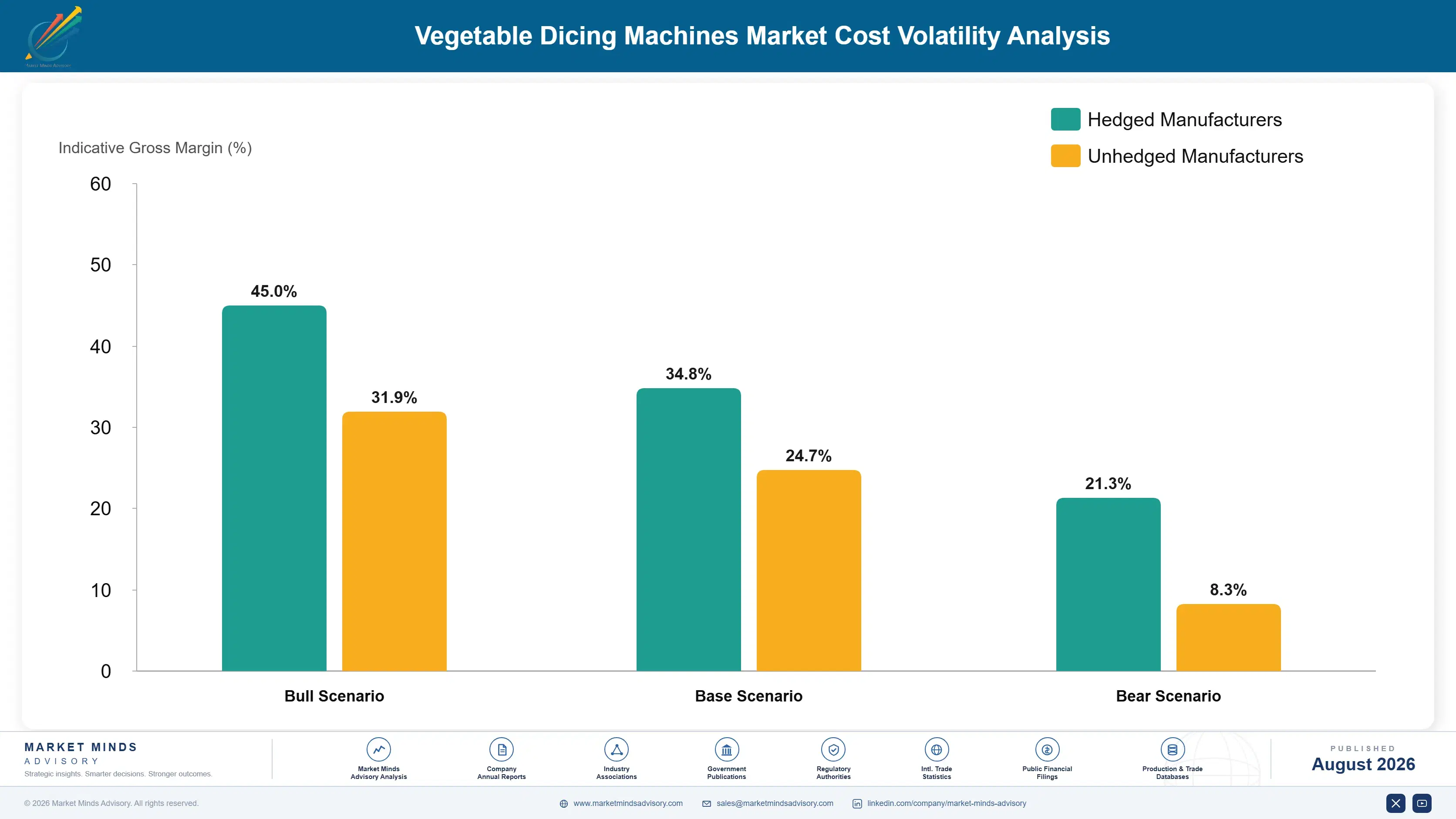
Stainless steel dominates the bill of materials on machine and blade alike. Food grade stainless accounts for roughly 34% of machine cost of goods, with drives, motors and control systems adding a further 26% and machining labour taking most of the remainder. Blade steel is a specialist grade from a few European and Japanese mills, with hardening and grinding held in house at established builders.
Stainless steel pricing moved sharply through the period on nickel and energy costs together. Nickel markets were disrupted in 2022 while European mill energy costs rose, pushing stainless input costs up substantially, and company annual reports across the equipment sector documented the margin pressure. Lead times extended rather than prices rising, since most orders were already contracted. Drive and control component availability compounded it through semiconductor allocation.

Exposure divides by revenue mix rather than by builder size. A company earning 58% of revenue through blades carries steel exposure continuously, though it reprices parts annually where machines are quoted at contract. Builders holding hardening and grinding in house control cost, while those outsourcing carry a supplier margin on their most profitable product. Smaller specialists buying steel in modest quantities pay noticeably more per tonne.
vegetable-dicing-machines-market-trends-cost-volatility-analysis-1787641395198

Index machine quotations to stainless steel benchmarks

Machine build times run months and quotations frequently precede material purchase, which leaves a builder carrying steel movement it never agreed to. Indexation clauses tied to published stainless benchmarks transfer that exposure to the customer, who is generally better able to absorb it. Processors resist initially and accept once the alternative is a wider contingency in the price.

Bring blade hardening and grinding capability in house

Knife assemblies are the most profitable product a dicing builder sells, and outsourcing hardening and grinding hands a supplier margin on exactly that line while limiting control over the geometry consistency that yield depends on. Capital cost is significant and payback runs several years. Builders holding it also respond faster to compatible competition, changing geometry without renegotiating anything.

Qualify alternative drive and control component sources

Semiconductor allocation extended machine lead times across the sector without warning, and a control system waiting on one component holds an entire build. Qualifying alternative drives and controllers requires engineering and certification work that nobody undertakes until a shortage forces it. Builders that maintained qualified alternatives delivered on schedule while competitors quoted lead times customers found unacceptable.

Portfolio Architecture for Margin Defence

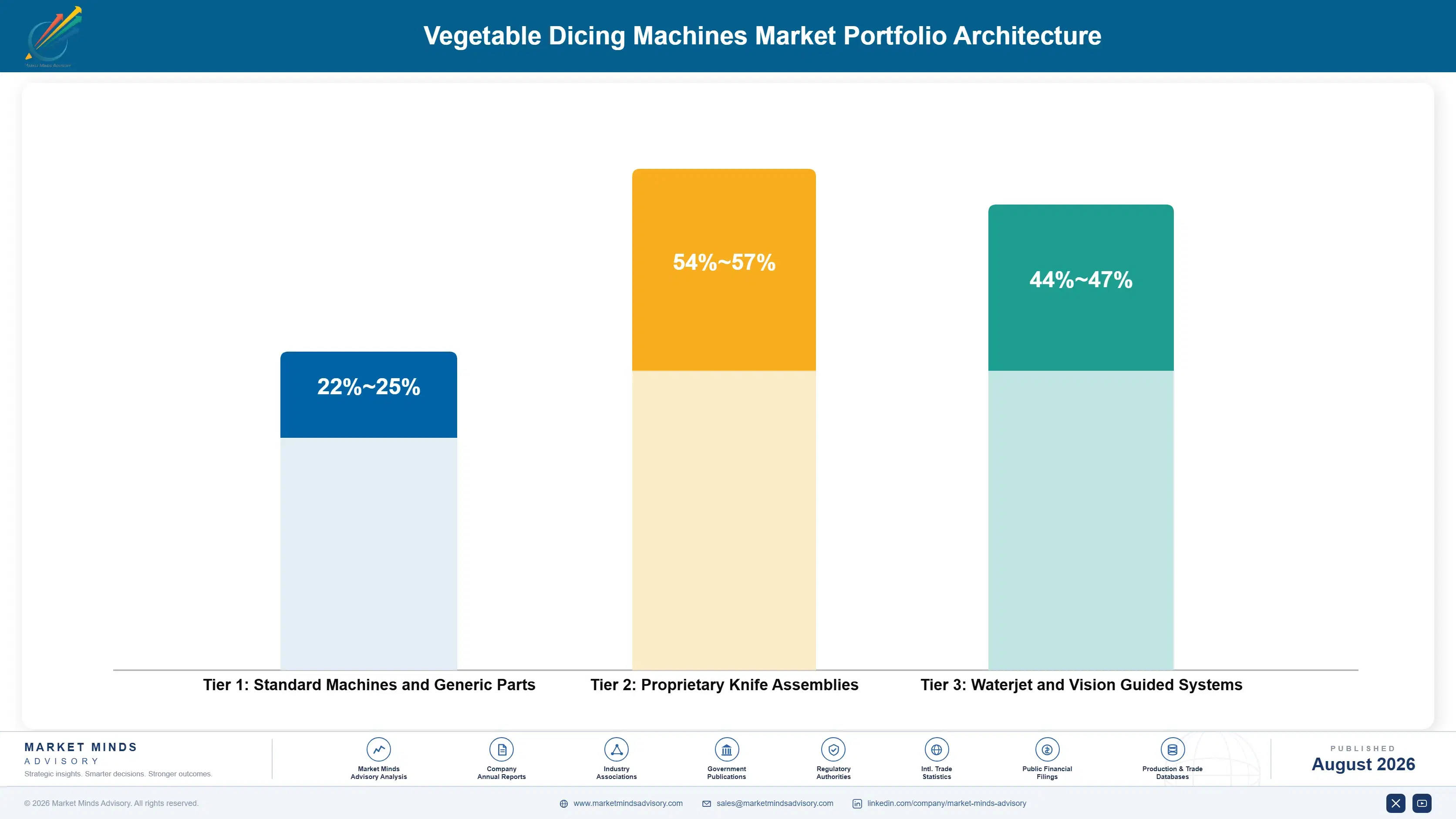
Margin architecture follows the split between iron and consumables. Machines earn modest margins, since a processor compares quotations carefully and capital committees exist to negotiate. Knife assemblies and wear parts earn far better and arrive continuously across a fourteen year machine life. Waterjet systems invert the pattern, carrying good machine margin and almost no parts stream, which changes the whole commercial calculation behind selling one.
The tension is that the technology growing fastest generates the least recurring revenue. Waterjet grows at 8.7% and consumes no blades, so a builder succeeding with it erodes the annuity that makes this business attractive. Vision guided cells sit similarly, earning on capital and software rather than on steel. A portfolio shifting toward both is shifting toward a different business model than the one it was built on.

High value pools concentrate in proprietary blade formats with genuine geometry advantages and in service agreements bundling parts with yield guarantees, both of which resist compatible competition. Everything else is exposed either to quotation comparison on machines or to third party blades on parts. Builders that have not started defending the parts stream are watching their most profitable revenue erode without a response.

Standard Machines and Generic Parts

Mechanical dicers quoted against competing builders and wear parts available from compatible manufacturers at meaningful discounts. Both compete on price against comparable alternatives, and neither carries any defensible position for long.
Gross Margin: 22-25%

Proprietary Knife Assemblies

Coated and proprietary geometry blade sets exchanged every 180 running hours across a fourteen year machine life. Margin holds where mounting systems and coating formulations make compatible substitution genuinely difficult rather than merely inconvenient.
Gross Margin: 54-57%

Waterjet and Vision Guided Systems

Blade free and camera guided systems sold on cut quality and yield recovery rather than on throughput. Machine margin is good and parts revenue minimal, which makes the lifetime economics different from anything else in the portfolio.
Gross Margin: 44-47%
vegetable-dicing-machines-market-trends-portfolio-architecture-1787641395707

High-value Sub-segments and Strategic Watch-out

Waterjet Cutting Systems

The fastest growing type at 8.7% and the one that generates no blade revenue at all, which makes commercial success here a mixed result for any builder. It wins decisively on soft and cooked product where mechanical knives destroy the cut surface entirely. The trade is genuinely awkward.
Gross Margin: 44-47%

Vision Guided Robotic Dicing Cells

Second fastest at 7.6% on a yield argument worth more than labour saving when vegetables are 66% of product cost. Capital cost restricts adoption to large processors handling premium product, and component pricing rather than commercial effort decides when that changes. Adoption follows component pricing downward.
Gross Margin: 48-51%

Centrifugal Dicers

Growing at 5.2% and carrying most of the installed base and most of the blade annuity that funds this industry. Compatible parts competition attacks precisely here, since the platforms are widely deployed and the geometry has been in the field for decades. Defending it is now urgent.
Gross Margin: 24-27%

Rotary Knife Dicers

Growing at only 3.6% and gradually displaced by centrifugal and waterjet systems on both yield and cut quality. It persists in specific product applications and in plants where the capital case for replacement has never been made convincingly enough. Replacement arguments here rarely get made convincingly at all.
Gross Margin: 22-25%

How Equipment Revenue Actually Recurs

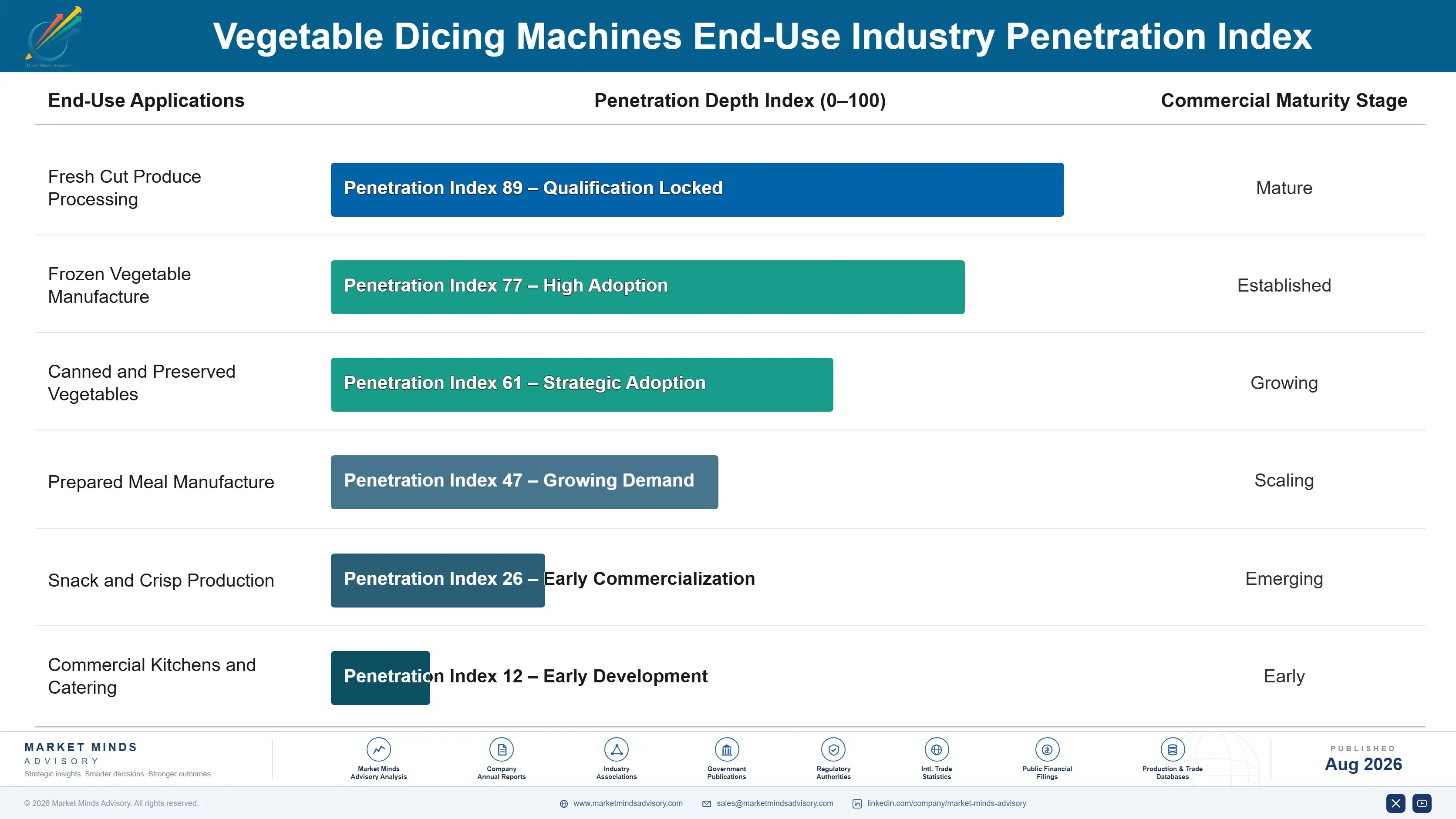
The recurring revenue in this business is steel, not software. A machine placed today consumes knife assemblies every 180 running hours for a working life around 14 years, and roughly 58% of builder revenue arrives that way rather than through the capital sale. That makes an installation an annuity rather than a transaction, which is why builders price machines competitively and defend parts fiercely.
Stickiness depends on whether the plant standardised. A processor running one builder's platform across every line holds spares, training and maintenance procedures built around it, and displacing that is a plant wide decision rather than a machine one. A plant running mixed equipment switches far more readily, comparing each replacement individually. Compatible blade manufacturers exploit the second group first, since nothing there depends on the original relationship.

The buyer has moved from engineering toward operations. Equipment selection once sat with a plant engineer comparing specifications and service records. It now runs through operations and finance functions evaluating yield percentage, waste reduction and payback period, because raw material at 66% of product cost makes those the numbers that matter. Builders whose commercial teams speak specification are being evaluated by people asking a different question entirely.
vegetable-dicing-machines-market-trends-end-use-penetration-index-1787641396217

Where This Business Actually Earns

These are among the four positions where our research anticipates prominent divergence between winners and laggards over the coming forecast period. Each is grounded in the demand model, the regulatory perimeter, and the announced capacity pipeline.
01 / YIELD DEMONSTRATION SELLING

Prove the carrot, not the throughput rate

Raw vegetables account for roughly 66% of processed product cost, so two points of additional usable output pays for the machine delivering it inside a single season and no throughput comparison generates a number remotely that size. Trial installations measuring yield directly against the incumbent turn an abstract projection into something a plant manager verifies within a week of running it. Builders that invested in trial fleets close replacement sales on equipment still operating perfectly well, which is a purchase behaviour most capital markets never see.
02 / PARTS ANNUITY DEFENCE

Compatible blades attack the profitable half first

Roughly 58% of builder revenue arrives after the machine through knife assemblies exchanged every 180 running hours across a fourteen year life, and independent manufacturers now supply compatible sets for most widely deployed platforms. A blade is a geometry rather than a technology, and after a decade in the field anybody willing to measure it can produce one. Proprietary mounting, coatings that genuinely extend interval and service agreements bundling parts with yield guarantees all work, and doing nothing loses the most profitable revenue permanently.
03 / GREENFIELD SPECIFICATION ACCESS

Export processing lines displace nothing at all

Mexico grows at 10.2%, faster than any country covered, and Polish, Vietnamese and Thai export processing capacity follows identical logic, with each facility specifying a full equipment complement from a standing start. A greenfield line faces none of the resistance a replacement meets and is specified to the retail customer's standards rather than to local practice, which favours established builders. Companies present while a project is being designed take the entire line, while those arriving after commissioning wait fourteen years for a replacement conversation.
04 / TECHNOLOGY MIX CONSEQUENCES

Winning with waterjet erodes your own annuity

Waterjet grows at 8.7% against a market rate of 5.8% because nothing dulls, which is exactly why it consumes no blades and generates almost none of the recurring revenue that makes this industry attractive to own. Vision guided cells sit similarly, earning on capital and software rather than on steel exchanged every 180 hours. A portfolio shifting toward both technologies is shifting toward a genuinely different business model, and very few builders have said so out loud to their own boards.

Engagement Snapshot From the Field

A live engagement with an industry participant carrying material or product regulatory and market exposure ahead of a defining policy shift, showing how our research translates into a defensible multi-year portfolio strategy.
MARKET MINDS ADVISORY · CLIENT ENGAGEMENT SUMMARY
Vegetable Dicing Machines Producer Strategic Portfolio Review and Transition Roadmap 2026·Investment Scenario on Vegetable Dicing Machines Exposure Evaluation 2025-26
CLIENT PROFILE
A European food processing equipment builder supplying centrifugal and belt fed vegetable dicers across twenty two countries, with a substantial installed base built over four decades. Annual revenue was approximately 220 million dollars (client-reported, unverified by MMA), of which 54% came from knife assemblies and spare parts. No waterjet or vision guided product existed in the range.
STRATEGIC CHALLENGE
Parts revenue had declined for three consecutive years as compatible blade manufacturers took share on widely deployed older platforms, while machine sales grew slowly. Management wanted to know whether to defend parts on price, redesign mounting systems, or accept the erosion and pursue new technologies. Each option had an internal champion and no evidence behind any of them.
MMA APPROACH
MMA modelled parts revenue durability by platform age and installed density, establishing where compatible competition had reached and where it had not yet arrived. Blade coating and mounting redesign options were costed against expected retention. Forty-seven expert interviews with plant engineers, operations managers and procurement leaders established what actually drives a decision to buy compatible blades rather than original ones.
KEY FINDINGS
  1. Compatible blade penetration reached 41% on platforms installed more than ten years ago and under 8% on platforms under five years old, confirming that geometry familiarity drives it.
  2. Plant managers in 33 of the 47 interviews said they would pay original prices if blade life were demonstrably longer, and had never been shown comparative data.
  3. Coated blade formulations extended replacement interval from around 180 hours to roughly 260 in trial conditions, which changed the cost per running hour comparison entirely.
  4. Waterjet enquiries came from 19% of the installed base, almost entirely for cooked and soft products the client's mechanical machines could not cut acceptably.
CLIENT PROFILE
A European food processing equipment builder supplying centrifugal and belt fed vegetable dicers across twenty two countries, with a substantial installed base built over four decades. Annual revenue was approximately 220 million dollars (client-reported, unverified by MMA), of which 54% came from knife assemblies and spare parts. No waterjet or vision guided product existed in the range.
STRATEGIC CHALLENGE
Parts revenue had declined for three consecutive years as compatible blade manufacturers took share on widely deployed older platforms, while machine sales grew slowly. Management wanted to know whether to defend parts on price, redesign mounting systems, or accept the erosion and pursue new technologies. Each option had an internal champion and no evidence behind any of them.
MMA APPROACH
MMA modelled parts revenue durability by platform age and installed density, establishing where compatible competition had reached and where it had not yet arrived. Blade coating and mounting redesign options were costed against expected retention. Forty-seven expert interviews with plant engineers, operations managers and procurement leaders established what actually drives a decision to buy compatible blades rather than original ones.
KEY FINDINGS
  1. Compatible blade penetration reached 41% on platforms installed more than ten years ago and under 8% on platforms under five years old, confirming that geometry familiarity drives it.
  2. Plant managers in 33 of the 47 interviews said they would pay original prices if blade life were demonstrably longer, and had never been shown comparative data.
  3. Coated blade formulations extended replacement interval from around 180 hours to roughly 260 in trial conditions, which changed the cost per running hour comparison entirely.
  4. Waterjet enquiries came from 19% of the installed base, almost entirely for cooked and soft products the client's mechanical machines could not cut acceptably.
RECOMMENDED STRATEGY
Phase 1: Phase one: launch coated blade assemblies and publish comparative life data, since 33 of 47 plant managers would pay original pricing for demonstrable longevity. Phase 2: Phase two: redesign mounting systems on new platforms only, since compatible penetration reaches 41% on old platforms and 8% on recent ones. Phase 3: Phase three: add waterjet capability through partnership rather than development, since 19% of the installed base is already asking for it.
OUTCOME
The client launched coated assemblies within nine months alongside published life comparisons and signed a waterjet distribution partnership the following year. Parts revenue returned to growth after three years of decline, and waterjet enquiries converted at rates the commercial team had not expected from an installed base assumed to be mechanical only (client-reported, unverified by MMA).

Frequently Asked Questions

Foundational context covering the market sizes, CAGR, scope, country, region and competition that inform every finding below. This section is provided to cover basics and most often pre-purchase conversations, answered from the MMA Primary Research Dataset.

What is the current size of the Vegetable Dicing Machines Market?

The market was valued at 0.64 billion dollars in 2025, covering dicing machines, knife assemblies and spare parts across industrial and foodservice applications. It reaches an estimated 0.68 billion dollars during 2026.

How large will the Vegetable Dicing Machines Market be by 2036?

MMA forecasts 1.20 billion dollars by 2036, an increase of 0.52 billion dollars over the 2026 base. That represents an expansion multiple of 1.76 times across the forecast period.

What is the CAGR for the Vegetable Dicing Machines Market 2026 to 2036?

The base case compound annual growth rate is 5.8%, with a bull case of 7.0% and a bear case of 4.6%. Vision guided pricing and capital deferral separate those scenarios.

Which segment is growing fastest?

Waterjet cutting systems grow at 8.7%, half again the market rate of 5.8%, because they have no blade to dull across a shift. Vision guided robotic cells follow at 7.6%.

Who are the major companies in the Vegetable Dicing Machines Market?

Urschel Laboratories, Marel, JBT Corporation, Kronen and TOMRA Systems lead on machine shipments and associated parts revenue worldwide. Together they account for 42% of the market.

Which country is growing fastest?

Mexico grows fastest at 10.2%, on prepared and fresh cut vegetable processing capacity built specifically to supply North American retail and foodservice customers across the border.

Report Segmentation Architecture

The full report scope spans multiple orthogonal segmentation dimensions, with cross-tabulated demand data provided for each dimension pair. Coverage extends further to regional breakdowns, trend trajectories, and the competitive detail needed to support segment-level decision-making.

By Machine Type

  • Centrifugal Dicers
  • Belt Fed Dicers
  • Waterjet Cutting Systems
  • Vision Guided Robotic Dicing Cells
  • Rotary Knife Dicers
  • Foodservice Bench Dicers

By End-Use Industry

  • Fresh Cut Produce Processing
  • Frozen Vegetable Manufacture
  • Canned and Preserved Vegetables
  • Prepared Meal Manufacture
  • Snack and Crisp Production
  • Commercial Kitchens and Catering

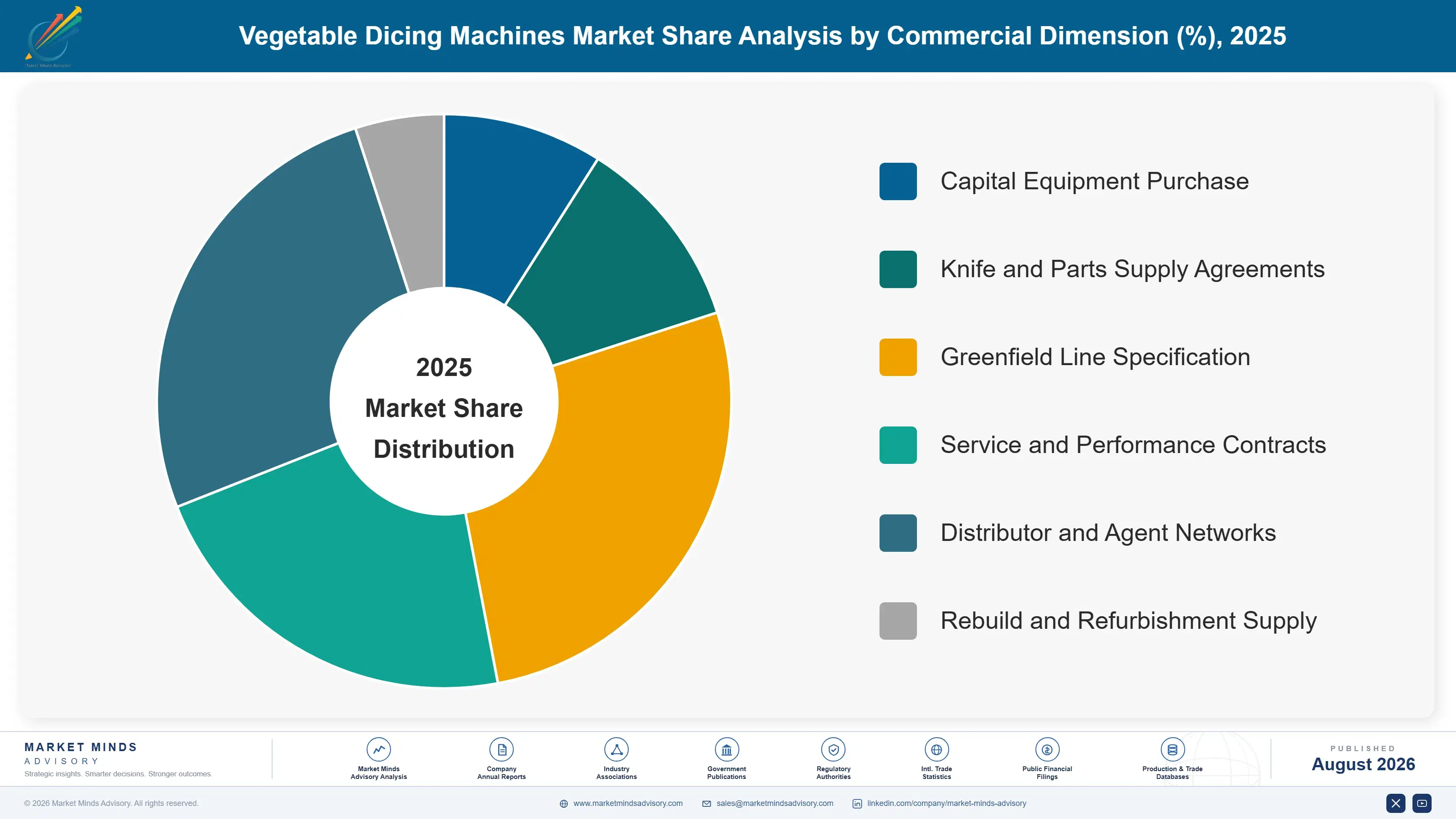
By Commercial Dimension

  • Capital Equipment Purchase
  • Knife and Parts Supply Agreements
  • Greenfield Line Specification
  • Service and Performance Contracts
  • Distributor and Agent Networks
  • Rebuild and Refurbishment Supply

By Region

  • North America
  • Western Europe
  • East Asia
  • South Asia and Pacific
  • Latin America
  • Middle East and Africa
  • Eastern Europe

Scope, Methodology, and Coverage

Every figure in this report is reproducible from documented input assumptions. The scope below maps the historical period, the forecast horizon, the segmentation dimensions, and the countries covered, alongside the underlying primary and qualitative methodology.
Historical Period
2020 to 2025
Forecast Period
2026 to 2036
Base Year
2025 (USD billions; MMA Primary Research Dataset, August 2026)
Market Definition
Machines used to dice, cube and portion vegetables in commercial and industrial food processing worldwide, covering centrifugal dicers, belt fed dicers, waterjet cutting systems, vision guided robotic dicing cells, rotary knife dicers, and foodservice bench dicers, together with knife assemblies and wear parts consumed by them. Measured at builder selling value. Slicing and shredding equipment without dicing capability, meat and protein cutting machines, peeling, washing and blanching lines, and downstream packaging equipment are excluded from scope.
Quantitative Units
USD billions (current prices); machines shipped; USD per machine and per knife assembly by type
Segmentation Dimensions
Machine type; end-use industry; commercial dimension; region
Regions Covered
North America, Western Europe, East Asia, South Asia and Pacific, Latin America, Middle East and Africa, Eastern Europe
Countries Covered
Netherlands, Germany, Italy, Spain, France, Belgium, United States, Canada, Mexico, China, Japan, South Korea, India, Vietnam, Thailand, Australia, Brazil, Peru, Poland, Saudi Arabia
Key Companies Profiled
Urschel Laboratories, Marel, JBT Corporation, Kronen, TOMRA Systems, FAM Stumabo, Turatti Group, Sormac, Nilma, Brunner-Anliker, Hallde, Robot Coupe, Treif Maschinenbau, Holac Maschinenbau, Emura Food Machine, Nantsune, Dadaux, Sammic, Electrolux Professional, Hobart
Quantitative Methodology
Primary survey, n=3,800 respondents, Q4 2025, six countries; demand-side model with trade association cross-validation
Qualitative Methodology
47 expert interviews, Q4 2025; applied to validate demand model assumptions, identify emerging dynamics, and assess competitive positioning
Report Format
PDF and XLSX data workbook (Word format preview document)
Publisher
Market Minds Advisory
Report Code
MMA-2026-CON-121
Published
August 2026
Contact
sales@marketmindsadvisory.com | www.marketmindsadvisory.com

Purchase the full Vegetable Dicing Machines Market Report (2026 to 2036).

The full report treats dicing equipment as an annuity business where the machine is sold once and knife assemblies are consumed for fourteen years, which explains why builders price capital competitively and defend parts fiercely. It sizes all six machine types independently through 2036, models parts revenue durability by platform age against compatible blade penetration, and quantifies the yield economics that drive replacement of equipment still operating within specification. Regional chapters cover all seven regions, with export processing capacity assessed separately from domestic consumption. Competitive profiling covers 20 participants on one consistent machine shipment basis.
Six machine types sized independently through 2036
Parts revenue durability modelled by platform age and density
Yield economics quantified against raw material cost share
Compatible blade penetration measured by platform and geography
Export processing capacity assessed separately from domestic demand
Twenty participants profiled on one consistent shipment basis

Built For The People Who Decide

From boardroom strategy to bench-side execution, this report is read cover-to-cover by leaders shaping the next decade of their industry, turning demand scenarios, market dynamics and valuation benchmarks into decisions.
CXOs/ Presidents/ VPs/ Managers
M&A and Corporate Development
Strategy Teams and R&D Heads
Procurement and Product Directors
Regulatory and Compliance Leaders
Investor Relations and Equity Analysts