
Market Minds Advisory
Vanilla Bean Industry in Western Europe

Vanilla Bean Industry in Western Europe: Vanilla Bean Industry in Western Europe: Labelling Value, Origin Concentration and an Unhedgeable Price

Synthetic vanillin costs roughly a two hundredth of the natural equivalent and supplies about 99% of world vanilla flavour, so this entire industry rests on a labelling definition rather than on taste.

Lead Analyst

Lisa Gevelber

Published

August 2026

Make Smarter Decisions with Customized Research Insights

Request a free sample report and evaluate market opportunities, growth trends, and competitive dynamics relevant to your business needs.

2025 MARKET VALUE$0.6BMarket Size 2025
2036 FORECAST VALUE$0.9BBase Case , 2026 to 2036
CAGR 2026 TO 20364.4 %Bull 5.6% / Bear 3.2%
INCREMENTAL OPPORTUNITY$0.3BNet 10- year value creation
EXPANSION MULTIPLE1.54x2036 value over 2026 base
Strategic Levers
M&A Pipeline
Regional Outlook
Country Rankings
Competitive Intelligence
Segmental Deep-dive
Call-Us : 91 93563 13602

Executive Snapshot and Market Trajectory.

Western Europe does not grow a single vanilla bean and holds almost the entire premium of the trade. Curing assessment, extraction capability, regulatory definition and the customer relationships all sit here. The pods come from smallholders in Madagascar, Uganda and Indonesia who see a fraction of the value.
The commercially decisive fact is that synthetic vanillin costs roughly a two hundredth of the natural equivalent per unit of vanillin, and around 99% of world vanilla flavour is synthetic. This industry therefore exists because of labelling rather than because of taste, since blind panels routinely fail to separate the two. Vanilla extracts and alcoholic solutions grow fastest at 6.6%, half again the market rate of 4.4%. Oleoresins follow at 5.8% into fragrance.
Concentration is moderate at 58% of bean volume, and the commercial skill in this business is inventory timing rather than flavour science. Madagascar supplies roughly 62% of regional beans and its green bean price has moved thirty fold within a decade on cyclones, speculation and export floors. There is no futures market, so nobody can hedge any of it. Buying well is the whole business.
Market Definition
Natural vanilla beans and bean derived products traded, processed and consumed in Western Europe, covering cured whole beans, extraction grade beans, vanilla extracts and alcoholic solutions, vanilla oleoresins and absolutes, and vanilla powder and ground bean. Measured at trade and processor selling value. Synthetic vanillin from lignin, guaiacol or ferulic acid, biotechnology derived vanillin, and compound flavour blends containing no bean derived material are excluded.
Base Year Value
$0.6B in 2025 (MMA Primary Research Dataset, August 2026)
Forecast Period
2026 to 2036, eleven discrete annual values
CAGR
4.4% base case. Bull 5.6%. Bear 3.2%.
Fastest Growth Segment
Vanilla Extracts and Alcoholic Solutions: 6.6% CAGR
Fastest Growth Country
Spain: 6.8% CAGR
Fastest Growth Region
South Asia and Pacific: 6.6% CAGR
Largest Region
Western Europe: 88% of 2025 global value
Market Leaders
Symrise, Givaudan, dsm-firmenich, International Flavors and Fragrances, Prova. Source: MMA Primary Research Dataset, July 2026.
Primary Survey
n=3,800 procurement and R&D decision-makers, Q4 2025, six countries
Methodology
Demand-side build-up, cross-validated against public data, 47 expert interviews

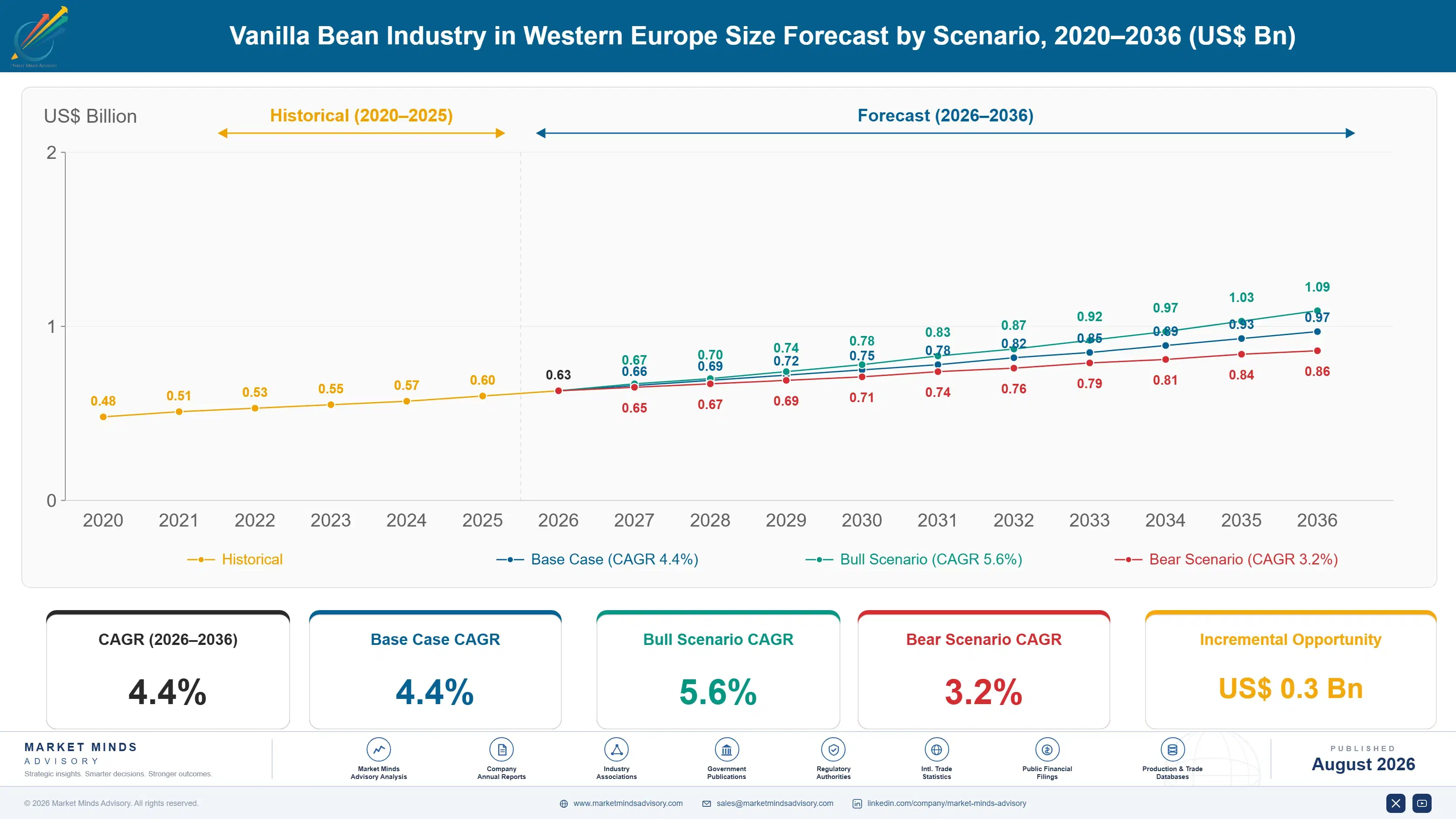
Vanilla Bean Industry in Western Europe Market Forecast Scenarios

vanilla-bean-industry-in-western-europe-market-tre-size-forecast-scenario-1787641291029
The five years to 2025 were dominated by a price collapse rather than by anything demand did. Madagascar green bean prices fell from extraordinary highs as speculative stocks unwound and harvests arrived intact, which cut the value of the trade even as volume held. Processors holding peak priced inventory took losses lasting years. The 3.4% historical rate describes an average nobody actually experienced.
The 4.4% base case rests on three mechanisms. Clean label reformulation continues across European confectionery, dairy and bakery, and each conversion from synthetic vanillin to bean derived extract multiplies the ingredient cost by a large factor while adding a claim the manufacturer wants. Premium ice cream and patisserie demand keeps growing in southern Europe. And fragrance houses continue expanding absolute and oleoresin use, which is a smaller volume at considerably better value per kilogram.
The 5.6% bull case turns on European labelling rules tightening around what may be described as natural vanilla, which would force conversions that manufacturers currently avoid. The 3.2% bear case is a repeat of the last price spike: when green bean prices multiply, food manufacturers reformulate away from natural vanilla and most of them do not come back afterwards.

An Industry Built on a Labelling Definition

Almost nobody buying vanilla in Europe can taste the difference and almost everybody buying it knows that. Synthetic vanillin delivers the same principal aroma compound at roughly a two hundredth of the cost, and around 99% of world vanilla flavour is made that way. Blind panels comparing a good synthetic against a bean extract separate them inconsistently at best. What the bean buys is a legal claim.
TOP FIVE CONCENTRATION58%Combined bean volume handled by the largest processors
SYNTHETIC COST RATIO200xPrice of natural vanillin against the synthetic equivalent
NATURAL SHARE OF FLAVOUR1%Portion of global vanilla flavour derived from beans
MADAGASCAR ORIGIN SHARE62%Proportion of regional bean supply from a single origin
PEAK TROUGH PRICE RANGE30xSpread between highest and lowest green bean pricing
INVENTORY HOLDING PERIOD18 monthsTypical time beans sit before extraction or resale
European regulation defines what may be described as natural vanilla flavouring and what may not, and that definition is the asset this whole industry rests on. It is more fragile than a crop. A rule change, a court interpretation or a shift in what consumers believe natural means would reprice the trade far more sharply than any cyclone ever has. Nobody in the industry likes discussing that.
Underneath sits a supply problem nobody has solved. Roughly 62% of regional beans come from Madagascar, green bean prices have moved thirty fold inside a decade, and no futures market exists to hedge any of it. Processors hold inventory for around 18 months, which means every purchase is a position. The companies that survive price cycles bought well, rather than extracting better.
"This is a flavour industry where flavour is almost beside the point. What a customer is buying is permission to write the word natural on a package, and the pod is simply the most expensive way anyone has found to earn it."
Director, Food Ingredients and Agricultural Commodities Practice · MMA Agriculture and Food Ingredients Practice · August 2026

Market Trends

Clean Label Reformulation Converts Volume at Enormous Cost

European confectionery, dairy and bakery manufacturers continue replacing synthetic vanillin with bean derived extract to secure a natural flavouring declaration, and each conversion multiplies the ingredient cost by a factor most procurement teams find genuinely uncomfortable. Vanilla extracts and alcoholic solutions grow at 6.6% against a market rate of 4.4% substantially on this mechanism. The conversions concentrate in premium tiers where the ingredient cost disappears into a high retail price. Mainstream products convert and then quietly revert when green bean prices spike, which is a pattern the industry has now watched twice.
Market Impact: Governs 100% of premium claims
Fragrance Demand Values the Bean Differently From Food

Perfumery uses vanilla absolutes and oleoresins for aromatic complexity rather than for a label claim, which makes it the one part of this market where the product is bought for what it actually does. Growth of 5.8% in oleoresins and absolutes is second fastest in the region, on volumes far smaller than food but at considerably better value per kilogram. Fragrance houses also tolerate origin and vintage variation that food manufacturers reject outright, since complexity is the point. That opens an outlet for beans a food buyer would refuse, which matters more in a poor harvest year.
Market Impact: Spain grows at 6.8% annually

Market Opportunities and Growth Drivers

European Labelling Rules Define the Entire Premium

European regulation sets out what may be described as natural vanilla flavouring, and that definition is what separates a product costing a two hundredth as much from one that commands the premium this industry depends on. Manufacturers buy beans to satisfy a declaration rather than a sensory specification, which is why conversions cluster in categories where the label matters most to shoppers. The regulatory framework has been stable for years and the industry has built entirely around it. Any tightening would expand demand and any loosening would remove it almost overnight.
Market Impact: Prices moved 30 times over

Premium Patisserie and Gelato Demand Grows Across Southern Europe

Artisan ice cream, premium patisserie and specialist bakery consumption has grown steadily across Spain, Italy and Portugal, and those categories use whole beans and paste rather than the cheapest available extract. Spain grows at 6.8%, faster than any other country in the region, on exactly this demand. The buyers are small, numerous and considerably less price sensitive than an industrial food manufacturer, because a single bean disappears into a product retailing at a strong margin. Distribution runs through specialist ingredient wholesalers rather than through the flavour houses. Those relationships take years to build properly.
Market Impact: Removes 12% of volume permanently

Market Restraints and Challenges

No Futures Market Exists to Hedge an Unstable Price

Madagascar green bean prices have moved roughly thirty fold within a decade on cyclone damage, speculative stockholding and government export price floors, and there is no futures contract or recognised index against which a European buyer can hedge any of it. The root cause is a market too small and too concentrated in one origin to support a liquid derivative. Commercially this converts every purchase into a directional position held for around 18 months. Processors respond with forward contracting at origin, inventory laddering and multi origin sourcing, none of which removes the exposure.
Market Impact: Multiplies ingredient cost 200 times

Manufacturers Reformulate Away and Rarely Return

When green bean prices multiply, industrial food manufacturers reformulate toward synthetic vanillin or vanilla flavouring blends, and the reformulation work is expensive enough that very few reverse it when prices fall again. The root cause is that a recipe change requires stability testing, label revision and often consumer validation, so the decision is treated as permanent once taken. Each price spike therefore removes volume from the natural market for good rather than temporarily. Processors respond with price stabilisation contracts and multi year supply agreements that trade margin for volume retention.
Market Impact: Absolutes grow 5.8% annually
3 additional market trends, 4 additional growth drivers, and 2 additional restraints and challenges are covered in the full report. Contact sales@marketmindsadvisory.com to access the complete intelligence.

Segment CAGR and Growth Architecture

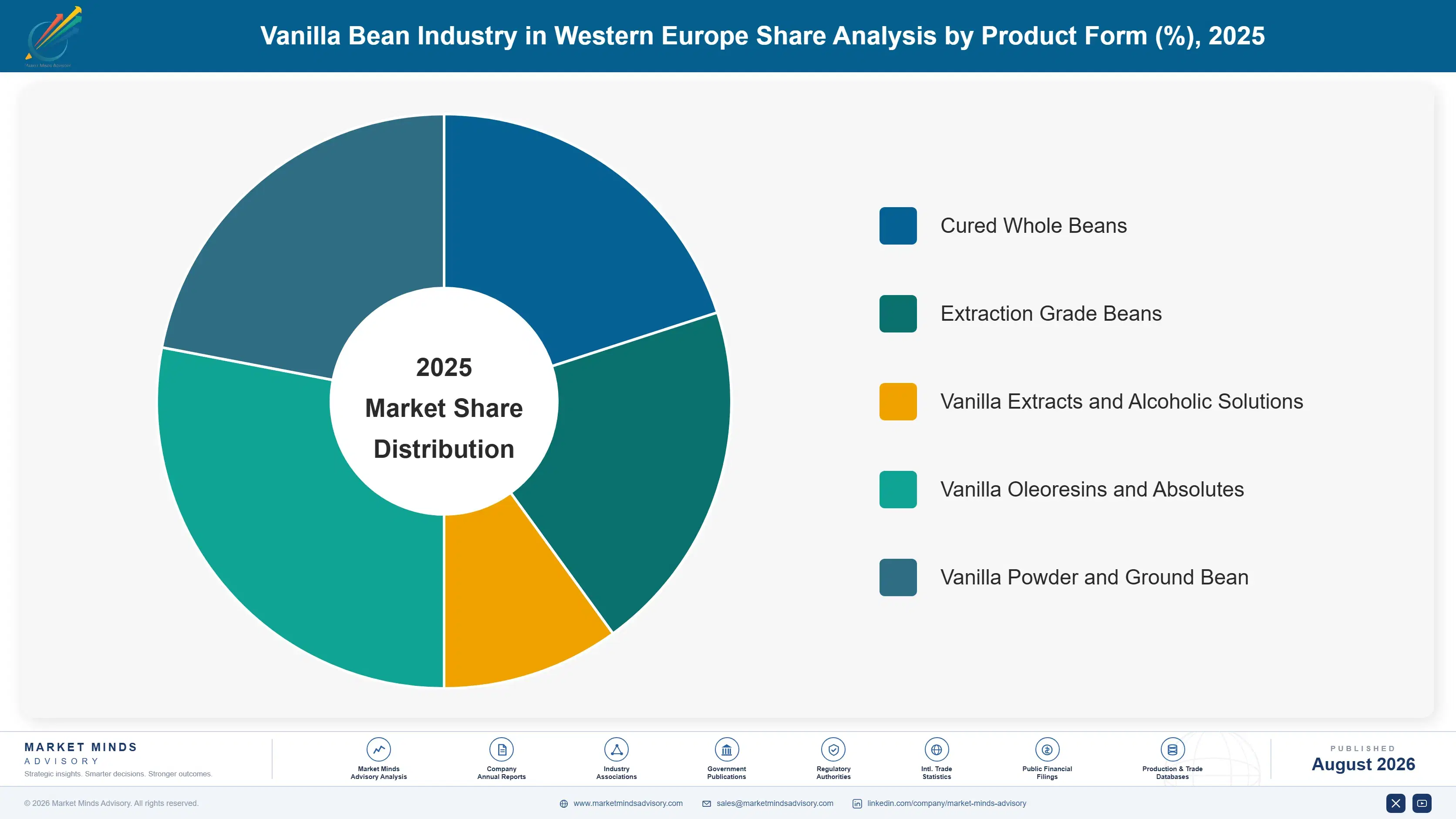
Segmentation follows product form, since form determines who buys, what they are buying it for and how the price volatility reaches them. Five forms cover the trade, from a whole cured pod sold to a patisserie through to an absolute sold to a perfumer. Growth sits with the processed forms rather than with the bean itself.
vanilla-bean-industry-in-western-europe-market-tre-market-share-analysis-1787641291781

Vanilla Extracts and Alcoholic Solutions

Ethanol and water extracts of cured beans, standardised to declared vanillin content and sold to food manufacturers who need a natural flavouring declaration on a finished product. At 6.6% this is the fastest growing form in the region, half again the market rate of 4.4%, and clean label reformulation drives almost all of it. What the customer is buying is a legal category rather than a sensory outcome, since a good synthetic performs comparably in most finished applications. Standardisation is the technical skill, because bean vintage and origin vary enormously and a manufacturer needs the same result every batch. Extractors holding inventory across vintages blend to specification. Holding stock across vintages is the price of that capability.
CAGR 6.6%

Vanilla Oleoresins and Absolutes

Solvent extracted concentrates carrying the full aromatic profile rather than vanillin alone, sold principally into fragrance and into premium food applications where complexity is genuinely valued. Growth of 5.8% is second fastest in the region, on far smaller volumes at considerably better value per kilogram than extract. Fragrance buyers tolerate and often prefer origin and vintage variation that a food manufacturer would reject as inconsistency, which opens an outlet for material the food trade will not take. That matters most in a poor harvest year, when quality distribution widens. Perfumery is also the one segment buying this product for what it does rather than for what the label says. Very few processors have built this outlet deliberately at all.
CAGR 5.8%
Full segment breakdown across 5 segments available in the complete report.

Regional Architecture and Country Demand Map

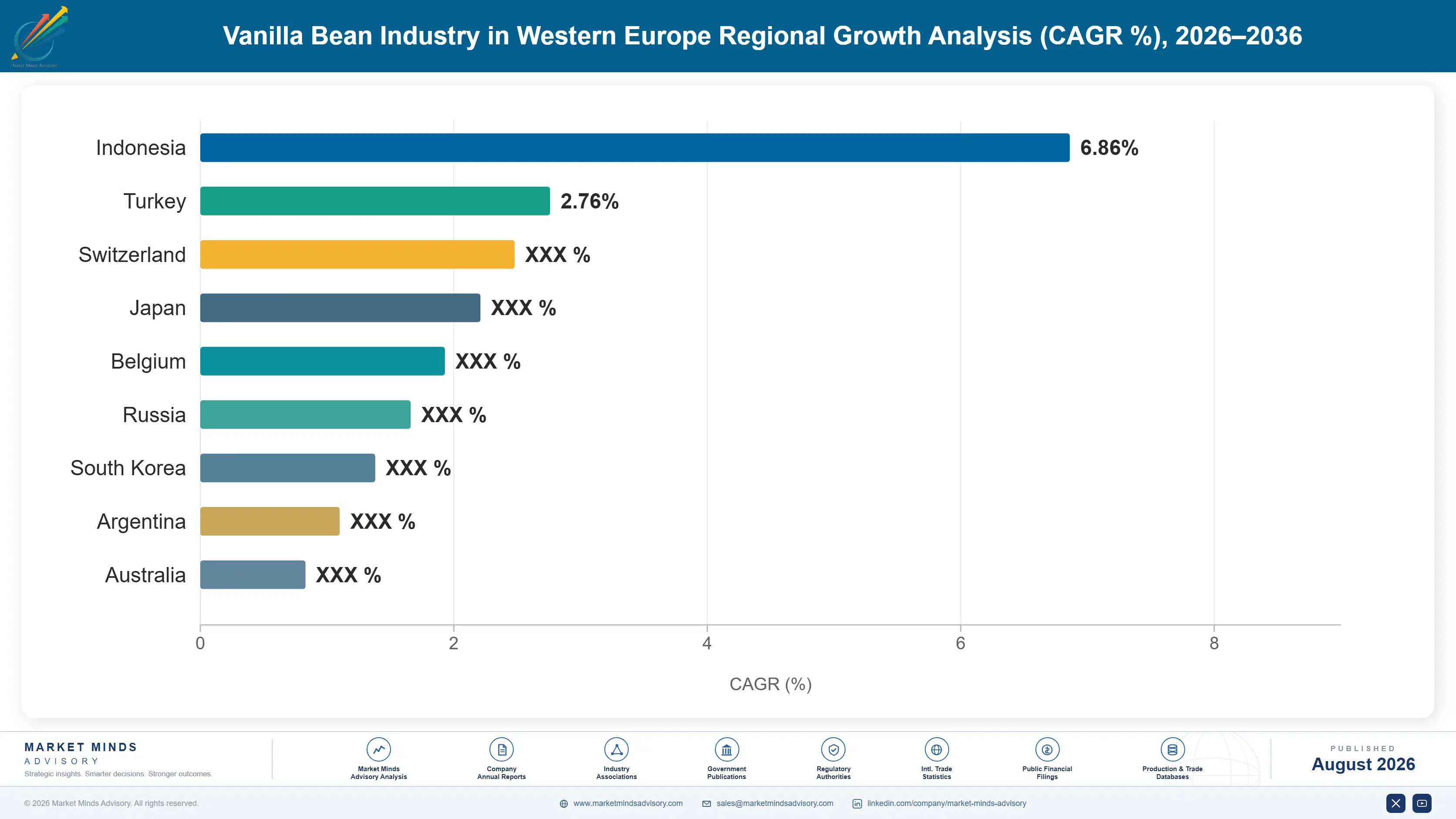
Western Europe holds 88% of the market by definition, since scope covers regional trade and consumption. The remaining shares represent origin supply relationships and competing destination markets rather than European demand. Germany, France and Spain carry most regional volume between them. Trading hubs sit in the Netherlands and Belgium.

Western Europe

This 88% share sits far outside the standard band because scope covers Western European trade and consumption, so the region carries the market by construction and everything else represents supply or competing demand. Germany is the largest single consumer, with substantial confectionery, dairy and bakery manufacture buying extract in industrial quantities. France holds the deepest processing and trading expertise, with houses that have handled Bourbon vanilla for over a century and hold the relationships at origin that matter in a short year. Spain grows fastest in the region at 6.8% on premium patisserie and artisan gelato demand. The Netherlands and Belgium function as trading and warehousing hubs rather than as consumption markets.
Share: 88% | CAGR: 3.4% (2026 to 2036)

North America

A 4% share here reflects competing demand rather than European consumption, and it sits below the standard band for that reason alone. American buyers compete directly with European processors for the same Madagascar and Ugandan beans, and their labelling framework defines vanilla extract by a minimum bean content standard that has no European equivalent. That standard supports a large and relatively stable extract market, which means American demand does not fluctuate with price the way European industrial demand does. When Madagascar supply tightens, American and European buyers bid against each other at origin. Growth of 4.4% reflects that competing demand rather than anything happening inside Western Europe. That competition sharpens considerably in a short harvest year.
Share: 4% | CAGR: 4.4% (2026 to 2036)
Regional intelligence for 5 additional markets available in the complete report: East Asia, South Asia and Pacific, Latin America, Middle East and Africa, Eastern Europe. Contact sales@marketmindsadvisory.com.
vanilla-bean-industry-in-western-europe-market-tre-country-cagr-analysis-1787641292395

Where Money Is Made in This Trade

Nobody in Western Europe grows vanilla and nobody wins on extraction technology, which is widely available. Value accrues to whoever buys inventory at the right point in a violent price cycle, whoever can standardise across vintages, and whoever holds the origin relationships that matter in a short year. Four routes carry weight, and three of them are trading disciplines.

Treat Inventory Timing as the Core Competence

Green bean prices have moved roughly thirty fold within a decade and there is no futures market, so every purchase is a directional position held for around 18 months before extraction or resale. Companies that survived the last cycle bought counter cyclically and held through the collapse, while those that bought at the peak took losses lasting years. This is a trading discipline rather than a flavour one, and the people who do it well tend to sit in the treasury function rather than in research. Recruiting for it accordingly is uncomfortable but correct.
Market Impact: Manages exposure across a 30 times price range

Standardise Across Vintages the Customer Cannot Tolerate

Bean vintage, origin and curing quality vary enormously, and an industrial food manufacturer needs identical extract performance every batch regardless of what the harvest delivered. Blending across vintages and origins to a declared vanillin specification is the technical skill that separates processors, and it requires holding inventory across years rather than buying to order. Extracts grow at 6.6%, fastest in the region, and the customers driving that growth will not accept batch variation at any price. Consistency is what they are actually paying the processor for, whatever the contract says.
Market Impact: Supports the 6.6% extract segment growth rate today

Diversify Origin Before the Next Madagascar Event

Roughly 62% of regional beans come from a single island exposed to cyclones, currency movement and government export price floors, which is a concentration no procurement function would accept in any other ingredient. Ugandan supply offers two harvests a year against Madagascar's one, and Indonesian and Papua New Guinean volumes have expanded as high prices made alternatives interesting. Quality and curing consistency remain the constraint rather than availability. Building buying relationships at secondary origins costs little in a good year and becomes decisive in a bad one, which is precisely when nobody can build them.
Market Impact: Reduces the current 62% single origin supply dependence

Sell Complexity to Perfumery, Not Labels to Food

Fragrance buyers purchase absolutes and oleoresins for aromatic complexity rather than for a natural declaration, which makes them the one customer group buying this product for what it genuinely does. Growth of 5.8% comes on far smaller volumes at considerably better value per kilogram than food extract. They also accept origin and vintage variation that food manufacturers reject, opening an outlet for material the food trade will not take. In a poor harvest year that outlet is worth more than its share of revenue suggests, and very few processors have built it properly.
Market Impact: Earns 5.8% growth at genuinely premium unit values

Who Controls the Margin Pool

Concentration is moderate and unevenly distributed. The top five handle 58% of bean volume reaching Western Europe, the basis applied consistently here, though several specialist traders hold origin positions far larger than their volume share suggests. Symrise leads on integrated sourcing and extraction scale, and the distance to the next tier reflects capital available to hold inventory through a price cycle rather than any technical advantage.
Competition runs on three fronts. Large flavour houses compete for industrial food accounts on consistency, supply security and the ability to absorb price movement across a portfolio. Specialist traders compete on origin relationships and on quality assessment, which is genuinely a skill and largely undocumented. Ingredient wholesalers compete for patisserie and artisan demand on service and range rather than on price, since those buyers are small and numerous.

Rankings shift with price cycles rather than with commercial performance. A processor caught long at a peak can lose a decade of accumulated position, and several have. Consolidation among mid sized traders has continued since the last collapse. The other pressure point is biotechnology derived vanillin, which is produced by fermentation and increasingly permitted a natural declaration in some jurisdictions, which threatens the labelling premium directly.
vanilla-bean-industry-in-western-europe-market-tre-company-positioning-matrix-1787641292980

Competitive Moat and Risk Dimensions

SYMRISE

Moat: Integrated Origin Position

Direct sourcing operations in Madagascar and other origins, including curing and preparation capability close to the farm, give visibility on quality and volume that pure traders buy secondhand. Balance sheet depth also allows holding inventory through a price collapse, which is exactly when position is won in this trade and exactly when smaller processors are forced to sell.
SYMRISE

Risk: Labelling Definition Exposure

The premium this business earns rests on a regulatory definition of natural vanilla flavouring rather than on any sensory advantage a bean holds over synthetic vanillin. Fermentation derived vanillin already secures a natural declaration in some jurisdictions at a fraction of the cost, and any broadening of that treatment would reprice the entire portfolio downward.
PROVA

Moat: Vanilla Specialist Depth

Concentration on vanilla rather than on a broad flavour portfolio has built quality assessment expertise and origin relationships over generations, and in a trade where grading is largely undocumented judgement, that knowledge is genuinely difficult to acquire. Customers buying premium extract for patisserie and confectionery value that specialisation over the breadth a large house offers.
PROVA

Risk: Single Category Concentration

A specialist has no other category to absorb a price cycle, so a thirty fold move in green bean pricing reaches the income statement without any dilution at all. Large flavour houses spread that exposure across hundreds of ingredients and can price through it, which is a structural advantage no amount of vanilla expertise offsets in a bad year.

Players Tracked

Prominent Players

Symrise
Givaudan
dsm-firmenich
International Flavors and Fragrances
Prova

Other Key Players

Eurovanille
Touton
Nielsen-Massey Vanillas
Aust and Hachmann
Frey and Lau
Sensient Technologies
Kerry Group
Doehler
Robertet
Mane
Takasago
T Hasegawa
Norevo
Bakels
Zeelandia

Recent Developments

MARCH 2025

Madagascar authorities revise vanilla export price floor arrangements

Malagasy authorities adjusted export price floor arrangements governing green and cured vanilla leaving the country, following several seasons in which the mechanism pushed volume through informal channels. European buyers welcomed the change while noting that traceability documentation demanded by their own customers remains difficult to secure.
Signal: Export policy at a single origin moves European landed cost more than any commercial negotiation ever does
JUNE 2025

European manufacturer reverts premium dairy line to synthetic vanillin

A large European dairy manufacturer reformulated a premium product line away from bean derived extract, citing ingredient cost against a retail price that could not absorb it. The reformulation followed a period of rising green bean pricing and was described internally as permanent rather than as a temporary substitution.
Signal: Conversions away from natural vanilla are almost never reversed once the recipe work has been completed
SEPTEMBER 2025

Fermentation derived vanillin secures natural declaration in further markets

Producers of vanillin manufactured by fermentation from plant derived substrates secured natural flavouring declarations in additional jurisdictions, at production costs far below bean derived material. Food manufacturers seeking a natural claim without vanilla pricing now have a route that did not exist commercially a decade ago.
Signal: The labelling premium this industry depends on is being competed away by a fermentation tank rather than a farm

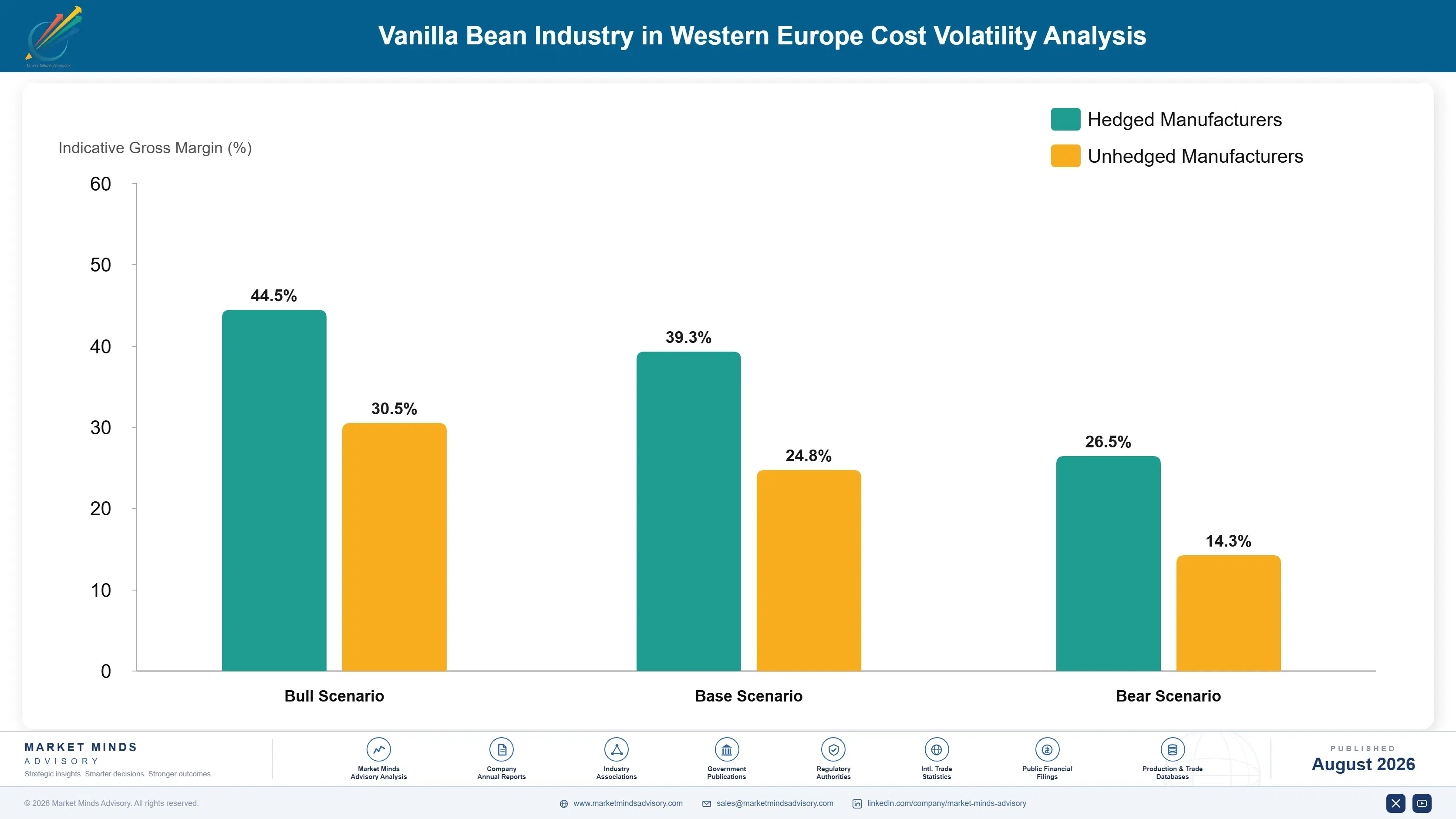
What Landed Cost Actually Contains

Green and cured bean purchase price dominates everything else, accounting for roughly 71% of landed cost in a normal year and far more in a spike. Curing labour at origin, freight, insurance and duty add most of the remainder, with extraction processing costs proving almost trivial by comparison. Beans come principally from Madagascar, Uganda, Indonesia and Papua New Guinea, and roughly 62% of regional supply originates on a single island.
The price history is the input cost history. Madagascar green bean pricing moved roughly thirty fold within a decade, driven by cyclone damage in Sava, speculative stockholding and government export price floors. European processors bought at every point on that curve. Company annual reports across the flavour sector documented inventory write downs following the collapse, and several mid sized traders did not survive the experience at all.

Exposure divides by balance sheet rather than by skill. A processor with capital to hold inventory through a collapse recovers position when prices normalise, while one forced to sell into a falling market crystallises the loss permanently. Specialists carry the full exposure with no other category to dilute it. Ethanol and solvent costs move within ranges that look irrelevant beside the bean.
vanilla-bean-industry-in-western-europe-market-tre-cost-volatility-analysis-1787641293187

Ladder purchasing across seasons rather than buying to order

Buying a fixed proportion of annual requirement each season averages the acquisition price across a cycle no forecaster has ever called correctly. It requires holding inventory longer than a demand driven model would and carries financing cost accordingly. Processors that laddered through the last spike acquired well below the peak, and competitors buying to order did not.

Contract forward with origin cooperatives on multi season terms

Multi season agreements with producer cooperatives secure volume and support the traceability documentation European customers increasingly demand at audit. Pricing formulas rather than fixed prices are essential, since a fixed price agreement collapses when the spot market moves thirty fold in either direction. The relationship also matters more than the contract when supply tightens and everybody is bidding.

Build secondary origin capability during good harvest years

Ugandan, Indonesian and Papua New Guinean supply can be developed cheaply when Madagascar is abundant and cannot be arranged at all when it is not. Curing consistency rather than availability is the constraint, and improving it requires sustained presence over several seasons. Processors that invested during the last surplus had genuine alternatives in the following shortage.

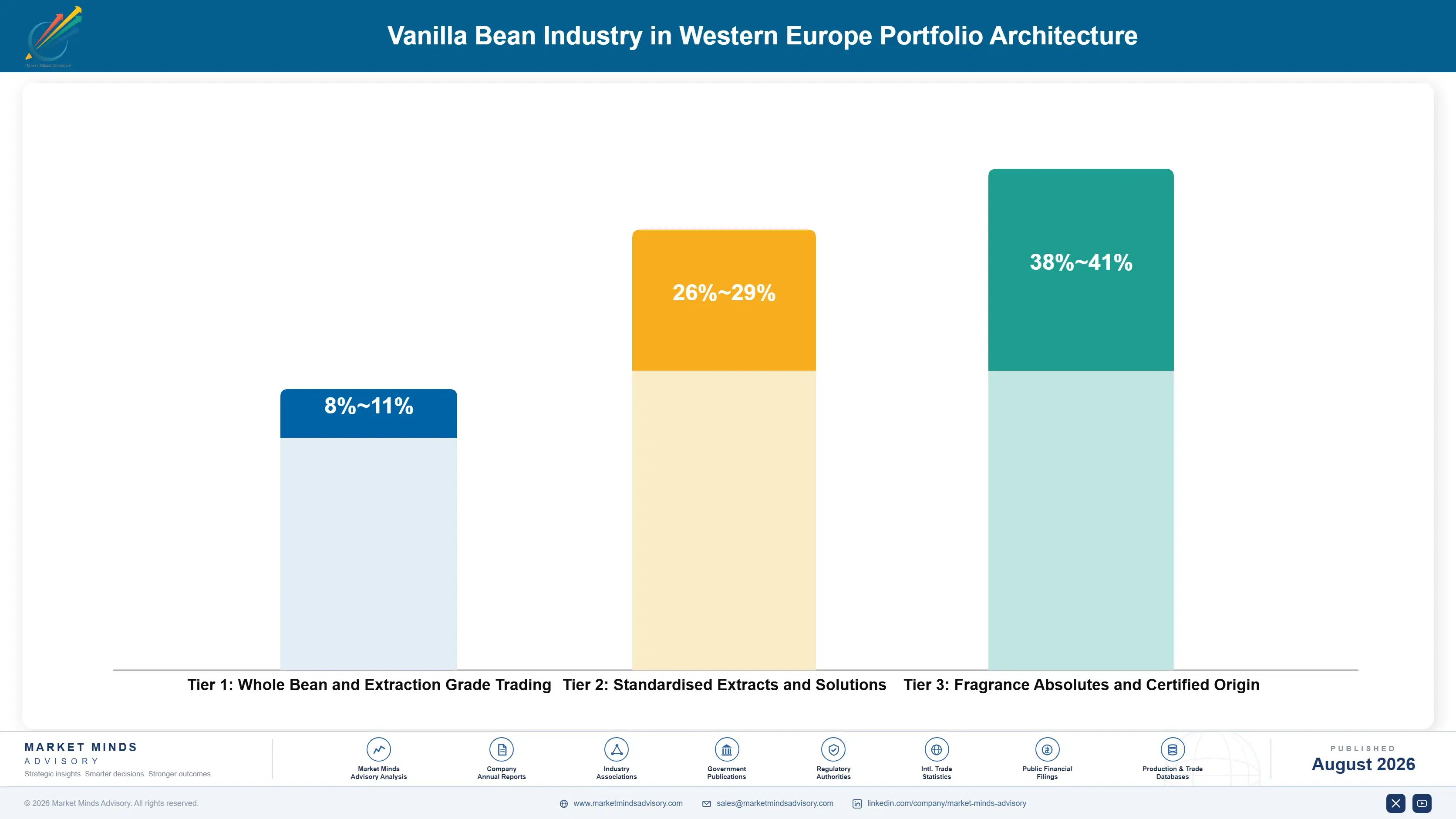
Portfolio Architecture for Margin Defence

Margin architecture here follows how far a product sits from raw bean trading. Whole bean resale earns trading margins that swing with the cycle and turn negative in a falling market. Standardised extract earns better, since blending across vintages to a declared specification is a capability the customer cannot replicate. Absolutes for fragrance earn best, on small volumes at values no food application supports.
The tension is that the volume sits where the exposure sits. Extract for industrial food manufacture carries most of the tonnage and most of the price risk, since those customers convert away when prices spike and do not return. Fragrance and premium patisserie carry far less volume and considerably more stability, because complexity and craft matter to those buyers. Nothing here offers both.

High value pools concentrate in fragrance absolutes and in premium artisan supply, both sold to buyers who value the product itself rather than the declaration attached to it. Everything sold on a labelling premium is exposed to fermentation derived vanillin securing the same claim at a fraction of the cost. That competition arrives from a fermentation tank rather than a farm.

Whole Bean and Extraction Grade Trading

Cured beans bought at origin and resold to processors or premium buyers, earning trading margins that swing with a cycle nobody can hedge. A falling market turns the position negative regardless of how well the buying was done.
Gross Margin: 8-11%

Standardised Extracts and Solutions

Extracts blended across vintages and origins to a declared vanillin specification for industrial food manufacture. Margin holds because consistency across harvests is a capability the customer cannot replicate and genuinely values in every batch.
Gross Margin: 26-29%

Fragrance Absolutes and Certified Origin

Absolutes and oleoresins for perfumery alongside traceable certified origin supply for premium food brands. Margin is the best available because these buyers value aromatic complexity and provenance rather than a labelling declaration alone.
Gross Margin: 38-41%
vanilla-bean-industry-in-western-europe-market-tre-portfolio-architecture-1787641293728

High-value Sub-segments and Strategic Watch-out

Vanilla Extracts and Alcoholic Solutions

The fastest growing form at 6.6% and the most exposed in the trade, since the demand behind it rests on a labelling definition rather than on any sensory advantage. Fermentation derived vanillin securing the same declaration would remove much of that demand quickly. Nobody has priced that risk.
Gross Margin: 26-29%

Vanilla Oleoresins and Absolutes

Second fastest at 5.8% and the only segment where buyers purchase the product for what it genuinely does rather than for what a label permits. Fragrance houses also accept vintage variation the food trade rejects, which matters greatly in a poor harvest. Volumes stay small deliberately.
Gross Margin: 38-41%

Cured Whole Beans

Growing at only 3.2% and carrying the full price exposure of the trade without any processing margin to cushion it. Premium patisserie and artisan gelato demand is the defensible part, since those buyers pay for craft and provenance rather than for vanillin content. Craft buyers pay reliably.
Gross Margin: 8-11%

Extraction Grade Beans

Growing at 3.6% as an intermediate traded between origin and processor, with margins that turn negative whenever the market falls during a holding period of around 18 months. Nobody holds this position deliberately unless they intend to extract it themselves. It is a position, not a product line.
Gross Margin: 8-11%

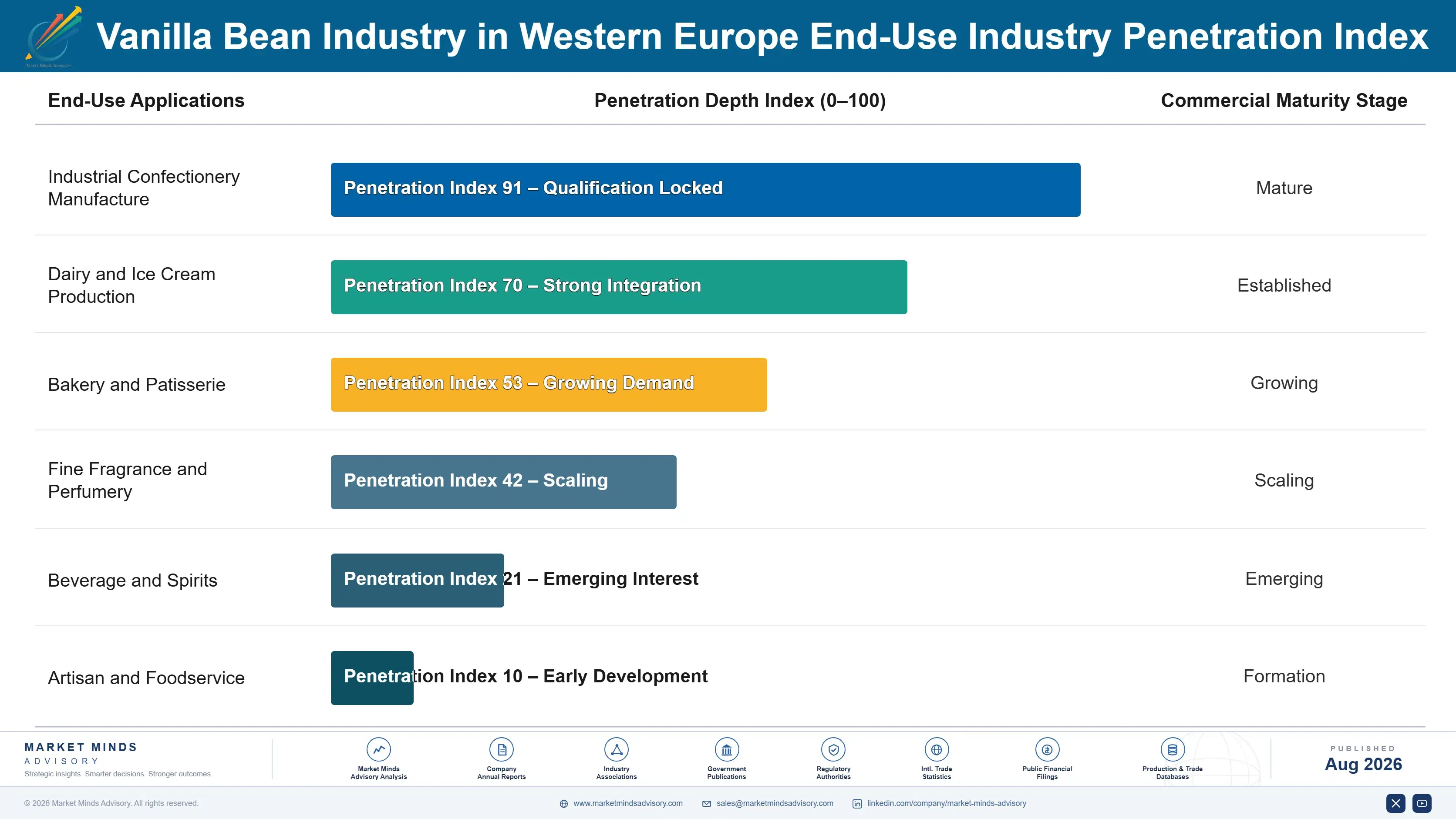
How This Demand Actually Repeats

Demand recurs annually and reliably at the recipe level, which is the useful part of this business. A product formulated with bean derived extract consumes the same quantity every year for as long as the recipe stands. What breaks the annuity is price: when green beans multiply, manufacturers reformulate, and roughly 12% of converted volume has been lost permanently across the last two spikes.
Stickiness varies sharply by customer type. Industrial food manufacturers are the least sticky despite the largest volumes, because their procurement functions run cost reviews that a natural claim does not always survive. Premium patisserie and artisan buyers are stickier, since craft identity depends on the ingredient. Fragrance houses are stickiest of all, because reformulating a perfume is not a procurement decision.

The buyer has shifted upward and outward within a decade. The decision once sat with a food technologist choosing a flavour system on sensory grounds. It now involves procurement, regulatory affairs and marketing simultaneously, because the purchase is a label claim with a cost attached rather than an ingredient choice. Marketing wants the declaration, procurement resists the price, and regulatory decides whether it survives audit.
vanilla-bean-industry-in-western-europe-market-tre-end-use-penetration-index-1787641294273

Where This Trade Rewards Skill

These are among the four positions where our research anticipates prominent divergence between winners and laggards over the coming forecast period. Each is grounded in the demand model, the regulatory perimeter, and the announced capacity pipeline.
01 / INVENTORY CYCLE TIMING

Buying well beats extracting well by a distance

Green bean prices have moved roughly thirty fold inside a decade with no futures market available to hedge any of it, which makes every purchase a directional position held for around 18 months. Processors that survived the last collapse bought counter cyclically and held through it, while those that bought at the peak carried losses for years afterwards. Extraction technology is well understood and widely available, so the difference between companies in this trade is almost entirely trading judgement rather than technical capability.
02 / LABELLING PREMIUM DEFENCE

Fermentation is competing away the whole premium

Synthetic vanillin already delivers the same principal aroma compound at roughly a two hundredth of the cost, and around 99% of world vanilla flavour is made that way, so the bean earns its premium from a regulatory definition rather than from taste. Vanillin produced by fermentation now secures a natural declaration in a growing number of jurisdictions at a fraction of bean cost. Any business whose value rests on a labelling category rather than on product performance should be planning for that category to narrow.
03 / ORIGIN CONCENTRATION REDUCTION

One island supplies most of the region's beans

Roughly 62% of beans reaching Western Europe come from Madagascar, exposed to cyclones, currency movement and government export price floors, which is a concentration no procurement function would tolerate in any other ingredient. Ugandan supply offers two harvests a year and Indonesian and Papua New Guinean volumes have expanded, with curing consistency rather than availability the binding constraint. Building those relationships costs very little during a surplus and becomes impossible during a shortage, which is exactly when they matter most.
04 / CRAFT CHANNEL PRIORITY

Sell to buyers who want the bean itself

Fragrance houses and premium patisserie buyers purchase vanilla for aromatic complexity and craft identity rather than for a natural declaration, which makes them the only customers whose demand does not evaporate when the labelling argument shifts. Absolutes grow at 5.8% at values per kilogram no food extract supports, and Spain grows at 6.8% on artisan gelato and patisserie demand. These buyers also accept vintage variation that industrial manufacturers reject outright, which is worth a great deal in a poor harvest year.

Engagement Snapshot From the Field

A live engagement with an industry participant carrying material or product regulatory and market exposure ahead of a defining policy shift, showing how our research translates into a defensible multi-year portfolio strategy.
MARKET MINDS ADVISORY · CLIENT ENGAGEMENT SUMMARY
Vanilla Bean Industry in Western Europe Producer Strategic Portfolio Review and Transition Roadmap 2026·Investment Scenario on Vanilla Bean Industry in Western Europe Exposure Evaluation 2025-26
CLIENT PROFILE
A European vanilla processor buying cured beans at origin and supplying standardised extract to industrial food manufacturers across four countries, alongside a small whole bean trading operation. Annual revenue was approximately 96 million dollars (client-reported, unverified by MMA), with roughly 78% of beans sourced from Madagascar. No fragrance customer base existed and inventory was bought largely to order.
STRATEGIC CHALLENGE
The company had carried inventory write downs through the previous price collapse and had lost two industrial accounts to reformulation when prices spiked before that. The board wanted to know whether the business model could survive another cycle intact. Nobody internally could say whether the problem was sourcing, contract structure or customer mix, and each function blamed a different one.
MMA APPROACH
MMA modelled contribution across three price scenarios by customer type and product form, separating exposure that sourcing changes could address from exposure inherent in the customer base. Origin diversification options were costed at current and surplus year pricing. Forty-seven expert interviews with industrial procurement leaders, patisserie buyers and fragrance evaluators established which customers reformulate under price pressure and which do not.
KEY FINDINGS
  1. Industrial food accounts representing 61% of revenue reformulated away under a severe price scenario, while patisserie and fragrance demand modelled as almost entirely stable throughout.
  2. Laddered seasonal purchasing across the previous cycle would have produced an average acquisition cost 34% below what buying to order actually delivered.
  3. Ugandan sourcing development cost roughly 8 times less during the surplus year than the same capability would cost during a shortage, and could not be arranged at all in one.
  4. Fragrance evaluators in 29 of the 47 interviews said vintage variation was desirable rather than acceptable, opening an outlet for beans the food trade rejects entirely.
CLIENT PROFILE
A European vanilla processor buying cured beans at origin and supplying standardised extract to industrial food manufacturers across four countries, alongside a small whole bean trading operation. Annual revenue was approximately 96 million dollars (client-reported, unverified by MMA), with roughly 78% of beans sourced from Madagascar. No fragrance customer base existed and inventory was bought largely to order.
STRATEGIC CHALLENGE
The company had carried inventory write downs through the previous price collapse and had lost two industrial accounts to reformulation when prices spiked before that. The board wanted to know whether the business model could survive another cycle intact. Nobody internally could say whether the problem was sourcing, contract structure or customer mix, and each function blamed a different one.
MMA APPROACH
MMA modelled contribution across three price scenarios by customer type and product form, separating exposure that sourcing changes could address from exposure inherent in the customer base. Origin diversification options were costed at current and surplus year pricing. Forty-seven expert interviews with industrial procurement leaders, patisserie buyers and fragrance evaluators established which customers reformulate under price pressure and which do not.
KEY FINDINGS
  1. Industrial food accounts representing 61% of revenue reformulated away under a severe price scenario, while patisserie and fragrance demand modelled as almost entirely stable throughout.
  2. Laddered seasonal purchasing across the previous cycle would have produced an average acquisition cost 34% below what buying to order actually delivered.
  3. Ugandan sourcing development cost roughly 8 times less during the surplus year than the same capability would cost during a shortage, and could not be arranged at all in one.
  4. Fragrance evaluators in 29 of the 47 interviews said vintage variation was desirable rather than acceptable, opening an outlet for beans the food trade rejects entirely.
RECOMMENDED STRATEGY
Phase 1: Phase one: convert to laddered seasonal purchasing immediately, since buying to order cost 34% more than averaging across the previous full price cycle. Phase 2: Phase two: develop Ugandan sourcing capability during the current surplus, at roughly 8 times less than the equivalent cost during any shortage. Phase 3: Phase three: build a fragrance customer base deliberately, since those buyers value vintage variation and do not reformulate away under price pressure.
OUTCOME
The client moved to laddered purchasing within one season and established Ugandan buying and curing relationships the following year. Madagascar dependence fell from 78% to 54% of volume, and fragrance customers reached 14% of revenue at margins well above the industrial extract business (client-reported, unverified by MMA).

Frequently Asked Questions

Foundational context covering the market sizes, CAGR, scope, country, region and competition that inform every finding below. This section is provided to cover basics and most often pre-purchase conversations, answered from the MMA Primary Research Dataset.

What is the current size of the Vanilla Bean Industry in Western Europe?

The market was valued at 0.58 billion dollars in 2025, covering cured beans, extraction grade beans, extracts, oleoresins and powder traded and consumed regionally. It reaches an estimated 0.61 billion dollars during 2026.

How large will the Vanilla Bean Industry in Western Europe be by 2036?

MMA forecasts 0.94 billion dollars by 2036, an increase of 0.33 billion dollars over the 2026 base. That represents an expansion multiple of 1.54 times across the forecast period.

What is the CAGR for the Vanilla Bean Industry in Western Europe 2026 to 2036?

The base case compound annual growth rate is 4.4%, with a bull case of 5.6% and a bear case of 3.2%. Labelling rules and green bean price stability separate those scenarios.

Which segment is growing fastest?

Vanilla extracts and alcoholic solutions grow at 6.6%, half again the market rate of 4.4%, driven by clean label reformulation across food manufacturing. Oleoresins and absolutes follow at 5.8%.

Who are the major companies in the Vanilla Bean Industry in Western Europe?

Symrise, Givaudan, dsm-firmenich, International Flavors and Fragrances and Prova lead on bean volume handled into the region. Together they account for 58% of the market.

Which country is growing fastest?

Spain grows fastest at 6.8%, driven by premium patisserie and artisan gelato demand that uses whole beans and paste rather than the cheapest available extract.

Report Segmentation Architecture

The full report scope spans multiple orthogonal segmentation dimensions, with cross-tabulated demand data provided for each dimension pair. Coverage extends further to regional breakdowns, trend trajectories, and the competitive detail needed to support segment-level decision-making.

By Product Form

  • Cured Whole Beans
  • Extraction Grade Beans
  • Vanilla Extracts and Alcoholic Solutions
  • Vanilla Oleoresins and Absolutes
  • Vanilla Powder and Ground Bean

By End-Use Industry

  • Industrial Confectionery Manufacture
  • Dairy and Ice Cream Production
  • Bakery and Patisserie
  • Fine Fragrance and Perfumery
  • Beverage and Spirits
  • Artisan and Foodservice

By Commercial Dimension

  • Direct Origin Contracting
  • Broker and Trader Supply
  • Flavour House Supply Agreements
  • Specialist Ingredient Wholesale
  • Certified and Traceable Programmes
  • Spot Market Purchasing

By Region

  • North America
  • Western Europe
  • East Asia
  • South Asia and Pacific
  • Latin America
  • Middle East and Africa
  • Eastern Europe

Scope, Methodology, and Coverage

Every figure in this report is reproducible from documented input assumptions. The scope below maps the historical period, the forecast horizon, the segmentation dimensions, and the countries covered, alongside the underlying primary and qualitative methodology.
Historical Period
2020 to 2025
Forecast Period
2026 to 2036
Base Year
2025 (USD billions; MMA Primary Research Dataset, August 2026)
Market Definition
Natural vanilla beans and bean derived products traded, processed and consumed within Western Europe, covering cured whole beans, extraction grade beans, vanilla extracts and alcoholic solutions, vanilla oleoresins and absolutes, and vanilla powder and ground bean. Measured at trade and processor selling value. Synthetic vanillin produced from lignin, guaiacol or ferulic acid, fermentation derived vanillin, ethyl vanillin, and compound flavour blends containing no bean derived material are excluded from scope.
Quantitative Units
USD billions (current prices); tonnes of bean equivalent; USD per kilogram by product form and origin
Segmentation Dimensions
Product form; end-use industry; commercial dimension; region
Regions Covered
North America, Western Europe, East Asia, South Asia and Pacific, Latin America, Middle East and Africa, Eastern Europe
Countries Covered
Germany, France, Spain, Italy, Netherlands, Belgium, United Kingdom, Switzerland, Austria, Portugal, Denmark, Sweden, Madagascar, Uganda, Indonesia, Papua New Guinea, Mexico, Comoros, United States, Japan
Key Companies Profiled
Symrise, Givaudan, dsm-firmenich, International Flavors and Fragrances, Prova, Eurovanille, Touton, Nielsen-Massey Vanillas, Aust and Hachmann, Frey and Lau, Sensient Technologies, Kerry Group, Doehler, Robertet, Mane, Takasago, T Hasegawa, Norevo, Bakels, Zeelandia
Quantitative Methodology
Primary survey, n=3,800 respondents, Q4 2025, six countries; demand-side model with trade association cross-validation
Qualitative Methodology
47 expert interviews, Q4 2025; applied to validate demand model assumptions, identify emerging dynamics, and assess competitive positioning
Report Format
PDF and XLSX data workbook (Word format preview document)
Publisher
Market Minds Advisory
Report Code
MMA-2026-AGR-201
Published
August 2026
Contact
sales@marketmindsadvisory.com | www.marketmindsadvisory.com

Purchase the full Vanilla Bean Industry in Western Europe Report (2026 to 2036).

The full report treats vanilla as a trade whose premium rests on a labelling definition rather than on taste, since synthetic vanillin delivers the same principal compound at a two hundredth of the cost and supplies almost all world flavour volume. It sizes all five product forms independently through 2036, models contribution across three green bean price scenarios by customer type, and maps origin dependence against curing consistency at every alternative source. Regional chapters cover all seven regions, with origin supply and competing demand assessed separately from Western European consumption. Competitive profiling covers 20 participants on one consistent bean volume basis.
Five product forms sized independently through 2036
Contribution modelled across three green bean price scenarios
Origin dependence mapped against curing consistency by source
Reformulation risk quantified by customer type and category
Fermentation vanillin labelling treatment tracked by jurisdiction
Twenty participants profiled on one consistent volume basis

Built For The People Who Decide

From boardroom strategy to bench-side execution, this report is read cover-to-cover by leaders shaping the next decade of their industry, turning demand scenarios, market dynamics and valuation benchmarks into decisions.
CXOs/ Presidents/ VPs/ Managers
M&A and Corporate Development
Strategy Teams and R&D Heads
Procurement and Product Directors
Regulatory and Compliance Leaders
Investor Relations and Equity Analysts