
Market Minds Advisory
Turbofan Engines Market

Turbofan Engines Market: Turbofan Engines Market: Aftermarket Economics, Durability Recovery and the Geared Architecture Transition

New engine deliveries have never been the business, spares and shop visits have, and the durability problems on the current generation are simultaneously the industry's largest embarrassment and its most reliable revenue stream.

Lead Analyst

David Horsley

Published

August 2026

Make Smarter Decisions with Customized Research Insights

Request a free sample report and evaluate market opportunities, growth trends, and competitive dynamics relevant to your business needs.

2025 MARKET VALUE$88.0BMarket Size 2025
2036 FORECAST VALUE$189.1BBase Case , 2026 to 2036
CAGR 2026 TO 20367.2 %Bull 8.4% / Bear 6.0%
INCREMENTAL OPPORTUNITY$94.7BNet 10- year value creation
EXPANSION MULTIPLE2.00x2036 value over 2026 base
Strategic Levers
M&A Pipeline
Regional Outlook
Country Rankings
Competitive Intelligence
Segmental Deep-dive
Call-Us : 91 93563 13602

Executive Snapshot and Market Trajectory.

Engine manufacturers sell new engines at or below cost and make their money for the next forty years. Aftermarket supplies 68% of revenue, an engine family stays in service around forty-five years, and every commercial decision here follows from that arrangement rather than from anything about the hardware.
Ultra-high bypass geared turbofans grow at 10.8%, a full 1.50 times the market rate, because a reduction gearbox lets fan and turbine each run at their own optimal speed, delivering the kind of fuel burn improvement airlines will genuinely pay for. North America holds 32% of global value because two of the only four companies capable of designing a large turbofan sit there, alongside the world's largest and oldest commercial fleet.
Concentration runs at 82% for the top five, which is among the highest figures anywhere in industry, and it is entirely explicable. Designing a large turbofan takes a decade and several billion dollars, certification is genuinely unforgiving, and the installed base an incumbent already holds funds the next programme. Nobody has entered this market successfully in fifty years, and nothing currently suggests that anybody is about to.
Market Definition
This report covers turbofan aircraft engines across commercial and military applications, spanning ultra-high bypass geared architectures, high bypass narrowbody and widebody engines, low bypass military engines and regional or business jet turbofans, and including original engine deliveries, spare engines, spare parts and overhaul shop visit revenue. Turboprop and turboshaft engines, auxiliary power units, airframes and nacelles supplied separately, and ground support equipment are excluded from the sizing.
Base Year Value
$88.0B in 2025 (MMA Primary Research Dataset, August 2026)
Forecast Period
2026 to 2036, eleven discrete annual values
CAGR
7.2% base case. Bull 8.4%. Bear 6.0%.
Fastest Growth Segment
Ultra-High Bypass Geared Turbofan: 10.8% CAGR
Fastest Growth Country
India: 10.4% CAGR
Fastest Growth Region
South Asia and Pacific: 9.4% CAGR
Largest Region
North America: 32% of 2025 global value
Market Leaders
GE Aerospace, Safran Aircraft Engines, Pratt and Whitney, Rolls-Royce and MTU Aero Engines lead on engine deliveries and shop visit volume. Source: MMA Analysis, July 2026.
Primary Survey
n=3,800 procurement and R&D decision-makers, Q4 2025, six countries
Methodology
Demand-side build-up, cross-validated against public data, 47 expert interviews

Turbofan Engines Market Forecast Scenarios

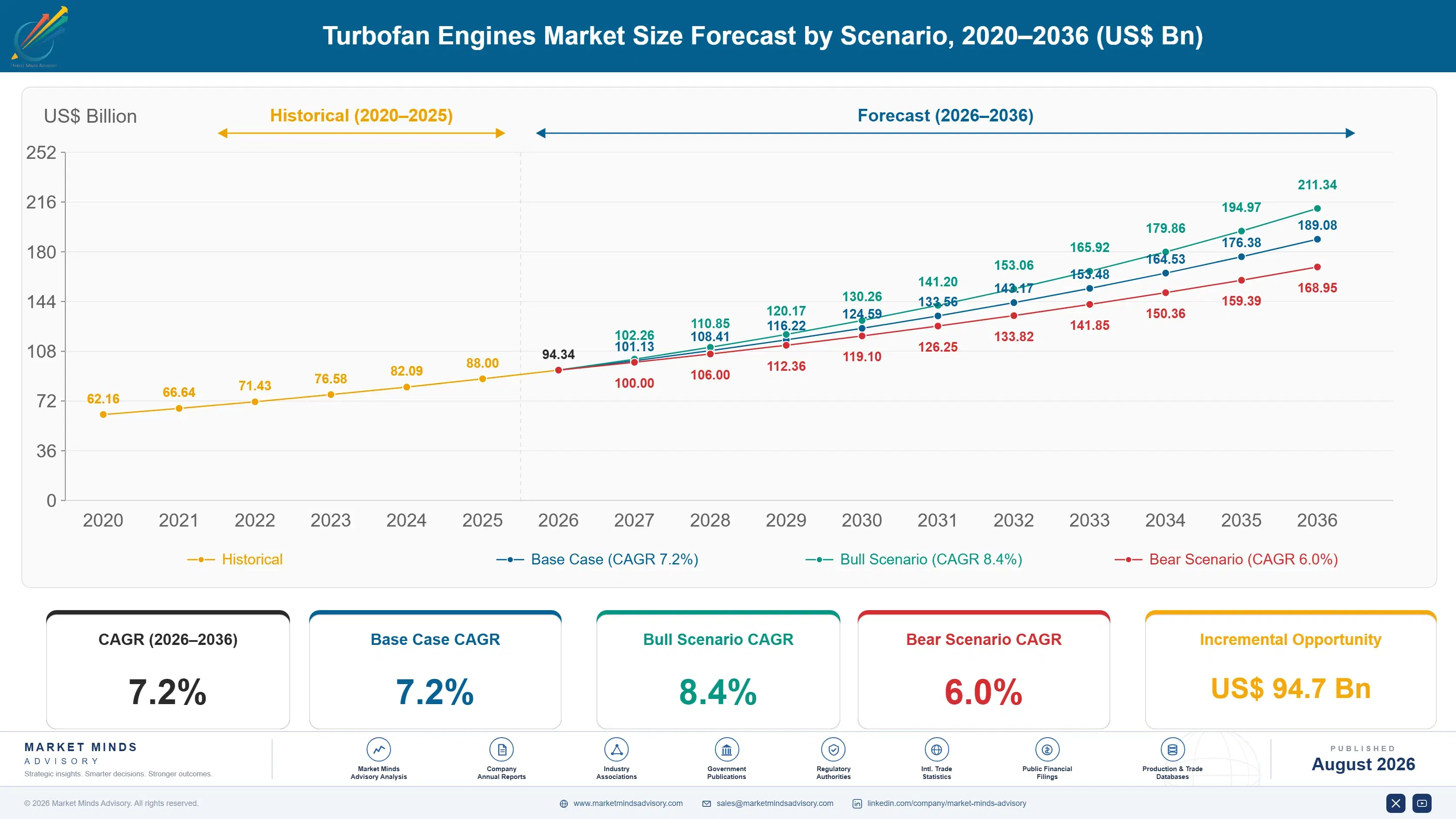
turbofan-engines-market-size-forecast-scenario-1787322258216
Between 2020 and 2025 the market compounded at 6.0%, and the period was violent in both directions. Flying stopped in 2020, shop visits collapsed with it, and manufacturers cut production against orders nobody expected to be honoured. Recovery then arrived faster than capacity could follow, and durability problems pulled unplanned removals forward while the supply chain was still rebuilding.
The base case at 7.2% rests on three mechanisms. Narrowbody build rate recovery at both airframers pulls original engine deliveries up through the decade, and every delivery seeds decades of aftermarket revenue behind it. Shop visit demand grows on an installed base that is both large and ageing, with capacity limiting throughput rather than demand. Geared architectures keep raising realised value per engine as airlines specify fuel burn improvements they measure directly against fuel cost.
The bull case at 8.4% turns on shop visit capacity expanding fast enough to clear the backlog, which would convert demand that currently exists into revenue that currently cannot be delivered. The bear case at 6.0% is durability problems persisting on current-generation engines: unplanned removals consume capacity that scheduled work needs, and aircraft grounded waiting for engines generate no flight hours at all.

What Actually Governs Turbofan Engine Value

The commercial model here is unlike anything else in industrial equipment. Manufacturers sell new engines at prices that frequently do not cover the cost of building them, because the engine is the entry ticket to forty-five years of spare parts and overhaul revenue that nobody else may legally supply on the same terms.
TOP FIVE CONCENTRATION82%Share held by the five largest engine manufacturers globally
AVERAGE ENGINE PRICE$14.6 millionTypical realised price for a narrowbody engine unit
AFTERMARKET REVENUE SHARE68%Portion of manufacturer revenue from spares and shop visits
PROGRAMME LIFE45 yearsTypical period an engine family remains in active service
SHOP VISIT INTERVAL6,000 cyclesFlight cycles typically flown between scheduled engine overhauls
INSTALLED ENGINE BASE72,000 enginesTurbofans currently operating across commercial and military fleets
That arrangement makes aftermarket 68% of revenue and explains why competition between programmes is so fierce and why losing one hurts for decades. It also explains the durability problem the current generation has produced. Engines designed to extract every possible point of fuel efficiency run hotter, and hot section parts wear faster than the models predicted, which pulls shop visits forward. That is simultaneously an embarrassment, a warranty cost and a revenue acceleration, which is an uncomfortable combination to explain to anybody.
Capacity rather than demand is the binding constraint right now. Overhaul shops are full, casting and forging supply for hot section parts remains tight after the titanium disruption, and airlines wait months for engines that exist as demand but cannot be delivered as revenue. That backlog is the single most important number in this industry and it is not improving quickly.
"Everybody discusses engine orders and almost nobody discusses turnaround time at the overhaul shops, which is backwards. The order book is full and largely irrelevant to this decade's revenue. What matters is how many engines a shop can actually put through, and right now the answer is not enough."
Practice Director, Aerospace Propulsion, Market Minds Advisory · MMA Industrial Equipment Practice · August 2026

Market Trends

Geared Architectures Separate Fan And Turbine Speeds

A conventional turbofan ties fan and low-pressure turbine to one shaft, forcing both to run at a compromise speed neither prefers. Inserting a reduction gearbox lets the fan turn slowly and the turbine quickly, which raises bypass ratio and cuts fuel burn by a margin airlines measure directly against fuel cost. The engineering difficulty sits in the gearbox itself, transmitting enormous power continuously for thousands of hours, and in a hot section that must run hotter to deliver the efficiency the architecture promises, which is where the durability problems originate.
Market Impact: Serves 72,000 installed engines
Hot Section Durability Reshapes Shop Visit Scheduling

Current-generation engines run hotter to deliver their efficiency, and hot section components have worn faster than the design models predicted across several programmes. Unplanned removals now consume overhaul capacity that scheduled maintenance work genuinely requires, extending turnaround times and grounding aircraft that airlines had planned to fly. Manufacturers are working through redesigned parts and improved coatings, but retrofitting an installed base of this size takes several years to complete. The commercial effect is genuinely double-edged, accelerating aftermarket revenue while simultaneously damaging customer relationships and generating warranty cost nobody budgeted for.
Market Impact: Adds 2 engines per aircraft

Market Opportunities and Growth Drivers

Ageing Installed Base Generates Compounding Shop Visit Demand

Roughly 72,000 turbofans operate across commercial and military fleets, and each returns for overhaul every few thousand flight cycles across a service life measured in decades. The demand compounds because engines accumulate cycles whether or not anybody is buying new aircraft at all, and older engines require considerably more extensive work at each visit than younger ones do. Aftermarket already supplies fully 68% of manufacturer revenue on exactly that basis, and the arithmetic behind it is considerably more predictable than any delivery forecast either airframer has ever published. Nothing about that arithmetic is fragile.
Market Impact: Extends turnaround to 120 days

Narrowbody Fleet Expansion Seeds Decades Of Future Revenue

Both airframers are now working toward single-aisle build rates that neither has ever previously sustained, and Indian and Southeast Asian carriers have placed some of the largest narrowbody orders ever recorded. Every single delivery carries two engines plus spare provisioning behind it, and each of those engines seeds forty-five years of parts and overhaul revenue behind it. That is why manufacturers compete so hard on programmes where the engine itself frequently sells at or below build cost, and why losing a programme costs four decades of revenue rather than a single contract.
Market Impact: Lead times exceed 70 weeks

Market Restraints and Challenges

Overhaul Capacity Constrains Revenue Below Actual Demand

Shop visit demand currently exceeds what overhaul capacity can process, and turnaround times have extended well beyond what airlines plan around. The root cause is compounded: skilled technicians take years to train, hot section part supply remains tight after the titanium disruption, and unplanned removals from durability problems consume slots scheduled work needed. Commercially this caps revenue below demonstrated demand. Participants are responding by expanding shop capacity, by licensing additional overhaul facilities, and by qualifying used serviceable material to reduce consumption of new parts that are themselves constrained. The gap is not closing quickly.
Market Impact: Cuts fuel burn by 16%

Casting And Forging Supply Limits Hot Section Throughput

Single-crystal turbine blades and large load-bearing forgings come from a very small qualified supply base, and sanctions on Russian titanium after 2022 removed a substantial share of Western availability. The root cause is that qualifying a new foundry for flight-critical hot section parts takes years of process validation. Commercially this constrains both new engine build and overhaul throughput simultaneously. Participants are responding with long-term foundry agreements, additive manufacturing for suitable components, and investment in additional qualified casting capacity that will still take years to reach production volume. Nothing resolves this within five years.
Market Impact: Pulls removals forward 40%
4 additional market trends, 3 additional growth drivers, and 2 additional restraints and challenges are covered in the full report. Contact sales@marketmindsadvisory.com to access the complete intelligence.

Segment CAGR and Growth Architecture

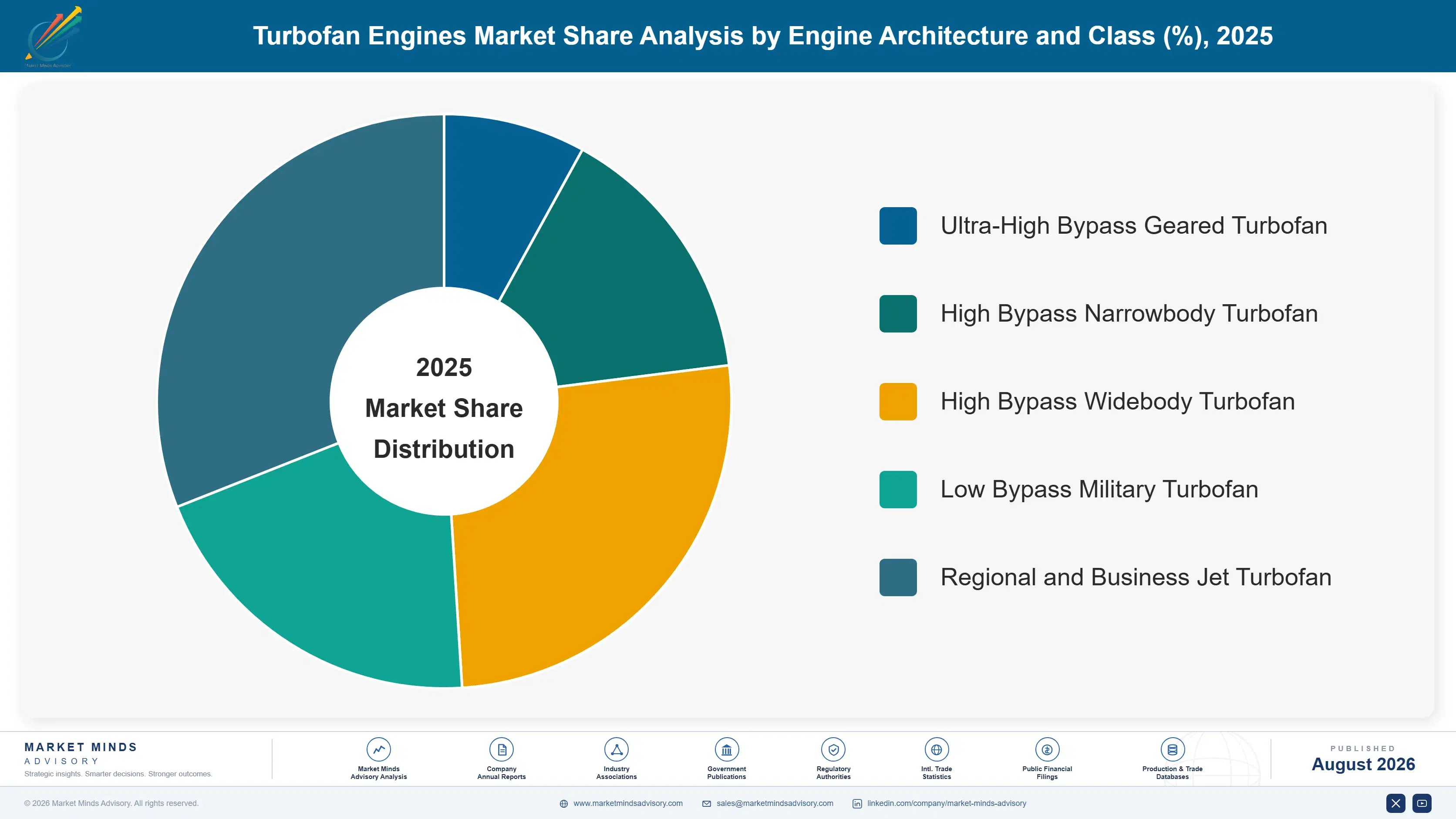
Segmentation follows engine architecture and application class, because bypass ratio, thrust range and mission profile together determine the airframes an engine can power, the aftermarket cadence it generates, the certification burden it carries and the realised value across its whole programme life. Materials, control systems and service agreements all sit downstream of that architectural decision.
turbofan-engines-market-market-share-analysis-1787322258753

Ultra-High Bypass Geared Turbofan

The fastest segment at 10.8%, a full 1.50 times the market rate, covering engines using a reduction gearbox between fan and low-pressure turbine so each can run at the speed it actually wants rather than at a shared compromise. The efficiency argument is straightforward and airlines can measure it. Higher bypass ratio cuts fuel burn by a margin that shows up directly against fuel cost, which is the largest controllable expense most carriers face. The difficulty sits in the gearbox transmitting enormous power continuously for thousands of hours, and in a hot section running hotter to deliver what the architecture promises. Durability recovery on that hot section is the segment's defining commercial issue right now.
CAGR 10.8%

High Bypass Narrowbody Turbofan

Growing at 8.6% on high bypass engines powering single-aisle aircraft, which is where the volume in commercial aviation genuinely sits and where the largest order books ever recorded have been placed. Both airframers are targeting build rates neither has previously sustained. Every aircraft carries two engines plus spare provisioning, and each seeds forty-five years of parts and overhaul revenue behind it, which is exactly why manufacturers compete on these programmes at prices that frequently do not even cover the build cost. Competition here is effectively a duopoly on most airframes, and the exclusivity or dual-source decision an airframer takes shapes an entire decade of revenue distribution across this whole industry.
CAGR 8.6%
Full segment breakdown across 5 segments available in the complete report.

Regional Architecture and Country Demand Map

North America holds 32% of global value because two of the four companies able to design a large turbofan sit there alongside the largest and oldest fleet. Western Europe follows on the remaining two designers, while growth runs fastest across South Asia and Pacific on Indian fleet expansion.

North America

The United States hosts two of the four companies capable of designing a large turbofan and operates the world's largest commercial fleet, which makes this region dominant on both manufacturing and aftermarket measures simultaneously. GE Aerospace and Pratt and Whitney between them hold positions on almost every widebody and narrowbody programme flying. Independent overhaul capacity is deeper here than anywhere, and the installed base generating shop visits is both the largest and among the oldest. Military turbofan demand adds a substantial second stream, since fighter and transport programmes carry engine content and sustainment obligations extending decades past delivery. Manufacturing and aftermarket depth reinforce each other here in a way no other region matches at all.
Share: 32% | CAGR: 6.7% (2026 to 2036)

Western Europe

Two of the remaining four large turbofan designers sit here, and the partnership structures binding them to American counterparts define how this industry actually works. Safran holds half of CFM, the most successful engine programme ever built, while Rolls-Royce concentrates on widebody power where it competes directly with GE. MTU Aero Engines and Avio contribute module workshare across several programmes. Airbus assembly pulls engine deliveries through the region, and European overhaul capacity through Lufthansa Technik and MTU serves fleets far beyond the continent. Aftermarket rather than original delivery carries the clear majority of regional value here. Partnership structures rather than outright competition define how this whole region actually operates commercially.
Share: 26% | CAGR: 5.7% (2026 to 2036)
Regional intelligence for 5 additional markets available in the complete report: East Asia, South Asia and Pacific, Latin America, Middle East and Africa, Eastern Europe. Contact sales@marketmindsadvisory.com.
turbofan-engines-market-country-cagr-analysis-1787322259273

Where Turbofan Margin Is Actually Won

Four positions separate manufacturers earning programme-life returns from those supplying hardware into somebody else's aftermarket: expanding overhaul capacity ahead of demand, defending parts revenue against used serviceable material harvested from retirements, structuring long-term service agreements that lock the installed base, and securing qualified hot section casting supply well before the next capacity constraint actually arrives.

Expand Overhaul Capacity Ahead Of Demonstrated Demand

Shop visit demand already exceeds what capacity can process and turnaround has stretched past 120 days, which means revenue currently exists as backlog rather than as delivered work. Manufacturers adding qualified shop capacity convert that backlog directly into revenue, and every additional slot generates aftermarket work at margins 25 to 34 points above what new engine delivery earns. Capacity takes years to build because qualified technicians themselves take years to train, which is precisely why the constraint persists and why acting early compounds across the whole decade. Nobody catches up quickly here.
Market Impact: Adds 34 margin points on every shop visit

Defend Parts Revenue Against Used Serviceable Material

Independent overhaul shops increasingly fit used serviceable parts harvested from retired engines, which is entirely legal, considerably cheaper for the airline and directly displaces the manufacturer new part sales funding this whole commercial model. Manufacturers responding with their own used material programmes, extended warranty tied to new parts and service agreements covering whole engines retain 18% to 26% more parts revenue than competitors trying to compete on new part price alone. Ignoring the channel altogether simply hands it to somebody else entirely, which several manufacturers have already discovered. The channel exists regardless.
Market Impact: Retains 26% more aftermarket parts revenue overall here

Structure Long-Term Service Agreements Locking Installed Base

An engine sold without a service agreement can be overhauled by anybody at all, while one covered by a long-term arrangement generates predictable revenue for decades and keeps independent shops out of the account entirely. Manufacturers achieving high service agreement penetration realise 30% to 40% more lifetime revenue per engine delivered, and those agreements smooth cash flow across a business that is otherwise brutally cyclical. Airlines accept them because cost per flight hour is predictable, which matters considerably more to an airline treasury function than headline purchase price does. Penetration decides the whole account.
Market Impact: Realises 40% more lifetime revenue on each engine

Secure Hot Section Casting Supply Before Constraints Bite

Single-crystal turbine blades and large load-bearing forgings come from a very small qualified supply base, and lead times already exceed 70 weeks after the titanium disruption removed much Western availability. Manufacturers holding long-term foundry agreements and equity positions in casting capacity ship to schedule while their competitors simply wait in allocation queues. Qualifying a new foundry takes years of process validation, which means the constraint cannot be solved reactively at all, and whoever secured capacity early now holds a genuine throughput advantage over everybody else. Early positioning is the only real defence available.
Market Impact: Avoids 70 week lead times on casting supply

Who Controls the Margin Pool

Concentration sits at 82% for the top five measured on engine deliveries and shop visit volume, the basis used throughout this section, and it is among the highest of any industry this practice covers. GE Aerospace and Safran through their CFM partnership hold the dominant narrowbody position, Pratt and Whitney competes there with geared architecture, Rolls-Royce concentrates on widebody power, and MTU carries module workshare across several programmes.
Competitive activity runs on three fronts. Overhaul capacity is the first and the most immediate, since revenue currently sits as backlog rather than as delivered work. Durability recovery is the second, and it determines both warranty cost and whether airlines trust the next programme. The third is service agreement penetration, which decides whether an engine generates decades of manufacturer revenue or gets overhauled by somebody else entirely.

Pressure comes from two directions that the manufacturers find genuinely awkward. Independent overhaul shops using used serviceable material undercut new part pricing legally and persistently. Separately, Chinese indigenous engine development continues behind sustained state investment. Rankings will not shift quickly, because designing a large turbofan takes a decade and nobody has entered this market successfully in fifty years.
turbofan-engines-market-company-positioning-matrix-1787322259796

Competitive Moat and Risk Dimensions

GE AEROSPACE

Moat: Installed base scale and partnership

The largest installed engine base anywhere generates aftermarket revenue for decades regardless of what happens to new deliveries, and the CFM partnership with Safran holds a narrowbody position built across the most commercially successful engine programme ever produced. Overhaul network breadth and long-term service agreement penetration both convert that base into revenue competitors cannot reach.
GE AEROSPACE

Risk: Durability recovery cost exposure

Hot section wear on current-generation engines has produced warranty obligations and unplanned removals that consume overhaul capacity scheduled work required, damaging airline relationships while the redesigned parts work through the fleet. Retrofitting an installed base of this size takes years, and the reputational cost with customers making next-generation decisions is genuinely difficult to quantify.
PRATT AND WHITNEY

Moat: Geared architecture technical position

Committing to geared turbofan architecture ahead of competitors established a technical position on fuel burn that conventional configurations struggle to match, and the engineering knowledge accumulated across that development is genuinely difficult to replicate. Military engine programmes alongside provide revenue on a cycle uncorrelated with commercial aviation demand entirely.
PRATT AND WHITNEY

Risk: Powder metal inspection programme burden

A manufacturing quality issue requiring extensive fleet inspection has grounded aircraft, consumed overhaul capacity and generated compensation obligations to affected airlines on a scale that materially affects group results. Working the affected population through inspection takes years, during which capacity is unavailable for the routine work that normally generates the aftermarket revenue.

Players Tracked

Prominent Players

GE Aerospace
Safran Aircraft Engines
Pratt and Whitney
Rolls-Royce
MTU Aero Engines

Other Key Players

IHI Corporation
Kawasaki Heavy Industries
Mitsubishi Heavy Industries
Honeywell Aerospace
Williams International
GKN Aerospace
Aero Engine Corporation of China
United Engine Corporation
Hindustan Aeronautics Limited
Avio Aero
ITP Aero
Lufthansa Technik
ST Engineering
AAR Corporation
StandardAero

Recent Developments

FEBRUARY 2025

Additional overhaul capacity commissioned against shop visit backlog

An engine manufacturer commissioned additional qualified overhaul capacity across two of its facilities during the year, responding to shop visit turnaround times that had extended past 120 days which had left airlines holding aircraft on the ground waiting for engines that demand had already committed to them.
Signal: Overhaul capacity rather than order intake is what currently limits how much revenue this industry can deliver
JUNE 2025

Redesigned hot section parts enter service across affected fleet

A manufacturer introduced newly redesigned high-pressure turbine components into service across an affected engine family during the year, which addresses the wear rates that had pulled unplanned removals forward substantially and had consumed overhaul slots that scheduled maintenance work genuinely needed across several years of scheduling.
Signal: Durability recovery on current generation engines determines whether airlines trust the manufacturer at next programme selection
OCTOBER 2025

Long-term service agreement signed covering entire narrowbody fleet

A major international carrier signed a full long-term service agreement covering its entire narrowbody engine fleet on a strict cost per flight hour basis, which transfers overhaul scheduling and parts risk entirely to the manufacturer and excludes independent shops from that account for decades ahead.
Signal: Service agreement penetration rather than delivery share now increasingly determines who actually captures the aftermarket revenue

What Drives Turbofan Engine Cost

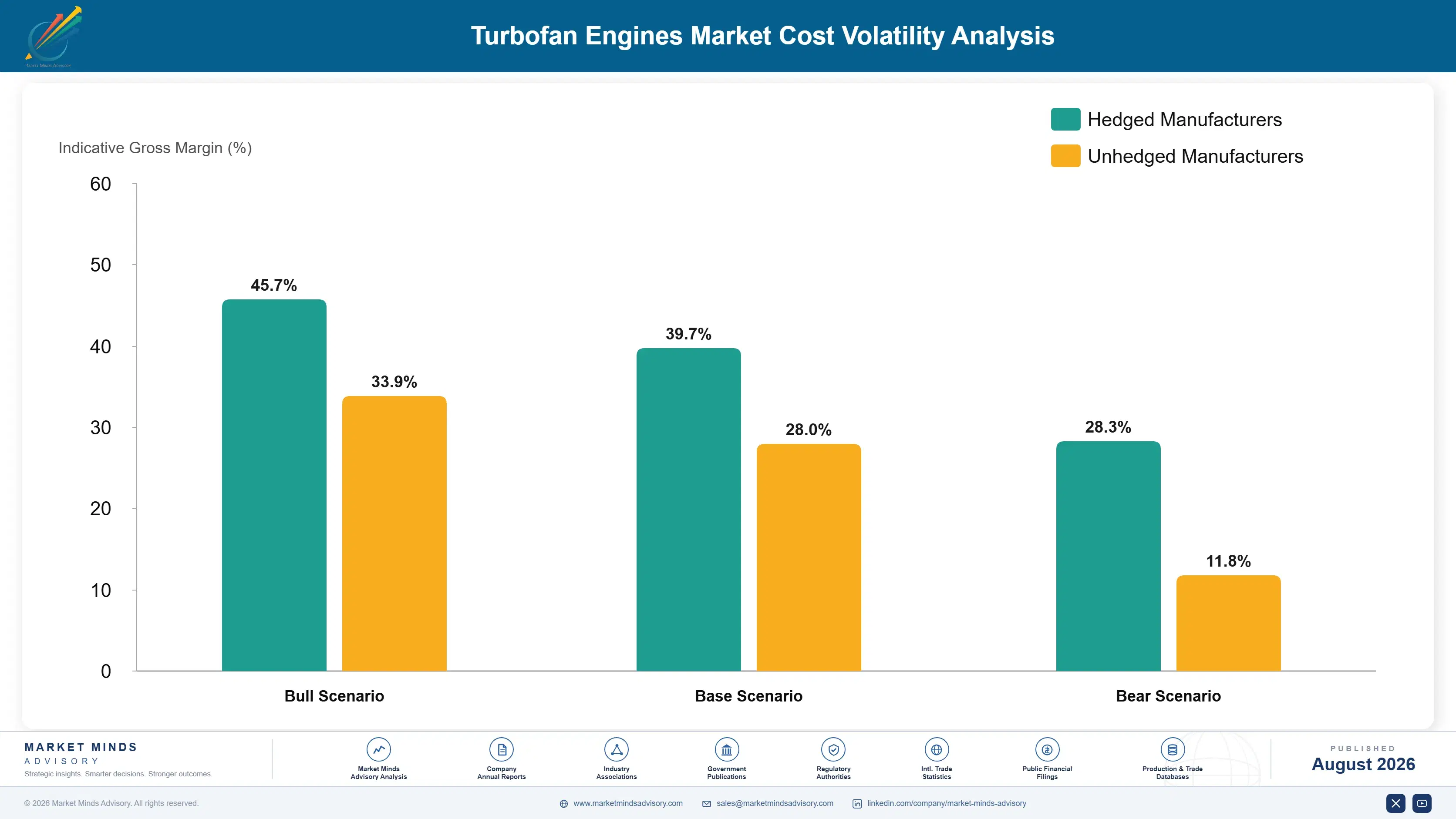
Nickel superalloy castings and forgings account for roughly 38% of manufactured engine cost, covering turbine blades, discs and casings that run above the melting point of the metal itself and survive only through internal cooling and coatings. Titanium fan and compressor content adds around 12%. Precision machining, coating and assembly labour contribute a further 26%, and test, certification and quality documentation about 9% across a typical build.
Sanctions on Russian titanium after 2022 removed a substantial share of Western programme supply and lead times extended past seventy weeks in places, while nickel pricing moved sharply during the 2022 London Metal Exchange disruption. GE Aerospace Annual Report 2025 and Safran Annual Report 2025 both identify raw material availability as a continuing limit on output, and IATA fleet data shows the demand pressure sitting behind them.

The disadvantage mechanism is qualified foundry access rather than metal pricing. Single-crystal turbine blade casting requires process validation taking years, and manufacturers holding long-term agreements or equity positions in that capacity ship to schedule while competitors sit in allocation queues. Exposure varies by programme age too: mature engines draw on established supply chains while new-generation hot sections compete for the scarcest capacity anywhere.
turbofan-engines-market-cost-volatility-analysis-1787322259995

Secure long-term agreements at qualified superalloy foundries

Multi-year commitments and equity positions at qualified casting suppliers convert allocation risk into contractual entitlement, which matters far more than price when single-crystal capacity is short. The cost is take-or-pay exposure if build rates fall below plan. Manufacturers holding such positions through the post-2022 squeeze shipped to schedule while competitors renegotiated delivery dates repeatedly with their airline customers.

Qualify additive manufacturing for suitable hot section components

Certified additive production for fuel nozzles, brackets and selected hot section components removes demand from a constrained casting base while cutting material consumption substantially. Qualification is slow and process control demanding, which is exactly why the capability concentrates among few manufacturers. Those holding approval are insulated from precisely the constraint limiting competitors' throughput today.

Expand used serviceable material harvesting and certification

Parts harvested from retired engines and recertified reduce new casting demand meaningfully while capturing revenue that independent shops would otherwise take entirely. The commercial tension is real, since used material displaces new part sales the model depends upon. Managing that channel deliberately rather than conceding it is the practical answer most manufacturers have now reached.

Portfolio Architecture for Margin Defence

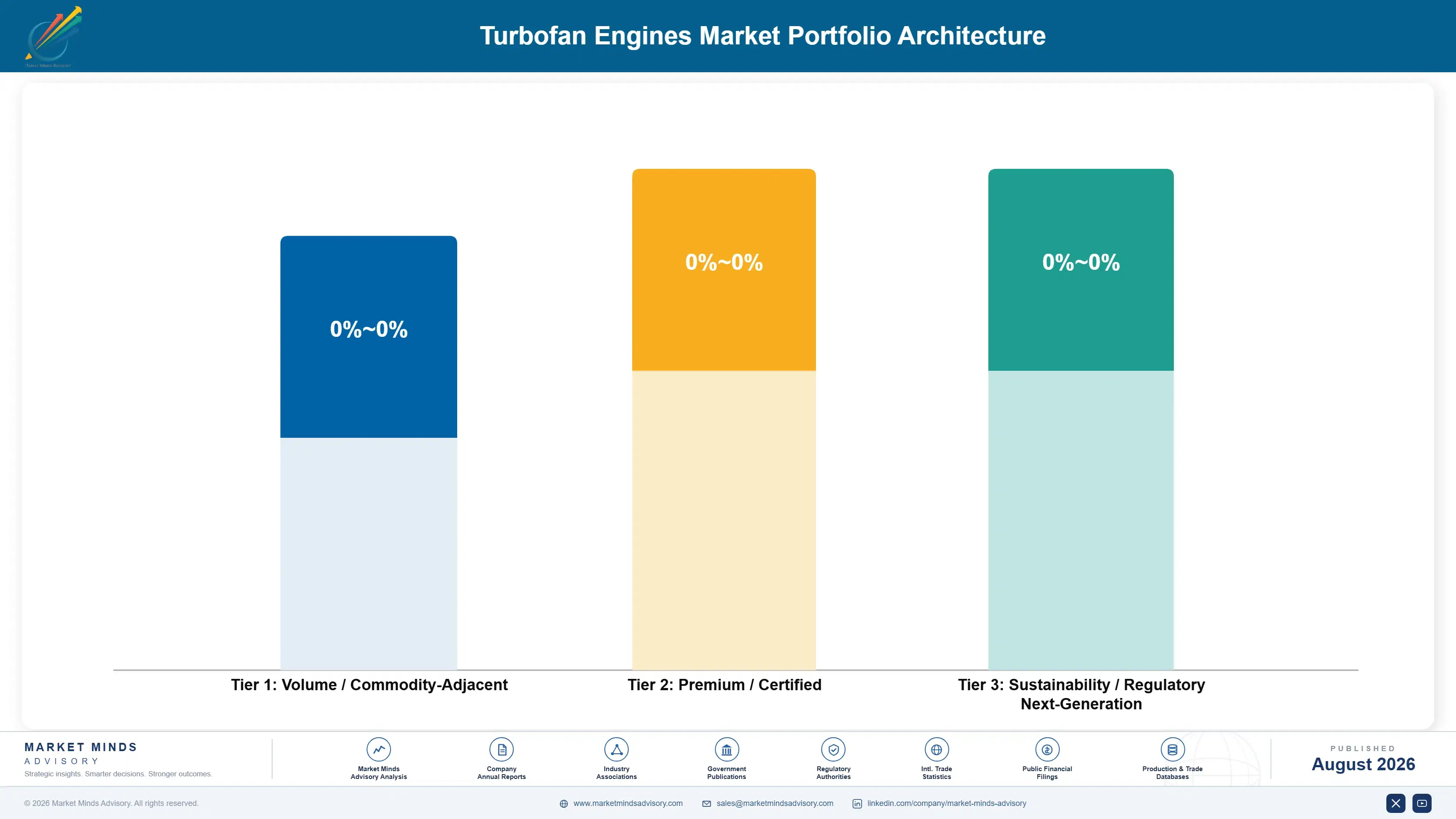
Portfolio economics here are almost inverted against normal industrial logic. New engine delivery earns gross margins in the low single digits and frequently below cost, because manufacturers price to win a programme whose real value arrives across the following four decades rather than at the moment of sale. Winning the programme is the entire point of the exercise, and margin at delivery is almost beside it.
The premium tier is spare parts supply into the installed base. A manufacturer holds design authority over its own components and airlines have limited alternatives once an engine is in service, which supports pricing that new engine delivery never could. Margins run in the mid thirties, and the revenue arrives regardless of whether anybody is buying new aircraft that year.

Above both sits long-term service agreement work covering whole engines on a cost per flight hour basis. Those arrangements lock the installed base, exclude independent shops from the account entirely and generate predictable revenue for decades at margins reaching the low forties. They also transfer scheduling and parts risk to the manufacturer, which requires genuine capability but is precisely what makes the position defensible.

Volume / Commodity-Adjacent

New engine delivery into competitively selected airframe programmes. Manufacturers price to win a position whose value arrives across four decades of aftermarket, which frequently means selling the hardware at or below build cost.
Gross Margin: 2 to 8%

Premium / Certified

Spare parts supply into the installed base under design authority. The range reflects how much used serviceable material competes on a given engine family, which varies considerably by fleet age and retirement volume.
Gross Margin: 30 to 38%

Sustainability / Regulatory / Next-Generation

Long-term service agreements covering whole engines on cost per flight hour terms. The range spans basic parts coverage through to full risk transfer arrangements that include scheduling and availability guarantees.
Gross Margin: 38 to 46%
turbofan-engines-market-portfolio-architecture-1787322260496

High-value Sub-segments and Strategic Watch-out

Long-Term Service Agreement Coverage

High value and high growth sitting squarely together. These arrangements lock the installed base in place for decades, exclude independent overhaul shops from the account entirely, and they give airlines exactly the predictable cost per flight hour that treasury functions value well above headline pricing.
Gross Margin: 39 to 47%

Spare Parts Supply Under Design Authority

High value running on genuinely steady underlying growth. Design authority over components gives pricing power that new engine delivery never approaches, and the revenue arrives whether or not anybody is buying aircraft, though used serviceable material harvested from retirements erodes that position steadily every year.
Gross Margin: 30 to 38%

Overhaul Shop Visit Throughput

The capacity-constrained core of this entire industry at present. Demand here already exceeds what qualified shops can process and turnaround has stretched well past four months, which means adding qualified capacity converts standing backlog directly into revenue that nobody can currently deliver to the customer at all.
Gross Margin: 25 to 33%

New Engine Delivery Programmes

The strategic watch-out sitting squarely inside this particular portfolio. Hardware here frequently sells at or even below its actual build cost, yet nobody ever reaches the aftermarket that funds this entire industry without first winning the airframe programme that the engine will eventually attach to.
Gross Margin: 2 to 8%

How Turbofan Demand Repeats

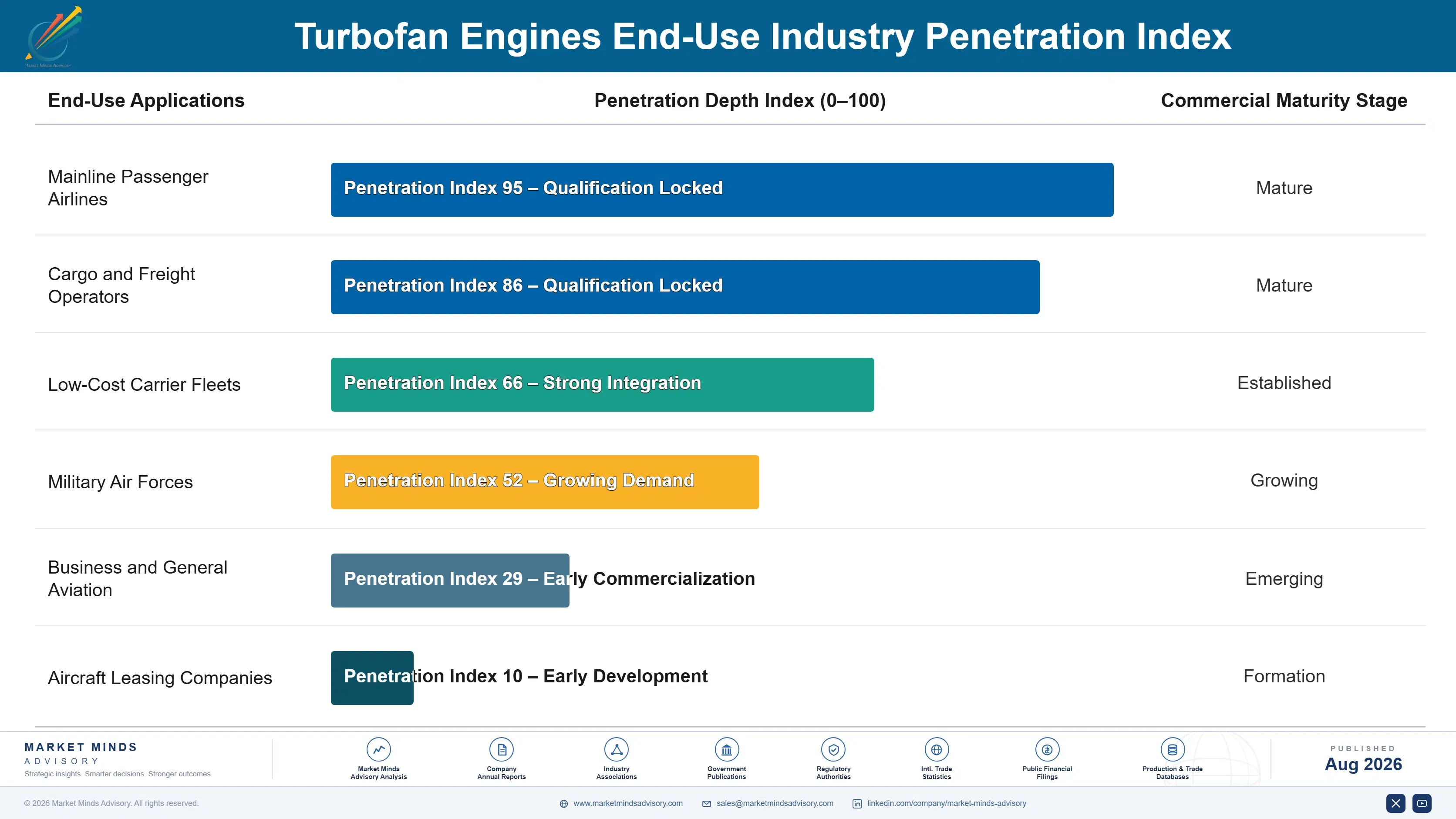
The annuity here is longer than in almost any other industry. An engine delivered today generates spare parts and overhaul revenue for roughly forty-five years, across perhaps seven or eight shop visits, and the manufacturer holds design authority throughout that period. Original delivery is the entry ticket rather than the business, which is why programmes are contested so fiercely and why losing one costs four decades rather than a contract.
Stickiness varies considerably by commercial arrangement. Engines covered by long-term service agreements are the stickiest by a wide margin, since the manufacturer holds the whole account and independents cannot enter it. Engines without such agreements are genuinely contestable, with independent shops competing on price using used serviceable material. Military engines sit between the two, tied to sustainment contracts that rarely change hands. Leasing company engines follow whatever the lessor originally negotiated.

The buyer profile has shifted noticeably. Engine selection once sat with airline engineering departments evaluating fuel burn, thrust and maintenance cost as technical questions. Today it sits with fleet planning and treasury functions weighing cost per flight hour, residual value and service agreement terms together, which favours manufacturers who can structure commercial arrangements as convincingly as they engineer hardware.
turbofan-engines-market-end-use-penetration-index-1787322260985

Where To Compete And Why

These are among the four positions where our research anticipates prominent divergence between winners and laggards over the coming forecast period. Each is grounded in the demand model, the regulatory perimeter, and the announced capacity pipeline.
01 / OVERHAUL CAPACITY EXPANSION

Backlog is revenue nobody can deliver

Shop visit demand already exceeds what qualified capacity can process and turnaround has stretched past 120 days, which means substantial revenue currently exists as backlog rather than as delivered work. Every additional qualified slot generates aftermarket revenue at margins 25 to 34 points above what new engine delivery earns. Capacity takes years to build because qualified technicians themselves take years to train, which is exactly why this constraint persists and why acting early on it compounds across the whole decade.
02 / PARTS REVENUE DEFENCE

Used material takes what nobody protects

Independent shops increasingly fit used serviceable parts harvested from retired engines, which is entirely legal, cheaper for the airline and directly displaces the new part sales funding this whole commercial model. Manufacturers running their own used material programmes, warranty tied to new parts and whole-engine service agreements retain 18% to 26% more parts revenue than competitors trying to compete on new part price. Ignoring the channel altogether simply hands it to somebody else outright, as several manufacturers have already found.
03 / SERVICE AGREEMENT PENETRATION

Coverage decides who keeps the engine

An engine sold without a service agreement can be overhauled by anybody at all, while one under a long-term arrangement generates predictable revenue for decades and keeps independents out of the account entirely. Manufacturers achieving high penetration realise 30% to 40% more lifetime revenue per engine delivered, and those agreements smooth cash flow across an otherwise brutally cyclical business. Airlines accept them precisely because predictable cost per flight hour matters far more to a treasury function than headline price does.
04 / CASTING SUPPLY SECURITY

Foundry access decides actual throughput

Single-crystal turbine blades and large load-bearing forgings come from a very small qualified base, and lead times already exceed 70 weeks after the titanium disruption removed much of the Western availability. Manufacturers holding long-term foundry agreements and equity positions in that capacity ship to schedule while their competitors simply sit in allocation queues waiting. Qualifying a new foundry takes years of careful process validation, which means the constraint simply cannot be solved reactively once it has already started biting into throughput.

Engagement Snapshot From the Field

A live engagement with an industry participant carrying material or product regulatory and market exposure ahead of a defining policy shift, showing how our research translates into a defensible multi-year portfolio strategy.
MARKET MINDS ADVISORY · CLIENT ENGAGEMENT SUMMARY
Turbofan Engines Producer Strategic Portfolio Review and Transition Roadmap 2026·Investment Scenario on Turbofan Engines Exposure Evaluation 2025-26
CLIENT PROFILE
An independent engine overhaul group with annual revenue near $740 million (client-reported, unverified by MMA), roughly 76% of it from narrowbody shop visits performed outside manufacturer service agreements. The business held genuine technical capability and long airline relationships but faced steadily rising service agreement penetration across the fleets it served, and its hot section part supply depended on manufacturer channels it did not control.
STRATEGIC CHALLENGE
Manufacturer service agreements were absorbing a growing share of the engines the client had historically overhauled, and hot section parts arrived on manufacturer terms and timelines. Management needed to decide whether to expand used serviceable material harvesting, invest in additional shop capacity to capture backlog demand, or specialise in engine families where service agreement penetration remained genuinely low.
MMA APPROACH
MMA modelled shop visit demand and service agreement penetration across eleven narrowbody and widebody engine families through 2038, quantified used serviceable material availability against retirement schedules, and assessed capacity expansion economics by facility. Twenty-four expert interviews with airline fleet planners, lessors and parts traders tested where overhaul work would genuinely remain contestable.
KEY FINDINGS
  1. Service agreement penetration across the client's core engine families was rising toward 70%, which meant its addressable shop visit pool was contracting even as total industry demand grew strongly.
  2. Used serviceable material availability was expected to rise sharply as pandemic-era retirements worked through teardown, creating a parts position the client could build without manufacturer cooperation at all.
  3. Two older engine families carried service agreement penetration below 30% and substantial remaining life, representing a genuinely defensible niche that manufacturers were not prioritising.
  4. Capacity expansion returned strongly on current turnaround times but risked stranding investment if manufacturer capacity additions cleared the backlog faster than expected.
CLIENT PROFILE
An independent engine overhaul group with annual revenue near $740 million (client-reported, unverified by MMA), roughly 76% of it from narrowbody shop visits performed outside manufacturer service agreements. The business held genuine technical capability and long airline relationships but faced steadily rising service agreement penetration across the fleets it served, and its hot section part supply depended on manufacturer channels it did not control.
STRATEGIC CHALLENGE
Manufacturer service agreements were absorbing a growing share of the engines the client had historically overhauled, and hot section parts arrived on manufacturer terms and timelines. Management needed to decide whether to expand used serviceable material harvesting, invest in additional shop capacity to capture backlog demand, or specialise in engine families where service agreement penetration remained genuinely low.
MMA APPROACH
MMA modelled shop visit demand and service agreement penetration across eleven narrowbody and widebody engine families through 2038, quantified used serviceable material availability against retirement schedules, and assessed capacity expansion economics by facility. Twenty-four expert interviews with airline fleet planners, lessors and parts traders tested where overhaul work would genuinely remain contestable.
KEY FINDINGS
  1. Service agreement penetration across the client's core engine families was rising toward 70%, which meant its addressable shop visit pool was contracting even as total industry demand grew strongly.
  2. Used serviceable material availability was expected to rise sharply as pandemic-era retirements worked through teardown, creating a parts position the client could build without manufacturer cooperation at all.
  3. Two older engine families carried service agreement penetration below 30% and substantial remaining life, representing a genuinely defensible niche that manufacturers were not prioritising.
  4. Capacity expansion returned strongly on current turnaround times but risked stranding investment if manufacturer capacity additions cleared the backlog faster than expected.
RECOMMENDED STRATEGY
Phase 1: Phase one: build used serviceable material harvesting and certification capability, securing a parts position independent of manufacturer supply channels entirely. Phase 2: Phase two: specialise capacity toward the engine families where service agreement penetration remains low and substantial fleet life still remains ahead. Phase 3: Phase three: expand shop capacity selectively against those families rather than broadly, avoiding exposure to backlog that manufacturer additions may clear.
OUTCOME
The client established used material harvesting within ten months and reported parts revenue of $58 million in the first full year (client-reported, unverified by MMA). Capacity was redirected toward two lower-penetration engine families, blended gross margin improved by roughly seven points, and broad capacity expansion was deliberately avoided.

Frequently Asked Questions

Foundational context covering the market sizes, CAGR, scope, country, region and competition that inform every finding below. This section is provided to cover basics and most often pre-purchase conversations, answered from the MMA Primary Research Dataset.

What is the current size of the Turbofan Engines Market?

The global turbofan engine market was valued at $88.00 billion in 2025, reaching an estimated $94.34 billion in 2026. That covers new engine deliveries, spare engines, spare parts and overhaul shop visit revenue.

How large will the Turbofan Engines Market be by 2036?

MMA forecasts the market reaching $189.08 billion by 2036, an increase of $94.74 billion over the 2026 base. That represents an expansion multiple of 2.00 times across the forecast period.

What is the CAGR for the Turbofan Engines Market 2026 to 2036?

The base case compound annual growth rate is 7.2%, with a bull case of 8.4% and a bear case of 6.0%. Historical growth between 2020 and 2025 ran at 6.0% annually.

Which segment is growing fastest?

Ultra-high bypass geared turbofans grow at 10.8%, a full 1.50 times the market rate, on fuel burn improvements airlines measure directly. High bypass narrowbody engines follow at 8.6% annually.

Who are the major companies in the Turbofan Engines Market?

GE Aerospace, Safran Aircraft Engines, Pratt and Whitney, Rolls-Royce and MTU Aero Engines lead on deliveries and shop visit volume. Together they account for roughly 82%, among the highest concentration anywhere.

Which country is growing fastest?

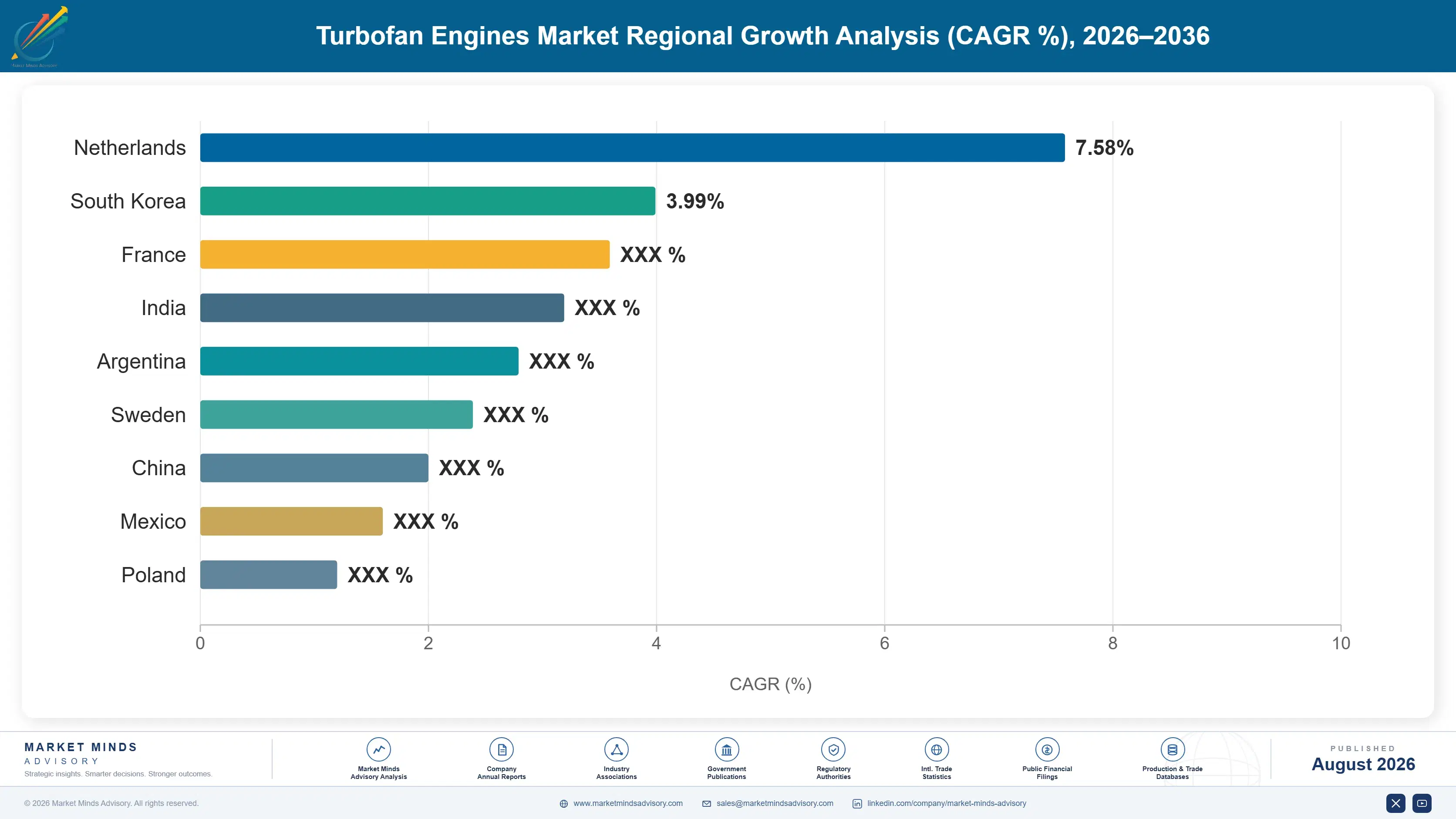
India grows fastest at 10.4% annually, driven by narrowbody orders among the largest ever recorded plus domestic overhaul capacity being built to serve them. Vietnam and Saudi Arabia follow.

Report Segmentation Architecture

The full report scope spans multiple orthogonal segmentation dimensions, with cross-tabulated demand data provided for each dimension pair. Coverage extends further to regional breakdowns, trend trajectories, and the competitive detail needed to support segment-level decision-making.

By Engine Architecture and Class

  • Ultra-High Bypass Geared Turbofan
  • High Bypass Narrowbody Turbofan
  • High Bypass Widebody Turbofan
  • Low Bypass Military Turbofan
  • Regional and Business Jet Turbofan

By End-Use Industry

  • Mainline Passenger Airlines
  • Cargo and Freight Operators
  • Low-Cost Carrier Fleets
  • Military Air Forces
  • Business and General Aviation
  • Aircraft Leasing Companies

By Commercial Dimension

  • Original Engine Delivery to Airframers
  • Spare Engine and Provisioning Sales
  • Manufacturer Spare Parts Supply
  • Long-Term Service Agreement Contracts
  • Independent Overhaul and Used Material Channel

By Region

  • North America
  • Western Europe
  • East Asia
  • South Asia and Pacific
  • Latin America
  • Middle East and Africa
  • Eastern Europe

Scope, Methodology, and Coverage

Every figure in this report is reproducible from documented input assumptions. The scope below maps the historical period, the forecast horizon, the segmentation dimensions, and the countries covered, alongside the underlying primary and qualitative methodology.
Historical Period
2020 to 2025
Forecast Period
2026 to 2036
Base Year
2025 (USD billions; MMA Primary Research Dataset, August 2026)
Market Definition
This report covers turbofan aircraft engines across commercial and military applications, spanning ultra-high bypass geared architectures, high bypass narrowbody and widebody engines, low bypass military engines and regional or business jet turbofans, and including original engine deliveries, spare engine provisioning, manufacturer and independent spare parts supply, and overhaul shop visit revenue. Turboprop and turboshaft engines, auxiliary power units, airframes, nacelles and thrust reversers supplied separately, ground support equipment and flight training are excluded from the sizing.
Quantitative Units
USD billions at manufacturer and service provider realised value; engine deliveries in thousands of units; shop visits in thousands annually.
Segmentation Dimensions
By engine architecture and class; by end-use industry; by commercial dimension; by region.
Regions Covered
North America, Western Europe, East Asia, South Asia and Pacific, Latin America, Middle East and Africa, Eastern Europe
Countries Covered
United States, Canada, United Kingdom, France, Germany, Italy, Spain, Switzerland, Japan, China, South Korea, India, Singapore, Australia, Brazil, Mexico, United Arab Emirates, Saudi Arabia, South Africa, Poland.
Key Companies Profiled
GE Aerospace, Safran Aircraft Engines, Pratt and Whitney, Rolls-Royce, MTU Aero Engines, IHI Corporation, Kawasaki Heavy Industries, Mitsubishi Heavy Industries, Honeywell Aerospace, Avio Aero, ITP Aero, Lufthansa Technik, ST Engineering, StandardAero and others.
Quantitative Methodology
Primary survey, n=3,800 respondents, Q4 2025, six countries; demand-side model with trade association cross-validation
Qualitative Methodology
47 expert interviews, Q4 2025; applied to validate demand model assumptions, identify emerging dynamics, and assess competitive positioning
Report Format
PDF and XLSX data workbook (Word format preview document)
Publisher
Market Minds Advisory
Report Code
MMA-2026-CON-026
Published
August 2026
Contact
sales@marketmindsadvisory.com | www.marketmindsadvisory.com

Purchase the full Turbofan Engines Market Report (2026 to 2036).

The full report sizes the turbofan engine market across five architecture classes, six end-use industries and seven regions, with delivery, shop visit and pricing detail behind every value estimate. It profiles twenty manufacturers and service providers on installed base scale, overhaul capacity and service agreement penetration. Regional chapters cover fleet composition, utilisation and overhaul capability by market. Aftermarket analysis quantifies shop visit demand against qualified capacity and the backlog between them. Supply chain analysis tracks superalloy casting and titanium availability against new build and overhaul requirements simultaneously.
Engine delivery and shop visit detail by architecture class
Service agreement penetration mapping by engine family
Overhaul capacity against shop visit demand through 2036
Superalloy casting and titanium availability tracking
Competitive position assessments across twenty industry participants
Used serviceable material availability by retirement schedule

Built For The People Who Decide

From boardroom strategy to bench-side execution, this report is read cover-to-cover by leaders shaping the next decade of their industry, turning demand scenarios, market dynamics and valuation benchmarks into decisions.
CXOs/ Presidents/ VPs/ Managers
M&A and Corporate Development
Strategy Teams and R&D Heads
Procurement and Product Directors
Regulatory and Compliance Leaders
Investor Relations and Equity Analysts