
Market Minds Advisory
Thin Insulation Market

Thin Insulation Market: Thin Insulation: Priced Against Insulation, Sold Against Floor Area

In a dense city retrofit the floor area saved by a thin panel is worth more than the entire insulation package, yet the whole category still competes on cost per unit of thermal resistance.

Lead Analyst

David Horsley

Published

August 2026

Make Smarter Decisions with Customized Research Insights

Request a free sample report and evaluate market opportunities, growth trends, and competitive dynamics relevant to your business needs.

2025 MARKET VALUE$3.6BMarket Size 2025
2036 FORECAST VALUE$8.7BBase Case , 2026 to 2036
CAGR 2026 TO 20368.4 %Bull 9.6% / Bear 7.2%
INCREMENTAL OPPORTUNITY$4.8BNet 10- year value creation
EXPANSION MULTIPLE2.24x2036 value over 2026 base
Strategic Levers
M&A Pipeline
Regional Outlook
Country Rankings
Competitive Intelligence
Segmental Deep-dive
Call-Us : 91 93563 13602

Executive Snapshot and Market Trajectory.

Thin insulation exists for one reason: space costs money. Internally lining a wall with 100 millimetres of conventional material takes floor area, and in a dense city that area is worth considerably more per square metre than the insulation package that consumed it.
Which makes the standard sales argument wrong. Vacuum panels grow at 12.6%, half again the market rate of 8.4%, and recover roughly 4% of internal floor area in a typical retrofit against conventional lining. Priced against insulation they look expensive. Priced against the property value of recovered space they are cheap, and almost nobody sells them that way. The comparison is the whole commercial problem here. Property value rather than energy policy carries the argument.
Installed performance is the other problem, and it is a detailing question rather than a materials one. A punctured vacuum panel loses around 80% of its rating and cannot be cut on site, while fixings and edges already carry roughly 35% of heat loss once the panel itself performs well. Fixed layouts drawn early and thermally broken fixings protect delivered performance. Design accommodates fixed sizes or the site improvises badly.
Market Definition
Insulation materials achieving high thermal resistance in constrained depth, covering vacuum insulation panels, aerogel blankets and boards, thin rigid foam boards, reflective and multi-foil systems, phase change composite panels, and insulating renders and thin coatings. Applied to building envelopes, appliances, transport and equipment enclosures. Measured at manufacturer selling value. Excludes industrial process and storage tank insulation systems, conventional thickness mineral fibre and foam products, and installation labour.
Base Year Value
$3.6B in 2025 (MMA Primary Research Dataset, August 2026)
Forecast Period
2026 to 2036, eleven discrete annual values
CAGR
8.4% base case. Bull 9.6%. Bear 7.2%.
Fastest Growth Segment
Vacuum Insulation Panels: 12.6% CAGR
Fastest Growth Country
Japan: 14.2% CAGR
Fastest Growth Region
South Asia and Pacific: 10.4% CAGR
Largest Region
East Asia: 30% of 2025 global value
Market Leaders
Kingspan, Panasonic, Aspen Aerogels, Evonik, Va-Q-Tec. Source: MMA Primary Research Dataset, July 2026.
Primary Survey
n=3,800 procurement and R&D decision-makers, Q4 2025, six countries
Methodology
Demand-side build-up, cross-validated against public data, 47 expert interviews

Thin Insulation Market Forecast Scenarios

thin-insulation-market-size-forecast-scenario-1787639933917
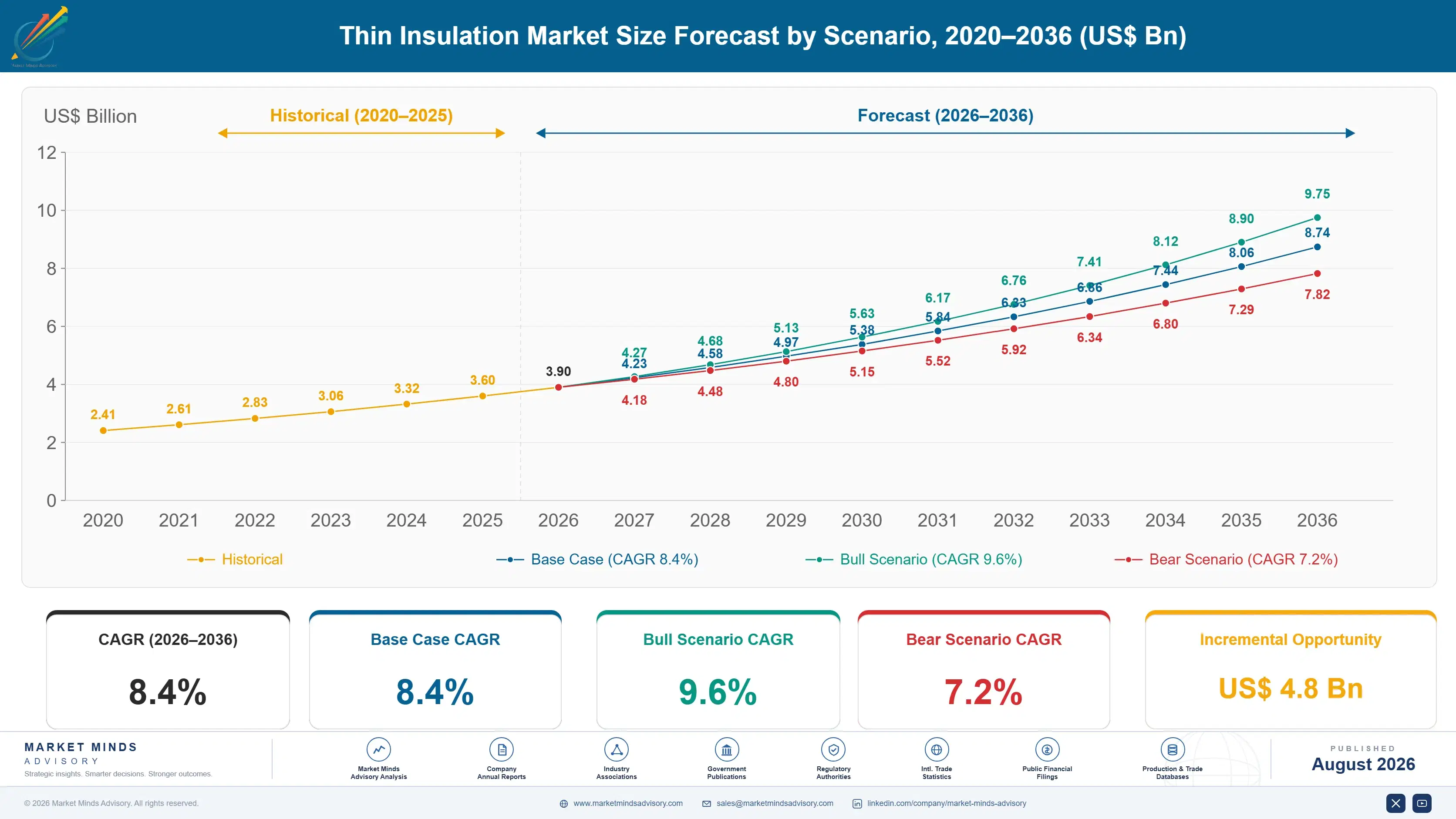
Growth ran near 7.0% between 2020 and 2025, driven far more by regulation than by any change in what buyers wanted. Appliance energy labelling forced refrigeration manufacturers toward vacuum panels because cabinet volume is fixed by standards and thinner insulation was the only route to efficiency without losing internal space. Building retrofit demand grew more slowly, held back by pricing arguments the category kept losing.
Base case 8.4% rests on three mechanisms. Vacuum panels grow at 12.6% as appliance regulation tightens and dense urban retrofit accepts the space argument. Aerogel grows at 10.4% where panels cannot be used because the substrate is irregular or must be cut. And Japan grows fastest of any country at 14.2% on retrofit in space constrained cities alongside its appliance manufacturing base. Retrofit subsidy availability drives none of these three, which is what makes them durable.
The bull case at 9.6% assumes retrofit specification shifting to value recovered floor area explicitly, which would reprice the whole category upward against property values rather than against insulation. The bear case at 7.2% is installed performance disappointing in early retrofit programmes, since punctured panels and unresolved thermal bridging produce results well below what the specification promised.

The Product Is Space, Not Resistance

This category is sold against the wrong benchmark almost everywhere. Thin insulation delivers around five times the resistance per unit depth of conventional mineral fibre, and priced per unit of thermal performance it looks expensive against products that have been cheap for decades. Nobody buys thinness for itself. They buy it because internal lining takes floor area, and in a dense city that area carries property value the insulation package cannot approach.
TOP FIVE CONCENTRATION38%Panel makers and materials producers occupy quite different positions
THICKNESS PERFORMANCE ADVANTAGE5xResistance per unit depth against conventional mineral fibre products
FLOOR AREA RECOVERED4%Internal space preserved in a typical dense urban retrofit
PUNCTURE PERFORMANCE LOSS80%Share of rated performance lost when a panel is breached
THERMAL BRIDGE HEAT SHARE35%Portion of loss travelling through fixings, edges and framing
PREMIUM APPLIANCE PENETRATION22%Share of premium refrigeration using vacuum panel cabinet construction
Vacuum panels recover roughly 4% of internal floor area in a typical retrofit against conventional lining, which in a London, Tokyo or Hong Kong apartment is worth several times the cost difference between the two approaches. Panels grow at 12.6% on that arithmetic where anybody actually runs it. The failure is the comparison, not the product.
Installed performance is where the category earns its reputation, well or badly. A vacuum panel punctured during installation loses around 80% of its rating and cannot be cut to fit, so the design must accommodate fixed panel sizes rather than expecting the site to adapt. Once the panel performs, fixings and edges carry roughly 35% of remaining heat loss. Detailing decides the result, and detailing sits with designers rather than manufacturers.
"The industry keeps arguing about cost per unit of thermal resistance while the customer is actually buying back a square metre of their living room. Those are different products with different price ceilings, and only one of them is worth what these panels cost."
Director, Building Envelope and Materials Practice · MMA Construction and Industrial Equipment Practice · August 2026

Market Trends

Appliance efficiency labelling forcing vacuum panel adoption

Cabinet volume is fixed by appliance standards, so a refrigeration manufacturer improving efficiency cannot simply add insulation without losing internal capacity that the same standards measure. Vacuum panels resolve that directly, which is why premium refrigeration penetration has reached around 22% and continues climbing. The driver is regulatory rather than commercial, and manufacturers adopt because the alternative is a lower energy label rather than because customers requested it. Model programme decisions are taken years ahead of production, which rewards suppliers tracking the regulatory calendar rather than construction cycles. Demand arrives on a fixed timetable.
Market Impact: Japan growing fastest at 14.2%
Retrofit specification beginning to value recovered floor area

A handful of dense urban retrofit programmes have started specifying against internal space preserved rather than against thermal resistance alone, which reprices thin panels against property value instead of against mineral fibre. Vacuum panels recover roughly 4% of floor area in typical applications. Where that comparison is made explicitly, the pricing objection largely disappears. Where it is not, the category keeps losing arguments it should comfortably win. Specification convention rather than product performance decides which argument the category ends up having with a customer. Reaching designers before writing is the only remedy.
Market Impact: Aerogel growing 10.4% annually

Market Opportunities and Growth Drivers

Dense city retrofit where wall depth carries property value

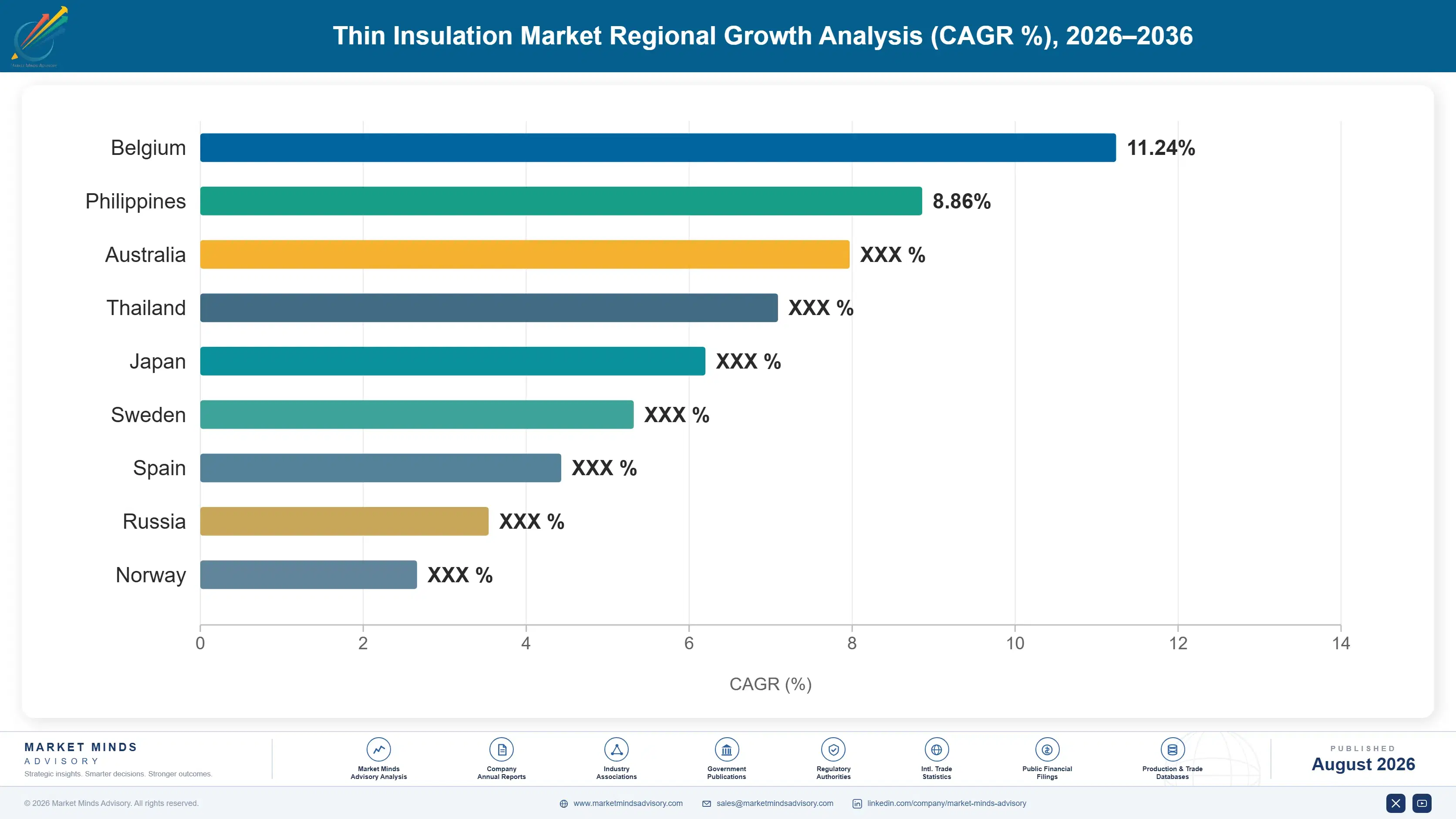
Japan grows fastest of any country at 14.2% because internal retrofit in space constrained cities makes wall depth a direct property cost, and residential floor area there is priced accordingly. Similar arithmetic applies across Hong Kong, Singapore, central London and Seoul. The driver is real estate value rather than energy policy, which means it survives changes in subsidy regimes that would remove conventional retrofit demand entirely. Residential floor area value rather than energy policy sets the pace here, and property values move far more slowly than subsidies do. Subsidy regimes come and go.
Market Impact: Punctured panels lose 80% rating

Irregular substrates requiring materials that can be cut

Vacuum panels cannot be cut on site and lose around 80% of rating when punctured, which rules them out wherever the substrate is irregular, penetrated by services or unknown until opened up. Aerogel blankets grow at 10.4% precisely because they handle exactly those conditions at somewhat lower performance. The two technologies are complements rather than competitors, though the industry frequently sells them as alternatives to one another. Holding both technologies and specifying by condition captures whole projects rather than the portion one happens to suit. Presenting them as rivals forces an unnecessary choice.
Market Impact: Costs about 5 times mineral fibre

Market Restraints and Challenges

Installed performance falling well below declared ratings

A punctured vacuum panel loses around 80% of its rating, and fixings and edges carry roughly 35% of heat loss once the panel itself performs well. The root cause is that thin high performance materials make detailing dominant in a way conventional thickness never did. Commercially it produces retrofit results below specification and damages category reputation. Fixed panel layouts designed early, thermally broken fixings and installer certification are the responses that actually work. None is a material property that a manufacturer can simply ship with the product. Certification is spreading slowly.
Market Impact: Penetration reached 22% of premium

Specification documents inviting the wrong price comparison

Most retrofit specifications request a thermal resistance value, which puts thin panels directly against mineral fibre on cost per unit of performance and guarantees they lose. The root cause is specification convention rather than any product shortcoming. Commercially it caps demand well below what the space argument would support. Space value modelling presented during design, before the specification is written, is the only mitigation participants have found effective. Reaching designers before the specification is written is the only point at which the benchmark itself can still be changed. Contractors cannot change it.
Market Impact: Recovers roughly 4% floor area
4 additional market trends, 3 additional growth drivers, and 2 additional restraints and challenges are covered in the full report. Contact sales@marketmindsadvisory.com to access the complete intelligence.

Segment CAGR and Growth Architecture

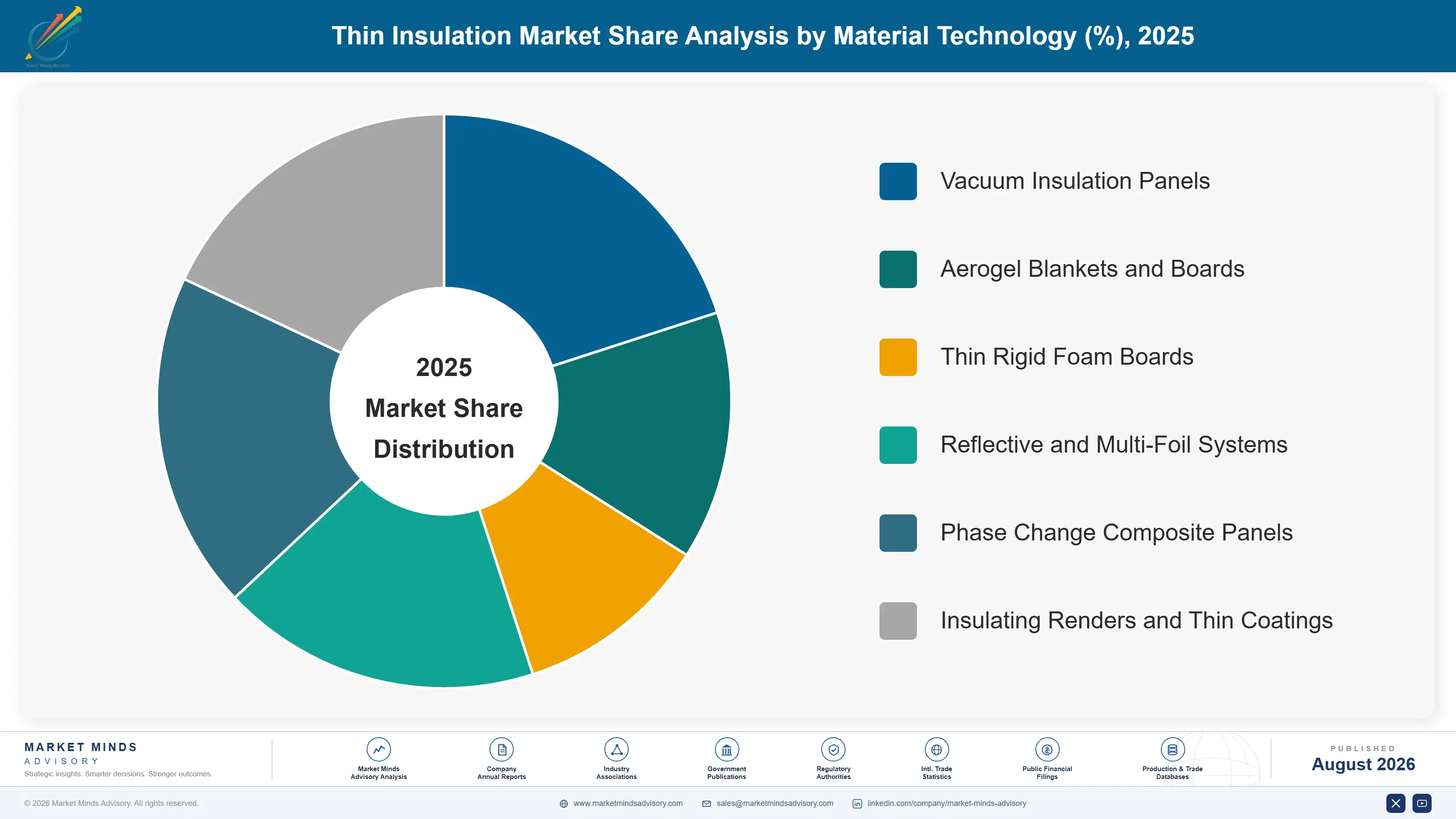
Six segments split by material technology, because technology determines the resistance achieved per unit depth, whether the material can be cut on site, the substrate conditions it tolerates and the price it can command. Application and format variants sit inside each technology. End-use and channel dimensions are handled separately within the framework. Technology decides almost everything commercially here.
thin-insulation-market-market-share-analysis-1787639934447

Vacuum Insulation Panels

Growing at 12.6%, half again the market rate of 8.4%, vacuum panels deliver the highest resistance per unit depth available and recover roughly 4% of internal floor area in a typical retrofit against conventional lining. They cannot be cut on site and lose around 80% of rating when punctured, which makes design accommodation of fixed sizes an absolute requirement rather than a preference. Appliance manufacturing provides the volume base, with premium refrigeration penetration near 22% and rising under energy labelling pressure. Building retrofit is where the pricing argument is genuinely contested, and where recovered floor area rather than thermal resistance decides the outcome. Designers rather than contractors now write that specification.
CAGR 12.6%

Aerogel Blankets and Boards

At 10.4% aerogel handles the conditions vacuum panels cannot: irregular substrates, service penetrations, and walls whose condition is unknown until they are opened up. Performance per unit depth is lower than a vacuum panel but far above conventional materials, and the material can be cut and shaped on site by ordinary trades. That combination makes it the practical choice across most building retrofit, while panels dominate manufactured products where dimensions are known and controlled in the factory. Production is energy intensive, since supercritical drying absorbs roughly a quarter of manufacturing cost, and no formulation change removes that exposure at all. Ordinary trades can install it without special certification. Ordinary trades handle it comfortably.
CAGR 10.4%
Full segment breakdown across 6 segments available in the complete report.

Regional Architecture and Country Demand Map

East Asia holds 30% of value on appliance manufacturing scale combined with dense urban retrofit where floor area carries the highest property value anywhere. Western Europe and North America follow at 24% each. South Asia and Pacific grows fastest of the seven regions covered here.

North America

Appliance manufacturing carries most of the regional volume, with premium refrigeration adopting vacuum panels under energy labelling requirements that fix cabinet dimensions. Building retrofit demand concentrates in dense coastal cities where internal floor area genuinely carries property value, and is largely absent elsewhere because wall depth costs nothing in suburban construction. Cold chain and transport applications are growing steadily. Growth at 7.8% reflects appliance regulation doing more work than building demand. Specification practice still requests thermal resistance almost everywhere, which puts thin systems against conventional insulation on the comparison they lose. Designers writing against recovered floor area remain rare here, which caps demand well below what the property value arithmetic would comfortably support.
Share: 24% | CAGR: 7.8% (2026 to 2036)

Western Europe

Retrofit policy across the region is the most developed anywhere and increasingly targets existing stock where external insulation is impossible on heritage or planning grounds, which leaves internal lining and therefore floor area as the constraint. Appliance labelling has pushed vacuum panel adoption in premium refrigeration substantially. Installed performance concerns have slowed some programmes. Regional growth of 6.8% is the slowest anywhere on a mature base and cautious specification practice. Heritage and planning restrictions that block external systems are the single most reliable source of demand here, since they leave internal lining as the only option available. Installed performance scrutiny is more rigorous here than anywhere, which rewards suppliers offering layout design and installer training.
Share: 24% | CAGR: 6.8% (2026 to 2036)
Regional intelligence for 5 additional markets available in the complete report: East Asia, South Asia and Pacific, Latin America, Middle East and Africa, Eastern Europe. Contact sales@marketmindsadvisory.com.
thin-insulation-market-country-cagr-analysis-1787639934968

Four Moves Against the Wrong Benchmark

The category loses arguments it should win because specifications ask for thermal resistance rather than for recovered space. What remains available is repricing against property value, designing panel layouts before the site can improvise, and treating aerogel and vacuum panels as complements rather than rivals. The benchmark decides everything downstream. Designers rather than contractors now write it.

Price against floor area recovered, not resistance

Vacuum panels recover roughly 4% of internal floor area in a typical dense city retrofit, which carries property value several times the cost difference against conventional lining. Suppliers quoting cost per unit of thermal resistance are competing against mineral fibre on the one measure where they cannot win. Presenting space value modelling during design, before the specification is written, changes the comparison and with it the achievable price entirely. Property value moves slowly and predictably, which makes the argument durable once accepted. Developers rather than contractors run this calculation properly.
Market Impact: Recovers about 4% of the internal floor area

Design fixed panel layouts before site improvisation begins

A punctured vacuum panel loses around 80% of its rating and cannot be cut, so installed performance depends on whether the design accommodated fixed sizes or expected the site to adapt. Suppliers providing layout design as part of supply protect the performance their product was specified for. Those shipping panels against a quantity are leaving the outcome to trades who have never handled the material before. Layout design costs little against the performance it protects on every project. Installer training alongside the drawings closes most of the remaining gap. Site improvisation destroys performance quietly.
Market Impact: Protects the 80% of rating lost at puncture

Sell aerogel and panels as complements, not alternatives

Vacuum panels suit known dimensions in factory conditions, while aerogel at 10.4% handles irregular substrates, service penetrations and walls whose condition is unknown until opened. Suppliers presenting them as competing options force customers into a choice that the building itself has already made. Holding both and specifying by condition captures the whole project rather than the portion one technology happens to suit. Substrate condition is frequently unknown until a wall is actually opened up, which decides the technology on site rather than in the specification. Both belong in the same catalogue.
Market Impact: Aerogel demand growing at 10.4% each single year

Follow appliance labelling rather than building policy

Cabinet volume is fixed by appliance standards, so tightening energy labels force manufacturers toward vacuum panels whether or not any consumer asked, and premium refrigeration penetration has reached around 22%. That demand is regulated and non-discretionary, unlike building retrofit which follows subsidy availability. Suppliers organised around construction cycles are missing volume that arrives on a regulatory calendar published years ahead. Labelling revisions are published years ahead and remarkably few suppliers track them at all, despite the demand arriving on a fixed timetable. Programme decisions precede production by years. Construction cycles are the wrong calendar entirely.
Market Impact: Appliance panel penetration climbing past 22% right now

Who Controls the Margin Pool

Participation is measured on annual revenue from thin insulation materials and panels, and the top five hold 38%. Concentration is moderate because appliance panel supply, building materials distribution and specialty aerogel production are quite separate businesses with different customers. Kingspan and Panasonic lead through insulation breadth and appliance panel capability respectively. The gap to challengers is a distribution question in building markets and a manufacturing one in appliances, which are quite different problems.
Competition runs on three fronts. Manufacturing scale decides appliance panel supply, where automotive style volumes and pricing apply. Specification engagement decides building retrofit, where the space argument is either made or lost. And installation support decides whether the delivered performance matches what was sold. Each front rewards a capability the others do not, and very few participants hold more than one properly.

Pressure ahead comes from retrofit programmes that value recovered floor area explicitly and from installed performance scrutiny. Expect suppliers offering layout design and installation support to gain. Rankings shift on who protects the performance gap between declared and delivered. Concentration should stay moderate given how separate the two customer bases remain.
thin-insulation-market-company-positioning-matrix-1787639935489

Competitive Moat and Risk Dimensions

KINGSPAN

Moat: Insulation breadth and specification reach

Holding conventional and thin insulation across a wide product range reaches specifiers through relationships built on ordinary volume business, then introduces high performance materials where the application justifies them. That access is difficult for a specialist to replicate, because a supplier who only offers premium products is not in the room for the routine decisions that establish the relationship.
KINGSPAN

Risk: Conventional product cannibalisation tension

Selling thin panels against a specification that conventional boards would otherwise satisfy moves revenue between the company's own product lines rather than winning it from competitors, which blunts commercial enthusiasm at branch level. That tension is internal, real, and considerably harder to manage than any external competitive threat the business currently faces.
PANASONIC

Moat: Appliance panel manufacturing scale

Vacuum panel production at appliance volumes requires manufacturing capability, quality control and cost position that building materials suppliers do not approach, and appliance customers qualify on those grounds rather than on thermal performance alone. That position is reinforced by energy labelling that makes the panels non-optional for premium refrigeration ranges across major markets.
PANASONIC

Risk: Appliance customer concentration exposure

Demand depends on a small number of appliance manufacturers whose model programmes decide volume years ahead, and losing a platform removes considerable throughput at once. Building market diversification would reduce that exposure but requires specification capability and distribution reach the business has not historically needed to develop.

Players Tracked

Prominent Players

Kingspan
Panasonic
Aspen Aerogels
Evonik
Va-Q-Tec

Other Key Players

Recticel
Knauf Insulation
Rockwool
Saint-Gobain
Owens Corning
Armacell
Cabot Corporation
Morgan Advanced Materials
Dow
LG Hausys
Fujian Super Tech
Nanopore
Thermablok
Unifrax
Sto SE

Recent Developments

APRIL 2026

Retrofit programme specifies against floor area preserved

A dense city retrofit programme wrote its specification around internal floor area preserved rather than thermal resistance alone, which repriced thin panels against residential property value and removed the cost objection that had blocked earlier phases. Later phases specified thin systems as standard practice throughout.
Signal: Changing the benchmark changes the achievable price without changing the product itself in any way at all
OCTOBER 2025

Appliance labelling revision pushes vacuum panels into mid range

An energy labelling revision tightened efficiency thresholds while holding cabinet volume measurement unchanged, moving vacuum panel construction from premium refrigeration into mid range models across several manufacturer portfolios simultaneously. Panel volume requirements rose sharply across those portfolios. Suppliers had roughly two years of visibility beforehand.
Signal: Regulation rather than consumer preference decides appliance insulation content across every single major market in the world
JANUARY 2026

Retrofit survey finds installed performance below specification

A post-completion survey of a retrofit scheme found delivered thermal performance well below specification, attributing the gap to panel damage during installation and to fixings that had not been thermally broken at all. Remedial work proved impractical once the lining was closed up. Costs fell on the scheme sponsor entirely.
Signal: Detailing decides the delivered performance once the material itself is already genuinely high performing on site

Silica, Film and Vacuum

Fumed and precipitated silica cores carry around 31% of vacuum panel cost, supplied by a small group of specialty chemical producers. Barrier film laminates take roughly 22% and come from a narrow field of converters capable of the required permeability. Aerogel production is energy intensive, with supercritical drying absorbing about 26% of cost. Getters, sealing, quality testing and packaging account for the balance.
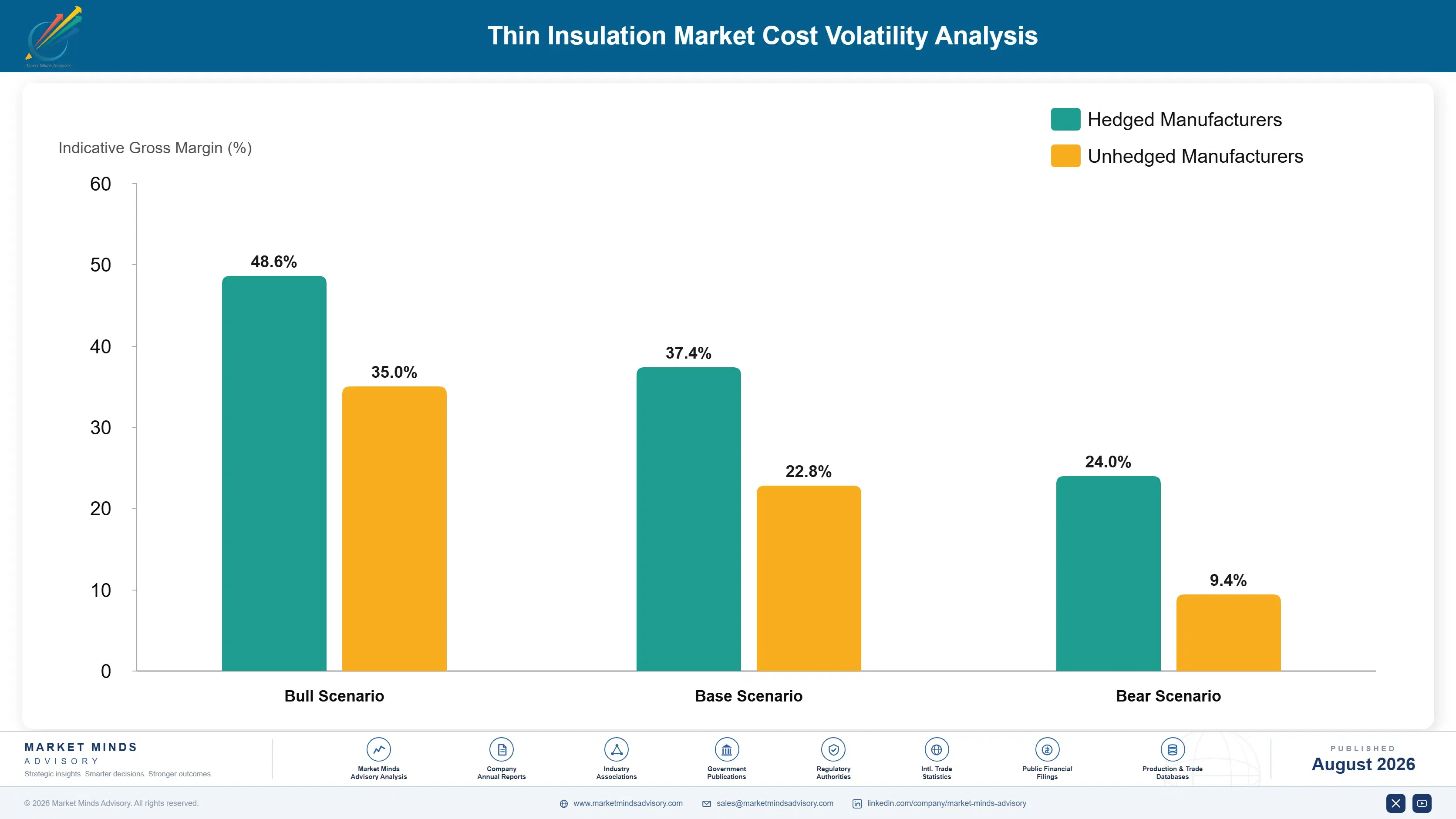
Silica and energy costs both moved sharply across recent years, per published energy market reporting and Aspen Aerogels annual reporting for 2025 on production cost commentary. Appliance panel suppliers absorbed considerably more than building material suppliers did, because appliance contracts are fixed against model programmes running years while construction pricing resets project by project. That difference shows no sign of narrowing. Contracting convention rather than negotiating power explains the split.

Exposure divides on technology and customer type. A vacuum panel producer carries silica and barrier film across more than half of cost with a narrow supplier field for both. An aerogel producer carries energy intensity that no formulation change removes. A building materials distributor carries only purchase price and resets it each project, which is a considerably more comfortable position than either manufacturer occupies.
thin-insulation-market-cost-volatility-analysis-1787639935683

Qualify additional barrier film converters ahead of need

Barrier film carries over a fifth of panel cost and comes from a narrow field of converters capable of the permeability required, which concentrates supply risk in a component most buyers never examine. Qualifying alternatives ahead of disruption costs testing time and removes an exposure that panel performance depends on absolutely. Panel performance depends on it absolutely.

Index energy exposure into aerogel supply agreements

Supercritical drying absorbs around a quarter of aerogel production cost and moves with industrial energy pricing that no producer influences at all. Indexation shifts that exposure to where it originates, and construction customers accustomed to indexed pricing in other material categories generally accept the mechanism readily. Energy is the largest single variable in aerogel production cost.

Contract appliance volume against model programme duration

Appliance platforms run for years while material costs reset far more often, which leaves panel suppliers absorbing movement they cannot pass through until the next programme. Matching contract duration to input cost visibility, or indexing within the programme, removes an exposure that has damaged supplier margins repeatedly. Margin damage has been repeated and avoidable.

Portfolio Architecture for Margin Defence

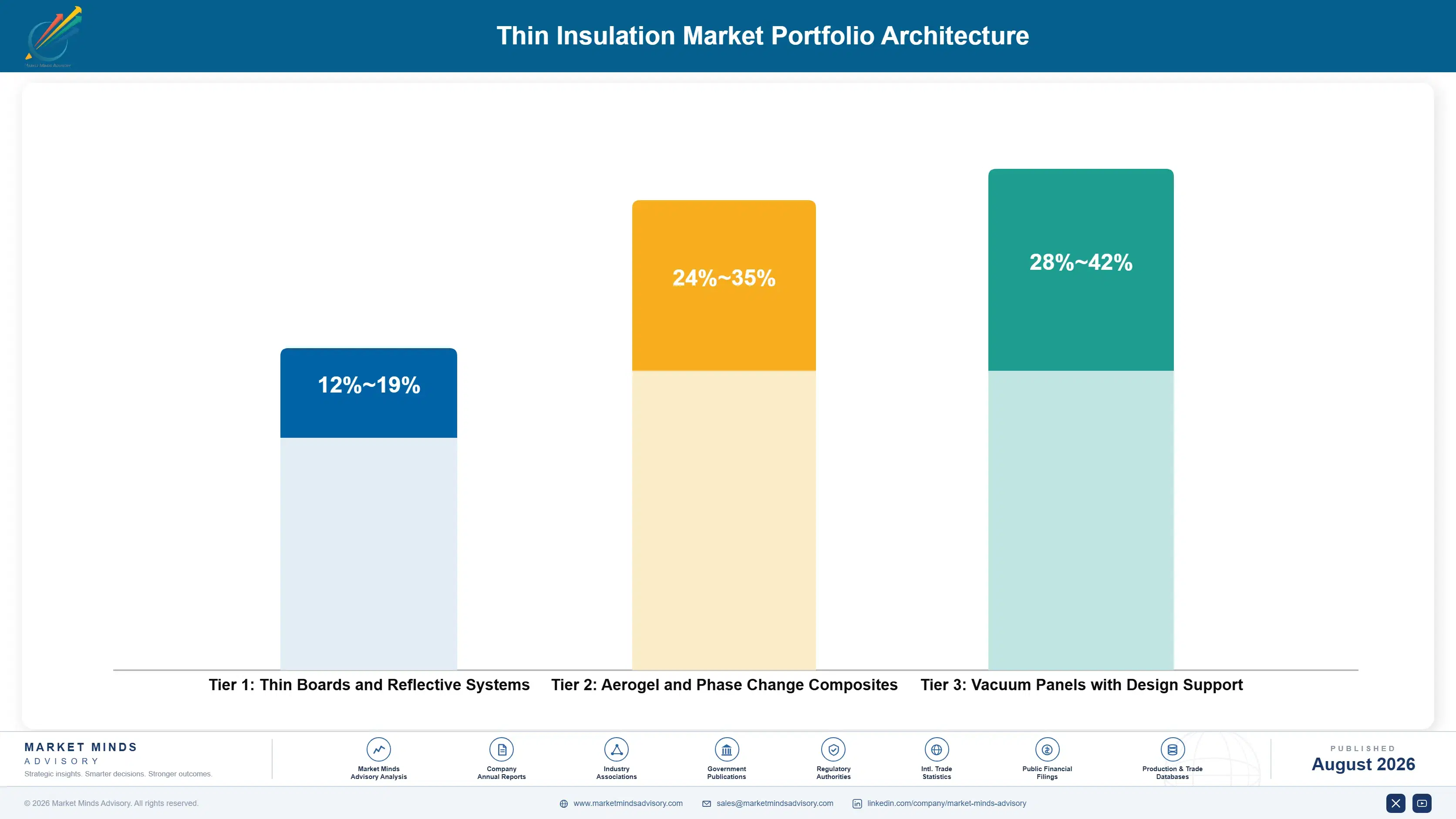
Margin here follows how tightly space is constrained, because a customer with depth available buys conventional material and a customer without one has no alternative at all. Thin rigid boards and reflective systems earn margins in the low to high teens, competing directly against conventional insulation where the space argument is marginal and the price comparison unforgiving. Distribution reach rather than product performance decides who wins that business.
Aerogel and phase change composites do better in the mid twenties to mid thirties, because performance per unit depth is genuinely differentiated and the ability to cut and shape on site solves problems panels cannot address at all. Application support separates suppliers more than material performance does at this level.

Vacuum panels supplied with layout design hold the strongest position, reaching into the low forties, where the customer is buying recovered floor area rather than thermal resistance and the comparison is against property value. Those margins depend entirely on whether the space argument is made during design, and collapse toward commodity levels wherever the specification simply requests a resistance figure. Design stage engagement is the whole difference between the two outcomes.

Thin Boards and Reflective Systems

Products competing directly against conventional insulation where space constraint is marginal. The seven point range reflects distribution position and manufacturing scale rather than any performance difference between suppliers. Space constraint decides whether they compete at all.
Gross Margin: 12-19%

Aerogel and Phase Change Composites

Materials solving irregular substrate and penetration problems that panels cannot address. The eleven point range reflects production cost position and whether application support accompanies the material supply. Site workability is the genuine differentiator here.
Gross Margin: 24-35%

Vacuum Panels with Design Support

Panels supplied with layout design where recovered floor area is the benchmark. The fourteen point range reflects whether the space argument was made during design or the specification simply requested resistance.
Gross Margin: 28-42%
thin-insulation-market-portfolio-architecture-1787639936186

High-value Sub-segments and Strategic Watch-out

Vacuum Insulation Panels

High value and the fastest growth at 12.6%, recovering roughly 4% of internal floor area. Margin depends entirely on whether the comparison is against property value or against mineral fibre cost per unit. Design stage engagement decides which of the two applies. Property value supports it comfortably.
Gross Margin: 28-42%

Aerogel Blankets and Boards

High value and growing at 10.4% on irregular substrates and service penetrations that panels cannot handle. Production energy intensity is the exposure, and no formulation change removes it entirely. Site workability is what panels cannot offer at all. Energy indexation is the sensible response here.
Gross Margin: 24-35%

Thin Rigid Boards

The volume core, competing against conventional insulation on cost per unit of resistance wherever space constraint is marginal. Distribution reach rather than product performance decides who wins that business. Conventional insulation sets the price ceiling everywhere. Margins compress steadily. Space constraint is marginal in most applications.
Gross Margin: 12-19%

Installed Performance Gap

The strategic watch-out. Punctured panels lose around 80% of rating and thermal bridges carry 35% of loss, and the range reflects whether a supplier controls detailing or ships material against a quantity. Layout design bundled with supply is the only reliable protection. Installer training closes the remaining gap.
Gross Margin: 10-40%

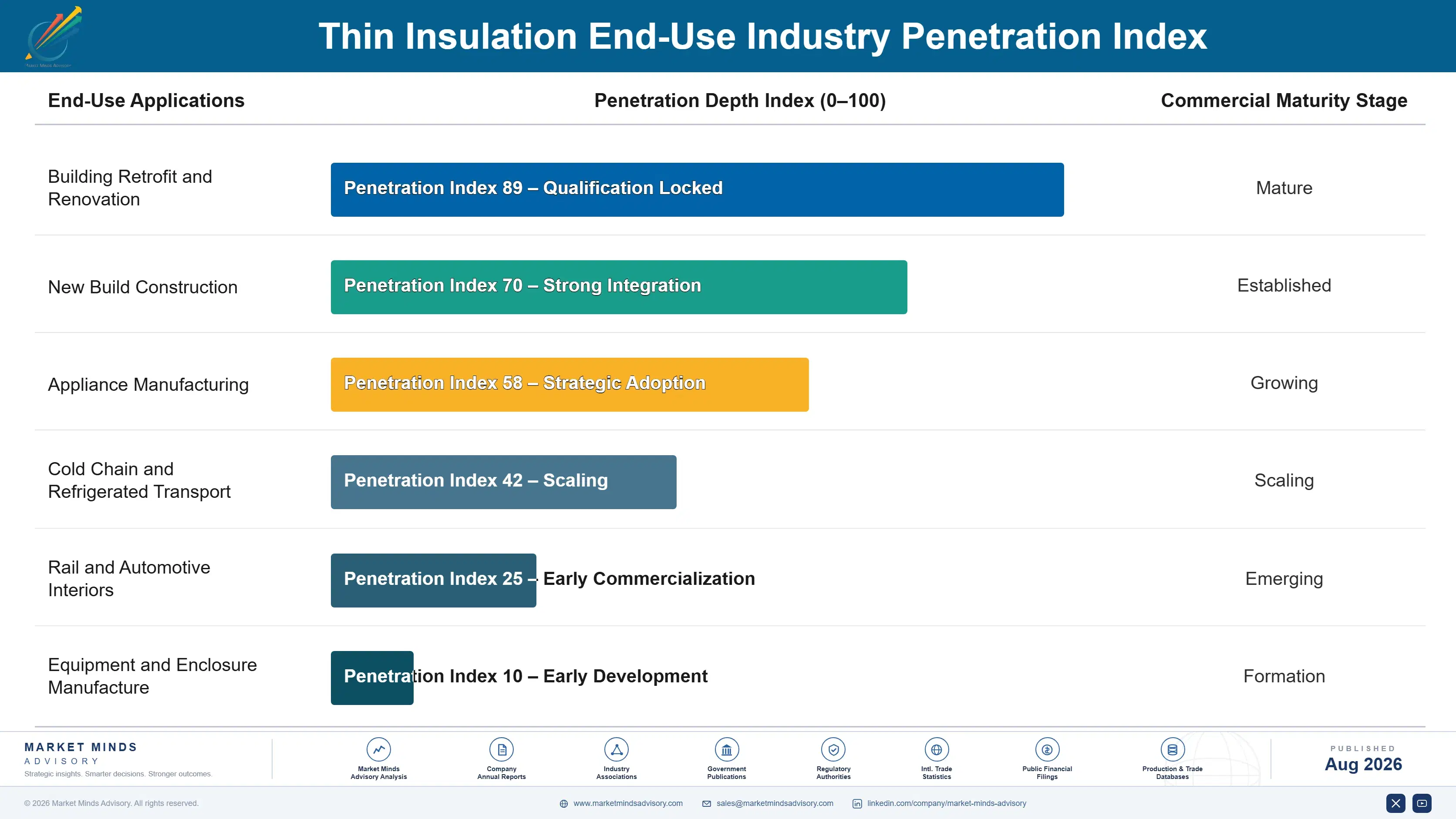
Bought Where Depth Costs Money

Demand here appears only where depth carries a price, which is a far narrower condition than the energy efficiency argument suggests. A suburban wall with cavity depth available buys conventional material and always will. A dense city retrofit, a fixed volume appliance cabinet or a transport enclosure has no depth to give, and thin insulation is the only option rather than the better one. Efficiency arguments are almost beside the point.
Stickiness follows the design decision completely. An appliance platform specifying vacuum panels holds that supplier through the model programme, typically several years, because requalification against efficiency filings is expensive. Building retrofit specifications reset project by project and reopen constantly. Distribution held thin board business is the least sticky of all, since a merchant substitutes on price without consulting anybody.

The buyer profile has shifted with who writes the specification. A decade ago it was contractors comparing material prices. Increasingly it is designers and developers running floor area value against envelope cost, which is a completely different calculation reaching a completely different answer. Suppliers still calling on contractors are talking to people executing a decision made elsewhere. The decision moved upstream and coverage did not.
thin-insulation-market-end-use-penetration-index-1787639936674

Where We Would Put Effort

These are among the four positions where our research anticipates prominent divergence between winners and laggards over the coming forecast period. Each is grounded in the demand model, the regulatory perimeter, and the announced capacity pipeline.
01 / SPACE VALUE FRAMING

Sell square metres, not thermal resistance

Vacuum panels recover roughly 4% of internal floor area in a typical dense city retrofit, and that area carries property value several times the cost difference against conventional lining. Suppliers quoting cost per unit of thermal resistance are competing against mineral fibre on the single measure where they cannot possibly win, and losing bids they should take comfortably. Presenting space value modelling during design, well before any specification is written, changes both the comparison being made and the achievable price completely.
02 / LAYOUT DESIGN CONTROL

The site will destroy what you shipped

A vacuum panel punctured during installation loses around 80% of its rating and cannot be cut to fit, which means installed performance depends on whether the design accommodated fixed sizes properly. Suppliers providing layout design as part of the supply package protect the performance their product was specified and priced to deliver on site. Those shipping panels against a quantity are leaving the outcome to trades who have never handled the material before and cannot be blamed for treating it like an ordinary board.
03 / COMPLEMENTARY TECHNOLOGY POSITIONING

The building already chose between them

Vacuum panels suit known dimensions under controlled factory conditions where nothing needs cutting while aerogel growing at 10.4% handles irregular substrates, service penetrations and walls whose condition nobody actually knows until they are opened up. Suppliers presenting the two as competing options force customers into a choice that the building itself has already quietly made for everybody concerned. Holding both technologies and specifying by actual substrate condition captures whole projects rather than whichever portion one technology happens to suit on the day.
04 / REGULATED DEMAND TRACKING

Appliance labels beat building subsidies

Cabinet volume is fixed by appliance standards, so tightening energy labels push refrigeration manufacturers toward vacuum panel construction regardless of whether any consumer asked, and premium refrigeration penetration has already reached around 22% of the installed model range. That demand is regulated and non-discretionary, unlike building retrofit demand, which follows subsidy availability closely and disappears when it lapses. Suppliers still organised around construction cycles are quietly missing volume that arrives on a regulatory calendar published years in advance and rarely revised.

Engagement Snapshot From the Field

A live engagement with an industry participant carrying material or product regulatory and market exposure ahead of a defining policy shift, showing how our research translates into a defensible multi-year portfolio strategy.
MARKET MINDS ADVISORY · CLIENT ENGAGEMENT SUMMARY
Thin Insulation Producer Strategic Portfolio Review and Transition Roadmap 2026·Investment Scenario on Thin Insulation Exposure Evaluation 2025-26
CLIENT PROFILE
A thin insulation manufacturer supplying vacuum panels and aerogel products to appliance and construction customers across European and Asian markets, at annual revenue near 310 million dollars (client-reported, unverified by MMA). Building market share was small and pricing followed thermal resistance comparison almost everywhere. Specification engagement happened at contractor level rather than during design. Design firms were rarely contacted.
STRATEGIC CHALLENGE
Appliance revenue was stable but concentrated among few customers, while building retrofit bids were being lost consistently on price against conventional insulation. Management wanted to know whether the building market was genuinely accessible or should be quietly abandoned. Margin on building projects had fallen to appliance levels without the volume that justifies them.
MMA APPROACH
MMA modelled floor area value recovered across the client's target retrofit markets, measured installed performance against specification on completed schemes, mapped specification writing practice by project type, and assessed how appliance and building demand actually differ. Interviews with 47 experts covered building design, retrofit delivery, appliance engineering and insulation distribution.
KEY FINDINGS
  1. Floor area recovered in dense city retrofit carried property value several times the price difference the client was losing bids over on every project examined.
  2. Every lost bid reviewed had been specified on thermal resistance, which placed the client's panels directly against mineral fibre on the one unwinnable comparison.
  3. Installed performance on completed schemes fell well below specification, with panel damage and unbroken thermal bridging accounting for most of the shortfall measured.
  4. Appliance and building demand behave entirely differently, with appliance volume regulated and non-discretionary while retrofit follows subsidy availability closely. Commercial coverage had never distinguished between the two.
CLIENT PROFILE
A thin insulation manufacturer supplying vacuum panels and aerogel products to appliance and construction customers across European and Asian markets, at annual revenue near 310 million dollars (client-reported, unverified by MMA). Building market share was small and pricing followed thermal resistance comparison almost everywhere. Specification engagement happened at contractor level rather than during design. Design firms were rarely contacted.
STRATEGIC CHALLENGE
Appliance revenue was stable but concentrated among few customers, while building retrofit bids were being lost consistently on price against conventional insulation. Management wanted to know whether the building market was genuinely accessible or should be quietly abandoned. Margin on building projects had fallen to appliance levels without the volume that justifies them.
MMA APPROACH
MMA modelled floor area value recovered across the client's target retrofit markets, measured installed performance against specification on completed schemes, mapped specification writing practice by project type, and assessed how appliance and building demand actually differ. Interviews with 47 experts covered building design, retrofit delivery, appliance engineering and insulation distribution.
KEY FINDINGS
  1. Floor area recovered in dense city retrofit carried property value several times the price difference the client was losing bids over on every project examined.
  2. Every lost bid reviewed had been specified on thermal resistance, which placed the client's panels directly against mineral fibre on the one unwinnable comparison.
  3. Installed performance on completed schemes fell well below specification, with panel damage and unbroken thermal bridging accounting for most of the shortfall measured.
  4. Appliance and building demand behave entirely differently, with appliance volume regulated and non-discretionary while retrofit follows subsidy availability closely. Commercial coverage had never distinguished between the two.
RECOMMENDED STRATEGY
Phase 1: Phase one: reach designers and developers with floor area value modelling before specifications are written, since resistance based specifications cannot be won. Phase 2: Phase two: bundle panel layout design with material supply to protect the installed performance the specification actually promised the client. Phase 3: Phase three: track appliance labelling revisions rather than construction cycles, because that demand arrives on a published regulatory calendar. That calendar rarely changes.
OUTCOME
The manufacturer introduced floor area value modelling into design stage engagement during 2026 and won retrofit specifications it had previously lost (client-reported, unverified by MMA). Layout design was bundled with panel supply, and installed performance complaints fell substantially. Appliance labelling tracking replaced construction cycle forecasting entirely.

Frequently Asked Questions

Foundational context covering the market sizes, CAGR, scope, country, region and competition that inform every finding below. This section is provided to cover basics and most often pre-purchase conversations, answered from the MMA Primary Research Dataset.

What is the current size of the Thin Insulation Market?

MMA sizes it at USD 3.6 billion in 2025, rising to USD 3.90 billion in 2026. The figure covers high performance insulation in constrained depth at manufacturer selling value.

How large will the Thin Insulation Market be by 2036?

USD 8.74 billion by 2036, an incremental USD 4.84 billion over the 2026 base and an expansion multiple of 2.24 times. Vacuum panels carry a disproportionate share of that.

What is the CAGR for the Thin Insulation Market 2026 to 2036?

8.4% in the base case, with a bull case at 9.6% and a bear case at 7.2%. The spread turns largely on whether retrofit specification starts valuing recovered floor area.

Which segment is growing fastest?

Vacuum insulation panels at 12.6%, half again the market rate of 8.4%. They recover roughly 4% of internal floor area in a typical dense city retrofit.

Who are the major companies in the Thin Insulation Market?

Kingspan, Panasonic, Aspen Aerogels, Evonik and Va-Q-Tec lead on thin insulation revenue. Fifteen further participants are profiled in the full report on the same basis.

Which country is growing fastest?

Japan at 14.2%, where internal retrofit in space constrained cities makes wall depth a direct property cost alongside a substantial appliance manufacturing base that originated the vacuum panel technology in the first place.

Report Segmentation Architecture

The full report scope spans multiple orthogonal segmentation dimensions, with cross-tabulated demand data provided for each dimension pair. Coverage extends further to regional breakdowns, trend trajectories, and the competitive detail needed to support segment-level decision-making.

By Material Technology

  • Vacuum Insulation Panels
  • Aerogel Blankets and Boards
  • Thin Rigid Foam Boards
  • Reflective and Multi-Foil Systems
  • Phase Change Composite Panels
  • Insulating Renders and Thin Coatings

By End-Use Industry

  • Building Retrofit and Renovation
  • New Build Construction
  • Appliance Manufacturing
  • Cold Chain and Refrigerated Transport
  • Rail and Automotive Interiors
  • Equipment and Enclosure Manufacture

By Commercial Dimension

  • Direct Manufacturer Supply
  • Building Materials Distribution
  • Specification Led Project Supply
  • Design and Supply Packages
  • Contractor Purchase
  • Original Equipment Contracts

By Region

  • North America
  • Western Europe
  • East Asia
  • South Asia and Pacific
  • Latin America
  • Middle East and Africa
  • Eastern Europe

Scope, Methodology, and Coverage

Every figure in this report is reproducible from documented input assumptions. The scope below maps the historical period, the forecast horizon, the segmentation dimensions, and the countries covered, alongside the underlying primary and qualitative methodology.
Historical Period
2020 to 2025
Forecast Period
2026 to 2036
Base Year
2025 (USD billions; MMA Primary Research Dataset, August 2026)
Market Definition
Insulation materials achieving high thermal resistance in constrained depth, covering vacuum insulation panels, aerogel blankets and boards, thin rigid foam boards, reflective and multi-foil systems, phase change composite panels, and insulating renders and thin coatings, applied to building envelopes, appliances, transport and equipment enclosures. Measured at manufacturer selling value. Industrial process and storage tank insulation systems, conventional thickness mineral fibre and foam products, and installation labour are excluded from scope.
Quantitative Units
USD billions (current prices); square metres shipped; USD per square metre by material technology
Segmentation Dimensions
Material technology; end-use industry; commercial dimension; region
Regions Covered
North America, Western Europe, East Asia, South Asia and Pacific, Latin America, Middle East and Africa, Eastern Europe
Countries Covered
United States, Canada, Mexico, Germany, United Kingdom, France, Netherlands, Switzerland, Japan, South Korea, China, Hong Kong, India, Singapore, Australia, Brazil, Chile, United Arab Emirates, South Africa, Poland
Key Companies Profiled
Kingspan, Panasonic, Aspen Aerogels, Evonik, Va-Q-Tec, Recticel, Knauf Insulation, Rockwool, Saint-Gobain, Owens Corning, Armacell, Cabot Corporation, Morgan Advanced Materials, Dow, LG Hausys, Fujian Super Tech, Nanopore, Thermablok, Unifrax, Sto SE
Quantitative Methodology
Primary survey, n=3,800 respondents, Q4 2025, six countries; demand-side model with trade association cross-validation
Qualitative Methodology
47 expert interviews, Q4 2025; applied to validate demand model assumptions, identify emerging dynamics, and assess competitive positioning
Report Format
PDF and XLSX data workbook (Word format preview document)
Publisher
Market Minds Advisory
Report Code
MMA-2026-CON-118
Published
August 2026
Contact
sales@marketmindsadvisory.com | www.marketmindsadvisory.com

Purchase the full Thin Insulation Market Report (2026 to 2036).

The full report treats thin insulation as a product bought for recovered space rather than for thermal resistance, which is why the category keeps losing price arguments it should win comfortably. It sizes all six material technologies independently through 2036, models floor area value against envelope cost across dense city markets, and quantifies the gap between declared and installed performance. Regional chapters cover all seven regions with property value support assessed separately from energy policy. Competitive profiling covers 20 participants on one consistent revenue basis.
Six material technologies sized independently through 2036
Floor area value modelled against envelope cost by market
Installed performance measured against declared ratings on completed schemes
Appliance labelling calendars mapped against building subsidy cycles regionally
Specification writing practice assessed by project and building type
Twenty participants profiled on one consistent revenue basis

Built For The People Who Decide

From boardroom strategy to bench-side execution, this report is read cover-to-cover by leaders shaping the next decade of their industry, turning demand scenarios, market dynamics and valuation benchmarks into decisions.
CXOs/ Presidents/ VPs/ Managers
M&A and Corporate Development
Strategy Teams and R&D Heads
Procurement and Product Directors
Regulatory and Compliance Leaders
Investor Relations and Equity Analysts