
Market Minds Advisory
Steering Tie Rod Market

Steering Tie Rod Market: Steering Tie Rod Market: Low-Friction Joints, Polymer Bearings and a Very Large Replacement Tail

Electric power steering rewarded low-friction joints in a way hydraulic systems never did, polymer bearing seats are displacing metal contact, and replacement demand now carries nearly half of everything sold in this category.

Lead Analyst

David Horsley

Published

August 2026

Make Smarter Decisions with Customized Research Insights

Request a free sample report and evaluate market opportunities, growth trends, and competitive dynamics relevant to your business needs.

2025 MARKET VALUE$4.4BMarket Size 2025
2036 FORECAST VALUE$7.2BBase Case , 2026 to 2036
CAGR 2026 TO 20364.6 %Bull 5.8% / Bear 3.4%
INCREMENTAL OPPORTUNITY$2.6BNet 10- year value creation
EXPANSION MULTIPLE1.57x2036 value over 2026 base
Strategic Levers
M&A Pipeline
Regional Outlook
Country Rankings
Competitive Intelligence
Segmental Deep-dive
Call-Us : 91 93563 13602

Executive Snapshot and Market Trajectory.

A tie rod is a forged steel bar with a ball joint at each end, and for sixty years nobody thought much about it. Electric power steering changed that, because an electric motor sized against total system friction pays directly for every joint that drags more than it needs to.
Sealed low-friction ball joint tie rods grow at 6.9%, a full 1.50 times the market rate, because reduced breakaway torque improves steering feel, cuts the motor current an electric system draws and removes the greasing schedule that serviceable joints impose on the owner. East Asia holds 35% of global value, above the standard regional band, because China builds roughly 30 million vehicles annually and hosts the largest linkage forging and machining base anywhere.
Concentration is very low at 27% for the top five, which reflects a component that is genuinely straightforward to manufacture and genuinely difficult to make well. Forging and machining capability is widespread. Joint friction characteristics, boot durability and consistency across a production run are not, and that gap is precisely where the original equipment business actually sits. Everything below it competes on delivered cost per thousand pieces.
Market Definition
This report covers steering tie rods and tie rod ends connecting the steering rack or box to the steering knuckle, spanning inner and outer assemblies, adjustable and one-piece designs, and the ball joints, bearing seats and boots integral to them, across passenger vehicles, light and heavy commercial vehicles and off-highway applications. Steering racks and gearboxes, intermediate shafts, drag links sold separately, control arms, ball joints for suspension use and complete steering assemblies are excluded from the sizing.
Base Year Value
$4.4B in 2025 (MMA Primary Research Dataset, August 2026)
Forecast Period
2026 to 2036, eleven discrete annual values
CAGR
4.6% base case. Bull 5.8%. Bear 3.4%.
Fastest Growth Segment
Sealed Low-Friction Ball Joint Tie Rod: 6.9% CAGR
Fastest Growth Country
India: 7.2% CAGR
Fastest Growth Region
South Asia and Pacific: 6.8% CAGR
Largest Region
East Asia: 35% of 2025 global value
Market Leaders
ZF Friedrichshafen, Musashi Seimitsu, THK Rhythm Automotive, Nexteer Automotive and Somic Ishikawa lead on assembly shipment volume. Source: MMA Analysis, July 2026.
Primary Survey
n=3,800 procurement and R&D decision-makers, Q4 2025, six countries
Methodology
Demand-side build-up, cross-validated against public data, 47 expert interviews

Steering Tie Rod Market Forecast Scenarios

steering-tie-rod-market-size-forecast-scenario-1787322236702
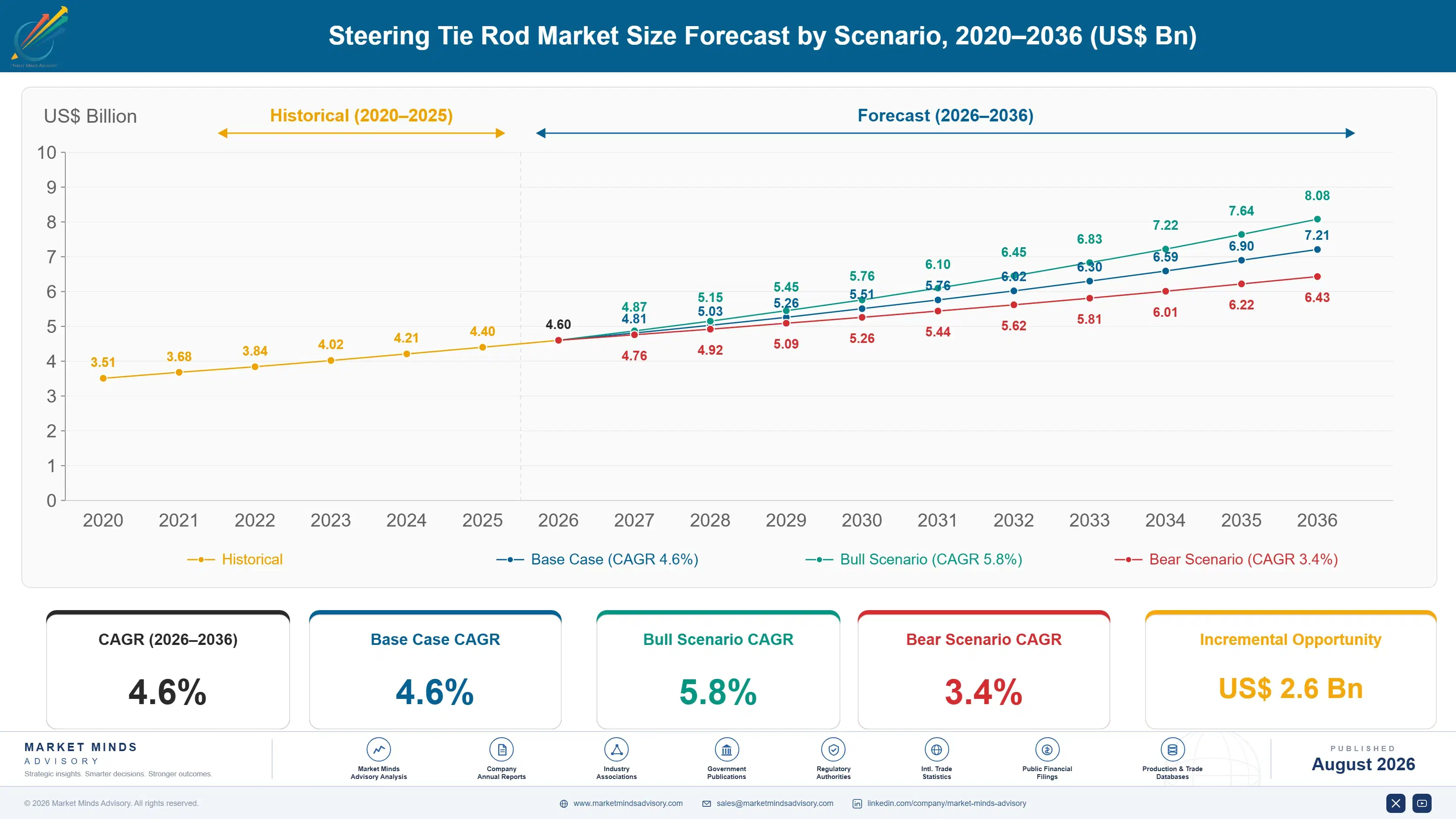
Between 2020 and 2025 the market compounded at 3.6%, and content rather than volume did most of the work. Vehicle production fell hard through 2020 and has not recovered to earlier peaks across Europe or Japan. What lifted value instead was specification: sealed low-friction joints and polymer bearing seats spread through mainstream programmes at prices well above the greasable metal-seated assemblies they replaced.
The base case at 4.6% rests on three mechanisms. Electric power steering keeps rewarding low-friction joint design, since motor sizing and current draw both respond directly to linkage friction. Aftermarket replacement grows on a global parc that keeps expanding and ageing, and worn tie rods fail roadworthiness testing across most developed markets regardless. Emerging market production adds genuine unit growth alongside replacement intervals that arrive far earlier on poor road surfaces.
The bull case at 5.8% turns on steer-by-wire adoption spreading faster than expected, since those systems place unusual demands on linkage precision and remove the packaging compromises a mechanical column imposes. The bear case at 3.4% is aftermarket price compression: Chinese and Turkish product already sets pricing in most replacement channels, and further erosion would pull realised value down even where unit volumes hold.

What Actually Determines Tie Rod Value

This component looks simpler than it is. A tie rod transmits every steering input from the rack to the wheel while accommodating suspension travel through a ball joint that must stay tight for a decade, survive road salt and impact loading, and add as little friction as physically possible to the system around it.
TOP FIVE CONCENTRATION27%Share held by the five largest tie rod suppliers globally
AVERAGE UNIT PRICE$18Typical realised price for a passenger vehicle assembly
AFTERMARKET VOLUME SHARE44%Portion of volume destined for replacement and repair
STEEL COST SHARE41% of COGSForged bar stock as portion of manufactured unit cost
REPLACEMENT INTERVAL80,000 milesTypical distance before a worn assembly requires replacement
PROGRAMME LENGTH7 yearsTypical production run before a vehicle platform changes
That last requirement changed the market. A hydraulic steering system had a pump running anyway and absorbed linkage friction without anybody noticing. An electric system sizes its motor against total friction and draws current in proportion to it, which means every unnecessary newton metre at a ball joint costs range on an electric vehicle and steering feel on any vehicle. Manufacturers now specify breakaway torque explicitly, and sealed low-friction designs with polymer bearing seats have displaced greasable metal-seated joints across most new programmes.
The other defining feature is the aftermarket, which takes 44% of volume. Tie rod ends wear, they are cheap relative to the labour of fitting them, and worn ones fail roadworthiness inspection in most developed markets, which makes replacement close to non-discretionary. That business earns considerably better margins than original fitment and is where Chinese and Turkish producers compete hardest on price.
"The interesting thing is that electrifying the steering made a dumb forged link into a component with a specification that matters. Nobody measured breakaway torque when a hydraulic pump was masking it. Now it appears on the drawing and suppliers who cannot hold it consistently are quietly losing programmes."
Practice Director, Automotive Components, Market Minds Advisory · MMA Automotive Practice · August 2026

Market Trends

Electric Steering Makes Joint Friction A Specified Requirement

Electric power steering sizes its assist motor against total system friction and draws current in proportion to it, which turned linkage drag from an invisible loss into a number engineers now specify on the drawing. Breakaway torque targets appear on tie rod specifications where they never previously existed, and suppliers unable to hold them consistently across a production run lose programmes regardless of price. Sealed low-friction assemblies now realise roughly 1.8 times what greasable equivalents command, and the requirement now applies to electrified and conventional platforms equally across every major manufacturer.
Market Impact: Serves 44% of volume
Polymer Bearing Seats Displace Metal Contact Surfaces

Ball joints traditionally ran a hardened stud against a metal seat with grease between them, which worked adequately and required periodic servicing. Engineered polymer bearing seats now carry that contact instead, delivering lower friction, quieter operation and a genuinely sealed-for-life assembly that eliminates the greasing schedule entirely. Material selection is where the real difficulty sits, since the polymer must resist creep under sustained load across a full decade of thermal cycling. Suppliers who chose poorly have produced warranty populations that took years to work their way through the delivered fleet.
Market Impact: Halves replacement distance below 40,000 miles

Market Opportunities and Growth Drivers

Roadworthiness Testing Makes Replacement Close To Mandatory

Worn tie rod ends produce steering play that fails periodic roadworthiness inspection across most developed markets, and the component is inexpensive relative to the labour involved in reaching it, which makes replacement close to non-discretionary for anybody who intends to keep the vehicle legal and on the road. Aftermarket already takes 44% of volume on that basis. The demand here is regulatory rather than discretionary in character, which makes it considerably less cyclical than original fitment and far less exposed to economic sentiment or interest rates. Nothing about that changes with the economy.
Market Impact: Undercuts pricing by 45%

Emerging Market Road Surfaces Shorten Replacement Intervals

Steering linkages on Indian, Southeast Asian, Latin American and African roads work considerably harder than on developed market motorways, and impact loading through potholes and unpaved surfaces accelerates joint wear substantially. Replacement intervals arrive at a fraction of the distance manufacturers specify for temperate conditions, which lifts aftermarket volume well above what fleet size alone would predict. Vehicle populations across all of those markets are also growing rather than flat, which compounds the effect considerably and makes those markets the fastest growing demand pools anywhere in this business. The effect compounds every year.
Market Impact: Affects 8% of aftermarket units

Market Restraints and Challenges

Aftermarket Price Compression From Low-Cost Producers

Chinese and Turkish manufacturers supply tie rod ends at delivered costs no Western producer approaches, and they already set the price in most independent replacement channels. The root cause is genuinely low technical barrier at the volume end, since forging and machining capability is widespread and the tolerances involved are demanding but well understood. Commercially this holds margins in the mid teens across the value aftermarket. Participants are responding by competing on branded quality positioning, by emphasising warranty and fitment accuracy, and by moving mix toward original equipment specification product.
Market Impact: Cuts breakaway torque 40%

Counterfeit Parts Damage Safety Outcomes And Brand Value

Steering components are safety critical, and counterfeit tie rod ends carrying established brand markings circulate widely across several regions with materially inferior forging quality and joint retention. The root cause is that packaging and markings are far easier to copy than metallurgy, and installers cannot distinguish them at fitting. Commercially this damages precisely the brands that counterfeiters choose to imitate, and it creates liability exposure that nobody wants to carry. Participants are responding with holographic authentication, serialised packaging, distributor verification programmes and direct enforcement action pursued through national customs authorities.
Market Impact: Removes 100% of greasing
4 additional market trends, 3 additional growth drivers, and 2 additional restraints and challenges are covered in the full report. Contact sales@marketmindsadvisory.com to access the complete intelligence.

Segment CAGR and Growth Architecture

Segmentation follows joint construction and bearing design, because how the ball stud is carried determines friction, service requirement, durability, manufacturing capability needed and the realised price per assembly. Vehicle class, forging geometry, coating specification and sales channel all sit downstream of that construction decision, and every one of them is priced directly against it during platform development.
steering-tie-rod-market-market-share-analysis-1787322237238

Sealed Low-Friction Ball Joint Tie Rod

The fastest segment at 6.9%, a full 1.50 times the market rate, covering assemblies using engineered polymer bearing seats and permanently sealed boots to deliver low breakaway torque with no service requirement at all. Electric power steering created the demand. An assist motor sized against total system friction draws current in proportion to it, so every unnecessary newton metre at a ball joint costs range on an electric vehicle and steering feel on every vehicle. Manufacturers now specify breakaway torque explicitly on the drawing where they never previously did. Realised pricing runs roughly 1.8 times greasable equivalents. The difficulty sits in polymer selection, since the seat must resist creep under sustained load across a decade of thermal cycling.
CAGR 6.9%

Forged One-Piece Integrated Assembly

Growing at 5.6% on one-piece forged assemblies where the rod and one joint housing are formed together rather than assembled from separate components. Mass and stiffness both improve. Eliminating a threaded joint removes a stress concentration, cuts weight from the unsprung assembly and removes an adjustment interface that can loosen in service, which matters more on electrified platforms where every kilogram is accounted for. Forging capability is the barrier, since one-piece geometry demands die design and press capacity that simpler two-piece production never required. What limits the segment is that eliminating adjustment removes the alignment tolerance that assembly plants and repair shops alike have historically relied upon during alignment work.
CAGR 5.6%
Full segment breakdown across 5 segments available in the complete report.

Regional Architecture and Country Demand Map

East Asia holds 35% of global value on Chinese vehicle output and the largest linkage forging base anywhere. North America follows on heavier vehicle loading and an enormous replacement market, while growth runs fastest across South Asia and Pacific on road conditions and production expansion.

East Asia

Note: East Asia holds 35% against a 22 to 30% band because China builds roughly 30 million vehicles annually and hosts the largest concentration of steering linkage forging and machining capacity anywhere. Producers across Zhejiang, Jiangsu and Hebei supply domestic assembly plants and export heavily into aftermarket channels worldwide, frequently under other companies' brand names. Japanese suppliers occupy the technical end, with Musashi Seimitsu, Somic Ishikawa and THK Rhythm all holding original equipment positions built on friction characteristics and durability rather than on delivered cost. Korean output through HL Mando and CTR serves Hyundai and Kia platforms globally alongside substantial export business. Volume and technical capability sit at opposite ends of this region.
Share: 35% | CAGR: 5.8% (2026 to 2036)

North America

Vehicle mass rather than unit volume shapes this region. Full-size pickups and body-on-frame utilities load steering linkages far harder than passenger cars do, and the assemblies fitted carry heavier forgings and larger joints that realise well above the world average price. Those platforms are also electrifying more slowly than anything else, which keeps the demand base unusually resilient. The installed parc above 290 million vehicles at an average age near thirteen years sustains a replacement market larger than new vehicle fitment generates, and road salt across the northern states accelerates boot and joint degradation measurably against milder climates. Replacement volume here runs well above what new vehicle fitment alone would generate.
Share: 22% | CAGR: 4.1% (2026 to 2036)
Regional intelligence for 5 additional markets available in the complete report: Western Europe, South Asia and Pacific, Latin America, Middle East and Africa, Eastern Europe. Contact sales@marketmindsadvisory.com.
steering-tie-rod-market-country-cagr-analysis-1787322237748

Where Tie Rod Margin Is Actually Won

Four positions separate suppliers earning genuine margin from those forging bar stock at commodity rates: holding friction specification capability that electric steering now demands, building branded aftermarket depth ahead of volume decline, owning polymer bearing engineering rather than buying seats, and defending actively against the counterfeits that damage whichever brand happens to be doing the selling.

Hold Friction Specification Capability Electric Steering Demands

Breakaway torque now appears on tie rod drawings where it never previously did, and suppliers unable to hold the target consistently across a production run lose programmes regardless of what they quote. Those who can hold it realise roughly 1.8 times greasable pricing and carry 12 to 18 points more gross margin on identical forging content. The capability is measurement discipline, polymer selection and process control rather than any exotic manufacturing, which makes it achievable in principle but genuinely difficult to sustain across high volume production. Very few suppliers hold it reliably.
Market Impact: Adds 18 margin points on identical forging content

Build Branded Aftermarket Depth Before Fitment Declines

Aftermarket already takes 44% of volume and earns 15 to 21 points more gross margin than original equipment supply, because a workshop fitting a safety-critical steering part buys on confidence rather than on price per unit. Every platform in production today generates replacement demand for a decade or more after the very last vehicle is built. Suppliers building catalogue coverage and distributor relationships now capture that tail; those waiting until fitment softens before acting find the shelf space has already been taken by low-cost imports. The tail is longer than the fitment itself.
Market Impact: Adds 21 margin points across all aftermarket volume

Own Polymer Bearing Engineering Rather Than Buying Seats

The polymer bearing seat determines friction, wear rate and whether the joint survives ten years in service without developing play, and suppliers buying seats to a purchase specification inherit somebody else's material choice along with the warranty exposure. Owning polymer formulation and seat design internally retains 9 to 14 points of additional margin and controls the failure mode that generates warranty populations. Several suppliers who chose their seat materials poorly then spent years working the consequences through fleets they had already delivered. Owning that choice matters more than it appears.
Market Impact: Retains 14 additional points of gross margin overall

Defend Against Counterfeits Damaging Your Own Brand

Counterfeit tie rod ends carrying established brand markings circulate widely, affecting roughly 8% of aftermarket units in the worst affected regions, and installers cannot distinguish them at fitting because packaging copies far more easily than metallurgy. Suppliers running holographic authentication, serialised packaging and distributor verification recover 10% to 16% of volume that counterfeits had displaced while removing liability exposure nobody wants. The cost is packaging and enforcement effort rather than manufacturing capital, and the safety argument involved makes customs cooperation considerably easier to obtain than commercial arguments alone. Enforcement works better than most expect.
Market Impact: Recovers up to 16% of displaced aftermarket volume

Who Controls the Margin Pool

Concentration sits at 27% for the top five measured on assembly shipment volume, the basis used throughout this section, and it is low because forging and machining capability is genuinely widespread. ZF leads through breadth across European and North American platforms, while Musashi Seimitsu, THK Rhythm and Somic Ishikawa hold strong Japanese original equipment positions and Nexteer competes on integrated steering system scope. The gap to the next tier is narrow in volume terms.
Competitive activity runs on three fronts. Friction specification capability is the first, since breakaway torque targets now decide programme awards that price alone once settled. Polymer bearing engineering is the second, and it separates suppliers who control their own failure modes from those who inherited somebody else's material choice. The third is branded aftermarket positioning, where low-cost imports have taken the value channel and established names defend the quality tier.

Pressure arrives almost entirely from Chinese and Turkish producers competing at delivered costs Western manufacturers cannot approach, particularly across independent replacement channels. Counterfeit product carrying established markings compounds the problem for the brands being imitated. Rankings will shift on who holds friction capability when the next generation of electrified platforms reaches specification.
steering-tie-rod-market-company-positioning-matrix-1787322238268

Competitive Moat and Risk Dimensions

ZF FRIEDRICHSHAFEN

Moat: Steering system scope breadth

Supplying steering racks, columns and linkage together means tie rod specification sits inside a system conversation rather than out at a component procurement desk, and friction targets get set collaboratively rather than imposed. The aftermarket brand portfolio alongside converts every original equipment position into replacement revenue lasting well beyond the production run itself.
ZF FRIEDRICHSHAFEN

Risk: European volume decline exposure

A large share of revenue depends on European vehicle production that has not recovered to earlier peaks and will not, while the group's cost base sits in exactly the region where that decline is sharpest. Growing outside Europe means competing against Japanese incumbents on technical grounds and Chinese producers on cost, neither of which is straightforward.
MUSASHI SEIMITSU

Moat: Forging precision and friction control

Deep forging capability combined with genuine measurement discipline on joint friction gives the business positions on programmes where breakaway torque consistency decides the award rather than delivered price. Japanese manufacturer relationships built over decades also mean specification conversations happen during platform development rather than through a tender document afterwards.
MUSASHI SEIMITSU

Risk: Narrow aftermarket channel presence

Strength in original equipment supply offers limited protection as replacement volume grows toward half the market, and the distributor relationships that carry aftermarket business have been built by others across decades. Entering that channel means competing against low-cost imports on price and established brands on recognition simultaneously.

Players Tracked

Prominent Players

ZF Friedrichshafen
Musashi Seimitsu
THK Rhythm Automotive
Nexteer Automotive
Somic Ishikawa

Other Key Players

HL Mando
Sona BLW Precision Forgings
Rane Group
Tenneco
Dorman Products
Bilstein Group
Sampa Otomotiv
Ditas Dogan
CTR Corporation
Wuxi Zhongyang Auto Parts
Zhejiang Ruitai Suspension System
MAT Holdings
Hyundai Mobis
JTEKT
NTN Corporation

Recent Developments

JANUARY 2025

Breakaway torque specification tightened across electrified platform family

A European vehicle manufacturer tightened tie rod breakaway torque requirements across an electrified platform family, driven by assist motor sizing and range calculations rather than by steering feel alone, and requiring measurement consistency across production that several incumbent suppliers simply could not demonstrate at volume.
Signal: Friction specification rather than delivered price is now deciding tie rod programme awards on electrified platforms
JUNE 2025

Polymer bearing seat formulation revised after creep findings

A supplier revised its polymer bearing seat formulation entirely following field findings on polymer creep under sustained load in hot climate operation, which addressed a wear mechanism that had been generating play in joints well inside their expected service life right across the affected vehicle fleets.
Signal: Bearing seat material selection rather than forging quality is where most modern joint failures actually originate
OCTOBER 2025

Serialised authentication rolled out across aftermarket packaging

A major component supplier introduced serialised holographic authentication right across its entire aftermarket steering component packaging range during the year, responding directly to counterfeit assemblies carrying its own brand markings that installers simply had no practical means of distinguishing at the point of fitting them.
Signal: Counterfeit steering components have become a safety and liability problem rather than only a lost revenue issue

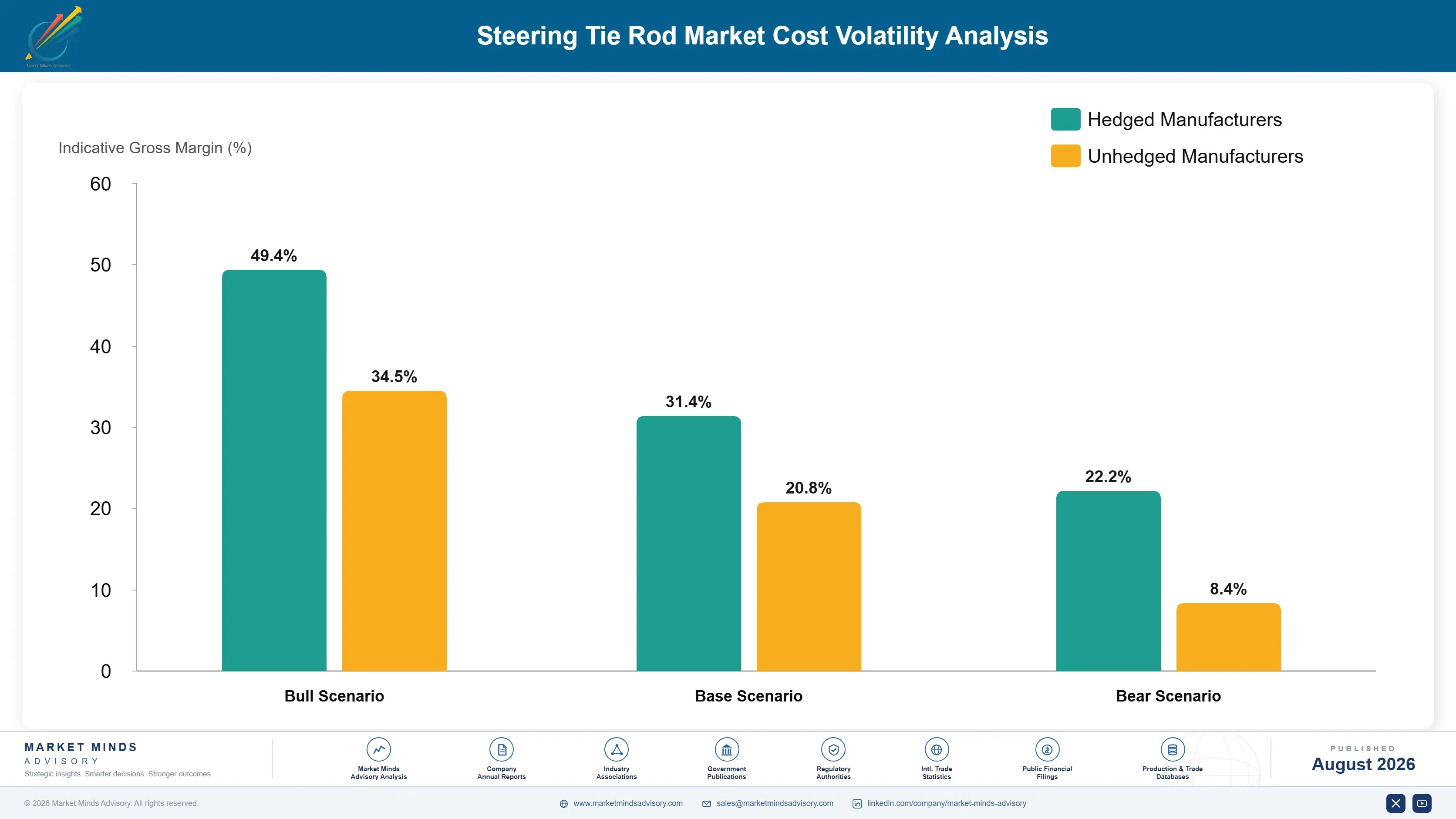
What Drives Tie Rod Input Cost

Forged steel bar stock accounts for roughly 41% of manufactured cost, generally medium carbon or micro-alloyed grades, sourced regionally because freight on steel is unforgiving at these values. Machining, thread rolling and finishing contribute around 19%. Ball studs and bearing seats add about 12%, boots and grease roughly 8%, and corrosion coating a further 6%.
Steel pricing moved sharply through 2021 and 2022 on demand recovery and energy costs, and again during 2025 as tariff measures reshaped regional trade flows. Forging energy costs rose materially during the 2022 European gas episode, since induction heating and press operation both draw power continuously. ZF Annual Report 2025 identifies material and energy cost as continuing pressure on component margins, and smaller forging operations have absorbed that considerably harder than large groups have.

The disadvantage mechanism is energy exposure at the forging stage rather than steel purchasing. A supplier running induction heating on European industrial power carries a cost position an Asian competitor on subsidised electricity simply does not, and where forging dominates the process that gap decides who quotes profitably. Exposure varies by product too: sealed assemblies carry polymer and precision content where steel is proportionally less of the total.
steering-tie-rod-market-cost-volatility-analysis-1787322238463

Index bar stock pricing to published steel benchmarks

Supply agreements written against published alloy steel indices rather than fixed annual pricing move volatility onto a formula both parties can verify, which shortens negotiation considerably. On a product earning mid teens gross margin at the volume end, the difference between recovering an input move and absorbing it decides whether the programme makes money across its whole life.

Recover forging heat into downstream process stages

Induction heating rejects substantial energy that most operations simply vent to atmosphere. Capturing it for parts washing, building heat or preheating incoming bar cuts net consumption on a cost line that European industrial power pricing has made painful. Payback runs a few years at current European rates and considerably longer where electricity remains cheap.

Standardise forging geometry across the product range

Common bar diameters, upset geometry and die sets shared across many part numbers concentrate steel purchasing, cut die development cost and allow longer press runs between changeovers. The constraint is that each assembly becomes slightly less optimised for its own application. Where forging dominates the cost base, that compromise pays for itself very quickly indeed.

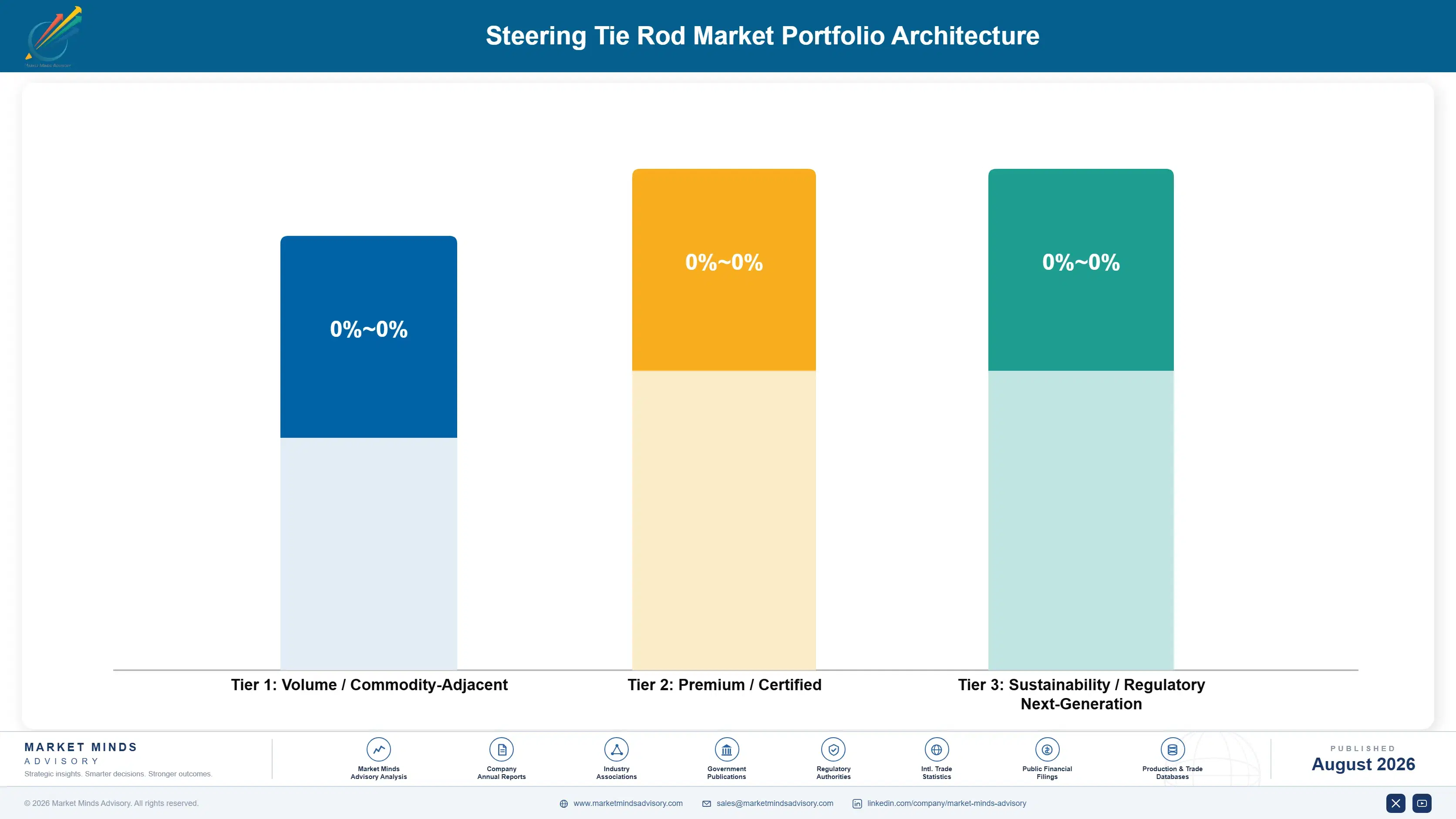
Portfolio Architecture for Margin Defence

Portfolio economics here divide on joint technology and channel rather than on forging complexity. Value aftermarket assemblies sold through independent distribution earn gross margins in the mid teens, because Chinese and Turkish producers set the price, the physical part is available from dozens of sources and buyers in that channel compare on cost per unit and nothing else. Volume here secures shelf presence rather than any margin.
The premium tier is original equipment supply carrying specified friction performance. Breakaway torque targets, polymer bearing engineering and measurement consistency across a production run all demand capability that volume forgers lack, and programme awards now turn on it rather than on price. Margins run in the high twenties. Measurement discipline decides where in that range a supplier lands.

Above both sits branded aftermarket supply. A workshop fitting a safety-critical steering component buys on confidence rather than on unit cost, the labour to reach the part dwarfs the part price, and established brands command genuine premiums for exactly that reason. Margins reach the high thirties, and the revenue continues for well over a decade after original fitment on any given platform has ended entirely.

Volume / Commodity-Adjacent

Value aftermarket assemblies sold through independent distribution. Low-cost producers set the price, the physical part is available from dozens of sources, and buyers compare purely on delivered cost per unit.
Gross Margin: 13 to 19%

Premium / Certified

Original equipment supply carrying specified breakaway torque targets and engineered polymer bearing performance. The range reflects how much friction measurement discipline and polymer material engineering a supplier genuinely owns internally rather than buys.
Gross Margin: 25 to 32%

Sustainability / Regulatory / Next-Generation

Branded aftermarket supply delivered through workshop chain and independent parts distributor channels. The wide range spans mainstream branded product through to premium ranges carrying extended warranty terms and authentication features.
Gross Margin: 35 to 43%
steering-tie-rod-market-portfolio-architecture-1787322238957

High-value Sub-segments and Strategic Watch-out

Branded Aftermarket Steering Components

High value and steady growth together. A workshop fitting a safety-critical steering part buys on confidence rather than unit cost, the labour to reach it dwarfs the part price, and the replacement demand continues for well over a decade after original fitment has ended entirely.
Gross Margin: 36 to 44%

Specified Low-Friction Original Equipment

High value running on genuinely strong underlying growth. Electric power steering turned breakaway torque into a specified requirement rather than the invisible system loss it had always been, and measurement consistency across a whole production run now decides awards that delivered price alone once settled entirely.
Gross Margin: 25 to 32%

Original Equipment Volume Assembly Supply

The volume core that keeps forging presses loaded and seeds the aftermarket tail behind every platform delivered. Margins sit only moderate because several suppliers quote comparable specification against each other, but nobody ever reaches the far richer branded replacement business without first winning the platform here.
Gross Margin: 18 to 25%

Value Aftermarket Assembly Supply

The strategic watch-out sitting squarely inside this portfolio. Volumes here are enormous and the channel is genuinely easy to enter, but Chinese and Turkish producers set pricing, counterfeit product circulates alongside, and nothing durable at all accrues to whoever happens to win that particular business.
Gross Margin: 13 to 19%

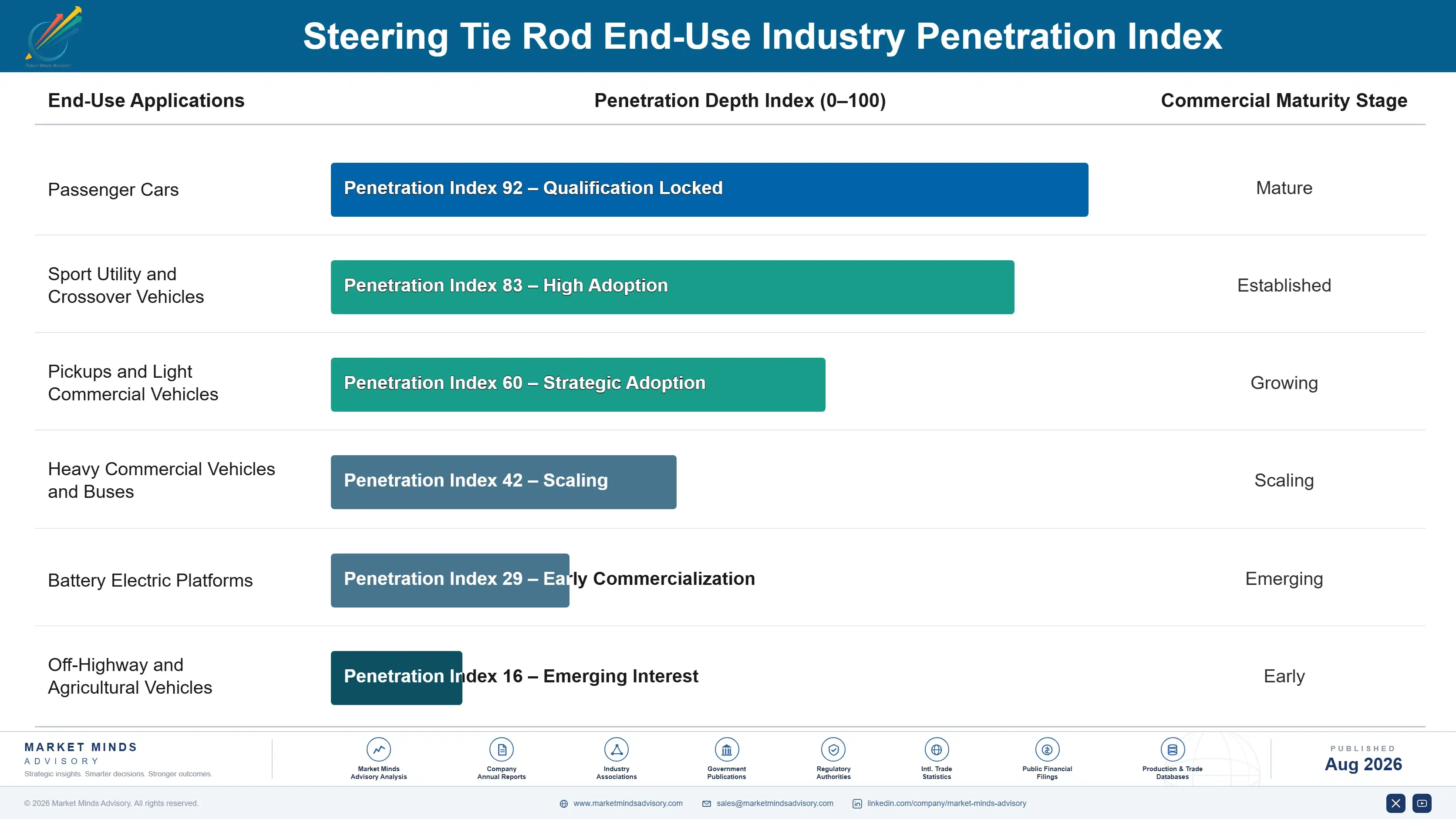
How Tie Rod Demand Repeats

This component has an unusually long tail and most participants underweight it. A platform fitted with a particular tie rod design generates original equipment revenue for roughly seven years of production, then replacement demand for a decade or more beyond that at considerably better margin. The specification decision taken once therefore determines almost two decades of demand, which is why losing a platform costs far more than the contract value alone ever suggests.
Stickiness varies by channel rather than by end-use. Original equipment positions are locked for the platform but fully contestable at each redesign, and friction specification has made those contests genuinely technical rather than purely commercial. Workshop and distributor relationships are stickier than they look, since installers develop preferences for parts that fit correctly and do not return. Value channel buyers show no loyalty whatsoever, comparing delivered price across dozens of near-identical listings.

The buyer profile has shifted noticeably. Specification once sat with chassis engineers evaluating durability and articulation in isolation. Today it sits with steering system teams weighing breakaway torque, assist motor current and steering feel together, which favours suppliers who arrive with friction measurement data rather than only with fatigue test results and a competitive price.
steering-tie-rod-market-end-use-penetration-index-1787322239444

Where To Compete And Why

These are among the four positions where our research anticipates prominent divergence between winners and laggards over the coming forecast period. Each is grounded in the demand model, the regulatory perimeter, and the announced capacity pipeline.
01 / FRICTION SPECIFICATION CAPABILITY

Breakaway torque now decides the award

Electric power steering sizes its assist motor against total system friction, which put breakaway torque onto tie rod drawings where it had never previously appeared at all. Suppliers holding the target consistently across a production run realise roughly 1.8 times greasable pricing and carry 12 to 18 points more gross margin on identical forging content. The capability is measurement discipline, polymer selection and process control rather than exotic manufacturing, which makes it achievable but genuinely difficult to sustain at volume.
02 / AFTERMARKET BRAND DEPTH

The tail outlasts the platform by a decade

Aftermarket takes 44% of volume and earns 15 to 21 points more gross margin than original fitment, because a workshop fitting a safety-critical steering part buys on confidence rather than on the unit price. Every platform in production today generates replacement demand for a decade or more after the very last vehicle is built. Suppliers building catalogue coverage and distributor relationships now capture that tail, while those waiting until fitment softens find shelf space already taken by low-cost imports instead.
03 / BEARING MATERIAL OWNERSHIP

The seat decides the failure mode

The polymer bearing seat determines friction, wear rate and whether a joint survives ten years in service without developing any play, and suppliers buying seats to a purchase specification inherit somebody else's material choice alongside the warranty exposure it carries. Owning polymer formulation and seat design internally retains 9 to 14 points of additional margin and controls the failure mode outright. Several suppliers who chose their materials poorly then spent years working the consequences through fleets they had already delivered.
04 / COUNTERFEIT DEFENCE PROGRAMMES

Fakes damage the brand they imitate

Counterfeit tie rod ends carrying established markings affect roughly 8% of aftermarket units in the worst regions, and installers cannot distinguish them at fitting because packaging copies far more easily than metallurgy does. Suppliers running holographic authentication, serialised packaging and distributor verification recover 10% to 16% of displaced volume while removing genuine liability exposure. The cost is packaging and enforcement effort rather than capital, and the safety argument involved makes customs cooperation far easier to obtain than commercial arguments alone.

Engagement Snapshot From the Field

A live engagement with an industry participant carrying material or product regulatory and market exposure ahead of a defining policy shift, showing how our research translates into a defensible multi-year portfolio strategy.
MARKET MINDS ADVISORY · CLIENT ENGAGEMENT SUMMARY
Steering Tie Rod Producer Strategic Portfolio Review and Transition Roadmap 2026·Investment Scenario on Steering Tie Rod Exposure Evaluation 2025-26
CLIENT PROFILE
A European manufacturer of forged steering linkage components with annual revenue near $270 million (client-reported, unverified by MMA), roughly 81% of it from original equipment tie rod supply to European vehicle programmes. The business held excellent forging capability and long manufacturer relationships but bought its polymer bearing seats externally, held no friction measurement laboratory, and had almost no branded aftermarket presence.
STRATEGIC CHALLENGE
Two programme losses in eighteen months had turned on breakaway torque consistency the client could not demonstrate, and European vehicle production was declining while the aftermarket it had never entered kept growing. Management needed to decide between building friction measurement and polymer capability, entering the branded aftermarket, or consolidating forging capacity and managing for cash.
MMA APPROACH
MMA modelled tie rod specification requirements across 46 European and Asian vehicle platforms through 2038, quantified replacement demand from the client's own installed base against catalogue coverage it did not hold, and assessed capability and channel investment requirements for each option. Twenty-three expert interviews with steering system engineers, workshop chains and distributors tested where decisions were genuinely being made.
KEY FINDINGS
  1. Every electrified platform studied for award after 2028 specified breakaway torque explicitly, which meant the client's addressable original equipment market was closing rather than merely shrinking over time.
  2. Replacement demand from platforms the client had already supplied would exceed its declining original equipment revenue before 2033, and none of that tail was addressed because no catalogue coverage existed.
  3. Externally purchased bearing seats accounted for both programme losses, since the supplier's material varied enough between batches that friction consistency could not be demonstrated at volume.
  4. Workshop chains ranked fitment accuracy and brand recognition above price, which favoured a supplier with genuine original equipment engineering behind an aftermarket catalogue.
CLIENT PROFILE
A European manufacturer of forged steering linkage components with annual revenue near $270 million (client-reported, unverified by MMA), roughly 81% of it from original equipment tie rod supply to European vehicle programmes. The business held excellent forging capability and long manufacturer relationships but bought its polymer bearing seats externally, held no friction measurement laboratory, and had almost no branded aftermarket presence.
STRATEGIC CHALLENGE
Two programme losses in eighteen months had turned on breakaway torque consistency the client could not demonstrate, and European vehicle production was declining while the aftermarket it had never entered kept growing. Management needed to decide between building friction measurement and polymer capability, entering the branded aftermarket, or consolidating forging capacity and managing for cash.
MMA APPROACH
MMA modelled tie rod specification requirements across 46 European and Asian vehicle platforms through 2038, quantified replacement demand from the client's own installed base against catalogue coverage it did not hold, and assessed capability and channel investment requirements for each option. Twenty-three expert interviews with steering system engineers, workshop chains and distributors tested where decisions were genuinely being made.
KEY FINDINGS
  1. Every electrified platform studied for award after 2028 specified breakaway torque explicitly, which meant the client's addressable original equipment market was closing rather than merely shrinking over time.
  2. Replacement demand from platforms the client had already supplied would exceed its declining original equipment revenue before 2033, and none of that tail was addressed because no catalogue coverage existed.
  3. Externally purchased bearing seats accounted for both programme losses, since the supplier's material varied enough between batches that friction consistency could not be demonstrated at volume.
  4. Workshop chains ranked fitment accuracy and brand recognition above price, which favoured a supplier with genuine original equipment engineering behind an aftermarket catalogue.
RECOMMENDED STRATEGY
Phase 1: Phase one: bring polymer bearing seat design and a friction measurement laboratory in house, addressing the direct cause of both programme losses before anything else. Phase 2: Phase two: build replacement catalogue coverage across every platform the business has ever supplied, starting with the highest installed volumes across Europe. Phase 3: Phase three: establish distributor and workshop chain relationships supporting a branded aftermarket position rather than competing in the value channel at all.
OUTCOME
The client commissioned its friction laboratory within eight months and won back one of the two lost programmes at re-bid (client-reported, unverified by MMA). Aftermarket catalogue coverage now spans 210 applications generating $17 million in the first full year, blended gross margin improved by roughly five points, and value channel participation was deliberately avoided.

Frequently Asked Questions

Foundational context covering the market sizes, CAGR, scope, country, region and competition that inform every finding below. This section is provided to cover basics and most often pre-purchase conversations, answered from the MMA Primary Research Dataset.

What is the current size of the Steering Tie Rod Market?

The global steering tie rod market was valued at $4.40 billion in 2025, reaching an estimated $4.60 billion in 2026. That covers tie rods and tie rod ends across passenger, commercial and off-highway vehicle applications.

How large will the Steering Tie Rod Market be by 2036?

MMA forecasts the market reaching $7.21 billion by 2036, an increase of $2.61 billion over the 2026 base. That represents an expansion multiple of 1.57 times across the forecast period.

What is the CAGR for the Steering Tie Rod Market 2026 to 2036?

The base case compound annual growth rate is 4.6%, with a bull case of 5.8% and a bear case of 3.4%. Historical growth between 2020 and 2025 ran at 3.6% annually.

Which segment is growing fastest?

Sealed low-friction ball joint tie rods grow at 6.9%, a full 1.50 times the market rate, as electric steering makes breakaway torque a specified requirement. Forged one-piece assemblies follow at 5.6%.

Who are the major companies in the Steering Tie Rod Market?

ZF Friedrichshafen, Musashi Seimitsu, THK Rhythm Automotive, Nexteer Automotive and Somic Ishikawa lead on assembly shipment volume. Together they account for roughly 27% of global shipments.

Which country is growing fastest?

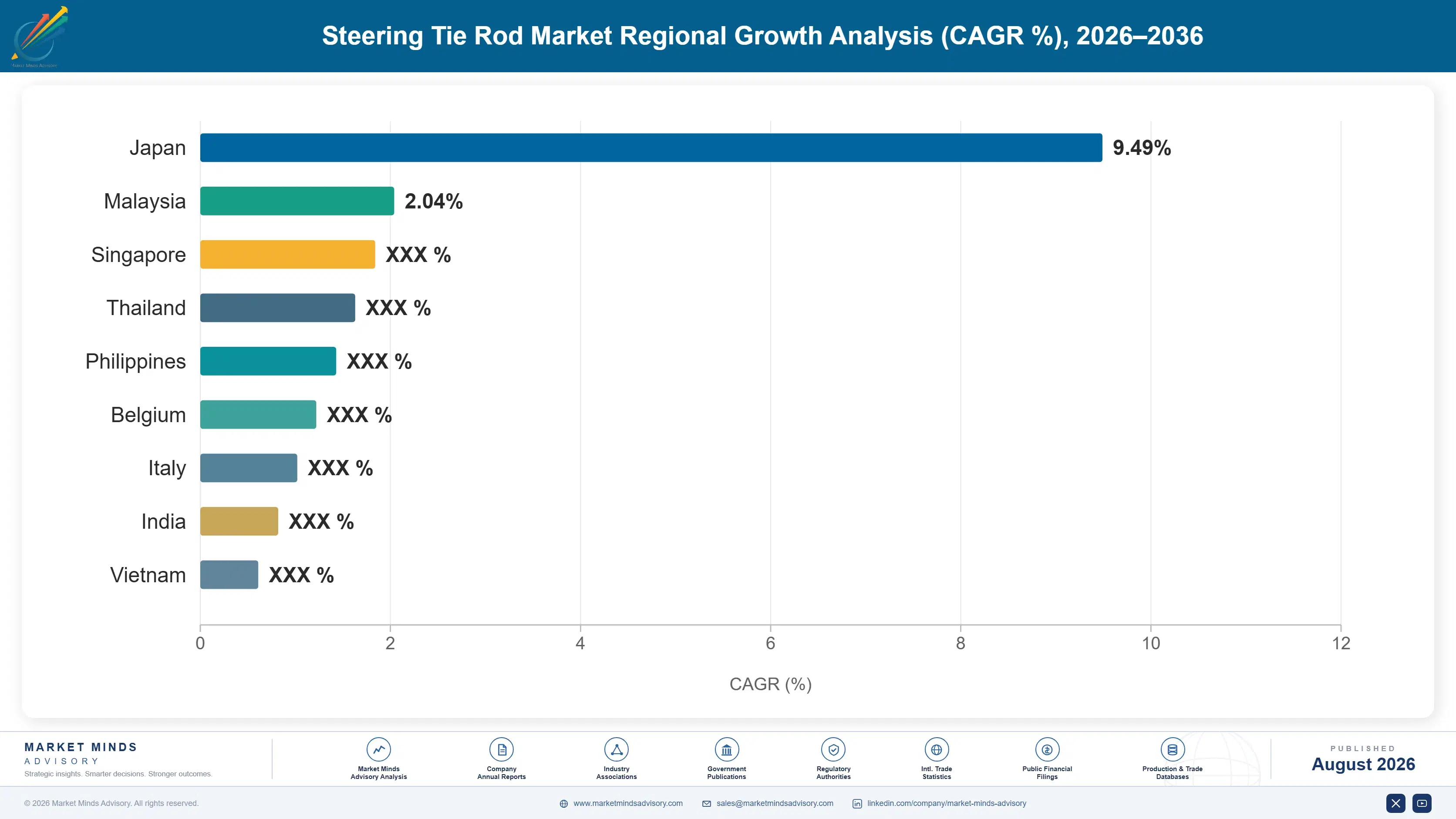
India grows fastest at 7.2% annually, driven by expanding vehicle production alongside road surfaces that shorten replacement intervals substantially against developed market norms. Indonesia and Vietnam follow closely.

Report Segmentation Architecture

The full report scope spans multiple orthogonal segmentation dimensions, with cross-tabulated demand data provided for each dimension pair. Coverage extends further to regional breakdowns, trend trajectories, and the competitive detail needed to support segment-level decision-making.

By Joint Construction and Bearing Design

  • Sealed Low-Friction Ball Joint Tie Rod
  • Forged One-Piece Integrated Assembly
  • Polymer Bearing Housing Tie Rod
  • Greasable Serviceable Ball Joint Tie Rod
  • Adjustable Two-Piece Tie Rod

By End-Use Industry

  • Passenger Cars
  • Sport Utility and Crossover Vehicles
  • Pickups and Light Commercial Vehicles
  • Heavy Commercial Vehicles and Buses
  • Battery Electric Platforms
  • Off-Highway and Agricultural Vehicles

By Commercial Dimension

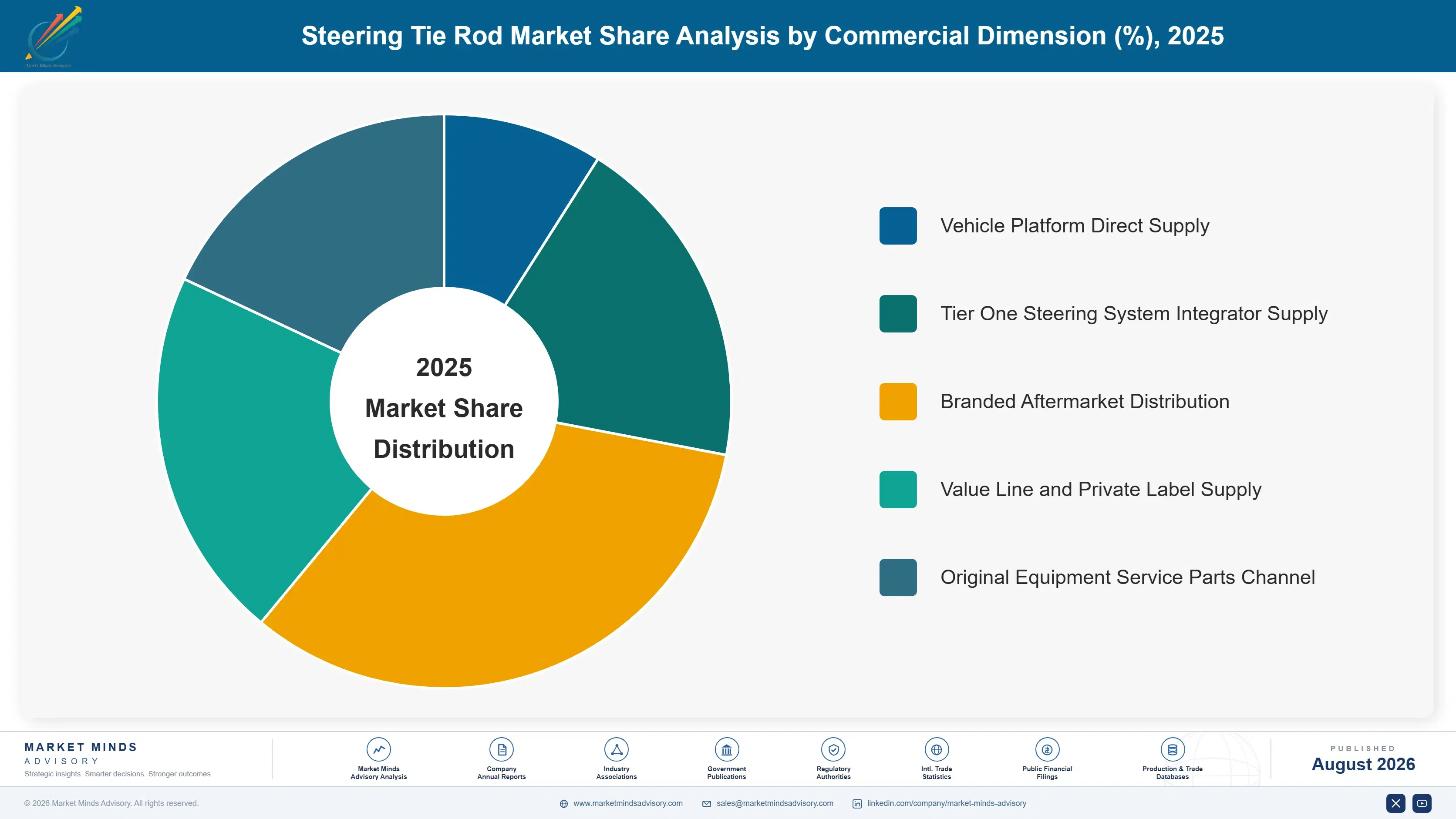
  • Vehicle Platform Direct Supply
  • Tier One Steering System Integrator Supply
  • Branded Aftermarket Distribution
  • Value Line and Private Label Supply
  • Original Equipment Service Parts Channel

By Region

  • North America
  • Western Europe
  • East Asia
  • South Asia and Pacific
  • Latin America
  • Middle East and Africa
  • Eastern Europe

Scope, Methodology, and Coverage

Every figure in this report is reproducible from documented input assumptions. The scope below maps the historical period, the forecast horizon, the segmentation dimensions, and the countries covered, alongside the underlying primary and qualitative methodology.
Historical Period
2020 to 2025
Forecast Period
2026 to 2036
Base Year
2025 (USD billions; MMA Primary Research Dataset, August 2026)
Market Definition
This report covers steering tie rods and tie rod ends connecting the steering rack or gearbox to the steering knuckle, spanning inner and outer assemblies, adjustable two-piece and forged one-piece designs, and the ball studs, bearing seats and protective boots integral to them, across passenger cars, light and heavy commercial vehicles, battery electric platforms and off-highway applications. Steering racks and gearboxes, intermediate shafts, separately sold drag links, suspension control arms and ball joints, and complete steering assemblies are excluded from the sizing.
Quantitative Units
USD billions at manufacturer realised value; assembly shipments in hundreds of millions of units; average realised price in USD per assembly.
Segmentation Dimensions
By joint construction and bearing design; by end-use industry; by commercial dimension; by region.
Regions Covered
North America, Western Europe, East Asia, South Asia and Pacific, Latin America, Middle East and Africa, Eastern Europe
Countries Covered
China, Japan, South Korea, India, Thailand, Indonesia, Germany, France, Italy, Spain, United Kingdom, Turkey, United States, Canada, Mexico, Brazil, Argentina, South Africa, Poland, Czech Republic.
Key Companies Profiled
ZF Friedrichshafen, Musashi Seimitsu, THK Rhythm Automotive, Nexteer Automotive, Somic Ishikawa, HL Mando, Sona BLW Precision Forgings, Rane Group, Tenneco, Dorman Products, Bilstein Group, Sampa Otomotiv, CTR Corporation, JTEKT and others.
Quantitative Methodology
Primary survey, n=3,800 respondents, Q4 2025, six countries; demand-side model with trade association cross-validation
Qualitative Methodology
47 expert interviews, Q4 2025; applied to validate demand model assumptions, identify emerging dynamics, and assess competitive positioning
Report Format
PDF and XLSX data workbook (Word format preview document)
Publisher
Market Minds Advisory
Report Code
MMA-2026-AUT-019
Published
August 2026
Contact
sales@marketmindsadvisory.com | www.marketmindsadvisory.com

Purchase the full Steering Tie Rod Market Report (2026 to 2036).

The full report sizes the steering tie rod market across five construction and bearing designs, six end-use industries and seven regions, with unit shipment and realised pricing detail behind every value estimate. It profiles twenty global suppliers on friction specification capability, polymer bearing engineering and aftermarket channel depth. Regional chapters cover vehicle production outlook, road surface conditions and replacement interval variation by market. Specification analysis quantifies breakaway torque requirements across electrified and conventional platforms. Cost analysis tracks forged steel and forging energy exposure across manufacturing regions and product tiers.
Unit shipment and pricing detail by joint construction
Breakaway torque specification tracking across platforms
Aftermarket replacement tail forecasts through 2038
Replacement interval variation by regional road conditions
Competitive position assessments across twenty global suppliers
Forging energy cost exposure by manufacturing region

Built For The People Who Decide

From boardroom strategy to bench-side execution, this report is read cover-to-cover by leaders shaping the next decade of their industry, turning demand scenarios, market dynamics and valuation benchmarks into decisions.
CXOs/ Presidents/ VPs/ Managers
M&A and Corporate Development
Strategy Teams and R&D Heads
Procurement and Product Directors
Regulatory and Compliance Leaders
Investor Relations and Equity Analysts