
Market Minds Advisory
Start-Stop System Market

Start-Stop System Market: Start-Stop System: A Technology With an End Date Nobody States

A battery electric vehicle has no engine to stop, so this technology ends when combustion does, and the interesting question is the shape of that decline rather than the rate of growth.

Lead Analyst

David Horsley

Published

August 2026

Make Smarter Decisions with Customized Research Insights

Request a free sample report and evaluate market opportunities, growth trends, and competitive dynamics relevant to your business needs.

2025 MARKET VALUE$6.4BMarket Size 2025
2036 FORECAST VALUE$10.5BBase Case , 2026 to 2036
CAGR 2026 TO 20364.6 %Bull 5.8% / Bear 3.4%
INCREMENTAL OPPORTUNITY$3.8BNet 10- year value creation
EXPANSION MULTIPLE1.57x2036 value over 2026 base
Strategic Levers
M&A Pipeline
Regional Outlook
Country Rankings
Competitive Intelligence
Segmental Deep-dive
Call-Us : 91 93563 13602

Executive Snapshot and Market Trajectory.

This technology exists because engines idle, which means it ends when combustion does. Nobody in the supply chain says so plainly, and the useful question is not how fast the market grows but what shape the decline takes and how long the replacement business outlives new fitment.
That decline is a long way off in most of the world. Enhanced flooded batteries grow fastest at 6.9% because India and Southeast Asia are fitting start-stop to small petrol cars where full hybridisation costs too much, and the cheaper battery chemistry is what makes the arithmetic work at that price point. India grows at 9.8%. Fitment spreads downward through segments there, reversing the European pattern.
The aftermarket is where the durable money sits. Cycling batteries need replacing around every 3.5 years against five or six for conventional flooded units, and the vehicle parc trails production by roughly eleven years. Replacement demand therefore keeps growing for a decade after new fitment starts falling, which very few suppliers have planned around. It reaches a different buyer, on different terms, and it is far more predictable than production volume ever is.
Market Definition
Start-stop system components supplied to vehicle manufacturers and the replacement market, covering absorbent glass mat batteries, enhanced flooded batteries, starter motors and enhanced starters, belt-driven starter generators, battery sensors and management modules, and voltage stabilisers and converters. Measured at supplier selling value. Excludes full hybrid and battery electric drivetrains, traction batteries, conventional flooded starting batteries, and vehicle assembly or calibration services.
Base Year Value
$6.4B in 2025 (MMA Primary Research Dataset, August 2026)
Forecast Period
2026 to 2036, eleven discrete annual values
CAGR
4.6% base case. Bull 5.8%. Bear 3.4%.
Fastest Growth Segment
Enhanced Flooded Batteries: 6.9% CAGR
Fastest Growth Country
India: 9.8% CAGR
Fastest Growth Region
South Asia and Pacific: 6.6% CAGR
Largest Region
East Asia: 30% of 2025 global value
Market Leaders
Robert Bosch, Denso, Valeo, Clarios, Continental. Source: MMA Primary Research Dataset, July 2026.
Primary Survey
n=3,800 procurement and R&D decision-makers, Q4 2025, six countries
Methodology
Demand-side build-up, cross-validated against public data, 47 expert interviews

Start-Stop System Market Forecast Scenarios

start-stop-system-market-trends-growth-size-forecast-scenario-1787595382865
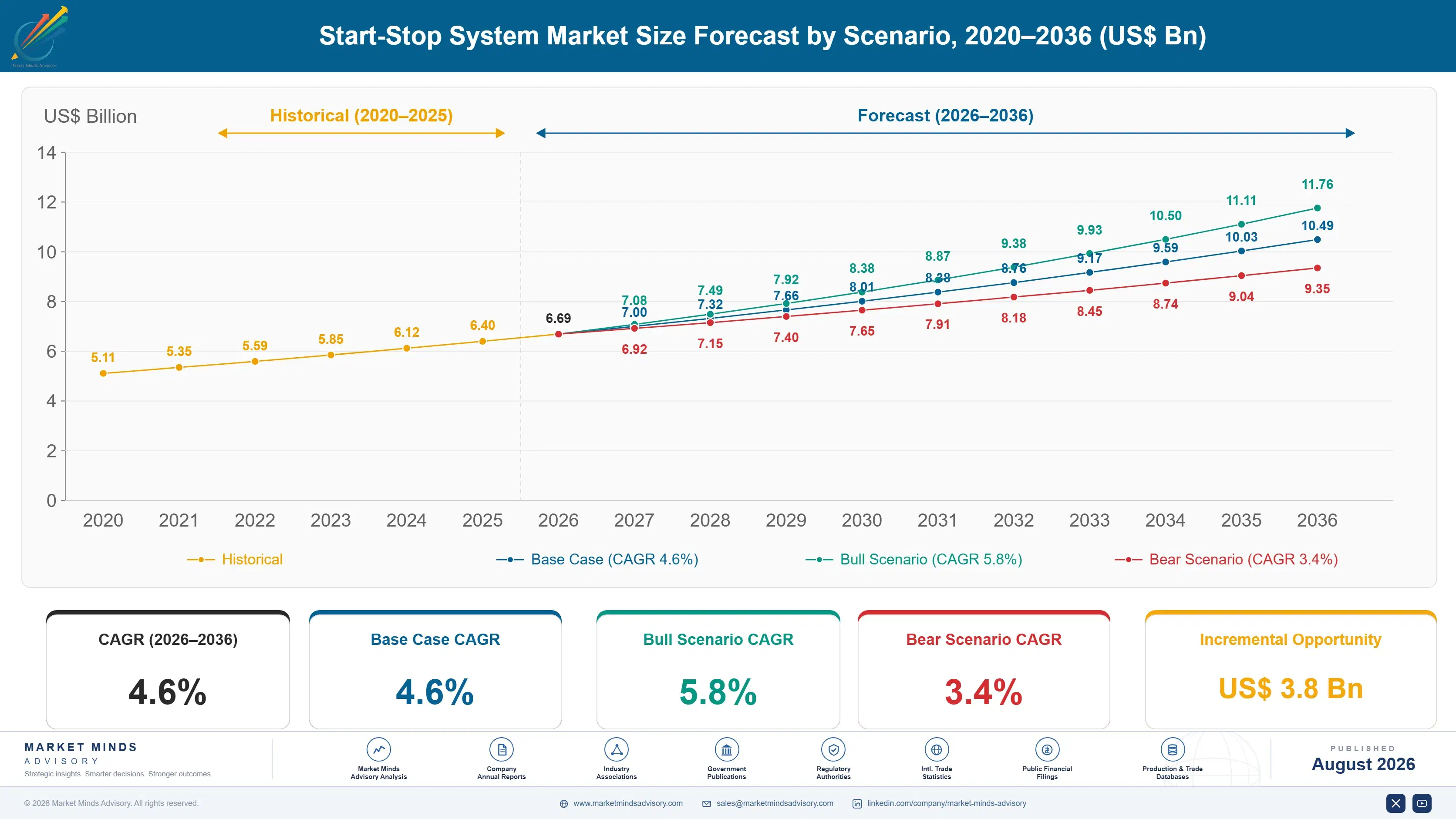
Growth ran near 4.0% between 2020 and 2025, and the regional composition diverged sharply beneath that number. European fitment peaked and began falling as battery electric share rose and as 48 volt mild hybrid systems absorbed the function into a belt-driven starter generator. Indian and Southeast Asian fitment expanded quickly on fuel economy rules. Replacement demand grew steadily everywhere, largely unnoticed.
Base case 4.6% rests on three mechanisms. Enhanced flooded batteries grow at 6.9% as cost sensitive markets fit start-stop to small petrol cars where hybridisation is unaffordable. India grows fastest of any country at 9.8% on fuel economy norms and rising vehicle production. And replacement demand expands on a vehicle parc trailing production by roughly eleven years, which keeps growing long after new fitment turns down. Only one of the three depends on new vehicle production at all.
The bull case at 5.8% assumes emerging market fuel economy rules tightening faster than expected, pulling start-stop into vehicle segments that currently go without it. The bear case at 3.4% is battery electric adoption accelerating in China and Europe simultaneously, which would compress new fitment faster than emerging market growth and aftermarket expansion can offset it.

The Long Tail After the Last Engine

Start-stop shuts an engine off at a traffic light, which is an entirely sensible thing to do and completely irrelevant to a vehicle with no engine. The technology therefore has a defined end date tied to combustion, and nobody in the supply chain enjoys saying so. What matters commercially is not the growth rate but the geography of the decline and the length of the replacement tail behind it.
TOP FIVE CONCENTRATION54%Battery and starter supply both concentrated among established groups
CYCLING BATTERY LIFE3.5 yearsService interval before a cycling battery needs replacing
URBAN FUEL SAVING6%Consumption reduction achieved across stop heavy driving conditions
PARC LAG BEHIND PRODUCTION11 yearsDelay before falling fitment reaches the replacement market
CYCLING BATTERY PREMIUM2.2xPrice against a conventional flooded starting battery equivalent
CONTENT PER VEHICLE$210Value added over conventional engine starting arrangements fitted
In Europe that decline has already begun, helped along from an unexpected direction. Forty-eight volt mild hybrid systems perform start-stop, torque assist and regeneration through a single belt-driven starter generator, which absorbs the function rather than competing with it. The category is being consumed from above by mild hybridisation and from below by battery electric vehicles, and the middle is where most suppliers still sell.
The replacement business tells a different story entirely. Cycling batteries last around 3.5 years against five or six for conventional flooded units, and the vehicle parc trails production by roughly eleven years. That combination means replacement demand keeps rising for a decade after new fitment peaks, which makes the aftermarket the most predictable revenue in this market and the one fewest suppliers have organised around properly.
"Everybody models the fitment curve and almost nobody models the parc behind it. A supplier watching European original equipment volume fall is watching the wrong number, because the batteries they fitted five years ago are about to need replacing twice before those cars leave the road."
Director, Powertrain Electrification and Components Practice · MMA Automotive Practice · August 2026

Market Trends

Mild hybridisation absorbing start-stop into a single machine

Forty-eight volt belt-driven starter generators perform start-stop, torque assist and regenerative braking through one unit, which removes the separate enhanced starter and much of the dedicated hardware around it. That absorbs the function upward into a hybrid architecture rather than competing with it on price. Suppliers selling discrete start-stop components into premium and mid segments are watching content migrate into a machine that a different supplier group generally makes, which is a difficult position to defend. Following the content into that machine is the only route available, and it generally requires partnership rather than internal development.
Market Impact: Delivers 6% urban fuel saving
Cost sensitive markets choosing cheaper battery chemistry deliberately

Enhanced flooded batteries grow at 6.9% because Indian and Southeast Asian manufacturers fit start-stop to small petrol cars where full hybridisation is unaffordable, and absorbent glass mat units at roughly 2.2 times conventional battery pricing break the cost case entirely. The cheaper chemistry accepts shorter life and lighter duty cycles in exchange for making the system viable at that price. That trade is deliberate engineering rather than any compromise on quality. Shorter service life lifts replacement volume rather than reducing it, which makes the commercial trade considerably better than a single unit comparison would suggest to anybody.
Market Impact: Replacement every 3.5 years

Market Opportunities and Growth Drivers

Emerging market fuel economy rules reaching small vehicles

Corporate average fuel economy requirements across India and Southeast Asia now reach small petrol vehicles where hybridisation costs more than the segment can carry, and start-stop delivers around 6% urban consumption reduction at a fraction of that price. India grows fastest of any country at 9.8% on exactly that arithmetic. Fitment is spreading downward through vehicle segments rather than upward, which is the opposite of how the technology propagated across European markets originally. Emerging market fitment growth is therefore both larger and more durable than most European forecasts assume it to be.
Market Impact: Removes 100% of the function

Replacement demand rising on a parc that trails production

Cycling batteries need replacing around every 3.5 years against five or six for conventional flooded units, and the vehicle parc lags production by roughly eleven years. Replacement demand therefore keeps expanding well after new fitment peaks in any given market, and it is considerably more predictable than production volume ever is. Suppliers organised entirely around vehicle manufacturer programmes are missing the steadier half of their own addressable demand. Distribution reach takes years to build, which means the work has to start well before original equipment volume actually turns down anywhere.
Market Impact: Forfeits the 6% saving

Market Restraints and Challenges

Battery electric adoption removing the function permanently

A battery electric vehicle has no engine to stop, so every such sale removes a start-stop system from future demand entirely rather than deferring it. The root cause is that this technology addresses combustion inefficiency and nothing else. Commercially it means European and Chinese fitment declines regardless of any product improvement. Emerging market expansion and replacement demand are the mitigations available, and both delay rather than prevent the eventual outcome for suppliers. The runway is a decade or more in most markets, which is long enough to matter commercially and short enough to plan around deliberately.
Market Impact: Consolidates into 1 machine

Consumer disabling undermining the fuel economy case

Many drivers switch start-stop off at every journey because of restart delay and cabin comfort loss, which removes most of the 6% urban fuel saving the system was fitted to deliver. The root cause is calibration prioritising the regulatory test cycle over the driving experience. Commercially it weakens the case for the technology with buyers and regulators alike. Faster restart, better thermal management and non-defeatable calibration are the mitigations manufacturers are pursuing. Regulators have begun noticing the gap between certified and observed consumption, which raises the stakes considerably. Nothing about the hardware needs changing.
Market Impact: Avoids 2.2 times battery premium
3 additional market trends, 4 additional growth drivers, and 2 additional restraints and challenges are covered in the full report. Contact sales@marketmindsadvisory.com to access the complete intelligence.

Segment CAGR and Growth Architecture

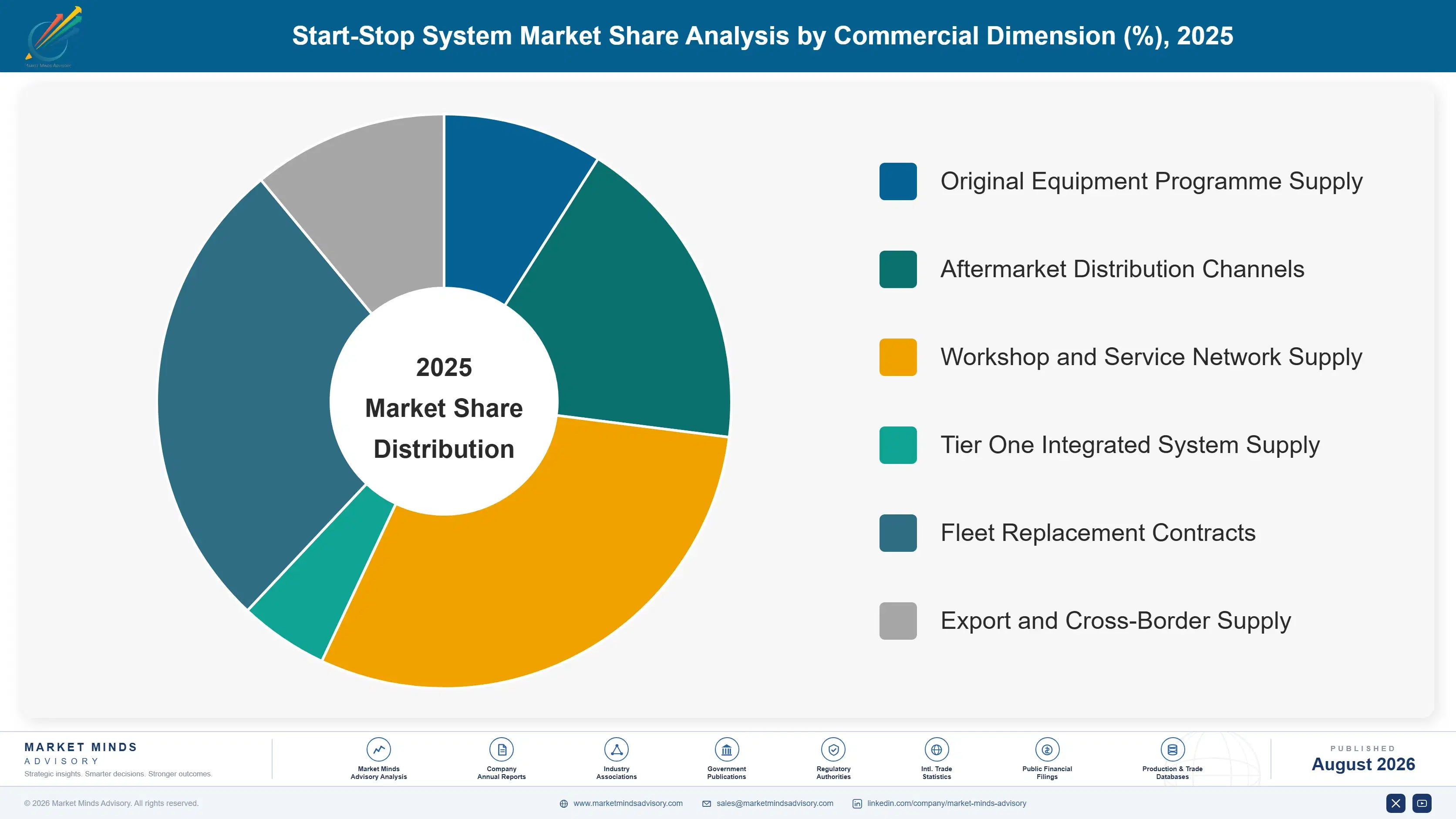
Six segments are split by system component, because component determines the supplier group involved, the technology and cost position, the durability and replacement behaviour and whether demand comes from vehicle production or from the existing parc. Voltage and capacity variants sit inside each component. Vehicle type and channel are handled separately in the framework.
start-stop-system-market-trends-growth-market-share-analysis-1787595383416

Enhanced Flooded Batteries

Growing at 6.9%, half again the market rate of 4.6%, these are conventional flooded batteries reinforced for the cycling duty that start-stop imposes, at cost far below absorbent glass mat units running around 2.2 times conventional battery pricing. Indian and Southeast Asian manufacturers fitting start-stop to small petrol cars choose them because the cost case for the whole system depends on it. Service life is shorter, which lifts replacement demand rather than reducing it, and the aftermarket behind these fitments is growing faster than the fitments themselves are. Suppliers insisting on premium chemistry are excluded from the fastest growing fitment anywhere in the world at present. Local manufacturing cost decides who supplies it.
CAGR 6.9%

Belt-Driven Starter Generators

At 6.2% these units combine starting, torque assist and regenerative braking in one machine operating on a 48 volt architecture, which absorbs the start-stop function into mild hybridisation rather than performing it alone. Growth comes from premium and mid segment vehicles in Europe, China and North America where fuel economy requirements exceed what basic start-stop can deliver. The unit carries considerably more content and better pricing than a discrete starter, and it is generally supplied by a different group of manufacturers than conventional starting components. Suppliers of discrete start-stop hardware lose content to these machines without any competitive tender occurring, which makes the loss difficult to see coming and impossible to contest.
CAGR 6.2%
Full segment breakdown across 6 segments available in the complete report.

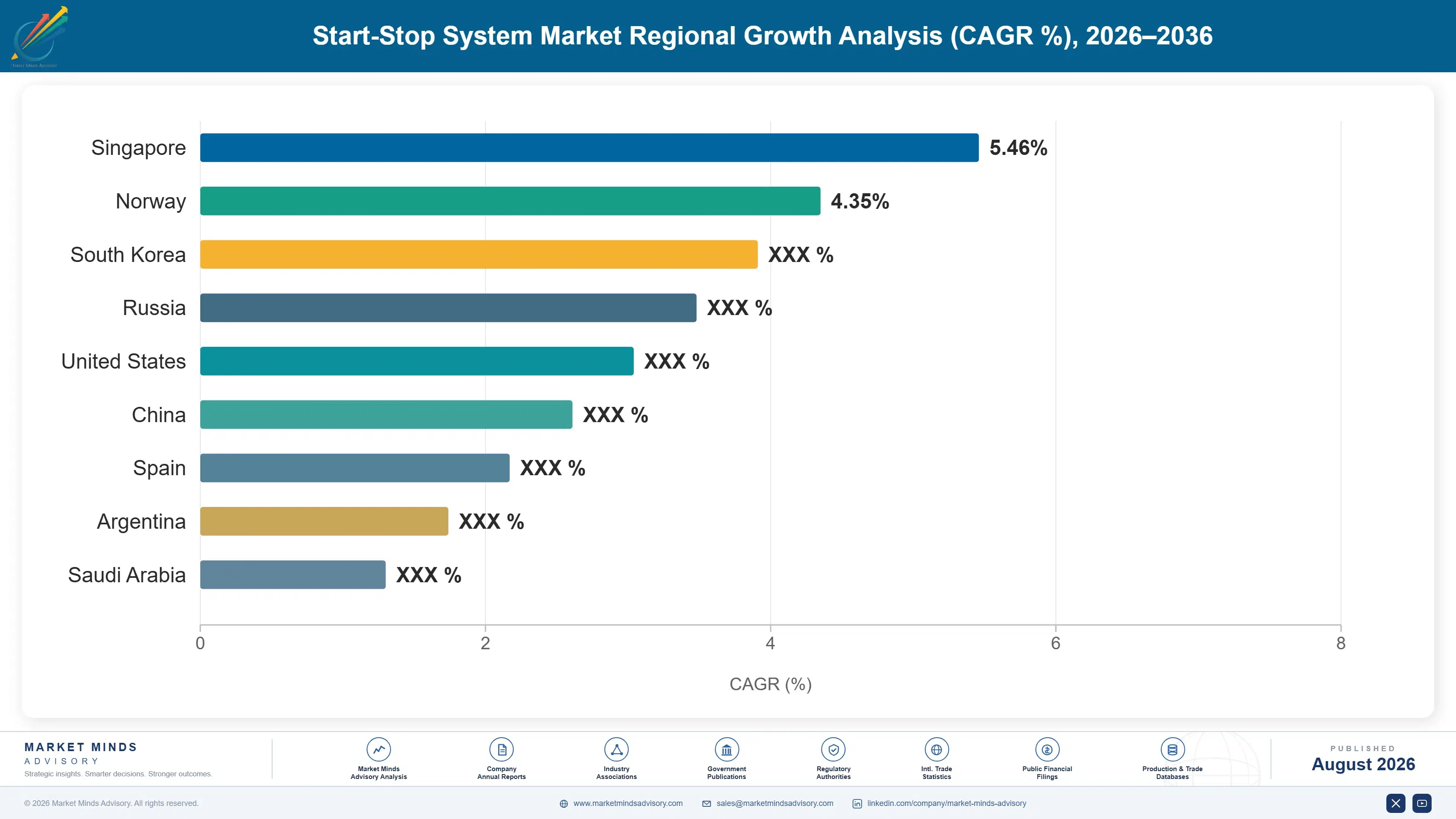
Regional Architecture and Country Demand Map

East Asia holds 30% of value on Chinese vehicle production scale. North America and Western Europe follow at 22% and 20%, with European fitment already declining as battery electric share rises across the largest national markets. South Asia and Pacific grows fastest of the seven regions.

North America

Fitment here concentrates in light trucks and larger passenger vehicles where fuel economy requirements bite hardest, using absorbent glass mat batteries suited to heavier electrical loads. Consumer disabling is more prevalent than in most markets, which weakens the delivered fuel saving relative to the certified figure. Battery electric adoption is slower than in Europe or China, which extends the fitment runway considerably. Replacement demand from a large existing parc is substantial. Growth at 3.8% reflects mature production against rising replacement volume. Light truck electrical loads favour absorbent glass mat chemistry, which keeps content per vehicle above what most other regions carry across comparable fitment volumes. Replacement volume is large and growing.
Share: 22% | CAGR: 3.8% (2026 to 2036)

Western Europe

New fitment has already peaked and is declining as battery electric share rises and as 48 volt mild hybrid systems absorb start-stop into a belt-driven starter generator. Suppliers of discrete components face content migration rather than a demand problem, which is harder to answer. Replacement demand from a large fitted parc will keep growing for roughly a decade regardless. Regulatory scrutiny of consumer disabling has increased. Growth of 3.0% is the slowest anywhere and understates how sharply the mix is shifting. Suppliers watching original equipment volume fall are watching the wrong number, since the batteries already fitted will need replacing twice before those vehicles leave the road. That replacement business is where the value now sits.
Share: 20% | CAGR: 3.0% (2026 to 2036)
Regional intelligence for 5 additional markets available in the complete report: East Asia, South Asia and Pacific, Latin America, Middle East and Africa, Eastern Europe. Contact sales@marketmindsadvisory.com.
start-stop-system-market-trends-growth-country-cagr-analysis-1787595383965

Four Moves Before the Engines Go

Original equipment fitment has a ceiling in every market and a decline already underway in some, so building a business plan around production volume is building on a curve that turns down. The replacement parc, the cost sensitive markets and the calibration problem are where the remaining value actually sits. All four are available now.

Build the replacement channel while fitment still grows

Cycling batteries need replacing around every 3.5 years and the vehicle parc trails production by roughly eleven years, which means replacement demand keeps rising for a decade after fitment peaks in any market. That business is more predictable than production volume and reaches a different buyer entirely. Suppliers organised around vehicle manufacturer programmes are ignoring the steadier half of their own demand, and building the channel takes years. Starting after fitment has already turned down leaves a supplier building distribution while its own revenue falls, which is the worst possible moment to attempt it.
Market Impact: Runs roughly 11 years behind new vehicle production

Serve cost sensitive fitment with the cheaper chemistry

Enhanced flooded batteries grow at 6.9% because absorbent glass mat units at roughly 2.2 times conventional battery pricing break the cost case for small petrol vehicles entirely. Suppliers insisting on the premium chemistry are excluded from the fastest growing fitment anywhere. Shorter service life lifts replacement volume rather than reducing it, which makes the trade commercially better than it looks on a single unit basis. Local manufacturing cost positions matter here, and European production generally cannot reach them on any operating basis at all. Premium chemistry simply prices the system out of the segment.
Market Impact: Avoids the 2.2 times battery cost premium entirely

Fix the calibration that drivers keep switching off

Consumer disabling removes most of the 6% urban fuel saving the system exists to deliver, and it happens because calibration prioritises the certification cycle over restart delay and cabin comfort. Faster restart and better thermal management cost engineering effort rather than hardware, and they protect the regulatory case for the whole technology. Suppliers solving it hold an argument with vehicle manufacturers that pricing alone never provides. Regulators have begun asking about the gap between certified and observed consumption, which makes this a defensive necessity rather than a product improvement. Nothing in the hardware needs changing.
Market Impact: Protects the full 6% urban cycle fuel saving

Follow content into the belt-driven starter generator

Forty-eight volt starter generators grow at 6.2% and absorb start-stop into a single machine carrying considerably more content and better pricing than a discrete starter. Suppliers of separate components are watching value migrate into a unit a different group generally builds. Developing or partnering into that machine is the only route that follows the content rather than defending a position it is steadily leaving behind. Partnership is generally faster than internal development, and the qualification timeline is what decides whether the content is reachable at all. Waiting until the migration is visible generally means waiting too long.
Market Impact: Follows 6.2% starter generator growth in every year

Who Controls the Margin Pool

Participation is measured on annual component units supplied across original equipment and replacement channels, and the top five hold 54%. Concentration is high because vehicle manufacturer qualification and battery manufacturing scale both favour established groups. Robert Bosch and Denso lead across starting and control components, while Clarios holds the strongest battery position, and the gap to challengers is qualification history rather than technical capability. The gap to challengers is qualification history rather than manufacturing capability.
Competition runs on three fronts. Vehicle manufacturer qualification decides original equipment access, and it takes years to obtain. Battery manufacturing cost decides both original equipment and replacement pricing, where regional producers compete effectively. And aftermarket distribution reach decides who captures the replacement demand that outlives fitment by roughly a decade. Content migration has become a fourth front, and it removes suppliers without any tender being lost.

Pressure ahead comes from content migrating into belt-driven starter generators and from battery electric adoption removing the function entirely in leading markets. Expect suppliers to compete for replacement channel position rather than defending original equipment volume. Rankings shift on who builds aftermarket reach before fitment turns down. Concentration should hold while qualification remains the barrier.
start-stop-system-market-trends-growth-company-positioning-matrix-1787595384489

Competitive Moat and Risk Dimensions

ROBERT BOSCH

Moat: Qualification breadth across manufacturers

Qualification across essentially every major vehicle manufacturer for starting, control and sensing components creates access that a challenger cannot bid for, since requalification carries programme risk manufacturers avoid without cause. That breadth also positions the company inside belt-driven starter generator development, where the content this category is losing happens to be going.
ROBERT BOSCH

Risk: Combustion exposure across portfolio

Broad exposure to combustion engine components ties a substantial revenue base to a technology with a defined end date, however distant it may look in emerging markets. Aftermarket demand extends the runway by roughly a decade but does not change the destination, and the transition requires content growth elsewhere to replace what disappears.
CLARIOS

Moat: Battery scale and aftermarket reach

Manufacturing scale in absorbent glass mat and enhanced flooded batteries combined with established aftermarket distribution captures both the original fitment and the roughly 3.5 year replacement cycle behind it. That combination reaches the steadier half of demand that component suppliers organised around vehicle programmes generally never touch at all.
CLARIOS

Risk: Regional low cost battery competition

Battery manufacturing in India, China and Southeast Asia competes effectively on cost for both original equipment and replacement demand, particularly in enhanced flooded products where the technical barrier is lowest. That competition presses hardest in exactly the markets where fitment growth is fastest, which is an awkward combination to manage.

Players Tracked

Prominent Players

Robert Bosch
Denso
Valeo
Clarios
Continental

Other Key Players

BorgWarner
Mitsubishi Electric
Hitachi Astemo
SEG Automotive
Exide Technologies
East Penn Manufacturing
GS Yuasa
Furukawa Battery
Amara Raja
Exide Industries
Camel Group
Leoch International
Mahle
ZF Friedrichshafen
Sensata Technologies

Recent Developments

APRIL 2026

Indian manufacturer extends start-stop across small petrol range

An Indian vehicle manufacturer extended start-stop fitment across a small petrol vehicle range to meet fuel economy requirements, specifying enhanced flooded batteries rather than absorbent glass mat units because the cost case for the segment would not carry the premium chemistry. Local battery manufacturing supported the cost position.
Signal: Fitment now spreads downward through segments, which reverses how the technology originally propagated across these markets
OCTOBER 2025

European manufacturer replaces start-stop hardware with mild hybrid system

A European vehicle manufacturer replaced discrete start-stop hardware with a 48 volt belt-driven starter generator across a model programme, consolidating starting, torque assist and regeneration into one machine. Component suppliers on the previous architecture lost content rather than losing a competitive tender. No opportunity to bid existed at any stage.
Signal: Content migration rather than competitive loss is what removes suppliers from this category without warning of any kind
JANUARY 2026

Aftermarket distributor expands cycling battery range on parc growth

An aftermarket distributor expanded its cycling battery range, citing a fitted vehicle parc that continues growing even where new fitment has begun declining. Replacement intervals near 3.5 years generate demand that runs well ahead of any production forecast. Distribution reach rather than manufacturer relationships decided the range decision.
Signal: The replacement parc keeps growing for roughly a decade after new fitment has peaked in every market

Lead, Copper and Semiconductors

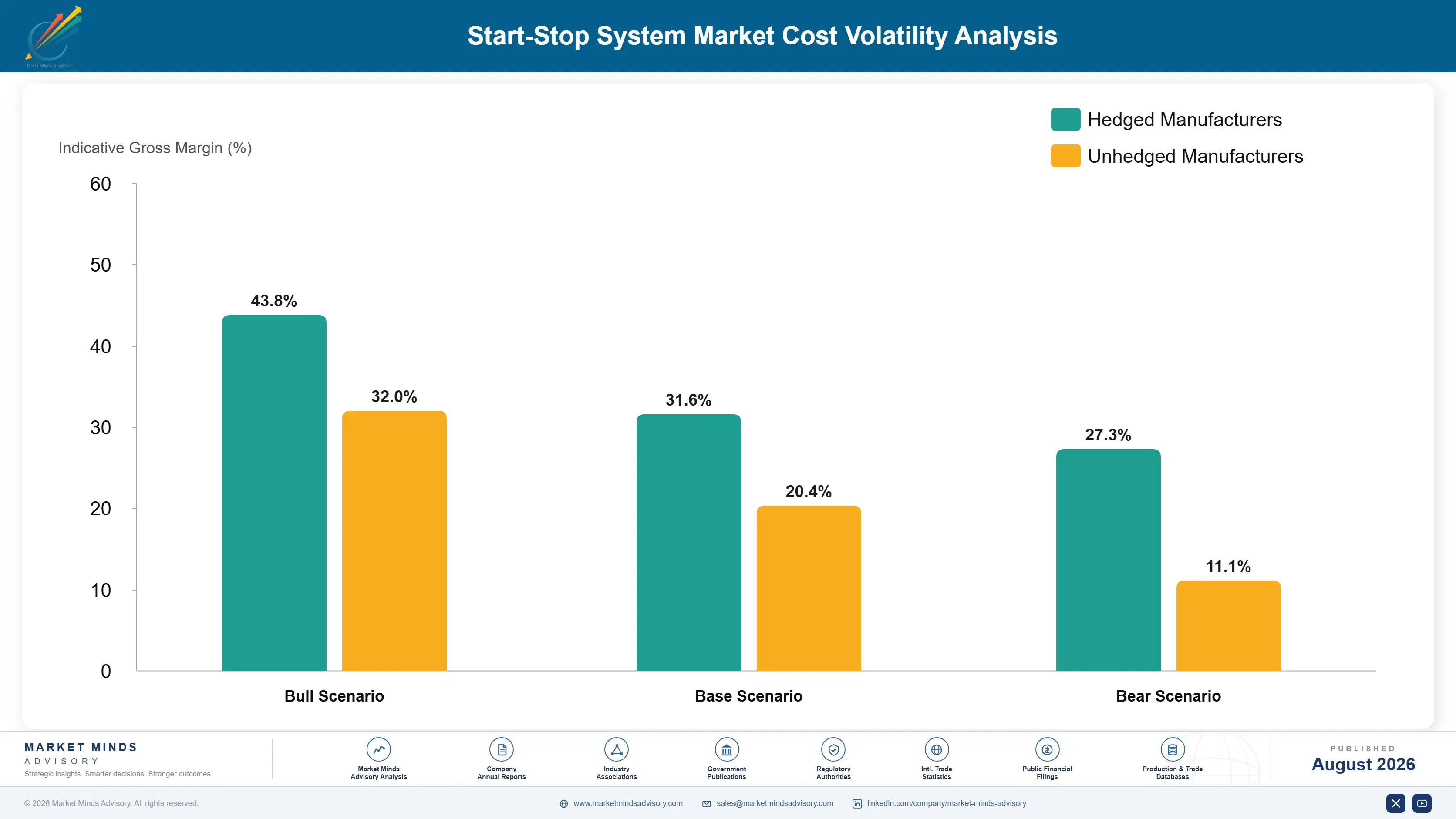
Lead carries around 47% of cycling battery cost and is priced on international metal markets no battery producer influences. Separator material, plastics and acid take about 14%. Copper carries roughly 21% of starter and starter generator cost, with rare earth magnet material adding more in higher output machines. Semiconductors for sensing and control absorb the balance, and their pricing behaves quite differently from either metal.
Lead and copper pricing both moved sharply through 2021 and 2022 alongside energy costs, per IEA industrial energy reporting and Clarios and Robert Bosch annual reporting for 2025 on raw material exposure. Semiconductor availability constrained control module supply through the same period, and several suppliers shipped incomplete systems or delayed programmes rather than accept allocation terms they considered unworkable. Allocation discipline has not relaxed since.

Exposure divides on component type rather than on scale. A battery producer carries lead across nearly half of cost with recycling providing a partial internal hedge, while a starter or generator manufacturer carries copper and magnet material instead. Semiconductor exposure sits with control and sensing suppliers and is an availability problem more than a pricing one, which is a different kind of risk to manage.
start-stop-system-market-trends-growth-cost-volatility-analysis-1787595384683

Use recycled lead streams to hedge metal exposure internally

Lead at around 47% of cycling battery cost is largely recoverable from end of life batteries, and a producer collecting through its own aftermarket channel holds a partial internal hedge that a pure manufacturer does not. Building that collection alongside replacement distribution serves both purposes with the same logistics investment. The logistics investment serves both.

Hold multi-source semiconductor qualification for control modules

Semiconductor availability rather than price stopped programmes during the last shortage, and single sourced control modules were where it bit hardest. Qualifying devices from more than one supplier family costs engineering effort upfront and converts an allocation problem into a sourcing decision, which is far more manageable in a crisis. Availability rather than price is the risk.

Design magnet content down in starter generator machines

Rare earth magnet material adds meaningfully to belt-driven starter generator cost and carries supply concentration risk beyond ordinary price exposure. Machine designs reducing magnet content for equivalent output cut both at once, and the engineering payback improves every time magnet pricing moves against manufacturers. Supply concentration risk falls alongside the cost, which matters more than the saving does.

Portfolio Architecture for Margin Defence

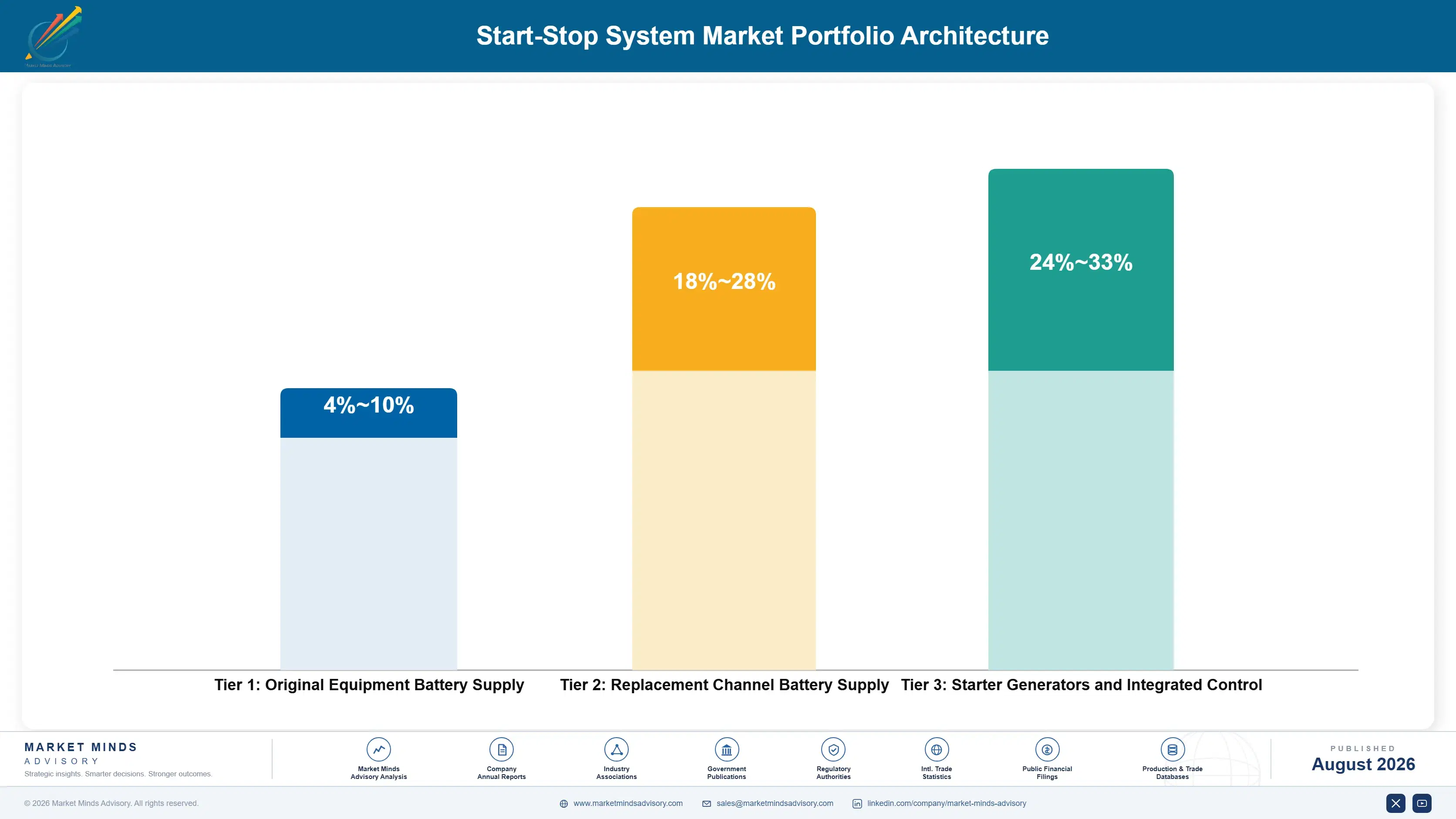
Margin here follows channel rather than technology, because the same battery earns very different returns depending on who buys it. Original equipment battery supply earns margins in the low to high single digits, since vehicle manufacturers tender against a specification and compare landed cost across qualified suppliers with considerable purchasing discipline. There is very little differentiation available in that contest.
Replacement channel supply does substantially better in the high teens to high twenties, because the buyer is a workshop or a distributor choosing on availability and brand rather than running a tender, and the roughly 3.5 year replacement interval produces repeat demand nobody has to bid for again. Brand recognition and shelf availability are slower and more durable things to lose than a tender position ever is.

Belt-driven starter generators and integrated control systems hold the strongest position, reaching into the low thirties, where qualification depth and system integration decide supply rather than component pricing. Those margins reflect engineering content and manufacturer relationships rather than any advantage in raw material cost position. Very few suppliers hold both the qualification history and the machine capability that position genuinely requires.

Original Equipment Battery Supply

Batteries tendered to vehicle manufacturers against specification where landed cost decides awards among qualified suppliers. The six point range reflects lead position and manufacturing scale rather than any product difference between the candidates.
Gross Margin: 4-10%

Replacement Channel Battery Supply

Aftermarket batteries sold through distribution on availability and brand rather than tender, with repeat demand every few years. The ten point range reflects distribution reach and brand standing across very different regional aftermarket structures.
Gross Margin: 18-28%

Starter Generators and Integrated Control

Belt-driven starter generators and integrated control systems where qualification and system integration decide supply. The nine point range reflects engineering content and how deeply the supplier sits inside manufacturer development programmes.
Gross Margin: 24-33%
start-stop-system-market-trends-growth-portfolio-architecture-1787595385183

High-value Sub-segments and Strategic Watch-out

Replacement Channel Supply

High value and growing steadily on a parc trailing production by roughly eleven years and replacement intervals near 3.5 years. Demand keeps rising for a decade after new fitment peaks, which very few suppliers have planned around. Distribution reach takes years to build properly. Predictability is the point.
Gross Margin: 20-28%

Belt-Driven Starter Generators

High value and growing at 6.2% as mild hybridisation absorbs start-stop into one machine. Content is migrating here from discrete components, generally toward a different group of suppliers than conventional starting parts. The loss happens without any tender being contested. A different supplier group generally builds it.
Gross Margin: 26-33%

Original Equipment Battery Supply

The volume core, tendered against specification where landed cost decides and low cost regional producers compete effectively. Fitment volume also turns down first in exactly the markets paying the most. Low cost regional producers compete effectively here. Purchasing discipline is considerable in these tenders. Volume turns down first.
Gross Margin: 4-10%

Combustion Dependence

The strategic watch-out. Every battery electric sale removes the function permanently rather than deferring it, and the range reflects how far a supplier has built replacement channel reach and starter generator content against that. Every electric sale removes the function permanently. Deferral is not what happens here.
Gross Margin: 3-31%

Fitment Now, Replacement Later

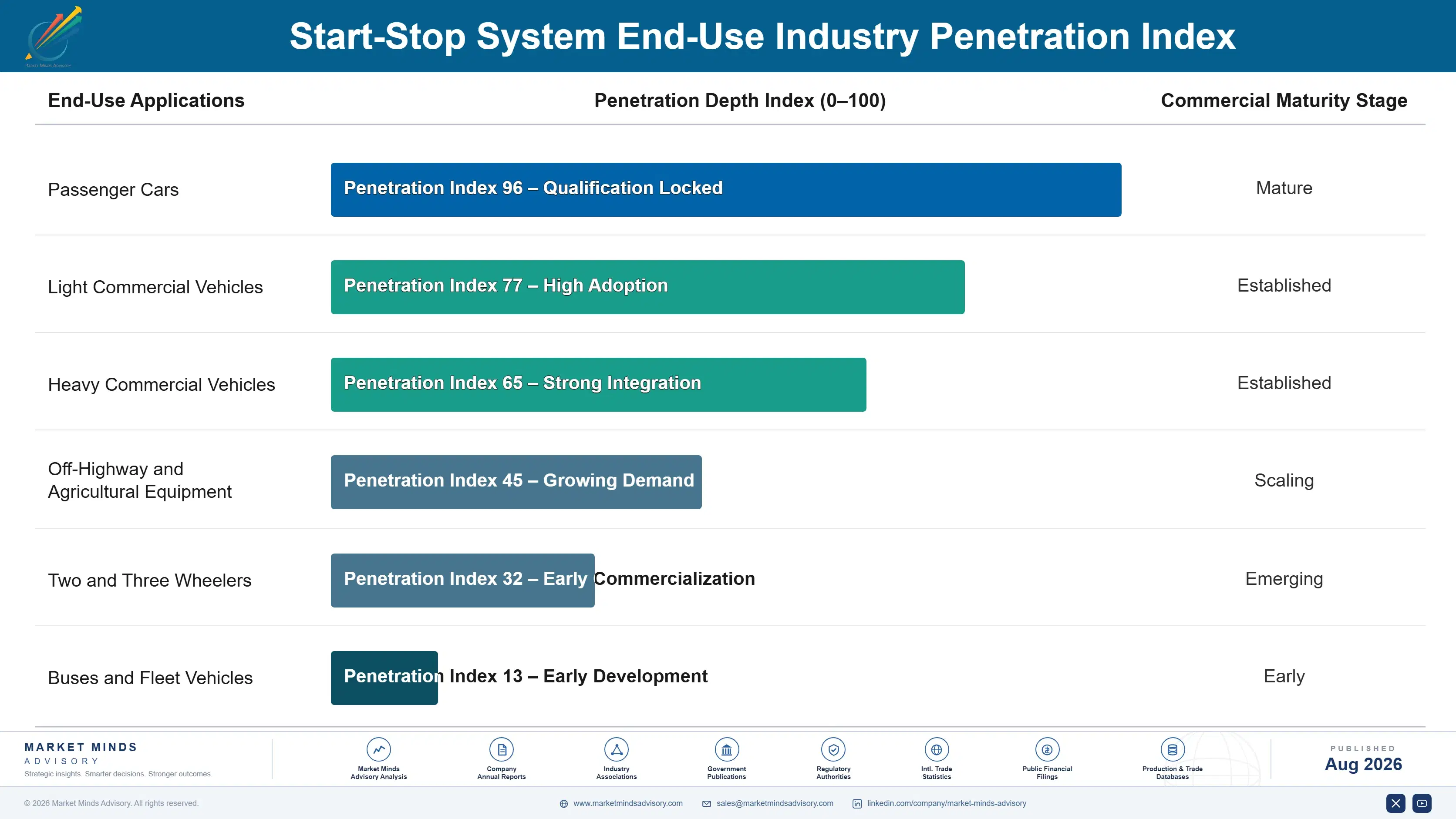
Demand here arrives twice from the same vehicle and on completely different terms. A manufacturer specifying original fitment runs a tender against a qualified supplier list and compares landed cost with considerable discipline. The workshop replacing that battery three or four years later chooses on availability and brand from a distributor's shelf, without any tender and usually without much price comparison at all.
Stickiness follows the channel exactly. Original equipment positions hold through a model programme and reopen at the next one, where content migration can remove a supplier without any competitive loss occurring. Replacement positions hold as long as distribution reach and brand recognition hold, which is a slower and more durable thing to lose than a tender is.

Buyer profiles are changing as electrification advances. Manufacturer purchasing increasingly evaluates start-stop content alongside mild hybrid alternatives rather than against competing start-stop suppliers. Aftermarket buying is consolidating into larger distribution groups with more purchasing discipline. And regulators have begun asking about real world benefit rather than certification results, which is a genuinely new voice in the conversation. Most suppliers have nobody assigned to answer it.
start-stop-system-market-trends-growth-end-use-penetration-index-1787595385670

Where We Would Put Effort

These are among the four positions where our research anticipates prominent divergence between winners and laggards over the coming forecast period. Each is grounded in the demand model, the regulatory perimeter, and the announced capacity pipeline.
01 / REPLACEMENT CHANNEL BUILDING

The parc outlives the production line

Cycling batteries need replacing around every 3.5 years and the vehicle parc trails production by roughly eleven years, which means replacement demand keeps rising for a decade after new fitment peaks in any market. That revenue is considerably more predictable than production volume and reaches a completely different buyer. Suppliers organised around vehicle manufacturer programmes are ignoring the steadier half of their own demand, and building distribution reach takes years rather than quarters, which means starting after the decline begins is far too late.
02 / CHEMISTRY COST POSITIONING

The cheaper battery wins the growth

Enhanced flooded batteries grow at 6.9% against a market rate of 4.6% because absorbent glass mat units at roughly 2.2 times conventional pricing break the cost case for small petrol vehicles completely. Suppliers insisting on the premium chemistry are excluded from the fastest growing fitment anywhere in the world. Shorter service life lifts replacement volume rather than reducing it, which makes the commercial trade considerably better than any single unit comparison would ever suggest when taken entirely on its own.
03 / CALIBRATION QUALITY WORK

Drivers keep switching your product off

Consumer disabling removes most of the 6% urban fuel saving that justifies fitting the system at all, and it happens because calibration prioritises the certification cycle over restart delay and cabin comfort. Regulators have already begun noticing the gap between certified and observed consumption. Faster restart and better thermal management both cost engineering effort rather than hardware investment, and they protect the regulatory case that the entire category ultimately depends upon for its continued existence in any market at all.
04 / CONTENT MIGRATION FOLLOWING

Go where the value is actually moving

Belt-driven starter generators grow at 6.2% and absorb start-stop into a single machine carrying more content and better pricing than any discrete starter arrangement does. Suppliers of separate components are watching value migrate into a unit that a different manufacturer group generally builds, which removes them without any competitive tender being lost. Developing or partnering into that machine follows the content instead of defending a position that the value is steadily leaving behind for good, whatever the current volume suggests.

Engagement Snapshot From the Field

A live engagement with an industry participant carrying material or product regulatory and market exposure ahead of a defining policy shift, showing how our research translates into a defensible multi-year portfolio strategy.
MARKET MINDS ADVISORY · CLIENT ENGAGEMENT SUMMARY
Start-Stop System Producer Strategic Portfolio Review and Transition Roadmap 2026·Investment Scenario on Start-Stop System Exposure Evaluation 2025-26
CLIENT PROFILE
A European automotive component supplier producing enhanced starters, battery sensors and control modules for start-stop systems across several vehicle manufacturer programmes, at annual revenue near 340 million euros (client-reported, unverified by MMA). Aftermarket supply was incidental and no starter generator capability existed within the business. Two customer programmes had already migrated content elsewhere. No replacement channel existed anywhere.
STRATEGIC CHALLENGE
Two model programmes had moved to 48 volt belt-driven starter generators without any competitive tender taking place, removing content the business had expected to carry for years. Management wanted to understand whether this was an isolated decision or the start of a broader pattern. A capital plan was due within the quarter.
MMA APPROACH
MMA mapped announced model programme architectures across the client's customer base to establish where content migration was already committed, sized replacement demand against the fitted parc by market, assessed starter generator development requirements against existing capability, and modelled fitment decline under alternative battery electric adoption scenarios. Interviews with 47 experts covered powertrain engineering, purchasing and aftermarket distribution.
KEY FINDINGS
  1. Content migration into belt-driven starter generators was committed across a majority of the client's customer programmes, and none of it would involve a competitive tender the business could contest.
  2. Replacement demand within the client's fitted parc would keep growing for roughly a decade after original equipment volume peaked, and the business had no channel to capture any of it.
  3. Enhanced flooded battery markets in India and Southeast Asia were growing fastest and required cost positions the client's European manufacturing could not reach at all.
  4. Starter generator development was achievable through partnership rather than internal development, though the qualification timeline exceeded the remaining life of two customer programmes.
CLIENT PROFILE
A European automotive component supplier producing enhanced starters, battery sensors and control modules for start-stop systems across several vehicle manufacturer programmes, at annual revenue near 340 million euros (client-reported, unverified by MMA). Aftermarket supply was incidental and no starter generator capability existed within the business. Two customer programmes had already migrated content elsewhere. No replacement channel existed anywhere.
STRATEGIC CHALLENGE
Two model programmes had moved to 48 volt belt-driven starter generators without any competitive tender taking place, removing content the business had expected to carry for years. Management wanted to understand whether this was an isolated decision or the start of a broader pattern. A capital plan was due within the quarter.
MMA APPROACH
MMA mapped announced model programme architectures across the client's customer base to establish where content migration was already committed, sized replacement demand against the fitted parc by market, assessed starter generator development requirements against existing capability, and modelled fitment decline under alternative battery electric adoption scenarios. Interviews with 47 experts covered powertrain engineering, purchasing and aftermarket distribution.
KEY FINDINGS
  1. Content migration into belt-driven starter generators was committed across a majority of the client's customer programmes, and none of it would involve a competitive tender the business could contest.
  2. Replacement demand within the client's fitted parc would keep growing for roughly a decade after original equipment volume peaked, and the business had no channel to capture any of it.
  3. Enhanced flooded battery markets in India and Southeast Asia were growing fastest and required cost positions the client's European manufacturing could not reach at all.
  4. Starter generator development was achievable through partnership rather than internal development, though the qualification timeline exceeded the remaining life of two customer programmes.
RECOMMENDED STRATEGY
Phase 1: Phase one: build aftermarket distribution reach for sensors and control modules, since replacement demand keeps growing after fitment volume turns down. Phase 2: Phase two: pursue starter generator content through partnership rather than internal development, given the qualification timeline against remaining programme life. Phase 3: Phase three: stop investing in discrete start-stop hardware for European programmes where migration is already committed. Defending that position wastes capital that the aftermarket build needs instead.
OUTCOME
The supplier established aftermarket distribution during 2026 and entered a starter generator development partnership (client-reported, unverified by MMA). Discrete component investment for European programmes was discontinued rather than defended. Aftermarket revenue reached a meaningful share of turnover before the year closed, and capital was redirected accordingly.

Frequently Asked Questions

Foundational context covering the market sizes, CAGR, scope, country, region and competition that inform every finding below. This section is provided to cover basics and most often pre-purchase conversations, answered from the MMA Primary Research Dataset.

What is the current size of the Start-Stop System Market?

MMA sizes it at USD 6.4 billion in 2025, rising to USD 6.69 billion in 2026. The figure covers all system components at supplier selling value across original equipment and replacement.

How large will the Start-Stop System Market be by 2036?

USD 10.49 billion by 2036, an incremental USD 3.80 billion over the 2026 base and an expansion multiple of 1.57 times. Replacement demand accounts for a rising share of that.

What is the CAGR for the Start-Stop System Market 2026 to 2036?

4.6% in the base case, with a bull case at 5.8% and a bear case at 3.4%. The spread turns on emerging market fitment growth against battery electric adoption removing the function.

Which segment is growing fastest?

Enhanced flooded batteries at 6.9%, half again the market rate of 4.6%. Cost sensitive markets choose them because premium chemistry breaks the case for small petrol vehicles.

Who are the major companies in the Start-Stop System Market?

Robert Bosch, Denso, Valeo, Clarios and Continental lead on component units supplied. Fifteen further participants are profiled in the full report on that same consistent basis.

Which country is growing fastest?

India at 9.8%, as fuel economy rules reach small petrol vehicles where hybridisation costs more than the segment can carry and start-stop delivers the required saving affordably.

Report Segmentation Architecture

The full report scope spans multiple orthogonal segmentation dimensions, with cross-tabulated demand data provided for each dimension pair. Coverage extends further to regional breakdowns, trend trajectories, and the competitive detail needed to support segment-level decision-making.

By System Component

  • Absorbent Glass Mat Batteries
  • Enhanced Flooded Batteries
  • Starter Motors and Enhanced Starters
  • Belt-Driven Starter Generators
  • Battery Sensors and Management Modules
  • Voltage Stabilisers and Converters

By End-Use Industry

  • Passenger Cars
  • Light Commercial Vehicles
  • Heavy Commercial Vehicles
  • Off-Highway and Agricultural Equipment
  • Two and Three Wheelers
  • Buses and Fleet Vehicles

By Commercial Dimension

  • Original Equipment Programme Supply
  • Aftermarket Distribution Channels
  • Workshop and Service Network Supply
  • Tier One Integrated System Supply
  • Fleet Replacement Contracts
  • Export and Cross-Border Supply

By Region

  • North America
  • Western Europe
  • East Asia
  • South Asia and Pacific
  • Latin America
  • Middle East and Africa
  • Eastern Europe

Scope, Methodology, and Coverage

Every figure in this report is reproducible from documented input assumptions. The scope below maps the historical period, the forecast horizon, the segmentation dimensions, and the countries covered, alongside the underlying primary and qualitative methodology.
Historical Period
2020 to 2025
Forecast Period
2026 to 2036
Base Year
2025 (USD billions; MMA Primary Research Dataset, August 2026)
Market Definition
Start-stop system components supplied to vehicle manufacturers and the replacement market, covering absorbent glass mat batteries, enhanced flooded batteries, starter motors and enhanced starters, belt-driven starter generators, battery sensors and management modules, and voltage stabilisers and converters. Measured at supplier selling value. Full hybrid and battery electric drivetrains, traction batteries, conventional flooded starting batteries, and vehicle assembly or calibration services are excluded from scope.
Quantitative Units
USD billions (current prices); million units supplied; USD per vehicle system content
Segmentation Dimensions
System component; vehicle type; commercial dimension; region
Regions Covered
North America, Western Europe, East Asia, South Asia and Pacific, Latin America, Middle East and Africa, Eastern Europe
Countries Covered
United States, Canada, Mexico, Germany, France, Italy, Spain, United Kingdom, China, Japan, South Korea, India, Thailand, Indonesia, Australia, Brazil, Argentina, Turkey, South Africa, Poland
Key Companies Profiled
Robert Bosch, Denso, Valeo, Clarios, Continental, BorgWarner, Mitsubishi Electric, Hitachi Astemo, SEG Automotive, Exide Technologies, East Penn Manufacturing, GS Yuasa, Furukawa Battery, Amara Raja, Exide Industries, Camel Group, Leoch International, Mahle, ZF Friedrichshafen, Sensata Technologies
Quantitative Methodology
Primary survey, n=3,800 respondents, Q4 2025, six countries; demand-side model with trade association cross-validation
Qualitative Methodology
47 expert interviews, Q4 2025; applied to validate demand model assumptions, identify emerging dynamics, and assess competitive positioning
Report Format
PDF and XLSX data workbook (Word format preview document)
Publisher
Market Minds Advisory
Report Code
MMA-2026-AUT-118
Published
August 2026
Contact
sales@marketmindsadvisory.com | www.marketmindsadvisory.com

Purchase the full Start-Stop System Market Report (2026 to 2036).

The full report models the fitment decline curve alongside the replacement parc behind it, because the second keeps growing for roughly a decade after the first turns down and almost nobody has planned for that. It sizes all six components independently through 2036, maps content migration into belt-driven starter generators by manufacturer programme, and quantifies replacement demand against fitted parc by market. Regional chapters cover all seven regions with original equipment and replacement demand separated throughout. Competitive profiling covers 20 participants on one consistent unit basis.
Six system components sized independently through 2036
Fitment decline modelled alongside the replacement parc behind it
Content migration into starter generators mapped by manufacturer programme
Replacement demand quantified against fitted parc by market
Consumer disabling rates assessed against certified fuel saving figures
Twenty participants profiled on one consistent component unit basis

Built For The People Who Decide

From boardroom strategy to bench-side execution, this report is read cover-to-cover by leaders shaping the next decade of their industry, turning demand scenarios, market dynamics and valuation benchmarks into decisions.
CXOs/ Presidents/ VPs/ Managers
M&A and Corporate Development
Strategy Teams and R&D Heads
Procurement and Product Directors
Regulatory and Compliance Leaders
Investor Relations and Equity Analysts