
Market Minds Advisory
Skid Steer Loader Market

Skid Steer Loader Market: Skid Steers: Selling the Platform While Somebody Else Sells the Tools

The standardised quick-attach plate turned a loader into a tool carrier and then handed the attachment business, which is worth several times the machine itself, to a third party industry entirely.

Lead Analyst

David Horsley

Published

August 2026

Make Smarter Decisions with Customized Research Insights

Request a free sample report and evaluate market opportunities, growth trends, and competitive dynamics relevant to your business needs.

2025 MARKET VALUE$3.9BMarket Size 2025
2036 FORECAST VALUE$6.3BBase Case , 2026 to 2036
CAGR 2026 TO 20364.4 %Bull 5.6% / Bear 3.2%
INCREMENTAL OPPORTUNITY$2.2BNet 10- year value creation
EXPANSION MULTIPLE1.54x2036 value over 2026 base
Strategic Levers
M&A Pipeline
Regional Outlook
Country Rankings
Competitive Intelligence
Segmental Deep-dive
Call-Us : 91 93563 13602

Executive Snapshot and Market Trajectory.

A skid steer is bought as a machine and used as a tool carrier. The standardised quick-attach interface let buckets, breakers, augers, mulchers and grapples come from anywhere, which handed an attachment business worth around 2.4 times the machine to third parties. Almost none reaches the loader manufacturer.
Rubber tracks are taking the category over. Compact track loaders now account for roughly 71% of North American compact loader sales, growing at 6.6% against a market rate of 4.4%, because flotation on soft ground beats the wheeled machine almost everywhere except hard surfaces. Undercarriage replacement at around six and a half thousand dollars is what keeps wheels alive. Whole life cost catches buyers out.
Rental takes around 54% of units, which changes the buying criteria completely. A rental company weighs auction residual value, serviceability and fleet standardisation rather than operator preference, and it accumulates roughly 900 hours a year on every machine it owns. India grows fastest anywhere at 8.8% on construction mechanisation replacing manual site methods. Domestic manufacture is bringing prices within contractor reach at last. Manual methods are the alternative being displaced. Rental develops alongside sales there.
Market Definition
Compact loaders using skid or track steering with a standardised attachment interface, covering small, medium and large frame wheeled skid steers, compact track loaders, mini and stand-on loaders, and electric and hybrid compact loaders. Measured at manufacturer selling value for complete machines. Excludes attachments sold separately, compact excavators, backhoe loaders, telehandlers, wheel loaders above compact class, and rental service revenue.
Base Year Value
$3.9B in 2025 (MMA Primary Research Dataset, August 2026)
Forecast Period
2026 to 2036, eleven discrete annual values
CAGR
4.4% base case. Bull 5.6%. Bear 3.2%.
Fastest Growth Segment
Compact Track Loaders: 6.6% CAGR
Fastest Growth Country
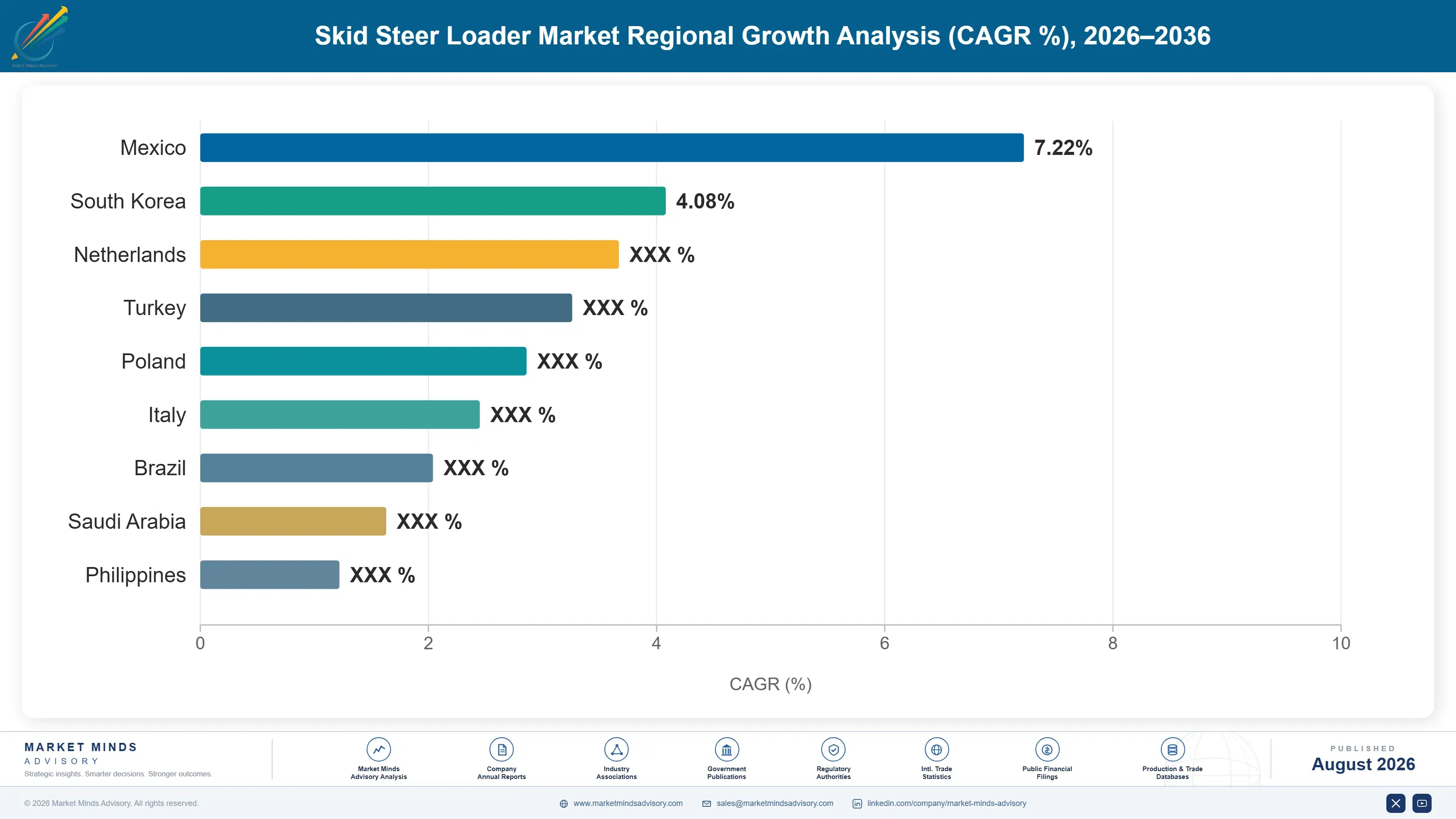
India: 8.8% CAGR
Fastest Growth Region
South Asia and Pacific: 6.4% CAGR
Largest Region
North America: 42% of 2025 global value
Market Leaders
Bobcat, Caterpillar, Deere, Kubota, CNH Industrial. Source: MMA Primary Research Dataset, July 2026.
Primary Survey
n=3,800 procurement and R&D decision-makers, Q4 2025, six countries
Methodology
Demand-side build-up, cross-validated against public data, 47 expert interviews

Skid Steer Loader Market Forecast Scenarios

skid-steer-loader-market-trends-growth-size-forecast-scenario-1787595175362
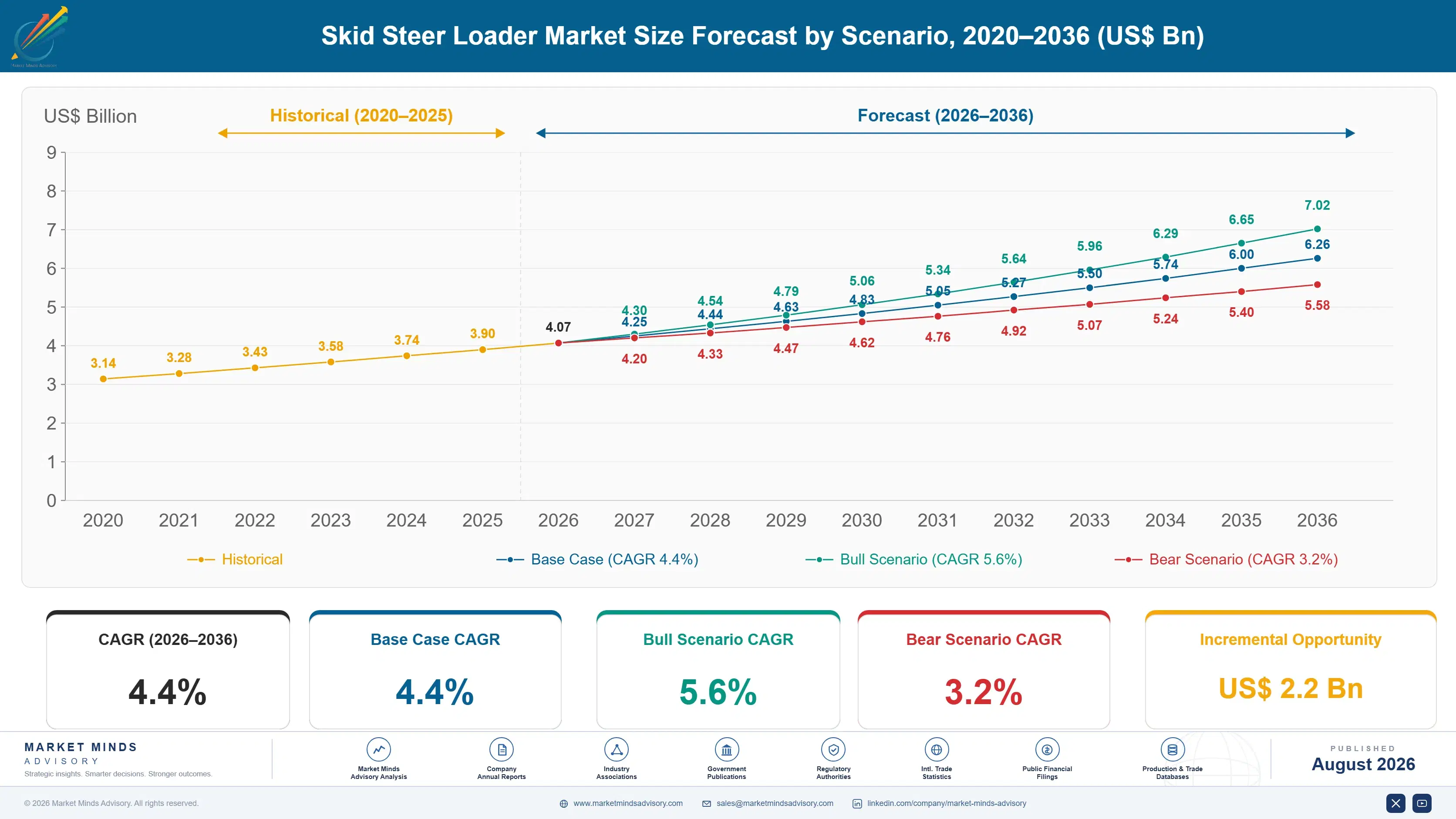
Growth ran near 3.8% between 2020 and 2025, with unit demand swinging on residential construction cycles and rental fleet replacement timing rather than on anything specific to the machines themselves. Compact track loaders took share continuously across the period, which lifted average selling value even where total unit volume was flat. Supply chain constraints delayed deliveries substantially during the middle years.
Base case 4.4% rests on three mechanisms. Compact track loaders keep taking share at 6.6% because flotation and traction on soft ground matter more to most contractors than the undercarriage cost they accept in return. Rental fleet expansion continues as contractors avoid owning machines used intermittently. And Indian construction mechanisation grows fastest anywhere at 8.8% from a base where manual methods still dominate much site work and domestic manufacture is bringing prices within reach.
The bull case at 5.6% assumes residential and light commercial construction strengthening alongside continued rental fleet growth, which would compound unit demand and mix improvement together. The bear case at 3.2% is a construction downturn deferring rental fleet replacement, since rental companies extend machine life rather than buying when utilisation falls and used values weaken simultaneously.

A Platform With Somebody Else's Tools

The defining commercial fact about this category is an interface. A standardised quick-attach plate and auxiliary hydraulic connection turned the loader into a universal tool carrier, and a whole industry of attachment manufacturers grew up behind it. Owners spend around 2.4 times the machine price on attachments across its working life, and almost none of that revenue reaches the company that built the loader.
TOP FIVE CONCENTRATION62%Dealer networks rather than machine design decide position
ATTACHMENT REVENUE MULTIPLE2.4xAttachment spending across a machine life against purchase
RENTAL CHANNEL SHARE54%Units delivered into rental fleets rather than owner operators
TRACK REPLACEMENT COST6,500Undercarriage renewal expense that wheeled machines entirely avoid
TRACK LOADER SALES SHARE71%Compact loader sales now taken by tracked configurations
ANNUAL UTILISATION HOURS900Operating hours accumulated on a typical rental fleet machine
Configuration is shifting decisively toward rubber tracks. Compact track loaders now take roughly 71% of North American compact loader sales because flotation on soft or disturbed ground lets a contractor work days when a wheeled machine would sit idle. What keeps wheeled machines alive is undercarriage economics, since track replacement runs near six and a half thousand dollars and arrives as an unwelcome surprise for owners who bought on capability alone.
The buyer is mostly a rental company rather than a contractor. Around 54% of units go into rental fleets that accumulate roughly 900 hours annually on each machine, and those fleets buy on residual value, serviceability and standardisation rather than on how a machine feels to operate. Manufacturers optimising for operator preference are addressing somebody who no longer signs the purchase order.
"Every manufacturer wants to talk about breakout force and cab comfort, and the person actually buying is calculating what the machine will fetch at auction in three years. Residual value is the specification that matters, and hardly anybody engineers deliberately against it."
Director, Compact Equipment and Construction Machinery Practice · MMA Construction and Industrial Equipment Practice · August 2026

Market Trends

Track configuration displacing wheeled machines across most applications

Compact track loaders now take roughly 71% of North American compact loader sales, because rubber tracks spread weight and let a contractor work soft or disturbed ground that would strand a wheeled machine entirely. Growth runs at 6.6% against a market rate of 4.4% on that advantage. Undercarriage cost is the counterweight, with track replacement near six and a half thousand dollars arriving as an unpleasant discovery for owners who bought on capability without modelling the whole life cost properly. Landscaping, site preparation and agricultural work drive most of that demand.
Market Impact: Attachments worth 2.4 times machine
Rental fleets buying against residual value rather than performance

Around 54% of units go into rental fleets accumulating roughly 900 hours a year, and those buyers weigh auction residual, serviceability and fleet standardisation far above operator preference or breakout force. That reorders every specification decision a manufacturer makes, since a feature improving productivity but hurting resale is a negative for the majority buyer. Very few manufacturers engineer deliberately against residual value, and the ones that do find rental fleets notice quickly. Rental purchasing carries the whole volume rather than a minority of it, which makes this the specification decision that actually matters.
Market Impact: Indian demand growing at 8.8%

Market Opportunities and Growth Drivers

Attachment range widening the application scope continuously

The standardised quick-attach interface lets a single machine runs buckets, breakers, augers, mulchers, trenchers, sweepers and grapples supplied by an industry of specialist manufacturers. Owners spend around 2.4 times machine price on attachments across a working life, and every new attachment category widens the applications a machine can address without changing anything about the loader itself. That continuously expands the addressable work rather than the machine, which is unusual and commercially awkward. The addressable work expands while the machine itself does not change. Every new attachment category widens the work without changing anything.
Market Impact: Cedes 2.4 times machine revenue

Indian construction mechanisation replacing manual site methods

India grows fastest anywhere at 8.8%, as construction mechanisation replaces manual methods on sites where labour availability and project timelines have both changed. Compact loaders suit Indian site conditions and project scales better than larger equipment, and rental channels are developing alongside sales rather than after them. Domestic manufacture is expanding under national programmes, which is bringing machine prices into a range contractors will actually pay across a much wider market. Rental channels are developing alongside sales rather than following them, which is unusual and changes how manufacturers must reach that market from the outset.
Market Impact: Limits shifts below 900 hours

Market Restraints and Challenges

Attachment revenue accruing almost entirely to third parties

Owners spend around 2.4 times the machine price on attachments across a working life, and the standardised interface that created that market also opened it to any manufacturer who can build to the plate dimensions. The root cause is a standard the industry adopted because it expanded machine usefulness, which it did, at the cost of the aftermarket. Commercially it leaves manufacturers with a single machine sale. Branded attachment ranges are the response and they compete against specialists on their own ground. Bundled packages at the point of sale are the only timing advantage available.
Market Impact: Tracks take 71% of sales

Hydraulic duty cycles constraining practical electrification

Attachments draw continuous hydraulic power rather than the intermittent demand of an excavator arm, which means a full working shift of high flow hydraulic work needs battery capacity that current packages struggle to deliver. The root cause is duty cycle rather than any battery technology gap that time alone resolves. Commercially it delays electrification in a category where urban and indoor work would otherwise favour it strongly. Hybrid arrangements and swappable packs are being trialled without settling the question. Urban and indoor work would otherwise favour electric machines strongly. Hybrid arrangements are being trialled.
Market Impact: Rental takes 54% of units
4 additional market trends, 3 additional growth drivers, and 2 additional restraints and challenges are covered in the full report. Contact sales@marketmindsadvisory.com to access the complete intelligence.

Segment CAGR and Growth Architecture

Six segments are split here by the machine configuration, because configuration determines ground performance, whole life cost, the application range reachable and the buyer most likely to specify it. Attachment and hydraulic option variants sit inside each configuration rather than beside them. End-use application and sales channel are both handled in the framework instead.
skid-steer-loader-market-trends-growth-market-share-analysis-1787595175918

Compact Track Loaders

Growing at 6.6%, half again the market rate of 4.4%, tracked machines spread weight across a much larger contact area and work soft, wet or disturbed ground that leaves a wheeled loader stuck or causing damage. That capability now takes roughly 71% of North American compact loader sales and is spreading into other markets as contractors discover the same advantage. Undercarriage cost is the trade, with track replacement near six and a half thousand dollars and rubber life depending heavily on how the operator turns. Landscaping, site preparation and agricultural work drive most of the demand. Rubber life depends heavily on how the operator turns the machine. Undercarriage cost is the trade being made.
CAGR 6.6%

Mini and Stand-On Loaders

At 5.8% mini and stand-on machines reach work that full-size compact loaders physically cannot, through gateways, inside buildings and across finished surfaces where weight and width both matter. Landscaping and utility contractors drive most demand, and the machines suit rental particularly well because they are cheap enough to fleet in numbers and simple enough to survive inexperienced operators. The attachment interface is generally compatible with the wider attachment range, which means a contractor already holding attachments can add a small machine without buying tools again. Weight and width both matter on finished surfaces and through gateways, which is exactly where full size machines simply cannot go at all. Rental fleets buy them in numbers.
CAGR 5.8%
Full segment breakdown across 6 segments available in the complete report.

Regional Architecture and Country Demand Map

North America holds 42% of value because the skid steer is an American machine category adopted far more widely there than anywhere else, which places it well above the standard band. Western Europe then follows at 20% on specialist applications, with East Asia at 16%.

North America

Holding 46% against a band of 22 to 32%, North America sits far outside the band because the skid steer originated here and penetrated construction, landscaping and agricultural work more deeply than in any other market. Compact track loaders now take around 71% of compact loader sales, a shift that happened here first and is spreading outward. Rental channels are highly developed and take most units, which makes residual value the governing specification. Dealer network density is the principal competitive asset. Growth of 3.6% reflects a mature and highly penetrated market. Residual value governs the specification because rental fleets take most of the units. Dealer network density is the principal competitive asset here.
Share: 42% | CAGR: 3.6% (2026 to 2036)

Western Europe

Compact equipment demand here skews toward mini excavators rather than skid steers, reflecting site conditions, urban work patterns and operator training traditions that differ from North American practice considerably. Skid steers and track loaders serve agricultural, waste handling and specialist applications rather than general construction. Rental penetration is high and fleets are professionally managed. Emissions regulation on compact engines is stricter than elsewhere and shapes specification directly. Growth at 3.0% runs below the base case on a smaller and more specialised application base. Emissions regulation on compact engines is stricter here than elsewhere and shapes specification directly. Rental penetration is high and the fleets are professionally managed throughout. Operator training traditions differ.
Share: 20% | CAGR: 3.0% (2026 to 2036)
Regional intelligence for 5 additional markets available in the complete report: East Asia, South Asia and Pacific, Latin America, Middle East and Africa, Eastern Europe. Contact sales@marketmindsadvisory.com.
skid-steer-loader-market-trends-growth-country-cagr-analysis-1787595176436

Four Moves on a Tool Carrier

Manufacturers in this market sell a hydraulic platform just once and then watch somebody else sell the tools for the rest of its working life. Around 54% of buyers are rental fleets calculating auction residuals, which means the specification decisions that actually matter are not the ones engineering organisations habitually optimise for at all.

Engineer deliberately against auction residual value

Rental fleets take around 54% of units and weigh residual value, serviceability and standardisation far above operator preference or breakout force. A feature improving productivity while hurting resale is a net negative for the majority buyer, which is not how most engineering organisations think about specification at all. Manufacturers who design against residual find rental fleets notice quickly, and rental purchasing decisions carry the whole volume rather than a minority of it. Operator preference reaches people who mostly hire rather than buy. Fleet managers decide, and increasingly residual modellers do.
Market Impact: Serves 54% of the total unit volume directly

Compete properly for the attachment revenue you created

Owners spend around 2.4 times machine price on attachments across a working life, and the standardised interface that generated that market handed it to specialists. Branded attachment ranges compete on the specialists' own ground and mostly lose, but bundled machine and attachment packages sold through the dealer network reach the buyer at the moment of machine purchase. That timing advantage is the only structural edge a manufacturer holds in attachments. Attachment specialists do nothing else and defend their ground accordingly. Dealer timing at the machine sale is the whole advantage.
Market Impact: Contests the whole 2.4 times machine revenue multiple

Sell undercarriage economics before the buyer discovers them

Track replacement runs near six and a half thousand dollars and arrives as an unpleasant surprise for owners who bought a tracked machine on capability alone. Presenting whole life cost honestly, including undercarriage and how operator turning habits affect rubber life, builds credibility that survives the first replacement invoice. Manufacturers who let the customer find out unaided lose the repeat purchase, and tracked machines take 71% of sales so the exposure is now general. Credibility surviving the first replacement invoice is worth the awkward conversation. Tracked machines take 71% of sales, so the exposure is general.
Market Impact: Addresses the full 6,500 dollar undercarriage replacement cost

Follow mechanisation into markets replacing manual methods

India grows fastest at 8.8% as construction mechanisation replaces manual site methods, and rental channels are developing alongside sales rather than after them. That sequence is unusual and rewards manufacturers who build rental relationships from the beginning rather than converting owner-operator channels later. Domestic manufacture is bringing prices into a range contractors will pay, which widens the market considerably beyond what imported machines ever reached. Converting owner-operator channels later is considerably harder than starting there. Prices are now reaching mid-sized contractors for the first time. Rental relationships built early are what hold the position.
Market Impact: Enters a market growing at 8.8% each year

Who Controls the Margin Pool

Participation is measured on annual compact loader unit sales, and the top five hold 62%. Concentration reflects dealer network density and rental fleet relationships rather than machine design, since compact loader engineering is well understood and several capable manufacturers build similar machines. Bobcat leads through the category it effectively created and a dealer network built around it. The gap to challengers is distribution and residual value reputation rather than product. Several capable manufacturers build similar machines.
Competition runs on three fronts. Dealer network density decides service response, which rental fleets weigh heavily given 900 hours of annual utilisation. Residual value reputation decides rental purchasing, since the fleet is buying an asset it intends to sell. Track configuration capability decides participation in the segment taking most of the growth. Growth sits almost entirely in tracked configurations.

Pressure ahead comes from Chinese manufacturers entering on price in emerging markets and from electrification remaining constrained by hydraulic duty cycles. Doosan Bobcat has held the category leadership position for decades through dealer network investment rather than acquisition. Expect residual value engineering and attachment bundling rather than large transactions. Rankings shift as track configuration matures and emerging market volumes grow.
skid-steer-loader-market-trends-growth-company-positioning-matrix-1787595176953

Competitive Moat and Risk Dimensions

BOBCAT

Moat: Category definition and dealer density

Having effectively created the category, the company built a dealer network and a brand recognition that make its name a generic term for the machine in several markets. Rental fleets value dealer density directly because service response determines utilisation, and machines carrying that badge hold residual value that competitors struggle to match at auction.
BOBCAT

Risk: Attachment revenue leakage

The standardised interface that expanded the machine's usefulness handed an attachment market worth around 2.4 times machine price to specialist manufacturers. Branded attachment ranges compete against companies that do nothing else, and the machine builder's advantage is limited to the moment of sale rather than the working life that follows it.
CATERPILLAR

Moat: Dealer network and residual reputation

A global dealer organisation built across every equipment category delivers service response and parts availability that rental fleets weigh heavily given the utilisation they run. Brand residual value at auction is strong across machine types, which matters directly to a buyer whose economics depend on what the asset fetches after three years.
CATERPILLAR

Risk: Compact category scale within group

Compact loaders are a modest line within an equipment group whose earnings come principally from mining and heavy construction machinery. Engineering and commercial attention compete against categories with far larger revenue at stake, and specialists focused entirely on compact equipment can move faster on features that matter to this particular buyer.

Players Tracked

Prominent Players

Bobcat
Caterpillar
Deere
Kubota
CNH Industrial

Other Key Players

JCB
Takeuchi
Wacker Neuson
Yanmar
Volvo Construction Equipment
Komatsu
ASV Holdings
Manitou Group
Hyundai Construction Equipment
LiuGong
XCMG
Sany
Terex
Toro Company
Vermeer

Recent Developments

APRIL 2026

Rental group specifies machines on residual value modelling

A large equipment rental group formalised machine selection around modelled auction residual value and serviceability rather than around operator feedback or specification comparison. Manufacturers whose machines held value poorly at auction were removed from the approved fleet list entirely. Operator feedback played no part in the revised process.
Signal: Residual value is the specification that actually decides most of the volume in this whole category
OCTOBER 2025

Track loader share reaches new high across compact loader sales

Compact track loaders reached a new high share of North American compact loader sales, continuing a shift that has run for over a decade as contractors prioritised ground flotation over undercarriage cost. Wheeled machine volumes declined again across the same period. Undercarriage cost did not slow the shift at all.
Signal: Flotation beats undercarriage economics for most contractors, whatever the whole life numbers might actually end up saying
JANUARY 2026

Electric compact loader trial constrained by hydraulic duty cycle

An electric compact loader trial with a municipal operator was constrained by hydraulic attachment duty cycles that drained battery capacity well before a full working shift completed. Intermittent applications performed acceptably while continuous hydraulic work did not. Swappable pack arrangements are being trialled instead. Municipal duty cycles were unusually demanding.
Signal: Duty cycle rather than battery technology is what genuinely delays electrification across this whole machine category

Steel, Engines and Hydraulics

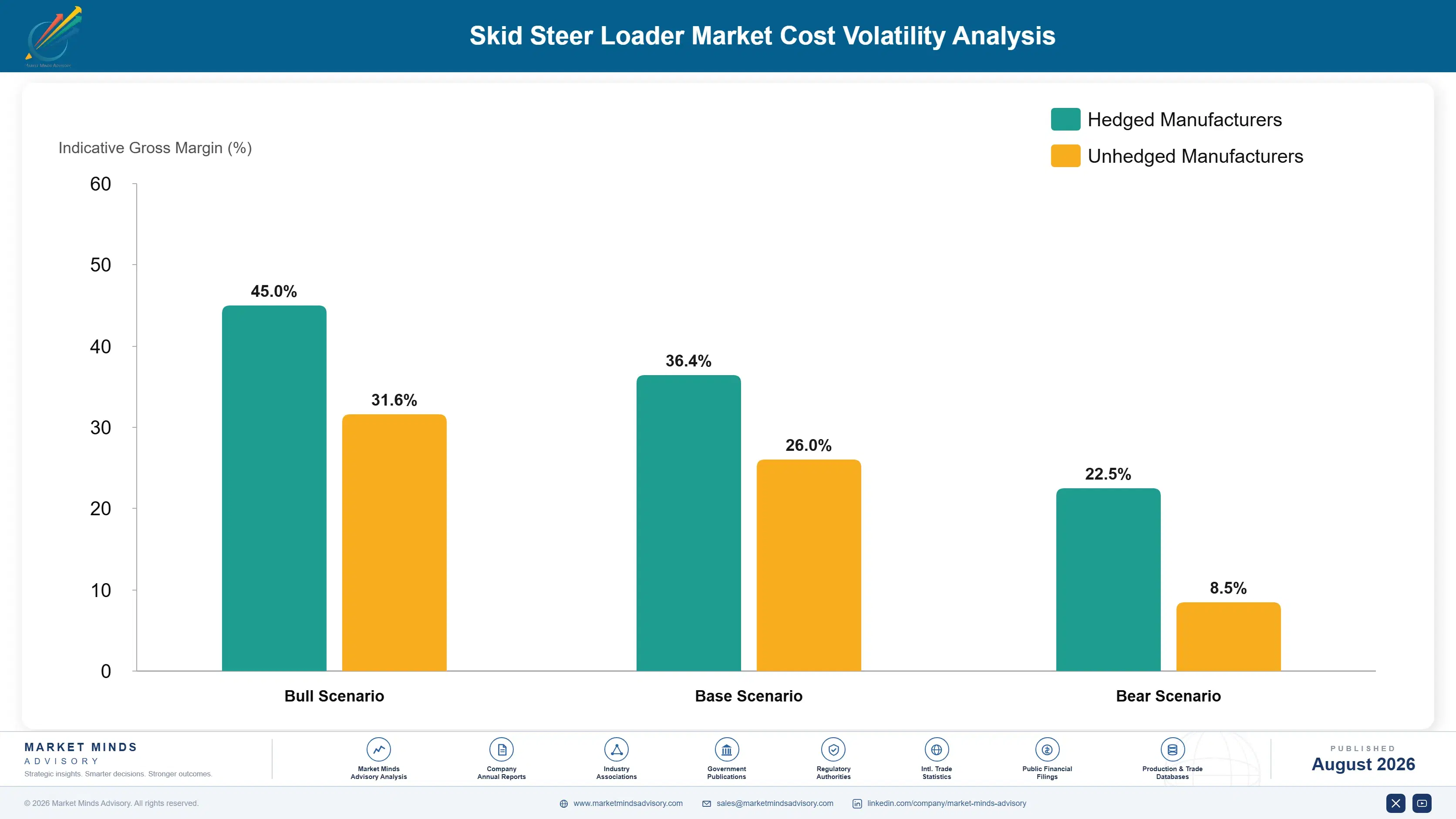
Engines and drivetrain account for roughly 24% of machine cost, sourced from a specialised supplier base and carrying emissions certification that varies by market. Hydraulic components including pumps, motors and valves carry about 21%. Steel fabrication and structures take around 18%, and rubber tracks or tyres absorb a further portion that differs sharply between configurations. Assembly, electronics and distribution absorb the balance.
Steel prices rose sharply through 2021 and 2022 on energy and raw material movements, per European Commission and national statistical office reporting for the period, while engine and hydraulic component availability constrained production independently through supply chain disruption. Delivery delays cost manufacturers more than the input cost inflation did, since rental fleets buying on replacement schedules simply bought elsewhere when machines were unavailable. Fleet positions lost then were slow to recover.

Exposure divides on configuration mix and on engine sourcing. Tracked machines carry rubber undercarriage cost that wheeled configurations avoid, which shifts the balance of exposure as track share rises toward 71% of sales. Emissions certification costs vary by market and weigh disproportionately on manufacturers serving many regulatory regimes with modest volumes in each of them.
skid-steer-loader-market-trends-growth-cost-volatility-analysis-1787595177150

Secure engine and hydraulic component supply on multi-year terms

Engines and hydraulics together carry around 45% of machine cost and both constrained production during the last disruption more severely than price movements did. Multi-year supply agreements protect delivery schedules that rental fleets plan against. Manufacturers unable to deliver during that period lost fleet positions rather than margin, and rental buyers did not return automatically afterwards.

Balance tracked and wheeled configuration exposure deliberately

Rubber undercarriage cost applies only to tracked machines while tyres cost considerably less, and track share rising toward 71% of sales shifts input exposure accordingly. Holding both configurations spreads that and serves buyers who have modelled whole life cost properly. Wheeled machines remain genuinely better on hard surfaces and considerably cheaper to keep running over time.

Consolidate emissions certification across machine platforms

Certification costs vary by market and weigh heavily on manufacturers serving many regulatory regimes at modest volume in each. Consolidating engine choices across machine platforms reduces the number of certifications needed without limiting the range offered. Manufacturers carrying a different engine in every frame size are paying for regulatory work they could avoid entirely.

Portfolio Architecture for Margin Defence

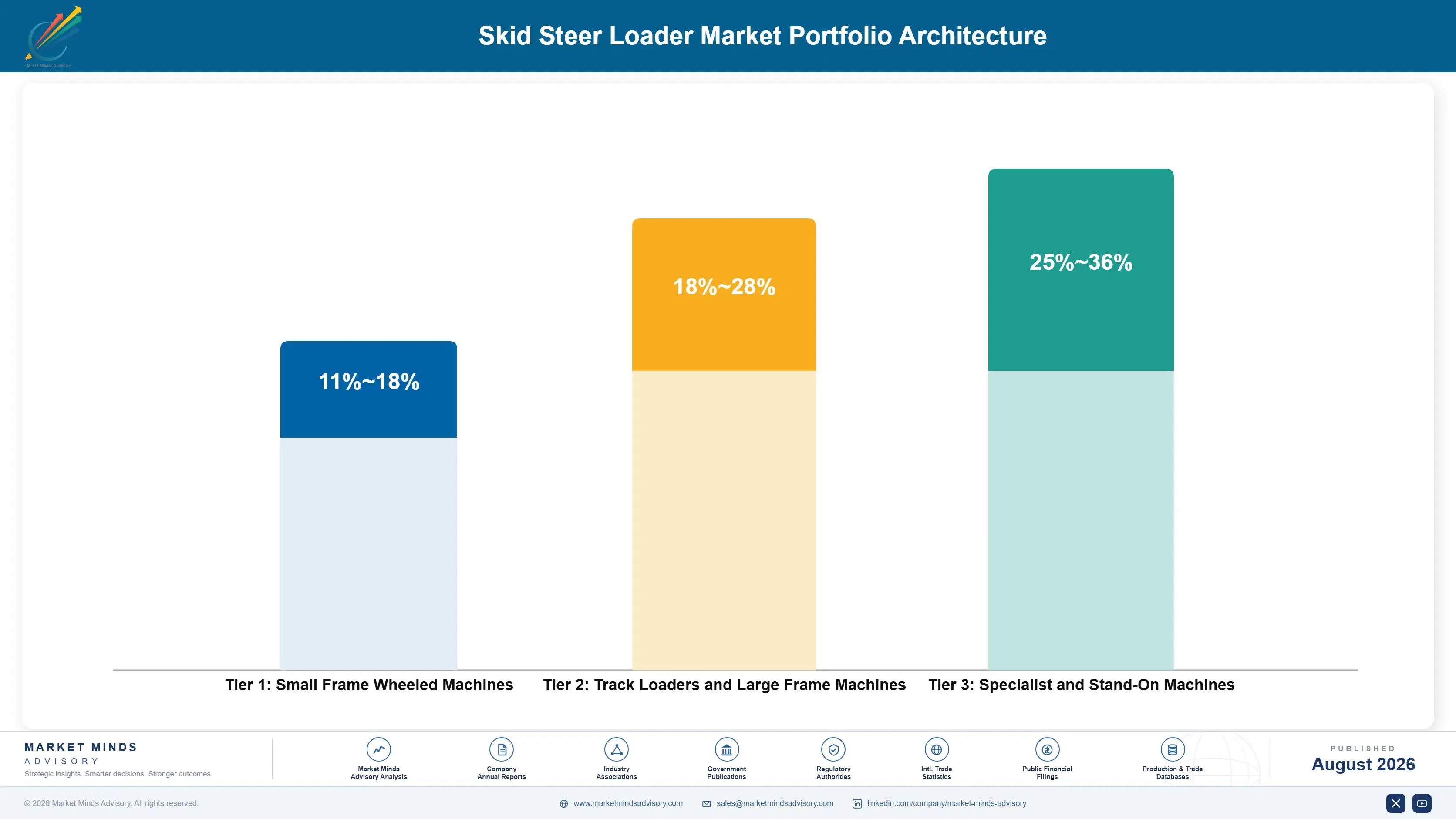
Margin here follows configuration and channel rather than machine capability, which reflects who is actually buying. Small frame wheeled machines earn margins in the low teens, because they compete directly on price against a wide field, rental fleets buy them in volume on tight terms and nothing about them supports a premium. Price competition across the field is intense.
Compact track loaders and larger frames do better in the high teens to high twenties, because tracked configuration commands more and the undercarriage content raises the absolute value of each unit. The range reflects brand residual value reputation, which affects what a rental fleet will pay far more than any specification comparison does. Undercarriage content raises the absolute value of each unit. Residual reputation moves what a fleet will pay.

Specialist and stand-on machines hold the strongest position, reaching into the mid thirties, because they reach work full size machines physically cannot and compete against a narrower field. Those margins reflect application scarcity rather than manufacturing advantage, and rental fleets buy them in numbers because they survive inexperienced operators. Inexperienced operators struggle to damage them badly. Application scarcity rather than manufacturing explains it.

Small Frame Wheeled Machines

Entry frame wheeled skid steers competing on price across a wide manufacturer field. The seven point range reflects manufacturing scale and dealer position rather than any meaningful capability difference between machines.
Gross Margin: 11-18%

Track Loaders and Large Frame Machines

Tracked and large frame configurations carrying higher content and stronger residual value. The ten point range reflects brand reputation at auction, which affects rental purchasing more than any specification comparison.
Gross Margin: 18-28%

Specialist and Stand-On Machines

Mini, stand-on and specialist configurations reaching work that full size machines physically cannot. The eleven point range reflects application scarcity and how narrow the competing manufacturer field actually is in each of them.
Gross Margin: 25-36%
skid-steer-loader-market-trends-growth-portfolio-architecture-1787595177673

High-value Sub-segments and Strategic Watch-out

Compact Track Loader Configurations

High value and the fastest growth at 6.6%, taking around 71% of compact loader sales on ground flotation. Undercarriage content raises unit value while replacement cost creates a whole life conversation buyers frequently avoid. Landscaping and site preparation drive most of it. Whole life conversations get avoided.
Gross Margin: 20-30%

Mini and Stand-On Machines

High value and growing at 5.8% into work that full size machines physically cannot reach at all. Rental fleets buy them in numbers because they are cheap to fleet and survive inexperienced operators well. Attachment compatibility means adding one costs no tools. Narrow competing field protects margin.
Gross Margin: 27-36%

Small Frame Wheeled Machines

The volume core in slow decline as track configurations take share on capability. Price competition is intense across a wide manufacturer field and rental fleets buy them on tight terms in volume. Nothing about them supports any premium at all. Track configurations keep taking share.
Gross Margin: 11-18%

Attachment Revenue Leakage

The strategic watch-out. Owners spend around 2.4 times machine price on attachments that mostly come from specialists, and the range reflects how far a manufacturer has contested that revenue at all. Bundled dealer packages are the only real answer available. Specialists defend their ground firmly.
Gross Margin: 8-30%

Fleets Buy, Contractors Rent

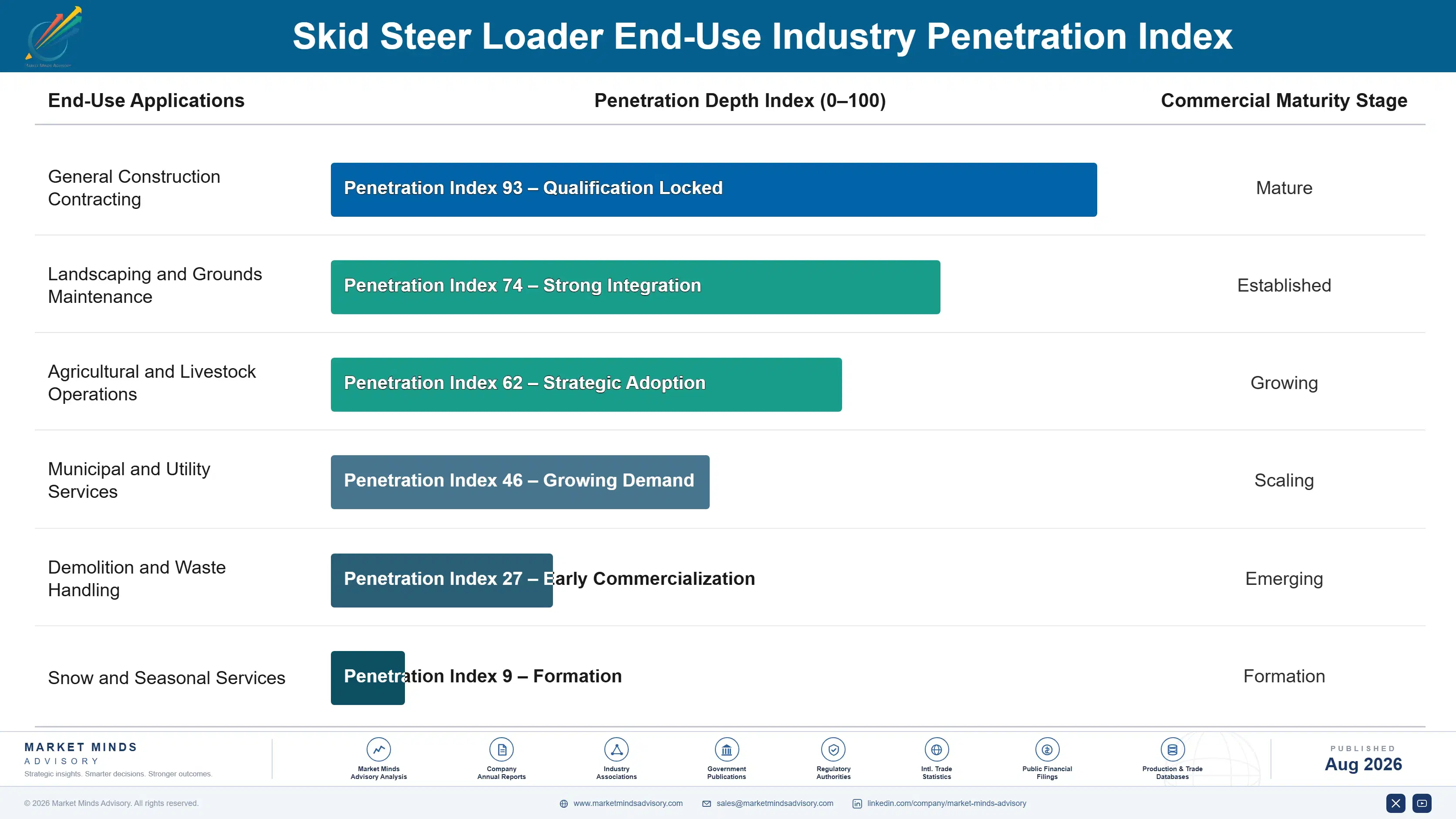
Around 54% of units go into rental fleets rather than to end users, which means most purchasing decisions are made by companies that will never operate the machine on a job. Those fleets run roughly 900 hours annually per unit and replace on schedules driven by utilisation, maintenance cost and residual value rather than by any change in what contractors need from the machine. Contractor need barely enters the calculation.
Stickiness sits with the dealer relationship rather than the machine. A rental fleet depends on service response to keep utilisation up, and a dealer who cannot supply parts quickly costs the fleet revenue directly. Machine specification switching is straightforward by comparison, which is why dealer network density rather than product capability determines most competitive outcomes here. Parts delays cost a fleet revenue directly.

The specifying voice has moved decisively from the operator to the fleet manager and, increasingly, to whoever models residual value. Operators once influenced purchasing through contractor preference, and that channel now represents a minority of units. Manufacturers still building brand preference among operators are reaching people who mostly hire rather than buy. Residual modelling now settles most selections.
skid-steer-loader-market-trends-growth-end-use-penetration-index-1787595178160

Where We Would Focus Effort

These are among the four positions where our research anticipates prominent divergence between winners and laggards over the coming forecast period. Each is grounded in the demand model, the regulatory perimeter, and the announced capacity pipeline.
01 / RESIDUAL VALUE ENGINEERING

Design for the auction, not the operator

Rental fleets take around 54% of units and weigh auction residual value, serviceability and fleet standardisation far above operator preference or any breakout force comparison. A feature that improves productivity while hurting resale is a straightforward negative for the majority buyer, which is not how engineering organisations habitually think about specification decisions at all. Manufacturers who design deliberately against residual find that rental fleets notice it very quickly, and those fleets carry the volume rather than any minority of it.
02 / ATTACHMENT REVENUE CONTEST

You created that market and gave it away

Owners spend around 2.4 times the machine price on attachments across a working life, and the standardised interface that generated that entire market handed it directly to specialist manufacturers. Branded ranges compete on the specialists' own ground and mostly lose, but bundled machine and attachment packages sold through a dealer network directly reach the buyer at the exact moment of machine purchase itself. That timing advantage is the only structural edge a machine builder actually holds anywhere in this market.
03 / WHOLE LIFE COST HONESTY

Tell them about the undercarriage first

Track replacement runs near six and a half thousand dollars and arrives as an unpleasant surprise for owners who bought a tracked machine on ground capability alone without ever modelling anything else. Presenting whole life cost honestly, including undercarriage and how operator turning habits affect rubber life over time, builds credibility that survives the first first replacement invoice actually arriving. Manufacturers letting customers discover it unaided lose the repeat purchase entirely, and tracked machines now take around 71% of all sales.
04 / MECHANISATION MARKET ENTRY

Build rental relationships from the beginning

India grows fastest anywhere at 8.8% as construction mechanisation replaces manual site methods, and rental channels there are developing alongside direct sales rather than following on afterwards as they did in every other market. That sequence is genuinely unusual and rewards manufacturers who build rental relationships from the outset rather than converting owner-operator channels over afterwards. Domestic manufacture is bringing machine prices into a range mid-sized contractors will actually pay, which widens the addressable market very considerably indeed beyond imports.

Engagement Snapshot From the Field

A live engagement with an industry participant carrying material or product regulatory and market exposure ahead of a defining policy shift, showing how our research translates into a defensible multi-year portfolio strategy.
MARKET MINDS ADVISORY · CLIENT ENGAGEMENT SUMMARY
Skid Steer Loader Producer Strategic Portfolio Review and Transition Roadmap 2026·Investment Scenario on Skid Steer Loader Exposure Evaluation 2025-26
CLIENT PROFILE
A European compact equipment manufacturer building wheeled skid steers and small track loaders for construction and agricultural customers across eleven markets, at annual revenue near 240 million euros (client-reported, unverified by MMA). Engineering effort concentrated on operator comfort and breakout performance, and no attachment range was offered alongside the machines at any point in the range.
STRATEGIC CHALLENGE
Rental fleet orders had declined for three consecutive years while direct contractor sales held steady, and management could not identify why fleets were selecting competitors whose machines tested no better. A programme to further improve cab ergonomics was in development at considerable cost and with board approval already granted for it.
MMA APPROACH
MMA analysed rental fleet selection criteria against the client's specification priorities, benchmarked auction residual values across competing machines, sized attachment spending across the installed base, and assessed dealer service response against fleet utilisation requirements. Interviews with 47 experts covered equipment rental practice, compact machinery engineering and dealer network operations directly.
KEY FINDINGS
  1. Rental fleets were selecting on modelled auction residual and dealer service response, and the client's machines held value materially below competitors at three year auction.
  2. Cab ergonomics improvements had no measurable influence on rental purchasing at all, since the fleets making those decisions never operate the machines themselves.
  3. Attachment spending across the client's installed base exceeded machine revenue by a wide multiple, and every unit of it went to specialist manufacturers rather than the client.
  4. Dealer parts availability lagged competitors in four separate markets, which directly reduced fleet utilisation and appeared explicitly in the fleet selection scoring.
CLIENT PROFILE
A European compact equipment manufacturer building wheeled skid steers and small track loaders for construction and agricultural customers across eleven markets, at annual revenue near 240 million euros (client-reported, unverified by MMA). Engineering effort concentrated on operator comfort and breakout performance, and no attachment range was offered alongside the machines at any point in the range.
STRATEGIC CHALLENGE
Rental fleet orders had declined for three consecutive years while direct contractor sales held steady, and management could not identify why fleets were selecting competitors whose machines tested no better. A programme to further improve cab ergonomics was in development at considerable cost and with board approval already granted for it.
MMA APPROACH
MMA analysed rental fleet selection criteria against the client's specification priorities, benchmarked auction residual values across competing machines, sized attachment spending across the installed base, and assessed dealer service response against fleet utilisation requirements. Interviews with 47 experts covered equipment rental practice, compact machinery engineering and dealer network operations directly.
KEY FINDINGS
  1. Rental fleets were selecting on modelled auction residual and dealer service response, and the client's machines held value materially below competitors at three year auction.
  2. Cab ergonomics improvements had no measurable influence on rental purchasing at all, since the fleets making those decisions never operate the machines themselves.
  3. Attachment spending across the client's installed base exceeded machine revenue by a wide multiple, and every unit of it went to specialist manufacturers rather than the client.
  4. Dealer parts availability lagged competitors in four separate markets, which directly reduced fleet utilisation and appeared explicitly in the fleet selection scoring.
RECOMMENDED STRATEGY
Phase 1: Phase one: redirect engineering effort away from cab ergonomics toward specification choices that improve auction residual value and serviceability directly. Phase 2: Phase two: introduce a bundled attachment offer sold through dealers at the point of machine purchase, where timing rather than product is the advantage. Phase 3: Phase three: address dealer parts availability in the four markets where it is measurably reducing fleet utilisation and costing selection.
OUTCOME
The manufacturer redirected engineering priorities during 2026 and reported returning to two rental fleet approved lists (client-reported, unverified by MMA). A bundled attachment offer was launched, parts availability was addressed in three markets, and the ergonomics programme was cancelled. Rental orders recovered within two quarters.

Frequently Asked Questions

Foundational context covering the market sizes, CAGR, scope, country, region and competition that inform every finding below. This section is provided to cover basics and most often pre-purchase conversations, answered from the MMA Primary Research Dataset.

What is the current size of the Skid Steer Loader Market?

MMA sizes it at USD 3.9 billion in 2025, rising to USD 4.07 billion in 2026. The figure covers compact loaders with skid or track steering at manufacturer selling value.

How large will the Skid Steer Loader Market be by 2036?

USD 6.26 billion by 2036, an incremental USD 2.19 billion over the 2026 base and an expansion multiple of 1.54 times. Track loaders account for a disproportionate share.

What is the CAGR for the Skid Steer Loader Market 2026 to 2036?

4.4% in the base case, with a bull case at 5.6% and a bear case at 3.2%. The spread turns on construction activity and on rental fleet replacement timing.

Which segment is growing fastest?

Compact track loaders at 6.6%, half again the market rate of 4.4%. Ground flotation lets contractors work soft conditions that would leave a wheeled machine idle.

Who are the major companies in the Skid Steer Loader Market?

Bobcat, Caterpillar, Deere, Kubota and CNH Industrial lead on compact loader unit sales. Fifteen further participants are profiled in the full report on that same basis.

Which country is growing fastest?

India at 8.8%, as construction mechanisation replaces manual site methods while domestic manufacture brings machine prices into a range that mid-sized contractors will actually pay.

Report Segmentation Architecture

The full report scope spans multiple orthogonal segmentation dimensions, with cross-tabulated demand data provided for each dimension pair. Coverage extends further to regional breakdowns, trend trajectories, and the competitive detail needed to support segment-level decision-making.

By Machine Configuration

  • Small Frame Wheeled Skid Steers
  • Medium Frame Wheeled Skid Steers
  • Large Frame Wheeled Skid Steers
  • Compact Track Loaders
  • Mini and Stand-On Loaders
  • Electric and Hybrid Compact Loaders

By End-Use Industry

  • General Construction Contracting
  • Landscaping and Grounds Maintenance
  • Agricultural and Livestock Operations
  • Municipal and Utility Services
  • Demolition and Waste Handling
  • Snow and Seasonal Services

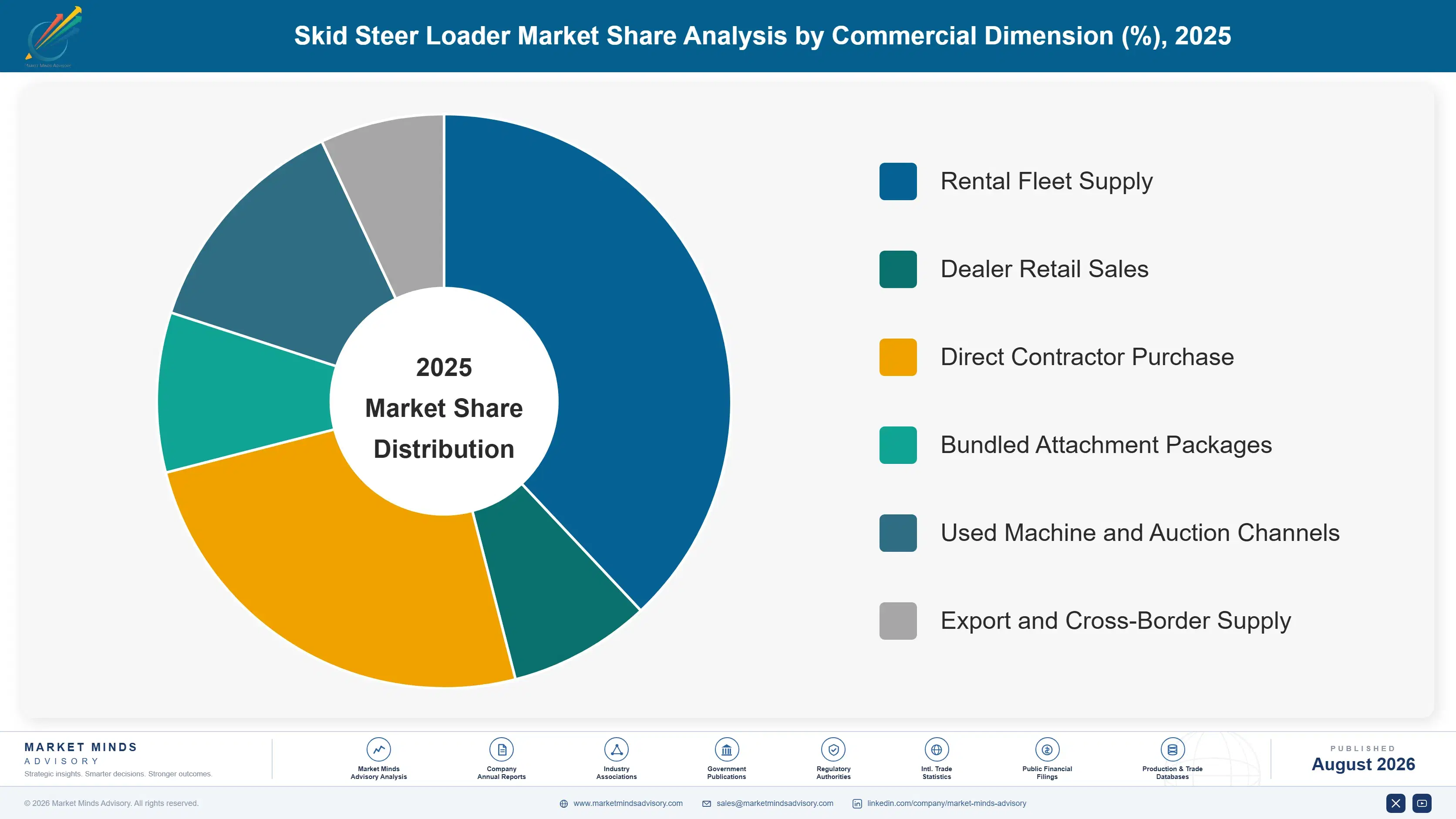
By Commercial Dimension

  • Rental Fleet Supply
  • Dealer Retail Sales
  • Direct Contractor Purchase
  • Bundled Attachment Packages
  • Used Machine and Auction Channels
  • Export and Cross-Border Supply

By Region

  • North America
  • Western Europe
  • East Asia
  • South Asia and Pacific
  • Latin America
  • Middle East and Africa
  • Eastern Europe

Scope, Methodology, and Coverage

Every figure in this report is reproducible from documented input assumptions. The scope below maps the historical period, the forecast horizon, the segmentation dimensions, and the countries covered, alongside the underlying primary and qualitative methodology.
Historical Period
2020 to 2025
Forecast Period
2026 to 2036
Base Year
2025 (USD billions; MMA Primary Research Dataset, August 2026)
Market Definition
Compact loaders using skid or track steering with a standardised attachment interface, covering small, medium and large frame wheeled skid steers, compact track loaders, mini and stand-on loaders, and electric and hybrid compact loaders. Measured at manufacturer selling value for complete machines across all channels. Attachments sold separately, compact excavators, backhoe loaders, telehandlers, wheel loaders above the compact class, and rental service revenue are excluded from scope.
Quantitative Units
USD billions (current prices); thousand units shipped; USD per unit by machine configuration
Segmentation Dimensions
Machine configuration; end-use application; commercial dimension; region
Regions Covered
North America, Western Europe, East Asia, South Asia and Pacific, Latin America, Middle East and Africa, Eastern Europe
Countries Covered
United States, Canada, Mexico, Germany, France, United Kingdom, Italy, Netherlands, Japan, South Korea, China, India, Australia, Indonesia, Brazil, Argentina, Saudi Arabia, South Africa, Poland, Czech Republic
Key Companies Profiled
Bobcat, Caterpillar, Deere, Kubota, CNH Industrial, JCB, Takeuchi, Wacker Neuson, Yanmar, Volvo Construction Equipment, Komatsu, ASV Holdings, Manitou Group, Hyundai Construction Equipment, LiuGong, XCMG, Sany, Terex, Toro Company, Vermeer
Quantitative Methodology
Primary survey, n=3,800 respondents, Q4 2025, six countries; demand-side model with trade association cross-validation
Qualitative Methodology
47 expert interviews, Q4 2025; applied to validate demand model assumptions, identify emerging dynamics, and assess competitive positioning
Report Format
PDF and XLSX data workbook (Word format preview document)
Publisher
Market Minds Advisory
Report Code
MMA-2026-CON-114
Published
August 2026
Contact
sales@marketmindsadvisory.com | www.marketmindsadvisory.com

Purchase the full Skid Steer Loader Market Report (2026 to 2036).

The full report treats rental fleet purchasing criteria as the governing commercial variable, because those fleets take most of the units and buy on entirely different grounds from the contractors who operate the machines. It sizes all six configurations independently through 2036, quantifies attachment spending across machine life against the revenue manufacturers capture, and models whole life cost including undercarriage across tracked and wheeled machines. Regional chapters cover all seven regions with rental penetration assessed separately. Competitive profiling covers 20 participants on a single unit sales basis.
Six machine configurations sized independently through 2036
Rental fleet selection criteria assessed against manufacturer specification priorities
Attachment spending quantified against machine revenue captured
Whole life cost modelled across tracked and wheeled configurations
Twenty participants profiled on one consistent unit basis
Auction residual values benchmarked across competing machine brands

Built For The People Who Decide

From boardroom strategy to bench-side execution, this report is read cover-to-cover by leaders shaping the next decade of their industry, turning demand scenarios, market dynamics and valuation benchmarks into decisions.
CXOs/ Presidents/ VPs/ Managers
M&A and Corporate Development
Strategy Teams and R&D Heads
Procurement and Product Directors
Regulatory and Compliance Leaders
Investor Relations and Equity Analysts