
Market Minds Advisory
Real-Time Parking System Market

Real-Time Parking System Market: Real-Time Parking System Market: Camera Detection, Curb Pricing and the Shift to Recurring Revenue

One camera now watches sixty bays where a sensor watched one, cities have started pricing curb space as the scarce asset it is, and suppliers are rebuilding around subscription revenue rather than hardware sales.

Lead Analyst

David Horsley

Published

August 2026

Make Smarter Decisions with Customized Research Insights

Request a free sample report and evaluate market opportunities, growth trends, and competitive dynamics relevant to your business needs.

2025 MARKET VALUE$5.8BMarket Size 2025
2036 FORECAST VALUE$16.2BBase Case , 2026 to 2036
CAGR 2026 TO 20369.8 %Bull 11.0% / Bear 8.6%
INCREMENTAL OPPORTUNITY$9.8BNet 10- year value creation
EXPANSION MULTIPLE2.55x2036 value over 2026 base
Strategic Levers
M&A Pipeline
Regional Outlook
Country Rankings
Competitive Intelligence
Segmental Deep-dive
Call-Us : 91 93563 13602

Executive Snapshot and Market Trajectory.

The economics of this market changed when detection stopped being one sensor per bay. A single camera with decent classification software now covers sixty spaces, which took instrumentation cost per bay from prohibitive to routine and opened estates that could never previously justify the spend at all.
Camera-based occupancy detection grows at 14.7%, a full 1.50 times the market rate, because the cost per monitored bay falls by roughly four fifths against in-ground sensors while also delivering plate recognition, dwell time and enforcement evidence from the same hardware. East Asia holds 34% of global value, above the standard regional band, because Chinese municipal deployment has been the largest programme of its kind anywhere and the underlying parking shortage is genuinely acute.
Concentration is extraordinarily low at 18% for the top five, which reflects an industry assembled from three unrelated businesses. Sensor manufacturers, access control and payment hardware companies, and parking software platforms have all converged on the same customer, and nobody yet holds a credible position across the whole estate an operator actually runs. Whoever assembles that first will define how these systems are procured.
Market Definition
This report covers real-time parking systems providing live occupancy awareness, spanning camera-based and in-ground occupancy detection, guidance signage and wayfinding, parking management and enforcement software, access control and payment terminals, and the platforms integrating them across municipal on-street, commercial garage, airport, campus and residential applications. Parking structure construction, unmonitored payment meters, valet operations, vehicle charging hardware and general traffic signal control are excluded from the sizing.
Base Year Value
$5.8B in 2025 (MMA Primary Research Dataset, August 2026)
Forecast Period
2026 to 2036, eleven discrete annual values
CAGR
9.8% base case. Bull 11.0%. Bear 8.6%.
Fastest Growth Segment
Camera-Based Occupancy Detection: 14.7% CAGR
Fastest Growth Country
India: 12.8% CAGR
Fastest Growth Region
South Asia and Pacific: 12.0% CAGR
Largest Region
East Asia: 34% of 2025 global value
Market Leaders
Hikvision, Amano Corporation, SKIDATA, FlashParking and Nedap lead on instrumented space deployment. Source: MMA Analysis, July 2026.
Primary Survey
n=3,800 procurement and R&D decision-makers, Q4 2025, six countries
Methodology
Demand-side build-up, cross-validated against public data, 47 expert interviews

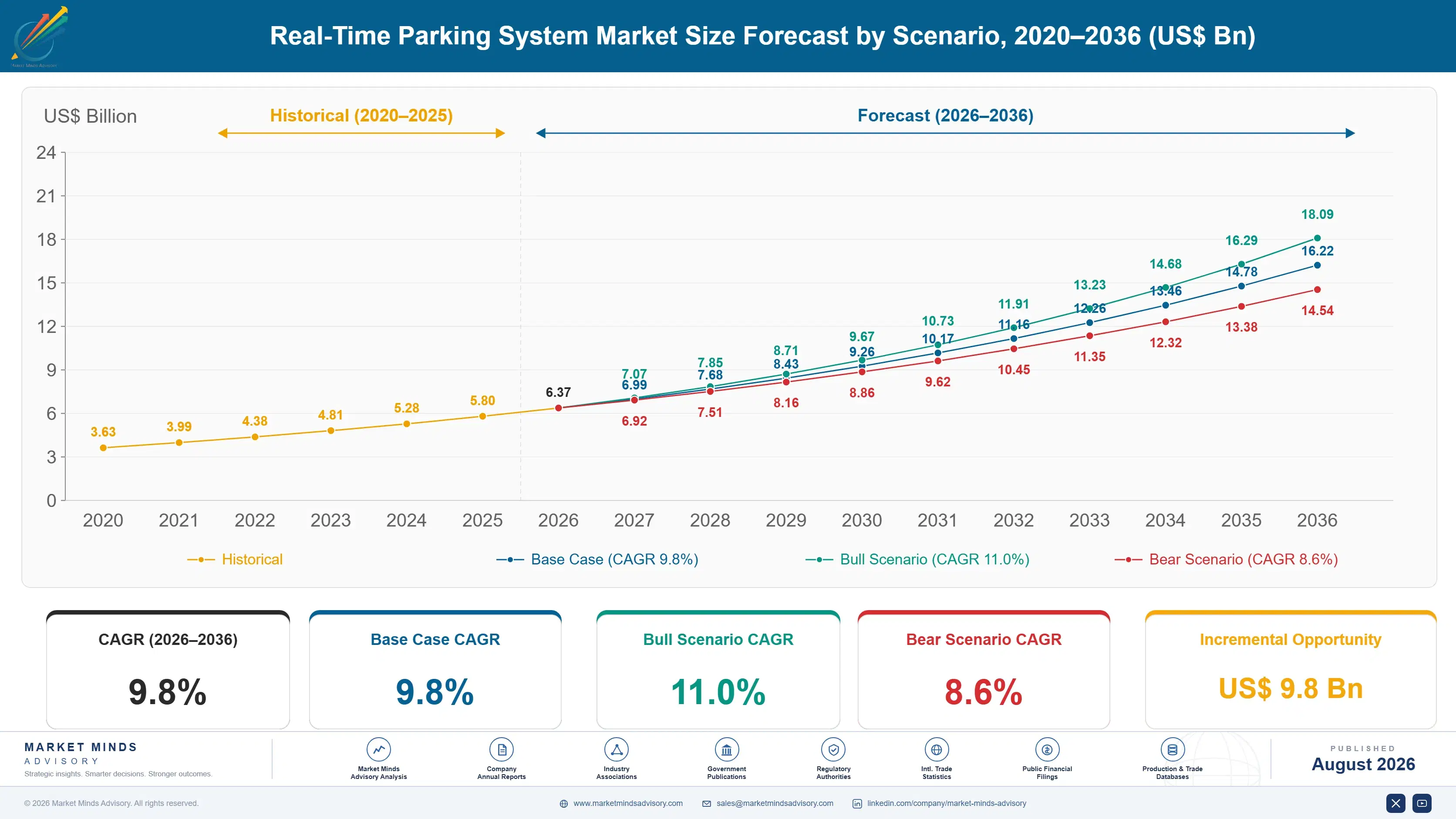
Real-Time Parking System Market Forecast Scenarios

real-time-parking-system-market-trends-size-forecast-scenario-1787322217672
Between 2020 and 2025 the market compounded at 8.4%, and the composition shifted more than the total did. Municipal deployment paused through 2020 and 2021 as city budgets absorbed other priorities entirely. Commercial operators moved the opposite way, instrumenting estates to manage capacity under changed demand patterns, and camera detection displaced in-ground sensors across new deployments almost completely during the same period.
The base case at 9.8% rests on three mechanisms. Camera detection keeps opening estates that could never justify sensor-per-bay economics, which expands the addressable base rather than merely growing existing deployment. Curb management policy across European and increasingly North American cities converts parking from supervision into priced allocation, which requires live occupancy data. Software and managed service revenue rises steadily as a share of the total, lifting realised value per instrumented space well ahead of hardware volume.
The bull case at 11.0% turns on more cities adopting dynamic curb pricing on the Dutch and Californian model, which historically produces step changes in instrumentation rather than gradual growth. The bear case at 8.6% is privacy regulation tightening against camera-based plate capture, which would push deployments back toward sensor economics that opened far fewer estates in the first place.

What Actually Drives Parking System Value

For twenty years instrumenting a parking space meant burying a magnetometer in the tarmac, one per bay, at a cost that only airports and premium garages could justify. Cutting the road surface was expensive, batteries failed, and resurfacing destroyed the installation entirely. That arithmetic confined the whole category.
TOP FIVE CONCENTRATION18%Share held by the five largest parking system suppliers
COST PER SPACE$310Typical instrumentation cost for a single monitored bay
SOFTWARE REVENUE SHARE34%Portion of supplier revenue from software and recurring services
DETECTION ACCURACY97%Typical bay status accuracy achieved by current generation systems
INSTRUMENTED SPACE BASE42 millionParking bays monitored electronically across major urban markets
PROCUREMENT CYCLE19 monthsTypical time from tender publication through to contract award
Camera detection broke it. One overhead unit with decent classification software now covers forty to sixty bays at roughly a fifth of the per-space cost, and the same hardware simultaneously delivers plate recognition for enforcement, dwell time analytics for pricing and video evidence for disputes. Estates that could never previously justify instrumentation became straightforward projects, and the addressable base expanded rather than the existing one merely growing.
What follows commercially is a shift toward software. Live occupancy data is only valuable if something acts on it, whether that is a guidance sign, a dynamic price, an enforcement dispatch or an app telling a driver where to go. Recurring software and managed service revenue now supplies 34% of supplier revenue at margins hardware never approached, and operators increasingly prefer that model because it fits operating budgets rather than capital ones.
"The whole industry spent two decades arguing about sensor accuracy and then a camera made the argument irrelevant by covering sixty bays for the price of ten sensors. The lesson is that cost per monitored space, not detection precision, was always the binding constraint on this market."
Practice Director, Urban Mobility Systems, Market Minds Advisory · MMA Technology Practice · August 2026

Market Trends

Camera Detection Collapses Cost Per Monitored Parking Space

A single overhead camera with classification software covers forty to sixty bays where a magnetometer covered exactly one, which cuts instrumentation cost per space by roughly four fifths and it removes the road cutting, battery replacement and resurfacing damage that made buried sensor deployments genuinely painful to own. The same hardware also delivers plate recognition, dwell time analytics and dispute evidence without any additional equipment at all. Estates that could never previously justify instrumentation now proceed routinely, which expands the addressable base rather than simply growing the deployments that already exist.
Market Impact: Returns payback within 24 months
Curb Space Becomes Priced Allocation Rather Than Supervision

Cities across the Netherlands, Germany, the Nordics and increasingly California have reframed on-street parking as scarce public space to be priced dynamically rather than merely policed, and doing that requires knowing occupancy in real time across whole districts. Demand-responsive pricing raises turnover on the most contested streets while reducing the cruising traffic to which studies attribute a substantial share of urban congestion. Every city adopting the approach instruments comprehensively rather than partially, which makes each adoption a step change in deployment volume rather than incremental growth. Adoption is spreading steadily.
Market Impact: Covers 4 million charging bays

Market Opportunities and Growth Drivers

Commercial Operators Instrument Estates For Yield Management

Garage owners, airports, universities and hospital campuses buy occupancy systems because knowing utilisation lets them price by demand, sell reservations and size staffing properly, and the payback arrives inside two years on most sites at current instrumentation costs. That buyer weighs financial return rather than policy, which makes the demand considerably more predictable than municipal procurement and far less exposed to political cycles. Airport parking is the most sophisticated deployment anywhere, integrating reservation, dynamic pricing and guidance into one yield system that operators genuinely rely on. Payback rather than policy decides it.
Market Impact: Limits retention to 30 days

Charging Bay Management Requires Live Occupancy Awareness

Electric vehicle charging bays are contested resources, occupied by vehicles that have finished charging and by vehicles that never intended to charge at all, and operators cannot manage either problem without knowing bay status in real time. Idle fee enforcement, reservation handling and dynamic allocation all depend on occupancy data that the parking system provides rather than the charger itself. That requirement is pulling instrumentation into estates that would otherwise have deferred it, and the two systems are increasingly procured together rather than separately by different departments. Procurement is converging accordingly.
Market Impact: Delays awards by 19 months

Market Restraints and Challenges

Privacy Regulation Constrains Camera-Based Plate Capture

Camera systems recording plates process personal data, and European data protection rules alongside comparable regimes elsewhere impose retention limits, purpose restrictions and impact assessment requirements that magnetometer sensors avoid entirely. The root cause is regulatory rather than technical, and it applies to precisely the technology whose economics opened this market. Commercially it slows deployment considerably wherever supplier compliance capability is thin. Participants are responding with on-device anonymisation, systems that classify occupancy without retaining plate images, and documented compliance frameworks that municipal procurement now increasingly requires before award. Compliance capability is becoming a genuine asset.
Market Impact: Cuts cost per space 80%

Fragmented Procurement Slows Municipal Deployment Considerably

Every city runs its own tender, procurement takes around 19 months from publication to award, and parking departments are usually small teams managing several programmes at once. The root cause is administrative capacity rather than funding availability. Commercially this caps how quickly committed money converts into instrumented spaces, and it makes selling cost high relative to individual contract value. Participants are responding by pursuing framework and cooperative purchasing agreements, by standardising deployment packages, and by supporting city teams through the specification and funding application work itself. Framework agreements are the practical answer.
Market Impact: Cuts cruising traffic 30%
3 additional market trends, 4 additional growth drivers, and 2 additional restraints and challenges are covered in the full report. Contact sales@marketmindsadvisory.com to access the complete intelligence.

Segment CAGR and Growth Architecture

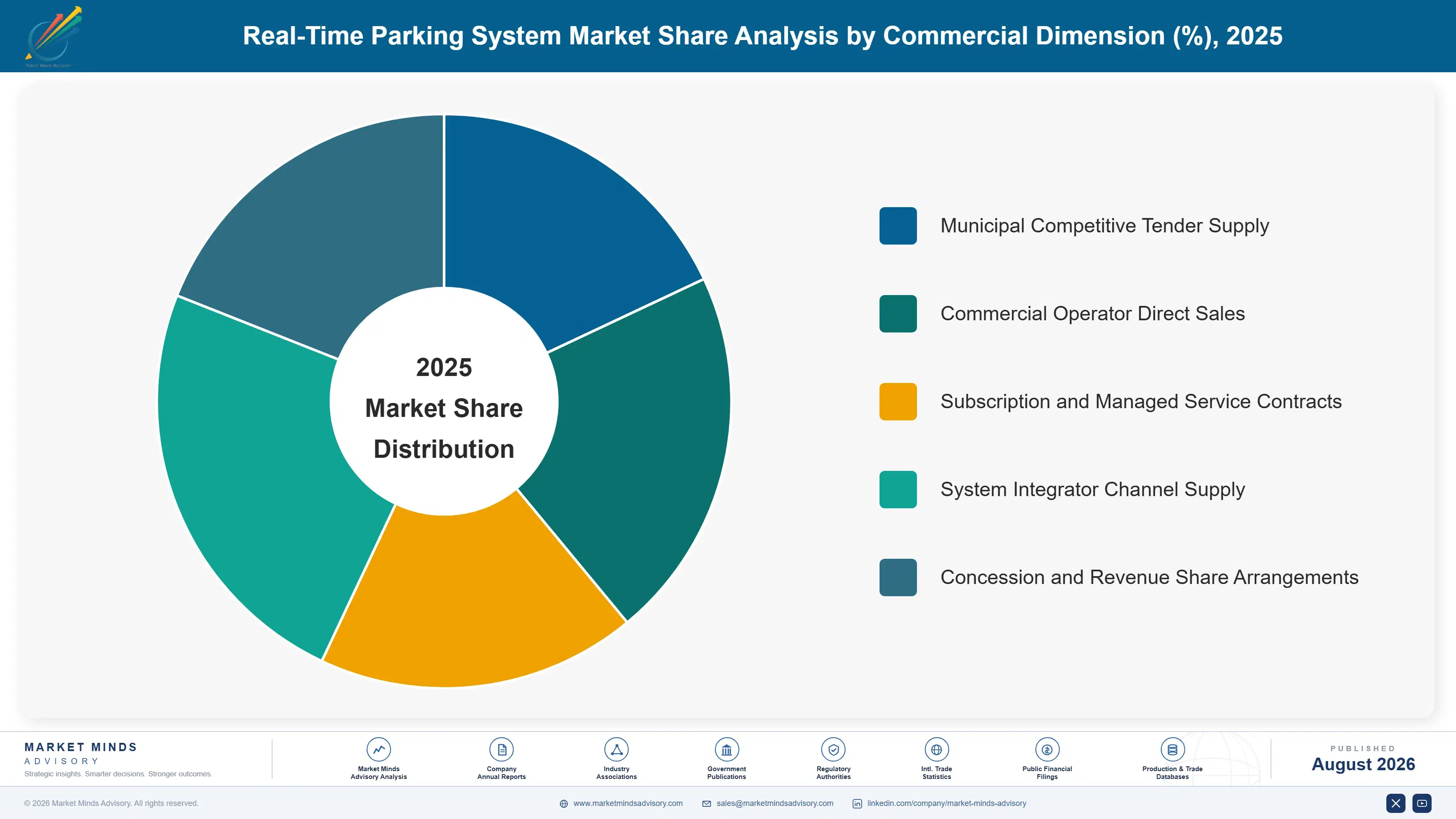
Segmentation follows system function, because what a subsystem actually does determines which budget funds it, the procurement route that applies, the software content it carries and the realised value per instrumented space. Detection technology, communication method, hosting arrangement and support model all sit downstream of that functional decision, and every one of them is priced directly against it.
real-time-parking-system-market-trends-market-share-analysis-1787322218201

Camera-Based Occupancy Detection

The fastest segment at 14.7%, a full 1.50 times the market rate, covering overhead and pole-mounted cameras running classification software that determines bay status across an entire zone rather than one space at a time. Cost per monitored bay is the whole argument. A single unit covers forty to sixty spaces at roughly a fifth of the per-space cost of in-ground sensors, and it eliminates the road cutting, battery replacement and resurfacing damage that made buried installations genuinely unpleasant to own. The same hardware simultaneously delivers plate recognition, dwell analytics and dispute evidence. What constrains it is privacy regulation, since capturing plates processes personal data in ways magnetometers simply never did.
CAGR 14.7%

Parking Management and Enforcement Software

Growing at 12.2% on the platforms that turn occupancy data into action, covering enforcement dispatch, dynamic pricing, permit administration, reservation handling and the reporting municipal committees actually read. Live occupancy data has no value at all unless something acts upon it, which is precisely why software increasingly carries the commercial weight in these projects. Recurring licensing also suits operators considerably better than capital purchase does, since it fits the operating budgets they can expand more readily. Displacement is genuinely difficult once a platform holds several years of permit records, enforcement history and configuration, which makes these positions considerably more durable than any hardware supply relationship ever proves to be in practice.
CAGR 12.2%
Full segment breakdown across 5 segments available in the complete report.

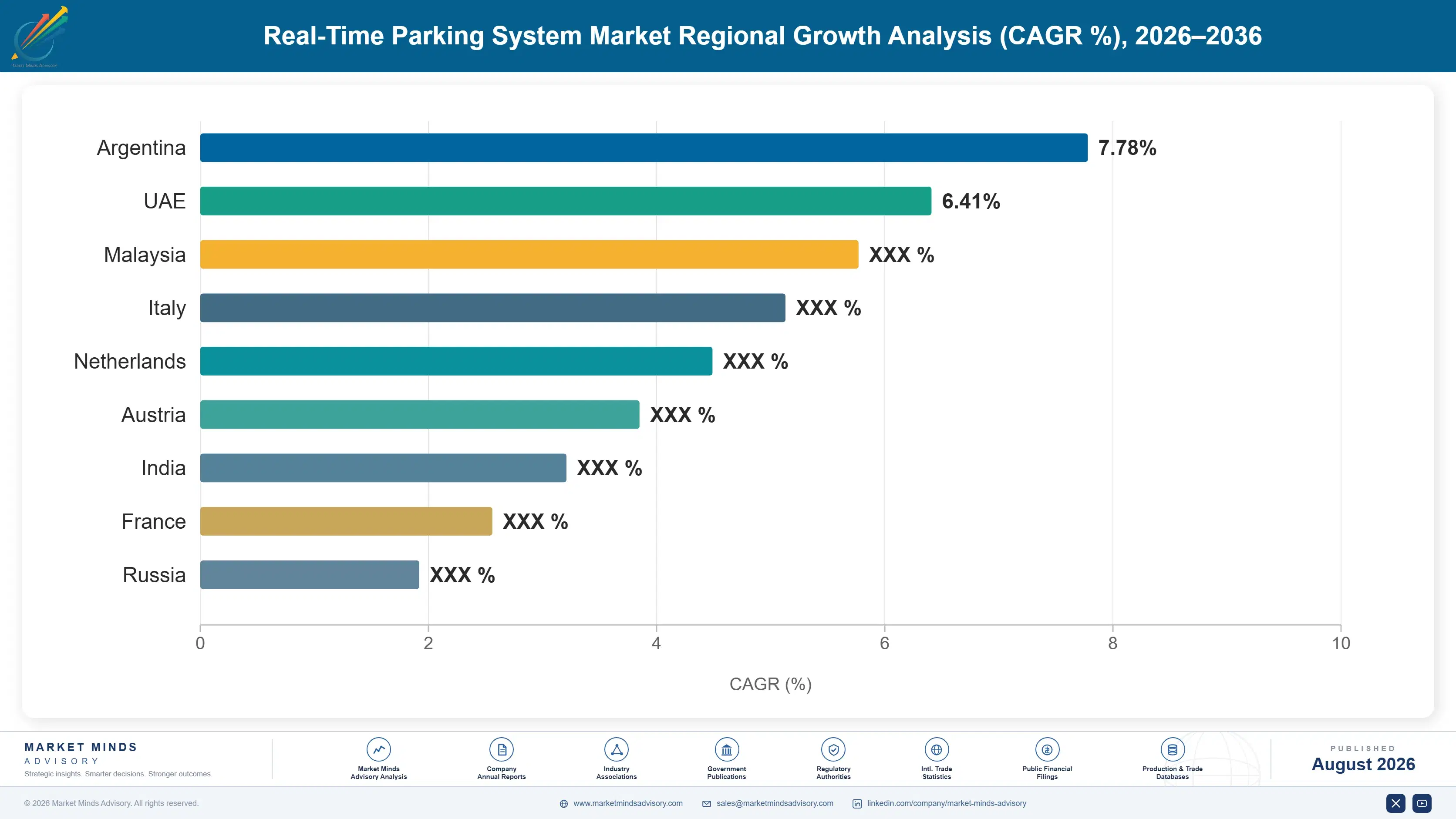
Regional Architecture and Country Demand Map

East Asia holds 34% of global value on Chinese municipal deployment at a scale that no Western procurement process comes close to approaching. Western Europe follows on curb management policy, while growth runs fastest across South Asia and Pacific on urban parking shortage and programme funding.

East Asia

Note: East Asia holds 34% against a 22 to 30% band because Chinese municipal smart parking deployment has been the largest programme of its kind anywhere and the parking shortage driving it is genuinely acute. Tier one cities carry vehicle populations that outstripped bay construction more than a decade ago, and city governments funded instrumentation at a pace no Western procurement process matches. Hikvision, Dahua and Keytop supply most of it. Japanese demand is different in character, mature and replacement-driven, with Amano holding deep positions across a parking estate that was instrumented decades before anywhere else. Korean deployment concentrates in apartment complexes and commercial developments. Scale and urgency reinforce each other here.
Share: 34% | CAGR: 11.0% (2026 to 2036)

Western Europe

Curb management policy drives this region with unusual directness. Cities across the Netherlands, Germany, France and the Nordics have reframed on-street parking as scarce public space to be priced and allocated rather than merely supervised, and doing that requires knowing which bays are occupied in real time. Low emission zone enforcement and residential permit schemes both piggyback on the same infrastructure. Privacy regulation shapes technology choice considerably, since camera systems capturing plates face data protection requirements that magnetometer sensors avoid entirely. EasyPark, Flowbird and Cleverciti all hold positions built on that regulatory reality rather than despite it. Privacy compliance capability has become a genuine competitive asset rather than a cost of doing business.
Share: 24% | CAGR: 8.3% (2026 to 2036)
Regional intelligence for 5 additional markets available in the complete report: North America, South Asia and Pacific, Latin America, Middle East and Africa, Eastern Europe. Contact sales@marketmindsadvisory.com.
real-time-parking-system-market-trends-country-cagr-analysis-1787322218721

Where Parking System Margin Is Won

Four positions separate suppliers building durable businesses from those winning individual tenders at cost: converting hardware sales into recurring software revenue, owning the management platform rather than the detection hardware, holding privacy compliance capability that camera deployments now require, and pursuing commercial operators whose straightforward payback logic beats municipal procurement cycles entirely on cash conversion.

Convert Hardware Sales Into Recurring Software Revenue

Software and managed services already supply 34% of supplier revenue at gross margins 22 to 30 points above hardware, and operators increasingly prefer that model because it moves cost from capital budgets into operating ones they can expand more easily. Suppliers structuring occupancy analytics, enforcement dispatch and hosted management as subscriptions hold that customer across the full deployment life rather than only at the point of installation. The revenue also arrives during entire budget years when no capital project happens at that operator at all. The model shift is largely irreversible now.
Market Impact: Adds 30 margin points across all software revenue

Own The Management Platform Not The Detection Hardware

Cameras and detection sensors are increasingly commodity purchases with several credible suppliers available, while the platform holding several years of permit records, enforcement history and zone configuration is genuinely difficult to displace. Suppliers holding that platform capture 28% to 36% more lifetime revenue per customer, because every hardware refresh then flows through them regardless of who manufactured the device. It also positions them to integrate competitors' detection hardware behind their own platform rather than finding themselves integrated by somebody else's software entirely. Platform ownership effectively decides the whole customer relationship here.
Market Impact: Captures 36% more lifetime revenue from each customer

Hold Privacy Compliance Capability Camera Deployments Require

Camera systems capturing plates process personal data, and European rules plus comparable regimes elsewhere impose retention limits, purpose restrictions and impact assessments that municipal procurement now tests explicitly. Suppliers offering on-device anonymisation, occupancy classification without any plate retention and documented compliance frameworks win 20% to 27% more municipal tenders than technical capability alone would ever predict. The cost involved is engineering discipline and documentation rather than any capital, which makes it among the cheapest competitive advantages available anywhere here. Very few competitors have actually built that capability properly at all.
Market Impact: Wins 27% more municipal tender awards than expected

Pursue Commercial Operators Over Municipal Procurement Cycles

Garage owners, airports and campus operators buy on payback rather than policy and decide in weeks rather than the 19 months a municipal tender consumes, which transforms selling cost per contract entirely. Suppliers weighted toward commercial customers turn revenue 3.2 times faster per unit of sales effort than those dependent on public procurement. Municipal work carries scale and reference value that commercial deployment simply does not, so the argument here is about mix rather than abandonment, but the difference in cash conversion between the two is genuinely stark. Mix rather than abandonment is the answer.
Market Impact: Turns revenue 3.2 times faster in commercial channel

Who Controls the Margin Pool

Concentration sits at 18% for the top five measured on instrumented space deployment, the basis used throughout this section, and it is genuinely low rather than a measurement artefact. Hikvision leads on installed volume through Chinese municipal deployment, while Amano holds deep Japanese and international garage positions, SKIDATA and Nedap compete across access control and detection, and FlashParking leads on platform software. The gap to the next tier barely exists at all.
Competitive activity runs on three fronts. Platform ownership is the first and the most consequential, since it determines who integrates whom across a deployment lasting a decade. Recurring revenue conversion is the second, and suppliers are restructuring commercial models around it aggressively. The third is privacy compliance capability, which increasingly decides which suppliers reach the shortlist on European and North American municipal tenders at all.

Pressure arrives from two directions. Video analytics specialists are entering from security rather than parking heritage, bringing detection capability at costs parking suppliers cannot match. Separately, payment platforms have moved upstream from transactions into occupancy and enforcement. Rankings will shift on who owns the management platform when the current generation of municipal deployments comes up for renewal.
real-time-parking-system-market-trends-company-positioning-matrix-1787322219237

Competitive Moat and Risk Dimensions

AMANO CORPORATION

Moat: Garage estate incumbency depth

Decades of installed access control, payment and management systems across Japanese and international commercial garages create switching friction that product comparison alone does not overcome, since operating procedures, staff training and revenue reporting all run through the installed platform. Manufacturing and service scale across a very large estate also spread support cost in ways specialist entrants cannot approach.
AMANO CORPORATION

Risk: Hardware heritage in software market

An organisation built around manufacturing access control equipment faces genuine difficulty competing on software depth against platform companies that never made hardware at all. Recurring revenue conversion requires commercial models and engineering skills that differ from what the business developed, and customers increasingly evaluate the software before considering the equipment behind it.
HIKVISION

Moat: Camera detection cost position

Manufacturing scale across security and traffic video delivers a camera cost position no parking specialist approaches, and detection algorithms trained against enormous volumes of real deployment imagery are difficult to replicate quickly. Chinese municipal reference installations at scale also give the business credibility on projects where nobody else can point to comparable deployment size.
HIKVISION

Risk: Regulatory exclusion from Western markets

Procurement restrictions have removed access to substantial North American public business entirely and European scrutiny has tightened alongside, which caps addressable market regardless of cost or capability. Growth therefore depends on Asian, African and Latin American demand, where competition on price is fiercest and contract values are considerably lower than Western equivalents.

Players Tracked

Prominent Players

Hikvision
Amano Corporation
SKIDATA
FlashParking
Nedap

Other Key Players

Dahua Technology
Keytop
Q-Free
Cleverciti
Smart Parking Limited
ParkHub
TIBA Parking Systems
Scheidt and Bachmann
Designa
T2 Systems
Passport Labs
EasyPark Group
Flowbird
Parkopedia
Indigo Group

Recent Developments

FEBRUARY 2025

Camera detection replaces sensor estate across municipal deployment

A European city replaced its ageing in-ground sensor estate with overhead camera detection covering exactly the same on-street parking zones, which cut instrumentation cost per bay substantially while adding plate recognition and dwell analytics that the original buried sensors could never have delivered at all.
Signal: Sensor replacement cycles are now converting directly into camera deployments rather than into like-for-like sensor renewal
JUNE 2025

Demand-responsive curb pricing launched across central districts

A large metropolitan authority introduced demand-responsive on-street parking pricing right across its central districts during the year, adjusting hourly rates by measured occupancy to hold a target availability level on every single block, which requires comprehensive real-time instrumentation across the whole district to operate at all.
Signal: Dynamic curb pricing converts parking instrumentation from an optional improvement into a genuine operational necessity outright
OCTOBER 2025

Charging bay management contracted alongside parking instrumentation

A large parking operator procured charging bay occupancy management together with its wider parking system rather than separately through two different departments, which then enables idle fee enforcement and reservation handling across contested charging spaces that the charging hardware alone could never have supported properly.
Signal: Charging bay management is now pulling parking instrumentation into estates that would otherwise have deferred it

What Drives Parking System Cost

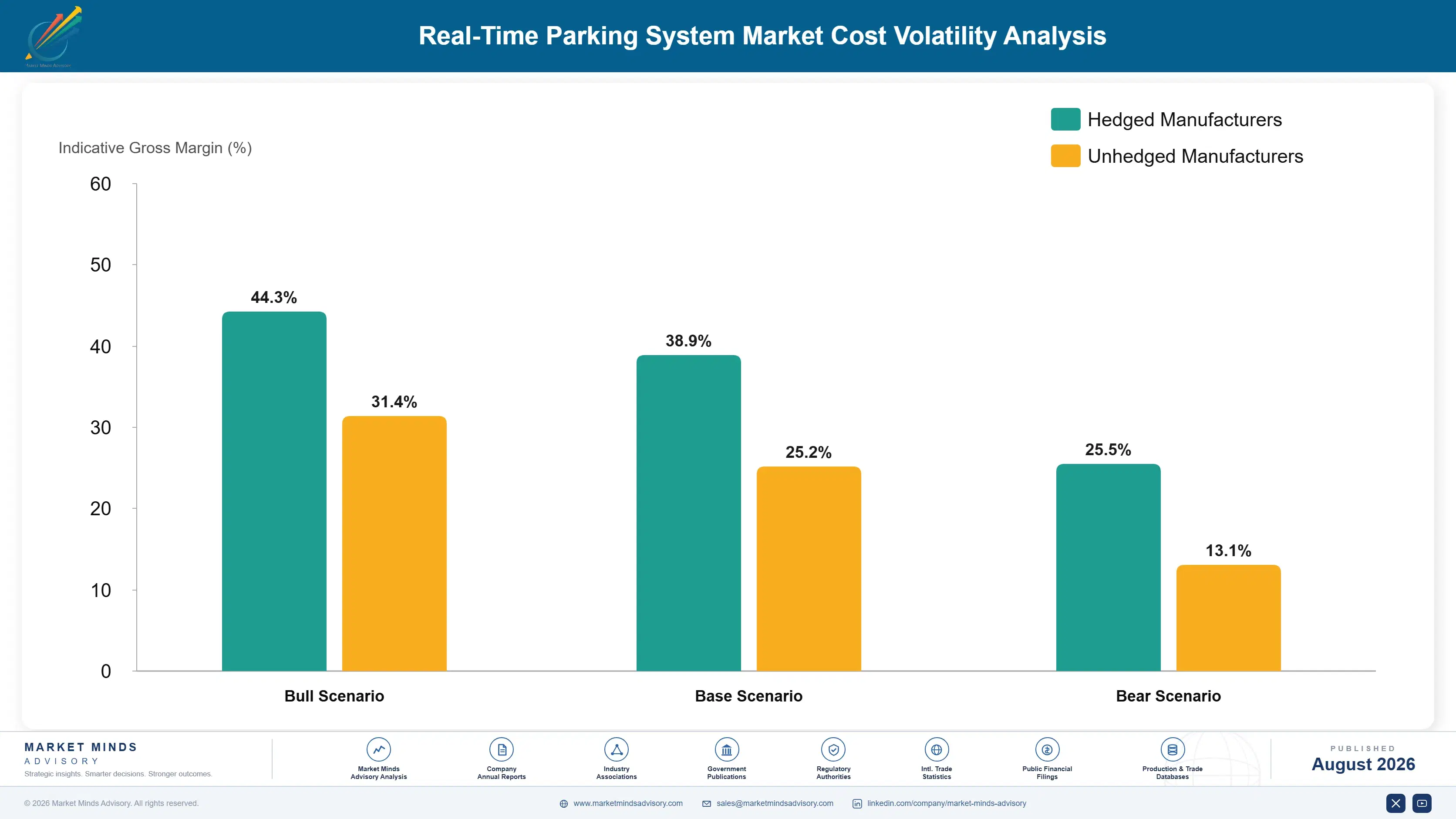
Detection hardware, gateways and signage account for roughly 34% of delivered project cost, with image sensors and processing silicon the dominant content inside them. Software development and integration engineering add around 26%. Installation, mounting, cabling and civil work contribute a further 22%, which rises sharply on in-ground sensor deployments requiring road cutting. Project management, commissioning and compliance documentation account for about 9% across a typical municipal project.
The 2021 semiconductor shortage delayed camera and controller deliveries by many months and pushed several municipal deployments past funding deadlines, which was an expensive lesson in single-sourced components inside long-cycle public procurement. Installation labour has risen steadily since alongside construction wages generally. Amano Corporation Annual Report 2025 identifies component availability and project cost inflation as continuing factors, and civil works pricing has moved with construction labour throughout.

The disadvantage mechanism is fixed-price contract exposure rather than component cost. Municipal contracts are typically fixed price across multi-year deployments, so a supplier bidding before an input move absorbs the whole swing with no adjustment route. Exposure varies by detection technology too: camera deployments avoid the civil works risk that in-ground sensor projects carry, and that risk has proved considerably more damaging than hardware pricing.
real-time-parking-system-market-trends-cost-volatility-analysis-1787322219434

Qualify detection hardware from multiple approved vendors

Cameras and sensors from two or three qualified vendors integrated behind one platform remove the single-source exposure that both semiconductor shortage and procurement restriction created. The cost is duplicated integration and validation work at platform level. Against a deployment that missed its funding deadline waiting on one vendor's hardware, that cost recovers on the first avoided delay comfortably.

Favour camera deployment over in-ground civil works

Overhead camera installation avoids road cutting, traffic management and reinstatement that in-ground sensors require, removing the construction labour exposure that has moved faster than hardware pricing. It also eliminates resurfacing damage that destroys buried installations entirely. Where mounting infrastructure exists, the choice is straightforward, and where it does not the pole cost is still modest against trenching.

Index multi-year deployment contracts to published benchmarks

Municipal programmes running three or four years at fixed price carry genuine exposure to component and labour movement nobody forecasts at bid. Indexing to published semiconductor and construction labour benchmarks moves that volatility onto a verifiable formula. Public procurement rules complicate it, though several authorities now accept indexation on longer programmes precisely because fixed pricing produced supplier failures.

Portfolio Architecture for Margin Defence

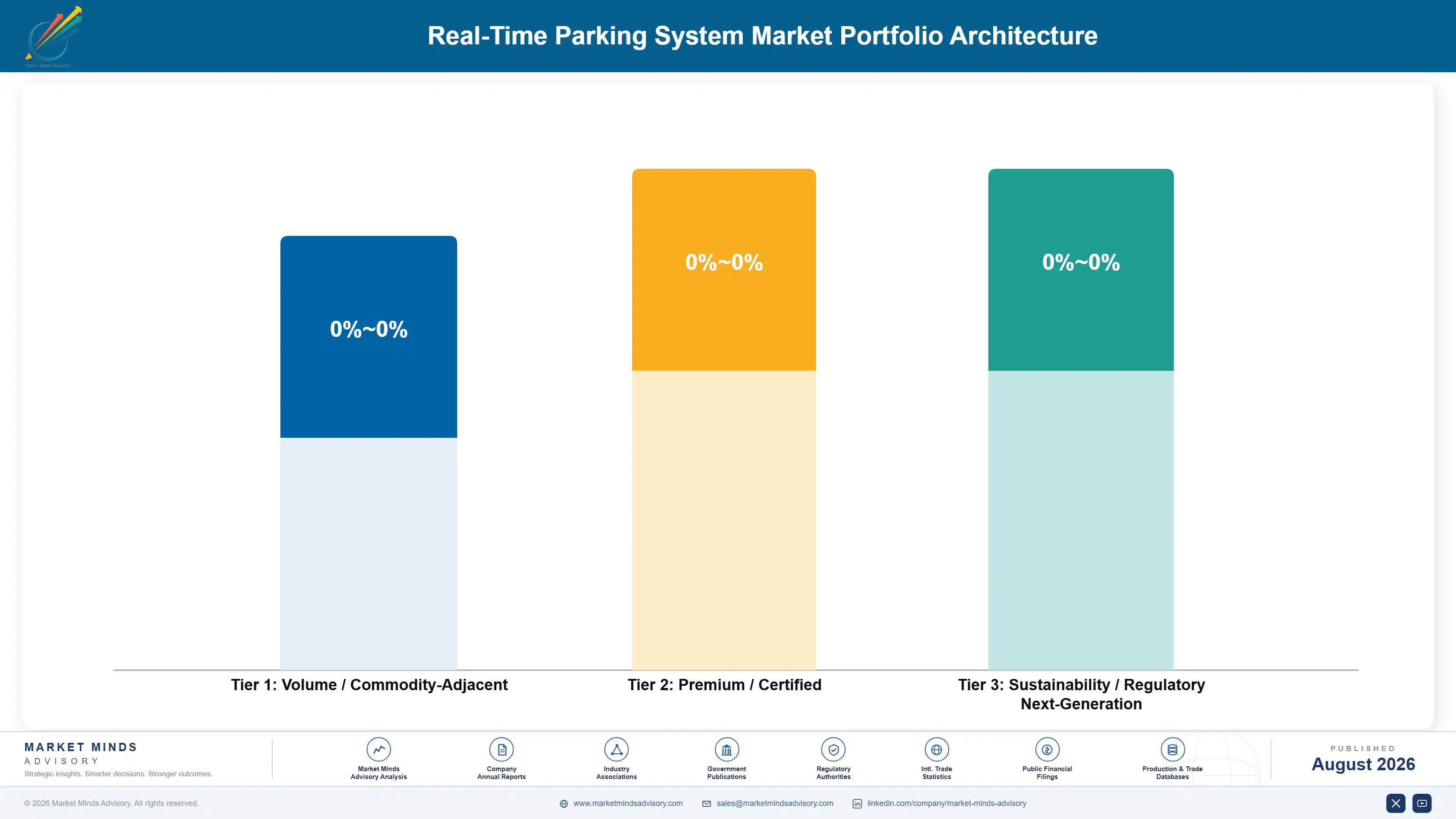
Portfolio economics here divide on recurring content rather than on subsystem. Competitively tendered detection hardware, meaning cameras, sensors or signage quoted into a specification written for comparability, earns gross margins in the high teens because several suppliers meet the requirement and price decides the award once technical compliance is established by everyone bidding. Volume secures the operator relationship rather than any margin.
The premium tier is platform and integration work. Supplying the software an operator configures zones inside, populates with permit records and builds enforcement procedures around is far harder to displace than any camera, and it positions the supplier to integrate competitors' hardware rather than the reverse. Margins run in the low to mid thirties. Platform depth decides where in that range a supplier actually lands.

Above both sits recurring software and managed service revenue. Occupancy analytics subscriptions, hosted enforcement platforms and managed detection contracts carry margins in the low forties, arrive whether or not the operator has capital budget in any given year, and hold the customer across a deployment life measured in a decade rather than at the single point of installation. Operators increasingly prefer it for exactly that reason.

Volume / Commodity-Adjacent

Competitively tendered detection cameras, sensors and guidance signage. Specifications are written for comparability, several suppliers meet them, and price decides the award once basic technical compliance has been demonstrated by every bidder.
Gross Margin: 16 to 22%

Premium / Certified

Platform supply and integration engineering across a parking estate. The range reflects how much of the operator workflow a platform genuinely owns, which varies considerably between full management suites and single-function tools.
Gross Margin: 30 to 37%

Sustainability / Regulatory / Next-Generation

Occupancy analytics subscriptions, hosted enforcement platforms and fully managed detection service contracts. The wide range spans basic data feeds through to fully outsourced estates carrying availability and detection accuracy obligations.
Gross Margin: 39 to 47%
real-time-parking-system-market-trends-portfolio-architecture-1787322219932

High-value Sub-segments and Strategic Watch-out

Managed Detection And Analytics Subscriptions

High value and high growth sitting squarely together. Recurring revenue arrives whether or not an operator holds capital budget that year, the model fits operating budgets that operators can expand more easily, and the supplier retains that customer relationship across an entire decade-long deployment life.
Gross Margin: 40 to 48%

Parking Management Platform Integration

High value running on genuinely steady underlying growth. Zone configuration, permit records and enforcement procedures all accumulate inside the platform across years of continuous operation, which makes any displacement genuinely difficult indeed, and it lets whoever holds that platform integrate competitors' detection hardware behind it instead.
Gross Margin: 30 to 37%

Camera Detection Deployment Projects

The expanding core of this whole market. Cost per monitored bay falls by roughly four fifths against buried in-ground sensors, which opens up estates that could never previously have justified instrumentation at all and it expands the addressable base rather than merely growing whatever already exists.
Gross Margin: 24 to 32%

Competitively Tendered Hardware Supply

The strategic watch-out sitting squarely inside this particular portfolio. Volumes here keep manufacturing loaded and maintain the operator relationships behind everything else, but the specifications are written deliberately for comparability across bidders, and nothing durable at all accrues to whoever happens to win any individual award.
Gross Margin: 16 to 22%

How Parking System Demand Repeats

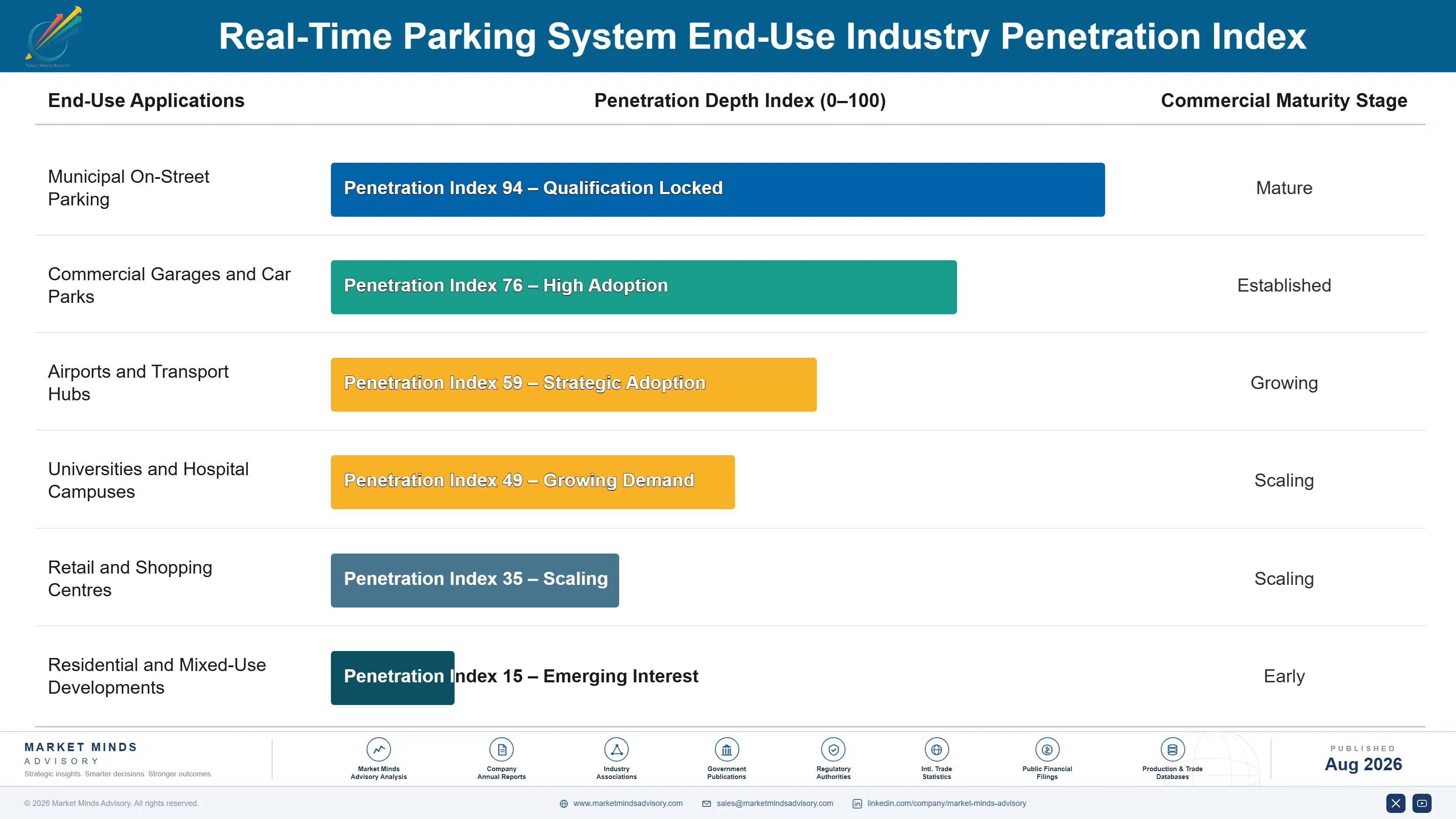
The annuity here is the operator relationship rather than any individual deployment. A parking system installed today runs for roughly a decade, generating maintenance, detection refresh, software updates and zone expansion revenue throughout, and the operator's staff build working procedures around it across that whole period. Winning the original platform decision therefore shapes ten years of spending, which is why suppliers accept thin margins on initial hardware to establish the position.
Stickiness varies sharply by component. Platform positions are the deepest, since permit records, enforcement history and zone configuration accumulate inside the software and none of it transfers cleanly to a competitor. Access control and payment terminal estates are nearly as sticky, because operators standardise deliberately to simplify maintenance and cash handling. Detection hardware is far less sticky, replaced on shorter cycles and integrated behind whatever platform exists. Enforcement contracts are the least sticky of all.

The buyer profile has shifted noticeably. Procurement once sat with parking operations managers evaluating equipment reliability and cash security in isolation. Today it increasingly involves data and technology officers weighing privacy compliance, data ownership, interoperability and hosting arrangements alongside, which favours suppliers who can answer software and regulatory questions as convincingly as operational ones.
real-time-parking-system-market-trends-end-use-penetration-index-1787322220419

Where To Compete And Why

These are among the four positions where our research anticipates prominent divergence between winners and laggards over the coming forecast period. Each is grounded in the demand model, the regulatory perimeter, and the announced capacity pipeline.
01 / RECURRING REVENUE CONVERSION

Subscriptions outlive every capital budget cycle

Software and managed services already supply 34% of supplier revenue at gross margins 22 to 30 points above hardware, and operators prefer the model because it moves cost into operating budgets they can expand more readily. Structuring occupancy analytics, enforcement dispatch and hosted management as subscriptions holds that customer across a decade-long deployment life rather than only at the point of installation. The revenue also arrives during entire budget years when no capital project happens at that operator at all.
02 / PLATFORM OWNERSHIP POSITION

Own the software that outlives the cameras

Cameras and detection sensors are increasingly commodity purchases with several credible suppliers available, while the platform holding several years of permit records, enforcement history and zone configuration is genuinely very difficult to displace at all. Suppliers holding that platform capture 28% to 36% more lifetime revenue per customer, because every subsequent hardware refresh then flows through them regardless of who actually manufactured the device. It also determines who integrates whom right across the entire operator estate for a decade or more.
03 / PRIVACY COMPLIANCE CAPABILITY

Compliance decides the municipal shortlist

Camera systems capturing plates process personal data, and European rules plus comparable regimes elsewhere impose retention limits, purpose restrictions and formal impact assessments that municipal procurement now tests explicitly before any award. Suppliers offering on-device anonymisation, occupancy classification without plate retention and documented compliance frameworks win 20% to 27% more municipal tenders than technical capability alone would ever predict. The cost involved is engineering discipline and documentation rather than any capital investment whatsoever, which makes it exceptionally cheap to establish.
04 / COMMERCIAL CUSTOMER WEIGHTING

Payback decides faster than procurement does

Garage owners, airports and campus operators buy on payback rather than policy and decide in weeks rather than the 19 months a municipal tender consumes, which transforms selling cost per contract completely for whoever pursues them. Suppliers weighted toward commercial customers turn revenue 3.2 times faster per unit of sales effort than competitors dependent on public procurement do. Municipal work carries scale and reference value commercial deployment does not, so the argument here is about mix rather than abandoning public procurement entirely.

Engagement Snapshot From the Field

A live engagement with an industry participant carrying material or product regulatory and market exposure ahead of a defining policy shift, showing how our research translates into a defensible multi-year portfolio strategy.
MARKET MINDS ADVISORY · CLIENT ENGAGEMENT SUMMARY
Real-Time Parking System Producer Strategic Portfolio Review and Transition Roadmap 2026·Investment Scenario on Real-Time Parking System Exposure Evaluation 2025-26
CLIENT PROFILE
A European supplier of in-ground parking sensors and guidance signage with annual revenue near $86 million (client-reported, unverified by MMA), roughly 88% of it from competitively tendered municipal hardware supply across seven countries. The business held strong sensor engineering and long city relationships but almost no recurring revenue, no camera detection product and no platform software of its own.
STRATEGIC CHALLENGE
Camera detection was winning deployments the client could not bid at all, and its sensor business faced replacement cycles converting to competitor cameras rather than to renewal. Margins had compressed as municipal specifications became increasingly comparable across suppliers. Management needed to choose between developing camera detection, building platform software, or pursuing commercial operators where sensor economics still worked.
MMA APPROACH
MMA modelled deployment demand and pricing across 240 European municipal and commercial parking estates by detection technology, mapped the client's installed sensor base against replacement timing, and assessed development requirements for camera detection and platform software. Twenty-one expert interviews with city parking managers, commercial operators and data protection officers tested how decisions were actually being taken.
KEY FINDINGS
  1. Roughly 78% of the client's installed sensor base faced replacement within six years, and every competitive replacement studied had converted to camera detection rather than renewing sensors.
  2. Municipal buyers ranked privacy compliance documentation above detection accuracy when evaluating camera systems, which favoured a European supplier with genuine data protection engineering over lower-cost alternatives.
  3. Commercial operators decided in six to ten weeks against the 19 month municipal average, and the client's sales cost per commercial contract was under a third of its municipal equivalent.
  4. Platform software development would take roughly 30 months, during which competitors would capture replacement deployments the client's own installed base was generating for them.
CLIENT PROFILE
A European supplier of in-ground parking sensors and guidance signage with annual revenue near $86 million (client-reported, unverified by MMA), roughly 88% of it from competitively tendered municipal hardware supply across seven countries. The business held strong sensor engineering and long city relationships but almost no recurring revenue, no camera detection product and no platform software of its own.
STRATEGIC CHALLENGE
Camera detection was winning deployments the client could not bid at all, and its sensor business faced replacement cycles converting to competitor cameras rather than to renewal. Margins had compressed as municipal specifications became increasingly comparable across suppliers. Management needed to choose between developing camera detection, building platform software, or pursuing commercial operators where sensor economics still worked.
MMA APPROACH
MMA modelled deployment demand and pricing across 240 European municipal and commercial parking estates by detection technology, mapped the client's installed sensor base against replacement timing, and assessed development requirements for camera detection and platform software. Twenty-one expert interviews with city parking managers, commercial operators and data protection officers tested how decisions were actually being taken.
KEY FINDINGS
  1. Roughly 78% of the client's installed sensor base faced replacement within six years, and every competitive replacement studied had converted to camera detection rather than renewing sensors.
  2. Municipal buyers ranked privacy compliance documentation above detection accuracy when evaluating camera systems, which favoured a European supplier with genuine data protection engineering over lower-cost alternatives.
  3. Commercial operators decided in six to ten weeks against the 19 month municipal average, and the client's sales cost per commercial contract was under a third of its municipal equivalent.
  4. Platform software development would take roughly 30 months, during which competitors would capture replacement deployments the client's own installed base was generating for them.
RECOMMENDED STRATEGY
Phase 1: Phase one: develop camera detection immediately, positioning privacy-by-design classification without plate retention as the differentiator European municipal buyers actually rank highest. Phase 2: Phase two: rebalance sales effort toward commercial operators, where decision cycles are a fraction as long and the client's cost per contract is already far lower. Phase 3: Phase three: build platform software progressively rather than as a single programme, starting with the enforcement and permit functions municipal customers ask about first.
OUTCOME
The client launched camera detection within thirteen months and retained 64% of its replacement-cycle installed base against an internal plan of 40% (client-reported, unverified by MMA). Commercial revenue rose from 12% to 29% of the total, blended gross margin improved by roughly six points, and platform development is proceeding in stages as planned.

Frequently Asked Questions

Foundational context covering the market sizes, CAGR, scope, country, region and competition that inform every finding below. This section is provided to cover basics and most often pre-purchase conversations, answered from the MMA Primary Research Dataset.

What is the current size of the Real-Time Parking System Market?

The global real-time parking system market was valued at $5.80 billion in 2025, reaching an estimated $6.37 billion in 2026. That covers occupancy detection, guidance, management software, access control and payment systems.

How large will the Real-Time Parking System Market be by 2036?

MMA forecasts the market reaching $16.22 billion by 2036, an increase of $9.85 billion over the 2026 base. That represents an expansion multiple of 2.55 times across the forecast period.

What is the CAGR for the Real-Time Parking System Market 2026 to 2036?

The base case compound annual growth rate is 9.8%, with a bull case of 11.0% and a bear case of 8.6%. Historical growth between 2020 and 2025 ran at 8.4% annually.

Which segment is growing fastest?

Camera-based occupancy detection grows at 14.7%, a full 1.50 times the market rate, by cutting cost per monitored bay dramatically. Parking management and enforcement software follows at 12.2% annually.

Who are the major companies in the Real-Time Parking System Market?

Hikvision, Amano Corporation, SKIDATA, FlashParking and Nedap lead on instrumented space deployment. Together they account for roughly 18% of the market, which is exceptionally fragmented.

Which country is growing fastest?

India grows fastest at 12.8% annually, driven by vehicle populations that long ago outgrew formal parking provision plus smart city programme funding across dozens of cities. Vietnam and Saudi Arabia follow.

Report Segmentation Architecture

The full report scope spans multiple orthogonal segmentation dimensions, with cross-tabulated demand data provided for each dimension pair. Coverage extends further to regional breakdowns, trend trajectories, and the competitive detail needed to support segment-level decision-making.

By System Function

  • Camera-Based Occupancy Detection
  • Parking Management and Enforcement Software
  • In-Ground and Overhead Occupancy Sensors
  • Guidance Signage and Wayfinding Systems
  • Access Control, Barrier and Payment Terminals

By End-Use Industry

  • Municipal On-Street Parking
  • Commercial Garages and Car Parks
  • Airports and Transport Hubs
  • Universities and Hospital Campuses
  • Retail and Shopping Centres
  • Residential and Mixed-Use Developments

By Commercial Dimension

  • Municipal Competitive Tender Supply
  • Commercial Operator Direct Sales
  • Subscription and Managed Service Contracts
  • System Integrator Channel Supply
  • Concession and Revenue Share Arrangements

By Region

  • North America
  • Western Europe
  • East Asia
  • South Asia and Pacific
  • Latin America
  • Middle East and Africa
  • Eastern Europe

Scope, Methodology, and Coverage

Every figure in this report is reproducible from documented input assumptions. The scope below maps the historical period, the forecast horizon, the segmentation dimensions, and the countries covered, alongside the underlying primary and qualitative methodology.
Historical Period
2020 to 2025
Forecast Period
2026 to 2036
Base Year
2025 (USD billions; MMA Primary Research Dataset, August 2026)
Market Definition
This report covers real-time parking systems providing live occupancy awareness and management, spanning camera-based and in-ground occupancy detection, guidance signage and wayfinding, parking management and enforcement software platforms, access control and barrier equipment, and payment terminals integrated with those systems, across municipal on-street, commercial garage, airport, campus, retail and residential applications. Parking structure construction, standalone unmonitored payment meters, valet operations, electric vehicle charging hardware and general traffic signal control are excluded from the sizing.
Quantitative Units
USD billions at supplier realised value; instrumented parking spaces in millions; average instrumentation cost in USD per monitored bay.
Segmentation Dimensions
By system function; by end-use industry; by commercial dimension; by region.
Regions Covered
North America, Western Europe, East Asia, South Asia and Pacific, Latin America, Middle East and Africa, Eastern Europe
Countries Covered
China, Japan, South Korea, India, Singapore, Australia, Indonesia, Germany, Netherlands, France, United Kingdom, Sweden, Spain, United States, Canada, Mexico, Brazil, United Arab Emirates, South Africa, Poland.
Key Companies Profiled
Hikvision, Amano Corporation, SKIDATA, FlashParking, Nedap, Dahua Technology, Keytop, Q-Free, Cleverciti, Smart Parking Limited, TIBA Parking Systems, Scheidt and Bachmann, T2 Systems, EasyPark Group and others.
Quantitative Methodology
Primary survey, n=3,800 respondents, Q4 2025, six countries; demand-side model with trade association cross-validation
Qualitative Methodology
47 expert interviews, Q4 2025; applied to validate demand model assumptions, identify emerging dynamics, and assess competitive positioning
Report Format
PDF and XLSX data workbook (Word format preview document)
Publisher
Market Minds Advisory
Report Code
MMA-2026-TEC-012
Published
August 2026
Contact
sales@marketmindsadvisory.com | www.marketmindsadvisory.com

Purchase the full Real-Time Parking System Market Report (2026 to 2036).

The full report sizes the real-time parking system market across five system functions, six end-use industries and seven regions, with instrumented space and pricing detail behind every value estimate. It profiles twenty global suppliers on platform ownership, recurring revenue conversion and privacy compliance capability. Regional chapters cover curb management policy, municipal procurement structures and data protection requirements by market. Technology analysis quantifies cost per monitored bay across detection approaches and the addressable expansion camera economics create. Commercial model analysis tracks the shift from capital hardware toward subscription and managed service delivery.
Instrumented space and pricing detail by system function
Cost per monitored bay across detection technologies
Curb pricing policy adoption tracked through 2036
Privacy compliance requirement mapping by jurisdiction
Competitive position assessments across twenty global suppliers
Commercial versus municipal decision cycle benchmarking

Built For The People Who Decide

From boardroom strategy to bench-side execution, this report is read cover-to-cover by leaders shaping the next decade of their industry, turning demand scenarios, market dynamics and valuation benchmarks into decisions.
CXOs/ Presidents/ VPs/ Managers
M&A and Corporate Development
Strategy Teams and R&D Heads
Procurement and Product Directors
Regulatory and Compliance Leaders
Investor Relations and Equity Analysts