
Market Minds Advisory
Powerglide Shifter Market

Powerglide Shifter Market: Powerglide Shifter Market: Air Actuation, Sportsman Participation and a Sixty-Year-Old Transmission

Pneumatic actuation is spreading from professional classes down into sportsman bracket racing, direct online selling has cut out the traditional speed shop, and the transmission underneath it all was designed in 1962.

Lead Analyst

David Horsley

Published

August 2026

Make Smarter Decisions with Customized Research Insights

Request a free sample report and evaluate market opportunities, growth trends, and competitive dynamics relevant to your business needs.

2025 MARKET VALUE$0.1BMarket Size 2025
2036 FORECAST VALUE$0.1BBase Case , 2026 to 2036
CAGR 2026 TO 20364.4 %Bull 5.6% / Bear 3.2%
INCREMENTAL OPPORTUNITY$0.1BNet 10- year value creation
EXPANSION MULTIPLE1.54x2036 value over 2026 base
Strategic Levers
M&A Pipeline
Regional Outlook
Country Rankings
Competitive Intelligence
Segmental Deep-dive
Call-Us : 91 93563 13602

Executive Snapshot and Market Trajectory.

The Powerglide is a two-speed automatic that General Motors stopped fitting to production cars in 1973, and drag racers have never found anything better. Two gears means one shift, one shift means one thing to get wrong, and in a sport decided by hundredths that simplicity has proved unbeatable.
Pneumatic air shifter systems grow at 6.6%, a full 1.50 times the market rate, because a compressed air actuator shifts identically on every pass regardless of what the driver's hand happens to be doing, and consistency is precisely what bracket racing rewards far above outright speed. North America holds 68% of global value, far outside the standard band, because drag racing is an American sport and the Powerglide is an American transmission.
Concentration sits at 58% for the top five, high for a market this small, and it reflects how much runs on reputation. Racers buy what worked for somebody they personally watched win, and a component carrying a genuine track record is worth far more than any specification sheet. New entrants consistently find that barrier far harder to clear than any manufacturing challenge they face.
Market Definition
This report covers shifter assemblies, actuation systems and associated linkage hardware for Powerglide and comparable two-speed racing automatic transmissions, spanning manual gate and ratchet shifters, pneumatic air shifters, electronic actuation systems and cable-operated street units. Complete transmissions, torque converters, valve bodies, transmission internals, transmission coolers and shifters for three and four-speed automatic or manual gearboxes are excluded from the sizing.
Base Year Value
$0.1B in 2025 (MMA Primary Research Dataset, August 2026)
Forecast Period
2026 to 2036, eleven discrete annual values
CAGR
4.4% base case. Bull 5.6%. Bear 3.2%.
Fastest Growth Segment
Pneumatic Air Shifter System: 6.6% CAGR
Fastest Growth Country
India: 7.2% CAGR
Fastest Growth Region
South Asia and Pacific: 6.6% CAGR
Largest Region
North America: 68% of 2025 global value
Market Leaders
Holley Performance Brands, ATI Performance Products, Biondo Racing Products, Precision Performance Products and Dedenbear Products lead on unit shipment volume. Source: MMA Analysis, July 2026.
Primary Survey
n=3,800 procurement and R&D decision-makers, Q4 2025, six countries
Methodology
Demand-side build-up, cross-validated against public data, 47 expert interviews

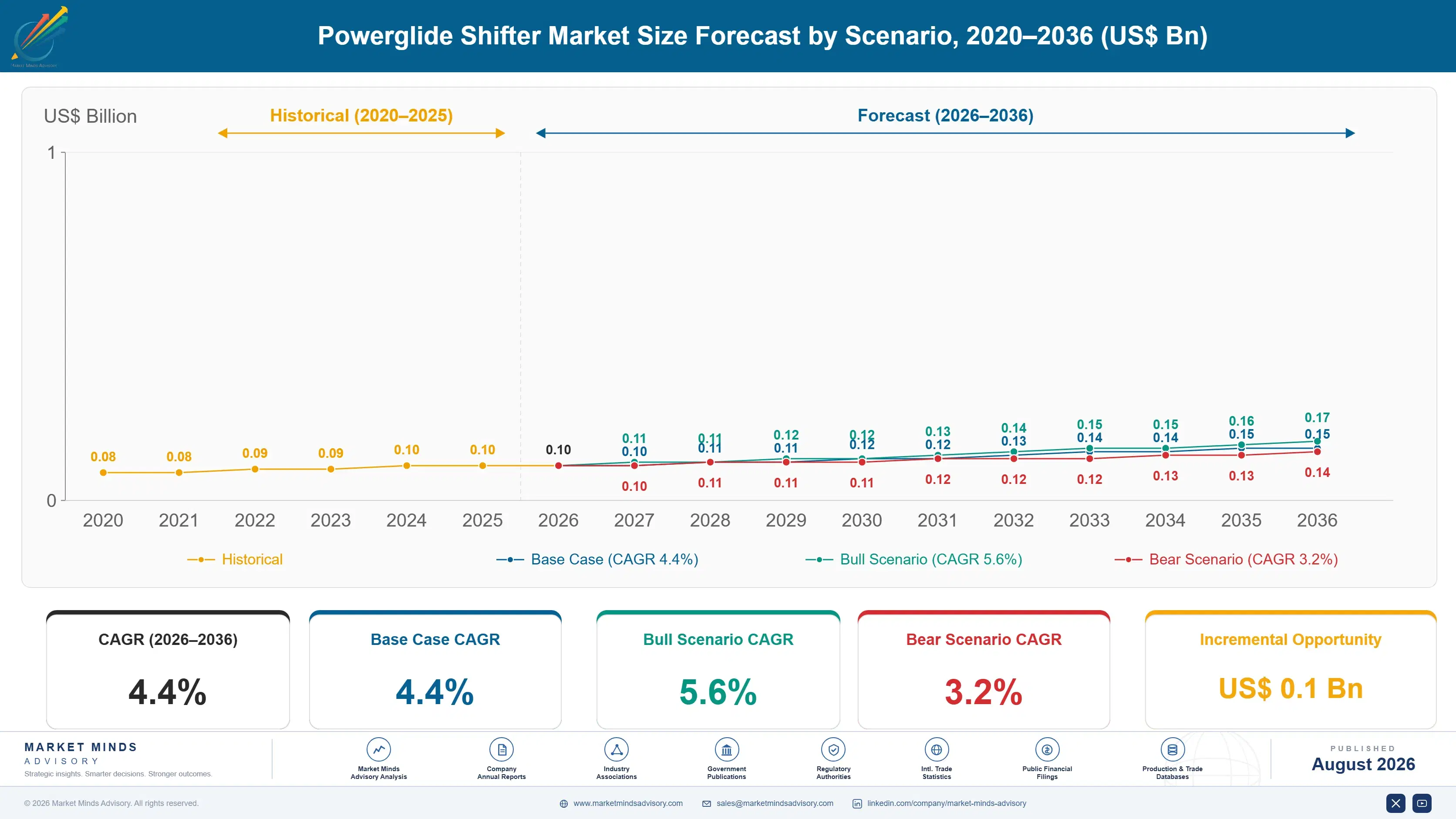
Powerglide Shifter Market Forecast Scenarios

powerglide-shifter-market-size-forecast-scenario-1787334610212
Between 2020 and 2025 the market compounded at 3.4%, and participation rather than product explains most of it. Track closures and event cancellations through 2020 removed a racing season almost entirely, and the recovery that followed brought competitors back with equipment that needed replacing. Air shifter adoption spread steadily through sportsman classes across the same period, lifting average realised price ahead of unit volume.
The base case at 4.4% rests on three mechanisms. Air and electronic actuation keep displacing manual shifters as sportsman racers pursue the consistency that bracket competition rewards, and both carry considerably higher pricing than manual product. Direct online selling continues shifting margin from distributors toward manufacturers who reach racers themselves. International participation grows modestly across Australia, the Gulf and Scandinavia, where competitors buy at the top of the range without much price sensitivity at all.
The bull case at 5.6% turns on sportsman participation recovering toward pre-2020 levels across American regional tracks, which is where the volume genuinely sits. The bear case at 3.2% is continued track closure and an ageing competitor base: American drag strips keep closing under development pressure, and every closure removes a local racing community that will not reassemble elsewhere.

What Actually Drives Racing Shifter Value

Understanding this market requires understanding why a transmission from 1962 still wins races. The Powerglide has two forward gears, which means exactly one upshift per pass. Fewer parts spinning means less rotating mass to accelerate, and one shift means one opportunity for something to go wrong rather than three.
TOP FIVE CONCENTRATION58%Share held by the five largest racing shifter manufacturers
AVERAGE UNIT PRICE$420Typical realised price for a competition shifter assembly
SANCTIONED EVENT COUNT3,400 eventsDrag racing meetings run annually across sanctioning bodies
ALUMINIUM COST SHARE34% of COGSBillet and casting content as portion of unit cost
COMPONENT REPLACEMENT INTERVAL3 seasonsTypical competitive life before a shifter is replaced
DIRECT SALES SHARE37%Portion of volume sold direct to racers online
The shifter is what executes that single event, and in bracket racing the value of executing it identically every time is difficult to overstate. A competitor whose car runs within hundredths of the same elapsed time pass after pass wins events; one whose times scatter does not, regardless of how quick the car is at its best. That is why pneumatic actuation has spread from professional classes down into sportsman racing, because an air cylinder does not have a good day or a bad one.
Commercially this is a small market that behaves unusually. Reputation carries far more weight than specification, since a racer choosing between two shifters is essentially asking who wins with which. Direct online selling now takes 37% of volume, which has compressed the traditional speed shop channel considerably, and manufacturers reaching racers themselves keep margin that distribution used to absorb.
"There is something instructive about an industry where the winning product design is sixty years old and the competitive advantage is entirely about doing one simple thing the same way every single time. Most engineering markets would benefit from thinking that way and almost none of them do."
Practice Director, Motorsport and Performance Aftermarket, Market Minds Advisory ·

Market Trends

Pneumatic Actuation Spreads From Professional Into Sportsman Classes

Air shifters were once professional equipment and now appear routinely on bracket cars at regional tracks. Consistency explains it entirely. A compressed air cylinder executes the upshift at exactly the same point every pass regardless of the driver's reaction, grip or fatigue, and bracket racing rewards repeatability far more than outright speed. Complete air systems run roughly 2.4 times a quality ratchet shifter once the bottle, regulator and plumbing are counted. Sanctioning bodies now permit them across most sportsman categories, which removed the last real obstacle standing in the way of adoption.
Market Impact: Runs 3,400 annual events
Direct Online Selling Displaces The Traditional Speed Shop

Manufacturers now sell 37% of volume directly to racers through their own channels, bypassing the distributor and speed shop layer that carried this market for decades. Racers research components through forums, results and video far more than through counter conversations, which removed most of the advisory function that justified the traditional channel. Manufacturers capture margin that distribution previously absorbed and gain direct contact with the customers whose feedback drives product development. Specialist distributors now survive on inventory depth and immediate availability during racing season rather than on any advice they offer.
Market Impact: Covers 70% of automatic entries

Market Opportunities and Growth Drivers

Bracket Racing Participation Sustains Predictable Replacement Demand

Sportsman bracket racing at regional tracks is where the volume genuinely sits, and roughly 3,400 sanctioned meetings run annually across the major bodies. A competitive shifter lasts around three seasons before wear affects the consistency that is the entire point of owning it, which generates replacement demand entirely independent of any new competitor ever joining the sport. The economics also favour replacement over repair, since a rebuilt shifter costs most of a new one and carries a doubt that any racer chasing hundredths of a second simply will not accept.
Market Impact: Lost 40 tracks since 2018

Powerglide Dominance Concentrates Demand On One Transmission

Racers have tested every automatic transmission available and keep returning to a two-speed designed in 1962, because one shift beats three when consistency decides outcomes and lower rotating mass beats gear spread when the whole run lasts eight seconds. That concentration is commercially valuable to shifter manufacturers, since development effort concentrates on one shift pattern and one linkage geometry rather than fragmenting across many different transmissions. Aftermarket case and internals manufacturing has also removed the core supply constraint that once limited how many of these transmissions could actually be built.
Market Impact: Average competitor aged 52

Market Restraints and Challenges

American Track Closures Remove Local Racing Communities Permanently

Drag strips across the United States have been closing steadily under development pressure, noise complaints and land values that make racing an uncompetitive use of the ground. The root cause is real estate economics rather than any decline in interest. Commercially each closure removes a local community of competitors who mostly do not relocate to another track two hours away, and the equipment demand simply disappears with them. Participants are responding by supporting track preservation efforts, by sponsoring regional series, and by building international distribution where facilities are being built rather than closed.
Market Impact: Costs 2.4 times ratchet shifter

Ageing Competitor Base Narrows The Replacement Buyer Pool

The average sportsman drag racer is older than the average participant in almost any other motorsport discipline, and replacement rates among younger competitors have not kept pace with attrition. The root cause is cost and time rather than any lack of interest, since a competitive bracket car and a full season of racing demand both in considerable quantity. Commercially this narrows the pool of buyers who will replace equipment every three seasons. Participants are responding with junior dragster support, entry-level product ranges and finance arrangements that lower the entry barrier considerably.
Market Impact: Takes 37% of unit volume
3 additional market trends, 2 additional growth drivers, and 4 additional restraints and challenges are covered in the full report. Contact sales@marketmindsadvisory.com to access the complete intelligence.

Segment CAGR and Growth Architecture

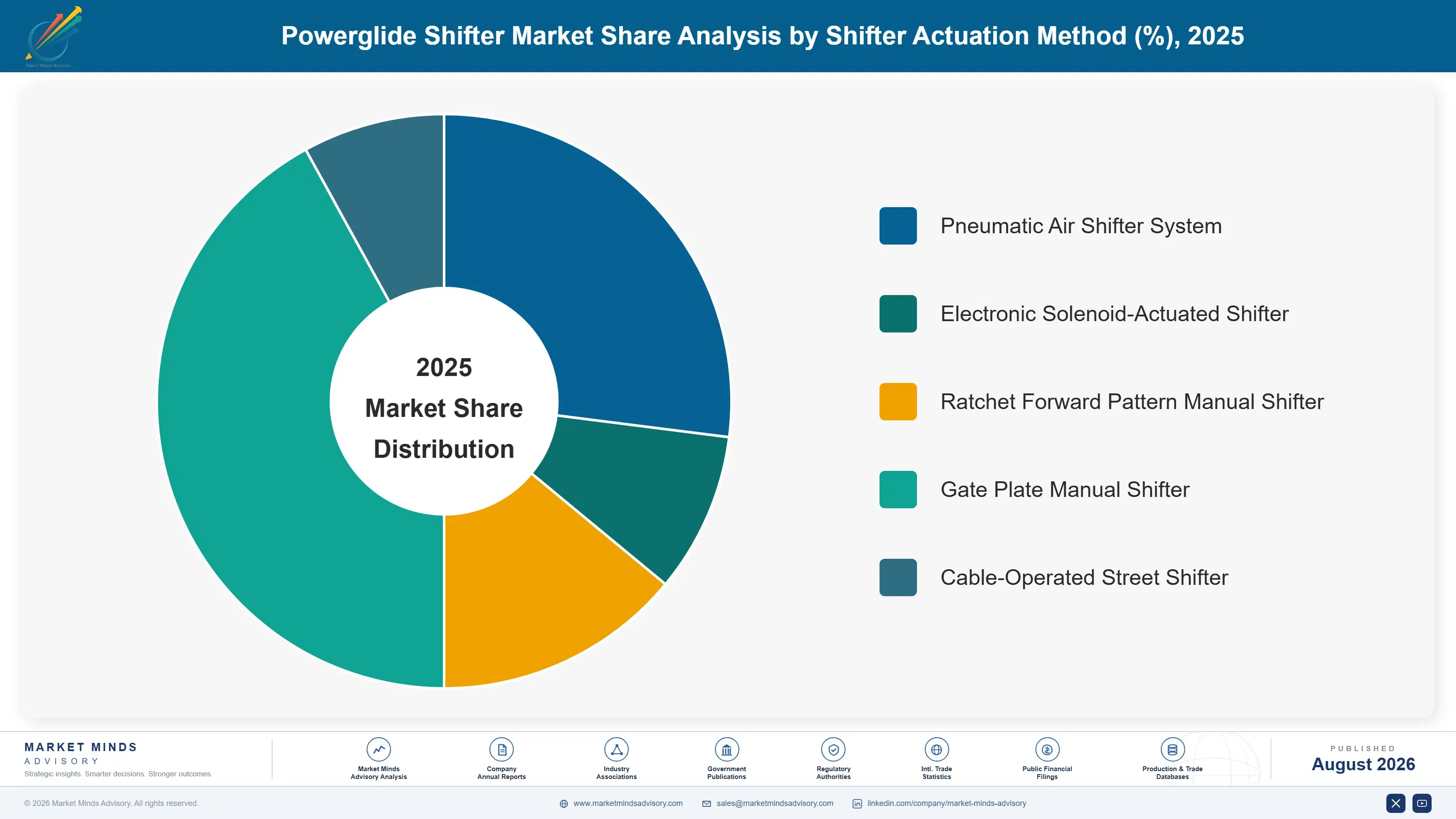
Segmentation follows shifter actuation method, because how the gear change is initiated determines consistency, the price a competitor will pay, the sanctioning categories the equipment is permitted in and the manufacturing capability required to build it. Housing material, pattern layout and mounting arrangement all sit downstream of that actuation decision and are priced against it.
powerglide-shifter-market-market-share-analysis-1787334610738

Pneumatic Air Shifter System

The fastest segment at 6.6%, a full 1.50 times the market rate, covering shifters actuated by a compressed air cylinder triggered electrically rather than by the driver moving a lever. Consistency is the entire argument and it is not a marginal one. An air cylinder executes the upshift at precisely the same point on every pass regardless of the driver's reaction time, grip strength or fatigue late in an event, and bracket racing rewards repeatability far above outright speed. Complete systems run roughly 2.4 times a quality ratchet shifter once the bottle, regulator, solenoid and plumbing are all counted. Sanctioning bodies permit them across most sportsman categories, which removed the final obstacle that had confined them to professional classes.
CAGR 6.6%

Electronic Solenoid-Actuated Shifter

Growing at 5.4% on shifters using electric solenoid actuation triggered by a timer, a driveshaft sensor or an engine management output rather than by air pressure. Packaging and simplicity favour them over pneumatic systems, since there is no bottle to fill, no regulator to set and considerably less plumbing to leak at exactly the wrong moment. The trade is actuation force, because a solenoid struggles to match what an air cylinder delivers on a transmission requiring firm engagement. Sanctioning rules also treat electronic actuation carefully, since anything triggered by a timer sits close to prohibited automation, and category regulations vary enough between bodies that careful competitors check the rulebook before buying anything.
CAGR 5.4%
Full segment breakdown across 5 segments available in the complete report.

Regional Architecture and Country Demand Map

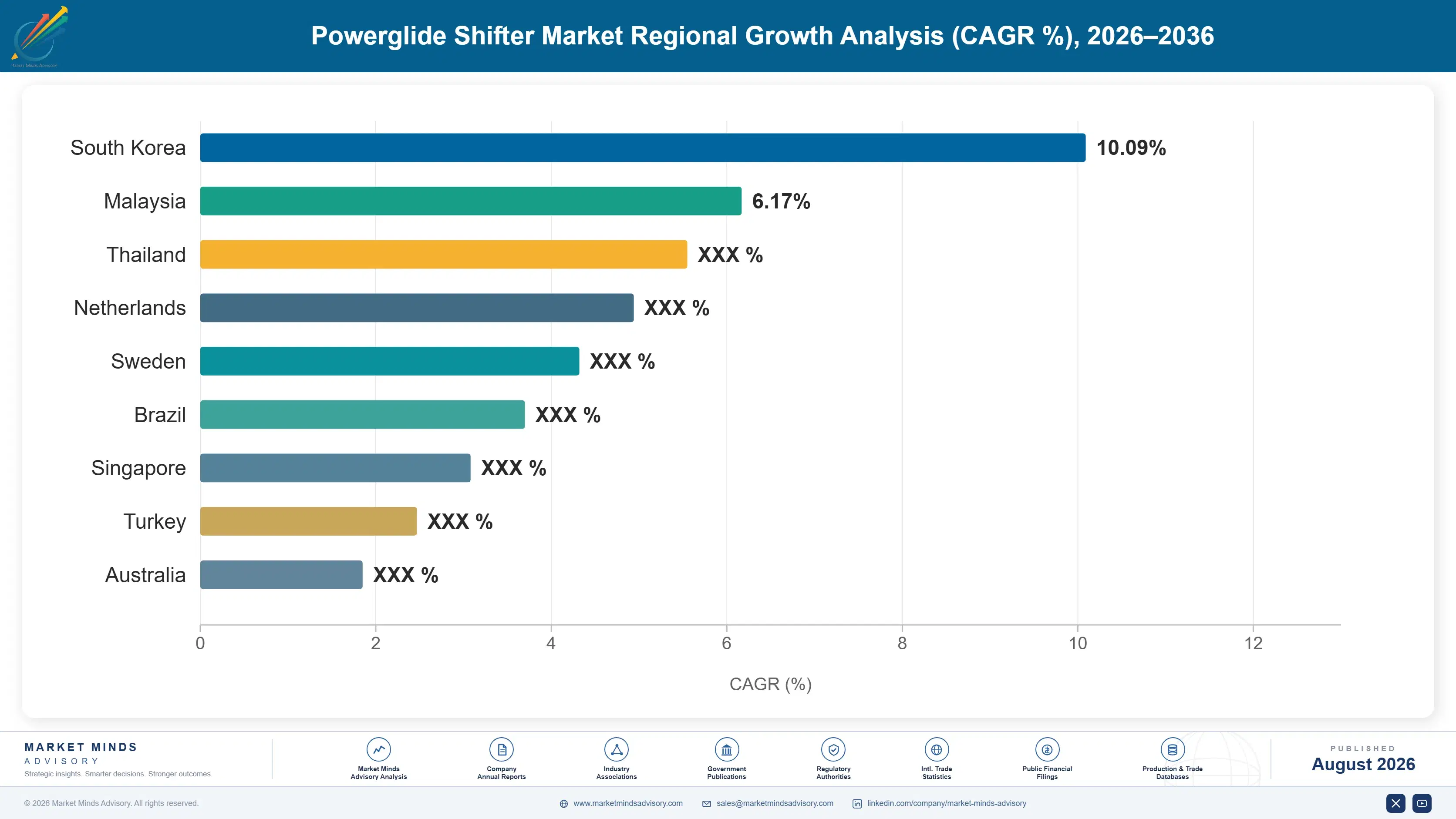
North America holds 68% of global value because drag racing is an American sport and the Powerglide is an American transmission, with manufacturing concentrated alongside. Australia anchors the second largest base, and growth runs fastest across South Asia and Pacific from genuinely small starting points.

North America

Note: North America holds 68% against a 22 to 32% band because drag racing is an American sport and the Powerglide is an American transmission, and neither fact admits much argument. The National Hot Rod Association and International Hot Rod Association between them sanction the overwhelming majority of world drag racing events, and bracket racing at local eighth-mile tracks is where most shifters are actually bought. Manufacturing sits here too, almost entirely in small specialist shops across California, Michigan, Ohio and the Carolinas. Every serious product development in this category has originated within a day's drive of an American drag strip. Nothing about that concentration looks remotely likely to change soon.
Share: 68% | CAGR: 3.9% (2026 to 2036)

South Asia and Pacific

Australia carries this region and does so with genuine depth. Drag racing there has an established sanctioning structure, purpose-built strips at Sydney, Perth and Willowbank, and a competitor base that buys American driveline components without hesitation. Import freight and duty push realised pricing well above United States levels, which supports a modest local distribution layer. New Zealand contributes proportionally more competitors than its population suggests. Indian and Southeast Asian activity is small but growing from an extremely low base, concentrated around a handful of events, and the equipment arriving there is generally second-hand rather than newly purchased. Australian competitors buy at specification levels matching American practice closely, which makes the market disproportionately valuable.
Share: 9% | CAGR: 6.6% (2026 to 2036)
Regional intelligence for 5 additional markets available in the complete report: Western Europe, East Asia, Latin America, Middle East and Africa, Eastern Europe. Contact sales@marketmindsadvisory.com.
powerglide-shifter-market-country-cagr-analysis-1787334611253

Where Racing Shifter Margin Is Won

Four commercial positions separate the manufacturers earning genuine margin from those machining competent parts on reputation borrowed from somebody else entirely: building visible competition credibility, selling direct to racers rather than through traditional distribution, moving mix toward actuated systems, and holding genuine sanctioning body engagement so that products stay legal in the categories that actually matter.

Build Competition Credibility Racers Can Actually See

Racers buy what wins, and a component carrying visible results behind it commands 20% to 28% higher pricing than a technically identical part without any. Contingency programmes, class sponsorship and supported competitors all cost real money, but between them they generate the only evidence that this market genuinely accepts. The spending looks like marketing and behaves far more like product development, because feedback from supported racers surfaces failure modes that no bench test produces. New entrants consistently underestimate how completely reputation substitutes for specification in this particular market. Nothing else in this market works.
Market Impact: Commands 28% higher pricing on othe

Sell Direct Rather Than Through Traditional Distribution

Direct online selling already takes 37% of total volume, and manufacturers reaching racers themselves keep 22 to 30 points of margin that the distributor and speed shop layer had previously absorbed entirely. Racers now research through forums, published results and video footage rather than counter conversations, which removed most of the advisory function that had justified that channel. Direct contact with racers also generates exactly the customer feedback that drives product development, which is worth as much commercially as the retained margin itself in a market this specialised. The channel shift is largely irreversible.
Market Impact: Retains 30 margin points across all

Move Mix Toward Actuated Rather Than Manual Systems

A complete pneumatic system realises roughly 2.4 times a quality ratchet shifter once the bottle, regulator, solenoid and plumbing are all counted, and the manufacturing content behind that premium is genuinely modest relative to the price difference. Manufacturers moving their mix toward actuated systems hold 14 to 20 points more gross margin on exactly the same customer. The engineering involved is pneumatic control rather than anything remotely exotic, which makes the transition genuinely achievable for any shop already producing quality mechanical shifters at all. Most competent shops can make that move.
Market Impact: Realises 2.4 times the manual shift

Hold Sanctioning Body Engagement So Products Stay Legal

Electronic actuation sits close to the automation boundary that sanctioning rules police carefully, and a product ruled illegal in a major category becomes commercially worthless overnight regardless of how well it actually works. Manufacturers engaged with rule-making committees shape those decisions toward designs they already produce, and they avoid 100% write-offs on tooling committed against a ruling that goes the other way. The engagement costs committee meeting time rather than any capital at all, which makes it comfortably the cheapest insurance available anywhere in this business. Very few manufacturers bother turning up.
Market Impact: Avoids 100% write-off on any ruled-

Who Controls the Margin Pool

Concentration sits at 58% for the top five measured on unit shipment volume across manufacturers and specialist distribution, the basis used throughout this section. Holley Performance Brands leads through several acquired heritage names that racers still recognise individually, while ATI, Biondo, Precision Performance and Dedenbear hold strong positions built on competition results rather than on scale. The gap to the next tier reflects reputation more than manufacturing capability.
Competitive activity runs on three fronts. Competition credibility is the first and the most consequential, since racers buy what wins and no amount of specification substitutes for that. Direct channel reach is the second, and manufacturers who built it early keep margin that competitors still share with distribution. The third is actuated system development, where pneumatic and electronic products carry the pricing that manual shifters never will.

Pressure comes from two directions. Low-cost imported shifters compete on price at the entry level, though they rarely win competitive business where consistency matters. Separately, consolidation under larger performance groups has changed how heritage brands are managed. Rankings shift slowly here, because a reputation built across decades of results does not erode in a season or two.
powerglide-shifter-market-company-positioning-matrix-1787334611779

Competitive Moat and Risk Dimensions

HOLLEY PERFORMANCE BRANDS

Moat: Heritage brand portfolio depth

Owning several shifter names that racers have recognised individually for decades gives the group presence across price points and categories that no single brand achieves, and each name carries its own competition history. Distribution reach and manufacturing scale across the wider performance portfolio also spread cost across volumes that specialist shifter builders cannot approach at all.
HOLLEY PERFORMANCE BRANDS

Risk: Corporate ownership credibility erosion

Racers are unusually alert to heritage brands being managed as portfolio assets rather than as engineering businesses, and any perception that product decisions are made by finance rather than by people who race damages credibility quickly. Specialist competitors trade explicitly on being racer-owned, which is a position a large group cannot occupy at all.
ATI PERFORMANCE PRODUCTS

Moat: Competition results and driveline breadth

Deep competition credibility built across decades of professional and sportsman results is precisely the evidence this market accepts, and supplying transmissions, converters and shifters together means the shift quality argument is made across the whole driveline rather than one component. Racers buying a matched package rarely split the order between suppliers.
ATI PERFORMANCE PRODUCTS

Risk: Concentration in a shrinking sport

Revenue depends almost entirely on American drag racing participation, and track closures plus an ageing competitor base both narrow that pool steadily. International expansion helps at the margin but the addressable communities elsewhere are small, and no adjacent motorsport discipline uses this equipment in comparable volume.

Players Tracked

Prominent Players

Holley Performance Brands
ATI Performance Products
Biondo Racing Products
Precision Performance Products
Dedenbear Products

Other Key Players

JW Performance Transmissions
Coan Racing
Rossler Transmissions
Turbo Action
Winters Performance Products
Hughes Performance
Lenco Racing Transmissions
CSR Performance Products
Moroso Performance Products
Jerico Performance Products
Art Carr Performance
Reid Racing
Sun Coast Performance
Quarter Master
Summit Racing Equipment

Recent Developments

JANUARY 2025

Air shifter system approved across additional sportsman categories

A major sanctioning body formally confirmed pneumatic shifter eligibility across several additional sportsman bracket categories during the year, which finally removes the rules uncertainty that had kept regional competitors on manual shifters despite the consistency advantage that air actuation plainly offers them over a manual lever.
Signal: Sanctioning rule clarity rather than produ
MAY 2025

Manufacturer moves entire range to direct online distribution

A specialist shifter manufacturer moved its complete product range across to direct online sale, ending the distributor supply arrangements that had carried the business for several decades and capturing directly the margin that a traditional speed shop channel had been absorbing throughout that entire period.
Signal: Direct selling is now viable enough that m
SEPTEMBER 2025

Electronic actuation ruling clarifies automation boundary for competitors

A major American sanctioning body issued formal written clarification on electronic shift actuation during the year, distinguishing permitted driver-initiated triggering from prohibited automatic shift timing systems, which resolved the uncertainty that had made competitors genuinely reluctant to commit any money to solenoid systems at all.
Signal: The automation boundary written into sanct

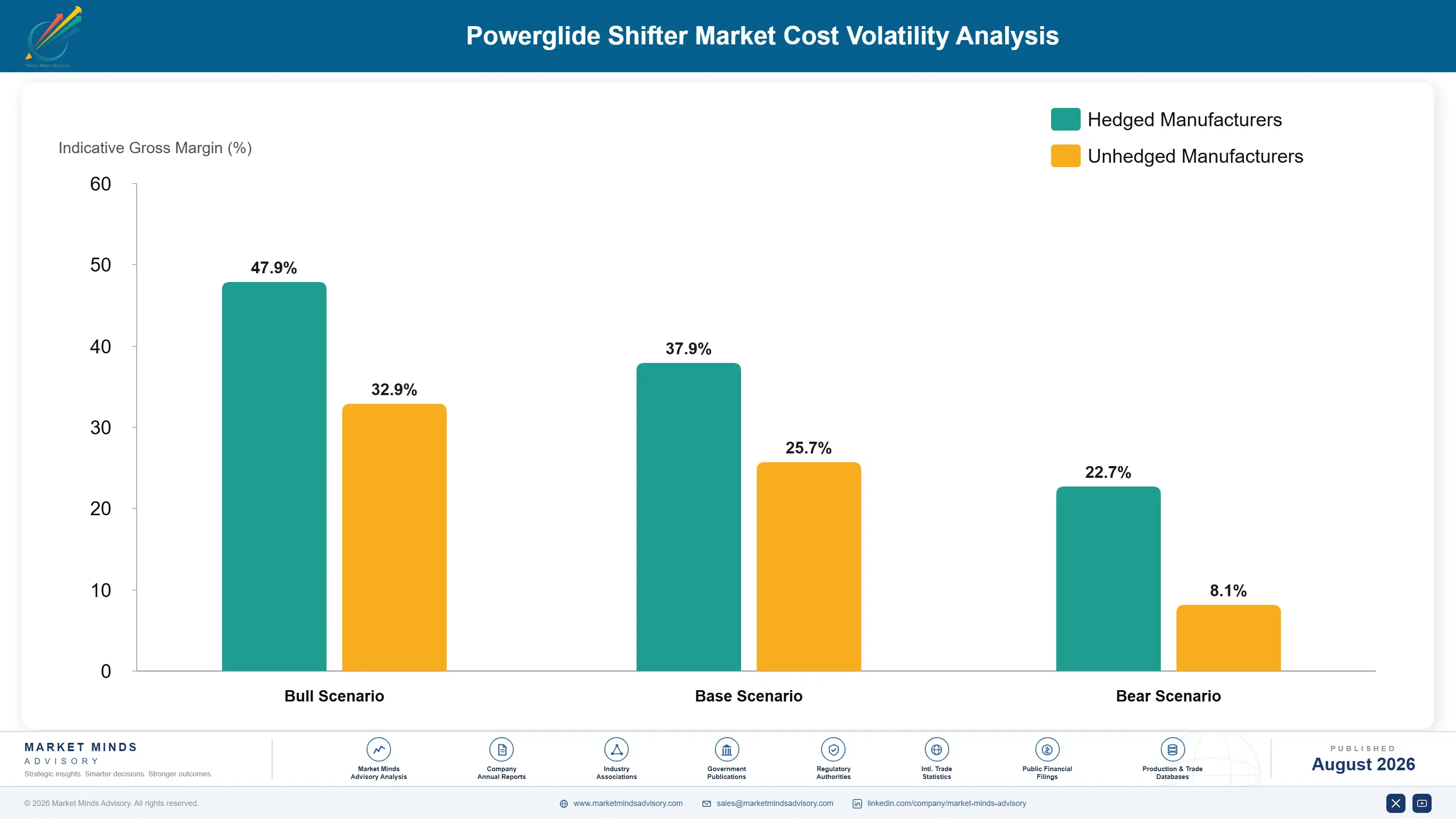
What Drives Racing Shifter Cost

Billet aluminium accounts for roughly 34% of manufactured cost, since almost every quality shifter housing, lever and mounting bracket is machined from solid rather than cast at these volumes. Machining labour contributes around 28%, unusually high because low batch quantities defeat any automation economics. Steel shafts, detents and hardware add about 12%, anodising and finishing roughly 7%, and packaging with freight a further 6%.
Aluminium pricing moved sharply during 2022 as European smelter curtailments removed capacity, and again during 2025 as tariff measures reshaped North American billet supply specifically. Machining labour rates have risen steadily since 2021 as skilled machinists became scarce and competing employers paid more. Holley Performance Brands Annual Report 2025 identifies material and labour cost as continuing pressure, and small specialist shops have felt it harder still.

The disadvantage mechanism is batch size rather than material purchasing. A manufacturer running fifty units at a time carries setup cost across each of them that a shop running five hundred spreads far thinner, and in a market this small very few participants ever reach the second position. Exposure varies by product too: actuated systems carry purchased pneumatic and electronic components where machining is proportionally less of the total.
powerglide-shifter-market-cost-volatility-analysis-1787334611974

Standardise housing geometry across the product range

Common housing blanks and mounting geometry shared across several models concentrate billet purchasing, cut setup frequency and let a shop run larger batches of the same operation. The constraint is that each model becomes slightly less optimised for its own application. Where machining labour is over a quarter of total cost, that compromise pays for itself quickly.

Batch production against racing season rather than orders

Demand concentrates heavily into the weeks before season opening, and shops filling orders individually through that window carry setup cost repeatedly on the same parts. Building to forecast during the off-season and holding inventory converts many small runs into a few larger ones. The trade is working capital tied up over winter, which small shops find genuinely difficult to fund.

Source pneumatic and electronic components from industrial suppliers

Cylinders, regulators and solenoids specified from standard industrial catalogues cost a fraction of custom parts and carry availability a bespoke component never will. Racers care how the system performs, not whose name is on the cylinder. Several manufacturers still specify custom components largely out of habit, which adds cost the customer cannot detect and would not knowingly pay for.

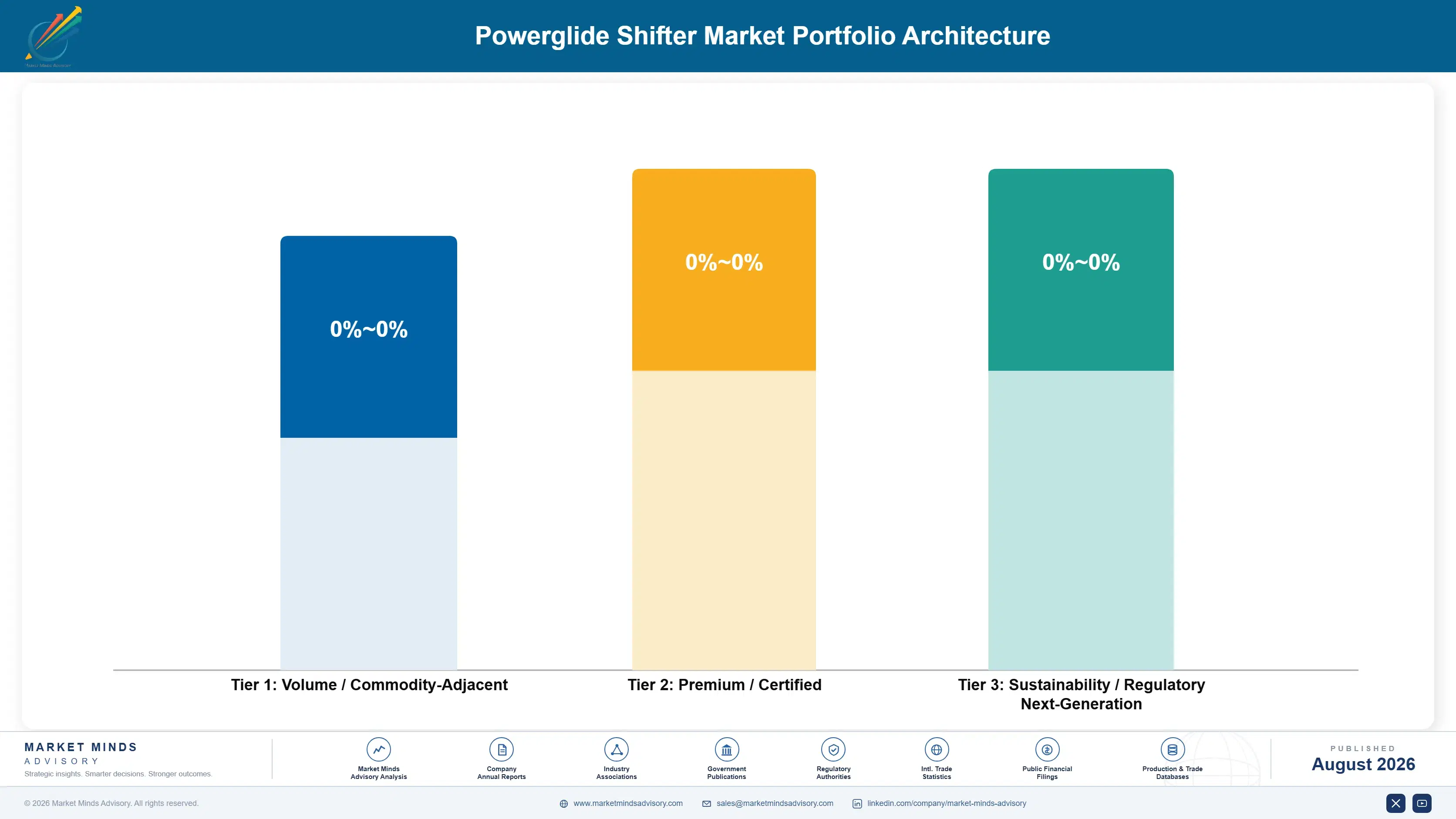
Portfolio Architecture for Margin Defence

Portfolio economics here divide on actuation content and channel rather than on anything mechanical. Entry-level cable and basic gate shifters sold through general performance retail earn gross margins in the high teens, because imported alternatives are close substitutes at that price point and buyers in that channel are building street cars rather than chasing hundredths of a second.
The premium tier is competition ratchet shifters sold on reputation. Racers buying at this level are choosing a component whose results they have seen, and the pricing reflects credibility rather than manufacturing content. Margins run in the low thirties, and the position is defended by decades of competition history rather than by anything a competitor can machine.

Above both sits actuated system supply. A complete pneumatic package realises roughly 2.4 times a quality ratchet shifter while the manufacturing content behind that premium is modest, and electronic systems carry comparable economics. Selling those direct rather than through distribution adds a further 22 to 30 points of retained margin. Margins reach the low forties, and the competitive field is limited to manufacturers whom sanctioning bodies and racers both accept.

Volume / Commodity-Adjacent

Entry-level cable and basic gate shifters sold through general performance retail. Imported alternatives substitute closely at this price point, and buyers are building street cars rather than chasing competitive consistency.
Gross Margin: 16 to 22%

Premium / Certified

Competition ratchet shifters sold on established reputation and results. The range reflects how much genuine competition history a brand carries, which varies enormously between brands and simply cannot be manufactured quickly at all.
Gross Margin: 28 to 35%

Sustainability / Regulatory / Next-Generation

Complete pneumatic and electronic actuation systems sold direct to competing racers. The wide range spans basic air setups through to fully integrated systems carrying data logging and sanctioning body approval.
Gross Margin: 37 to 45%
powerglide-shifter-market-portfolio-architecture-1787334612487

High-value Sub-segments and Strategic Watch-out

Direct-Sold Pneumatic Actuation Systems

High value and high growth sitting very squarely together here. Complete systems realise several times manual shifter revenue on genuinely modest additional manufacturing content, and selling direct to racers rather than through distribution retains the margin that a traditional speed shop channel previously absorbed almost entirely.
Gross Margin: 39 to 46%

Competition Ratchet Shifter Supply

High value running on genuinely moderate growth. Racers here buy proven competition results rather than specifications, which means pricing here reflects decades of competition credibility that no rival can simply machine, and the resulting position erodes far more slowly than any manufacturing advantage ever would.
Gross Margin: 28 to 35%

Electronic Actuation System Development

The emerging tier sitting inside this particular portfolio. Solenoid systems package considerably more simply than pneumatic ones and they suit competitors who dislike having to manage air bottles, but sanctioning rules police the automation boundary very carefully indeed, and category eligibility ultimately decides commercial viability outright.
Gross Margin: 33 to 41%

Entry-Level Street Shifter Product

The strategic watch-out sitting squarely inside this portfolio. Volumes here are real enough and the product does introduce new buyers to the brand, but imported alternatives substitute very closely, and nothing about winning that business builds the competition credibility that everything else here depends upon.
Gross Margin: 16 to 22%

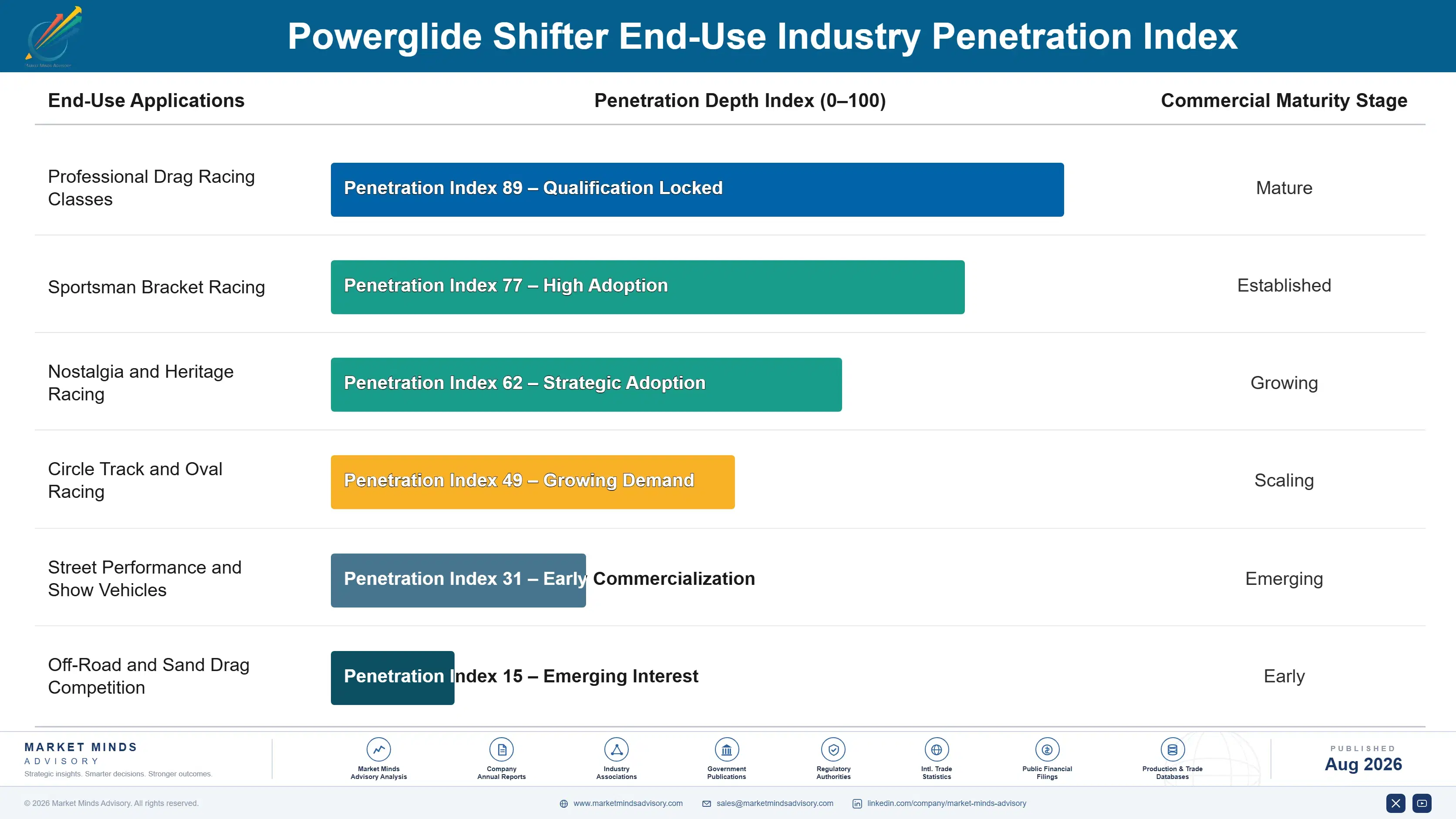
How Racing Shifter Demand Repeats

The repeat cycle here is the racing season rather than any product life. A competition shifter lasts roughly three seasons before wear affects the consistency that justified buying it, and replacement rather than repair is standard, because a rebuilt unit costs most of a new one and carries doubt nobody chasing hundredths accepts. Demand therefore arrives on a cadence tied to how many racers are actively competing.
Stickiness varies considerably by competitor type. Professional and semi-professional racers with sponsorship relationships are the stickiest, since contingency programmes tie equipment choice to money. Serious sportsman competitors are loyal to whatever last delivered consistent results and rarely experiment mid-season. Casual bracket racers switch more readily on price and availability. Street car builders show almost no loyalty at all, buying whatever the retailer stocks at the price they had in mind.

The buyer profile has shifted noticeably. Purchasing once happened at a counter with a conversation, where the shop's recommendation carried real weight. Today racers arrive having researched results, forum discussion and video footage before buying, which has removed most of the advisory role distribution once played and rewards manufacturers whose competition record is visible online rather than merely known locally.
powerglide-shifter-market-end-use-penetration-index-1787334612982

Where To Compete And Why

These are among the four positions where our research anticipates prominent divergence between winners and laggards over the coming forecast period. Each is grounded in the demand model, the regulatory perimeter, and the announced capacity pipeline.
01 / COMPETITION CREDIBILITY BUILDING

Racers buy results not specifications

A component carrying visible competition results behind it commands 20% to 28% higher pricing than a technically identical part without them, and no specification sheet substitutes for that evidence anywhere in this market. Contingency programmes, class sponsorship and supported competitors all cost real money while generating the only proof that racers actually accept. The spending looks like marketing and functions as product development, because supported racers surface failure modes in service that no amount of bench testing will ever produce.
02 / DIRECT CHANNEL OWNERSHIP

The speed shop no longer advises anybody

Direct online selling already takes 37% of total volume, and manufacturers reaching racers themselves retain 22 to 30 points of margin that the distributor and speed shop layer had previously absorbed. Racers now research through forums, published results and video rather than counter conversations, which has removed most of the advisory function that once justified the traditional channel entirely. Direct contact also generates product development feedback worth as much commercially as the retained margin itself in a market this specialised.
03 / ACTUATED SYSTEM MIX

Air pays several times what levers do

A complete pneumatic system realises roughly 2.4 times a quality ratchet shifter once bottle, regulator, solenoid and plumbing are all counted, while the manufacturing content behind that premium is genuinely modest by comparison. Manufacturers moving their mix toward actuated systems hold between 14 and 20 points more gross margin on exactly the same customer. The engineering involved is pneumatic control rather than anything remotely exotic, which puts the transition comfortably within reach of any shop already building quality mechanical shifters.
04 / SANCTIONING RULE ENGAGEMENT

A ruling can make tooling worthless overnight

Electronic actuation sits close to the automation boundary that sanctioning rules police carefully, and a product ruled illegal in a major category becomes commercially worthless immediately regardless of how well it actually performs. Manufacturers engaged with rule-making committees shape those decisions toward designs they already produce, and they avoid complete write-offs on tooling committed against an adverse ruling. The engagement costs committee meeting time rather than any capital, which makes it comfortably the cheapest insurance available anywhere in this business.

Engagement Snapshot From the Field

A live engagement with an industry participant carrying material or product regulatory and market exposure ahead of a defining policy shift, showing how our research translates into a defensible multi-year portfolio strategy.
MARKET MINDS ADVISORY · CLIENT ENGAGEMENT SUMMARY
Powerglide Shifter Producer Strategic Portfolio Review and Transition Roadmap 2026·Investment Scenario on Powerglide Shifter Exposure Evaluation 2025-26
CLIENT PROFILE
A North American manufacturer of racing transmission and shifter components with annual revenue near $18 million (client-reported, unverified by MMA), roughly 68% of it from manual ratchet shifters sold through performance distributors and speed shops. The business held genuine competition credibility built across three decades but had no pneumatic product, no direct sales channel and no relationship with sanctioning rule committees.
STRATEGIC CHALLENGE
Distributor margins were consuming an increasing share of a shrinking category while competitors selling direct were both cheaper to the racer and more profitable to themselves. Management needed to decide whether to build a direct online channel, develop pneumatic actuation products, or accept a narrowing manual shifter position and manage the business for cash as participation declined.
MMA APPROACH
MMA modelled unit demand and pricing across sanctioned categories by actuation type, benchmarked the client's distributor cost stack against direct-selling competitors, and assessed the engineering requirement for pneumatic system development. Eighteen expert interviews with sportsman racers, sanctioning officials and distributors tested how purchase decisions were genuinely made and what would change them.
KEY FINDINGS
  1. Distribution absorbed roughly 27 points of margin on every unit, and racers surveyed reported buying on results and availability rather than on any advice a speed shop counter had provided them.
  2. Pneumatic system development required no capability the client lacked, since cylinders, regulators and solenoids are standard industrial components and the mechanical shifter expertise already existed internally.
  3. Sanctioning eligibility for pneumatic systems had recently widened across sportsman categories, opening a buyer pool considerably larger than management had assumed was addressable.
  4. The client's competition credibility transferred directly to a new product category, since racers associate the brand with consistency rather than with any particular actuation method.
CLIENT PROFILE
A North American manufacturer of racing transmission and shifter components with annual revenue near $18 million (client-reported, unverified by MMA), roughly 68% of it from manual ratchet shifters sold through performance distributors and speed shops. The business held genuine competition credibility built across three decades but had no pneumatic product, no direct sales channel and no relationship with sanctioning rule committees.
STRATEGIC CHALLENGE
Distributor margins were consuming an increasing share of a shrinking category while competitors selling direct were both cheaper to the racer and more profitable to themselves. Management needed to decide whether to build a direct online channel, develop pneumatic actuation products, or accept a narrowing manual shifter position and manage the business for cash as participation declined.
MMA APPROACH
MMA modelled unit demand and pricing across sanctioned categories by actuation type, benchmarked the client's distributor cost stack against direct-selling competitors, and assessed the engineering requirement for pneumatic system development. Eighteen expert interviews with sportsman racers, sanctioning officials and distributors tested how purchase decisions were genuinely made and what would change them.
KEY FINDINGS
  1. Distribution absorbed roughly 27 points of margin on every unit, and racers surveyed reported buying on results and availability rather than on any advice a speed shop counter had provided them.
  2. Pneumatic system development required no capability the client lacked, since cylinders, regulators and solenoids are standard industrial components and the mechanical shifter expertise already existed internally.
  3. Sanctioning eligibility for pneumatic systems had recently widened across sportsman categories, opening a buyer pool considerably larger than management had assumed was addressable.
  4. The client's competition credibility transferred directly to a new product category, since racers associate the brand with consistency rather than with any particular actuation method.
RECOMMENDED STRATEGY
Phase 1: Phase one: launch a direct online channel alongside existing distribution, pricing to protect distributors while capturing margin on customers who buy direct anyway. Phase 2: Phase two: develop a pneumatic actuation system using standard industrial components, building on existing mechanical expertise rather than acquiring any new capability at all. Phase 3: Phase three: engage sanctioning rule committees directly, protecting any future electronic development against adverse rulings before committing tooling to it.
OUTCOME
The client launched direct selling within five months and reported it reaching 31% of volume in the first full year (client-reported, unverified by MMA). The pneumatic system shipped nine months later and contributed $2.4 million against a $1.5 million plan, blended gross margin improved by roughly nine points, and the business now sits on two sanctioning technical committees.

Frequently Asked Questions

Foundational context covering the market sizes, CAGR, scope, country, region and competition that inform every finding below. This section is provided to cover basics and most often pre-purchase conversations, answered from the MMA Primary Research Dataset.

What is the current size of the Powerglide Shifter Market?

The global Powerglide shifter market was valued at $0.10 billion in 2025, holding at an estimated $0.10 billion in 2026. That covers shifter assemblies and actuation systems for two-speed racing automatic transmissions.

How large will the Powerglide Shifter Market be by 2036?

MMA forecasts the market reaching $0.15 billion by 2036, an increase of $0.05 billion over the 2026 base. That represents an expansion multiple of 1.54 times across the forecast period.

What is the CAGR for the Powerglide Shifter Market 2026 to 2036?

The base case compound annual growth rate is 4.4%, with a bull case of 5.6% and a bear case of 3.2%. Historical growth between 2020 and 2025 ran at 3.4% annually.

Which segment is growing fastest?

Pneumatic air shifter systems grow at 6.6%, a full 1.50 times the market rate, because consistency matters more than speed in bracket racing. Electronic solenoid systems follow at 5.4% annually.

Who are the major companies in the Powerglide Shifter Market?

Holley Performance Brands, ATI Performance Products, Biondo Racing Products, Precision Performance Products and Dedenbear Products lead on unit shipment volume. Together they account for roughly 58% of global shipments.

Which country is growing fastest?

India grows fastest at 7.2% annually from a genuinely small base, as sanctioned drag racing activity develops around a handful of events. Australia remains the largest market outside North America.

Report Segmentation Architecture

The full report scope spans multiple orthogonal segmentation dimensions, with cross-tabulated demand data provided for each dimension pair. Coverage extends further to regional breakdowns, trend trajectories, and the competitive detail needed to support segment-level decision-making.

By Shifter Actuation Method

  • Pneumatic Air Shifter System
  • Electronic Solenoid-Actuated Shifter
  • Ratchet Forward Pattern Manual Shifter
  • Gate Plate Manual Shifter
  • Cable-Operated Street Shifter

By End-Use Industry

  • Professional Drag Racing Classes
  • Sportsman Bracket Racing
  • Nostalgia and Heritage Racing
  • Circle Track and Oval Racing
  • Street Performance and Show Vehicles
  • Off-Road and Sand Drag Competition

By Commercial Dimension

  • Direct Online Sales to Racers
  • Performance Distributor Channel
  • Speed Shop and Retail Counter Sales
  • Transmission Builder Package Supply
  • Contingency and Sponsorship Programme Supply

By Region

  • North America
  • Western Europe
  • East Asia
  • South Asia and Pacific
  • Latin America
  • Middle East and Africa
  • Eastern Europe

Scope, Methodology, and Coverage

Every figure in this report is reproducible from documented input assumptions. The scope below maps the historical period, the forecast horizon, the segmentation dimensions, and the countries covered, alongside the underlying primary and qualitative methodology.
Historical Period
2020 to 2025
Forecast Period
2026 to 2036
Base Year
2025 (USD billions; MMA Primary Research Dataset, August 2026)
Market Definition
This report covers shifter assemblies, actuation systems and associated linkage hardware for Powerglide and comparable two-speed racing automatic transmissions, spanning manual gate and ratchet shifters, pneumatic air shifter systems, electronic solenoid actuation and cable-operated street units, across professional drag racing, sportsman bracket racing, nostalgia classes, circle track and street performance applications. Complete transmissions, torque converters, valve bodies, transmission internals and coolers, and shifters for three or four-speed automatic and manual gearboxes are excluded from the sizing.
Quantitative Units
USD billions at manufacturer realised value; unit shipments in thousands; average realised price in USD per assembly.
Segmentation Dimensions
By shifter actuation method; by end-use industry; by commercial dimension; by region.
Regions Covered
North America, Western Europe, East Asia, South Asia and Pacific, Latin America, Middle East and Africa, Eastern Europe
Countries Covered
United States, Canada, Mexico, Australia, New Zealand, United Kingdom, Sweden, Finland, Germany, Netherlands, Japan, China, India, Brazil, Puerto Rico, United Arab Emirates, Bahrain, South Africa, Poland, Czech Republic.
Key Companies Profiled
Holley Performance Brands, ATI Performance Products, Biondo Racing Products, Precision Performance Products, Dedenbear Products, JW Performance Transmissions, Coan Racing, Rossler Transmissions, Turbo Action, Winters Performance Products, Hughes Performance, Lenco Racing Transmissions, Moroso Performance Products and others.
Quantitative Methodology
Primary survey, n=3,800 respondents, Q4 2025, six countries; demand-side model with trade association cross-validation
Qualitative Methodology
47 expert interviews, Q4 2025; applied to validate demand model assumptions, identify emerging dynamics, and assess competitive positioning
Report Format
PDF and XLSX data workbook (Word format preview document)
Publisher
Market Minds Advisory
Report Code
MMA-2026-AUT-998
Published
August 2026
Contact
sales@marketmindsadvisory.com | www.marketmindsadvisory.com

Purchase the full Powerglide Shifter Market Report (2026 to 2036).

The full report sizes the Powerglide shifter market across five actuation methods, six racing and street applications and seven regions, with unit shipment and realised pricing detail behind every value estimate. It profiles twenty manufacturers and distributors on competition credibility, direct channel development and actuated product capability. Regional chapters cover sanctioning body structures, event calendars and participation trends by market. Channel analysis quantifies the shift from distribution toward direct online selling. Rules analysis tracks sanctioning positions on electronic actuation and the automation boundary across major categories.
Unit shipment and pricing detail by actuation method
Sanctioning body eligibility rules across racing categories
Direct channel share development tracked through 2036
Participation and event count trends by regional market
Competitive position assessments across twenty manufacturers
Track closure impact analysis across American regions

Built For The People Who Decide

From boardroom strategy to bench-side execution, this report is read cover-to-cover by leaders shaping the next decade of their industry, turning demand scenarios, market dynamics and valuation benchmarks into decisions.
CXOs/ Presidents/ VPs/ Managers
M&A and Corporate Development
Strategy Teams and R&D Heads
Procurement and Product Directors
Regulatory and Compliance Leaders
Investor Relations and Equity Analysts