
Market Minds Advisory
Polymerization Initiators Market

Polymerization Initiators Market: Molecules Designed To Fall Apart

The product works because it decomposes, which means the entire supply chain is refrigerated, diluted, distance-limited, and licensed by regulators who rarely approve a new plant these days. That is the whole business.

Lead Analyst

Bilal Shaikh

Published

August 2026

Make Smarter Decisions with Customized Research Insights

Request a free sample report and evaluate market opportunities, growth trends, and competitive dynamics relevant to your business needs.

2025 MARKET VALUE$1.9BMarket Size 2025
2036 FORECAST VALUE$3.3BBase Case , 2026 to 2036
CAGR 2026 TO 20365.0 %Bull 6.2% / Bear 3.8%
INCREMENTAL OPPORTUNITY$1.3BNet 10- year value creation
EXPANSION MULTIPLE1.63x2036 value over 2026 base
Strategic Levers
M&A Pipeline
Regional Outlook
Country Rankings
Competitive Intelligence
Segmental Deep-dive
Call-Us : 91 93563 13602

Executive Snapshot and Market Trajectory

An initiator is useful precisely because it is unstable. Every grade has a temperature above which decomposition accelerates on its own and cannot be stopped, which is why this material ships diluted to around 40% active, refrigerated, and with roughly six months of shelf life.
Growth runs at 5.0% and crosslinking grades lead it. Specialty crosslinking peroxides grow at 7.5%, exactly 1.50 times the market rate, pulled by cable insulation, rubber, and thermoset applications where the peroxide builds the network rather than starting a chain. East Asia holds 44%, far outside band, because Chinese polymer production consumes more initiator than every other region combined. Licensed capacity is what a competitor cannot simply buy or build.
Concentration is high at 66% across the top five measured on initiator tonnage supplied, and manufacturing licences rather than chemical capability hold it there. Organic peroxide plants are difficult to permit and considerably harder to expand after any incident, and regulators in several jurisdictions have approved almost nothing new. Initiator is around 0.4% of polymer cost and absolutely required to run a reactor, so buyers negotiate availability rather than price. Cold chain keeps supply regional.
Market Definition
This market covers initiators and related radical sources supplied for polymerisation, curing, and crosslinking, spanning organic peroxides for suspension polymerisation, high-pressure polyethylene initiators, specialty crosslinking peroxides, azo initiators and blowing agents, and persulfate and redox initiator systems. Polymerisation catalysts including metallocene and Ziegler-Natta systems, chain transfer agents, stabilisers and antioxidants, finished polymers and compounds, and hazardous goods logistics services sold independently of product supply fall outside scope.
Base Year Value
$1.9B in 2025 (MMA Primary Research Dataset, August 2026)
Forecast Period
2026 to 2036, eleven discrete annual values
CAGR
5.0% base case. Bull 6.2%. Bear 3.8%.
Fastest Growth Segment
Specialty Crosslinking Peroxides: 7.5% CAGR
Fastest Growth Country
India: 7.6% CAGR
Fastest Growth Region
South Asia and Pacific: 7.1% CAGR
Largest Region
East Asia: 44% of 2025 global value
Market Leaders
Nouryon, Arkema, United Initiators, Pergan, NOF Corporation. Source: MMA Analysis based on company annual reports.
Primary Survey
n=3,800 procurement and R&D decision-makers, Q4 2025, six countries
Methodology
Demand-side build-up, cross-validated against public data, 47 expert interviews

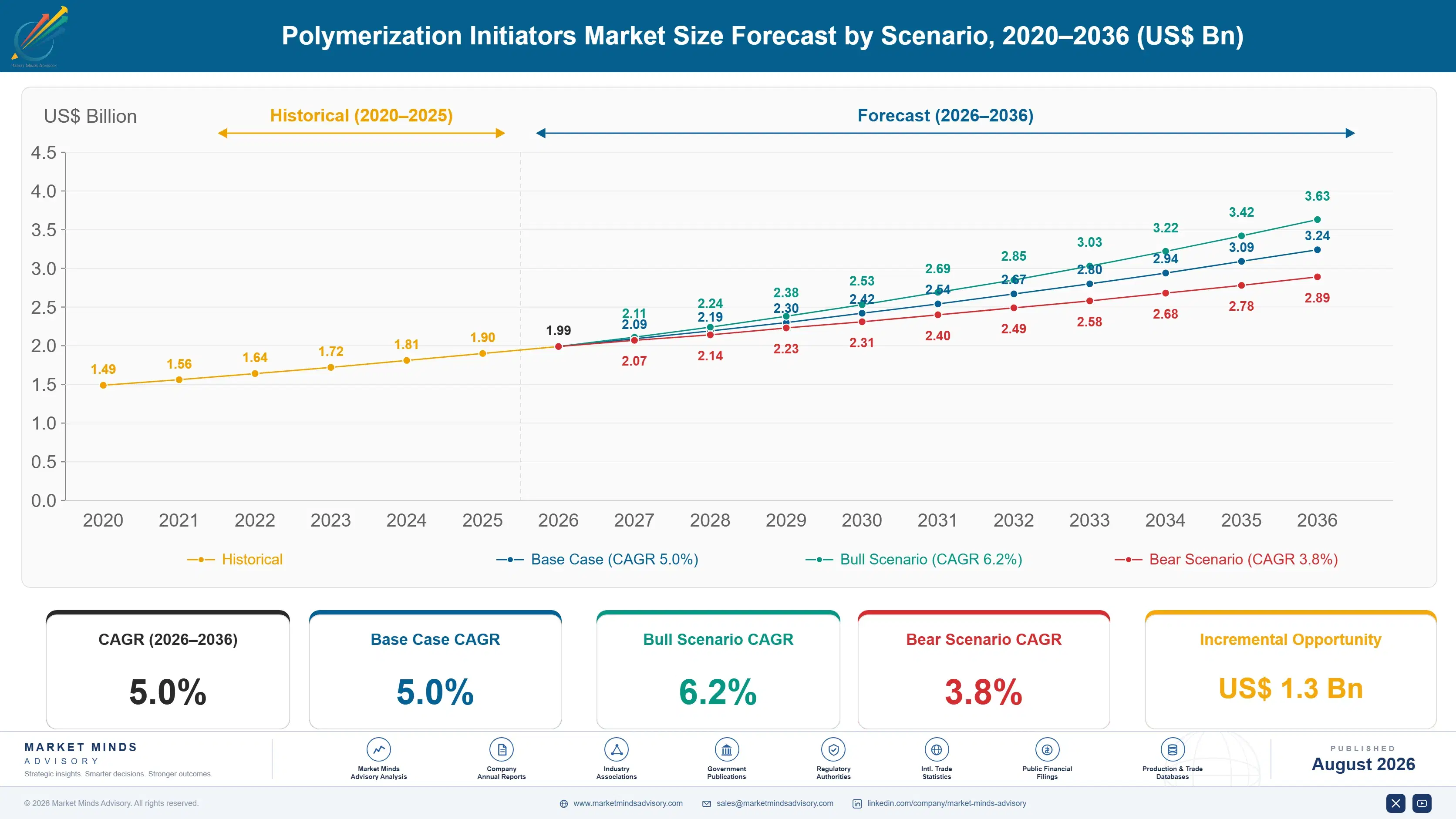
Polymerization Initiators Market Forecast Scenarios

polymerization-initiators-market-size-forecast-scenario-1787302770534
The 2020 to 2025 period ran at 4.1% and polymer production explained nearly all of it. Volumes fell in 2020, recovered through 2021 and 2022, then flattened as European polymer capacity rationalised against Asian additions. Crosslinking peroxide demand grew faster throughout on cable insulation for grid investment, which is the one application in this market that follows infrastructure rather than consumer polymer demand.
Three mechanisms carry the 5.0% base case. Global polymer production growth is the largest, since initiator consumption tracks monomer converted almost exactly and PVC, polyethylene, and polystyrene volumes keep rising. Cable and wire crosslinking is the second, at 7.5%, following transmission and distribution investment. And Indian and Southeast Asian polymer capacity additions are the third, adding demand where regional supply is thin. Composite and unsaturated polyester demand sits beneath all three at steadier rates.
The 6.2% bull case rests on grid cable insulation demand accelerating beyond current transmission schedules, which would pull crosslinking peroxide volumes well above polymer production growth. The 3.8% bear case is a serious incident at a producing site, since manufacturing licences are already difficult and a further tightening would constrain supply well beyond whatever capacity was directly lost.

A Logistics Business Wearing Chemistry

This is a chemical business whose real constraints are logistical. An initiator works by decomposing into free radicals, so instability is the product rather than a defect, and every grade carries a temperature above which that decomposition accelerates by itself and cannot be arrested. The most reactive grades reach that point around 40 degrees, which is an ordinary summer afternoon in most of the world.
TOP FIVE CONCENTRATION66%High, following hazardous manufacturing licences rather than chemical capability
DECOMPOSITION ONSET TEMPERATURE40 degreesAbove which the most reactive grades run away irreversibly
INITIATOR COST SHARE0.4%Of finished polymer cost, against an absolute production necessity
REFRIGERATED SHELF LIFE6 monthsFor reactive grades held under continuous temperature control throughout
ACTIVE CONTENT AS SHIPPED40%With the balance as solvent or phlegmatising diluent instead
COLD CHAIN DELIVERY RADIUS900 kmBeyond which refrigerated transport economics defeat the delivered price
Everything downstream follows from that. Material ships at roughly 40% active with the balance made up of solvent or phlegmatising diluent, under continuous refrigeration, with about six months of usable shelf life. Beyond roughly 900 kilometres the cold chain defeats delivered economics, which keeps supply regional in a market whose customers are anything but. Suppliers leading with pricing are answering a question nobody asked them.
The commercial asymmetry is stark. Initiator represents around 0.4% of finished polymer cost while being absolutely required to make the polymer at all, so producers rarely negotiate hard on price and negotiate ferociously on supply reliability. Concentration at 66% reflects manufacturing licences that regulators have become extremely reluctant to grant rather than any chemical difficulty. A well-funded entrant can buy equipment and still never obtain permission.
"A customer once told us our product was the cheapest line on their bill and the only one that could stop the plant. They have never asked us for a discount since, and they call every quarter about our inventory position."
Director, Polymer Additives and Reactive Chemicals Practice · MMA Chemicals and

Market Trends

Crosslinking Demand Follows Grid Rather Than Polymer Cycles

Peroxide crosslinking of cable insulation builds a permanent network rather than starting a polymer chain, and demand for those grades follows transmission and distribution investment rather than consumer polymer cycles. Specialty crosslinking peroxides grow at 7.5% against 5.0% for the market as a result. That decoupling is unusual here, since almost every other grade in this business rises and falls with monomer conversion volumes directly. Purity and decomposition profile matter more in these grades than anywhere else in the market. Scorch during compounding ruins a batch. Cable makers qualify a named producer accordingly.
Market Impact: Initiator is 0.4% of polymer cost
Manufacturing Licences Have Become The Binding Constraint

Organic peroxide plants are difficult to permit and considerably harder to expand following any incident anywhere in the industry, and regulators across several jurisdictions have approved very little new capacity in years. Concentration sits at 66% largely because of that rather than because the chemistry is hard. Producers holding licensed capacity possess something a well-funded entrant cannot buy, build, or negotiate its way into quickly. Expansion has been declined at sites operating safely, on separation distance and population proximity grounds. No enforcement action was involved. Permitting alone settled it. Nothing else was needed.
Market Impact: Shelf life runs about 6 months

Market Opportunities and Growth Drivers

Initiator Demand Tracks Monomer Conversion Almost Exactly

Every tonne of PVC, polyethylene, polystyrene, or acrylic produced consumes initiator at a loading set by the process rather than by any purchasing decision, which makes demand unusually forecastable years ahead. Producers can model consumption directly from announced polymer capacity. That predictability is the compensation for a business whose supply chain is refrigerated, distance-limited, and licensed by authorities increasingly reluctant to approve anything. Consumption can be modelled directly from announced polymer capacity years ahead of commissioning. Very few chemical markets offer visibility like that. It compensates for everything else. Very few markets are this legible.
Market Impact: Delivery radius caps near 900 km

Supply Reliability Outweighs Price In Every Negotiation

Initiator carries around 0.4% of finished polymer cost while being absolutely required to run the reactor, so a polymer producer losing supply loses production worth many multiples of a year's initiator spend. Buyers therefore negotiate inventory positions, dual sourcing, and delivery guarantees rather than unit price. Suppliers who understand that sell availability, and those who lead with pricing are answering a question nobody asked. A polymer producer losing initiator supply loses production worth many multiples of its annual spend. Inventory positions and second sources follow from that. Price barely enters the conversation.
Market Impact: Decomposition begins near 40 degree

Market Restraints and Challenges

Cold Chain Economics Confine Supply To A Radius

Material ships at roughly 40% active under continuous refrigeration with about six months of shelf life, and the root cause is that the molecule decomposes above temperatures an unrefrigerated container reaches routinely. Commercial impact is that delivered economics fail beyond roughly 900 kilometres and supply stays regional. Mitigation runs through regional blending and dilution sites, higher stability grade substitution where the process permits, and inventory positioning close to major polymer clusters. Regional blending sites cost far less than licensed manufacturing capacity and extend reach considerably. Very few producers build them deliberately. Those that do reach clusters others concede.
Market Impact: Crosslinking grades grow at 7.5%

Licensing Prevents Any Rapid Capacity Response

New organic peroxide capacity requires permits that regulators have become reluctant to grant, and the root cause is that incidents at peroxide facilities have consequences severe enough to reshape local regulatory attitudes for years. Commercial impact is that supply cannot expand to meet a demand surge in any grade. Mitigation runs through debottlenecking within existing licensed envelopes, toll manufacturing arrangements, and long-term contracting that allocates constrained capacity deliberately. Producers who mapped licensed headroom carefully have generally found more of it than expected. Debottlenecking is slower than building. It is frequently the only route available.
Market Impact: Top five hold 66% of supply
3 additional market trends, 4 additional growth drivers, and 2 additional restraints and challenges are covered in the full report. Contact sales@marketmindsadvisory.com to access the complete intelligence.

Segment CAGR and Growth Architecture

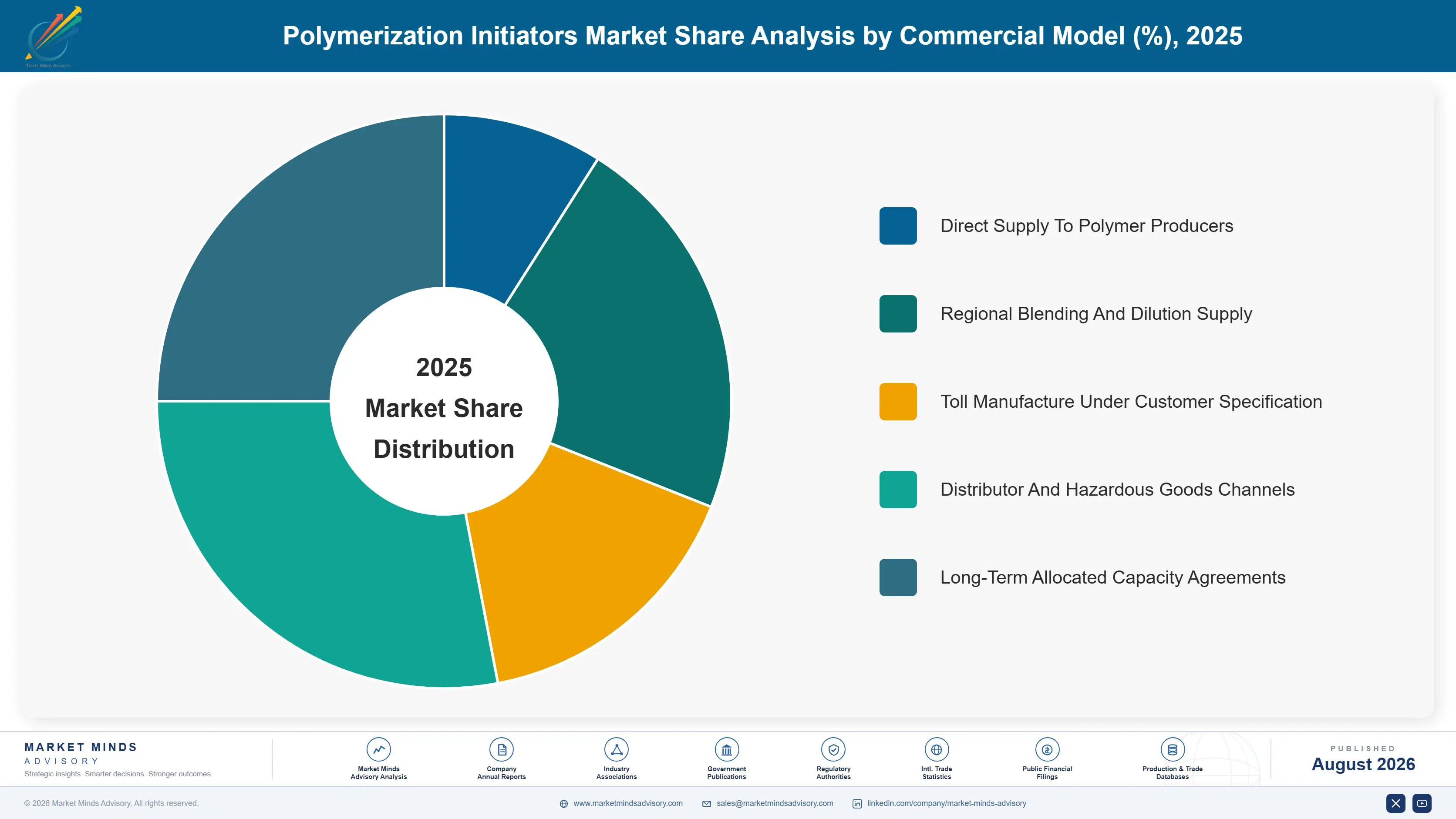
Segmentation follows initiator chemistry class, because that determines decomposition behaviour, handling and transport classification, the polymerisation process it serves, and which customers can use it at all. Polymer type and reactor configuration both cut across every chemistry class rather than separating them, which makes either weaker as a primary dimension. Chemistry also decides how far it can travel.
polymerization-initiators-market-market-share-analysis-1787302771070

Specialty Crosslinking Peroxides

The fastest class at 7.5%, exactly 1.50 times the market rate, used to build permanent networks in cable insulation, rubber compounds, and thermoset systems rather than to start a polymer chain. Demand follows transmission and distribution investment rather than consumer polymer cycles, which decouples it from everything else in this market. Purity and decomposition profile matter more here than in any other class, since scorch during compounding ruins a batch and cable makers qualify a named producer rather than a specification. High value and low volume also make these grades economic to ship well beyond the usual cold chain radius. Very few other grades justify that. Positions hold for a cable product's life.
CAGR 7.5%

Azo Initiators And Blowing Agents

Second fastest at 6.2%, covering azo compounds used as radical sources in acrylic and vinyl polymerisation and as chemical blowing agents in foamed polymers. Decomposition is cleaner and more predictable than most peroxides, which suits processes where by-product residues matter, and the gas evolved is what makes the blowing agent applications work at all. Handling classification is severe and several traditional azo blowing agents face regulatory pressure, which has been redistributing volume within the class rather than out of it. Redistribution within the class has been the pattern rather than any move away from azo chemistry entirely. Formulators substitute inside the family. That mirrors how flame retardants have behaved. Volumes stay inside the class.
CAGR 6.2%
Full segment breakdown across 5 segments available in the complete report.

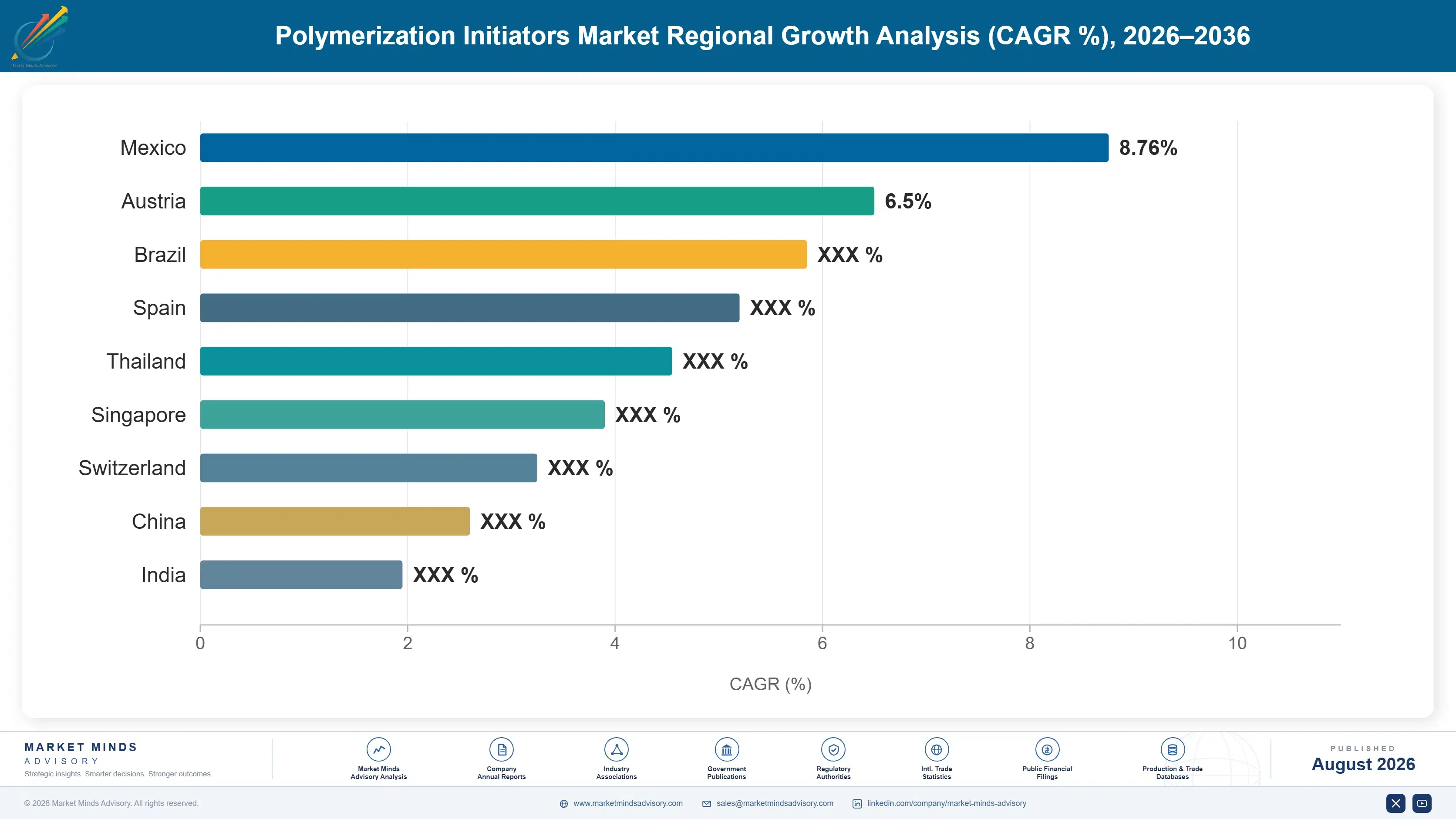
Regional Architecture and Country Demand Map

East Asia leads at 44%, far outside band, because Chinese polymer production consumes more initiator than every other region combined. Cold chain economics keep supply regional everywhere. India grows fastest. Four regional shares sit outside their framework bands. Polymer reactor geography explains all four of them.

East Asia

Forty-four percent, far outside the framework band, and justified because Chinese PVC, polyethylene, and polystyrene production together consume more initiator than every other region combined by a clear margin. Domestic producers supply most of that demand, since cold chain economics make importing uneconomic beyond roughly 900 kilometres regardless of price. Japanese and Korean producers hold the specialty crosslinking and high purity grades. Growth at 5.9% runs above the market rate on continued polymer capacity additions. Chinese producers have added licensed capacity at a pace Western regulators would not permit anywhere. That capacity now competes into export markets inside its own radius. Cold chain still bounds it. Radius bounds everything. Nothing crosses it.
Share: 44% | CAGR: 5.9% (2026 to 2036)

North America

Sixteen percent, far below the framework band because initiator demand follows polymer reactors rather than economic output, and North American polymer capacity is large but far smaller than Asian capacity. Gulf Coast polyethylene expansion has added high-pressure initiator demand. Licensing for new peroxide capacity is notably difficult here, which constrains supply response independently of demand. Growth at 4.4% sits below the market rate, tracking domestic polymer production closely. Licensing for new peroxide capacity is notably difficult here, which constrains supply response entirely independently of what demand does. Separation distance requirements are strict. Existing sites carry real value because of that. Gulf Coast polyethylene expansion has added high-pressure initiator demand alongside all of that.
Share: 16% | CAGR: 4.4% (2026 to 2036)
Regional intelligence for 5 additional markets available in the complete report: Western Europe, South Asia and Pacific, Latin America, Middle East and Africa, Eastern Europe. Contact sales@marketmindsadvisory.com.
polymerization-initiators-market-country-cagr-analysis-1787302771580

Licences, Cold Chain And Availability

Licensed capacity is the barrier, material ships at 40% active with six months of life, delivery caps near 900 kilometres, and crosslinking grades grow at 7.5%. Value comes from licensed capacity, from cold chain positioning, and from selling availability rather than price. Chemical capability decides remarkably little of it. Permits and geography decide it.

Treat Licensed Capacity As The Core Asset

Organic peroxide plants are difficult to permit and considerably harder to expand after any incident, and regulators across several jurisdictions have approved almost no new capacity in years. Concentration at 66% follows from that rather than from chemical difficulty. A well-funded entrant can hire chemists and buy equipment and still cannot obtain a licence, which makes existing permitted capacity considerably more valuable than its replacement cost suggests. Debottlenecking within an approved envelope generally avoids the process that new capacity triggers. Licensed headroom is worth mapping carefully. Most producers have never done it.
Market Impact: Top five hold fully 66% of all supp

Sell Availability Rather Than Price Per Kilogram

Initiator carries around 0.4% of finished polymer cost while being absolutely required to run a reactor, so a producer losing supply loses production worth many multiples of its annual initiator spend. Buyers negotiate inventory positions, dual sourcing, and delivery guarantees rather than unit price. Suppliers leading with pricing are answering a question the customer did not ask and cannot easily be persuaded to care about. Inventory position, second sourcing, and delivery guarantees are what the buyer genuinely wants discussed. Unit price is close to irrelevant to them. Very few suppliers restructure the conversation.
Market Impact: Initiator is only 0.4% of finished

Position Inventory Inside The Cold Chain Radius

Material ships at roughly 40% active under refrigeration with about six months of shelf life, and delivered economics fail beyond around 900 kilometres. Regional blending, dilution, and inventory sites reach customers that direct supply from a distant plant simply cannot serve. Those sites cost far less than licensed manufacturing capacity and extend commercial reach into polymer clusters a producer would otherwise concede entirely. Blending sites cost a fraction of licensed manufacturing capacity and require none of the same permits. Reach in this market is physical. Commercial effort cannot substitute for it.
Market Impact: Delivery radius caps out near 900 k

Build Crosslinking Grade Depth Ahead Of Grid Demand

Specialty crosslinking peroxides grow at 7.5% against 5.0% for the market because cable insulation demand follows transmission investment rather than consumer polymer cycles. Purity and decomposition profile matter more in these grades than anywhere else, and cable makers qualify a named producer rather than a specification. Those positions hold for a cable product's commercial life, which very few other grades in this market can claim. Cable insulation demand follows transmission investment rather than any consumer polymer cycle at all. That decoupling is unique within this market. Everything else tracks monomer conversion.
Market Impact: Crosslinking grades are now growing

Who Controls the Margin Pool

Concentration is high at 66% across the top five measured on initiator tonnage supplied, and hazardous manufacturing licences rather than chemical capability explain almost all of it. Synthesising an organic peroxide is well within many chemical companies; obtaining permission to manufacture one at scale, particularly after any incident has reshaped regulatory attitudes locally, is not. The leader to challenger gap is widest in specialty crosslinking grades and narrowest in commodity suspension
Competitive activity runs on three fronts. Licensed capacity is the first and effectively the position itself, since it cannot be created quickly at any price. Cold chain and inventory positioning is the second, because delivered economics fail beyond roughly 900 kilometres and reach is therefore physical. And crosslinking grade qualification is the third, where positions hold for a cable product's whole life.

Pressure arrives from two directions. Chinese producers have added licensed capacity at a pace Western regulators would not permit. And polymer producers increasingly demand dual sourcing, which fragments volumes that were previously single-supplier. Rankings shift on capacity licensing rather than on commercial activity. Neither pressure reaches specialty crosslinking grades, where decomposition profile decides whether a compounding batch survives at all. That tier competes on entirely different terms.
polymerization-initiators-market-company-positioning-matrix-1787302772100

Competitive Moat and Risk Dimensions

NOURYON

Moat: Licensed capacity across regions

Permitted organic peroxide manufacturing at several sites across separate regions serves polymer clusters that cold chain economics otherwise place out of reach, and those licences cannot be replicated by a competitor at any speed. Technical depth across suspension, high-pressure, and crosslinking grades lets one supplier serve a polymer producer's whole requirement. Both positions rest on assets and permissions
NOURYON

Risk: Incident risk reshaping regulatory attitudes

A serious incident at any peroxide facility, including a competitor's, reshapes regulatory attitudes toward the whole industry and can constrain expansion at sites entirely unconnected to it. The larger the licensed footprint, the greater the exposure to that dynamic. Insurance and permitting conditions have tightened after previous incidents without any regulatory change being formally announced.
ARKEMA

Moat: Crosslinking and specialty grade depth

Technical positions in specialty crosslinking peroxides serve cable insulation demand growing at 7.5% and largely decoupled from polymer production cycles. Cable makers qualify a named producer rather than a specification, which makes those positions durable for a cable product's whole commercial life. High value and low volume also make these grades economic to ship beyond the usual cold chain radius.
ARKEMA

Risk: Commodity grade cost competition

Chinese producers have added licensed suspension polymerisation initiator capacity at a pace Western regulators would not permit, and those grades compete largely on delivered cost inside a regional radius. Specialty depth contributes little in that contest. Commodity volumes also carry the fixed cost absorption that licensed manufacturing sites depend on to stay economic.

Players Tracked

Prominent Players

Nouryon
Arkema
United Initiators
Pergan
NOF Corporation

Other Key Players

Adeka Corporation
Dongsung Chemical
Chinasun Specialty Products
Jiangsu Qiangsheng Functional Chemical
Shandong Huaxing Chemical
MPI Chemie
Vanderbilt Chemicals
Lanxess
Evonik
Kayaku Nouryon
ACE Chemical
Fine Organics
Otsuka Chemical
Wuxi Qiangsheng
Hebei Jiayida

Recent Developments

JANUARY 2025

Regulator declines peroxide capacity expansion at existing site

A regulatory authority declined an application to expand organic peroxide manufacturing capacity at an established site, citing separation distances and population proximity rather than any operational or compliance failure at the facility itself. The decision was a permitting outcome rather than any enforcement action against the producer.
Signal: Licensed capacity cannot be expanded to me
APRIL 2025

Polymer producer contracts dual initiator supply after outage

A large polymer manufacturer established a second qualified initiator supplier following a delivery interruption that had idled a reactor, accepting higher administrative cost to protect production worth far more than its annual initiator spend. The change was internal supply risk management rather than any quality dispute.
Signal: Buyers now negotiate availability rather t
AUGUST 2025

Supplier commissions regional blending site near polymer cluster

An initiator producer opened a regional dilution and blending facility close to a polymer manufacturing cluster, serving customers that direct supply from its distant plant could not reach within cold chain economics. The investment was organic facility construction rather than any acquisition or partnership. No permits were required.
Signal: Reach in this market is physical, and blen

Peroxide Precursors, Solvent and Refrigeration

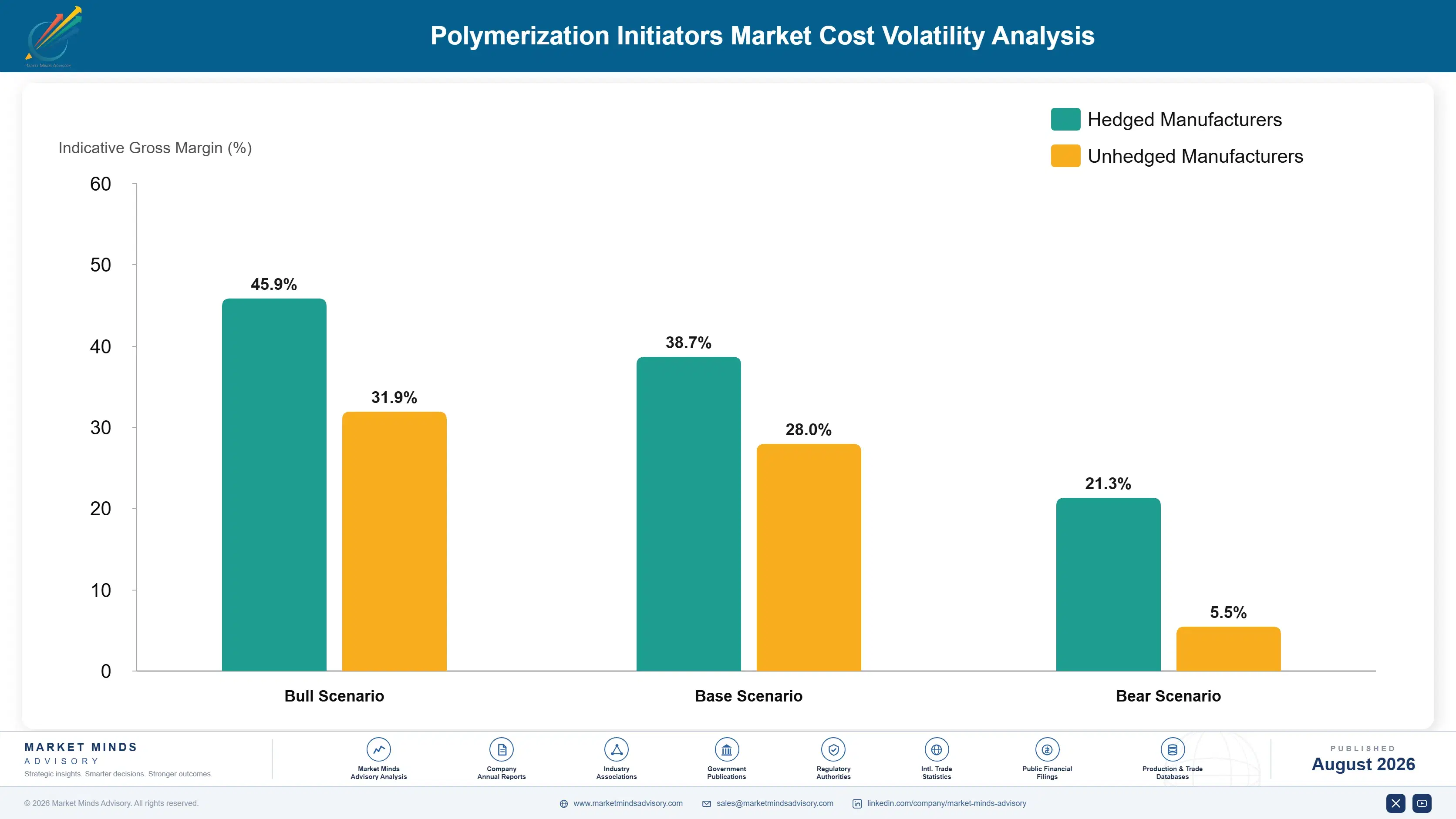
Production and delivered cost divides between hydrogen peroxide and organic precursors at roughly 34%, solvents and phlegmatising diluents near 15%, refrigerated storage and distribution around 18%, safety systems, containment, and site compliance about 21%, and quality control, labour, and overhead the balance. Safety and cold chain together exceed the chemical feedstock, which describes this business accurately in a way no chemistry discussion does.
Hydrogen peroxide and solvent pricing both moved sharply through 2022 as European energy costs affected production economics, and several specialty chemical producers disclosed input cost pressure in filings covering that year, with IEA data tracking the underlying movement. Refrigeration energy costs rose alongside. Pass-through was slower than the movement, since polymer producers contract initiator annually against production plans set well in advance. Production plans are set well in advance of any delivery.

The competitive disadvantage mechanism runs through site compliance burden rather than through feedstock purchasing. Precursors cost broadly the same for producers of reasonable scale, while safety systems, containment, separation distances, and compliance overhead differ enormously between sites depending on when they were permitted and what has been required since. Older sites carry retrofit obligations that newer licensed capacity elsewhere never faced at all.
polymerization-initiators-market-cost-volatility-analysis-1787302772295

Debottleneck within the existing licensed envelope

New organic peroxide capacity requires permits regulators have become extremely reluctant to grant, while incremental output within an already approved envelope generally does not trigger the same process. Debottlenecking is slower and less satisfying than building, and it is frequently the only route available. Producers who mapped their licensed headroom carefully have found more of it than they expected.

Substitute higher stability grades where the process permits

Refrigerated storage and distribution carry around 18% of delivered cost, and more thermally stable grades reduce that burden while extending both shelf life and reachable radius. Not every polymerisation process tolerates a different decomposition profile, and many tolerate more than the customer assumes. Testing that assumption with the customer's own process is work very few suppliers actually undertake.

Index polymer producer contracts to precursor movement

Hydrogen peroxide, organic precursors, and solvents together carry roughly 49% of production cost and move on cycles no initiator producer influences, while polymer producers contract annually against production plans. Indexation shifts that exposure toward customers for whom initiator is 0.4% of cost. Buyers resist indexation on principle and concede it more readily than the negotiation suggests they will.

Portfolio Architecture for Margin Defence

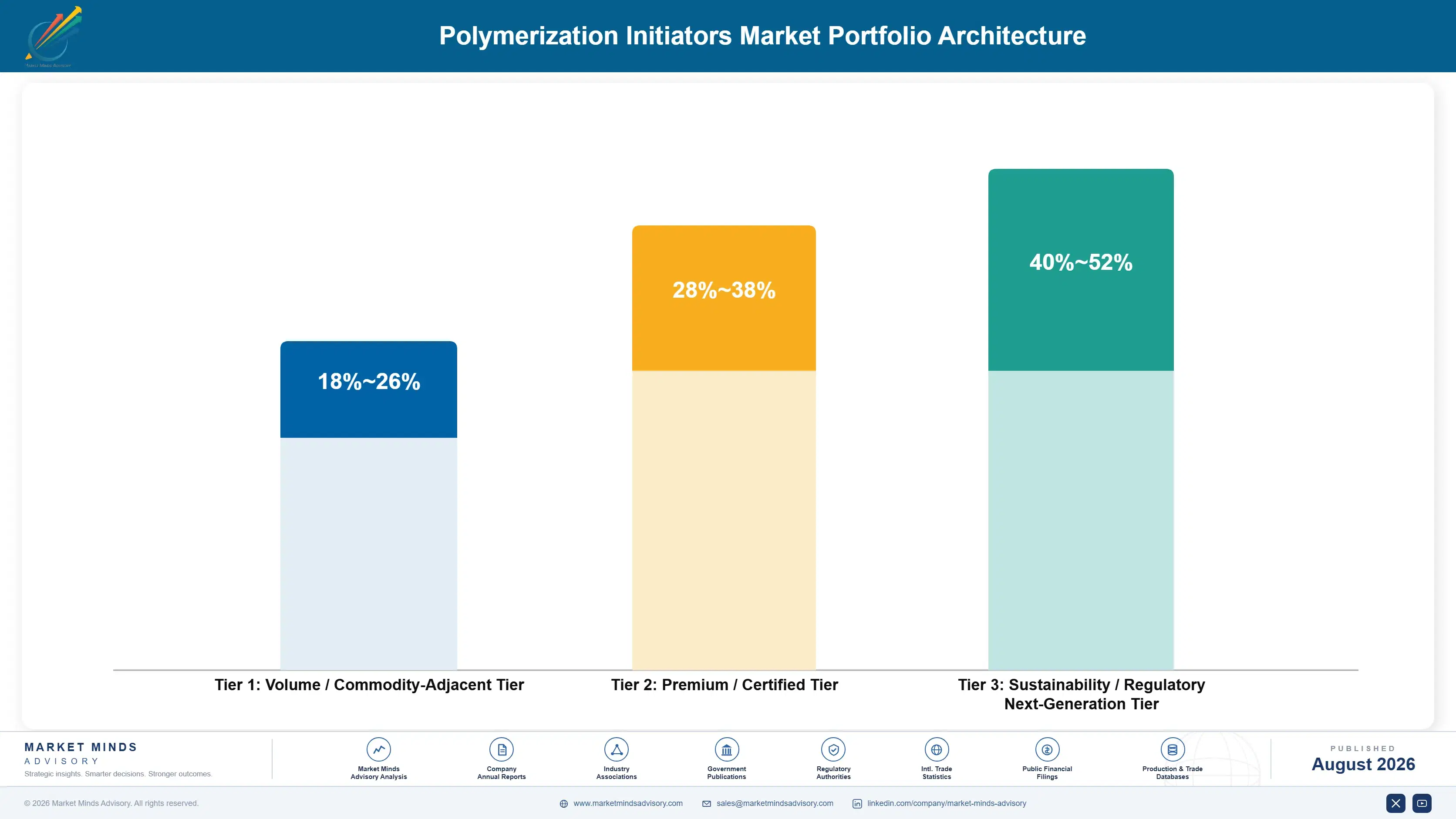
Three tiers describe this business and the spread follows grade specialisation rather than volume. Commodity suspension polymerisation initiators sit at the bottom, where the chemistry is settled and delivered cost inside a radius decides everything. High-pressure polyethylene and standard azo initiators occupy the middle. Specialty crosslinking peroxides and high purity grades sit at the top, where decomposition profile and producer qualification both restrict participation.
The tension is that commodity grades carry the tonnage that absorbs a licensed site's fixed cost while earning least, and they compete directly against Chinese capacity added at a pace Western regulators would not permit. A producer weighted there defends volume it needs and margin it does not have. One weighted toward crosslinking holds better positions on volumes too small to keep a licensed plant economic.

High-value pools concentrate where decomposition behaviour matters to the customer's process. Crosslinking peroxides for cable insulation are the clearest case, since scorch during compounding ruins a batch and cable makers qualify a named producer rather than a specification, which makes those positions unusually durable. High-pressure polyethylene initiators are the second such pool, where reactor qualification is meaningful and rarely reopened. Neither pool is decided on delivered price.

Volume / Commodity-Adjacent Tier

Suspension polymerisation initiators for PVC and polystyrene where chemistry is settled and delivered cost inside a radius decides orders. Carries the tonnage that keeps a licensed site economic. Imported material competes hardest here.
Gross Margin: 18-26%

Premium / Certified Tier

High-pressure polyethylene initiators and standard azo grades where process fit and consistency genuinely differentiate suppliers. Handling classification is severe and qualification is meaningful in both. Reactor qualification is meaningful and rarely reopened once settled.
Gross Margin: 28-38%

Sustainability / Regulatory / Next-Generation Tier

Specialty crosslinking peroxides and high purity grades where decomposition profile decides whether a batch survives. Best margin available and the most durable qualified positions in this market. Volumes are too small to keep a plant economic alone.
Gross Margin: 40-52%
polymerization-initiators-market-portfolio-architecture-1787302772793

Reactors, Radii and Qualifications

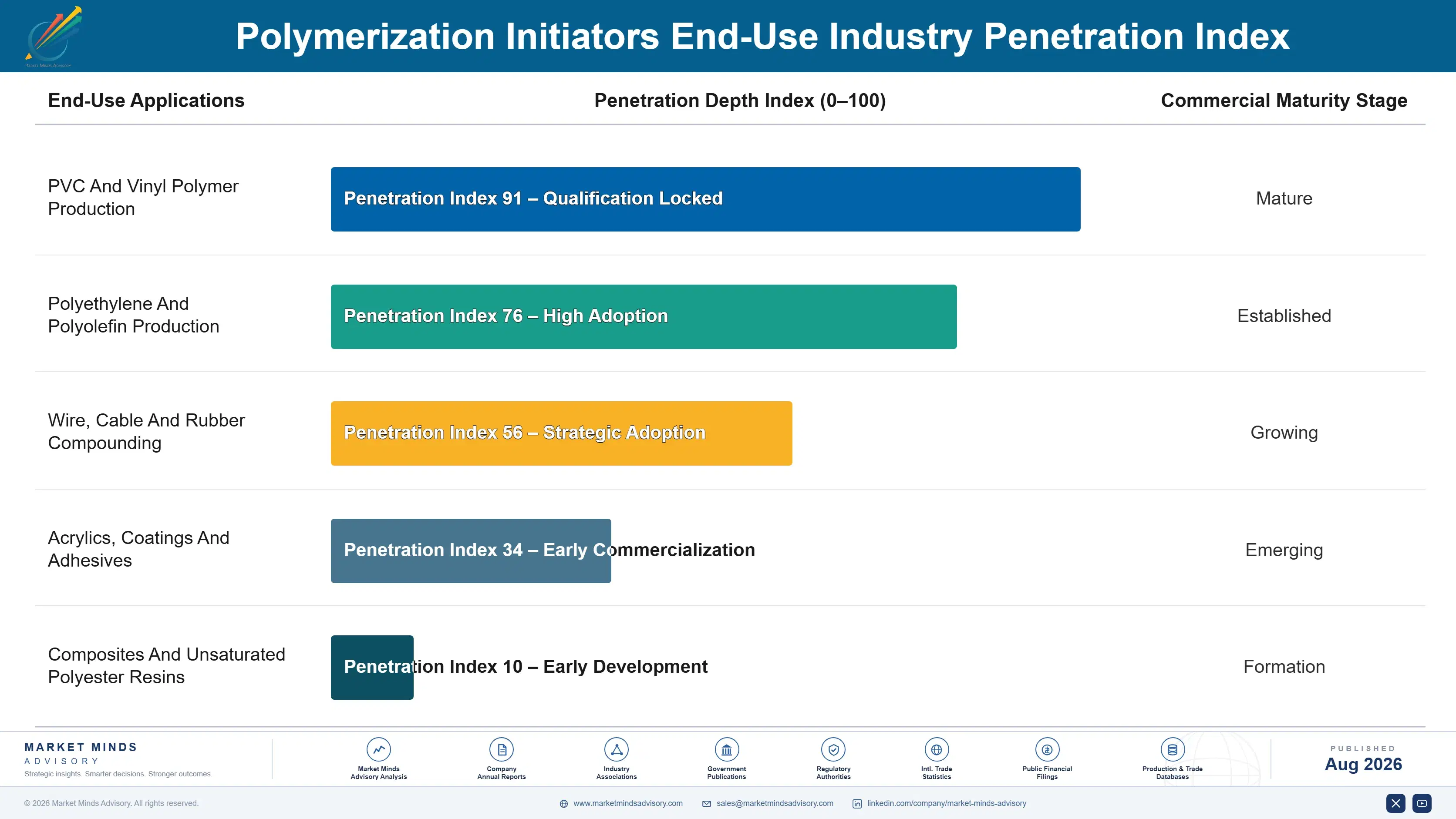
Demand behaves as continuous consumption tied to reactor output rather than to any purchasing cycle, since loading is set by the polymerisation process rather than by anybody's decision. A qualified supplier ships against a polymer plant's production continuously, with commercial activity confined to annual contract renewal. That predictability is unusual and it is what makes a refrigerated, distance-limited supply chain commercially viable at all.
Stickiness varies sharply by grade. Crosslinking peroxide positions at cable makers are the firmest, since decomposition profile differences between producers show up as scorch during compounding and requalification means full cure testing. High-pressure polyethylene qualifications sit close behind. Commodity suspension initiators stick least and move on delivered price within the cold chain radius, which is where Chinese capacity competes hardest. Chinese capacity competes hardest inside exactly that radius.

Buyer profiles shifted as supply reliability became the dominant concern. The earlier buyer was a polymer plant purchasing manager comparing qualified suppliers on delivered price per kilogram. The current conversation increasingly involves a production or supply chain function asking about inventory positions, second sources, and what happens to a reactor if a refrigerated delivery fails to arrive.
polymerization-initiators-market-end-use-penetration-index-1787302773282

What We Would Tell a Board

These are among the four positions where our research anticipates prominent divergence between winners and laggards over the coming forecast period. Each is grounded in the demand model, the regulatory perimeter, and the announced capacity pipeline.
01 / LICENSED CAPACITY VALUATION

Your permits are worth more than your plants

Organic peroxide manufacturing licences are difficult to obtain and considerably harder to expand after any incident anywhere in the industry, and regulators across several jurisdictions have approved almost no new capacity in years. Concentration at 66% across the top five follows entirely from that rather than from any chemical difficulty involved in the synthesis itself. A well-funded entrant can hire all the chemists it wants and buy every piece of equipment and still never obtain permission to operate the plant.
02 / AVAILABILITY SELLING DISCIPLINE

Nobody is negotiating your price seriously

Initiator represents around 0.4% of the finished polymer cost while being absolutely required to run the reactor at all, so any producer that loses its supply loses production worth many multiples of an entire year of initiator spend. Buyers therefore negotiate inventory positions, second sourcing, and delivery guarantees with real intensity rather than unit pricing at any point. Suppliers who lead with price are answering a question that the customer never actually asked and cannot be persuaded to care about.
03 / COLD CHAIN REACH BUILDING

Reach here is physical, not commercial

Material ships at roughly 40% active under continuous refrigeration with only about six months of usable shelf life, and delivered economics simply fail beyond around 900 kilometres from whichever site is supplying it. Regional blending, dilution, and inventory positions reach polymer clusters that direct supply from any distant plant simply cannot serve at all. Those blending and dilution sites cost far less than licensed manufacturing capacity and extend commercial reach considerably further into clusters that would otherwise be conceded entirely.
04 / CROSSLINKING POSITION BUILDING

Cable grades follow grids, not polymer cycles

Specialty crosslinking peroxides grow at 7.5% against just 5.0% for the wider market, largely because cable insulation demand follows transmission and distribution investment rather than any consumer polymer cycle at all. Purity and decomposition profile matter considerably more in those grades than anywhere else in this business, and cable makers therefore qualify a named producer rather than any written specification at all. Those qualified positions then hold for a whole cable product's commercial life without ever once being reopened by anybody.

Engagement Snapshot From the Field

A live engagement with an industry participant carrying material or product regulatory and market exposure ahead of a defining policy shift, showing how our research translates into a defensible multi-year portfolio strategy.
MARKET MINDS ADVISORY · CLIENT ENGAGEMENT SUMMARY
Polymerization Initiators Producer Strategic Portfolio Review and Transition Roadmap 2026·Investment Scenario on Polymerization Initiators Exposure Evaluation 2025-26
CLIENT PROFILE
A regional polymerisation initiator producer with approximately 155 million dollars in annual revenue (client-reported, unverified by MMA), operating one licensed organic peroxide site serving polymer producers within its cold chain radius. Commodity suspension grades carried most volume, crosslinking capability was limited, and a capacity expansion application had been under review for two years. Volume had held steady throughout.
STRATEGIC CHALLENGE
The board wanted to know whether to continue pursuing the expansion permit, what alternatives existed if it were refused, and why margin had compressed while volume had held steady across the same period. Nobody had assessed licensed headroom inside the existing permit envelope, and no alternative to expansion had been examined at all.
MMA APPROACH
We assessed licensed headroom within the existing permit envelope rather than assuming expansion. Customer demand was mapped against cold chain radius from the site and from potential blending locations. Margin was decomposed by grade, and crosslinking qualification requirements were scoped with two cable manufacturers. Blending site economics were then costed by location.
KEY FINDINGS
  1. Licensed headroom within the existing envelope was substantially larger than management had assumed, and debottlenecking would deliver most of the sought capacity without any new permit.
  2. Margin compression traced entirely to commodity suspension grades competing against imported material, while specialty volumes had held pricing throughout the same period.
  3. Two polymer clusters sat just outside the site's cold chain radius and could be reached economically from a blending facility costing a fraction of licensed capacity.
  4. Both cable manufacturers approached would qualify a second crosslinking supplier, and neither had been contacted by the client at any point previously.
CLIENT PROFILE
A regional polymerisation initiator producer with approximately 155 million dollars in annual revenue (client-reported, unverified by MMA), operating one licensed organic peroxide site serving polymer producers within its cold chain radius. Commodity suspension grades carried most volume, crosslinking capability was limited, and a capacity expansion application had been under review for two years. Volume had held steady throughout.
STRATEGIC CHALLENGE
The board wanted to know whether to continue pursuing the expansion permit, what alternatives existed if it were refused, and why margin had compressed while volume had held steady across the same period. Nobody had assessed licensed headroom inside the existing permit envelope, and no alternative to expansion had been examined at all.
MMA APPROACH
We assessed licensed headroom within the existing permit envelope rather than assuming expansion. Customer demand was mapped against cold chain radius from the site and from potential blending locations. Margin was decomposed by grade, and crosslinking qualification requirements were scoped with two cable manufacturers. Blending site economics were then costed by location.
KEY FINDINGS
  1. Licensed headroom within the existing envelope was substantially larger than management had assumed, and debottlenecking would deliver most of the sought capacity without any new permit.
  2. Margin compression traced entirely to commodity suspension grades competing against imported material, while specialty volumes had held pricing throughout the same period.
  3. Two polymer clusters sat just outside the site's cold chain radius and could be reached economically from a blending facility costing a fraction of licensed capacity.
  4. Both cable manufacturers approached would qualify a second crosslinking supplier, and neither had been contacted by the client at any point previously.
RECOMMENDED STRATEGY
Phase 1: Phase 1 (months one to ten): pursue debottlenecking within the existing licensed envelope rather than waiting on the expansion permit. Phase 2: Phase 2 (months ten to twenty-four): open a regional blending site serving the two clusters outside the current cold chain radius. Phase 3: Phase 3 (months twenty-four to forty-two): begin crosslinking peroxide qualification with both cable manufacturers identified. Approach both before any competitor does.
OUTCOME
Debottlenecking delivered most of the sought capacity within a year and the expansion application was allowed to lapse. A blending site was approved for one cluster, and crosslinking qualification began with one cable manufacturer (client-reported, unverified by MMA). Licensed headroom mapping became a standing planning input.

Frequently Asked Questions

Foundational context covering the market sizes, CAGR, scope, country, region and competition that inform every finding below. This section is provided to cover basics and most often pre-purchase conversations, answered from the MMA Primary Research Dataset.

What is the current size of the Polymerization Initiators Market?

The market is valued at USD 1.9 billion in 2025, rising to USD 2.00 billion in 2026. Scope covers initiators and radical sources for polymerisation and crosslinking, not polymerisation catalysts, stabilisers, or finished polymers.

How large will the Polymerization Initiators Market be by 2036?

MMA forecasts USD 3.26 billion by 2036, an increase of USD 1.26 billion over the 2026 base. That represents an expansion multiple of 1.63 times across the forecast period.

What is the CAGR for the Polymerization Initiators Market 2026 to 2036?

The base case CAGR is 5.0%, with a bull case of 6.2% and a bear case of 3.8%. The historical rate from 2020 to 2025 was 4.1%, tracking polymer production closely throughout.

Which segment is growing fastest?

Specialty crosslinking peroxides at 7.5%, exactly 1.50 times the market rate. Cable insulation demand follows transmission investment rather than the consumer polymer cycles driving every other grade.

Who are the major companies in the Polymerization Initiators Market?

Nouryon, Arkema, United Initiators, Pergan, and NOF Corporation lead on initiator tonnage supplied. The top five hold 66%, held there by manufacturing licences rather than chemical capability.

Which country is growing fastest?

India at 7.6%, where PVC, polyester, and acrylic capacity additions are outpacing regional initiator supply. Licensing and handling infrastructure remain the practical constraints on domestic production.

Report Segmentation Architecture

The full report scope spans multiple orthogonal segmentation dimensions, with cross-tabulated demand data provided for each dimension pair. Coverage extends further to regional breakdowns, trend trajectories, and the competitive detail needed to support segment-level decision-making.

By Initiator Chemistry Class

  • Organic Peroxides For Suspension Polymerisation
  • High-Pressure Polyethylene Initiators
  • Specialty Crosslinking Peroxides
  • Azo Initiators And Blowing Agents
  • Persulfate And Redox Initiator Systems

By End-Use Industry

  • PVC And Vinyl Polymer Production
  • Polyethylene And Polyolefin Production
  • Wire, Cable And Rubber Compounding
  • Acrylics, Coatings And Adhesives
  • Composites And Unsaturated Polyester Resins

By Commercial Model

  • Direct Supply To Polymer Producers
  • Regional Blending And Dilution Supply
  • Toll Manufacture Under Customer Specification
  • Distributor And Hazardous Goods Channels
  • Long-Term Allocated Capacity Agreements

By Region

  • East Asia
  • North America
  • Western Europe
  • South Asia and Pacific
  • Latin America
  • Middle East and Africa
  • Eastern Europe

Scope, Methodology, and Coverage

Every figure in this report is reproducible from documented input assumptions. The scope below maps the historical period, the forecast horizon, the segmentation dimensions, and the countries covered, alongside the underlying primary and qualitative methodology.
Historical Period
2020 to 2025
Forecast Period
2026 to 2036
Base Year
2025 (USD billions; MMA Primary Research Dataset, August 2026)
Market Definition
This market comprises initiators and related radical sources manufactured and supplied for polymerisation, curing, and crosslinking applications, measured at producer revenue across direct polymer producer, regional blending, toll manufacture, distribution, and allocated capacity channels. Coverage spans organic peroxides for suspension and emulsion polymerisation, high-pressure polyethylene initiators, specialty crosslinking peroxides for cable, rubber and thermoset applications, azo initiators and chemical blowing agents, and persulfate and redox initiator systems. Polymerisation catalysts including metallocene, Ziegler-Natta and chromium systems, chain transfer agents and molecular weight regulators, stabilisers, antioxidants and processing aids, photoinitiators for radiation curing, finished polymers, compounds and masterbatches, and hazardous goods transport and warehousing services sold independently of product supply fall outside scope.
Quantitative Units
USD billions (current prices); initiator tonnage supplied by class; price per tonne of active by grade; active content as shipped
Segmentation Dimensions
By Initiator Chemistry Class; By End-Use Industry; By Commercial Model; By Region
Regions Covered
East Asia, North America, Western Europe, South Asia and Pacific, Latin America, Middle East and Africa, Eastern Europe
Countries Covered
China, Japan, South Korea, Taiwan, India, Vietnam, Thailand, Indonesia, Australia, United States, Canada, Mexico, Germany, Netherlands, France, Italy, Spain, United Kingdom, Brazil, Argentina, Saudi Arabia, United Arab Emirates, South Africa, Poland, Czechia, Russia, and additional markets relevant to this sector
Key Companies Profiled
Nouryon, Arkema, United Initiators, Pergan, NOF Corporation, Adeka Corporation, Dongsung Chemical, Chinasun Specialty Products, Jiangsu Qiangsheng Functional Chemical, Shandong Huaxing Chemical, MPI Chemie, Vanderbilt Chemicals, Lanxess, Evonik, Kayaku Nouryon, ACE Chemical, Fine Organics, Otsuka Chemical, Wuxi Qiangsheng, Hebei Jiayida
Quantitative Methodology
Primary survey, n=3,800 respondents, Q4 2025, six countries; demand-side model with trade association cross-validation
Qualitative Methodology
47 expert interviews, Q4 2025; applied to validate demand model assumptions, identify emerging dynamics, and assess competitive positioning
Report Format
PDF and XLSX data workbook (Word format preview document)
Publisher
Market Minds Advisory
Report Code
MMA-2026-CHM-938
Published
August 2026
Contact
sales@marketmindsadvisory.com | www.marketmindsadvisory.com

Purchase the full Polymerization Initiators Market Report (2026 to 2036).

The full report sizes polymerisation initiators across five chemistry classes, five end-use industries, five commercial models, and seven regions, with licensed manufacturing capacity assessed as the primary competitive constraint throughout. Cold chain radius economics are modelled from every producing and blending site against polymer cluster locations. Grade level qualification stickiness is assessed separately from commodity supply. Competitive profiling covers twenty producers on initiator tonnage supplied, and licensed headroom within existing permit envelopes is evaluated site by site. Regional figures reflect polymer reactor geography rather than any general industrial output measure.
Licensed manufacturing capacity assessed as the primary competitive constraint
Cold chain radius modelled from every producing site
Grade level qualification stickiness assessed separately from commodity supply
Licensed headroom within existing permit envelopes evaluated site by site
Crosslinking demand modelled against transmission investment rather than polymer cycles
Site compliance and retrofit burden compared across permitting vintages

Built For The People Who Decide

From boardroom strategy to bench-side execution, this report is read cover-to-cover by leaders shaping the next decade of their industry, turning demand scenarios, market dynamics and valuation benchmarks into decisions.
CXOs/ Presidents/ VPs/ Managers
M&A and Corporate Development
Strategy Teams and R&D Heads
Procurement and Product Directors
Regulatory and Compliance Leaders
Investor Relations and Equity Analysts