
Market Minds Advisory
Polyimide Film and Tape Market

Polyimide Film and Tape Market: The Monomers Are Scarcer Than the Film

Two specialty monomers made by a handful of plants set the ceiling on this entire industry, and the film producers downstream have spent a decade discovering they cannot fix that.

Lead Analyst

Bilal Shaikh

Published

August 2026

Make Smarter Decisions with Customized Research Insights

Request a free sample report and evaluate market opportunities, growth trends, and competitive dynamics relevant to your business needs.

2025 MARKET VALUE$2.9BMarket Size 2025
2036 FORECAST VALUE$7.4BBase Case , 2026 to 2036
CAGR 2026 TO 20368.9 %Bull 10.1% / Bear 7.7%
INCREMENTAL OPPORTUNITY$4.3BNet 10- year value creation
EXPANSION MULTIPLE2.36x2036 value over 2026 base
Strategic Levers
M&A Pipeline
Regional Outlook
Country Rankings
Competitive Intelligence
Segmental Deep-dive
Call-Us : 91 93563 13602

Executive Snapshot and Market Trajectory

Polyimide film needs pyromellitic dianhydride and a diamine, and roughly six plants worldwide make those monomers at the purity this chemistry demands. Monomers carry about 44% of film cost, so producers sit downstream of a supply base considerably narrower than they are. That inversion defines the whole industry.
Growth runs at 8.9% and display applications lead it. Colorless polyimide for displays grows at 13.35%, exactly 1.50 times the market rate, as foldable and rollable panels need a substrate that survives processing temperature without yellowing. East Asia holds the largest share at 44%, far outside band, because display and flexible circuit manufacturing both concentrate there. Flexible circuit film remains the volume base underneath that. Panel makers set the specification years ahead.
Concentration is high at 71% across the top five measured on film area produced. Casting and imidisation control rather than chemistry knowledge holds it there, and a producer that can make the polymer but cannot cast it uniformly at three microns is not in this market at all. Chinese producers compete hard on standard industrial grades from below. Rankings shift on qualification wins. Qualification holds it.
Market Definition
This market covers polyimide film and adhesive tape products supplied for electronic, electrical, and industrial applications, spanning standard polyimide film for flexible circuits, colorless polyimide for display applications, thermally conductive and graphite-precursor film, polyimide adhesive and masking tapes, and electrical insulation film for motors and cables. Polyimide moulding resins and powders, polyimide-coated wire enamels, other high temperature polymers including polyetheretherketone, and finished flexible circuits fall outside scope.
Base Year Value
$2.9B in 2025 (MMA Primary Research Dataset, August 2026)
Forecast Period
2026 to 2036, eleven discrete annual values
CAGR
8.9% base case. Bull 10.1%. Bear 7.7%.
Fastest Growth Segment
Colorless Polyimide for Display Applications: 13.3% CAGR
Fastest Growth Country
India: 11.8% CAGR
Fastest Growth Region
South Asia and Pacific: 11.1% CAGR
Largest Region
East Asia: 44% of 2025 global value
Market Leaders
DuPont, Kaneka, SKC Kolon PI, UBE Corporation, Taimide Technology. Source: MMA Analysis based on company annual reports.
Primary Survey
n=3,800 procurement and R&D decision-makers, Q4 2025, six countries
Methodology
Demand-side build-up, cross-validated against public data, 47 expert interviews

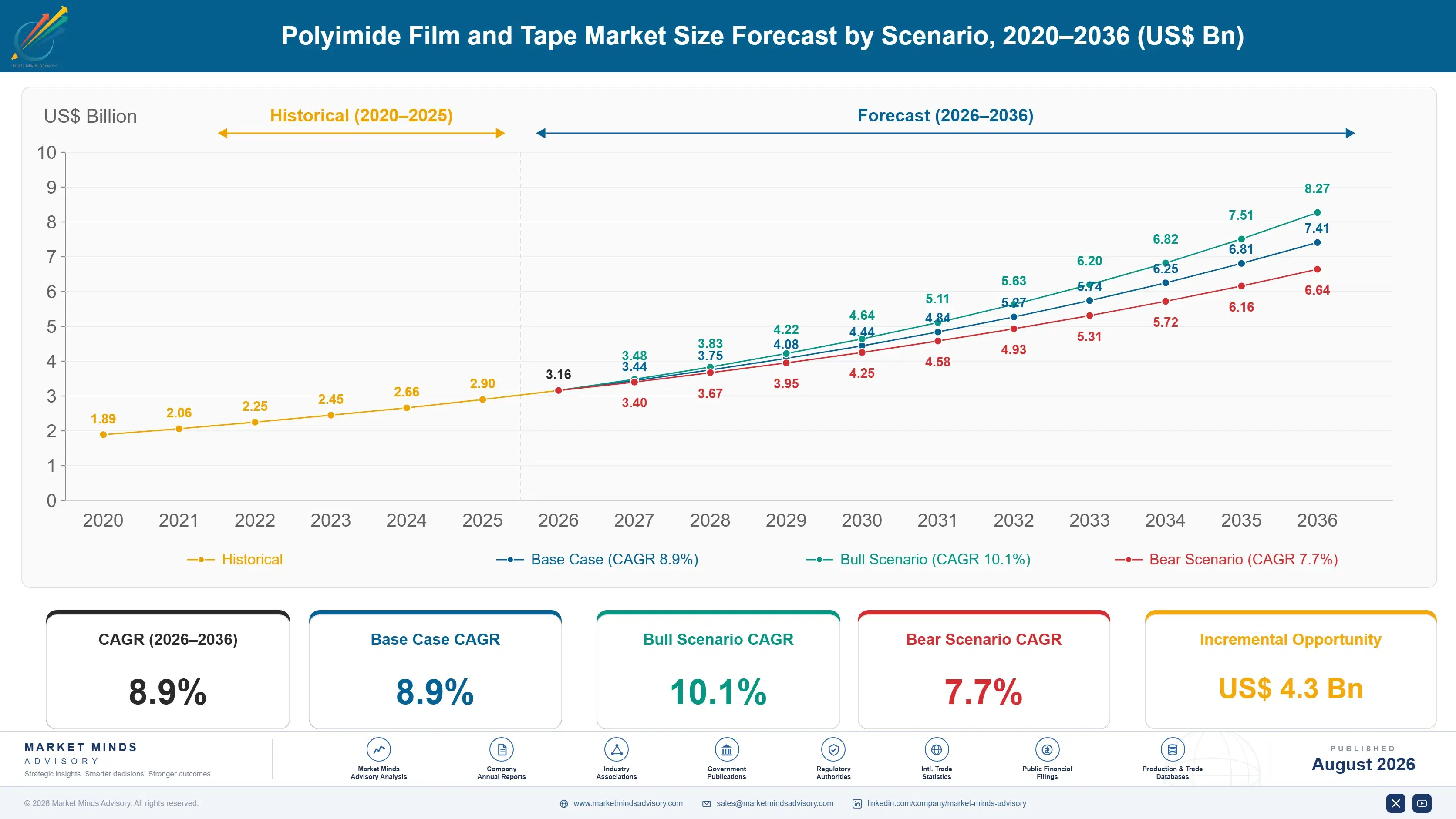
Polyimide Film and Tape Market Forecast Scenarios

polyimide-film-and-tape-market-size-forecast-scenario-1787302762628
The 2020 to 2025 period ran at 7.4% and flexible display development carried more of the value growth than flexible circuits did. Standard film demand tracked electronics production through a disrupted cycle, while colorless polyimide moved from development quantities into commercial volume as foldable devices reached market. Monomer supply tightened through 2022 and constrained several producers independently of their own casting capacity.
Three mechanisms carry the 8.9% base case. Flexible and foldable display substrate is the largest, since colorless polyimide has no established alternative at the processing temperatures involved. Thermal management film is the second, where graphite precursor demand follows device power density. And electric vehicle motor insulation is the third, growing with traction motor production rather than with electronics. Thermal precursor film grows alongside rising device power density rather than with unit shipments.
The 10.1% bull case rests on rollable and foldable display volumes scaling faster than panel makers currently guide, which would consume colorless polyimide capacity that has been built ahead of demand. The 7.7% bear case is monomer supply constraining output regardless of film capacity, which has happened before and would cap the whole industry rather than any single producer.

Six Plants Set the Ceiling

Polyimide film exists because nothing else survives what it survives. Continuous service at around 260 degrees, dimensional stability through solder reflow, and dielectric performance that holds under heat together explain why a material this expensive sits inside almost every flexible circuit ever made. No cheaper polymer has managed that combination in sixty years of trying. Cheaper films fail on one axis or another every time.
MONOMER PRODUCER COUNT6Plants worldwide making the dianhydride at required purity levels
MONOMER SHARE OF COST44%Of film production cost from two specialty chemical inputs
THINNEST COMMERCIAL GAUGE3 micronsBelow which casting uniformity defeats most producers entirely
TOP FIVE CONCENTRATION71%High, held by casting and imidisation control rather than chemistry
DISPLAY GRADE PRICE PREMIUM9 timesAgainst standard flexible circuit film per unit area
CONTINUOUS SERVICE TEMPERATURE260 degreesWhich is what nothing cheaper has ever managed to match
The constraint is upstream and it is narrow. Polyimide requires a dianhydride and a diamine at purity levels that roughly six plants worldwide can reliably achieve, and those monomers carry around 44% of film production cost. Film producers therefore sit downstream of a supply base narrower than their own industry, and monomer tightness in 2022 constrained output for several of them regardless of available casting capacity.
Casting is where the second barrier sits. Producing film at three microns with the thickness uniformity flexible circuits demand is genuinely difficult, and imidisation control determines whether the finished film has the properties the datasheet claims. Concentration at 71% reflects that rather than any chemistry secret, since the polymer itself has been in the literature since the nineteen sixties.
"A client had the polymer chemistry working in six months. They spent four years learning to cast it flat. Everybody who enters this market underestimates that gap and most of them never close it."
Director, Electronic Materials and Specialty Films Practice · MMA Chemicals and

Market Trends

Colorless Grades Create A Separate High Value Market

Foldable and rollable displays need a substrate that survives panel processing temperature without yellowing, and colorless polyimide is the only material doing that at commercial scale. It commands around nine times standard film pricing per unit area and grows at 13.35% against 8.9% for the market. The chemistry differs enough from conventional polyimide that casting expertise transfers only partially, which is why several capable film producers have not entered the segment at all. Panel makers now qualify more than one substrate supplier where they can find a second one. Second sources are still scarce.
Market Impact: Withstands 260 degrees continuously
Monomer Supply Caps The Whole Industry Periodically

Around six plants worldwide produce the dianhydride at required purity, and monomers carry roughly 44% of film cost, so tightness upstream constrains every film producer simultaneously regardless of their own capacity. That happened through 2022 and will happen again, because monomer capacity expands in large discrete steps against demand that grows continuously. Film producers who secured long-term monomer agreements operated through that period while competitors could not. Monomer capacity is added in large increments against demand that grows continuously, so the market alternates between comfortable and constrained. Film capacity is not the binding limit here.
Market Impact: Traction motors need 260 degree ins

Market Opportunities and Growth Drivers

Nothing Cheaper Survives What Polyimide Survives

Continuous service around 260 degrees, dimensional stability through solder reflow, and dielectric performance under heat together define a specification no cheaper polymer has matched in sixty years of attempts. That is why flexible circuits use polyimide despite the cost, and why substitution pressure in this market is almost entirely absent. Demand therefore follows electronics and motor production directly rather than being contested by alternative materials on price. Price pressure in this market therefore comes from other polyimide producers rather than from any competing chemistry at all. Competition comes from other polyimide producers.
Market Impact: Casting at 3 microns defeats entran

Traction Motor Insulation Adds Non-Electronic Volume

Electric vehicle traction motors run hot and require slot liner and phase insulation that survives thermal cycling across a vehicle life, and polyimide film handles that where cheaper insulation films degrade. This demand follows traction motor production rather than electronics cycles, which diversifies a market that had been almost entirely dependent on flexible circuits. Volumes per motor are modest and the population growing behind them is not. Qualification into a traction motor programme also holds for that programme's whole production life, which makes the volume unusually predictable. Slot liner volumes are modest per unit.
Market Impact: Around 6 plants supply monomer

Market Restraints and Challenges

Casting Uniformity Defeats Most New Entrants

Producing film at three microns with the thickness uniformity flexible circuits require is genuinely difficult, and the root cause is that imidisation and solvent removal must proceed uniformly across a moving web under tension. Commercial impact is that concentration stays near 71% despite polymer chemistry published since the nineteen sixties. Mitigation for an entrant runs through acquiring casting capability rather than developing it, licensing established process technology, and accepting several years before commercial yields are reached. Even acquired capability takes time to transfer across to different gauges and grades. Grade transfer is slow.
Market Impact: Display grades cost 9 times more

Monomer Capacity Expands In Discrete Steps

Roughly six plants worldwide make the required dianhydride and capacity is added in large increments against continuously growing demand, so the market alternates between comfortable and constrained rather than clearing smoothly. The root cause is specialty chemical plant economics. Commercial impact is periodic supply crises that stop film producers regardless of their own investment. Mitigation runs through long-term monomer agreements, qualified second sources, and inventory positions ahead of known capacity gaps. None of those mitigations create additional monomer, so the industry-level ceiling remains exactly where the upstream plants put it.
Market Impact: Monomers are 44% of film cost
3 additional market trends, 4 additional growth drivers, and 2 additional restraints and challenges are covered in the full report. Contact sales@marketmindsadvisory.com to access the complete intelligence.

Segment CAGR and Growth Architecture

Segmentation follows film grade and the property that governs its application, because those determine monomer chemistry, casting difficulty, price per unit area, and which qualification pathway applies. Film thickness and web width both cut across every grade rather than separating them, which makes either a weaker primary dimension for this market. Grade is what the customer actually qualifies.
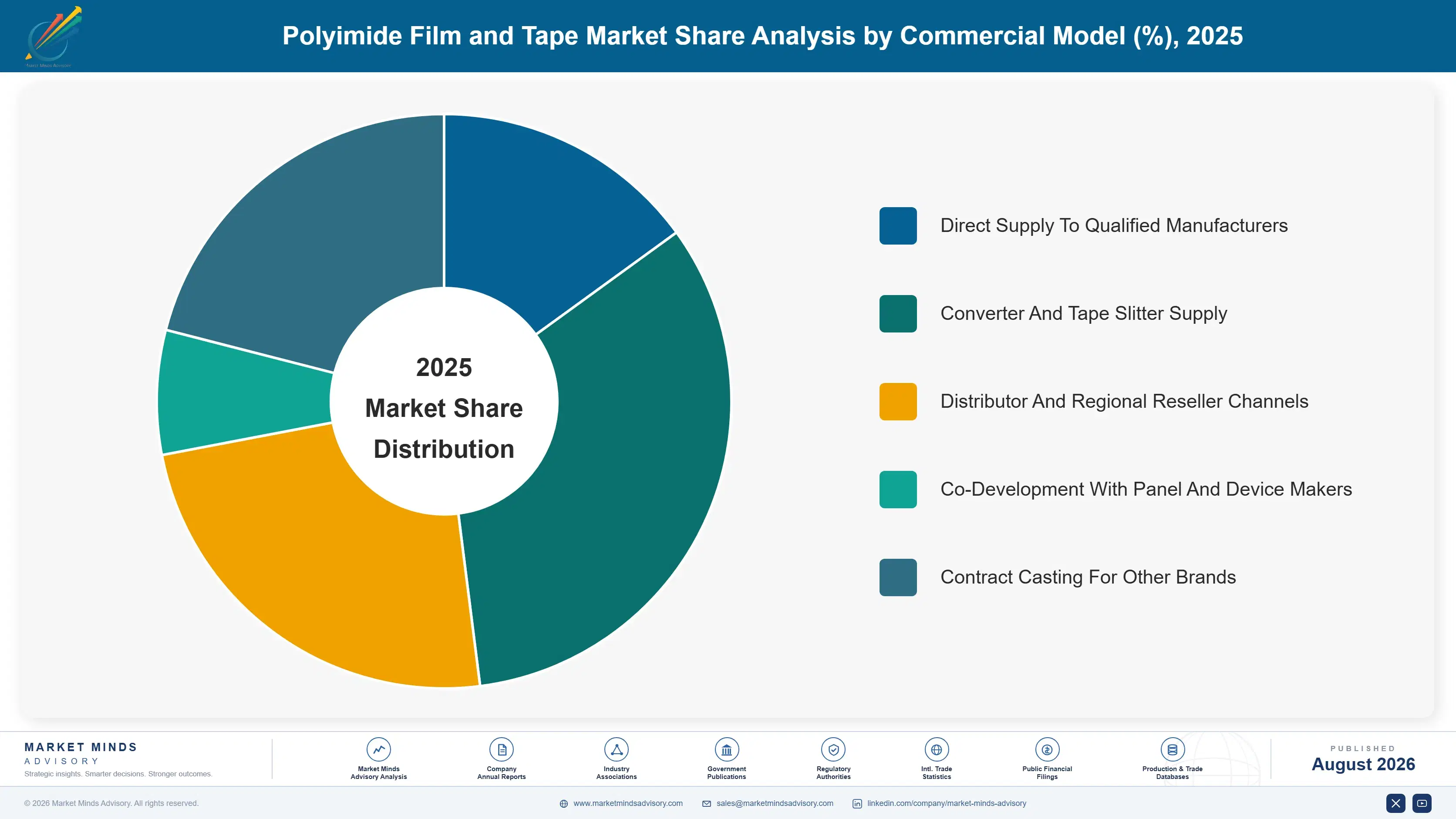
polyimide-film-and-tape-market-market-share-analysis-1787302763558

Colorless Polyimide For Display Applications

The fastest grade at 13.35%, exactly 1.50 times the market rate, and effectively a separate market sharing a name with the rest. Foldable and rollable display substrates must survive panel processing temperature without yellowing, and colorless polyimide is the only material doing that commercially. Pricing runs around nine times standard film per unit area. The chemistry differs enough that casting expertise transfers only partially from conventional grades, which is precisely why several otherwise capable film producers have never entered this segment. Panel makers have begun qualifying second suppliers, which widens the segment without softening its pricing much. Capacity was built here ahead of demand, on roadmaps only regional panel makers could see clearly.
CAGR 13.3%

Thermally Conductive And Graphite Precursor Film

Second fastest at 11.1%, supplying the precursor film that is graphitised into thermal spreading sheets for phones, tablets, and increasingly power electronics. Device power density rather than device count drives this demand, so it grows even where unit shipments plateau. The precursor requires specific molecular orientation and thickness control to graphitise properly, which means not every polyimide film producer can serve it. Downstream graphitisation is a separate industry with its own capacity constraints entirely. Power electronics thermal management is the newer application and it is growing faster than the phone and tablet base beneath it. Precursor supply and graphitisation capacity constrain each other in both directions. Power electronics is the newer pull and the one growing fastest.
CAGR 11.1%
Full segment breakdown across 5 segments available in the complete report.

Regional Architecture and Country Demand Map

East Asia leads at 44%, far outside band, because display panel and flexible circuit manufacturing both concentrate there almost entirely. North America follows on aerospace and industrial grades. South Asia and Pacific grows fastest from a small base. Every share here sits outside its framework band.

East Asia

Forty-four percent, far outside the framework band, and justified because display panel fabrication and flexible circuit assembly both concentrate in the region to a degree almost no other electronic material matches. Korean, Japanese, Chinese, and Taiwanese producers hold both film capacity and the customer proximity that qualification requires. Colorless polyimide capacity in particular was built here against display roadmaps that only regional panel makers could see clearly. Growth at 9.7% runs above the market rate on display and thermal management demand together. Monomer production is also concentrated here, which gives regional film producers supply proximity that importers elsewhere simply cannot match through a constraint. Taiwanese producers hold a disproportionate position in standard flexible circuit film specifically.
Share: 44% | CAGR: 9.7% (2026 to 2036)

North America

Nineteen percent, below the framework band because display and flexible circuit manufacture sits in East Asia, and aerospace, defence, and industrial grades carry more of it than consumer electronics does. Wire and cable insulation, aircraft wiring, and high temperature industrial applications sustain demand that is less cyclical than electronics and considerably less price sensitive. Domestic film capacity is meaningful and monomer supply is partly regional. Growth at 8.5% sits close to the market rate, supported by aerospace and emerging traction motor insulation demand together. Requalification cost in aerospace wiring is high enough that positions established decades ago still ship today. Traction motor programmes add newer volume. Domestic monomer supply reduces exposure to Asian tightness.
Share: 19% | CAGR: 8.5% (2026 to 2036)
Regional intelligence for 5 additional markets available in the complete report: Western Europe, South Asia and Pacific, Eastern Europe, Latin America, Middle East and Africa. Contact sales@marketmindsadvisory.com.
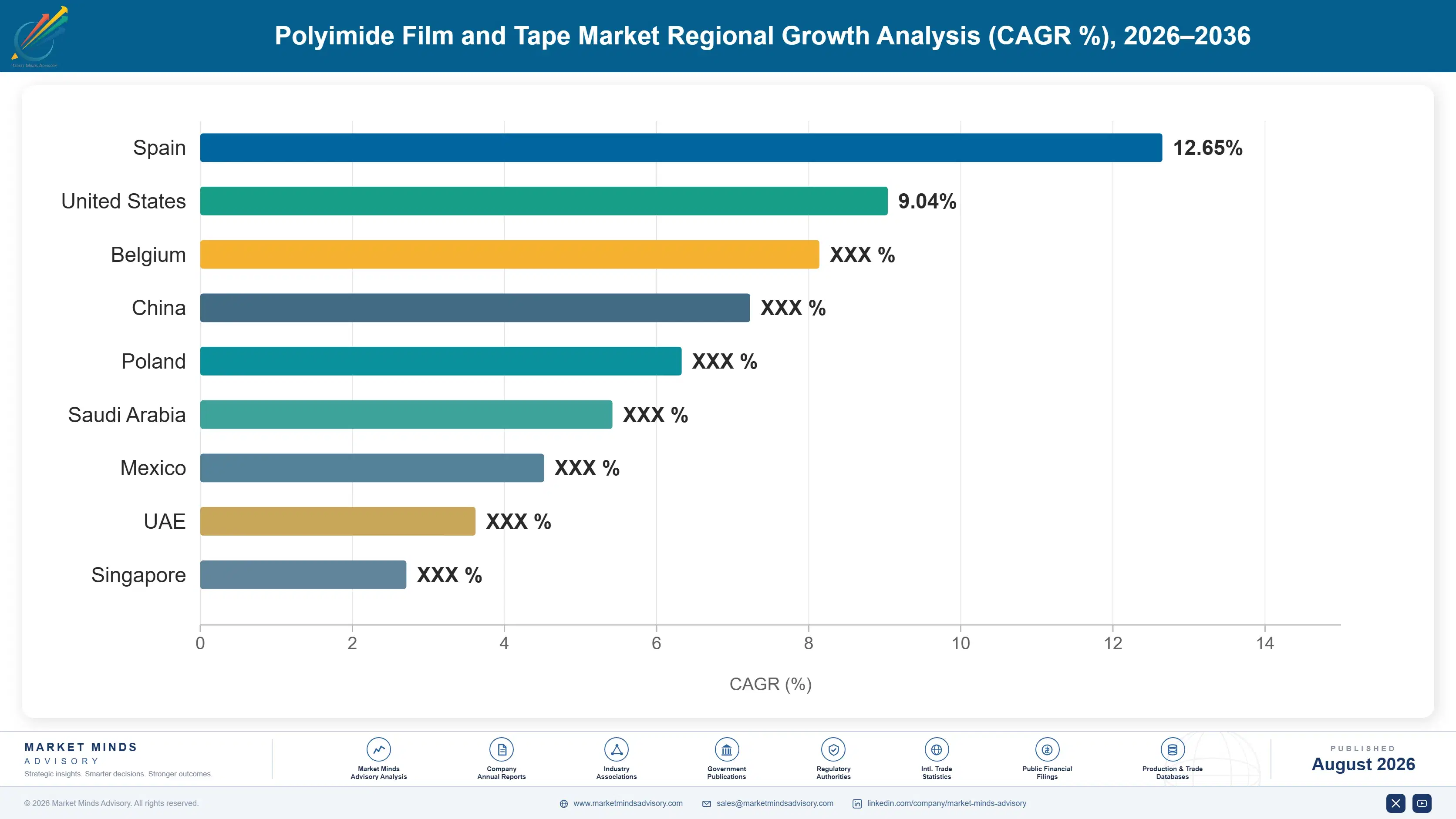
polyimide-film-and-tape-market-country-cagr-analysis-1787302764394

Securing Monomer Before Adding Capacity

Roughly six plants make the required monomer, monomers carry 44% of film cost, three micron casting defeats most entrants, and display grades command nine times standard pricing. Value comes from monomer agreements, from colorless capability, and from application qualification depth. Each of those is a decision taken years before revenue appears against it. All three compound.

Contract Monomer Supply Before Expanding Casting Capacity

Around six plants worldwide make the required dianhydride at purity, and monomers carry roughly 44% of film production cost, so casting capacity without secured monomer supply is capacity that will periodically stand idle. Monomer capacity expands in large discrete steps against continuously growing demand, which produces recurring tightness rather than a smooth market. Producers who held long-term agreements through the 2022 constraint operated while competitors with equivalent casting capacity simply could not. Allocation during tightness follows relationship length and contract commitment rather than order size or the price offered. Price rarely enters it.
Market Impact: Monomers carry 44% of total film co

Develop Colorless Capability Or Concede The Growth

Colorless polyimide commands around nine times standard film pricing per unit area and grows at 13.35% against 8.9% for the market, and the chemistry differs enough that casting expertise transfers only partially from conventional grades. Several otherwise capable producers have never entered as a result. A film business without colorless capability is competing entirely in the slower-growing part of its own market while watching the fast part expand without it. Colorless grades grow at 13.35% against 8.9% for the market, which compounds that gap every year the decision is deferred.
Market Impact: Display grades command around 9 tim

Sell Qualification Depth Rather Than Film Specification

Film qualified into a flexible circuit process, a display panel line, or an aerospace wiring specification cannot be substituted without requalification that no customer undertakes for a price difference. Concentration at 71% reflects that as much as it reflects casting difficulty. Producers competing on datasheet properties are addressing a comparison that does not decide anything, while those investing in application engineering hold positions for a product's whole commercial life. Concentration at 71% has held for years on exactly that mechanism rather than on any capacity advantage. Application engineering is what actually defends it.
Market Impact: Top five producers hold 71% of the

Buy Casting Capability Rather Than Attempting To Build It

Casting at three microns with the uniformity flexible circuits require takes years to master, and the polymer chemistry has been published since the nineteen sixties without that making entry any easier. Companies entering this market consistently underestimate the casting gap and most never close it. Acquiring an existing producer or licensing established process technology is expensive and considerably cheaper than several years of unsaleable yield while learning it independently. Casting at 3 microns with the uniformity flexible circuits demand is where entrants consistently stall, and the gap is measured in years rather than quarters.
Market Impact: Casting at 3 microns takes several

Who Controls the Margin Pool

Concentration is high at 71% across the top five measured on film area produced, and casting capability rather than chemistry knowledge holds it there. The polymer has been in the literature since the nineteen sixties and remains difficult to cast flat at 3 microns, a process barrier rather than an intellectual one. The leader to challenger gap is widest in colorless and thermal grades and narrower in standard industrial film.
Competitive activity runs on three fronts. Monomer supply security is the first and least visible from outside, since it determines what a producer can actually make rather than what it can sell. Colorless polyimide capability is the second, which is where the growth and the pricing both sit. And application qualification depth is the third, holding positions for a product's whole commercial life.

Pressure arrives from two directions. Chinese producers have added standard film capacity aggressively and compete hard on industrial grades. And display panel makers are qualifying multiple substrate suppliers rather than depending on one. Both act on price rather than technical position, and neither has yet reached the colorless or aerospace grades where casting capability still decides everything. Rankings shift on qualification wins rather than capacity additions.
polyimide-film-and-tape-market-company-positioning-matrix-1787302765262

Competitive Moat and Risk Dimensions

DUPONT

Moat: Casting depth and qualification breadth

Decades of casting process development combined with qualification positions across flexible circuits, aerospace wiring, and industrial applications gives a position that neither chemistry knowledge nor capital replicates quickly. Those qualifications hold for a product's commercial life and were won across many years. Monomer relationships built over the same period determine what can actually be produced against them.
DUPONT

Risk: Standard grades face Chinese capacity

Chinese producers have added standard film capacity aggressively and compete hard on industrial and flexible circuit grades where qualification barriers are lower than in display or aerospace applications. Casting depth defends the demanding segments and contributes less in the price-led ones. Volume share erodes from below while the technical position holds above.
SKC KOLON PI

Moat: Colorless capability and panel proximity

Colorless polyimide capability developed alongside Korean display makers puts a producer inside the roadmap conversations that determine substrate specification years before volume arrives. That proximity cannot be replicated at distance, and the casting chemistry for colorless grades transfers only partially from conventional film. Both advantages compound with each panel generation.
SKC KOLON PI

Risk: Concentration in display cycles

Weighting toward display substrate ties revenue to panel maker capital cycles and foldable device adoption rates that move sharply and independently of industrial electronics demand. Broader producers absorb that volatility across applications that do not correlate. Depth in the fastest growing grade also means depth in the most cyclical one.

Players Tracked

Prominent Players

DuPont
Kaneka
SKC Kolon PI
UBE Corporation
Taimide Technology

Other Key Players

Mitsubishi Gas Chemical
Toray Industries
I.S.T Corporation
Saint-Gobain Performance Plastics
Zhuzhou Times New Material
Wuxi Shunxuan New Materials
Jiangsu Yabao Insulation
Shenzhen Danbond Technology
PI Advanced Materials
Arakawa Chemical
3M
Nitto Denko
Rogers Corporation
Yunda Technology
Guangdong Huaqiang

Recent Developments

JANUARY 2025

Film producer signs long-term dianhydride supply agreement

A polyimide film manufacturer contracted multi-year dianhydride supply ahead of a casting capacity expansion, securing monomer volume before committing capital to the production line itself. The agreement was a long-term supply contract rather than any joint venture, acquisition, or equity investment in the monomer producer.
Signal: Casting capacity without secured monomer s
APRIL 2025

Panel maker qualifies second colorless substrate supplier

A display panel manufacturer completed qualification of an additional colorless polyimide substrate supplier, ending a single-source position on a material with very few capable producers worldwide. The qualification was internal supply risk management rather than a dispute or supply failure. Volume allocation between the two suppliers was not disclosed.
Signal: Panel makers are now paying real qualifica
AUGUST 2025

Entrant abandons casting development after extended yield failure

A specialty materials company ended a polyimide film development programme after several years of casting trials failed to reach commercial thickness uniformity at the gauges its target applications required. The decision was an internal programme closure rather than any regulatory, technical licensing, or partnership matter.
Signal: The chemistry has been published for six d

Monomers, Solvent and Casting Energy

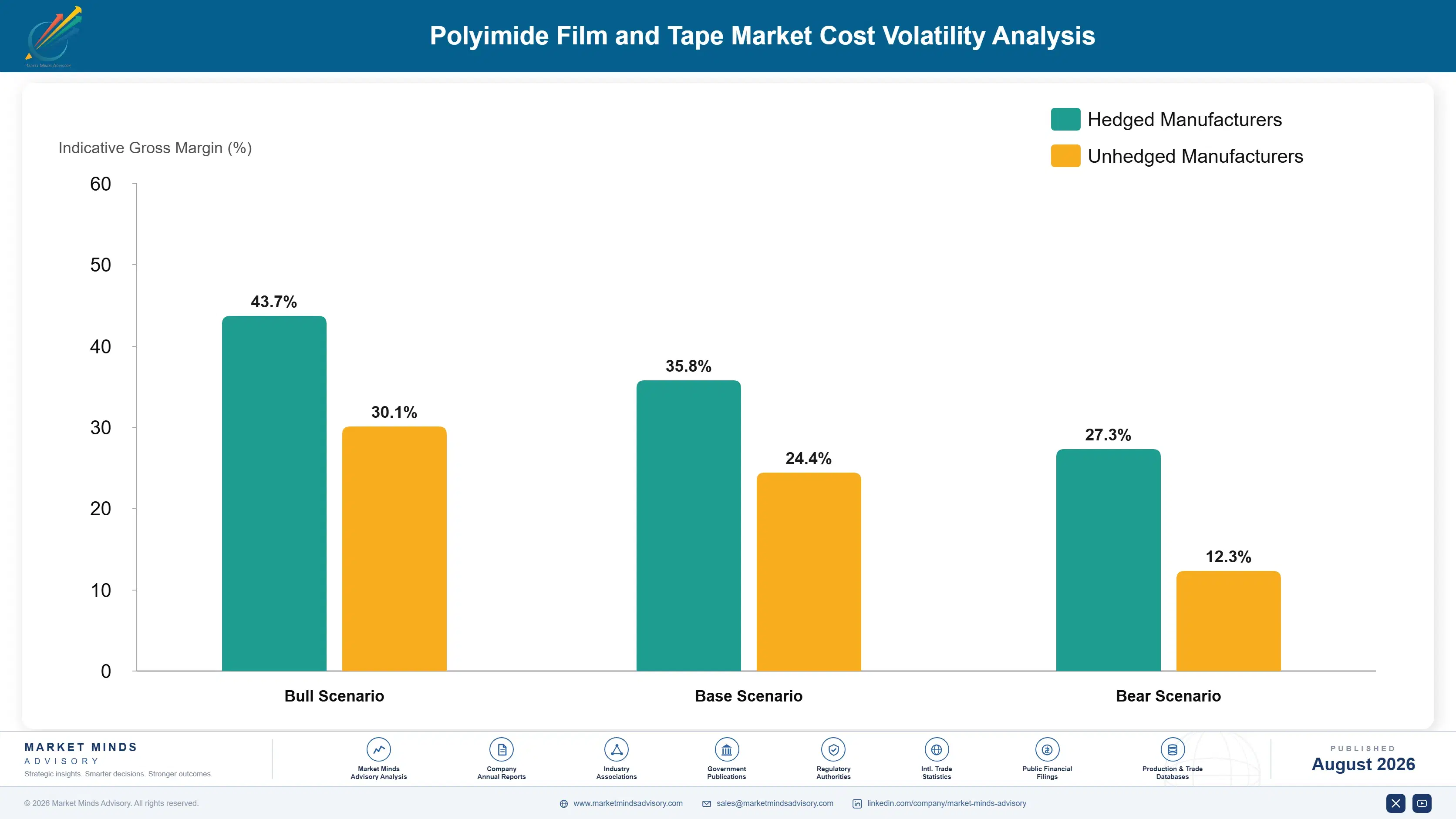
Dianhydride and diamine monomers together carry roughly 44% of film production cost, solvent and its recovery about 15%, casting and imidisation energy near 17%, web handling, slitting, and packaging around 9%, and quality testing, labour, and overhead the balance. Monomer dominates and comes from a supply base considerably narrower than the film industry it feeds. Casting energy varies more by region than any other line in the structure.
Monomer availability tightened sharply through 2022 as electronics demand recovered faster than specialty chemical capacity, and several film producers disclosed input constraints and allocation in annual filings covering that year. Solvent recovery costs rose alongside on energy pricing. Monomer supply has since eased without becoming comfortable, and the discrete nature of specialty chemical capacity additions means the pattern will repeat. Film producers cannot resolve that pattern from where they sit.

The competitive disadvantage mechanism runs through monomer access rather than through casting efficiency. Solvent, energy, and web handling cost broadly the same for competent producers anywhere, while a film maker without long-term monomer agreements cannot run its lines during periods of tightness regardless of its own capability. Purchasing scale helps less than expected, since allocation follows relationship length and contract commitment.
polyimide-film-and-tape-market-cost-volatility-analysis-1787302765558

Contract monomer on long-term volume rather than spot

Roughly six plants worldwide make the required dianhydride at purity, and allocation during tightness follows relationship length and contract commitment rather than order size or price offered. Long-term agreements carry volume risk against uncertain demand and are the only mechanism that keeps casting lines running through a constraint. Producers who held them through 2022 operated while equivalent competitors could not.

Close the solvent recovery loop within the casting line

Solvent and its recovery carry about 15% of film production cost, and polar aprotic solvents used in polyimide casting are expensive, regulated, and recoverable at high rates when the line is designed for it. Producers venting or incinerating solvent are purchasing material they could have recycled. Retrofitting recovery into an existing line is possible and considerably more expensive

Recover imidisation heat into upstream drying stages

Casting and imidisation energy carries near 17% of production cost, and imidisation ovens run at temperatures where exhaust heat is genuinely useful for the earlier drying stages of the same line. Producers venting that heat purchase energy they have already generated. The engineering is straightforward and the payback depends entirely on regional energy pricing.

Portfolio Architecture for Margin Defence

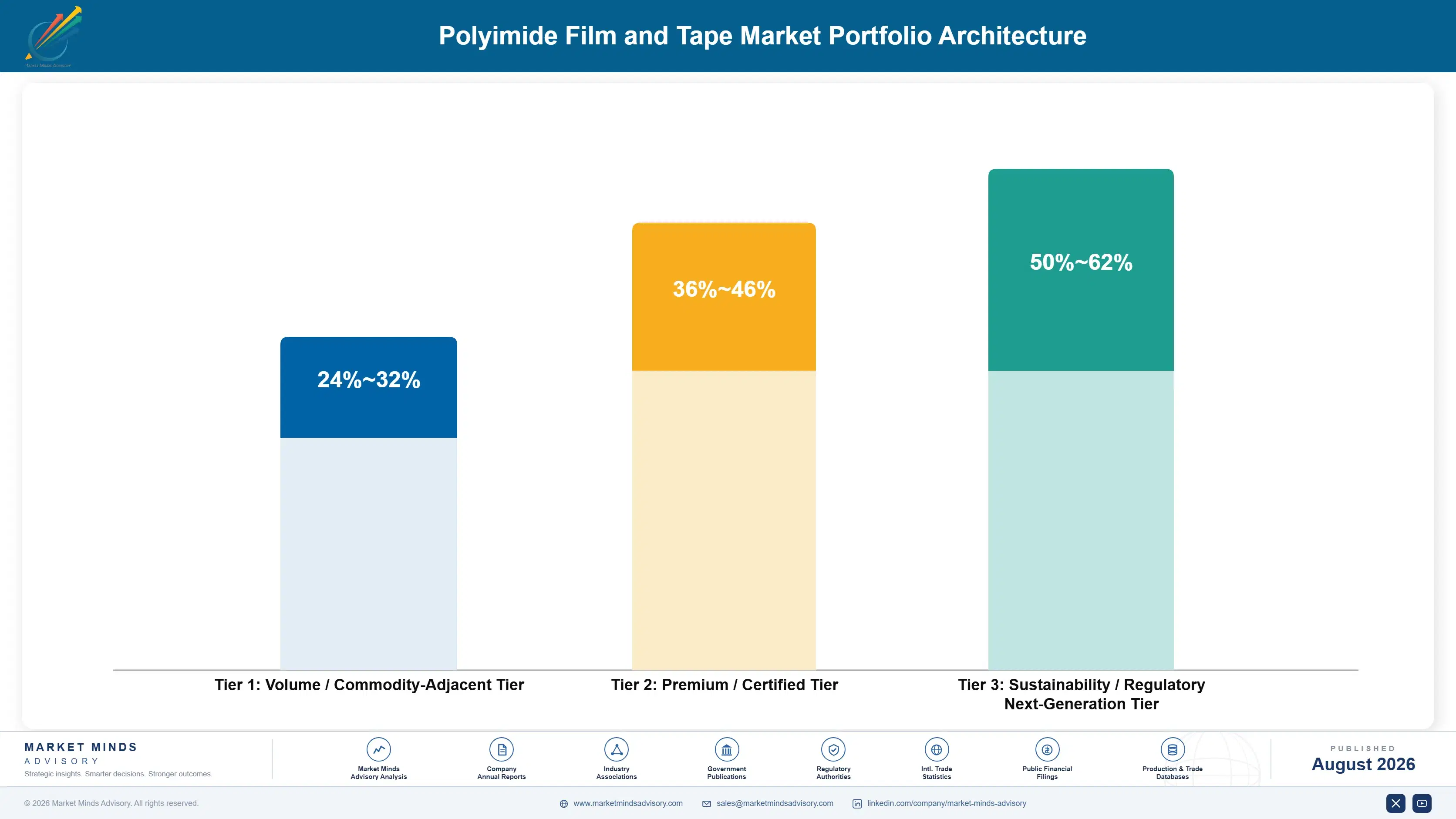
Three tiers describe this business and the spread follows casting difficulty and qualification depth rather than volume. Industrial tape and insulation grades sit at the bottom, where Chinese capacity competes hard and qualification barriers are lowest. Standard flexible circuit film occupies the middle. Colorless display substrate and thermal precursor grades sit at the top, where casting chemistry and panel proximity both apply.
The tension is that the top tier requires capability that does not transfer from the bottom, while the bottom tier funds the line utilisation the whole operation depends on. A producer strong in standard film discovers that colorless casting is a different problem rather than a harder version of the same one. One weighted to display grades carries exposure to panel maker capital cycles that industrial demand would have smoothed.

High-value pools concentrate where no alternative material exists. Display substrate is the clearest case, since colorless polyimide is the only material surviving panel processing temperature without yellowing at commercial scale. Thermal precursor film is the second such pool, since molecular orientation and thickness control determine whether the material graphitises properly at all. Both carry margin that industrial tape grades never will.

Volume / Commodity-Adjacent Tier

Polyimide adhesive tapes, masking film, and general electrical insulation where qualification barriers are lowest and Chinese capacity competes hard. Volume funds casting line utilisation and contributes limited margin on its own account.
Gross Margin: 24-32%

Premium / Certified Tier

Standard flexible circuit film and aerospace wiring insulation where qualification into customer processes holds positions for a product's commercial life. Casting uniformity at thin gauges genuinely differentiates producers here. Requalification cost keeps positions durable for years.
Gross Margin: 36-46%

Sustainability / Regulatory / Next-Generation Tier

Colorless display substrate and thermal graphite precursor film where casting chemistry and customer proximity both apply. Best margin by a clear distance, with display grades commanding around nine times standard film pricing per unit area.
Gross Margin: 50-62%
polyimide-film-and-tape-market-portfolio-architecture-1787302766387

Qualification, Panels and Programmes

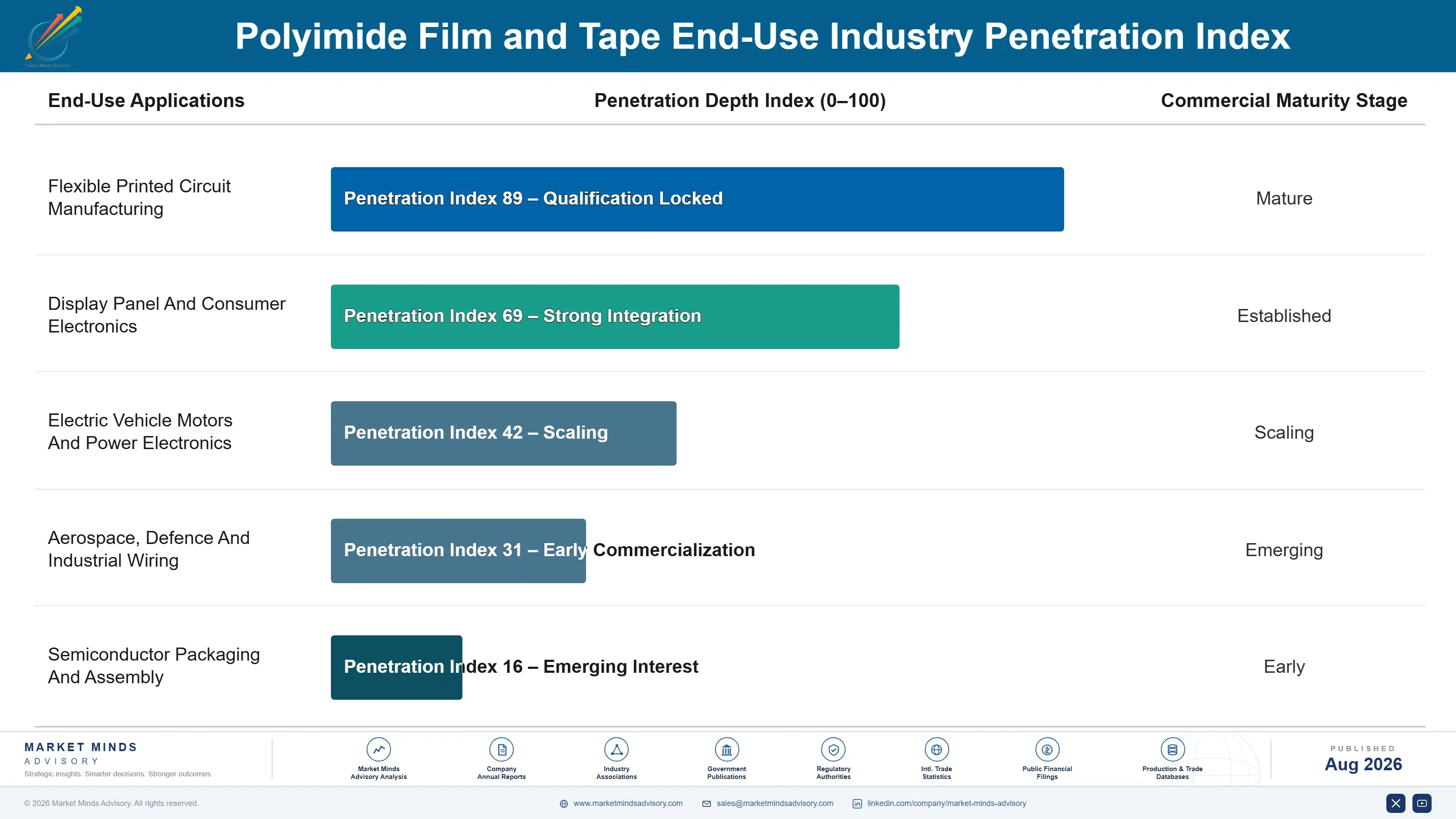
Demand follows qualification rather than purchasing decisions in almost every application. Film qualified into a flexible circuit process, a display panel line, or an aerospace wiring specification ships against production volume for years with no further commercial activity, and the decision that created it was taken during development long before any volume appeared at all.
Stickiness therefore runs through requalification cost rather than any relationship. Changing a substrate in a qualified display panel process means revalidating yield, dimensional behaviour, and optical properties across an entire production line, which no panel maker undertakes for a price difference. Aerospace wiring qualifications are firmer still. Industrial tape and general insulation grades stick hardly at all and are retendered on price routinely.

Buyer profiles shifted as display substrate became the growth application. The earlier buyer was a flexible circuit manufacturer evaluating film against a datasheet and a price. The current conversation increasingly involves a display panel process engineer who evaluates substrate behaviour through a full panel run before anything commercial is discussed at all. That change moves the selling conversation years earlier and into a technical function that never used to be involved.
polyimide-film-and-tape-market-end-use-penetration-index-1787302767167

What We Would Tell a Board

These are among the four positions where our research anticipates prominent divergence between winners and laggards over the coming forecast period. Each is grounded in the demand model, the regulatory perimeter, and the announced capacity pipeline.
01 / MONOMER SUPPLY SECURITY

Secure the monomer before you build the line

Around six plants worldwide make the required dianhydride at the purity this chemistry demands, and monomers carry roughly 44% of film production cost across every grade produced. Casting capacity without secured monomer supply behind it is capacity that will periodically stand idle through constraints nobody downstream controls. Producers who held long-term agreements through the 2022 tightness operated normally, while competitors holding entirely equivalent casting capacity simply could not run their lines at all, because allocation during a constraint follows contract commitment rather than the price anybody offers.
02 / COLORLESS CAPABILITY DECISION

Without colorless you have conceded the growth

Colorless polyimide commands around nine times standard film pricing per unit area and grows at 13.35% against 8.9% for the wider market, and its casting chemistry transfers only partially from conventional polyimide grades. Several otherwise entirely capable film producers have never entered the segment for exactly that reason. A film business without colorless capability is competing only in the slower-growing part of its own market, watching the faster part expand without it and knowing that the gap widens further with every year the decision gets deferred again.
03 / QUALIFICATION DEPTH SELLING

Datasheet comparison decides nothing in this market

Film qualified into a flexible circuit process, a display panel line, or an aerospace wiring specification cannot be substituted without requalification work that no customer will undertake for a price difference alone. Concentration at 71% reflects that reality as much as it reflects any casting difficulty. Producers competing on datasheet properties are addressing a comparison that decides nothing at all, while those investing in application engineering hold positions for a product's whole commercial life and rarely have to defend them on price again.
04 / CASTING ENTRY ROUTE

Buy the casting capability; building it rarely works

Casting film at three microns with the thickness uniformity flexible circuits require takes years to master properly, and the polymer chemistry has been published since the nineteen sixties without making entry any easier for anybody. Companies entering this market consistently underestimate that casting gap and most of them never actually close it. Acquiring an existing producer or licensing established process technology is expensive, and it remains considerably cheaper than several years of unsaleable yield spent learning the same process independently from the beginning.

Engagement Snapshot From the Field

A live engagement with an industry participant carrying material or product regulatory and market exposure ahead of a defining policy shift, showing how our research translates into a defensible multi-year portfolio strategy.
MARKET MINDS ADVISORY · CLIENT ENGAGEMENT SUMMARY
Polyimide Film and Tape Producer Strategic Portfolio Review and Transition Roadmap 2026·Investment Scenario on Polyimide Film and Tape Exposure Evaluation 2025-26
CLIENT PROFILE
A specialty film producer with approximately 145 million dollars in annual revenue (client-reported, unverified by MMA), casting standard polyimide film for flexible circuit and industrial insulation customers across two regions. Colorless capability was absent, monomer was purchased on annual contracts, and management had proposed a substantial casting capacity expansion against growing flexible circuit demand. Casting capability at standard gauges was strong.
STRATEGIC CHALLENGE
The board asked whether the expansion would address where growth was actually occurring, and whether the resulting output could be supplied reliably, before committing capital to casting lines that would take two years to commission and qualify. Standard film volumes had been flat for three years while the board's proposal assumed they would not be.
MMA APPROACH
We mapped monomer supply globally by plant, grade, and available capacity against the client's expansion requirement. Growth was decomposed by film grade across three years. Colorless casting requirements were assessed against the client's existing process capability, and qualification positions were reviewed for durability across the customer base. Three expansion scenarios were then costed against secured monomer volume.
KEY FINDINGS
  1. The expansion required monomer volumes exceeding the client's annual contracts, and uncommitted capacity across all producers was smaller than the incremental requirement.
  2. Growth over three years had concentrated almost entirely in colorless and thermal precursor grades, while standard film volumes had been broadly flat throughout.
  3. Colorless casting required chemistry and process control the client's existing lines could not deliver without substantial modification and requalification. Requalification of existing customers would have been required regardless.
  4. Standard film qualification positions were durable, but the segment they served was the slowest growing part of the whole market. Growth there had been effectively flat for three years.
CLIENT PROFILE
A specialty film producer with approximately 145 million dollars in annual revenue (client-reported, unverified by MMA), casting standard polyimide film for flexible circuit and industrial insulation customers across two regions. Colorless capability was absent, monomer was purchased on annual contracts, and management had proposed a substantial casting capacity expansion against growing flexible circuit demand. Casting capability at standard gauges was strong.
STRATEGIC CHALLENGE
The board asked whether the expansion would address where growth was actually occurring, and whether the resulting output could be supplied reliably, before committing capital to casting lines that would take two years to commission and qualify. Standard film volumes had been flat for three years while the board's proposal assumed they would not be.
MMA APPROACH
We mapped monomer supply globally by plant, grade, and available capacity against the client's expansion requirement. Growth was decomposed by film grade across three years. Colorless casting requirements were assessed against the client's existing process capability, and qualification positions were reviewed for durability across the customer base. Three expansion scenarios were then costed against secured monomer volume.
KEY FINDINGS
  1. The expansion required monomer volumes exceeding the client's annual contracts, and uncommitted capacity across all producers was smaller than the incremental requirement.
  2. Growth over three years had concentrated almost entirely in colorless and thermal precursor grades, while standard film volumes had been broadly flat throughout.
  3. Colorless casting required chemistry and process control the client's existing lines could not deliver without substantial modification and requalification. Requalification of existing customers would have been required regardless.
  4. Standard film qualification positions were durable, but the segment they served was the slowest growing part of the whole market. Growth there had been effectively flat for three years.
RECOMMENDED STRATEGY
Phase 1: Phase 1 (months one to twelve): defer the standard capacity expansion, secure long-term monomer agreements covering existing production first. Map uncommitted monomer capacity by plant. Phase 2: Phase 2 (months twelve to thirty): acquire or license colorless casting capability rather than attempting internal development from scratch. Internal development had already consumed two years without result. Phase 3: Phase 3 (months thirty to forty-eight): size any capacity addition against contracted monomer and qualified colorless positions together. Commit capital only against both being in place.
OUTCOME
The standard expansion was deferred. Long-term monomer agreements were secured with two producers within three quarters, and a licensing discussion for colorless casting technology replaced the internal development programme that had been proposed (client-reported, unverified by MMA). The board accepted that standard film capacity was not the constraint it had assumed.

Frequently Asked Questions

Foundational context covering the market sizes, CAGR, scope, country, region and competition that inform every finding below. This section is provided to cover basics and most often pre-purchase conversations, answered from the MMA Primary Research Dataset.

What is the current size of the Polyimide Film and Tape Market?

The market is valued at USD 2.9 billion in 2025, rising to USD 3.15 billion in 2026. Scope covers polyimide film and adhesive tape products, not moulding resins, wire enamels, or finished flexible circuits.

How large will the Polyimide Film and Tape Market be by 2036?

MMA forecasts USD 7.44 billion by 2036, an increase of USD 4.29 billion over the 2026 base. That represents an expansion multiple of 2.36 times across the forecast period.

What is the CAGR for the Polyimide Film and Tape Market 2026 to 2036?

The base case CAGR is 8.9%, with a bull case of 10.1% and a bear case of 7.7%. The historical rate from 2020 to 2025 was 7.4%, carried by flexible display development.

Which segment is growing fastest?

Colorless polyimide for display applications at 13.35%, exactly 1.50 times the market rate. It is the only material surviving panel processing temperature without yellowing at commercial scale.

Who are the major companies in the Polyimide Film and Tape Market?

DuPont, Kaneka, SKC Kolon PI, UBE Corporation, and Taimide Technology lead on film area produced. The top five hold 71%, held by casting and imidisation control rather than chemistry knowledge.

Which country is growing fastest?

India at 11.8%, where electronics assembly is expanding and flexible circuit manufacture is beginning to establish domestically. Almost all film is imported and no monomer capacity exists regionally.

Report Segmentation Architecture

The full report scope spans multiple orthogonal segmentation dimensions, with cross-tabulated demand data provided for each dimension pair. Coverage extends further to regional breakdowns, trend trajectories, and the competitive detail needed to support segment-level decision-making.

By Film Grade And Governing Property

  • Standard Polyimide Film For Flexible Circuits
  • Colorless Polyimide For Display Applications
  • Thermally Conductive And Graphite Precursor Film
  • Polyimide Adhesive And Masking Tapes
  • Electrical Insulation Film For Motors And Cables

By End-Use Industry

  • Flexible Printed Circuit Manufacturing
  • Display Panel And Consumer Electronics
  • Electric Vehicle Motors And Power Electronics
  • Aerospace, Defence And Industrial Wiring
  • Semiconductor Packaging And Assembly

By Commercial Model

  • Direct Supply To Qualified Manufacturers
  • Converter And Tape Slitter Supply
  • Distributor And Regional Reseller Channels
  • Co-Development With Panel And Device Makers
  • Contract Casting For Other Brands

By Region

  • East Asia
  • North America
  • Western Europe
  • South Asia and Pacific
  • Eastern Europe
  • Latin America
  • Middle East and Africa

Scope, Methodology, and Coverage

Every figure in this report is reproducible from documented input assumptions. The scope below maps the historical period, the forecast horizon, the segmentation dimensions, and the countries covered, alongside the underlying primary and qualitative methodology.
Historical Period
2020 to 2025
Forecast Period
2026 to 2036
Base Year
2025 (USD billions; MMA Primary Research Dataset, August 2026)
Market Definition
This market comprises polyimide film and polyimide-based adhesive tape products manufactured for electronic, electrical, and industrial applications, measured at producer revenue across direct, converter, distribution, and co-development channels. Coverage spans standard polyimide film for flexible printed circuits, colorless polyimide for display substrate applications, thermally conductive and graphite precursor film, polyimide adhesive and masking tapes, and electrical insulation film for motors, transformers, and cables. Polyimide moulding resins, powders and shapes, polyimide wire enamels applied as coatings, other high temperature polymers including polyetheretherketone and liquid crystal polymer films, finished flexible printed circuits, and graphitised thermal sheets sold after conversion fall outside scope.
Quantitative Units
USD billions (current prices); film area produced in square metres; price per unit area by grade; monomer consumption by producer
Segmentation Dimensions
By Film Grade And Governing Property; By End-Use Industry; By Commercial Model; By Region
Regions Covered
East Asia, North America, Western Europe, South Asia and Pacific, Eastern Europe, Latin America, Middle East and Africa
Countries Covered
South Korea, Japan, China, Taiwan, United States, Canada, Mexico, Germany, France, United Kingdom, Italy, India, Vietnam, Thailand, Australia, Brazil, Israel, Saudi Arabia, United Arab Emirates, Poland, Hungary, Czechia, and additional markets relevant to this sector
Key Companies Profiled
DuPont, Kaneka, SKC Kolon PI, UBE Corporation, Taimide Technology, Mitsubishi Gas Chemical, Toray Industries, I.S.T Corporation, Saint-Gobain Performance Plastics, Zhuzhou Times New Material, Wuxi Shunxuan New Materials, Jiangsu Yabao Insulation, Shenzhen Danbond Technology, PI Advanced Materials, Arakawa Chemical, 3M, Nitto Denko, Rogers Corporation, Yunda Technology, Guangdong Huaqiang
Quantitative Methodology
Primary survey, n=3,800 respondents, Q4 2025, six countries; demand-side model with trade association cross-validation
Qualitative Methodology
47 expert interviews, Q4 2025; applied to validate demand model assumptions, identify emerging dynamics, and assess competitive positioning
Report Format
PDF and XLSX data workbook (Word format preview document)
Publisher
Market Minds Advisory
Report Code
MMA-2026-CHM-763
Published
August 2026
Contact
sales@marketmindsadvisory.com | www.marketmindsadvisory.com

Purchase the full Polyimide Film and Tape Market Report (2026 to 2036).

The full report sizes polyimide film and tape across five film grades, five end-use industries, five commercial models, and seven regions, with monomer supply mapped by plant, grade, and available capacity throughout. Casting capability is assessed separately from polymer chemistry, since the process barrier rather than the chemistry is what keeps entrants out of this market. Qualification positions are tracked by application and durability. Competitive profiling covers twenty producers on film area produced, and colorless casting requirements are compared against conventional grade capability. Regional demand is built from application mix rather than from electronics output alone.
Monomer supply mapped by plant, grade, and available capacity
Casting capability assessed separately from polymer chemistry knowledge
Qualification positions tracked by application and expected durability
Colorless casting requirements compared against conventional grade capability
Display substrate demand modelled against panel maker capital cycles
Traction motor insulation demand separated from electronics cycle exposure

Built For The People Who Decide

From boardroom strategy to bench-side execution, this report is read cover-to-cover by leaders shaping the next decade of their industry, turning demand scenarios, market dynamics and valuation benchmarks into decisions.
CXOs/ Presidents/ VPs/ Managers
M&A and Corporate Development
Strategy Teams and R&D Heads
Procurement and Product Directors
Regulatory and Compliance Leaders
Investor Relations and Equity Analysts