
Market Minds Advisory
Polydimethylsiloxane (PDMS) Market

Polydimethylsiloxane (PDMS) Market: Everything Downstream Waits on the Siloxane Monomer Loop

Hundreds of formulated products depend on one upstream reaction that runs at enormous scale or not at all, which is why a single plant outage reprices the entire downstream industry.

Lead Analyst

Bilal Shaikh

Published

August 2026

Make Smarter Decisions with Customized Research Insights

Request a free sample report and evaluate market opportunities, growth trends, and competitive dynamics relevant to your business needs.

2025 MARKET VALUE$8.6BMarket Size 2025
2036 FORECAST VALUE$19.9BBase Case , 2026 to 2036
CAGR 2026 TO 20367.9 %Bull 9.1% / Bear 6.7%
INCREMENTAL OPPORTUNITY$10.6BNet 10- year value creation
EXPANSION MULTIPLE2.14x2036 value over 2026 base
Strategic Levers
M&A Pipeline
Regional Outlook
Country Rankings
Competitive Intelligence
Segmental Deep-dive
Call-Us : 91 93563 13602

Executive Snapshot and Market Trajectory

PDMS starts with the direct process, which converts silicon metal and methyl chloride into siloxane monomer at a scale where a viable plant costs well over a billion dollars. Roughly 78% of world capacity sits in eight integrated complexes, and everything formulated downstream waits on them.
Growth runs at 7.9% and electronics grades lead it. Electronics and thermal management grades grow at 11.85%, exactly 1.50 times the market rate, as chip packaging and battery pack thermal interface demand both scale. East Asia holds the largest share at 38%, well outside band, because Chinese siloxane capacity expansion since 2020 reshaped global supply. Personal care and medical grades follow at 9.9% on qualification rather than performance. Construction sealant demand tracks building activity closely.
Concentration is high at 63% across the top five measured on siloxane capacity in tonnes. The barrier is the monomer loop rather than formulation: hundreds of companies compound and formulate PDMS, and eight complexes decide whether any of them have material to work with. Chinese capacity built since 2021 has pushed utilisation down to around 74%. Western producers are reducing output rather than pricing into an oversupply they cannot correct.
Market Definition
This market covers polydimethylsiloxane fluids, elastomers, gels, and resins supplied for industrial and consumer formulation, spanning silicone fluids and emulsions, liquid and high consistency silicone rubber, electronics and thermal management grades, personal care and medical grade PDMS, and siloxane intermediates supplied to compounders. Silicon metal and methyl chloride feedstocks, silane coupling agents outside the siloxane chain, fumed silica sold independently, and finished consumer products containing silicone fall outside scope.
Base Year Value
$8.6B in 2025 (MMA Primary Research Dataset, August 2026)
Forecast Period
2026 to 2036, eleven discrete annual values
CAGR
7.9% base case. Bull 9.1%. Bear 6.7%.
Fastest Growth Segment
Electronics and Thermal Management Grades: 11.8% CAGR
Fastest Growth Country
India: 10.4% CAGR
Fastest Growth Region
South Asia and Pacific: 9.9% CAGR
Largest Region
East Asia: 38% of 2025 global value
Market Leaders
Dow, Wacker Chemie, Shin-Etsu Chemical, Momentive Performance Materials, Elkem Silicones. Source: MMA Analysis based on company annual reports.
Primary Survey
n=3,800 procurement and R&D decision-makers, Q4 2025, six countries
Methodology
Demand-side build-up, cross-validated against public data, 47 expert interviews

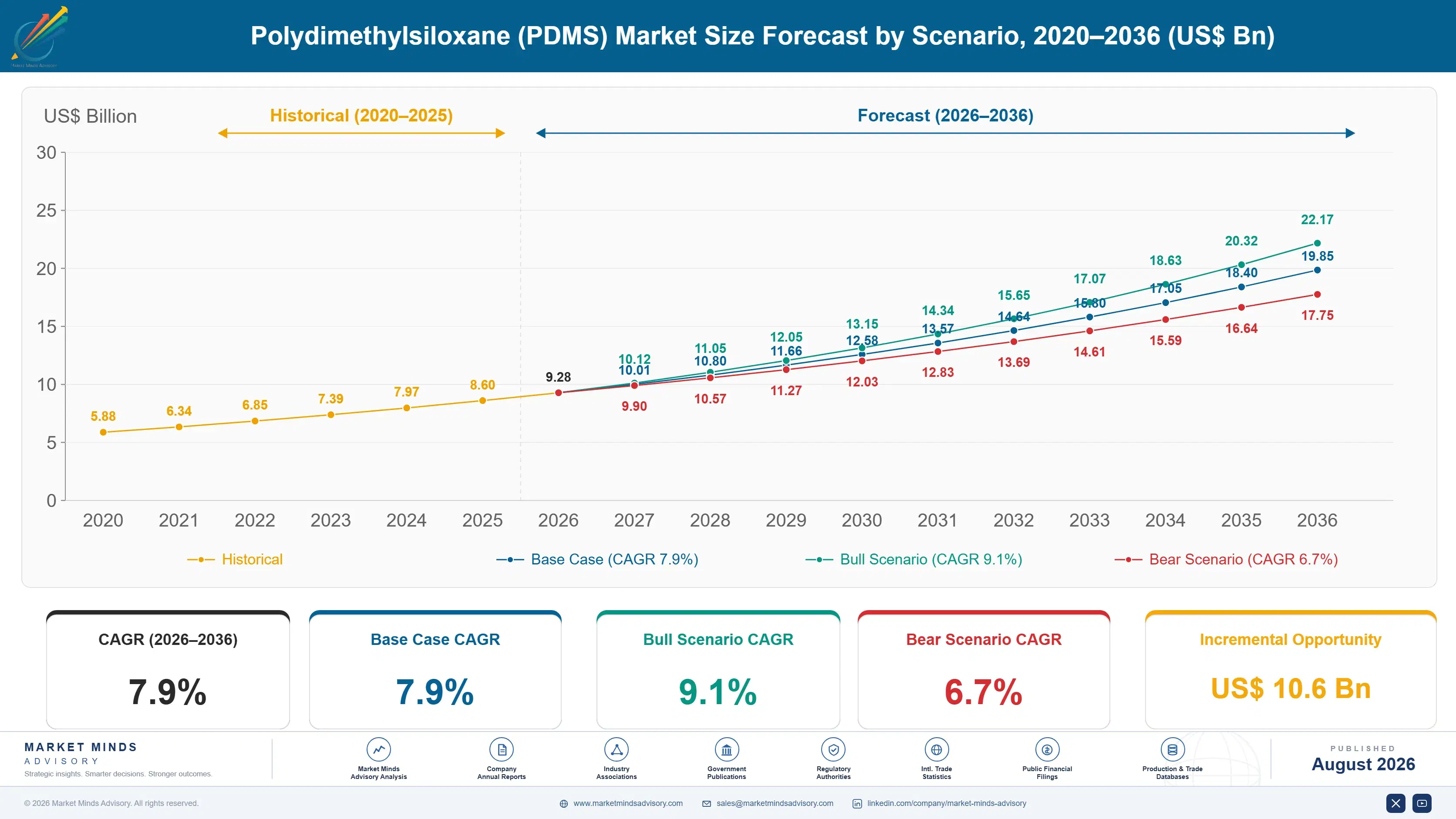
Polydimethylsiloxane (PDMS) Market Forecast Scenarios

polydimethylsiloxane-pdms-market-size-forecast-scenario-1787302756291
The 2020 to 2025 period ran at 6.5% and Chinese capacity addition rather than demand growth defined it. Siloxane capacity built between 2021 and 2023 moved the market from tight to oversupplied within roughly eighteen months, and prices fell sharply as a result. Western producers reduced output while downstream formulators enjoyed input costs they had not seen in a decade.
Three mechanisms carry the 7.9% base case. Electronics and thermal management demand is the largest, since chip packaging, battery packs, and power electronics all need materials that conduct heat while insulating electrically. Medical and personal care is the second, growing steadily on regulatory-driven substitution. And construction sealant demand is the third, tracking building activity closely across every region. None of the three mechanisms depends on the current oversupply correcting first.
The 9.1% bull case rests on battery pack thermal interface volumes scaling with electric vehicle production, which would consume PDMS in quantities that automotive sealing never approached. The 6.7% bear case is continued Chinese capacity addition against slower demand, which would extend an oversupply that has already destroyed several years of Western producer margin. Neither case turns on any change in the direct process itself.

Eight Complexes Decide Everything

Everything in silicones begins with one reaction. The direct process combines silicon metal with methyl chloride over a copper catalyst to make chlorosilanes, which hydrolyse into siloxane, which becomes every PDMS product downstream. It works at enormous scale or it does not work economically at all, and a viable complex costs somewhere north of 1.2 billion dollars to build. Nothing downstream exists without that reaction running somewhere first.
CAPACITY IN INTEGRATED COMPLEXES78%Of world siloxane capacity concentrated in eight integrated sites
MINIMUM VIABLE PLANT COST1.2 billionDollars for a direct process complex at economic operating scale
SILICON SHARE OF COST38%Of siloxane production cost from the primary metal feedstock
DOWNSTREAM FORMULATOR COUNT900Companies compounding and formulating from purchased siloxane intermediates
TOP FIVE CONCENTRATION63%High, held entirely by upstream monomer capacity rather than formulation
CAPACITY UTILISATION74%Across global siloxane assets following recent Chinese capacity additions
The consequence is a market shaped like an hourglass. Roughly 78% of world siloxane capacity sits in eight integrated complexes, and around 900 companies compound, formulate, and sell downstream products made from what those complexes produce. A single unplanned outage at one site reprices materials for hundreds of formulators who have no alternative source and no ability to substitute.
Chinese capacity built between 2021 and 2023 changed that balance considerably. Utilisation across global assets now runs near 74%, which is comfortable for buyers and painful for producers, and it followed roughly a decade in which the same industry had been persistently short. Western producers have reduced output rather than pricing into an oversupply they did not create and cannot correct alone.
"A formulator asked me to model their input risk. I told them it was one reaction in eight places. They had two hundred products and every single one traced back through the same bottleneck."
Director, Specialty Polymers and Silicones Practice · MMA Chemicals and Specialt

Market Trends

Thermal Management Becomes The Fastest Application

Chip packaging, battery pack cooling, and power electronics all need materials that transfer heat while insulating electrically, and filled PDMS systems do that in forms ranging from dispensable gap fillers to cured pads. Electronics and thermal management grades grow at 11.85% against 7.9% for the market. Filler loading and cure chemistry rather than the base polymer determine performance, which means formulation capability matters more here than upstream position does. Battery pack applications alone consume volumes that conventional automotive silicone never approached at all. Dispensing behaviour in production matters as much as the cured properties do.
Market Impact: Grades growing at 11.85%
Chinese Capacity Turned Shortage Into Oversupply

Siloxane capacity added between 2021 and 2023 moved a structurally tight market into oversupply within roughly eighteen months, and utilisation across global assets now sits near 74%. Western producers responded by reducing output rather than chasing volume into collapsing prices. Downstream formulators have enjoyed input costs unavailable for a decade, and several have built inventory positions against a correction they expect but cannot time. Western producers have reduced output rather than chasing tonnage into a price they cannot win. Mix shift toward formulated grades is the only route back to margin.
Market Impact: About 900 formulators downstream

Market Opportunities and Growth Drivers

Battery Packs Consume Volumes Automotive Sealing Never Did

A battery pack uses thermal interface material between cells and cooling plates, gap fillers around modules, and sealing at every enclosure joint, which together consume PDMS at volumes per vehicle that conventional automotive silicone applications never approached. Dispensing equipment and cure profile matter as much as the material itself in production. This application barely existed a decade ago and is now the largest single growth contributor in the whole market. Cell plant construction across every region continues expanding that requirement steadily. Qualification into a pack assembly line then holds until the next vehicle platform.
Market Impact: Some 78% in eight complexes

Medical Grades Command Qualification Nobody Repeats Casually

Implantable and device-contact PDMS carries biocompatibility testing, master file registration, and change control that make a qualified material extremely difficult to displace once a device has been approved around it. Regulatory filing rather than any performance attribute holds those positions. Volumes are modest against industrial grades and pricing reflects the qualification burden rather than the manufacturing cost, which makes the segment disproportionately valuable. A device approved around a specific material cannot change it without change control nobody undertakes casually. Those positions hold for the product's entire commercial life regardless of price. Volumes stay modest and value does not.
Market Impact: Utilisation fell to 74%

Market Restraints and Challenges

One Reaction In Eight Places Concentrates All Risk

Roughly 78% of world siloxane capacity sits in eight integrated complexes, and the root cause is that the direct process is only economic at a scale requiring more than 1.2 billion dollars of capital. Commercial impact is that a single unplanned outage reprices materials for around 900 downstream formulators with no alternative source. Mitigation runs through multi-supplier qualification, inventory positions against known turnaround schedules, and formulation designed to tolerate grade substitution where possible. Downstream buyers are only now beginning to trace their own exposure back through the monomer loop properly.
Market Impact: Electronics grades growing at 11.85

Oversupply Has Removed Western Producer Margin

Capacity added between 2021 and 2023 pushed utilisation to around 74% and prices well below where Western integrated producers earn adequate returns, and the root cause is capital deployed against a demand forecast that did not materialise on schedule. Commercial impact is output reduction, deferred maintenance, and delayed expansion across Western assets. Mitigation runs through mix shift toward electronics, medical, and specialty grades where formulation rather than tonnage sets the price. Utilisation dominates unit economics across a complex costing more than 1.2 billion dollars to build. Chasing tonnage into oversupply worsens price without improving loading meaningfully.
Market Impact: Utilisation now sits at 74%
3 additional market trends, 4 additional growth drivers, and 2 additional restraints and challenges are covered in the full report. Contact sales@marketmindsadvisory.com to access the complete intelligence.

Segment CAGR and Growth Architecture

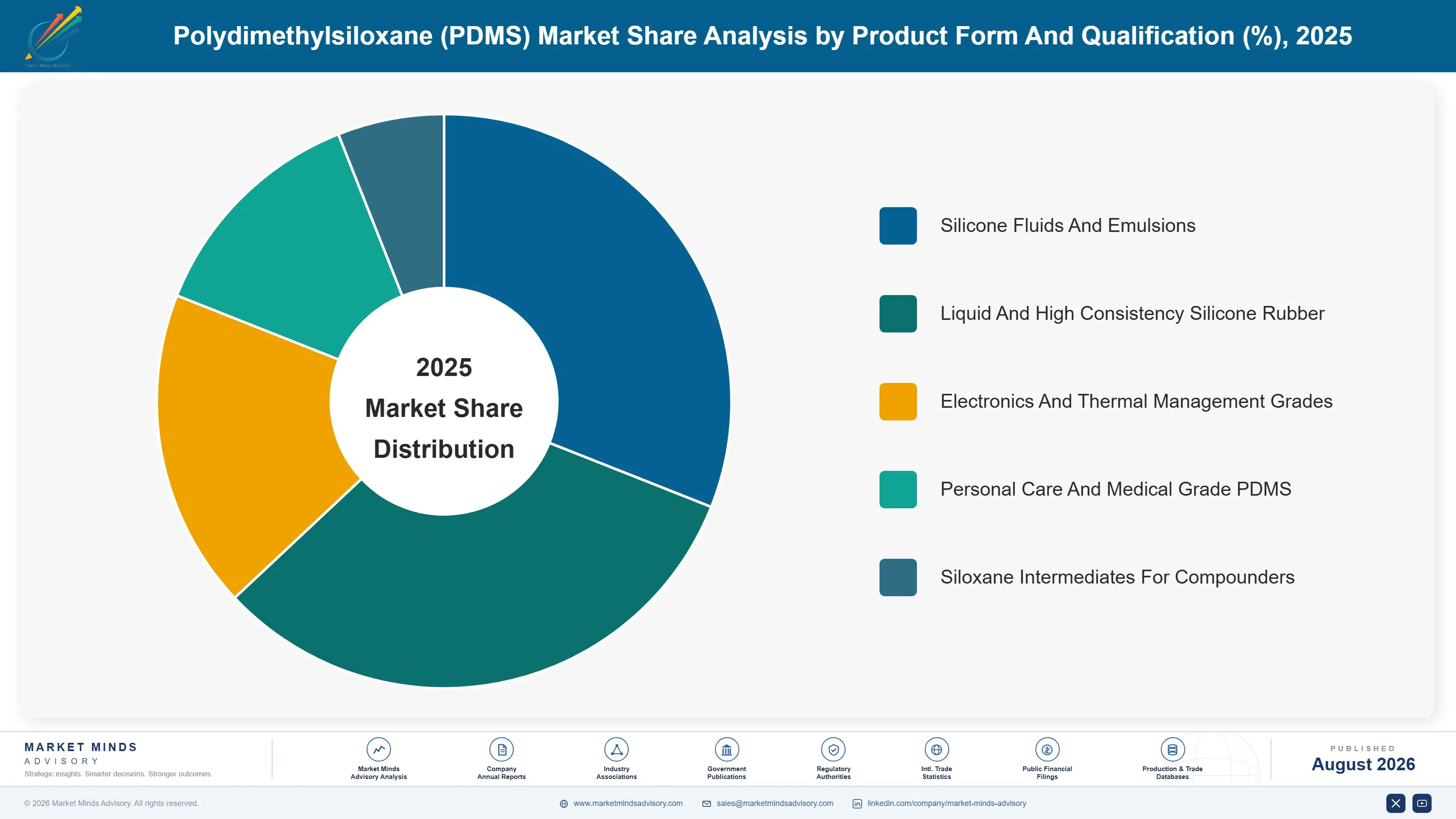
Segmentation follows product form and qualification requirement, because those determine formulation complexity, regulatory burden, pricing basis, and whether upstream position or downstream capability decides who wins. Viscosity grade and cure chemistry both cut across every product form rather than separating them, which makes either a weaker primary dimension. Qualification requirement decides how durable each position becomes.
polydimethylsiloxane-pdms-market-market-share-analysis-1787302756897

Electronics And Thermal Management Grades

The fastest category at 11.85%, exactly 1.50 times the market rate, driven by chip packaging, battery pack cooling, and power electronics needing heat transfer with electrical insulation together. Filler loading, particle size distribution, and cure chemistry determine performance far more than the base polymer does, which means formulation capability rather than any upstream siloxane position is what decides who wins here. Battery pack applications alone consume volumes that conventional automotive silicone never approached, and dispensing behaviour in production matters as much as the cured properties do. Qualification into a pack assembly line holds until the next vehicle platform arrives. Downstream compounders integrating formulation capability are competing directly for this value now.
CAGR 11.8%

Personal Care And Medical Grade PDMS

Second fastest at 9.9%, covering cosmetic fluids and emulsions alongside implantable and device-contact grades carrying biocompatibility testing and master file registration. Regulatory qualification rather than any performance attribute holds these positions, since a device approved around a specific material cannot change it without change control that no manufacturer undertakes casually. Volumes are modest against industrial grades while pricing reflects the qualification burden rather than manufacturing cost, which makes the segment disproportionately valuable relative to its tonnage. Cosmetic fluid grades behave quite differently, competing on price and formulation support rather than filing position. The two halves of this segment share a chemistry and very little else commercially. Regulatory burden separates them entirely.
CAGR 9.9%
Full segment breakdown across 5 segments available in the complete report.

Regional Architecture and Country Demand Map

East Asia leads at 38%, far outside band, because Chinese siloxane capacity expansion since 2020 reshaped global supply. Western Europe follows on formulation and specialty grades, ahead of North America. South Asia and Pacific grows fastest. Capacity location rather than consumption alone sets these regional shares.

East Asia

Thirty-eight percent, far outside the framework band, and justified because Chinese siloxane capacity built between 2021 and 2023 physically relocated a substantial share of world supply into the region. That expansion turned a structurally short market into an oversupplied one within roughly eighteen months and reset global pricing. Japanese producers hold high-specification electronics and medical positions that the capacity addition did not touch. Growth at 8.9% runs above the market rate on domestic electronics and battery manufacturing demand rather than on further capacity. Domestic formulators nonetheless remain exposed to the same monomer concentration as everybody else. Electronics and battery demand within the region is growing faster than capacity utilisation. Regional formulation capability is developing alongside that capacity steadily.
Share: 38% | CAGR: 8.9% (2026 to 2036)

Western Europe

Formulation capability and specialty grades rather than siloxane tonnage carry this 20%. German, French, and Nordic producers hold strong positions in electronics, medical, and high-performance elastomer grades where formulation and qualification rather than upstream capacity determine value. Integrated European siloxane assets have reduced output rather than pricing into the oversupply. Growth at 6.3% is the slowest of any region, reflecting margin compression on commodity grades partly offset by specialty positions holding firm. Energy pricing entering twice makes European siloxane cost position permanently difficult against newer capacity. Formulation and qualification rather than tonnage are where European producers now compete. Specialty positions have held margin throughout. Medical and electronics qualification positions remain genuinely defensible here.
Share: 20% | CAGR: 6.3% (2026 to 2036)
Regional intelligence for 5 additional markets available in the complete report: North America, South Asia and Pacific, Latin America, Middle East and Africa, Eastern Europe. Contact sales@marketmindsadvisory.com.
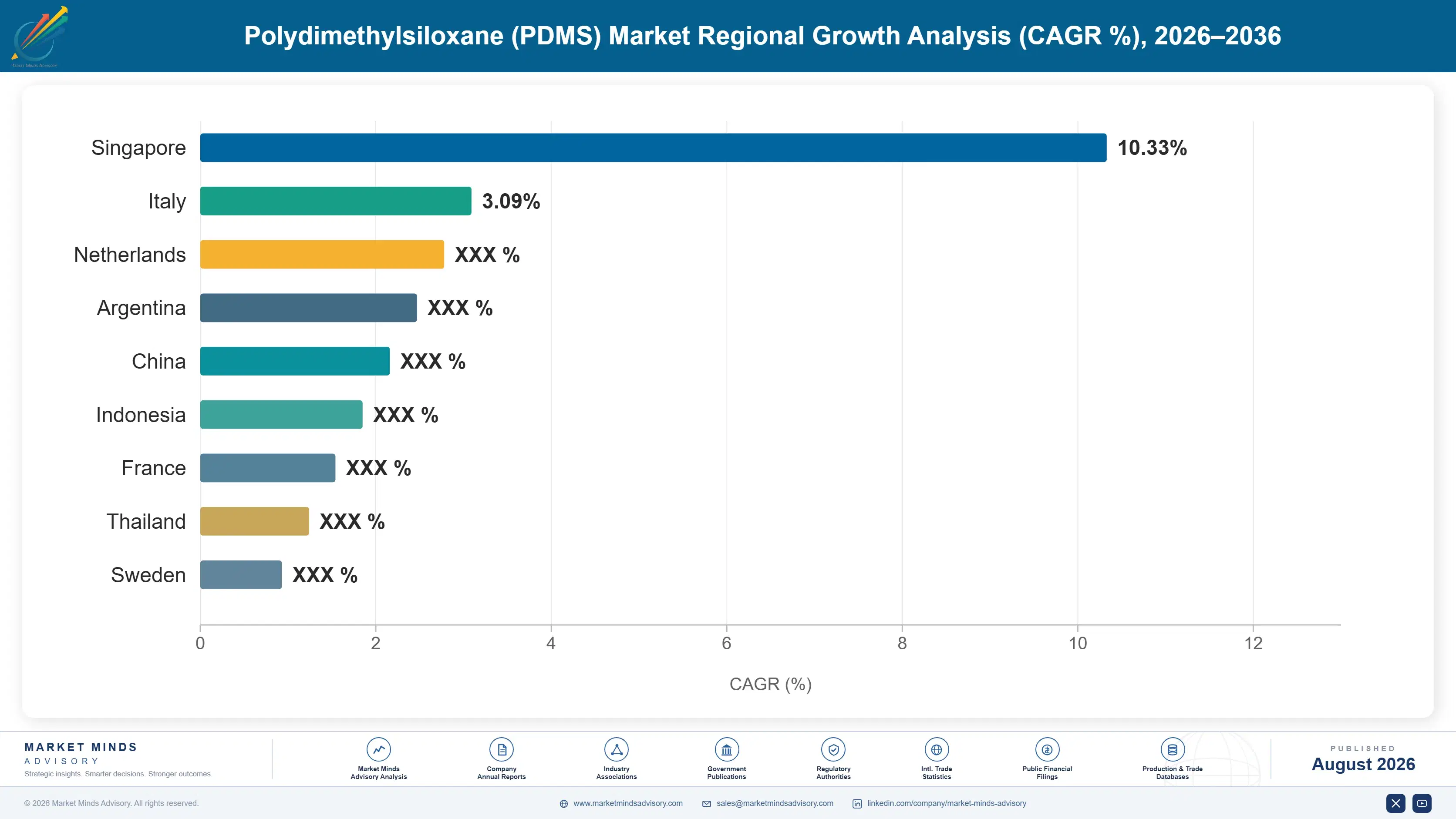
polydimethylsiloxane-pdms-market-country-cagr-analysis-1787302757421

Escaping the Tonnage Price Contest

Roughly 78% of capacity sits in eight complexes, a viable plant costs 1.2 billion dollars, utilisation runs near 74%, and around 900 formulators sit downstream. Value comes from mix shift into formulated grades, from qualification positions, and from supply security offered as a product. The hourglass shape of this industry decides where value can be captured.

Move Mix Toward Grades Priced On Formulation

Utilisation near 74% has removed margin from commodity siloxane and fluid grades where tonnage sets the price and Chinese capacity sets the tonnage. Electronics, thermal management, medical, and specialty elastomer grades price on filler systems, cure chemistry, and qualification rather than on polymer cost. A producer competing on siloxane tonnage is competing against capacity it cannot match, while formulation capability is where the remaining margin actually sits. Fixed cost across a complex makes utilisation dominate unit economics more than any input does. Reducing output beats pricing into an oversupply nobody can correct alone.
Market Impact: Utilisation currently runs near 74%

Build Qualification Positions That Nobody Revisits

Medical and device-contact grades carry biocompatibility testing, master file registration, and change control that make a qualified material extremely difficult to displace once a device has been approved around it. Regulatory filing rather than performance holds those positions for a product's whole commercial life. Volumes are modest against industrial tonnage and pricing reflects the qualification burden, which makes each position considerably more valuable than its weight suggests. Around 900 formulators sit downstream, and very few hold medical qualification positions of their own. Change control makes those filings effectively permanent once granted.
Market Impact: Around 900 formulators sit downstre

Sell Supply Security As A Product Feature

Roughly 78% of world siloxane capacity sits in eight complexes, so a single unplanned outage reprices material for around 900 downstream formulators with no alternative source. Multi-site supply guarantees, inventory positions held on a customer's behalf, and transparent turnaround scheduling all address a risk those formulators genuinely carry. Buyers who lived through a supply interruption pay for that assurance, and buyers who have not yet will eventually. A complex costing more than 1.2 billion dollars is not replicated by anybody in response. That concentration is permanent rather than cyclical, which makes the assurance durable.
Market Impact: About 78% of capacity sits in eight

Design Formulations That Tolerate Grade Substitution

A formulator whose product only works with one supplier's specific grade has accepted a single point of failure inside a market where roughly 78% of capacity sits in eight places. Designing tolerance for viscosity and endgroup variation across qualified alternatives costs development effort and removes that exposure entirely. Very few formulators do this deliberately, and those that did found the 2021 disruptions considerably less damaging than competitors who had not. Those that had built tolerance found the 2021 disruptions considerably less damaging than competitors did. Inventory positions address the symptom while formulation tolerance addresses the exposure.
Market Impact: Eight complexes hold 78% of all wor

Who Controls the Margin Pool

Concentration is high at 63% across the top five measured on siloxane capacity in tonnes, and the direct process holds it there rather than any formulation advantage. A complex costs more than 1.2 billion dollars and is economic only at very large scale, so upstream participation is closed to anyone without that capital and a decade of process experience. The leader to challenger gap is wide upstream and effectively nonexistent downstream.
Competitive activity runs on three fronts. Formulation capability in electronics and thermal management is the first, since filler systems and cure chemistry rather than base polymer determine performance there. Regulatory qualification depth in medical and device grades is the second, which holds positions for a product's whole commercial life. And supply reliability is the third, valued by formulators who have experienced an outage.

Pressure arrives from two directions. Chinese siloxane capacity has removed pricing power from commodity grades across the whole industry. And downstream compounders are integrating formulation capability that upstream producers previously supplied. Both pressures reduce what upstream integration alone can capture from this market. Formulation and qualification are where the defensible value now sits.

Rankings shift on capacity decisions rather than commercial activity.
polydimethylsiloxane-pdms-market-company-positioning-matrix-1787302757946

Competitive Moat and Risk Dimensions

DOW

Moat: Integrated capacity and formulation breadth

Holding siloxane capacity alongside deep formulation capability across electronics, medical, construction, and personal care lets one company capture value at both ends of an hourglass-shaped industry rather than only at the pinch point. Application development laboratories serving formulators also generate the specification positions that tonnage alone never would. Building either capability takes decades.
DOW

Risk: Commodity grades face structural oversupply

Chinese capacity added between 2021 and 2023 pushed utilisation to around 74% and removed pricing power from the fluid and commodity elastomer grades that carry substantial tonnage. Integration defends specialty positions and contributes nothing in a tonnage contest against newer, cheaper capacity. Volume exposure works directly against the integration advantage here.
SHIN-ETSU CHEMICAL

Moat: Electronics and high purity positions

Deep positions in semiconductor packaging, thermal management, and high purity grades sit in exactly the applications growing fastest and pricing on formulation rather than tonnage. Those positions are qualified into customer processes and specifications that change slowly, which insulates them from the commodity pricing pressure affecting fluids and general elastomers considerably.
SHIN-ETSU CHEMICAL

Risk: Narrow exposure to electronics cycles

Concentration in semiconductor and electronics applications carries exposure to a cycle that moves sharply and independently of construction, personal care, or automotive demand. Broader producers absorb that volatility across applications that do not move together. Depth in the fastest growing segment also means depth in the most cyclical one available.

Players Tracked

Prominent Players

Dow
Wacker Chemie
Shin-Etsu Chemical
Momentive Performance Materials
Elkem Silicones

Other Key Players

KCC Corporation
Zhejiang Xinan Chemical
Hoshine Silicon Industry
Dongyue Group
Tangshan Sanyou
Jiangxi Bluestar Xinghuo
Gelest
Siltech Corporation
Supreme Silicones
Innospec
Nusil Technology
CHT Group
Bluestar Silicones
Reiss Manufacturing
Silicone Solutions

Recent Developments

FEBRUARY 2025

Western producer reduces siloxane output rather than cutting price

An integrated silicones producer reduced siloxane operating rates across Western assets rather than pricing into an oversupplied market, redirecting commercial effort toward formulated specialty grades. The decision was internal operating policy rather than any acquisition, joint venture, or capacity closure arrangement with another producer. Specialty output was prioritised instead.
Signal: Reducing output beats chasing tonnage into
MAY 2025

Battery manufacturer qualifies second thermal interface supplier

A battery pack manufacturer qualified an additional thermal interface material supplier after recognising that its single-source position depended on upstream siloxane capacity concentrated in very few sites. The qualification was internal risk management rather than any dispute, supply failure, or commercial arrangement change. Qualification covered several grades.
Signal: Downstream buyers are finally mapping thei
SEPTEMBER 2025

Formulator redesigns products to accept multiple siloxane grades

A silicone formulator reworked product specifications to tolerate viscosity and endgroup variation across several qualified intermediate suppliers, removing a single point of failure from its whole portfolio. The redesign was internal development work rather than any supplier arrangement, acquisition, or joint venture. Requalification covered the whole portfolio.
Signal: Formulation tolerance is considerably chea

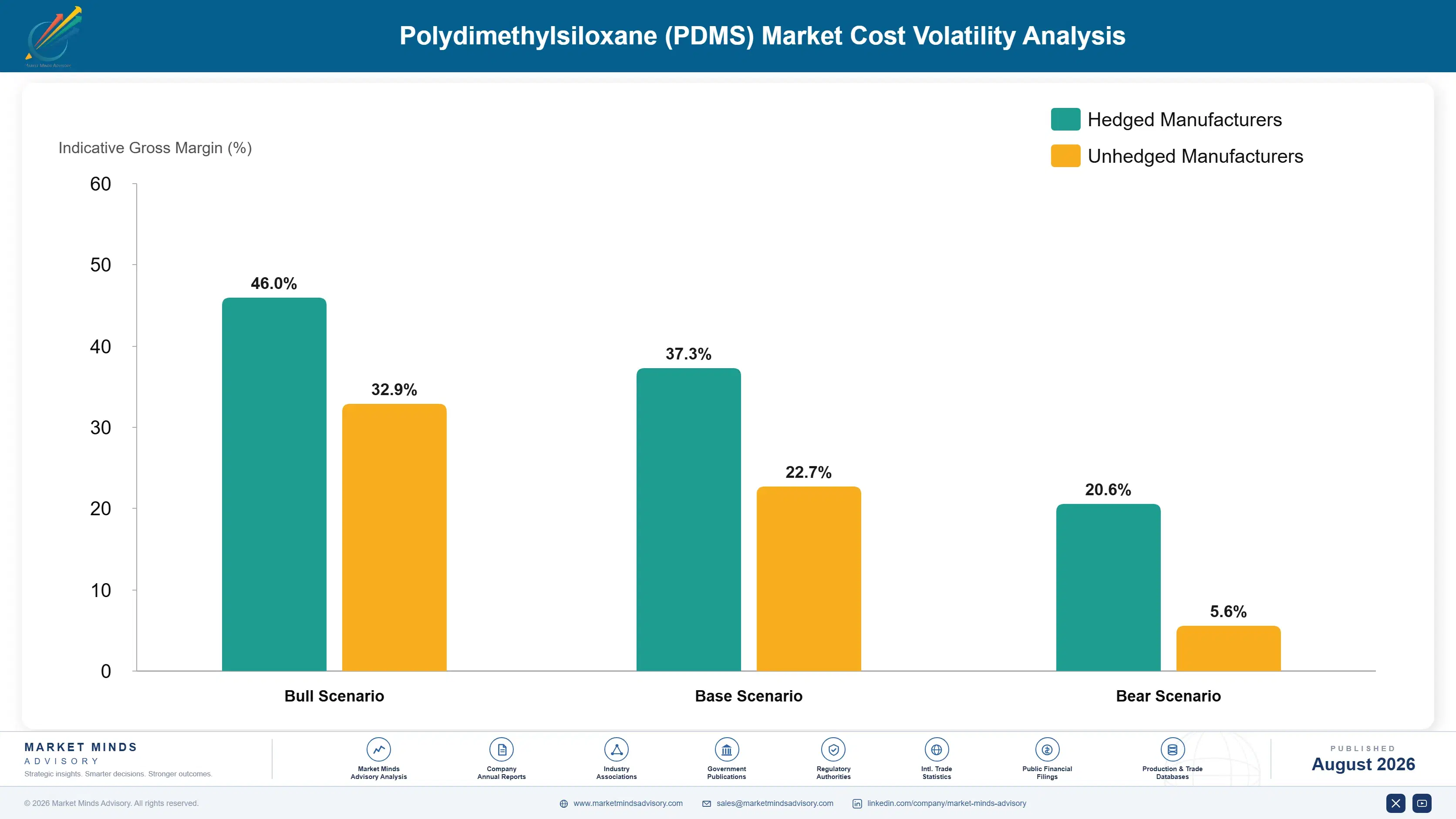
Silicon Metal, Methyl Chloride and Energy

Silicon metal carries roughly 38% of siloxane production cost, methyl chloride and methanol feedstock about 17%, electricity and process energy near 21%, catalyst and consumables around 6%, and maintenance, labour, and overhead the balance. The direct process is energy intensive and silicon metal is itself produced in electric arc furnaces, so power pricing enters the cost structure twice over.
Silicon metal and European energy pricing both moved violently through 2021 and 2022, and several silicones producers disclosed severe margin compression and temporary output reduction in annual filings covering those years. European producers were affected most sharply given regional power costs. Silicon metal pricing has since eased considerably as Chinese production expanded, though energy costs across Western assets have not returned to prior levels at all.

The competitive disadvantage mechanism runs through energy pricing rather than through silicon purchasing. Power enters twice, once in silicon metal smelting and again in the direct process, so a producer in a high electricity cost region carries a compounded disadvantage no procurement improvement addresses. Silicon metal now trades broadly at parity everywhere; the energy behind it and the process using it emphatically does not.
polydimethylsiloxane-pdms-market-cost-volatility-analysis-1787302758141

Contract power on long-term terms across both stages

Electricity enters silicones cost twice, once in silicon metal smelting and again in the energy-intensive direct process, so power pricing carries considerably more weight than the 21% direct figure suggests. Long-term contracts, self-generation, and siting decisions all address it while procurement improvements do not. European producers learned this expensively across 2021 and 2022 and are still carrying the consequence.

Recover and reuse methyl chloride within the loop

Methyl chloride and methanol feedstock carry about 17% of production cost, and the direct process regenerates methyl chloride during downstream hydrolysis, which an integrated complex can recycle back into the reaction. Producers operating without that loop closure purchase feedstock they could have recovered. Retrofitting recovery is possible and considerably more expensive than designing it into a complex from the outset.

Hold capacity utilisation rather than chasing tonnage price

Fixed cost across a complex costing more than 1.2 billion dollars spreads across whatever volume is produced, so utilisation dominates unit economics far more than any variable input does. Utilisation near 74% is where the whole industry currently sits, and chasing tonnage into oversupply worsens the price without improving the loading meaningfully. Mix shift toward formulated grades protects both simultaneously.

Portfolio Architecture for Margin Defence

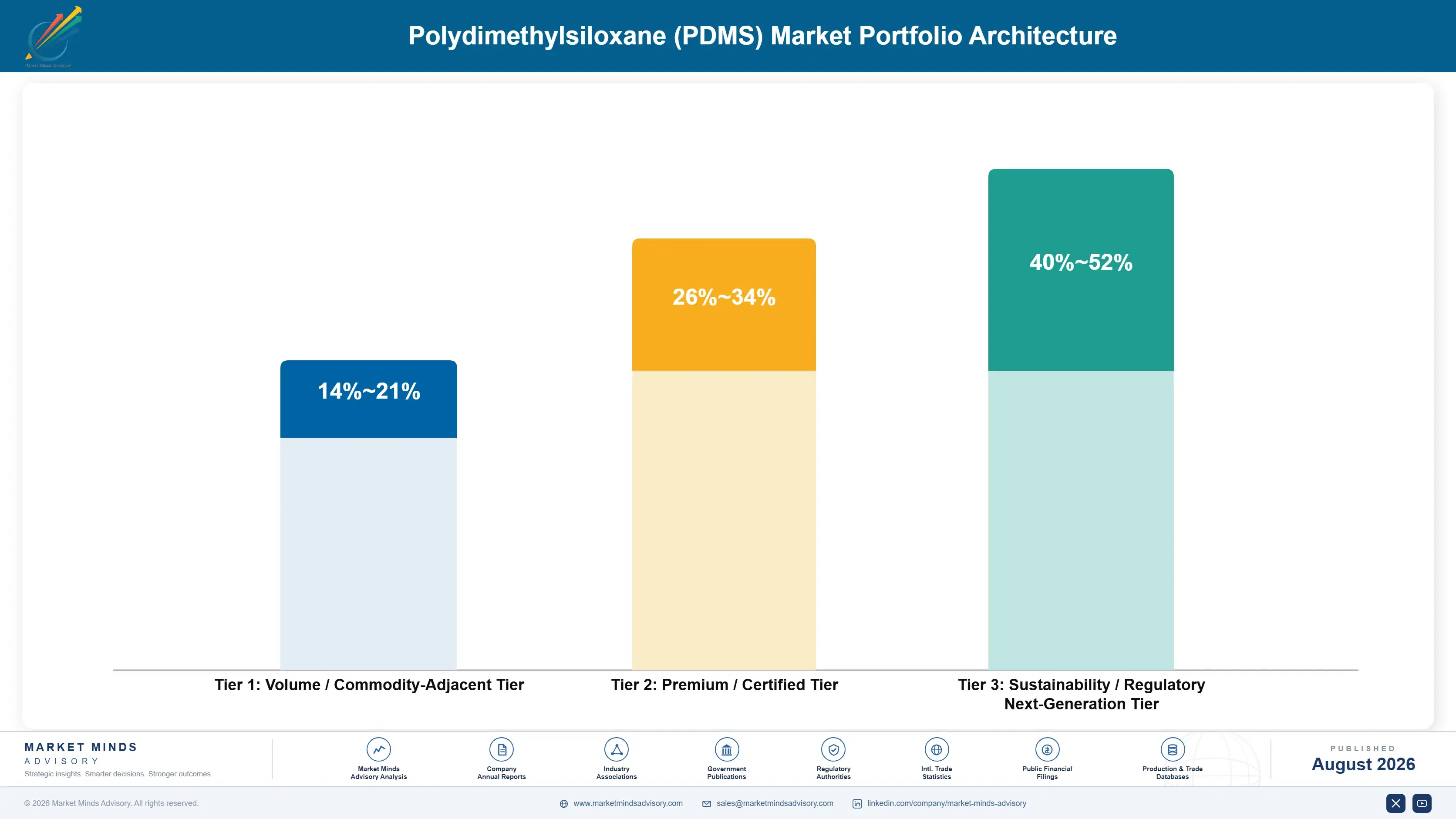
Three tiers describe this business and the spread follows formulation content rather than volume. Commodity fluids and general elastomer grades sit at the bottom, priced on tonnage where Chinese capacity sets terms nobody else can match. Construction sealant and industrial grades occupy the middle. Electronics, thermal management, and medical grades sit at the top, where filler systems, cure chemistry, and regulatory qualification all apply together.
The tension is that upstream integration protects the tier that no longer earns and contributes little to the tier that does. A siloxane complex is a formidable asset in a tight market and an expensive one at 74% utilisation, while the formulation capability carrying electronics and medical margin requires laboratories and application engineers rather than reactors. Very few producers have rebalanced properly toward that.

High-value pools concentrate where qualification outlasts the commercial relationship. Medical and device-contact grades are the clearest case, since a material approved into a device filing holds that position for the product's whole commercial life. Electronics thermal interface qualification pools value similarly, holding until a vehicle platform changes. Both pools price on qualification rather than on tonnage.

Volume / Commodity-Adjacent Tier

Commodity silicone fluids, emulsions, and general elastomer grades priced on tonnage where Chinese siloxane capacity sets terms Western producers cannot match. Utilisation near 74% has removed most of the pricing power that once existed here.
Gross Margin: 14-21%

Premium / Certified Tier

Construction sealants, industrial elastomers, and personal care fluids where formulation and application support add genuine value above the base polymer. Specification positions with major customers hold reasonably well through pricing cycles.
Gross Margin: 26-34%

Sustainability / Regulatory / Next-Generation Tier

Electronics, thermal management, and medical grade PDMS where filler systems, cure chemistry, and regulatory qualification all apply together. Best margin by a clear distance, and pricing reflects qualification burden rather than manufacturing cost.
Gross Margin: 40-52%
polydimethylsiloxane-pdms-market-portfolio-architecture-1787302758641

Specifications, Filings and Tonnage

Demand arrives through three quite different routes. Commodity fluid and elastomer tonnage moves on price against annual or spot arrangements and switches readily. Specification positions in construction, automotive, and industrial applications follow product approvals that change slowly. Medical and device-contact grades sit inside regulatory filings and effectively never change at all, which makes them a different business entirely despite sharing a production chain.
Stickiness therefore varies more within this market than between it and adjacent ones. A medical grade written into a device master file holds for the product's commercial life regardless of price. An electronics thermal interface qualified into a battery pack assembly line holds until the next platform. A commodity fluid holds until somebody quotes lower, which in current conditions happens frequently.

Buyer profiles shifted as supply concentration became visible. The earlier buyer was a purchasing function treating siloxane intermediates as an available commodity input. The current conversation increasingly involves supply chain risk assessment tracing exposure back through the monomer loop, which is a question nobody downstream had asked for roughly a decade. Those assessments trace exposure through a monomer loop nobody downstream had examined for a decade.
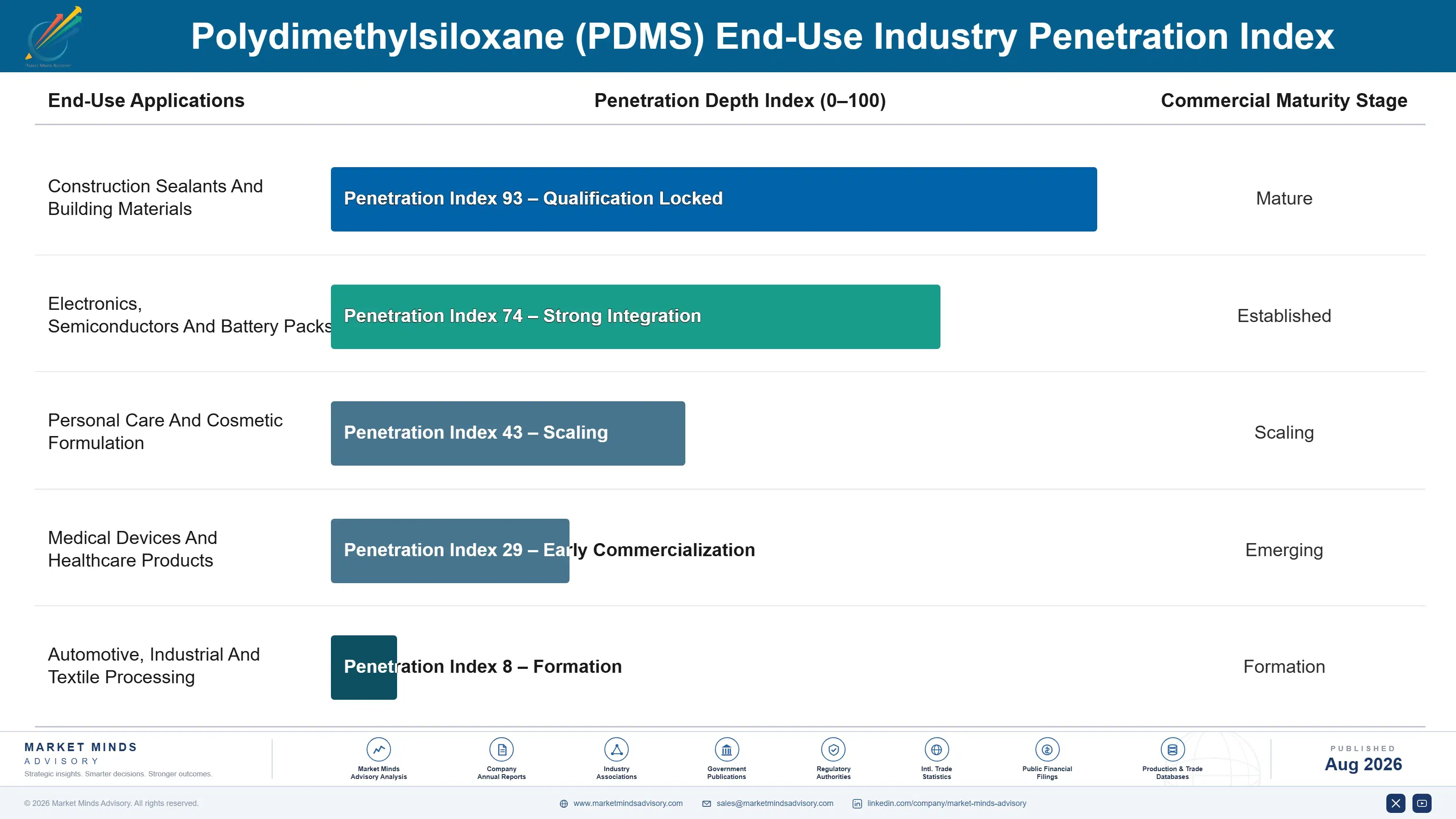
polydimethylsiloxane-pdms-market-end-use-penetration-index-1787302759288

What We Would Tell a Board

These are among the four positions where our research anticipates prominent divergence between winners and laggards over the coming forecast period. Each is grounded in the demand model, the regulatory perimeter, and the announced capacity pipeline.
01 / PORTFOLIO MIX REBALANCING

Tonnage stopped paying and formulation still does

Utilisation near 74% has now removed almost all pricing power from commodity siloxane and fluid grades, where tonnage alone sets the price and the Chinese capacity added since 2021 sets the available tonnage. Electronics, thermal management, medical, and specialty elastomer grades price instead on filler systems, cure chemistry, and regulatory qualification, rather than on the polymer cost at all. A producer competing on siloxane tonnage alone is competing against newer capacity it simply cannot match on any cost basis whatever.
02 / QUALIFICATION POSITION BUILDING

A device filing outlasts every commercial relationship

Medical and device-contact grades carry biocompatibility testing, master file registration, and change control that make a qualified material extremely difficult to displace once a device has been approved around it. Regulatory filing rather than any performance attribute at all holds those positions for a product's entire commercial life, regardless of what competitors subsequently offer. Volumes stay modest against industrial tonnage while pricing reflects the qualification burden instead, which makes each position considerably more valuable than its weight would ever suggest.
03 / SUPPLY ASSURANCE SELLING

Sell the reliability that eight complexes cannot promise

Roughly 78% of all world siloxane capacity sits inside just eight integrated complexes, so a single unplanned outage reprices material for around 900 downstream formulators who have no alternative source available to them. Multi-site supply guarantees, inventory held on a customer's behalf, and transparent turnaround scheduling all address a real risk that those formulators genuinely carry every single day. Buyers who have lived through a supply interruption pay willingly for that assurance, and most of the rest eventually will too.
04 / FORMULATION TOLERANCE DESIGN

Build products that accept more than one grade

A formulator whose product only performs with one supplier's specific grade has accepted a single point of failure inside a market where roughly 78% of capacity sits in eight places. Designing tolerance for viscosity and endgroup variation across several qualified alternatives costs some development effort upfront and it removes that exposure entirely and permanently. Very few formulators do this deliberately, and those who had already done so found the 2021 disruptions considerably less damaging than competitors who never considered it.

Engagement Snapshot From the Field

A live engagement with an industry participant carrying material or product regulatory and market exposure ahead of a defining policy shift, showing how our research translates into a defensible multi-year portfolio strategy.
MARKET MINDS ADVISORY · CLIENT ENGAGEMENT SUMMARY
Polydimethylsiloxane (PDMS) Producer Strategic Portfolio Review and Transition Roadmap 2026·Investment Scenario on Polydimethylsiloxane (PDMS) Exposure Evaluation 2025-26
CLIENT PROFILE
An integrated silicones producer with approximately 640 million dollars in annual revenue (client-reported, unverified by MMA), operating siloxane capacity alongside downstream formulation across construction, industrial, and personal care grades. Commodity fluid and elastomer volumes carried most of the revenue, electronics and medical grades were small, and margin had fallen sharply since 2023 against stable tonnage.
STRATEGIC CHALLENGE
Management proposed a cost reduction programme across siloxane production to restore competitiveness against imported material. The board wanted an independent view on whether that gap could realistically be closed before committing capital to an asset already running below economic utilisation. Portfolio margin had never been decomposed by tier. Specialty capability was unassessed.
MMA APPROACH
We benchmarked the client's siloxane cost position against Chinese and Middle Eastern capacity, separating energy, feedstock, and fixed cost components. Margin was decomposed by product tier. Electronics and medical grade requirements were assessed against the client's existing formulation and qualification capability, and downstream customer switching behaviour was reviewed by tier.
KEY FINDINGS
  1. The cost gap against recently built Chinese capacity was driven substantially by energy pricing entering twice, and no plausible programme closed a difference of that magnitude.
  2. Commodity fluid and elastomer grades had produced negative contribution in two of the previous three quarters, while specialty tiers had held margin throughout.
  3. The client held formulation capability adequate for electronics grades and no medical qualification positions at all, despite having the base polymer capability required.
  4. Customers in commodity tiers switched supplier readily on price, while specification and filing-based positions had shown no churn across the whole review period.
CLIENT PROFILE
An integrated silicones producer with approximately 640 million dollars in annual revenue (client-reported, unverified by MMA), operating siloxane capacity alongside downstream formulation across construction, industrial, and personal care grades. Commodity fluid and elastomer volumes carried most of the revenue, electronics and medical grades were small, and margin had fallen sharply since 2023 against stable tonnage.
STRATEGIC CHALLENGE
Management proposed a cost reduction programme across siloxane production to restore competitiveness against imported material. The board wanted an independent view on whether that gap could realistically be closed before committing capital to an asset already running below economic utilisation. Portfolio margin had never been decomposed by tier. Specialty capability was unassessed.
MMA APPROACH
We benchmarked the client's siloxane cost position against Chinese and Middle Eastern capacity, separating energy, feedstock, and fixed cost components. Margin was decomposed by product tier. Electronics and medical grade requirements were assessed against the client's existing formulation and qualification capability, and downstream customer switching behaviour was reviewed by tier.
KEY FINDINGS
  1. The cost gap against recently built Chinese capacity was driven substantially by energy pricing entering twice, and no plausible programme closed a difference of that magnitude.
  2. Commodity fluid and elastomer grades had produced negative contribution in two of the previous three quarters, while specialty tiers had held margin throughout.
  3. The client held formulation capability adequate for electronics grades and no medical qualification positions at all, despite having the base polymer capability required.
  4. Customers in commodity tiers switched supplier readily on price, while specification and filing-based positions had shown no churn across the whole review period.
RECOMMENDED STRATEGY
Phase 1: Phase 1 (months one to nine): abandon the siloxane cost programme, reduce commodity output and redirect capacity toward specialty grades. Phase 2: Phase 2 (months nine to twenty-four): build electronics and thermal management formulation capability and begin medical grade qualification work. across two target applications. Phase 3: Phase 3 (months twenty-four to forty-two): develop supply assurance offerings for downstream formulators exposed to upstream concentration. through multi-site guarantees. Inventory support was included.
OUTCOME
The cost programme was abandoned. Commodity output was reduced within two quarters and contribution improved despite lower tonnage, while electronics formulation capability was funded and the first medical grade qualification programme began (client-reported, unverified by MMA). Siloxane capital spending was redirected toward formulation laboratories. Tonnage fell deliberately throughout.

Frequently Asked Questions

Foundational context covering the market sizes, CAGR, scope, country, region and competition that inform every finding below. This section is provided to cover basics and most often pre-purchase conversations, answered from the MMA Primary Research Dataset.

What is the current size of the Polydimethylsiloxane (PDMS) Market?

The market is valued at USD 8.6 billion in 2025, rising to USD 9.28 billion in 2026. Scope covers PDMS fluids, elastomers, gels, and resins supplied for formulation, not silicon metal feedstock or finished consumer products.

How large will the Polydimethylsiloxane (PDMS) Market be by 2036?

MMA forecasts USD 19.85 billion by 2036, an increase of USD 10.57 billion over the 2026 base. That represents an expansion multiple of 2.14 times across the forecast period.

What is the CAGR for the Polydimethylsiloxane (PDMS) Market 2026 to 2036?

The base case CAGR is 7.9%, with a bull case of 9.1% and a bear case of 6.7%. The historical rate from 2020 to 2025 was 6.5%, shaped by Chinese capacity addition rather than demand.

Which segment is growing fastest?

Electronics and thermal management grades at 11.85%, exactly 1.50 times the market rate. Chip packaging and battery pack cooling both need heat transfer with electrical insulation, which filled PDMS systems deliver.

Who are the major companies in the Polydimethylsiloxane (PDMS) Market?

Dow, Wacker Chemie, Shin-Etsu Chemical, Momentive Performance Materials, and Elkem Silicones lead on siloxane capacity in tonnes. The top five hold 63%, held entirely by upstream monomer capacity rather than formulation.

Which country is growing fastest?

India at 10.4%, where construction, personal care, and electronics manufacturing are expanding simultaneously. Domestic siloxane capacity remains limited, so almost all intermediate material is currently imported.

Report Segmentation Architecture

The full report scope spans multiple orthogonal segmentation dimensions, with cross-tabulated demand data provided for each dimension pair. Coverage extends further to regional breakdowns, trend trajectories, and the competitive detail needed to support segment-level decision-making.

By Product Form And Qualification

  • Silicone Fluids And Emulsions
  • Liquid And High Consistency Silicone Rubber
  • Electronics And Thermal Management Grades
  • Personal Care And Medical Grade PDMS
  • Siloxane Intermediates For Compounders

By End-Use Industry

  • Construction Sealants And Building Materials
  • Electronics, Semiconductors And Battery Packs
  • Personal Care And Cosmetic Formulation
  • Medical Devices And Healthcare Products
  • Automotive, Industrial And Textile Processing

By Commercial Model

  • Direct Supply To Formulators And Compounders
  • Specification Supply Through Application Development
  • Intermediate Supply To Downstream Producers
  • Distributor And Regional Reseller Channels
  • Medical Master File And Qualified Supply Agreements

By Region

  • East Asia
  • Western Europe
  • North America
  • South Asia and Pacific
  • Latin America
  • Middle East and Africa
  • Eastern Europe

Scope, Methodology, and Coverage

Every figure in this report is reproducible from documented input assumptions. The scope below maps the historical period, the forecast horizon, the segmentation dimensions, and the countries covered, alongside the underlying primary and qualitative methodology.
Historical Period
2020 to 2025
Forecast Period
2026 to 2036
Base Year
2025 (USD billions; MMA Primary Research Dataset, August 2026)
Market Definition
This market comprises polydimethylsiloxane in fluid, elastomer, gel, and resin forms supplied for industrial, electronic, medical, and consumer formulation, measured at producer revenue across direct, specification, distribution, and intermediate supply channels. Coverage spans silicone fluids and emulsions, liquid and high consistency silicone rubber, electronics and thermal management grades including filled systems, personal care and medical grade PDMS, and siloxane intermediates supplied to downstream compounders and formulators. Silicon metal, methyl chloride, and methanol feedstocks, silane coupling agents outside the siloxane chain, fumed silica and other fillers sold independently, silicone products based on chemistries other than dimethylsiloxane, and finished consumer or industrial goods containing silicone fall outside scope.
Quantitative Units
USD billions (current prices); siloxane capacity and output in tonnes; capacity utilisation by region; formulated against intermediate revenue split
Segmentation Dimensions
By Product Form And Qualification; By End-Use Industry; By Commercial Model; By Region
Regions Covered
East Asia, Western Europe, North America, South Asia and Pacific, Latin America, Middle East and Africa, Eastern Europe
Countries Covered
China, Japan, South Korea, Taiwan, Germany, France, Norway, United Kingdom, Belgium, Italy, United States, Canada, Mexico, India, Thailand, Australia, Brazil, Argentina, Saudi Arabia, United Arab Emirates, South Africa, Poland, Czechia, Hungary, and additional markets relevant to this sector
Key Companies Profiled
Dow, Wacker Chemie, Shin-Etsu Chemical, Momentive Performance Materials, Elkem Silicones, KCC Corporation, Zhejiang Xinan Chemical, Hoshine Silicon Industry, Dongyue Group, Tangshan Sanyou, Jiangxi Bluestar Xinghuo, Gelest, Siltech Corporation, Supreme Silicones, Innospec, Nusil Technology, CHT Group, Bluestar Silicones, Reiss Manufacturing, Silicone Solutions
Quantitative Methodology
Primary survey, n=3,800 respondents, Q4 2025, six countries; demand-side model with trade association cross-validation
Qualitative Methodology
47 expert interviews, Q4 2025; applied to validate demand model assumptions, identify emerging dynamics, and assess competitive positioning
Report Format
PDF and XLSX data workbook (Word format preview document)
Publisher
Market Minds Advisory
Report Code
MMA-2026-CHM-735
Published
August 2026
Contact
sales@marketmindsadvisory.com | www.marketmindsadvisory.com

Purchase the full Polydimethylsiloxane (PDMS) Market Report (2026 to 2036).

The full report sizes polydimethylsiloxane across five product forms, five end-use industries, five commercial models, and seven regions, with siloxane capacity mapped by complex, owner, and utilisation throughout. Upstream concentration is analysed against downstream formulator exposure, since one reaction in eight places determines availability for around 900 companies. Formulated grade margin is separated from intermediate tonnage margin. Competitive profiling covers twenty companies on siloxane capacity in tonnes, medical qualification positions are assessed for durability against pricing pressure, and battery pack thermal interface demand is quantified per vehicle produced.
Siloxane capacity mapped by complex, owner, and utilisation rate
Upstream concentration analysed against downstream formulator exposure
Formulated grade margin separated from intermediate tonnage margin
Medical qualification positions assessed for durability against pricing pressure
Energy cost modelled across smelting and process stages
Battery pack thermal interface demand quantified per vehicle produced

Built For The People Who Decide

From boardroom strategy to bench-side execution, this report is read cover-to-cover by leaders shaping the next decade of their industry, turning demand scenarios, market dynamics and valuation benchmarks into decisions.
CXOs/ Presidents/ VPs/ Managers
M&A and Corporate Development
Strategy Teams and R&D Heads
Procurement and Product Directors
Regulatory and Compliance Leaders
Investor Relations and Equity Analysts