
Market Minds Advisory
Pharmaceutical Grade Sodium Bicarbonate Market

Pharmaceutical Grade Sodium Bicarbonate Market: Paying Eleven Times For The Paperwork

The molecule is chemically identical to something sold by the tonne for baking, and pharmaceutical buyers pay roughly eleven times more for it because the audit trail is the actual product.

Lead Analyst

Bilal Shaikh

Published

August 2026

Make Smarter Decisions with Customized Research Insights

Request a free sample report and evaluate market opportunities, growth trends, and competitive dynamics relevant to your business needs.

2025 MARKET VALUE$0.6BMarket Size 2025
2036 FORECAST VALUE$1.1BBase Case , 2026 to 2036
CAGR 2026 TO 20366.2 %Bull 7.4% / Bear 5.0%
INCREMENTAL OPPORTUNITY$0.5BNet 10- year value creation
EXPANSION MULTIPLE1.83x2036 value over 2026 base
Strategic Levers
M&A Pipeline
Regional Outlook
Country Rankings
Competitive Intelligence
Segmental Deep-dive
Call-Us : 91 93563 13602

Executive Snapshot and Market Trajectory

Sodium bicarbonate is one of the cheapest industrial chemicals in existence and the pharmaceutical grade sells at roughly eleven times technical pricing. Nothing about the molecule changes. What changes is the manufacturing documentation, the elemental impurity control, and whether the site survives a regulatory inspection.
Growth runs at 6.2% and sterile injectable grade leads it. Injectable material grows at 9.3%, exactly 1.50 times the market rate, because parenteral specification requires endotoxin and particulate control that oral grades never face. East Asia holds 33%, above band, since Chinese dialysis patient numbers exceed any other country and haemodialysis consumes 58% of pharmaceutical volume. A clinic network cannot pause treatment while any supply problem resolves.
Concentration is high at 68% across the top five measured on pharmaceutical grade tonnage supplied, and pharmacopoeial compliance rather than production capability holds it there. Qualification into a formulator runs around 14 months, and manufacturing records must remain retrievable for 15 years, which is a commitment few commodity producers will make. Many capable soda ash producers decline pharmaceutical qualification entirely on that basis. Concentration exists because of the obligation rather than the chemistry.
Market Definition
This market covers sodium bicarbonate manufactured and supplied to pharmacopoeial specification for medicinal and medical device applications, spanning sterile injectable grade, haemodialysis concentrate grade, buffering and excipient grade, effervescent and tablet grade, and oral antacid and over-the-counter grade. Technical, food, feed, and industrial grade sodium bicarbonate, soda ash and other sodium carbonates, finished dialysis concentrate and dialysate products, formulated pharmaceutical products containing the material, and other pharmaceutical excipients fall outside scope.
Base Year Value
$0.6B in 2025 (MMA Primary Research Dataset, August 2026)
Forecast Period
2026 to 2036, eleven discrete annual values
CAGR
6.2% base case. Bull 7.4%. Bear 5.0%.
Fastest Growth Segment
Sterile Injectable Grade: 9.3% CAGR
Fastest Growth Country
India: 9.2% CAGR
Fastest Growth Region
South Asia and Pacific: 8.4% CAGR
Largest Region
East Asia: 33% of 2025 global value
Market Leaders
Solvay, Tata Chemicals, Church and Dwight, Humens, AGC. Source: MMA Analysis based on company annual reports.
Primary Survey
n=3,800 procurement and R&D decision-makers, Q4 2025, six countries
Methodology
Demand-side build-up, cross-validated against public data, 47 expert interviews

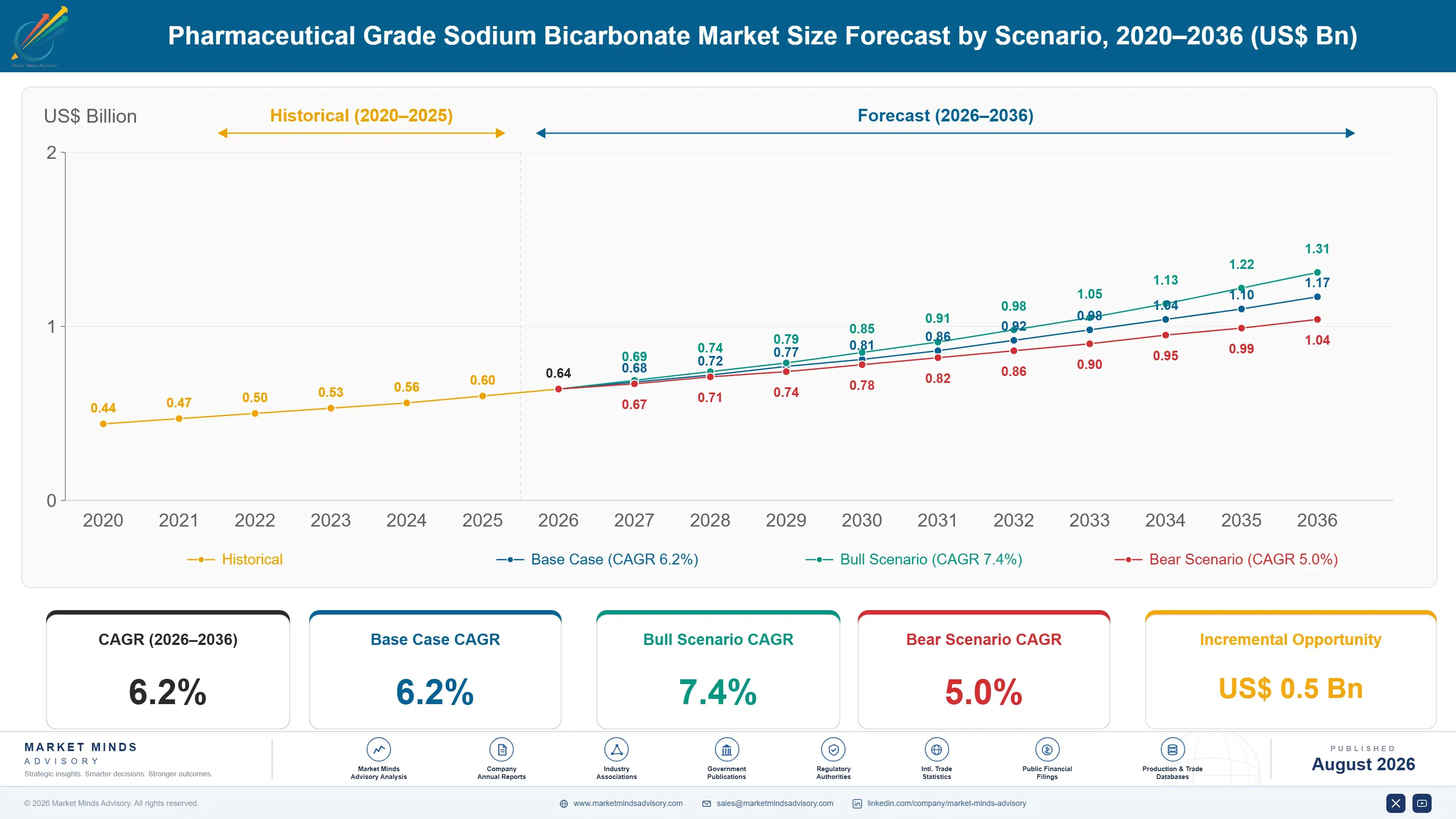
Pharmaceutical Grade Sodium Bicarbonate Market Forecast Scenarios

pharmaceutical-grade-sodium-bicarbonate-market-size-forecast-scenario-1787302749866
The 2020 to 2025 period ran at 5.2% and dialysis patient growth explained most of it. Treatment volumes dipped briefly in 2020 as elective procedures paused, then resumed their long-term trajectory because dialysis is not deferrable in any meaningful sense. Elemental impurity requirements tightened across the same period, which removed several marginal suppliers from pharmaceutical qualification without any change in demand.
Three mechanisms carry the 6.2% base case. Haemodialysis patient population growth is the largest, since chronic kidney disease prevalence rises with diabetes and ageing across every region. Sterile injectable use is the second, at 9.3%, as acidosis correction and buffering protocols expand in critical care. And effervescent formulation growth is the third, driven by consumer preference in markets where tablet swallowing is resisted. Buffering and excipient demand sits beneath all three, growing steadily with formulation volume.
The 7.4% bull case rests on dialysis access expanding faster than currently funded across Asian and Latin American health systems, since treated patient numbers there remain well below diagnosed prevalence. The 5.0% bear case is peritoneal dialysis and home therapy taking share from in-centre haemodialysis, which would reduce bicarbonate concentrate consumption per patient considerably. Neither scenario touches the qualification barrier.

The Audit Trail Is The Product

Nothing about the chemistry justifies the price. Sodium bicarbonate sells by the tonne for baking, cleaning, and flue gas treatment, and the pharmaceutical grade commands roughly eleven times that for a molecule with an identical formula. The premium buys dedicated manufacturing, elemental impurity control below five parts per million, complete batch documentation, and a site that will pass an inspection.
TOP FIVE CONCENTRATION68%High, held through pharmacopoeial compliance rather than production capability
PHARMA GRADE PRICE PREMIUM11 timesAbove technical grade for a chemically identical molecule entirely
DIALYSIS SHARE OF VOLUME58%Of pharmaceutical grade demand consumed by haemodialysis concentrate alone
ELEMENTAL IMPURITY LIMIT5 ppmTotal permitted under current pharmacopoeial monograph requirements everywhere
SUPPLIER QUALIFICATION PERIOD14 monthsBefore a formulator will accept material into commercial production
BATCH RECORD RETENTION15 yearsFor which full manufacturing records must remain fully retrievable
That makes this an unusual chemical business. Producers are not competing on synthesis, cost position, or scale in any conventional sense; they are competing on whether a customer's regulatory affairs function can defend the choice. Records must remain retrievable for 15 years, and a supplier that exits the market leaves its former customers holding a documentation obligation nobody else can satisfy.
Dialysis dominates the volume and shapes the risk. Haemodialysis concentrate consumes around 58% of pharmaceutical grade demand, and a clinic network cannot pause treatment while a supply problem is resolved. Continuity of supply is therefore a patient safety matter rather than a procurement inconvenience, which is why buyers qualify second sources they may never actually order from. They pay full qualification cost over 14 months for that insurance.
"A customer asked us why they should not simply buy food grade. The correct answer is not chemistry. It is that a regulator will ask them to produce the batch record in eleven years and food grade will not have one."
Director, Pharmaceutical Ingredients and Excipients Practice · MMA Chemicals and

Market Trends

Elemental Impurity Rules Removed Marginal Suppliers Quietly

Pharmacopoeial elemental impurity requirements tightened to total limits around five parts per million, and several producers who had supplied pharmaceutical grade for decades could not demonstrate control at that level from their existing process routes. They withdrew rather than invest. Concentration rose to 68% without any commercial event occurring at all, which is how regulation reshapes a supply base far more effectively than competition ever manages to. Producers who invested instead now hold positions that no commercial effort by a competitor reaches. Regulation did the consolidating. Nobody had to buy anybody.
Market Impact: Qualification takes about 14 months
Dialysis Buyers Qualify Sources They Never Order From

Haemodialysis consumes around 58% of pharmaceutical grade volume, and a clinic network cannot suspend treatment while a supply interruption resolves, which makes continuity a clinical rather than commercial question. Buyers therefore qualify second and third sources at real cost and then order almost nothing from them. That behaviour rewards producers who can absorb qualification effort against volumes that may never materialise into revenue. Dual-site registration and contractual continuity commitments are what those buyers are actually paying for. Very few producers offer either explicitly. Most sell specification instead. Specification is the part everybody assumes.
Market Impact: Injectable grade grows at 9.3%

Market Opportunities and Growth Drivers

Dialysis Patient Populations Grow Across Every Region

Chronic kidney disease prevalence rises with diabetes and population ageing, and treated patient numbers grow steadily across developed and developing health systems alike. Dialysis is not deferrable, so this demand held through the 2020 disruption when almost every other pharmaceutical volume fell. Bicarbonate consumption per patient is fixed by treatment protocol rather than by any purchasing decision, which makes the volume unusually predictable years ahead. Treated patient numbers across Asia and Latin America remain well below diagnosed prevalence. Access rather than clinical need constrains those markets. Funding decisions move the volume.
Market Impact: Qualification runs about 14 months

Critical Care Protocols Expand Injectable Buffering Use

Sterile injectable sodium bicarbonate is used in metabolic acidosis correction, cardiac arrest protocols, and as a buffering agent in compounded preparations, and injectable grade grows at 9.3% against 6.2% for the market. Parenteral specification requires endotoxin and particulate control that oral grades never encounter, which restricts supply to producers with sterile-capable facilities. Very few pharmaceutical grade producers hold that capability at all. Pricing reflects that scarcity clearly, and the investment reaches the only genuinely narrow supply here. Everything else is qualified rather than scarce. The distinction matters commercially. Facilities decide participation here.
Market Impact: Records held for 15 years

Market Restraints and Challenges

Qualification Timelines Block Any Rapid Supply Response

Supplier qualification into a formulator runs around 14 months of documentation review, sample testing, and audit, and the root cause is that a change of excipient source is a regulatory variation requiring justification rather than a purchasing decision. Commercial impact is that supply disruptions cannot be resolved by switching. Mitigation runs through pre-qualified second sources held at nominal volume, dual-site registration by producers, and inventory positions sized against qualification time rather than lead time. Buyers therefore size inventory against qualification time rather than against any delivery lead time. That is an unusual policy and a rational one.
Market Impact: Impurity limits sit near 5 ppm

Record Retention Obligations Deter Commodity Producers

Manufacturing records must remain retrievable for 15 years and the root cause is that a regulator may question a batch long after the product containing it has been consumed. Commercial impact is that commodity soda ash producers with capable plants decline pharmaceutical qualification entirely, since the obligation outlasts any commercial interest they have. Mitigation runs through dedicated pharmaceutical subsidiaries, documentation systems built for the retention period, and pricing that reflects the obligation honestly. A supplier that exits leaves former customers holding a documentation obligation nobody else can satisfy. That risk is rarely priced by either side.
Market Impact: Dialysis takes 58% of volume
3 additional market trends, 4 additional growth drivers, and 2 additional restraints and challenges are covered in the full report. Contact sales@marketmindsadvisory.com to access the complete intelligence.

Segment CAGR and Growth Architecture

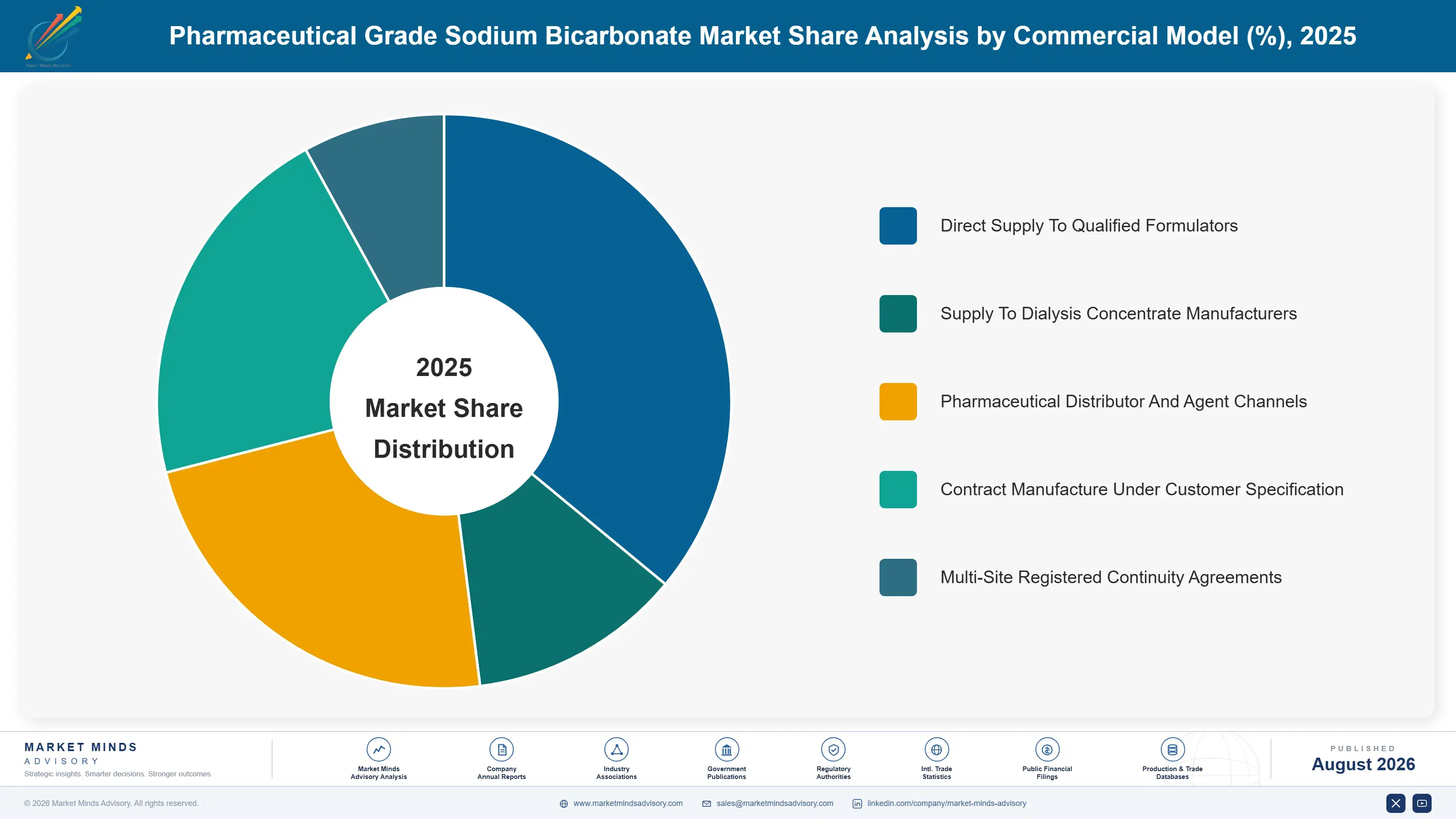
Segmentation follows the pharmacopoeial grade and the specification governing it, because those determine manufacturing environment, impurity and particulate control, qualification pathway, and which formulators can accept the material at all. Delivery format and customer type both cut across every grade rather than separating them, which makes either weaker as a primary dimension. Grade decides which facility can even make it.
pharmaceutical-grade-sodium-bicarbonate-market-market-share-analysis-1787302750403

Sterile Injectable Grade

The fastest grade at 9.3%, exactly 1.50 times the market rate, supplied for parenteral solutions used in acidosis correction, cardiac arrest protocols, and compounded preparations. Endotoxin limits, particulate control, and sterile manufacturing environment requirements make this a fundamentally different production problem from oral grades rather than a tighter version of one. Very few pharmaceutical grade producers hold sterile-capable facilities at all, which keeps supply narrow and pricing well above every other grade in this market by a considerable margin. Qualification into a parenteral product holds for that product's whole registered life without reopening at any point. Requalification is a regulatory variation. Nobody undertakes one to save money. Positions are correspondingly durable.
CAGR 9.3%

Haemodialysis Concentrate Grade

Second fastest at 7.0% and by far the largest by volume, consuming around 58% of pharmaceutical grade demand across dry bicarbonate cartridges and liquid concentrate production. The specification is demanding on impurity and dissolution consistency because material contacts blood across a membrane, and treatment cannot pause while a supply issue resolves. That combination makes buyers qualify second sources they rarely order from, and it makes supply reliability worth considerably more to them than unit price ever is. Dialysis providers have consolidated into large networks with real purchasing power, which pulls against that pricing power. Essential supply meets hard negotiation. The two forces partly cancel each other out. Essential supply still gets negotiated hard.
CAGR 7.0%
Full segment breakdown across 5 segments available in the complete report.

Regional Architecture and Country Demand Map

East Asia leads at 33%, above band, because Chinese dialysis patient numbers exceed any other country. North America and Western Europe follow on treatment intensity and injectable use. India grows fastest. Three regional shares sit outside their framework bands. Dialysis patient geography explains all three.

East Asia

Thirty-three percent, above the framework band, and justified because Chinese haemodialysis patient numbers exceed those of any other country while treatment access continues expanding under national health insurance coverage. Japanese dialysis practice is the most established anywhere and consumes proportionally more per patient through longer and more frequent treatment protocols. Domestic Chinese producers supply most regional dialysis volume while injectable grade is largely imported. Growth at 7.2% runs above the market rate on patient population expansion alone. Elemental impurity compliance among domestic Chinese producers varies considerably, which is why export-facing qualification remains concentrated among a smaller group. Regional and export supply are different businesses. Export qualification remains a narrow group.
Share: 33% | CAGR: 7.2% (2026 to 2036)

North America

Twenty-four percent, and treatment intensity rather than patient count explains the share, since dialysis protocols here use more concentrate per session than most regions and injectable use in critical care is proportionally higher. Supplier qualification standards are the most demanding anywhere, which narrows the accepted supply base considerably. Record retention expectations are enforced rigorously in inspection. Growth at 5.6% sits below the market rate, reflecting a mature and fully treated patient population. Dialysis provision has consolidated into a small number of very large networks, which concentrates purchasing power more than in any other region. Essential supply still gets negotiated hard. Continuity commitments are what actually win awards. Price alone rarely wins here.
Share: 24% | CAGR: 5.6% (2026 to 2036)
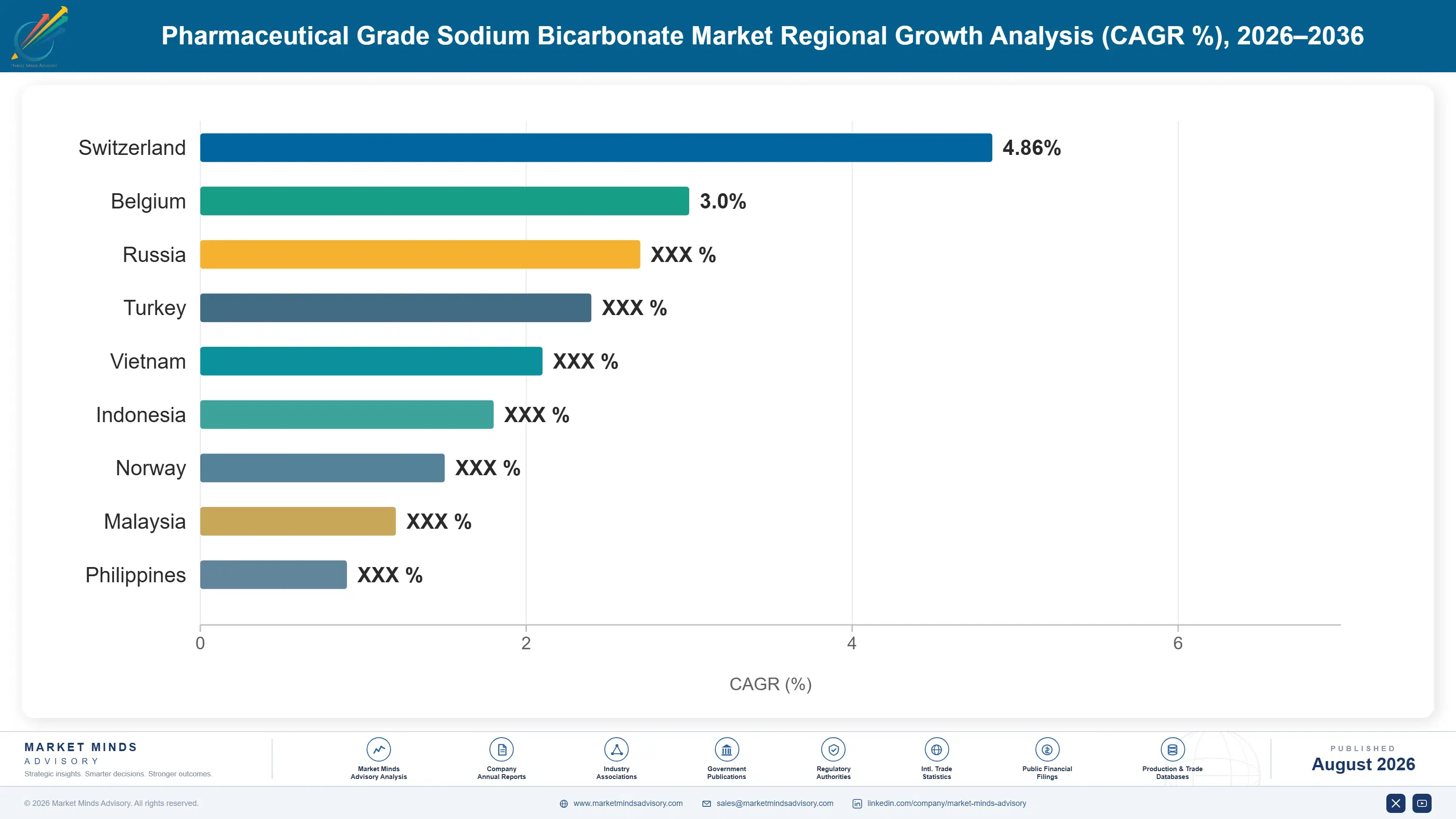
Regional intelligence for 5 additional markets available in the complete report: Western Europe, South Asia and Pacific, Latin America, Middle East and Africa, Eastern Europe. Contact sales@marketmindsadvisory.com.
pharmaceutical-grade-sodium-bicarbonate-market-country-cagr-analysis-1787302750922

Documentation, Continuity And Grade Reach

Pharmaceutical grade prices at eleven times technical, qualification runs 14 months, records are held 15 years, and dialysis consumes 58% of volume. Value comes from documentation systems, from supply continuity commitments, and from grades commodity producers will not attempt. Synthesis capability decides nothing whatever. Value comes from documentation systems, from continuity commitments, and from grades commodity producers will not attempt.

Sell The Documentation System Rather Than The Material

Pharmaceutical grade commands roughly eleven times technical pricing for a chemically identical molecule, and the entire premium rests on batch documentation, impurity control below five parts per million, and inspection readiness. Producers describing purity and specification are describing the part customers assume. Producers describing their documentation systems, retention capability, and inspection history are describing what the customer's regulatory affairs function actually has to defend. Impurity control below 5 parts per million and 15 year retention are the specific commitments being bought. Neither appears on a certificate of analysis. Both decide the award.
Market Impact: Grade prices at 11 times technical

Price Supply Continuity As A Clinical Commitment

Haemodialysis consumes around 58% of volume and a clinic network cannot suspend treatment while a supply interruption resolves, which makes continuity a patient safety matter rather than a service level. Buyers qualify second sources at real cost and order almost nothing from them, purely as insurance. A producer offering dual-site registration and contractual continuity commitments is selling exactly what the buyer is already paying for elsewhere. Qualification of a source that is never ordered from still costs the buyer 14 months and real money. They pay it anyway. That reveals what they value.
Market Impact: Dialysis alone consumes 58% of the

Build Sterile Injectable Capability Where Justified

Injectable grade grows at 9.3% against 6.2% for the market and requires endotoxin control, particulate limits, and a sterile manufacturing environment that oral grade production simply does not have. Very few producers hold that capability, and pricing reflects that scarcity clearly. The investment is substantial and it reaches the only grade in this market where supply is genuinely narrow rather than merely qualified. Endotoxin limits and particulate control need a facility type most producers have never built and will not. Scarcity rather than difficulty sets the price. Very few will enter.
Market Impact: Injectable grade grows at 9.3% ever

Treat Record Retention As A Competitive Barrier

Manufacturing records must remain retrievable for 15 years, which is longer than many commodity producers intend to stay in any given business, and that obligation deters capable soda ash producers from entering pharmaceutical qualification at all. A producer with documentation systems designed for that horizon holds a barrier no synthesis capability creates. Concentration at 68% exists because of this rather than because the chemistry is difficult. Capable soda ash producers decline qualification even where their plants could easily make the material. The obligation outlasts their commercial interest. That is the barrier.
Market Impact: Records must survive a full 15 year

Who Controls the Margin Pool

Concentration is high at 68% across the top five measured on pharmaceutical grade tonnage supplied, and pharmacopoeial compliance rather than production capability holds it there. Many soda ash and bicarbonate producers have plants technically capable of making this material and decline pharmaceutical qualification because the documentation, audit, and retention obligations outlast their commercial interest. The leader to challenger gap is widest in sterile injectable grade and narrowest in
Competitive activity runs on three fronts. Documentation and inspection readiness is the first and the one customers actually evaluate, since a regulatory affairs function must be able to defend the choice years later. Supply continuity commitment is the second, because dialysis buyers treat interruption as a clinical risk. And sterile capability is the third, where the only genuinely narrow supply in this market sits.

Pressure arrives from two directions. Indian producers have qualified into regulated export markets at costs Western producers do not match. And dialysis providers have consolidated into large networks with correspondingly large purchasing power. Rankings shift on qualification and inspection outcomes rather than on price. Neither pressure reaches sterile injectable supply, where facility requirements restrict participation to a handful of producers worldwide. That tier behaves separately from everything else.
pharmaceutical-grade-sodium-bicarbonate-market-company-positioning-matrix-1787302751449

Competitive Moat and Risk Dimensions

SOLVAY

Moat: Multi-site pharmaceutical qualification depth

Pharmaceutical grade production qualified at more than one site lets a supplier offer genuine continuity commitments to dialysis buyers who treat interruption as a clinical risk rather than a service failure. Documentation systems built for fifteen year retention and a long inspection history compound that. Neither can be assembled quickly by a producer entering from technical grade.
SOLVAY

Risk: Indian producers reaching regulated markets

Indian pharmaceutical grade producers have invested in qualification to serve regulated export markets and operate at cost positions Western producers do not attempt to match. Once qualified, the material is accepted on the same documentation basis as any other. Cost advantage becomes decisive precisely when qualification stops being the differentiator.
TATA CHEMICALS

Moat: Integrated production and regulated qualification

Upstream soda ash and bicarbonate integration alongside pharmaceutical qualification gives a cost position that dedicated pharmaceutical producers cannot approach while still meeting the documentation standard regulated markets demand. Qualification into export markets required investment domestic sales alone would never have justified. Both advantages now serve two quite different customer bases at once.
TATA CHEMICALS

Risk: Sterile injectable capability remains limited

Sterile injectable grade grows at 9.3% and requires endotoxin control and a sterile manufacturing environment that oral grade production does not provide at any scale. A position weighted toward dialysis and oral grades participates little in the fastest growing and highest priced part of this market. Building that capability is a facility investment rather than a process adjustment.

Players Tracked

Prominent Players

Solvay
Tata Chemicals
Church and Dwight
Humens
AGC

Other Key Players

Sisecam Chemicals
Genesis Energy
Natural Soda
Shandong Haihua
Tokuyama Corporation
Nirma
GHCL
DCW
Merck KGaA
Thermo Fisher Scientific
Spectrum Chemical
Jost Chemical
Dr. Paul Lohmann
Qingdao Soda Ash Industrial
Hubei Yihua Chemical

Recent Developments

JANUARY 2025

Producer withdraws from pharmaceutical grade on impurity requirements

A long-established bicarbonate producer ended pharmaceutical grade supply after concluding that meeting tightened elemental impurity limits from its existing process route required investment its volumes would not repay. The withdrawal was a commercial decision rather than any regulatory action, recall, or safety finding against the material.
Signal: Regulation is now reshaping this whole sup
APRIL 2025

Dialysis network qualifies third supplier as continuity insurance

A large dialysis provider completed qualification of a third bicarbonate supplier it does not intend to order from routinely, holding the position purely as protection against interruption at either of its two active sources. The qualification was internal continuity risk management rather than any dispute or performance failure.
Signal: Buyers pay the full qualification cost for
AUGUST 2025

Indian producer completes qualification into regulated export market

An Indian pharmaceutical grade producer finished supplier qualification with a formulator in a strictly regulated market, having invested in documentation systems and impurity control that domestic sales alone would not have justified. The qualification was a technical and regulatory process rather than any commercial partnership.
Signal: Cost advantage becomes decisive at exactly

Soda Ash, Carbon Dioxide and Compliance

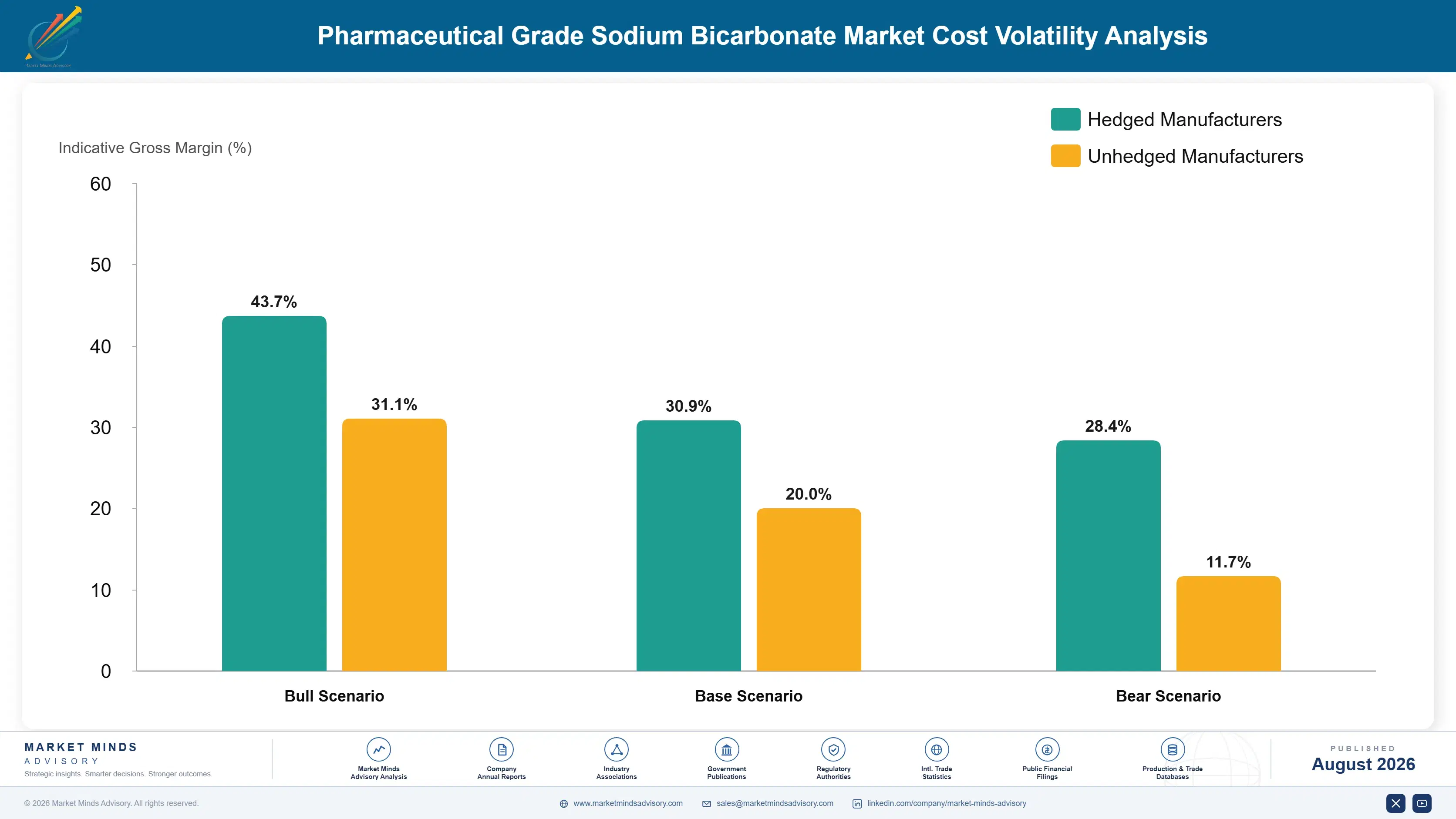
Production cost divides between soda ash or trona feedstock at roughly 29%, carbon dioxide and process utilities near 17%, quality control, analytical testing, and documentation around 21%, dedicated facility overhead and cleaning validation about 18%, and packaging, freight, and general overhead the balance. Compliance and documentation together exceed feedstock cost, which is the clearest possible statement of what this business actually sells.
Soda ash and industrial energy prices both moved sharply through 2022, and several chemical producers disclosed input cost pressure in filings covering that year, with IEA data tracking the underlying energy movement. Analytical and compliance costs rose separately and more persistently as elemental impurity testing requirements expanded. Pass-through was slower than the cost movement, since pharmaceutical supply agreements typically run multi-year with limited adjustment provision.

The competitive disadvantage mechanism runs through compliance overhead amortisation rather than through feedstock cost. Soda ash costs broadly the same for producers of reasonable scale, while quality, documentation, and dedicated facility costs are largely fixed regardless of volume. A producer running small pharmaceutical volumes through a dedicated facility carries a burden per tonne that a larger qualified producer simply does not, and no process improvement narrows it.
pharmaceutical-grade-sodium-bicarbonate-market-cost-volatility-analysis-1787302751646

Amortise compliance overhead across sufficient qualified volume

Quality, documentation, and dedicated facility costs together carry around 39% of production cost and are largely fixed rather than variable with volume. A producer running small pharmaceutical volumes through a dedicated facility carries a burden per tonne that scale removes entirely. That arithmetic argues for either committing to meaningful qualified volume or not entering the grade at all.

Design documentation systems for the full retention period

Manufacturing records must remain retrievable for 15 years, and systems designed around shorter commercial horizons create a liability that outlasts the business decision behind them. Building retrieval capability deliberately at the outset costs far less than reconstructing records under inspection pressure later. Several producers have discovered that distinction at exactly the wrong moment. Retrieval capability is what an

Contract soda ash feedstock on multi-year indexed terms

Soda ash and trona feedstock carry roughly 29% of production cost and move on cycles no bicarbonate producer influences, while pharmaceutical supply agreements typically run multi-year with limited price adjustment. Indexed feedstock contracts align the two exposures rather than leaving the producer carrying a mismatch. Feedstock suppliers resist indexation and accept it more readily on committed volume.

Portfolio Architecture for Margin Defence

Three tiers describe this business and the spread follows specification severity rather than volume. Oral antacid and over-the-counter grade sits at the bottom, where requirements are the least demanding and qualified producers compete on price. Effervescent, tablet, and buffering grades occupy the middle. Sterile injectable and haemodialysis concentrate grades sit at the top, where specification and continuity obligation both restrict supply.
The tension is that haemodialysis carries by far the largest volume and sits in the top tier on requirement while behaving like a volume business on price, because dialysis providers have consolidated into networks with real purchasing power. A producer weighted there holds essential supply to a customer that negotiates hard. One weighted toward injectable holds better pricing on volumes that cannot fill a facility.

High-value pools concentrate where the manufacturing environment restricts supply rather than where the specification is merely tight. Sterile injectable grade is the clearest case, since endotoxin and particulate control require a facility type that most pharmaceutical grade producers have never built and will not build for this volume. Multi-site registered continuity is the second such pool, since it answers a risk dialysis buyers already pay to cover.

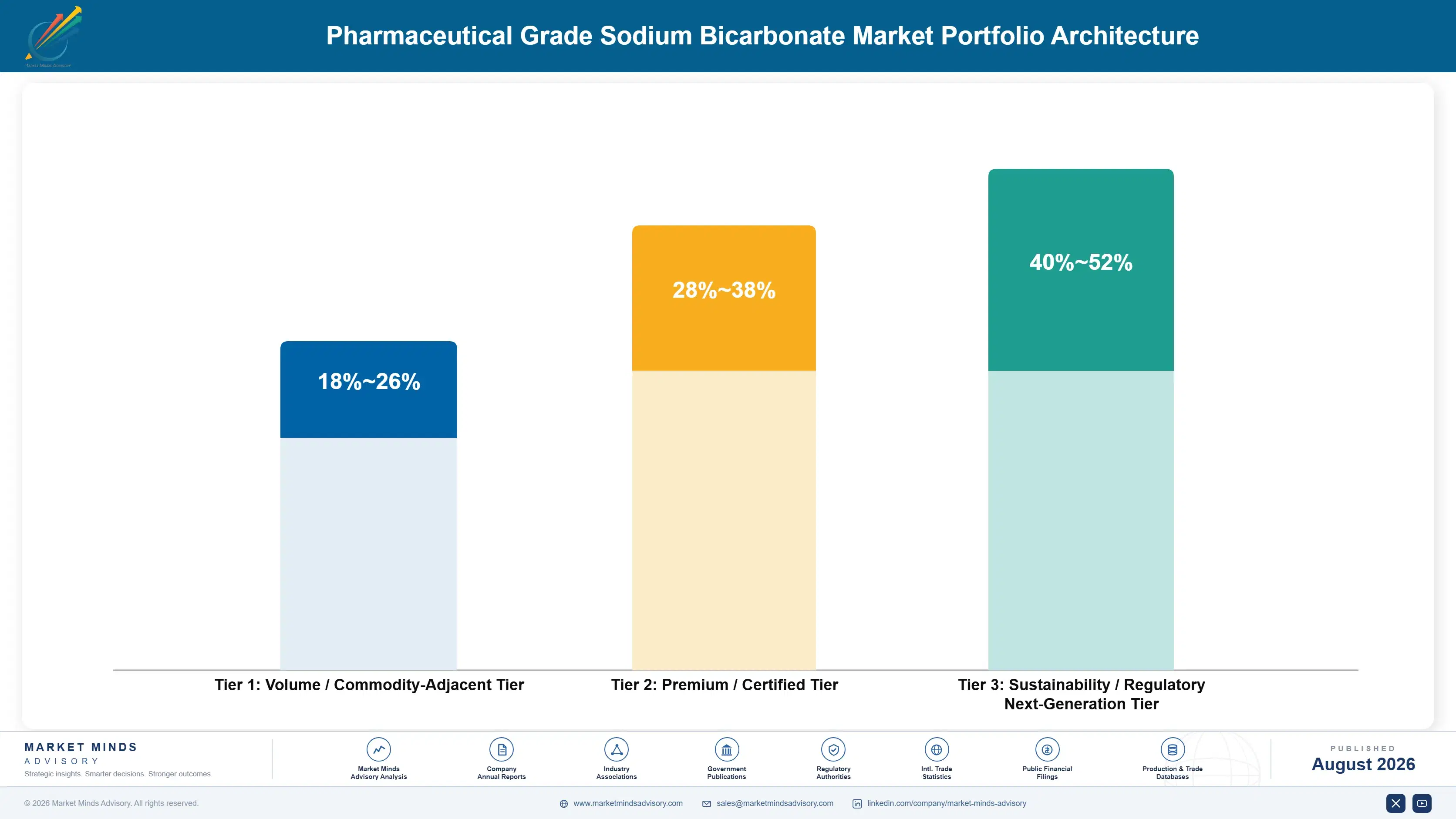
Volume / Commodity-Adjacent Tier

Oral antacid and over-the-counter grade where pharmacopoeial requirements are least demanding and qualified producers compete openly on price. Qualification still applies, and it confers the least advantage here. Alternatives qualify more readily than elsewhere.
Gross Margin: 18-26%

Premium / Certified Tier

Effervescent, tablet, and buffering excipient grades where particle size distribution and dissolution consistency matter as much as purity. Formulation performance rather than specification compliance differentiates suppliers here. Effervescent presentations demand tight particle control.
Gross Margin: 28-38%

Sustainability / Regulatory / Next-Generation Tier

Sterile injectable and haemodialysis concentrate grades where manufacturing environment and continuity obligations both restrict supply severely. Best margin available and the most durable positions anywhere in this market. Facility type restricts entry more than specification does.
Gross Margin: 40-52%
pharmaceutical-grade-sodium-bicarbonate-market-portfolio-architecture-1787302752142

Qualifications, Protocols and Retention

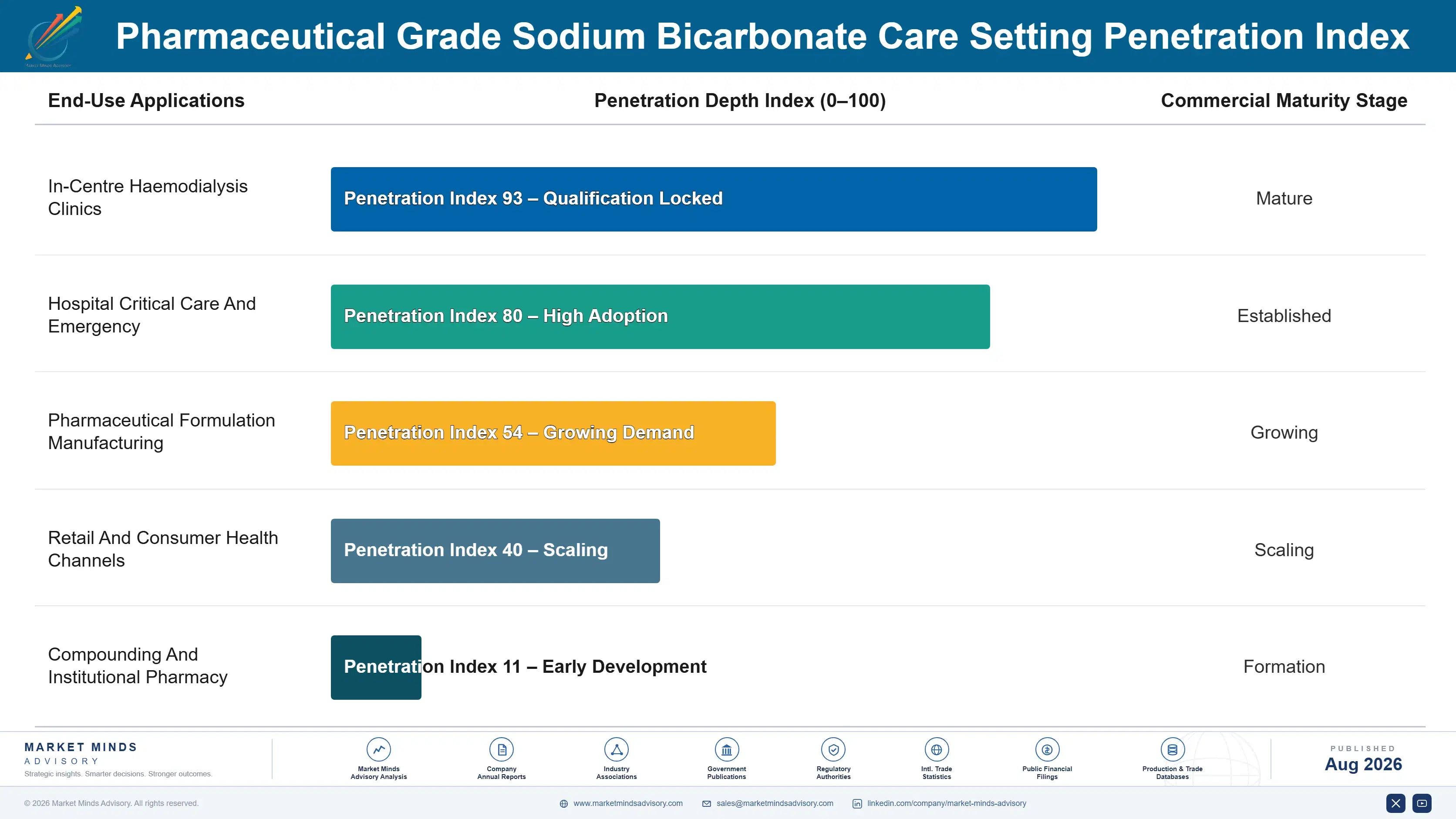
Demand behaves as continuous consumption tied to treatment protocols and formulation production rather than to any purchasing cycle. A dialysis clinic consumes bicarbonate against session counts set by patient numbers and treatment frequency, and a formulator consumes it against production volume, both with almost no commercial interaction between contract renewals. That predictability is unusual and it is what makes the qualification investment rational.
Stickiness runs through regulatory variation cost rather than through satisfaction. Changing an excipient supplier is a regulatory filing requiring justification rather than a purchasing decision, and qualification runs around 14 months before the change can even be proposed. Injectable and dialysis positions are the firmest. Oral antacid supply sits looser, since the specification is less demanding and alternatives qualify more readily.

Buyer profiles shifted as dialysis providers consolidated and impurity rules tightened. The earlier buyer was a purchasing manager at a single formulator or clinic group comparing qualified suppliers on delivered price. The current conversation increasingly involves a network procurement function negotiating across hundreds of clinics, or a regulatory affairs lead assessing whether a supplier's documentation would survive an inspection. That question arrives before any commercial discussion begins.
pharmaceutical-grade-sodium-bicarbonate-market-end-use-penetration-index-1787302752636

What We Would Tell a Board

These are among the four positions where our research anticipates prominent divergence between winners and laggards over the coming forecast period. Each is grounded in the demand model, the regulatory perimeter, and the announced capacity pipeline.
01 / DOCUMENTATION SELLING DISCIPLINE

Nobody is buying the molecule from you

Pharmaceutical grade commands roughly eleven times technical pricing for a chemically identical compound, and the entire premium rests on batch documentation, impurity control below five parts per million, and demonstrable inspection readiness across the site. Producers describing purity and specification are simply describing the part that every customer in this market already assumes has been handled properly. What a regulatory affairs function actually has to defend years later is the documentation itself, and that is what a producer should be selling.
02 / CONTINUITY COMMITMENT PRICING

Dialysis buyers are purchasing insurance, not bicarbonate

Haemodialysis consumes around 58% of all pharmaceutical grade volume, and a clinic network simply cannot suspend patient treatment while any supply interruption is being resolved somewhere upstream of it. Buyers therefore qualify second and third sources at full cost over 14 months and then order almost nothing at all from them, purely as protection. A producer offering dual-site registration alongside contractual continuity commitments is selling precisely the thing that those buyers are already paying somebody else in the market to provide for them.
03 / RETENTION BARRIER EXPLOITATION

Fifteen years of records keeps competitors out

Manufacturing records must remain fully retrievable for 15 years, which is considerably longer than many commodity chemical producers intend to remain in any particular business line at all. That single obligation deters technically capable soda ash producers from entering pharmaceutical qualification at all, even where their existing plants could easily make the material. Concentration at 68% across the top five exists because of that single retention commitment rather than because the underlying chemistry presents anybody at all with any real difficulty.
04 / COMPLIANCE SCALE DECISION

Commit real volume or do not qualify at all

Quality control, documentation, and dedicated facility costs together carry around 39% of total production cost, and they are largely fixed rather than varying with the volume produced through them. A producer running small pharmaceutical volumes through a dedicated facility carries a cost burden per tonne that a larger qualified competitor simply does not face at any point. That simple arithmetic argues for either committing to genuinely meaningful qualified volume from the outset or for staying out of the pharmaceutical grade entirely.

Engagement Snapshot From the Field

A live engagement with an industry participant carrying material or product regulatory and market exposure ahead of a defining policy shift, showing how our research translates into a defensible multi-year portfolio strategy.
MARKET MINDS ADVISORY · CLIENT ENGAGEMENT SUMMARY
Pharmaceutical Grade Sodium Bicarbonate Producer Strategic Portfolio Review and Transition Roadmap 2026·Investment Scenario on Pharmaceutical Grade Sodium Bicarbonate Exposure Evaluation 2025-26
CLIENT PROFILE
A regional sodium bicarbonate producer with approximately 140 million dollars in annual revenue (client-reported, unverified by MMA), supplying technical, food, and feed grades from two plants. Pharmaceutical grade had been evaluated twice and rejected on capital grounds, and a third proposal was before the board following enquiries from two dialysis concentrate manufacturers. Neither prior evaluation had modelled volume scenarios.
STRATEGIC CHALLENGE
The board wanted to understand whether pharmaceutical grade was a genuine opportunity or a recurring distraction, given that the price premium looked attractive while two previous evaluations had concluded the investment could not be justified against available volume. Nobody had asked either enquiring customer what volume commitment they would actually make.
MMA APPROACH
We modelled compliance overhead per tonne across three volume scenarios rather than assessing capital alone. Qualification timelines were mapped with both enquiring customers. Documentation and retention system requirements were scoped against the client's existing quality infrastructure, and the sterile injectable option was costed separately. Retention system costs were then added to every scenario.
KEY FINDINGS
  1. Compliance and documentation overhead per tonne fell by more than half between the low and high volume scenarios, which neither previous evaluation had modelled at all.
  2. The two enquiring dialysis manufacturers together represented volume sitting in the middle scenario, and neither had been asked what commitment they would make.
  3. Fifteen year record retention required systems the client's existing quality infrastructure could not provide, and that cost had been omitted from both prior evaluations entirely.
  4. Sterile injectable capability required a facility investment several times the oral grade case and reached volumes too small to justify it at the client's likely scale.
CLIENT PROFILE
A regional sodium bicarbonate producer with approximately 140 million dollars in annual revenue (client-reported, unverified by MMA), supplying technical, food, and feed grades from two plants. Pharmaceutical grade had been evaluated twice and rejected on capital grounds, and a third proposal was before the board following enquiries from two dialysis concentrate manufacturers. Neither prior evaluation had modelled volume scenarios.
STRATEGIC CHALLENGE
The board wanted to understand whether pharmaceutical grade was a genuine opportunity or a recurring distraction, given that the price premium looked attractive while two previous evaluations had concluded the investment could not be justified against available volume. Nobody had asked either enquiring customer what volume commitment they would actually make.
MMA APPROACH
We modelled compliance overhead per tonne across three volume scenarios rather than assessing capital alone. Qualification timelines were mapped with both enquiring customers. Documentation and retention system requirements were scoped against the client's existing quality infrastructure, and the sterile injectable option was costed separately. Retention system costs were then added to every scenario.
KEY FINDINGS
  1. Compliance and documentation overhead per tonne fell by more than half between the low and high volume scenarios, which neither previous evaluation had modelled at all.
  2. The two enquiring dialysis manufacturers together represented volume sitting in the middle scenario, and neither had been asked what commitment they would make.
  3. Fifteen year record retention required systems the client's existing quality infrastructure could not provide, and that cost had been omitted from both prior evaluations entirely.
  4. Sterile injectable capability required a facility investment several times the oral grade case and reached volumes too small to justify it at the client's likely scale.
RECOMMENDED STRATEGY
Phase 1: Phase 1 (months one to eight): approach both dialysis manufacturers for volume commitments before committing any capital to qualification work. Phase 2: Phase 2 (months eight to twenty-six): invest in documentation and retention systems ahead of production capability, since qualification depends on them. Phase 3: Phase 3 (months twenty-six to forty-four): qualify oral and dialysis grades only, deferring the sterile injectable option indefinitely. Revisit injectable only at greater scale.
OUTCOME
Volume commitments were secured from one of the two manufacturers within two quarters, moving the case into the viable scenario. Documentation system investment was approved ahead of plant work, and the sterile injectable option was formally excluded from the programme (client-reported, unverified by MMA). Compliance overhead per tonne became a standing board metric.

Frequently Asked Questions

Foundational context covering the market sizes, CAGR, scope, country, region and competition that inform every finding below. This section is provided to cover basics and most often pre-purchase conversations, answered from the MMA Primary Research Dataset.

What is the current size of the Pharmaceutical Grade Sodium Bicarbonate Market?

The market is valued at USD 0.55 billion in 2025, rising to USD 0.58 billion in 2026. Scope covers pharmacopoeial grade material only, not technical, food, or feed grades, or finished dialysis concentrate products.

How large will the Pharmaceutical Grade Sodium Bicarbonate Market be by 2036?

MMA forecasts USD 1.06 billion by 2036, an increase of USD 0.48 billion over the 2026 base. That represents an expansion multiple of 1.83 times across the forecast period.

What is the CAGR for the Pharmaceutical Grade Sodium Bicarbonate Market 2026 to 2036?

The base case CAGR is 6.2%, with a bull case of 7.4% and a bear case of 5.0%. The historical rate from 2020 to 2025 was 5.2%, tracking dialysis patient population growth closely.

Which segment is growing fastest?

Sterile injectable grade at 9.3%, exactly 1.50 times the market rate. Endotoxin and particulate control require a sterile manufacturing environment that most pharmaceutical grade producers have never built.

Who are the major companies in the Pharmaceutical Grade Sodium Bicarbonate Market?

Solvay, Tata Chemicals, Church and Dwight, Humens, and AGC lead on pharmaceutical grade tonnage supplied. The top five hold 68%, held there by pharmacopoeial compliance rather than production capability.

Which country is growing fastest?

India at 9.2%, where dialysis access is expanding from treated patient numbers far below diagnosed prevalence. Public programmes are funding new centres across most states.

Report Segmentation Architecture

The full report scope spans multiple orthogonal segmentation dimensions, with cross-tabulated demand data provided for each dimension pair. Coverage extends further to regional breakdowns, trend trajectories, and the competitive detail needed to support segment-level decision-making.

By Pharmacopoeial Grade And Specification

  • Sterile Injectable Grade
  • Haemodialysis Concentrate Grade
  • Buffering And Excipient Grade
  • Effervescent And Tablet Grade
  • Oral Antacid And Over-The-Counter Grade

By Care Setting

  • In-Centre Haemodialysis Clinics
  • Hospital Critical Care And Emergency
  • Pharmaceutical Formulation Manufacturing
  • Retail And Consumer Health Channels
  • Compounding And Institutional Pharmacy

By Commercial Model

  • Direct Supply To Qualified Formulators
  • Supply To Dialysis Concentrate Manufacturers
  • Pharmaceutical Distributor And Agent Channels
  • Contract Manufacture Under Customer Specification
  • Multi-Site Registered Continuity Agreements

By Region

  • East Asia
  • North America
  • Western Europe
  • South Asia and Pacific
  • Latin America
  • Middle East and Africa
  • Eastern Europe

Scope, Methodology, and Coverage

Every figure in this report is reproducible from documented input assumptions. The scope below maps the historical period, the forecast horizon, the segmentation dimensions, and the countries covered, alongside the underlying primary and qualitative methodology.
Historical Period
2020 to 2025
Forecast Period
2026 to 2036
Base Year
2025 (USD billions; MMA Primary Research Dataset, August 2026)
Market Definition
This market comprises sodium bicarbonate manufactured and supplied to pharmacopoeial specification for medicinal, medical device, and pharmaceutical formulation applications, measured at producer revenue across direct formulator, dialysis manufacturer, distribution, contract manufacture, and continuity agreement channels. Coverage spans sterile injectable grade, haemodialysis concentrate grade, buffering and excipient grade, effervescent and tablet grade, and oral antacid and over-the-counter grade material meeting United States, European, and equivalent pharmacopoeial monographs. Technical, food, feed, animal nutrition and industrial grade sodium bicarbonate, soda ash, sodium carbonate and sesquicarbonate, finished haemodialysis concentrate, dialysate and cartridge products, formulated pharmaceutical and consumer health products containing the material, other pharmaceutical excipients and buffering agents, and analytical or reference standard quantities fall outside scope.
Quantitative Units
USD billions (current prices); pharmaceutical grade tonnage supplied; price per tonne by grade; qualified supplier positions by formulator
Segmentation Dimensions
By Pharmacopoeial Grade And Specification; By Care Setting; By Commercial Model; By Region
Regions Covered
East Asia, North America, Western Europe, South Asia and Pacific, Latin America, Middle East and Africa, Eastern Europe
Countries Covered
China, Japan, South Korea, Taiwan, India, Indonesia, Vietnam, Australia, United States, Canada, Mexico, Germany, France, Italy, United Kingdom, Spain, Netherlands, Brazil, Argentina, Colombia, Saudi Arabia, United Arab Emirates, Egypt, South Africa, Poland, Romania, Hungary, and additional markets relevant to this sector
Key Companies Profiled
Solvay, Tata Chemicals, Church and Dwight, Humens, AGC, Sisecam Chemicals, Genesis Energy, Natural Soda, Shandong Haihua, Tokuyama Corporation, Nirma, GHCL, DCW, Merck KGaA, Thermo Fisher Scientific, Spectrum Chemical, Jost Chemical, Dr. Paul Lohmann, Qingdao Soda Ash Industrial, Hubei Yihua Chemical
Quantitative Methodology
Primary survey, n=3,800 respondents, Q4 2025, six countries; demand-side model with trade association cross-validation
Qualitative Methodology
47 expert interviews, Q4 2025; applied to validate demand model assumptions, identify emerging dynamics, and assess competitive positioning
Report Format
PDF and XLSX data workbook (Word format preview document)
Publisher
Market Minds Advisory
Report Code
MMA-2026-CHM-896
Published
August 2026
Contact
sales@marketmindsadvisory.com | www.marketmindsadvisory.com

Purchase the full Pharmaceutical Grade Sodium Bicarbonate Market Report (2026 to 2036).

The full report sizes pharmaceutical grade sodium bicarbonate across five pharmacopoeial grades, five care settings, five commercial models, and seven regions, with compliance overhead modelled per tonne across volume scenarios throughout. Supplier qualification positions are mapped by formulator and dialysis manufacturer, since those determine which producers can actually supply rather than merely produce. Record retention and documentation requirements are assessed as a distinct entry barrier. Competitive profiling covers twenty producers on pharmaceutical grade tonnage, and sterile injectable capability is assessed separately from oral grade production.
Compliance overhead modelled per tonne across three volume scenarios
Supplier qualification positions mapped by formulator and dialysis manufacturer
Record retention requirements assessed as a distinct entry barrier
Sterile injectable capability assessed separately from oral grade production
Dialysis patient populations modelled against treated versus diagnosed prevalence
Elemental impurity compliance tracked by producer and process route

Built For The People Who Decide

From boardroom strategy to bench-side execution, this report is read cover-to-cover by leaders shaping the next decade of their industry, turning demand scenarios, market dynamics and valuation benchmarks into decisions.
CXOs/ Presidents/ VPs/ Managers
M&A and Corporate Development
Strategy Teams and R&D Heads
Procurement and Product Directors
Regulatory and Compliance Leaders
Investor Relations and Equity Analysts