
Market Minds Advisory
Over-the-Air Engine Control Module Market

Over-the-Air Engine Control Module Market: Over-the-Air Engine Control Module Market. Cybersecurity Certification and the EV Calibration Race

Automakers racing to push EV powertrain calibration updates wirelessly are running into UNECE certification timelines slower than any software release cycle, forcing suppliers to engineer compliance into the update pipeline itself.

Lead Analyst

David Horsley

Published

August 2026

Make Smarter Decisions with Customized Research Insights

Request a free sample report and evaluate market opportunities, growth trends, and competitive dynamics relevant to your business needs.

2025 MARKET VALUE$2.1BMarket Size 2025
2036 FORECAST VALUE$10.3BBase Case , 2026 to 2036
CAGR 2026 TO 203615.5 %Bull 16.8% / Bear 14.2%
INCREMENTAL OPPORTUNITY$7.8BNet 10- year value creation
EXPANSION MULTIPLE4.23x2036 value over 2026 base
Strategic Levers
M&A Pipeline
Regional Outlook
Country Rankings
Competitive Intelligence
Segmental Deep-dive
Call-Us : 91 93563 13602

Executive Snapshot and Market Trajectory.

Cybersecurity certification, not update speed, now decides which OTA platform an automaker chooses. Suppliers with UNECE-compliant software update management systems are winning platform contracts that uncertified rivals cannot even bid for. Buyers now treat that certification gap as a hard qualification filter from the very outset today.
Electric vehicle makers are pulling demand fastest, since continuous battery and powertrain calibration updates directly affect published range and performance figures that automakers have already promised customers. China's EV manufacturing scale makes it the fastest-growing national market, while North American and European regulators increasingly require certified software update management systems before granting type approval for new vehicle programmes. That gap in certified capacity shapes nearly every platform sourcing decision automakers make.
Competition concentrates among a handful of automotive software and semiconductor specialists able to guarantee certified, secure update delivery across an entire vehicle fleet, a capability that separates qualified platform suppliers from component-only vendors selling uncertified update tools. Cybersecurity vulnerability risk, fragmented regional certification requirements, and EV calibration demand are together reshaping which suppliers can convert pilot deployments into fleet-wide platform contracts. That reshaping rewards documentation depth decisively.
Market Definition
The over-the-air engine control module market covers software, firmware, and platform systems that deliver wireless updates to engine and powertrain control units across passenger, commercial, two-wheeler, off-highway, and marine vehicles. It excludes infotainment-only OTA systems, general telematics hardware unrelated to powertrain control, and unrelated automotive software categories.
Base Year Value
$2.1B in 2025 (MMA Primary Research Dataset, August 2026)
Forecast Period
2026 to 2036, eleven discrete annual values
CAGR
15.5% base case. Bull 16.8%. Bear 14.2%.
Fastest Growth Segment
EV Powertrain Control Modules: 21.0% CAGR
Fastest Growth Country
China: 18.5% CAGR
Fastest Growth Region
South Asia and Pacific: 17.6% CAGR
Largest Region
East Asia: 30% of 2025 global value
Market Leaders
Continental AG, Robert Bosch GmbH, Aptiv PLC, HARMAN International, Excelfore Corporation. Source: MMA Analysis based on company annual reports.
Primary Survey
n=3,800 procurement and R&D decision-makers, Q4 2025, six countries
Methodology
Demand-side build-up, cross-validated against public data, 47 expert interviews

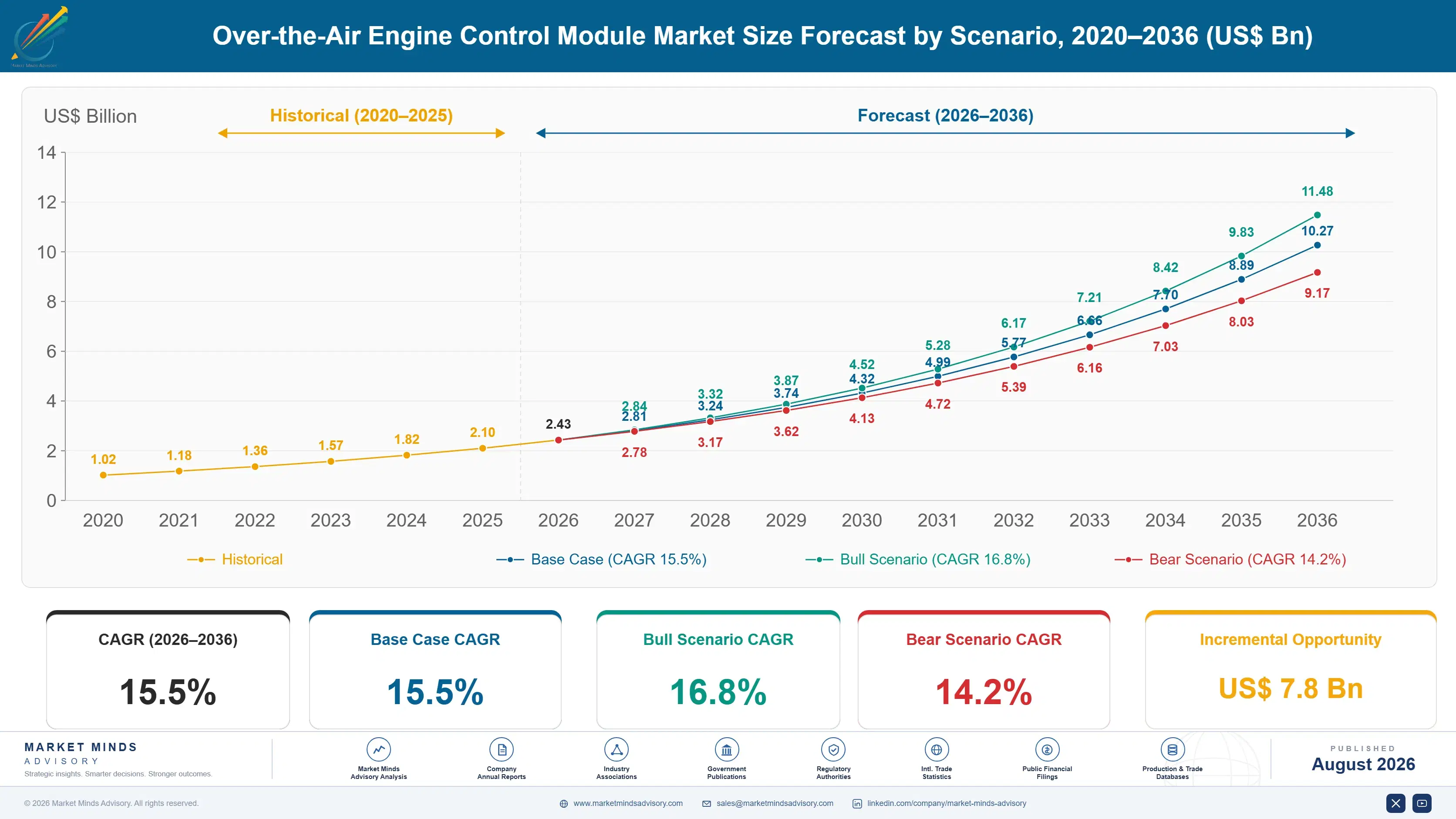
Over-the-Air Engine Control Module Market Forecast Scenarios

over-the-air-engine-control-module-market-size-forecast-scenario-1787558943737
Between 2020 and 2025 the category grew near a 14.0% annual pace as early OTA deployments concentrated almost entirely among electric vehicle pioneers, before UNECE WP.29 R156 certification requirements pushed mainstream automakers to adopt certified update platforms from 2023 onward across most major vehicle programmes. That transition converted OTA from a niche EV feature into an industry-wide compliance requirement virtually overnight.
The base case carries the market to a 15.5% CAGR on three mechanisms: electric vehicle manufacturers scaling continuous powertrain and battery calibration updates as fleet size grows, mainstream automakers adopting UNECE-certified update platforms to meet tightening cybersecurity regulation across major export markets, and commercial fleet operators specifying OTA-capable engine control modules to cut physical recall cost and downtime across large vehicle fleets. These three mechanisms reinforce each other across nearly every major automotive market worldwide today.
The bull case at 16.8% assumes electric vehicle penetration and software-defined vehicle architecture adoption accelerate faster than currently modelled. The bear case at 14.2% assumes fragmented regional certification requirements across UNECE, China, and United States regulators slow global platform standardisation more than expected. Both scenarios assume no major disruption to global semiconductor or certification testing capacity.

Certification Depth and the EV Calibration Race

Three forces converge on this category. Electric vehicle manufacturers need continuous calibration updates that directly affect published range and performance figures, regulators across multiple regions are tightening cybersecurity certification requirements simultaneously, and commercial fleet operators want OTA capability that cuts physical recall cost without introducing new security vulnerabilities. Reconciling all three demands inside one platform specification remains genuinely difficult for most suppliers.
TOP PRODUCER SHAREChina, 26%Share of global platform deployment concentrated in Chinese fleets
AVERAGE SELLING PRICEUSD 42 per vehicleBlended annual platform licensing fee per connected vehicle
CERTIFICATION COST SHARE24% of COGSCybersecurity certification and testing share of platform cost
EV FLEET PENETRATION34% of installsVolume deployed into electric vehicle powertrain control platforms
CERTIFICATION CYCLE10 to 16 monthsTypical time to certify a new update management platform
MARKET CONCENTRATIONCR5: 42%Combined share held by five largest platform suppliers
Commercially, the category rewards certification depth over raw software development speed. Suppliers that can guarantee UNECE-compliant, secure update delivery across an entire vehicle fleet command platform contracts that uncertified competitors cannot access, which is why automakers increasingly default to a small pool of certified suppliers rather than building update capability in-house from uncertified components. That preference has hardened as certification requirements have tightened across every major export market. That preference rarely changes once a certification relationship is established.
Over the next decade, cybersecurity certification, EV calibration demand, and regional regulatory harmonisation will decide which suppliers convert pilot deployments into durable fleet-wide platform contracts. Suppliers without certified update management systems risk losing automaker programmes entirely as compliance becomes a baseline requirement rather than a differentiator. Suppliers slow to certify will find their addressable market shrinking steadily.
"Everyone still talks about this as a convenience feature. Automakers now treat wireless update capability as a certified safety system, and they price supplier risk accordingly."
Director, Connected Vehicle Software and Electronics Practice · MMA Connected Vehicle Software and Electronics Practice · August 2026

Market Trends

UNECE WP.29 R156 Drives Standardised Certification Adoption

The United Nations Economic Commission for Europe's WP.29 R156 regulation now requires automakers selling into signatory markets to maintain a certified software update management system covering the entire vehicle lifecycle, a requirement that has pushed mainstream automakers to adopt certified third-party platforms rather than building compliance internally. Continental and Bosch have both expanded certified platform offerings specifically to serve automakers needing rapid compliance ahead of new vehicle programme launches. This shift is standardising update architecture across the industry in a way that pure convenience-driven OTA adoption never achieved on its own, regardless of how an automaker views the feature commercially.
Market Impact: Adds 24% to EV calibration volume
Feature Activation Monetisation Expands Beyond Electric Vehicles

Automakers are increasingly monetising OTA-delivered feature activations, subscription-based performance upgrades, and calibration enhancements across both electric and internal combustion vehicle lines, a practice pioneered by electric vehicle makers that mainstream automakers are now adopting more broadly. HARMAN and Excelfore have both expanded platform capability specifically to support subscription billing and feature entitlement management alongside core update delivery. This shift converts what was historically a cost centre for automakers into a genuine recurring revenue stream, giving platform suppliers a stronger commercial case for automaker adoption beyond pure compliance necessity. That commercial shift strengthens the automaker's platform investment case.
Market Impact: Adds 18% to fleet OTA adoption

Market Opportunities and Growth Drivers

Electric Vehicle Fleets Require Continuous Powertrain Calibration

Electric vehicle manufacturers increasingly rely on continuous over-the-air calibration updates to optimise battery management, motor efficiency, and published range figures throughout a vehicle's operating life, since battery chemistry and motor performance both benefit from ongoing software refinement that physical hardware changes cannot provide. Tesla pioneered this approach, and Chinese manufacturers including BYD and NIO have scaled comparable calibration update programmes across their own rapidly growing fleets. That reliance on software-driven performance improvement gives OTA platform suppliers a durable, recurring role in a vehicle's operating life that extends well beyond the initial sale.
Market Impact: Halts fleets 2 to 4 weeks

Commercial Fleet Operators Adopt OTA to Cut Recall Cost

Commercial fleet operators increasingly specify OTA-capable engine control modules specifically to avoid the cost and downtime of physical recall campaigns, since a software-correctable defect resolved wirelessly avoids the vehicle-by-vehicle service centre visits that traditional recalls require. Fleet operators managing thousands of vehicles report meaningful cost avoidance when a defect can be resolved through a single coordinated software push rather than scheduling individual service appointments across an entire fleet. This driver is pulling commercial vehicle manufacturers toward OTA-capable engine control architecture even in markets where regulatory certification requirements remain less developed than in passenger vehicles.
Market Impact: Certification adds 6 to 9 months

Market Restraints and Challenges

Wireless Update Capability Expands the Vehicle Cyberattack Surface

Adding wireless update capability to engine and powertrain control units genuinely expands the attack surface available to malicious actors, since any remote update channel capable of modifying safety-critical vehicle software could theoretically be exploited if security controls fail. The root cause is an inherent tradeoff in the technology itself rather than a solvable engineering defect, since remote update capability by definition requires a communication channel that did not previously exist on isolated vehicle systems. Suppliers are mitigating this through cryptographic signing, secure boot verification, and continuous penetration testing, though no security architecture can eliminate this risk category entirely.
Market Impact: Certified platforms cover 55% of programmes

Fragmented Regional Certification Slows Global Platform Standardisation

UNECE, Chinese, and United States regulators each maintain distinct cybersecurity and software update certification requirements that do not fully align with one another, forcing suppliers to maintain separate certification tracks for platforms sold into different regions rather than certifying once globally. The root cause is the absence of a harmonised international standard comparable to what exists in other automotive safety categories, leaving suppliers to negotiate compliance market by market. Suppliers are mitigating this by designing modular certification architectures that isolate region-specific compliance modules from the core update platform, though full harmonisation remains genuinely distant.
Market Impact: Feature activation revenue tops 12% share
3 additional market trends, 3 additional growth drivers, and 3 additional restraints and challenges are covered in the full report. Contact sales@marketmindsadvisory.com to access the complete intelligence.

Segment CAGR and Growth Architecture

Segmentation follows vehicle platform type, a single certification and engineering logic, since passenger, commercial, two-wheeler, off-highway, and marine platforms each carry distinct regulatory pathways and update architecture requirements rather than differing by distribution channel or customer type. That alignment keeps certification investment matched to platform requirements. That alignment lets buyers evaluate suppliers on consistent, comparable engineering and compliance criteria.
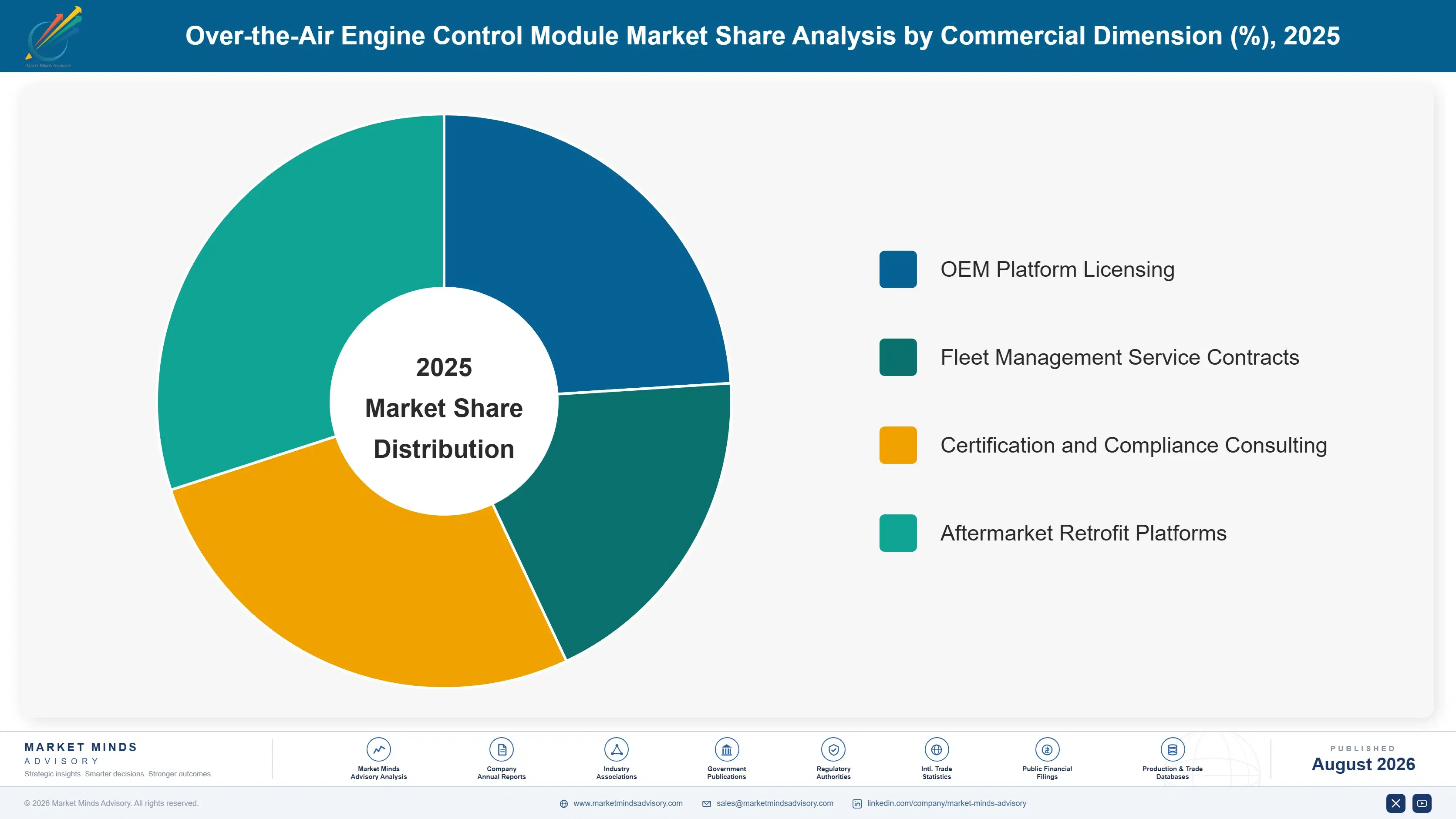
over-the-air-engine-control-module-market-market-share-analysis-1787558944289

EV Powertrain Control Modules

EV powertrain control modules grow fastest at 21.0%, about 1.35 times the overall 15.5% rate, as electric vehicle manufacturers scale continuous battery and motor calibration updates across rapidly growing global fleets. These modules demand the most frequent update cadence in the entire category, since battery management and range optimisation benefit from ongoing refinement throughout a vehicle's operating life in a way internal combustion powertrains generally do not require. Continental and Bosch lead qualified EV platform supply, competing on update reliability and certified security architecture rather than price alone. Growth concentrates in China and other markets where electric vehicle production volume itself is scaling fastest. Export relationships into global OEM programmes compound this advantage further each certification cycle.
CAGR 21.0%

Passenger Vehicle OTA ECMs

Passenger vehicle OTA engine control modules grow at 17.0%, the second-fastest platform, as mainstream automakers adopt certified update platforms to meet tightening cybersecurity regulation across internal combustion and hybrid vehicle lines. Aptiv and HARMAN lead qualified passenger vehicle platform supply, competing on certification breadth across multiple regulatory regions rather than on raw update speed alone. Unlike EV-specific modules, this segment sells substantially into mainstream mass-market vehicle programmes rather than premium electric platforms, so certification cost efficiency and platform scalability matter as much as the underlying update capability itself. Suppliers unable to demonstrate certification breadth across multiple regulatory regions rarely win the multi-year automaker contracts that anchor this segment's growth trajectory going forward into future vehicle generations.
CAGR 17.0%
Full segment breakdown across 6 segments available in the complete report.

Regional Architecture and Country Demand Map

East Asia leads on Chinese electric vehicle manufacturing scale and OTA deployment volume, while North America follows closely on early regulatory adoption and established platform supplier depth. Western Europe and South Asia and Pacific contribute meaningful but more moderately growing demand across the coming decade.

North America

Early regulatory adoption and Tesla's pioneering OTA deployment model give North America the second-largest share at 28%, reflecting the region's established platform supplier base and mature cybersecurity certification infrastructure. Aptiv and HARMAN's American operations supply both domestic automakers and export platforms certified for United States National Highway Traffic Safety Administration guidance on software update management. United States electric vehicle manufacturers increasingly compete on calibration update frequency as a marketed feature, reinforcing continued platform investment. Growth of 16.0% tracks electric vehicle fleet expansion and mainstream automaker certification adoption more directly than any broader connected vehicle trend. American electric vehicle manufacturers increasingly compete on calibration update frequency as a marketed feature, reinforcing sustained platform investment across the industry.
Share: 28% | CAGR: 16.0% (2026 to 2036)

Western Europe

UNECE WP.29 R156 certification requirements, which originated within European regulatory frameworks, explain why Western Europe holds 20% of global value despite a smaller electric vehicle fleet than China or the United States. Continental and Bosch, both headquartered within the region, hold deep certification relationships with European automakers navigating the regulation's phased implementation timeline. German and French automakers increasingly specify certified platforms across their full vehicle lineup rather than electric models alone, since regulatory compliance applies regardless of powertrain type. Growth of 14.0%, the slowest major region, reflects an already mature certification and deployment base rather than any underlying demand weakness. Scandinavian automakers have also begun requiring certified platforms as electric vehicle adoption keeps expanding steadily.
Share: 20% | CAGR: 14.0% (2026 to 2036)
Regional intelligence for 5 additional markets available in the complete report: East Asia, South Asia and Pacific, Latin America, Middle East and Africa, Eastern Europe. Contact sales@marketmindsadvisory.com.
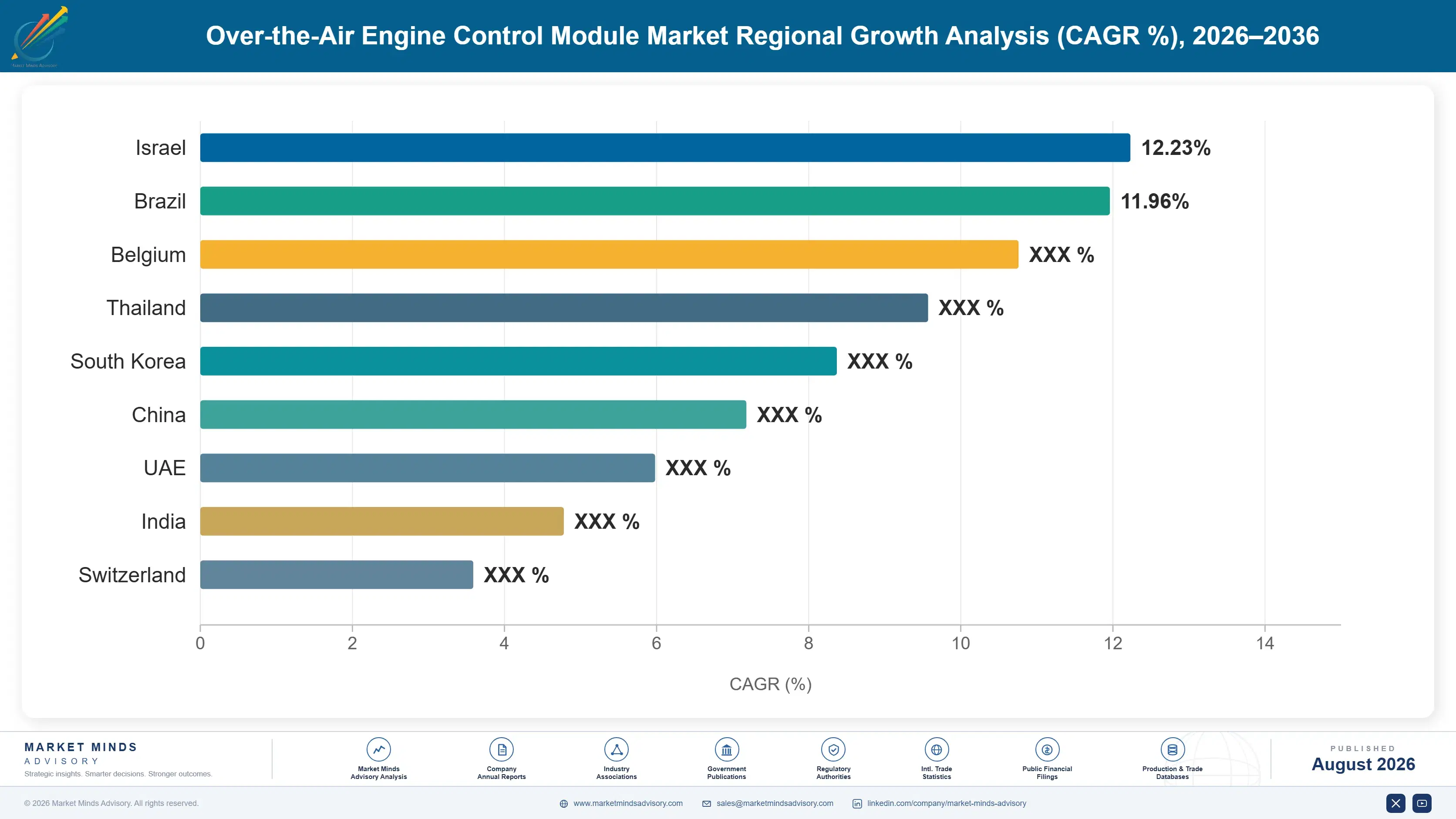
over-the-air-engine-control-module-market-country-cagr-analysis-1787558944817

Where Certification Depth Creates Margin

Margin in this category increasingly sits in cybersecurity certification breadth and regional regulatory compliance depth rather than in raw software development speed alone. Suppliers converting that capability into fleet-wide platform contracts are pulling ahead of competitors still selling uncertified update tools into price-only procurement channels. That gap is widening fastest wherever EV fitment volume is scaling quickest.

Certify Platforms Across Every Major Regulatory Region Early

Suppliers that certify update platforms across UNECE, Chinese, and United States regulatory frameworks simultaneously can bid on automaker programmes regardless of the vehicle's target export markets, while narrowly-certified competitors must decline contracts outside their certified scope entirely. Continental's multi-region certification breadth lets it participate in the large majority of new vehicle programme tenders industry-wide, compared with a much narrower addressable share for suppliers holding only regional certification. Certification across all three regions typically takes 18 to 24 months but opens the broadest possible automaker customer base. Suppliers entering multi-region certification late find much of that addressable base already committed elsewhere.
Market Impact: Multi-region certification opens up 80% of new tenders

Bundle Feature Activation Monetisation Into Core Platform Offerings

Suppliers offering feature activation and subscription billing capability alongside core update delivery convert automaker platform relationships into a shared recurring revenue arrangement rather than a one-time software licensing sale. HARMAN's feature entitlement platform illustrates how monetisation capability strengthens the automaker's own commercial case for platform adoption, making the supplier relationship more durable across multiple vehicle generations. That shared revenue model has lifted average platform contract value by roughly 20% to 30% where automakers actively monetise feature activations. Automakers increasingly view this shared revenue model as a meaningful factor in long-term supplier selection.
Market Impact: Monetisation bundles lift contract value 20% to 30%

Engineer EV-Specific Calibration Update Architecture Ahead of Demand

Suppliers that engineer calibration update architecture specifically for electric vehicle battery and motor management ahead of confirmed automaker demand capture EV platform contracts that generic combustion-oriented update tools cannot serve adequately. Continental and Bosch's EV-specific platform investment illustrates how early engineering work converts directly into fleet-wide contracts as electric vehicle production volume scales. Suppliers entering EV-specific development only after losing a major automaker programme typically spend 12 to 18 months rebuilding platform capability before requalifying. Suppliers entering EV-specific engineering only after losing a major contract typically spend well over a year rebuilding platform credibility.
Market Impact: Early EV specialisation wins 65% of new EV programmes

Support Commercial Fleet Recall-Avoidance With Dedicated Tooling

Suppliers offering dedicated fleet management tooling that lets commercial operators coordinate software-based recall resolution across thousands of vehicles simultaneously capture contracts that generic consumer-oriented update platforms cannot serve at comparable scale. Fleet operators adopting this capability report meaningful reductions in recall-related downtime compared with traditional physical recall campaigns requiring individual service appointments. Suppliers without dedicated fleet tooling increasingly find themselves excluded from large commercial fleet contracts regardless of their consumer platform quality. Fleet operators report recall resolution completing within days rather than the 4 to 6 weeks typical physical campaigns require.
Market Impact: Fleet tooling cuts recall downtime by roughly 40%

Who Controls the Margin Pool

Concentration sits at a substantial CR5 of 42%, reflecting a category where cybersecurity certification depth, not raw software development scale, separates a small group of qualified platform suppliers from a long tail of regional and component-only vendors. Continental leads on certified multi-region platform breadth, and the gap to mid-tier challengers is measured in years of certification investment rather than in engineering headcount alone. That gap has persisted.
All participants are assessed on platform deployment volume across certified and uncertified update systems, a consistent basis given how widely certification maturity varies by supplier. Current competitive activity concentrates on three fronts: certifying platforms across every major regulatory region early, bundling feature activation monetisation into core platform offerings, and engineering EV-specific calibration update architecture ahead of confirmed demand. That pattern spans every major consuming region.

Emerging pressure comes from Chinese domestic platform suppliers scaling commodity-tier deployment faster than expected, backed by proximity to the world's largest electric vehicle production base. Rankings are likely to shift toward suppliers who combine multi-region certification with EV-specific engineering depth, since neither software development scale nor brand heritage alone is deciding automaker platform contracts anymore.
over-the-air-engine-control-module-market-company-positioning-matrix-1787558945365

Competitive Moat and Risk Dimensions

CONTINENTAL AG

Moat: Broadest multi-region certification

Continental holds cybersecurity certification across more regulatory regions and vehicle platform types than any single competitor, letting it bid on the large majority of new vehicle programme tenders regardless of target export market. That breadth, built over years of regulatory engagement, gives it access to automaker relationships that narrowly-certified competitors cannot easily reach.
CONTINENTAL AG

Risk: German Cost Base Exposure

Continental's primary engineering base inside Germany carries meaningfully higher labour cost than Chinese competitors, limiting its ability to compete purely on price for commodity-tier volume in price-sensitive emerging markets. Should Chinese suppliers close the certification technology gap further, Continental's cost disadvantage would become increasingly difficult to offset.
ROBERT BOSCH GMBH

Moat: Deepest automaker engineering relationships

Bosch's decades of powertrain control engineering and established relationships across nearly every major global automaker give it platform integration depth that newer entrants cannot replicate without years of joint engineering work. That relationship depth lets it embed update architecture early in a vehicle's development cycle rather than retrofitting it later.
ROBERT BOSCH GMBH

Risk: Diversified Portfolio Distraction Risk

OTA platform software represents one of many business lines within Bosch's much broader automotive components portfolio, meaning internal capital allocation and management attention could shift toward larger business lines during any broader corporate restructuring, leaving platform-focused specialists room to capture share in specific high-growth segments.

Players Tracked

Prominent Players

Continental AG
Robert Bosch GmbH
Aptiv PLC
HARMAN International
Excelfore Corporation

Other Key Players

Airbiquity Inc.
Sibros Technologies
AVL List GmbH
Vector Informatik GmbH
Wind River Systems
NNG LLC
Luxoft
Green Hills Software
BlackBerry QNX
Denso Corporation
ZF Friedrichshafen
Marelli Corporation
Renesas Electronics
Elektrobit
Garmin Ltd.

Recent Developments

JANUARY 2025

Continental Expands UNECE Certification to Additional Vehicle Platforms

Continental secured expanded UNECE WP.29 R156 certification covering additional vehicle platform types, building on its existing passenger vehicle certification portfolio. The milestone was a certification achievement, not an acquisition or joint venture, extending Continental's addressable programme pipeline ahead of less-certified competitors. across two additional major markets.
Signal: Certification expansion, not a transaction, confirms regulatory breadth as the primary lever. across every certified market.
MAY 2025

HARMAN Signs Multi-Year Platform Agreement With Global Automaker

HARMAN signed a multi-year platform supply agreement with a global automaker to provide OTA update and feature monetisation capability across an expanded share of the automaker's vehicle lineup. The arrangement was a supply agreement, not an acquisition or joint venture, securing guaranteed volume ahead of the automaker's next launch.
Signal: A supply agreement, not M&A, shows platform contracts now drive multi-year procurement planning. more than headline unit pricing.
SEPTEMBER 2025

Excelfore Acquires Minority Stake in Cybersecurity Testing Startup

Excelfore acquired a minority equity stake in an automotive cybersecurity testing startup, aiming to integrate advanced penetration testing capability into its existing certification workflow. The transaction was an equity investment rather than a full acquisition or merger, giving Excelfore early technology access without full integration risk.
Signal: A minority stake, not a full acquisition, shows suppliers hedging cybersecurity technology bets. rather than committing full capital.

Certification Testing and Semiconductor Exposure

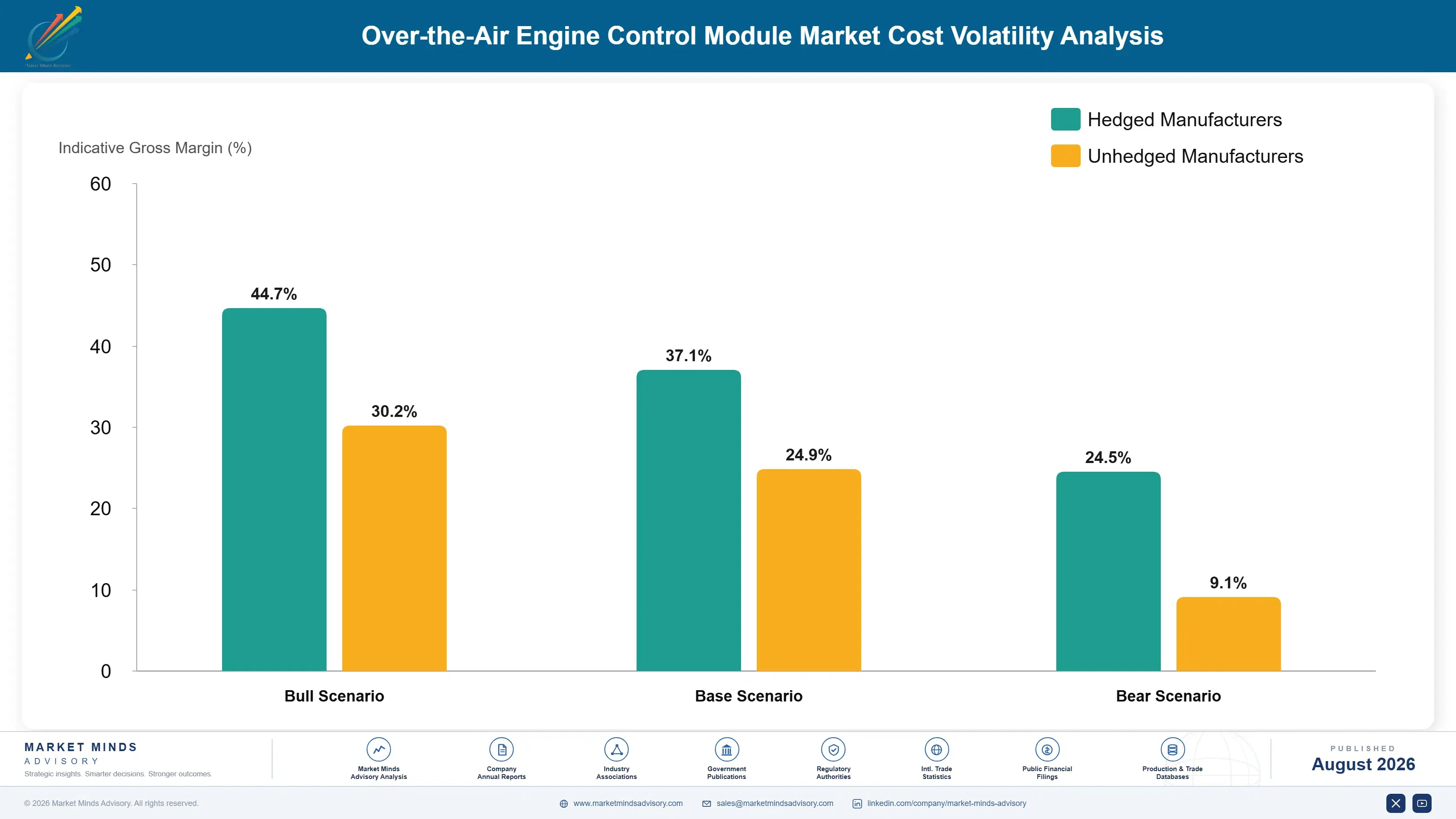
Cybersecurity certification testing and third-party audit fees account for roughly 24% of platform cost, paid to established testing laboratories across Germany, the United States, and China, with secure microcontroller hardware adding a further 30% to 36% depending on vehicle platform complexity and certification tier. Precision testing for safety-critical modules adds further specialised cost. Certification testing labs charge premium rates during peak automaker launch seasons.
Semiconductor prices and secure microcontroller availability tightened sharply through 2021 and 2022 amid the broader global chip shortage that constrained automotive electronics production industry-wide, before easing through 2023 and 2024 as foundry capacity expanded. The Semiconductor Industry Association has documented that shortage as a recurring vulnerability in automotive electronics supply chains, and suppliers without long-term allocation contracts absorbed delivery delays directly into customer relationships. Delays persisted.

Exposure varies by supplier scale and semiconductor sourcing strategy. Larger integrated suppliers like Continental and Bosch hedge semiconductor exposure through long-term foundry allocation agreements, while smaller platform specialists buying on spot markets absorb availability constraints immediately into delivery schedules. That gap leaves smaller suppliers at a persistent delivery disadvantage precisely when chip supply tightens,. That relief gap widens further during periods of sustained capacity expansion.
over-the-air-engine-control-module-market-cost-volatility-analysis-1787558945562

Secure long-term semiconductor allocation agreements with foundries

Locking secure microcontroller volume through long-term foundry allocation agreements protects delivery schedules from spot market shortages during periods of peak automotive electronics demand. This trades some pricing flexibility for delivery certainty that automaker platform contracts increasingly require as a condition of the relationship itself. Several suppliers have already extended these arrangements to multi-year fixed-allocation terms.

Diversify certification testing across multiple accredited laboratories

Qualifying certification testing capacity across multiple accredited laboratories in Germany, the United States, and China simultaneously reduces exposure to any single facility's capacity constraint or scheduling backlog. Suppliers with diversified testing relationships completed certification measurably faster than single-laboratory dependent competitors did. Suppliers with diversified testing relationships completed certification measurably faster during the busiest renewal periods overall.

Standardise secure microcontroller architecture across product lines

Standardising secure microcontroller selection across multiple platform variants reduces the total number of distinct components a supplier must qualify and certify, simplifying supply chain management and reducing exposure to component-specific shortages during periods of tight semiconductor supply. That standardisation also shortens development timelines for new platform variants considerably across every vehicle programme as well.

Portfolio Architecture for Margin Defence

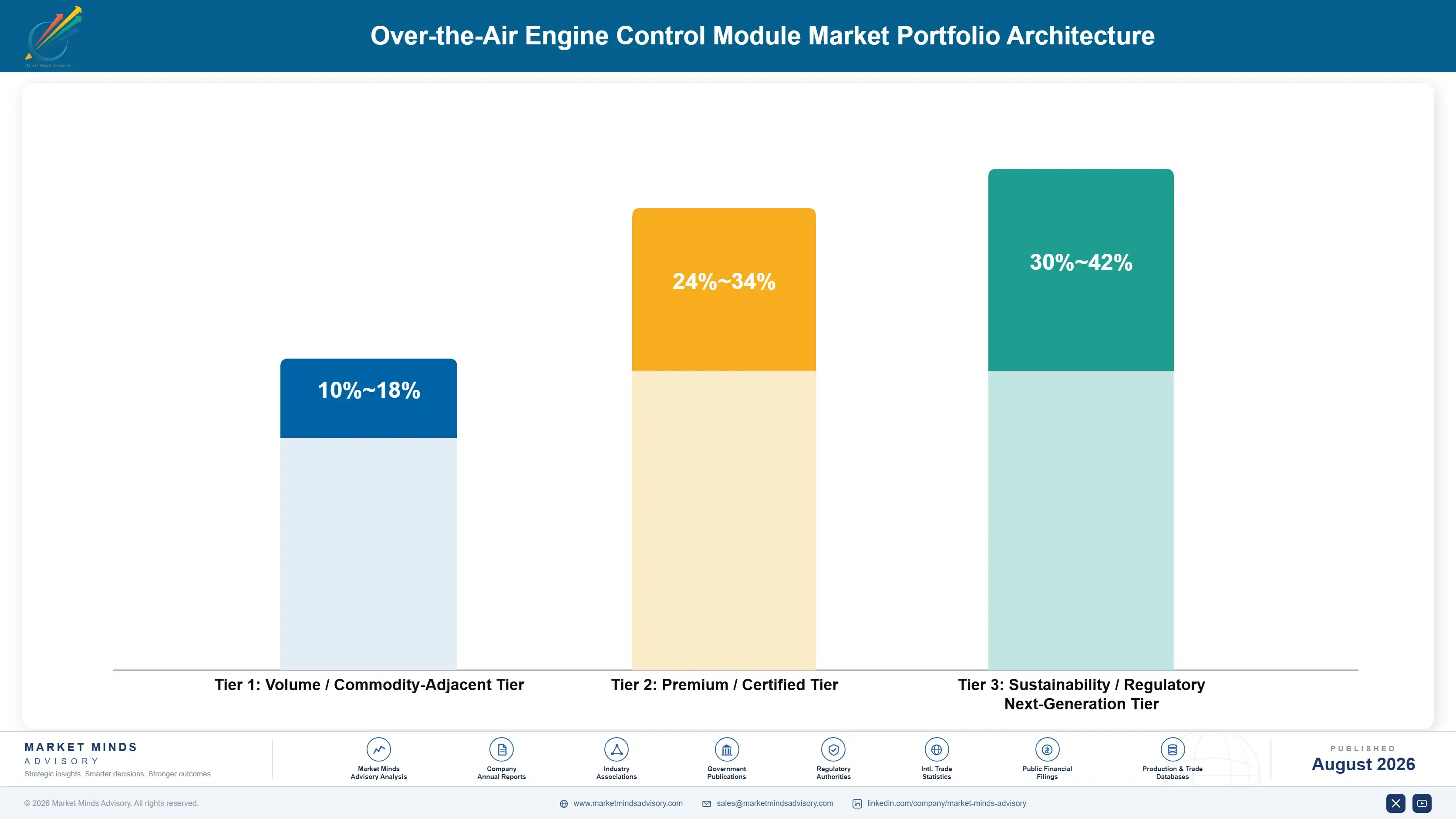
The portfolio splits into three tiers with clear margin separation tied to certification depth and vehicle platform type. Basic uncertified update tools for early-stage or non-regulated markets compete on price and earn thin margins, certified platforms for mainstream passenger and commercial vehicles earn considerably more, and next-generation EV-specific platforms with feature monetisation carry the highest margin given their engineering depth and certification barriers to entry. That gap persists.
The tension between volume and premium reflects platform type: certified mainstream and EV platforms reward documented compliance and calibration depth over price, pulling suppliers toward sustained certification investment, while much of the early-stage and less-regulated market segment still buys on price and delivery speed alone. Suppliers running both product lines must manage genuinely distinct certification, engineering, and sales organisations without letting either investment starve the other. That balance rarely holds.

High-value margin pools concentrate in EV-specific platforms and certified passenger vehicle programmes with feature monetisation, where documented compliance and calibration performance both reward proven supplier capability directly. The volume core of basic uncertified update tools remains necessary for manufacturing scale but contributes comparatively little to blended margin across the portfolio as a whole. That pattern continues.

Volume / Commodity-Adjacent Tier

Basic uncertified update tools for early-stage or less-regulated vehicle markets, competing on price with limited certification investment and thin documentation behind them. and thin brand differentiation across most regional markets.
Gross Margin: 10-18%

Premium / Certified Tier

Certified update platforms for mainstream passenger and commercial vehicle programmes, sold under multi-year contracts requiring documented cybersecurity compliance across multiple regulatory regions. requiring documented compliance testing that smaller suppliers rarely complete consistently.
Gross Margin: 24-34%

Sustainability / Regulatory / Next-Generation Tier

EV-specific calibration platforms with feature activation monetisation and fleet management tooling, engineered for the most demanding update cadence and still building qualification breadth across every major automaker. with engineering depth few competitors match.
Gross Margin: 30-42%
over-the-air-engine-control-module-market-portfolio-architecture-1787558946060

High-value Sub-segments and Strategic Watch-out

EV Powertrain Control Modules

High value and the fastest-growing platform at 21.0% CAGR, carrying both a calibration-frequency premium and genuine engineering barriers to entry. The wide margin range reflects varying certification maturity across suppliers rather than differences in underlying software development cost. Suppliers investing earliest capture the deepest automaker relationships.
Gross Margin: 30-42%

Feature Monetisation Platforms

High value with strong growth, sustained by automakers converting update infrastructure into recurring subscription revenue. Margin varies with how much entitlement management depth a supplier holds with the specific automaker it serves. Suppliers without documented entitlement management rarely win the largest revenue-sharing contracts available today.
Gross Margin: 24-34%

Standard Passenger Vehicle Platforms

The volume core, competing on price across most mainstream vehicle programmes worldwide. Margin stays thin and the range is narrow because certification cost efficiency, not calibration depth, dominates purchasing decisions in this tier. Suppliers competing here rarely invest heavily in certification depth beyond basic requirements.
Gross Margin: 10-18%

Off-Highway and Marine Platforms

The strategic watch-out, where certification standards remain immature and buyer willingness to pay for OTA capability is still largely unproven across construction and marine equipment fleets. Margin range is wide because pricing power varies sharply by individual customer relationship. Few suppliers report meaningful volume growth here currently.
Gross Margin: 12-26%

Platform Lock-In and Certification Depth

Demand behaves like an annuity once a supplier wins a vehicle platform certification: automakers rarely requalify an update supplier mid-generation, since replacing a certified platform means repeating months of cybersecurity documentation against a system that already works. That repeat-purchase pattern gives incumbent certified suppliers a durable revenue base that competitors cannot easily displace once a vehicle programme has launched. Suppliers depend on that pattern.
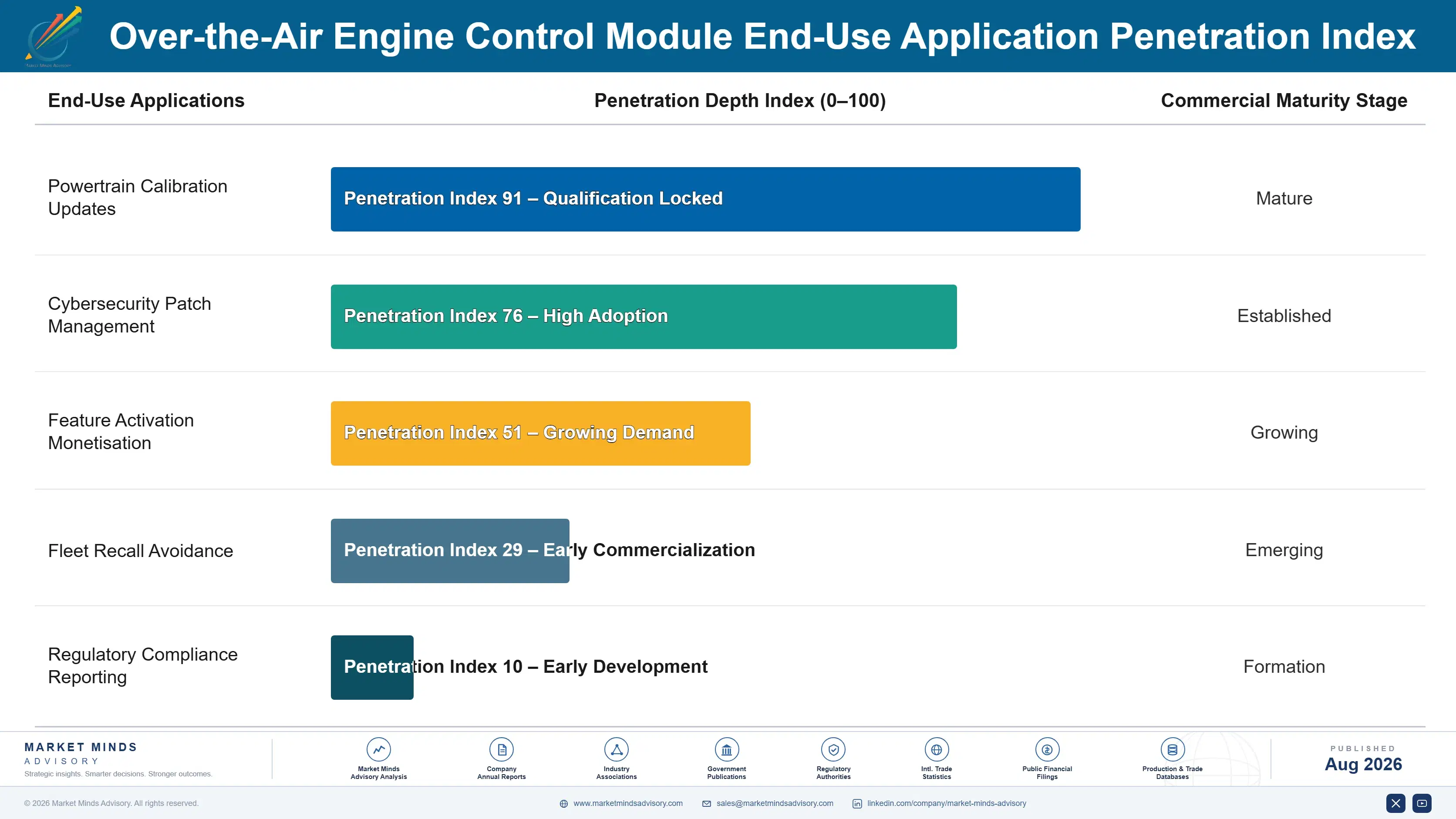
Adoption depth varies sharply by vehicle type. Electric vehicle manufacturers have converted deepest, since calibration update frequency directly affects marketed range and performance figures. Mainstream passenger and commercial vehicle manufacturers adopt readily once regulatory certification requirements apply, while off-highway and marine vehicle makers remain the shallowest adopters, held back by less mature certification standards and unproven buyer willingness to pay for the capability. That gap persists.

Buyer profiles are shifting generationally. Younger automotive software engineers increasingly default to certified, documented update platforms without evaluating uncertified alternatives at all, treating cybersecurity compliance as a baseline requirement rather than an optional upgrade. That default is spreading faster among electric vehicle programmes than among legacy internal combustion platforms, where engineering teams still weigh certification cost against perceived regulatory urgency. That shift favours documented suppliers.
over-the-air-engine-control-module-market-end-use-penetration-index-1787558946551

Certification Depth Beats Development Speed

These are among the four positions where our research anticipates prominent divergence between winners and laggards over the coming forecast period. Each is grounded in the demand model, the regulatory perimeter, and the announced capacity pipeline.
01 / MULTI-REGION CERTIFICATION STRATEGY

Suppliers without broad certification will lose automaker programmes by 2029

Automakers default to suppliers holding certification across every major regulatory region simultaneously, since narrowly-certified competitors must decline contracts outside their certified scope regardless of price offered. Continental's broad certification illustrates how addressable tender share follows directly from certification investment completed years earlier rather than from any competitive bid held closer to contract award. As vehicle programmes diversify across more export markets, this certification gap compounds rather than narrows, a gap unlikely to close for late-certifying competitors despite continued engineering investment.
02 / EV CALIBRATION SPECIALISATION

Early EV-specific engineering will decide electric vehicle platform share

Electric vehicle manufacturers specify calibration update architecture engineered specifically for battery and motor management, and suppliers without that specialised engineering cannot serve EV programmes adequately regardless of their combustion-vehicle platform quality. Continental and Bosch's EV-specific investment shows how early engineering work converts directly into fleet-wide contracts as production volume scales. That specialisation advantage will compound as electric vehicle penetration keeps expanding across more global markets, an advantage most combustion-only specialists cannot easily replicate even with comparable engineering resources over time.
03 / FEATURE MONETISATION ADOPTION

Monetisation capability will separate premium platform suppliers from pure compliance vendors

Automakers increasingly favour suppliers whose platforms support feature activation and subscription billing alongside core update delivery, since this capability strengthens the automaker's own commercial case for platform adoption beyond pure compliance necessity. HARMAN's entitlement management capability shows how monetisation support converts directly into stronger, more durable platform relationships that compliance-only vendors cannot offer. That relationship grows more valuable with each successive vehicle generation released to market, a depth compliance-only vendors cannot replicate without years of comparable engineering investment over time.
04 / CHINESE SUPPLIER CONVERGENCE

Chinese domestic suppliers will close the certification gap faster than incumbents expect

Domestic electric vehicle fitment volume inside China is funding certification research at a pace that is narrowing the technology gap against established Western incumbents faster than most competitive forecasts assumed even two years ago. Chinese domestic platform suppliers' growing specification share reflects how proximity to the world's largest EV production base translates directly into certification progress that Western suppliers cannot easily match at comparable cost. That gap will only widen as domestic EV production keeps scaling further, especially across passenger and commercial vehicle platforms alike.

Engagement Snapshot From the Field

A live engagement with an industry participant carrying material or product regulatory and market exposure ahead of a defining policy shift, showing how our research translates into a defensible multi-year portfolio strategy.
MARKET MINDS ADVISORY · CLIENT ENGAGEMENT SUMMARY
Over-the-Air Engine Control Module Producer Strategic Portfolio Review and Transition Roadmap 2026·Investment Scenario on Over-the-Air Engine Control Module Exposure Evaluation 2025-26
CLIENT PROFILE
A global automaker approached MMA while evaluating whether to consolidate OTA platform procurement across its electric and internal combustion vehicle lines onto a single certified supplier framework. The client reported an annual vehicle production volume exceeding 2.8 million units and OTA platform procurement spend surpassing USD 110 million across both powertrain types (client-reported, unverified by MMA).
STRATEGIC CHALLENGE
Management wanted to consolidate onto fewer suppliers to improve pricing leverage and reduce certification maintenance burden, but had not benchmarked certification depth across available suppliers, nor evaluated whether any single qualified supplier could realistically cover both powertrain types at the required volume. The engineering team wanted rigorous validation; the procurement team wanted cost savings.
MMA APPROACH
MMA benchmarked cybersecurity certification breadth and current platform capacity across all qualified suppliers serving the client's vehicle programmes. We modelled delivery risk under a two-supplier framework against the client's existing four-supplier base and quantified realistic pricing leverage achievable at each consolidation scenario using comparable automaker benchmarks. We also interviewed the client's engineering leadership to validate certification timeline assumptions directly.
KEY FINDINGS
  1. A two-supplier framework captured roughly 75% of the pricing benefit of full single-sourcing while preserving meaningful delivery redundancy (client-reported, unverified by MMA).
  2. Only two of the client's four existing suppliers held certification breadth sufficient to cover both EV and combustion platforms without gaps. across every converted model line.
  3. Single-sourcing risked programme delays exceeding four months if the chosen supplier faced any certification renewal disruption during peak launch periods. a delay the client could not absorb.
  4. Framework consolidation strengthened the client's negotiating position for feature monetisation revenue sharing, which suppliers priced separately under the fragmented four-supplier structure. helping justify the platform consolidation investment.
CLIENT PROFILE
A global automaker approached MMA while evaluating whether to consolidate OTA platform procurement across its electric and internal combustion vehicle lines onto a single certified supplier framework. The client reported an annual vehicle production volume exceeding 2.8 million units and OTA platform procurement spend surpassing USD 110 million across both powertrain types (client-reported, unverified by MMA).
STRATEGIC CHALLENGE
Management wanted to consolidate onto fewer suppliers to improve pricing leverage and reduce certification maintenance burden, but had not benchmarked certification depth across available suppliers, nor evaluated whether any single qualified supplier could realistically cover both powertrain types at the required volume. The engineering team wanted rigorous validation; the procurement team wanted cost savings.
MMA APPROACH
MMA benchmarked cybersecurity certification breadth and current platform capacity across all qualified suppliers serving the client's vehicle programmes. We modelled delivery risk under a two-supplier framework against the client's existing four-supplier base and quantified realistic pricing leverage achievable at each consolidation scenario using comparable automaker benchmarks. We also interviewed the client's engineering leadership to validate certification timeline assumptions directly.
KEY FINDINGS
  1. A two-supplier framework captured roughly 75% of the pricing benefit of full single-sourcing while preserving meaningful delivery redundancy (client-reported, unverified by MMA).
  2. Only two of the client's four existing suppliers held certification breadth sufficient to cover both EV and combustion platforms without gaps. across every converted model line.
  3. Single-sourcing risked programme delays exceeding four months if the chosen supplier faced any certification renewal disruption during peak launch periods. a delay the client could not absorb.
  4. Framework consolidation strengthened the client's negotiating position for feature monetisation revenue sharing, which suppliers priced separately under the fragmented four-supplier structure. helping justify the platform consolidation investment.
RECOMMENDED STRATEGY
Phase 1: Phase 1 (0 to 6 months): Consolidate onto the two suppliers holding sufficient certification breadth, retaining both for delivery redundancy. Phase 2: Phase 2 (6 to 18 months): Negotiate shared feature monetisation revenue terms across both suppliers using the client's full vehicle volume as leverage. Phase 3: Phase 3 (18 to 36 months): Reassess consolidation depth annually against certification renewal performance and pricing benchmarks from comparable automaker frameworks.
OUTCOME
The client proceeded with the two-supplier consolidation, retaining redundancy while capturing most of the modelled pricing benefit. The client reported procurement cost savings of roughly USD 14 million annualised across both powertrain lines within the first year of the new framework (client-reported, unverified by MMA).

Frequently Asked Questions

Foundational context covering the market sizes, CAGR, scope, country, region and competition that inform every finding below. This section is provided to cover basics and most often pre-purchase conversations, answered from the MMA Primary Research Dataset.

What is the current size of the Over-the-Air Engine Control Module Market?

The Over-the-Air Engine Control Module Market stood at USD 2.1 billion in 2025, based on MMA Primary Research Dataset estimates. Electric vehicle calibration demand is the primary near-term driver.

How large will the Over-the-Air Engine Control Module Market be by 2036?

MMA projects the market reaching USD 10.27 billion by 2036 under the base case scenario. That represents a 4.23 times expansion over the 2026 base value.

What is the CAGR for the Over-the-Air Engine Control Module Market 2026 to 2036?

The base case CAGR is 15.5% annually. The bull case reaches 16.8% and the bear case falls to 14.2%, depending on certification harmonisation pace and semiconductor availability.

Which segment is growing fastest?

EV powertrain control modules grow fastest at 21.0% CAGR, about 1.35 times the overall market rate. Continuous battery and motor calibration demand drives that growth directly.

Who are the major companies in the Over-the-Air Engine Control Module Market?

Continental, Bosch, Aptiv, HARMAN, and Excelfore lead the category. Combined, the top five hold a substantial CR5 of 42% across a moderately concentrated field where certification breadth increasingly separates leaders from smaller challengers.

Which country is growing fastest?

China grows fastest at 18.5% CAGR, driven by its dominant electric vehicle manufacturing scale. Domestic platform suppliers are increasingly competing alongside established global vendors and growing domestic certification capability.

Report Segmentation Architecture

The full report scope spans multiple orthogonal segmentation dimensions, with cross-tabulated demand data provided for each dimension pair. Coverage extends further to regional breakdowns, trend trajectories, and the competitive detail needed to support segment-level decision-making.

By Vehicle Platform Type

  • Passenger Vehicle Platforms
  • Commercial Vehicle Platforms
  • EV Powertrain Control Modules
  • Two-Wheeler and Motorcycle Platforms
  • Off-Highway and Construction Equipment Platforms
  • Marine and Recreational Vehicle Platforms

By End-Use Application

  • Powertrain Calibration Updates
  • Cybersecurity Patch Management
  • Feature Activation Monetisation
  • Fleet Recall Avoidance
  • Regulatory Compliance Reporting

By Commercial Dimension

  • OEM Platform Licensing
  • Fleet Management Service Contracts
  • Certification and Compliance Consulting
  • Aftermarket Retrofit Platforms

By Region

  • North America
  • Western Europe
  • East Asia
  • South Asia and Pacific
  • Latin America
  • Middle East and Africa
  • Eastern Europe

Scope, Methodology, and Coverage

Every figure in this report is reproducible from documented input assumptions. The scope below maps the historical period, the forecast horizon, the segmentation dimensions, and the countries covered, alongside the underlying primary and qualitative methodology.
Historical Period
2020 to 2025
Forecast Period
2026 to 2036
Base Year
2025 (USD billions; MMA Primary Research Dataset, August 2026)
Market Definition
The over-the-air engine control module market comprises software, firmware, and platform systems that deliver wireless updates to engine and powertrain control units across passenger, commercial, two-wheeler, off-highway, and marine vehicles. Infotainment-only OTA systems, general telematics hardware unrelated to powertrain control, and unrelated automotive software categories are excluded.
Quantitative Units
USD billions (current prices); platform deployments in millions of vehicles where applicable
Segmentation Dimensions
By Vehicle Platform Type; By End-Use Application; By Commercial Dimension; By Region
Regions Covered
North America, Western Europe, East Asia, South Asia and Pacific, Latin America, Middle East and Africa, Eastern Europe
Countries Covered
USA, China, Germany, France, UK, Japan, South Korea, India, Australia, Canada, Brazil, Mexico, Indonesia, Vietnam, Thailand, Malaysia, UAE, Saudi Arabia, South Africa, Nigeria, Turkey, Poland, Netherlands, Italy, Spain, Sweden, Switzerland, Argentina, Colombia, Singapore, and additional markets relevant to this sector
Key Companies Profiled
Continental AG, Robert Bosch GmbH, Aptiv PLC, HARMAN International, Excelfore Corporation, Airbiquity Inc., Sibros Technologies, AVL List GmbH, Vector Informatik GmbH, Wind River Systems, NNG LLC, Luxoft, Green Hills Software, BlackBerry QNX, Denso Corporation, ZF Friedrichshafen, Marelli Corporation, Renesas Electronics, Elektrobit, Garmin Ltd.
Quantitative Methodology
Primary survey, n=3,800 respondents, Q4 2025, six countries; demand-side model with trade association cross-validation
Qualitative Methodology
47 expert interviews, Q4 2025; applied to validate demand model assumptions, identify emerging dynamics, and assess competitive positioning
Report Format
PDF and XLSX data workbook (Word format preview document)
Publisher
Market Minds Advisory
Report Code
MMA-2026-AUT-204
Published
August 2026
Contact
sales@marketmindsadvisory.com | www.marketmindsadvisory.com

Purchase the full Over-the-Air Engine Control Module Market Report (2026 to 2036).

The full MMA Over-the-Air Engine Control Module report sizes the market across six vehicle platform types, five end-use applications, four commercial dimensions, and seven regions through 2036. It profiles 20 suppliers on a consistent platform deployment volume basis, scoring each on cybersecurity certification breadth, EV-specific engineering depth, and feature monetisation capability. Scenario models quantify how electric vehicle penetration, regulatory harmonisation, and semiconductor price cycles shift both volume and realised price across platform types. The report also includes delivered-cost modelling by platform type, a certification exposure screen, and feature monetisation revenue analysis built for supplier strategy, automaker procurement, and investment teams.
Six-platform segmentation with cross-tabulated regional demand
Twenty-company competitive benchmarking on deployment volume
Cybersecurity certification breadth tracking by supplier
Feature monetisation and subscription revenue analysis
Semiconductor and certification cost scenario modelling
Country-level regulatory and EV adoption policy tracking

Built For The People Who Decide

From boardroom strategy to bench-side execution, this report is read cover-to-cover by leaders shaping the next decade of their industry, turning demand scenarios, market dynamics and valuation benchmarks into decisions.
CXOs/ Presidents/ VPs/ Managers
M&A and Corporate Development
Strategy Teams and R&D Heads
Procurement and Product Directors
Regulatory and Compliance Leaders
Investor Relations and Equity Analysts