
Market Minds Advisory
Offshore Environmental Impact Assessment Market Premium Report

Offshore Environmental Impact Assessment Market Premium Report: The Survey Window Is Shorter Than the Consent Queue

Baseline surveys need a full seasonal cycle and calm weather, while consenting authorities want the data now, and those two calendars have never once agreed with each other about anything.

Lead Analyst

David Horsley

Published

August 2026

Make Smarter Decisions with Customized Research Insights

Request a free sample report and evaluate market opportunities, growth trends, and competitive dynamics relevant to your business needs.

2025 MARKET VALUE$2.7BMarket Size 2025
2036 FORECAST VALUE$7.4BBase Case , 2026 to 2036
CAGR 2026 TO 20369.6 %Bull 10.8% / Bear 8.4%
INCREMENTAL OPPORTUNITY$4.4BNet 10- year value creation
EXPANSION MULTIPLE2.50x2036 value over 2026 base
Strategic Levers
M&A Pipeline
Regional Outlook
Country Rankings
Competitive Intelligence
Segmental Deep-dive
Call-Us : 91 93563 13602

Executive Snapshot and Market Trajectory

Baseline data needs a full seasonal cycle to be defensible and offshore survey vessels can work roughly 41% of days in a North Atlantic winter. Around 58% of consent delays trace to incomplete baseline data rather than to any objection about what the project would actually do.
Growth runs at 9.6% and autonomous acquisition leads it. Autonomous and remote survey data acquisition grows at 14.4%, exactly 1.50 times the market rate, because uncrewed platforms extend the working window that vessel availability and weather jointly restrict. Western Europe holds the largest share at 34%, well outside band, because North Sea offshore wind consenting sets the global standard. Post-consent monitoring follows at 12.0%, recurring annually across the whole operating asset life.
Concentration is very low at 34% across the top five measured on assessment programmes delivered. Consenting expertise is jurisdictional rather than transferable, so a consultancy that knows one regulator well holds an advantage that does not travel to the next country at all. Survey vessel operators are moving upward into assessment work rather than merely supplying the data underneath it. Developers are also building internal environmental teams.
Market Definition
This market covers environmental impact assessment services for offshore energy and marine infrastructure projects, spanning baseline ecological and physical survey programmes, autonomous and remote survey data acquisition, impact modelling and assessment reporting, consenting support and stakeholder engagement, and post-consent monitoring and compliance programmes. Onshore environmental assessment, geotechnical and geophysical survey conducted for engineering rather than environmental purposes, marine spatial planning undertaken by authorities, and construction supervision fall outside scope.
Base Year Value
$2.7B in 2025 (MMA Primary Research Dataset, August 2026)
Forecast Period
2026 to 2036, eleven discrete annual values
CAGR
9.6% base case. Bull 10.8%. Bear 8.4%.
Fastest Growth Segment
Autonomous and Remote Survey Data Acquisition: 14.4% CAGR
Fastest Growth Country
India: 12.2% CAGR
Fastest Growth Region
South Asia and Pacific: 11.8% CAGR
Largest Region
Western Europe: 34% of 2025 global value
Market Leaders
Ramboll, RPS Group, Fugro, GoBe Consultants, Ocean Ecology. Source: MMA Analysis based on company annual reports.
Primary Survey
n=3,800 procurement and R&D decision-makers, Q4 2025, six countries
Methodology
Demand-side build-up, cross-validated against public data, 47 expert interviews

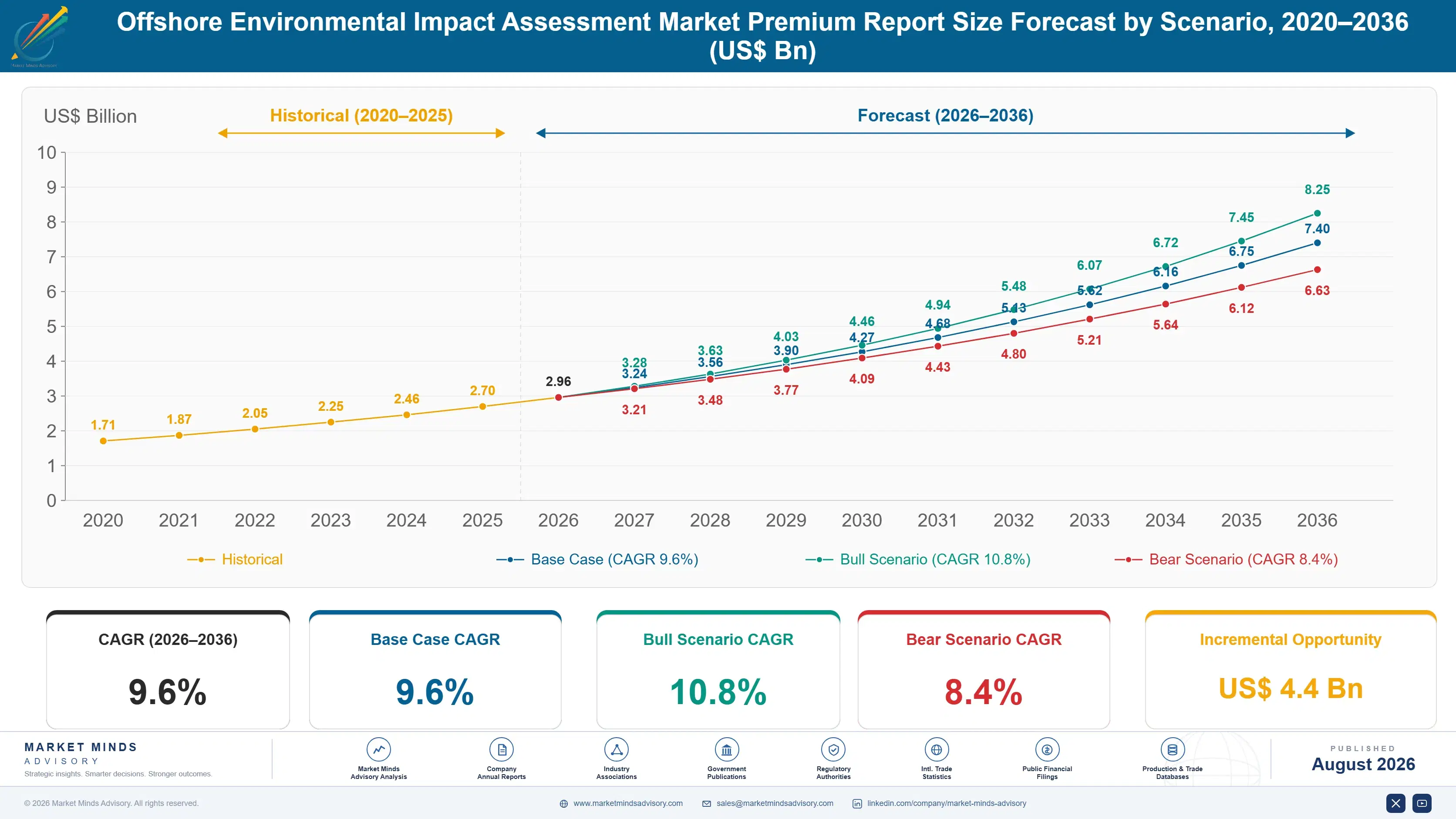
Offshore Environmental Impact Assessment Market Forecast Scenarios

offshore-environmental-impact-assessment-market-size-forecast-scenario-1787302723089
The 2020 to 2025 period ran at 8.2% and offshore wind leasing rounds rather than oil and gas activity carried it. Survey work paused through 2020 as vessel operations were restricted, creating baseline gaps that pushed several consent applications back by a full year. Autonomous platforms moved from trial to routine deployment across the period, largely because crewed survey capacity could not meet demand.
Three mechanisms carry the 9.6% base case. Offshore wind consenting is the largest, since every project requires multi-year baseline data before an application can be made at all. Autonomous acquisition is the second, extending working windows that weather and vessel availability jointly restrict. And post-consent monitoring is the third, which recurs annually across an operating asset life rather than ending at consent. None of the three depends on any change in evidence standards.
The 10.8% bull case rests on floating wind leasing proceeding at announced rates in deeper water, where baseline requirements are more demanding and less well understood than in fixed foundation areas. The 8.4% bear case is leasing round deferral across major markets, which would remove the pipeline that baseline survey programmes are commissioned years ahead of.

Two Calendars That Never Agree

Offshore environmental assessment runs on two calendars that have never agreed. Ecological baselines need a full seasonal cycle, and preferably two, so that migration, breeding, and overwintering are all captured rather than inferred. That means around 24 months of data before an application can be defended properly. Consenting authorities and developers both want the application sooner, and the ecology does not accommodate either of them.
WINTER SURVEY AVAILABILITY41%Of days workable by crewed vessels in Atlantic winter
BASELINE DATA DELAY SHARE58%Of consent delays caused by incomplete or contested baseline data
MINIMUM BASELINE DURATION24 monthsOf seasonal data typically required before an application is defensible
TOP FIVE CONCENTRATION34%Very low, because consenting expertise is jurisdictional rather than transferable
POST-CONSENT MONITORING SHARE29%Of programme value arising after consent rather than before it
AUTONOMOUS DATA COST38%Below crewed vessel acquisition for equivalent survey coverage delivered
Weather compounds it. Crewed survey vessels work roughly 41% of days through a North Atlantic winter, so the season when overwintering bird and marine mammal data matters most is the season when collecting it is hardest. Programmes routinely lose a survey window entirely to weather, and losing one means either an incomplete dataset or a full year's delay while the season comes round again.
That is why around 58% of consent delays trace to baseline data being incomplete or contested rather than to any substantive objection about project impact. The argument at inquiry is frequently not whether the development harms a species but whether anybody knows what was there beforehand. Developers who commissioned baseline work late discover that the shortfall cannot be bought back at any price.
"A developer asked whether we could compress a two-year baseline into eight months. You can collect data faster. You cannot make a winter happen sooner, and that is what the inquiry will ask about."
Director, Marine Environment and Consenting Practice · MMA Energy Services and E

Market Trends

Autonomous Platforms Extend The Working Window

Uncrewed surface vessels and gliders work through conditions that stop crewed operations, and they cost around 38% less per unit of survey coverage delivered. Autonomous acquisition grows at 14.4% against 9.6% for the market. The gain is availability rather than price: extending a season that permits only 41% workable days in winter is worth considerably more to a developer than a cheaper survey would be. Regulator acceptance of autonomous data has followed the deployment rather than preceded it. Losing a survey window means an incomplete dataset or a full year of delay.
Market Impact: Baselines run at least 24 months
Consenting Expertise Stays Stubbornly Jurisdictional Everywhere

Every offshore regulator has its own evidence expectations, precedent, and appetite for uncertainty, and none of that transfers across a border however good the underlying science is. Concentration sits at 34% because a consultancy that has taken twenty projects through one authority holds an advantage worth nothing in the next jurisdiction. Firms expanding internationally hire local consenting teams rather than exporting method, which is slower and considerably more expensive than it looks. Acquisitions of local practices are how most international entries have actually succeeded. Method transfer consistently fails to substitute for regulatory relationships.
Market Impact: Post-consent is 29% of value

Market Opportunities and Growth Drivers

Every Leasing Round Commits Years Of Baseline Work

A developer awarded a seabed lease cannot apply for consent without multi-year ecological baseline data, so each leasing round commits assessment work that begins immediately and continues for at least 24 months before any application. That relationship makes demand unusually forecastable, since the leasing calendar is published years ahead. It also means a deferred leasing round removes work that consultancies had already resourced and staffed against. Consultancies resource and staff years ahead against a calendar governments control entirely. A deferred round removes work already committed, which is genuinely difficult to plan around.
Market Impact: Baselines require 24 months

Monitoring Obligations Continue Across Operating Life

Consent conditions typically require ongoing monitoring of bird collision, marine mammal displacement, benthic recovery, and noise for years after construction, which produces recurring revenue across an asset life rather than a single pre-consent engagement. Around 29% of programme value arises after consent for exactly that reason. Those obligations also sit with whoever holds the consenting relationship, which makes the original assessment contract considerably more valuable than its own fee. A competitor bidding for monitoring separately begins without the historical record every submission references. That dataset advantage compounds across each year of operation.
Market Impact: Concentration is only 34%

Market Restraints and Challenges

Baseline Data Cannot Be Compressed At Any Price

Ecological baselines need around 24 months of seasonal coverage and crewed vessels work only about 41% of winter days, so a developer who commissioned survey work late cannot recover the shortfall by spending more. The root cause is that seasons happen once a year regardless of budget. Commercial impact is consent applications delayed by a full year at enormous carrying cost. Mitigation runs through early commissioning, autonomous platforms extending the window, and existing regional datasets where they exist and are accepted. Developers who commissioned late discover the shortfall cannot be bought back at any price.
Market Impact: Autonomous costs 38% less

Jurisdictional Expertise Limits Consultancy Scale Considerably

Consenting knowledge is precedent-based and specific to each regulator, so the experience that wins projects in one country contributes almost nothing in the next, and concentration accordingly sits at only 34%. The root cause is that environmental law and evidence expectations are national rather than scientific. Commercial impact is that international expansion requires hiring rather than exporting capability. Mitigation runs through local acquisition, long recruitment lead times, and accepting that method transfer will not substitute for regulatory relationships. Firms that recruited or acquired locally established themselves considerably faster than those exporting method.
Market Impact: Concentration sits at 34%
4 additional market trends, 3 additional growth drivers, and 2 additional restraints and challenges are covered in the full report. Contact sales@marketmindsadvisory.com to access the complete intelligence.

Segment CAGR and Growth Architecture

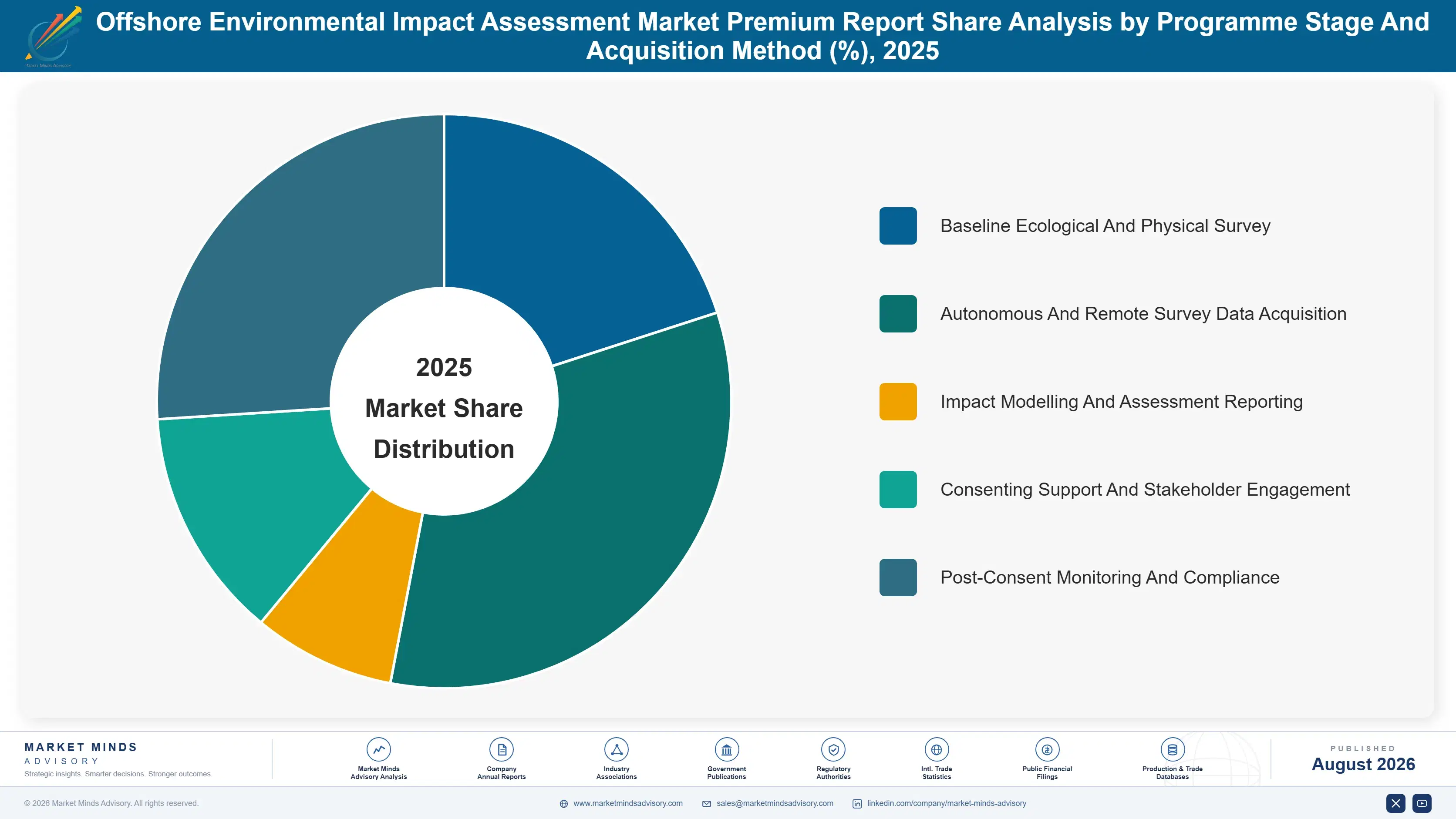
Segmentation follows programme stage and acquisition method, because those determine timing constraints, revenue recurrence, technical capability required, and whether the work is data collection or regulatory argument. Project type and water depth both cut across every stage rather than separating them, which makes either a weaker primary dimension here. Programme stage decides whether revenue recurs at all.
offshore-environmental-impact-assessment-market-market-share-analysis-1787302723630

Autonomous And Remote Survey Data Acquisition

The fastest category at 14.4%, exactly 1.50 times the market rate, and the only one addressing the constraint that actually delays projects. Uncrewed surface vessels, gliders, and remote acoustic monitoring work through conditions that stop crewed operations, extending a season permitting only around 41% workable winter days. Cost per unit of coverage runs roughly 38% below crewed acquisition, though availability rather than price is what developers are actually buying. Regulator acceptance has followed deployment rather than preceding it, which required somebody to go first. Firms deploying early shaped what became acceptable evidence and now hold both capability and precedent. Waiting for acceptance means arriving after somebody else defined the standard.
CAGR 14.4%

Post-Consent Monitoring And Compliance

Second fastest at 12.0% and around 29% of total programme value, covering bird collision, marine mammal displacement, benthic recovery, and noise monitoring required by consent conditions across an operating asset life. Revenue recurs annually rather than ending at consent, which changes the economics of the original assessment contract considerably. These obligations also sit naturally with whoever holds the consenting relationship and the historical dataset, making them difficult for a competitor to win separately from the assessment work that preceded them. A competitor would begin without the historical record that every subsequent submission references. That advantage compounds across each year an asset operates. Consultancies treating consent as an endpoint forfeit it entirely.
CAGR 12.0%
Full segment breakdown across 5 segments available in the complete report.

Regional Architecture and Country Demand Map

Western Europe leads at 34%, well outside band, because North Sea offshore wind consenting set the global standard and carries the deepest pipeline. East Asia follows on Chinese, Korean, and Japanese offshore wind. South Asia and Pacific grows fastest. Consenting frameworks differ sharply between every one of them.

Western Europe

Thirty-four percent, well outside the framework band, and justified because North Sea offshore wind consenting established the evidence standards that other jurisdictions now adapt. British, Danish, Dutch, and German regulators have decades of accumulated precedent, and the consultancies working to it hold expertise that does not transfer outward easily. Post-consent monitoring obligations across a large operating fleet also generate recurring work no other region yet matches. Growth at 8.2% is the slowest of any region, reflecting a mature consenting pipeline rather than reduced activity. Autonomous acquisition acceptance also happened here first, which shaped what regulators elsewhere now expect. Consultancies here hold precedent that partially transfers into newer markets. Post-consent monitoring across that operating fleet recurs annually and compounds.
Share: 34% | CAGR: 8.2% (2026 to 2036)

East Asia

Twenty-four percent, and Chinese, Korean, Japanese, and Taiwanese offshore wind development accounts for nearly all of it. Consenting frameworks differ sharply between those markets and from European practice, which means European consultancies compete through local hires rather than through exported method. Taiwanese and Korean projects have adopted evidence standards closer to European practice, while Chinese consenting follows an entirely separate framework. Growth at 10.6% runs above the market rate on continued leasing and construction across the region. Local hires rather than exported method are how European firms have entered these markets at all. Post-consent monitoring obligations are less developed than European equivalents currently. Leasing activity continues expanding steadily. Survey vessel availability across the region is tighter than in Europe.
Share: 24% | CAGR: 10.6% (2026 to 2036)
Regional intelligence for 5 additional markets available in the complete report: North America, South Asia and Pacific, Middle East and Africa, Latin America, Eastern Europe. Contact sales@marketmindsadvisory.com.
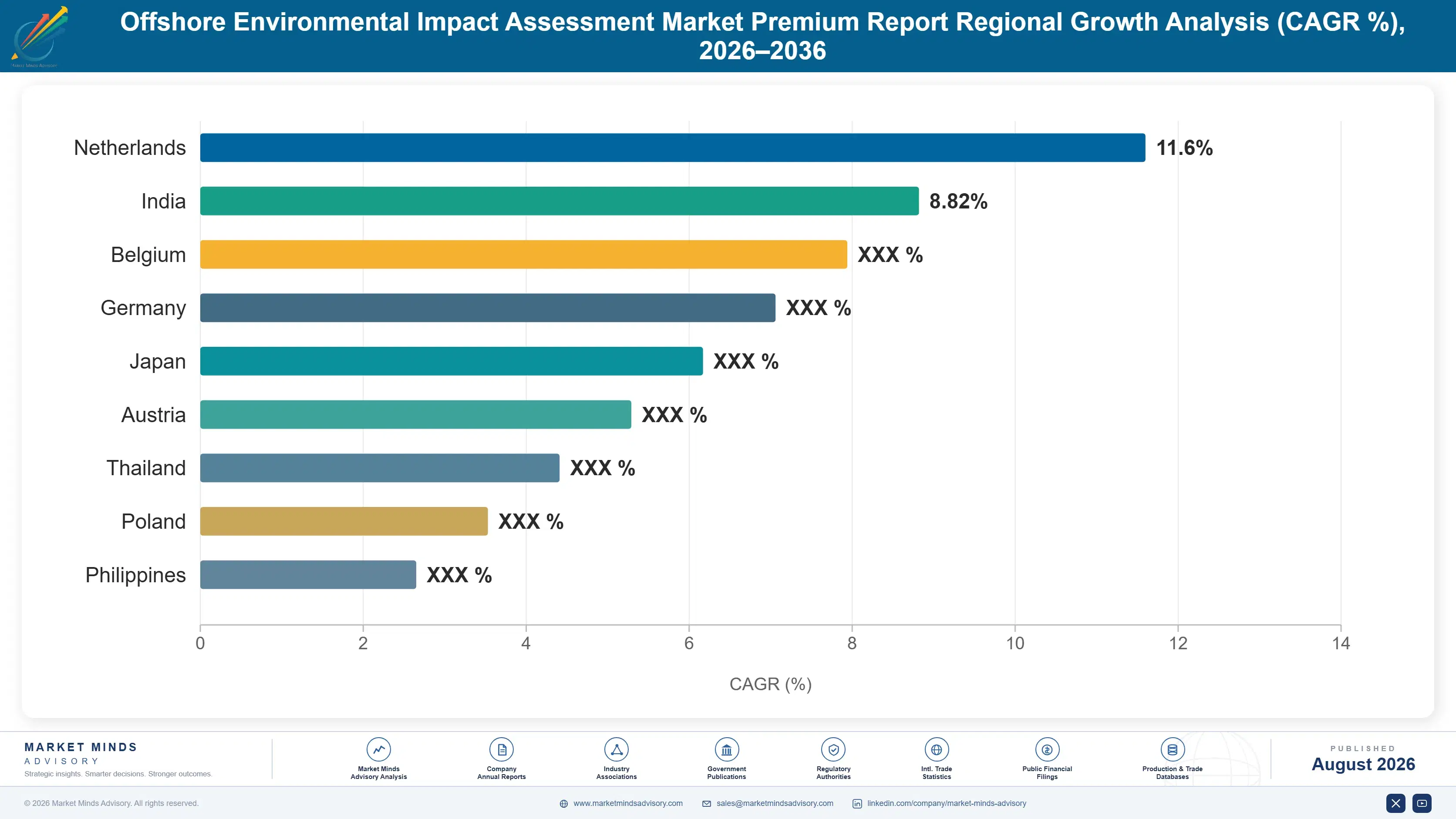
offshore-environmental-impact-assessment-market-country-cagr-analysis-1787302724153

Winning the Consent, Not the Survey

Baselines need around 24 months, crewed vessels work 41% of winter days, roughly 58% of delays trace to baseline data, and post-consent monitoring is 29% of value. Value comes from selling programme timing, from building autonomous capability, and from holding the monitoring relationship afterward. Timing rather than technical capability decides most of the outcomes here.

Sell The Consent Timeline Rather Than The Survey

Around 58% of consent delays trace to incomplete or contested baseline data, and a single year of delay costs a developer far more than any survey programme they might commission. A consultancy quoting survey days is selling an input, while the customer is actually buying a consent date. Presenting a programme against the consenting timeline, including which seasons must be captured and what happens if any window is lost, changes what the developer is actually evaluating. Developers are increasingly staffed with environmental leads who ask about window risk before fees.
Market Impact: Roughly 58% of delays trace to base

Build Autonomous Capability For Window Extension

Crewed vessels work around 41% of winter days, and losing a survey window means either an incomplete dataset or a full year of delay while the season returns. Uncrewed platforms work through conditions that stop crewed operations and cost roughly 38% less per unit of coverage, though availability rather than price is what a developer is really buying. Regulator acceptance followed deployment rather than preceding it, so the early adopters effectively shaped what became acceptable evidence. Firms that waited for acceptance arrived after the standard had already been defined elsewhere.
Market Impact: Crewed vessels work only 41% of win

Hold The Monitoring Relationship After Consent

Post-consent monitoring represents around 29% of total programme value and it recurs annually across an operating asset life rather than ending once consent is granted. Those obligations sit naturally with whoever holds the historical dataset and the regulatory relationship, which makes them very difficult indeed for a competitor to win separately. A consultancy treating assessment as a discrete project, rather than as the opening of a decade-long relationship, leaves most of the value on the table. Building monitoring capability costs staff rather than capital, and it extends every relationship considerably.
Market Impact: Monitoring is 29% of the total prog

Hire Consenting Expertise Rather Than Exporting Method

Concentration sits at only 34% because consenting knowledge is precedent-based and specific to each regulator, so twenty successful projects in one jurisdiction contribute almost nothing in the next one. Firms expanding internationally consistently underestimate this and attempt to export method rather than hire local regulatory relationships. That approach fails slowly and expensively everywhere it is tried, and firms recruiting locally from the outset established themselves considerably faster. Local acquisition buys regulatory relationships that no amount of technical credibility substitutes for. Recruitment lead times for experienced consenting specialists run long everywhere.
Market Impact: Concentration sits at only 34% acro

Who Controls the Margin Pool

Concentration is very low at 34% across the top five measured on assessment programmes delivered, and jurisdictional expertise rather than capability holds it there. Environmental law, evidence expectation, and regulatory precedent are national rather than scientific, so a consultancy with deep standing before one authority carries an advantage that stops at the border. That structure sustains strong regional specialists alongside international firms operating as collections of national practice
Competitive activity runs on three fronts. Regulatory relationship depth is the first and most decisive, since consenting outcomes depend on how evidence is framed as much as on what it shows. Autonomous acquisition capability is the second, which addresses the timing constraint that causes most delays. And post-consent monitoring positions are the third, where the recurring revenue actually sits.

Pressure comes from two directions. Survey vessel operators are moving up into assessment and reporting rather than supplying data alone. And developers are building internal environmental teams that manage consultancies rather than depending on them. Both pressures squeeze consultancies that positioned themselves around data collection rather than consenting outcomes. Regulatory relationships remain the defensible position.

Rankings shift on leasing round outcomes rather than commercial activity.
offshore-environmental-impact-assessment-market-company-positioning-matrix-1787302724681

Competitive Moat and Risk Dimensions

RAMBOLL

Moat: Regulatory depth across multiple jurisdictions

Holding genuine consenting relationships across several national regulators rather than in one market lets a firm follow developers internationally in a business where expertise otherwise stops at borders. Those relationships were built through completed projects rather than recruitment, and they take a decade to establish anywhere at all.
RAMBOLL

Risk: Pipeline tied to leasing decisions

Assessment demand follows leasing rounds that governments schedule and defer for reasons unconnected to consultancy performance, so a deferred round removes work already resourced and staffed against. Post-consent monitoring cushions that and does not replace it. Capacity planning against a political calendar is genuinely difficult and no commercial capability resolves it.
FUGRO

Moat: Survey assets and autonomous capability

Owning survey vessels and autonomous platforms alongside assessment capability means the firm controls the data acquisition that most consultancies subcontract, which matters enormously when weather windows are the binding constraint. Autonomous fleet investment made ahead of regulator acceptance also shaped what became acceptable evidence. That combination is rare and expensive to assemble.
FUGRO

Risk: Asset base against consulting margins

Survey vessels and autonomous fleets carry capital and utilisation risk that a pure consultancy simply does not bear, and assessment work alone rarely loads them fully across a year. Chartering to others fills capacity and funds competitors at the same time. Asset ownership secures acquisition and complicates the earnings profile considerably.

Players Tracked

Prominent Players

Ramboll
RPS Group
Fugro
GoBe Consultants
Ocean Ecology

Other Key Players

Wood Group
ERM
APEM Group
Natural Power
MarineSpace
Xodus Group
DHI Group
NIRAS
Aqualis Braemar
Ocean Infinity
Saildrone
Subsea Europe Services
Tetra Tech
AECOM
Royal HaskoningDHV

Recent Developments

JANUARY 2025

Regulator accepts autonomous platform data in consent application

A national marine regulator accepted bird and marine mammal survey data collected by uncrewed platforms as sufficient evidence within an offshore wind consent application, following several years of parallel validation work. The acceptance was a regulatory determination rather than any commercial arrangement, joint venture, or partnership with a survey provider.
Signal: Regulator acceptance followed deployment r
APRIL 2025

Developer loses consent year after missed winter survey window

An offshore wind developer deferred a consent application by a full year after weather prevented completion of a winter baseline survey season, leaving the ecological dataset incomplete for the intended submission. The deferral was a project timing decision rather than any regulatory refusal, dispute, or contractual failure.
Signal: A lost survey window cannot be bought back
AUGUST 2025

Consultancy acquires local practice to enter new jurisdiction

An international environmental consultancy acquired a domestic marine consenting practice to enter a new offshore wind market, buying regulatory relationships rather than attempting to export its existing methodology. The transaction was a full acquisition rather than any joint venture, partnership, or licensing arrangement between the firms.
Signal: Consenting expertise is bought locally bec

Vessels, Specialists and Data Processing

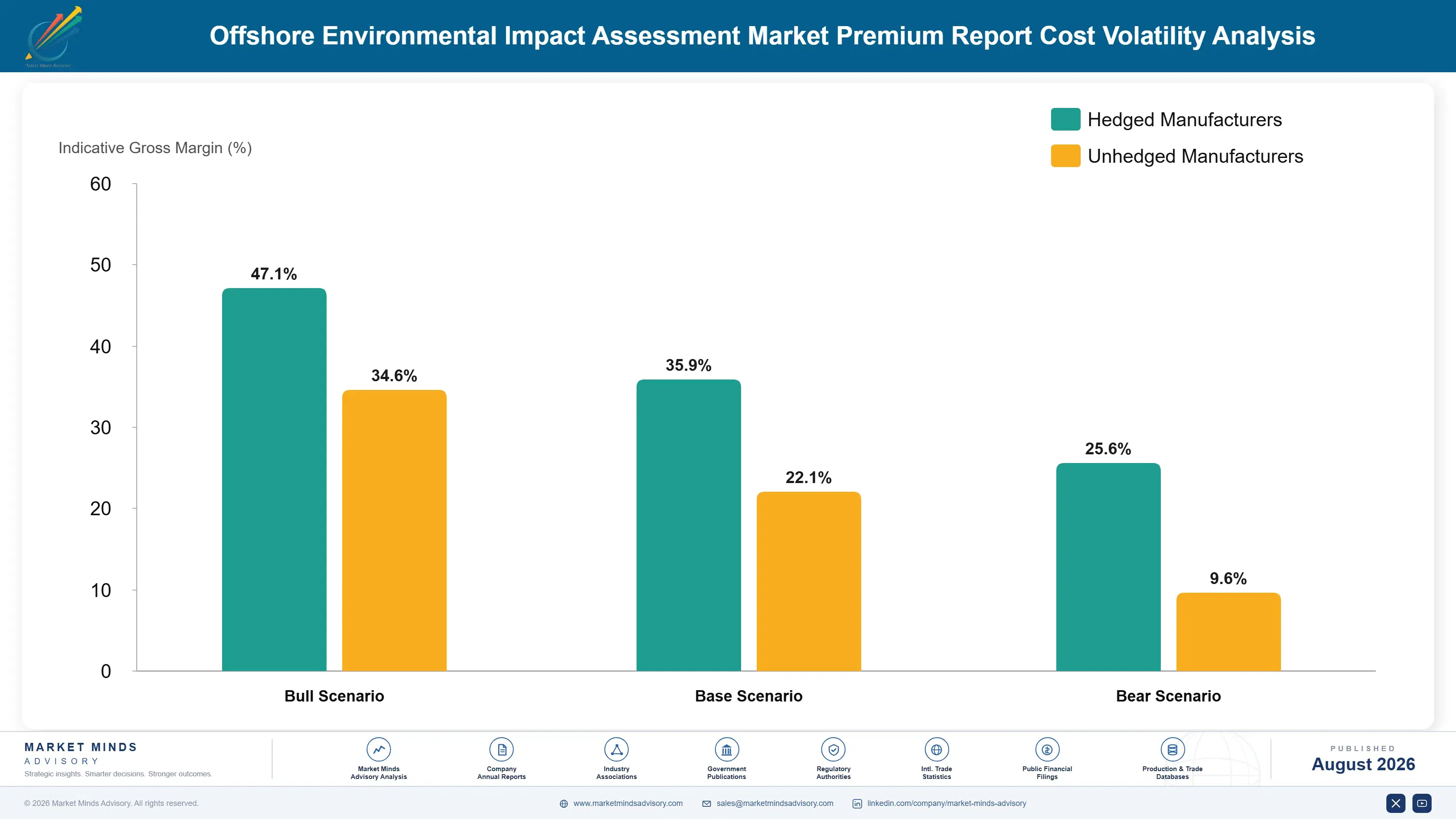
Survey vessel charter and mobilisation carry roughly 39% of programme cost across crewed acquisition, specialist ecologist and consultant time about 27%, data processing and analysis near 14%, autonomous platform operation around 9% where used, and reporting, project management, and overhead the balance. Vessel cost dominates and is exactly what autonomous platforms displace when conditions permit their use.
Offshore survey vessel day rates rose sharply through 2022 and 2023 as offshore wind construction competed for the same vessels, and several marine service providers disclosed charter cost increases and availability constraints in annual filings covering those years. Specialist ecologist availability tightened simultaneously, since the skills involved take years to develop and the pipeline had not anticipated offshore wind volume. Charter availability rather than rate became binding.

The competitive disadvantage mechanism runs through vessel and specialist access rather than through pricing. A consultancy without secured vessel availability during a critical survey window loses the season entirely, and a firm without ornithologists and marine mammal observers on staff competes for the same scarce contractors everybody else is chasing. Data processing costs broadly the same everywhere; access to the window and the people does not.
offshore-environmental-impact-assessment-market-cost-volatility-analysis-1787302724876

Secure vessel availability before the survey window opens

Vessel charter carries roughly 39% of programme cost, and offshore wind construction competes for exactly the same assets during exactly the same weather windows. A consultancy without secured availability loses a season that cannot be recovered at any price. Framework charter agreements cost commitment against uncertain programme timing and remove the risk that ends projects entirely.

Develop specialist staff rather than competing for contractors

Specialist ecologist time carries about 27% of programme cost, and ornithologists, marine mammal observers, and benthic taxonomists all take years to train while the pipeline never anticipated offshore wind volume. Firms developing staff internally hold capability during peak season when contractors are unavailable at any rate. That investment carries cost through quieter periods and prevents the failure that matters.

Invest in autonomous platforms ahead of regulator acceptance

Autonomous acquisition costs roughly 38% less per unit of coverage and works through conditions that stop crewed operations, but regulator acceptance followed deployment rather than preceding it. Firms that deployed early shaped what became acceptable evidence and now hold both the capability and the precedent. Waiting for acceptance means arriving after somebody else has defined the standard.

Portfolio Architecture for Margin Defence

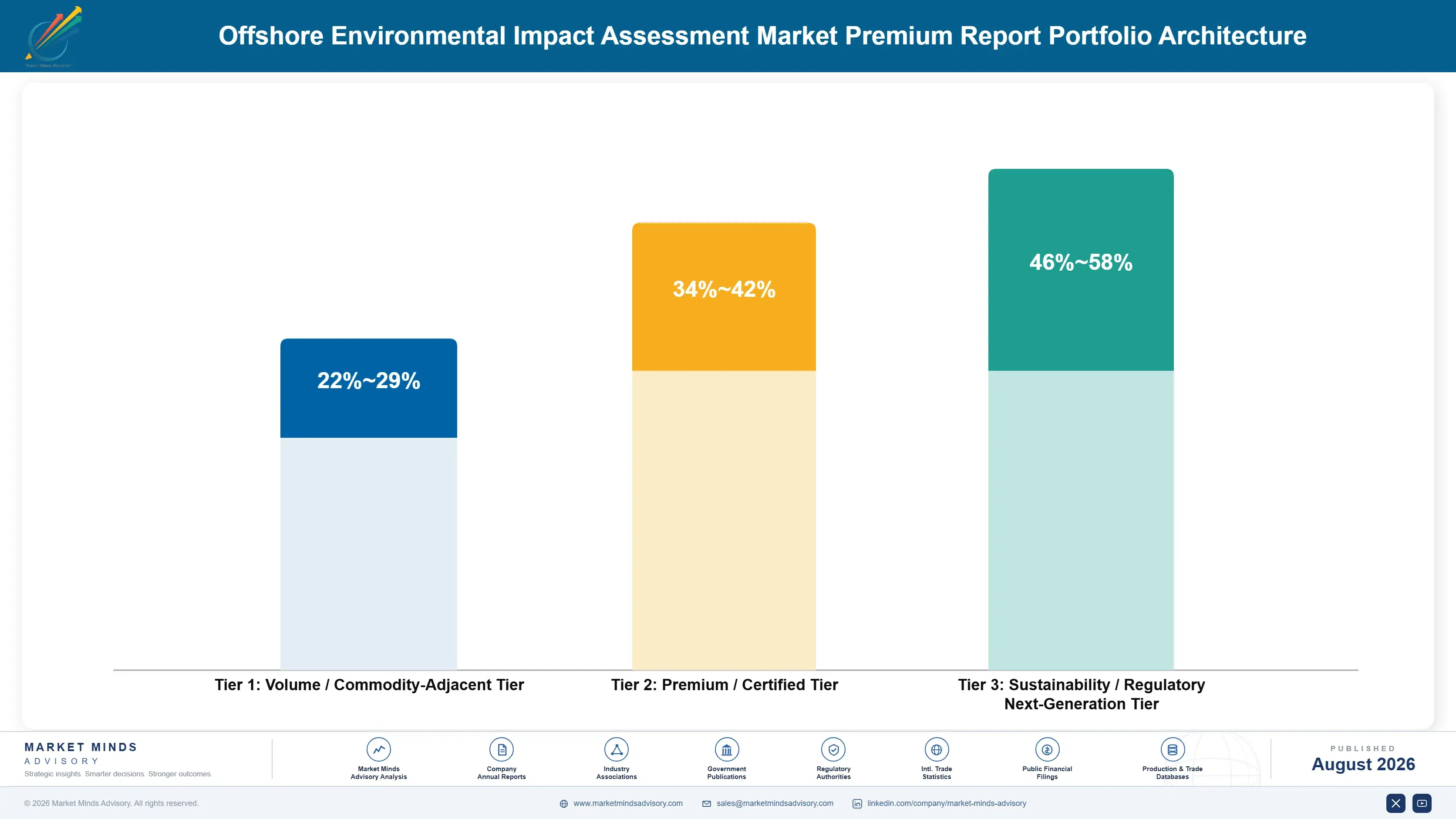
Three tiers describe this business and the spread follows regulatory content rather than technical difficulty. Data acquisition sits at the bottom, competing on vessel day rates and increasingly on autonomous cost where survey operators are moving upward. Impact modelling and reporting occupies the middle. Consenting strategy, expert evidence, and stakeholder engagement sit at the top, priced on outcome rather than on effort at all. Regulatory argument rather than data volume separates these tie
The tension is that acquisition builds the dataset that everything else depends on, while the consenting work carries the margin and the relationship. A firm competing on survey day rates faces vessel operators integrating forward with better assets. One offering consenting advice without acquisition depends on subcontractors during exactly the windows when nobody has capacity available.

High-value pools concentrate where the argument rather than the data decides the outcome. Expert evidence at inquiry is the clearest case, since two consultants can present identical data and reach entirely different consent outcomes depending on how it is framed. Post-consent monitoring pools value similarly, since the historical dataset makes displacement genuinely impractical. Both pools sit well outside the day rate contest.

Volume / Commodity-Adjacent Tier

Baseline data acquisition competing on vessel day rates and autonomous coverage cost, where survey operators are integrating forward with better assets than most consultancies own. Margin is thin and vessel access is the real constraint.
Gross Margin: 22-29%

Premium / Certified Tier

Impact modelling, assessment reporting, and post-consent monitoring where technical capability and accumulated datasets both matter. Monitoring obligations recur annually and sit with whoever holds the historical record and regulatory relationship.
Gross Margin: 34-42%

Sustainability / Regulatory / Next-Generation Tier

Consenting strategy, expert evidence, and stakeholder engagement priced on outcome rather than effort. Best margin by a clear distance, since two consultants presenting identical data can reach entirely different consent outcomes.
Gross Margin: 46-58%
offshore-environmental-impact-assessment-market-portfolio-architecture-1787302725391

Leases, Seasons and Conditions

Demand originates with seabed leasing decisions taken by governments, which commit multi-year assessment programmes beginning immediately and running at least 24 months before any consent application. That makes the pipeline unusually visible, since leasing calendars are published years ahead, and unusually exposed, since a deferred round removes work that consultancies have already resourced and staffed against. Leasing calendars therefore drive resourcing decisions years ahead.
Stickiness runs through accumulated datasets and regulatory relationships rather than any contractual position. A consultancy holding several years of baseline data for a site is extremely difficult to displace, because a competitor would begin without the historical record that every subsequent submission references. Post-consent monitoring reinforces that further. Pure data acquisition sticks hardly at all and is retendered on vessel availability and price.

Buyer profiles shifted as developers built internal environmental capability. The earlier buyer was a project manager commissioning a required study without much technical view. The current one is increasingly an in-house environmental lead who manages several consultancies, understands the evidence standards, and asks about survey window risk before discussing fees. Those leads evaluate programme risk and consenting timeline before they compare any fee proposals.
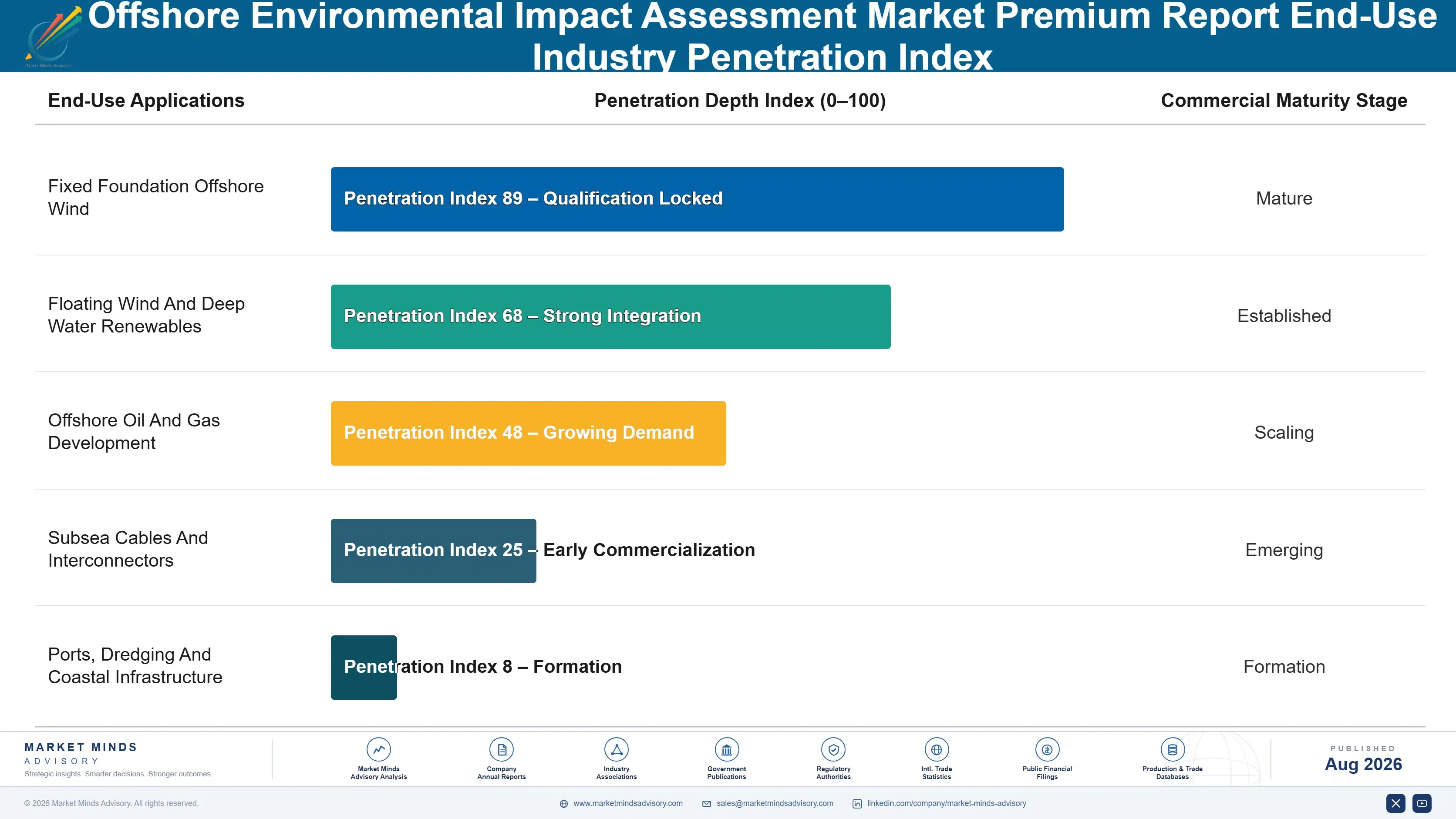
offshore-environmental-impact-assessment-market-end-use-penetration-index-1787302725887

What We Would Tell a Board

These are among the four positions where our research anticipates prominent divergence between winners and laggards over the coming forecast period. Each is grounded in the demand model, the regulatory perimeter, and the announced capacity pipeline.
01 / CONSENT TIMELINE FRAMING

The developer is buying a date, not survey days

Around 58% of consent delays trace to incomplete or contested baseline data, and a single year of delay costs an offshore developer very considerably more than any survey programme they might commission. A consultancy quoting survey days and vessel rates is selling an input while the customer is actually buying a consent date they can plan a financing round around. Presenting the whole programme against the consenting timeline, including which seasons must be captured, changes entirely what that developer is evaluating.
02 / WINDOW EXTENSION CAPABILITY

Autonomous platforms buy season, not just savings

Crewed survey vessels work roughly 41% of days through a North Atlantic winter, and losing a survey window means either an incomplete dataset or a full year of delay while that season comes round again. Uncrewed platforms work through conditions that stop crewed operations entirely, and they cost around 38% less per unit of coverage delivered. Availability rather than price is what a developer is genuinely buying here, and regulator acceptance followed the deployment rather than preceding it at all.
03 / MONITORING RELATIONSHIP RETENTION

Consent is the beginning of the revenue, not the end

Post-consent monitoring represents around 29% of total programme value and recurs annually across an entire operating asset life rather than concluding when consent is finally granted. Those obligations sit naturally with whoever holds the historical dataset and the established regulatory relationship, which makes them genuinely difficult for any competitor to win separately from the assessment. A consultancy treating each assessment as a discrete project rather than as the opening of a decade-long relationship is leaving most of the available value entirely uncollected.
04 / JURISDICTIONAL ENTRY METHOD

Buy the relationships; exporting method does not work

Concentration sits at only 34% precisely because consenting knowledge is precedent-based and specific to each individual regulator, so twenty successful projects in one jurisdiction contribute almost nothing at all in the next one. Firms expanding internationally consistently underestimate that, and they attempt to export their own methodology rather than hire the local regulatory relationships they need. That approach fails slowly and expensively in every market where it has been attempted, while firms recruiting or acquiring locally established themselves considerably faster.

Engagement Snapshot From the Field

A live engagement with an industry participant carrying material or product regulatory and market exposure ahead of a defining policy shift, showing how our research translates into a defensible multi-year portfolio strategy.
MARKET MINDS ADVISORY · CLIENT ENGAGEMENT SUMMARY
Offshore Environmental Impact Assessment Premium Report Producer Strategic Portfolio Review and Transition Roadmap 2026·Investment Scenario on Offshore Environmental Impact Assessment Premium Report Exposure Evaluation 2025-26
CLIENT PROFILE
An environmental consultancy with approximately 74 million dollars in annual revenue (client-reported, unverified by MMA), delivering offshore baseline survey and impact assessment across two European markets. Data acquisition carried most of the revenue, consenting advisory was a small share, and margin had declined for three consecutive years while programme volume had grown throughout. Post-consent monitoring capture had never been measured.
STRATEGIC CHALLENGE
Management proposed acquiring survey vessels to control acquisition cost and improve margin. The board wanted an independent assessment of where margin was actually being lost, and whether owning assets would address it, before committing capital to a fleet the firm had never operated. Service line margin had never been decomposed. Utilisation assumptions were untested.
MMA APPROACH
We decomposed margin by service line across three years, separating acquisition from modelling, reporting, and consenting advisory. Vessel charter cost was benchmarked against ownership economics at the client's utilisation. Win rates were compared between acquisition-led and consenting-led pursuits, and post-consent monitoring capture was traced across completed projects. Charter availability risk was assessed separately.
KEY FINDINGS
  1. Data acquisition had produced barely positive contribution across all three years, while consenting advisory margin had held throughout at multiples of it.
  2. Vessel ownership at the client's actual utilisation would have cost more than chartering, since offshore wind construction demand made off-season chartering to others difficult.
  3. The client had won post-consent monitoring on a minority of completed assessments, having treated consent as the natural end of each engagement.
  4. Consenting-led pursuits won at a substantially higher rate than acquisition-led ones, and carried longer client relationships afterward. Relationship duration differed sharply. Positioning explained most of it.
CLIENT PROFILE
An environmental consultancy with approximately 74 million dollars in annual revenue (client-reported, unverified by MMA), delivering offshore baseline survey and impact assessment across two European markets. Data acquisition carried most of the revenue, consenting advisory was a small share, and margin had declined for three consecutive years while programme volume had grown throughout. Post-consent monitoring capture had never been measured.
STRATEGIC CHALLENGE
Management proposed acquiring survey vessels to control acquisition cost and improve margin. The board wanted an independent assessment of where margin was actually being lost, and whether owning assets would address it, before committing capital to a fleet the firm had never operated. Service line margin had never been decomposed. Utilisation assumptions were untested.
MMA APPROACH
We decomposed margin by service line across three years, separating acquisition from modelling, reporting, and consenting advisory. Vessel charter cost was benchmarked against ownership economics at the client's utilisation. Win rates were compared between acquisition-led and consenting-led pursuits, and post-consent monitoring capture was traced across completed projects. Charter availability risk was assessed separately.
KEY FINDINGS
  1. Data acquisition had produced barely positive contribution across all three years, while consenting advisory margin had held throughout at multiples of it.
  2. Vessel ownership at the client's actual utilisation would have cost more than chartering, since offshore wind construction demand made off-season chartering to others difficult.
  3. The client had won post-consent monitoring on a minority of completed assessments, having treated consent as the natural end of each engagement.
  4. Consenting-led pursuits won at a substantially higher rate than acquisition-led ones, and carried longer client relationships afterward. Relationship duration differed sharply. Positioning explained most of it.
RECOMMENDED STRATEGY
Phase 1: Phase 1 (months one to nine): abandon the vessel acquisition, secure framework charter agreements covering critical survey windows. across both operating markets. Phase 2: Phase 2 (months nine to twenty-one): pursue post-consent monitoring on every completed assessment and build the required capability. through dedicated staffing. Phase 3: Phase 3 (months twenty-one to thirty-six): shift commercial positioning toward consenting outcomes rather than survey scope and pricing. in every new pursuit.
OUTCOME
The vessel acquisition was abandoned. Framework charter agreements covered both critical windows within two quarters, post-consent monitoring capture improved materially across completed projects, and consenting-led positioning was adopted across all new pursuits (client-reported, unverified by MMA). Capital was preserved rather than committed to vessels. Margin recovered within the year.

Frequently Asked Questions

Foundational context covering the market sizes, CAGR, scope, country, region and competition that inform every finding below. This section is provided to cover basics and most often pre-purchase conversations, answered from the MMA Primary Research Dataset.

What is the current size of the Offshore Environmental Impact Assessment Market?

The market is valued at USD 2.7 billion in 2025, rising to USD 2.96 billion in 2026. Scope covers environmental assessment for offshore energy and marine infrastructure, not onshore assessment or engineering survey work.

How large will the Offshore Environmental Impact Assessment Market be by 2036?

MMA forecasts USD 7.40 billion by 2036, an increase of USD 4.44 billion over the 2026 base. That represents an expansion multiple of 2.50 times across the forecast period.

What is the CAGR for the Offshore Environmental Impact Assessment Market 2026 to 2036?

The base case CAGR is 9.6%, with a bull case of 10.8% and a bear case of 8.4%. The historical rate from 2020 to 2025 was 8.2%, carried by offshore wind leasing rounds.

Which segment is growing fastest?

Autonomous and remote survey data acquisition at 14.4%, exactly 1.50 times the market rate. Uncrewed platforms extend a season in which crewed vessels work only around 41% of winter days.

Who are the major companies in the Offshore Environmental Impact Assessment Market?

Ramboll, RPS Group, Fugro, GoBe Consultants, and Ocean Ecology lead on assessment programmes delivered. The top five hold only 34%, because consenting expertise is jurisdictional rather than transferable.

Which country is growing fastest?

India at 12.2%, where offshore wind leasing is beginning and consenting frameworks are being written rather than applied. That creates both uncertainty and opportunity for consultancies shaping evidence expectations.

Report Segmentation Architecture

The full report scope spans multiple orthogonal segmentation dimensions, with cross-tabulated demand data provided for each dimension pair. Coverage extends further to regional breakdowns, trend trajectories, and the competitive detail needed to support segment-level decision-making.

By Programme Stage And Acquisition Method

  • Baseline Ecological And Physical Survey
  • Autonomous And Remote Survey Data Acquisition
  • Impact Modelling And Assessment Reporting
  • Consenting Support And Stakeholder Engagement
  • Post-Consent Monitoring And Compliance

By End-Use Industry

  • Fixed Foundation Offshore Wind
  • Floating Wind And Deep Water Renewables
  • Offshore Oil And Gas Development
  • Subsea Cables And Interconnectors
  • Ports, Dredging And Coastal Infrastructure

By Commercial Model

  • Full Programme Assessment Contracts
  • Framework Agreements With Developers
  • Specialist Survey Subcontracting
  • Expert Evidence And Inquiry Support
  • Long-Term Monitoring Service Agreements

By Region

  • Western Europe
  • East Asia
  • North America
  • South Asia and Pacific
  • Middle East and Africa
  • Latin America
  • Eastern Europe

Scope, Methodology, and Coverage

Every figure in this report is reproducible from documented input assumptions. The scope below maps the historical period, the forecast horizon, the segmentation dimensions, and the countries covered, alongside the underlying primary and qualitative methodology.
Historical Period
2020 to 2025
Forecast Period
2026 to 2036
Base Year
2025 (USD billions; MMA Primary Research Dataset, August 2026)
Market Definition
This market comprises environmental impact assessment services delivered for offshore energy and marine infrastructure projects, measured at consultancy and survey provider revenue across programme, framework, and monitoring contracts. Coverage spans baseline ecological and physical survey programmes, autonomous and remote survey data acquisition undertaken for environmental purposes, impact modelling and assessment reporting, consenting support, expert evidence and stakeholder engagement, and post-consent monitoring and compliance programmes. Onshore environmental impact assessment, geotechnical and geophysical survey conducted for engineering design rather than environmental assessment, marine spatial planning performed by public authorities, construction environmental supervision, and decommissioning engineering fall outside scope.
Quantitative Units
USD billions (current prices); assessment programmes delivered annually; survey days by acquisition method; pre-consent against post-consent revenue split
Segmentation Dimensions
By Programme Stage And Acquisition Method; By End-Use Industry; By Commercial Model; By Region
Regions Covered
Western Europe, East Asia, North America, South Asia and Pacific, Middle East and Africa, Latin America, Eastern Europe
Countries Covered
United Kingdom, Denmark, Netherlands, Germany, France, Belgium, Ireland, Norway, China, Japan, South Korea, Taiwan, United States, Canada, India, Australia, Vietnam, Brazil, Saudi Arabia, United Arab Emirates, Egypt, Nigeria, Poland, Lithuania, Estonia, and additional markets relevant to this sector
Key Companies Profiled
Ramboll, RPS Group, Fugro, GoBe Consultants, Ocean Ecology, Wood Group, ERM, APEM Group, Natural Power, MarineSpace, Xodus Group, DHI Group, NIRAS, Aqualis Braemar, Ocean Infinity, Saildrone, Subsea Europe Services, Tetra Tech, AECOM, Royal HaskoningDHV
Quantitative Methodology
Primary survey, n=3,800 respondents, Q4 2025, six countries; demand-side model with trade association cross-validation
Qualitative Methodology
47 expert interviews, Q4 2025; applied to validate demand model assumptions, identify emerging dynamics, and assess competitive positioning
Report Format
PDF and XLSX data workbook (Word format preview document)
Publisher
Market Minds Advisory
Report Code
MMA-2026-ENE-742
Published
August 2026
Contact
sales@marketmindsadvisory.com | www.marketmindsadvisory.com

Purchase the full Offshore Environmental Impact Assessment Market Premium Report Report (2026 to 2036).

The full report sizes offshore environmental impact assessment across five programme stages, five end-use industries, five commercial models, and seven regions, with pre-consent and post-consent revenue separated throughout. Survey window availability is quantified by region and season, since weather rather than budget determines whether a baseline can be completed on schedule. Consent delay causes are analysed by category across completed applications. Competitive profiling covers twenty firms on assessment programmes delivered, autonomous acquisition acceptance is tracked by regulator and jurisdiction, and leasing round calendars are mapped against programme commitments.
Pre-consent and post-consent revenue separated throughout the sizing
Survey window availability quantified by region and season
Consent delay causes analysed by category across completed applications
Autonomous acquisition acceptance tracked by regulator and jurisdiction
Leasing round calendars mapped against assessment programme commitments
Vessel availability modelled against offshore construction demand competition

Built For The People Who Decide

From boardroom strategy to bench-side execution, this report is read cover-to-cover by leaders shaping the next decade of their industry, turning demand scenarios, market dynamics and valuation benchmarks into decisions.
CXOs/ Presidents/ VPs/ Managers
M&A and Corporate Development
Strategy Teams and R&D Heads
Procurement and Product Directors
Regulatory and Compliance Leaders
Investor Relations and Equity Analysts