
Market Minds Advisory
Off-Highway EV Component Market

Off-Highway EV Component Market: Off-Highway EV Component Market: Duty Cycle Constraints, Ventilation Economics and Compact Machine Adoption

Underground mining electrifies on ventilation savings rather than emissions, compact construction machines electrify because municipal rules leave no alternative, and everything larger still waits on batteries that can finish a shift.

Lead Analyst

David Horsley

Published

August 2026

Make Smarter Decisions with Customized Research Insights

Request a free sample report and evaluate market opportunities, growth trends, and competitive dynamics relevant to your business needs.

2025 MARKET VALUE$5.4BMarket Size 2025
2036 FORECAST VALUE$21.9BBase Case , 2026 to 2036
CAGR 2026 TO 203613.6 %Bull 14.9% / Bear 12.3%
INCREMENTAL OPPORTUNITY$15.8BNet 10- year value creation
EXPANSION MULTIPLE3.58x2036 value over 2026 base
Strategic Levers
M&A Pipeline
Regional Outlook
Country Rankings
Competitive Intelligence
Segmental Deep-dive
Call-Us : 91 93563 13602

Executive Snapshot and Market Trajectory.

Off-highway electrification is not one market, and treating it as though it were produces nonsense. Underground mining electrifies because removing diesel exhaust cuts ventilation cost enormously. Urban construction electrifies because municipal rules leave contractors no alternative. Neither of those cases has much to do with emissions sentiment at all.
Off-highway battery pack systems grow at 20.4%, a full 1.50 times the market rate, because these machines demand energy densities and shock tolerances that automotive packs cannot deliver, and ruggedised pack engineering has become a distinct discipline. East Asia holds 38% of global value, above the standard band, because China builds the largest volume of electrified machines and supplies most of the cells and drives inside everybody else's.
Concentration is very low indeed at 22% for the top five, and it reflects an industry that is still assembling itself from three separate directions at once. Hydraulics specialists, automotive electrification suppliers and battery manufacturers are all converging on the same machines, and none of them yet holds the full range of capability that an off-highway platform genuinely requires. The supplier assembling that combination first will define how these machines are built.
Market Definition
This report covers electrification components and systems for off-highway machinery, spanning ruggedised battery packs, traction and implement motors, power electronics and inverters, electrified hydraulic and actuation systems, and thermal management with charging interfaces, across construction, mining, agriculture and material handling equipment. Complete machines valued at machine level, diesel engines and conventional transmissions, stationary charging infrastructure, on-highway commercial vehicle components and grid connection works are excluded.
Base Year Value
$5.4B in 2025 (MMA Primary Research Dataset, August 2026)
Forecast Period
2026 to 2036, eleven discrete annual values
CAGR
13.6% base case. Bull 14.9%. Bear 12.3%.
Fastest Growth Segment
Off-Highway Battery Pack Systems: 20.4% CAGR
Fastest Growth Country
India: 16.4% CAGR
Fastest Growth Region
South Asia and Pacific: 15.8% CAGR
Largest Region
East Asia: 38% of 2025 global value
Market Leaders
Danfoss Power Solutions, Bosch Rexroth, Dana Incorporated, Parker Hannifin and ZF Friedrichshafen lead on electrified system shipment volume. Source: MMA Analysis, July 2026.
Primary Survey
n=3,800 procurement and R&D decision-makers, Q4 2025, six countries
Methodology
Demand-side build-up, cross-validated against public data, 47 expert interviews

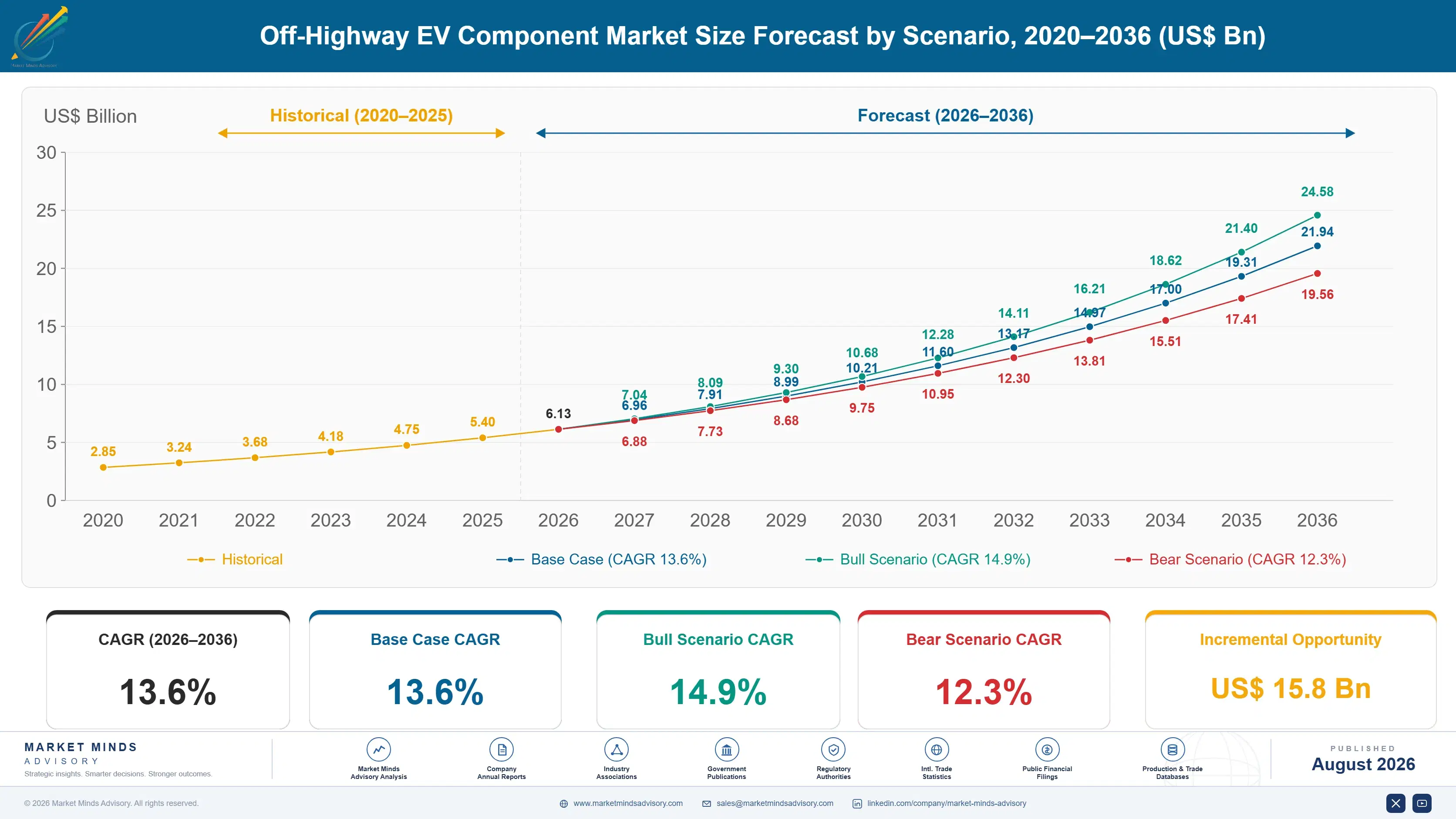
Off-Highway EV Component Market Forecast Scenarios

off-highway-ev-component-market-size-forecast-scenario-1787317082227
Between 2020 and 2025 the market compounded at 12.2%, and adoption ran well ahead of what most equipment manufacturers had planned for in compact machines while lagging badly in large ones. Municipal zero-emission construction requirements across Northern Europe arrived faster than anticipated. Underground mining electrification progressed on ventilation economics that had nothing to do with policy, and both segments pulled component demand forward.
The base case at 13.6% rests on three mechanisms. Compact construction machine electrification keeps spreading as more European and increasingly North American cities adopt low-emission site requirements. Underground mining conversion continues on ventilation cost arithmetic that works regardless of any regulatory position. Cell cost decline steadily widens the range of machine sizes where a battery can deliver a full shift, which converts demonstration projects into commercial purchases one machine class at a time.
The bull case at 14.9% turns on battery energy density improving enough to bring mid-size excavators and wheel loaders into commercial viability, which would open by far the largest volume pool in this market. The bear case at 12.3% is charging infrastructure at construction sites remaining the practical obstacle it currently is, leaving electrification confined to machines that return to a depot every night.

What Actually Governs Off-Highway Electrification

The engineering problem here is duty cycle and it is considerably harder than the automotive equivalent. A car spends most of its life parked and draws peak power in bursts. An excavator digs continuously for nine hours, and the energy it consumes doing that is what determines whether a battery machine is a product or a demonstration.
TOP FIVE CONCENTRATION22%Share held by the five largest off-highway electrification suppliers
BATTERY COST SHARE44% of COGSEnergy storage as portion of electrified machine cost
AVERAGE PACK CAPACITY210 kilowatt hoursTypical energy stored on an electrified compact machine
MACHINE ATTACH RATE6%Share of new off-highway machines shipped as electric
DAILY OPERATING HOURS9 hoursTypical shift a machine must complete without recharging
PROGRAMME LENGTH10 yearsTypical production run before a machine platform changes
That constraint explains the adoption pattern exactly. Compact excavators, skid steers and telehandlers electrified first because their energy demand fits packs that current cell pricing makes affordable. Mid-size machines are arriving now as cell costs fall. Large excavators and mining trucks still need energy that no practical pack delivers across a shift, which is why tethered and swappable approaches keep appearing in that class rather than conventional battery installations.
Underground mining is the exception that proves how commercial this market actually is. A diesel machine working underground requires ventilation airflow that costs enormous amounts of electricity to move, and removing the exhaust cuts that requirement dramatically. Operators there electrified on pure operating cost arithmetic years before anybody wrote a regulation, and they are the most demanding customers in this market as a direct result.
"The construction electrification conversation is dominated by emissions and the mining one never mentions them. Mining worked out that a battery machine lets you move less air, and moving air underground is one of the largest electricity bills any operator has. That is a real business case and it did not need a policy to exist."
Practice Director, Construction and Mining Equipment, Market Minds Advisory · MM

Market Trends

Compact Machines Electrify First On Duty Cycle Fit

Compact excavators, skid steers, telehandlers and small wheel loaders have moved into series production because their energy consumption across a working shift fits packs that current cell pricing makes commercially sensible. A compact machine typically carries around 210 kilowatt hours and completes a full day, while a mid-size excavator would need several times that. Urban work also suits them particularly well, since noise and exhaust restrictions bite hardest exactly where compact machines operate. Machine attach rates in that class now run several times the off-highway average, and the gap keeps widening.
Market Impact: Cuts ventilation load 40%
Electrified Actuation Replaces Centralised Hydraulic Circuits

Conventional machines run one pump driving hydraulics throughout, which wastes energy continuously because the pump turns whether or not anything is moving. Distributed electric actuation and electro-hydraulic units powered individually eliminate that standing loss, recovering roughly 22% of the energy a conventional circuit throws away. On a battery machine that saving translates directly into working hours, which matters far more than it ever did on diesel. Retrofitting the architecture is difficult, so it appears on clean-sheet electric platforms rather than on converted diesel designs, which slows how quickly it spreads.
Market Impact: Covers 100% of municipal work

Market Opportunities and Growth Drivers

Underground Ventilation Economics Justify Mining Electrification Alone

A diesel machine working underground requires substantial ventilation airflow to dilute exhaust, and moving that volume of air consumes electricity on a scale that surprises almost anybody outside the industry. Removing diesel from a working level cuts airflow requirements dramatically and reduces refrigeration load alongside in deep operations. Mining operators calculated that payback years before any regulator anywhere became interested, which makes this the one segment where electrification is driven entirely by operating cost. Those operators are also the most demanding customers anywhere in this market, by a considerable margin.
Market Impact: Requires 800 kilowatt hours

Municipal Zero-Emission Site Rules Remove The Diesel Option

Oslo already requires zero-emission machinery on all its municipal construction projects, and Amsterdam, Copenhagen, Stockholm and several German cities have committed to comparable requirements on defined timetables. A contractor bidding that work has no diesel option available at any price, which converts electrification from a commercial choice into an outright condition of participation. The commercial character matters: this demand is regulatory rather than discretionary, so it survives budget pressure and interest rate cycles that would otherwise defer capital equipment purchases indefinitely. Contractors plan fleet conversion against published deadlines rather than sentiment.
Market Impact: Needs 350 kilowatt connections

Market Restraints and Challenges

Energy Demand Blocks Electrification Of Larger Machine Classes

A mid-size excavator working a full shift consumes several times what a compact machine does, and a large mining truck consumes an order more again. The root cause is physics rather than any engineering shortfall: moving that much material takes energy that current cell density cannot store within the mass and volume a machine can carry. Commercially this confines electrification to the smaller end of every equipment category. Participants are responding with tethered power for stationary applications, battery swapping at fixed sites, and hybrid architectures that bridge toward full electrification over time.
Market Impact: Carries 210 kilowatt hour packs

Site Charging Infrastructure Remains The Practical Obstacle

A construction site frequently has no grid connection at all, and one capable of charging several machines overnight requires civil works and utility coordination that nobody budgets for. The root cause is that sites are temporary and grid upgrades are not. Commercially this confines electrification to machines returning to a depot each night or to sites with established power, which excludes a very large share of the addressable machine base entirely. Participants are responding with mobile battery energy storage, generator-buffered charging, and machines designed to accept opportunity charging during operator breaks.
Market Impact: Recovers 22% of wasted energy
4 additional market trends, 3 additional growth drivers, and 2 additional restraints and challenges are covered in the full report. Contact sales@marketmindsadvisory.com to access the complete intelligence.

Segment CAGR and Growth Architecture

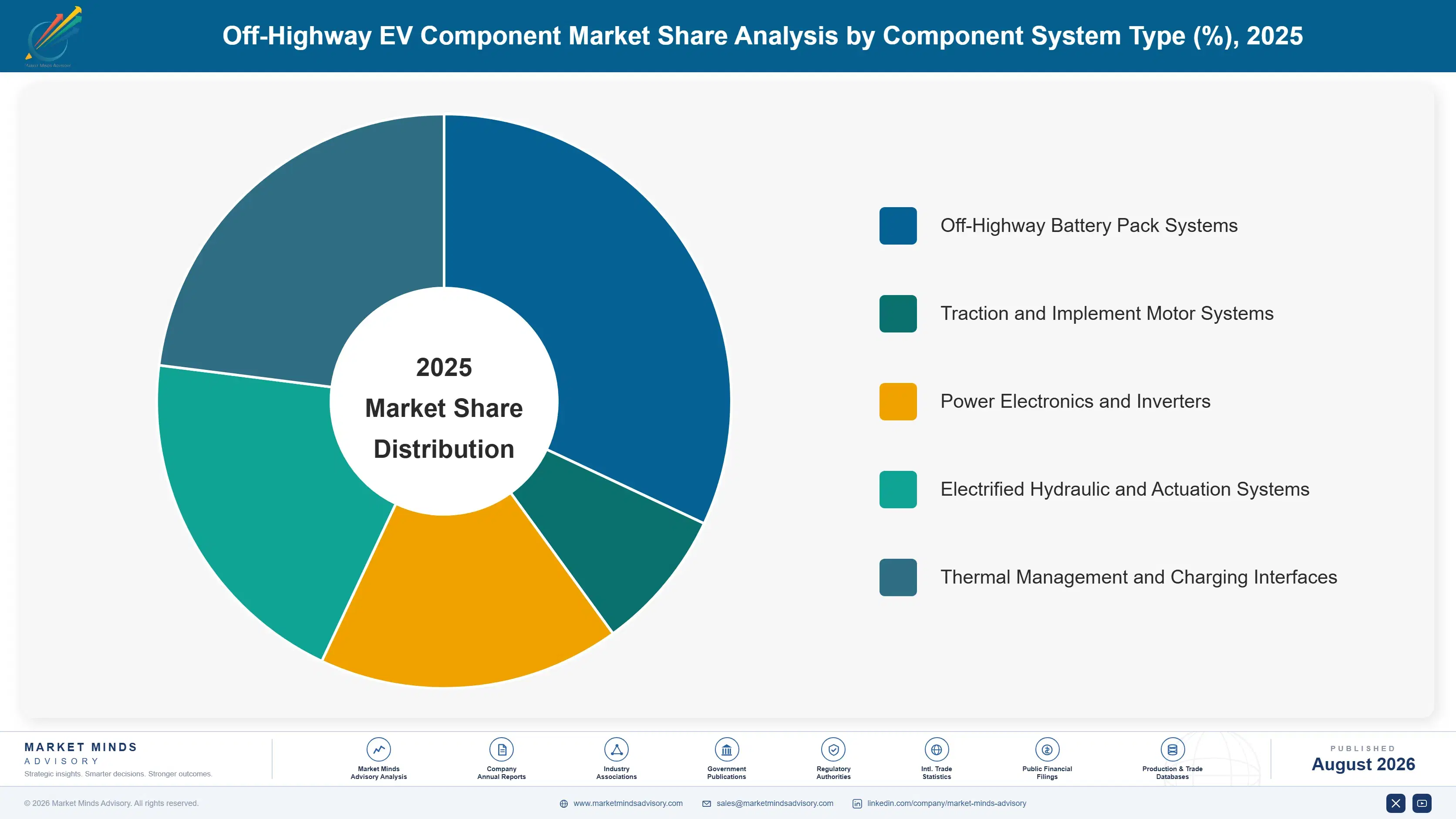
Segmentation follows component system type, because each subsystem carries a distinct engineering discipline, supplier base, share of machine cost and rate of technical change. Machine class, duty cycle and application all determine how much of each system a platform requires, but they sit downstream of the component architecture decision and are priced against it.
off-highway-ev-component-market-market-share-analysis-1787317082855

Off-Highway Battery Pack Systems

The fastest segment at 20.4%, a full 1.50 times the market rate, covering ruggedised battery packs engineered specifically for off-highway duty rather than adapted from automotive designs. The engineering difference is genuine and frequently underestimated. A machine pack must survive continuous vibration, shock loading, dust ingress, wash-down cleaning and ambient temperature swings that no road vehicle experiences, while delivering sustained discharge across a nine hour shift rather than intermittent bursts. Enclosure design, mounting isolation and thermal management all differ substantially from automotive practice. Packs account for roughly 44% of electrified machine cost, which makes this both the largest component opportunity in the market and the one where cell pricing movements matter most directly.
CAGR 20.4%

Traction and Implement Motor Systems

Growing at 15.4% on traction motors driving the machine and implement motors powering work functions, both of which face duty requirements that automotive motors were never designed to meet. Continuous high-torque operation at very low speed is the defining difference: an excavator slewing or a loader pushing into a pile demands sustained torque near stall, where an automotive motor would overheat rapidly. Cooling design and magnet selection both reflect that requirement directly, and neither carries over from automotive practice. Implement motors also increasingly replace hydraulic functions directly rather than driving a pump, which improves efficiency considerably but requires control integration that hydraulics specialists and motor suppliers are still working out between themselves programme by programme.
CAGR 15.4%
Full segment breakdown across 5 segments available in the complete report.

Regional Architecture and Country Demand Map

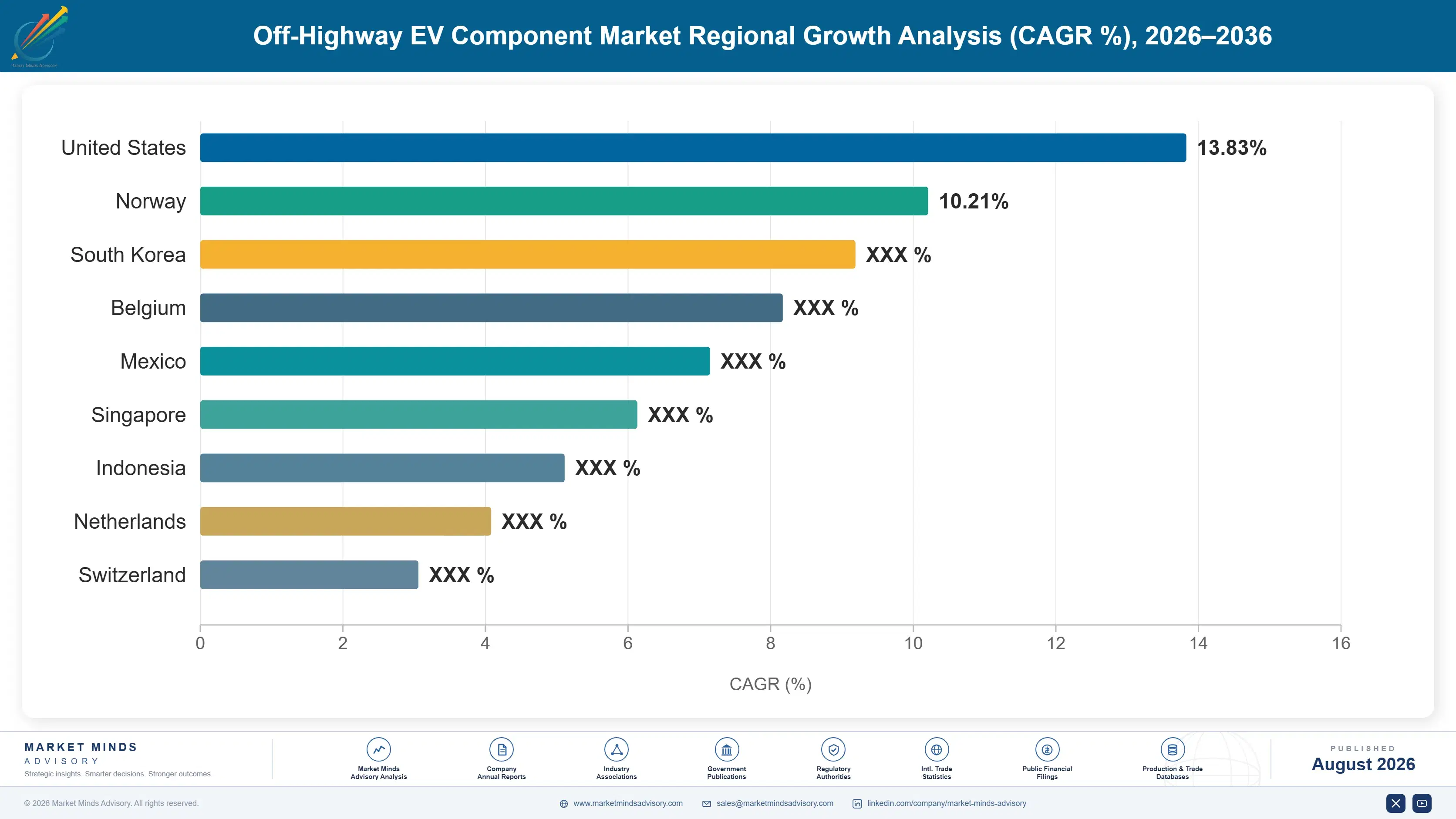
East Asia holds 38% of global value because China builds the largest volume of electrified machines and supplies most cells and drives inside everybody else's. Western Europe follows on municipal zero-emission rules, and growth runs fastest across South Asia and Pacific on manufacturing policy and mining conversion.

East Asia

Note: East Asia holds 38% against a 22 to 30% band because China both builds the largest volume of electrified off-highway machines and supplies most of the cells, motors and power electronics inside them regardless of where the machine is assembled. Sany, XCMG, LiuGong and Zoomlion have all put electric excavators and loaders into series production ahead of Western equivalents, supported by domestic cell capacity no other region approaches. Japanese manufacturers hold a different position, with Komatsu and Kubota electrifying compact machines for markets where noise and exhaust restrictions bite hardest. Korean suppliers contribute cells and drive components across both. Cell capacity and machine volume reinforce each other here in a way no other region matches at all.
Share: 38% | CAGR: 14.8% (2026 to 2036)

Western Europe

Regulation is the demand mechanism here and it is unusually direct. Oslo requires zero-emission construction sites on municipal projects, Amsterdam, Copenhagen and several German cities have committed to comparable rules, and a contractor bidding that work simply cannot use diesel machines. Compact excavators, loaders and telehandlers electrified first because their duty cycles fit available battery capacity. Danfoss, Bosch Rexroth and Liebherr all hold deep electrified hydraulic and drive capability developed for that demand. Indoor demolition and tunnelling add further volume where exhaust ventilation is expensive enough that battery machines pay back on ventilation savings alone. Regulation rather than operating cost is what drives this region, and contractors plan against published deadlines.
Share: 22% | CAGR: 12.1% (2026 to 2036)
Regional intelligence for 5 additional markets available in the complete report: North America, South Asia and Pacific, Latin America, Middle East and Africa, Eastern Europe. Contact sales@marketmindsadvisory.com.
off-highway-ev-component-market-country-cagr-analysis-1787317083425

Where Electrification Component Margin Is Won

Four positions separate suppliers earning genuine margins from those adapting automotive parts and hoping: engineering packs for off-highway duty rather than repurposing car designs, holding integrated hydraulic and electric capability in one organisation, winning platform architecture decisions before machine design freezes, and building mining qualified capability, where the underlying business case needs no regulatory support at all.

Engineer Packs For Off-Highway Duty Not Automotive Reuse

Battery packs are roughly 44% of electrified machine cost, and automotive designs adapted for machine duty fail in service through vibration, shock, ingress and thermal cycling that no road vehicle produces. Suppliers engineering purpose-built off-highway packs realise 25% to 34% higher pricing than adapted alternatives, and they avoid entirely the warranty exposure that has already damaged several early entrants very badly. The engineering is enclosure design, mounting isolation and thermal management rather than cell chemistry, which is precisely why automotive suppliers entering this market keep underestimating what it actually takes.
Market Impact: Realises 34% higher pricing than ad

Hold Integrated Hydraulic And Electric Capability Together

An electrified machine replaces some hydraulic functions with electric actuation while keeping others, and getting that division right requires understanding both disciplines properly rather than advocating for one. Suppliers holding both hydraulic and electrification capability inside one organisation win architecture decisions worth 2.8 times any component supply position, because the machine manufacturer wants one partner defining the whole energy path across the platform. Hydraulics specialists buying electrification capability and automotive suppliers buying hydraulics are both actively pursuing this, which tells you plainly how valuable that particular combination has genuinely become.
Market Impact: Wins positions worth 2.8 times comp

Win Platform Architecture Before Machine Design Freezes

Off-highway platforms run roughly ten years in production and the electrification architecture gets fixed very early, because pack placement, cooling routing and actuation choices all determine the machine structure built around them. Suppliers embedded in that architecture definition work hold positions worth 12 to 18 times the development contract across the whole platform life. Those arriving afterwards end up quoting against a specification already built around a competitor's package envelope and they generally cannot physically fit their own hardware inside it at any price at all. Timing decides this one entirely.
Market Impact: Holds positions worth 18 times deve

Build Mining Capability Where Regulation Is Irrelevant

Underground mining electrifies on ventilation cost arithmetic that works regardless of any policy position at all, which makes it the one segment here where demand does not depend on regulatory continuity holding. Suppliers holding mining-qualified capability realise 30% to 40% higher pricing than construction equivalents, because those operators weigh machine availability and safety certification far above whatever the purchase price happens to be. Qualification is genuinely demanding, covering explosion protection, thermal runaway containment and underground rescue procedures, and it takes years that any construction-focused supplier has simply not yet spent.
Market Impact: Realises 40% higher pricing across

Who Controls the Margin Pool

Concentration sits at 22% for the top five measured on electrified system shipment volume, the basis used throughout this section, and it is low because the industry is assembling from several directions at once. Danfoss Power Solutions and Bosch Rexroth lead through hydraulic incumbency extended into electrification, while Dana, Parker Hannifin and ZF compete on drive and actuation capability. The gap to the next tier barely exists.
Competitive activity runs on three fronts. Purpose-built pack engineering is the first, since adapted automotive designs keep failing in service and machine manufacturers have noticed. Combined hydraulic and electric capability is the second, and both hydraulics specialists and automotive suppliers are acquiring toward it. The third is mining qualification, where explosion protection and thermal runaway containment requirements exclude most entrants entirely.

Pressure arrives from two directions. Chinese suppliers hold a cell and drive cost position that Western competitors cannot approach, and Chinese machine manufacturers increasingly build electrification in house. Separately, machine manufacturers in every region are weighing whether to integrate rather than buy. Rankings will shift on who holds architecture positions when the current generation of platforms reaches design freeze.
off-highway-ev-component-market-company-positioning-matrix-1787317083962

Competitive Moat and Risk Dimensions

DANFOSS POWER SOLUTIONS

Moat: Combined hydraulic and electric capability

Holding hydraulic system incumbency alongside genuine electrification capability lets the business define the whole energy path on a machine rather than supplying components into somebody else's architecture. Machine manufacturers electrifying a platform want one partner who understands which functions should stay hydraulic and which should not, and very few suppliers can hold that conversation credibly at all.
DANFOSS POWER SOLUTIONS

Risk: Legacy hydraulic revenue exposure

A substantial installed hydraulic business generates revenue that successful electrification progressively displaces, which creates an uncomfortable internal tension around how hard to push the transition. Competitors without that legacy can advocate full electrification without cannibalising anything, and machine manufacturers occasionally read that hesitation entirely accurately.
DANA INCORPORATED

Moat: Integrated electric drive systems

Complete electrified drive systems combining motors, gearboxes, inverters and controls give machine manufacturers a single integrated solution rather than components requiring their own integration engineering. Off-highway drivetrain heritage also means the duty cycle assumptions built into those systems are correct from the outset, which adapted automotive hardware repeatedly is not.
DANA INCORPORATED

Risk: Balance sheet constrains capability building

Funding electrification development while managing a substantial conventional driveline business demands capital discipline that limits how aggressively new capability can be built or acquired. Competitors backed by larger industrial groups or by cheap domestic manufacturing can outspend on pack engineering and mining qualification simultaneously, forcing sequencing where the market rewards both.

Players Tracked

Prominent Players

Danfoss Power Solutions
Bosch Rexroth
Dana Incorporated
Parker Hannifin
ZF Friedrichshafen

Other Key Players

BorgWarner
Nidec
Eaton
Deutz
Accelera by Cummins
Kubota
Hitachi Astemo
Contemporary Amperex Technology
BYD FinDreams Battery
Webasto
Rolls-Royce Power Systems
Linde Material Handling
Kollmorgen
Voith
Liebherr

Recent Developments

FEBRUARY 2025

Purpose-built off-highway pack platform enters series production

A supplier launched a modular battery pack platform engineered specifically for off-highway machine duty, with enclosure, mounting isolation and thermal management all designed around the vibration, shock and wash-down conditions which adapted automotive packs had repeatedly failed to survive across their first years in service.
Signal: Machine manufacturers have now learned tha
JUNE 2025

Underground mine commits fleet conversion on ventilation economics

A deep underground mining operation formally committed to converting its entire haulage and drilling fleet to battery electric equipment over several years, citing reduced ventilation airflow and refrigeration load rather than any emissions target at all as the calculation that finally justified the capital outlay.
Signal: Mining electrification runs on operating c
OCTOBER 2025

Hydraulics supplier acquires electrification systems capability

An established hydraulic systems manufacturer acquired a traction motor and power electronics business outright during the year, at considerable cost, buying the capability needed to define complete energy paths across electrified machines rather than continuing to supply components into architectures that somebody else had already fixed.
Signal: Combined hydraulic and electric capability

What Drives Electrified Machine Cost

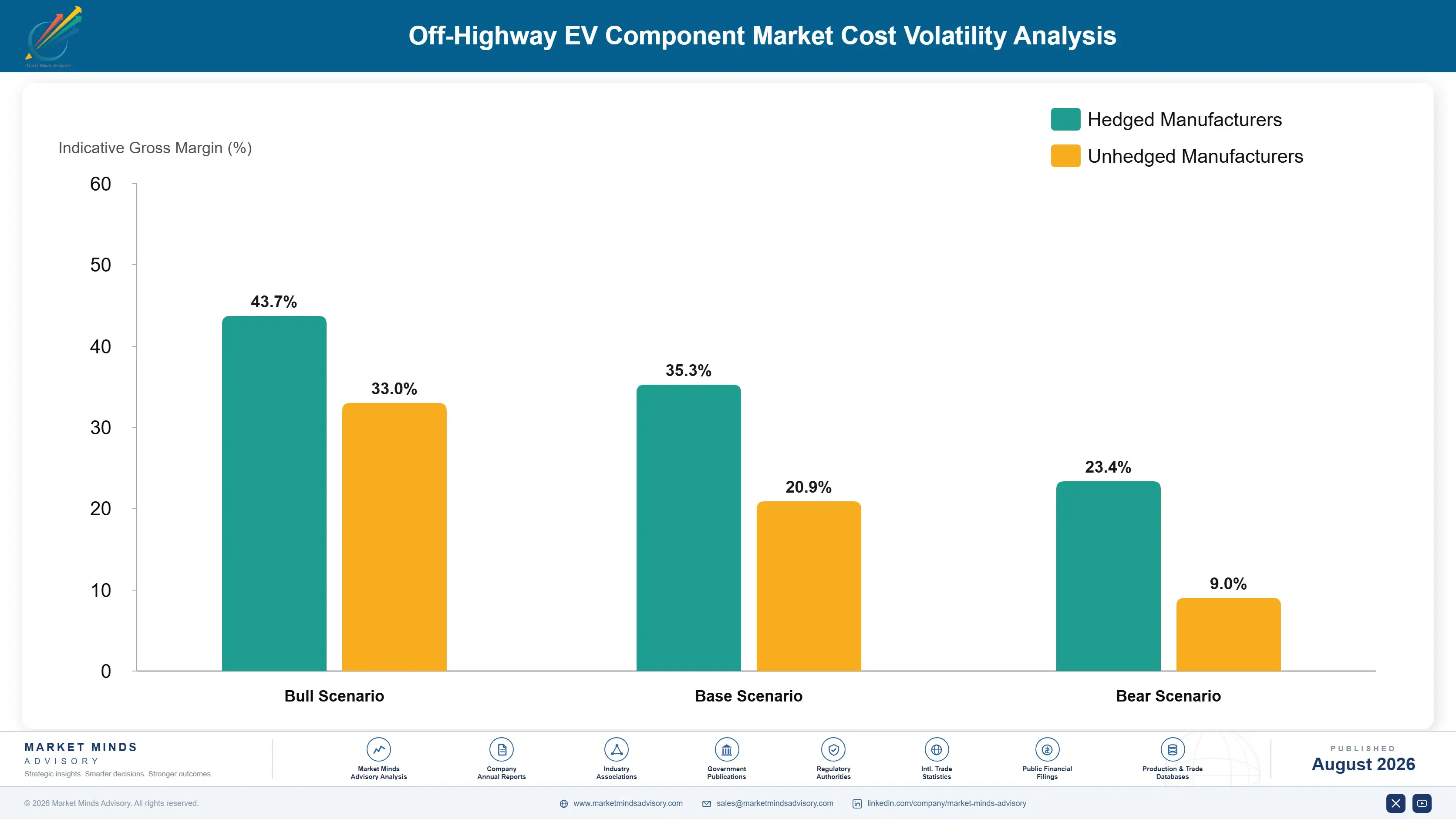
Battery cells and pack assembly dominate at roughly 44% of electrified machine component cost, with ruggedised enclosure and thermal hardware adding meaningfully above bare cell pricing. Traction and implement motors contribute around 14%, of which rare earth magnets are a substantial share. Power electronics and inverters account for a further 13%, thermal management systems about 8%, and wiring, connectors and high-voltage protection roughly 9% across a typical machine.
Lithium carbonate pricing collapsed through 2023 and 2024 after the 2022 spike, which cut pack costs materially and widened the range of machine sizes where electrification makes commercial sense. IEA battery price tracking shows the decline clearly. Rare earth magnet pricing moved the opposite way as Chinese export controls tightened, and Caterpillar Annual Report 2025 identifies electrified component cost and availability as continuing factors in its electrification programmes.

The disadvantage mechanism is pack engineering capability rather than cell purchasing. A supplier adapting automotive packs buys cells at similar prices but carries warranty exposure that purpose-built designs avoid, and field failures in off-highway service are expensive to rectify because machines work in remote locations. Exposure varies geographically too: Chinese suppliers source cells domestically at prices no importer matches after freight and tariff.
off-highway-ev-component-market-cost-volatility-analysis-1787317084157

Qualify motor topologies avoiding rare earth magnet dependence

Externally excited synchronous and induction architectures remove neodymium and dysprosium exposure entirely, at some cost in efficiency and package size. Off-highway machines generally have more space than a car does, which makes that trade considerably easier to accept here than in automotive applications. Suppliers holding both topologies quote whichever the machine programme favours rather than being locked to one position.

Design pack architecture common across several machine classes

Modular packs scaling by module count across compact, mid-size and specialty machines concentrate cell purchasing, spread certification evidence and simplify the spare parts position across a dealer network. The constraint is that each machine is slightly less optimised for its own package envelope. Where cells are 44% of cost, that compromise is comfortably worth accepting on almost every programme.

Contract cell supply across multiple qualified manufacturers

Cell supply concentrates among a small group, and qualifying comparable cells from two or three manufacturers without requalifying the whole pack removes allocation exposure that a demand spike creates immediately. The cost is duplicated validation and testing at design stage. Against a stopped machine assembly line, which suppliers experienced during the semiconductor shortage, that cost recovers within a single incident.

Portfolio Architecture for Margin Defence

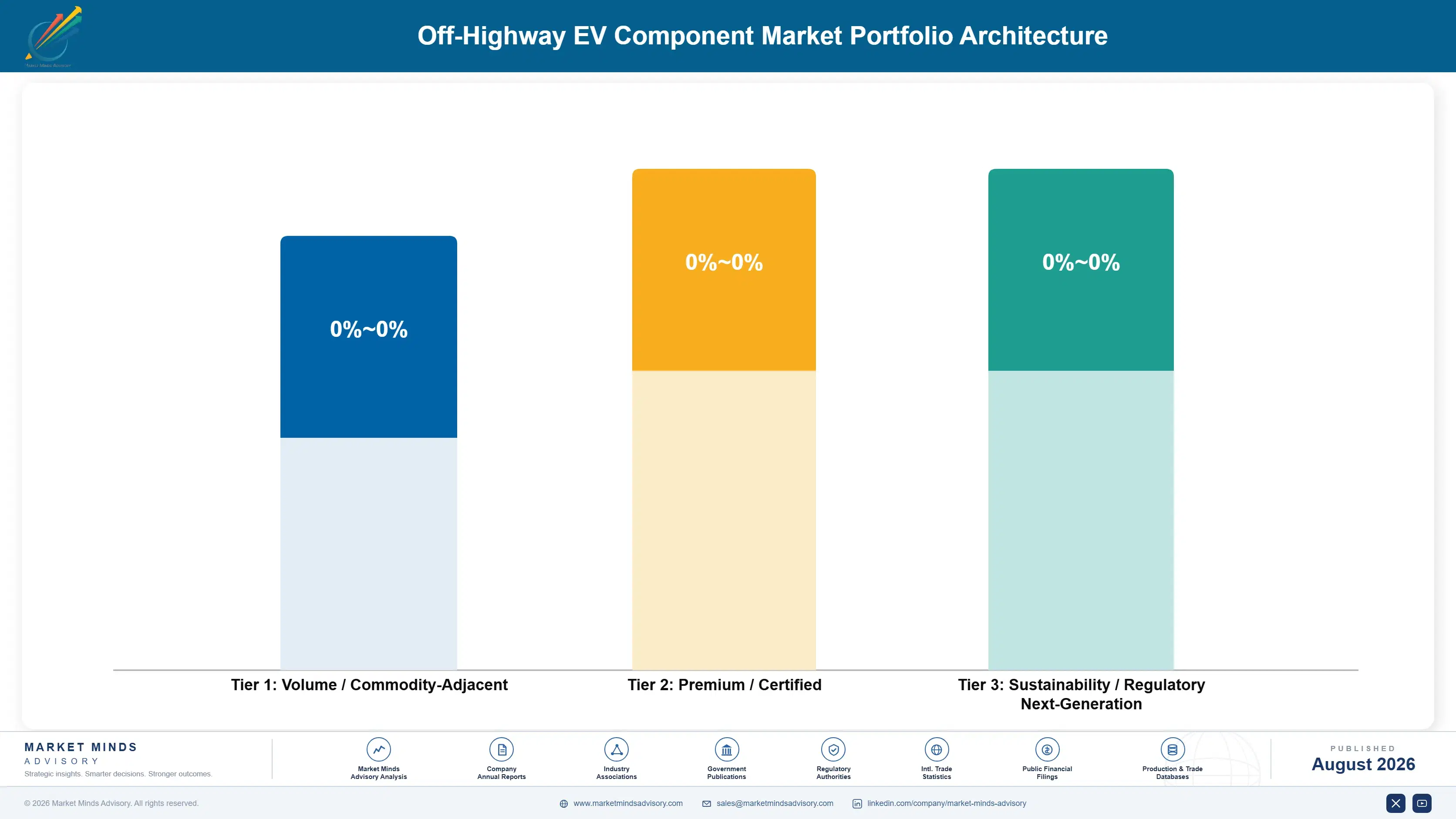
Portfolio economics here divide on engineering specificity rather than on component type. Adapted automotive components sold into machine programmes earn gross margins in the mid teens, because the supplier brings no off-highway understanding to the transaction, several competitors offer comparable adapted hardware, and the machine manufacturer carries the integration burden and the warranty risk together. Volume here buys experience rather than any margin.
The premium tier is purpose-built off-highway systems. Packs, motors and actuation engineered for machine duty cycles from the outset command considerably higher pricing because they survive service conditions that adapted hardware does not, and machine manufacturers who have been burned once specify them deliberately. Margins run in the high twenties to mid thirties. Validation evidence decides where in that range a supplier lands.

Above both sits mining-qualified equipment and complete architecture positions. Underground qualification demands explosion protection, thermal runaway containment and rescue procedure compliance that excludes most suppliers entirely, while architecture positions won at platform definition run for a decade of production. Margins reach the low forties, and both positions are defended by capability rather than by price, which makes them considerably more durable than anything else in this market.

Volume / Commodity-Adjacent

Adapted automotive components sold into off-highway machine programmes. The supplier brings no machine duty understanding, several competitors offer comparable hardware, and the machine manufacturer carries both the integration burden and the warranty risk itself.
Gross Margin: 13 to 19%

Premium / Certified

Purpose-built off-highway packs, motors and actuation engineered for machine duty from the outset. The range reflects how much genuine off-highway validation testing a supplier has actually completed rather than merely claimed.
Gross Margin: 27 to 35%

Sustainability / Regulatory / Next-Generation

Mining-qualified systems together with complete machine platform architecture definition positions. The range spans single mining subsystems through to full energy path definition across an entire ten year machine platform programme.
Gross Margin: 36 to 44%
off-highway-ev-component-market-portfolio-architecture-1787317084688

High-value Sub-segments and Strategic Watch-out

Underground Mining Qualified Systems

High value and high growth sitting squarely together. Ventilation economics justify conversion without any regulatory support at all, explosion protection and thermal containment qualification exclude most suppliers entirely, and operators weigh machine availability and safety certification far above whatever the purchase price happens to be.
Gross Margin: 38 to 45%

Purpose-Built Compact Machine Packs

High value running on genuinely rapid growth. Compact machines electrify first because their duty cycles fit pack sizes that current pricing makes affordable, municipal site rules leave contractors no alternative, and adapted automotive packs keep failing in service in ways that make purpose-built engineering genuinely necessary.
Gross Margin: 30 to 38%

Integrated Electric Drive Systems

The volume core that carries most of the electrified content on a machine. Complete drive systems spare the machine manufacturer integration engineering it would very much rather not do, and off-highway duty assumptions built in correctly from the very outset are what separate credible suppliers from mere adapters.
Gross Margin: 24 to 31%

Adapted Automotive Component Supply

The strategic watch-out sitting squarely inside this particular component portfolio. Volumes here exist only for as long as machine manufacturers are still experimenting with suppliers, but adapted hardware fails repeatedly in off-highway service, and every warranty event moves that customer permanently toward purpose-built alternatives instead.
Gross Margin: 13 to 19%

How Electrified Machine Demand Repeats

The repeat business here is the machine platform rather than any individual order. An electrification architecture fixed during machine design runs for roughly ten years of production, and it is almost never revisited because pack placement, cooling routing and actuation choices determine the machine structure built around them. Winning that architecture decision is worth many multiples of the development contract, and losing one costs a decade of volume that nothing recovers.
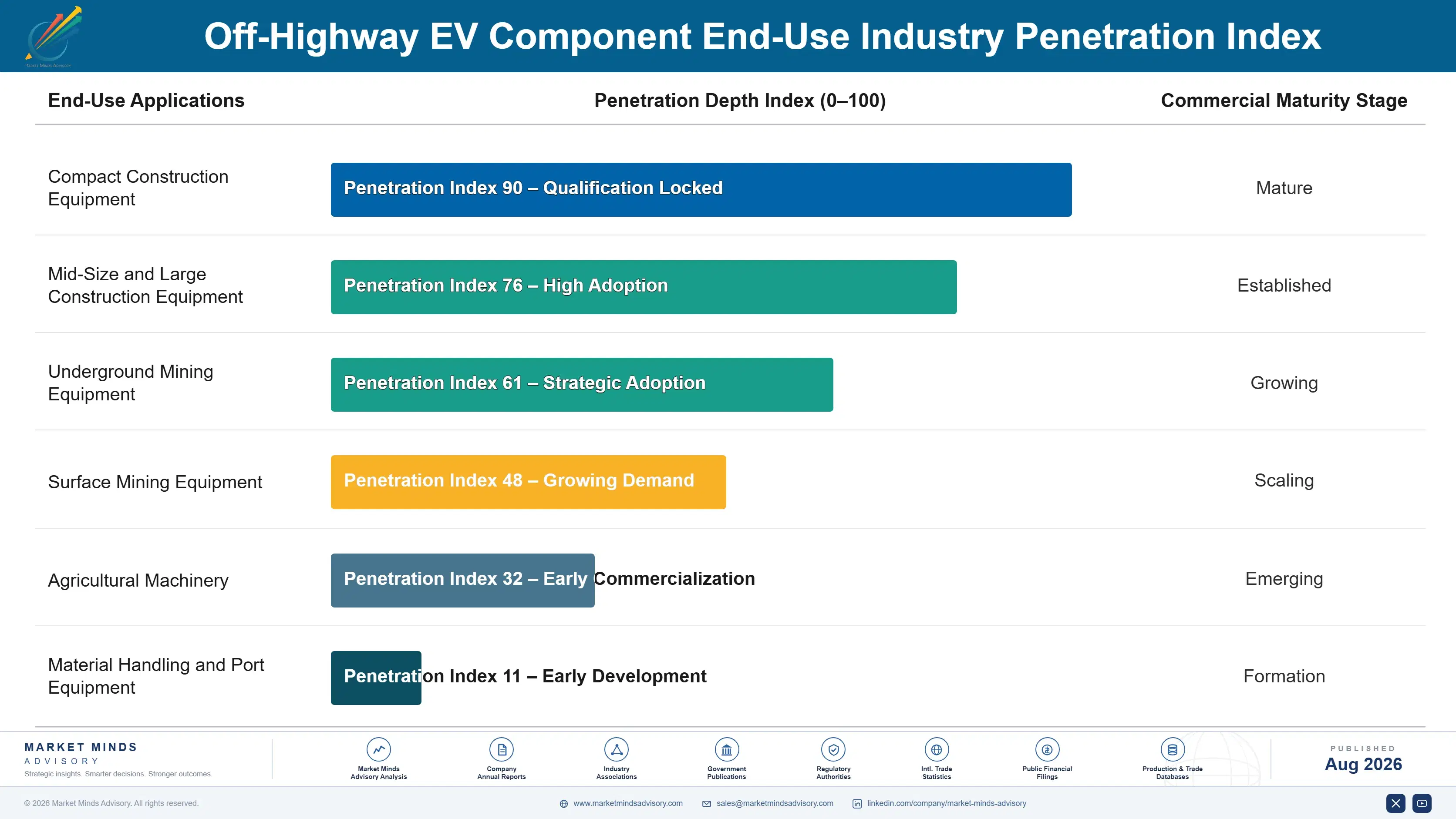
Stickiness varies sharply by customer type. Mining operators are the stickiest, because qualification, training and rescue procedures all attach to specific equipment and requalifying is expensive and slow. Construction machine manufacturers are locked for the platform but fully contestable at each redesign. Rental fleets sit between the two, valuing standardisation but switching where service coverage disappoints. Agricultural manufacturers are the least sticky, still experimenting across suppliers rather than committing.

The buyer profile has shifted decisively. Machine specification once sat with hydraulic and powertrain engineers evaluating flow rates, torque curves and fuel consumption. Today it sits with electrification programme teams weighing energy budgets, thermal behaviour, charging strategy and control software together, which favours suppliers arriving with systems engineers rather than only with component samples and a datasheet.
off-highway-ev-component-market-end-use-penetration-index-1787317085194

Where To Compete And Why

These are among the four positions where our research anticipates prominent divergence between winners and laggards over the coming forecast period. Each is grounded in the demand model, the regulatory perimeter, and the announced capacity pipeline.
01 / PURPOSE-BUILT PACK ENGINEERING

Automotive packs fail in machine service

Battery packs are roughly 44% of electrified machine cost, and automotive designs adapted for off-highway duty fail through vibration, shock, ingress and thermal cycling that no road vehicle ever produces. Suppliers engineering purpose-built packs realise 25% to 34% higher pricing than adapted alternatives while avoiding warranty exposure that has already damaged several early entrants. The engineering is enclosure, isolation and thermal design rather than cell chemistry, which is exactly why automotive suppliers entering this market keep underestimating what it actually requires.
02 / COMBINED DISCIPLINE CAPABILITY

Machines need one partner for the energy path

An electrified machine keeps some hydraulic functions and replaces others, and dividing them correctly requires understanding both disciplines properly rather than advocating for one. Suppliers holding hydraulic and electrification capability together win architecture decisions worth 2.8 times a component supply position, because the machine manufacturer wants one partner defining the whole energy path across the platform. Hydraulics specialists and automotive suppliers are both acquiring their way toward that combination, which indicates plainly how valuable that combination has genuinely become across this market.
03 / ARCHITECTURE TIMING DISCIPLINE

Package envelope freezes before anything else

Off-highway platforms run roughly ten years in production and the electrification architecture fixes very early, because pack placement, cooling routing and actuation choices determine the machine structure built around them. Suppliers embedded in that architecture definition work hold positions worth 12 to 18 times the development contract across the platform life. Those arriving afterwards end up quoting against a specification already built around a competitor's package envelope and they generally cannot physically fit their own hardware inside it at any price.
04 / MINING QUALIFICATION INVESTMENT

The one segment needing no regulation

Underground mining electrifies on ventilation cost arithmetic that works regardless of any policy position, which makes it the only segment here where demand does not depend on regulatory continuity holding at all. Suppliers holding mining-qualified capability realise 30% to 40% higher pricing than comparable construction equivalents, because operators weigh machine availability and safety certification well above purchase price. Qualification covering explosion protection, thermal runaway containment and rescue procedures takes years that construction-focused competitors have simply not yet spent at all.

Engagement Snapshot From the Field

A live engagement with an industry participant carrying material or product regulatory and market exposure ahead of a defining policy shift, showing how our research translates into a defensible multi-year portfolio strategy.
MARKET MINDS ADVISORY · CLIENT ENGAGEMENT SUMMARY
Off-Highway EV Component Producer Strategic Portfolio Review and Transition Roadmap 2026·Investment Scenario on Off-Highway EV Component Exposure Evaluation 2025-26
CLIENT PROFILE
A European manufacturer of hydraulic systems for construction and agricultural machinery, with annual revenue near $620 million (client-reported, unverified by MMA), roughly 91% of it from conventional hydraulic components. The business held deep hydraulic engineering and long machine manufacturer relationships but had entered electrification by adapting purchased automotive motors and packs, and two field programmes had produced warranty claims.
STRATEGIC CHALLENGE
Machine manufacturers were fixing electrification architecture on new platforms, and the client was being excluded from those conversations because it could not define an energy path across both hydraulic and electric domains. Management needed to decide whether to acquire electrification capability, partner with an automotive supplier, or concentrate on hydraulic content within electrified machines and accept a diminished position.
MMA APPROACH
MMA mapped electrification architecture decisions across 38 machine platforms scheduled for redesign, assessed the client's warranty data against purpose-built competitor equipment, and modelled acquisition, partnership and narrowed-scope economics for each option. Twenty-five expert interviews with machine engineers, mining operators and rental fleet managers tested where architecture decisions were genuinely made and when.
KEY FINDINGS
  1. Machine manufacturers were selecting electrification partners an average of 26 months before production, and the client had participated in only three of the fourteen decisions taken during the study period.
  2. Warranty claims on the client's adapted automotive packs ran roughly four times the rate of purpose-built competitor equipment, and every claim moved that customer decisively toward alternative suppliers.
  3. Partnership structures returned around 45% of the margin that owned electrification capability would deliver, because the partner captured pack and power electronics value the manufacturer paid a premium for.
  4. Mining qualification carried pricing 36% above construction equivalents but required certification work the client estimated at three years, considerably longer than management had assumed.
CLIENT PROFILE
A European manufacturer of hydraulic systems for construction and agricultural machinery, with annual revenue near $620 million (client-reported, unverified by MMA), roughly 91% of it from conventional hydraulic components. The business held deep hydraulic engineering and long machine manufacturer relationships but had entered electrification by adapting purchased automotive motors and packs, and two field programmes had produced warranty claims.
STRATEGIC CHALLENGE
Machine manufacturers were fixing electrification architecture on new platforms, and the client was being excluded from those conversations because it could not define an energy path across both hydraulic and electric domains. Management needed to decide whether to acquire electrification capability, partner with an automotive supplier, or concentrate on hydraulic content within electrified machines and accept a diminished position.
MMA APPROACH
MMA mapped electrification architecture decisions across 38 machine platforms scheduled for redesign, assessed the client's warranty data against purpose-built competitor equipment, and modelled acquisition, partnership and narrowed-scope economics for each option. Twenty-five expert interviews with machine engineers, mining operators and rental fleet managers tested where architecture decisions were genuinely made and when.
KEY FINDINGS
  1. Machine manufacturers were selecting electrification partners an average of 26 months before production, and the client had participated in only three of the fourteen decisions taken during the study period.
  2. Warranty claims on the client's adapted automotive packs ran roughly four times the rate of purpose-built competitor equipment, and every claim moved that customer decisively toward alternative suppliers.
  3. Partnership structures returned around 45% of the margin that owned electrification capability would deliver, because the partner captured pack and power electronics value the manufacturer paid a premium for.
  4. Mining qualification carried pricing 36% above construction equivalents but required certification work the client estimated at three years, considerably longer than management had assumed.
RECOMMENDED STRATEGY
Phase 1: Phase one: acquire pack engineering and power electronics capability rather than partnering, since partnership surrenders exactly the value machine manufacturers are willing to pay for. Phase 2: Phase two: rebuild the commercial approach around complete energy path definition, engaging machine programmes well before architecture freeze rather than bidding components afterwards. Phase 3: Phase three: begin mining qualification in parallel, accepting the three year timeline rather than deferring a segment whose demand needs no regulatory support.
OUTCOME
The client completed the acquisition in fourteen months and reported warranty claim rates on new packs falling to competitor levels (client-reported, unverified by MMA). Architecture participation rose from three of fourteen decisions to nine of the following sixteen, blended gross margin improved by roughly six points, and mining qualification work is underway on schedule.

Frequently Asked Questions

Foundational context covering the market sizes, CAGR, scope, country, region and competition that inform every finding below. This section is provided to cover basics and most often pre-purchase conversations, answered from the MMA Primary Research Dataset.

What is the current size of the Off-Highway EV Component Market?

The global off-highway electrification component market was valued at $5.40 billion in 2025, reaching an estimated $6.13 billion in 2026. That covers packs, motors, power electronics, electrified actuation and thermal systems.

How large will the Off-Highway EV Component Market be by 2036?

MMA forecasts the market reaching $21.94 billion by 2036, an increase of $15.81 billion over the 2026 base. That represents an expansion multiple of 3.58 times across the forecast period.

What is the CAGR for the Off-Highway EV Component Market 2026 to 2036?

The base case compound annual growth rate is 13.6%, with a bull case of 14.9% and a bear case of 12.3%. Historical growth between 2020 and 2025 ran at 12.2% annually.

Which segment is growing fastest?

Off-highway battery pack systems grow at 20.4%, a full 1.50 times the market rate, on duty requirements automotive packs cannot meet. Traction and implement motor systems follow at 15.4% annually.

Who are the major companies in the Off-Highway EV Component Market?

Danfoss Power Solutions, Bosch Rexroth, Dana Incorporated, Parker Hannifin and ZF Friedrichshafen lead on electrified system shipment volume. Together they account for roughly 22%, which is unusually fragmented.

Which country is growing fastest?

India grows fastest at 16.4% annually, driven by production incentive schemes pulling component manufacturing behind assembly plus domestic electric compact equipment. Australia follows on underground mining conversion.

Report Segmentation Architecture

The full report scope spans multiple orthogonal segmentation dimensions, with cross-tabulated demand data provided for each dimension pair. Coverage extends further to regional breakdowns, trend trajectories, and the competitive detail needed to support segment-level decision-making.

By Component System Type

  • Off-Highway Battery Pack Systems
  • Traction and Implement Motor Systems
  • Power Electronics and Inverters
  • Electrified Hydraulic and Actuation Systems
  • Thermal Management and Charging Interfaces

By End-Use Industry

  • Compact Construction Equipment
  • Mid-Size and Large Construction Equipment
  • Underground Mining Equipment
  • Surface Mining Equipment
  • Agricultural Machinery
  • Material Handling and Port Equipment

By Commercial Dimension

  • Machine Manufacturer Direct Supply
  • Platform Architecture Partnership
  • Rental Fleet Retrofit and Conversion
  • Mining Operator Direct Specification
  • Contract Assembly and Build-to-Print Supply

By Region

  • North America
  • Western Europe
  • East Asia
  • South Asia and Pacific
  • Latin America
  • Middle East and Africa
  • Eastern Europe

Scope, Methodology, and Coverage

Every figure in this report is reproducible from documented input assumptions. The scope below maps the historical period, the forecast horizon, the segmentation dimensions, and the countries covered, alongside the underlying primary and qualitative methodology.
Historical Period
2020 to 2025
Forecast Period
2026 to 2036
Base Year
2025 (USD billions; MMA Primary Research Dataset, August 2026)
Market Definition
This report covers electrification components and systems for off-highway machinery, spanning ruggedised battery pack systems, traction and implement motors, power electronics and inverters, electrified hydraulic and actuation systems, and thermal management with charging interfaces, across construction, mining, agricultural and material handling equipment. Complete machines valued at machine level, diesel engines and conventional transmissions, stationary charging infrastructure and grid connection works, on-highway commercial vehicle components, and hydrogen fuel cell systems are excluded from the sizing.
Quantitative Units
USD billions at supplier realised value; electrified machine shipments in thousands; average component content in USD per machine.
Segmentation Dimensions
By component system type; by end-use industry; by commercial dimension; by region.
Regions Covered
North America, Western Europe, East Asia, South Asia and Pacific, Latin America, Middle East and Africa, Eastern Europe
Countries Covered
China, Japan, South Korea, Germany, France, United Kingdom, Italy, Sweden, Norway, Netherlands, United States, Canada, India, Australia, Indonesia, Brazil, Chile, South Africa, Poland, Hungary.
Key Companies Profiled
Danfoss Power Solutions, Bosch Rexroth, Dana Incorporated, Parker Hannifin, ZF Friedrichshafen, BorgWarner, Nidec, Eaton, Deutz, Accelera by Cummins, Contemporary Amperex Technology, BYD FinDreams Battery, Kollmorgen, Liebherr and others.
Quantitative Methodology
Primary survey, n=3,800 respondents, Q4 2025, six countries; demand-side model with trade association cross-validation
Qualitative Methodology
47 expert interviews, Q4 2025; applied to validate demand model assumptions, identify emerging dynamics, and assess competitive positioning
Report Format
PDF and XLSX data workbook (Word format preview document)
Publisher
Market Minds Advisory
Report Code
MMA-2026-CON-991
Published
August 2026
Contact
sales@marketmindsadvisory.com | www.marketmindsadvisory.com

Purchase the full Off-Highway EV Component Market Report (2026 to 2036).

The full report sizes the off-highway electrification component market across five system types, six end-use industries and seven regions, with machine shipment and component content detail behind every value estimate. It profiles twenty global suppliers on pack engineering capability, combined hydraulic and electric scope and mining qualification status. Regional chapters cover municipal zero-emission site rules, mining electrification programmes and local content policy by market. Duty cycle analysis quantifies energy demand against available pack capacity by machine class. Cost analysis tracks cell and rare earth magnet exposure across motor topologies and pack architectures.
Component content and pricing detail by system type
Machine class duty cycle against available pack capacity
Municipal zero-emission site rule tracking by city
Mining electrification programme pipeline through 2036
Competitive position assessments across twenty global suppliers
Architecture decision timing across machine platform redesigns

Built For The People Who Decide

From boardroom strategy to bench-side execution, this report is read cover-to-cover by leaders shaping the next decade of their industry, turning demand scenarios, market dynamics and valuation benchmarks into decisions.
CXOs/ Presidents/ VPs/ Managers
M&A and Corporate Development
Strategy Teams and R&D Heads
Procurement and Product Directors
Regulatory and Compliance Leaders
Investor Relations and Equity Analysts