
Market Minds Advisory
Natural Food Colors Market

Natural Food Colors Market: Reformulation Economics in a Post-Synthetic-Dye Supply Chain

Petroleum dye phase-outs across major markets are forcing food and beverage manufacturers into a scarce, weather-dependent natural pigment supply chain, where fermentation-derived blues and heat-stable reds compete for limited extraction capacity and premium shelf space.

Lead Analyst

Lisa Gevelber

Published

August 2026

Make Smarter Decisions with Customized Research Insights

Request a free sample report and evaluate market opportunities, growth trends, and competitive dynamics relevant to your business needs.

2025 MARKET VALUE$2.8BMarket Size 2025
2036 FORECAST VALUE$6.0BBase Case , 2026 to 2036
CAGR 2026 TO 20367.2 %Bull 8.4% / Bear 6.0%
INCREMENTAL OPPORTUNITY$3.0BNet 10- year value creation
EXPANSION MULTIPLE2.00x2036 value over 2026 base
Strategic Levers
M&A Pipeline
Regional Outlook
Country Rankings
Competitive Intelligence
Segmental Deep-dive
Call-Us : 91 93563 13602

Executive Snapshot and Market Trajectory

Regulatory bans on synthetic dyes have flipped natural colorants from a premium add-on into a mandatory reformulation input across snacks, beverages, and confectionery, and buyers are now locking in multi-year extraction contracts to secure supply before smaller competitors bid up already tight harvests.
Beverage and confectionery reformulation is pulling demand fastest, with algae-derived blue pigments recording the steepest growth as brands chase FDA-compliant substitutes for banned synthetic blues, even though phycocyanin's heat sensitivity still limits use in baked and retort applications. East Asia has emerged as the largest production and consumption base, anchored by China's turmeric, paprika, and algae cultivation, while European formulators drive premium anthocyanin demand for confectionery and dairy applications, pushing extraction margins higher.
Competitive intensity centers on fermentation capacity rather than brand strength, since Chr. Hansen and Sensient control proprietary microbial strains that shortcut the breeding cycles smaller extractors face. Regulatory divergence compounds the challenge: the US FDA's 2025 to 2027 phase-out of eight synthetic dyes moves faster than EU labeling rules, forcing manufacturers to run parallel formulations rather than one worldwide recipe, adding real cost and complexity to every export program.
Market Definition
The natural food colors market covers plant-, algae-, mineral-, and fermentation-derived pigments and pigment extracts used to color food, beverage, confectionery, dairy, and nutraceutical products, including carotenoids, anthocyanins, curcumin, chlorophyll, and phycocyanin. It excludes synthetic and nature-identical dyes, flavor or fragrance ingredients, and food-contact packaging colorants that do not enter the final formulated product.
Base Year Value
$2.8B in 2025 (MMA Primary Research Dataset, August 2026)
Forecast Period
2026 to 2036, eleven discrete annual values
CAGR
7.2% base case. Bull 8.4%. Bear 6.0%.
Fastest Growth Segment
Algae-Based Blue Colorants (Phycocyanin): 10.5% CAGR
Fastest Growth Country
China: 8.9% CAGR
Fastest Growth Region
South Asia and Pacific: 9.2% CAGR
Largest Region
East Asia: 30% of 2025 global value
Market Leaders
Chr. Hansen Holding A/S, Sensient Technologies Corporation, GNT Group B.V., Givaudan SA, Kalsec Inc. Source: MMA Analysis based on company annual reports.
Primary Survey
n=3,800 procurement and R&D decision-makers, Q4 2025, six countries
Methodology
Demand-side build-up, cross-validated against public data, 47 expert interviews

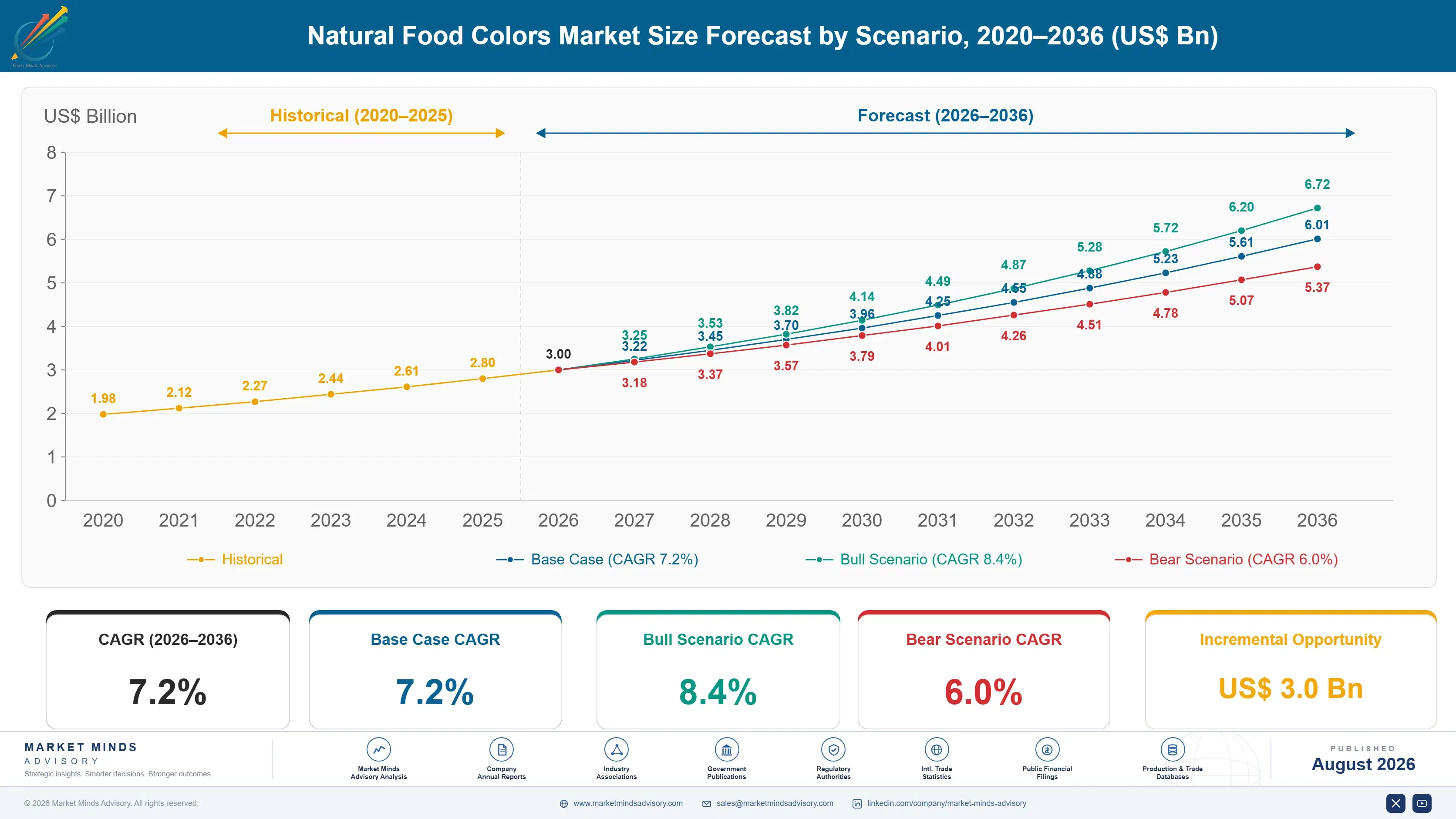
Natural Food Colors Market Forecast Scenarios

natural-food-colors-market-size-forecast-scenario-1787300744616
Between 2020 and 2025 the market grew at an estimated 6.3% CAGR, a period defined by pandemic-era clean-label acceleration followed by supply disruption in turmeric and paprika sourcing regions. Growth was steady rather than explosive, constrained by extraction capacity and by formulators' caution about color stability, but the pace quickened once major retailers began delisting synthetic-dye products from shelves.
The base case assumes 7.2% CAGR through 2036, driven by three mechanisms: mandatory reformulation as the US FDA phases out eight petroleum dyes between 2025 and 2027, expansion of fermentation-based phycocyanin capacity that relieves the current blue-pigment bottleneck, and retailer-level delisting commitments from major grocery chains that lock shelf space to certified natural formulations. Together these mechanisms shift natural colors from an optional premium claim into a baseline procurement requirement across most packaged food categories.
The bull case, 8.4% CAGR, assumes faster EU alignment with US dye restrictions, pulling forward reformulation among export-oriented manufacturers. The bear case, 6.0% CAGR, reflects the risk that turmeric and annatto harvest volatility, worsened by erratic monsoon patterns in South Asia, keeps raw material costs elevated enough that some manufacturers revert to nature-identical alternatives wherever regulation still permits them.

Reformulation Economics and Extraction Capacity Constraints

Natural colors sit at the intersection of regulatory mandate and agricultural supply risk, an unusual combination for an additive category. Manufacturers no longer treat certification as a marketing upgrade; it has become a baseline listing requirement at major retailers, and that shift converts what used to be a discretionary reformulation project into a fixed procurement line item with its own budget cycle and dedicated supplier scorecards.
MARKET CONCENTRATION (CR5)38%Top five suppliers hold meaningful but not dominant share
AVERAGE SELLING PRICE$42/kgPremium extracts command well above commodity synthetic dye pricing
TOP PRODUCING COUNTRY SHAREChina, 24%leads global extraction capacity across turmeric and algae inputs
CAPACITY UTILIZATION81%Fermentation lines run near ceiling amid blue pigment scarcity
TRADE INTENSITY58% cross-borderMajority of extract volume crosses at least one border
FEEDSTOCK COST SHARE46%Agricultural inputs dominate total production cost structure heavily
Commercially, the category behaves less like a specialty chemical business and more like an agricultural commodity trade with a chemistry layer on top. Extraction yields depend on weather, harvest timing, and regional crop economics, so buyers increasingly sign forward contracts resembling those used in cocoa or coffee procurement, and several large formulators have begun taking equity stakes in upstream turmeric and spirulina cultivation to secure supply.
The next decade favors integrated players who control both cultivation and fermentation, since spot-market extract pricing has become too volatile for pure-play formulators to plan around confidently. Expect consolidation among mid-sized extractors squeezed between rising feedstock costs and firm retailer price caps on finished branded products, particularly those without any grower relationships of their own to fall back on during shortfalls.
"The blue pigment shortage is the real story here, not the dye bans themselves. Whoever solves phycocyanin's heat stability problem first effectively sets pricing for the entire natural colors category for the next five years."
Director, Food Ingredients and Nutrition Practice · MMA Chemicals and Materials

Market Trends

FDA Synthetic Dye Phase-Out Accelerates Timelines

The US FDA's action plan to eliminate eight petroleum-based dyes, including Red 40 and Yellow 5, from the food supply between 2025 and 2027 has compressed reformulation timelines that food companies once spread across a decade into a two-year sprint. Major manufacturers including General Mills and Kraft Heinz have committed to removing synthetic dyes from their US portfolios ahead of the federal deadline, pulling forward demand for stable natural substitutes in cereal, snacks, and beverages, categories where color consistency across long production runs has historically been the hardest technical barrier for natural pigments to clear.
Market Impact: Secures shelf space for 1,200 SKUs
Algae-Based Blue Pigment Capacity Race Intensifies

Spirulina-derived phycocyanin is the only widely approved natural blue with broad application range, and current global fermentation capacity cannot meet demand from confectionery, beverage, and cereal manufacturers simultaneously reformulating away from FD&C Blue 1. Producers including Chr. Hansen and DIC Corporation have announced new cultivation and extraction lines across Southeast Asia and China, targeting a near doubling of output by 2028, but heat instability above 60 degrees Celsius still restricts phycocyanin from baked goods and retort-sterilized products, leaving formulators to blend it with spirulina extract or accept shorter shelf stability in those categories.
Market Impact: Adds 14 new approved pigment sources

Market Opportunities and Growth Drivers

Retailer Delisting Commitments Lock In Demand

Major US grocery chains including Whole Foods, Kroger, and Sprouts Farmers Market have committed to delisting products containing eight petroleum-based synthetic dyes from private-label and increasingly branded shelves by the end of 2027. That commitment converts natural colorant certification from a nice-to-have marketing claim into a hard listing requirement, since losing shelf placement at a top-five grocer materially affects a brand's revenue base. Suppliers report that request-for-proposal volume for certified natural colorants rose sharply through 2025 as manufacturers raced to requalify formulations before retailer deadlines closed distribution windows entirely, leaving latecomers with far fewer qualified extraction partners to choose from.
Market Impact: Curcuminoid prices rose 31 percent

EU Novel Food Approvals Widen Ingredient Palette

European Commission novel food approvals for new pigment sources, including butterfly pea flower extract and select algae strains, have widened the palette available to formulators beyond the traditional turmeric, beet, and paprika base. Each approval takes an average of eighteen months to clear EFSA safety review, but once granted it opens addressable applications across beverages, confectionery, and bakery that previously had no natural equivalent for certain blue and purple shades. This regulatory widening reduces formulators' dependence on any single crop, which had been a recurring supply risk during recent turmeric harvest shortfalls in India.
Market Impact: Excludes 18 percent of applications

Market Restraints and Challenges

Turmeric and Paprika Harvest Volatility Squeezes Supply

Curcumin and paprika extract supply depends heavily on monsoon-timed harvests in India and Peru, and erratic rainfall linked to shifting monsoon patterns produced two poor turmeric harvests since 2023, pushing curcuminoid prices up sharply. The root cause is thin agricultural diversification: a handful of growing regions supply most global volume, leaving little buffer when weather disrupts a single season. Extractors are responding by qualifying secondary growing regions across Southeast Asia and by pre-financing farmer contracts that guarantee purchase volumes, though these mitigation efforts will take several harvest cycles to meaningfully diversify the supply base.
Market Impact: Adds $340 million reformulation-driven demand

Color Stability Limits Retort Category Use

Many natural pigments, particularly anthocyanins and phycocyanin, degrade under the high-heat retort sterilization and extended shelf-life conditions common in canned, ready-to-eat, and shelf-stable beverage categories, a fundamental chemistry barrier rather than a formulation inconvenience. The root cause is molecular instability of plant-derived chromophores above roughly 100 degrees Celsius combined with pH sensitivity that shifts hue during storage. This keeps synthetic dyes entrenched in categories where regulation still allows them and forces manufacturers into costly reformulation trial cycles. Encapsulation technology and co-pigmentation with tannins are emerging mitigation pathways, though neither is yet proven at commercial retort scale.
Market Impact: Blue pigment prices up 22 percent
3 additional market trends, 2 additional growth drivers, and 2 additional restraints and challenges are covered in the full report. Contact sales@marketmindsadvisory.com to access the complete intelligence.

Segment CAGR and Growth Architecture

MMA segments the natural food colors market by pigment source and chemistry class, the classification buyers actually purchase against, rather than by end-use application. This lens captures how sourcing risk, extraction technology, and heat or pH stability differ fundamentally between a fermentation-derived blue and a root-extracted orange, distinctions that application-based segmentation alone would obscure entirely.
natural-food-colors-market-market-share-analysis-1787300745142

Algae-Based Blue Colorants (Phycocyanin)

Algae-based blue colorants, led by spirulina-extracted phycocyanin, are growing faster than any other pigment class as brands race to replace FD&C Blue 1 following FDA delisting action. Blue is chemically the hardest natural shade to produce at scale, since almost no plant source yields a stable, food-grade blue, which explains why this segment commands the steepest pricing of any natural color and the tightest capacity. Confectionery and beverage formulators are the primary buyers, accepting shorter shelf-stability windows in exchange for regulatory compliance. New fermentation capacity from Chr. Hansen, DIC Corporation, and several Chinese algae cultivators is expected to roughly double global output by 2028, though heat sensitivity above 60 degrees Celsius continues to exclude retort and baked applications from substitution.
CAGR 10.5%

Anthocyanin-Based Reds and Purples

Anthocyanin extracts, sourced from black carrot, grape skin, red cabbage, and purple sweet potato, form the second-fastest-growing segment as formulators seek broadly applicable natural reds and purples for confectionery, dairy, and beverage use. Unlike phycocyanin, anthocyanins tolerate a wider pH and processing range, making them the default substitute across more product categories even though their hue shifts noticeably with pH, requiring careful reformulation rather than a direct swap. European demand is particularly strong given earlier synthetic dye restrictions there, and black carrot supply concentrated in Turkey and India has become a strategic sourcing priority for extractors seeking to avoid the volatility that hit turmeric growers hard across recent successive growing seasons.
CAGR 9.0%
Full segment breakdown across 6 segments available in the complete report.

Regional Architecture and Country Demand Map

Natural color demand concentrates where packaged food manufacturing volume and regulatory pressure intersect. East Asia leads on production scale and growing domestic reformulation, North America follows closely given the FDA phase-out timeline, and Western Europe anchors premium anthocyanin and carotenoid consumption under longer-standing labeling rules.

North America

North America's natural colors demand is compressed into an unusually short window because the FDA's phase-out of eight synthetic dyes runs from 2025 through 2027, rather than unfolding over the decade-long timelines seen in prior reformulation waves. General Mills, Kraft Heinz, and PepsiCo have announced portfolio-wide removal commitments ahead of the federal deadline, and retailer delisting pressure from Kroger and Whole Foods adds a second enforcement layer. Demand concentrates in cereal, snacks, and beverages, categories where color consistency across long production runs has been the hardest technical hurdle for natural substitutes. Extraction capacity within the region remains limited, so finished colorant volume is imported from Indian and Peruvian growers even as domestic formulation accelerates.
Share: 24% | CAGR: 6.9% (2026 to 2036)

Western Europe

Western Europe's market matured earlier than most regions because UK and EU restrictions on the so-called Southampton Six synthetic dyes have applied since 2010, giving formulators there a fifteen-year head start on reformulation that other regions are only now beginning. Growth has consequently slowed relative to newer-adopting markets, concentrating instead on premiumization: certified organic anthocyanin and carotenoid extracts for confectionery and dairy applications command notable price premiums across German, French, and UK retail chains. Clean-label claims layer on top of color certification, with brands increasingly seeking single-ingredient colorant declarations rather than blended proprietary mixes. Givaudan and GNT Group both maintain significant formulation and application laboratories across the region to support this premium, technically demanding customer base.
Share: 20% | CAGR: 5.7% (2026 to 2036)
Regional intelligence for 5 additional markets available in the complete report: East Asia, South Asia and Pacific, Latin America, Middle East and Africa, Eastern Europe. Contact sales@marketmindsadvisory.com.
natural-food-colors-market-country-cagr-analysis-1787300745650

Securing Feedstock and Blue Pigment Premiums

Suppliers are shifting from spot-market extract sales toward structured commercial models that capture more value across the chain: upstream cultivation partnerships, capacity reservation contracts for scarce blue pigments, tiered certification pricing for sourcing documentation, and bundled application laboratory services that lock in formulator loyalty during the current, unusually compressed reformulation rush now well underway.

Upstream Cultivation Partnerships With Key Growers

Leading extractors are taking direct equity stakes or signing multi-year offtake agreements with turmeric, paprika, and spirulina growers to insulate themselves from the harvest volatility that pushed curcuminoid prices up 31 percent since 2023. This shifts the commercial model from opportunistic spot buying toward agricultural supply chain management resembling cocoa or coffee procurement, complete with farmer financing and yield-improvement agronomy support. Chr. Hansen's cultivation partnerships across Southeast Asia illustrate the model: guaranteed purchase volumes at pre-agreed pricing reduce grower risk, and early adopters report more stable input costs than competitors still buying on the open market.
Market Impact: Cuts input cost volatility by roughly 15 points

Capacity Reservation Contracts for Scarce Blue Pigments

With phycocyanin demand outrunning fermentation capacity, several producers now sell forward capacity reservations rather than spot volume, requiring buyers to commit twelve to eighteen months ahead at fixed pricing in exchange for guaranteed allocation when a production run completes. This converts a scarce input into a predictable revenue stream for the producer while giving beverage and confectionery brands the supply certainty needed to commit shelf space and marketing budgets to blue-pigment reformulations. Early adopters among mid-sized producers report reservation contracts now cover more than 40 percent of planned 2026 output, up from near zero two years earlier.
Market Impact: Locks in more than 40 percent of 2026 output

Tiered Certification Pricing for Organic Documentation

Suppliers increasingly price organic-certified, non-GMO, and identity-preserved extracts at a distinct premium tier above conventional natural colorants, since retailer compliance audits now frequently require full chain-of-custody documentation rather than a simple natural-origin claim. Certified organic anthocyanin and curcumin extracts command premiums of 20 to 35 percent over conventional equivalents across European and North American markets, reflecting the higher cost of certified cultivation and the scarcity of growers maintaining required documentation. Producers who invested early in traceability systems, including blockchain-based tools some extractors piloted in 2024, are capturing disproportionate share of this tier as audit requirements tighten into 2026.
Market Impact: Adds a 20 to 35 percent price premium tier

Application Laboratory Services for Formulation Support

Large suppliers bundle free or discounted application laboratory support, including shelf-life testing and pH stability trials, with extract sales to lock in formulator loyalty during the reformulation rush, since switching suppliers mid-project risks costly requalification delays most brand teams cannot absorb before retailer deadlines close. Sensient and Givaudan operate regional labs that turn around a stability trial in under 3 weeks, faster than the 6 to 8 weeks typical of independent testing houses. This service layer generates limited direct revenue but raises customer retention and average order size measurably across the formulator base.
Market Impact: Improves customer retention by an estimated 18 percent

Who Controls the Margin Pool

CR5 sits at 38 percent, moderate concentration that reflects how fragmented extraction remains despite several large diversified ingredient houses. Chr. Hansen and Sensient lead on fermentation and formulation breadth respectively, but the gap to the next tier of challengers is narrower than the headline figure suggests, since regional specialists in India, Peru, and China supply meaningful volume that never reaches global brand recognition.
Current activity centers on three fronts: capacity expansion in algae-based blue pigments, where nearly every major player has announced new fermentation lines since 2024; upstream integration into cultivation, reducing exposure to the harvest volatility that has repeatedly disrupted turmeric and paprika supply; and geographic diversification of growing regions to avoid the single-country concentration risk that hurt several extractors during recent Indian monsoon disruptions.

Emerging pressure comes from mid-sized regional specialists in India and Southeast Asia moving up the value chain from raw spice export toward standardized, certified extract production, undercutting established suppliers on price while narrowing the technical gap through licensed fermentation technology. Expect ranking shifts over the next several years as these challengers capture share in commodity-grade curcumin and carotenoid segments, pushing leaders further toward the specialty blue-pigment and application-service segments where technical barriers remain higher.
natural-food-colors-market-company-positioning-matrix-1787300746167

Competitive Moat and Risk Dimensions

CHR. HANSEN HOLDING A/S

Moat: Proprietary Fermentation Strain Library

Chr. Hansen holds a proprietary library of microbial and algae strains developed over decades of fermentation research, originally built for its cultures and enzyme business, redirected toward natural blue and red pigment production. Competitors entering phycocyanin production face multi-year strain development timelines Chr. Hansen has already cleared, giving it a real head start on capacity scaling.
CHR. HANSEN HOLDING A/S

Risk: Novonesis Merger Integration Drag

The 2023 merger with Novozymes into Novonesis folded Chr. Hansen's natural colors business into a much larger enzymes and biosolutions conglomerate, and integration priorities have periodically pulled management and capital attention away from the colors division. Competitors argue this creates openings to win contracts with customers frustrated by slower decision cycles during the ongoing organizational transition.
SENSIENT TECHNOLOGIES CORPORATION

Moat: Global Multi-Crop Extraction Footprint

Sensient operates extraction and processing facilities across more crop types and geographies than most competitors, spanning turmeric, paprika, beet, and spirulina sourcing on multiple continents. This diversification means a poor harvest in any single region rarely threatens Sensient's overall supply position the way it can for narrower, single-crop specialists, giving formulators a reliably consistent single-source option.
SENSIENT TECHNOLOGIES CORPORATION

Risk: Raw Material Price Pass-Through Lag

Sensient's broad customer contracts often fix pricing for twelve months at a time, which means sudden feedstock cost spikes, like the curcuminoid increase following recent poor turmeric harvests, compress margins until contracts reset. Competitors with more flexible, shorter-cycle pricing models can pass through cost increases faster, occasionally winning price-sensitive volume during periods of raw material volatility.

Key Players

Chr. Hansen Holding A/S
Sensient Technologies Corporation
GNT Group B.V.
Givaudan SA
Kalsec Inc.

Others

Döhler Group
DDW The Colour House
Symrise AG
Roha Group
San-Ei Gen F.F.I., Inc.
Kancor Ingredients Limited
AIDP Inc.
Fiorio Colori S.p.A.
LycoRed Ltd.
Synthite Industries Ltd.
ColorMaker Inc.
Chenland Nutritionals Inc.
BASF SE
IFF (International Flavors and Fragrances Inc.)
Vinayak Corporation

Recent Developments

MARCH 2025

Novonesis Expands Spirulina Fermentation Capacity in Denmark

Novonesis, formed from the 2023 Chr. Hansen and Novozymes merger, completed an organic capacity expansion at its Danish fermentation site dedicated to spirulina-derived phycocyanin, adding new production lines aimed at closing the persistent supply gap for FDA-compliant natural blue colorants across confectionery and beverage customers.
Signal: Signals the industry's bet that blue pigment scarcity, not demand, is now the binding growth constraint.
SEPTEMBER 2025

GNT Group Signs Multi-Year Supply Agreement With Global QSR Chain

GNT Group signed a multi-year supply agreement with a major global quick-service restaurant chain to provide EXBERRY coloring foods across select beverage and dessert menu items, reflecting the QSR sector's accelerating shift away from synthetic dyes ahead of tightening state and federal ingredient disclosure requirements now on the horizon.
Signal: Shows quick-service restaurant chains moving early rather than waiting for regulatory deadlines to force reformulation decisions across their menus.
JANUARY 2026

Sensient Technologies Acquires Regional Natural Pigment Extractor

Sensient Technologies acquired a mid-sized Indian natural pigment extraction company specializing in curcumin and paprika oleoresin, expanding its upstream processing footprint closer to primary growing regions and reducing reliance on intermediary traders for raw extract volumes feeding its global formulation network across confectionery and beverage customers.
Signal: Extends Sensient's upstream reach precisely where harvest volatility has hit spot-market competitors hardest in recent seasons.

Feedstock Sourcing and Harvest Risk

Agricultural feedstock, primarily turmeric, paprika, beet, and spirulina biomass, accounts for an estimated 46 percent of production cost for finished natural color extracts, with the remainder split between processing energy, solvent, and enzyme inputs. India supplies the majority of global turmeric volume, while Peru and China anchor paprika and algae cultivation respectively, concentrating sourcing risk in a small number of climate-exposed regions.
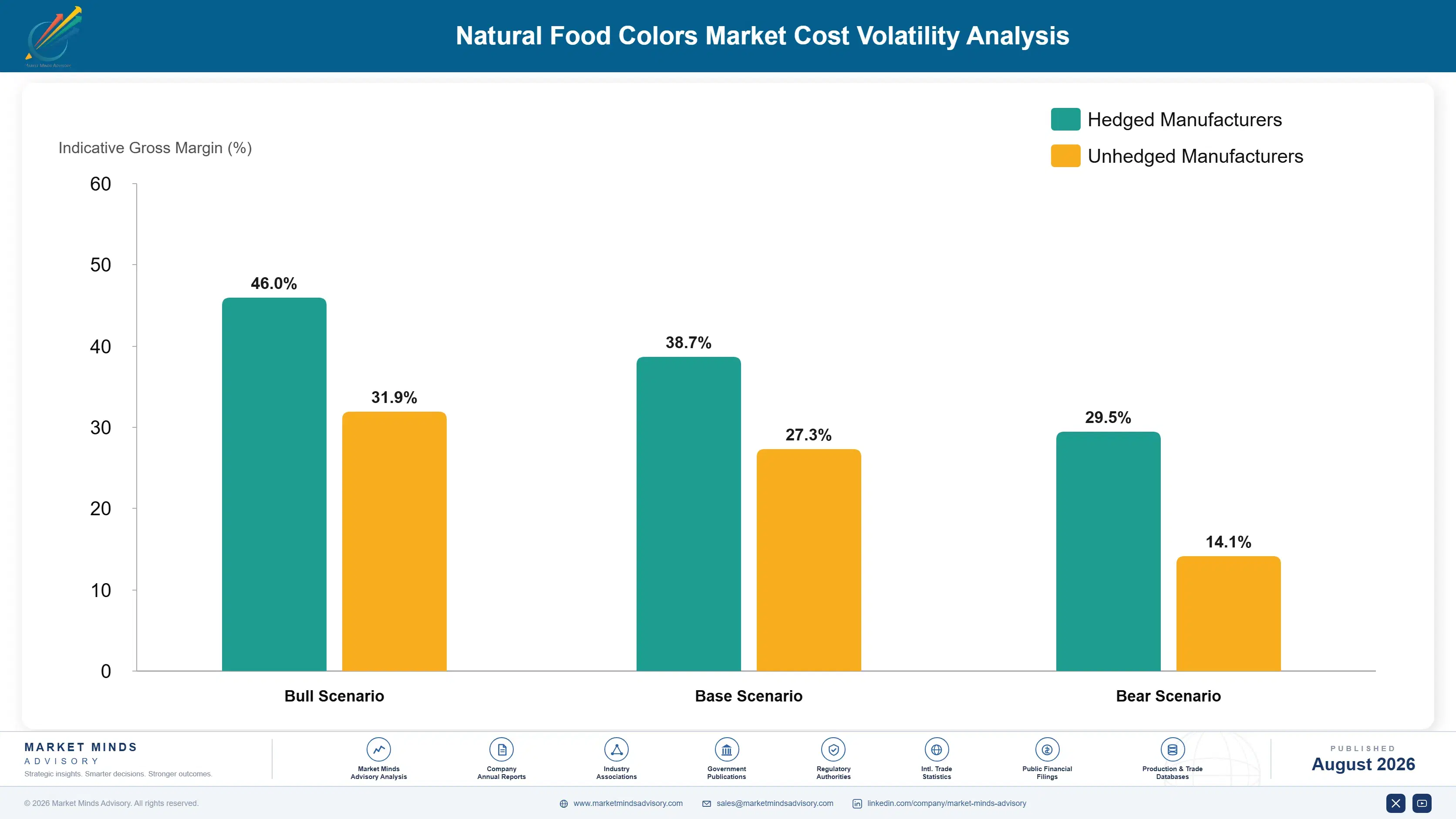
Turmeric prices rose sharply following back-to-back poor monsoon harvests in 2023 and 2024 across India's growing districts in Andhra Pradesh and Telangana, according to India's Ministry of Commerce trade data, pushing curcuminoid extract prices up more than 30 percent within eighteen months. Extractors that had not locked in forward contracts before the shortfall absorbed the increase directly, while those with grower partnerships already in place passed through only a fraction of the spike.

Exposure varies by player type: vertically integrated extractors with cultivation partnerships absorbed less margin pressure than pure formulators buying extract on the spot market, since the latter had no hedge against the harvest shortfall. Geographic exposure also differs, as European and North American buyers sourcing primarily from Indian growers faced steeper cost pass-through than Chinese buyers able to draw on more diversified regional cultivation.
natural-food-colors-market-cost-volatility-analysis-1787300746361

Forward Contracting With Diversified Grower Networks

Extractors are qualifying secondary growing regions across Southeast Asia and Africa alongside traditional Indian and Peruvian sources, and locking multi-year forward contracts with growers across these diversified regions to smooth single-harvest disruptions. This reduces reliance on any one climate zone and gives buyers more predictable input costs even when a growing region underperforms badly in a given season.

Strategic Inventory Buffers for Critical Extracts

Larger suppliers now hold several months of buffer inventory for the most supply-constrained extracts, particularly phycocyanin and curcumin, absorbing short-term harvest shocks without immediately passing cost spikes to formulator customers. This raises working capital requirements but has become a genuine competitive differentiator, since customers increasingly favor suppliers who can reliably guarantee delivery continuity through disruption.

Fermentation Pathways for Key Pigments

Several producers are investing in fermentation-based and precision biology production pathways for pigments traditionally sourced from agriculture, aiming to decouple supply from weather-dependent harvests over the next decade. Early commercial pilots for lab-cultivated carotenoids remain small-scale today, but they represent the clearest long-term mitigation path against recurring climate-driven feedstock disruption across the wider category.

Portfolio Architecture for Margin Defence

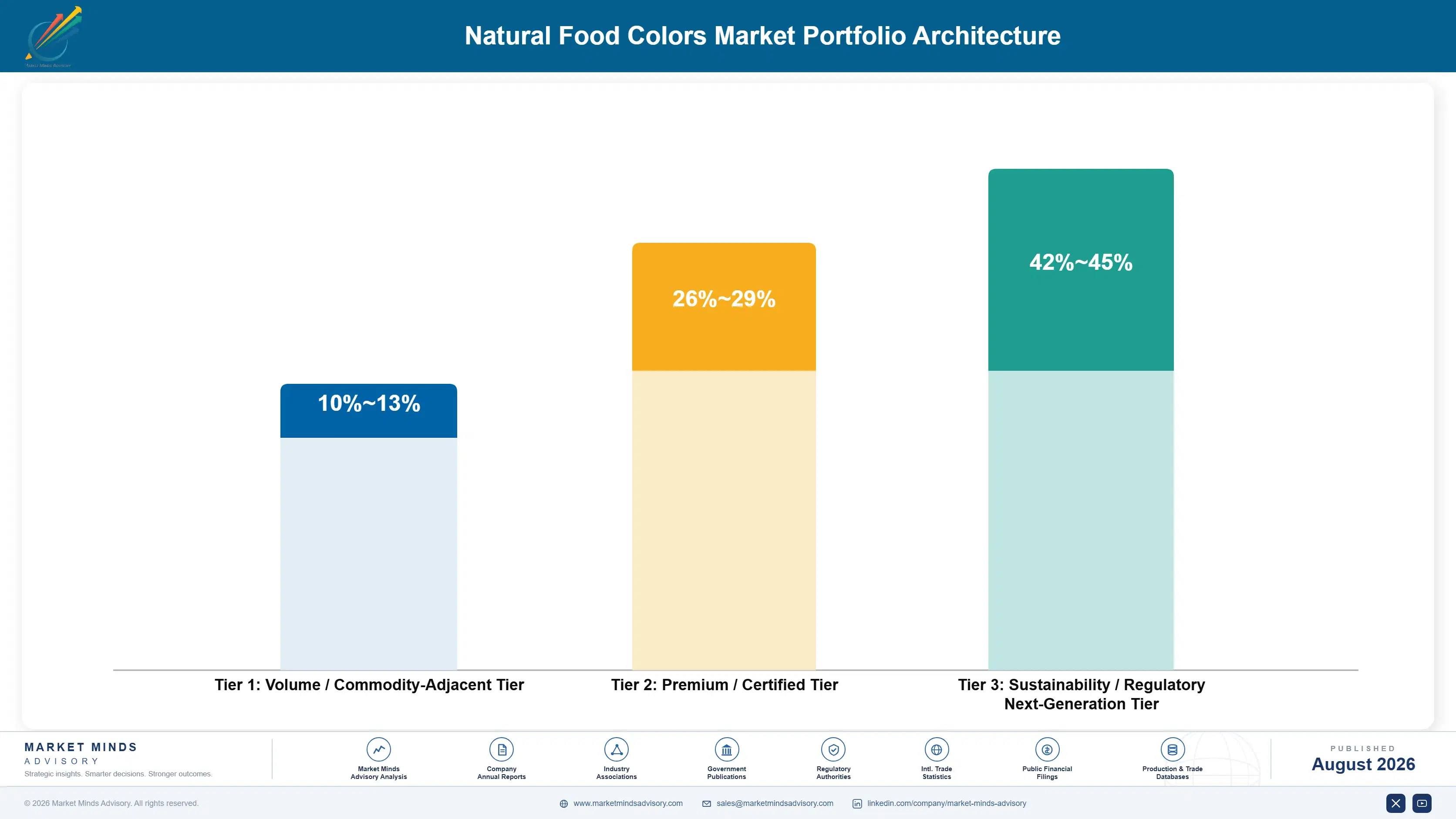
The category splits into three commercial tiers with sharply different margin economics. Commodity-adjacent natural colors, largely caramel and standard carotenoid extracts sold into low-differentiation applications, compete mostly on price and logistics reliability. Premium certified extracts, carrying organic, non-GMO, or identity-preserved documentation, command materially higher margins tied to compliance value rather than pigment chemistry itself. The sustainability and next-generation tier
Volume and premium tiers pull suppliers in opposite strategic directions. Commodity volume rewards scale, logistics efficiency, and tight cost control, favoring large diversified players like Sensient who can spread fixed costs across many crop types. Premium and next-generation tiers reward technical differentiation and speed, favoring focused specialists like Chr. Hansen who can move fermentation strains from lab to commercial scale faster than diversified competitors distracted across multiple crop categories at once.

High-value pools concentrate overwhelmingly in blue and purple pigments, where technical scarcity, not brand strength, sets pricing power. Suppliers positioned in phycocyanin and premium anthocyanin extraction capture disproportionate margin relative to their revenue share, a pattern that should persist while fermentation capacity remains the binding constraint on blue pigment supply.

Volume / Commodity-Adjacent Tier

Standard caramel color, common carotenoid blends, and unstandardized extracts sold largely on price into bakery, sauces, and processed meat applications where cost per kilogram outweighs color precision or shade consistency.
Gross Margin: 10-13%

Premium / Certified Tier

Organic-certified, non-GMO, and identity-preserved anthocyanin, curcumin, and carotenoid extracts sold into branded confectionery, beverage, and dairy applications requiring documented chain-of-custody and full retailer compliance audit readiness across every single production batch.
Gross Margin: 26-29%

Sustainability / Regulatory / Next-Generation Tier

Fermentation-derived phycocyanin, precision-biology carotenoids, and emerging lab-cultivated pigments developed to decouple supply from agricultural harvest variability and meet the newest regulatory approval categories opening across major export markets worldwide today.
Gross Margin: 42-45%
natural-food-colors-market-portfolio-architecture-1787300746859

High-value Sub-segments and Strategic Watch-out

Algae-Based Blue Pigments

Phycocyanin sits at the intersection of severe supply scarcity and urgent regulatory-driven demand, commanding the category's highest margins and fastest growth simultaneously. Capacity additions through 2028 should ease scarcity somewhat, but heat-stability limits will likely keep this segment premium-priced well beyond the current reformulation wave.
Gross Margin: 43-46%

Certified Organic Anthocyanins

Organic-certified anthocyanin extracts carry strong margins tied to documentation and traceability rather than scarcity, growing steadily as European and North American premium brands expand certified formulation programs further. Growth is more moderate than blue pigments since anthocyanin supply is comparatively less constrained across crop sources.
Gross Margin: 27-30%

Standard Carotenoid and Caramel Blends

This segment anchors category volume across bakery, sauces, and processed foods where cost discipline outweighs premium positioning, delivering thin but stable margins on high, predictable order volumes year after year regardless of the wider reformulation cycle. Growth tracks broader packaged food output rather than reformulation trends specifically.
Gross Margin: 11-14%

Single-Origin Turmeric-Dependent Extractors

Extractors overly concentrated in Indian turmeric sourcing without diversified grower relationships face repeated margin compression whenever monsoon patterns disrupt harvests, a risk that has intensified rather than eased across the past three consecutive growing seasons and shows little sign of abating any time soon for smaller players.
Gross Margin: 6-9%

Compliance-Driven Reformulation Cycles

Once a formulation clears retailer requalification and regulatory review, it tends to stay locked in for years, since re-testing shelf stability, taste panels, and packaging claims costs enough that brands rarely revisit a working recipe without a new forcing event like the current dye ban. This gives suppliers who win the initial reformulation contract durable, annuity-like revenue that is difficult for competitors to dislodge without a comparable price or performance advantage.
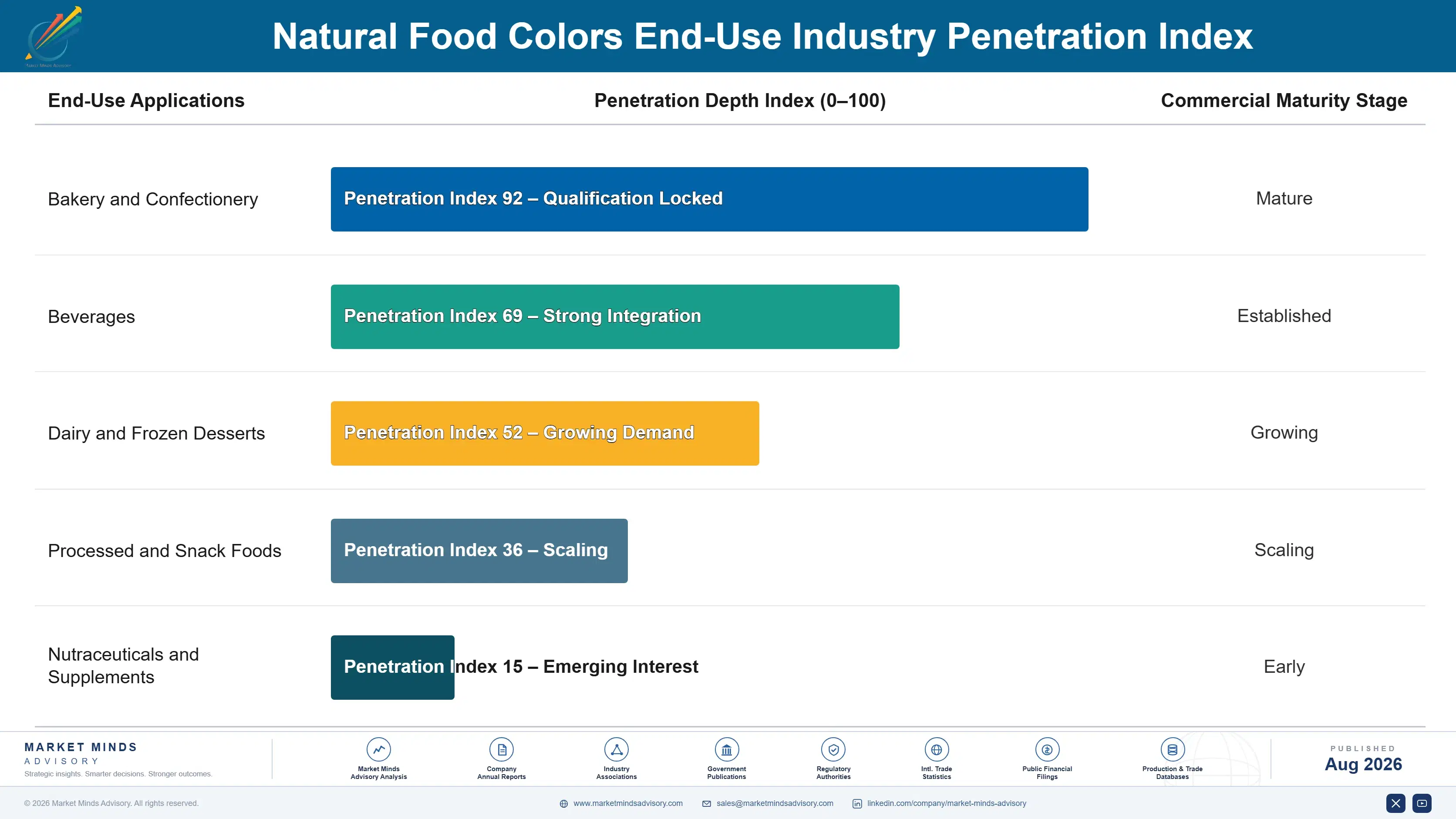
Depth of adoption varies sharply by vertical. Confectionery and beverage brands have moved fastest, since their formulations tolerate natural pigment's shorter shelf stability more easily than baked goods or retort products. Bakery and shelf-stable canned categories lag well behind, constrained by the heat and pH sensitivity that still excludes many natural pigments from high-temperature processing, leaving synthetic dyes entrenched there until stabilization technology matures further or regulation forces the issue.

Procurement decision-makers have shifted generationally too: younger brand and R&D leads treat natural colorant sourcing as a core competency worth in-house expertise, rather than outsourcing entirely to suppliers as prior generations did. This shift pulls manufacturers toward direct grower relationships and away from transactional purchasing, mirroring how sustainability sourcing evolved in coffee and cocoa over the previous decade.
natural-food-colors-market-end-use-penetration-index-1787300747345

Where MMA Sees Advantage Building

These are among the four positions where our research anticipates prominent divergence between winners and laggards over the coming forecast period. Each is grounded in the demand model, the regulatory perimeter, and the announced capacity pipeline.
01 / UPSTREAM SUPPLY SECURITY

Lock in grower partnerships before the next harvest shock hits

Turmeric price spikes following the 2023 and 2024 harvest shortfalls demonstrated that spot-market buyers absorb the full cost of agricultural volatility while integrated competitors with grower partnerships pass through only a fraction. Extractors without direct cultivation relationships in India, Peru, or emerging Southeast Asian regions will keep facing unpredictable margin swings tied to monsoon timing they cannot control or forecast reliably. MMA expects the gap between integrated and spot-market suppliers to widen further as certified organic and identity-preserved sourcing requirements deepen across 2026 and 2027.
02 / BLUE PIGMENT CAPACITY

Fermentation capacity, not demand, will set blue pigment pricing

Phycocyanin remains the single tightest natural color category because almost no plant source yields a stable food-grade blue at any meaningful scale, unlike red, orange, or yellow shades with multiple viable botanical sources. Producers who commit capital to new fermentation lines now will capture premium pricing through at least 2028, since announced capacity additions will not fully close the current supply gap before then. MMA views early capacity commitment as the single highest-leverage investment decision available to suppliers in this category today.
03 / RETORT APPLICATION BARRIER

Heat-stable natural pigments remain the category's unsolved problem

Baked goods, retort-sterilized, and extended shelf-life categories remain largely closed to natural pigment substitution because anthocyanins and phycocyanin both degrade meaningfully above typical processing temperatures, a chemistry constraint no amount of reformulation budget currently resolves. Encapsulation and co-pigmentation techniques show promise in early trials but remain unproven at commercial retort scale, leaving synthetic dyes entrenched wherever regulation still permits their use. MMA expects the supplier who first commercializes a genuinely heat-stable natural red or blue to capture outsized share across an entire underserved category.
04 / REGIONAL SOURCING DIVERSIFICATION

Diversify growing regions before the next climate shock arrives

Concentration of global turmeric supply in a handful of Indian growing districts has repeatedly translated single-region weather events into worldwide curcuminoid price spikes, a fragility buyers only fully appreciated after back-to-back poor harvests. Extractors qualifying secondary growing regions across Southeast Asia and parts of Africa are building resilience that spot-market competitors lack, even though these newer regions currently offer smaller volumes and less consistent quality. MMA expects diversified sourcing to become an explicit differentiator buyers screen for during supplier qualification within the next two to three years.

Engagement Snapshot From the Field

A live engagement with an industry participant carrying material or product regulatory and market exposure ahead of a defining policy shift, showing how our research translates into a defensible multi-year portfolio strategy.
MARKET MINDS ADVISORY · CLIENT ENGAGEMENT SUMMARY
Natural Food Colors Producer Strategic Portfolio Review and Transition Roadmap 2026·Investment Scenario on Natural Food Colors Exposure Evaluation 2025-26
CLIENT PROFILE
The client is a multinational confectionery manufacturer with several billion dollars in annual revenue (client-reported, unverified by MMA), operating production facilities across North America and Europe and distributing branded and private-label products through major grocery and mass retail channels. The company's portfolio spans gummies, hard candy, and chocolate-adjacent products, several of which relied on synthetic dyes for consistent, vivid coloring across high-volume production runs.
STRATEGIC CHALLENGE
Facing FDA delisting deadlines and retailer-level synthetic dye removal commitments, the client needed to reformulate more than sixty SKUs within an eighteen-month window while preserving color vibrancy, shelf stability, and unit production cost targets. Internal R&D lacked deep natural pigment sourcing expertise, and initial pilot reformulations using blue pigments failed shelf-stability testing, risking the launch timeline the client had already committed to retailers.
MMA APPROACH
MMA conducted a supplier landscape assessment across five natural colorant producers, benchmarking fermentation capacity commitments, pricing stability, and application laboratory turnaround times. The engagement included a segmented reformulation roadmap sequencing SKUs by technical difficulty, prioritizing high-volume, lower-risk products first to build internal expertise before tackling the blue-pigment-dependent products carrying the greatest shelf-stability risk and benefiting most from lessons learned earlier in the sequence.
KEY FINDINGS
  1. Spot-market extract purchasing left the client exposed to a 31 percent curcuminoid price increase that a forward-contracted competitor largely avoided during the same period.
  2. Blue pigment reformulations required nearly triple the shelf-stability testing cycles of red and orange reformulations, extending timelines beyond initial project estimates significantly.
  3. Supplier application laboratory turnaround time varied from three to eight weeks across the five evaluated vendors, directly affecting how many SKUs could be requalified within the client's window.
  4. Retailer-specific labeling requirements differed enough between grocery chains that a single reformulated recipe sometimes required two distinct label declarations depending on the retail channel.
CLIENT PROFILE
The client is a multinational confectionery manufacturer with several billion dollars in annual revenue (client-reported, unverified by MMA), operating production facilities across North America and Europe and distributing branded and private-label products through major grocery and mass retail channels. The company's portfolio spans gummies, hard candy, and chocolate-adjacent products, several of which relied on synthetic dyes for consistent, vivid coloring across high-volume production runs.
STRATEGIC CHALLENGE
Facing FDA delisting deadlines and retailer-level synthetic dye removal commitments, the client needed to reformulate more than sixty SKUs within an eighteen-month window while preserving color vibrancy, shelf stability, and unit production cost targets. Internal R&D lacked deep natural pigment sourcing expertise, and initial pilot reformulations using blue pigments failed shelf-stability testing, risking the launch timeline the client had already committed to retailers.
MMA APPROACH
MMA conducted a supplier landscape assessment across five natural colorant producers, benchmarking fermentation capacity commitments, pricing stability, and application laboratory turnaround times. The engagement included a segmented reformulation roadmap sequencing SKUs by technical difficulty, prioritizing high-volume, lower-risk products first to build internal expertise before tackling the blue-pigment-dependent products carrying the greatest shelf-stability risk and benefiting most from lessons learned earlier in the sequence.
KEY FINDINGS
  1. Spot-market extract purchasing left the client exposed to a 31 percent curcuminoid price increase that a forward-contracted competitor largely avoided during the same period.
  2. Blue pigment reformulations required nearly triple the shelf-stability testing cycles of red and orange reformulations, extending timelines beyond initial project estimates significantly.
  3. Supplier application laboratory turnaround time varied from three to eight weeks across the five evaluated vendors, directly affecting how many SKUs could be requalified within the client's window.
  4. Retailer-specific labeling requirements differed enough between grocery chains that a single reformulated recipe sometimes required two distinct label declarations depending on the retail channel.
RECOMMENDED STRATEGY
Phase 1: Phase 1 (Months 1-3): Benchmark supplier capacity and pricing across five candidate natural colorant producers, and sequence the sixty-plus SKU portfolio by reformulation technical difficulty and shelf-stability risk. Phase 2: Phase 2 (Months 4-10): Execute reformulation and stability testing for high-volume, lower-risk SKUs first, building internal formulation expertise before advancing to phycocyanin-dependent blue and purple products. Phase 3: Phase 3 (Months 11-18): Complete blue-pigment reformulations using forward-contracted capacity reservations, finalize retailer-specific labeling, and validate production-scale consistency ahead of the federal compliance deadline.
OUTCOME
The client completed reformulation of 58 of 62 targeted SKUs within the window, ahead of the federal deadline, with the remaining four extended by mutual agreement with retailers (client-reported, unverified by MMA). Forward-contracted phycocyanin capacity reportedly insulated the client from roughly half the blue pigment price increase competitors absorbed (client-reported, unverified by MMA).

Frequently Asked Questions

Foundational context covering the market sizes, CAGR, scope, country, region and competition that inform every finding below. This section is provided to cover basics and most often pre-purchase conversations, answered from the MMA Primary Research Dataset.

What is the current size of the Natural Food Colors Market?

The global natural food colors market is valued at $2.8 billion in 2025. It is forecast to reach $3.0 billion in 2026 as reformulation activity accelerates ahead of regulatory deadlines.

How large will the Natural Food Colors Market be by 2036?

MMA forecasts the market will reach $6.01 billion by 2036, roughly double its 2026 value. Growth is driven primarily by mandatory reformulation away from synthetic dyes.

What is the CAGR for the Natural Food Colors Market 2026 to 2036?

The base case CAGR is 7.2 percent across the 2026 to 2036 forecast period. Bull and bear scenarios range from 6.0 to 8.4 percent depending on regulatory pacing.

Which segment is growing fastest?

Algae-based blue colorants, led by spirulina-derived phycocyanin, are growing fastest at a 10.5 percent CAGR. That is roughly 1.46 times the overall market growth rate.

Who are the major companies in the Natural Food Colors Market?

Leading suppliers include Novonesis, Sensient Technologies, GNT Group, Givaudan, and Kalsec. Together these five companies hold an estimated 38 percent of a moderately fragmented global market.

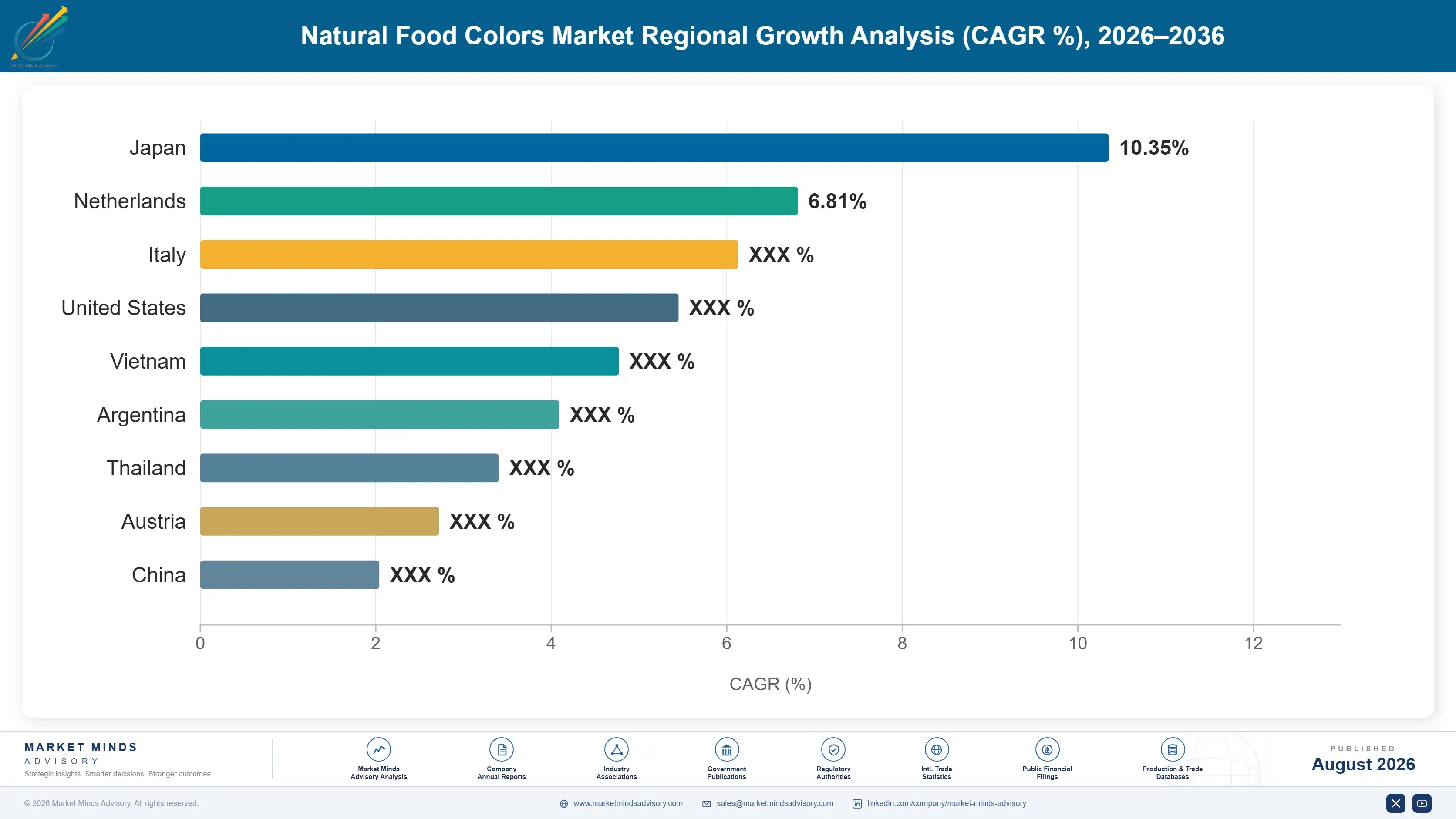
Which country is growing fastest?

China is the fastest-growing major market, expanding at an estimated 8.9 percent CAGR. Growth is driven by rising domestic packaged food reformulation and expanding algae cultivation capacity.

Report Segmentation Architecture

The full report scope spans multiple orthogonal segmentation dimensions, with cross-tabulated demand data provided for each dimension pair. Coverage extends further to regional breakdowns, trend trajectories, and the competitive detail needed to support segment-level decision-making.

By Pigment Source and Chemistry Type

  • Carotenoids
  • Anthocyanins
  • Curcumin and Turmeric Extracts
  • Chlorophyll and Chlorophyllin
  • Algae-Based Blue Colorants (Phycocyanin)
  • Caramel and Other Natural Colors

By End-Use Industry

  • Bakery and Confectionery
  • Beverages
  • Dairy and Frozen Desserts
  • Processed and Snack Foods
  • Nutraceuticals and Supplements

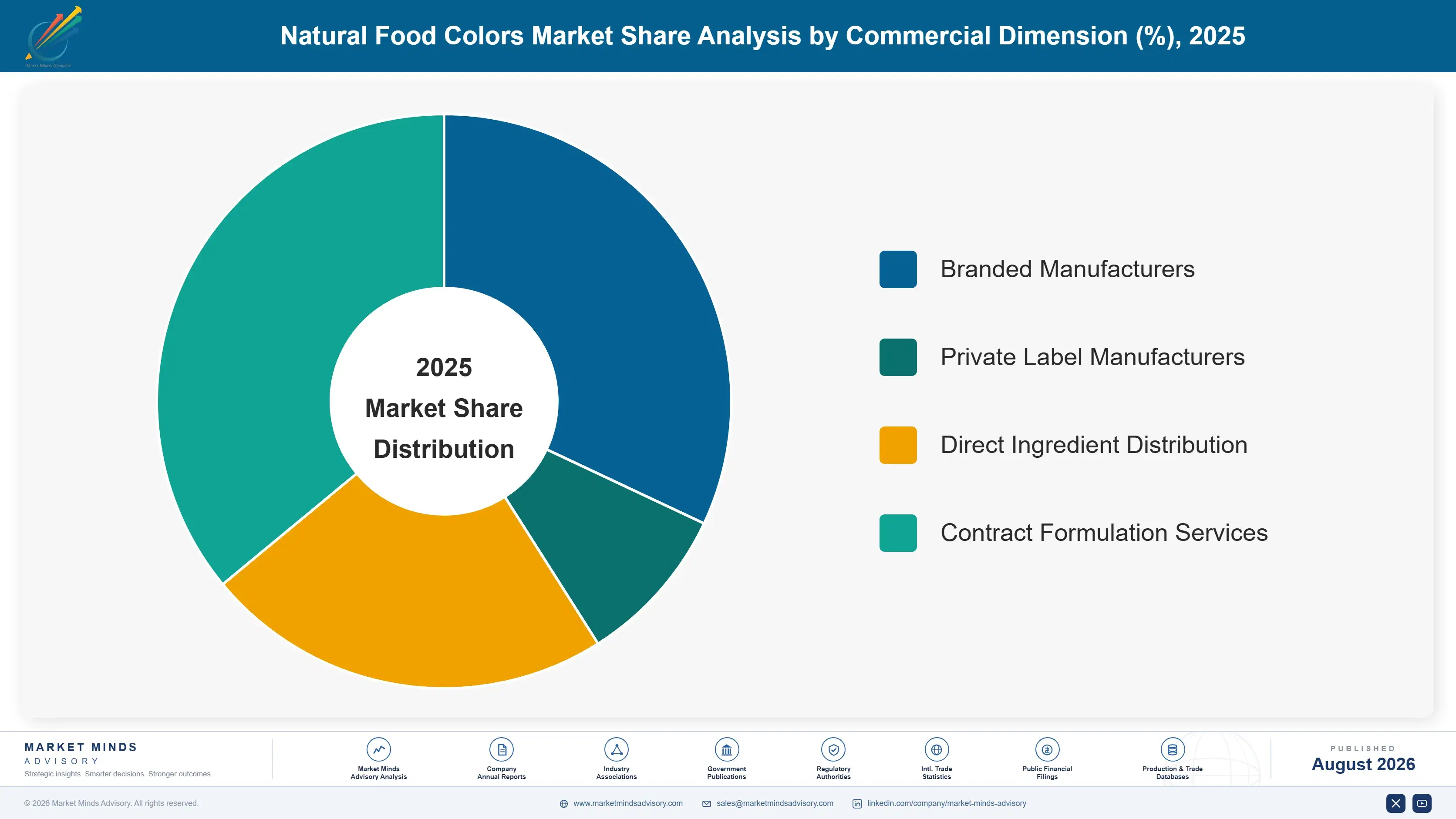
By Commercial Dimension

  • Branded Manufacturers
  • Private Label Manufacturers
  • Direct Ingredient Distribution
  • Contract Formulation Services

By Region

  • North America
  • Western Europe
  • East Asia
  • South Asia and Pacific
  • Latin America
  • Middle East and Africa
  • Eastern Europe

Scope, Methodology, and Coverage

Every figure in this report is reproducible from documented input assumptions. The scope below maps the historical period, the forecast horizon, the segmentation dimensions, and the countries covered, alongside the underlying primary and qualitative methodology.
Historical Period
2020 to 2025
Forecast Period
2026 to 2036
Base Year
2025 (USD billions; MMA Primary Research Dataset, August 2026)
Market Definition
This report defines the natural food colors market as plant-, algae-, mineral-, and fermentation-derived pigments and pigment extracts formulated into food, beverage, confectionery, dairy, and nutraceutical products. It excludes synthetic and nature-identical dyes, flavor and fragrance ingredients, and colorants used solely in food-contact packaging rather than the food product itself.
Quantitative Units
USD billions (current prices); metric tons of extract volume where applicable
Segmentation Dimensions
By Pigment Source and Chemistry Type; By End-Use Industry; By Commercial Dimension; By Region
Regions Covered
North America, Western Europe, East Asia, South Asia and Pacific, Latin America, Middle East and Africa, Eastern Europe
Countries Covered
USA, China, Germany, France, UK, Japan, South Korea, India, Australia, Canada, Brazil, Mexico, Indonesia, Vietnam, Thailand, Malaysia, UAE, Saudi Arabia, South Africa, Nigeria, Turkey, Poland, Netherlands, Italy, Spain, Sweden, Switzerland, Argentina, Colombia, Singapore, and additional markets relevant to this sector
Key Companies Profiled
Chr. Hansen Holding A/S, Sensient Technologies Corporation, GNT Group B.V., Givaudan SA, Kalsec Inc., Döhler Group, DDW The Colour House, Symrise AG, Roha Group, San-Ei Gen F.F.I., Inc., Kancor Ingredients Limited, AIDP Inc., Fiorio Colori S.p.A., LycoRed Ltd., Synthite Industries Ltd., ColorMaker Inc., Chenland Nutritionals Inc., BASF SE, IFF (International Flavors and Fragrances Inc.), Vinayak Corporation
Quantitative Methodology
Primary survey, n=3,800 respondents, Q4 2025, six countries; demand-side model with trade association cross-validation
Qualitative Methodology
47 expert interviews, Q4 2025; applied to validate demand model assumptions, identify emerging dynamics, and assess competitive positioning
Report Format
PDF and XLSX data workbook (Word format preview document)
Publisher
Market Minds Advisory
Report Code
MMA-2026-CHM-101
Published
August 2026
Contact
sales@marketmindsadvisory.com | www.marketmindsadvisory.com

Purchase the full Natural Food Colors Market Report (2026 to 2036).

The full report provides a comprehensive assessment of the global natural food colors market, including detailed sizing and ten-year forecasts across all seven regions and six pigment source segments. It profiles twenty leading suppliers, benchmarking fermentation capacity, cultivation partnerships, and application laboratory capabilities across the five largest players in particular. The analysis includes primary research drawn from MMA's Q4 2025 survey of 3,800 food and beverage manufacturing respondents across six countries and 47 expert interviews with formulation and procurement leaders. Regional analysis sections cover regulatory timelines, feedstock sourcing risk, and competitive dynamics specific to each market, supported by a standalone input cost and mitigation framework.
Ten-year market sizing and growth forecasts
Profiles of twenty leading natural colorant suppliers
Regional feedstock sourcing risk and mitigation analysis
Segment-level margin and portfolio tier benchmarking
Primary survey data from 3,800 industry respondents
Forty-seven expert interviews with procurement and R&D leaders

Built For The People Who Decide

From boardroom strategy to bench-side execution, this report is read cover-to-cover by leaders shaping the next decade of their industry, turning demand scenarios, market dynamics and valuation benchmarks into decisions.
CXOs/ Presidents/ VPs/ Managers
M&A and Corporate Development
Strategy Teams and R&D Heads
Procurement and Product Directors
Regulatory and Compliance Leaders
Investor Relations and Equity Analysts