
Market Minds Advisory
Medical Bed Market

Medical Bed Market: Nursing Labour, Never Events, and the Twelve-Year Replacement Cycle

A hospital bed is bought to protect nursing backs and to avoid the falls and pressure injuries that payers have stopped reimbursing, which is a very different specification from comfort.

Lead Analyst

Alice Ballenger

Published

August 2026

Make Smarter Decisions with Customized Research Insights

Request a free sample report and evaluate market opportunities, growth trends, and competitive dynamics relevant to your business needs.

2025 MARKET VALUE$4.1BMarket Size 2025
2036 FORECAST VALUE$7.5BBase Case , 2026 to 2036
CAGR 2026 TO 20365.6 %Bull 6.8% / Bear 4.4%
INCREMENTAL OPPORTUNITY$3.1BNet 10- year value creation
EXPANSION MULTIPLE1.72x2036 value over 2026 base
Strategic Levers
M&A Pipeline
Regional Outlook
Country Rankings
Competitive Intelligence
Segmental Deep-dive
Call-Us : 91 93563 13602

Executive Snapshot and Market Trajectory

Nobody buys a hospital bed for the patient's comfort. They buy it because nursing staff injure their backs moving people, and because payers stopped reimbursing care for falls and pressure injuries that happen in hospital. Both of those are money. Comfort has never signed a purchase order.
Home care beds compound at 8.4%, a full 1.50x the market rate, as hospital-level care delivered at home moves from waiver programme to established service line across several health systems. East Asia holds the largest share at 33%, on a Chinese hospital bed count larger than any other country's and Japanese bed density that exceeds every other developed market. Japanese long-term care demand rises steadily as the population ages.
Concentration is high at 58% for a product that looks like furniture, because powered articulation, load ratings, service networks and regulatory history all take years to assemble. Baxter and Stryker lead through hospital relationships that span far more than beds. Linet, Arjo and Paramount Bed hold strong regional positions built on the same logic at home. Chinese and Eastern European manufacturers win a growing share wherever specifications are undemanding. Service coverage is the practical barrier.
Market Definition
This market covers powered and manually adjustable beds designed for patient care, spanning acute medical-surgical beds, intensive care beds, long-term and skilled nursing beds, home care beds, bariatric and specialty beds, and birthing and paediatric beds, together with support surfaces sold with them. Examination and procedure tables, operating tables, stretchers and transport trolleys, patient lifts and transfer devices sold separately, wheelchairs, and standalone mattresses sold into consumer channels are excluded.
Base Year Value
$4.1B in 2025 (MMA Primary Research Dataset, August 2026)
Forecast Period
2026 to 2036, eleven discrete annual values
CAGR
5.6% base case. Bull 6.8%. Bear 4.4%.
Fastest Growth Segment
Home Care Beds: 8.4% CAGR
Fastest Growth Country
India: 9.2% CAGR
Fastest Growth Region
South Asia and Pacific: 7.8% CAGR
Largest Region
East Asia: 33% of 2025 global value
Market Leaders
Baxter, Stryker, Linet Group, Arjo, and Paramount Bed. Source: MMA Primary Research Dataset, July 2026.
Primary Survey
n=3,800 procurement and R&D decision-makers, Q4 2025, six countries
Methodology
Demand-side build-up, cross-validated against public data, 47 expert interviews

Medical Bed Market Forecast Scenarios

medical-bed-market-size-forecast-scenario-1787305761475
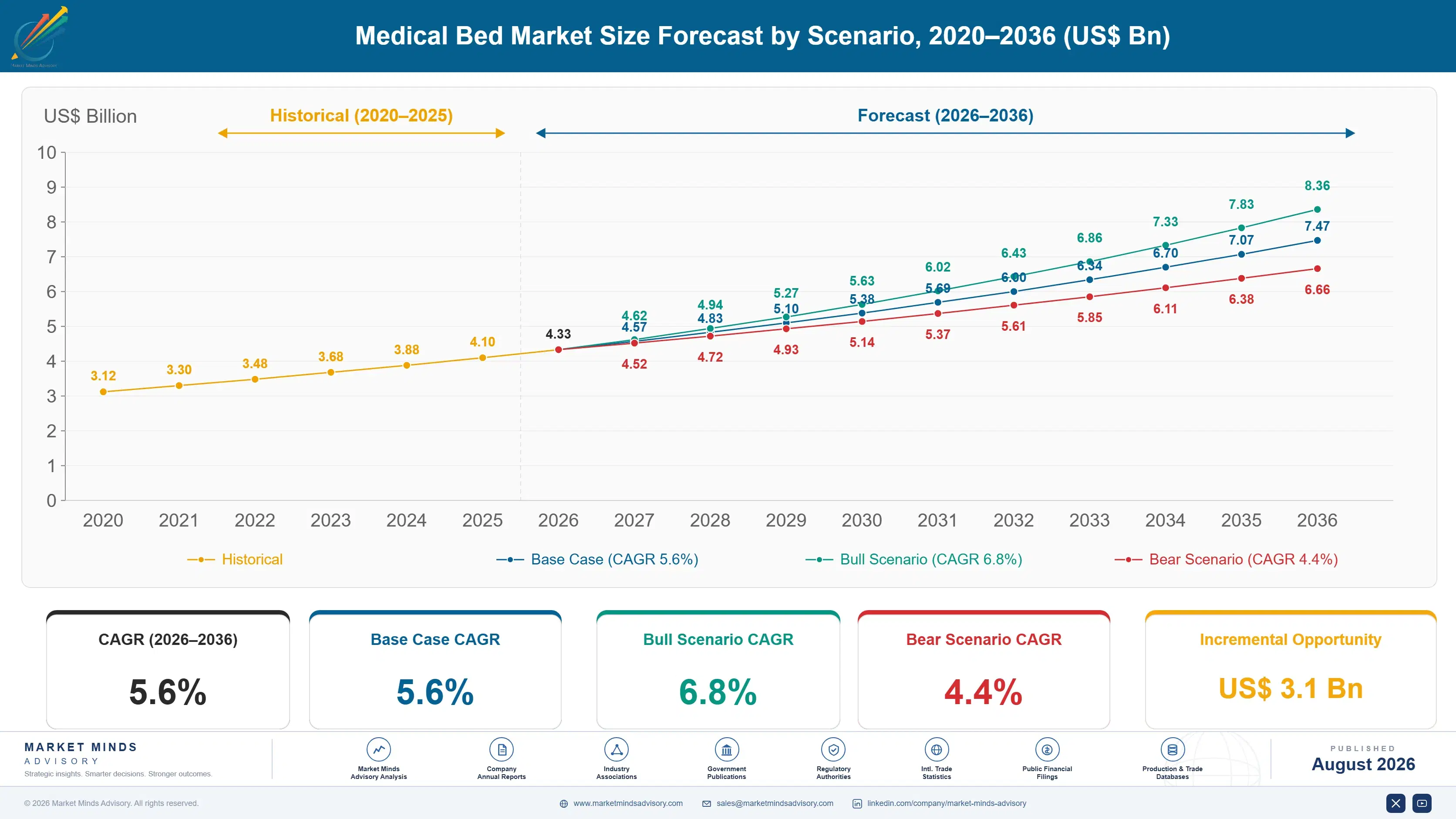
Growth ran near 4.6% from 2020 to 2025, and it was unusually lumpy. Capacity expansion in 2020 and 2021 pulled forward purchases that would otherwise have been spread across several years, particularly intensive care beds, and the years afterward were correspondingly quiet as hospitals worked through what they had bought. Underlying replacement demand continued at its usual slow pace throughout.
Base case growth of 5.6% rests on three mechanisms. Hospital-at-home programmes keep converting from temporary waiver arrangements into funded service lines, and each admission at home needs a bed that a household does not own. Safe patient handling requirements keep tightening, which pushes powered turn assistance from premium option toward specification. And Asian hospital construction continues at a pace developed markets cannot match. None of the three depends on developed market replacement cycles accelerating.
The bull case at 6.8% assumes hospital-at-home reimbursement becomes permanent across the major health systems currently running it provisionally, which would establish a genuinely new demand channel. The bear case at 4.4% reflects capital budget deferral, which is the oldest risk in this market: a twelve-year bed can be run for fifteen when a hospital needs to protect its operating position.

Beds as Labour Equipment and Liability Control

The purchase argument for a hospital bed is about staff and about penalties, not about patients resting comfortably. Nursing musculoskeletal injury rates are among the highest of any occupation, and most of that damage comes from repositioning people who cannot move themselves. A bed that turns a patient, raises to working height and lowers to a safe height addresses a cost line that appears in workers compensation rather than in clinical outcomes.
TOP FIVE CONCENTRATION58%Concentrated among established manufacturers with hospital service networks
BED SERVICE LIFE12 yearsYears a hospital typically keeps a bed before replacing it
NURSE HANDLING INJURIES46 per 10,000Musculoskeletal injuries among nursing staff from moving patients
SUPPORT SURFACE ATTACHMENT67%Beds sold together with a specialty support surface included
CONNECTED BED SHARE29%Beds reporting patient data into hospital records systems
CAPITAL TENDER SHARE82%Beds bought through capital tender rather than direct order
The second argument arrived through reimbursement policy. Falls with injury and advanced pressure injuries acquired in hospital were classified as conditions payers would no longer fund care for, which converted bed-exit detection, low-height positioning and pressure redistributing surfaces from clinical preferences into financial ones. Support surfaces now accompany roughly 67% of bed sales, and they carry considerably better margin than the frame beneath them.
What makes this a difficult market commercially is the replacement cycle. Beds last around twelve years and can be run longer when capital is tight, and 82% of purchases run through capital tender where a hospital can simply defer. Demand is therefore driven by construction, refurbishment and regulation rather than by anything a manufacturer does, which limits how much commercial effort can actually move.
"The people who authorise a bed purchase are not clinicians, they are finance and facilities. Show them the workers compensation claims from patient handling and the unreimbursed cost of a hospital-acquired pressure injury and the conversation changes completely. Talk about patient comfort and you will be told the existing beds work fine, which they do."
Principal Analyst, Hospital Capital Equipment and Patient Handling Practice · MM

Market Trends

Hospital-level care at home creates a new bed channel

Programmes delivering acute hospital care in the patient's home began as temporary waiver arrangements and have converted into funded service lines across several health systems. Every admission at home requires a bed with articulation, safe working height and often pressure redistribution, none of which a household owns. The equipment is placed, used and recovered rather than sold to a patient, which suits rental and service models more than capital sales. Home care beds compound at 8.4% against a market rate of 5.6%, and the channel barely existed a decade ago.
Market Impact: Injury rate near 46 per 10,000
Support surfaces carry the margin the frame cannot

A bed frame is a competitive tender item where load rating, articulation and service terms are broadly comparable across established suppliers. The support surface is where pressure injury prevention actually happens, where clinical evidence differentiates products, and where roughly 67% attachment produces materially better margin than the frame beneath it. Manufacturers competing on frame specification alone are competing for the least profitable part of the transaction. Surface replacement also recurs on a far shorter cycle than the twelve-year frame, which turns a capital sale into recurring revenue. Frame-only participants concede that recurring revenue entirely.
Market Impact: Support surfaces on 67% of beds

Market Opportunities and Growth Drivers

Safe patient handling requirements push powered assistance into specification

Nursing musculoskeletal injury rates near 46 per 10,000 workers make patient handling one of the most expensive occupational hazards in healthcare, and legislation in several jurisdictions now requires employers to provide equipment that reduces manual lifting. Powered turn assistance, lateral rotation and variable height positioning move from premium features into written specification when that happens. The purchase then competes against workers compensation cost rather than against a cheaper bed, which is a considerably easier argument for a manufacturer to win. Finance leaders authorise the purchase on that basis, and suppliers describe an entirely different conversation.
Market Impact: Service life running 12 years

Non-reimbursement of hospital-acquired conditions changed the specification

Payers classifying falls with injury and advanced pressure injuries as events they will not fund care for turned bed features into financial controls. Bed-exit detection, low-height positioning and pressure redistributing surfaces stopped being clinical preferences and became mechanisms for avoiding unreimbursed cost, which moved the purchase decision toward finance and quality functions. Roughly 67% of beds now ship with a specialty support surface. The rule changed nothing clinically and changed the entire commercial argument. Surfaces also carry better margin than the frames they sit on. Few manufacturers moved quickly to take advantage.
Market Impact: Tender covering 82% of purchases

Market Restraints and Challenges

Twelve-year service life makes demand almost entirely deferrable

A medical bed lasts around twelve years in normal use and can be run considerably longer when a hospital needs to protect its operating margin. The root cause is that the product is mechanically simple and durable, and a bed that still articulates is difficult to justify replacing on clinical grounds alone. Commercial impact is that 82% of demand runs through capital tender where deferral costs a hospital nothing immediately. Manufacturers respond with rental and managed equipment programmes, surface replacement contracts and refurbishment services that generate revenue between capital cycles.
Market Impact: Home segment compounding at 8.4%

Frame specifications converged, leaving price as the differentiator

Load rating, articulation range, working height and braking are comparable enough across established manufacturers that procurement can treat frames as substitutable. The root cause is a mature engineering problem where the remaining improvements are marginal and difficult to demonstrate in a tender document. Commercial impact is sustained price pressure on the frame, particularly against Chinese and Eastern European manufacturers with different cost bases. Participants respond by bundling surfaces, service and connectivity, and by competing on total cost of ownership rather than on unit price. Unbundling remains the procurement default in most public systems.
Market Impact: Surfaces attaching to 67% of beds
4 additional market trends, 3 additional growth drivers, and 2 additional restraints and challenges are covered in the full report. Contact sales@marketmindsadvisory.com to access the complete intelligence.

Segment CAGR and Growth Architecture

Six bed classes divide this market by care setting and patient acuity, which is the dimension purchasing actually follows since each setting buys through a different budget. Price across the classes spans more than an order of magnitude despite the underlying engineering being recognisably related throughout. Acuity and setting together decide which budget pays for the bed.
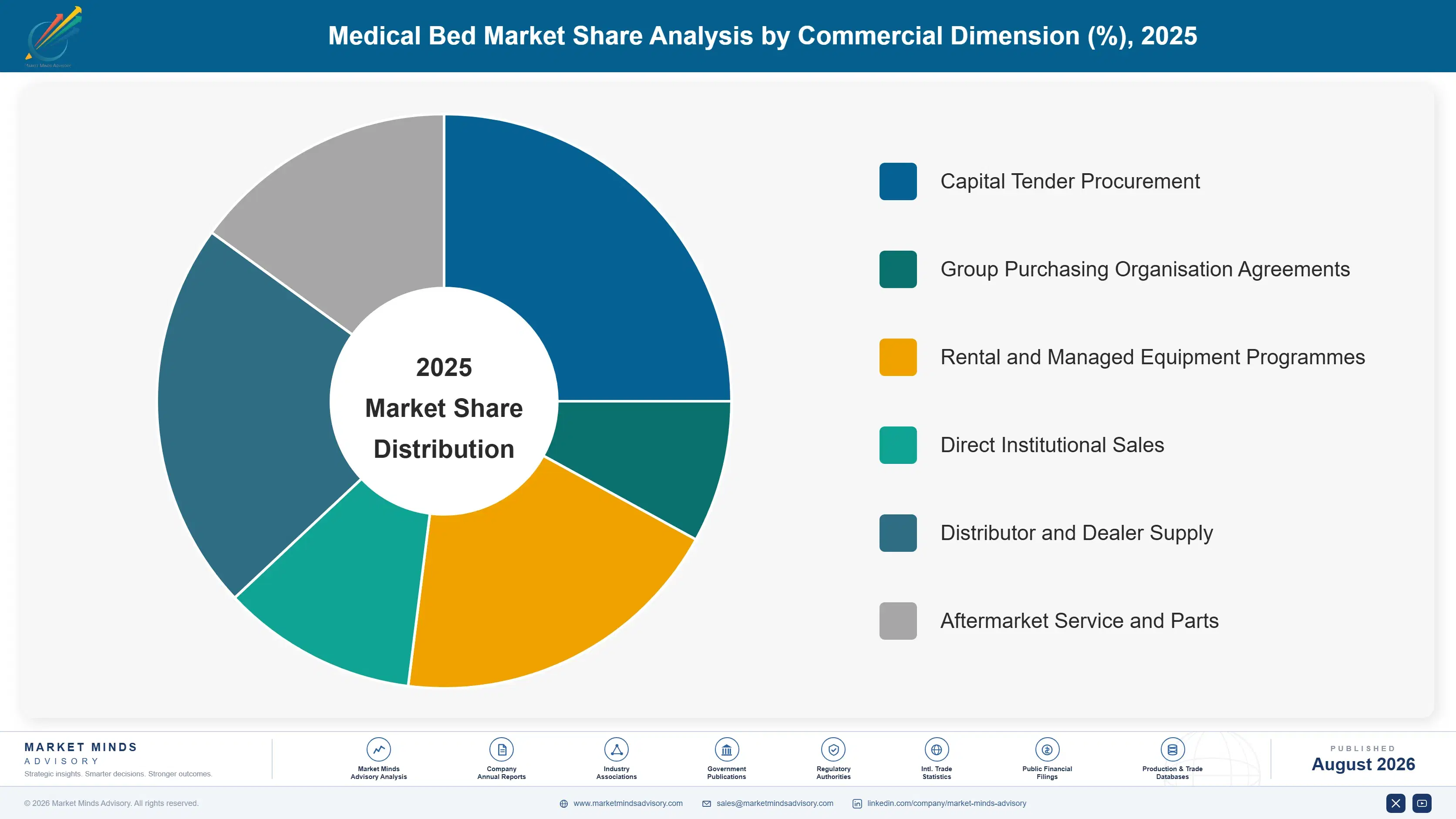
medical-bed-market-market-share-analysis-1787305762007

Home Care Beds

Compounding at 8.4%, a full 1.50x the market rate, this class serves both long-term domiciliary care and the newer hospital-at-home programmes converting from waiver status into funded service lines. The two use cases differ commercially: domiciliary beds are bought or rented by families and providers on price, while hospital-at-home equipment is placed and recovered by a health system that needs clinical-grade articulation and pressure management. That second channel barely existed a decade ago and it favours rental and managed service models over capital sale. Domestic ambience matters commercially here in a way it never does in a hospital. Manufacturers entering through capital sale models find the hospital-at-home channel effectively closed to them.
CAGR 8.4%

Bariatric and Specialty Beds

Growing at 7.6%, this class covers beds rated for weight capacities well beyond standard limits alongside specialty configurations for burns, bariatric surgery recovery and complex wound care. Prices run several times a standard medical-surgical bed and volumes are a fraction of it, which makes the class disproportionately valuable per unit sold. Demand tracks obesity prevalence, which continues rising across every region covered. Handling requirements are extreme enough that manual repositioning is genuinely unsafe, so powered turn assistance and lateral rotation are specification rather than option. Service and parts revenue is correspondingly higher than on standard frames. Load certification for extended weight capacity also narrows the supplier field considerably, which supports pricing in a way standard frames no longer do anywhere.
CAGR 7.6%
Full segment breakdown across 6 segments available in the complete report.

Regional Architecture and Country Demand Map

Regional distribution follows installed bed count and construction activity rather than population or disease burden. Markets building hospitals purchase beds in volume; markets with mature capacity purchase only replacements, which is a considerably slower and more deferrable form of demand. Construction rather than clinical need drives the map.

East Asia

Thirty-three per cent of global value, the largest regional position, and installed bed count explains it. Note: this share exceeds the 22 to 30% band because China operates more hospital beds than any other country by a wide margin and Japan carries the highest bed density of any developed market. Chinese hospital construction continues across provincial and county facilities, supplied predominantly by domestic manufacturers at prices imported products cannot approach. Japan's market is replacement-driven and dominated by Paramount Bed, with long-term care demand rising as the population ages. South Korea and Taiwan follow Japanese specification patterns closely. Support surface attachment across the region runs well below North American rates. Connectivity adoption is similarly limited outside the largest tertiary hospitals.
Share: 33% | CAGR: 6.4% (2026 to 2036)

North America

Twenty-four per cent of value on far fewer beds than East Asia, which reflects pricing and specification rather than volume. Non-reimbursement of hospital-acquired falls and pressure injuries made bed features into financial controls here before anywhere else, which drove support surface attachment and connectivity adoption ahead of other regions. Hospital-at-home programmes are also furthest developed, creating a home placement channel that did not previously exist. Capital budget cycles remain the dominant constraint, and interviewed facilities leaders described deferring bed replacement routinely when operating margins tighten. Group purchasing organisation agreements cover a substantial share of volume, which concentrates awards and makes each one worth pursuing with genuine commercial effort. Losing one is expensive and slow to recover.
Share: 24% | CAGR: 5.2% (2026 to 2036)
Regional intelligence for 5 additional markets available in the complete report: Western Europe, South Asia and Pacific, Latin America, Middle East and Africa, Eastern Europe. Contact sales@marketmindsadvisory.com.
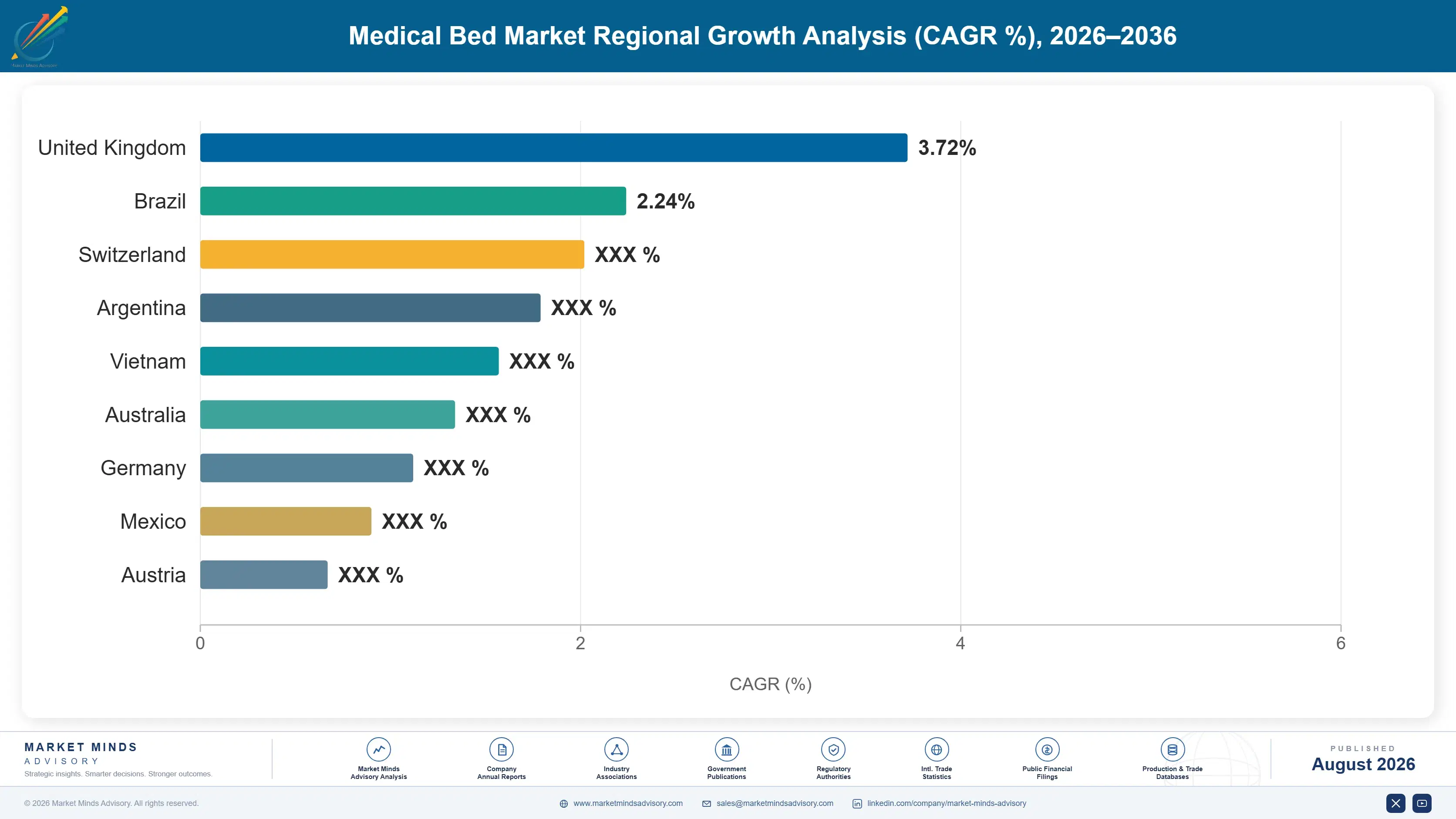
medical-bed-market-country-cagr-analysis-1787305762530

Where Medical Bed Value Actually Sits

The frame is a tender item where specifications have converged and price decides. Everything commercially interesting sits around it: the surface that prevents an unreimbursed injury, the service contract that spans a twelve-year life, and the rental model that reaches demand a capital budget was never going to fund. None of those three is a manufacturing advantage.

Sell the surface, not the frame beneath it

Support surfaces accompany roughly 67% of bed sales, carry the pressure injury prevention evidence and generate materially better margin than the frame does. They also replace on a far shorter cycle than the twelve-year bed, which converts a capital transaction into recurring revenue. Manufacturers leading commercially with frame specification compete on the least profitable element of the sale and frequently concede the surface to a specialist. Interviewed suppliers reported blended margin 12 to 18 points higher on bundled sales than on frame-only awards of comparable size. Procurement will unbundle unless the bundle is bid credibly.
Market Impact: Blended margin 12 to 18 points high

Take the argument to finance and workers compensation

Clinicians will say the existing beds work adequately, and they are usually right. Facilities and finance leaders looking at nursing musculoskeletal injury rates near 46 per 10,000 workers and at unreimbursed hospital-acquired condition costs see a different calculation entirely. Positioning powered handling and fall prevention against those cost lines rather than against a cheaper competing bed changes which budget the purchase competes within. Suppliers that reframed the conversation this way reported capital approval rates roughly 40% higher on comparable proposals. The budget the purchase competes within changes entirely. Clinicians will confirm the current beds work.
Market Impact: Capital approvals running roughly 4

Reach hospital-at-home through rental rather than sale

Hospital-level care delivered at home compounds at 8.4% and requires clinical-grade equipment placed, maintained and recovered rather than sold. A health system running these programmes does not want to own beds sitting idle between admissions, which makes rental and managed service the natural structure. Participants entering through capital sale models find the channel closed to them. The service infrastructure required is substantial, and it is also what makes the position defensible once established rather than simply another product line. Fleet utilisation rather than unit price decides the economics. Idle fleet is the operator's problem, not the hospital's.
Market Impact: Home channel compounding at 8.4% ev

Monetise the twelve years between capital purchases

A bed generates one transaction every twelve years and then nothing, which is a poor commercial structure whatever the unit price. Service contracts, parts, surface replacement, refurbishment and connectivity subscriptions all generate revenue during the gap, and interviewed manufacturers reported aftermarket contributing 22% to 30% of total account value over a bed's life. Participants without a service network capture the transaction alone and forfeit the rest. Building that network is expensive and difficult to replicate, which is exactly why it holds. Coverage takes years to build in any market. That difficulty is precisely the point.
Market Impact: Aftermarket contributing 22% to 30%

Who Controls the Margin Pool

The top five hold 58% of the market measured on revenue from medical bed and support surface products, the basis used throughout this section. Concentration is high for a product that superficially resembles furniture, because powered articulation, load certification, regulatory history and hospital service networks all take years to assemble and none can be bought quickly. Baxter and Stryker lead through hospital relationships that extend across many product categories.
Competitive activity runs along three lines. Established manufacturers are pushing connectivity that reports patient position, weight and turn compliance into hospital records, on the argument that documentation supports reimbursement. Several are building rental and managed equipment programmes to reach hospital-at-home demand that capital sale cannot serve. And Chinese and Eastern European manufacturers compete on delivered price in tenders where specification requirements are least demanding.

Pressure is building from two directions. Frame specifications have converged enough that procurement treats established suppliers as substitutable, which favours low-cost manufacturers in price-led awards. And hospital-at-home demand rewards service infrastructure rather than manufacturing scale. Rankings shift toward participants holding both a service network and a surface portfolio, since neither the frame alone nor the transaction alone is defensible any longer.
medical-bed-market-company-positioning-matrix-1787305763040

Competitive Moat and Risk Dimensions

BAXTER

Moat: Installed base and service network

The acquired Hillrom position brought one of the largest installed bases of hospital beds worldwide together with the field service infrastructure that maintains them, and hospitals replacing beds overwhelmingly replace like with like to avoid retraining and parts complexity. Connectivity into hospital records systems deepens that further, since integration work already completed is rarely repeated for a competitor.
BAXTER

Risk: Beds inside broader portfolio

Medical beds sit within a company whose revenue is dominated by injectables, infusion and other hospital products, and capital equipment competes internally against businesses with faster cycles and different margin profiles. A slow twelve-year replacement market rarely wins that competition for investment attention, particularly when the portfolio is under review and capital allocation is being examined closely.
STRYKER

Moat: Hospital relationship across categories

Beds and stretchers reach hospitals through a commercial organisation that already sells surgical equipment, instruments and other capital products to the same institutions, which means the bed conversation happens inside an existing relationship rather than requiring a new one. That access advantage matters considerably in tender processes where familiarity and service history carry real weight alongside specification.
STRYKER

Risk: Capital budget cycle exposure

Bed demand is among the most deferrable capital purchases a hospital faces, since a twelve-year bed can be run for fifteen without any clinical consequence that finance will recognise. That makes the business cyclical against hospital operating margins in a way the company's higher-acuity surgical products are not, and recovery after a deferral period is slow rather than compensating.

Players Tracked

Prominent Players

Baxter
Stryker
Linet Group
Arjo
Paramount Bed

Other Key Players

Invacare
Joerns Healthcare
Malvestio
Favero Health
Merivaara
Stiegelmeyer
Gendron
Medline Industries
Getinge
Savion Industries
Amico Group
France Bed
Shandong Yongsheng
Jiangsu Saikang Medical
Drive DeVilbiss Healthcare

Recent Developments

NOVEMBER 2020

Hospital-level care at home authorised for reimbursement

United States authorities established a waiver permitting hospitals to deliver acute inpatient-level care in patients' homes with equivalent reimbursement. The programme created a channel requiring clinical-grade beds placed in domestic settings, which no capital purchasing process had previously needed to accommodate, and several health systems have since made it permanent.
Signal: Reimbursement policy opened a bed channel
DECEMBER 2021

Baxter completes Hillrom acquisition

Baxter completed its acquisition of Hillrom, bringing one of the largest installed bases of hospital beds and patient support equipment into a company previously focused on infusion and injectable products. The transaction was an acquisition rather than a merger, and it consolidated a substantial share of global bed supply.
Signal: Bed manufacturing is consolidating into po
JANUARY 2023

Home care equipment manufacturer files for bankruptcy protection

Invacare filed for Chapter 11 bankruptcy protection following sustained pressure on home medical equipment reimbursement and supply chain costs, later emerging from the process with restructured obligations. The filing was a court-supervised restructuring rather than any acquisition or merger, and it exposed how thin home equipment economics had become.
Signal: Home equipment margins are thin enough tha

What Actually Costs Money Here

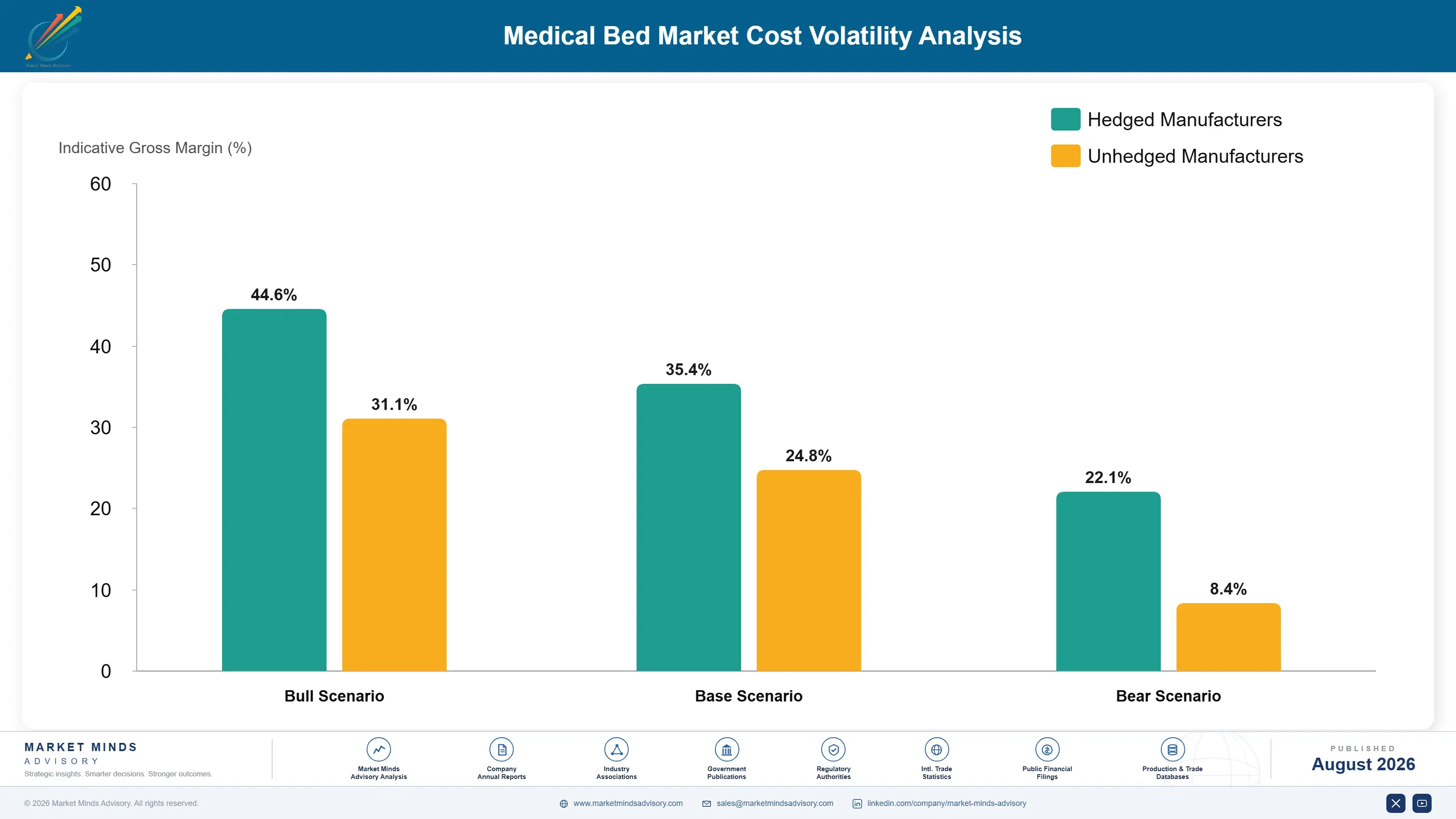
This is a steel fabrication and electromechanical assembly business with a regulated quality system attached. Steel, aluminium and fabricated components account for roughly 31% of cost of goods, sourced regionally since shipping a bed frame across an ocean is expensive relative to its value. Electric actuators, control systems and load cells add a further 22% from a concentrated group of specialist suppliers, mostly European and Asian.
Steel pricing rose sharply through 2021 and 2022 and manufacturers with fixed-price tender commitments absorbed the increase for a full contract cycle before repricing became possible. Company reporting across the hospital equipment sector documented that margin compression. Actuator and control component availability also constrained production during the same period, and freight costs on a product with very poor density relative to value made import-based supply models temporarily uneconomic.

Exposure varies most by manufacturing footprint and by how much of the transaction is frame. Manufacturers producing in Western Europe or North America carry steel, labour and compliance costs that Chinese and Eastern European producers do not face, and that gap decides price-led tenders. Participants earning much of their value from surfaces, service and rental carry less exposure, since none of those costs move with steel.
medical-bed-market-cost-volatility-analysis-1787305763241

Regional manufacturing against freight economics

A bed frame occupies substantial volume for modest value, which makes intercontinental shipping expensive and exposes import models to freight rate movement. Manufacturing or final assembly within each major region removes that exposure and shortens lead times on tender awards. Regulatory registration of additional sites is substantial work and quality consistency across them decides whether the saving survives an audit.

Index-linked pricing in multi-year tender terms

Fixed-price commitments through a steel cycle cost manufacturers a full contract period of compressed margin during recent volatility. Index-linked adjustment clauses transfer that risk to the purchaser, and public procurement bodies increasingly accept them since the alternative is suppliers pricing the risk into every bid. Negotiating the index and the trigger threshold is where most of the value is decided.

Shift value toward surfaces and service revenue

Support surfaces, service contracts, parts and rental generate revenue whose cost base moves with labour rather than with steel and freight, which materially reduces input exposure. Participants earning a substantial share of account value this way weathered recent commodity movement far better than frame-dependent competitors. Building the network is slow, which is why it holds.

Portfolio Architecture for Margin Defence

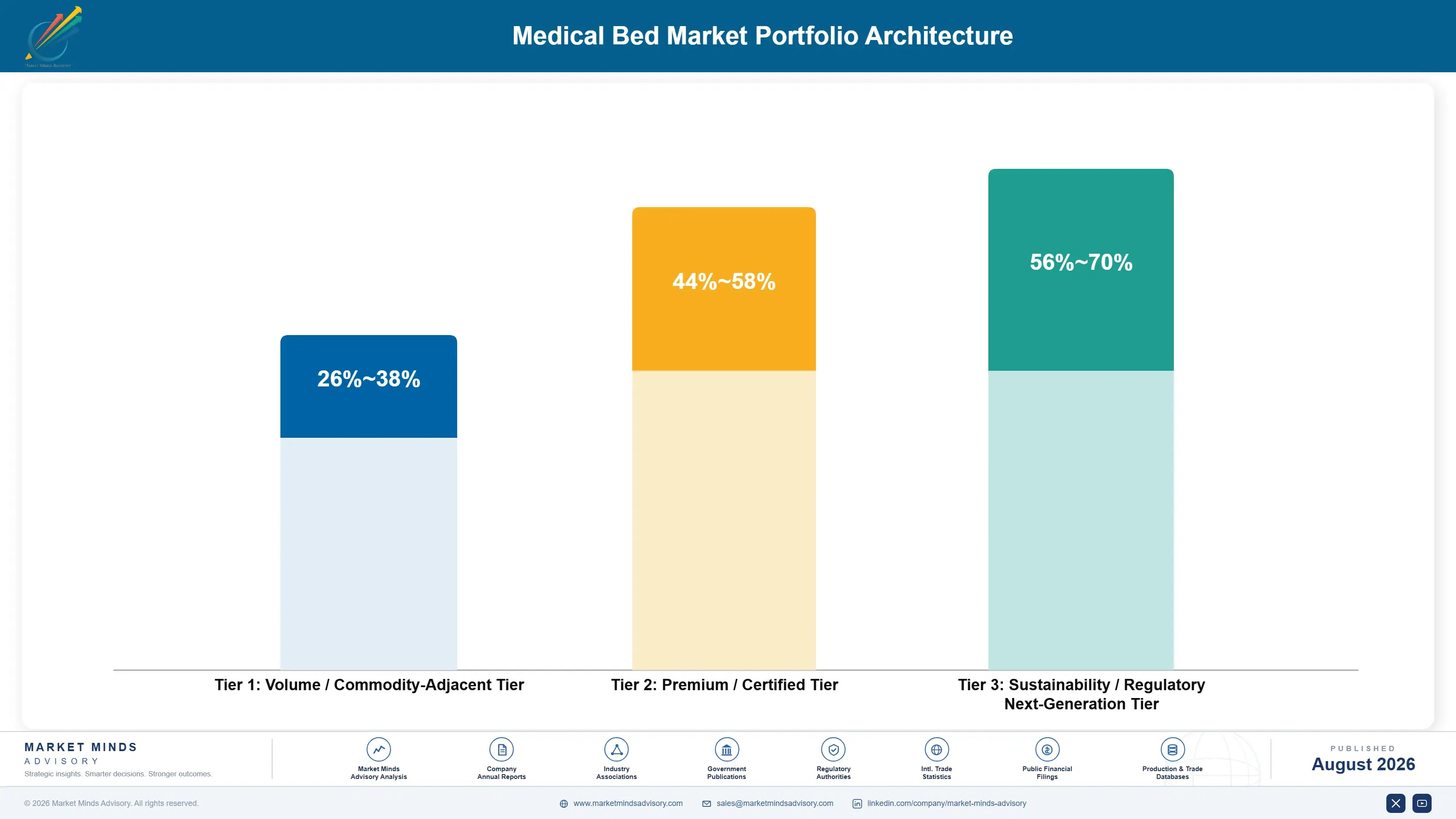
Margin architecture separates by whether procurement can substitute the item. Standard medical-surgical frames are comparable enough across established suppliers that tender treats them as interchangeable, and gross margin sits in the low thirties as a result. Specialty configurations for bariatric, critical care and burns work carry load ratings and clinical requirements that limit the supplier field, and they clear roughly twenty points higher on far smaller volume.
The tension is between volume and defensibility. Standard frames provide the manufacturing scale that supports fabrication capacity, service network coverage and tender presence, all of which the specialty business depends upon. They are also the part of the market most exposed to low-cost competition and capital deferral. Nobody has built a viable specialty-only position, and frame-only participants face steady erosion.

High-value pools concentrate where the product prevents a cost the hospital would otherwise absorb. Pressure redistributing surfaces, powered turn assistance and fall detection all sit there, because the purchase competes against unreimbursed injury cost and workers compensation rather than against a cheaper bed. Everything sold on articulation range and load rating alone competes with manufacturers whose cost base differs in kind.

Volume / Commodity-Adjacent Tier

Standard medical-surgical and long-term care frames purchased through capital tender where load rating and articulation are comparable across suppliers, and delivered price decides awards against Chinese and Eastern European manufacturers.
Gross Margin: 26-38%

Premium / Certified Tier

Critical care, bariatric and specialty configurations carrying load ratings and clinical requirements that narrow the supplier field considerably, sold on capability rather than price and generating higher service and parts revenue.
Gross Margin: 44-58%

Sustainability / Regulatory / Next-Generation Tier

Pressure redistributing support surfaces, powered turn assistance and connected monitoring, priced against unreimbursed hospital-acquired condition costs and workers compensation exposure rather than against competing bed frames. Clinical evidence rather than engineering differentiates this tier.
Gross Margin: 56-70%
medical-bed-market-portfolio-architecture-1787305763739

Who Authorises and What Recurs

Revenue arrives once every twelve years per bed and then largely stops, which is among the weakest recurring structures in hospital equipment. What redeems it is everything sold around the frame: service contracts, parts, support surface replacement on a much shorter cycle, refurbishment and increasingly connectivity subscriptions. Interviewed manufacturers put aftermarket at 22% to 30% of total account value over a bed's working life, and participants without a service network forfeit all of it
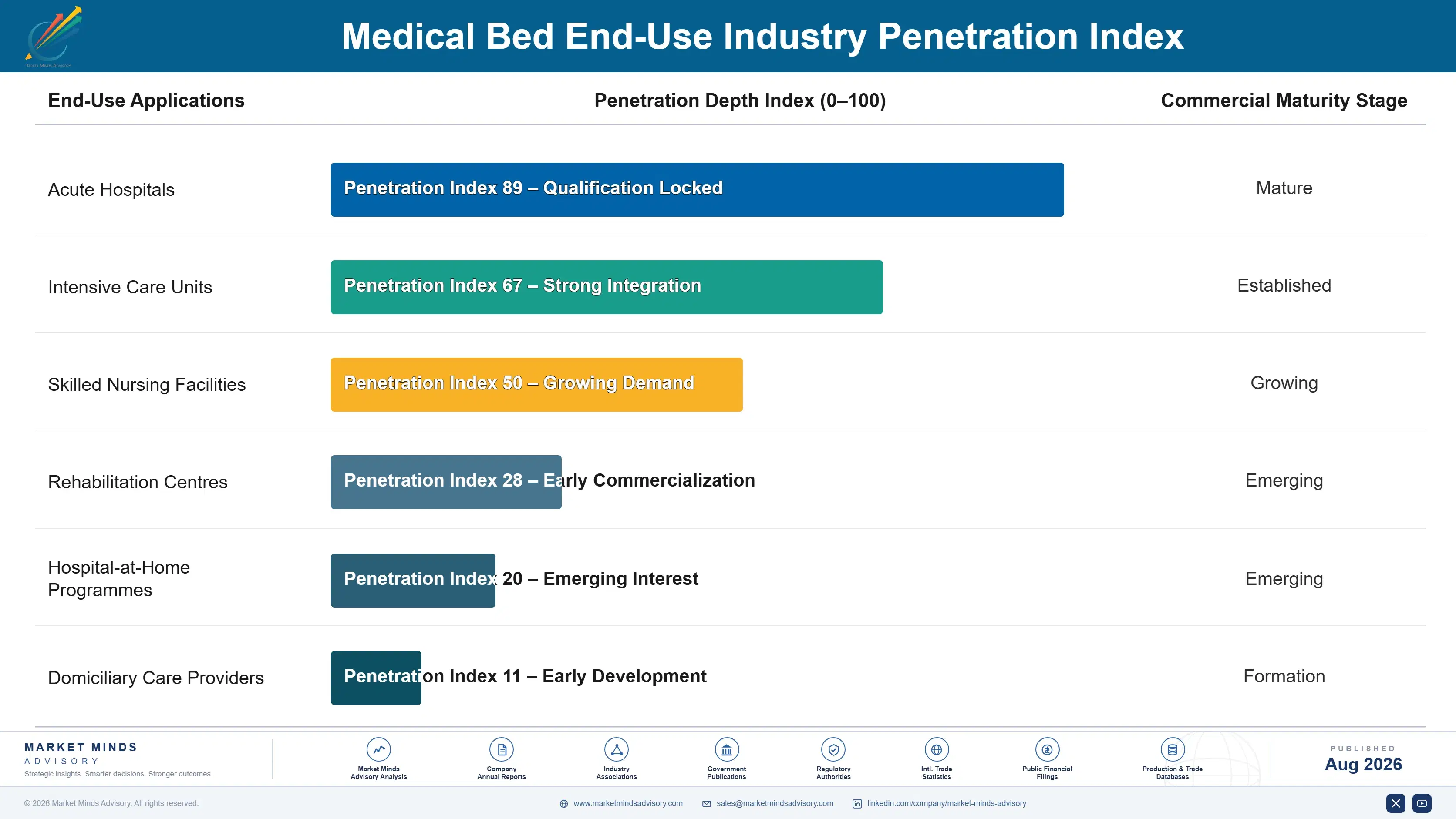
Purchasing depth varies sharply by institution type. Large hospital systems standardise across facilities and buy on multi-year framework agreements, which makes each award durable and worth pursuing with real effort. Independent hospitals buy tender by tender with little continuity between cycles. Long-term care operators buy on price with minimal specification, and home care providers rent rather than purchase. Those four buyers respond to different arguments entirely.

The authorising function has also moved. Bed purchases were once specified by nursing leadership and approved by facilities; they are now increasingly driven by finance and quality functions weighing workers compensation exposure and unreimbursed hospital-acquired condition costs. That favours suppliers who can quantify avoided cost, and commercial organisations have been slow to follow.
medical-bed-market-end-use-penetration-index-1787305764226

Where Value Actually Sits

These are among the four positions where our research anticipates prominent divergence between winners and laggards over the coming forecast period. Each is grounded in the demand model, the regulatory perimeter, and the announced capacity pipeline.
01 / SURFACE ATTACHMENT PRIORITY

The margin is above the frame, not in it

Support surfaces accompany roughly 67% of bed sales, carry the pressure injury prevention evidence that actually differentiates products, and replace on a far shorter cycle than the twelve-year frame beneath them. Manufacturers that lead commercially with frame specification compete for the least profitable element of the whole transaction and then frequently concede the surface to a specialist entirely. Interviewed suppliers reported blended margin running 12 to 18 points higher on bundled awards than on frame-only sales of otherwise comparable value.
02 / FINANCE BUDGET POSITIONING

Clinicians will say the current beds are fine

Nursing staff comparing an existing working bed against a proposed new one generally conclude that the existing bed works perfectly well, and on purely clinical grounds they are usually correct about that. Finance and quality leaders looking instead at handling injury rates near 46 per 10,000 workers and at unreimbursed hospital-acquired condition costs reach an entirely different conclusion about it. Suppliers that reframed their proposals against those specific cost lines reported capital approval rates running roughly 40% higher on otherwise comparable submissions.
03 / SERVICE NETWORK ECONOMICS

One transaction every twelve years is not a business

A capital bed sale generates a single transaction and then nothing for over a decade, which is a poor commercial structure regardless of the unit price achieved on the award. Service contracts, parts, surface replacement, refurbishment and connectivity subscriptions together contribute 22% to 30% of total account value across a single bed's working life. Participants without a field service network capture the single transaction alone and forfeit the rest, and building such a network is expensive enough to remain genuinely defensible.
04 / RENTAL CHANNEL ACCESS

Hospital-at-home cannot be reached by selling beds

Care delivered at hospital level in a patient's own home compounds at 8.4% and requires clinical-grade equipment placed, maintained and then recovered between admissions rather than purchased outright. No health system wants to own beds sitting idle in a warehouse between placements, so manufacturers offering only capital sale models find the channel simply closed to them. The service infrastructure required to serve that channel properly is substantial, and that requirement is precisely what makes an established position in it durable.

Engagement Snapshot From the Field

A live engagement with an industry participant carrying material or product regulatory and market exposure ahead of a defining policy shift, showing how our research translates into a defensible multi-year portfolio strategy.
MARKET MINDS ADVISORY · CLIENT ENGAGEMENT SUMMARY
Medical Bed Producer Strategic Portfolio Review and Transition Roadmap 2026·Investment Scenario on Medical Bed Exposure Evaluation 2025-26
CLIENT PROFILE
A medical bed manufacturer with annual revenue near $380 million (client-reported, unverified by MMA), producing acute and long-term care frames at two European plants and selling primarily through public hospital tender across eight countries. Frame pricing had eroded for four consecutive years against Chinese and regional competitors, and leadership wanted to understand whether the position could be defended or whether the business needed a different revenue structure.
STRATEGIC CHALLENGE
Competing on frame price against manufacturers with materially lower cost bases was not winnable, and the company had no meaningful support surface portfolio and only a limited field service organisation. Leadership needed to know which adjacent revenue would be reachable within three years, and whether tender customers would actually pay for bundled offerings rather than unbundling and buying the cheapest frame available.
MMA APPROACH
We analysed 340 tender awards across eight markets to separate price-led outcomes from those weighted on service and total cost of ownership. Twenty-six hospital procurement and facilities leaders were interviewed on bundling appetite and evaluation criteria. We modelled a support surface entry, a service network build and a rental programme against the existing frame-only structure.
KEY FINDINGS
  1. Frame-only awards had declined from 71% to 54% of tender volume across the period examined, with the balance moving toward bundled evaluations weighted on total cost of ownership.
  2. Procurement leaders in twelve of twenty-six institutions said they would accept a bundled award but had never been offered one credibly, since incumbent suppliers bid frames and surfaces separately.
  3. Support surface margins in the markets examined ran 18 to 24 points above frame margins, and replacement cycles were roughly a third the length of the bed's working life.
  4. Building a field service network to competitive coverage modelled at four years and a cost the company could not fund alongside a surface portfolio launch simultaneously.
CLIENT PROFILE
A medical bed manufacturer with annual revenue near $380 million (client-reported, unverified by MMA), producing acute and long-term care frames at two European plants and selling primarily through public hospital tender across eight countries. Frame pricing had eroded for four consecutive years against Chinese and regional competitors, and leadership wanted to understand whether the position could be defended or whether the business needed a different revenue structure.
STRATEGIC CHALLENGE
Competing on frame price against manufacturers with materially lower cost bases was not winnable, and the company had no meaningful support surface portfolio and only a limited field service organisation. Leadership needed to know which adjacent revenue would be reachable within three years, and whether tender customers would actually pay for bundled offerings rather than unbundling and buying the cheapest frame available.
MMA APPROACH
We analysed 340 tender awards across eight markets to separate price-led outcomes from those weighted on service and total cost of ownership. Twenty-six hospital procurement and facilities leaders were interviewed on bundling appetite and evaluation criteria. We modelled a support surface entry, a service network build and a rental programme against the existing frame-only structure.
KEY FINDINGS
  1. Frame-only awards had declined from 71% to 54% of tender volume across the period examined, with the balance moving toward bundled evaluations weighted on total cost of ownership.
  2. Procurement leaders in twelve of twenty-six institutions said they would accept a bundled award but had never been offered one credibly, since incumbent suppliers bid frames and surfaces separately.
  3. Support surface margins in the markets examined ran 18 to 24 points above frame margins, and replacement cycles were roughly a third the length of the bed's working life.
  4. Building a field service network to competitive coverage modelled at four years and a cost the company could not fund alongside a surface portfolio launch simultaneously.
RECOMMENDED STRATEGY
Phase 1: Phase one: enter support surfaces through a licensing or distribution arrangement rather than internal development, reaching bundled tender capability within twelve months. Phase 2: Phase two: build field service coverage in the three markets producing the highest tender volume, rather than pursuing coverage across all eight at once. Phase 3: Phase three: pilot a rental programme with two hospital-at-home providers, testing the channel before committing to fleet investment at any scale.
OUTCOME
The surface distribution arrangement went live in nine months and attached to roughly 30% of new frame awards in its first year (client-reported, unverified by MMA). Bundled bids won three tenders the company would previously have lost on frame price alone. Service network build began in two markets rather than three, on capital discipline grounds.

Frequently Asked Questions

Foundational context covering the market sizes, CAGR, scope, country, region and competition that inform every finding below. This section is provided to cover basics and most often pre-purchase conversations, answered from the MMA Primary Research Dataset.

What is the current size of the Medical Bed Market?

The global market is valued at $4.1 billion in 2025, rising to $4.33 billion in 2026. East Asia holds the largest share at 33%, reflecting a hospital bed count larger than any other region's.

How large will the Medical Bed Market be by 2036?

MMA forecasts $7.47 billion by 2036, an increase of $3.14 billion over the 2026 base and an expansion multiple of 1.72x. Home care and specialty configurations carry most of that increase.

What is the CAGR for the Medical Bed Market 2026 to 2036?

The base case compound annual growth rate is 5.6%, with a bull case at 6.8% and a bear case at 4.4%. Historical growth from 2020 to 2025 ran near 4.6% and was unusually lumpy.

Which segment is growing fastest?

Home care beds compound at 8.4%, a full 1.50x the market rate. Hospital-level care delivered at home is converting from temporary waiver programmes into funded service lines across several health systems.

Who are the major companies in the Medical Bed Market?

Baxter, Stryker, Linet Group, Arjo and Paramount Bed together hold 58% of revenue from medical bed and support surface products. Service networks and load certification rather than manufacturing capability separate them.

Which country is growing fastest?

India compounds at 9.2%, faster than any other country covered, on private hospital group expansion adding bed capacity at a rate no developed market approaches. Domestic manufacturers supply most of that demand.

Report Segmentation Architecture

The full report scope spans multiple orthogonal segmentation dimensions, with cross-tabulated demand data provided for each dimension pair. Coverage extends further to regional breakdowns, trend trajectories, and the competitive detail needed to support segment-level decision-making.

By Bed Class

  • Acute Care and Medical-Surgical Beds
  • Intensive and Critical Care Beds
  • Long-Term and Skilled Nursing Beds
  • Home Care Beds
  • Bariatric and Specialty Beds
  • Birthing and Paediatric Beds

By End-Use Industry

  • Acute Hospitals
  • Intensive Care Units
  • Skilled Nursing Facilities
  • Rehabilitation Centres
  • Hospital-at-Home Programmes
  • Domiciliary Care Providers

By Commercial Dimension

  • Capital Tender Procurement
  • Group Purchasing Organisation Agreements
  • Rental and Managed Equipment Programmes
  • Direct Institutional Sales
  • Distributor and Dealer Supply
  • Aftermarket Service and Parts

By Region

  • East Asia
  • North America
  • Western Europe
  • South Asia and Pacific
  • Latin America
  • Middle East and Africa
  • Eastern Europe

Scope, Methodology, and Coverage

Every figure in this report is reproducible from documented input assumptions. The scope below maps the historical period, the forecast horizon, the segmentation dimensions, and the countries covered, alongside the underlying primary and qualitative methodology.
Historical Period
2020 to 2025
Forecast Period
2026 to 2036
Base Year
2025 (USD billions; MMA Primary Research Dataset, August 2026)
Market Definition
This market comprises powered and manually adjustable beds designed for patient care, measured at manufacturer revenue across capital tender procurement, group purchasing organisation agreements, rental and managed equipment programmes, direct institutional sales, distributor and dealer supply, and aftermarket service and parts. Coverage spans acute care and medical-surgical beds, intensive and critical care beds with advanced positioning and integrated monitoring, long-term and skilled nursing beds, home care beds serving both domiciliary and hospital-at-home use, bariatric and specialty beds rated for extended weight capacity and complex wound or burns care, and birthing and paediatric beds, together with support surfaces and pressure redistributing mattresses sold with them. Examination and procedure tables, operating tables, stretchers and patient transport trolleys, ceiling and floor patient lifts and transfer devices sold separately from beds, wheelchairs and mobility equipment, standalone mattresses sold through consumer retail channels, and furniture without patient care articulation fall outside scope.
Quantitative Units
USD millions (current prices); units shipped by bed class; installed bed base; average selling price by class; support surface attachment rate; service life; aftermarket revenue share
Segmentation Dimensions
By Bed Class; By End-Use Industry; By Commercial Dimension; By Region
Regions Covered
East Asia, North America, Western Europe, South Asia and Pacific, Latin America, Middle East and Africa, Eastern Europe
Countries Covered
China, Japan, South Korea, Taiwan, United States, Canada, Germany, France, United Kingdom, Italy, Spain, Netherlands, Sweden, Denmark, Switzerland, India, Australia, Indonesia, Vietnam, Philippines, Thailand, Malaysia, Brazil, Mexico, Argentina, Chile, Colombia, Saudi Arabia, United Arab Emirates, Egypt, South Africa, Poland, Czechia, Hungary, Romania, Turkey, and additional markets relevant to hospital equipment analysis
Key Companies Profiled
Baxter, Stryker, Linet Group, Arjo, Paramount Bed, Invacare, Joerns Healthcare, Malvestio, Favero Health, Merivaara, Stiegelmeyer, Gendron, Medline Industries, Getinge, Savion Industries, Amico Group, France Bed, Shandong Yongsheng, Jiangsu Saikang Medical, Drive DeVilbiss Healthcare
Quantitative Methodology
Primary survey, n=3,800 respondents, Q4 2025, six countries; demand-side model with trade association cross-validation
Qualitative Methodology
47 expert interviews, Q4 2025; applied to validate demand model assumptions, identify emerging dynamics, and assess competitive positioning
Report Format
PDF and XLSX data workbook (Word format preview document)
Publisher
Market Minds Advisory
Report Code
MMA-2026-MED-472
Published
August 2026
Contact
sales@marketmindsadvisory.com | www.marketmindsadvisory.com

Purchase the full Medical Bed Market Report (2026 to 2036).

The full MMA report treats the bed as labour equipment and liability control rather than as furniture, quantifying how handling injury cost and unreimbursed hospital-acquired conditions drive specification. It sizes six bed classes and seven regions to 2036, modelling units shipped, installed base, pricing by class, support surface attachment, service life and aftermarket revenue separately. Competitive assessment covers twenty manufacturers on one consistent revenue basis. Cost exposure is traced through steel, actuators and freight. Four commercial levers and a strategic verdict close the report, grounded in 47 expert interviews and a 3,800-respondent survey.
Six bed classes sized separately through 2036
Tender award patterns analysed across price and bundled evaluations
Support surface attachment quantified against frame award volume
Twenty manufacturers assessed on one consistent revenue basis
Hospital-at-home channel modelled through rental rather than capital sale
Anonymised manufacturer engagement with tested commercial recommendations

Built For The People Who Decide

From boardroom strategy to bench-side execution, this report is read cover-to-cover by leaders shaping the next decade of their industry, turning demand scenarios, market dynamics and valuation benchmarks into decisions.
CXOs/ Presidents/ VPs/ Managers
M&A and Corporate Development
Strategy Teams and R&D Heads
Procurement and Product Directors
Regulatory and Compliance Leaders
Investor Relations and Equity Analysts