
Market Minds Advisory
Malaria Ag Rapid Testing Market

Malaria Ag Rapid Testing Market: Gene Deletion, Donor Pricing, and the Antigen Switch

The parasite is deleting the gene that makes the dominant test work, and roughly nine in ten of those tests are bought by donor programmes that set the price themselves.

Lead Analyst

Alice Ballenger

Published

August 2026

Make Smarter Decisions with Customized Research Insights

Request a free sample report and evaluate market opportunities, growth trends, and competitive dynamics relevant to your business needs.

2025 MARKET VALUE$0.2BMarket Size 2025
2036 FORECAST VALUE$0.5BBase Case , 2026 to 2036
CAGR 2026 TO 20366.2 %Bull 7.4% / Bear 5.0%
INCREMENTAL OPPORTUNITY$0.2BNet 10- year value creation
EXPANSION MULTIPLE1.88x2036 value over 2026 base
Strategic Levers
M&A Pipeline
Regional Outlook
Country Rankings
Competitive Intelligence
Segmental Deep-dive
Call-Us : 91 93563 13602

Executive Snapshot and Market Trajectory

Falciparum parasites across the Horn of Africa have deleted the genes producing the antigen that most rapid tests detect, which makes those infections invisible to 68% of the tests in use. The organism is selecting against the diagnostic. Deleted strains escape treatment too, which makes the spread self-reinforcing.
pLDH-only tests compound at 9.3%, a full 1.50x the market rate, because that antigen is essential to parasite metabolism and cannot be deleted the way the dominant target has been. Middle East and Africa holds 54% of value, far above the standard band, because sub-Saharan Africa carries the overwhelming majority of global malaria burden and consumes tests accordingly. Ethiopia compounds at 11.4% on replacement of existing stock.
Concentration is high at 71% and roughly 87% of tests are bought by donor programmes through pooled procurement at around USD 0.42 each. No manufacturer sets a price here, which makes this a tender business with public health consequences rather than a commercial diagnostics market. Switching to alternative antigens costs more per test, so a market with no pricing power is being asked to fund a transition that public health rather than any customer requires.
Market Definition
This market covers antigen-based rapid diagnostic tests for malaria, spanning HRP2-only tests, HRP2 and pLDH combination tests, pLDH-only tests, aldolase and pan-species antigen tests, and ultra-sensitive HRP2 tests, measured at manufacturer revenue including donor and national programme procurement. Microscopy consumables and equipment, molecular and isothermal amplification tests for malaria, antimalarial medicines, vector control products, serological antibody tests, and laboratory quality assurance services are excluded.
Base Year Value
$0.2B in 2025 (MMA Primary Research Dataset, August 2026)
Forecast Period
2026 to 2036, eleven discrete annual values
CAGR
6.2% base case. Bull 7.4%. Bear 5.0%.
Fastest Growth Segment
pLDH-Only Tests: 9.3% CAGR
Fastest Growth Country
Ethiopia: 11.4% CAGR
Fastest Growth Region
South Asia and Pacific: 8.2% CAGR
Largest Region
Middle East and Africa: 54% of 2025 global value
Market Leaders
Abbott, SD Biosensor, Access Bio, Premier Medical Corporation, and Zephyr Biomedicals. Source: MMA Primary Research Dataset, July 2026.
Primary Survey
n=3,800 procurement and R&D decision-makers, Q4 2025, six countries
Methodology
Demand-side build-up, cross-validated against public data, 47 expert interviews

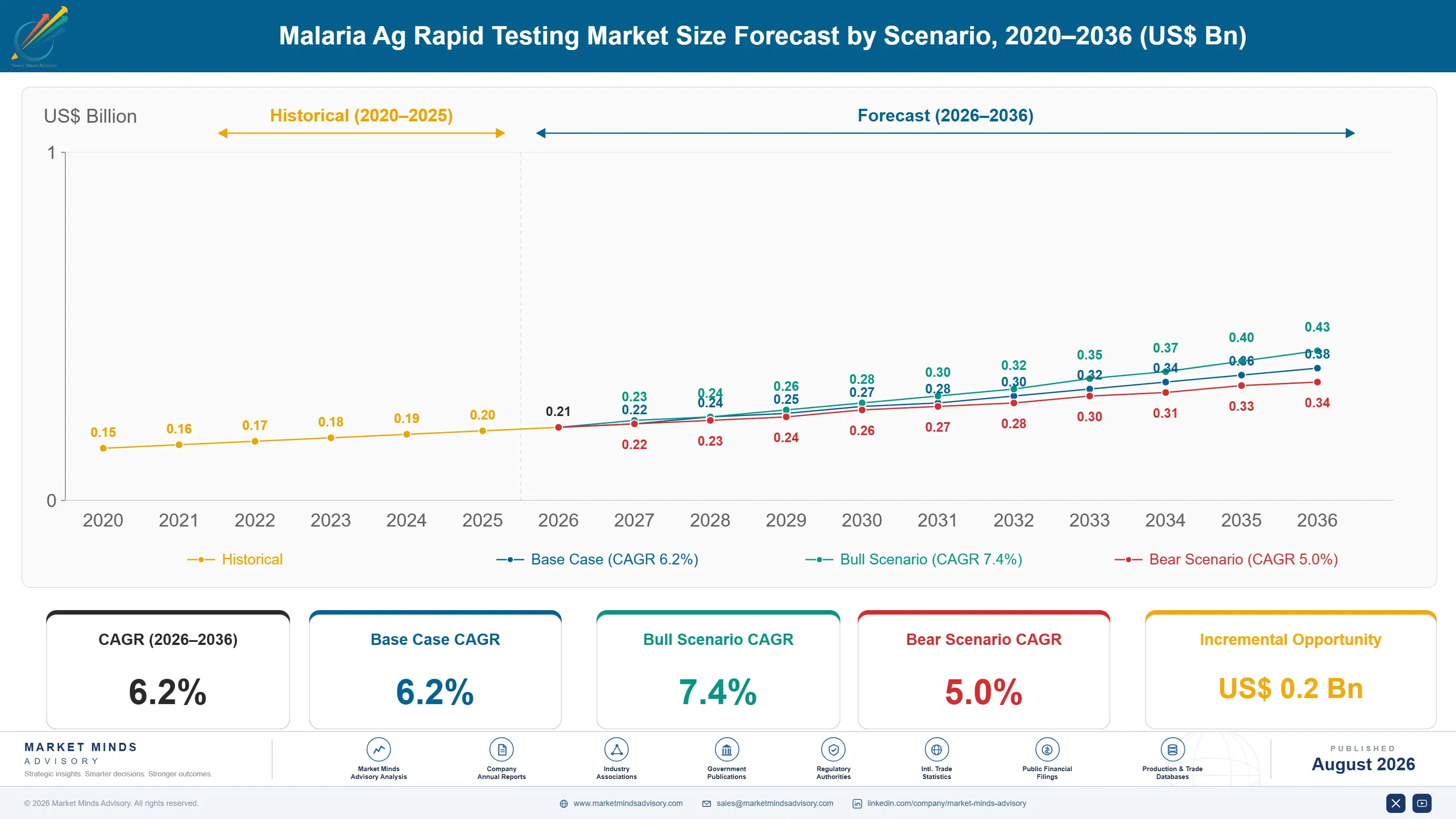
Malaria Ag Rapid Testing Market Forecast Scenarios

malaria-ag-rapid-testing-market-size-forecast-scenario-1787305750683
Growth ran near 5.2% from 2020 to 2025 on volume that barely moved and a mix that shifted considerably. Test numbers held broadly steady as programmes maintained coverage, while procurement prices stayed under sustained pressure from pooled tendering. Composition changed instead, as Horn of Africa countries switched antigen after surveys found false negatives above the threshold triggering a national change.
Base case growth of 6.2% rests on three mechanisms. Antigen switching continues as deletion surveys extend beyond the Horn of Africa and more countries cross the threshold requiring a change. Combination tests detecting two antigens replace single-target products as a pragmatic hedge, and they cost more. And case volumes in high-burden countries remain stubbornly high, which sustains testing demand even where elimination programmes had expected reductions. None of the three depends on the others.
The bull case at 7.4% assumes deletion surveillance expands sharply and drives faster conversion toward higher-priced combination and pLDH products across a wider set of national programmes. The bear case at 5.0% is a funding story: international health financing for malaria contracts, procurement volumes fall with it, and a market where 87% of tests are donor-purchased has no commercial demand underneath to absorb that.

Malaria Rapid Tests: Deletion, Donors and Antigens

Something unusual is happening in this market. Falciparum parasites in Eritrea, Ethiopia, Djibouti and increasingly elsewhere have deleted the genes producing histidine-rich protein 2, which is the antigen that 68% of malaria rapid tests detect. Those infections return a negative result on a test that works perfectly. False negative rates in affected populations reach near 12%, and deleted strains escape detection and treatment, which gives them a selective advantage.
TOP FIVE CONCENTRATION71%Concentrated among prequalified manufacturers winning pooled procurement tenders
ANNUAL TEST VOLUME410 millionRapid diagnostic tests distributed to malaria programmes worldwide each year
AVERAGE PROCUREMENT PRICEUSD 0.42Blended price across pooled donor and national programme purchasing
DONOR FUNDED SHARE87%Tests purchased through international financing rather than national health budgets
HRP2 TEST SHARE68%Tests detecting only the antigen now subject to deletion
DELETION PREVALENCE AFFECTED12%False negative rate observed across surveyed populations in affected regions
The World Health Organization set a threshold: once false negatives from deletion exceed 5% of falciparum cases, a country should switch to tests detecting a different antigen. Eritrea did so nearly a decade ago and others have followed. This is a diagnostic defeated by evolution rather than by any competitor. Deletion surveys keep identifying the trait in places nobody had examined.
The economics sit awkwardly against that. Roughly 87% of the 410 million tests distributed annually are bought by international financing mechanisms through pooled procurement at around USD 0.42 each, so no manufacturer sets a price and margins are thin throughout. Switching antigen costs more per test, and a market with no pricing power is being asked to fund that transition.
"The parasite is doing what parasites do, and the procurement system is doing what procurement systems do, and those two facts point in opposite directions. Somebody has to pay for tests that cost more, and nobody in this market has ever had the ability to charge more."
Principal Analyst, Global Health Diagnostics and Infectious Disease Practice · M

Market Trends

Gene deletion forces national antigen switching decisions

Falciparum parasites lacking the histidine-rich protein 2 genes return negative results on tests that detect only that antigen, and surveys across the Horn of Africa found false negative rates reaching roughly 12% in affected populations. Guidance sets a 5% threshold at which a country should change test type, and several have. Deleted strains escape detection and therefore treatment, which gives them a selective advantage and makes the spread self-reinforcing rather than incidental. Surveillance coverage remains patchy across much of the affected transmission belt, which means many programmes are switching on precaution rather than on local evidence they can actually obtain.
Market Impact: Ethiopia compounding at 11.4% annua
Combination tests replace single antigen products as a hedge

Tests detecting both histidine-rich protein 2 and parasite lactate dehydrogenase catch deleted strains without abandoning the sensitivity that made the original antigen dominant, which makes them the pragmatic response for programmes uncertain about local deletion prevalence. They cost more per test than single-target products in a market procuring at roughly USD 0.42. Programmes are increasingly specifying them by default rather than waiting for survey data that may take years to arrive. Manufacturers holding current prequalification across both configurations capture those conversions, and prequalification takes considerably longer than the window a survey result creates for anybody reacting to it.
Market Impact: Donor funding covering 87% of tests

Market Opportunities and Growth Drivers

African case burden sustains testing volume despite elimination efforts

Sub-Saharan Africa carries the overwhelming majority of global malaria cases and deaths, and case numbers have proved considerably more stubborn than elimination targets assumed, with insecticide resistance and funding constraints both slowing progress. Roughly 410 million tests are distributed annually and that figure has not fallen. Ethiopia compounds at 11.4% as antigen switching drives replacement of existing stock alongside continuing programme coverage across a large and heavily affected population. Community health worker programmes carry tests into villages rather than requiring patients to reach a facility, which is where most of that volume actually goes.
Market Impact: Pooled tenders setting USD 0.42

Testing before treatment remains the governing clinical policy

Guidance requires parasitological confirmation before antimalarial treatment rather than presumptive treatment of any febrile illness, which is what created this market and what sustains it. That policy protects artemisinin combination therapies from resistance pressure and directs treatment toward patients who actually have malaria. Roughly 87% of tests are donor-funded on exactly that rationale, since the diagnostic exists to protect a drug supply that international programmes also fund and depend upon. Presumptive treatment of febrile illness would consume far more antimalarial supply and accelerate resistance, which is why funders treat the diagnostic as protecting the therapy.
Market Impact: Exposure across 87% of volume

Market Restraints and Challenges

Pooled donor procurement removes all manufacturer pricing power

Roughly 87% of tests are purchased through international financing mechanisms using pooled tendering at around USD 0.42 each, which sets price centrally and leaves manufacturers competing purely on cost and prequalification status. The root cause is that the disease burden and the ability to pay sit in entirely different places. Commercial impact is margins too thin to fund the technical transition that antigen switching requires. Manufacturers respond by pursuing volume scale, manufacturing automation and adjacent test menus. Automation and internal antibody production are the only levers that actually move a bid.
Market Impact: False negatives reaching 12%

International health financing contraction threatens procurement volumes

A market where 87% of purchases are donor-funded has no commercial demand underneath to absorb a funding reduction, and international health financing for malaria has faced genuine disruption. The root cause is that national health budgets in high-burden countries cannot fund testing at anything like current volumes. Commercial impact would be immediate and severe rather than gradual. Manufacturers are responding by diversifying test menus, pursuing national budget sales and building non-malaria product lines. Lateral flow capacity does not readily convert to anything else, so idle plant is the realistic consequence.
Market Impact: Procurement priced near USD 0.42
3 additional market trends, 4 additional growth drivers, and 2 additional restraints and challenges are covered in the full report. Contact sales@marketmindsadvisory.com to access the complete intelligence.

Segment CAGR and Growth Architecture

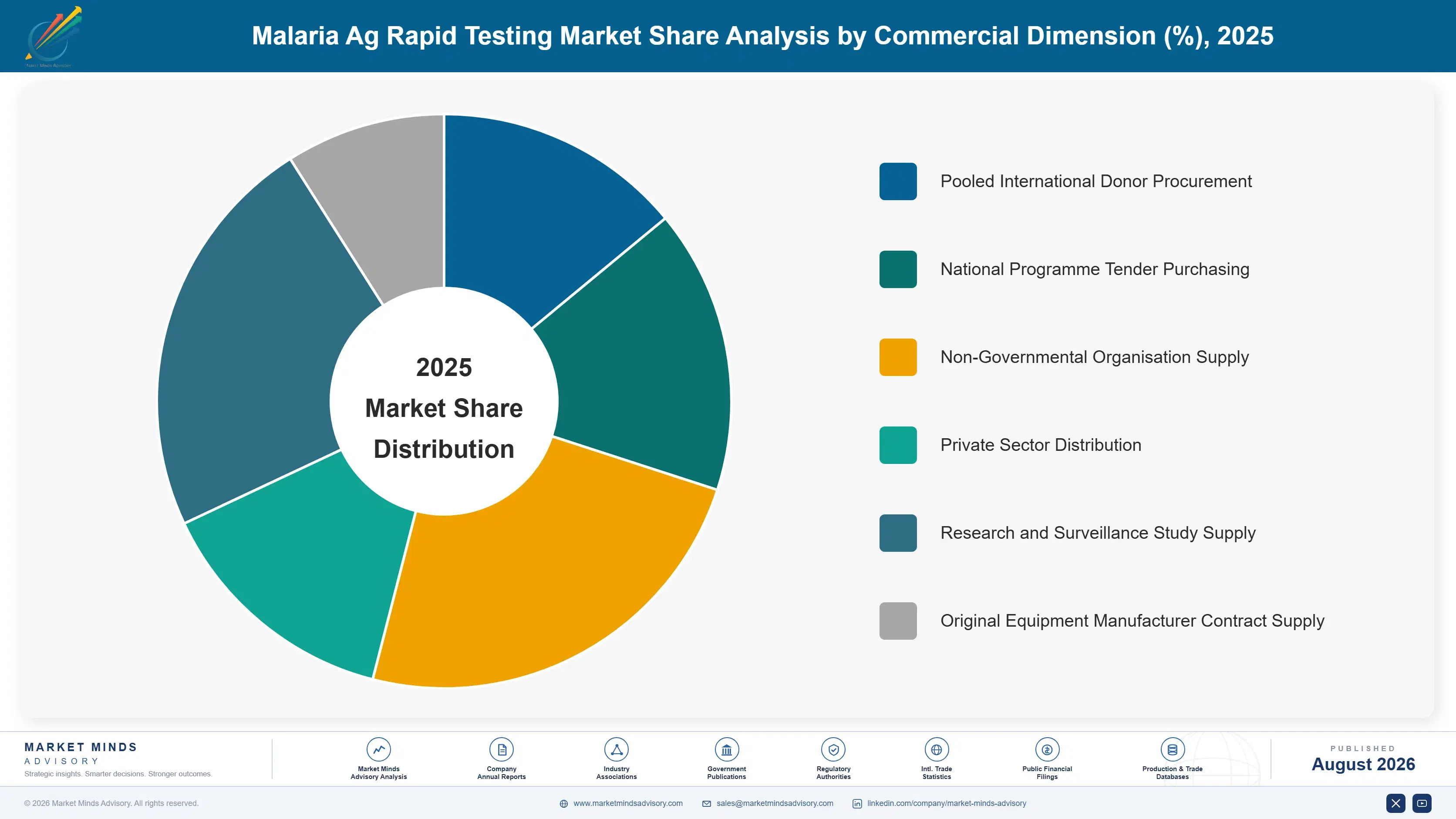
Segmentation follows antigen target, because the target determines whether a test detects deleted parasite strains, how sensitive it is at low parasite density, which species it identifies and what it costs to manufacture. Five antigen configurations cover malaria rapid test supply without overlap. Programme setting and species prevalence cut across every configuration and are treated as use attributes.
malaria-ag-rapid-testing-market-market-share-analysis-1787305751217

pLDH-Only Tests

Growing at 9.3%, a full 1.50x the market rate, tests detecting parasite lactate dehydrogenase alone target an enzyme essential to parasite metabolism, which cannot be deleted the way histidine-rich protein 2 has been without the organism losing viability. That makes the segment the direct answer to a diagnostic problem the parasite created. Sensitivity at very low parasite density trails the dominant antigen, which matters in asymptomatic screening but far less in symptomatic case management. Manufacturing cost is higher, and in a market procuring at roughly USD 0.42 per test that difference is commercially significant. Antibody supply for this target costs more than the long-established alternative, which compounds the cost difference further.
CAGR 9.3%

HRP2 and pLDH Combination Tests

Combination tests grow at 8.4% by detecting both antigens on a single strip, which catches deleted strains without giving up the low-density sensitivity that made histidine-rich protein 2 the dominant target originally. For programmes uncertain about local deletion prevalence, and most are because surveillance is patchy, this is the pragmatic choice rather than a compromise. Cost per test exceeds single-target products in a market with no pricing power at all. Programmes increasingly specify these by default rather than waiting for survey data that may take years to reach them. Manufacturers holding current prequalification for this configuration capture whole national conversions when survey results arrive, and those reacting afterwards arrive after the tender has already closed.
CAGR 8.4%
Full segment breakdown across 5 segments available in the complete report.

Regional Architecture and Country Demand Map

Regional shares here follow malaria burden alone, which places almost the entire market in regions that fund very little of it themselves. Note: five regional positions consequently sit far outside standard bands. Disease burden and ability to pay sit in entirely different places here. Burden alone sets it.

Middle East and Africa

The largest share at 54%. Note: this sits far above the standard regional band because sub-Saharan Africa carries the overwhelming majority of global malaria cases and deaths, and consumes rapid tests in proportion to that burden. Nigeria and the Democratic Republic of the Congo account for the greatest volume. Ethiopia compounds at 11.4% as antigen switching drives replacement of existing stock across a heavily affected population. Deletion surveillance across the Horn of Africa produced the findings that started the transition, and it continues extending westward. Community health worker distribution carries most of that volume into villages rather than through facilities. Deletion surveillance across the Horn produced the findings that began the transition, and it keeps extending westward across the continent.
Share: 54% | CAGR: 6.4% (2026 to 2036)

South Asia and Pacific

Twenty-two per cent of value and the fastest regional growth at 8.2%. Note: this greatly exceeds the standard band because India, Indonesia, Papua New Guinea and Myanmar all carry substantial malaria burden with active national programmes. Indian manufacturing supplies a large share of global test volume alongside domestic demand, and several prequalified producers operate from there. Vivax malaria is far more prevalent across the region than in Africa, which shifts the antigen requirement toward pan-species and species-differentiating tests rather than falciparum-specific products. Indian producers compete directly on assembly and moulding cost positions that Korean and Western manufacturers cannot approach, which is why so much global supply originates there. Several prequalified producers operate from India.
Share: 22% | CAGR: 8.2% (2026 to 2036)
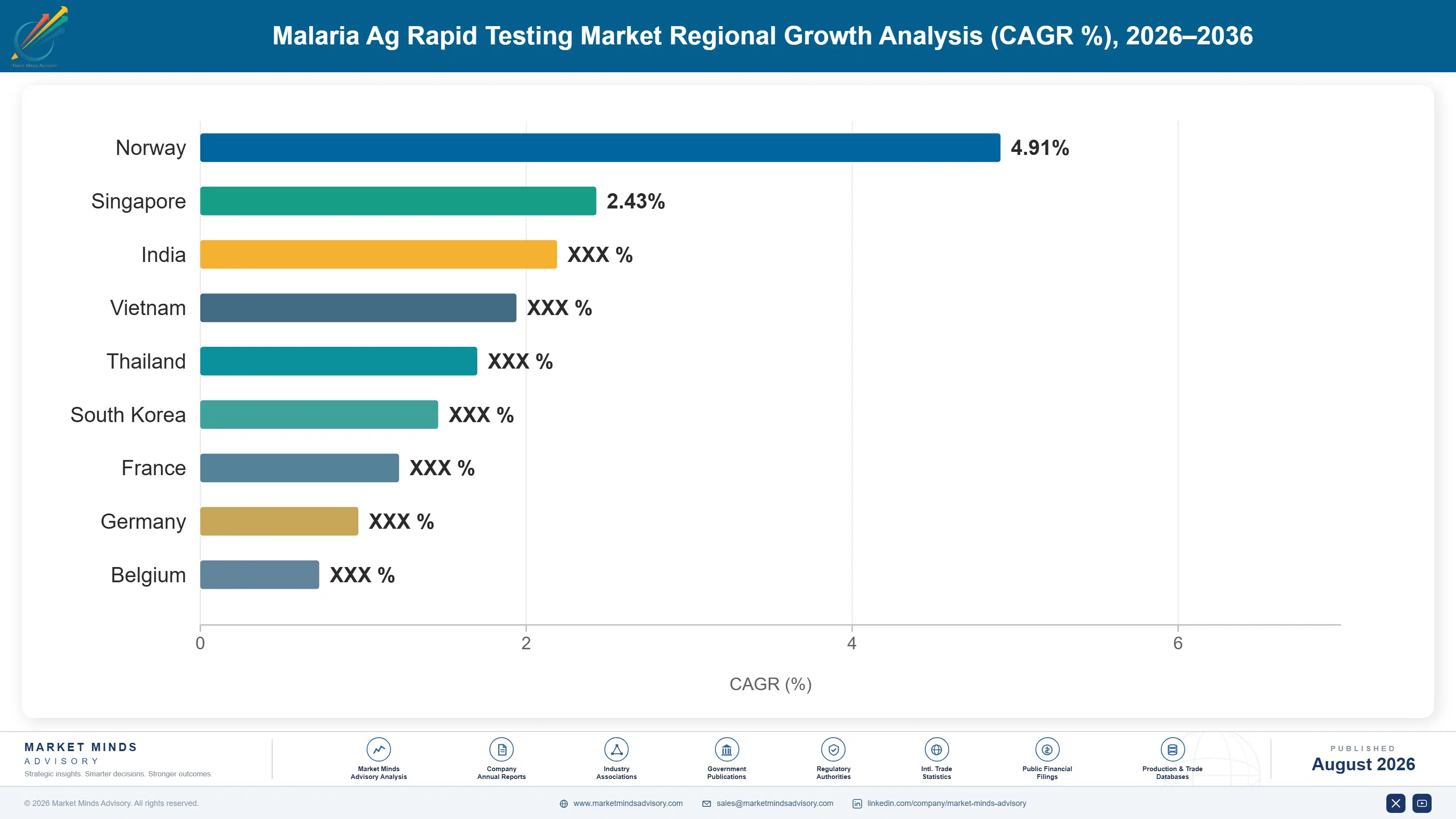
Regional intelligence for 5 additional markets available in the complete report: North America, Latin America, East Asia, Western Europe, Eastern Europe. Contact sales@marketmindsadvisory.com.
malaria-ag-rapid-testing-market-country-cagr-analysis-1787305751735

Where Malaria Test Suppliers Hold Ground

Donor programmes buy 87% of tests at prices they set, so nobody here has commercial pricing power. Position depends instead on prequalification status, on manufacturing cost, and on being ready with the antigen configuration that programmes are about to be required to buy. Nothing commercial reaches the purchasing decision. Only prequalification and cost matter.

Be ready when a programme crosses the switching threshold

Guidance sets a 5% false negative threshold at which a national programme should change antigen type, and surveys keep finding deletions in new places. Manufacturers holding prequalified pLDH and combination products when a country crosses that line capture a full national conversion, while those holding only single-antigen stock lose one. Ethiopia compounds at 11.4% substantially on that replacement cycle. Prequalification takes far longer than the decision window a survey result creates. Reacting after a survey result arrives is reacting too late. A survey result creates a decision window shorter than the qualification process itself.
Market Impact: Switching triggered above a 5% fals

Compete on manufacturing cost, because price is set elsewhere

Roughly 87% of tests are bought through pooled tendering at around USD 0.42 each, which means no commercial argument reaches the purchasing decision at all beyond prequalification status and delivered cost. Automation, nitrocellulose sourcing scale and yield improvement are what determine whether a manufacturer can bid profitably. Suppliers investing in clinical differentiation for a tender that scores on price and quality gates alone are funding an argument nobody in the process will hear. Indian and Chinese assembly cost positions set the bar everyone else must reach. Prequalification status is the only other criterion scored.
Market Impact: Tenders clearing near USD 0.42 for

Diversify the menu against funding concentration

A market with 87% donor funding and no commercial demand underneath is exposed to financing decisions made entirely outside it, and international health funding for malaria has already faced genuine disruption. Manufacturers producing tests for other conditions on the same lateral flow lines spread that exposure without new capital. Those whose capacity serves malaria alone face idle plant if procurement contracts, and lateral flow manufacturing does not readily convert to anything else. Shared lateral flow lines spread the exposure without new capital. Idle lateral flow plant does not convert to anything else.
Market Impact: Exposure now covers 87% of all cate

Hold prequalification across the full antigen range

Programme procurement requires prequalified products, and the process is slow enough that a manufacturer reacting to a switching decision arrives after the tender has closed. Holding current prequalification across single-antigen, combination and pLDH configurations covers whichever way a national programme moves. The cost is regulatory maintenance rather than manufacturing investment, and it is trivial against the volume a single national conversion across 410 million annual tests can represent. A single national conversion can represent very substantial volume. Regulatory maintenance costs a fraction of what a lost conversion does. Reacting later means arriving after allocation.
Market Impact: Covers volume across 410 million an

Who Controls the Margin Pool

Concentration is high at 71% across the top five, measured on annual revenue from malaria antigen rapid tests, the single basis applied throughout this analysis. Abbott and SD Biosensor lead through different strengths, the first on brand recognition and prequalification depth built over many years of programme supply, the second on Korean manufacturing scale that wins pooled procurement tenders where delivered cost decides the outcome.
Competition looks nothing like a commercial diagnostics market. Pooled tendering scores on prequalification status, lot testing performance and delivered price, and no clinical argument reaches the decision. Manufacturers compete on cost position and on holding the right antigen configurations when a programme switches. Relationships with international financing mechanisms and their procurement agents matter more than any relationship with a laboratory or clinician.

Pressure builds from two directions that arrive together. Antigen switching rewards manufacturers holding prequalified pLDH and combination products and penalises those weighted toward single-antigen stock. Separately, international health financing disruption threatens the procurement volumes everyone depends upon. Rankings shift most where a manufacturer holds prequalification across the full antigen range when a national programme crosses the switching threshold unexpectedly.
malaria-ag-rapid-testing-market-company-positioning-matrix-1787305752258

Competitive Moat and Risk Dimensions

ABBOTT

Moat: Prequalification depth and recognition

A long-established malaria rapid test brand with prequalification across multiple antigen configurations gives Abbott the ability to supply whichever way a national programme moves when deletion surveys force a switching decision. Programme familiarity and consistent lot testing performance over many years carry genuine weight with procurement agents assessing supply reliability at very large volumes.
ABBOTT

Risk: Persistently thin category margins

Pooled procurement at roughly USD 0.42 per test leaves margins that a diversified diagnostics company can question against alternative uses of manufacturing capacity. Asian manufacturers operate at cost positions that established suppliers cannot match on price alone. International health financing disruption would affect the entire volume base rather than any single contract.
SD BIOSENSOR

Moat: Korean manufacturing cost position

Very large lateral flow manufacturing scale, built across malaria and other rapid test categories, gives SD Biosensor a delivered cost position that wins pooled tenders where price and prequalification are the only criteria scored. Capacity flexibility across multiple test types spreads fixed cost in a way single-category manufacturers cannot replicate at comparable volumes.
SD BIOSENSOR

Risk: Tender dependence and switching risk

Revenue depends on pooled procurement outcomes decided periodically on price, which makes any cost disadvantage immediately consequential rather than gradually erosive. Indian and Chinese manufacturers compete directly on the same basis with comparable capability. Antigen switching penalises stock weighted toward single-target products if prequalification does not keep pace.

Players Tracked

Prominent Players

Abbott
SD Biosensor
Access Bio
Premier Medical Corporation
Zephyr Biomedicals

Other Key Players

Guangzhou Wondfo Biotech
Oscar Medicare
Rapigen
CTK Biotech
Arkray Healthcare
Nantong Egens Biotechnology
Hangzhou AllTest Biotech
Meril Diagnostics
J Mitra and Company
Span Diagnostics
Turklab
Beijing Wantai
InTec Products
Orchid Biomedical
Qualpro Diagnostics

Recent Developments

MARCH 2025

Deletion surveys extend findings beyond the Horn of Africa

Parasite gene deletion surveillance identified histidine-rich protein 2 deletions in additional countries beyond the Horn of Africa, an epidemiological finding rather than any commercial event, extending the population of national programmes facing antigen switching decisions. Programmes in newly affected countries began reviewing their test specifications immediately.
Signal: A diagnostic here is being defeated by evo
AUGUST 2025

Programmes specify combination tests by default amid surveillance gaps

National malaria programmes increasingly specified tests detecting two antigens rather than waiting for local deletion survey results, an organic procurement shift reflecting that surveillance coverage remains patchy across much of the affected transmission belt. Combination products cost more per test than single-antigen alternatives. Surveillance data often arrives years late.
Signal: Uncertainty about local deletion prevalenc
DECEMBER 2025

International health financing disruption affects procurement planning

Malaria programme procurement planning across several high-burden countries faced disruption as international health financing arrangements came under review, an external funding development rather than any change in disease burden or clinical guidance. National health budgets could not absorb the volumes involved at any realistic scale.
Signal: Almost nine tests in every ten are bought

Nitrocellulose, Antibody and Assembly Costs

Lateral flow economics are unforgiving at these prices. Nitrocellulose membrane accounts for roughly 31% of test cost of goods, sourced from a very small number of specialist producers concentrated in Western Europe and the United States. Monoclonal antibodies against the target antigens add a further 24%, with pLDH antibodies costing more than the long-established histidine-rich protein antibodies. Plastic cassette moulding, assembly labour and packaging carry most of the remainder.
Nitrocellulose membrane supply tightened severely through 2020 and 2021 as rapid test demand across all applications absorbed capacity from a producer base that had never needed to expand quickly, and malaria manufacturers competed for allocation against far larger buyers. Producer annual reports across the period documented both the constraint and the subsequent capacity investment. Antibody supply proved similarly limiting for manufacturers without internal hybridoma capability.

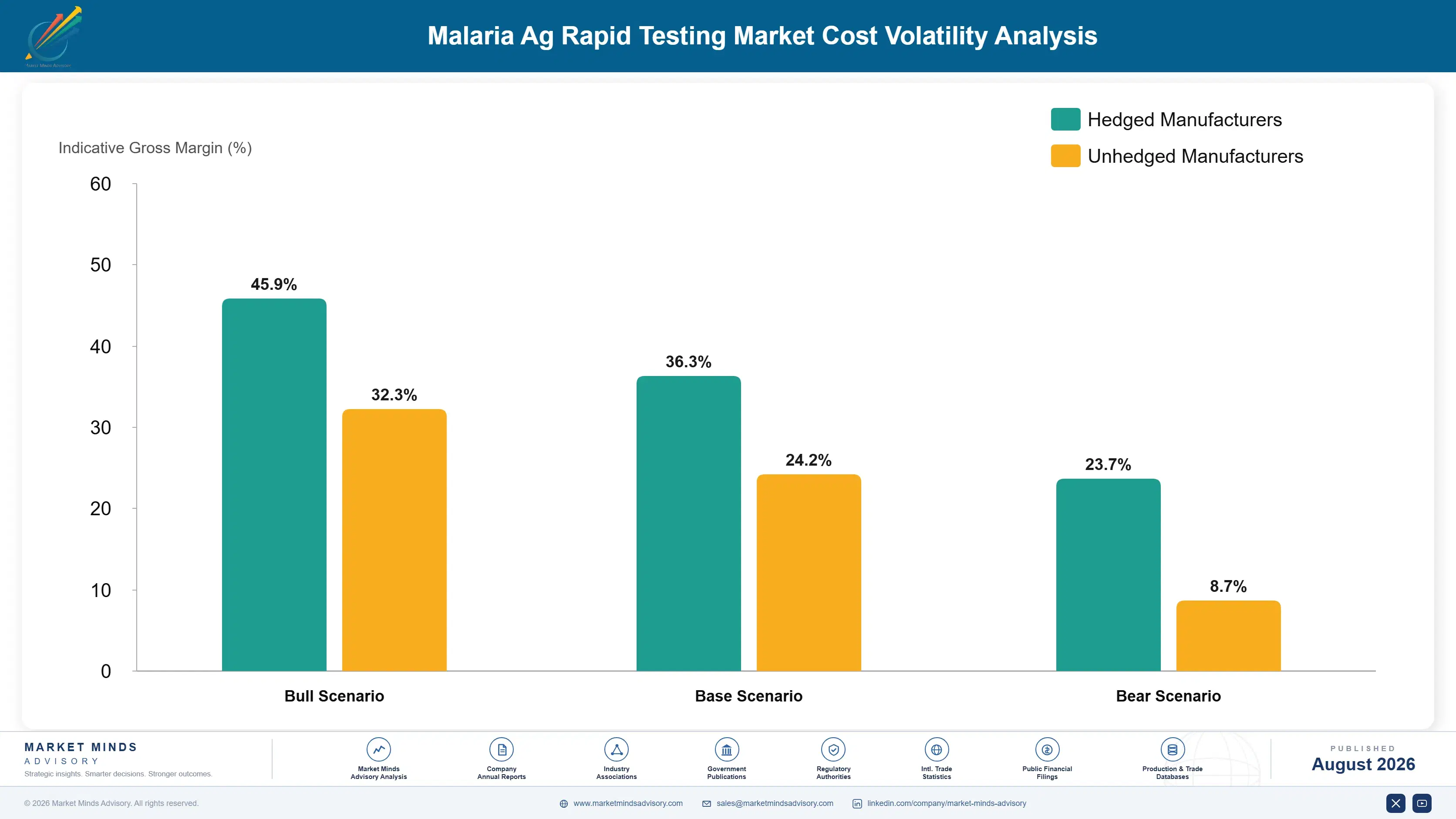
Exposure varies most by antibody sourcing and by antigen configuration. Manufacturers producing their own antibodies control a quarter of cost directly, while those buying finished antibody carry supplier margin into every test at a procurement price near USD 0.42. Geography compounds it: Indian and Chinese assembly and moulding costs sit below what other producers can approach.
malaria-ag-rapid-testing-market-cost-volatility-analysis-1787305752454

Develop internal antibody capability for alternative antigen targets

Antibodies represent roughly a quarter of test cost and pLDH antibodies cost more than the long-established alternatives, which matters directly as antigen switching advances. Internal hybridoma and production capability converts supplier margin into process cost and secures supply for the configurations programmes are moving toward. Buying finished antibody carries that margin into every test.

Contract nitrocellulose membrane supply on multi-year terms

Membrane comes from a very small producer base that had never needed to expand quickly, and malaria manufacturers sat behind far larger rapid test buyers in every allocation decision during recent disruption. Multi-year committed supply protects production continuity at modest cost relative to the tender volumes at stake. Qualifying a second source takes validation work best done in advance.

Automate assembly to compete with lower labour cost producers

Assembly labour and cassette moulding carry a substantial share of cost in a product procured at cents per unit, and Indian and Chinese manufacturers hold labour cost positions that others cannot match directly. Automation is the only route by which higher-wage producers stay competitive in pooled tendering. The capital requirement is modest relative to the annual volumes those tenders allocate.

Portfolio Architecture for Margin Defence

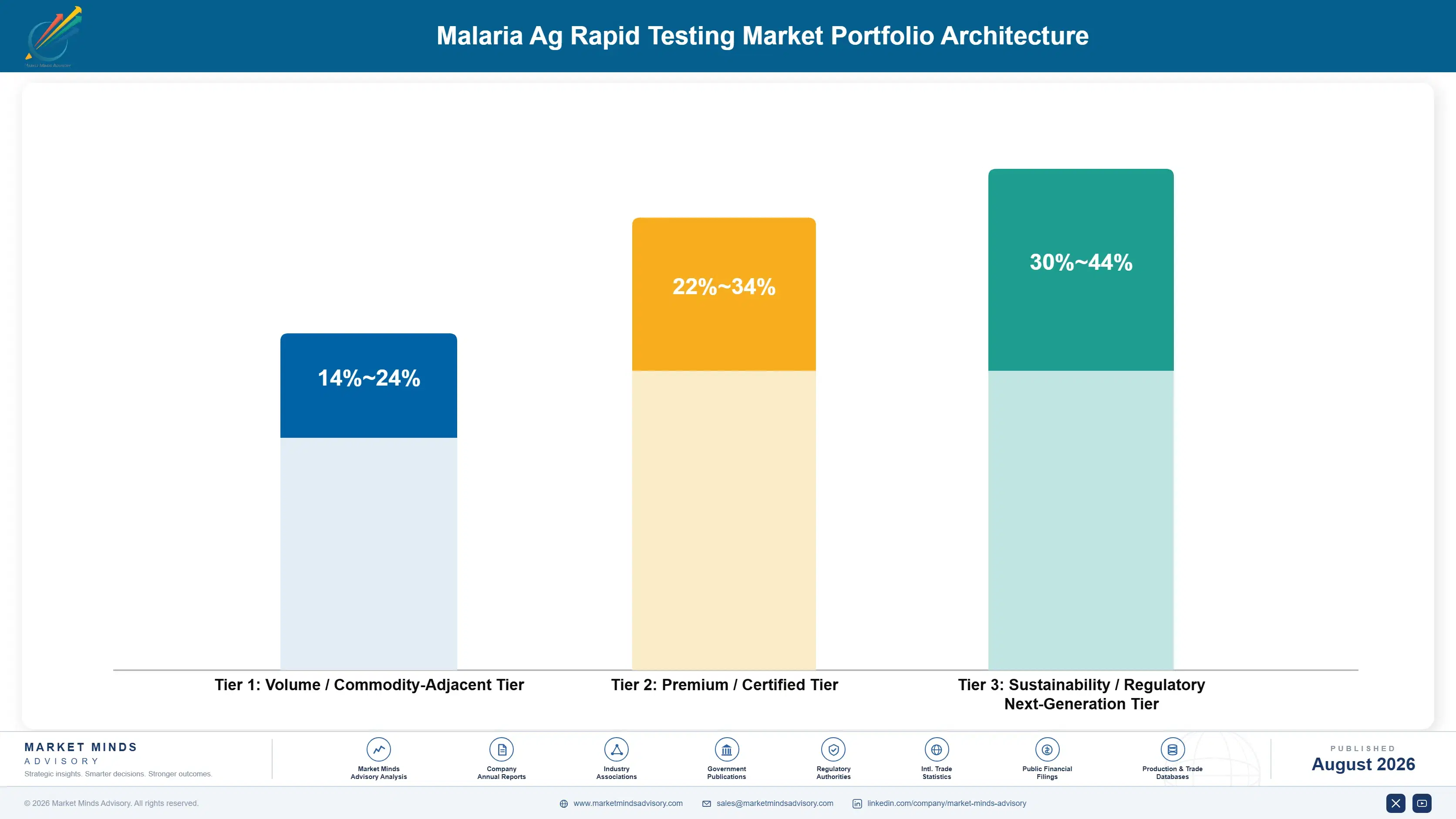
Margin architecture in this category is compressed everywhere and differs only by degree. Single-antigen tests procured through pooled tendering at around USD 0.42 earn the least, decided entirely on delivered cost between prequalified suppliers with comparable products. Combination and pLDH tests earn somewhat better because manufacturing cost is higher and fewer suppliers hold current prequalification. Nothing in this market earns diagnostic industry margins, and nothing is likely to.
The volume against premium tension barely exists, because there is no premium. What differs is exposure. Manufacturers weighted toward single-antigen products face conversion risk as programmes switch, while those holding the full prequalified range capture national conversions whichever way they go. Producers serving malaria alone carry funding concentration risk that those making other rapid tests on the same lines do not.

High-value pools, such as they are, concentrate around prequalification breadth and manufacturing cost. Current prequalification across every antigen configuration, internal antibody production and automated assembly all improve position in a tender that scores on price and quality gates. Single-antigen capacity without alternative configurations, whatever its cost position, faces a market that evolution is steadily converting away from it.

Volume / Commodity-Adjacent Tier

Single-antigen histidine-rich protein tests procured through pooled tendering, decided entirely on delivered cost between prequalified suppliers offering essentially indistinguishable products at cents per unit. Evolution is steadily converting this tier away entirely.
Gross Margin: 14-24%

Premium / Certified Tier

Combination and pLDH tests holding current prequalification, protected by higher manufacturing cost and by a narrower field of suppliers who have completed the qualification process for those configurations. Prequalification breadth is the barrier here.
Gross Margin: 22-34%

Sustainability / Regulatory / Next-Generation Tier

Ultra-sensitive and species-differentiating configurations serving elimination surveillance and vivax-prevalent settings, commanding better pricing because programme requirements are specific and alternative suppliers are few. Vivax-prevalent settings need species identification rather than falciparum detection alone.
Gross Margin: 30-44%
malaria-ag-rapid-testing-market-portfolio-architecture-1787305752964

Programme Procurement and Switching Events

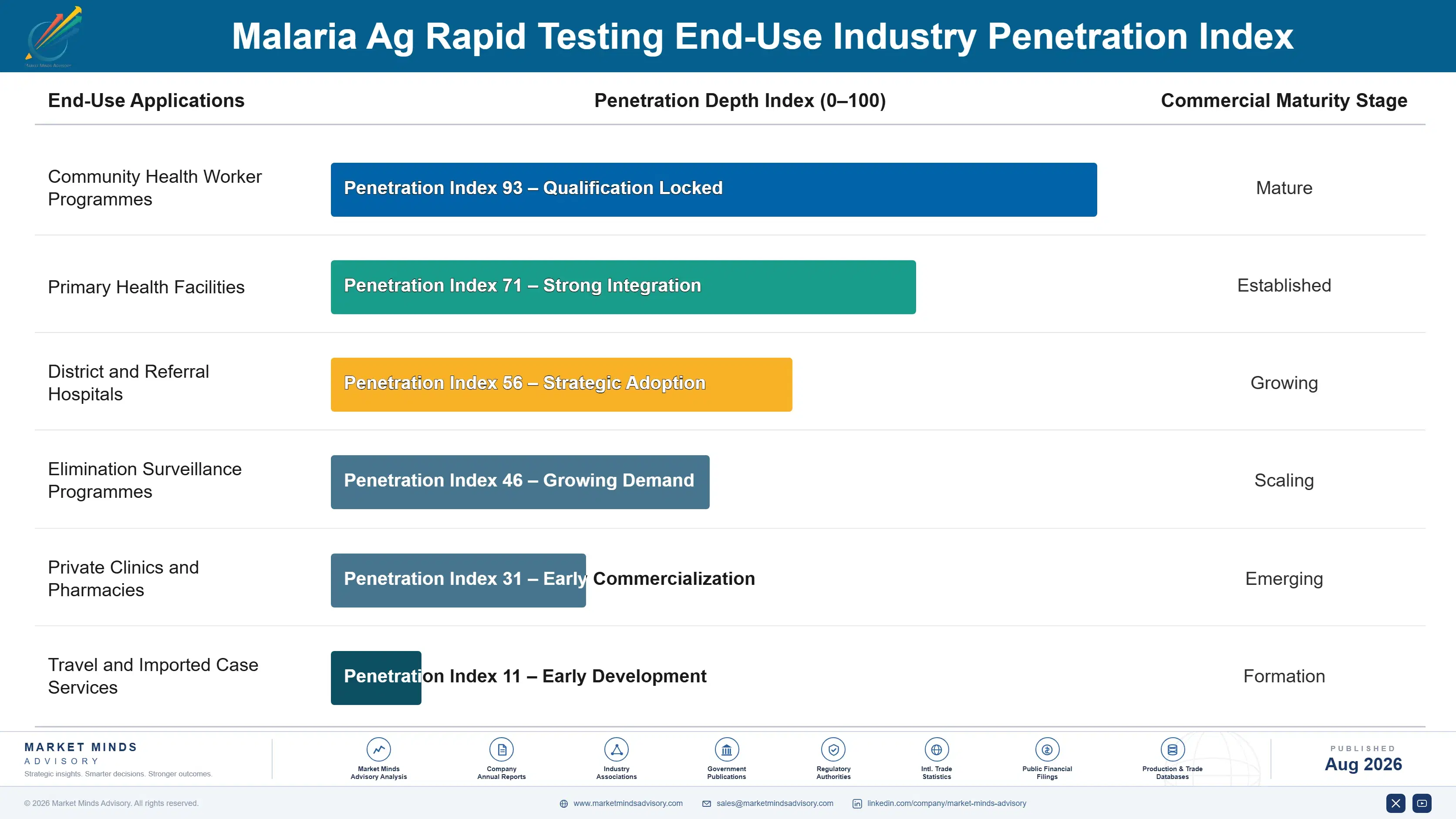
Demand arrives through procurement cycles rather than through clinical purchasing. International financing mechanisms and national programmes forecast requirements against case burden and coverage targets, tender periodically, and allocate volume among prequalified suppliers on delivered price. Roughly 410 million tests move that way each year at around USD 0.42, and no individual clinic, laboratory or clinician makes a supplier choice anywhere in the process.
Consumption depth follows transmission intensity and testing policy rather than health system capability. High-burden African countries test at community level through health workers who carry tests into villages, which is where most volume goes. Asian and Latin American programmes test more often through facilities and require species differentiation because vivax predominates. Elimination settings test far more per case detected, since surveillance requires screening populations with very low prevalence.

The purchasing profile is unusually narrow and unusually consequential. A small number of international financing mechanisms and their procurement agents decide the great majority of volume, applying prequalification status, lot testing history and delivered price. National programme managers influence antigen configuration specification. Manufacturers reach neither group through anything resembling conventional commercial activity, and product differentiation arguments rarely feature at all.
malaria-ag-rapid-testing-market-end-use-penetration-index-1787305753459

Where Malaria Test Strategy Must Land

These are among the four positions where our research anticipates prominent divergence between winners and laggards over the coming forecast period. Each is grounded in the demand model, the regulatory perimeter, and the announced capacity pipeline.
01 / ANTIGEN READINESS PRIORITY

Evolution is converting this market on its own timetable

Falciparum parasites deleting the histidine-rich protein genes return negative results on the tests that 68% of programmes currently use, and those deleted strains escape both detection and treatment, which gives them a genuine and compounding selective advantage. Guidance triggers a national antigen switch once false negatives exceed 5% of all falciparum cases, and surveys keep finding these deletions in entirely new places. Manufacturers without current prequalification across pLDH and combination configurations lose entire national conversions whenever those survey results finally arrive.
02 / COST POSITION REALISM

Nobody here has ever been able to charge more

Roughly 87% of the 410 million tests distributed annually are purchased through pooled donor tendering at around USD 0.42 each, which sets price centrally and admits no clinical or commercial argument into the decision beyond prequalification and delivered cost. Automation, membrane sourcing scale and internal antibody production determine whether a manufacturer can bid profitably at all. Suppliers investing in clinical differentiation for a tender scored on price and quality gates alone are funding an argument that nobody in the process ever hears.
03 / FUNDING CONCENTRATION EXPOSURE

One financing decision determines the entire volume base

A market in which 87% of all purchases are donor-funded has no commercial demand sitting underneath it to absorb any reduction, and national health budgets across the high-burden countries cannot fund testing at anything remotely approaching current volumes. International health financing for malaria has already faced genuine disruption within the period this forecast covers. Manufacturers producing other rapid tests on the very same lateral flow lines spread that exposure without any new capital, and those serving malaria alone simply cannot.
04 / PREQUALIFICATION BREADTH PRIORITY

Qualification is slower than the decision window allows

Programme procurement requires prequalified products, and the qualification process itself runs considerably longer than the interval between a deletion survey result and the tender that follows a national switching decision. A manufacturer reacting to that decision afterwards arrives well after the volume has already been allocated to somebody else entirely. Simply holding current prequalification across single-antigen, combination and pLDH configurations costs only regulatory maintenance rather than any manufacturing capital, and it covers whichever way a national programme eventually decides to move.

Engagement Snapshot From the Field

A live engagement with an industry participant carrying material or product regulatory and market exposure ahead of a defining policy shift, showing how our research translates into a defensible multi-year portfolio strategy.
MARKET MINDS ADVISORY · CLIENT ENGAGEMENT SUMMARY
Malaria Ag Rapid Testing Producer Strategic Portfolio Review and Transition Roadmap 2026·Investment Scenario on Malaria Ag Rapid Testing Exposure Evaluation 2025-26
CLIENT PROFILE
A rapid diagnostic manufacturer supplying prequalified single-antigen malaria tests into pooled donor procurement, with a combination product in development and no pLDH-only configuration. Annual malaria revenue was approximately USD 21 million (client-reported, unverified by MMA), representing most of the company's output from lateral flow lines serving few other test categories. Prequalification covered only the antigen now being deleted.
STRATEGIC CHALLENGE
Deletion surveys were extending beyond the Horn of Africa while the client's prequalification covered only the antigen those parasites had deleted, and international health financing disruption threatened the procurement volumes on which nearly all revenue depended. The board needed to decide how urgently to complete prequalification across other configurations and whether to diversify beyond malaria entirely.
MMA APPROACH
MMA conducted 47 expert interviews spanning national malaria programme managers, procurement agents for international financing mechanisms, parasitologists conducting deletion surveillance, community health workers, laboratory quality assurance specialists and lateral flow manufacturing directors across six countries. A quantitative survey of 3,800 respondents established testing practice, specification behaviour and switching intent. We then modelled revenue outcomes under prequalification acceleration and menu diversification strategies.
KEY FINDINGS
  1. Procurement agents confirmed that prequalification status and delivered price were the only scored criteria, and that no clinical differentiation argument entered the tender evaluation at all.
  2. National programme managers in four of six countries expected to specify combination tests within the forecast period regardless of whether local deletion survey data had arrived.
  3. Parasitologists reported deletion findings extending westward from the Horn of Africa, and none expected the trend to reverse given the selective advantage involved.
  4. Manufacturers producing other rapid tests on shared lateral flow lines reported materially lower exposure to malaria financing decisions than single-category producers did.
CLIENT PROFILE
A rapid diagnostic manufacturer supplying prequalified single-antigen malaria tests into pooled donor procurement, with a combination product in development and no pLDH-only configuration. Annual malaria revenue was approximately USD 21 million (client-reported, unverified by MMA), representing most of the company's output from lateral flow lines serving few other test categories. Prequalification covered only the antigen now being deleted.
STRATEGIC CHALLENGE
Deletion surveys were extending beyond the Horn of Africa while the client's prequalification covered only the antigen those parasites had deleted, and international health financing disruption threatened the procurement volumes on which nearly all revenue depended. The board needed to decide how urgently to complete prequalification across other configurations and whether to diversify beyond malaria entirely.
MMA APPROACH
MMA conducted 47 expert interviews spanning national malaria programme managers, procurement agents for international financing mechanisms, parasitologists conducting deletion surveillance, community health workers, laboratory quality assurance specialists and lateral flow manufacturing directors across six countries. A quantitative survey of 3,800 respondents established testing practice, specification behaviour and switching intent. We then modelled revenue outcomes under prequalification acceleration and menu diversification strategies.
KEY FINDINGS
  1. Procurement agents confirmed that prequalification status and delivered price were the only scored criteria, and that no clinical differentiation argument entered the tender evaluation at all.
  2. National programme managers in four of six countries expected to specify combination tests within the forecast period regardless of whether local deletion survey data had arrived.
  3. Parasitologists reported deletion findings extending westward from the Horn of Africa, and none expected the trend to reverse given the selective advantage involved.
  4. Manufacturers producing other rapid tests on shared lateral flow lines reported materially lower exposure to malaria financing decisions than single-category producers did.
RECOMMENDED STRATEGY
Phase 1: Phase one: accelerate prequalification for combination and pLDH configurations immediately, since the process runs longer than the window a switching decision creates. Phase 2: Phase two: develop internal antibody capability for pLDH targets, converting supplier margin into process cost at a price point measured in cents. Phase 3: Phase three: add non-malaria rapid test lines on existing capacity, spreading the funding concentration exposure without requiring new capital investment.
OUTCOME
The client accelerated prequalification across two additional configurations, began internal pLDH antibody development and added two non-malaria test lines on existing capacity (client-reported, unverified by MMA). Combination product prequalification completed ahead of two national switching decisions, and non-malaria revenue reached a meaningful share within eighteen months.

Frequently Asked Questions

Foundational context covering the market sizes, CAGR, scope, country, region and competition that inform every finding below. This section is provided to cover basics and most often pre-purchase conversations, answered from the MMA Primary Research Dataset.

What is the current size of the Malaria Ag Rapid Testing Market?

The global malaria antigen rapid testing market was valued at USD 0.24 billion in 2025, covering roughly 410 million tests distributed annually. Around 87% of those tests are purchased through international donor financing rather than national budgets.

How large will the Malaria Ag Rapid Testing Market be by 2036?

MMA forecasts the market at USD 0.47 billion by 2036, expanding 1.88 times from the 2026 base of USD 0.25 billion. That represents roughly USD 0.22 billion of incremental value across the forecast decade.

What is the CAGR for the Malaria Ag Rapid Testing Market 2026 to 2036?

The base case compound annual growth rate is 6.2%, with a bull case of 7.4% and a bear case of 5.0%. The bear case assumes international health financing for malaria contracts and procurement volumes fall with it.

Which segment is growing fastest?

pLDH-only tests grow at 9.3%, a full 1.50x the overall market rate. That antigen is essential to parasite metabolism and cannot be deleted the way the currently dominant target has been.

Who are the major companies in the Malaria Ag Rapid Testing Market?

Abbott, SD Biosensor, Access Bio, Premier Medical Corporation and Zephyr Biomedicals together hold 71% of revenue. Abbott leads on prequalification depth while SD Biosensor leads on manufacturing cost position.

Which country is growing fastest?

Ethiopia grows fastest at 11.4%, as antigen switching drives replacement of existing test stock across a heavily affected population. Middle East and Africa holds 54% of value on malaria burden alone.

Report Segmentation Architecture

The full report scope spans multiple orthogonal segmentation dimensions, with cross-tabulated demand data provided for each dimension pair. Coverage extends further to regional breakdowns, trend trajectories, and the competitive detail needed to support segment-level decision-making.

By Antigen Target

  • HRP2-Only Tests
  • HRP2 and pLDH Combination Tests
  • pLDH-Only Tests
  • Aldolase and Pan-Species Antigen Tests
  • Ultra-Sensitive HRP2 Tests

By End-Use Industry

  • Community Health Worker Programmes
  • Primary Health Facilities
  • District and Referral Hospitals
  • Elimination Surveillance Programmes
  • Private Clinics and Pharmacies
  • Travel and Imported Case Services

By Commercial Dimension

  • Pooled International Donor Procurement
  • National Programme Tender Purchasing
  • Non-Governmental Organisation Supply
  • Private Sector Distribution
  • Research and Surveillance Study Supply
  • Original Equipment Manufacturer Contract Supply

By Region

  • Middle East and Africa
  • South Asia and Pacific
  • North America
  • Latin America
  • East Asia
  • Western Europe
  • Eastern Europe

Scope, Methodology, and Coverage

Every figure in this report is reproducible from documented input assumptions. The scope below maps the historical period, the forecast horizon, the segmentation dimensions, and the countries covered, alongside the underlying primary and qualitative methodology.
Historical Period
2020 to 2025
Forecast Period
2026 to 2036
Base Year
2025 (USD billions; MMA Primary Research Dataset, August 2026)
Market Definition
This market comprises antigen-based rapid diagnostic tests for malaria, measured at manufacturer revenue across pooled international donor procurement, national programme tender purchasing, non-governmental organisation supply, private sector distribution, research and surveillance study supply and contract manufacturing arrangements. Coverage spans lateral flow tests detecting histidine-rich protein 2 alone, combination tests detecting histidine-rich protein 2 together with parasite lactate dehydrogenase, tests detecting parasite lactate dehydrogenase alone in pan-species and species-specific configurations, aldolase and other pan-species antigen tests, and ultra-sensitive formats designed for low parasite density detection in elimination surveillance. Microscopy consumables, stains and equipment, molecular and isothermal amplification tests for malaria, antimalarial medicines and chemoprevention products, vector control products including nets and insecticides, serological antibody tests used for exposure assessment, and laboratory quality assurance or external competency assessment services fall outside scope.
Quantitative Units
USD millions (current prices); tests distributed by antigen configuration; average procurement price; donor funded share; prequalified products by supplier; deletion prevalence in surveyed populations
Segmentation Dimensions
By Antigen Target; By End-Use Industry; By Commercial Dimension; By Region
Regions Covered
Middle East and Africa, South Asia and Pacific, North America, Latin America, East Asia, Western Europe, Eastern Europe
Countries Covered
Nigeria, Democratic Republic of the Congo, Ethiopia, Eritrea, Uganda, Tanzania, Mozambique, Kenya, Ghana, Burkina Faso, Mali, Sudan, India, Indonesia, Papua New Guinea, Myanmar, Cambodia, Thailand, Philippines, Brazil, Venezuela, Colombia, Peru, China, South Korea, Japan, United States, United Kingdom, France, Germany, Turkey, and additional markets relevant to malaria programme analysis
Key Companies Profiled
Abbott, SD Biosensor, Access Bio, Premier Medical Corporation, Zephyr Biomedicals, Guangzhou Wondfo Biotech, Oscar Medicare, Rapigen, CTK Biotech, Arkray Healthcare, Nantong Egens Biotechnology, Hangzhou AllTest Biotech, Meril Diagnostics, J Mitra and Company, Span Diagnostics, Turklab, Beijing Wantai, InTec Products, Orchid Biomedical, Qualpro Diagnostics
Quantitative Methodology
Primary survey, n=3,800 respondents, Q4 2025, six countries; demand-side model with trade association cross-validation
Qualitative Methodology
47 expert interviews, Q4 2025; applied to validate demand model assumptions, identify emerging dynamics, and assess competitive positioning
Report Format
PDF and XLSX data workbook (Word format preview document)
Publisher
Market Minds Advisory
Report Code
MMA-2026-HLT-374
Published
August 2026
Contact
sales@marketmindsadvisory.com | www.marketmindsadvisory.com

Purchase the full Malaria Ag Rapid Testing Market Report (2026 to 2036).

The full MMA report treats parasite gene deletion as the commercial event it actually is, quantifying how a diagnostic being defeated by evolution interacts with a procurement system that admits no pricing power. It sizes five antigen configurations and seven regions to 2036, modelling tests distributed, procurement pricing, donor funding share, switching decisions and deletion prevalence separately. Competitive assessment covers twenty manufacturers on one consistent revenue basis. Cost exposure is traced through membrane, antibody and assembly inputs. Four commercial levers and a strategic verdict close the report, grounded in 47 expert interviews and a 3,800-respondent survey.
Five antigen configurations sized separately through 2036
Gene deletion prevalence mapped against national switching thresholds
Donor procurement volumes separated from national budget purchasing
Twenty manufacturers assessed on one consistent revenue basis
Prequalification coverage tracked across every antigen configuration
Anonymised client engagement with tested strategic recommendations

Built For The People Who Decide

From boardroom strategy to bench-side execution, this report is read cover-to-cover by leaders shaping the next decade of their industry, turning demand scenarios, market dynamics and valuation benchmarks into decisions.
CXOs/ Presidents/ VPs/ Managers
M&A and Corporate Development
Strategy Teams and R&D Heads
Procurement and Product Directors
Regulatory and Compliance Leaders
Investor Relations and Equity Analysts