
Market Minds Advisory
Loop-Mediated Isothermal Amplification Market

Loop-Mediated Isothermal Amplification Market: Expiring Patents, Enzyme Control, and the Field Advantage

A method invented a quarter century ago spent most of its life constrained by patents rather than by physics, and those patents are now expiring at exactly the wrong moment for the inventor.

Lead Analyst

Alice Ballenger

Published

August 2026

Make Smarter Decisions with Customized Research Insights

Request a free sample report and evaluate market opportunities, growth trends, and competitive dynamics relevant to your business needs.

2025 MARKET VALUE$0.6BMarket Size 2025
2036 FORECAST VALUE$2.1BBase Case , 2026 to 2036
CAGR 2026 TO 203611.8 %Bull 13.0% / Bear 10.6%
INCREMENTAL OPPORTUNITY$1.4BNet 10- year value creation
EXPANSION MULTIPLE3.06x2036 value over 2026 base
Strategic Levers
M&A Pipeline
Regional Outlook
Country Rankings
Competitive Intelligence
Segmental Deep-dive
Call-Us : 91 93563 13602

Executive Snapshot and Market Trajectory

Foundational patents held by the method's Japanese inventor constrained commercialisation for two decades, and they are now expiring. That single fact opens a technology whose physical advantages were never the limiting factor on its adoption. Physics was never the obstacle here. The chemistry itself was never once in question.
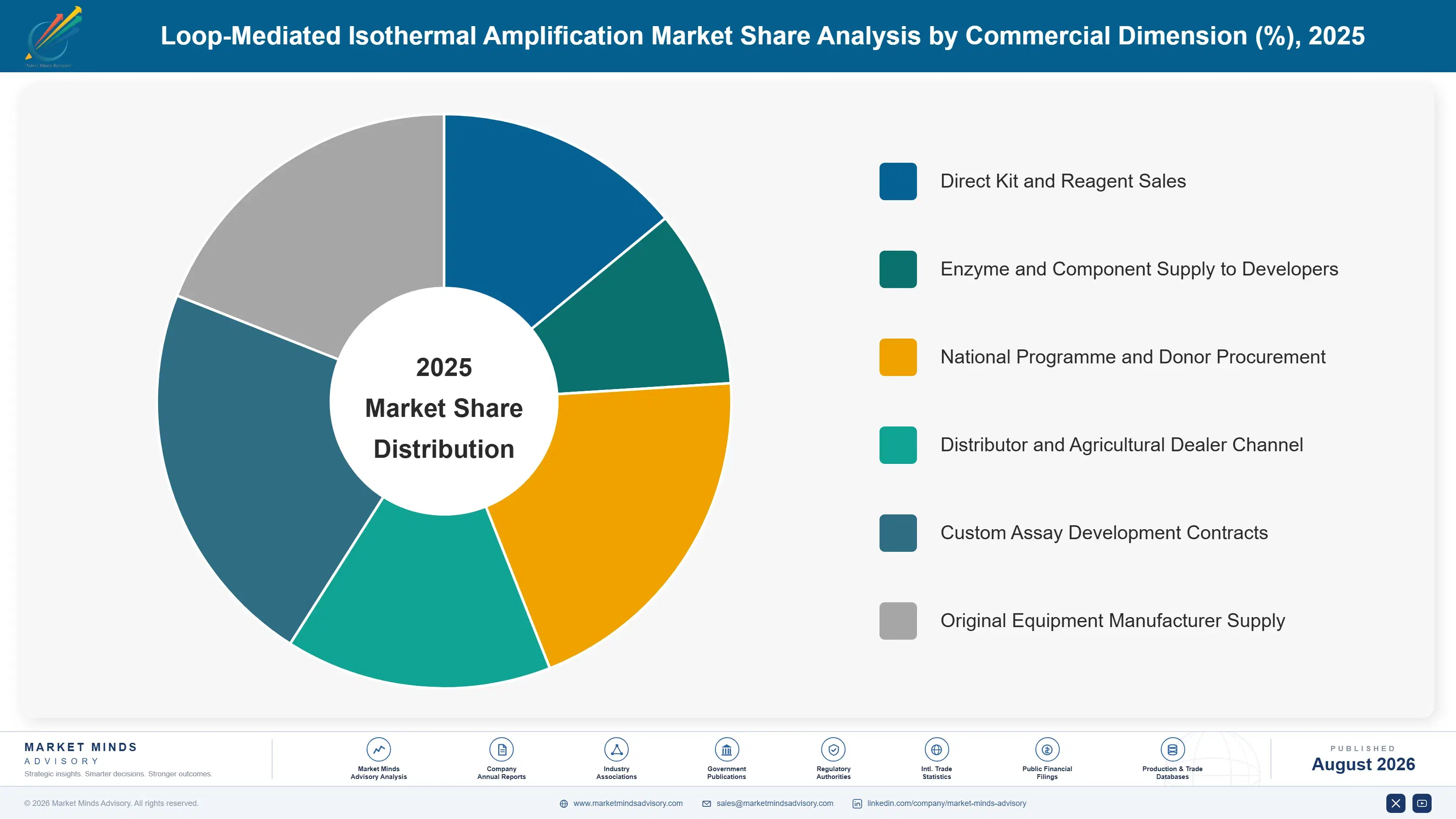
Agricultural and food safety assay kits compound at 17.7%, a full 1.50x the market rate, because field deployability matters more outside the clinic than inside it and the regulatory burden is a fraction of what diagnostic approval demands. East Asia holds the largest share at 30%, spanning the Japanese originator, substantial Chinese manufacturing and agricultural applications across the region on a scale no other market approaches.
Concentration is low at 44%, and the most defensible position is not a kit at all. Bst polymerase is required by every reaction anybody runs, which makes the enzyme supplier a beneficiary of all competition rather than a participant. Assay design is the constraint patents were obscuring, since six primers take roughly 14 months to validate and frequently fail. Whoever industrialises that design work captures the constraint patent expiry has just exposed.
Market Definition
This market covers products and services enabling loop-mediated isothermal amplification, spanning Bst polymerase and amplification enzymes, validated clinical assay kits, agricultural and food safety assay kits, detection instruments and readers, colorimetric and lateral flow readout reagents, and primer design and custom assay development services, measured at supplier revenue. Polymerase chain reaction products, other isothermal chemistries including recombinase polymerase and helicase-dependent amplification, sequencing reagents, sample collection devices, and nucleic acid extraction products are excluded.
Base Year Value
$0.6B in 2025 (MMA Primary Research Dataset, August 2026)
Forecast Period
2026 to 2036, eleven discrete annual values
CAGR
11.8% base case. Bull 13.0%. Bear 10.6%.
Fastest Growth Segment
Agricultural and Food Safety Assay Kits: 17.7% CAGR
Fastest Growth Country
India: 19.0% CAGR
Fastest Growth Region
South Asia and Pacific: 13.8% CAGR
Largest Region
East Asia: 30% of 2025 global value
Market Leaders
Eiken Chemical, New England Biolabs, Meridian Bioscience, OptiGene, and Ustar Biotechnologies. Source: MMA Primary Research Dataset, July 2026.
Primary Survey
n=3,800 procurement and R&D decision-makers, Q4 2025, six countries
Methodology
Demand-side build-up, cross-validated against public data, 47 expert interviews

Loop-Mediated Isothermal Amplification Market Forecast Scenarios

loop-mediated-isothermal-amplification-market-size-forecast-scenario-1787305729113
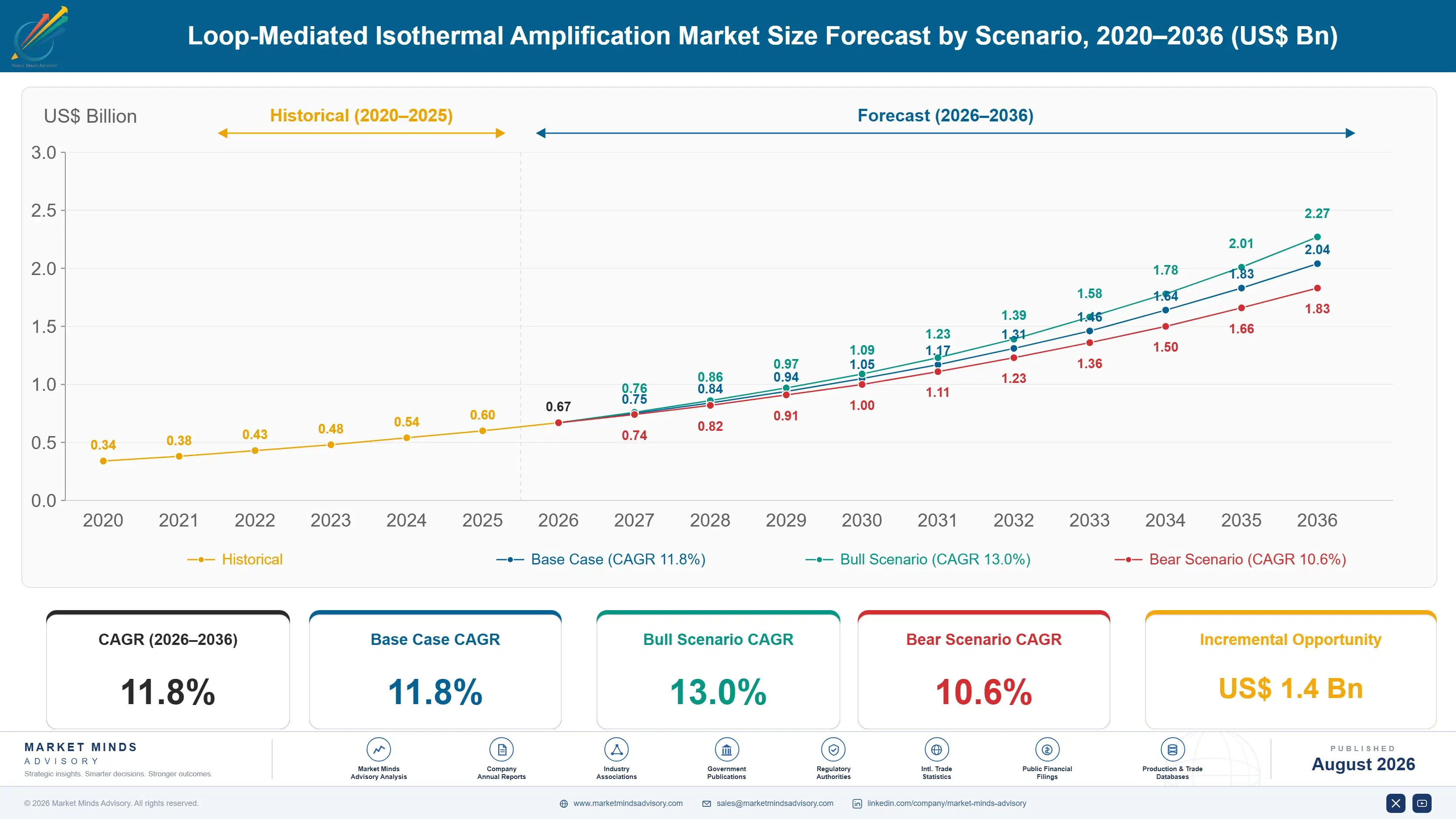
Growth ran near 10.6% from 2020 to 2025 through the most turbulent period this technology has experienced. Testing demand pulled loop-mediated amplification into applications it had never reached, manufacturing capacity expanded quickly, and awareness spread far beyond the specialist community. Then demand collapsed and several products were withdrawn, leaving more capacity, wider recognition and a slightly ambivalent reputation.
Base case growth of 11.8% rests on three mechanisms. Foundational patent expiry removes a licensing constraint that limited commercialisation for two decades and lowers the barrier for new assay developers. Agricultural and food safety applications expand where field deployability is decisive and approval burden is modest. And tuberculosis and malaria programmes across high-burden countries continue deploying validated assays into settings with no laboratory infrastructure at all. None of the three depends on the others.
The bull case at 13.0% assumes patent expiry brings a wave of new assay development that broadens validated menu substantially, since assay availability rather than technology capability has always been the constraint. The bear case at 10.6% is a specificity problem: false positives from carryover contamination and non-specific amplification undermine confidence in field settings, and users revert to laboratory methods wherever a laboratory is reachable.

Isothermal Amplification: Patents, Enzymes and Fields

This technology's history is a lesson in how intellectual property shapes adoption more than physics does. Loop-mediated amplification was published a quarter century ago, works at a single temperature, tolerates crude samples that defeat other methods and returns a visible result in about 30 minutes. It then spent two decades constrained by foundational patents. Those patents are now expiring, and the constraint that actually limited adoption is lifting.
TOP FIVE CONCENTRATION44%Fragmented across the originator, enzyme suppliers and regional kit manufacturers
TYPICAL REACTION TIME30 minutesInterval from sample addition to a readable amplification result
PRIMERS PER ASSAY6 primersOligonucleotides recognising distinct target regions in each designed assay
COST PER REACTIONUSD 2.40Blended reagent cost across clinical and agricultural application formats
ASSAY DEVELOPMENT TIME14 monthsTypical period from target selection to a validated working assay
COLD CHAIN FREE FORMATS41%Share of available assays supplied in ambient stable lyophilised form
The most durable commercial position in the category is not a kit. Every reaction anybody runs requires Bst polymerase or an engineered variant of it, and supply of that enzyme is concentrated among very few producers. That makes the enzyme business a beneficiary of every contest fought downstream rather than a participant, which beats sitting in a kit market at 44% concentration.
The genuine constraint on the method is assay design. Loop-mediated amplification needs six primers recognising eight distinct regions, which makes development slower and more failure-prone than designing a two-primer reaction, and typical assay development runs to roughly 14 months. That is why an older technology has a narrower validated menu, and why patent expiry matters: more developers can now attempt that work.
"The enzyme supplier wins whoever else wins. Everybody arguing about whose kit performs better is buying polymerase from the same place, and patent expiry only widens the field of people who have to."
Principal Analyst, Molecular Diagnostics and Field Testing Practice · MMA Health

Market Trends

Patent expiry removes a two-decade commercialisation constraint

Foundational patents held by the Japanese originator required licensing that made commercial development expensive and deterred entrants who would otherwise have built assays. Those patents are expiring, and the barrier that genuinely limited adoption is lifting rather than any technical one. Assay availability has always been the binding constraint, since the chemistry itself was never in question, and more developers attempting the difficult primer design work is what actually broadens the validated menu available to users. Chinese manufacturers with retained capacity benefit first, competing on kit pricing wherever no approval stands in the way.
Market Impact: Results within 30 minutes
Agricultural and food applications outgrow clinical deployment

Field deployability matters far more outside a clinic than inside one, and agricultural regulatory burden is a fraction of what diagnostic approval demands, so plant pathogen detection, seed testing, food safety verification and veterinary applications adopt faster than medicine does. The segment compounds at 17.7% on that combination. Roughly 41% of available assays now ship in ambient stable lyophilised form, which removes the cold chain that would otherwise defeat the entire field deployment argument. Plant pathogen detection, seed verification and contamination screening all serve decisions made in a field rather than a laboratory.
Market Impact: Reagent cost near USD 2.40

Market Opportunities and Growth Drivers

Disease programmes deploy testing where no laboratory exists

Tuberculosis and malaria programmes across high-burden countries deploy validated loop-mediated assays into peripheral health facilities that have no thermocycler, no reliable power and no laboratory technician, which is precisely the setting where other molecular methods cannot function at all. India compounds at 19.0% substantially on national tuberculosis programme deployment. A result in roughly 30 minutes also permits treatment during the same visit rather than requiring a patient to return. That single-visit capability matters enormously in populations where returning for a result is genuinely difficult, and programme funders weigh it heavily when selecting between available testing approaches.
Market Impact: Development taking 14 months

Crude sample tolerance removes the extraction step entirely

The polymerase used in this chemistry tolerates inhibitors that defeat conventional amplification, which allows direct testing of minimally processed samples and removes the nucleic acid extraction step that normally precedes molecular testing. That eliminates equipment, reagent cost and roughly an hour of handling from every test performed. Blended reagent cost falls near USD 2.40 per reaction as a result, which is what makes the method viable in settings that could not fund a full molecular workflow. Removing extraction also removes the cold chain and equipment that would otherwise accompany it, which compounds the deployment advantage considerably.
Market Impact: Affecting up to 4% of results

Market Restraints and Challenges

Six-primer design makes assay development slow and failure-prone

Loop-mediated amplification requires six primers recognising eight distinct regions of a target, against two primers for conventional amplification, and typical development runs to roughly 14 months with a meaningful proportion of attempts failing outright. The root cause is combinatorial: primer sets must function together at one temperature without interfering. Commercial impact is a narrow validated menu for a method older than several competitors. Design software, published primer libraries and outsourced development services are the responses in use. Whoever industrialises that design work captures the constraint patent expiry has just made relevant to far more developers.
Market Impact: Constraint held for 25 years

High amplification efficiency produces false positive exposure

The reaction generates enormous quantities of product, which makes carryover contamination between tests a persistent hazard and non-specific amplification a genuine analytical concern in field conditions. The root cause is the same efficiency that makes the method fast and sensitive. Commercial impact falls on confidence in exactly the decentralised settings where the method has most advantage. Closed-tube formats, sequence-specific probe detection and lyophilised single-reaction packaging all address it partially rather than completely. Users revert to laboratory methods wherever a laboratory is genuinely reachable. Closed-tube formats mitigate rather than eliminate the hazard involved.
Market Impact: Compounding at 17.7% each year
3 additional market trends, 4 additional growth drivers, and 2 additional restraints and challenges are covered in the full report. Contact sales@marketmindsadvisory.com to access the complete intelligence.

Segment CAGR and Growth Architecture

Segmentation follows product class, because class determines the manufacturing base, the regulatory pathway, the customer and whether revenue recurs with every reaction or arrives once per placement. Six product classes cover loop-mediated amplification supply without overlap between them. Target organism and application setting cut across every class at once and are treated here as use attributes.
loop-mediated-isothermal-amplification-market-market-share-analysis-1787305729645

Agricultural and Food Safety Assay Kits

Growing at 17.7%, a full 1.50x the market rate, agricultural and food safety kits detect plant pathogens in fields and greenhouses, verify seed lots, confirm species identity and screen food for contamination, all in settings where a laboratory is either distant or irrelevant to the decision being made. Regulatory burden is a small fraction of diagnostic approval, which shortens development considerably and lowers the cost of a failed assay. Roughly 41% of available products ship ambient stable, removing the cold chain that would otherwise defeat the field deployment argument entirely. Barriers are correspondingly low, which means many entrants and aggressive competition on delivered cost across every target menu offered. Decisions here are made on delivered cost.
CAGR 17.7%

Bst Polymerase and Amplification Enzymes

Enzyme supply grows at 14.6% and represents the most defensible position anywhere in this category, because every reaction that anybody runs requires Bst polymerase or an engineered variant, regardless of whose kit contains it. Production is concentrated among very few capable manufacturers, and engineered variants offering improved thermostability, inhibitor tolerance or reverse transcriptase activity carry genuine formulation difficulty. Patent expiry on the amplification method widens the field of developers who need enzyme without touching the enzyme position at all, which makes it a beneficiary of competition rather than a participant. Chinese enzyme producers have expanded capacity considerably and will erode pricing in applications where engineered variant performance is not actually required.
CAGR 14.6%
Full segment breakdown across 6 segments available in the complete report.

Regional Architecture and Country Demand Map

Regional value here follows where laboratories are absent rather than where testing spending concentrates, which inverts the usual diagnostics pattern. Note: two regional positions consequently sit outside standard bands. Diagnostic spending alone would place this market almost exactly where it is not. Infrastructure absence rather than spending drives it.

East Asia

East Asia holds the largest share at 30% for three separate reasons. The method was invented and first commercialised in Japan, where the originator retains strong positions in clinical assays and instrumentation. Chinese manufacturers including Ustar and Sansure built substantial capacity during the testing surge and retained it, now competing globally on price. And agricultural applications across rice, vegetable and aquaculture production reach a scale no other region approaches, with plant pathogen and species verification testing deployed at field level rather than through laboratories. Regional agricultural testing volume exceeds clinical volume by a wide margin. Japanese instrumentation and Chinese kit manufacturing serve quite different customer sets, and the two rarely compete directly for the same accounts across the region.
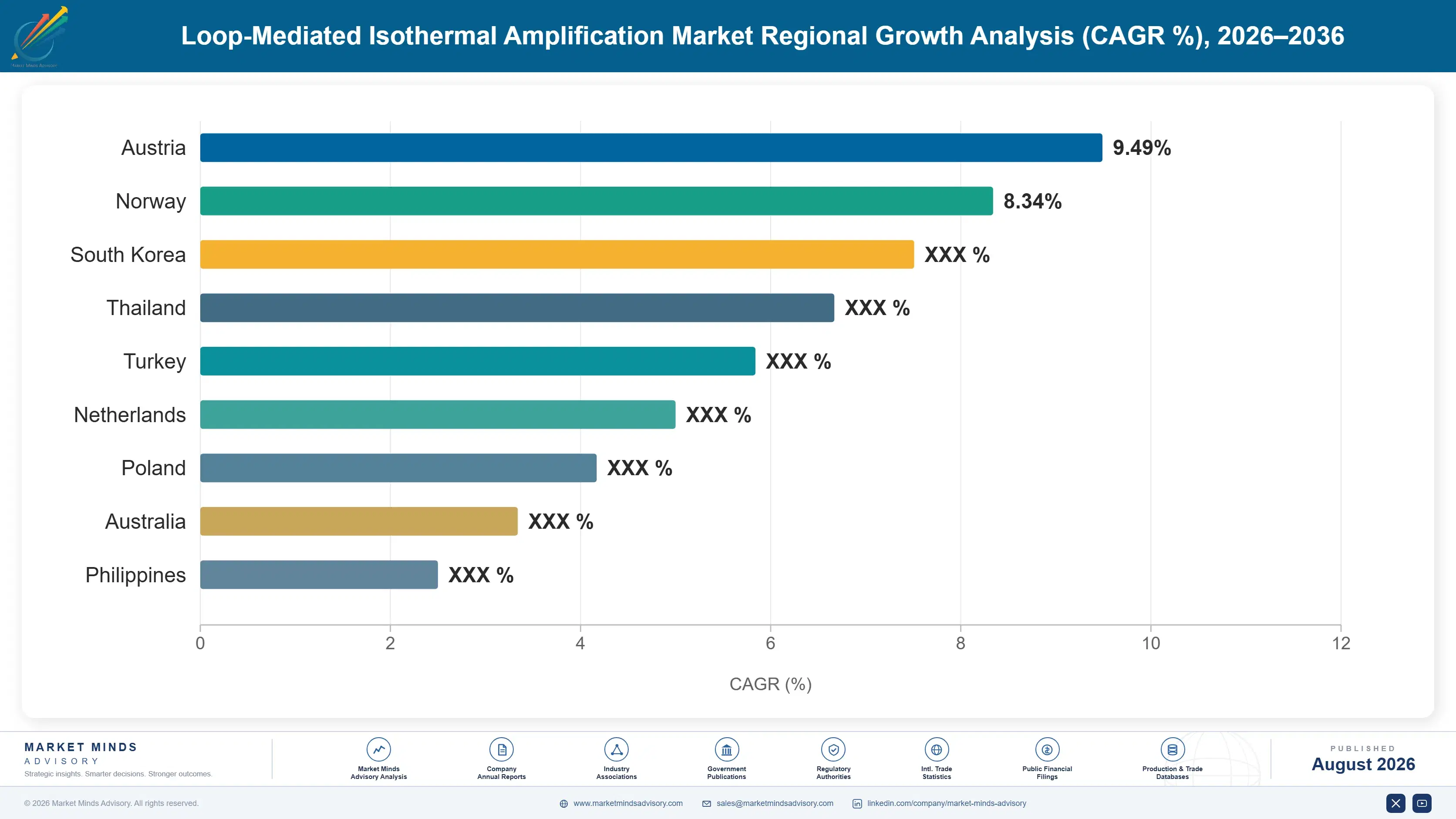
Share: 30% | CAGR: 12.8% (2026 to 2036)

North America

Twenty per cent of value, growing at 10.8%. Note: this sits below the standard regional band because the method's principal advantage is functioning without a laboratory, and North American testing infrastructure makes that advantage far less valuable than it is elsewhere. The genuinely strong position here is enzyme supply, where New England Biolabs serves developers worldwide from a picks-and-shovels position stronger than any kit business. Food safety and veterinary applications account for most domestic deployment rather than clinical diagnostics. Enzyme supply from here reaches developers worldwide, which means regional revenue understates the region's commercial importance to the category considerably. Clinical deployment is limited precisely because laboratory access is universal, which removes the advantage entirely.
Share: 20% | CAGR: 10.8% (2026 to 2036)
Regional intelligence for 5 additional markets available in the complete report: South Asia and Pacific, Western Europe, Latin America, Middle East and Africa, Eastern Europe. Contact sales@marketmindsadvisory.com.
loop-mediated-isothermal-amplification-market-country-cagr-analysis-1787305730171

Where Isothermal Amplification Value Sits

The chemistry was never the constraint; patents and primer design were. With one lifting and the other unchanged, value accrues to whoever supplies the enzyme every competitor needs, and to applications where the absence of a laboratory is the whole point. Kit competition is fragmenting further rather than consolidating. Upstream positions are the durable ones.

Hold the enzyme position rather than fight over kits

Every reaction anybody runs requires Bst polymerase or an engineered variant, and production is concentrated among very few capable manufacturers, which makes enzyme supply a beneficiary of every competitive contest fought downstream. Patent expiry widens the field of developers needing enzyme without touching that position at all. Kit competition is fragmented at 44% top five concentration and getting more so, while the enzyme business gains from precisely the fragmentation that damages everyone selling assays. Fragmentation downstream is an advantage rather than a threat. Very few producers can make engineered variants reliably at commercial scale.
Market Impact: Enzyme demand is growing at 14.6% e

Build where the absence of a laboratory is the point

This method's advantage is functioning without a thermocycler, without reliable power and without a trained technician, which is worth a great deal in a field, a packing house or a district health facility and almost nothing in a Western hospital laboratory. Agricultural and food safety kits compound at 17.7% for exactly that reason. Developers pursuing clinical menu expansion in well-served laboratory markets are competing against methods that perform better wherever infrastructure exists. Well-equipped laboratories deploy this method rarely and only where nothing else fits. Infrastructure absence rather than income determines where adoption happens.
Market Impact: Field applications are growing 17.7

Solve primer design rather than wait for it

Six primers recognising eight regions must function together at one temperature, and typical assay development runs to roughly 14 months with many attempts failing outright, which is why a quarter-century-old method has a narrower validated menu than newer alternatives. Design software, curated primer libraries and outsourced development services each shorten that. Whoever industrialises assay design captures the constraint that patent expiry has just made commercially relevant to a far larger group of developers. Design failure rather than chemistry performance accounts for most abandoned assay programmes. Curated primer libraries shorten it considerably for common targets.
Market Impact: Development currently takes 14 mont

Ship ambient stable formats as the default

Roughly 41% of available assays currently require no cold chain, and in the settings where this method has genuine advantage cold chain is either unreliable or absent entirely. Lyophilised single-reaction packaging also addresses the carryover contamination hazard that high amplification efficiency creates. Formulation development is a one-time engineering cost against permanently wider deployment, and suppliers shipping refrigerated product into field applications are undermining the argument they are selling. Single-reaction packaging also limits the contamination hazard directly. Lyophilisation capability determines addressable application rather than merely reducing shipping cost. It is a strategic investment rather than an operational one.
Market Impact: Only 41% currently ship in ambient

Who Controls the Margin Pool

Concentration is low at 44% across the top five, measured on annual revenue from loop-mediated amplification enzymes, kits, instruments and development services, the single basis applied throughout this analysis. Eiken Chemical and New England Biolabs lead through entirely different positions, the first as the method's inventor holding validated clinical assays and instrumentation, the second as the enzyme supplier that every developer in the field depends upon regardless of competitive outcome.
Competition therefore runs on levels that barely interact. Enzyme supply is concentrated among few capable producers and competes on formulation performance and reliability. Clinical assay development competes on validation depth, regulatory approval and programme endorsement. Agricultural and food safety kits compete on price, breadth of target menu and field usability, with far lower barriers and correspondingly more entrants arriving each year.

Pressure builds from two directions simultaneously. Patent expiry lowers the barrier for new assay developers, which fragments an already fragmented kit market further and advantages the enzyme suppliers those developers must buy from. Separately, Chinese manufacturers with retained pandemic capacity compete aggressively on kit pricing. Rankings shift most where a participant industrialises primer design, since assay availability rather than chemistry has always been the real constraint.
loop-mediated-isothermal-amplification-market-company-positioning-matrix-1787305730694

Competitive Moat and Risk Dimensions

EIKEN CHEMICAL

Moat: Originator with validated clinical menu

Inventing the method and commercialising it first gave Eiken validated clinical assays, established instrumentation and programme endorsements including tuberculosis testing recommendations that reach high-burden national programmes directly. Accumulated primer design experience across many targets is genuinely valuable in a chemistry where design difficulty rather than performance limits what assays exist at all.
EIKEN CHEMICAL

Risk: Foundational patent expiry

The licensing position that constrained competitors for two decades is expiring, removing a barrier that protected commercial returns more effectively than any technical advantage did. New assay developers can now enter without negotiating terms. Chinese manufacturers with retained capacity compete on price across agricultural and non-regulated clinical applications directly.
NEW ENGLAND BIOLABS

Moat: Concentrated amplification enzyme supply

Supplying the polymerase that every loop-mediated reaction requires, regardless of whose kit contains it, places New England Biolabs outside the competitive contest it profits from entirely. Engineered variants offering improved thermostability, inhibitor tolerance and reverse transcriptase activity carry genuine formulation difficulty that few producers can replicate reliably at commercial scale.
NEW ENGLAND BIOLABS

Risk: Enzyme production entry pressure

Bst polymerase itself is well characterised and Chinese enzyme producers have expanded capacity considerably, which will erode pricing in applications where engineered variant performance is not required. Patent expiry on the amplification method also encourages enzyme entrants alongside kit developers. Agricultural customers are considerably more price-sensitive than clinical ones.

Players Tracked

Prominent Players

Eiken Chemical
New England Biolabs
Meridian Bioscience
OptiGene
Ustar Biotechnologies

Other Key Players

Lucigen
LGC Biosearch Technologies
HiberGene Diagnostics
SD Biosensor
Sansure Biotech
Bioneer
Nippon Gene
Amplex Diagnostics
Genomtec
GenBody
Mast Group
Takara Bio
Promega
Agdia
Neogen

Recent Developments

MARCH 2025

Foundational patent expiry opens assay development to new entrants

Core patents covering the amplification method reached expiry across major jurisdictions, an organic intellectual property event rather than any transaction, removing licensing requirements that had constrained commercial assay development for approximately two decades. New entrants began announcing assay programmes within months of expiry. Licensing negotiations ceased entirely.
Signal: The barrier that actually limited this met
SEPTEMBER 2025

Plant pathogen testing expands field deployment across export agriculture

Agricultural exporters across Latin America and Southeast Asia widened field-level plant pathogen and species verification testing, an organic commercial response to importing market inspection requirements rather than to any regulatory mandate in producing countries themselves. Testing moved to packing houses rather than to any laboratory.
Signal: Applications where a laboratory is entirel
JANUARY 2026

Ambient stable formats extend deployment into unreliable cold chain settings

Lyophilised single-reaction formats requiring no refrigeration reached wider commercial availability across clinical and agricultural applications, addressing both cold chain absence in field settings and the carryover contamination hazard that open multi-reaction packaging creates. Deployment into settings without reliable refrigeration widened accordingly. Contamination hazard from open packaging also fell noticeably.
Signal: Formulation rather than the chemistry itse

Enzyme, Oligonucleotide and Lyophilisation Costs

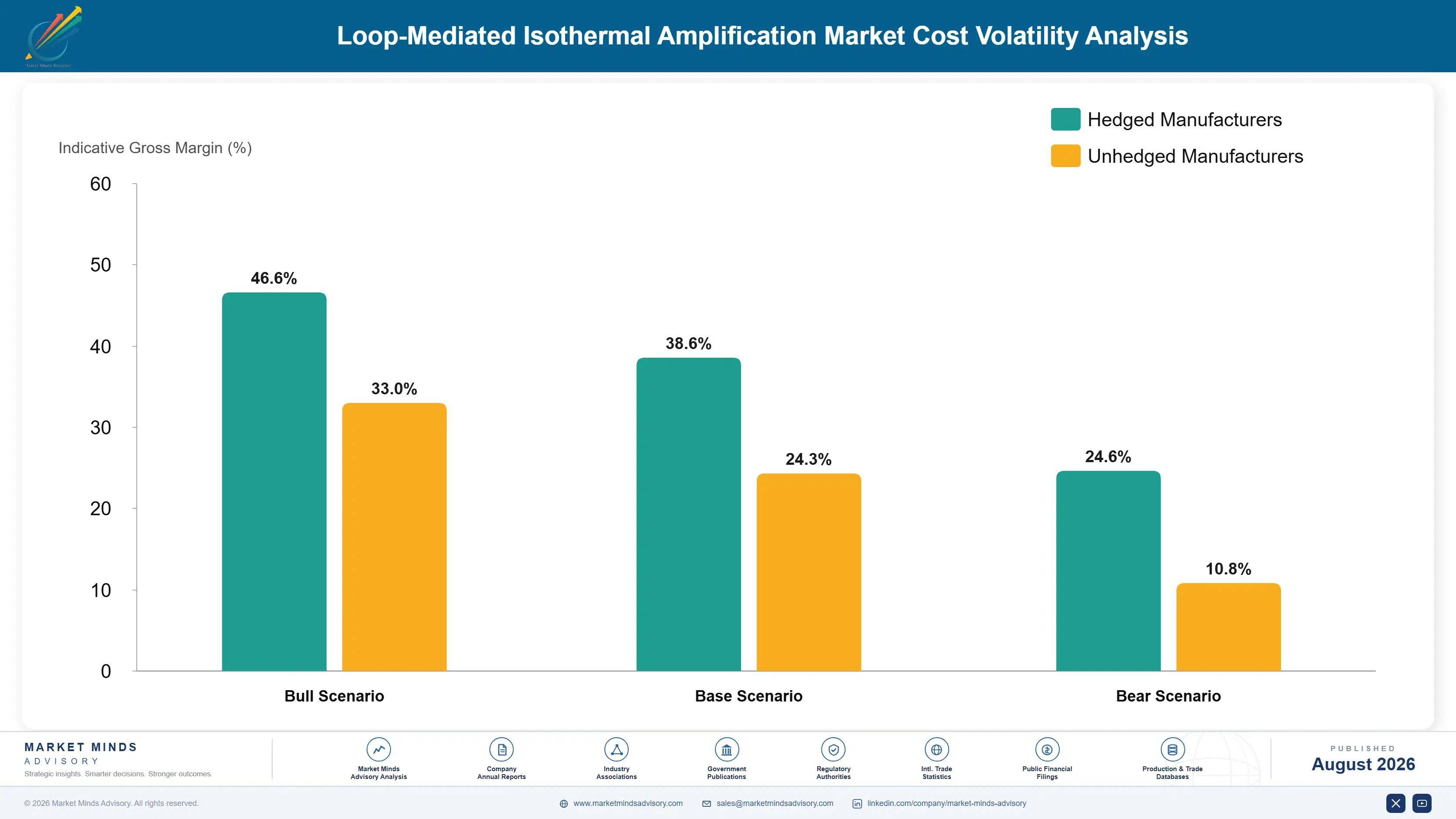
Reagent economics are dominated by two inputs. Bst polymerase and engineered variants account for roughly 43% of kit cost of goods, produced through microbial expression by a small number of capable manufacturers. Synthesised oligonucleotide primers add a further 21%, and six primers per assay against two for conventional amplification makes that burden permanently higher here than in competing chemistries. Lyophilisation, packaging and quality release testing carry most of the remainder.
Enzyme and oligonucleotide supply tightened materially through 2021 and 2022 as testing demand absorbed production capacity that research and agricultural applications normally rely upon, and loop-mediated developers competed for the same fermentation and synthesis slots as far larger diagnostic manufacturers. Supplier annual reports across the period documented allocation constraints and subsequent capacity investment. Single-use plastic and reaction tube availability proved similarly limiting for several kit producers.

Exposure varies most by enzyme dependency rather than by scale. Kit developers buying finished enzyme carry supplier margin and allocation risk into every reaction sold, while integrated producers control that cost directly. Geography compounds it: Chinese enzyme and oligonucleotide producers now supply at prices Western manufacturers cannot approach, which matters most in agricultural applications where purchasers compare delivered cost rather than validated performance.
loop-mediated-isothermal-amplification-market-cost-volatility-analysis-1787305730888

Secure enzyme supply on multi-year committed terms

Bst polymerase at roughly 43% of kit cost comes from a small group of capable producers, and loop-mediated developers sat behind far larger diagnostic customers in every allocation decision during recent disruption. Multi-year agreements covering qualified enzyme protect production continuity at modest cost. Qualifying a second source takes validation work that must happen before an interruption rather than during one.

Design assays with the oligonucleotide burden in mind

Six primers per reaction against two for conventional amplification makes synthesis cost permanently higher in this chemistry, and that difference compounds across every reaction produced. Primer design targeting shorter sequences, shared primers across related assays and bulk synthesis contracting each reduce it. The constraint is inherent rather than removable, so it belongs at design stage.

Invest in lyophilisation capability rather than contracting it

Ambient stable formats are what make field deployment possible, and roughly 41% of assays currently ship that way, so the capability determines addressable application rather than merely reducing shipping cost. Contract lyophilisation adds cost and lead time to every batch and gives away formulation knowledge. Owned capability becomes essential at any volume beyond occasional supply.

Portfolio Architecture for Margin Defence

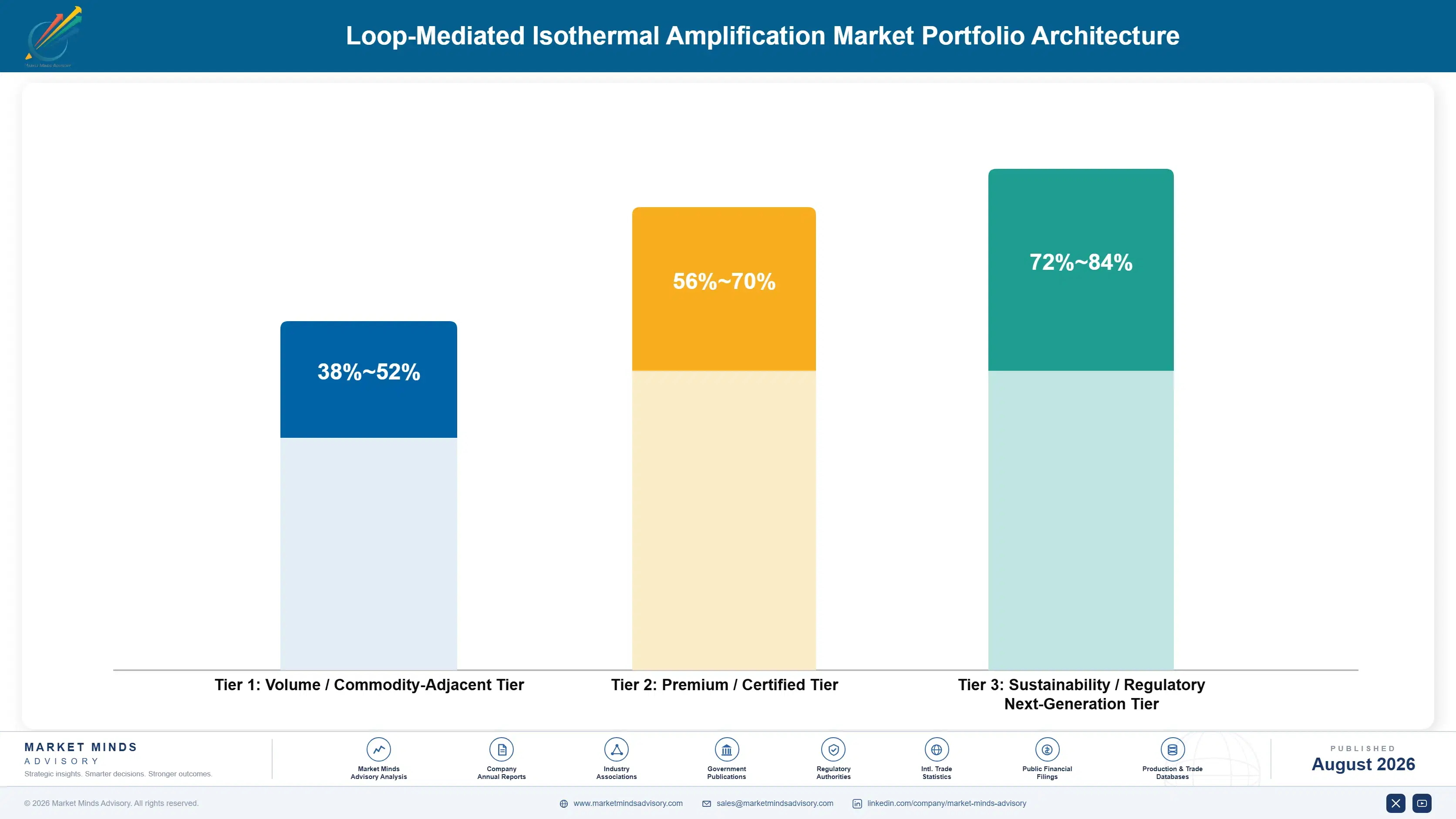
Margin architecture separates on whether a competitor can substitute the product. Agricultural and food safety kits face low barriers, many entrants and purchasers comparing delivered cost, so they earn modestly despite growing fastest. Validated clinical assays with regulatory approval and programme endorsement earn considerably better, protected by approval cost that most entrants will not incur. Enzyme supply earns best of all, because everybody needs it and few can make it.
The volume against premium tension runs between application settings rather than geographies. Agricultural deployment generates the largest reaction volume at low prices and minimal regulatory burden, and it is where the method's advantage is most decisive. Clinical deployment generates higher value per reaction from far fewer tests, with approval requirements that take years. Serving both means running two quite different development and regulatory functions simultaneously.

High-value pools concentrate around enzyme supply and validated clinical menu. Bst polymerase and engineered variants, approved clinical assays with programme endorsement, and industrialised primer design capability all command pricing that generic agricultural kits do not. Undifferentiated field kits, whatever their target menu, compete against Chinese manufacturers with retained capacity and cost structures Western producers cannot realistically approach.

Volume / Commodity-Adjacent Tier

Agricultural, veterinary and food safety kits sold on delivered cost with minimal regulatory barrier, where Chinese manufacturers with retained pandemic capacity compete most effectively across every target menu. Barriers here are genuinely low.
Gross Margin: 38-52%

Premium / Certified Tier

Validated clinical assays holding regulatory approval and disease programme endorsement, protected by approval cost and evidence requirements that new entrants arriving after patent expiry will not readily incur. Programme endorsement reaches national deployments directly.
Gross Margin: 56-70%

Sustainability / Regulatory / Next-Generation Tier

Bst polymerase and engineered enzyme variants supplied to every developer in the field, commanding premium because production capability is concentrated and formulation difficulty genuinely limits credible entry. Everyone downstream must buy from this tier.
Gross Margin: 72-84%
loop-mediated-isothermal-amplification-market-portfolio-architecture-1787305731395

Reaction-Linked Volume and Menu Constraints

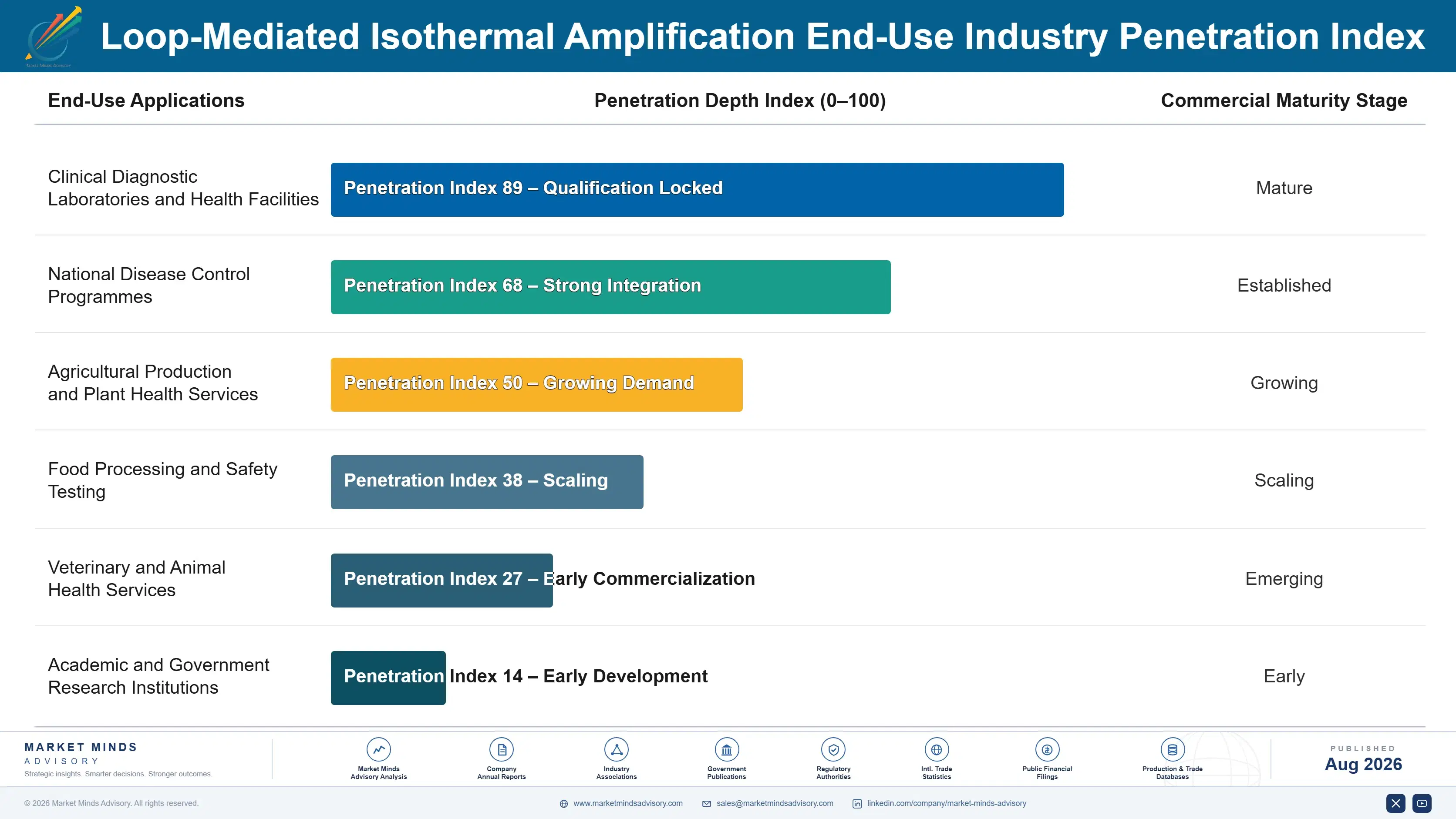
Demand tracks reactions performed rather than any purchasing cycle, which makes this a consumable business at every level including the enzyme underneath it. Every test consumes primers, enzyme and readout reagent at a blended cost near USD 2.40, and volume follows testing activity directly. Instrument placements are modest and infrequent by comparison, since a heat block is inexpensive and many applications need no instrument at all beyond visual readout.
Adoption depth follows infrastructure absence rather than income. District health facilities without laboratories, packing houses testing produce before shipment and field agronomists checking plant disease all adopt readily, because no alternative functions in those settings. Well-equipped laboratories adopt rarely, since conventional amplification performs better wherever a thermocycler and trained staff exist. That inversion means the method's best markets are those least able to pay.

Purchasing profiles are unusually varied. National disease programmes and international health funders procure clinical assays in volume against programme criteria. Agricultural exporters and packing houses buy against importing market inspection requirements. Assay developers buy enzyme and design services rather than finished kits. And research users buy small quantities of everything, which seeds the applications that later become programmes.
loop-mediated-isothermal-amplification-market-end-use-penetration-index-1787305731886

Where Isothermal Amplification Strategy Lands

These are among the four positions where our research anticipates prominent divergence between winners and laggards over the coming forecast period. Each is grounded in the demand model, the regulatory perimeter, and the announced capacity pipeline.
01 / ENZYME POSITION PRIORITY

The polymerase supplier profits from everyone else's fight

Every loop-mediated reaction performed anywhere requires Bst polymerase or an engineered variant of it, regardless of whose kit happens to contain that enzyme or which competitor eventually wins the account. Production capability is concentrated among very few manufacturers and engineered variants carry formulation difficulty that limits credible entry considerably. Patent expiry widens the field of developers who must buy that enzyme without touching the enzyme position at all, which makes downstream fragmentation an advantage rather than any kind of threat.
02 / INFRASTRUCTURE ABSENCE FOCUS

This method is worth most where laboratories are not

Working at a single temperature without a thermocycler, without reliable power and without a trained technician is worth a great deal in a district health facility, a packing house or an actual field, and it is worth almost nothing at all in a well-equipped Western hospital laboratory. Agricultural and food safety kits compound at 17.7% precisely because that is where the advantage genuinely decides the outcome. Developers pursuing clinical menu expansion into well-served laboratory markets are competing against methods that simply perform better there.
03 / DESIGN INDUSTRIALISATION PRIORITY

Primer design is the constraint patents were hiding

Six primers recognising eight distinct target regions must all function together at a single temperature, and typical assay development runs to roughly 14 months with a meaningful proportion of attempts failing outright before validation. That is why a method published a quarter century ago still carries a narrower validated menu than considerably newer alternatives do. Patent expiry has just made that constraint commercially relevant to a far larger group of developers, and whoever industrialises the design work will capture it.
04 / AMBIENT FORMAT DEFAULT

Refrigerated product contradicts the argument being sold

Roughly 41% of all available assays currently ship in an ambient stable lyophilised form, which means that the majority still require a cold chain that is unreliable or entirely absent in exactly the settings where this method holds its advantage. Single-reaction lyophilised packaging also directly addresses the carryover contamination hazard that this method's very high amplification efficiency inevitably creates. Suppliers still shipping refrigerated product into genuine field applications are actively undermining the deployment argument that their own product entirely depends upon.

Engagement Snapshot From the Field

A live engagement with an industry participant carrying material or product regulatory and market exposure ahead of a defining policy shift, showing how our research translates into a defensible multi-year portfolio strategy.
MARKET MINDS ADVISORY · CLIENT ENGAGEMENT SUMMARY
Loop-Mediated Isothermal Amplification Producer Strategic Portfolio Review and Transition Roadmap 2026·Investment Scenario on Loop-Mediated Isothermal Amplification Exposure Evaluation 2025-26
CLIENT PROFILE
A molecular diagnostics developer holding several validated loop-mediated clinical assays, a small instrument line and no enzyme production capability. Annual revenue was approximately USD 38 million (client-reported, unverified by MMA), concentrated in clinical assays sold into European and Southeast Asian markets, with enzyme purchased from a single external supplier at substantial cost. Licensed access had been the principal competitive advantage.
STRATEGIC CHALLENGE
Foundational patent expiry was expected to bring numerous new assay developers into a market where the client's principal advantage had been licensed access, while enzyme cost consumed a large share of every kit sold. The board needed to decide whether to expand clinical menu, enter agricultural applications, or invest in enzyme production and primer design capability instead.
MMA APPROACH
MMA conducted 47 expert interviews spanning clinical microbiologists, national tuberculosis programme managers, plant pathologists, food safety directors, agricultural exporters, enzyme producers and assay development specialists across six countries. A quantitative survey of 3,800 respondents established deployment settings, purchasing criteria and menu requirements. We then modelled revenue and margin outcomes under menu expansion, agricultural entry and upstream investment strategies against observed patent timelines.
KEY FINDINGS
  1. Enzyme cost represented the largest single input across every developer surveyed, and none holding internal production capability reported any allocation difficulty during recent supply disruption.
  2. Agricultural and food safety purchasers rated field usability and delivered cost above validated performance, and regulatory requirements were a fraction of clinical approval burden.
  3. Assay development timelines exceeded a year across nearly every surveyed programme, and primer design failure rather than chemistry performance accounted for most abandoned projects.
  4. Clinical laboratory customers across the well-equipped settings surveyed preferred conventional amplification consistently, and deployed loop-mediated assays only where laboratory access was absent.
CLIENT PROFILE
A molecular diagnostics developer holding several validated loop-mediated clinical assays, a small instrument line and no enzyme production capability. Annual revenue was approximately USD 38 million (client-reported, unverified by MMA), concentrated in clinical assays sold into European and Southeast Asian markets, with enzyme purchased from a single external supplier at substantial cost. Licensed access had been the principal competitive advantage.
STRATEGIC CHALLENGE
Foundational patent expiry was expected to bring numerous new assay developers into a market where the client's principal advantage had been licensed access, while enzyme cost consumed a large share of every kit sold. The board needed to decide whether to expand clinical menu, enter agricultural applications, or invest in enzyme production and primer design capability instead.
MMA APPROACH
MMA conducted 47 expert interviews spanning clinical microbiologists, national tuberculosis programme managers, plant pathologists, food safety directors, agricultural exporters, enzyme producers and assay development specialists across six countries. A quantitative survey of 3,800 respondents established deployment settings, purchasing criteria and menu requirements. We then modelled revenue and margin outcomes under menu expansion, agricultural entry and upstream investment strategies against observed patent timelines.
KEY FINDINGS
  1. Enzyme cost represented the largest single input across every developer surveyed, and none holding internal production capability reported any allocation difficulty during recent supply disruption.
  2. Agricultural and food safety purchasers rated field usability and delivered cost above validated performance, and regulatory requirements were a fraction of clinical approval burden.
  3. Assay development timelines exceeded a year across nearly every surveyed programme, and primer design failure rather than chemistry performance accounted for most abandoned projects.
  4. Clinical laboratory customers across the well-equipped settings surveyed preferred conventional amplification consistently, and deployed loop-mediated assays only where laboratory access was absent.
RECOMMENDED STRATEGY
Phase 1: Phase one: invest in enzyme production capability, since it is the largest input cost and the position that benefits from the new entrants patent expiry will bring. Phase 2: Phase two: enter agricultural and food safety applications, where field deployability decides outcomes and regulatory burden is a small fraction of clinical approval. Phase 3: Phase three: industrialise primer design as a service, capturing the constraint that has always limited how many validated assays actually exist.
OUTCOME
The client invested roughly USD 12 million in enzyme production capability, launched an agricultural assay range and established a primer design service (client-reported, unverified by MMA). Enzyme cost per kit fell substantially within eighteen months, agricultural revenue exceeded plan, and three external developers contracted the design service after patent expiry.

Frequently Asked Questions

Foundational context covering the market sizes, CAGR, scope, country, region and competition that inform every finding below. This section is provided to cover basics and most often pre-purchase conversations, answered from the MMA Primary Research Dataset.

What is the current size of the Loop-Mediated Isothermal Amplification Market?

The global loop-mediated isothermal amplification market was valued at USD 0.62 billion in 2025, spanning enzymes, clinical and agricultural assay kits, instruments, readout reagents and design services. Blended reagent cost runs near USD 2.40 per reaction.

How large will the Loop-Mediated Isothermal Amplification Market be by 2036?

MMA forecasts the market at USD 2.11 billion by 2036, expanding 3.06 times from the 2026 base of USD 0.69 billion. That represents roughly USD 1.42 billion of incremental value across the forecast decade.

What is the CAGR for the Loop-Mediated Isothermal Amplification Market 2026 to 2036?

The base case compound annual growth rate is 11.8%, with a bull case of 13.0% and a bear case of 10.6%. The bull case assumes patent expiry brings a wave of new assay development broadening the validated menu.

Which segment is growing fastest?

Agricultural and food safety assay kits grow at 17.7%, a full 1.50x the overall market rate. Field deployability matters more outside the clinic and the regulatory burden is a fraction of diagnostic approval.

Who are the major companies in the Loop-Mediated Isothermal Amplification Market?

Eiken Chemical, New England Biolabs, Meridian Bioscience, OptiGene and Ustar Biotechnologies together hold 44% of revenue. Eiken invented the method while New England Biolabs supplies the enzyme every developer requires.

Which country is growing fastest?

India grows fastest at 19.0%, substantially on national tuberculosis programme deployment into district facilities with no laboratory. East Asia is the largest region at 30% of value across origin, manufacturing and agriculture.

Report Segmentation Architecture

The full report scope spans multiple orthogonal segmentation dimensions, with cross-tabulated demand data provided for each dimension pair. Coverage extends further to regional breakdowns, trend trajectories, and the competitive detail needed to support segment-level decision-making.

By Product Class

  • Bst Polymerase and Amplification Enzymes
  • Validated Clinical Assay Kits
  • Agricultural and Food Safety Assay Kits
  • Detection Instruments and Readers
  • Colorimetric and Lateral Flow Readout Reagents
  • Primer Design and Custom Assay Services

By End-Use Industry

  • Clinical Diagnostic Laboratories and Health Facilities
  • National Disease Control Programmes
  • Agricultural Production and Plant Health Services
  • Food Processing and Safety Testing
  • Veterinary and Animal Health Services
  • Academic and Government Research Institutions

By Commercial Dimension

  • Direct Kit and Reagent Sales
  • Enzyme and Component Supply to Developers
  • National Programme and Donor Procurement
  • Distributor and Agricultural Dealer Channel
  • Custom Assay Development Contracts
  • Original Equipment Manufacturer Supply

By Region

  • East Asia
  • North America
  • South Asia and Pacific
  • Western Europe
  • Latin America
  • Middle East and Africa
  • Eastern Europe

Scope, Methodology, and Coverage

Every figure in this report is reproducible from documented input assumptions. The scope below maps the historical period, the forecast horizon, the segmentation dimensions, and the countries covered, alongside the underlying primary and qualitative methodology.
Historical Period
2020 to 2025
Forecast Period
2026 to 2036
Base Year
2025 (USD billions; MMA Primary Research Dataset, August 2026)
Market Definition
This market comprises products and services enabling loop-mediated isothermal amplification across clinical, agricultural, food safety, veterinary and research applications, measured at supplier revenue across direct kit and reagent sales, enzyme and component supply to developers, national programme and donor procurement, distributor and agricultural dealer channels, custom assay development contracts and original equipment manufacturer supply. Coverage spans Bst polymerase and engineered amplification enzyme variants, validated clinical assay kits including tuberculosis, malaria and respiratory targets, agricultural and food safety assay kits for plant pathogens, species verification and contamination screening, detection instruments, readers and heat blocks supplied for the method, colorimetric, turbidimetric and lateral flow readout reagents, and primer design software and custom assay development services. Polymerase chain reaction reagents and instruments, other isothermal chemistries including recombinase polymerase, helicase-dependent and nicking enzyme amplification, sequencing reagents and library preparation, sample collection devices and transport media, and nucleic acid extraction products fall outside scope.
Quantitative Units
USD millions (current prices); reactions performed by application; kits supplied; cost per reaction; enzyme volumes consumed; validated assays available; ambient stable format share
Segmentation Dimensions
By Product Class; By End-Use Industry; By Commercial Dimension; By Region
Regions Covered
East Asia, North America, South Asia and Pacific, Western Europe, Latin America, Middle East and Africa, Eastern Europe
Countries Covered
Japan, China, South Korea, Taiwan, India, Indonesia, Philippines, Vietnam, Thailand, Bangladesh, Australia, United States, Canada, Mexico, Germany, United Kingdom, France, Netherlands, Spain, Italy, Brazil, Chile, Peru, Colombia, Argentina, Kenya, Nigeria, South Africa, Saudi Arabia, Poland, Czechia, and additional markets relevant to field testing analysis
Key Companies Profiled
Eiken Chemical, New England Biolabs, Meridian Bioscience, OptiGene, Ustar Biotechnologies, Lucigen, LGC Biosearch Technologies, HiberGene Diagnostics, SD Biosensor, Sansure Biotech, Bioneer, Nippon Gene, Amplex Diagnostics, Genomtec, GenBody, Mast Group, Takara Bio, Promega, Agdia, Neogen
Quantitative Methodology
Primary survey, n=3,800 respondents, Q4 2025, six countries; demand-side model with trade association cross-validation
Qualitative Methodology
47 expert interviews, Q4 2025; applied to validate demand model assumptions, identify emerging dynamics, and assess competitive positioning
Report Format
PDF and XLSX data workbook (Word format preview document)
Publisher
Market Minds Advisory
Report Code
MMA-2026-HLT-367
Published
August 2026
Contact
sales@marketmindsadvisory.com | www.marketmindsadvisory.com

Purchase the full Loop-Mediated Isothermal Amplification Market Report (2026 to 2036).

The full MMA report treats intellectual property and primer design as the constraints that actually governed this technology's adoption, quantifying what changes as foundational patents expire. It sizes six product classes and seven regions to 2036, modelling reactions performed, kits supplied, enzyme consumption, cost per reaction and validated assay availability separately so that upstream and downstream positions can be assessed independently. Competitive assessment covers twenty suppliers on one consistent revenue basis. Cost exposure is traced through enzyme, oligonucleotide and lyophilisation inputs. Four commercial levers and a strategic verdict close the report, grounded in 47 expert interviews and a 3,800-respondent survey.
Six product classes sized separately through 2036
Patent expiry impact modelled on developer entry rates
Agricultural deployment separated from clinical diagnostic adoption
Twenty suppliers assessed on one consistent revenue basis
Enzyme dependency quantified across every downstream kit developer
Anonymised client engagement with tested strategic recommendations

Built For The People Who Decide

From boardroom strategy to bench-side execution, this report is read cover-to-cover by leaders shaping the next decade of their industry, turning demand scenarios, market dynamics and valuation benchmarks into decisions.
CXOs/ Presidents/ VPs/ Managers
M&A and Corporate Development
Strategy Teams and R&D Heads
Procurement and Product Directors
Regulatory and Compliance Leaders
Investor Relations and Equity Analysts