
Market Minds Advisory
Lip Fillers Market

Lip Fillers Market: Reversibility, the Volume Retreat, and Who Is Allowed to Inject

The fastest growing product in this market is the enzyme that dissolves lip filler, which tells you almost everything about where aesthetic taste has moved in the past three years.

Lead Analyst

Alice Ballenger

Published

August 2026

Make Smarter Decisions with Customized Research Insights

Request a free sample report and evaluate market opportunities, growth trends, and competitive dynamics relevant to your business needs.

2025 MARKET VALUE$1.6BMarket Size 2025
2036 FORECAST VALUE$3.9BBase Case , 2026 to 2036
CAGR 2026 TO 20368.4 %Bull 9.6% / Bear 7.2%
INCREMENTAL OPPORTUNITY$2.2BNet 10- year value creation
EXPANSION MULTIPLE2.25x2036 value over 2026 base
Strategic Levers
M&A Pipeline
Regional Outlook
Country Rankings
Competitive Intelligence
Segmental Deep-dive
Call-Us : 91 93563 13602

Executive Snapshot and Market Trajectory

Hyaluronic acid dominates lip augmentation for one reason: an enzyme dissolves it. That reversibility is the product's safety net, its commercial advantage and, increasingly, the source of a whole service line built on undoing previous treatment. Lips remain hyaluronic acid territory almost exclusively for that reason.
Hyaluronidase reversal products compound at 12.6%, a full 1.50x the market rate, driven by an aesthetic retreat from visible volume and by patient awareness of product migrating above the lip border. East Asia holds the largest share at 30%, with South Korea compounding at 13.6% on the highest aesthetic injectable penetration anywhere and a manufacturing base exporting filler worldwide at prices Western brands cannot match.
Concentration is high at 68% and average product volume per treatment has fallen to 0.7 mL as the overfilled look lost favour. Roughly 31% of injections are performed by practitioners without medical qualification, which is where the vascular occlusion risk actually sits. The perioral region carries genuine arterial embolism risk that requires immediate hyaluronidase and the knowledge to use it under pressure, and licensing regimes are arriving considerably later than the treatment volumes warranted.
Market Definition
This market covers injectable products and associated consumables used for lip augmentation, definition and hydration, spanning soft cohesive hyaluronic acid fillers, structured volumising hyaluronic acid fillers, skin quality and hydration injectables, hyaluronidase reversal products, non-hyaluronic acid volumising products, and cannulas, needles and injection accessories, measured at manufacturer revenue. Botulinum toxin products, fillers indicated exclusively for other facial areas, surgical lip implants and augmentation procedures, topical lip products, and clinic service or procedure fee revenue are excluded.
Base Year Value
$1.6B in 2025 (MMA Primary Research Dataset, August 2026)
Forecast Period
2026 to 2036, eleven discrete annual values
CAGR
8.4% base case. Bull 9.6%. Bear 7.2%.
Fastest Growth Segment
Hyaluronidase Reversal Products: 12.6% CAGR
Fastest Growth Country
South Korea: 13.6% CAGR
Fastest Growth Region
South Asia and Pacific: 10.4% CAGR
Largest Region
East Asia: 30% of 2025 global value
Market Leaders
AbbVie, Galderma, Merz Aesthetics, Teoxane, and Prollenium. Source: MMA Primary Research Dataset, July 2026.
Primary Survey
n=3,800 procurement and R&D decision-makers, Q4 2025, six countries
Methodology
Demand-side build-up, cross-validated against public data, 47 expert interviews

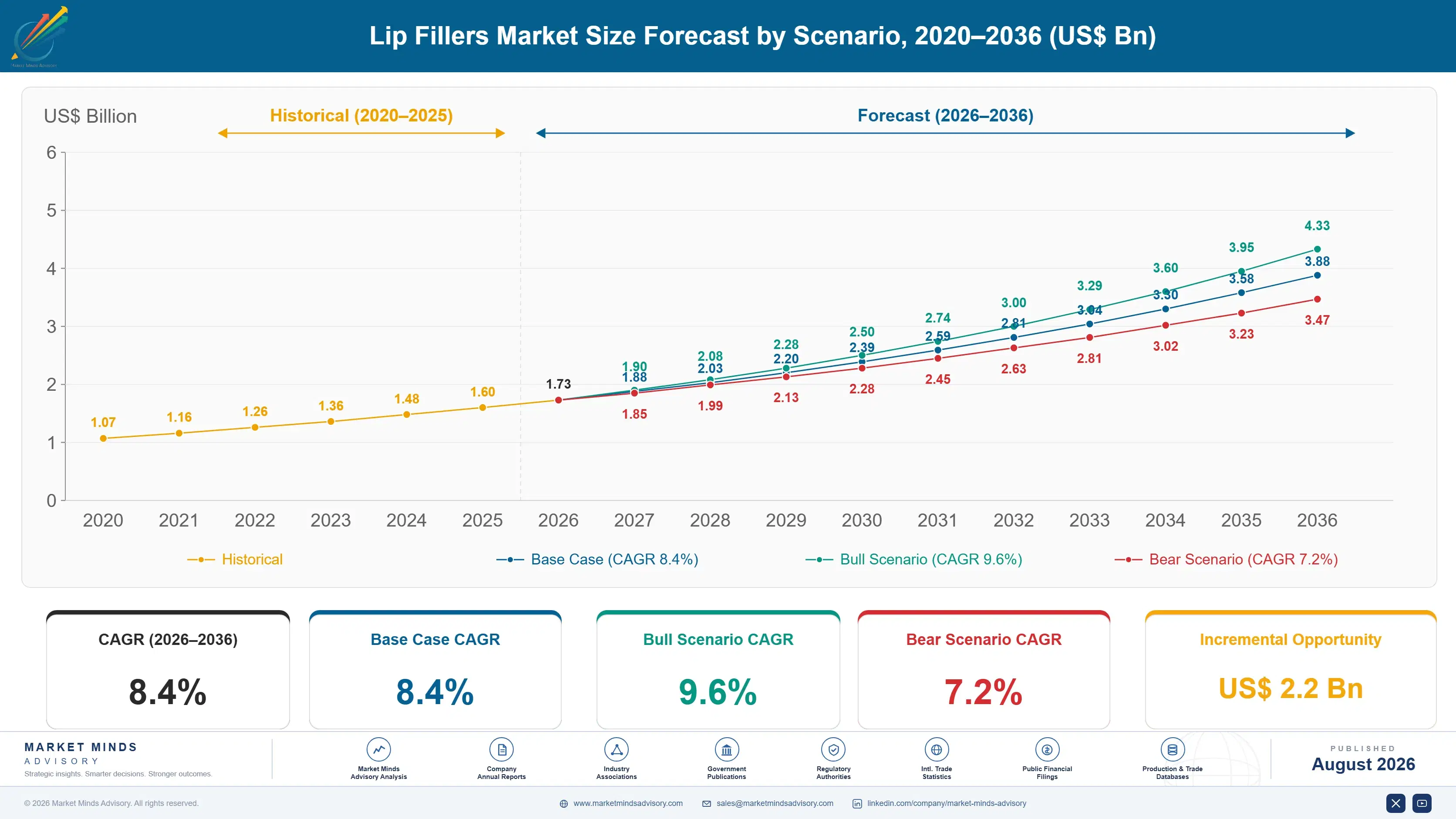
Lip Fillers Market Forecast Scenarios

lip-fillers-market-size-forecast-scenario-1787305716329
Growth ran near 7.4% from 2020 to 2025 through a period when patient numbers and product volume moved in opposite directions. Aesthetic demand rebounded strongly as people returned to consultations with heightened awareness of their appearance. Then taste shifted decisively against visible volume, high-profile dissolutions drew wide attention, and injectors began treating with materially less product per patient than they had been.
Base case growth of 8.4% rests on three mechanisms. Patient numbers keep rising as injectable treatment normalises across younger demographics and across markets where it was previously uncommon. Reversal and correction work expands into a service line of its own. And skin quality injectables aimed at lip hydration and texture rather than volume open a treatment for patients who would decline augmentation outright. None of the three depends on the others arriving first.
The bull case at 9.6% assumes licensing regimes for non-medical injectors formalise across major markets, which would raise treatment prices and channel volume toward qualified practitioners with better retention. The bear case at 7.2% is a taste problem: the retreat from visible volume continues past hydration into no treatment at all, average volume per patient falls further, and patient growth cannot offset declining product consumption.

Lip Fillers: Reversibility, Restraint and Regulation

Hyaluronic acid holds this market for a reason that has nothing to do with how it looks. It can be dissolved. Hyaluronidase breaks the gel down within hours, which means an unsatisfactory result, a lump, a migration or a genuine vascular emergency can all be reversed. No other injectable offers that, which is why biostimulatory products used elsewhere on the face are almost never placed in lips.
TOP FIVE CONCENTRATION68%Concentrated among established aesthetic manufacturers with deep injector training networks
AVERAGE TREATMENT PRICEUSD 680Typical patient cost per lip treatment session, entirely self-funded
VOLUME PER TREATMENT0.7 mLAverage product injected per session, declining as taste shifted
DISSOLUTION REQUEST RATE17%Patients requesting removal of previously placed lip product
RETREATMENT INTERVAL9 monthsTypical period between repeat lip treatments among returning patients
NON-MEDICAL INJECTOR SHARE31%Lip injections performed by practitioners without medical qualification
That reversibility now supports a service line of its own. Roughly 17% of patients presenting for lip treatment are asking for previous product to be removed rather than added, driven by taste moving against visible volume and by awareness of filler migrating above the vermilion border. Average product per session has fallen to about 0.7 mL. The market is treating more people with less material, which makes patient growth and revenue growth diverge.
The uncomfortable part concerns who holds the syringe. Roughly 31% of lip injections are performed by practitioners without medical qualification, and the perioral region carries genuine arterial embolism risk that can cause tissue necrosis or, rarely, blindness. Managing that emergency requires immediate hyaluronidase and the knowledge to use it. Licensing regimes are arriving considerably later than the volume warranted.
"The whole category rests on a single enzyme. Fillers that cannot be dissolved never took the lip market and never will, because the thing patients are really buying is permission to change their mind afterwards."
Principal Analyst, Aesthetic Injectables and Facial Rejuvenation Practice · MMA

Market Trends

Reversal becomes a treatment category rather than a correction

Roughly 17% of patients presenting for lip treatment now want previous product removed rather than more added, and clinics increasingly market dissolution as a service in its own right rather than as a remedy for a poor outcome. Taste has moved decisively against visible volume, and awareness of product migrating above the vermilion border reached mainstream consumer conversation. The segment compounds at 12.6%, which makes the enzyme that destroys filler the fastest growing product in a filler market. Clinics currently source the enzyme informally rather than through their principal filler supplier.
Market Impact: Korea compounding at 13.6% annually
Treatment shifts from adding volume toward improving lip quality

Average product per session has fallen to around 0.7 mL as injectors treat for definition, hydration and texture rather than for size, and skin quality injectables designed to improve tissue rather than add structure now reach patients who would refuse augmentation outright. That expands the addressable population while reducing material consumed per patient. Revenue per treatment holds up better than volume suggests, because technique and injector time rather than product quantity increasingly determine what a clinic charges. Finer-particle formulations serve definition rather than size. The category is expanding toward patients who want to look entirely untreated by anybody.
Market Impact: Reversal possible within 2 hours

Market Opportunities and Growth Drivers

Asian aesthetic penetration exceeds every other regional market

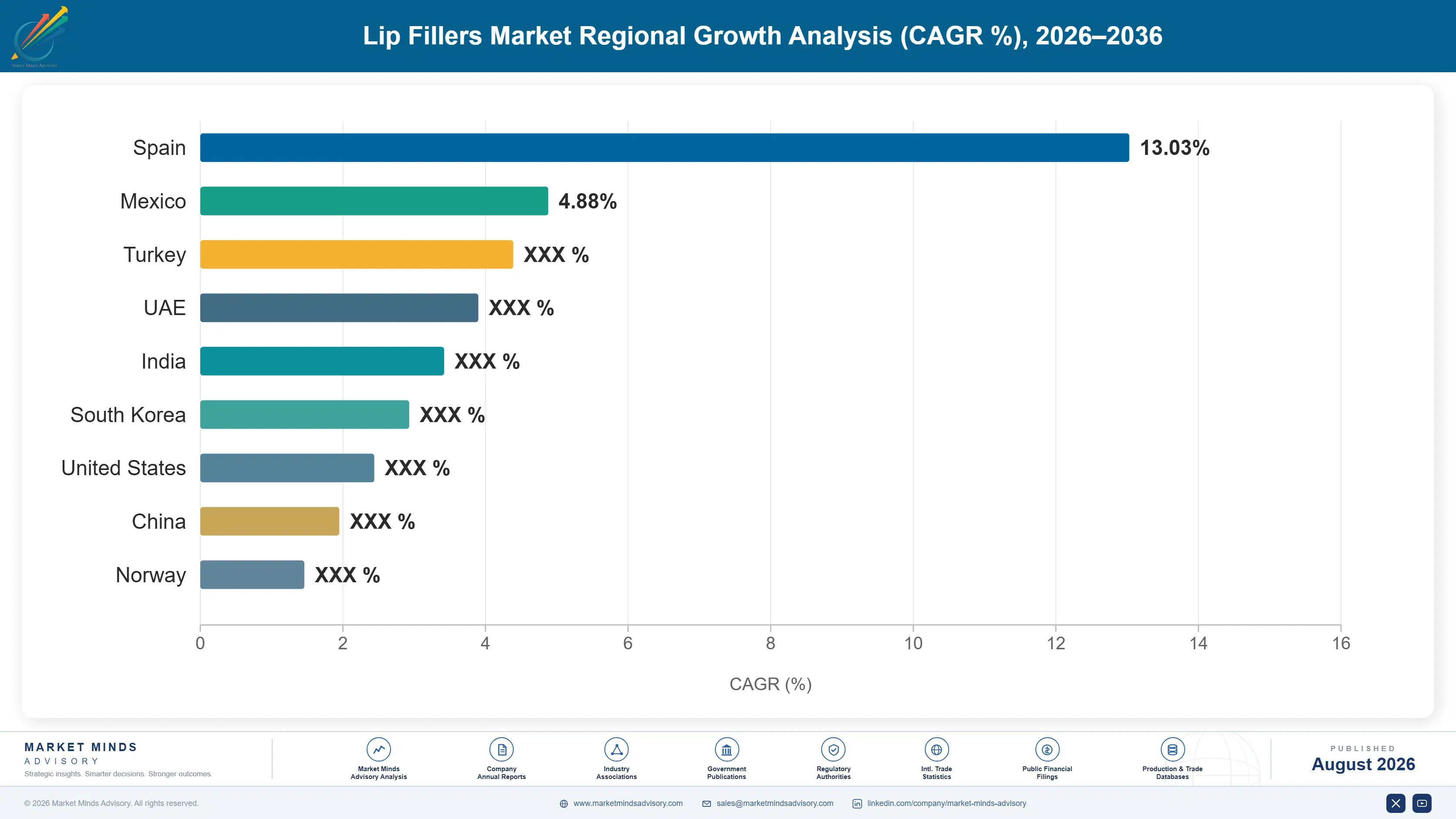
South Korea compounds at 13.6% and holds the highest per capita aesthetic injectable treatment rate anywhere, supported by a domestic manufacturing industry that exports hyaluronic acid filler worldwide at prices established Western brands cannot approach. Chinese demand is expanding rapidly from a large base with domestic producers including Bloomage and Imeik taking substantial share. Treatment carries considerably less social reticence across the region than in Western markets, which lifts first-time patient conversion materially. Korean manufacturers export that price position into every other region, which is why brand recognition rather than formulation quality determines where premium pricing still holds.
Market Impact: Roughly 31% lack medical qualificat

Reversibility permits treatment that permanent products never could

Hyaluronidase dissolves hyaluronic acid within hours, which converts an irreversible aesthetic decision into a trial. That single property is why patients accept lip treatment at rates permanent implants never achieved, and why practitioners will treat younger patients whose preferences may change. It also converts a vascular occlusion from a catastrophe into a manageable emergency, provided the injector holds the enzyme and knows how to use it under pressure. Practitioners will treat younger patients whose preferences may change precisely because the decision can be undone, which extends the addressable population well beyond what permanent augmentation ever reached.
Market Impact: Volume down to 0.7 mL

Market Restraints and Challenges

Unqualified injectors concentrate the serious complication risk

Roughly 31% of lip injections are performed by practitioners without medical qualification, and the perioral region carries real arterial embolism risk producing tissue necrosis or, rarely, permanent visual loss. The root cause is regulatory: in several major markets anyone could inject filler with no training requirement whatsoever. Commercial impact arrives through reputational damage that reaches the whole category when incidents surface publicly. Licensing regimes, mandatory hyaluronidase availability and manufacturer-restricted distribution are the responses underway. Complication clinicians report that unqualified injectors frequently hold no hyaluronidase at all at the point of treatment, which several describe as the category's most serious exposure.
Market Impact: Compounding at 12.6% each year

Aesthetic taste moved against the visible result being sold

Average product per treatment has fallen to about 0.7 mL as visible lip volume lost favour, and 17% of presenting patients now want existing product removed. The root cause is a genuine cultural shift amplified by social media and by prominent public dissolutions rather than any clinical finding. Commercial impact is patient growth and material consumption diverging. Participants are responding with hydration and skin quality products, finer-particle formulations and repositioning toward definition rather than augmentation. Discounting does not reverse a taste change, which several manufacturers have now demonstrated at their own expense.
Market Impact: Volume falling toward 0.7 mL
3 additional market trends, 4 additional growth drivers, and 2 additional restraints and challenges are covered in the full report. Contact sales@marketmindsadvisory.com to access the complete intelligence.

Segment CAGR and Growth Architecture

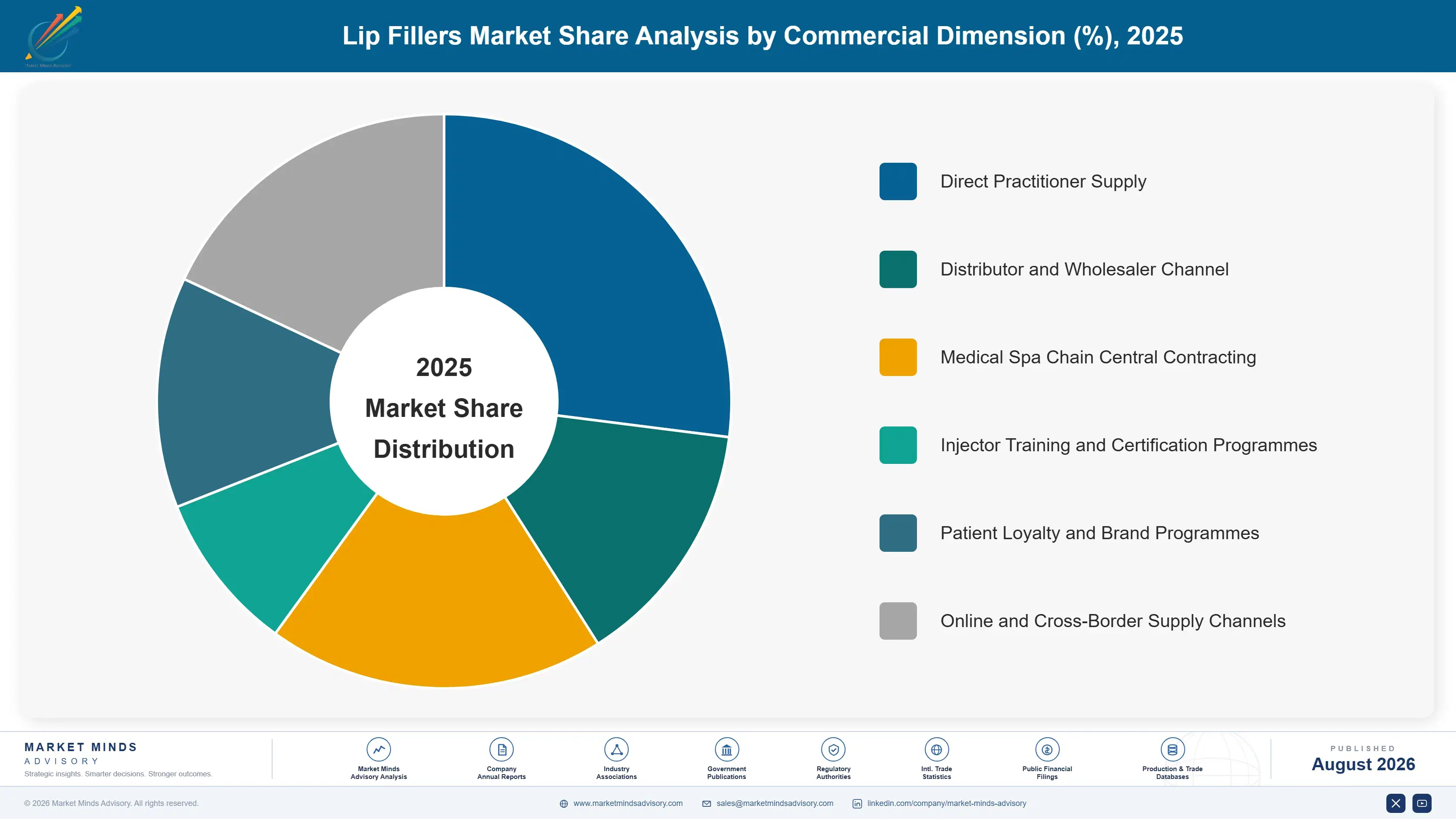
Segmentation follows product class, because class determines the rheology and handling characteristics, the regulatory pathway, the clinical purpose within a lip treatment and the price a practitioner will pay. Six product classes cover lip injectable supply without overlap between them. Patient demographic and treatment setting cut across every class and are treated here as use attributes.
lip-fillers-market-market-share-analysis-1787305716889

Hyaluronidase Reversal Products

Growing at 12.6%, a full 1.50x the market rate, hyaluronidase dissolves hyaluronic acid gel within hours and now serves three quite different purposes: correcting an unsatisfactory result, removing product a patient no longer wants on aesthetic grounds, and managing a vascular occlusion emergency. Roughly 17% of presenting patients ask for removal rather than addition, which has converted a corrective agent into a treatment category. Regulatory status varies awkwardly between markets, and availability at the point of injection remains inconsistent precisely where the emergency need is greatest. Clinics frequently source the enzyme informally rather than from their principal filler supplier, which is a commercial gap nobody has closed. Availability at the point of injection remains inconsistent.
CAGR 12.6%

Skin Quality and Hydration Injectables

Hydration and skin quality injectables grow at 10.8% by offering treatment to patients who would decline augmentation outright, improving lip tissue texture, hydration and fine lines rather than adding any shaped volume. Formulations use lower concentration, less cross-linked hyaluronic acid delivered through multiple small deposits rather than a shaped bolus. That suits the retreat from visible volume precisely, and it expands the addressable population toward patients who want to look treated by nobody. Retreatment intervals are shorter than for volumising products, which partially offsets the lower price per session. The category expands toward patients who want to look untreated, which is a very different proposition from the one this market was originally built to sell.
CAGR 10.8%
Full segment breakdown across 6 segments available in the complete report.

Regional Architecture and Country Demand Map

Regional shares follow aesthetic treatment penetration and social acceptance rather than population or income, and those diverge sharply enough here to place the market somewhere most healthcare categories would not. Income and population explain remarkably little of the pattern set out below. Culture explains most of it instead.

East Asia

East Asia holds the largest share at 30%, and the reason is penetration rather than population. South Korea compounds at 13.6% on the highest per capita aesthetic injectable treatment rate anywhere, alongside a domestic manufacturing industry that exports hyaluronic acid filler globally at prices Western brands cannot approach. Chinese demand is expanding rapidly with Bloomage and Imeik taking substantial domestic share from international products. Social acceptance of aesthetic treatment across the region is considerably higher than in Western markets, which lifts first-time conversion materially. Korean exports carry that price position into every other region worldwide. Domestic products have displaced international brands across a substantial share of Chinese treatment volume, and the same pattern is now emerging across Southeast Asian markets.
Share: 30% | CAGR: 9.6% (2026 to 2036)

North America

Twenty-five per cent of value, growing at 7.6%. Treatment pricing is the highest anywhere, and the branded products consumers actually name by name were established here through direct patient marketing that most other regions restrict. The retreat from visible volume began here and moved fastest, with dissolution requests reaching a higher proportion of presenting patients than in any other region. Medical spa expansion has broadened access while raising injector qualification questions that state regulation addresses inconsistently. Treatment pricing near USD 680 a session sustains brand investment that price-driven markets elsewhere could never support at all. Dissolution requests reached a higher proportion of presenting patients here than in any other region, and clinics responded by marketing removal as a distinct service.
Share: 25% | CAGR: 7.6% (2026 to 2036)
Regional intelligence for 5 additional markets available in the complete report: Western Europe, South Asia and Pacific, Latin America, Middle East and Africa, Eastern Europe. Contact sales@marketmindsadvisory.com.
lip-fillers-market-country-cagr-analysis-1787305717400

Where Lip Injectable Value Concentrates

Patients are treating more often with less material, taste has moved against the visible result the category was built on, and roughly a third of injections are performed by people with no medical training. Value now accrues to whoever serves restraint rather than volume, and to whoever controls distribution. Volume was the product and volume is what patients stopped wanting.

Treat reversal as a product line, not a warranty claim

Roughly 17% of presenting patients want previous product removed rather than added, and hyaluronidase compounds at 12.6% as clinics market dissolution as a service in its own right. Manufacturers treating reversal agents as a corrective obligation supplied grudgingly are missing the fastest growing product in their own category. It also serves the vascular occlusion emergency, which makes availability at the point of injection a genuine safety requirement rather than a commercial choice. Clinics currently source it informally, which is a gap nobody has closed. Bundling it alongside filler supply closes that gap directly.
Market Impact: Reversal now requested by 17% of pr

Build the portfolio around restraint rather than volume

Average product per treatment has fallen to about 0.7 mL and shows no sign of recovering, because the shift is cultural rather than clinical. Hydration and skin quality injectables reach patients who would refuse augmentation entirely, growing at 10.8%, and finer-particle formulations serve definition rather than size. Manufacturers whose portfolios are weighted toward structured volumising gels are selling into an aesthetic that patients have publicly abandoned, and discounting does not reverse a taste change. The shift is cultural rather than clinical, so discounting achieves nothing at all. Portfolio weighting rather than pricing is the variable that matters.
Market Impact: Hydration products are growing at 1

Control distribution before regulation forces the issue

Roughly 31% of lip injections are performed by practitioners without medical qualification, and licensing schemes are arriving across several major markets. Manufacturers restricting distribution to qualified injectors ahead of regulation protect brand reputation from incidents that damage the whole category, and they position favourably when licensing takes effect. Those selling through unrestricted channels gain volume now and carry the reputational exposure when a serious complication reaches public attention. Complication clinicians describe missing hyaluronidase at the point of injection as the category's most serious exposure, and it sits almost entirely within that unqualified group.
Market Impact: Restricts access for the 31% curren

Defend brand recognition where patients actually choose

Lip treatment is entirely self-funded at roughly USD 680 per session, and patients increasingly arrive naming a specific product rather than accepting whatever the clinic stocks. That consumer brand recognition is the only defence against Korean and Chinese product priced far below Western levels with comparable rheology. Manufacturers competing on injector economics alone in markets where patients name the brand are surrendering the one advantage that price competition cannot easily erode. Advertising permission determines where that defence exists at all. Korean product with comparable rheology sits far below Western pricing everywhere.
Market Impact: Sessions priced near USD 680 for ea

Who Controls the Margin Pool

Concentration is high at 68% across the top five, measured on annual revenue from injectable products used in lip treatment, the single basis applied throughout this analysis. AbbVie and Galderma lead through different strengths, the first on consumer brand recognition that patients bring into consultations by name, the second on lip-specific formulations positioned around flexibility and natural movement rather than shaped volume.
Competition runs on three dimensions that resolve with different audiences. Consumer brand competition happens before the appointment, when a patient decides which product to request. Injector competition happens on rheology, handling, longevity and training support, and practitioners hold genuine preferences that price alone rarely moves. Price competition is fiercest where patients do not name a brand, which is most of Asia, Latin America and Eastern Europe.

Pressure builds from two directions. Korean and Chinese manufacturers produce hyaluronic acid filler with comparable rheology at prices Western brands cannot approach, and they now hold substantial share wherever consumer brand recognition is weak. Separately, the retreat from visible volume disadvantages portfolios weighted toward structured gels. Rankings shift most where a manufacturer builds credible positions in reversal and hydration alongside volumising products.
lip-fillers-market-company-positioning-matrix-1787305717918

Competitive Moat and Risk Dimensions

ABBVIE

Moat: Consumer brand recognition depth

Patients arrive at consultations naming the product by brand, which is an advantage almost no other medical device or injectable category possesses and one that price competition cannot easily erode. Direct patient marketing built over two decades, combined with the widest injector training network, makes the brand the default request wherever advertising is permitted.
ABBVIE

Risk: Structured volume portfolio weighting

The portfolio is weighted toward products that add visible volume, precisely the aesthetic that patients have publicly retreated from, with average treatment volume falling toward 0.7 mL. Korean and Chinese manufacturers undercut pricing substantially in markets where patients do not name brands. Reversal and hydration positions are less developed than the volumising range.
GALDERMA

Moat: Lip-specific formulation positioning

Dedicated lip formulations positioned around flexibility and natural movement rather than shaped volume align closely with where aesthetic preference has actually moved, which is a considerably better place to be than the volumising end of the category. Strong injector relationships and training investment support technique-led selling that consumer marketing alone does not reach.
GALDERMA

Risk: Consumer recognition gap

Brand recognition among patients trails the market leader in the markets where patients name a product before the consultation, which is where premium pricing is most defensible. Advertising restrictions across Europe limit the route to closing that gap. Korean manufacturers compete directly on the natural movement positioning at materially lower prices.

Players Tracked

Prominent Players

AbbVie
Galderma
Merz Aesthetics
Teoxane
Prollenium

Other Key Players

Sinclair Pharma
Vivacy
IBSA Derma
Croma-Pharma
Medytox
Hugel
LG Chem
Humedix
Bloomage Biotechnology
Imeik Technology
Suneva Medical
Revance Therapeutics
Evolus
Regen Biotech
Fill-Med

Recent Developments

APRIL 2025

Dissolution services expand as clinics market removal directly

Aesthetic clinics across North American and European markets began marketing lip filler dissolution as a distinct treatment rather than as correction of a poor outcome, an organic commercial response to patients requesting removal at rising rates. Most clinics sourced the enzyme informally rather than through their filler supplier.
Signal: The enzyme that destroys filler has now be
SEPTEMBER 2025

Licensing schemes advance for non-surgical cosmetic injectable practice

Regulatory licensing frameworks for non-surgical cosmetic procedures progressed across several major markets, addressing an injector qualification gap that clinicians had raised for more than a decade without any legislative response. Mandatory hyaluronidase availability and training requirements featured in several of the schemes, addressing complication management directly.
Signal: Roughly a third of all lip injections were
FEBRUARY 2026

Korean filler exports extend share across price-sensitive markets

Korean hyaluronic acid filler manufacturers widened distribution across Latin American, Southeast Asian and Eastern European markets through organic commercial expansion, offering comparable rheology at prices established Western brands could not profitably match. Patients in those markets rarely named any brand before consultation, which left product selection entirely with the injector.
Signal: Consumer brand recognition remains the onl

Hyaluronic Acid, Crosslinking and Sterility Costs

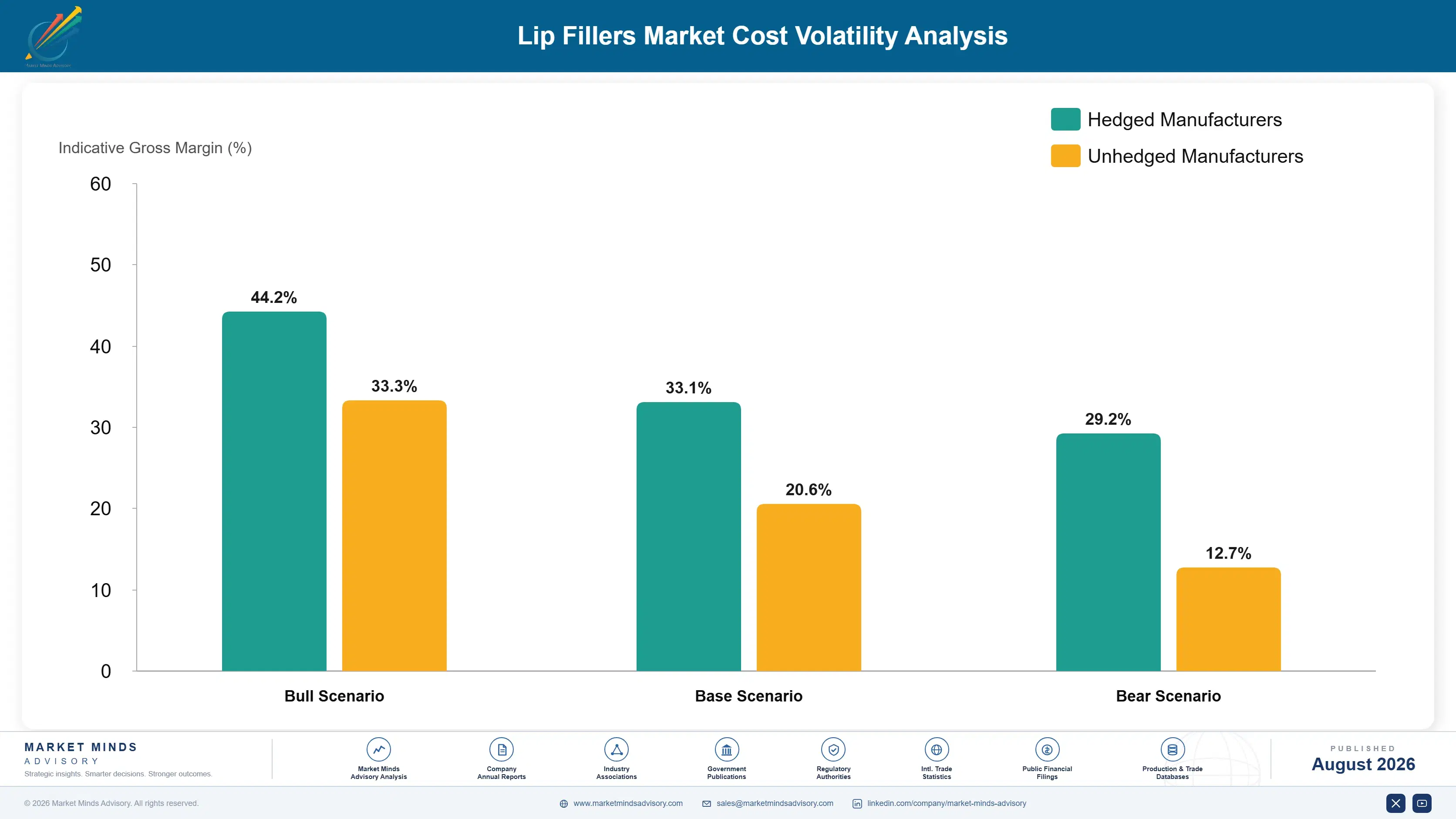
Raw hyaluronic acid is inexpensive and almost everything else is not. Bacterial fermentation-derived hyaluronic acid accounts for roughly 14% of finished product cost of goods, with crosslinking chemistry, purification and residual crosslinker removal contributing considerably more given the analytical burden involved. Prefilled syringe components, terminal sterilisation and packaging make up most of the remainder, and regulatory quality system overhead sits outside cost of goods entirely.
Chinese hyaluronic acid fermentation capacity expanded very substantially over recent years, and Bloomage in particular supplies raw material to manufacturers worldwide including several Western brands. Producer annual reports across the period documented both that capacity growth and the resulting price decline in raw material. The cost differentiation between premium and value products therefore sits almost entirely in crosslinking technology and quality systems rather than in the underlying polymer at all.

Exposure varies most by regulatory pathway rather than by input pricing. Manufacturers pursuing device approval in the United States and Europe carry clinical study, quality system and post-market surveillance costs that products sold under lighter regimes never incur, which is a large part of the price gap. Geography compounds it: Korean and Chinese manufacturers carry lower regulatory burden and lower production cost together.
lip-fillers-market-cost-volatility-analysis-1787305718113

Differentiate on crosslinking rather than on raw material

Hyaluronic acid polymer is inexpensive and increasingly commoditised as Chinese fermentation capacity expands, so no durable advantage exists in the input itself. Crosslinking chemistry determines rheology, longevity, tissue integration and how a product handles under a needle, which is what injectors actually perceive. Investment there rather than in raw material sourcing is where genuine formulation differentiation remains possible.

Amortise regulatory quality systems across a broader portfolio

Device approval, quality system maintenance and post-market surveillance in regulated markets consume costs that lighter regimes never impose, and single-product manufacturers carry that burden against very narrow revenue. Portfolio breadth across volumising, hydration and reversal products spreads it considerably further. That is a genuine argument for range extension beyond any commercial reasoning about shelf presence.

Secure prefilled syringe and needle component supply

Prefilled syringe barrels, plungers and fine gauge needles come from a concentrated group of medical component suppliers, and aesthetic volumes command limited priority against pharmaceutical customers during allocation. Multi-year agreements covering qualified components protect continuity at modest cost. The dependency is easy to overlook because the components have been reliably available and inexpensive for years.

Portfolio Architecture for Margin Defence

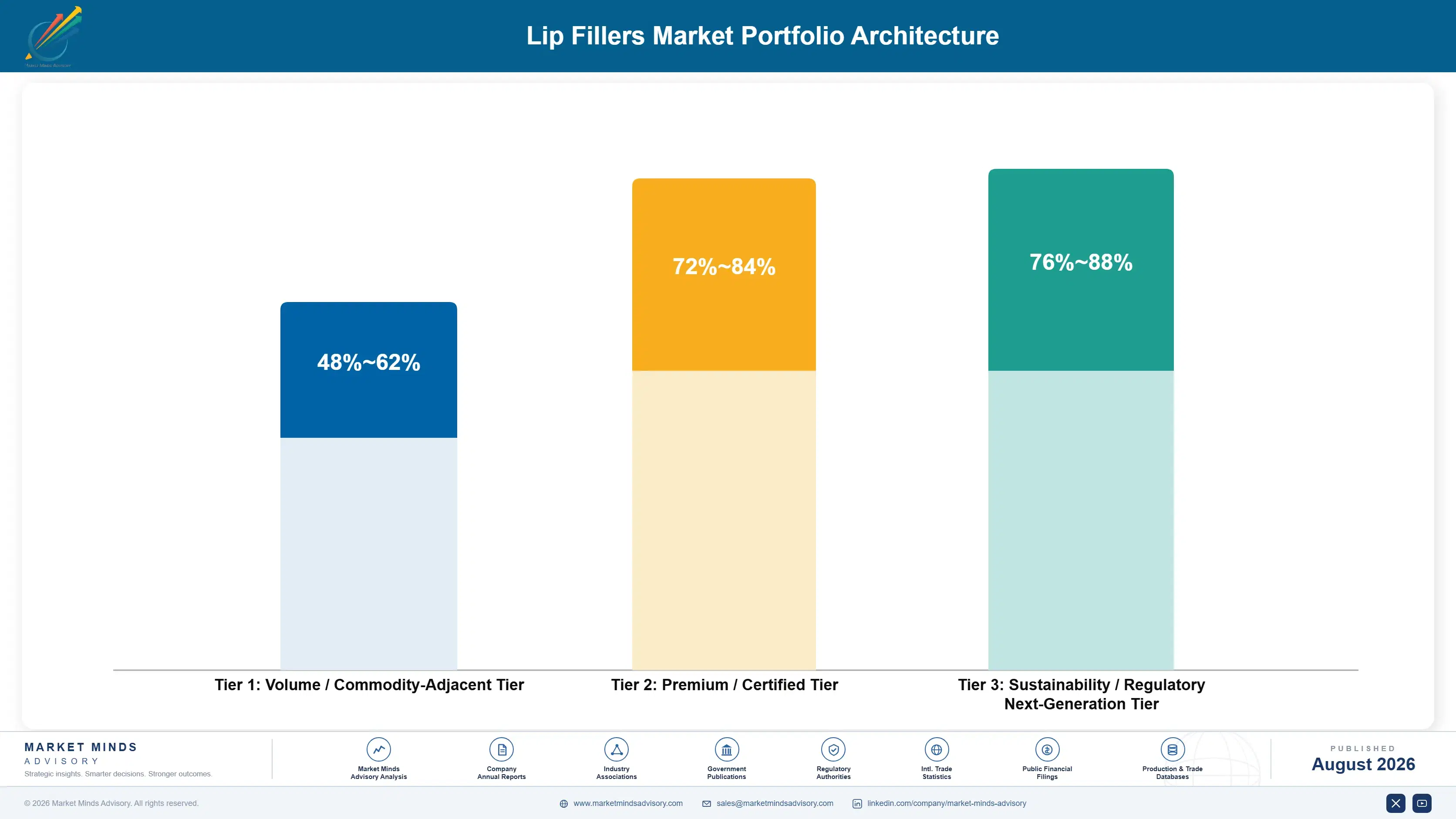
Margin architecture separates on whether the patient names the product. Filler sold into markets where the clinic simply stocks whatever it stocks competes on injector economics and delivered price, which hands volume to Korean and Chinese manufacturers with comparable rheology and lower cost. Products patients request by brand command premium that price competition has not eroded. Reversal and hydration products earn well on scarcity of credible options.
The volume against premium tension runs along consumer marketing permission. North America permits direct patient advertising and consequently has the highest prices and the strongest brand recognition anywhere. Most of Europe, Asia and Latin America restrict it, which leaves practitioners choosing on handling and cost. A brand that cannot reach the patient directly is competing in a category where its principal advantage does not apply at all.

High-value pools concentrate around reversal, hydration and recognised brands. Hyaluronidase products, skin quality injectables and premium filler requested by name all command pricing that generic volumising gel does not. Structured volumising products sold into markets without consumer brand recognition, whatever their formulation quality, compete against manufacturers with lower regulatory burden and lower production cost simultaneously.

Volume / Commodity-Adjacent Tier

Volumising hyaluronic acid gels sold into markets without consumer brand recognition, competing on injector economics against Korean and Chinese product with comparable rheology and materially lower cost. Injector preference decides these accounts.
Gross Margin: 48-62%

Premium / Certified Tier

Branded fillers that patients request by name in markets permitting direct patient marketing, protected by consumer recognition and clinical evidence that price competition has consistently failed to erode. Advertising permission determines where this tier exists.
Gross Margin: 72-84%

Sustainability / Regulatory / Next-Generation Tier

Hyaluronidase reversal products and skin quality injectables serving the retreat from visible volume, commanding premium because credible alternatives are scarce and demand is growing considerably faster. Credible competing options remain genuinely scarce.
Gross Margin: 76-88%
lip-fillers-market-portfolio-architecture-1787305718614

Repeat Cycles and Discretionary Timing

Demand behaves as a repeat cycle rather than a course of treatment. Hyaluronic acid degrades over months, patients return at roughly nine month intervals to maintain a result, and each visit is a fresh discretionary decision rather than a continuation of anything. That produces predictable underlying frequency and highly variable timing, because a patient under financial pressure simply lets the previous treatment fade rather than cancelling anything.
Adoption depth varies sharply by market culture rather than by income. East Asian and Brazilian patients treat injectable procedures as routine maintenance comparable to any other grooming expenditure, which sustains volume that far wealthier Northern European markets do not generate. First-time conversion is the hardest step everywhere, and social acceptance rather than price determines how readily it happens. Once converted, repeat behaviour is broadly similar across regions.

Purchasing profiles have shifted in a way that matters commercially. Practitioners once selected product entirely on handling, longevity and their own commercial terms, and patients now frequently arrive naming a specific brand they encountered through social media rather than advertising. Medical spa chains negotiate centrally across many sites. And a growing number arrive requesting removal, a customer nobody here was designed to serve.
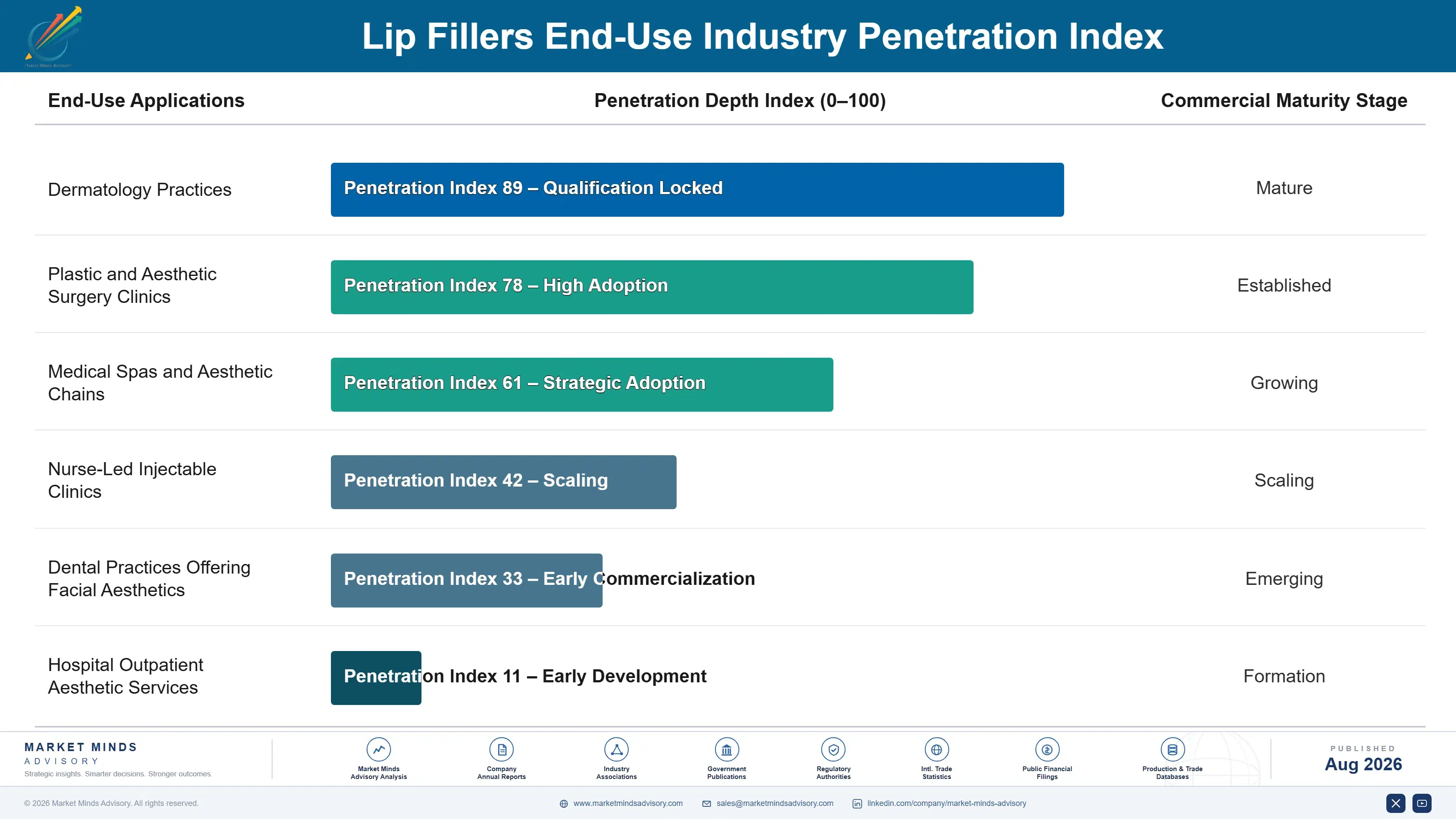
lip-fillers-market-end-use-penetration-index-1787305719101

Where Lip Filler Strategy Must Land

These are among the four positions where our research anticipates prominent divergence between winners and laggards over the coming forecast period. Each is grounded in the demand model, the regulatory perimeter, and the announced capacity pipeline.
01 / REVERSAL LINE PRIORITY

The dissolving enzyme is the fastest growing product

Roughly 17% of patients now presenting for lip treatment want previously placed product removed rather than more of it added, and hyaluronidase compounds at 12.6% as clinics increasingly market dissolution as a distinct service in its own right. Manufacturers still treating reversal agents as a grudging corrective obligation are overlooking the fastest growing product inside their own category. Point-of-injection availability is also a genuine safety requirement rather than any kind of discretionary commercial decision that a manufacturer gets to make.
02 / TASTE SHIFT RESPONSE

Volume portfolios are selling an abandoned aesthetic

Average product injected per treatment has fallen to roughly 0.7 mL and shows no sign at all of recovering, because the retreat from visible lip volume is entirely cultural rather than clinical in origin. Hydration and skin quality injectables reach patients who would refuse augmentation outright altogether, and they compound at 10.8% on exactly that basis. Manufacturers whose portfolios still sit heavily in structured volumising gels are selling into an aesthetic that patients have publicly and fairly comprehensively abandoned already.
03 / DISTRIBUTION CONTROL TIMING

Restrict access before a complication forces it

Roughly 31% of all lip injections are currently performed by practitioners holding no medical qualification whatsoever, in an anatomical region that carries genuine arterial embolism risk capable of producing tissue necrosis or even permanent visual loss. Licensing regimes are now finally arriving across several major markets, considerably later than the treatment volumes involved had long warranted. Manufacturers restricting distribution to qualified injectors ahead of regulation protect their brand from incidents that damage every participant across the whole category rather than one.
04 / BRAND RECOGNITION DEFENCE

Consumer naming is the only durable price defence

Korean and Chinese manufacturers produce hyaluronic acid filler with genuinely comparable rheology at prices established Western brands simply cannot approach, and they now hold substantial share wherever patients do not name a specific product beforehand. Consumer brand recognition built through sustained direct patient marketing is the one advantage that this price competition has consistently failed to erode anywhere at all. Manufacturers competing on injector economics alone in markets where patients arrive naming specific brands are simply surrendering their strongest available position.

Engagement Snapshot From the Field

A live engagement with an industry participant carrying material or product regulatory and market exposure ahead of a defining policy shift, showing how our research translates into a defensible multi-year portfolio strategy.
MARKET MINDS ADVISORY · CLIENT ENGAGEMENT SUMMARY
Lip Fillers Producer Strategic Portfolio Review and Transition Roadmap 2026·Investment Scenario on Lip Fillers Exposure Evaluation 2025-26
CLIENT PROFILE
An aesthetic injectable manufacturer with a volumising hyaluronic acid filler range, modest lip-specific formulations and no hyaluronidase or hydration products. Annual lip-attributable revenue was approximately USD 74 million (client-reported, unverified by MMA), concentrated in European and Latin American markets where advertising restrictions limited any direct patient brand building. Volume per treatment had fallen materially across every served market.
STRATEGIC CHALLENGE
Volume per treatment had fallen materially as patients retreated from visible lip volume, while Korean product with comparable rheology undercut pricing across every price-sensitive market the client served. The board needed to decide whether to compete on injector economics, extend into reversal and hydration products, or invest in consumer brand building where regulation permitted it at all.
MMA APPROACH
MMA conducted 47 expert interviews spanning aesthetic physicians, dermatologists, nurse injectors, medical spa operators, distributors, regulatory affairs specialists and complication management clinicians across six countries. A quantitative survey of 3,800 respondents established patient product awareness, dissolution intent, treatment frequency and willingness to pay. We then modelled revenue and margin outcomes under injector economics, portfolio extension and brand investment strategies against observed volume trends.
KEY FINDINGS
  1. Patients in five of six markets could not name any filler brand before consultation, and product selection there rested entirely with the injector on handling and commercial terms.
  2. Dissolution requests had risen sharply across every surveyed market, and most clinics reported sourcing hyaluronidase informally rather than through their principal filler supplier.
  3. Injectors rated handling characteristics and training support above price, but switched readily to Korean product where patients expressed no brand preference at all.
  4. Complication management clinicians reported that unqualified injectors frequently held no hyaluronidase at the point of treatment, which several described as the category's most serious exposure.
CLIENT PROFILE
An aesthetic injectable manufacturer with a volumising hyaluronic acid filler range, modest lip-specific formulations and no hyaluronidase or hydration products. Annual lip-attributable revenue was approximately USD 74 million (client-reported, unverified by MMA), concentrated in European and Latin American markets where advertising restrictions limited any direct patient brand building. Volume per treatment had fallen materially across every served market.
STRATEGIC CHALLENGE
Volume per treatment had fallen materially as patients retreated from visible lip volume, while Korean product with comparable rheology undercut pricing across every price-sensitive market the client served. The board needed to decide whether to compete on injector economics, extend into reversal and hydration products, or invest in consumer brand building where regulation permitted it at all.
MMA APPROACH
MMA conducted 47 expert interviews spanning aesthetic physicians, dermatologists, nurse injectors, medical spa operators, distributors, regulatory affairs specialists and complication management clinicians across six countries. A quantitative survey of 3,800 respondents established patient product awareness, dissolution intent, treatment frequency and willingness to pay. We then modelled revenue and margin outcomes under injector economics, portfolio extension and brand investment strategies against observed volume trends.
KEY FINDINGS
  1. Patients in five of six markets could not name any filler brand before consultation, and product selection there rested entirely with the injector on handling and commercial terms.
  2. Dissolution requests had risen sharply across every surveyed market, and most clinics reported sourcing hyaluronidase informally rather than through their principal filler supplier.
  3. Injectors rated handling characteristics and training support above price, but switched readily to Korean product where patients expressed no brand preference at all.
  4. Complication management clinicians reported that unqualified injectors frequently held no hyaluronidase at the point of treatment, which several described as the category's most serious exposure.
RECOMMENDED STRATEGY
Phase 1: Phase one: launch a hyaluronidase reversal product and supply it alongside filler, since clinics currently source it informally and it is the fastest growing segment. Phase 2: Phase two: extend into skin quality and hydration injectables, reaching patients who now refuse augmentation while retaining the same practitioner relationships. Phase 3: Phase three: restrict distribution to qualified injectors ahead of licensing regimes, protecting the brand from category-wide reputational exposure to complications.
OUTCOME
The client launched a hyaluronidase product bundled with filler supply, added a hydration injectable range and restricted distribution to medically qualified practitioners (client-reported, unverified by MMA). Reversal product attach reached a substantial share of filler accounts within a year, hydration revenue exceeded plan, and two markets subsequently introduced licensing that the restricted policy had anticipated.

Frequently Asked Questions

Foundational context covering the market sizes, CAGR, scope, country, region and competition that inform every finding below. This section is provided to cover basics and most often pre-purchase conversations, answered from the MMA Primary Research Dataset.

What is the current size of the Lip Fillers Market?

The global lip fillers market was valued at USD 1.6 billion in 2025, spanning hyaluronic acid fillers, hydration injectables, reversal products and injection accessories. Average product injected per treatment has fallen to roughly 0.7 mL.

How large will the Lip Fillers Market be by 2036?

MMA forecasts the market at USD 3.89 billion by 2036, expanding 2.25 times from the 2026 base of USD 1.73 billion. That represents roughly USD 2.16 billion of incremental value across the forecast decade.

What is the CAGR for the Lip Fillers Market 2026 to 2036?

The base case compound annual growth rate is 8.4%, with a bull case of 9.6% and a bear case of 7.2%. The bull case assumes licensing regimes formalise and channel volume toward qualified practitioners.

Which segment is growing fastest?

Hyaluronidase reversal products grow at 12.6%, a full 1.50x the overall market rate. The enzyme that dissolves filler is the fastest growing product in a filler market, which reflects where taste has moved.

Who are the major companies in the Lip Fillers Market?

AbbVie, Galderma, Merz Aesthetics, Teoxane and Prollenium together hold 68% of revenue. AbbVie leads on consumer brand recognition while Galderma leads on lip-specific formulation positioning.

Which country is growing fastest?

South Korea grows fastest at 13.6%, holding the highest per capita aesthetic injectable treatment rate anywhere alongside a large export manufacturing base. East Asia is the largest region at 30% of value.

Report Segmentation Architecture

The full report scope spans multiple orthogonal segmentation dimensions, with cross-tabulated demand data provided for each dimension pair. Coverage extends further to regional breakdowns, trend trajectories, and the competitive detail needed to support segment-level decision-making.

By Product Class

  • Soft Cohesive Hyaluronic Acid Fillers
  • Structured Volumising Hyaluronic Acid Fillers
  • Skin Quality and Hydration Injectables
  • Hyaluronidase Reversal Products
  • Non-Hyaluronic Acid Volumising Products
  • Cannulas, Needles and Injection Accessories

By End-Use Industry

  • Dermatology Practices
  • Plastic and Aesthetic Surgery Clinics
  • Medical Spas and Aesthetic Chains
  • Nurse-Led Injectable Clinics
  • Dental Practices Offering Facial Aesthetics
  • Hospital Outpatient Aesthetic Services

By Commercial Dimension

  • Direct Practitioner Supply
  • Distributor and Wholesaler Channel
  • Medical Spa Chain Central Contracting
  • Injector Training and Certification Programmes
  • Patient Loyalty and Brand Programmes
  • Online and Cross-Border Supply Channels

By Region

  • East Asia
  • North America
  • Western Europe
  • South Asia and Pacific
  • Latin America
  • Middle East and Africa
  • Eastern Europe

Scope, Methodology, and Coverage

Every figure in this report is reproducible from documented input assumptions. The scope below maps the historical period, the forecast horizon, the segmentation dimensions, and the countries covered, alongside the underlying primary and qualitative methodology.
Historical Period
2020 to 2025
Forecast Period
2026 to 2036
Base Year
2025 (USD billions; MMA Primary Research Dataset, August 2026)
Market Definition
This market comprises injectable products and associated consumables used for lip augmentation, definition, correction and hydration, measured at manufacturer revenue across direct practitioner supply, distributor and wholesaler channels, medical spa chain central contracting, injector training programmes, patient loyalty programmes and online or cross-border supply. Coverage spans soft cohesive hyaluronic acid fillers formulated for lip tissue, structured volumising hyaluronic acid gels used in lip augmentation, low crosslink skin quality and hydration injectables applied to the lip and perioral area, hyaluronidase products used for reversal and complication management, non-hyaluronic acid volumising products indicated for lip use, and cannulas, fine gauge needles and injection accessories supplied for lip procedures. Botulinum toxin products, dermal fillers indicated exclusively for other facial regions, surgical lip implants, fat transfer and other operative augmentation procedures, topical lip cosmetics and plumping products, energy-based perioral devices, and clinic service or procedure fee revenue fall outside scope.
Quantitative Units
USD millions (current prices); syringes supplied by product class; treatments performed; average volume per treatment; treatment price; retreatment interval; dissolution requests
Segmentation Dimensions
By Product Class; By End-Use Industry; By Commercial Dimension; By Region
Regions Covered
East Asia, North America, Western Europe, South Asia and Pacific, Latin America, Middle East and Africa, Eastern Europe
Countries Covered
South Korea, China, Japan, Taiwan, United States, Canada, Mexico, Brazil, Colombia, Argentina, Chile, Germany, France, United Kingdom, Italy, Spain, Switzerland, Netherlands, India, Australia, Thailand, Singapore, Indonesia, United Arab Emirates, Saudi Arabia, Israel, Turkey, Poland, Czechia, Hungary, Romania, and additional markets relevant to aesthetic injectable analysis
Key Companies Profiled
AbbVie, Galderma, Merz Aesthetics, Teoxane, Prollenium, Sinclair Pharma, Vivacy, IBSA Derma, Croma-Pharma, Medytox, Hugel, LG Chem, Humedix, Bloomage Biotechnology, Imeik Technology, Suneva Medical, Revance Therapeutics, Evolus, Regen Biotech, Fill-Med
Quantitative Methodology
Primary survey, n=3,800 respondents, Q4 2025, six countries; demand-side model with trade association cross-validation
Qualitative Methodology
47 expert interviews, Q4 2025; applied to validate demand model assumptions, identify emerging dynamics, and assess competitive positioning
Report Format
PDF and XLSX data workbook (Word format preview document)
Publisher
Market Minds Advisory
Report Code
MMA-2026-HLT-360
Published
August 2026
Contact
sales@marketmindsadvisory.com | www.marketmindsadvisory.com

Purchase the full Lip Fillers Market Report (2026 to 2036).

The full MMA report examines a category whose fastest growing product dissolves its principal one, quantifying how the retreat from visible volume has separated patient growth from material consumption. It sizes six product classes and seven regions to 2036, modelling syringes supplied, treatments performed, volume per session, pricing, retreatment intervals and dissolution requests separately. Competitive assessment covers twenty manufacturers on one consistent revenue basis. Cost exposure is traced through hyaluronic acid, crosslinking and sterility inputs. Four commercial levers and a strategic verdict close the report, grounded in 47 expert interviews and a 3,800-respondent survey.
Six product classes sized separately through 2036
Dissolution demand modelled alongside augmentation treatment volumes
Volume per treatment tracked against patient number growth
Twenty manufacturers assessed on one consistent revenue basis
Injector qualification exposure mapped by regulatory jurisdiction
Anonymised client engagement with tested strategic recommendations

Built For The People Who Decide

From boardroom strategy to bench-side execution, this report is read cover-to-cover by leaders shaping the next decade of their industry, turning demand scenarios, market dynamics and valuation benchmarks into decisions.
CXOs/ Presidents/ VPs/ Managers
M&A and Corporate Development
Strategy Teams and R&D Heads
Procurement and Product Directors
Regulatory and Compliance Leaders
Investor Relations and Equity Analysts