
Market Minds Advisory
Laryngoscope Market

Laryngoscope Market: Reprocessing Economics, Video Evidence, and the Training Problem

Hospitals discovered that properly reprocessing a reusable blade costs more than buying a disposable one, and that finding reshaped this market more thoroughly than any clinical trial ever managed to.

Lead Analyst

Alice Ballenger

Published

August 2026

Make Smarter Decisions with Customized Research Insights

Request a free sample report and evaluate market opportunities, growth trends, and competitive dynamics relevant to your business needs.

2025 MARKET VALUE$1.4BMarket Size 2025
2036 FORECAST VALUE$3.5BBase Case , 2026 to 2036
CAGR 2026 TO 20368.8 %Bull 10.0% / Bear 7.6%
INCREMENTAL OPPORTUNITY$2.0BNet 10- year value creation
EXPANSION MULTIPLE2.33x2036 value over 2026 base
Strategic Levers
M&A Pipeline
Regional Outlook
Country Rankings
Competitive Intelligence
Segmental Deep-dive
Call-Us : 91 93563 13602

Executive Snapshot and Market Trajectory

Reprocessing a reusable blade properly costs around USD 11 once labour, tracking and sterilisation are counted, which is more than many disposable blades cost outright. That arithmetic converted this category faster than any clinical argument did. Infection control made proper reprocessing non-negotiable. Single-use blades already carry 58% of units.
Single-use video laryngoscopes and blades compound at 13.2%, a full 1.50x the market rate, because they combine both forces at once: imaging evidence that guidelines now endorse and a disposable model that removes reprocessing entirely. North America holds the largest share at 29% on adoption depth and device pricing, while East Asia performs more intubations and realises considerably less value per unit. That gap is wider here than in any comparable device category.
Concentration is moderate at 64%. Video improved first-attempt intubation success by roughly 5 percentage points in critically ill patients, which is genuine evidence and also narrower than how it is generally cited. That trial sat in critical care rather than routine theatre. Airway educators meanwhile regard the training consequence as a genuine problem. Trainees learning only on video cannot manage an obscured lens.
Market Definition
This market covers laryngoscopes and their blades used for tracheal intubation and laryngeal examination, spanning reusable and single-use direct laryngoscopes, reusable and single-use video laryngoscopes with their blades, flexible intubation endoscopes, and rigid or flexible examination laryngoscopes, measured at manufacturer revenue including disposable components. Endotracheal tubes, supraglottic airway devices, bronchoscopes used for therapeutic rather than intubation purposes, anaesthesia machines and monitors, and reprocessing equipment or services are excluded.
Base Year Value
$1.4B in 2025 (MMA Primary Research Dataset, August 2026)
Forecast Period
2026 to 2036, eleven discrete annual values
CAGR
8.8% base case. Bull 10.0%. Bear 7.6%.
Fastest Growth Segment
Single-Use Video Laryngoscopes and Blades: 13.2% CAGR
Fastest Growth Country
China: 14.4% CAGR
Fastest Growth Region
South Asia and Pacific: 10.8% CAGR
Largest Region
North America: 29% of 2025 global value
Market Leaders
Verathon, Ambu, Medtronic, Karl Storz, and Teleflex. Source: MMA Primary Research Dataset, July 2026.
Primary Survey
n=3,800 procurement and R&D decision-makers, Q4 2025, six countries
Methodology
Demand-side build-up, cross-validated against public data, 47 expert interviews

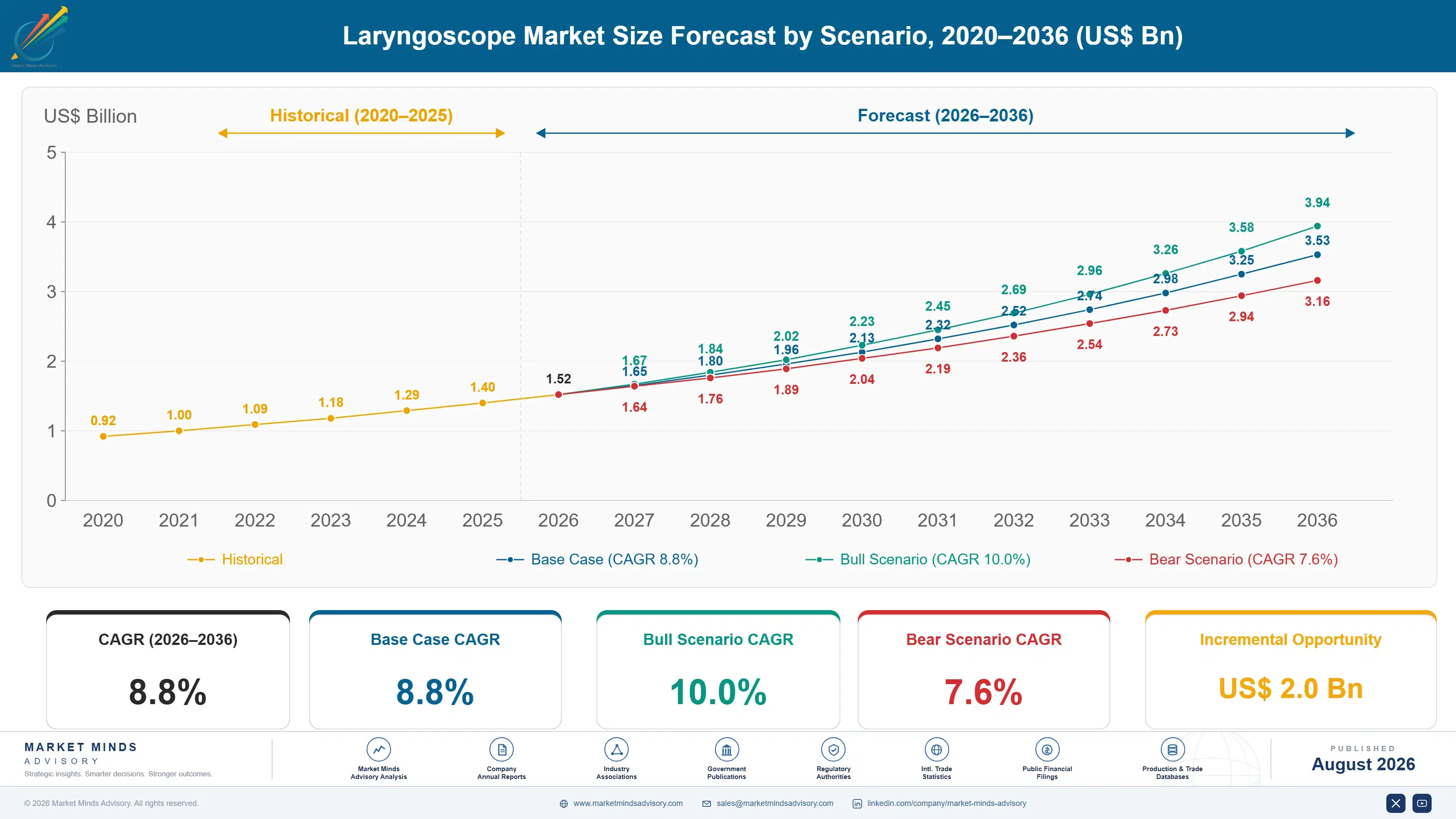
Laryngoscope Market Forecast Scenarios

laryngoscope-market-size-forecast-scenario-1787305710518
Growth ran near 7.6% from 2020 to 2025 as two separate arguments happened to point the same way. Infection control concern accelerated single-use adoption across airway devices, and reusable blade reprocessing came under scrutiny it had not faced before. Then a large randomised trial reported that video laryngoscopy improved first-attempt intubation success in critically ill patients, and airway guidelines began moving toward video as the default.
Base case growth of 8.8% rests on three mechanisms. Single-use video blades convert the category into a consumable business, since a disposable blade is bought with every intubation rather than every decade. Flexible intubation scopes continue shifting to disposable formats after reprocessing failures across flexible endoscopy generally. And emerging market anaesthesia volumes keep rising, with China compounding at 14.4% as surgical capacity extends into provincial hospitals. None of the three depends on the others arriving first.
The bull case at 10.0% assumes video becomes the guideline default across routine theatre anaesthesia rather than only in critical care, which would convert a very large elective procedure population currently served by direct blades. The bear case at 7.6% is price collapse: Chinese blade manufacturing scales further, suppliers cannot hold pricing, and unit growth arrives without value.

Laryngoscopes: Disposables, Evidence and Training

The decisive argument in this category was an accounting one. Hospitals examining what it actually costs to reprocess a reusable metal blade, counting collection, cleaning, tracking, sterilisation and the labour behind each step, arrived at figures near USD 11 per use. Many single-use blades cost less than that outright. Once infection control made proper reprocessing non-negotiable, the reusable device stopped being cheap and single-use blades reached 58% of units.
TOP FIVE CONCENTRATION64%Concentrated across video specialists and single-use airway device manufacturers
REPROCESSING COST PER USEUSD 11Loaded cost of cleaning, tracking and sterilising a blade
SINGLE-USE BLADE SHARE58%Proportion of laryngoscope blades used once and then discarded
FIRST-ATTEMPT SUCCESS GAIN5 pointsImprovement video showed over direct laryngoscopy in critically ill patients
ANNUAL INTUBATION VOLUME62 millionTracheal intubations performed worldwide across theatre and emergency settings
VIDEO PLATFORM INSTALLED BASE410,000 unitsVideo laryngoscopy systems in clinical service across hospitals worldwide
The clinical argument arrived separately and is narrower than its reputation. A large randomised trial found video laryngoscopy improved first-attempt intubation success by roughly 5 percentage points in critically ill patients, which is a real and useful finding. It was conducted in critical care rather than routine theatre, and the advantage in a straightforward elective airway is considerably less established. Guidelines have nonetheless moved toward video as a default.
That creates a tension the specialty discusses openly. Trainees learning only on video never develop direct laryngoscopy skill, and video fails exactly where it is most needed: blood and secretions obscuring the camera when a direct view might still work. Airway educators regard this as a genuine problem rather than nostalgia, and no manufacturer has an answer to it.
"Video won the guidelines and disposables won the ledger, and only one of those was decided by evidence. The device that reshaped this market is a plastic blade that costs less than washing a metal one properly, which is not the story anybody wanted to tell."
Principal Analyst, Airway Management and Anaesthesia Devices Practice · MMA Medi

Market Trends

Single-use video blades convert capital sales into consumables

A reusable handle and screen paired with a disposable blade turns laryngoscopy into a per-intubation purchase rather than a capital item replaced once a decade, which is the razor and blade model the category never previously supported. The segment compounds at 13.2% because it satisfies both the infection control argument and the imaging guidance at once. Blade architecture decided at platform design determines whether a placed system generates recurring revenue or none at all afterwards. Recovering that revenue after hospitals qualify cheaper third-party blades has proved impossible everywhere it has been attempted.
Market Impact: Improvement of 5 percentage points
Flexible intubation scopes follow endoscopy toward disposable formats

Contamination failures across flexible endoscopy generally, and duodenoscope incidents in particular, made hospitals reassess whether any lumened flexible device can be reliably reprocessed at all. Single-use flexible intubation scopes answered that directly, and adoption in difficult airway and awake intubation has advanced faster than in most endoscopy applications because the devices are simpler and cheaper. Reprocessing at roughly USD 11 per use makes the comparison straightforward for hospitals doing the arithmetic properly. Awake intubation, difficult airway and cervical spine precautions all require flexible access no rigid blade provides, so this population does not shrink as video advances.
Market Impact: China compounding at 14.4% annually

Market Opportunities and Growth Drivers

Airway guidelines move toward video as the default approach

Randomised evidence showing roughly 5 percentage points of improvement in first-attempt intubation success among critically ill patients has moved difficult airway and emergency airway guidance toward video laryngoscopy as a first choice rather than a rescue device. Institutional protocols follow guidelines closely in airway management, because failed intubation carries immediate and severe consequences. Video platform installed base has reached around 410,000 units worldwide and continues expanding across emergency and prehospital settings. Institutional protocols in airway management follow published guidance more closely than in almost any other specialty, because a failed intubation produces consequences within minutes rather than months.
Market Impact: Affecting roughly 40% of trainees

Surgical capacity expansion across Asia lifts intubation volume

Roughly 62 million tracheal intubations are performed worldwide each year, and volume growth now comes overwhelmingly from surgical capacity expansion in Asia rather than from developed markets where procedure counts are broadly flat. China compounds at 14.4% as anaesthesia services extend into provincial hospitals with theatre construction. Domestic manufacturers supply most of that demand directly, so unit growth translates into far less value than comparable growth in North America would. Regional unit share therefore exceeds regional value share by a wider margin here than in any comparable device category. Domestic suppliers capture most of it.
Market Impact: Blades priced below USD 11

Market Restraints and Challenges

Video-only training erodes direct laryngoscopy competence

Trainees learning exclusively on video never develop the direct laryngoscopy skill that remains necessary when blood, vomit or secretions obscure a camera lens, which is precisely when airway management is hardest. The root cause is that video makes the routine case easy enough that deliberate direct practice stops happening. Commercial impact is institutional hesitation about full conversion in teaching hospitals. Participants offer hybrid blades permitting both direct and indirect views, and manufacturers support simulation training programmes. No manufacturer has yet produced a convincing answer to the underlying problem. Institutions defer conversion rather than resolve it.
Market Impact: Compounding at 13.2% each year

Single-use blade pricing faces sustained manufacturing competition

Chinese manufacturers produce single-use blades at costs established suppliers cannot approach, and blades are a moulded plastic component where scale rather than design determines price. The root cause is that disposable conversion removed the engineering barrier that reusable metal instruments once carried. Commercial impact falls hardest on suppliers whose platforms accept third-party blades. Participants respond with closed blade architectures, integrated imaging in the blade itself and bundled service agreements that resist unbundling. Adequate quality is a complete answer for a device discarded after one use. Bundled service agreements resist unbundling somewhat better than pricing does.
Market Impact: Reprocessing costing USD 11 per use
3 additional market trends, 4 additional growth drivers, and 2 additional restraints and challenges are covered in the full report. Contact sales@marketmindsadvisory.com to access the complete intelligence.

Segment CAGR and Growth Architecture

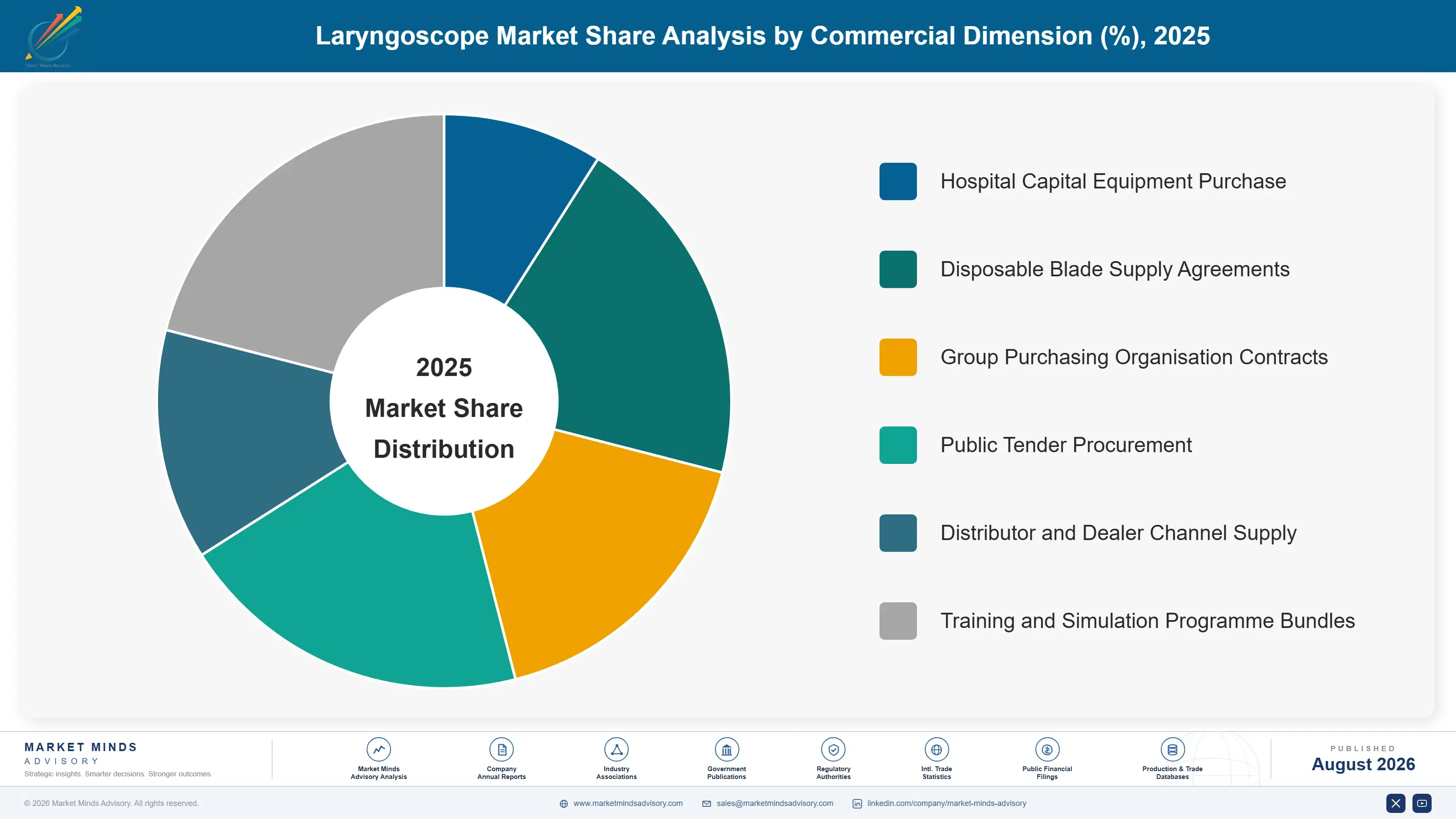
Segmentation follows device type, because type determines the imaging approach, the reuse model, the price point and whether revenue arrives as capital or per procedure. Six device types cover laryngoscope supply without overlap between them. Care setting and patient population cut across every type at once and are treated here as use attributes rather than as segments.
laryngoscope-market-market-share-analysis-1787305711051

Single-Use Video Laryngoscopes and Blades

Growing at 13.2%, a full 1.50x the market rate, single-use video devices pair a reusable handle and screen with a disposable blade, or in some designs discard the whole unit, which satisfies infection control and imaging guidance simultaneously. That combination converts laryngoscopy from a capital purchase replaced once a decade into a consumable bought with every intubation, and it is the only structure in this category that produces recurring revenue at scale. Whether a placed platform earns that revenue is settled at blade architecture design, and open systems accepting third-party blades gave the position away. Recovering it afterwards has proved impossible everywhere it has been attempted. The design decision outweighs every later commercial one.
CAGR 13.2%

Flexible Intubation Endoscopes

Flexible intubation scopes grow at 10.4%, driven by conversion from reusable fibreoptic instruments to single-use formats after contamination failures across flexible endoscopy made hospitals question whether lumened devices can be reliably reprocessed at all. Awake intubation, anticipated difficult airway and cervical spine precautions all require flexible access that rigid blades cannot provide. Adoption has advanced faster here than in most endoscopy applications because intubation scopes are simpler and cheaper to make disposable than diagnostic instruments carrying working channels and complex optics. Chinese manufacturers compete far less effectively here than in blade moulding, because optical performance and tip manoeuvrability carry genuine engineering difficulty that scale alone does not overcome. Purchasers rate both above delivered cost consistently.
CAGR 10.4%
Full segment breakdown across 6 segments available in the complete report.

Regional Architecture and Country Demand Map

Regional value and regional procedure volume point in different directions here, because single-use blade pricing varies by several multiples between markets while intubation counts do not vary nearly as much. Reading unit shipments alone would place this market somewhere quite different from where its revenue actually accumulates today.

North America

North America holds the largest share at 29% on adoption depth and device pricing rather than on procedure volume, which East Asia exceeds. Video conversion is furthest advanced here, supported by the randomised evidence that emerged largely from United States critical care research and by institutional protocols that follow airway guidelines closely. Single-use conversion is similarly advanced, driven by reprocessing cost analysis and infection control policy. Group purchasing agreements make conversions large and infrequent. Teaching hospital hesitation over direct laryngoscopy skill retention is the one factor slowing full conversion. Prehospital and emergency medical services adoption has advanced quickly, supported by rugged single-use devices that suit field conditions better than reusable instruments requiring return and reprocessing.
Share: 29% | CAGR: 8.0% (2026 to 2036)

East Asia

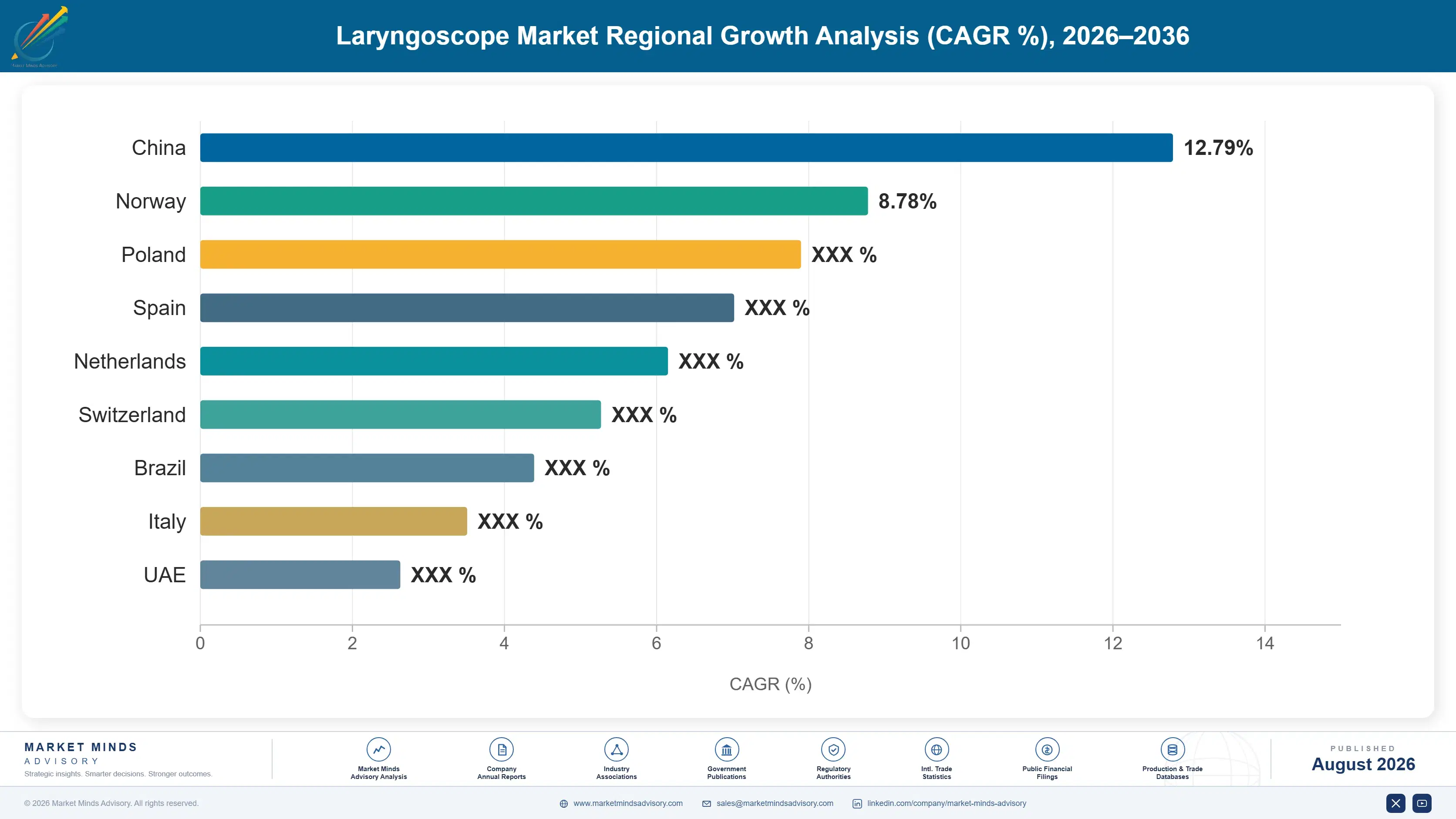
Twenty-seven per cent of value and the largest intubation volume of any region, growing at 10.0%. China compounds at 14.4% as surgical capacity extends into provincial hospitals and anaesthesia services expand alongside theatre construction. Domestic manufacturers including Zhejiang UE Medical and Besdata supply most of that demand and export single-use blades globally at prices established suppliers cannot approach. Japanese and South Korean practice is mature, video-converted and premium-weighted. The gap between regional unit share and regional value share is the widest anywhere. Domestic video laryngoscope manufacture has also advanced considerably, and Chinese platforms now compete on specification as well as on price across several Asian and Latin American tender markets.
Share: 27% | CAGR: 10.0% (2026 to 2036)
Regional intelligence for 5 additional markets available in the complete report: Western Europe, South Asia and Pacific, Latin America, Middle East and Africa, Eastern Europe. Contact sales@marketmindsadvisory.com.
laryngoscope-market-country-cagr-analysis-1787305711573

Where Laryngoscope Margin Now Sits

Reprocessing arithmetic converted this category to disposables before any trial arrived, and blades are moulded plastic that scale rather than design prices. Value therefore accrues to whoever owns the blade interface, and to devices where imaging or flexibility still commands genuine engineering premium. Clinical argument alone has rarely decided a conversion. Architecture decides the rest.

Close the blade interface at platform design stage

Single-use video blades compound at 13.2% and are consumed with every intubation, which makes blade attach the only recurring revenue this category has ever supported. Whether a placed handle and screen earns that revenue is decided entirely by architecture at design, and open systems accepting third-party blades surrendered it permanently. Recovering the position from an installed base after hospitals have qualified cheaper blades has proved effectively impossible in every market where it has been attempted. It is a product design question rather than a commercial one. Hospitals qualify alternatives within about a year of installation.
Market Impact: Blades consumed across all 62 milli

Sell the reprocessing arithmetic rather than the clinical argument

Fully loaded reusable blade reprocessing costs around USD 11 per use once collection, cleaning, tracking, sterilisation and labour are all counted, which exceeds many disposable blade prices outright. Sterile services departments respond to that analysis in a way clinicians rarely respond to imaging arguments, and it converted 58% of blade units before guidelines moved at all. Suppliers leading with clinical evidence are addressing the wrong department entirely in most conversion decisions. Offering the analysis rather than waiting for a hospital to construct it reaches the decision earlier and more reliably.
Market Impact: Reprocessing costing USD 11 on ever

Compete where engineering still commands a premium

Moulded plastic blades are priced by manufacturing scale rather than by design, which hands that segment to Chinese producers permanently. Flexible single-use intubation scopes compound at 10.4% and carry genuine optical and mechanical difficulty that plastic blade moulding does not. Integrated imaging built into the blade itself, paediatric and difficult airway geometries, and video quality in obscured fields all resist commoditisation in ways that a standard adult Macintosh profile simply cannot. Purchasers rate optical performance above delivered cost in flexible scopes consistently. Genuine optical and mechanical difficulty is the only durable defence available here.
Market Impact: Flexible scopes are growing at 10.4

Answer the training problem before institutions raise it

Teaching hospitals hesitate over full video conversion because trainees who never practise direct laryngoscopy cannot perform it when a camera lens is obscured by blood or secretions, and roughly 40% of trainees now report limited direct experience. Hybrid blades permitting both views, structured simulation programmes and staged conversion protocols address that directly. Suppliers who bring the answer rather than waiting for the objection reach academic institutions that otherwise defer conversion decisions indefinitely. Institutions that defer conversion indefinitely represent volume nobody currently reaches. Several training directors have formally delayed conversion within their own institutions on exactly these grounds.
Market Impact: Concern now affecting roughly 40% o

Who Controls the Margin Pool

Concentration is moderate at 64% across the top five, measured on annual revenue from laryngoscopes, blades and dedicated disposable components, the single basis applied throughout this analysis. Verathon and Ambu lead through different routes, the first as the video laryngoscopy category creator holding the deepest clinical evidence and installed base, the second as the single-use airway specialist that industrialised disposable scope manufacturing across several device categories.
Competition runs on three dimensions that resolve separately. Platform competition turns on imaging quality, blade geometry range and clinical evidence, and it decides which system a hospital installs. Blade competition is a manufacturing cost contest that Chinese producers increasingly win wherever architecture permits third-party supply. Flexible scope competition is closer to endoscopy, fought on optical performance and manoeuvrability against reusable instruments still in service.

Pressure builds from two directions. Chinese single-use blade manufacturers supply globally at prices established suppliers cannot approach, and their quality is adequate for a device used once and discarded. Separately, hospital sterile services departments continue publishing reprocessing cost analyses that accelerate conversion. Rankings shift most where a supplier holds a closed blade architecture on a large installed base, since that converts placements into an annuity nobody else can access.
laryngoscope-market-company-positioning-matrix-1787305712090

Competitive Moat and Risk Dimensions

VERATHON

Moat: Video category evidence leadership

Creating the video laryngoscopy category and accumulating the deepest clinical evidence behind it gives Verathon a position that guidelines and institutional protocols reference directly, which matters enormously in airway management where failed intubation carries immediate consequences. A large installed base combined with proprietary blade architecture converts those placements into recurring disposable revenue that competitors cannot reach.
VERATHON

Risk: Blade manufacturing cost exposure

Disposable blades are moulded plastic components where manufacturing scale rather than design determines cost, and Chinese producers operate well below established supplier structures. Hospital procurement increasingly tests whether third-party blades will function on installed platforms. Evidence leadership in critical care translates less strongly into routine theatre anaesthesia where the advantage is smaller.
AMBU

Moat: Single-use manufacturing at scale

Industrialising disposable scope and blade manufacture across several airway and endoscopy categories gives Ambu genuine cost position in exactly the products this market converted toward, alongside credibility with infection control and sterile services departments that drove the conversion. Breadth across flexible intubation scopes and video laryngoscopes lets it supply an entire airway trolley from one source.
AMBU

Risk: Clinical evidence depth gap

Airway guidelines reference video laryngoscopy evidence generated substantially by competitors, and institutional protocols follow that evidence closely when specifying equipment. Competing primarily on cost and infection control invites the same argument from Chinese manufacturers operating further down the cost curve. Reusable flexible scope incumbents retain positions in institutions with established reprocessing capability.

Players Tracked

Prominent Players

Verathon
Ambu
Medtronic
Karl Storz
Teleflex

Other Key Players

Olympus
Intersurgical
Vyaire Medical
Flexicare
Prodol Meditec
Truphatek
Heine Optotechnik
Welch Allyn
SunMed
Zhejiang UE Medical
Besdata Technology
Infinium Medical
Pentax Medical
Boston Scientific
Timesco Healthcare

Recent Developments

MARCH 2025

Airway guidelines extend video laryngoscopy toward routine first-line use

Difficult airway and emergency airway guidance across several national societies moved further toward recommending video laryngoscopy as a first-line approach rather than a rescue technique, following randomised evidence on first-attempt intubation success in critically ill patients. Institutional protocols across emergency and critical care followed within months.
Signal: Guidelines rather than any purchasing argu
AUGUST 2025

Sterile services analyses accelerate single-use blade conversion across Europe

Hospital sterile services departments across European health systems published fully loaded reprocessing cost analyses covering collection, cleaning, tracking and sterilisation labour, an organic operational review that accelerated single-use blade conversion beyond what infection control policy alone had achieved. Clinicians had not performed that analysis themselves at any point.
Signal: The department that costed reprocessing pr
JANUARY 2026

Chinese blade manufacturers extend supply into Western tender markets

Chinese single-use laryngoscope blade manufacturers widened distribution into European and Latin American tender markets through organic commercial expansion, offering adequate quality for single-use application at prices established suppliers could not profitably match at all. Open platform architectures allowed those blades to substitute directly. Established suppliers lost blade volume accordingly.
Signal: Adequate quality is a complete answer for

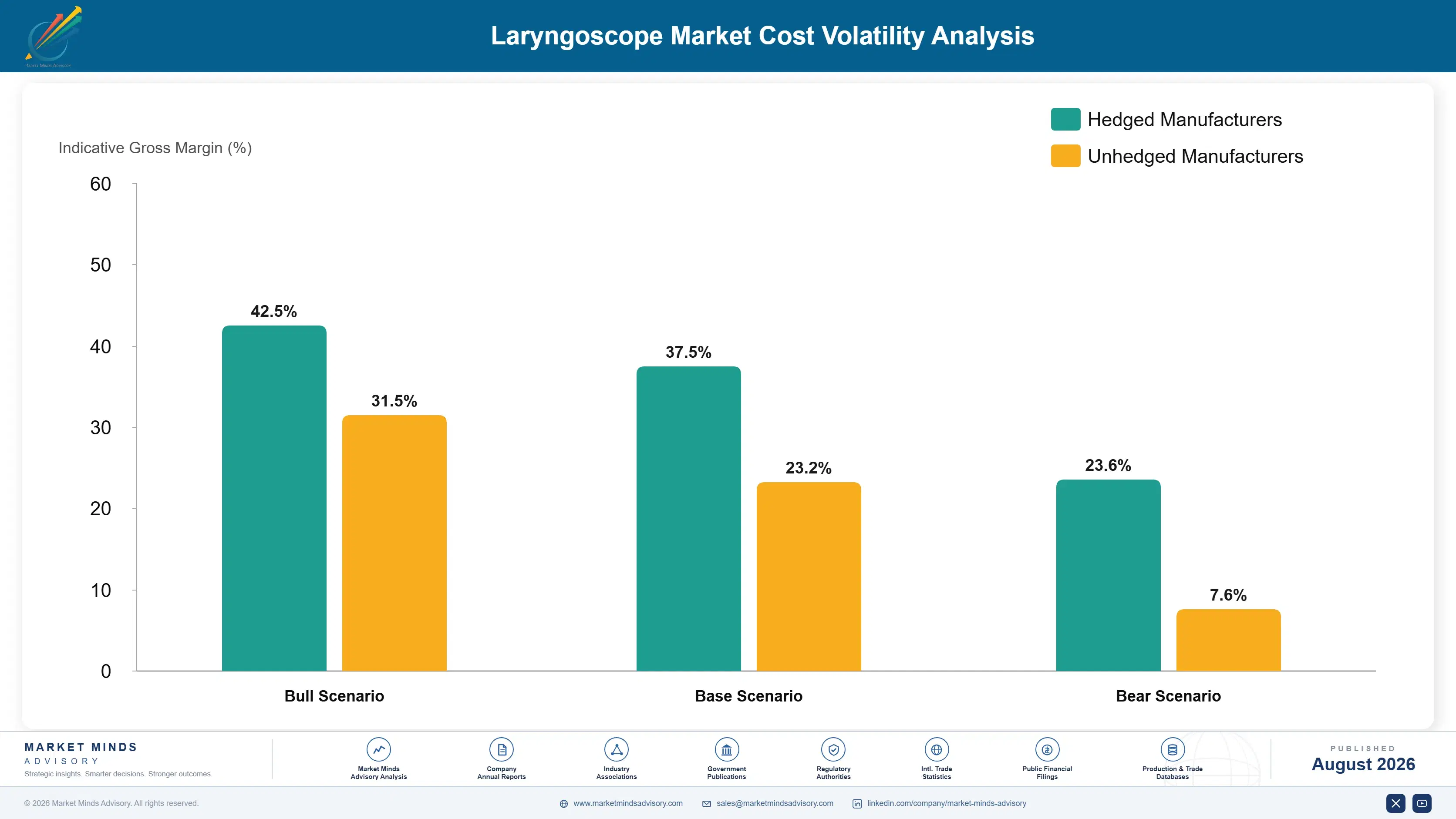
Polymer, Optical and Sensor Cost Exposure

Cost structures split cleanly between disposable and durable components. Medical grade polymers for blade mouldings account for roughly 46% of single-use blade cost of goods, sourced from resin producers concentrated in Asia and Western Europe, with injection moulding tooling carrying substantial upfront cost amortised over very long runs. Image sensors, lenses and illumination assemblies dominate video component cost, drawn from consumer electronics supply chains that medical volumes barely inf
Medical grade resin availability tightened materially through 2021 and 2022 as several producers withdrew from medical applications on liability grounds, and blade manufacturers requalified materials under time pressure. Manufacturer annual reports across that period documented supply disruption and subsequent inventory building. Image sensor allocation also proved difficult, since medical device volumes command no priority whatsoever against consumer and automotive demand in the same fabrication capacity.

Exposure varies most by manufacturing location and integration. Producers moulding blades at scale in Asia carry materially lower cost than those manufacturing in Western Europe or North America, and that gap decides tender outcomes wherever blade architecture permits third-party supply. Suppliers integrating sensor assembly rather than buying finished camera modules control more of the video cost base.
laryngoscope-market-cost-volatility-analysis-1787305712285

Qualify alternate medical resin grades before producers withdraw

Several resin producers exited medical applications entirely because liability exposure outweighed modest volumes, and blade manufacturers discovered the dependency only when supply stopped. Polymer represents nearly half of disposable blade cost, so the exposure is material rather than incidental. Qualifying alternate grades during ordinary conditions costs validation and filing work rather than any capital outlay at all.

Move blade moulding capacity toward lower-cost manufacturing regions

Moulded plastic blades are priced by manufacturing scale and location rather than by design sophistication, and Western moulding cost cannot compete in tender markets where delivered price decides. Relocating or contracting capacity in Asia closes most of that gap. Regulatory registration of a new manufacturing site takes time and considerably less capital than the tender volumes it makes accessible.

Integrate imaging assembly rather than buying finished camera modules

Image sensors and lens assemblies come from consumer electronics supply chains where medical volumes command no priority and no negotiating room during allocation periods. Integrating assembly rather than buying finished modules controls more of the cost base and enables blade-integrated imaging designs that purchased modules cannot support. Engineering investment here also protects against sensor generation changes outside the manufacturer's control.

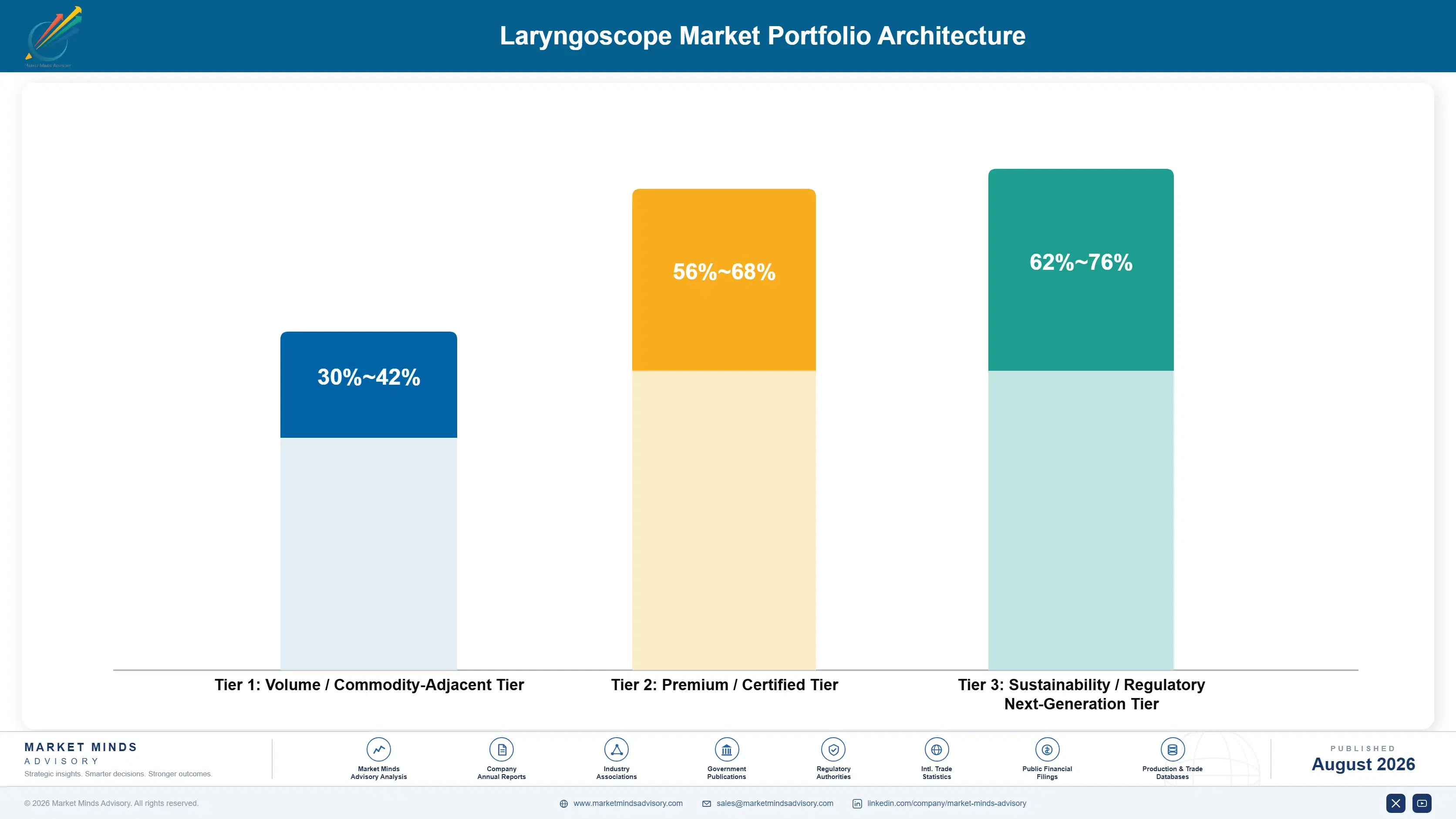
Portfolio Architecture for Margin Defence

Margin architecture separates on whether a competitor can supply the consumable. Standard single-use blades for open platforms compete on moulding cost against Chinese producers and earn very little, because adequate quality is a complete answer for a device discarded after one use. Blades tied to a closed video architecture earn considerably better, protected by platform compatibility rather than by any performance difference. Flexible single-use scopes earn best, carrying genuine engineering d
The volume against premium tension runs along architecture rather than geography. Open platforms reach more institutions and generate no consumable annuity, since hospitals qualify cheaper blades within a year of installation. Closed platforms convert fewer accounts and earn from every intubation performed on them afterwards. That trade is made once at product design and cannot be revisited, which is why the decision matters more than any subsequent commercial choice.

High-value pools concentrate around closed consumables and genuine engineering. Proprietary blade interfaces on installed video platforms, flexible single-use intubation scopes, blade-integrated imaging and paediatric or difficult airway geometries all command pricing that standard adult blades do not. Open-platform disposable blades, whatever the brand on them, compete against manufacturers with cost structures Western producers have no realistic route to matching.

Volume / Commodity-Adjacent Tier

Standard single-use blades for open platforms and reusable direct laryngoscopes sold through tenders, where Chinese moulding cost sets the price and adequate quality answers the requirement completely. Scale rather than design determines the price.
Gross Margin: 30-42%

Premium / Certified Tier

Video laryngoscopy platforms with proprietary blade interfaces, protected by architecture compatibility and by clinical evidence that institutional airway protocols reference directly when specifying equipment. Evidence leadership supports the platform selection.
Gross Margin: 56-68%

Sustainability / Regulatory / Next-Generation Tier

Single-use flexible intubation endoscopes and blade-integrated imaging designs, commanding premium because genuine optical and mechanical difficulty resists the commoditisation that plain blade moulding cannot. Very few competitors hold this capability today.
Gross Margin: 62-76%
laryngoscope-market-portfolio-architecture-1787305712785

Per-Intubation Consumption and Protocol Conversion

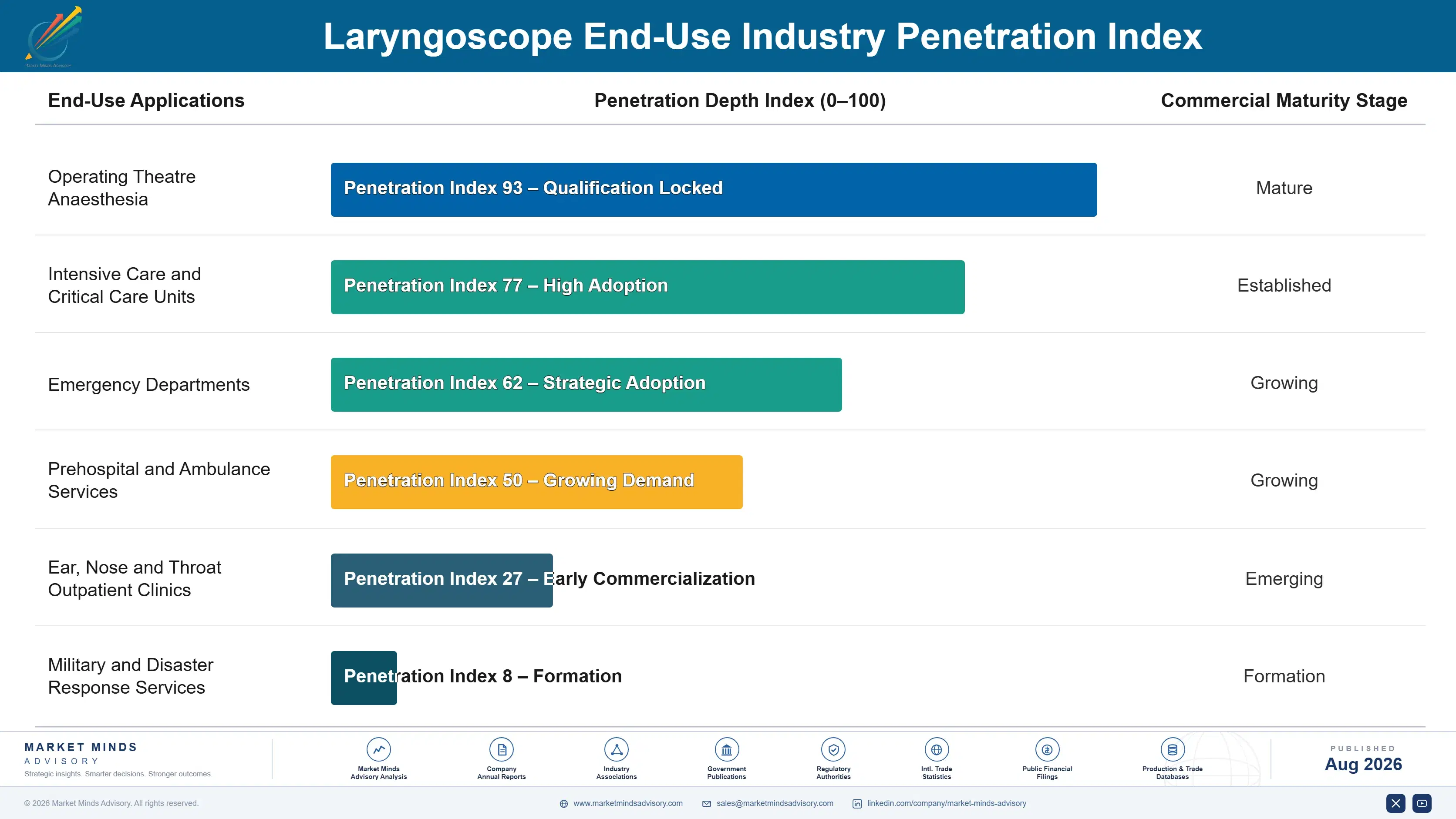
Demand now behaves as a consumable rather than a capital business for the first time in this category's history. Roughly 62 million intubations are performed worldwide each year, and 58% of them already consume a blade that is discarded afterwards, so revenue tracks clinical activity directly rather than any equipment replacement cycle. A placed video platform generates income whenever it is used, provided its blade architecture was closed at design.
Adoption depth varies sharply by care setting rather than by geography. Critical care and emergency departments converted to video fastest, because that is where the randomised evidence sits and where failed intubation consequences are most immediate. Routine theatre anaesthesia converted more slowly, since experienced anaesthetists managing straightforward elective airways see less advantage. Prehospital and military settings favour rugged single-use devices for reasons that have nothing to do with either argument.

Purchasing profiles are unusually distributed. Anaesthetists and intensivists specify platforms against airway guidelines and clinical evidence. Sterile services and infection control departments drove the single-use conversion through reprocessing cost analysis that clinicians never performed. Group purchasing organisations negotiate blade pricing across systems. And medical educators hold an effective veto in teaching institutions on quite separate grounds.
laryngoscope-market-end-use-penetration-index-1787305713270

Where Laryngoscope Strategy Must Land

These are among the four positions where our research anticipates prominent divergence between winners and laggards over the coming forecast period. Each is grounded in the demand model, the regulatory perimeter, and the announced capacity pipeline.
01 / BLADE ARCHITECTURE DECISION

The annuity is settled at product design, permanently

Single-use video blades compound at 13.2% and are consumed with every one of roughly 62 million intubations performed worldwide each year, which is the only recurring revenue this category has ever managed to support at any scale. Whether a placed handle and screen actually earns that revenue is decided entirely by blade architecture at design stage rather than commercially afterwards. Open systems accepting third-party blades surrendered that revenue permanently, and no installed base anywhere has ever subsequently been reclaimed successfully.
02 / STERILE SERVICES AUDIENCE

The ledger converted more units than the evidence did

Fully loaded reusable blade reprocessing costs around USD 11 per single use once collection, cleaning, tracking, sterilisation and all of the associated labour are properly counted, which comfortably exceeds many disposable blade prices outright. That single analysis converted 58% of all blade units to disposables before airway guidelines had moved toward video at all. Suppliers still leading with imaging evidence are addressing anaesthetists, when the decision in most institutions was actually taken by a sterile services department doing careful arithmetic.
03 / ENGINEERING PREMIUM FOCUS

Plastic blades are a contest Western producers lose

Moulded single-use blades are now priced entirely by manufacturing scale and by location rather than by any design sophistication, and adequate quality remains a complete answer for a device that gets used once and then discarded immediately. Chinese producers therefore hold that entire segment permanently, wherever a platform architecture allows any third-party blade supply at all. Flexible single-use intubation scopes growing at 10.4% annually and blade-integrated imaging designs both carry genuine engineering difficulty that plain blade moulding simply does not have.
04 / TRAINING OBJECTION HANDLING

Educators hold a veto nobody has answered yet

Trainees who learn exclusively on video never develop direct laryngoscopy competence, and video fails in exactly the circumstances where airway management is hardest, when blood, vomit or secretions obscure the camera lens completely. Teaching hospitals defer full conversion over precisely that concern, and roughly 40% of trainees now report limited direct laryngoscopy experience. Hybrid blades permitting both direct and indirect views and structured simulation programmes both address it, and suppliers bringing that answer unprompted reach institutions that otherwise keep deferring.

Engagement Snapshot From the Field

A live engagement with an industry participant carrying material or product regulatory and market exposure ahead of a defining policy shift, showing how our research translates into a defensible multi-year portfolio strategy.
MARKET MINDS ADVISORY · CLIENT ENGAGEMENT SUMMARY
Laryngoscope Producer Strategic Portfolio Review and Transition Roadmap 2026·Investment Scenario on Laryngoscope Exposure Evaluation 2025-26
CLIENT PROFILE
An airway device manufacturer with a reusable direct laryngoscope range, an open-architecture video platform accepting third-party blades and no flexible intubation scope. Annual revenue was approximately USD 118 million (client-reported, unverified by MMA), weighted toward tender markets across Europe, Latin America and the Middle East where delivered blade price decided most awards. Consumable revenue from placed platforms was effectively nil.
STRATEGIC CHALLENGE
Blade pricing had eroded severely against Chinese manufacturers, and the open video architecture meant hospitals qualified third-party blades within a year of every installation, leaving the platform generating almost no recurring revenue. The board needed to decide whether to compete on moulding cost, close the architecture on a new platform generation, or move toward flexible single-use scopes instead.
MMA APPROACH
MMA conducted 47 expert interviews spanning anaesthetists, intensivists, emergency physicians, sterile services managers, infection control leads, group purchasing negotiators and anaesthesia training directors across six countries. A quantitative survey of 3,800 respondents established conversion drivers, blade qualification behaviour and platform selection criteria. We then modelled revenue and margin outcomes under cost competition, architecture closure and portfolio extension strategies against observed tender pricing.
KEY FINDINGS
  1. Sterile services managers rather than clinicians had initiated single-use conversion in five of six markets, using fully loaded reprocessing cost analyses that no supplier had helped them construct.
  2. Hospitals with open architecture platforms had qualified third-party blades within roughly a year of installation in nearly every surveyed case, eliminating any consumable revenue entirely.
  3. Anaesthesia training directors expressed genuine concern about direct laryngoscopy skill loss, and several had formally delayed full video conversion within their institutions.
  4. Flexible single-use intubation scopes faced no meaningful Chinese price competition, and purchasers there rated optical performance and manoeuvrability above delivered cost consistently.
CLIENT PROFILE
An airway device manufacturer with a reusable direct laryngoscope range, an open-architecture video platform accepting third-party blades and no flexible intubation scope. Annual revenue was approximately USD 118 million (client-reported, unverified by MMA), weighted toward tender markets across Europe, Latin America and the Middle East where delivered blade price decided most awards. Consumable revenue from placed platforms was effectively nil.
STRATEGIC CHALLENGE
Blade pricing had eroded severely against Chinese manufacturers, and the open video architecture meant hospitals qualified third-party blades within a year of every installation, leaving the platform generating almost no recurring revenue. The board needed to decide whether to compete on moulding cost, close the architecture on a new platform generation, or move toward flexible single-use scopes instead.
MMA APPROACH
MMA conducted 47 expert interviews spanning anaesthetists, intensivists, emergency physicians, sterile services managers, infection control leads, group purchasing negotiators and anaesthesia training directors across six countries. A quantitative survey of 3,800 respondents established conversion drivers, blade qualification behaviour and platform selection criteria. We then modelled revenue and margin outcomes under cost competition, architecture closure and portfolio extension strategies against observed tender pricing.
KEY FINDINGS
  1. Sterile services managers rather than clinicians had initiated single-use conversion in five of six markets, using fully loaded reprocessing cost analyses that no supplier had helped them construct.
  2. Hospitals with open architecture platforms had qualified third-party blades within roughly a year of installation in nearly every surveyed case, eliminating any consumable revenue entirely.
  3. Anaesthesia training directors expressed genuine concern about direct laryngoscopy skill loss, and several had formally delayed full video conversion within their institutions.
  4. Flexible single-use intubation scopes faced no meaningful Chinese price competition, and purchasers there rated optical performance and manoeuvrability above delivered cost consistently.
RECOMMENDED STRATEGY
Phase 1: Phase one: close blade architecture on the next platform generation, since consumable revenue is decided at design and cannot be recovered from installed systems. Phase 2: Phase two: build sterile services engagement offering reprocessing cost analysis directly, addressing the department that actually initiates most conversion decisions. Phase 3: Phase three: enter single-use flexible intubation scopes, where genuine engineering difficulty resists the moulding cost competition now eroding blade pricing.
OUTCOME
The client closed blade architecture on its next platform, launched a reprocessing cost analysis service for sterile services departments, and licensed a single-use flexible scope design (client-reported, unverified by MMA). Blade attach on new placements reached a meaningful share within eighteen months, and two hospital systems converted after the reprocessing analysis rather than on any clinical argument.

Frequently Asked Questions

Foundational context covering the market sizes, CAGR, scope, country, region and competition that inform every finding below. This section is provided to cover basics and most often pre-purchase conversations, answered from the MMA Primary Research Dataset.

What is the current size of the Laryngoscope Market?

The global laryngoscope market was valued at USD 1.4 billion in 2025, spanning reusable and single-use direct and video devices, flexible intubation scopes and examination laryngoscopes. Single-use blades already account for 58% of units.

How large will the Laryngoscope Market be by 2036?

MMA forecasts the market at USD 3.54 billion by 2036, expanding 2.33 times from the 2026 base of USD 1.52 billion. That represents roughly USD 2.02 billion of incremental value across the forecast decade.

What is the CAGR for the Laryngoscope Market 2026 to 2036?

The base case compound annual growth rate is 8.8%, with a bull case of 10.0% and a bear case of 7.6%. The bull case assumes video becomes the guideline default across routine theatre anaesthesia.

Which segment is growing fastest?

Single-use video laryngoscopes and blades grow at 13.2%, a full 1.50x the overall market rate. They satisfy the infection control and imaging arguments simultaneously while converting capital sales into consumables.

Who are the major companies in the Laryngoscope Market?

Verathon, Ambu, Medtronic, Karl Storz and Teleflex together hold 64% of revenue. Verathon leads on video evidence and installed base while Ambu leads on single-use manufacturing scale.

Which country is growing fastest?

China grows fastest at 14.4%, as surgical capacity extends into provincial hospitals and anaesthesia services expand alongside. North America is the largest region at 29% of value on adoption depth and pricing.

Report Segmentation Architecture

The full report scope spans multiple orthogonal segmentation dimensions, with cross-tabulated demand data provided for each dimension pair. Coverage extends further to regional breakdowns, trend trajectories, and the competitive detail needed to support segment-level decision-making.

By Device Type

  • Reusable Direct Laryngoscopes
  • Single-Use Direct Laryngoscopes
  • Reusable Video Laryngoscopes
  • Single-Use Video Laryngoscopes and Blades
  • Flexible Intubation Endoscopes
  • Rigid and Flexible Examination Laryngoscopes

By End-Use Industry

  • Operating Theatre Anaesthesia
  • Intensive Care and Critical Care Units
  • Emergency Departments
  • Prehospital and Ambulance Services
  • Ear, Nose and Throat Outpatient Clinics
  • Military and Disaster Response Services

By Commercial Dimension

  • Hospital Capital Equipment Purchase
  • Disposable Blade Supply Agreements
  • Group Purchasing Organisation Contracts
  • Public Tender Procurement
  • Distributor and Dealer Channel Supply
  • Training and Simulation Programme Bundles

By Region

  • North America
  • East Asia
  • Western Europe
  • South Asia and Pacific
  • Latin America
  • Middle East and Africa
  • Eastern Europe

Scope, Methodology, and Coverage

Every figure in this report is reproducible from documented input assumptions. The scope below maps the historical period, the forecast horizon, the segmentation dimensions, and the countries covered, alongside the underlying primary and qualitative methodology.
Historical Period
2020 to 2025
Forecast Period
2026 to 2036
Base Year
2025 (USD billions; MMA Primary Research Dataset, August 2026)
Market Definition
This market comprises laryngoscopes and their blades used for tracheal intubation and laryngeal examination, measured at manufacturer revenue across hospital capital purchase, disposable blade supply agreements, group purchasing contracts, public tender procurement, distributor channels and training programme bundles. Coverage spans reusable metal direct laryngoscope handles and blades, single-use direct laryngoscopes, reusable video laryngoscopy systems with their handles, screens and reusable blades, single-use video laryngoscopes and disposable video blades including blade-integrated imaging designs, flexible reusable and single-use intubation endoscopes, and rigid or flexible laryngoscopes used for outpatient laryngeal examination. Endotracheal tubes, stylets, bougies and airway exchange catheters, supraglottic airway devices, bronchoscopes intended for diagnostic or therapeutic rather than intubation use, anaesthesia machines, ventilators and patient monitors, and sterilisation, reprocessing equipment or reprocessing services fall outside scope.
Quantitative Units
USD millions (current prices); devices and blades shipped by type; intubations performed; single-use share of units; average selling price by device class; video platform installed base
Segmentation Dimensions
By Device Type; By End-Use Industry; By Commercial Dimension; By Region
Regions Covered
North America, East Asia, Western Europe, South Asia and Pacific, Latin America, Middle East and Africa, Eastern Europe
Countries Covered
United States, Canada, Mexico, Germany, France, United Kingdom, Italy, Spain, Netherlands, Sweden, Denmark, Switzerland, China, Japan, South Korea, Taiwan, India, Australia, Thailand, Indonesia, Singapore, Brazil, Argentina, Colombia, Chile, Saudi Arabia, United Arab Emirates, Israel, South Africa, Poland, Czechia, Hungary, and additional markets relevant to airway management analysis
Key Companies Profiled
Verathon, Ambu, Medtronic, Karl Storz, Teleflex, Olympus, Intersurgical, Vyaire Medical, Flexicare, Prodol Meditec, Truphatek, Heine Optotechnik, Welch Allyn, SunMed, Zhejiang UE Medical, Besdata Technology, Infinium Medical, Pentax Medical, Boston Scientific, Timesco Healthcare
Quantitative Methodology
Primary survey, n=3,800 respondents, Q4 2025, six countries; demand-side model with trade association cross-validation
Qualitative Methodology
47 expert interviews, Q4 2025; applied to validate demand model assumptions, identify emerging dynamics, and assess competitive positioning
Report Format
PDF and XLSX data workbook (Word format preview document)
Publisher
Market Minds Advisory
Report Code
MMA-2026-MED-353
Published
August 2026
Contact
sales@marketmindsadvisory.com | www.marketmindsadvisory.com

Purchase the full Laryngoscope Market Report (2026 to 2036).

The full MMA report separates the two arguments that converted this category, quantifying how reprocessing economics moved more units than clinical evidence did. It sizes six device types and seven regions to 2036, modelling devices and blades shipped, intubation volumes, single-use conversion, pricing by class and video installed base separately so that consumable revenue can be assessed against architecture decisions. Competitive assessment covers twenty manufacturers on one consistent revenue basis. Cost exposure is traced through polymer, optical and sensor inputs. Four commercial levers and a strategic verdict close the report, grounded in 47 expert interviews and a 3,800-respondent survey.
Six device types sized separately through 2036
Reprocessing economics modelled against single-use conversion by region
Blade architecture decisions mapped to consumable revenue outcomes
Twenty manufacturers assessed on one consistent revenue basis
Video adoption separated between critical care and routine theatre
Anonymised client engagement with tested strategic recommendations

Built For The People Who Decide

From boardroom strategy to bench-side execution, this report is read cover-to-cover by leaders shaping the next decade of their industry, turning demand scenarios, market dynamics and valuation benchmarks into decisions.
CXOs/ Presidents/ VPs/ Managers
M&A and Corporate Development
Strategy Teams and R&D Heads
Procurement and Product Directors
Regulatory and Compliance Leaders
Investor Relations and Equity Analysts