
Market Minds Advisory
Laryngeal Mask Market

Laryngeal Mask Market: The Cuff That Disappeared, Gastric Access, and a Borrowed Brand Name

Removing the inflatable cuff removed an entire step, a failure mode and a patent position at the same time, and the company that did it took a great deal of share.

Lead Analyst

Alice Ballenger

Published

August 2026

Make Smarter Decisions with Customized Research Insights

Request a free sample report and evaluate market opportunities, growth trends, and competitive dynamics relevant to your business needs.

2025 MARKET VALUE$0.6BMarket Size 2025
2036 FORECAST VALUE$1.3BBase Case , 2026 to 2036
CAGR 2026 TO 20367.8 %Bull 9.0% / Bear 6.6%
INCREMENTAL OPPORTUNITY$0.7BNet 10- year value creation
EXPANSION MULTIPLE2.11x2036 value over 2026 base
Strategic Levers
M&A Pipeline
Regional Outlook
Country Rankings
Competitive Intelligence
Segmental Deep-dive
Call-Us : 91 93563 13602

Executive Snapshot and Market Trajectory

A device that seals against the larynx without an inflatable cuff removed the inflation step, the over-inflation failure mode and the original patent position simultaneously. The company behind it took very substantial share from the category's inventor. Subtraction beat every feature anyone added.
Video-enabled laryngeal masks compound at 11.7%, a full 1.50x the market rate, from a small base, letting a clinician confirm placement visually rather than inferring it from ventilation. East Asia holds the largest share at 29%, on surgical volume that exceeds every other region combined with domestic manufacturing that supplies much of the world's supply at prices Western producers cannot match. Design differences between competing second-generation devices have narrowed considerably since the founding patents expired.
Concentration is high at 69% and single-use devices now account for 96% of volume. Second-generation designs with gastric drainage reached 61% of use as airway guidance moved decisively toward them, leaving first-generation devices in steady decline. A blended device sells for around USD 9 across 58 million annual units, which makes this a moulding and materials business with a clinical argument attached rather than a premium device market at all.
Market Definition
This market covers supraglottic airway devices seated above the larynx for ventilation without tracheal intubation, spanning first-generation inflatable cuff devices, second-generation devices with gastric access channels, non-inflatable thermoplastic devices, intubating laryngeal masks and video-enabled laryngeal masks, measured at manufacturer revenue. Endotracheal tubes and stylets, laryngoscopes and video intubation systems, face masks and bag-valve devices, tracheostomy products, and anaesthesia machines or ventilators are excluded.
Base Year Value
$0.6B in 2025 (MMA Primary Research Dataset, August 2026)
Forecast Period
2026 to 2036, eleven discrete annual values
CAGR
7.8% base case. Bull 9.0%. Bear 6.6%.
Fastest Growth Segment
Video-Enabled Laryngeal Masks: 11.7% CAGR
Fastest Growth Country
China: 12.8% CAGR
Fastest Growth Region
South Asia and Pacific: 9.8% CAGR
Largest Region
East Asia: 29% of 2025 global value
Market Leaders
Intersurgical, Teleflex, Ambu, Medtronic, and Flexicare. Source: MMA Primary Research Dataset, July 2026.
Primary Survey
n=3,800 procurement and R&D decision-makers, Q4 2025, six countries
Methodology
Demand-side build-up, cross-validated against public data, 47 expert interviews

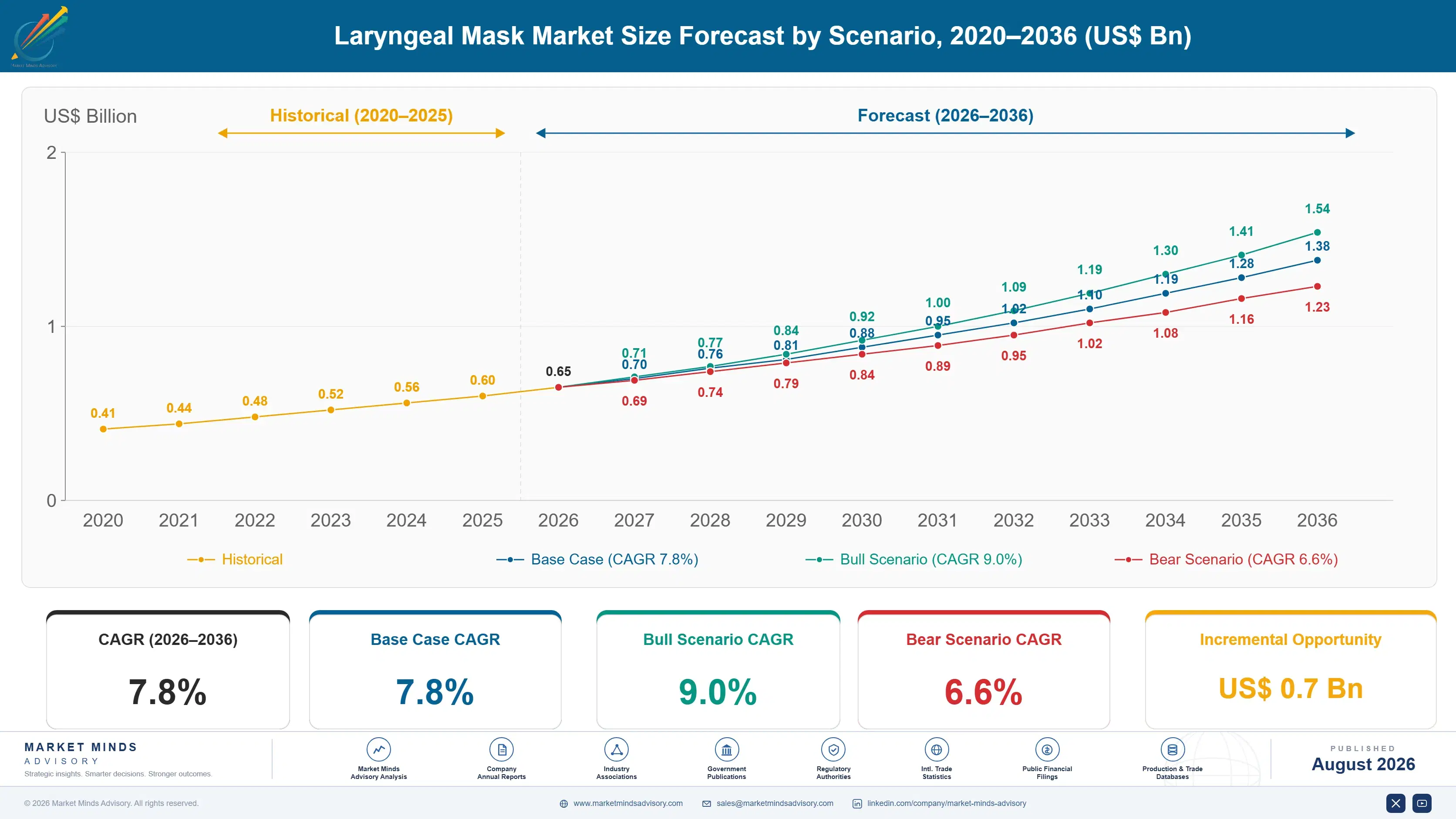
Laryngeal Mask Market Forecast Scenarios

laryngeal-mask-market-size-forecast-scenario-1787305701639
Growth ran near 6.8% from 2020 to 2025 as two design shifts worked through the installed prescribing habit. Original patents on the inflatable cuff expired, and a non-inflatable thermoplastic alternative took very large share by removing a step clinicians had performed for thirty years. Airway guidance meanwhile moved decisively toward second-generation devices offering gastric drainage, which displaced first-generation products steadily rather than abruptly.
Base case growth of 7.8% rests on three mechanisms. Second-generation conversion continues as guidance and institutional protocol both favour devices permitting gastric access, and those cost more than the first-generation products they replace. Prehospital and resuscitation use expands because a supraglottic device is far easier to place correctly than a tracheal tube. And surgical volume growth across Asia adds units at prices well below developed market levels. None of the three depends on the others.
The bull case at 9.0% assumes video-enabled devices reach routine theatre use rather than remaining a difficult airway product, which would lift average selling price considerably across a very large unit base. The bear case at 6.6% is price collapse: Asian manufacturers scale further in a moulded product where design differences have narrowed, and unit growth arrives without value.

Supraglottic Airways: Design, Guidance and Price

The most instructive event in this category was a subtraction. The original laryngeal mask sealed using an inflatable cuff, which meant an inflation step, a syringe, a pressure judgement and an over-inflation failure mode causing mucosal injury. A thermoplastic elastomer device that seals on body heat alone removed all of that at once, arriving as the founding patents expired, and it took very substantial share.
TOP FIVE CONCENTRATION69%Concentrated among airway specialists and the category's original inventor
SECOND-GENERATION SHARE61%Devices in use offering gastric drainage and higher sealing pressure
AVERAGE DEVICE PRICEUSD 9Blended manufacturer price across generations and geographic markets
ANNUAL DEVICE VOLUME58 millionSupraglottic airway devices used worldwide across theatre and prehospital settings
SINGLE-USE DEVICE SHARE96%Devices discarded after one patient rather than cleaned and reused
FIRST ATTEMPT SUCCESS RATE94%Insertions achieving adequate ventilation on the first attempt made
The second shift came from guidance rather than design. Airway societies moved decisively toward second-generation devices offering a separate gastric drainage channel and higher oropharyngeal leak pressure, on the grounds that both reduce aspiration risk in a device that does not protect the airway the way a cuffed tracheal tube does. Second-generation products now account for 61% of use, and first-generation devices are in steady rather than dramatic decline.
Everything happens at very low unit prices. A blended device sells for around USD 9 across 58 million annual units, which makes this a moulding and materials business with a clinical argument attached rather than a premium device market. Chinese and Indian manufacturers compete directly on that basis, and design differences have narrowed considerably. The strongest defences left are guidance-aligned features and a generic brand name.
"Everybody says laryngeal mask the way they say hoover, and the company that owns the name has been losing share to a device that made the cuff unnecessary. Owning the vocabulary and owning the volume are quite different things."
Principal Analyst, Airway Management and Anaesthesia Devices Practice · MMA Medi

Market Trends

Visual placement confirmation moves beyond difficult airway use

Video-enabled supraglottic devices carry a camera at the distal tip, letting a clinician see the laryngeal inlet and confirm seating directly rather than inferring position from chest movement and capnography. The segment compounds at 11.7% from a small base, currently concentrated in anticipated difficult airway and teaching settings. First attempt success already sits near 94%, so the argument is confirmation and training rather than rescue, and price remains the obstacle to routine theatre adoption. Teaching institutions have adopted earlier than community hospital theatres, where price sensitivity binds considerably harder against a device already costing under ten dollars.
Market Impact: Success rates reaching 94% consiste
Guidance drives conversion toward gastric access designs

Airway societies moved decisively toward second-generation devices with a separate drainage channel and higher oropharyngeal leak pressure, since a supraglottic airway does not protect against aspiration the way a cuffed tracheal tube does. Second-generation products now represent 61% of use, and institutional protocols increasingly specify them by default. They cost more than the first-generation devices being displaced, which lifts realised pricing even where unit volumes hold steady. Manufacturers whose ranges remain weighted toward inflatable first-generation designs are selling into a segment that guidance is deliberately shrinking, and no pricing action reverses a written protocol.
Market Impact: China compounding at 12.8% annually

Market Opportunities and Growth Drivers

Resuscitation guidance favours supraglottic over tracheal intubation

Placing a supraglottic device correctly requires far less training and far fewer attempts than passing a tracheal tube, which is why resuscitation guidance now favours it for most non-specialist airway management in cardiac arrest and prehospital care. First attempt success runs near 94% in trained hands and remains high among occasional users, which no intubation technique matches. Ambulance services across Europe standardised on these devices, and that volume is high in units and low in price. One standardisation decision commits an entire organisation for years with almost no further selling required afterwards.
Market Impact: Devices priced near USD 9 each

Asian surgical volume growth adds units at emerging market pricing

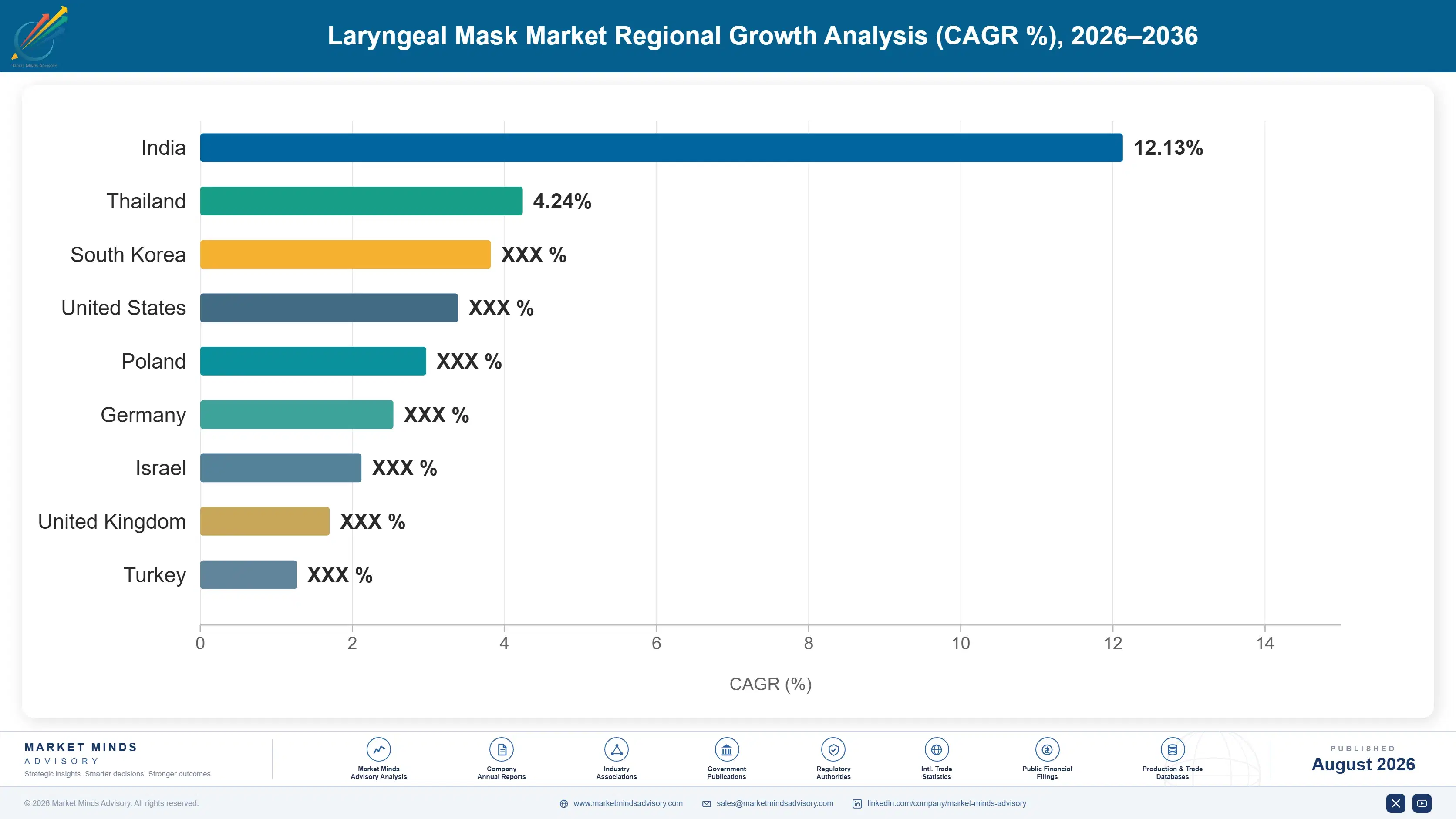
China compounds at 12.8% as theatre capacity extends into provincial hospitals and anaesthesia services expand alongside it, and Indian surgical volumes follow a comparable trajectory. Roughly 58 million devices are used worldwide each year and most incremental units now come from these markets. Domestic manufacturers supply the great majority of that demand at prices international suppliers cannot approach, so unit growth translates into far less value than equivalent growth elsewhere. Western producers cannot match those cost structures directly, and treating that pricing as unacceptable rather than as a different business model simply surrenders the only unit growth available anywhere.
Market Impact: Excluded from 30% of anaesthetics

Market Restraints and Challenges

Moulded devices at nine dollars invite manufacturing cost competition

A blended device sells for around USD 9 across 58 million annual units, and it is a moulded polymer product where design differences between competing second-generation devices have narrowed considerably since the original patents expired. The root cause is that the underlying engineering is now widely understood. Commercial impact falls hardest on Western manufacturers with higher cost bases. Participants respond with guidance-aligned features, integrated cameras and clinical education that price competition addresses less directly. Moulding location now decides more of the outcome than design does. Clinical education carries further than discounting here.
Market Impact: Compounding at 11.7% each year

Aspiration risk caps use in the highest-risk surgical populations

A supraglottic device seats above the larynx and does not protect the airway the way a cuffed tracheal tube does, which excludes it from full stomach, high aspiration risk and many prolonged or prone procedures regardless of how good the seal is. The root cause is anatomical rather than technical. Commercial impact is a ceiling on the share of general anaesthetics these devices can take. Higher-seal second-generation designs and gastric drainage extend that boundary without removing it. That boundary is anatomical and will not move much further. Higher-seal designs extend it without removing it.
Market Impact: Second-generation reaching 61% of u
3 additional market trends, 4 additional growth drivers, and 2 additional restraints and challenges are covered in the full report. Contact sales@marketmindsadvisory.com to access the complete intelligence.

Segment CAGR and Growth Architecture

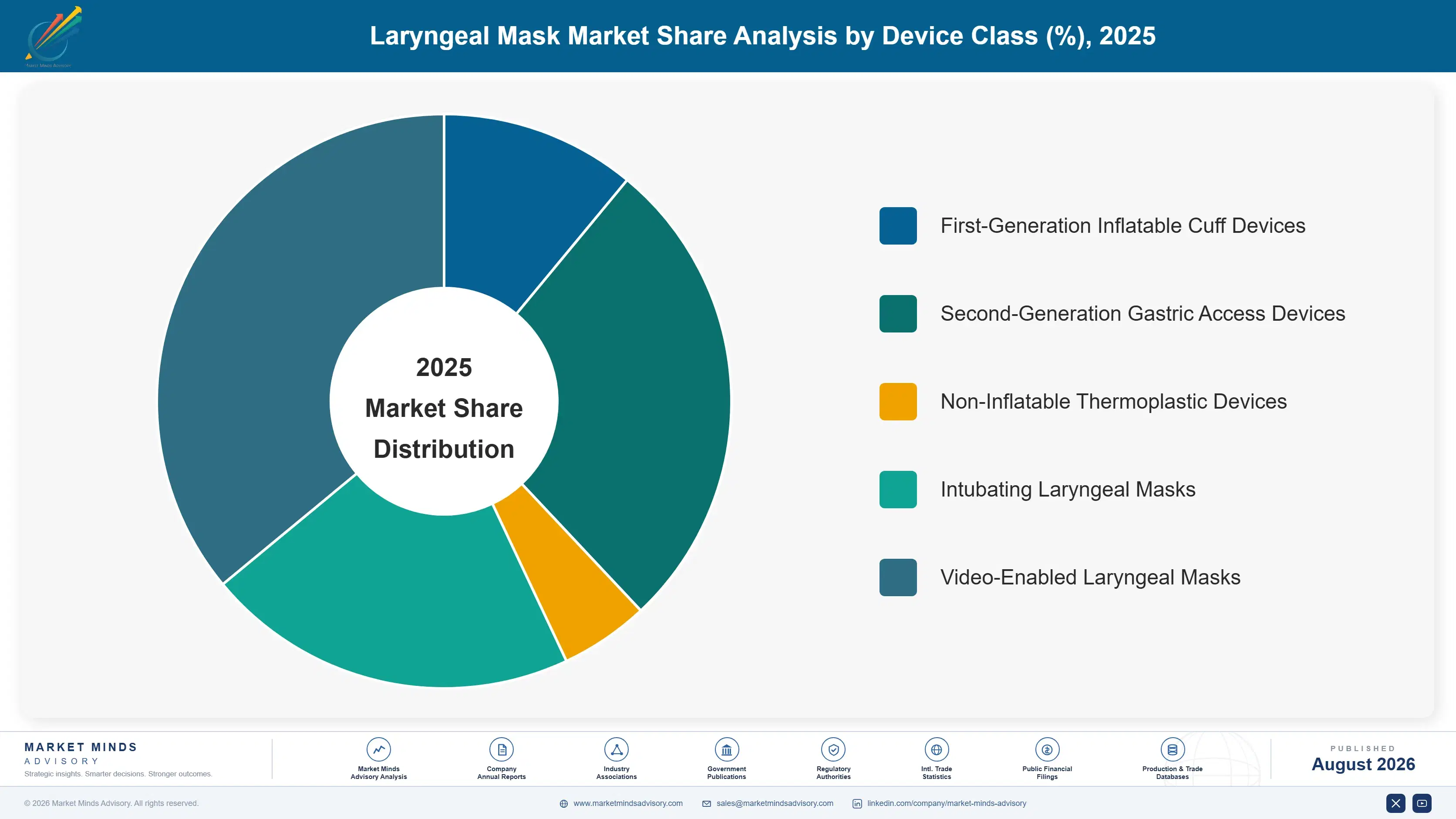
Segmentation follows device class, because class determines the sealing mechanism, whether gastric access exists, what the device costs to manufacture and which clinical situations guidance permits it in. Five device classes cover supraglottic airway supply without overlap between them. Care setting and patient size cut across every class at once and are treated here as use attributes.
laryngeal-mask-market-market-share-analysis-1787305702166

Video-Enabled Laryngeal Masks

Growing at 11.7%, a full 1.50x the market rate, video-enabled devices place a camera at the distal tip so a clinician can see the laryngeal inlet and confirm seating directly rather than inferring it from ventilation. Adoption concentrates in anticipated difficult airway management and in teaching, where watching a trainee seat a device correctly is genuinely valuable. First attempt success already runs near 94% without any camera, so the argument is confirmation, documentation and training rather than rescue. Price is the obstacle to routine theatre use, and it is a considerable one at these unit economics. Documentation value in teaching settings is genuine. Routine adoption awaits a lower price point.
CAGR 11.7%

Non-Inflatable Thermoplastic Devices

Non-inflatable devices grow at 10.4% by removing the cuff entirely, sealing instead through a thermoplastic elastomer that softens against the perilaryngeal anatomy at body temperature. That eliminates the inflation step, the syringe, the pressure judgement and the over-inflation injury that careless cuff management caused, which is why the design took very substantial share once the original patents expired. Insertion is faster and requires less training, which suits prehospital and resuscitation use particularly well. Manufacturing is straightforward enough that competing versions have followed. Competing versions of the design have followed, which erodes the differentiation that produced the original share gain and leaves manufacturing cost as the decisive variable once again. Manufacturing is straightforward.
CAGR 10.4%
Full segment breakdown across 5 segments available in the complete report.

Regional Architecture and Country Demand Map

Regional value reflects surgical procedure volume, guidance-driven device mix and manufacturing location together, and those three factors do not point toward the same places at all. Reading procedure counts alone would place this market somewhere quite different from where its value actually accumulates. All three need reading together.

East Asia

East Asia holds the largest share at 29% on surgical volume and manufacturing together rather than on pricing, which trails every developed market. China compounds at 12.8% as theatre capacity extends into provincial hospitals and anaesthesia services expand alongside. Domestic manufacturers including Well Lead and Besmed supply the majority of regional demand and export substantial volume globally at prices Western producers cannot approach in any tender. Japanese and South Korean practice is mature, second-generation converted and premium-weighted, which distinguishes it sharply from the rest of the region. Second-generation conversion across the region trails developed markets considerably on cost grounds. Export volume from the region reaches every other market at prices that shape tender outcomes globally.
Share: 29% | CAGR: 9.0% (2026 to 2036)

Western Europe

Twenty-five per cent of value, growing at 6.2%, the slowest of the seven regions on mature procedure volumes. Second-generation conversion is furthest advanced anywhere, driven by airway society guidance that European institutions follow closely when writing protocol. The non-inflatable design originated here and its regional position remains strongest, having displaced inflatable cuff devices across both theatre and prehospital use. Ambulance services standardised on supraglottic airways for resuscitation earlier than elsewhere, which created large volume at very low unit prices. Second-generation devices carry a clear majority of regional use, and first-generation products are now largely confined to settings where budgets rather than guidance determine the choice. Ambulance standardisation created very large committed volume at low unit prices.
Share: 25% | CAGR: 6.2% (2026 to 2036)
Regional intelligence for 5 additional markets available in the complete report: North America, South Asia and Pacific, Latin America, Middle East and Africa, Eastern Europe. Contact sales@marketmindsadvisory.com.
laryngeal-mask-market-country-cagr-analysis-1787305702681

Where Supraglottic Airway Margin Survives

This is a moulded polymer product selling at around nine dollars where the founding patents have expired and design differences have narrowed. Margin now depends on guidance alignment, on features competitors have not copied, and on the volume that low-price markets generate. Design alone no longer differentiates. Cost position increasingly decides tenders. Guidance decides the rest.

Align the portfolio to what guidance actually specifies

Airway societies moved decisively toward second-generation devices with gastric drainage and higher leak pressure, and institutional protocols increasingly specify them by default rather than by clinician preference. Those devices already carry 61% of use and cost more than the first-generation products they displace. Manufacturers whose ranges remain weighted toward inflatable first-generation designs are selling into a segment that guidance is deliberately shrinking, and no pricing action reverses a protocol decision. Protocol decisions hold for years once written. Institutional protocols adopt new guidance within months of publication. Guidance is shrinking the alternative deliberately.
Market Impact: Second-generation devices now carry

Compete on removed steps rather than added features

The single largest share shift in this category's history came from taking the inflatable cuff away, which removed a step, a syringe, a judgement and an injury mechanism at once. Non-inflatable designs compound at 10.4% on that subtraction. Features that add complexity to a device costing around USD 9 rarely justify themselves, while anything that removes a step in a time-pressured airway situation carries genuine clinical and commercial value that clinicians recognise immediately. Clinicians cited cuff inflation as the action they were most relieved to lose. Clinicians recognise a removed action immediately.
Market Impact: Subtraction is driving 10.4% of the

Own the prehospital and resuscitation standardisation decision

Ambulance services and resuscitation programmes standardise on a single device across an entire organisation, which converts a low-price product into very large committed volume with almost no ongoing selling. First attempt success near 94% among occasional users is the argument that wins those decisions, since no intubation technique performs comparably in untrained hands. Those standardisation reviews happen rarely, so being present when one occurs matters more than continuous promotional coverage. Presence at the review matters more than continuous coverage. Training already invested in one device reinforces the position further. Reviews recur only every few years.
Market Impact: Success near 94% among all the occa

Accept low pricing where the volume actually is

Roughly 58 million devices are used annually and most incremental units now come from Asian markets at prices well below developed market levels, supplied largely by domestic manufacturers. Western producers cannot match those cost structures and should not attempt to, but they can license, partner or manufacture regionally rather than ceding the volume entirely. Treating emerging market pricing as unacceptable rather than as a different business model surrenders the only unit growth available. Regional manufacturing or licensing captures it instead. Most incremental units now come from those markets. The alternative is ceding the growth entirely.
Market Impact: Volume reaching 58 million devices

Who Controls the Margin Pool

Concentration is high at 69% across the top five, measured on annual revenue from supraglottic airway devices, the single basis applied throughout this analysis. Intersurgical and Teleflex lead through an unusual arrangement, the first having taken very substantial share with a non-inflatable design once the founding patents expired, the second retaining the brand name that clinicians worldwide still use generically for the entire category.
Competition runs on three dimensions that resolve at different levels. Product competition turns on sealing performance, gastric access and insertion ease, where design differences have narrowed considerably since patent expiry. Protocol competition happens when an institution or ambulance service standardises, and those decisions hold for years. Price competition is fiercest in Asian and Latin American tenders, where domestic manufacturers with far lower cost structures compete directly.

Pressure builds from two directions. Chinese and Indian manufacturers produce competent second-generation devices at prices Western producers cannot approach, and their export reach now extends well beyond their home markets. Separately, guidance keeps narrowing what first-generation devices may be used for. Rankings shift most where a manufacturer wins an ambulance service or hospital system standardisation, since those commit very large volumes for extended periods.
laryngeal-mask-market-company-positioning-matrix-1787305703201

Competitive Moat and Risk Dimensions

INTERSURGICAL

Moat: Non-inflatable design disruption

Removing the inflatable cuff entirely gave Intersurgical a genuinely different product at the moment the founding patents expired, eliminating an inflation step, a syringe and an over-inflation injury mechanism that clinicians had managed for three decades. Prehospital and resuscitation standardisation across European ambulance services locked in very large committed volumes that competitors cannot readily contest.
INTERSURGICAL

Risk: Design advantage now copied

Non-inflatable thermoplastic sealing is straightforward enough to manufacture that competing versions have followed, which erodes the differentiation that produced the original share gain. Chinese and Indian producers compete directly on a moulded product at around USD 9. Video-enabled devices are advancing from competitors while the core portfolio remains conventional.
TELEFLEX

Moat: Generic brand name recognition

Clinicians worldwide use the trade name generically for the whole device category, which is an advantage almost no medical device holds and one that keeps the brand present in every airway conversation regardless of what product is actually in the trolley. Breadth across first-generation, second-generation and intubating variants supplies a whole airway trolley from one source.
TELEFLEX

Risk: Volume behind the name

Owning the vocabulary has not prevented substantial share loss to a non-inflatable design that removed a step the original product required. Portfolio weighting toward inflatable cuff devices sits against guidance that favours gastric access designs. Price competition from Asian manufacturers presses hardest on the conventional products that carry most remaining volume.

Players Tracked

Prominent Players

Intersurgical
Teleflex
Ambu
Medtronic
Flexicare

Other Key Players

Vyaire Medical
ICU Medical
VBM Medizintechnik
Sumi
Besmed Health Business
Well Lead Medical
SunMed
Mercury Medical
Baska Anaesthesia
Marshall Products
P3 Medical
Tuoren Medical
Romsons
Angiplast
UE Medical

Recent Developments

MARCH 2025

Airway guidance narrows acceptable first-generation device indications

National airway society guidance narrowed the situations in which first-generation supraglottic devices without gastric access remain acceptable, an organic clinical standardisation that institutional protocols across several health systems adopted within months of publication. First-generation devices were confined to narrower circumstances as a result. Stocking decisions followed.
Signal: Protocol decisions rather than any clinici
AUGUST 2025

Ambulance services extend supraglottic standardisation across resuscitation

Emergency medical services across several European and Australian jurisdictions extended standardisation on supraglottic airways for resuscitation, an organic protocol development reflecting first attempt success rates that intubation cannot match among occasional operators. Occasional operators place these devices far more reliably than tracheal tubes. Volume committed for years.
Signal: A single standardisation decision commits
JANUARY 2026

Asian manufacturers extend second-generation device exports westward

Chinese and Indian supraglottic device manufacturers widened export distribution into European and Latin American tender markets, an organic commercial expansion offering competent second-generation designs at prices established suppliers could not profitably match. Established suppliers lost tender awards accordingly. Second-generation geometry is now widely understood and available from multiple sources.
Signal: Design differences narrowed enough that a

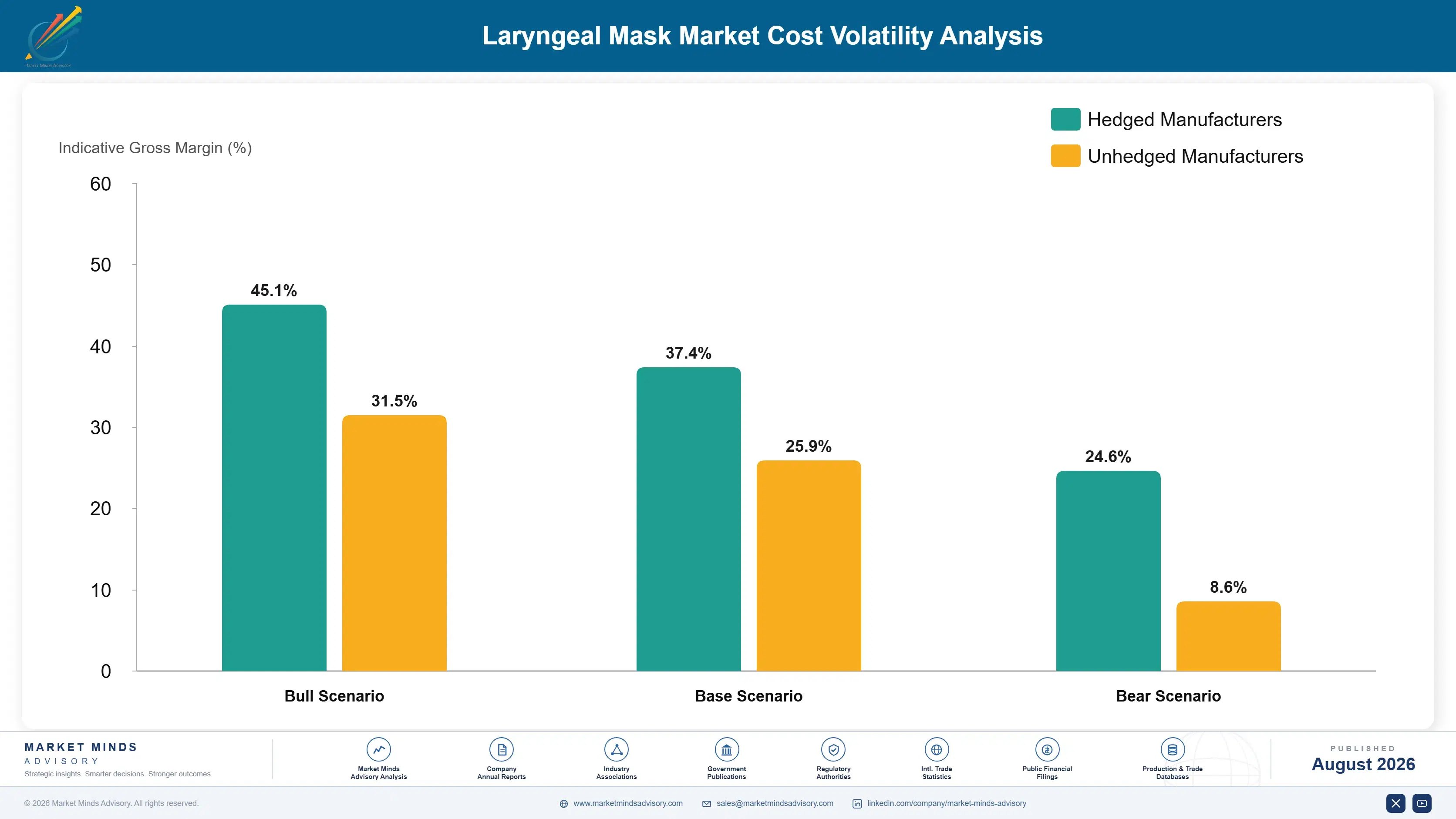
Polymer, Moulding and Sterilisation Exposure

This is a materials and moulding business at heart. Medical grade silicone and thermoplastic elastomer account for roughly 48% of device cost of goods, sourced from a concentrated group of polymer producers in Western Europe, the United States and increasingly Asia. Injection and compression moulding tooling carries substantial upfront cost amortised across very long runs, and ethylene oxide or radiation sterilisation plus packaging make up most of the remainder.
Medical grade polymer availability tightened materially through 2021 and 2022 as several producers withdrew from medical applications citing liability exposure disproportionate to volume, and airway device manufacturers requalified materials under time pressure. Manufacturer annual reports across the period documented supply disruption and subsequent inventory building. Ethylene oxide sterilisation capacity also faced regulatory restriction in several United States locations, constraining availability for single-use device categories generally.

Exposure varies most by manufacturing location rather than by design. Producers moulding in Asia carry materially lower polymer, tooling and assembly costs than European or North American manufacturers, and in a device selling at around USD 9 that gap decides tender outcomes directly. Design sophistication offers limited protection, since second-generation geometry is widely understood and competing versions are available from multiple sources.
laryngeal-mask-market-cost-volatility-analysis-1787305703396

Qualify alternate medical polymer grades before producers withdraw

Several polymer producers exited medical applications entirely because liability exposure outweighed modest volumes, and airway manufacturers discovered the dependency only when supply stopped arriving. Polymer represents nearly half of device cost, so this exposure is material rather than incidental. Qualifying alternate grades during ordinary conditions costs validation and regulatory filing work rather than any capital outlay whatsoever.

Diversify sterilisation modality and geographic capacity

Ethylene oxide sterilisation faced regulatory restriction across several United States locations, and manufacturers dependent on single facilities lost availability with very little warning. Qualifying radiation alternatives or additional geographic sites costs validation and materials compatibility testing. Both are considerably cheaper undertaken in advance than negotiated during an interruption that halts shipment entirely. Single-facility dependence is the exposure worth removing first.

Move moulding capacity toward lower-cost manufacturing regions

A moulded polymer device selling at around nine dollars is priced by manufacturing location as much as by design, and Western moulding cost cannot compete in the tender markets generating most unit growth. Relocating or contracting capacity in Asia closes most of that gap. Regulatory registration of a new manufacturing site takes time rather than substantial capital investment.

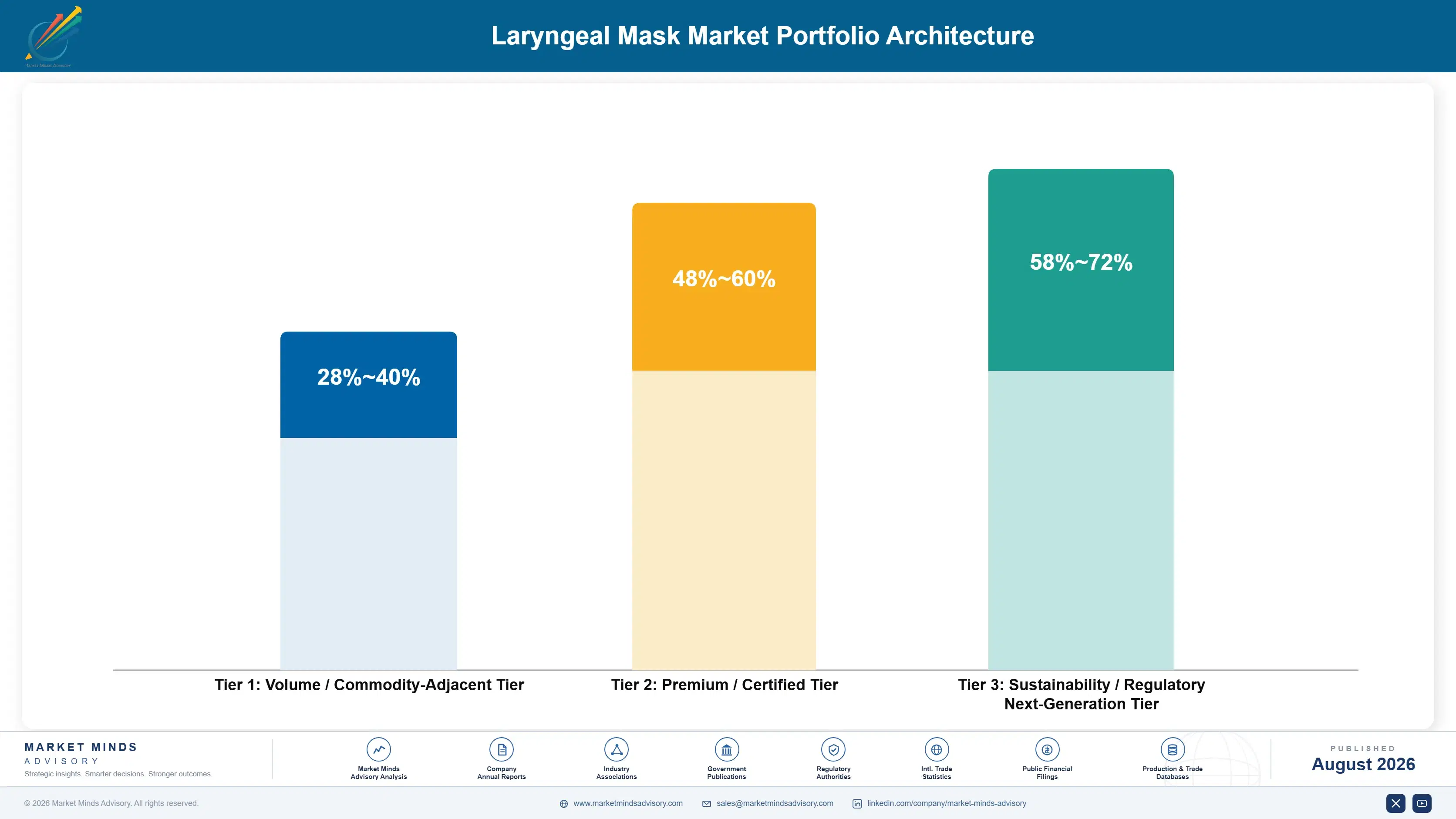
Portfolio Architecture for Margin Defence

Margin architecture separates on what guidance specifies and what competitors cannot yet copy. First-generation inflatable devices sold into tender procurement earn very little, and guidance is deliberately narrowing where they may be used at all. Second-generation designs with gastric access earn better because protocols specify them, though competing versions are now widely available. Video-enabled devices earn most, on a feature nobody has commoditised yet at these unit economics.
The volume against premium tension runs along geography rather than product tier. Developed markets pay several times Asian prices for comparable second-generation devices across broadly flat procedure volumes. Asian and Latin American markets generate almost all incremental units at prices domestic manufacturers set. A Western producer competing only in the first is in a slow market, and one attempting the second on its own cost base cannot win a tender.

High-value pools concentrate around protocol position and unreplicated features. Institutional and ambulance service standardisations, video-enabled devices, and second-generation designs specified by guidance all command pricing that first-generation products do not. Conventional moulded devices, whatever the brand on them, compete against Asian manufacturers whose cost structures Western producers have no realistic route to matching in a nine dollar product.

Volume / Commodity-Adjacent Tier

First-generation inflatable cuff devices and conventional second-generation products sold through tender procurement, where Asian moulding cost sets the achievable price and design differences no longer separate competitors. Guidance is narrowing this tier deliberately.
Gross Margin: 28-40%

Premium / Certified Tier

Guidance-aligned second-generation devices held under institutional and ambulance service standardisation agreements, protected by protocol decisions that hold for years and by training already invested in a specific device. Reviews happen rarely and commit large volume.
Gross Margin: 48-60%

Sustainability / Regulatory / Next-Generation Tier

Video-enabled devices and non-inflatable designs offering genuine step reduction, commanding premium because they either remove a clinical action entirely or add confirmation that competitors have not yet commoditised. Neither has been commoditised at these unit economics.
Gross Margin: 58-72%
laryngeal-mask-market-portfolio-architecture-1787305703892

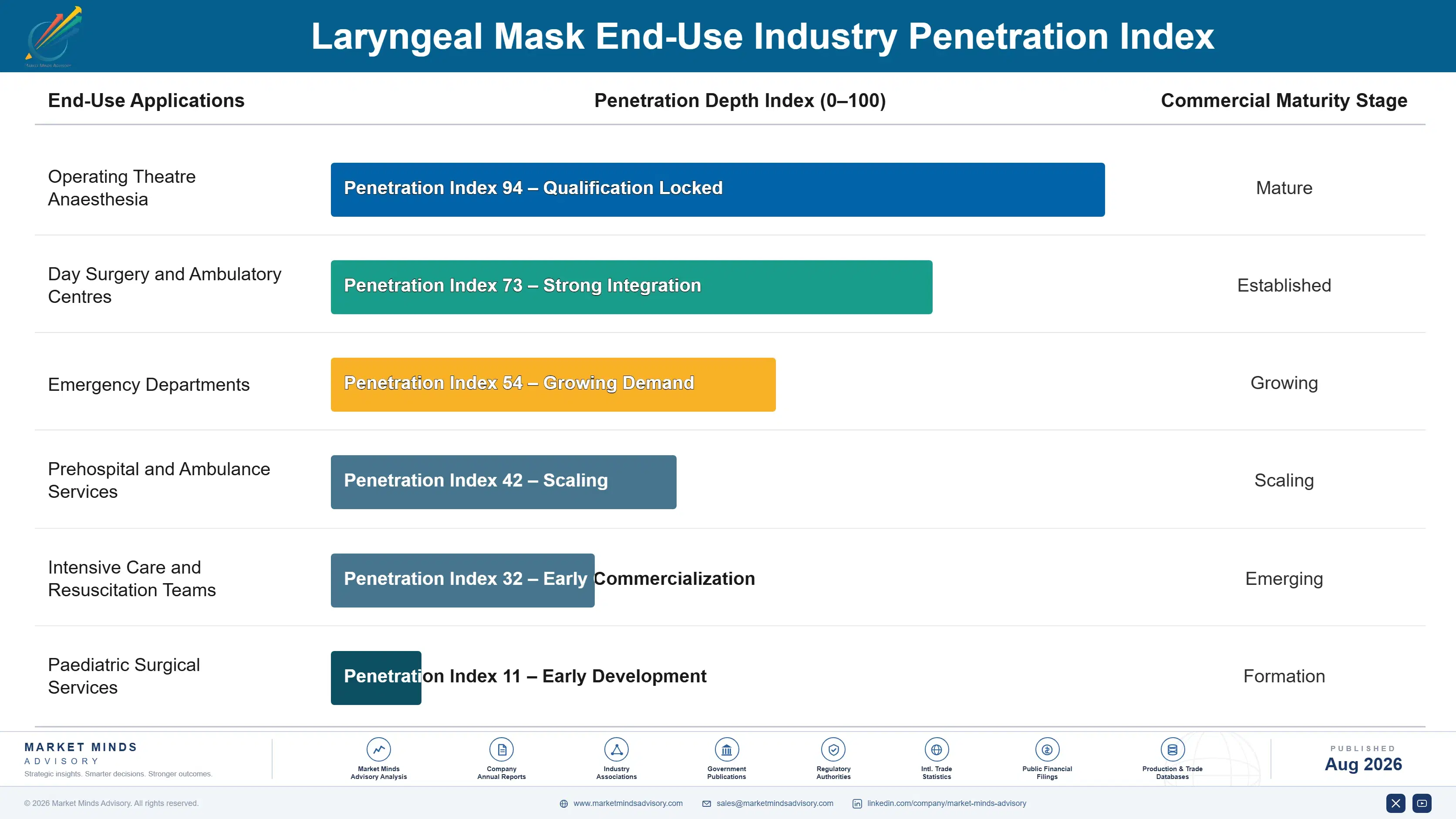
Per-Case Consumption and Protocol Commitment

Demand is pure per-case consumption with essentially no capital component. Every general anaesthetic using a supraglottic airway consumes one device that is discarded afterwards, and 96% of devices are already single-use, so revenue tracks surgical and resuscitation activity directly. Roughly 58 million devices are used annually. There is no instrument to place, no replacement cycle to forecast and no installed base to defend beyond the protocol that specifies a brand.
Depth of use varies by procedure type and by anatomy rather than by geography. Short elective procedures in fasted patients with normal airways are the natural indication and account for most theatre volume. Full stomach, high aspiration risk, prolonged and prone cases remain intubation territory regardless of seal quality, which caps the share of general anaesthetics these devices can take. Prehospital resuscitation is a separate high-volume, low-price population entirely.

Purchasing profiles are unusually concentrated for a consumable. Hospital anaesthesia departments select devices and then rarely revisit the decision, ambulance services and resuscitation programmes standardise across whole organisations, and public tender committees decide on delivered price in most emerging markets. Individual anaesthetists influence the original selection and the reorder decision hardly at all, which manufacturers frequently misread.
laryngeal-mask-market-end-use-penetration-index-1787305704377

Where Supraglottic Airway Strategy Lands

These are among the four positions where our research anticipates prominent divergence between winners and laggards over the coming forecast period. Each is grounded in the demand model, the regulatory perimeter, and the announced capacity pipeline.
01 / GUIDANCE ALIGNMENT PRIORITY

Protocols now decide what sits in the trolley

Airway society guidance moved decisively toward second-generation devices offering gastric drainage and higher oropharyngeal leak pressure, and institutional protocols increasingly specify them by default rather than leaving the choice to individual clinician preference. Those devices already carry 61% of all use, and they cost more than the first-generation products they are steadily displacing. Manufacturers whose ranges remain weighted toward inflatable first-generation designs are selling into a segment that airway guidance is quite deliberately shrinking, and no price action reverses that.
02 / SUBTRACTION OVER ADDITION

Removing a step beat every feature anyone added

The largest share shift in this category's entire history came from taking the inflatable cuff away, which simultaneously removed a step, a syringe, a pressure judgement and an over-inflation injury mechanism clinicians had managed for three decades. Non-inflatable designs compound at 10.4% annually on that single subtraction alone. Features adding complexity to a device selling at around USD 9 rarely justify themselves at all, while anything removing an action in a time-pressured airway situation carries value that clinicians recognise instantly.
03 / STANDARDISATION WINDOW FOCUS

One decision commits volume for several years

Ambulance services, resuscitation programmes and hospital systems standardise on a single supraglottic device across an entire organisation, which converts a nine dollar product into very large committed volume requiring almost no further selling afterwards. First attempt success near 94% among occasional operators is the argument that wins those reviews, because no intubation technique performs comparably in untrained hands. Those standardisation reviews happen rarely, so being present at one is worth considerably more commercially than any amount of continuous promotional coverage.
04 / EMERGING PRICE ACCEPTANCE

The unit growth only exists at Asian pricing

Roughly 58 million devices are used worldwide every year and most incremental units now arrive from Asian markets at prices well below developed market levels, supplied largely by capable domestic manufacturers operating locally. Western producers cannot match those cost structures directly and should not attempt to do so on their existing manufacturing base. Licensing, partnership or regional manufacturing captures that volume instead, while treating emerging market pricing as unacceptable simply surrenders the only real unit growth available anywhere at all.

Engagement Snapshot From the Field

A live engagement with an industry participant carrying material or product regulatory and market exposure ahead of a defining policy shift, showing how our research translates into a defensible multi-year portfolio strategy.
MARKET MINDS ADVISORY · CLIENT ENGAGEMENT SUMMARY
Laryngeal Mask Producer Strategic Portfolio Review and Transition Roadmap 2026·Investment Scenario on Laryngeal Mask Exposure Evaluation 2025-26
CLIENT PROFILE
An airway device manufacturer with a first-generation inflatable cuff range, one second-generation product and European moulding capacity only. Annual supraglottic revenue was approximately USD 58 million (client-reported, unverified by MMA), concentrated in European and Middle Eastern hospital tenders where delivered price increasingly decided awards against Asian competitors. Guidance had narrowed where its main range could be used.
STRATEGIC CHALLENGE
Airway guidance had narrowed acceptable first-generation indications while Asian manufacturers offered competent second-generation devices at prices European moulding could not match, and the client held no position in non-inflatable or video-enabled designs. The board needed to decide whether to compete on manufacturing cost, invest in differentiated design, or pursue protocol standardisation positions instead.
MMA APPROACH
MMA conducted 47 expert interviews spanning anaesthetists, intensive care clinicians, ambulance service medical directors, resuscitation training leads, hospital procurement officers and moulding manufacturing directors across six countries. A quantitative survey of 3,800 respondents established device selection criteria, protocol review frequency and switching behaviour. We then modelled revenue and margin outcomes under cost competition, design investment and standardisation strategies against observed tender pricing data.
KEY FINDINGS
  1. Anaesthesia departments in five of six markets reported that institutional protocol rather than individual preference determined which device generation was stocked, and protocols changed rarely.
  2. Ambulance service medical directors selected devices on first attempt success among occasional operators, and none had reviewed the decision within the preceding three years.
  3. Procurement officers treated conventional second-generation devices as entirely interchangeable between all prequalified suppliers, and they awarded contracts on delivered price without exception.
  4. Clinicians consistently valued removed steps over added features, and several cited cuff inflation as the action they were most relieved to have lost from the procedure.
CLIENT PROFILE
An airway device manufacturer with a first-generation inflatable cuff range, one second-generation product and European moulding capacity only. Annual supraglottic revenue was approximately USD 58 million (client-reported, unverified by MMA), concentrated in European and Middle Eastern hospital tenders where delivered price increasingly decided awards against Asian competitors. Guidance had narrowed where its main range could be used.
STRATEGIC CHALLENGE
Airway guidance had narrowed acceptable first-generation indications while Asian manufacturers offered competent second-generation devices at prices European moulding could not match, and the client held no position in non-inflatable or video-enabled designs. The board needed to decide whether to compete on manufacturing cost, invest in differentiated design, or pursue protocol standardisation positions instead.
MMA APPROACH
MMA conducted 47 expert interviews spanning anaesthetists, intensive care clinicians, ambulance service medical directors, resuscitation training leads, hospital procurement officers and moulding manufacturing directors across six countries. A quantitative survey of 3,800 respondents established device selection criteria, protocol review frequency and switching behaviour. We then modelled revenue and margin outcomes under cost competition, design investment and standardisation strategies against observed tender pricing data.
KEY FINDINGS
  1. Anaesthesia departments in five of six markets reported that institutional protocol rather than individual preference determined which device generation was stocked, and protocols changed rarely.
  2. Ambulance service medical directors selected devices on first attempt success among occasional operators, and none had reviewed the decision within the preceding three years.
  3. Procurement officers treated conventional second-generation devices as entirely interchangeable between all prequalified suppliers, and they awarded contracts on delivered price without exception.
  4. Clinicians consistently valued removed steps over added features, and several cited cuff inflation as the action they were most relieved to have lost from the procedure.
RECOMMENDED STRATEGY
Phase 1: Phase one: move conventional device moulding to contracted Asian capacity, since European cost cannot win tenders where products are treated as interchangeable. Phase 2: Phase two: target ambulance service and hospital system standardisation reviews specifically, because one decision commits large volume for several years afterwards. Phase 3: Phase three: develop a differentiated design that removes a clinical step rather than adding a feature, following the pattern that produced this category's largest share shift.
OUTCOME
The client contracted Asian moulding capacity for conventional lines, established a standardisation review targeting programme and began development of a non-inflatable design (client-reported, unverified by MMA). Tender win rates improved measurably within a year, two ambulance service standardisations were secured, and blended margin held despite continued price erosion in conventional products.

Frequently Asked Questions

Foundational context covering the market sizes, CAGR, scope, country, region and competition that inform every finding below. This section is provided to cover basics and most often pre-purchase conversations, answered from the MMA Primary Research Dataset.

What is the current size of the Laryngeal Mask Market?

The global laryngeal mask market was valued at USD 0.58 billion in 2025, spanning first and second-generation devices, non-inflatable designs, intubating and video-enabled variants. Roughly 58 million devices are used worldwide each year.

How large will the Laryngeal Mask Market be by 2036?

MMA forecasts the market at USD 1.33 billion by 2036, expanding 2.11 times from the 2026 base of USD 0.63 billion. That represents roughly USD 0.70 billion of incremental value across the forecast decade.

What is the CAGR for the Laryngeal Mask Market 2026 to 2036?

The base case compound annual growth rate is 7.8%, with a bull case of 9.0% and a bear case of 6.6%. The bull case assumes video-enabled devices reach routine theatre use rather than difficult airway management alone.

Which segment is growing fastest?

Video-enabled laryngeal masks grow at 11.7%, a full 1.50x the overall market rate. A camera at the distal tip lets clinicians confirm seating visually rather than inferring it from ventilation.

Who are the major companies in the Laryngeal Mask Market?

Intersurgical, Teleflex, Ambu, Medtronic and Flexicare together hold 69% of revenue. Intersurgical took substantial share with a non-inflatable design while Teleflex retains the brand name clinicians use generically.

Which country is growing fastest?

China grows fastest at 12.8%, as theatre capacity extends into provincial hospitals and domestic manufacturers supply most demand. East Asia is the largest region at 29% of value on volume rather than pricing.

Report Segmentation Architecture

The full report scope spans multiple orthogonal segmentation dimensions, with cross-tabulated demand data provided for each dimension pair. Coverage extends further to regional breakdowns, trend trajectories, and the competitive detail needed to support segment-level decision-making.

By Device Class

  • First-Generation Inflatable Cuff Devices
  • Second-Generation Gastric Access Devices
  • Non-Inflatable Thermoplastic Devices
  • Intubating Laryngeal Masks
  • Video-Enabled Laryngeal Masks

By End-Use Industry

  • Operating Theatre Anaesthesia
  • Day Surgery and Ambulatory Centres
  • Emergency Departments
  • Prehospital and Ambulance Services
  • Intensive Care and Resuscitation Teams
  • Paediatric Surgical Services

By Commercial Dimension

  • Hospital Direct Supply Agreements
  • Public Tender Procurement
  • Ambulance Service Standardisation Contracts
  • Group Purchasing Organisation Contracts
  • Distributor and Dealer Channel Supply
  • Training and Simulation Programme Bundles

By Region

  • East Asia
  • Western Europe
  • North America
  • South Asia and Pacific
  • Latin America
  • Middle East and Africa
  • Eastern Europe

Scope, Methodology, and Coverage

Every figure in this report is reproducible from documented input assumptions. The scope below maps the historical period, the forecast horizon, the segmentation dimensions, and the countries covered, alongside the underlying primary and qualitative methodology.
Historical Period
2020 to 2025
Forecast Period
2026 to 2036
Base Year
2025 (USD billions; MMA Primary Research Dataset, August 2026)
Market Definition
This market comprises supraglottic airway devices seated above the larynx to provide ventilation without tracheal intubation, measured at manufacturer revenue across hospital direct supply agreements, public tender procurement, ambulance service standardisation contracts, group purchasing contracts, distributor channels and training programme bundles. Coverage spans first-generation inflatable cuff laryngeal mask airways, second-generation devices incorporating gastric drainage channels and higher oropharyngeal seal pressure, non-inflatable thermoplastic elastomer devices sealing through body temperature, intubating laryngeal masks designed to permit tracheal tube passage, and video-enabled devices carrying integrated cameras for placement confirmation, across adult, paediatric and neonatal sizes. Endotracheal tubes, stylets, bougies and airway exchange catheters, laryngoscopes and video intubation systems, face masks, bag-valve devices and oropharyngeal airways, tracheostomy and cricothyroidotomy products, anaesthesia machines, ventilators and monitors, and sterilisation or reprocessing services fall outside scope.
Quantitative Units
USD millions (current prices); devices shipped by class; procedures using supraglottic airways; average selling price by generation; single-use share; first attempt success rate
Segmentation Dimensions
By Device Class; By End-Use Industry; By Commercial Dimension; By Region
Regions Covered
East Asia, Western Europe, North America, South Asia and Pacific, Latin America, Middle East and Africa, Eastern Europe
Countries Covered
China, Japan, South Korea, Taiwan, Germany, France, United Kingdom, Italy, Spain, Netherlands, Sweden, Denmark, United States, Canada, Mexico, India, Australia, Thailand, Indonesia, Singapore, Brazil, Argentina, Colombia, Chile, Saudi Arabia, United Arab Emirates, South Africa, Egypt, Poland, Czechia, Hungary, Turkey, and additional markets relevant to airway management analysis
Key Companies Profiled
Intersurgical, Teleflex, Ambu, Medtronic, Flexicare, Vyaire Medical, ICU Medical, VBM Medizintechnik, Sumi, Besmed Health Business, Well Lead Medical, SunMed, Mercury Medical, Baska Anaesthesia, Marshall Products, P3 Medical, Tuoren Medical, Romsons, Angiplast, UE Medical
Quantitative Methodology
Primary survey, n=3,800 respondents, Q4 2025, six countries; demand-side model with trade association cross-validation
Qualitative Methodology
47 expert interviews, Q4 2025; applied to validate demand model assumptions, identify emerging dynamics, and assess competitive positioning
Report Format
PDF and XLSX data workbook (Word format preview document)
Publisher
Market Minds Advisory
Report Code
MMA-2026-MED-409
Published
August 2026
Contact
sales@marketmindsadvisory.com | www.marketmindsadvisory.com

Purchase the full Laryngeal Mask Market Report (2026 to 2036).

The full MMA report examines how removing a component reshaped a category more than any addition ever did, and how airway guidance now determines what hospitals actually stock. It sizes five device classes and seven regions to 2036, modelling devices shipped, procedures performed, pricing by generation, single-use share and protocol conversion separately. Competitive assessment covers twenty manufacturers on one consistent revenue basis. Cost exposure is traced through polymer, moulding and sterilisation inputs. Four commercial levers and a strategic verdict close the report, grounded in 47 expert interviews and a 3,800-respondent survey.
Five device classes sized separately through 2036
Guidance-driven second-generation conversion modelled by region
Protocol standardisation volumes separated from open tender purchasing
Twenty manufacturers assessed on one consistent revenue basis
Asian manufacturing cost position quantified against Western producers
Anonymised client engagement with tested strategic recommendations

Built For The People Who Decide

From boardroom strategy to bench-side execution, this report is read cover-to-cover by leaders shaping the next decade of their industry, turning demand scenarios, market dynamics and valuation benchmarks into decisions.
CXOs/ Presidents/ VPs/ Managers
M&A and Corporate Development
Strategy Teams and R&D Heads
Procurement and Product Directors
Regulatory and Compliance Leaders
Investor Relations and Equity Analysts