
Market Minds Advisory
Japan Battery Management System Market

Japan Battery Management System Market: Japan Battery Management System Market: Wireless Topology, Hybrid Volume and the Domestic Semiconductor Question

Wireless topology is removing the harness that dominated pack assembly cost, Japanese hybrid volume keeps automotive demand higher than any battery electric forecast predicted, and domestic semiconductor supply remains the unresolved dependency.

Lead Analyst

David Horsley

Published

August 2026

Make Smarter Decisions with Customized Research Insights

Request a free sample report and evaluate market opportunities, growth trends, and competitive dynamics relevant to your business needs.

2025 MARKET VALUE$1.1BMarket Size 2025
2036 FORECAST VALUE$2.9BBase Case , 2026 to 2036
CAGR 2026 TO 20369.2 %Bull 10.4% / Bear 8.0%
INCREMENTAL OPPORTUNITY$1.7BNet 10- year value creation
EXPANSION MULTIPLE2.41x2036 value over 2026 base
Strategic Levers
M&A Pipeline
Regional Outlook
Country Rankings
Competitive Intelligence
Segmental Deep-dive
Call-Us : 91 93563 13602

Executive Snapshot and Market Trajectory.

Japan's battery management market is shaped by a fact that distinguishes it from every other developed market: hybrids, not battery electric vehicles, carry the volume. A hybrid pack is smaller, cycles far harder and demands tighter state estimation, which makes the management system technically more demanding rather than less.
Wireless battery management systems grow at 13.8%, a full 1.50 times the market rate, because removing the sense harness cuts pack assembly labour, eliminates a substantial connector failure population and frees packaging volume that cell suppliers immediately want back. Domestic demand accounts for 88% of what this report measures, well outside the standard regional band, because the study is scoped to Japan and the remaining regions represent supplier-origin content rather than any demand.
Concentration sits at 54% for the top five, and it reflects an unusually closed domestic structure. Japanese vehicle manufacturers specify Japanese systems, and the qualification relationships behind that go back decades. Where the market genuinely opens is semiconductors: analog front ends and microcontrollers arrive from American and European suppliers, and that dependency has now become a live policy question rather than merely a procurement one.
Market Definition
This report covers battery management systems sold into the Japanese market, spanning hardware, embedded software and integrated monitoring electronics for lithium-ion and comparable rechargeable packs across automotive, stationary storage, industrial, rail, marine and backup power applications. Battery cells, modules and complete packs, standalone power conversion equipment, charging infrastructure and energy management software operating above the pack level are excluded from the sizing.
Base Year Value
$1.1B in 2025 (MMA Primary Research Dataset, August 2026)
Forecast Period
2026 to 2036, eleven discrete annual values
CAGR
9.2% base case. Bull 10.4%. Bear 8.0%.
Fastest Growth Segment
Wireless Battery Management System: 13.8% CAGR
Fastest Growth Country
India: 11.4% CAGR
Fastest Growth Region
South Asia and Pacific: 11.4% CAGR
Largest Region
East Asia: 88% of 2025 global value
Market Leaders
Denso, Hitachi Astemo, Renesas Electronics, Toshiba and Panasonic Energy lead on domestic system shipment volume. Source: MMA Analysis, July 2026.
Primary Survey
n=3,800 procurement and R&D decision-makers, Q4 2025, six countries
Methodology
Demand-side build-up, cross-validated against public data, 47 expert interviews

Japan Battery Management System Market Forecast Scenarios

japan-battery-management-system-industry-size-forecast-scenario-1787315892685
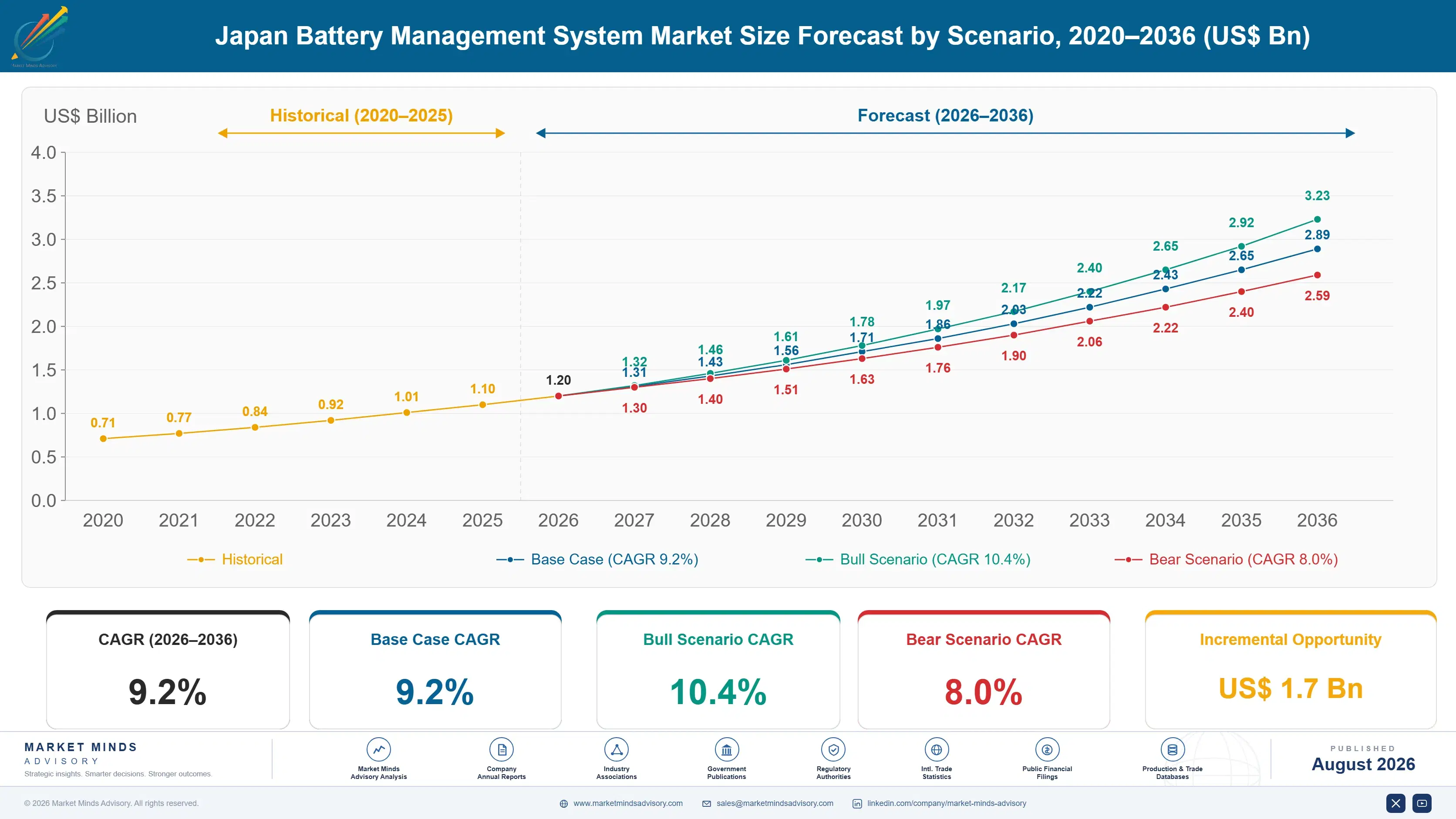
Between 2020 and 2025 the market compounded at 7.9%, and hybrid volume rather than battery electric adoption carried most of it. Japanese battery electric share stayed well below European or Chinese levels throughout, which disappointed forecasters and suppliers alike. Hybrid production did not disappoint at all, and every hybrid carries a management system solving a genuinely harder estimation problem than a large traction pack does.
The base case at 9.2% rests on three mechanisms. Automotive demand grows on hybrid volume that shows no sign of falling plus a battery electric ramp starting from a low base. Grid-scale and commercial storage adds a second stream, pulled by national capacity procurement and grid stability requirements after continued renewable build. The third is content per system: wireless topology, tighter voltage accuracy and functional safety certification all raise realised price ahead of unit growth.
The bull case at 10.4% turns on stationary storage procurement accelerating beyond current auction schedules, which would lift demand for the highest-value system configurations. The bear case at 8.0% is domestic vehicle production continuing its slow decline while battery electric share stays low, leaving automotive volume flat and putting the entire growth burden on storage alone.

What Governs Japanese Battery Management Value

A battery management system does three things: it measures every cell, it decides what the pack can safely do, and it stops the pack doing anything else. The measuring is a hardware problem, the deciding is an algorithm problem, and the stopping is a functional safety problem. Very few companies are genuinely good at all three.
TOP FIVE CONCENTRATION54%Share held by the five largest domestic system suppliers
AVERAGE SYSTEM PRICE$310Typical realised price for a vehicle battery system
DOMESTIC CONTENT SHARE72%Portion of systems designed and built within the country
SEMICONDUCTOR COST SHARE41% of COGSAnalog front end and microcontroller portion of system cost
VOLTAGE MEASUREMENT ACCURACY2 millivoltsTypical cell voltage precision achieved by current generation
PROGRAMME LENGTH8 yearsTypical production run before a battery platform changes
Japan's version of this market has a distinctive shape because hybrids dominate the volume. A hybrid pack is small, shallow-cycled thousands of times a day and expected to last the vehicle's life, which makes state-of-charge and state-of-health estimation considerably harder than on a large traction battery that cycles once daily. Japanese suppliers have spent two decades on that estimation problem, and the resulting algorithm work is genuinely differentiated rather than commodity.
The unresolved question is silicon. Analog front-end integrated circuits and safety microcontrollers make up roughly 41% of system cost, and a substantial share arrives from Texas Instruments, Analog Devices, Infineon and STMicroelectronics. Renesas competes credibly and domestic policy favours it, but no Japanese supplier currently covers the full device set, which leaves a dependency that both industry and government have been openly discussing.
"The interesting asymmetry here is that Japan leads the world on battery state estimation and depends on foreign suppliers for the chips that run it. Two decades of hybrid data is a genuine moat, and it sits on top of a supply chain nobody in Tokyo controls."
Practice Director, Energy Storage and Power Electronics, Market Minds Advisory ·

Market Trends

Wireless Topology Removes The Sense Harness From Packs

Wireless battery management replaces the wiring harness running from every cell group to the monitoring board with short-range radio links, and the commercial argument is assembly rather than electronics. A harness is roughly 11% of pack assembly labour, it constitutes a substantial share of the connector failure population in service, and it occupies packaging volume that cell suppliers want returned. Japanese automotive customers have been notably slower to adopt than their Western counterparts on radio reliability grounds, but formal qualification programmes are now running at all three of the major domestic manufacturers.
Market Impact: Covers 55% of domestic output
Functional Safety Certification Raises System Content Substantially

Automotive battery systems now require ISO 26262 certification at ASIL C or D, which changes the hardware architecture rather than merely adding paperwork. Redundant measurement paths, independent watchdog processors and diagnostic coverage requirements all add components and validation effort, and the certification work itself runs between 18 and 24 months before any production begins. Realised prices on certified systems run roughly 35% above uncertified industrial equivalents built to comparable measurement accuracy. Storage applications are moving in the same direction as grid operators impose their own safety requirements on every connected asset.
Market Impact: Commits 4 gigawatt hours capacity

Market Opportunities and Growth Drivers

Japanese Hybrid Volume Sustains The Hardest Estimation Workload

Japan builds hybrids at a share no other market approaches, and hybrid packs impose the most demanding state estimation problem in this industry. Shallow cycling thousands of times daily across a small pack, with a service life expectation matching the vehicle, leaves very little margin for estimation error at all before capacity fade turns into a warranty matter. That workload has driven two decades of algorithm development inside Japanese suppliers, and it produces systems those suppliers can now sell into overseas markets where hybrid share is rising rather than falling.
Market Impact: Exposes 41% of system cost

Grid Storage Procurement Creates A Second Demand Stream

Ministry of Economy, Trade and Industry capacity procurement and long-term decarbonisation auctions have committed substantial grid-scale storage capacity, and every one of those installations requires management systems at both pack and string level. Commercial and industrial storage adds further volume as building operators respond to demand charges, grid stability incentives and their own resilience requirements. The technical requirement differs sharply from automotive: fewer units, much larger systems, longer design lives and communication protocols that automotive engineering does not transfer into cleanly, which favours the small number of suppliers holding both capabilities properly.
Market Impact: Loses 2% annual production

Market Restraints and Challenges

Foreign Semiconductor Dependency Constrains Domestic Supply Security

Analog front ends and safety microcontrollers reach roughly 41% of system cost, and a substantial share arrives from American and European suppliers. The root cause is portfolio coverage rather than capability: Renesas competes strongly on microcontrollers but no Japanese supplier offers the complete device set a modern system needs. Commercially this leaves lead times and pricing outside domestic control, as the 2021 shortage demonstrated painfully. Participants are responding by dual-sourcing device families, by funding domestic analog development, and by designing architectures that tolerate substitution between comparable parts without requalifying the safety case.
Market Impact: Cuts assembly labour by 11%

Domestic Vehicle Production Decline Caps Automotive Unit Growth

Japanese domestic vehicle output has been drifting down for a decade as manufacturers build closer to their end markets. The root cause is currency and logistics economics rather than any loss of competitiveness. Commercially this caps automotive battery management unit volume regardless of how battery adoption progresses, because a vehicle built in Kentucky or Guangzhou generally takes a locally sourced or locally integrated system. Participants are responding by following manufacturers overseas with design support, by pushing content per system upward, and by building stationary storage positions that carry no such constraint.
Market Impact: Adds 35% to system price
3 additional market trends, 4 additional growth drivers, and 2 additional restraints and challenges are covered in the full report. Contact sales@marketmindsadvisory.com to access the complete intelligence.

Segment CAGR and Growth Architecture

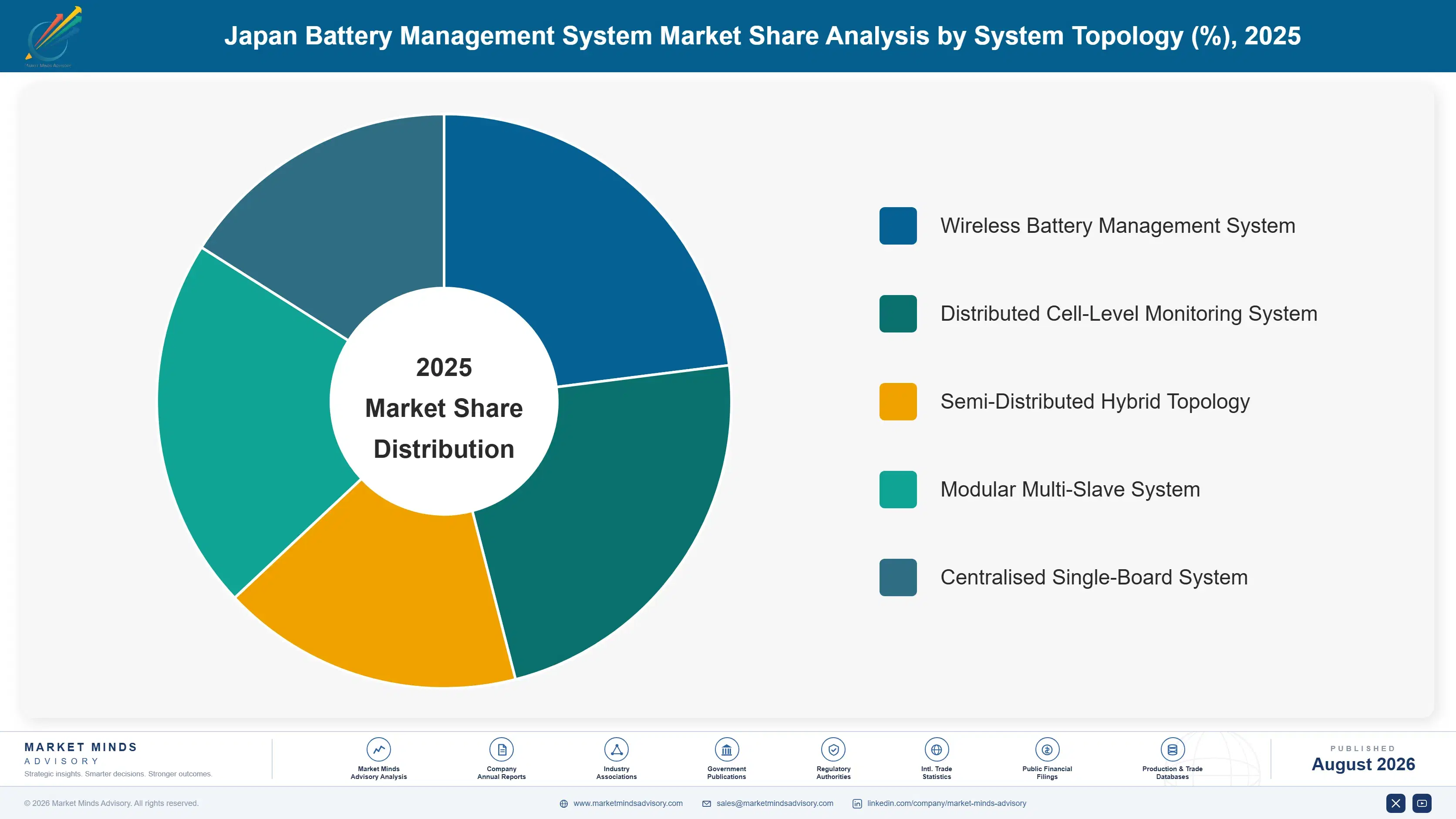
Segmentation follows system topology, because how the measurement electronics are distributed across a pack determines wiring content, assembly labour, failure modes, diagnostic capability, supplier skill requirements and realised price per system. Application, battery chemistry, customer type and sales channel all sit downstream of that one architectural decision, and every one of them is priced against it.
japan-battery-management-system-industry-market-share-analysis-1787315893267

Wireless Battery Management System

The fastest segment at 13.8%, a full 1.50 times the market rate, covering systems where cell monitoring boards communicate with the pack controller over short-range radio rather than through a physical sense harness. Assembly economics drive it rather than electronics performance. A sense harness accounts for roughly 11% of pack assembly labour, contributes a substantial share of the connector failures seen in warranty data, and occupies packaging volume that cell suppliers immediately want returned to them. Japanese automotive customers have adopted more slowly than Western ones on radio reliability grounds, and that caution is entirely characteristic. Qualification programmes are now running at all three major domestic manufacturers, which is what changes the trajectory here.
CAGR 13.8%

Distributed Cell-Level Monitoring System

Growing at 11.6% on architectures placing measurement electronics directly at each cell or cell group, with only a communication bus running back to the pack controller. Diagnostic depth is the argument. Cell-level electronics measure voltage and temperature far closer to the source, which improves accuracy, shortens fault isolation time and supports the state-of-health estimation that Japanese hybrid applications demand more than any other duty cycle in the world. Component count is the obvious drawback, since every cell group carries its own board and each board is another reliability item. Stationary storage has adopted this topology fastest, because system size at those installations makes centralised measurement wiring genuinely impractical at scale.
CAGR 11.6%
Full segment breakdown across 5 segments available in the complete report.

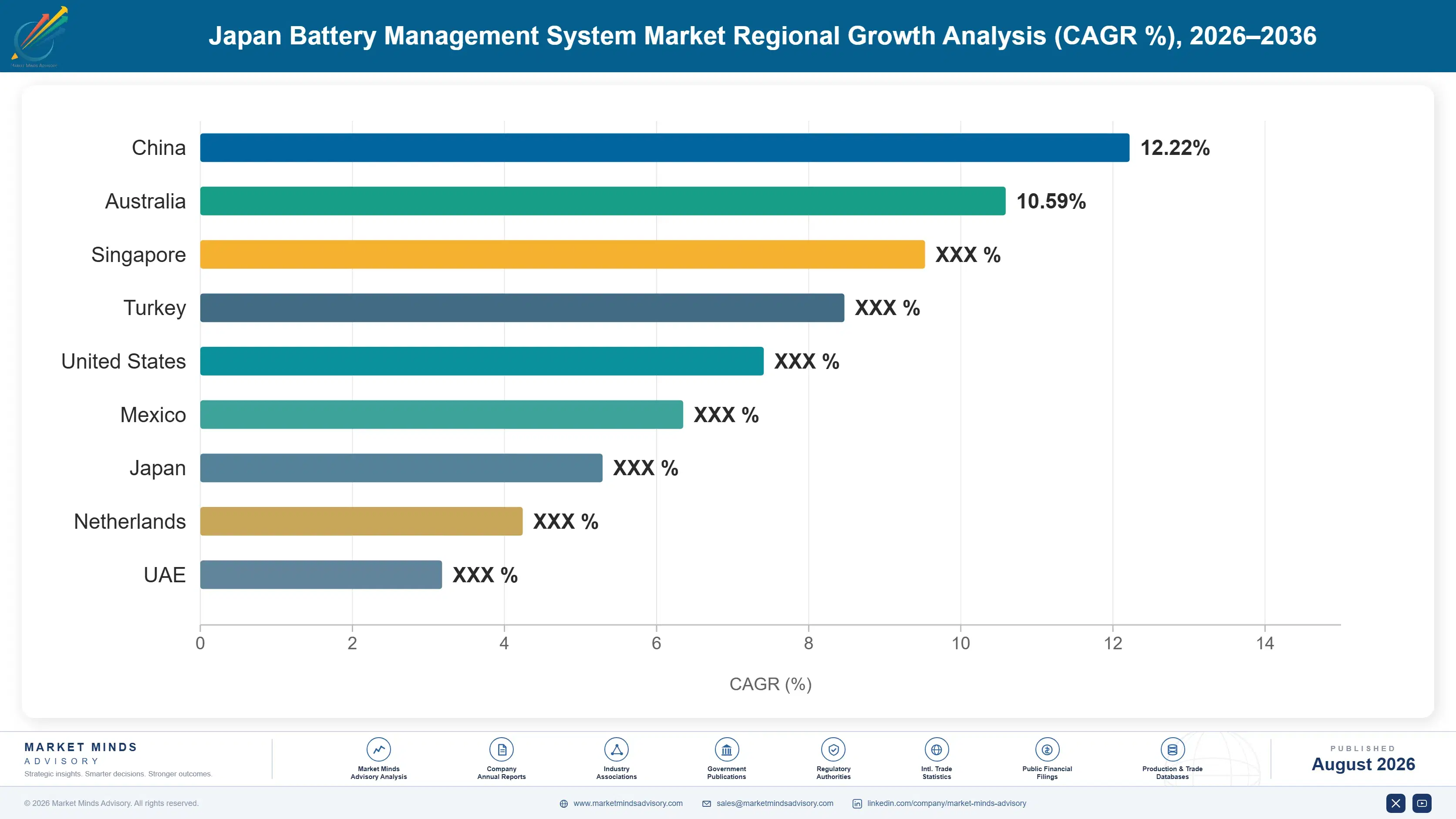
Regional Architecture and Country Demand Map

This report is scoped to Japan, so East Asia carries 88% of measured value and every other region represents supplier-origin content rather than demand. American and European semiconductor suppliers hold the largest external shares, and Southeast Asian contract assembly accounts for most of the remaining traced content.

East Asia

Note: this report is scoped to Japan, so East Asia carries 88% against a 22 to 30% band and the remaining regions represent supplier-origin content rather than demand. Domestic demand splits three ways. Automotive battery systems for Toyota, Honda, Nissan and Subaru hybrid and battery electric platforms take the largest share, and Japanese hybrid volume is the highest of any market on earth. Grid-scale and commercial storage forms the second stream, pulled by the Ministry of Economy, Trade and Industry capacity auctions. Industrial, rail, marine and backup power applications form the third, smaller but technically demanding and served almost entirely by domestic suppliers. All three streams grow through the forecast period.
Share: 88% | CAGR: 10.4% (2026 to 2036)

North America

Note: North America holds 4% against a 22 to 32% band because this report covers Japanese demand only, and this figure represents the American-origin content inside systems sold in Japan. Analog front-end integrated circuits from Texas Instruments and Analog Devices appear in a substantial share of Japanese battery management designs, particularly on cost-sensitive stationary storage products where domestic semiconductor pricing is uncompetitive. American software and cloud analytics platforms also feature in several utility-scale storage deployments. Design authority almost always stays in Japan; what crosses the Pacific is silicon and, increasingly, the state-of-health estimation algorithms running above it. That silicon dependency is what the policy debate is actually about. Both flows are growing.
Share: 4% | CAGR: 8.7% (2026 to 2036)
Regional intelligence for 5 additional markets available in the complete report: Western Europe, South Asia and Pacific, Latin America, Middle East and Africa, Eastern Europe. Contact sales@marketmindsadvisory.com.
japan-battery-management-system-industry-country-cagr-analysis-1787315893819

Where System Margin Is Actually Won

Four commercial positions separate the suppliers earning genuine system margins from those assembling monitoring boards at contract electronics rates: owning state estimation algorithms rather than licensing them, holding full functional safety certification capability internally, building stationary storage capability alongside automotive, and designing system architectures that tolerate semiconductor substitution whenever foreign device supply tightens again.

Own State Estimation Algorithms Rather Than Licensing Them

Two full decades of Japanese hybrid operation has produced state-of-charge and state-of-health estimation that genuinely outperforms any generic implementation available to buy, and manufacturers pay for that difference because estimation error shows up directly and expensively in warranty capacity claims. Suppliers owning their own algorithms hold 16 to 22 points more gross margin than those licensing third-party software and assembling hardware around it. The underlying asset is accumulated field data plus the engineers who genuinely understand it, and neither of those can be purchased or replicated on any useful timescale.
Market Impact: Holds 22 additional points of gross

Hold Functional Safety Certification Capability Internally

Automotive battery systems require ISO 26262 certification at ASIL C or D, and that work runs between 18 and 24 months, with redundant measurement architecture and diagnostic coverage evidence behind all of it. Suppliers holding that capability internally realise roughly 35% higher prices than uncertified industrial equivalents built to comparable accuracy, and they reach the market a full year earlier than competitors routing their certification work through external assessment houses. Storage customers are now imposing broadly comparable requirements, which widens the addressable scope for exactly the same investment quite considerably.
Market Impact: Realises 35% higher pricing across

Build Stationary Storage Capability Alongside Automotive Scope

Grid and commercial storage requires far fewer units at much larger system size, with longer design lives and communication protocols that automotive engineering does not transfer into cleanly at all. Suppliers holding both capabilities spread development cost across two demand streams that peak at different times, and storage margins run 8 to 14 points above automotive, because procurement there is less concentrated and considerably less ruthless. Ministry of Economy, Trade and Industry procurement has committed substantial capacity, so the demand here is contracted rather than merely forecast, which changes the investment case entirely.
Market Impact: Earns 14 points above automotive gr

Design Architectures Tolerating Semiconductor Device Substitution

Analog front ends and safety microcontrollers reach roughly 41% of system cost and arrive largely from foreign suppliers, as the 2021 semiconductor shortage demonstrated at very considerable expense across this industry. Architectures designed so comparable devices from two or three vendors can be substituted without requalifying the safety case cut allocation exposure sharply, and they give real negotiating room at annual renewal. The engineering cost involved is duplicated validation work at design stage, which is modest indeed against the alternative of stopping a whole production line for want of a single part.
Market Impact: Protects 41% of the exposed system

Who Controls the Margin Pool

Concentration sits at 54% for the top five measured on domestic system shipment volume, the basis used throughout this section. Denso and Hitachi Astemo lead on automotive systems through long-standing qualification relationships with Japanese vehicle manufacturers, while Renesas holds the strongest semiconductor and reference design position and Toshiba and Panasonic Energy compete across both automotive and storage. The gap to the next tier is wide in automotive and considerably narrower in st
Competitive activity runs on three fronts. Wireless topology qualification is the first, with all three major vehicle manufacturers now running programmes and suppliers positioning hard for them. Functional safety capability is the second, since ASIL C and D certification decides who can quote automotive work at all. The third is stationary storage, where the competitive field is thinner, procurement is contracted rather than forecast and margins run materially better than automotive.

Pressure arrives from two directions. Foreign semiconductor suppliers are moving up the stack, offering reference designs and estimation software alongside silicon, which threatens the algorithm value Japanese suppliers hold. Separately, Chinese storage integrators compete on delivered cost in commercial projects. Rankings will shift on who qualifies wireless topology first with the domestic vehicle manufacturers.
japan-battery-management-system-industry-company-positioning-matrix-1787315894353

Competitive Moat and Risk Dimensions

DENSO

Moat: Entrenched vehicle manufacturer qualification

Decades of joint development with Toyota and the wider domestic manufacturer base means battery system architecture gets defined collaboratively during platform development rather than tendered afterwards. That relationship carries programmes for their full eight year runs, and the accumulated hybrid field data behind the estimation algorithms is genuinely difficult for any competitor to replicate.
DENSO

Risk: Domestic production volume decline

Revenue concentrates on vehicles built in Japan, and domestic output has been drifting down for a decade as manufacturers build closer to end markets. Following those manufacturers overseas means competing against established local suppliers on their own cost base, which is a materially different contest from the one the business has been winning at home.
RENESAS ELECTRONICS

Moat: Semiconductor and reference design position

Supplying safety microcontrollers alongside complete reference designs puts the company inside system architecture decisions rather than downstream of them, and domestic policy support for semiconductor capability strengthens that position further. Customers building on a Renesas reference design rarely move away from it, because requalification of the safety case is expensive and slow.
RENESAS ELECTRONICS

Risk: Incomplete analog device coverage

The analog front-end portfolio does not match what Texas Instruments, Analog Devices and Infineon offer, so system designers pair Renesas microcontrollers with foreign measurement silicon. That leaves roughly half the semiconductor value in the system outside the company, and closing the gap requires analog development that takes years and considerable capital to complete.

Players Tracked

Prominent Players

Denso
Hitachi Astemo
Renesas Electronics
Toshiba
Panasonic Energy

Other Key Players

Nuvoton Technology Japan
ROHM
TDK
Murata Manufacturing
GS Yuasa
Mitsubishi Electric
Yokogawa Electric
Meidensha
Nichicon
Furukawa Electric
Kyocera
NGK Insulators
Sanyo Denki
Omron
Yazaki Corporation

Recent Developments

MARCH 2025

Wireless battery management qualification begins with domestic manufacturer

A leading domestic supplier entered formal qualification with a major Japanese vehicle manufacturer covering wireless cell monitoring hardware on a forthcoming battery electric vehicle platform, which directly addresses the radio reliability concerns that had kept domestic adoption behind Western practice for several years running now.
Signal: Wireless topology is finally clearing the
JULY 2025

Grid storage management contract awarded under capacity procurement

A domestic supplier won pack and string level management scope on a large grid storage installation awarded under national capacity procurement, a project type where system size makes centralised measurement wiring impractical and distributed topology is therefore effectively mandatory from the very outset of design.
Signal: Contracted storage procurement now gives s
NOVEMBER 2025

Domestic analog front-end development programme announced

A Japanese semiconductor manufacturer announced development of a dedicated cell measurement analog front-end device family aimed at reducing reliance on American and European devices, addressing a dependency that reached roughly 41% of system cost and which drew sustained government attention after the 2021 semiconductor shortage.
Signal: Semiconductor supply security has now beco

What Drives System Input Cost

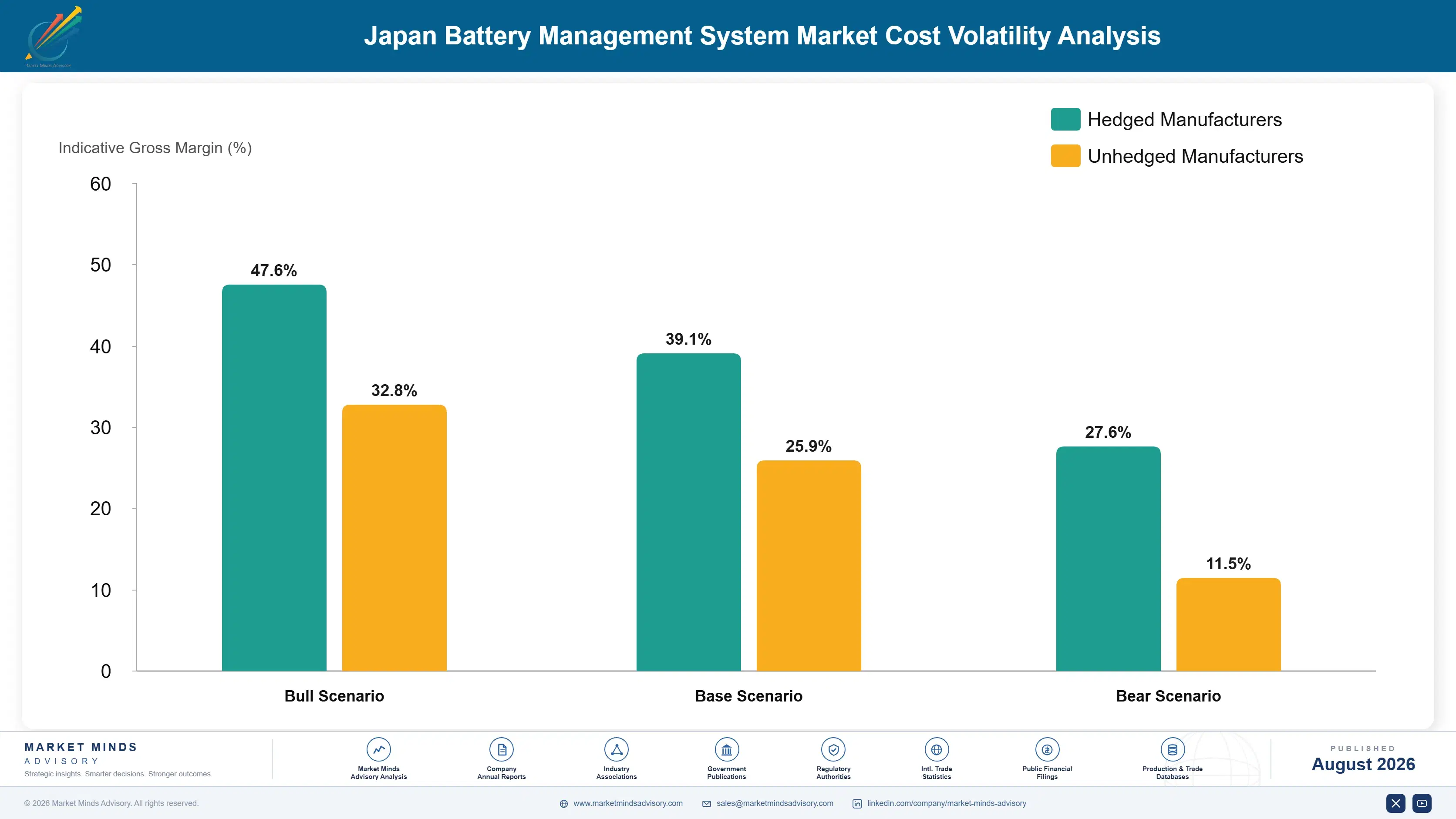
Semiconductors dominate. Analog front-end measurement devices and safety microcontrollers together account for roughly 41% of system cost, and most arrive from American and European suppliers rather than domestic ones. Passive components, isolation devices and board assembly add around 18%. Wiring harness and connector content contributes a further 14% on conventional topologies, though wireless architectures remove most of that, and validation plus certification labour accounts for roughly 12%.
The 2021 semiconductor shortage was the defining event and its lessons have not faded. Lead times on automotive-grade analog devices extended past fifty weeks and allocation decisions were taken outside Japan, halting lines with no substitute part qualified. Renesas Annual Report 2025 and Denso Annual Report 2025 both identify semiconductor availability as a continuing planning constraint, and domestic capability has since become an explicit government policy objective.

The disadvantage mechanism is qualification breadth rather than purchasing scale. A supplier whose architecture accepts devices from three vendors negotiates from a genuinely different position than one locked to a single part number, and during allocation that difference is production continuity rather than price. Exposure varies by application too: automotive safety requirements narrow the qualified device set considerably, while storage designers substitute far more freely.
japan-battery-management-system-industry-cost-volatility-analysis-1787315894549

Qualify comparable devices from multiple semiconductor vendors

Architectures designed so that analog front ends and microcontrollers from two or three vendors can be substituted without requalifying the safety case remove the single-point exposure that allocation creates. The cost is duplicated validation at design stage and a slightly more conservative architecture. Against a stopped production line, which is what 2021 actually delivered, that cost recovers within one incident.

Move measurement content toward domestic analog development

Domestic analog front-end programmes now underway will not displace foreign devices quickly, but early engagement gives system suppliers influence over specification and first access to qualified parts. Policy support reduces the development risk considerably. The commercial argument is supply security rather than cost, since domestic devices are unlikely to undercut established American and European pricing for several years yet.

Design wireless topology to remove harness cost exposure

Wireless architectures eliminate most of the 14% of system cost sitting in sense harness and connectors, which removes copper price exposure and a substantial warranty population at the same time. The offset is added radio and antenna content plus qualification effort that Japanese customers scrutinise closely. On packs where assembly labour is expensive the arithmetic already favours it clearly.

Portfolio Architecture for Margin Defence

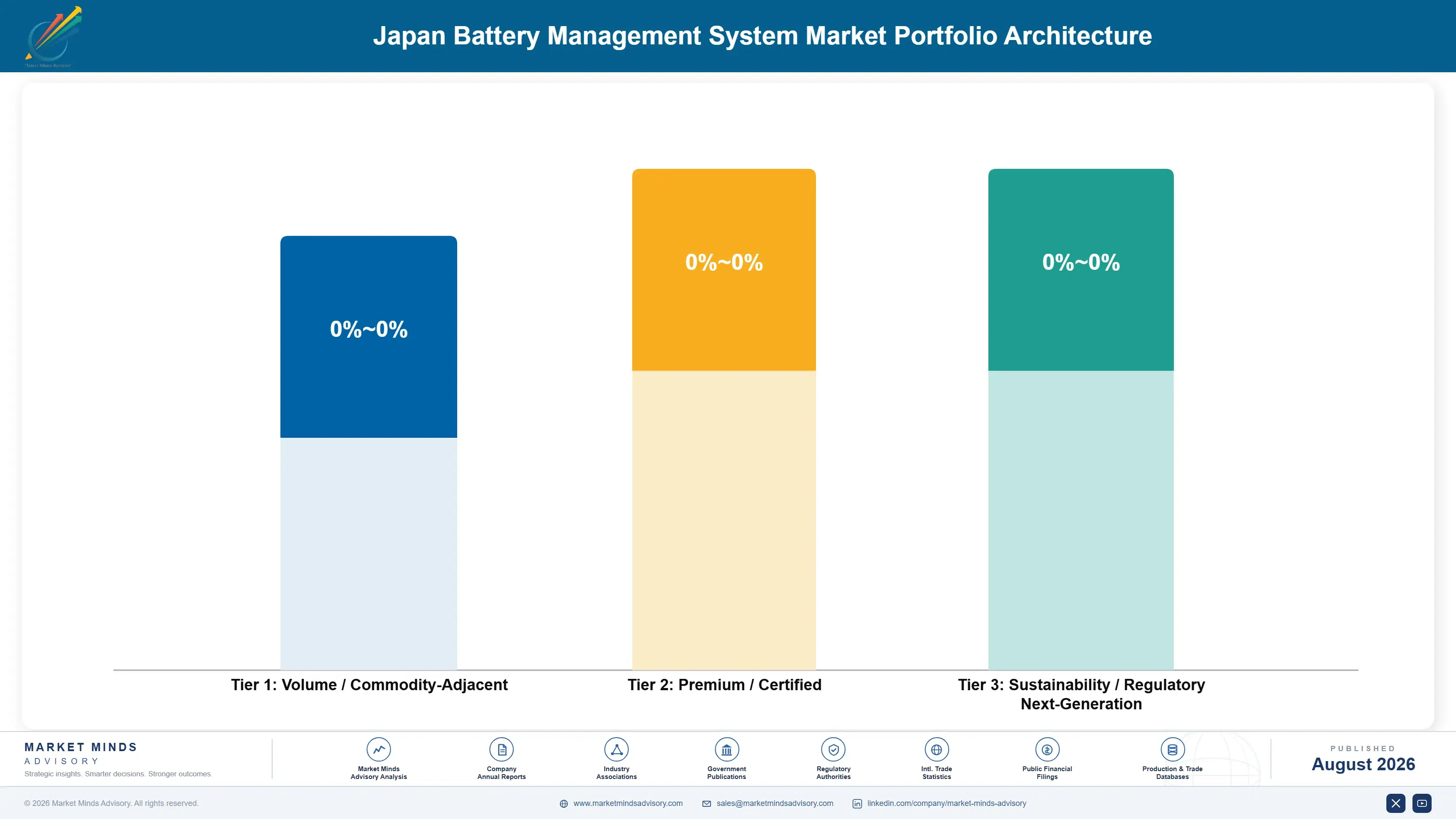
Portfolio economics here divide on software and certification content rather than on hardware sophistication. Monitoring board assembly built to a customer specification, where the customer supplies the estimation algorithms and owns the safety case, earns gross margins in the mid teens because the work is contract electronics manufacturing wearing a battery label and several suppliers can do it competently.
The premium tier is certified automotive systems with proprietary estimation. ISO 26262 certification at ASIL C or D plus algorithms built on two decades of hybrid field data command roughly 35% above uncertified equivalents, and manufacturers renew rather than retender because requalifying a safety case is expensive. Margins run in the low to mid thirties. Renewal odds are the real prize here.

Above both sits stationary storage system scope and wireless topology work. Storage procurement is contracted under national capacity auctions rather than forecast, the competitive field is thinner than automotive, and margins run 8 to 14 points higher for exactly those reasons. Wireless systems carry a further premium while qualification remains scarce, and both categories reach the high thirties to low forties with far less pricing pressure than automotive board supply.

Volume / Commodity-Adjacent

Monitoring board assembly built to customer specification, with the customer owning estimation algorithms and the safety case. Effectively contract electronics manufacturing, widely capable across several suppliers, which holds margin near the floor.
Gross Margin: 14 to 19%

Premium / Certified

Certified automotive systems carrying proprietary state estimation and internal functional safety capability. The range reflects how much algorithm content is genuinely owned rather than licensed, which varies considerably between suppliers.
Gross Margin: 29 to 36%

Sustainability / Regulatory / Next-Generation

Stationary storage system scope and qualified wireless topology work. The range is wide because storage project sizes vary enormously and wireless pricing reflects scarcity of qualification rather than any settled cost basis.
Gross Margin: 37 to 44%
japan-battery-management-system-industry-portfolio-architecture-1787315895072

High-value Sub-segments and Strategic Watch-out

Qualified Wireless Automotive Systems

High value and high growth sitting together. Harness removal cuts pack assembly labour and warranty exposure simultaneously, all three domestic vehicle manufacturers are now running qualification programmes on it, and pricing currently reflects genuine scarcity of qualified suppliers rather than any settled cost structure at all.
Gross Margin: 38 to 45%

Grid Storage Management System Scope

High value running on moderate growth. National capacity procurement makes this demand genuinely contracted rather than merely forecast, the competitive field bidding is considerably thinner than in automotive, and system sizes are large enough that pricing pressure works quite differently from anything automotive procurement applies.
Gross Margin: 36 to 43%

Certified Automotive Hybrid Systems

The volume core that keeps engineering teams loaded and field data accumulating. Hybrid volume shows no sign of falling, the estimation problem is the hardest in the industry, and the resulting algorithm asset is precisely what makes everything else in this portfolio defensible at all.
Gross Margin: 29 to 36%

Contract Monitoring Board Assembly

The strategic watch-out sitting in this portfolio. Volumes here are real enough and they keep assembly lines loaded, but the customer owns the algorithms and the safety case, which means the supplier holds nothing durable at all and ends up competing purely on delivered assembly cost.
Gross Margin: 14 to 19%

How System Demand Repeats

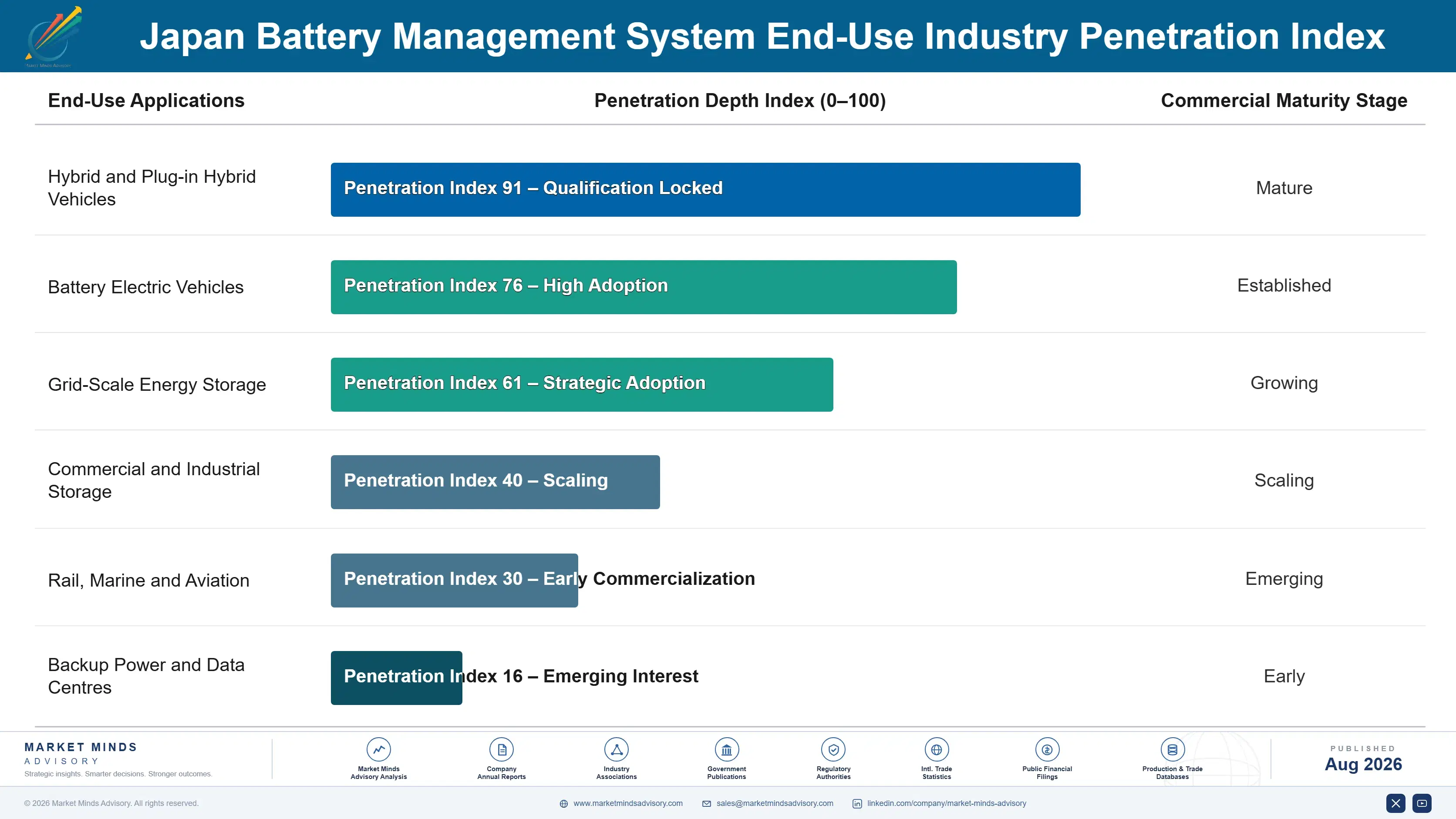
The repeat business is the battery platform rather than any individual order. A management system qualified onto a vehicle platform ships for roughly eight years of production, and the safety case behind it is expensive enough to requalify that manufacturers renew rather than retender at revision. Winning the original architecture decision therefore carries far more value than the development contract itself suggests, and losing one costs a decade.
Stickiness varies sharply by application. Automotive positions are the deepest, because functional safety certification and accumulated calibration data both raise the cost of switching well beyond any price difference a competitor might offer. Grid storage sits close behind, since project developers value reference installations and long warranty support above initial cost. Industrial and backup power customers switch more readily on price. Consumer and small-format applications are the least sticky by a considerable margin.

The buyer profile has shifted generationally. System specification once sat with pack engineers evaluating measurement accuracy and balancing current in isolation. Today it sits with platform teams weighing functional safety, over-the-air update capability, warranty modelling and data strategy together, which favours suppliers who arrive with software architects rather than only with hardware samples.
japan-battery-management-system-industry-end-use-penetration-index-1787315895562

Where To Compete And Why

These are among the four positions where our research anticipates prominent divergence between winners and laggards over the coming forecast period. Each is grounded in the demand model, the regulatory perimeter, and the announced capacity pipeline.
01 / ESTIMATION ALGORITHM OWNERSHIP

The algorithms are the only durable asset

Two decades of Japanese hybrid operation produced state estimation that outperforms generic implementations, and manufacturers pay for it because estimation error surfaces directly and expensively as warranty capacity claims. Suppliers owning their algorithms hold 16 to 22 points more gross margin than those licensing software and assembling hardware around it. The asset is accumulated field data and the engineers who understand it, and neither of those can be purchased or replicated on any timescale that matters to a competitor arriving now.
02 / FUNCTIONAL SAFETY CAPABILITY

Certification decides who can quote at all

Automotive systems require ISO 26262 certification at ASIL C or D, and the work takes between 18 and 24 months, with redundant architecture and diagnostic coverage evidence behind all of it. Suppliers holding that capability internally realise roughly 35% higher prices than uncertified equivalents and reach market a full year ahead of competitors routing certification externally. Storage customers now impose comparable requirements, which widens the addressable scope for exactly the same investment without requiring any additional development spending at all.
03 / STORAGE MARKET ENTRY

Contracted demand beats forecast demand

Grid and commercial storage requires fewer units at far larger system size, with communication protocols and design lives that automotive engineering does not transfer into cleanly. Suppliers holding both capabilities spread development cost across two demand streams that peak at different times, and storage margins run 8 to 14 points above automotive. National capacity procurement has already committed the volume, which makes this genuinely contracted demand rather than a forecast, and that changes the investment case entirely rather than marginally.
04 / SEMICONDUCTOR SUBSTITUTION DESIGN

Architect for the shortage you already had

Analog front ends and safety microcontrollers reach roughly 41% of system cost and arrive largely from foreign suppliers, and the 2021 shortage stopped production lines outright at companies that had qualified only one part. Architectures accepting comparable devices from two or three vendors without requalifying the safety case cut allocation exposure sharply, and they create real negotiating room at every annual renewal. The cost involved is duplicated validation at design stage, which a single avoided line stoppage recovers several times over.

Engagement Snapshot From the Field

A live engagement with an industry participant carrying material or product regulatory and market exposure ahead of a defining policy shift, showing how our research translates into a defensible multi-year portfolio strategy.
MARKET MINDS ADVISORY · CLIENT ENGAGEMENT SUMMARY
Japan Battery Management System Producer Strategic Portfolio Review and Transition Roadmap 2026·Investment Scenario on Japan Battery Management System Exposure Evaluation 2025-26
CLIENT PROFILE
A Japanese supplier of battery management hardware and embedded software, with annual revenue near $210 million (client-reported, unverified by MMA), roughly 81% of it from automotive systems supplied to two domestic vehicle manufacturers. The business held strong estimation algorithm capability built on hybrid field data but had no stationary storage presence, and its wireless topology work remained at prototype stage while competitors entered qualification.
STRATEGIC CHALLENGE
Domestic vehicle production was declining and both customers were shifting volume to overseas plants where local suppliers held the relationships. Management needed to decide whether to follow those manufacturers abroad with design support offices, accelerate wireless qualification to defend domestic position, or build stationary storage capability against national capacity procurement that carried entirely different technical requirements.
MMA APPROACH
MMA modelled battery platform demand across 19 domestic and overseas vehicle programmes through 2036, mapped national storage procurement schedules against system requirements by project size, and assessed the engineering and capital requirements for each option. Twenty-five expert interviews with pack engineers, storage developers and procurement leads tested where system specification decisions were genuinely being made.
KEY FINDINGS
  1. Overseas plants belonging to the client's own customers specified locally integrated systems in eleven of the fourteen cases studied, making the follow-abroad strategy considerably weaker than management had assumed it to be.
  2. Storage procurement already committed capacity sufficient to replace the client's projected automotive decline twice over, and the competitive field bidding for that scope was markedly thinner than automotive.
  3. Wireless qualification was already contested by two better-resourced competitors, and arriving third would have secured no volume on the platforms currently in qualification at all.
  4. The client's estimation algorithms transferred into storage applications with roughly 70% reuse, which made the capability gap far smaller than the technical differences initially suggested.
CLIENT PROFILE
A Japanese supplier of battery management hardware and embedded software, with annual revenue near $210 million (client-reported, unverified by MMA), roughly 81% of it from automotive systems supplied to two domestic vehicle manufacturers. The business held strong estimation algorithm capability built on hybrid field data but had no stationary storage presence, and its wireless topology work remained at prototype stage while competitors entered qualification.
STRATEGIC CHALLENGE
Domestic vehicle production was declining and both customers were shifting volume to overseas plants where local suppliers held the relationships. Management needed to decide whether to follow those manufacturers abroad with design support offices, accelerate wireless qualification to defend domestic position, or build stationary storage capability against national capacity procurement that carried entirely different technical requirements.
MMA APPROACH
MMA modelled battery platform demand across 19 domestic and overseas vehicle programmes through 2036, mapped national storage procurement schedules against system requirements by project size, and assessed the engineering and capital requirements for each option. Twenty-five expert interviews with pack engineers, storage developers and procurement leads tested where system specification decisions were genuinely being made.
KEY FINDINGS
  1. Overseas plants belonging to the client's own customers specified locally integrated systems in eleven of the fourteen cases studied, making the follow-abroad strategy considerably weaker than management had assumed it to be.
  2. Storage procurement already committed capacity sufficient to replace the client's projected automotive decline twice over, and the competitive field bidding for that scope was markedly thinner than automotive.
  3. Wireless qualification was already contested by two better-resourced competitors, and arriving third would have secured no volume on the platforms currently in qualification at all.
  4. The client's estimation algorithms transferred into storage applications with roughly 70% reuse, which made the capability gap far smaller than the technical differences initially suggested.
RECOMMENDED STRATEGY
Phase 1: Phase one: build stationary storage system capability using existing estimation algorithms, targeting the capacity procurement awards scheduled over the next two years. Phase 2: Phase two: continue wireless development toward the following platform generation rather than contesting qualification programmes already dominated by two better-resourced competitors. Phase 3: Phase three: support overseas customer plants with engineering rather than manufacturing, keeping design authority and algorithm ownership entirely in Japan.
OUTCOME
The client won storage management scope on three procurement awards within the first year and reported storage revenue of $26 million against a $17 million plan (client-reported, unverified by MMA). Blended gross margin improved by roughly seven points, and wireless development was rescheduled toward the next platform generation where the qualification field remains open.

Frequently Asked Questions

Foundational context covering the market sizes, CAGR, scope, country, region and competition that inform every finding below. This section is provided to cover basics and most often pre-purchase conversations, answered from the MMA Primary Research Dataset.

What is the current size of the Japan Battery Management System Market?

The Japanese battery management system market was valued at $1.10 billion in 2025, reaching an estimated $1.20 billion in 2026. That covers hardware and embedded software across automotive, stationary storage, industrial and backup power applications.

How large will the Japan Battery Management System Market be by 2036?

MMA forecasts the market reaching $2.89 billion by 2036, an increase of $1.69 billion over the 2026 base. That represents an expansion multiple of 2.41 times across the forecast period.

What is the CAGR for the Japan Battery Management System Market 2026 to 2036?

The base case compound annual growth rate is 9.2%, with a bull case of 10.4% and a bear case of 8.0%. Historical growth between 2020 and 2025 ran at 7.9% annually.

Which segment is growing fastest?

Wireless battery management systems grow at 13.8%, a full 1.50 times the market rate, on assembly labour and warranty savings from harness removal. Distributed cell-level monitoring systems follow at 11.6% annually.

Who are the major companies in the Japan Battery Management System Market?

Denso, Hitachi Astemo, Renesas Electronics, Toshiba and Panasonic Energy lead on domestic system shipment volume. Together they account for roughly 54% of systems shipped into the Japanese market.

Which country is growing fastest?

This report is scoped to Japan, so growth outside it reflects export destinations for Japanese-designed systems. India leads those at 11.4% annually on domestic vehicle and storage build-out.

Report Segmentation Architecture

The full report scope spans multiple orthogonal segmentation dimensions, with cross-tabulated demand data provided for each dimension pair. Coverage extends further to regional breakdowns, trend trajectories, and the competitive detail needed to support segment-level decision-making.

By System Topology

  • Wireless Battery Management System
  • Distributed Cell-Level Monitoring System
  • Semi-Distributed Hybrid Topology
  • Modular Multi-Slave System
  • Centralised Single-Board System

By End-Use Industry

  • Hybrid and Plug-in Hybrid Vehicles
  • Battery Electric Vehicles
  • Grid-Scale Energy Storage
  • Commercial and Industrial Storage
  • Rail, Marine and Aviation
  • Backup Power and Data Centres

By Commercial Dimension

  • Vehicle Manufacturer Direct Supply
  • Battery Pack Integrator Supply
  • Storage Project Developer Supply
  • Embedded Software and Algorithm Licensing
  • Contract Assembly and Build-to-Print Supply

By Region

  • North America
  • Western Europe
  • East Asia
  • South Asia and Pacific
  • Latin America
  • Middle East and Africa
  • Eastern Europe

Scope, Methodology, and Coverage

Every figure in this report is reproducible from documented input assumptions. The scope below maps the historical period, the forecast horizon, the segmentation dimensions, and the countries covered, alongside the underlying primary and qualitative methodology.
Historical Period
2020 to 2025
Forecast Period
2026 to 2036
Base Year
2025 (USD billions; MMA Primary Research Dataset, August 2026)
Market Definition
This report covers battery management systems sold into the Japanese market, spanning monitoring hardware, embedded control software, balancing electronics and safety functions for lithium-ion and comparable rechargeable packs across hybrid and battery electric vehicles, grid and commercial storage, rail, marine, industrial and backup power applications. Battery cells, modules and complete packs, power conversion equipment, charging infrastructure, and energy management software operating above pack level are excluded from the sizing.
Quantitative Units
USD billions at supplier realised value; system shipments in millions of units; average realised price in USD per system.
Segmentation Dimensions
By system topology; by end-use industry; by commercial dimension; by region of supplier origin.
Regions Covered
North America, Western Europe, East Asia, South Asia and Pacific, Latin America, Middle East and Africa, Eastern Europe
Countries Covered
Japan as the scoped demand market, with supplier-origin content traced to the United States, Germany, Switzerland, the Netherlands, South Korea, China, Taiwan, Malaysia, Thailand, India, Singapore, the Philippines, Chile, Peru, Poland, the Czech Republic, the United Kingdom, France, Italy and Israel.
Key Companies Profiled
Denso, Hitachi Astemo, Renesas Electronics, Toshiba, Panasonic Energy, Nuvoton Technology Japan, ROHM, TDK, Murata Manufacturing, GS Yuasa, Mitsubishi Electric, Yokogawa Electric, Nichicon, Yazaki Corporation and others.
Quantitative Methodology
Primary survey, n=3,800 respondents, Q4 2025, six countries; demand-side model with trade association cross-validation
Qualitative Methodology
47 expert interviews, Q4 2025; applied to validate demand model assumptions, identify emerging dynamics, and assess competitive positioning
Report Format
PDF and XLSX data workbook (Word format preview document)
Publisher
Market Minds Advisory
Report Code
MMA-2026-TEC-914
Published
August 2026
Contact
sales@marketmindsadvisory.com | www.marketmindsadvisory.com

Purchase the full Japan Battery Management System Market Report (2026 to 2036).

The full report sizes the Japanese battery management system market across five system topologies, six end-use industries and supplier-origin regions, with unit shipment and realised pricing detail behind every value estimate. It profiles twenty suppliers on algorithm ownership, functional safety capability and storage market position. Chapters cover domestic vehicle platform schedules, national storage capacity procurement and the semiconductor dependency question in detail. Wireless topology analysis tracks qualification progress at each domestic vehicle manufacturer. Cost analysis quantifies semiconductor exposure and substitution readiness across the supplier base.
System shipment and pricing detail by topology
Wireless qualification progress by vehicle manufacturer
Storage procurement award pipeline through 2036
Semiconductor dependency and substitution readiness scoring
Competitive position assessments across twenty domestic suppliers
Functional safety certification capability by supplier

Built For The People Who Decide

From boardroom strategy to bench-side execution, this report is read cover-to-cover by leaders shaping the next decade of their industry, turning demand scenarios, market dynamics and valuation benchmarks into decisions.
CXOs/ Presidents/ VPs/ Managers
M&A and Corporate Development
Strategy Teams and R&D Heads
Procurement and Product Directors
Regulatory and Compliance Leaders
Investor Relations and Equity Analysts