
Market Minds Advisory
Hydrogen Vehicle Market

Hydrogen Vehicle Market: Hydrogen Vehicles: Where Heavy Trucking Found The Use Case Passenger Cars Never Did

A commercial reading of hydrogen vehicles, where heavy-duty trucking finally found the use case battery electric vehicles cannot match, and refuelling infrastructure remains the industry's most genuine real constraint now.

Lead Analyst

David Horsley

Published

August 2026

Make Smarter Decisions with Customized Research Insights

Request a free sample report and evaluate market opportunities, growth trends, and competitive dynamics relevant to your business needs.

2025 MARKET VALUE$6.2BMarket Size 2025
2036 FORECAST VALUE$33.3BBase Case , 2026 to 2036
CAGR 2026 TO 203616.5 %Bull 17.7% / Bear 15.2%
INCREMENTAL OPPORTUNITY$26.0BNet 10- year value creation
EXPANSION MULTIPLE4.61x2036 value over 2026 base
Strategic Levers
M&A Pipeline
Regional Outlook
Country Rankings
Competitive Intelligence
Segmental Deep-dive
Call-Us : 91 93563 13602

Executive Snapshot and Market Trajectory.

Hydrogen vehicles spent a decade as a passenger car curiosity that never found its actual market anywhere. Heavy trucking changed that decisively, since payload and refuelling speed matter more there than anywhere batteries currently compete effectively across the entire transportation industry.
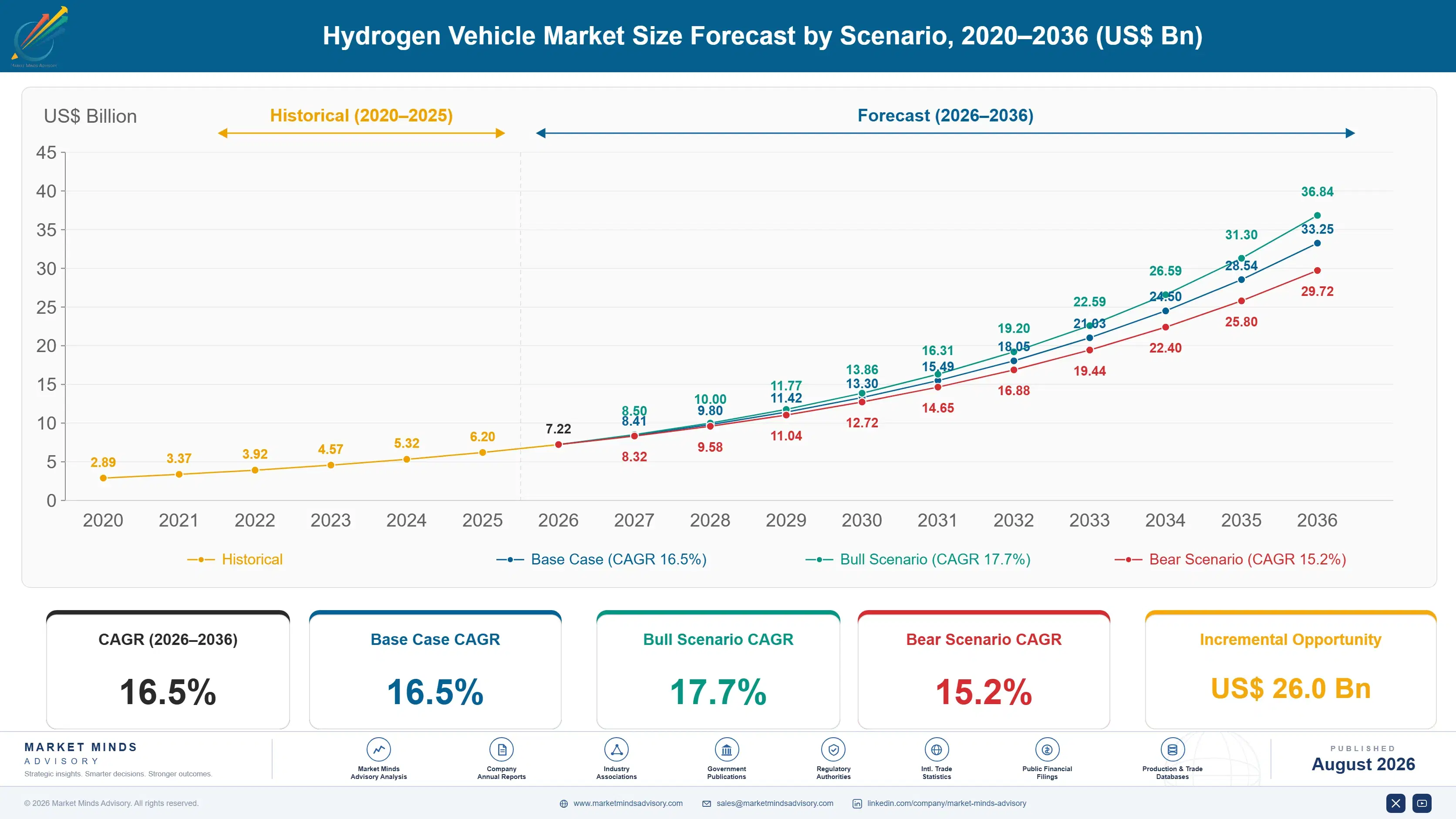
The market stands at USD 6.2 billion in 2025 and reaches USD 33.26 billion by 2036 at a 16.5% CAGR. Heavy-duty hydrogen fuel cell trucks grow fastest at 27.8%, roughly 1.68 times the overall rate, as commercial fleets value refuelling speed and payload capacity over battery electric alternatives across most freight categories today. East Asia holds 35% of value on dense government hydrogen infrastructure investment, while the Netherlands posts the quickest growth at 19.0%.
Concentration is high at roughly 44%, dominated by automotive majors and fuel cell system suppliers holding both vehicle platforms and powertrain manufacturing simultaneously across multiple vehicle categories worldwide today. Two forces dominate the period ahead. Heavy-duty trucking is proving the commercial case hydrogen passenger cars never established, and government hydrogen refuelling infrastructure investment is finally catching up with vehicle deployment ambitions after years of chicken-and-egg stagnation across most major markets.
Market Definition
The hydrogen vehicle market covers vehicles powered by hydrogen fuel cell or hydrogen internal combustion powertrains, valued at manufacturer selling prices. Battery electric vehicles and conventional internal combustion vehicles are excluded.
Base Year Value
$6.2B in 2025 (MMA Primary Research Dataset, August 2026)
Forecast Period
2026 to 2036, eleven discrete annual values
CAGR
16.5% base case. Bull 17.7%. Bear 15.2%.
Fastest Growth Segment
Heavy-Duty Hydrogen Fuel Cell Trucks: 27.8% CAGR
Fastest Growth Country
Netherlands: 19.0% CAGR
Fastest Growth Region
South Asia and Pacific: 18.4% CAGR
Largest Region
East Asia: 35% of 2025 global value
Market Leaders
Hyundai Motor Group, Toyota Motor Corporation, Cummins, Daimler Truck, Bosch. Source: MMA Analysis based on company annual reports.
Primary Survey
n=3,800 procurement and R&D decision-makers, Q4 2025, six countries
Methodology
Demand-side build-up, cross-validated against public data, 47 expert interviews

Hydrogen Vehicle Market Forecast Scenarios

hydrogen-vehicle-market-size-forecast-scenario-1787332883957
Growth from 2020 to 2025 compounded near 14.5%, and heavy-duty trucking pilots proved hydrogen's genuine commercial advantage over battery electric alternatives for long-haul freight, since fast refuelling and payload capacity mattered more to commercial fleet operators than passenger car buyers ever demonstrated. Government hydrogen infrastructure investment across East Asia and parts of Europe accelerated throughout the period, though refuelling station density remained the binding constraint limiting broader deployment.
Three mechanisms carry the base case to 16.5%. First, heavy-duty trucking adoption accelerating as commercial fleets recognise genuine total cost advantages over battery electric alternatives for long-haul routes. Second, government hydrogen refuelling infrastructure investment finally catching up with vehicle deployment ambitions after years of underbuilt station networks constraining adoption. Third, hydrogen production costs falling as electrolyser manufacturing scales, narrowing the cost gap against diesel and battery electric alternatives across most commercial categories.
The bull case at 17.7% assumes refuelling infrastructure expands faster and hydrogen production costs fall enough to reach cost parity with diesel sooner. The bear case at 15.2% assumes infrastructure buildout continues lagging vehicle deployment ambitions, battery electric trucks improve fast charging and range enough to narrow hydrogen's advantage, and government subsidy programmes prove less durable than current commitments suggest.

Why Refuelling Access, Not Vehicle Supply, Limits Adoption

Three forces set demand here. Fleet economics drive the most durable volume, as commercial trucking operators recognise genuine total cost advantages over battery electric alternatives for long-haul routes. Government infrastructure investment drives a second stream, since refuelling station buildout is finally catching up with vehicle ambitions. Regulatory pressure drives a third stream, as emissions targets push heavy-duty fleets toward zero-emission alternatives regulators increasingly mandat
MARKET CONCENTRATIONCR5: 44%Moderately concentrated across automotive majors and fuel cell system suppliers
REFUELLING TIME ADVANTAGE5 to 10 minutesRefuelling time for a hydrogen vehicle against battery charging
FLEET PILOT PENETRATIONAbout 12%Share of heavy-duty truck fleets now piloting hydrogen powertrains
FLEET-SCALE COST REDUCTIONUp to 22%Reduction in total cost of ownership achieved through fleet-scale deployment
STATION PERMITTING TIMELINE18 to 30 monthsTime to permit and commission a new hydrogen refuelling station
STACK COST SHAREAbout 35% of costShare of vehicle cost attributable to fuel cell stack manufacturing
The commercial character is defined by a widening gap between vehicle availability and refuelling infrastructure density. A fleet operator can order hydrogen trucks today, yet without a refuelling station within practical range of their delivery routes, the vehicles simply cannot operate commercially. That mismatch concentrates risk with regions where infrastructure investment lags vehicle ambitions, and rewards markets where government and industry coordinate station buildout ahead of deployment.
The decade turns on whether hydrogen production costs fall fast enough to reach genuine cost parity with diesel across the heavy-duty categories where hydrogen holds its strongest advantage. Production cost and refuelling density remain the primary constraints separating hydrogen from becoming the default zero-emission choice rather than a subsidised pilot programme. That shift matters more than any single launch, because it determines whether hydrogen trucking becomes commercially self-sustaining.
"Nobody doubts the fuel cell works anymore. What decides winners now is whether there's a station within range when the tank runs low, and that's a logistics problem, not a technology one."
Director, Clean Transportation and Hydrogen Mobility Practice · MMA Automotive /

Market Trends

Heavy-Duty Trucking Is Proving The Commercial Case

Heavy-duty trucking fleet operators are increasingly recognising that hydrogen fuel cell trucks solve a problem battery electric alternatives genuinely cannot at commercial scale, since payload capacity, refuelling time, and range remain critical for long-haul freight economics in ways passenger vehicle use cases never demonstrated as clearly. That commercial validation is converting hydrogen trucking from a subsidised pilot programme into a genuine total cost of ownership decision fleet operators evaluate on economic merit rather than environmental credentials alone. Manufacturers with proven heavy-duty fuel cell platforms are capturing fleet orders that battery electric truck makers increasingly cannot match on route flexibility.
Market Impact: Cuts refuelling time by 80%
Infrastructure Coordination Is Breaking The Deadlock

Government hydrogen refuelling infrastructure investment is finally catching up with vehicle deployment ambitions after years of chicken-and-egg stagnation, where fleet operators would not commit to hydrogen trucks without refuelling access and infrastructure investors would not build stations without confirmed vehicle demand justifying the capital commitment. That coordination breakthrough is converting hydrogen trucking from a niche pilot programme confined to a handful of demonstration corridors into a genuine commercial option across an expanding network of freight routes. Regions coordinating infrastructure and fleet deployment simultaneously are capturing hydrogen trucking adoption fastest among comparable markets.
Market Impact: Station coverage now spans 500 rout

Market Opportunities and Growth Drivers

Fleet Economics Are Making Hydrogen A Rational Choice

Heavy-duty trucking fleet operators are recognising genuine total cost of ownership advantages that hydrogen fuel cell trucks hold over battery electric alternatives for long-haul freight, since payload capacity and refuelling time in minutes rather than hours matter considerably more to commercial route economics than passenger vehicle buyers ever demonstrated. That economic validation creates durable demand regardless of underlying fuel price volatility, since fleet operators evaluating route economics increasingly favour hydrogen for routes where battery weight and charging downtime genuinely undermine payload and schedule reliability. Each new fleet operator adopting hydrogen based on economic merit strengthens the case industry-wide.
Market Impact: Only 500 refuelling stations exist

Infrastructure Coordination Is Resolving The Deadlock

Government hydrogen refuelling infrastructure investment is finally resolving the chicken-and-egg stagnation that previously left fleet operators unwilling to commit to hydrogen trucks without refuelling access and investors unwilling to build stations without confirmed vehicle demand justifying the considerable capital required upfront across most markets. That coordinated infrastructure investment creates demand independent of broader vehicle pricing cycles, since committed government infrastructure spending continues according to programme schedules regardless of short-term commercial vehicle market conditions. Each new refuelling corridor coming online adds directly to addressable fleet deployment demand along that specific freight route.
Market Impact: Green hydrogen costs 40% more

Market Restraints and Challenges

Refuelling Density Confines Deployment To Demonstration Corridors

Hydrogen refuelling station density remains genuinely limited to a handful of demonstration corridors in most markets, leaving fleet operators unable to deploy hydrogen trucks commercially outside those narrow routes regardless of the vehicle's underlying performance advantages. The root cause is that refuelling station construction requires substantial capital investment that private investors remain reluctant to commit without confirmed vehicle demand, while fleet operators remain reluctant to purchase vehicles without confirmed refuelling access along their routes. The commercial impact is that hydrogen trucking stays confined to a handful of demonstration corridors. Mitigation runs through coordinated government-industry infrastructure planning and phased corridor buildout.
Market Impact: Cuts refuelling time by 80%

Green Hydrogen Costs Undermine The Environmental Case

Green hydrogen production, generated using renewable electricity to power the electrolysis process, currently costs considerably more than grey hydrogen produced from natural gas, undermining the environmental case that justifies hydrogen trucking's premium cost over diesel. The root cause is that electrolyser manufacturing scale remains genuinely limited relative to demand, keeping green hydrogen production costs elevated compared to fossil-fuel-derived alternatives that defeat the purpose of zero-emission transportation. The commercial impact is that some hydrogen truck fleets currently run on hydrogen offering limited genuine emissions benefit. Mitigation runs through electrolyser scale-up, renewable electricity cost decline, and production tax credits.
Market Impact: Stations now cover 500 routes
3 additional market trends, 4 additional growth drivers, and 2 additional restraints and challenges are covered in the full report. Contact sales@marketmindsadvisory.com to access the complete intelligence.

Segment CAGR and Growth Architecture

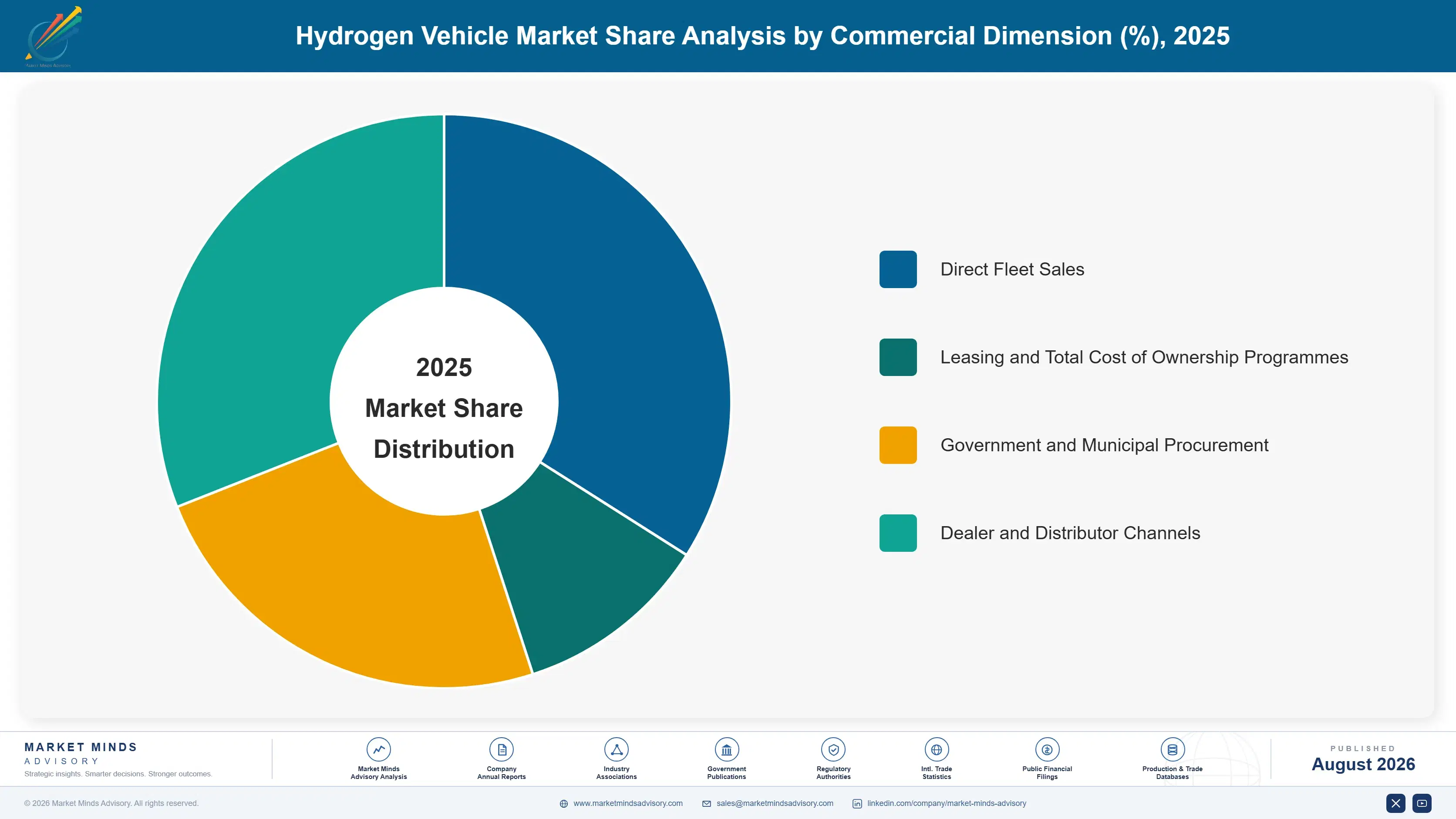
Segmentation follows vehicle category, a single functional logic describing what type of vehicle the hydrogen powertrain actually powers rather than which industry ultimately operates it. Each category carries its own cost structure, refuelling requirement, and total cost of ownership profile, so commercial position tracks the vehicle category rather than the end-use industry it happens to serve.
hydrogen-vehicle-market-market-share-analysis-1787332884536

Heavy-Duty Hydrogen Fuel Cell Trucks

Heavy-duty hydrogen fuel cell trucks grow fastest at 27.8%, about 1.68 times the overall 16.5% rate, as commercial fleet operators recognise genuine total cost of ownership advantages over battery electric alternatives for long-haul freight routes where payload and refuelling speed matter considerably across most freight categories today. Growth concentrates where government and industry coordinate refuelling infrastructure buildout ahead of fleet deployment, since a truck without refuelling access along its route simply cannot operate commercially regardless of underlying technical merit. Hyundai Motor Group and Cummins both hold well established positions in this fast-moving segment. Refuelling infrastructure density along major freight corridors remains the primary factor separating credible commercial deployment from demonstration-only pilot programmes.
CAGR 27.8%

Hydrogen Fuel Cell Buses

Hydrogen fuel cell buses grow at 20.4%, serving municipal and regional transit authorities that value hydrogen's fast refuelling and extended range for continuous daily operation schedules that battery electric buses often struggle to match without midday charging interruptions disrupting service and reliability. Adoption is concentrated in municipalities with existing government hydrogen infrastructure investment supporting broader transportation electrification and decarbonisation goals simultaneously across their entire transit network. Toyota Motor Corporation and Daimler Truck hold strong positions built on decades of heavy vehicle powertrain manufacturing experience across multiple transit categories and geographies. Total cost of ownership against battery electric alternatives remains the primary constraint on how broadly transit authorities adopt this format.
CAGR 20.4%
Full segment breakdown across 5 segments available in the complete report.

Regional Architecture and Country Demand Map

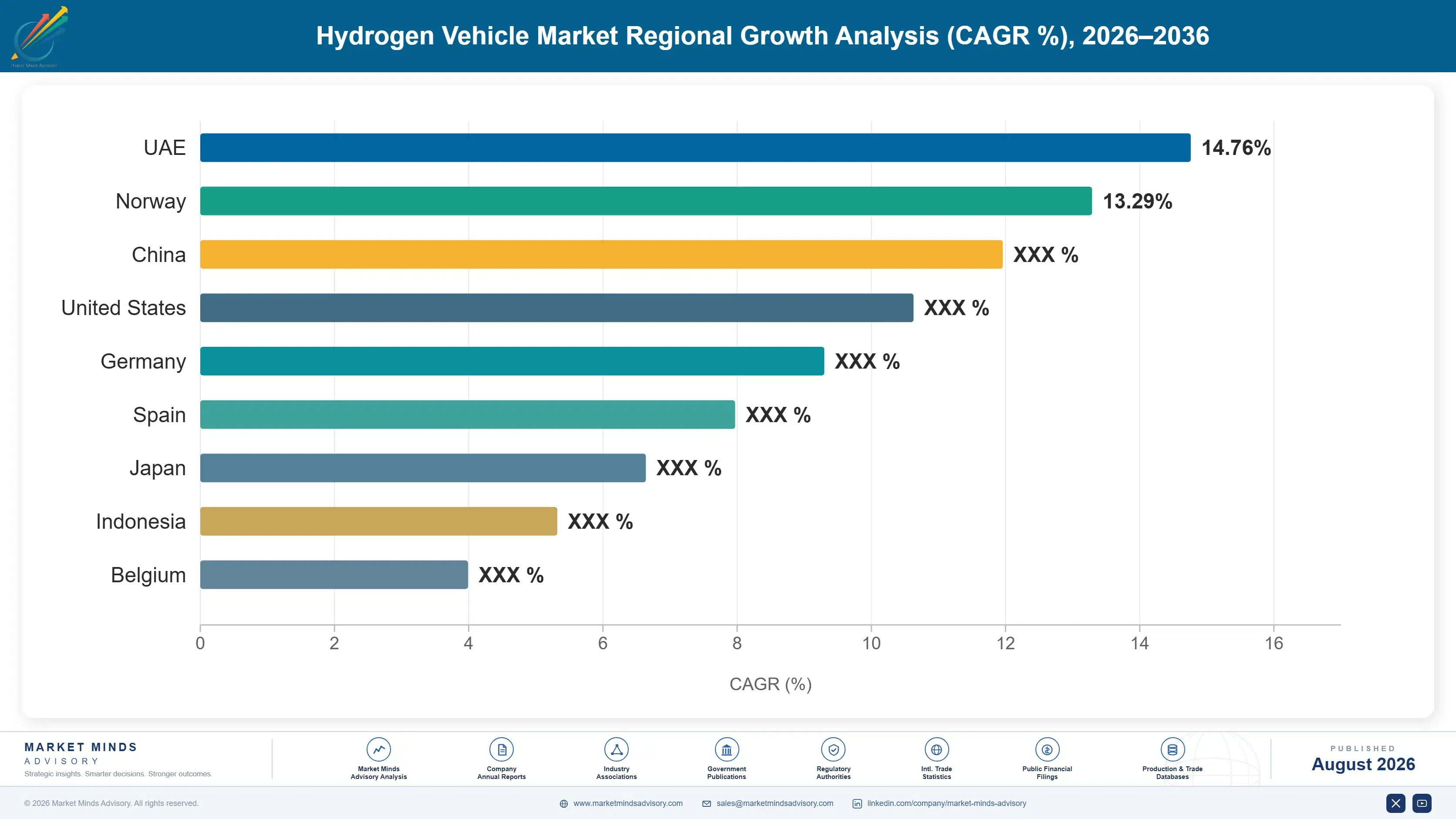
Government hydrogen infrastructure investment intensity, rather than population, sets this seven-region value distribution across the market. East Asia dominates on coordinated infrastructure buildout across China, Japan, and South Korea, North America follows on heavy-duty trucking pilot programmes, and the Netherlands grows fastest on port-linked hydrogen hub investment.

North America

North America holds 22% of value at 16.0% growth, on the strength of heavy-duty trucking pilot programmes that have expanded considerably as fleet operators recognise genuine total cost advantages over battery electric alternatives for long-haul routes. Hyundai Motor Group America and Cummins both maintain deep domestic commercial infrastructure spanning years of heavy-duty fuel cell truck relationships across major freight corridors. California leads domestic adoption, driven by both zero-emission vehicle mandates and concentrated refuelling infrastructure investment along key freight routes. Canadian demand follows comparable patterns at considerably smaller scale, concentrated in major logistics hubs specifically. Domestic fleet operators increasingly evaluate hydrogen trucks on economic merit rather than purely as an environmental compliance exercise.
Share: 22% | CAGR: 16.0% (2026 to 2036)

Western Europe

Western Europe holds 23% of value at 14.9% growth, the slowest of the seven regions, shaped by strong government hydrogen strategy commitments that have translated into meaningful but still developing refuelling infrastructure across major freight corridors nationwide and quite consistently now and steadily. Daimler Truck and Bosch both hold deep regional positions built on decades of heavy vehicle powertrain engineering and hydrogen fuel cell development expertise across the continent and beyond. German and Dutch producers lead regional deployment, driven by coordinated national hydrogen strategy investment and port-linked infrastructure planning. Growth reflects steady infrastructure expansion tempered by the considerable capital investment required to build genuinely dense refuelling networks across diverse national markets.
Share: 23% | CAGR: 14.9% (2026 to 2036)
Regional intelligence for 5 additional markets available in the complete report: East Asia, South Asia and Pacific, Latin America, Middle East and Africa, Eastern Europe. Contact sales@marketmindsadvisory.com.
hydrogen-vehicle-market-country-cagr-analysis-1787332885051

Where Hydrogen Vehicle Manufacturers Hold Margin

A manufacturer selling hydrogen vehicles into markets without coordinated refuelling infrastructure while a competitor holds proven fleet economics and infrastructure partnerships is competing on the wrong axis. The four moves below shift earnings toward what actually captures share: fleet economics positioning, infrastructure co-investment partnerships, green hydrogen supply securing, and total cost of ownership demonstration built early for skeptical fleet buyers.

Demonstrate Genuine Heavy-Duty Fleet Economics Advantages Early

Manufacturers that demonstrate genuine total cost of ownership advantages for heavy-duty trucking, rather than relying purely on environmental messaging that passenger vehicle buyers never found compelling enough, capture fleet orders that battery electric truck makers increasingly cannot match on route flexibility. That capability commands a premium of 15 to 30% in effective realized contract value over manufacturers relying on subsidy-dependent pricing, since fleet operators pay for proven economics as much as for the underlying vehicle technology itself. Hyundai Motor Group and Cummins built this economic case over years, and it is not quickly replicated by manufacturers entering the category late.
Market Impact: Commands a 15 to 30% economics prem

Co-Invest In Refuelling Infrastructure Ahead Of Rivals

Manufacturers who co-invest in refuelling infrastructure alongside vehicle deployment, rather than waiting for third parties to build stations independently, resolve the chicken-and-egg stagnation that has confined hydrogen trucking to a handful of demonstration corridors for years, cutting fleet adoption time by roughly 40%. That infrastructure partnership converts a market entirely dependent on external coordination into one the manufacturer can accelerate directly, since guaranteed refuelling access removes the single biggest objection fleet operators cite when declining hydrogen adoption. Daimler Truck and Toyota have both invested directly in refuelling infrastructure that increasingly differentiates their commercial offering.
Market Impact: Infrastructure co-investment cuts a

Secure Green Hydrogen Supply Ahead Of Demand

Green hydrogen supply agreements secured ahead of broader market demand let manufacturers offer fleet customers genuinely low-emission fuel rather than grey hydrogen, which currently costs 40% less but undermines the environmental case justifying hydrogen's premium cost over diesel, addressing a credibility gap that increasingly matters to sustainability-conscious logistics customers. That secured supply position reaches fleet operators who specifically require verified green hydrogen for their own customer sustainability commitments, opening contracts that manufacturers offering only conventional grey hydrogen sourcing cannot access. Manufacturers securing green hydrogen supply early are converting an emerging requirement into a durable competitive advantage.
Market Impact: Green hydrogen currently costs 40%

Build Independently Verified Total Cost Demonstration Early

Manufacturers who invest in rigorous, independently verified total cost of ownership demonstration, rather than relying on manufacturer-provided projections fleet operators increasingly distrust, win specification battles against competitors whose economic claims lack comparable third-party validation across real-world operating conditions, converting 3 times more sales prospects into signed customer contracts. That verified credibility becomes especially valuable as fleet operators face internal pressure to justify hydrogen adoption against increasingly credible battery electric alternatives on cost grounds alone. Manufacturers with strong independently verified track records increasingly dominate competitive shortlists for large fleet conversion contracts.
Market Impact: Verified fleets now convert 3x more

Who Controls the Margin Pool

Concentration is high at roughly 44% for the top five, dominated by automotive majors and fuel cell system suppliers holding both vehicle platforms and powertrain manufacturing simultaneously. The gap between leaders and challengers is fleet economics credibility and infrastructure partnership depth rather than raw vehicle count, broadly comparable across established players. All participants are assessed on one basis, revenue from hydrogen vehicles and fuel cell powertrains, excluding battery e
Competition runs along three lines. First, fleet economics credibility, since that increasingly determines which manufacturers win heavy-duty trucking contracts against battery electric alternatives. Second, infrastructure partnership depth, which shapes fleet relationships for years once a manufacturer resolves the refuelling access objection. Third, green hydrogen supply security, since sustainability-conscious logistics customers increasingly require verified low-emission fuel sourcing.

Pressure is building from two directions. Large diversified automotive groups are acquiring specialist fuel cell technology firms to build powertrain capability faster than organic development allows. Meanwhile smaller heavy-duty specialists are winning niche fleet contracts directly through deeper route-specific infrastructure partnerships than large incumbents typically invest in. Rankings should favour manufacturers combining fleet economics credibility with genuine infrastructure partnerships over those competing on vehicle platform breadth alone.
hydrogen-vehicle-market-company-positioning-matrix-1787332885582

Competitive Moat and Risk Dimensions

HYUNDAI MOTOR GROUP

Moat: Fleet economics credibility advantage

Hyundai Motor Group built genuine heavy-duty fleet economics credibility over years of commercial trucking pilot programmes demonstrating real-world total cost advantages. Its established treatment across major freight corridors provides fleet relationships smaller specialists cannot easily replicate. Continued investment in refuelling infrastructure partnerships positions it ahead of manufacturers relying purely on third-party station buildout.
HYUNDAI MOTOR GROUP

Risk: Infrastructure dependency limits reach

Its fleet deployment still depends considerably on refuelling infrastructure availability that remains genuinely limited outside a handful of demonstration corridors globally. Battery electric truck manufacturers entering with improving range and faster charging are targeting exactly the routes where hydrogen's infrastructure gap matters most. Expanding beyond current corridors requires infrastructure investment the business cannot fully control independently.
CUMMINS

Moat: Fuel cell system manufacturing scale

Cummins built deep fuel cell system manufacturing expertise through its Accelera division over years of heavy-duty powertrain engineering relationships spanning multiple vehicle platforms. Its established position across truck and bus manufacturers provides distribution reach smaller specialists cannot access. Continued investment in green hydrogen supply partnerships extends that expertise into the fastest-growing sustainability-driven segments.
CUMMINS

Risk: Exposure to fleet deployment timing

Its powertrain revenue remains meaningfully exposed to fleet deployment timing decisions, which move independently of underlying technology readiness and depend heavily on refuelling infrastructure buildout schedules outside its direct control. Diversification into infrastructure investment itself requires capital the business is still actively allocating across competing priorities. Vertically integrated competitors controlling both vehicles and infrastructure directly threaten its component-supplier position.

Players Tracked

Prominent Players

Hyundai Motor Group
Toyota Motor Corporation
Cummins
Daimler Truck
Bosch

Other Key Players

Honda
BMW
Nikola Corporation
Hyzon Motors
Plug Power
Ballard Power Systems
Ceres Power
Weichai Power
Foton Motor
Doosan Fuel Cell
Air Liquide
Linde
ITM Power
Hexagon Purus
Forvia

Recent Developments

JUNE 2023

Government hydrogen strategy programme funds refuelling corridor buildout

A major government hydrogen strategy programme announced substantial funding for coordinated refuelling infrastructure buildout along key freight corridors serving heavy-duty trucking fleets. This was regulatory and funding implementation rather than any corporate transaction, and it addressed the infrastructure gap that had constrained hydrogen trucking deployment beyond demonstration corridors.
Signal: Coordinated government infrastructure fund
JANUARY 2024

Automotive major acquires specialist fuel cell technology firm

A leading automotive major announced an acquisition of a specialist fuel cell technology firm, adding advanced powertrain capability directly into its existing heavy-duty vehicle platform. This was a genuine acquisition rather than a joint venture or minority stake, and it closed a fuel cell technology gap the manufacturer previously lacked.
Signal: Acquiring fuel cell technology directly re
APRIL 2025

Major logistics company completes fleet-wide hydrogen conversion

A major logistics company announced fleet-wide conversion of its long-haul trucking operations to hydrogen fuel cell vehicles following a successful multi-year pilot programme across several regions. This was a customer deployment decision rather than a corporate transaction, and it provided manufacturers a credible large-scale commercial reference case.
Signal: Fleet-wide conversion announcements from m

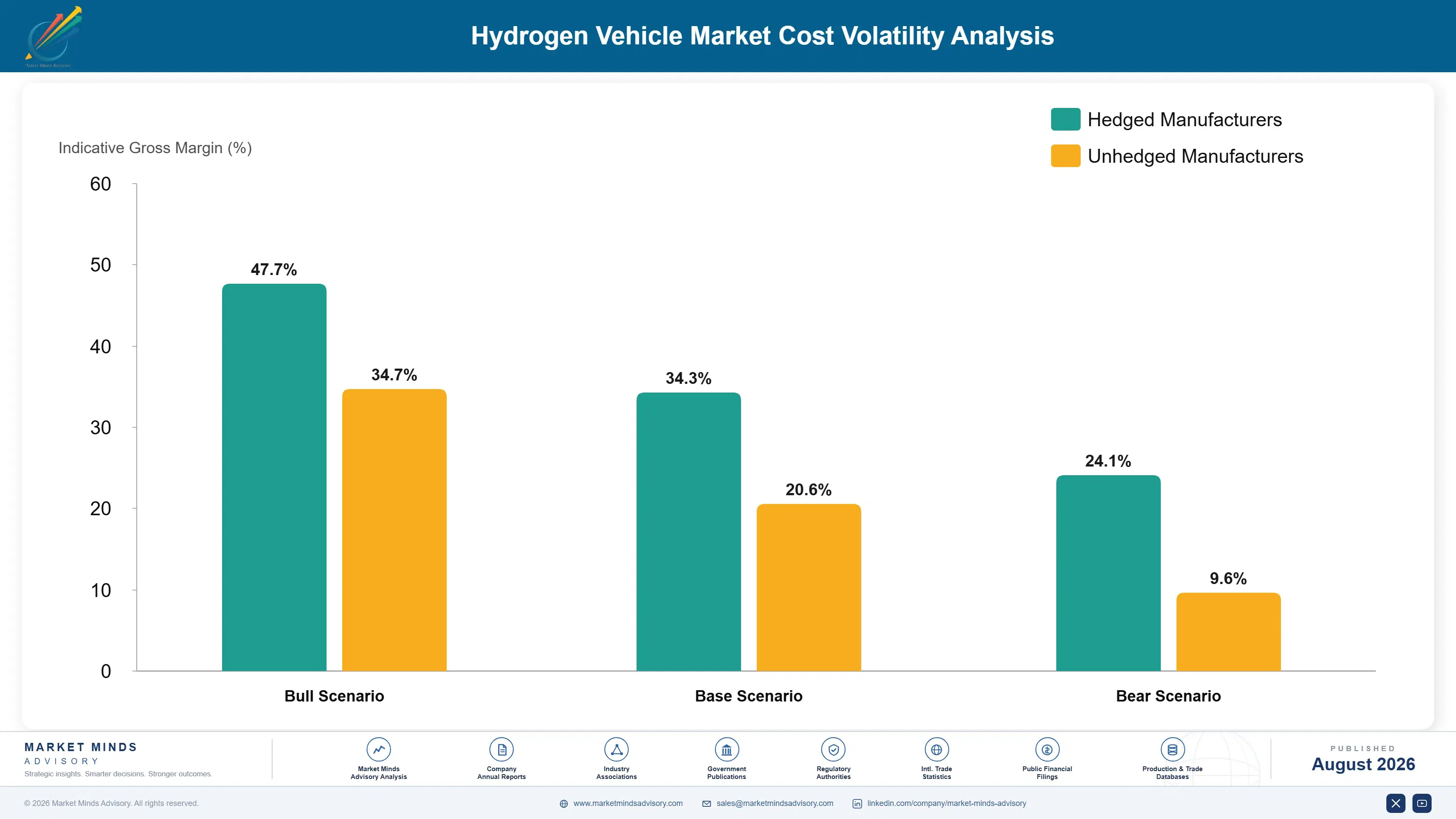
Platinum Group Metal And Fuel Cell Risk

Fuel cell stack materials and hydrogen storage systems dominate cost structure for hydrogen vehicles. Platinum catalyst material, specialty membrane components, and high-pressure hydrogen storage tanks together account for a substantial share of vehicle cost, sourced from specialty suppliers concentrated in a handful of countries. Vehicle chassis integration and assembly complete the cost structure for finished hydrogen vehicles.
Platinum group metal prices moved considerably through 2021 and 2022 as fuel cell manufacturing demand across the broader hydrogen industry outpaced available mining supply, lifting catalyst material costs meaningfully faster than the broader automotive market moved during the same period. Several manufacturers disclosed the resulting margin pressure across their annual reporting through that window, and industry supply data recorded extended lead times for platinum group metal procurement that persisted well beyond the initial disruption.

Exposure divides sharply by catalyst technology strategy rather than by manufacturer size specifically. Manufacturers with reduced-platinum catalyst technology or long-term supply agreements held cost considerably better than those relying on conventional high-platinum designs during the tightening cycle. The disadvantage compounds, because a manufacturer unable to deliver committed vehicle orders during a shortage loses fleet customer relationships that competitors, once established, retain for years afterward.
hydrogen-vehicle-market-cost-volatility-analysis-1787332885777

Invest in reduced-platinum catalyst technology

Fuel cell designs dependent on high platinum loading tie production cost directly to platinum group metal price volatility, which the recent shortage demonstrated quite expensively across the entire hydrogen vehicle industry. Investing in reduced-platinum or platinum-free catalyst technology reduces that exposure and improves cost stability during any future platinum group metal supply constraint or price spike considerably.

Secure long-term platinum supply agreements early

Spot buying platinum group metals exposes manufacturers to price spikes precisely when demand for fuel cell vehicles is also rising sharply across the industry simultaneously and quite unpredictably each cycle. Multi-year supply agreements with mining and refining partners, even at modest committed volume, provide pricing stability and delivery priority that spot buyers competing during a shortage cannot access.

Diversify catalyst material sourcing across multiple suppliers

Manufacturers entirely dependent on a single platinum group metal supplier cannot control allocation priority when a shortage hits, leaving no real alternative but to absorb delay and cost increases directly and pass them downstream to fleet customers. Diversifying catalyst material sourcing across multiple qualified suppliers preserves supply continuity and negotiating leverage that single-supplier competitors simply cannot access as effectively.

Portfolio Architecture for Margin Defence

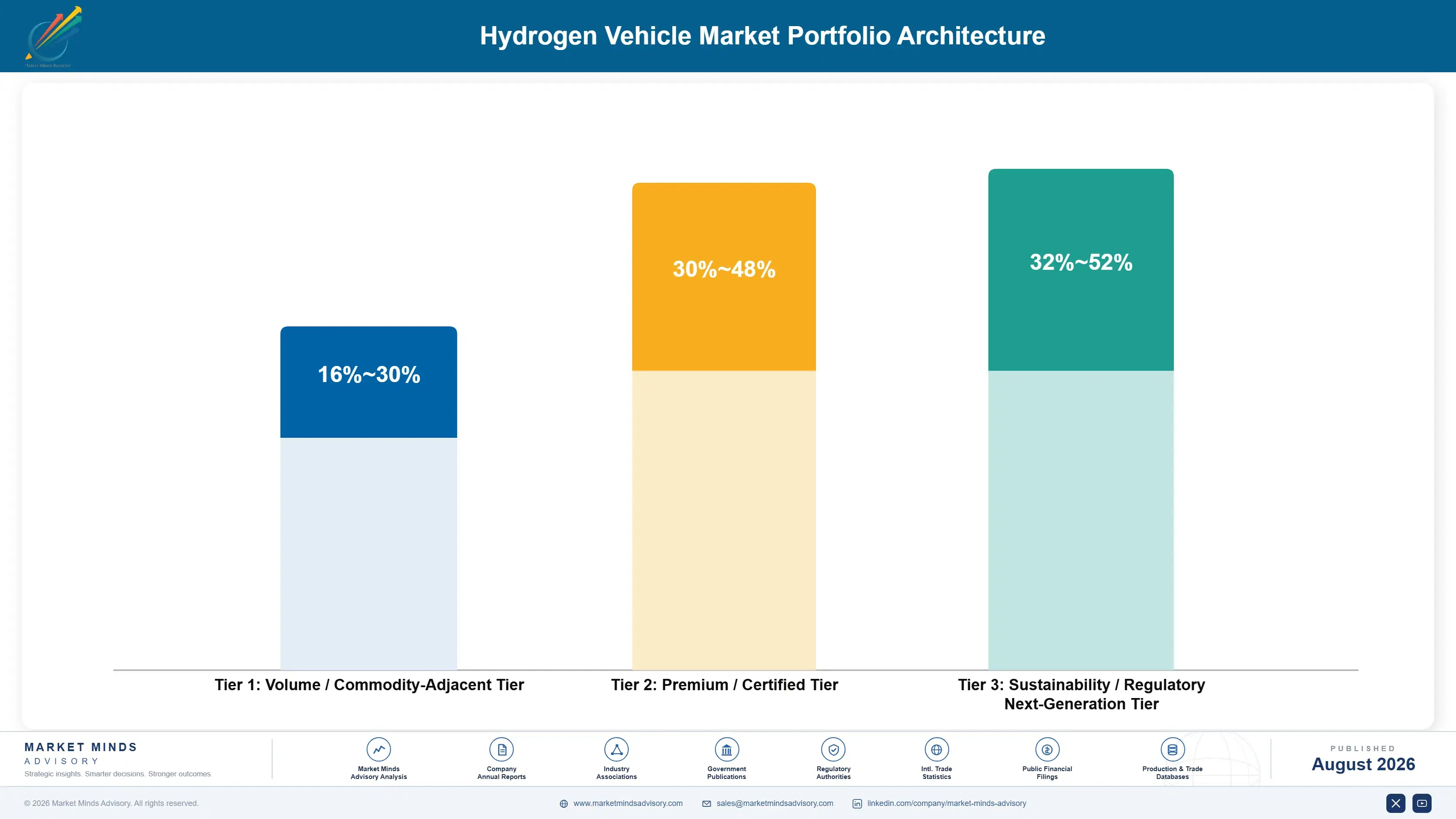
The portfolio splits into three tiers with genuinely different economics. Standard passenger and light commercial hydrogen vehicles form the volume tier, where manufacturing scale and platform sharing drive competition directly. Heavy-duty trucks and buses earn considerably more, because fleet economics credibility and infrastructure partnerships narrow the field. Next-generation green hydrogen platforms sit differently again, priced against the verified sustainability problem they solve rather
The tension runs between standard passenger vehicle volume that fills manufacturing capacity and premium heavy-duty work that earns the return. Passenger and light commercial vehicles generate the tonnage that keeps production lines loaded and maintains relationships through which higher-value fleet conversations happen. Yet this segment competes on cost against every qualified manufacturer serving the same demand. Manufacturers managing this well treat standard volume as capacity utilisation and direct investment toward heavy-duty depth.

High-value pools concentrate where fleet economics or infrastructure coordination genuinely limits competition: heavy-duty trucking solving the total cost of ownership problem, green hydrogen supply meeting sustainability-conscious fleet requirements, and infrastructure-partnered deployment resolving the refuelling constraint. All three resist the price competition defining standard passenger vehicles, because the customer is purchasing a solved fleet operations problem rather than comparing interchangeable vehicles across manufacturers.

Volume / Commodity-Adjacent Tier

Standard passenger and light commercial hydrogen vehicles sold into demonstration and early-adopter demand across most established automotive categories. The range is wide because manufacturing-efficient producers earn respectably while those competing purely on subsidy dependence frequently do not.
Gross Margin: 16-30%

Premium / Certified Tier

Heavy-duty trucks and buses carrying deep fleet economics credibility and established infrastructure partnerships in the most demanding long-haul freight categories. The range is wide because fleet economics depth and infrastructure coordination vary considerably by manufacturer.
Gross Margin: 30-48%

Sustainability / Regulatory / Next-Generation Tier

Next-generation green hydrogen vehicle platforms addressing the verified sustainability problem directly and durably across fleet customers requiring genuine emissions credentials. The range is wide because green hydrogen supply maturity still varies enormously by manufacturer currently.
Gross Margin: 32-52%
hydrogen-vehicle-market-portfolio-architecture-1787332886278

High-value Sub-segments and Strategic Watch-out

Heavy-Duty Hydrogen Fuel Cell Trucks

High value and the fastest growth at 27.8%, from a small base as commercial fleet operators recognise genuine total cost of ownership advantages over battery electric alternatives. Fleet economics credibility increasingly determines which manufacturers capture this volume, limiting near-term opportunity to those with proven infrastructure partnerships specifically.
Gross Margin: 34-52%

Hydrogen Fuel Cell Buses

High value with strong growth, protected by transit authority relationships and heavy vehicle powertrain expertise that create a durable barrier newer specialist entrants find genuinely difficult to replicate quickly. Government infrastructure investment compounds steadily as municipalities expand hydrogen refuelling networks supporting broader transit electrification goals.
Gross Margin: 30-48%

Hydrogen Fuel Cell Passenger Cars

The volume core across passenger and light commercial vehicles worldwide, and the category with the longest commercial history of the five segments listed here. Growth is steady but competition on cost is direct, holding margin below the heavy-duty truck and bus tiers positioned above it.
Gross Margin: 16-30%

Hydrogen Internal Combustion Engine Vehicles

The strategic watch-out, growing slowest as manufacturers increasingly favour dedicated fuel cell platforms over hydrogen internal combustion engine variants lacking comparable efficiency and emissions performance across most commercial categories today. Declining technology preference limits addressable volume exactly where growth elsewhere is fastest, threatening this segment's position.
Gross Margin: 18-32%

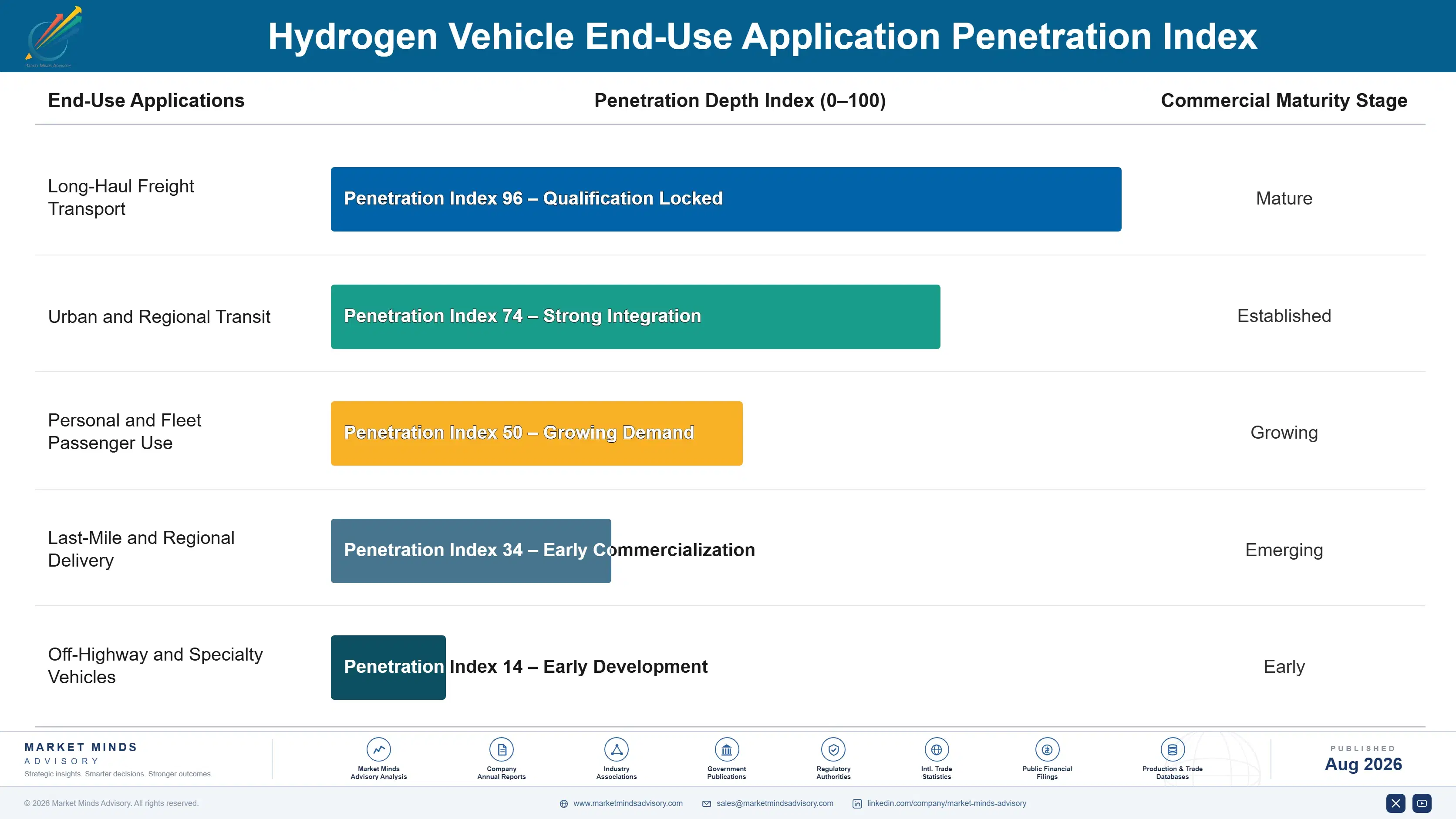
How Hydrogen Fleet Contracts Actually Commit

Revenue commits differently depending on which mechanism drives the purchase. Fleet conversion contracts lock in tightly once a logistics company commits to hydrogen adoption, since fleet operators reorder consistently across a multi-year vehicle replacement cycle once infrastructure access is confirmed. Government-subsidised passenger vehicle purchases stay genuinely reversible if subsidy programmes change. Infrastructure-linked demand persists on committed schedules regardless of near-term veh
Adoption depth varies sharply by fleet operator scale. Large logistics companies go deepest, standardising hydrogen trucks across their entire long-haul fleet once fleet economics and infrastructure access are confirmed. Mid-sized regional carriers adopt more selectively, often piloting hydrogen only on specific high-volume corridors before broader commitment. Smaller operators weigh infrastructure access most heavily, since limited route flexibility makes hydrogen adoption harder to justify.

Buyer profiles have shifted from procurement managers toward fleet sustainability officers and total cost of ownership analysts with distinct priorities. A procurement manager once compared vehicle price and reliability directly; a sustainability officer now tracks emissions reduction targets, and a cost analyst drives specification against verified total cost data a purely price-focused evaluation would never have prioritised. Manufacturers selling on price alone find decisions made by analysts who never reviewed their cost verification.
hydrogen-vehicle-market-end-use-penetration-index-1787332886766

Our Call On Hydrogen Vehicles

These are among the four positions where our research anticipates prominent divergence between winners and laggards over the coming forecast period. Each is grounded in the demand model, the regulatory perimeter, and the announced capacity pipeline.
01 / FLEET ECONOMICS STRATEGY

Demonstrate genuine heavy-duty total cost advantages

Manufacturers that demonstrate genuine total cost of ownership advantages for heavy-duty trucking, rather than relying purely on environmental messaging that passenger vehicle buyers never found compelling enough, capture fleet orders that battery electric truck makers increasingly cannot match on route flexibility. That capability commands a premium of 15 to 30% in effective realized contract value over manufacturers relying on subsidy-dependent pricing, since fleet operators pay for proven economics as much as for the underlying vehicle technology itself. Manufacturers should prioritise this now, because it is not quickly replicated.
02 / INFRASTRUCTURE CO-INVESTMENT STRATEGY

Co-invest in refuelling infrastructure ahead of rivals

Manufacturers who co-invest in refuelling infrastructure alongside vehicle deployment, rather than waiting for third parties to build stations independently, resolve the chicken-and-egg stagnation that has confined hydrogen trucking to a handful of demonstration corridors for years, cutting fleet adoption time by roughly 40%. That infrastructure partnership converts a market entirely dependent on external coordination into one the manufacturer can accelerate directly, since guaranteed refuelling access removes the single biggest objection fleet operators cite. Manufacturers should invest here now, before rivals close the gap.
03 / GREEN HYDROGEN SUPPLY STRATEGY

Secure green hydrogen supply ahead of sustainability demands

Green hydrogen supply agreements secured ahead of broader market demand let manufacturers offer fleet customers genuinely low-emission fuel rather than grey hydrogen, which currently costs 40% less but undermines the environmental case justifying hydrogen's premium cost over diesel, addressing a credibility gap that increasingly matters to sustainability-conscious logistics customers across most major markets. That secured supply position reaches fleet operators who specifically require verified green hydrogen for their own customer sustainability commitments. Manufacturers should secure supply now, before demand outpaces available production capacity.
04 / VERIFIED COST DEMONSTRATION

Build independently verified cost data before rivals do

Manufacturers who invest in rigorous, independently verified total cost of ownership demonstration, rather than relying on manufacturer-provided projections fleet operators increasingly distrust, win specification battles against competitors whose economic claims lack comparable third-party validation across real-world operating conditions, converting 3 times more sales prospects into signed customer contracts. That verified credibility becomes especially valuable as fleet operators face internal pressure to justify hydrogen adoption against increasingly credible battery electric alternatives. Manufacturers should build this evidence base now, before rivals establish it first.

Engagement Snapshot From the Field

A live engagement with an industry participant carrying material or product regulatory and market exposure ahead of a defining policy shift, showing how our research translates into a defensible multi-year portfolio strategy.
MARKET MINDS ADVISORY · CLIENT ENGAGEMENT SUMMARY
Hydrogen Vehicle Producer Strategic Portfolio Review and Transition Roadmap 2026·Investment Scenario on Hydrogen Vehicle Exposure Evaluation 2025-26
CLIENT PROFILE
A regional logistics company engaged MMA while evaluating conversion of its long-haul trucking fleet from diesel to hydrogen fuel cell vehicles following mounting pressure from major retail customers demanding lower-emission freight transportation. The client reported annual fleet fuel spend near USD 35 million and faced a board mandate to demonstrate a credible economic case before committing capital (client-reported, unverified by MMA).
STRATEGIC CHALLENGE
Converting to hydrogen would satisfy customer sustainability requirements, but the client's routes crossed regions with genuinely inconsistent refuelling infrastructure, creating real operational risk if vehicles could not refuel reliably along key corridors. The board wanted cost certainty across the conversion, but manufacturer economics claims and infrastructure reliability both varied considerably by route.
MMA APPROACH
MMA evaluated four candidate hydrogen truck manufacturers against demonstrated fleet economics on comparable routes, infrastructure partnership depth along the client's specific corridors, and independently verified total cost of ownership data. We modelled route-by-route infrastructure risk rather than accepting manufacturer projections alone. We then assessed each manufacturer's track record with comparable regional logistics fleets.
KEY FINDINGS
  1. Only two of the four candidate manufacturers had infrastructure partnerships covering the client's primary freight corridors with genuinely quite adequate refuelling density.
  2. The recommended manufacturer's verified total cost of ownership data showed a 22% advantage over diesel within three years of fleet conversion (client-reported, unverified by MMA).
  3. Infrastructure reliability varied considerably by corridor, with one specific route requiring a fully phased conversion timeline to align with planned station construction.
  4. Converting the entire fleet immediately, without phasing by corridor infrastructure readiness, would have risked serious operational disruption on the client's least-served delivery routes.
CLIENT PROFILE
A regional logistics company engaged MMA while evaluating conversion of its long-haul trucking fleet from diesel to hydrogen fuel cell vehicles following mounting pressure from major retail customers demanding lower-emission freight transportation. The client reported annual fleet fuel spend near USD 35 million and faced a board mandate to demonstrate a credible economic case before committing capital (client-reported, unverified by MMA).
STRATEGIC CHALLENGE
Converting to hydrogen would satisfy customer sustainability requirements, but the client's routes crossed regions with genuinely inconsistent refuelling infrastructure, creating real operational risk if vehicles could not refuel reliably along key corridors. The board wanted cost certainty across the conversion, but manufacturer economics claims and infrastructure reliability both varied considerably by route.
MMA APPROACH
MMA evaluated four candidate hydrogen truck manufacturers against demonstrated fleet economics on comparable routes, infrastructure partnership depth along the client's specific corridors, and independently verified total cost of ownership data. We modelled route-by-route infrastructure risk rather than accepting manufacturer projections alone. We then assessed each manufacturer's track record with comparable regional logistics fleets.
KEY FINDINGS
  1. Only two of the four candidate manufacturers had infrastructure partnerships covering the client's primary freight corridors with genuinely quite adequate refuelling density.
  2. The recommended manufacturer's verified total cost of ownership data showed a 22% advantage over diesel within three years of fleet conversion (client-reported, unverified by MMA).
  3. Infrastructure reliability varied considerably by corridor, with one specific route requiring a fully phased conversion timeline to align with planned station construction.
  4. Converting the entire fleet immediately, without phasing by corridor infrastructure readiness, would have risked serious operational disruption on the client's least-served delivery routes.
RECOMMENDED STRATEGY
Phase 1: Phase 1 (0 to 6 months): Convert the fleet segment operating on the client's best-served corridor with existing refuelling infrastructure. Phase 2: Phase 2 (6 to 18 months): Extend conversion to the remaining corridors as planned refuelling stations complete construction on schedule. Phase 3: Phase 3 (18 to 30 months): Complete full fleet conversion and validate total cost of ownership against the original economic model.
OUTCOME
The client completed fleet conversion within the thirty-month timeline, achieving the projected total cost advantage while avoiding operational disruption through phased corridor-by-corridor rollout. Customer sustainability requirements are now fully satisfied, and the phased infrastructure-aligned approach is the client's standard framework for future fleet decisions (client-reported, unverified by MMA).

Frequently Asked Questions

Foundational context covering the market sizes, CAGR, scope, country, region and competition that inform every finding below. This section is provided to cover basics and most often pre-purchase conversations, answered from the MMA Primary Research Dataset.

What is the current size of the Hydrogen Vehicle Market?

The global hydrogen vehicle market is valued at USD 6.2 billion in 2025, covering heavy-duty trucks, buses, passenger cars, and hydrogen internal combustion vehicles. Battery electric and conventional diesel vehicles are excluded from scope.

How large will the Hydrogen Vehicle Market be by 2036?

The market is forecast to reach USD 33.26 billion by 2036 in the base case, about 4.61 times the 2026 level. That represents incremental value of roughly USD 26.04 billion across the forecast decade.

What is the CAGR for the Hydrogen Vehicle Market 2026 to 2036?

The market grows at a 16.5% CAGR in the base case, with bull and bear scenarios at 17.7% and 15.2%. The spread turns mainly on refuelling infrastructure buildout pace and green hydrogen cost decline.

Which segment is growing fastest?

Heavy-duty hydrogen fuel cell trucks grow fastest at 27.8%, about 1.68 times the overall rate, as commercial fleets value refuelling speed and payload over battery electric alternatives. Fuel cell buses follow at 20.4%.

Who are the major companies in the Hydrogen Vehicle Market?

Leading suppliers include Hyundai Motor Group, Toyota Motor Corporation, Cummins, Daimler Truck, and Bosch, holding roughly 44% between them. Manufacturers combining fleet economics with infrastructure partnerships are increasingly capturing premium growth.

Which country is growing fastest?

The Netherlands grows fastest at a 19.0% CAGR, building on port-linked hydrogen hub investment and coordinated national refuelling infrastructure planning. Germany follows closely on comparable hydrogen strategy commitment.

Report Segmentation Architecture

The full report scope spans multiple orthogonal segmentation dimensions, with cross-tabulated demand data provided for each dimension pair. Coverage extends further to regional breakdowns, trend trajectories, and the competitive detail needed to support segment-level decision-making.

By Vehicle Category

  • Heavy-Duty Hydrogen Fuel Cell Trucks
  • Hydrogen Fuel Cell Buses
  • Hydrogen Fuel Cell Passenger Cars
  • Hydrogen Internal Combustion Engine Vehicles
  • Hydrogen Fuel Cell Light Commercial Vehicles

By End-Use Application

  • Long-Haul Freight Transport
  • Urban and Regional Transit
  • Personal and Fleet Passenger Use
  • Last-Mile and Regional Delivery
  • Off-Highway and Specialty Vehicles

By Commercial Dimension

  • Direct Fleet Sales
  • Leasing and Total Cost of Ownership Programmes
  • Government and Municipal Procurement
  • Dealer and Distributor Channels

By Region

  • North America
  • Western Europe
  • East Asia
  • South Asia and Pacific
  • Latin America
  • Middle East and Africa
  • Eastern Europe

Scope, Methodology, and Coverage

Every figure in this report is reproducible from documented input assumptions. The scope below maps the historical period, the forecast horizon, the segmentation dimensions, and the countries covered, alongside the underlying primary and qualitative methodology.
Historical Period
2020 to 2025
Forecast Period
2026 to 2036
Base Year
2025 (USD billions; MMA Primary Research Dataset, August 2026)
Market Definition
The hydrogen vehicle market comprises vehicles powered by hydrogen fuel cell or hydrogen internal combustion powertrains, valued at manufacturer selling prices. It spans heavy-duty hydrogen fuel cell trucks, hydrogen fuel cell buses, hydrogen fuel cell passenger cars, hydrogen internal combustion engine vehicles, and hydrogen fuel cell light commercial vehicles used across passenger, transit, and commercial freight applications. Battery electric vehicles, conventional internal combustion vehicles, and hydrogen refuelling infrastructure sold separately from vehicles are excluded from this scope entirely.
Quantitative Units
USD billions (current prices); vehicle unit shipments by category where applicable
Segmentation Dimensions
By Vehicle Category; By End-Use Application; By Commercial Dimension; By Region
Regions Covered
North America, Western Europe, East Asia, South Asia and Pacific, Latin America, Middle East and Africa, Eastern Europe
Countries Covered
USA, Canada, Germany, France, UK, Netherlands, Switzerland, Norway, China, Japan, South Korea, India, Australia, Singapore, Thailand, Brazil, Mexico, Chile, Argentina, UAE, Saudi Arabia, South Africa, Poland, Czechia, Hungary, Romania, and additional markets relevant to this sector
Key Companies Profiled
Hyundai Motor Group, Toyota Motor Corporation, Cummins, Daimler Truck, Bosch, Honda, BMW, Nikola Corporation, Hyzon Motors, Plug Power, Ballard Power Systems, Ceres Power, Weichai Power, Foton Motor, Doosan Fuel Cell, Air Liquide, Linde, ITM Power, Hexagon Purus, Forvia
Quantitative Methodology
Primary survey, n=3,800 respondents, Q4 2025, six countries; demand-side model with trade association cross-validation
Qualitative Methodology
47 expert interviews, Q4 2025; applied to validate demand model assumptions, identify emerging dynamics, and assess competitive positioning
Report Format
PDF and XLSX data workbook (Word format preview document)
Publisher
Market Minds Advisory
Report Code
MMA-2026-AUT-118
Published
August 2026
Contact
sales@marketmindsadvisory.com | www.marketmindsadvisory.com

Purchase the full Hydrogen Vehicle Market Report (2026 to 2036).

The full MMA Hydrogen Vehicle report sizes the market across five vehicle categories, five end-use applications, and seven regions through 2036. It profiles 20 manufacturers on a consistent basis of hydrogen vehicle revenue, scoring each on fleet economics credibility, infrastructure co-investment depth, green hydrogen supply security, and verified cost demonstration. Scenario models quantify how refuelling infrastructure buildout, green hydrogen cost decline, and fleet total cost of ownership move both volume and achievable margin by vehicle category. The report also includes infrastructure corridor mapping and fleet conversion tracking.
Five-category and five-application market sizing through 2036
Twenty-manufacturer benchmark on hydrogen vehicle revenue
Refuelling infrastructure corridor mapping by region
Fleet total cost of ownership benchmarking across manufacturers
Green hydrogen supply and cost tracking by market
Platinum group metal supply chain risk mapping

Built For The People Who Decide

From boardroom strategy to bench-side execution, this report is read cover-to-cover by leaders shaping the next decade of their industry, turning demand scenarios, market dynamics and valuation benchmarks into decisions.
CXOs/ Presidents/ VPs/ Managers
M&A and Corporate Development
Strategy Teams and R&D Heads
Procurement and Product Directors
Regulatory and Compliance Leaders
Investor Relations and Equity Analysts