
Market Minds Advisory
Cargo Bike Market

Cargo Bike Market: Cargo Bike Market: Zero-Emission Zones, Four-Wheel Freight Vehicles and the Second Car Substitution

Zero-emission delivery zones are pulling parcel carriers onto four-wheel freight cycles, municipal purchase grants keep converting households out of second cars, and the industry is still recovering from a punishing inventory correction.

Lead Analyst

David Horsley

Published

August 2026

Make Smarter Decisions with Customized Research Insights

Request a free sample report and evaluate market opportunities, growth trends, and competitive dynamics relevant to your business needs.

2025 MARKET VALUE$2.5BMarket Size 2025
2036 FORECAST VALUE$6.7BBase Case , 2026 to 2036
CAGR 2026 TO 20369.4 %Bull 10.6% / Bear 8.2%
INCREMENTAL OPPORTUNITY$4.0BNet 10- year value creation
EXPANSION MULTIPLE2.46x2036 value over 2026 base
Strategic Levers
M&A Pipeline
Regional Outlook
Country Rankings
Competitive Intelligence
Segmental Deep-dive
Call-Us : 91 93563 13602

Executive Snapshot and Market Trajectory.

Two entirely different businesses share this market's name. One sells expensive family vehicles to households replacing a second car, mostly in northern Europe. The other sells freight equipment to parcel carriers priced out of city centres by van restrictions. They share components and almost nothing else.
Four-wheel light electric freight vehicles grow at 14.1%, a full 1.50 times the market rate, because a covered four-wheel platform carries a full parcel cage, keeps a rider dry through a shift and still counts as a cycle under most municipal access rules. Western Europe holds 44% of global value, well outside the standard regional band, because the Netherlands, Denmark and Germany between them genuinely created this category.
Concentration is very low at 26% for the top five, which reflects an industry built by small specialist manufacturers rather than by anyone with scale. That is starting to change. Commercial fleet buyers want service networks, spare parts availability and financing, and none of those things suit a workshop building four hundred bikes a year. Capital and service infrastructure are entering a category that small specialists created and are poorly placed to defend.
Market Definition
This report covers purpose-built cargo cycles with dedicated load-carrying capacity, spanning electric and non-electric longtails, front-loaders, three-wheel trikes and four-wheel light electric freight vehicles sold into household and commercial use. Standard bicycles with aftermarket racks or trailers, electric mopeds and registered motor vehicles, cargo trailers sold separately, delivery fleet operating service revenue and rental scheme revenue are excluded from the sizing.
Base Year Value
$2.5B in 2025 (MMA Primary Research Dataset, August 2026)
Forecast Period
2026 to 2036, eleven discrete annual values
CAGR
9.4% base case. Bull 10.6%. Bear 8.2%.
Fastest Growth Segment
Four-Wheel Light Electric Freight Vehicle: 14.1% CAGR
Fastest Growth Country
India: 11.8% CAGR
Fastest Growth Region
South Asia and Pacific: 11.6% CAGR
Largest Region
Western Europe: 44% of 2025 global value
Market Leaders
Riese and Müller, Urban Arrow, Accell Group, Tern Bicycles and Rad Power Bikes lead on unit shipment volume. Source: MMA Analysis, July 2026.
Primary Survey
n=3,800 procurement and R&D decision-makers, Q4 2025, six countries
Methodology
Demand-side build-up, cross-validated against public data, 47 expert interviews

Cargo Bike Market Forecast Scenarios

global-cargo-bike-market-size-forecast-scenario-1787315794245
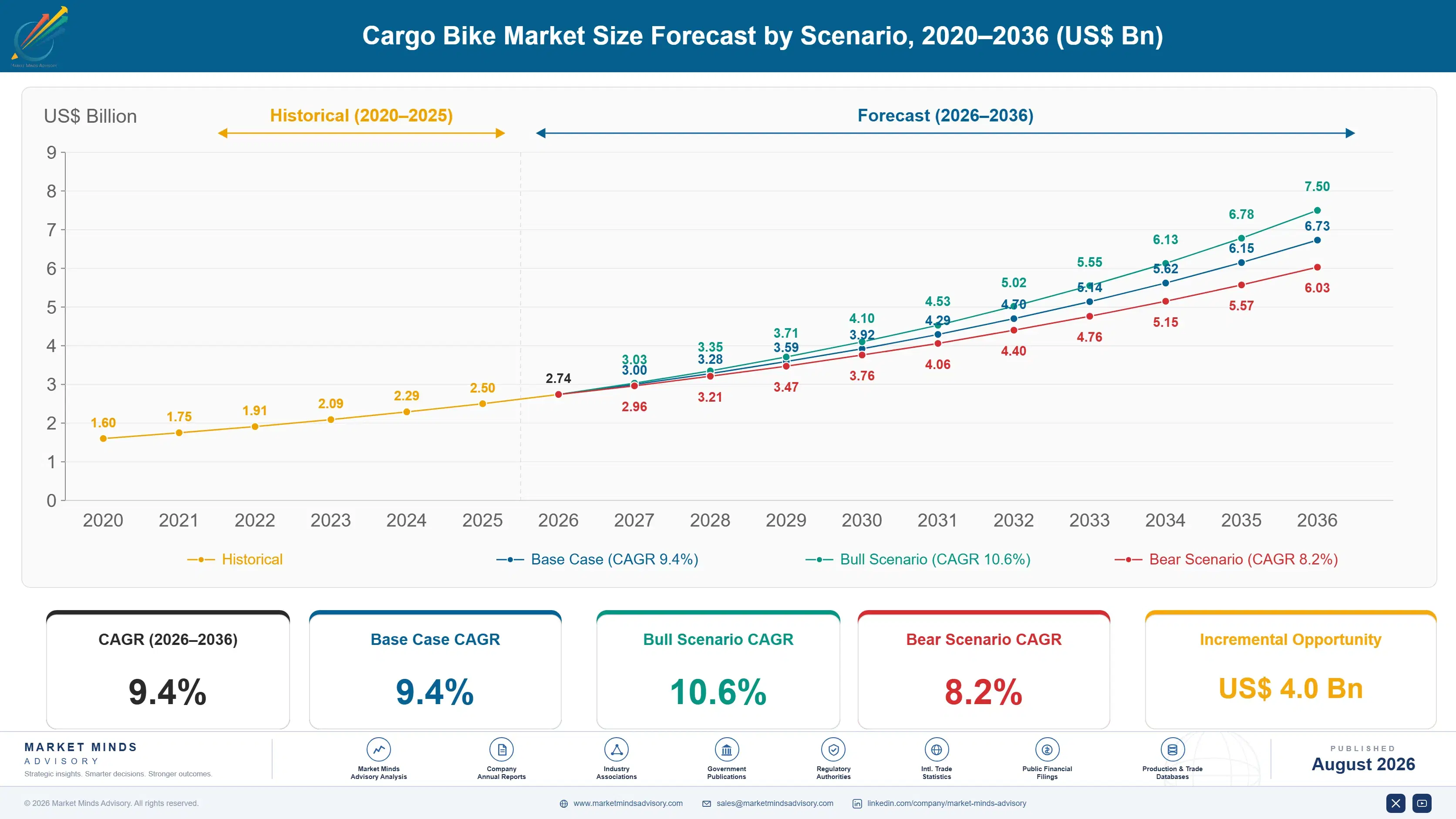
Between 2020 and 2025 the market compounded at 8.0%, and that figure smooths over a genuinely violent cycle. Pandemic demand pulled two years of purchases forward, manufacturers ordered components against that run rate, and the correction left the industry discounting inventory heavily to clear it. Several cargo specialists did not survive it. Commercial fleet demand grew steadily throughout and cushioned the damage.
The base case at 9.4% rests on three mechanisms. Zero-emission delivery zones keep expanding across European cities, and each one converts van routes into cycle routes with no alternative available to the carrier. Municipal and national purchase grants continue anchoring consumer affordability in the markets that matter most. Emerging market last-mile adoption, particularly across India, adds genuine unit growth, because electric cargo trikes there undercut the operating cost of anything carrying a licence plate.
The bull case at 10.6% turns on more European cities adopting zero-emission zones on the Paris and Amsterdam model, which historically produces step changes in fleet ordering rather than gradual growth. The bear case at 8.2% is subsidy withdrawal: several German and French grant schemes have finite budgets, and a retail price near $5,200 without support is simply outside what most households will spend.

What Actually Drives Cargo Bike Value

A cargo bike costs about as much as a used car, which is the fact that governs everything about how this market behaves. At roughly $5,200 for a decent electric model, the purchase is a considered financial decision rather than an impulse, and it competes directly against keeping the second car another two years.
TOP FIVE CONCENTRATION26%Share held by the five largest cargo bike manufacturers
AVERAGE RETAIL PRICE$5,200Typical consumer transaction price for an electric model
COMMERCIAL FLEET SHARE31%Portion of unit volume supplied into logistics operator fleets
DRIVE SYSTEM COST SHARE34% of COGSMotor, battery and controller portion of manufactured cost
VAN TRIP SUBSTITUTION42%Share of urban delivery trips a cycle could serve
PURCHASE GRANT LEVEL$1,100Typical municipal or national purchase support per vehicle
Purchase subsidies are what make that arithmetic work. German, French, Belgian and Nordic programmes covering a meaningful share of retail price have created the demand that built this industry, and the markets without them look completely different. That dependence is also the sector's most obvious vulnerability, since grant budgets are finite and political enthusiasm is not guaranteed to last.
The commercial half of the market runs on entirely different logic. A parcel carrier facing a zero-emission zone or a city centre where van parking has become impossible does not weigh a cargo cycle against a car; it weighs the cycle against not serving the route at all. That makes demand far less price-sensitive, and it is why four-wheel freight platforms carrying full parcel cages have grown fastest of anything in this market.
"The consumer side of this industry is a subsidy story and everyone involved knows it, which is uncomfortable but not fatal. The commercial side is a genuine economic argument about the cost of driving a van into a city that does not want vans, and that argument gets stronger every year."
Practice Director, Mobility and Specialty Vehicles, Market Minds Advisory · MMA

Market Trends

Four-Wheel Freight Platforms Replace Vans On Urban Routes

Light electric freight vehicles with four wheels, a weather-protected cab and a full parcel cage have moved from pilot projects to standing fleet orders at every major European parcel carrier. The commercial argument is access rather than cost: a zero-emission zone or a pedestrianised centre leaves the carrier no van option, and a four-wheel platform carries roughly three times what a two-wheel longtail manages. Regulatory classification is the enabling detail, since most European rules treat these vehicles as cycles provided that speed and continuous motor output stay within clearly defined limits.
Market Impact: Addresses 42% of urban deliveries
Purchase Grant Programmes Anchor Consumer Affordability Directly

Municipal and national purchase support across Germany, France, Belgium and the Nordic countries typically covers around $1,100 of a retail price near $5,200, which is exactly the difference between a considered purchase and an unaffordable one for most households. Markets without such programmes consistently show adoption running far below what income levels alone would predict. The dependence cuts both ways here: several schemes carry finite budgets and have simply paused when exhausted, producing sudden demand cliffs that manufacturers have found extremely difficult to plan any production schedule against at all.
Market Impact: Saves $4,800 in annual cost

Market Opportunities and Growth Drivers

Zero-Emission Delivery Zones Remove The Van Alternative

Paris, Amsterdam, Oslo, Barcelona and a lengthening list of European cities have committed to zero-emission or restricted-access freight zones, and each one converts van routes into cycle routes with no substitute available to the carrier. Roughly 42% of urban delivery trips fall within the range and payload a cargo cycle handles comfortably, which sets the theoretical ceiling well above current adoption. The commercial character matters here: this demand is regulatory rather than discretionary, which makes it considerably more predictable than consumer purchase and far less sensitive to interest rates or sentiment.
Market Impact: Insurance adds 4% annually

Second Car Replacement Reaches Households With Real Arithmetic

A household running two cars in a European city spends a substantial sum annually on the second one before it moves anywhere, and an electric cargo bike handles school runs, shopping and commuting across the distances that second car actually covers. With purchase support the payback arrives inside two years, which is short enough to convince buyers who would never make the decision on environmental grounds alone. Dutch and Danish normalisation also removes the social awkwardness that still slows adoption in the markets that lack any established cargo cycling culture of their own.
Market Impact: Cut prices by 25%

Market Restraints and Challenges

Theft And Secure Parking Deter High-Value Consumer Purchase

A cargo bike costs as much as a used car and parks like a bicycle, which is a combination buyers think hard about. The root cause is infrastructure: most European housing stock offers no secure ground-floor storage for a vehicle two and a half metres long, and street parking invites theft that insurers price accordingly. Commercially this suppresses purchase in exactly the dense urban areas where the vehicles work best. Participants are responding with integrated tracking, frame immobilisers, insurance partnerships, and municipal lobbying for secure parking provision in dense residential districts.
Market Impact: Carries 3 times longtail payload

Inventory Correction Damaged Pricing And Dealer Confidence

Pandemic demand pulled purchases forward, manufacturers ordered components against that run rate, and the correction that followed left the bicycle industry discounting heavily to clear stock. The root cause was ordering against a demand signal nobody stress-tested. Commercially the damage runs beyond the discounting itself, because dealers who lost money on inventory now order conservatively and carry less stock, which lengthens delivery times and costs manufacturers sales they would otherwise have made. Participants are responding with shorter component lead times, made-to-order production and considerably more disciplined channel inventory management than the sector previously practised anywhere.
Market Impact: Covers 21% of retail price
3 additional market trends, 4 additional growth drivers, and 2 additional restraints and challenges are covered in the full report. Contact sales@marketmindsadvisory.com to access the complete intelligence.

Segment CAGR and Growth Architecture

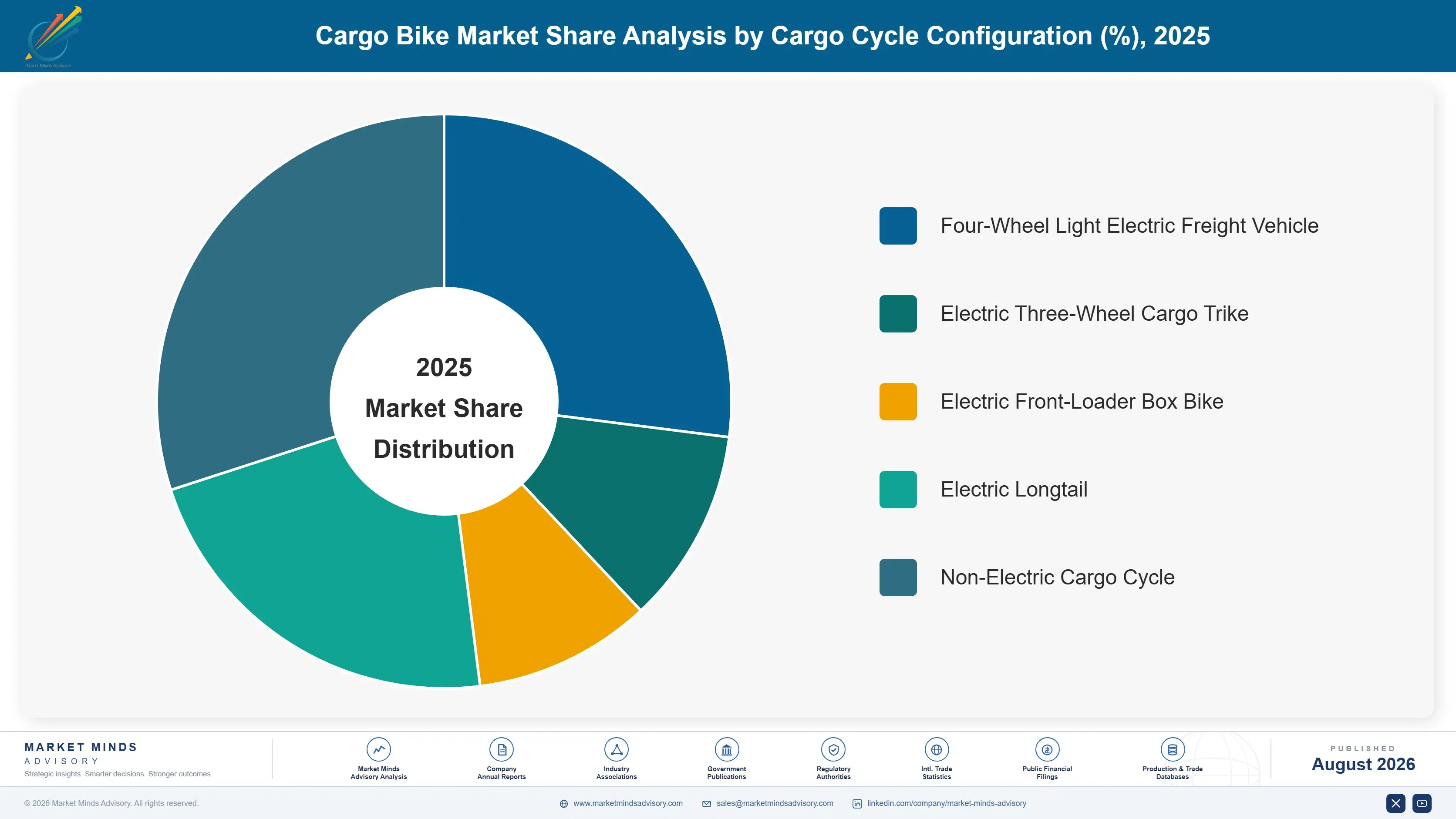
Segmentation follows cargo cycle configuration, because the number of wheels and where the load sits determine payload, stability, weather protection, regulatory classification, manufacturing cost and which buyer the vehicle is actually for. Drive system choice, accessory content, warranty scope and distribution channel all sit downstream of that configuration decision, and every one of them is priced against it.
global-cargo-bike-market-market-share-analysis-1787315794783

Four-Wheel Light Electric Freight Vehicle

The fastest segment at 14.1%, a full 1.50 times the market rate, covering four-wheel electric platforms with a weather-protected riding position and a load area sized to take a standard parcel cage. Regulatory classification is what makes the segment possible. Most European rules treat these vehicles as cycles rather than motor vehicles provided speed and continuous motor output stay within defined limits, which grants access to zones where vans are simply prohibited. Payload runs roughly three times what a two-wheel longtail manages, and a covered cab keeps a rider working through weather that would otherwise stop the shift. Parcel carriers buy these vehicles as direct van replacements rather than as bicycles of any kind.
CAGR 14.1%

Electric Three-Wheel Cargo Trike

Growing at 11.8% on three-wheel configurations where load sits over a two-wheel axle, either forward of the rider or behind, giving stability at standstill that two-wheel designs cannot match when loaded. Two very different buyers drive it. European commercial operators use trikes for heavier or awkward loads on routes where a four-wheel platform is unnecessary, while Indian and Southeast Asian last-mile operators use electric trikes because operating cost per delivery undercuts anything carrying a licence plate. Manufacturing is straightforward relative to four-wheel platforms, which keeps the competitive field wide. What limits the format is width, since a loaded trike simply does not fit through the gaps that a two-wheel bike passes easily.
CAGR 11.8%
Full segment breakdown across 5 segments available in the complete report.

Regional Architecture and Country Demand Map

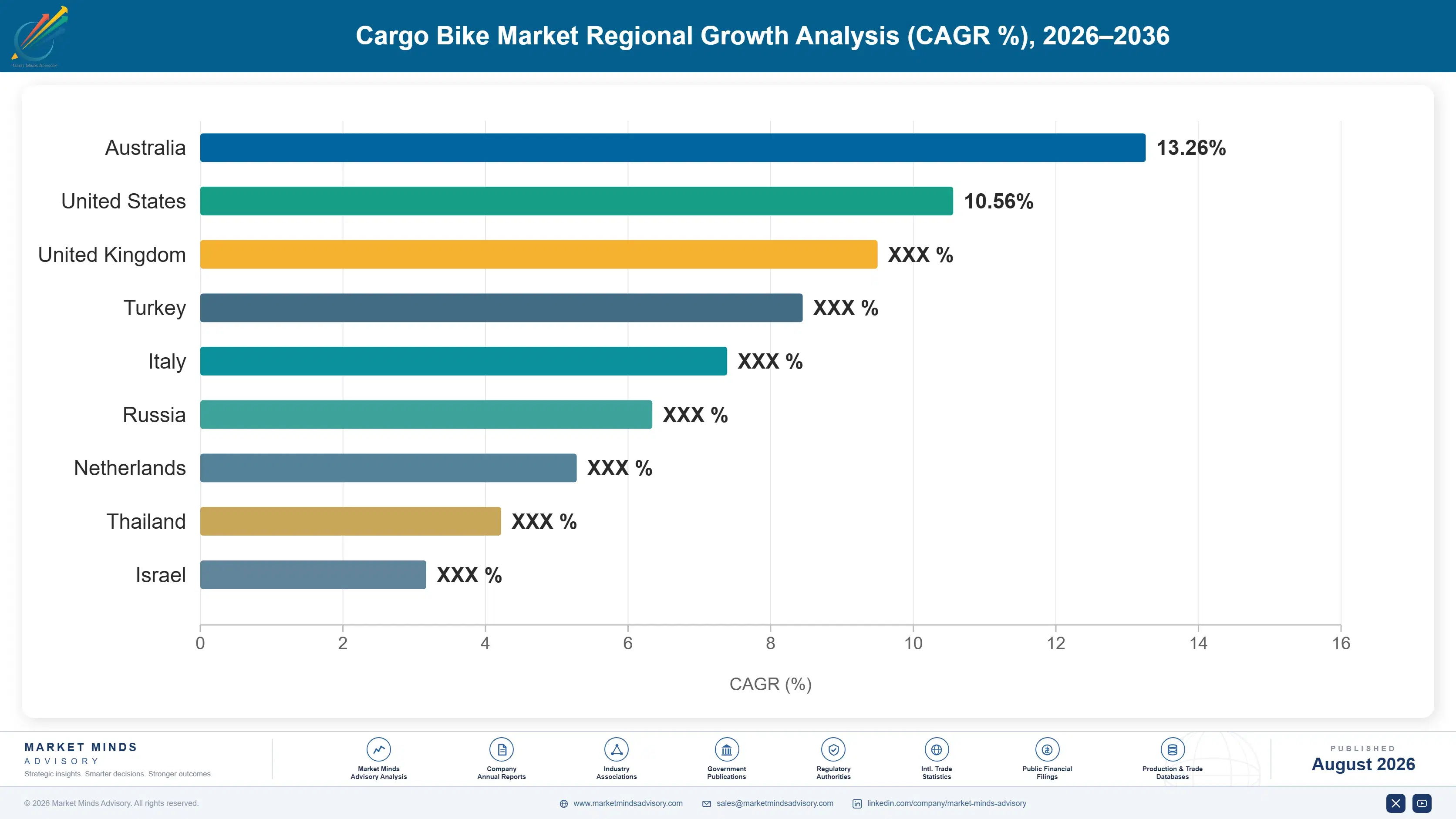
Western Europe holds 44% of global value because the Netherlands, Denmark and Germany created this category and still buy most of what gets built. East Asia follows on component manufacturing and Japanese family formats, while growth runs fastest across South Asia and Pacific on last-mile delivery economics.

Western Europe

Note: Western Europe holds 44% against an 18 to 26% band because this is genuinely where the category exists. The Netherlands and Denmark normalised cargo bikes as family transport decades before anywhere else, and Germany now buys more units annually than any other country on earth. Municipal purchase grants across Germany, France, Belgium and several Nordic cities cover a meaningful share of retail price, which converts an expensive purchase into a reasonable one. Zero-emission delivery zones in Paris, Amsterdam, Oslo and a growing list are pulling commercial fleets in behind the consumer base, and the manufacturing cluster sits here too. Nowhere else in the world combines culture, subsidy and regulation quite this way.
Share: 44% | CAGR: 7.9% (2026 to 2036)

East Asia

Note: East Asia holds 18% against a 22 to 30% band because the Western cargo bike concept sits alongside an enormous existing electric two and three-wheeler culture rather than replacing it. China builds a very large share of world frames, components and drive units regardless of where the finished bikes are badged, and domestic three-wheel cargo use is ubiquitous in forms that predate the category entirely. Japanese demand is distinctive: the mamachari carrying two children is a genuine cultural fixture, and electric assist versions of that format sell in volumes European manufacturers would recognise as a large market. Component supply matters more here than finished vehicle demand does, and that balance looks unlikely to change soon.
Share: 18% | CAGR: 10.6% (2026 to 2036)
Regional intelligence for 5 additional markets available in the complete report: North America, South Asia and Pacific, Latin America, Middle East and Africa, Eastern Europe. Contact sales@marketmindsadvisory.com.
global-cargo-bike-market-country-cagr-analysis-1787315795316

Where Cargo Bike Margin Is Won

Four positions separate manufacturers building durable businesses from workshops selling handbuilt bikes at craft volumes: engineering for commercial fleet duty rather than consumer use, building service and parts networks that fleet buyers demand, offering financing that removes the price barrier entirely, and designing deliberately to the regulatory classification that actually grants access to restricted city centres.

Engineer For Fleet Duty Not Consumer Use

A commercial cargo cycle runs eight hours a day, six days a week, ridden by whoever happens to be on shift, and consumer-grade components simply do not survive that duty at all. Manufacturers building genuine fleet hardware, meaning sealed drivetrains, service-friendly assemblies and properly documented duty ratings, realise 30% to 40% higher unit pricing and win multi-year supply agreements rather than one-off purchase orders. The engineering involved is unglamorous durability work, and it is precisely what the specialist workshops that built this industry were never structured to do at all.
Market Impact: Realises 40% higher pricing across

Build Service Networks Fleet Buyers Actually Require

A parcel carrier cannot have a vehicle off the road for three weeks waiting on a part from a workshop in Denmark, and that single fact excludes most of this industry from commercial tenders entirely. Manufacturers holding authorised service coverage and stocking spares across the markets they sell into win fleet business at 20% to 28% higher realised prices because uptime is what the buyer is actually purchasing. The investment required is inventory and partner management rather than any manufacturing capital at all, which makes it achievable inside a single planning cycle.
Market Impact: Wins fleet business at 28% higher r

Offer Financing That Removes The Price Barrier

At roughly $5,200 the retail price is the single largest obstacle to consumer adoption anywhere, and purchase subsidy programmes only partially address it. Manufacturers offering structured financing, employer lease schemes or subscription arrangements convert the buyers who would never write a cheque outright, and they lift conversion rates by 25% to 35% at dealer level as a direct consequence. The cost involved is credit risk management and partner arrangements rather than any product development at all, which makes it considerably quicker to implement than anything requiring engineering time and testing.
Market Impact: Lifts dealer conversion rates by up

Design To The Classification That Grants City Access

European rules treat light electric freight vehicles as cycles provided speed and continuous motor output stay inside defined limits, and that classification is precisely what grants access to zero-emission zones and pedestrianised city centres. Manufacturers designing deliberately inside those boundaries can sell into roughly 42% of all urban delivery trips; those exceeding them become registered motor vehicles instead and lose the entire access argument in the process. The design constraint costs outright performance, and in exchange it buys the only thing that a commercial buyer in this market genuinely cares about.
Market Impact: Opens 42% of all urban delivery tri

Who Controls the Margin Pool

Concentration sits at 26% for the top five measured on unit shipment volume, the basis used throughout this section, and it is remarkably low even for a young category. Riese and Müller and Urban Arrow lead on premium consumer product built through established European dealer networks, while Accell Group holds volume through Babboe, and Tern and Rad Power compete on more accessible price points. The gap to the next tier barely exists in volume terms.
Competitive activity runs on three fronts. Fleet-grade engineering is the first, since commercial buyers now specify duty ratings and service intervals that consumer product cannot meet. Service network coverage is the second, and it decides who can bid for parcel carrier tenders at all. The third is four-wheel platform development, where the competitive field is thin and the regulatory classification work is genuinely demanding.

Pressure arrives from two directions. Automotive and logistics equipment manufacturers are entering the four-wheel freight category with capital and service infrastructure that specialist bike builders cannot match. Separately, the inventory correction weakened balance sheets across the sector. Rankings will shift as commercial fleet volume overtakes consumer purchase, which on current trajectory happens before 2031.
global-cargo-bike-market-company-positioning-matrix-1787315795836

Competitive Moat and Risk Dimensions

RIESE AND MÜLLER

Moat: Premium engineering and dealer depth

Engineering quality that genuinely justifies premium pricing, combined with a specialist dealer network across German-speaking Europe that handles sales, fitting and service properly, creates a position that price competition does not easily erode. Buyers spending this much want to see and ride the vehicle first, and that requires exactly the dealer infrastructure the company has spent years building.
RIESE AND MÜLLER

Risk: Consumer subsidy dependence

Premium consumer sales concentrate in markets where purchase grants anchor affordability, and several of those programmes carry finite budgets with uncertain renewal. Commercial fleet business would balance that exposure, but it demands service coverage and duty engineering that a premium consumer brand has limited reason to have built already.
URBAN ARROW

Moat: Front-loader format leadership

The company effectively defined what a modern electric front-loader looks like, and its position in the Netherlands gives it credibility that transfers into every market where Dutch practice is treated as the reference. Component partnerships with established drive system suppliers also give it a service and parts footprint wider than its own scale would support.
URBAN ARROW

Risk: Narrow configuration exposure

Deep specialisation in front-loaders offers limited protection as commercial demand shifts toward four-wheel freight platforms carrying parcel cages, which is a genuinely different vehicle requiring different engineering. Building that capability from a two-wheel base means new regulatory work, new manufacturing and a fleet service network the business does not currently operate.

Players Tracked

Prominent Players

Riese and Müller
Urban Arrow
Accell Group
Tern Bicycles
Rad Power Bikes

Other Key Players

Larry vs Harry
Butchers and Bicycles
Christiania Bikes
Nihola
Yuba Bicycles
Xtracycle
Douze Cycles
Muli Cycles
Onomotion
Citkar
Electric Assisted Vehicles
Velove
Fernhay
Bunch Bikes
Ferla Bikes

Recent Developments

MARCH 2025

Parcel carrier commits to four-wheel freight cycle fleet

A major European parcel carrier placed a multi-year standing order for four-wheel light electric freight vehicles across several city centres, replacing van routes in zero-emission zones where no diesel or petrol alternative could legally operate any longer, and where van parking had already become impractical.
Signal: Commercial fleet orders are now standing c
JULY 2025

German purchase grant programme extended with revised budget

A national purchase support scheme covering roughly a fifth of typical retail price was extended with a revised annual budget after the previous allocation had been exhausted several months early, which restored the affordability anchor that consumer demand across the whole market visibly depends upon.
Signal: Consumer demand in this category remains d
NOVEMBER 2025

Automotive supplier enters light electric freight vehicle manufacturing

An established automotive component manufacturer began series production of four-wheel light electric freight vehicles at a European plant during the year, bringing service network infrastructure, volume manufacturing discipline and balance sheet depth that specialist cargo bike builders have never been structured to offer fleet customers at all.
Signal: Capital and service infrastructure are ent

What Drives Cargo Bike Cost

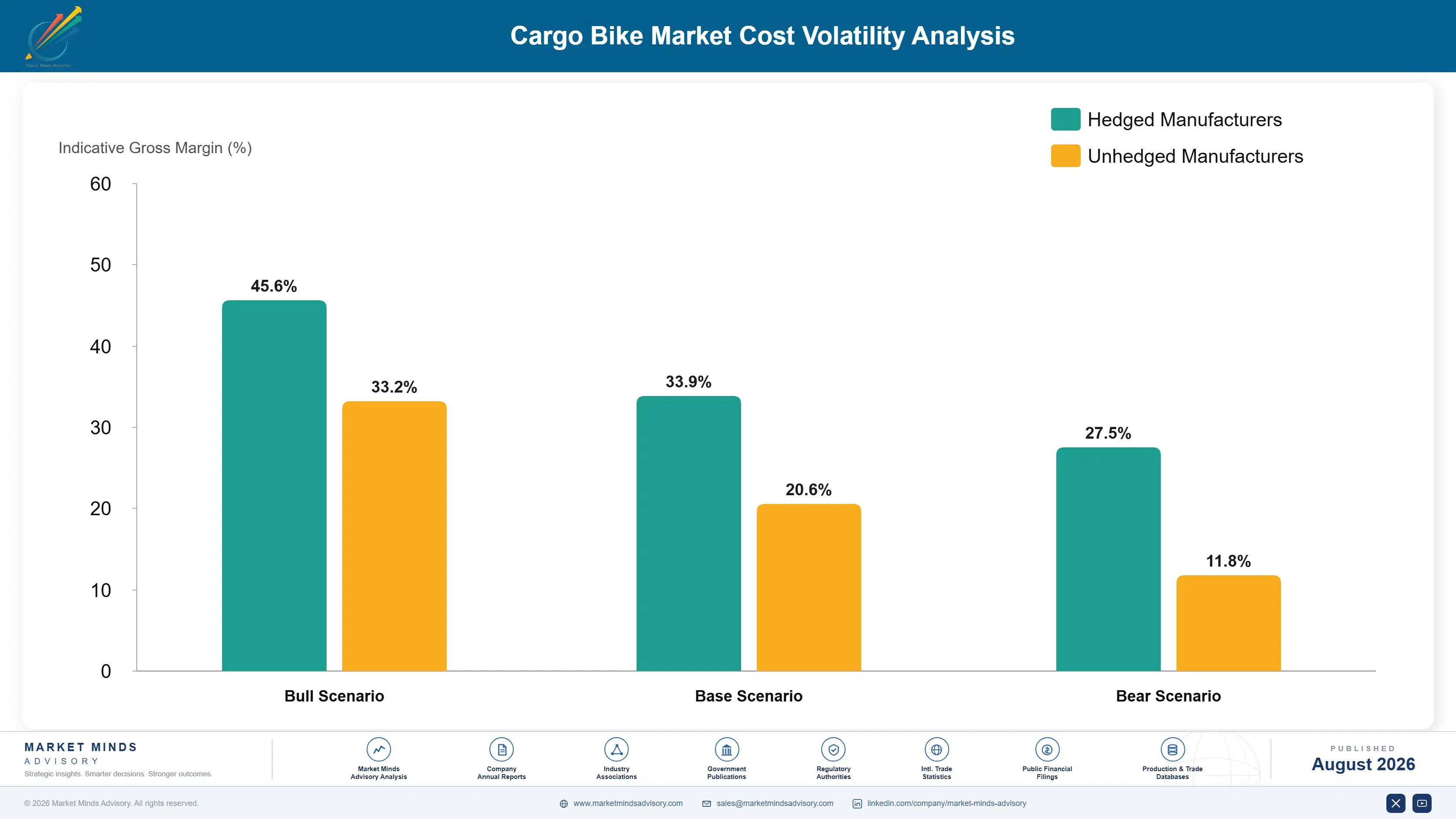
The drive system dominates. Motor, battery and controller together account for roughly 34% of manufactured cost, and most comes from a small group of European and Japanese suppliers whose pricing power here is considerable. Frame and load box content adds around 22%, split between aluminium extrusion, steel tube and composite or plywood box construction. Wheels, brakes and finishing components contribute a further 24%, and assembly labour roughly 11%.
The 2023 and 2024 inventory correction was the defining cost event and it worked in reverse. Component suppliers who had expanded against pandemic demand found the whole bicycle industry cancelling orders, and pricing fell sharply while manufacturers discounted finished stock to clear it. Accell Group Annual Report 2025 and Shimano Annual Report 2025 both describe the extended destocking cycle and its margin consequences across the sector plainly.

The disadvantage mechanism is drive system dependence rather than commodity exposure. A manufacturer specifying a single supplier's motor system carries pricing exposure it cannot negotiate away, since switching means redesigning the frame around a different motor mount. Exposure varies by segment too: consumer products need branded drive systems buyers recognise, while fleet buyers care about uptime and cost per kilometre instead.
global-cargo-bike-market-cost-volatility-analysis-1787315796030

Design frames accepting multiple drive system mounts

A frame engineered to accept motor systems from two or three suppliers without retooling converts a locked dependency into a genuine negotiation at every annual renewal. The engineering premium is modest at design stage and effectively impossible to retrofit once tooling exists. Manufacturers who did this work early held far better component pricing than those committed to one system.

Build to order rather than stocking finished inventory

Made-to-order production with short component lead times avoids exactly the inventory exposure that damaged this industry through 2023 and 2024, when demand signals proved wildly unreliable. The trade is delivery time, which consumer buyers accept more readily than dealers do. Fleet customers plan procurement months ahead anyway, so build-to-order suits the commercial half of this market almost perfectly.

Standardise load box construction across product families

Common box dimensions, materials and mounting interfaces across several models concentrate purchasing, simplify spare parts inventory and cut the tooling cost that bespoke box designs carry. The constraint is styling differentiation, which matters more to consumer buyers than to fleet operators. On the commercial side of this market the standardisation argument wins comfortably every single time.

Portfolio Architecture for Margin Defence

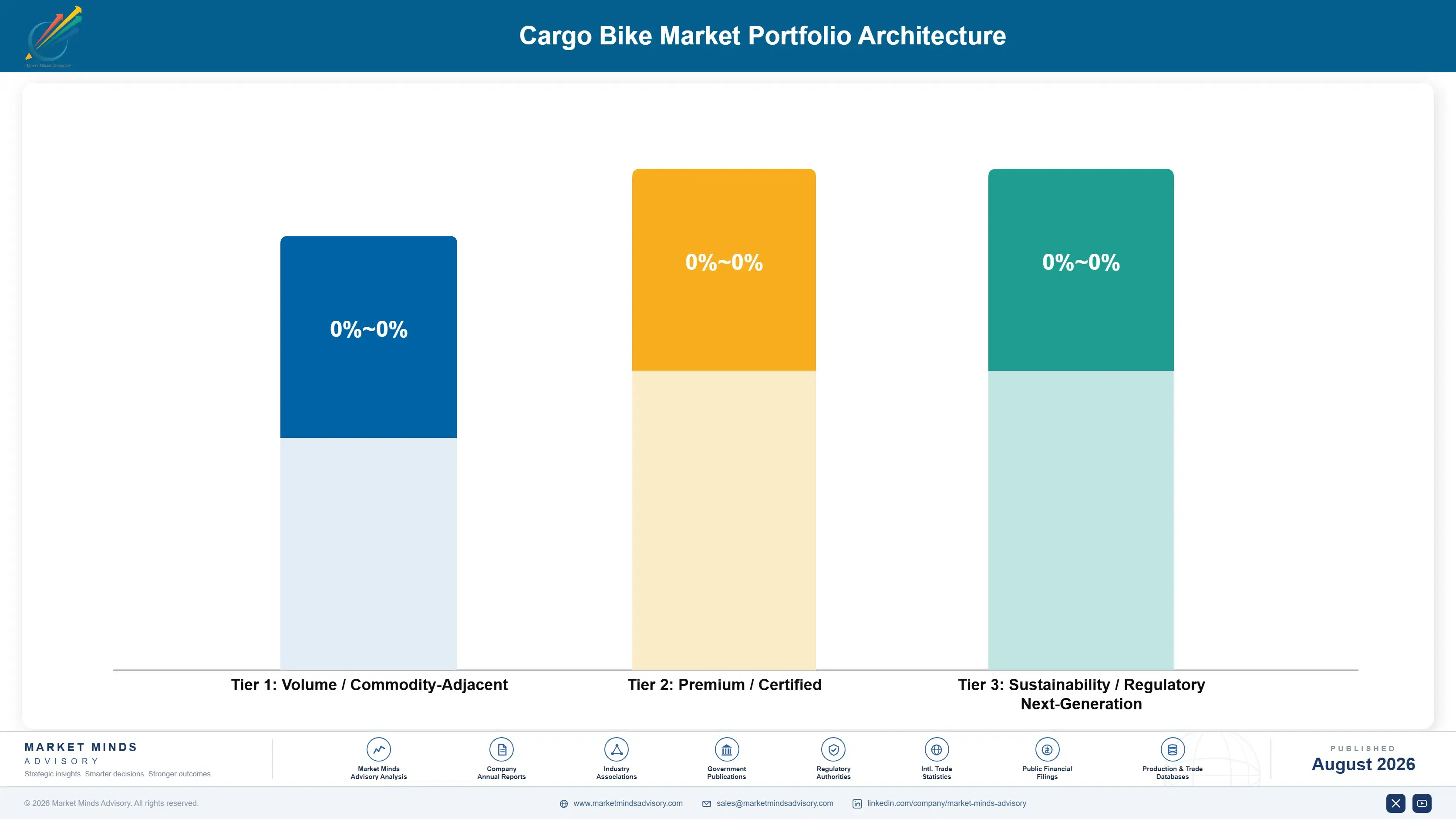
Portfolio economics here divide on buyer rather than on product sophistication. Entry-level consumer cargo bikes sold through general bicycle retail earn gross margins in the mid teens, because the format is now widely copied, Chinese and Eastern European production has closed most of the cost gap, and buyers at that price point compare specifications line by line before choosing.
The premium tier is engineered consumer product sold through specialist dealers. Buyers spending toward $5,200 want to ride before purchase, want the vehicle fitted properly and want service afterwards, all of which the dealer provides and prices into the transaction. Margins run in the high twenties to mid thirties. Dealer quality is the variable that decides where in that range a brand lands.

Above both sits commercial fleet supply, particularly four-wheel freight platforms. The buyer is a parcel carrier calculating cost per delivery against a van it is no longer permitted to drive into the city, which makes the purchase far less price-sensitive than any consumer decision. Multi-year supply agreements carry parts and service revenue behind them, and margins reach the high thirties with demand that is regulatory rather than discretionary in character.

Volume / Commodity-Adjacent

Entry-level consumer cargo bikes sold through general bicycle retail. The format is widely copied, low-cost production has closed most of the gap, and buyers compare specifications line by line before choosing on price.
Gross Margin: 14 to 19%

Premium / Certified

Engineered consumer product sold through specialist dealers who fit and service properly. The range is wide because dealer network quality varies considerably and because subsidy levels differ sharply between national markets.
Gross Margin: 27 to 35%

Sustainability / Regulatory / Next-Generation

Commercial fleet supply including four-wheel freight platforms, sold under multi-year agreements with parts and service attached. The range reflects the gap between single fleet orders and full supply partnerships carrying uptime obligations.
Gross Margin: 34 to 42%
global-cargo-bike-market-portfolio-architecture-1787315796529

High-value Sub-segments and Strategic Watch-out

Four-Wheel Fleet Freight Platforms

High value and high growth sitting squarely together. Zero-emission zones leave carriers no van alternative at all, payload runs at roughly three times what a longtail manages, and the competitive field remains thin because the regulatory classification work behind these vehicles is genuinely demanding to get right.
Gross Margin: 36 to 43%

Premium Consumer Front-Loaders

High value running on moderate growth. Households replacing a second car will pay for engineering quality and dealer support, and northern European normalisation means the purchase requires no cultural justification at all, though subsidy availability still anchors what those buyers will actually agree to spend.
Gross Margin: 29 to 36%

Electric Longtail Consumer Product

The volume core that keeps assembly lines loaded and dealer relationships alive between higher-value sales. Margins stay moderate in this tier because the format is now very widely copied, but the volume involved underwrites the brand and distribution investment that everything else in this portfolio depends on.
Gross Margin: 20 to 27%

Non-Electric Cargo Cycles

The strategic watch-out sitting squarely inside this particular portfolio. Volumes still persist across Dutch and Danish flat-terrain markets and in informal commerce throughout emerging economies, but electric assist has taken almost every new buyer, and the segment now shrinks steadily with each year that passes.
Gross Margin: 12 to 18%

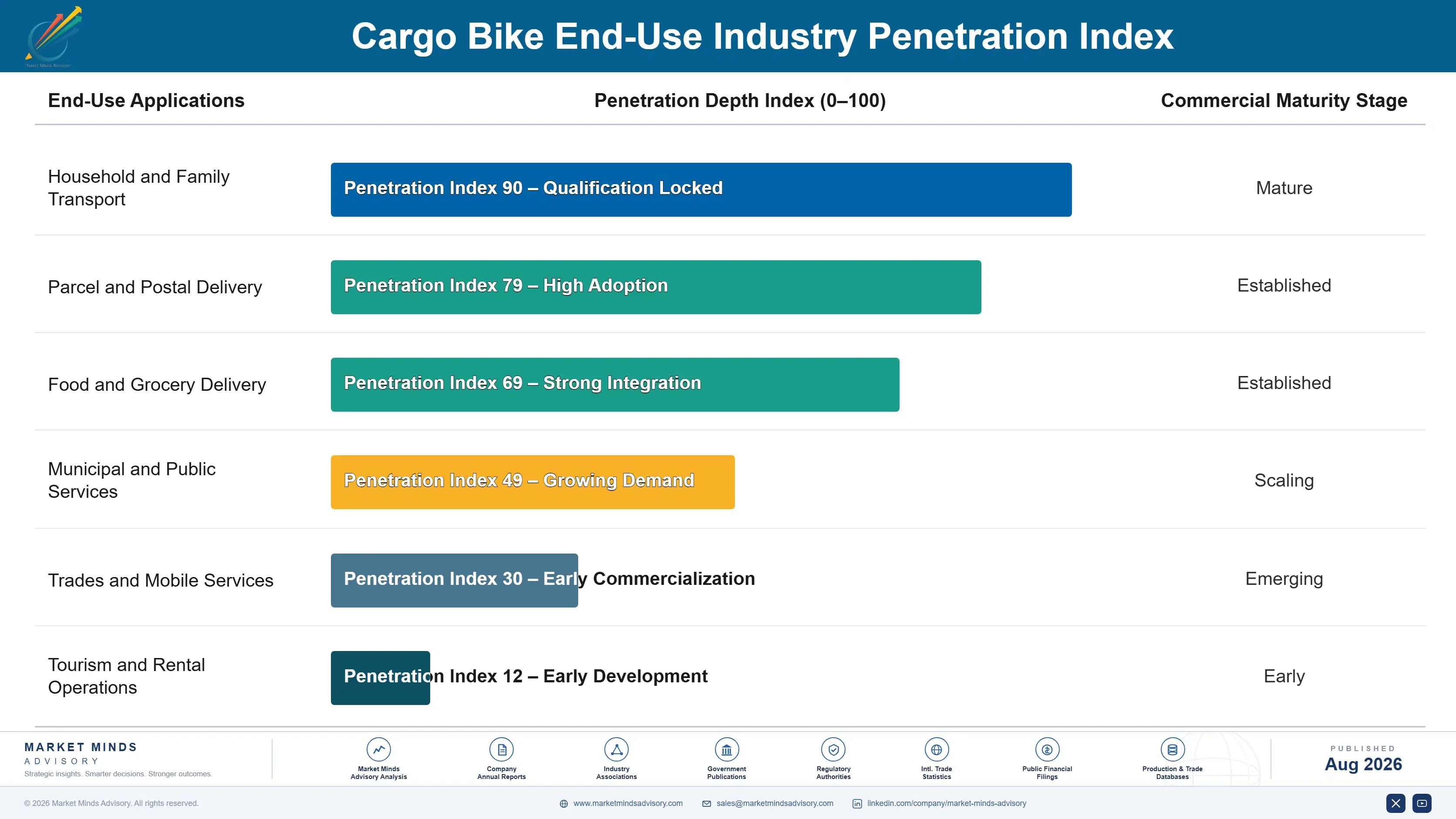
How Cargo Bike Demand Repeats

The two halves of this market repeat completely differently. A commercial fleet generates replacement demand on a roughly five year cycle plus continuous parts, battery and service revenue throughout that period, all of it contracted. A consumer purchase generates a battery replacement around year five and very little else, unless the manufacturer holds the dealer relationship that eventually produces the repurchase.
Stickiness varies sharply by buyer. Parcel carriers are the stickiest, because switching supplier means retraining riders, restocking parts and revalidating vehicles against municipal access rules. Specialist dealers are moderately sticky, since they invest in product training and service tooling they would rather not duplicate. General bicycle retail is not sticky at all, stocking whatever carries the best margin and turning it over without brand loyalty in either direction.

The buyer profile has shifted noticeably. Early consumer buyers were committed cyclists who wanted a cargo bike specifically. Today's buyer is a household running the numbers on a second car, and they evaluate financing, insurance, secure parking and resale value alongside the vehicle itself, which favours manufacturers who can answer commercial questions rather than only technical ones.
global-cargo-bike-market-end-use-penetration-index-1787315797020

Where To Compete And Why

These are among the four positions where our research anticipates prominent divergence between winners and laggards over the coming forecast period. Each is grounded in the demand model, the regulatory perimeter, and the announced capacity pipeline.
01 / FLEET DUTY ENGINEERING

Commercial use destroys consumer-grade hardware

A commercial cargo cycle runs eight hours daily, six days a week, ridden by whoever is on shift, and consumer components simply do not survive that duty at all. Manufacturers building genuine fleet hardware with sealed drivetrains and properly documented duty ratings realise 30% to 40% higher unit pricing and win multi-year agreements rather than single orders. The engineering is unglamorous durability work, which is exactly what the specialist workshops that built this whole industry were never structured to deliver.
02 / SERVICE NETWORK COVERAGE

Uptime is what fleet buyers are purchasing

A parcel carrier cannot have vehicles off the road for three weeks waiting on parts from a workshop in another country, and that fact alone excludes most of this industry from commercial tenders. Manufacturers holding authorised service coverage and stocked spares across their markets win fleet business at 20% to 28% higher realised prices. The investment is inventory and partner management rather than manufacturing capital, which makes it achievable within a single planning cycle rather than a product development one.
03 / CONSUMER FINANCING ACCESS

Price is the barrier subsidies only half solve

At roughly $5,200 the retail price is the largest single obstacle to household adoption, and purchase grants covering around a fifth of it only partly close the gap. Manufacturers offering structured financing, employer lease schemes or subscription arrangements lift dealer conversion rates by 25% to 35% among buyers who would never write the cheque outright. The cost involved is credit risk management and partner arrangements rather than any product development spending at all, and it shows up in results within months.
04 / REGULATORY CLASSIFICATION DESIGN

Stay inside the definition that grants access

European rules treat light electric freight vehicles as cycles provided speed and continuous motor output remain inside defined limits, and that classification is precisely what grants access to zero-emission zones and pedestrianised centres. Manufacturers designing deliberately within those boundaries address roughly 42% of urban delivery trips; those exceeding them become registered motor vehicles instead and lose the entire access argument. The design constraint costs outright performance and buys the only thing that commercial buyers in this market genuinely care about.

Engagement Snapshot From the Field

A live engagement with an industry participant carrying material or product regulatory and market exposure ahead of a defining policy shift, showing how our research translates into a defensible multi-year portfolio strategy.
MARKET MINDS ADVISORY · CLIENT ENGAGEMENT SUMMARY
Cargo Bike Producer Strategic Portfolio Review and Transition Roadmap 2026·Investment Scenario on Cargo Bike Exposure Evaluation 2025-26
CLIENT PROFILE
A European cargo cycle manufacturer with annual revenue near $58 million (client-reported, unverified by MMA), roughly 84% of it from premium consumer front-loaders sold through specialist dealers across five countries. The business held genuine engineering credibility and strong dealer relationships but almost no commercial fleet presence, and it had absorbed heavy losses clearing inventory through the 2024 destocking cycle.
STRATEGIC CHALLENGE
Consumer demand had proved far more subsidy-dependent than management assumed, with one national grant pause cutting monthly orders by more than a third overnight. The board needed to decide whether to develop a four-wheel freight platform for commercial fleets, expand consumer distribution into new national markets, or consolidate around existing markets and manage for cash while the sector recovered.
MMA APPROACH
MMA modelled consumer and commercial demand across nine European markets through 2036, mapped zero-emission zone commitments and grant scheme budgets city by city, and assessed the engineering, regulatory and service network requirements for commercial fleet entry. Twenty-two expert interviews with parcel carrier fleet managers, specialist dealers and municipal transport officials tested where demand would prove durable.
KEY FINDINGS
  1. Commercial fleet demand across the cities studied was tied to zero-emission zone commitments already in law, making it materially more predictable than consumer demand tied to annually renewed grant budgets.
  2. Four-wheel platform development would take roughly 26 months including regulatory classification work, considerably longer than management had assumed, but the competitive field remained thin throughout that window.
  3. The client's existing dealer network could not support fleet customers, who required guaranteed parts availability and service response times that specialist bicycle retailers were not structured to provide at all.
  4. Consumer expansion into markets without purchase grants showed adoption running roughly 60% below what income levels alone predicted, which effectively removed three of the four candidate countries from consideration.
CLIENT PROFILE
A European cargo cycle manufacturer with annual revenue near $58 million (client-reported, unverified by MMA), roughly 84% of it from premium consumer front-loaders sold through specialist dealers across five countries. The business held genuine engineering credibility and strong dealer relationships but almost no commercial fleet presence, and it had absorbed heavy losses clearing inventory through the 2024 destocking cycle.
STRATEGIC CHALLENGE
Consumer demand had proved far more subsidy-dependent than management assumed, with one national grant pause cutting monthly orders by more than a third overnight. The board needed to decide whether to develop a four-wheel freight platform for commercial fleets, expand consumer distribution into new national markets, or consolidate around existing markets and manage for cash while the sector recovered.
MMA APPROACH
MMA modelled consumer and commercial demand across nine European markets through 2036, mapped zero-emission zone commitments and grant scheme budgets city by city, and assessed the engineering, regulatory and service network requirements for commercial fleet entry. Twenty-two expert interviews with parcel carrier fleet managers, specialist dealers and municipal transport officials tested where demand would prove durable.
KEY FINDINGS
  1. Commercial fleet demand across the cities studied was tied to zero-emission zone commitments already in law, making it materially more predictable than consumer demand tied to annually renewed grant budgets.
  2. Four-wheel platform development would take roughly 26 months including regulatory classification work, considerably longer than management had assumed, but the competitive field remained thin throughout that window.
  3. The client's existing dealer network could not support fleet customers, who required guaranteed parts availability and service response times that specialist bicycle retailers were not structured to provide at all.
  4. Consumer expansion into markets without purchase grants showed adoption running roughly 60% below what income levels alone predicted, which effectively removed three of the four candidate countries from consideration.
RECOMMENDED STRATEGY
Phase 1: Phase one: begin four-wheel freight platform development immediately, including the regulatory classification work that determines city access rights across target markets. Phase 2: Phase two: build authorised service partner coverage in the cities with binding zero-emission zone commitments, ahead of the platform reaching production readiness. Phase 3: Phase three: hold consumer distribution at current markets and manage that business for cash rather than pursuing expansion into unsubsidised territories.
OUTCOME
The client began platform development within two months and secured two parcel carrier development partnerships before any hardware existed (client-reported, unverified by MMA). Service partner coverage now spans eleven cities, consumer distribution was held rather than expanded, and first fleet deliveries are scheduled for late 2027 against a committed order book of $14 million.

Frequently Asked Questions

Foundational context covering the market sizes, CAGR, scope, country, region and competition that inform every finding below. This section is provided to cover basics and most often pre-purchase conversations, answered from the MMA Primary Research Dataset.

What is the current size of the Cargo Bike Market?

The global cargo bike market was valued at $2.50 billion in 2025, reaching an estimated $2.74 billion in 2026. That covers purpose-built cargo cycles across household and commercial fleet applications worldwide.

How large will the Cargo Bike Market be by 2036?

MMA forecasts the market reaching $6.73 billion by 2036, an increase of $3.99 billion over the 2026 base. That represents an expansion multiple of 2.46 times across the forecast period.

What is the CAGR for the Cargo Bike Market 2026 to 2036?

The base case compound annual growth rate is 9.4%, with a bull case of 10.6% and a bear case of 8.2%. Historical growth between 2020 and 2025 ran at 8.0% annually.

Which segment is growing fastest?

Four-wheel light electric freight vehicles grow at 14.1%, a full 1.50 times the market rate, as zero-emission zones remove the van alternative. Electric three-wheel cargo trikes follow at 11.8% annually.

Who are the major companies in the Cargo Bike Market?

Riese and Müller, Urban Arrow, Accell Group, Tern Bicycles and Rad Power Bikes lead on unit shipment volume. Together they account for roughly 26% of global shipments, which is unusually fragmented.

Which country is growing fastest?

India grows fastest at 11.8% annually, driven by electric cargo trikes undercutting anything carrying a licence plate on last-mile delivery. Poland and Spain follow on infrastructure build-out.

Report Segmentation Architecture

The full report scope spans multiple orthogonal segmentation dimensions, with cross-tabulated demand data provided for each dimension pair. Coverage extends further to regional breakdowns, trend trajectories, and the competitive detail needed to support segment-level decision-making.

By Cargo Cycle Configuration

  • Four-Wheel Light Electric Freight Vehicle
  • Electric Three-Wheel Cargo Trike
  • Electric Front-Loader Box Bike
  • Electric Longtail
  • Non-Electric Cargo Cycle

By End-Use Industry

  • Household and Family Transport
  • Parcel and Postal Delivery
  • Food and Grocery Delivery
  • Municipal and Public Services
  • Trades and Mobile Services
  • Tourism and Rental Operations

By Commercial Dimension

  • Specialist Dealer Retail Channel
  • General Bicycle Retail Channel
  • Commercial Fleet Supply Agreements
  • Subscription and Lease Arrangements
  • Direct to Consumer Online Sales

By Region

  • North America
  • Western Europe
  • East Asia
  • South Asia and Pacific
  • Latin America
  • Middle East and Africa
  • Eastern Europe

Scope, Methodology, and Coverage

Every figure in this report is reproducible from documented input assumptions. The scope below maps the historical period, the forecast horizon, the segmentation dimensions, and the countries covered, alongside the underlying primary and qualitative methodology.
Historical Period
2020 to 2025
Forecast Period
2026 to 2036
Base Year
2025 (USD billions; MMA Primary Research Dataset, August 2026)
Market Definition
This report covers purpose-built cargo cycles with dedicated load-carrying capacity, spanning electric and non-electric longtails, front-loader box bikes, three-wheel trikes and four-wheel light electric freight vehicles sold into household, commercial fleet, municipal and rental applications. Standard bicycles with aftermarket racks or towed trailers, electric mopeds, registered motor vehicles, separately sold cargo trailers, delivery fleet operating service revenue and shared rental scheme revenue are all excluded from the sizing.
Quantitative Units
USD billions at manufacturer realised value; unit shipments in thousands; average realised price in USD per vehicle.
Segmentation Dimensions
By cargo cycle configuration; by end-use industry; by commercial dimension; by region.
Regions Covered
North America, Western Europe, East Asia, South Asia and Pacific, Latin America, Middle East and Africa, Eastern Europe
Countries Covered
Netherlands, Denmark, Germany, France, Belgium, United Kingdom, Sweden, Norway, Spain, Italy, United States, Canada, Japan, China, South Korea, India, Australia, Brazil, Colombia, Poland.
Key Companies Profiled
Riese and Müller, Urban Arrow, Accell Group, Tern Bicycles, Rad Power Bikes, Larry vs Harry, Butchers and Bicycles, Christiania Bikes, Nihola, Yuba Bicycles, Onomotion, Citkar, Electric Assisted Vehicles, Velove and others.
Quantitative Methodology
Primary survey, n=3,800 respondents, Q4 2025, six countries; demand-side model with trade association cross-validation
Qualitative Methodology
47 expert interviews, Q4 2025; applied to validate demand model assumptions, identify emerging dynamics, and assess competitive positioning
Report Format
PDF and XLSX data workbook (Word format preview document)
Publisher
Market Minds Advisory
Report Code
MMA-2026-AUT-928
Published
August 2026
Contact
sales@marketmindsadvisory.com | www.marketmindsadvisory.com

Purchase the full Cargo Bike Market Report (2026 to 2036).

The full report sizes the cargo bike market across five configurations, six end-use industries and seven regions, with unit shipment and realised pricing detail behind every value estimate. It profiles twenty global manufacturers on fleet duty engineering, service network coverage and regulatory classification capability. Regional chapters cover zero-emission zone commitments, purchase grant schemes and cycling infrastructure build-out city by city. Commercial analysis quantifies van trip substitution potential and fleet replacement economics. Cost analysis tracks drive system dependence and the continuing effects of the destocking cycle.
Unit shipment and pricing detail by configuration
Zero-emission zone commitment tracking across European cities
Purchase grant scheme budgets and renewal risk
Van trip substitution potential by city density
Competitive position assessments across twenty global manufacturers
Fleet service network coverage mapping by manufacturer

Built For The People Who Decide

From boardroom strategy to bench-side execution, this report is read cover-to-cover by leaders shaping the next decade of their industry, turning demand scenarios, market dynamics and valuation benchmarks into decisions.
CXOs/ Presidents/ VPs/ Managers
M&A and Corporate Development
Strategy Teams and R&D Heads
Procurement and Product Directors
Regulatory and Compliance Leaders
Investor Relations and Equity Analysts