
Market Minds Advisory
Gift Boxes Market

Gift Boxes Market: Premiumization and E-Commerce Unboxing Reshape a Fragmented Category

E-commerce gifting occasions and luxury retail unboxing expectations are pushing brand owners toward rigid and fabric-wrapped formats faster than fragmented regional box manufacturers can scale to meet, especially around peak seasonal demand windows each year.

Lead Analyst

Bilal Shaikh

Published

August 2026

Make Smarter Decisions with Customized Research Insights

Request a free sample report and evaluate market opportunities, growth trends, and competitive dynamics relevant to your business needs.

2025 MARKET VALUE$9.5BMarket Size 2025
2036 FORECAST VALUE$19.6BBase Case , 2026 to 2036
CAGR 2026 TO 20366.8 %Bull 8.0% / Bear 5.5%
INCREMENTAL OPPORTUNITY$9.4BNet 10- year value creation
EXPANSION MULTIPLE1.93x2036 value over 2026 base
Strategic Levers
M&A Pipeline
Regional Outlook
Country Rankings
Competitive Intelligence
Segmental Deep-dive
Call-Us : 91 93563 13602

Executive Snapshot and Market Trajectory

Luxury unboxing expectations built by direct-to-consumer brands are quietly rewriting purchasing criteria across an otherwise fragmented gift box category, forcing regional converters to qualify premium finishes far faster than most currently can manage without meaningful new capital investment behind them this fiscal year and the next.
Rigid setup boxes and fabric-wrapped formats are pulling volume away from plain folding cartons as retailers chase social-media-worthy unboxing moments, with East Asia now anchoring the largest share of global production capacity behind China's dense converter base and India's fast-expanding festival and wedding gifting culture. Corporate gifting programmes are becoming a genuinely important secondary demand channel across most developed markets, smoothing what was once an intensely seasonal revenue curve for most participants.
Competitive structure remains sharply fragmented behind a long tail of regional and family-owned converters, leaving custom finishing capability and seasonal capacity flex as the two dimensions that actually separate winners from also-rans across nearly every contested retail account. Sustainability packaging mandates in Western Europe are compressing timelines for kraft and recycled-content qualification across the entire converter base at once, and few are fully ready for what comes next.
Market Definition
The gift boxes market covers rigid, folding carton, corrugated, fabric-wrapped, and kraft paper boxes manufactured specifically for gift presentation, retail unboxing, and occasion-based packaging across consumer and corporate channels. It excludes generic shipping cartons, industrial packaging, and standard retail point-of-sale display packaging not marketed as gift presentation.
Base Year Value
$9.5B in 2025 (MMA Primary Research Dataset, August 2026)
Forecast Period
2026 to 2036, eleven discrete annual values
CAGR
6.8% base case. Bull 8.0%. Bear 5.5%.
Fastest Growth Segment
Fabric and Textile-Wrapped Gift Boxes: 10.5% CAGR
Fastest Growth Country
India: 9.8% CAGR
Fastest Growth Region
South Asia and Pacific: 8.9% CAGR
Largest Region
East Asia: 28% of 2025 global value
Market Leaders
WestRock Company, Smurfit Kappa Group, DS Smith Plc, Mondi Group, IG Design Group PLC. Source: MMA Analysis based on company annual reports and disclosures.
Primary Survey
n=3,800 procurement and R&D decision-makers, Q4 2025, six countries
Methodology
Demand-side build-up, cross-validated against public data, 47 expert interviews

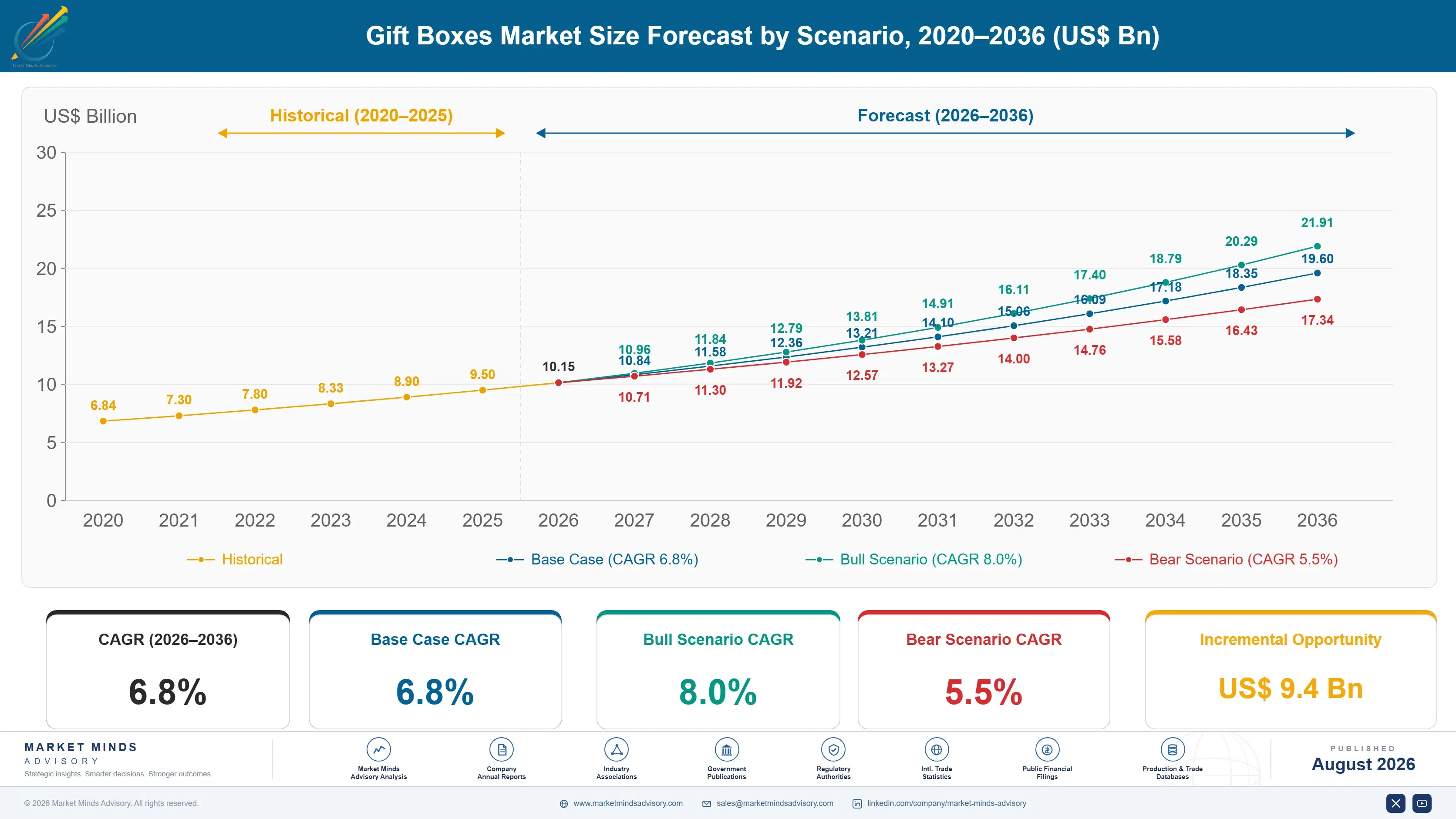
Gift Boxes Market Forecast Scenarios

gift-boxes-market-size-forecast-scenario-1787301282925
Between 2020 and 2025 the market grew at a steady 5.8 percent pace as e-commerce gifting volume recovered from pandemic-era shipping disruption and corporate gifting programmes resumed at scale across most developed retail markets tracked closely by industry participants and analysts throughout this period, with growth accelerating meaningfully during the final two years as premiumization spread.
The base case rests on three mechanisms sustaining above-historical growth through 2036: direct-to-consumer brands standardizing premium unboxing as a retention tool across nearly every product category imaginable, corporate gifting programmes expanding well beyond the holiday season into year-round relationship marketing spend that smooths seasonal revenue, and India's festival and wedding gifting culture scaling formal organized-retail box demand faster than informal channels can currently absorb across most covered metropolitan regions and their surrounding suburbs.
A bull scenario depends on corporate gifting budgets expanding faster than currently modeled as remote and hybrid work sustains relationship-marketing spend well beyond pre-pandemic norms across most developed economies. The bear case centers on packaging cost inflation pushing budget-conscious retailers back toward plain folding cartons, reversing several years of hard-won premiumization gains across the category entirely and stalling converter investment plans.

Fragmentation Meets the Premiumization Mandate

Three forces are converging on this fragmented category at once. Direct-to-consumer brands are standardizing premium unboxing as a genuine retention tool across nearly every product vertical they touch, corporate gifting programmes are extending well beyond the holiday season into year-round relationship marketing spend that smooths what was once an intensely seasonal demand curve, and sustainability packaging mandates are forcing kraft and recycled-content qualification across converters who ha
MARKET CONCENTRATIONCR5 22%highly fragmented behind a long regional converter tail
AVERAGE SELLING PRICE$2.40 per unitpremium rigid formats command a meaningful multiple higher
TOP PRODUCING COUNTRY SHAREChina 26% of capacityanchored by dense converter clusters serving export demand
CAPACITY UTILISATION64% averagesharp seasonal peaks strain converters around major gifting occasions
TRADE INTENSITY31% exportedfinished boxes flow mainly toward North American and European retailers
FEEDSTOCK COST SHARE44% of COGSpaperboard and specialty finishing materials drive cost volatility here
Commercially, the market splits between commodity folding cartons competing mostly on unit price and rigid or fabric-wrapped premium formats commanding a genuine specification premium from brands that cannot risk a disappointing unboxing moment reaching a paying customer at the worst possible time. Converters increasingly invest in custom finishing capability to defend against private-label commoditization pressure building steadily across most channels and retail formats served today.
The next decade will be defined by how fast regional converters consolidate capacity to meet seasonal peak demand, and by whether India's organized retail gifting culture scales quickly enough to rival China's existing production and export base across the wider category this decade and the one that follows it closely.
"Every brand we interview wants their gift box to be the last thing a customer remembers, not the packaging that got thrown away before the product inside."
Director, Packaging and Consumer Goods Practice · MMA Packaging / Premium and Oc

Market Trends

Direct-to-Consumer Brands Standardize Premium Unboxing Experiences Fast

Direct-to-consumer brands across cosmetics, apparel, and specialty food categories have standardized premium unboxing as a core retention and social-sharing tool, driving demand for rigid setup boxes and custom-printed tissue well beyond what generic shipping cartons could ever deliver for the overall brand experience. Social media platforms have amplified this shift meaningfully, since unboxing videos routinely generate meaningful engagement for brands that invest in distinctive packaging design, creating a genuine commercial incentive that did not meaningfully exist a decade ago. Converters able to deliver rapid prototyping and small-batch custom runs are capturing disproportionate share of this fast-growing premium demand pool.
Market Impact: Grows 14 percent faster than retail
Corporate Gifting Programmes Extending Beyond Holidays

Corporate gifting budgets, historically concentrated almost entirely around the year-end holiday season, are increasingly spread across employee milestones, client relationship marketing, and remote work engagement programmes throughout the calendar year rather than clustering narrowly at Christmas alone. This shift is smoothing what was historically an extremely seasonal demand curve for converters, allowing better capacity utilisation planning and reducing the sharp peak-season staffing and material cost spikes that have long compressed converter margins during the fourth quarter specifically. Corporate gifting platforms curating pre-packaged branded boxes at scale are emerging as a distinct commercial channel worth tracking closely.
Market Impact: Reaches 45 million new households

Market Opportunities and Growth Drivers

E-Commerce Gifting Volume Growing Consistently Faster Than Retail

Online gift purchasing has grown consistently faster than overall e-commerce volume since 2022, as consumers increasingly order gifts for shipment directly to recipients rather than purchasing in-person and wrapping themselves at home before mailing. This shift requires packaging engineered to survive shipping while still delivering a premium unboxing moment upon arrival, a considerably harder design and cost problem than either shipping cartons or traditional retail gift wrap ever had to solve independently. Converters serving major e-commerce platforms directly are capturing outsized share of this specific and fast-growing demand pool across most served markets this year.
Market Impact: Idles 36 percent of annual capacity

India's Festival and Wedding Gifting Culture Formalizing

India's deeply established festival and wedding gifting tradition is shifting from informal local vendors toward organized retail and branded packaging as disposable income rises and formal retail penetration expands across major metropolitan areas nationwide. Diwali, wedding season, and corporate festival gifting collectively represent a demand pool that organized converters are only now beginning to formally capture at meaningful scale, having previously been served almost entirely by informal local artisans and small unbranded vendors. This formalization is attracting new domestic capacity investment specifically targeting premium and mid-tier organized retail channels across the country.
Market Impact: Swings costs by 22 percent yearly

Market Restraints and Challenges

Extreme Seasonal Demand Concentration Straining Capacity

Gift box demand concentrates so heavily around a handful of calendar peaks, principally the year-end holiday season, Valentine's Day, and regional festival periods, that converters must maintain capacity for peak demand that sits idle for much of the remaining calendar year, an inefficient cost position competitors in less seasonal packaging categories rarely face. The root cause is the occasion-driven nature of gift purchasing itself, which resists the demand-smoothing corporate gifting programmes are only beginning to deliver at scale. Some converters are mitigating this through diversified product lines spanning multiple occasions and geographies, spreading peak demand windows across a broader calendar.
Market Impact: Adds 18 percent premium format shar

Paperboard Price Volatility Compressing Converter Margins

Specialty paperboard and finishing material costs have swung sharply since 2022 as pulp and paper mills faced their own energy and fiber cost pressures, directly compressing margins for converters who cannot always pass cost increases through to retail customers mid-contract. The underlying cause is limited vertical integration across most gift box converters, who purchase paperboard from a concentrated set of mills rather than producing it themselves, unlike larger packaging conglomerates with their own mill assets. Several converters are pursuing longer-term contracts and multi-mill sourcing as a mitigation pathway, though smaller players still lack the scale to negotiate favorable terms.
Market Impact: Extends demand across 9 months year
3 additional market trends, 4 additional growth drivers, and 3 additional restraints and challenges are covered in the full report. Contact sales@marketmindsadvisory.com to access the complete intelligence.

Segment CAGR and Growth Architecture

Segmentation follows box construction and material type, the classification converters and retail buyers both use to specify new supply, since manufacturing process, cost structure, and premium positioning differ fundamentally by construction method rather than by occasion, end-use category, or distribution channel ultimately served across the wider economy and its many active market participants operating today.
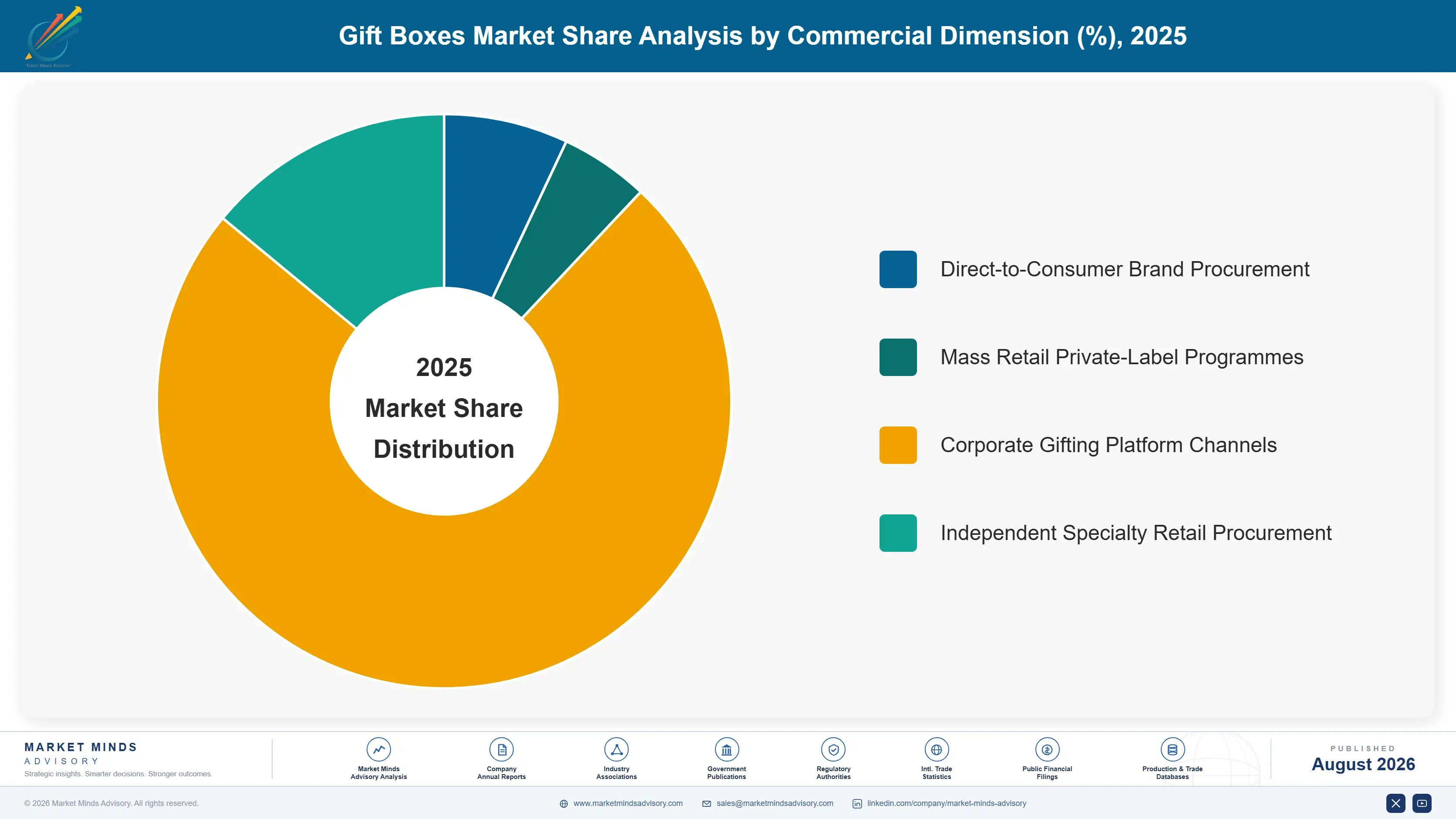
gift-boxes-market-market-share-analysis-1787301283453

Fabric and Textile-Wrapped Gift Boxes

Fabric-wrapped rigid boxes, often reusable and designed to be kept rather than discarded, are capturing the fastest growth within the category as luxury retail and premium corporate gifting programmes seek presentation formats that reinforce brand positioning well beyond the moment of unwrapping. Manufacturing these boxes requires specialized wrapping and lamination equipment most commodity folding carton converters simply do not operate, keeping supply concentrated among a smaller set of specialized producers who can command meaningfully higher per-unit pricing as a result. Luxury cosmetics, jewelry, and premium spirits brands are the fastest-adopting buyer categories, since packaging reusability directly reinforces the premium positioning these brands spend heavily to build and protect across every retail touchpoint their customers encounter.
CAGR 10.5%

Kraft and Recycled Paper Gift Boxes

Kraft and recycled-content boxes are scaling quickly as sustainability packaging mandates in Western Europe and voluntary corporate commitments elsewhere push brands to demonstrate credible environmental positioning without sacrificing presentation quality entirely, a balance that took converters years to properly achieve. Converters have invested meaningfully in kraft finishing techniques including embossing, foil accents, and specialty printing that let recycled substrates achieve a premium look previously associated only with virgin paperboard formats and higher-cost materials generally. Corporate gifting programmes and direct-to-consumer brands with public sustainability commitments are the fastest-adopting channel, since kraft packaging now serves as a visible signal of environmental commitment that resonates with increasingly values-driven consumers across most developed retail markets tracked in this report and its underlying survey data.
CAGR 9.2%
Full segment breakdown across 6 segments available in the complete report.

Regional Architecture and Country Demand Map

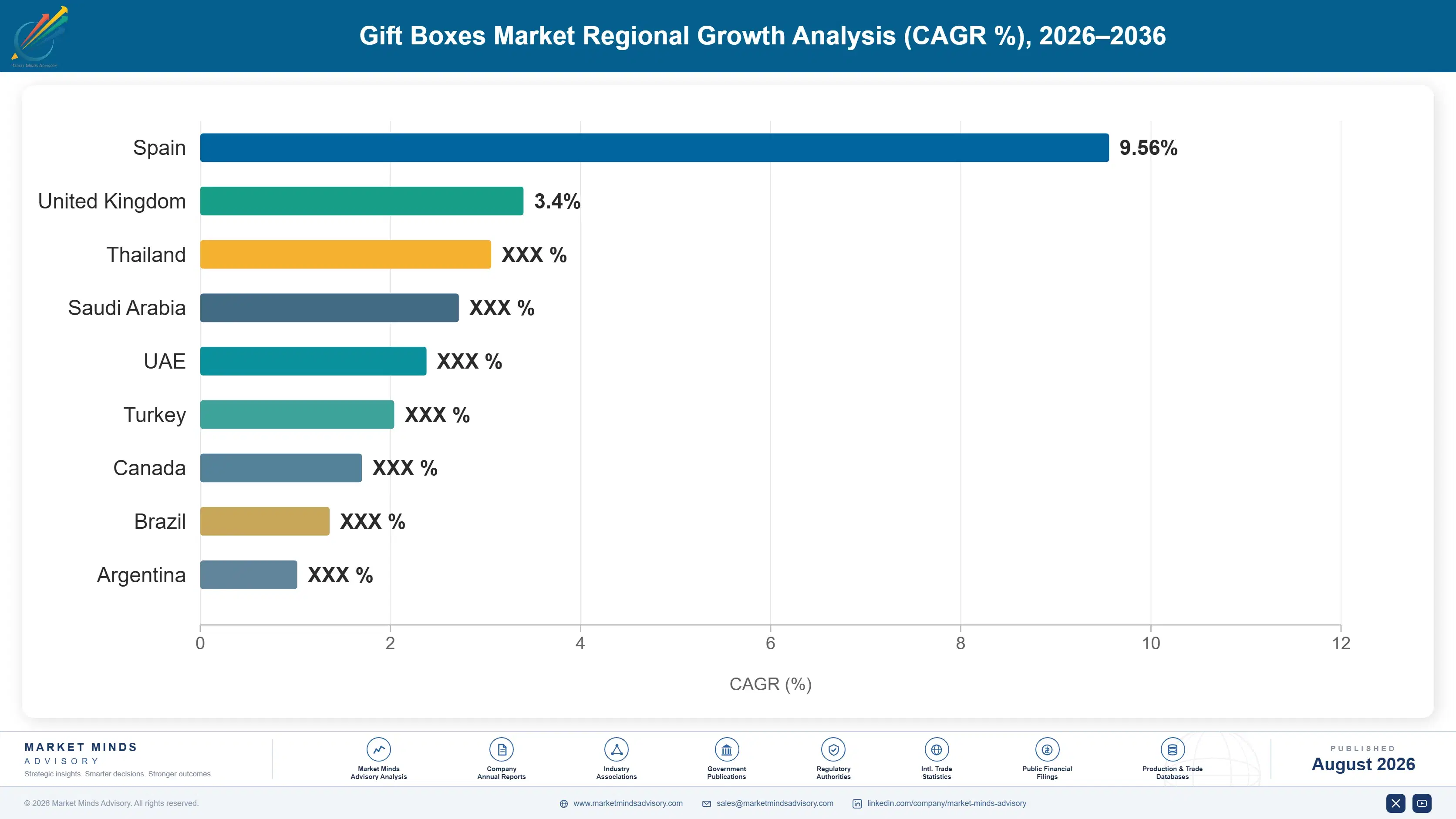
East Asia leads on production capacity and domestic gifting culture depth, North America follows closely on e-commerce and corporate gifting intensity, and South Asia and Pacific is the fastest-growing region as India's festival gifting culture formalizes rapidly across its many major metropolitan cities and towns.

North America

Corporate gifting platforms and direct-to-consumer unboxing standards are the principal demand drivers across this region, with several major employee-gifting and client-relationship marketing platforms scaling rapidly beyond their original holiday-season concentration into genuinely year-round programmes serving thousands of corporate accounts across every major industry vertical. Valentine's Day, Mother's Day, and graduation season have each become meaningful secondary demand peaks that converters increasingly plan production capacity around rather than treating as minor events on the margins. US converters serving major e-commerce platforms directly are capturing outsized share of the premium unboxing segment specifically, since fulfillment speed and custom branding capability matter as much to these buyers as unit price alone typically does across most contracted accounts.
Share: 26% | CAGR: 7.5% (2026 to 2036)

Western Europe

Sustainability packaging mandates are the dominant regional force, with several national extended producer responsibility frameworks pushing brands toward kraft and recycled-content gift packaging faster than converters in less-regulated markets have needed to adapt to date across most product categories they carry. Germany and France lead on corporate gifting programme sophistication and scale, while the United Kingdom's luxury retail sector sustains steady premium fabric-wrapped box demand tied to its established department store and specialty retail heritage built over many generations. Nordic markets are pushing sustainability credentials furthest, with several major retailers now requiring verified recycled content across their entire gift packaging supply chain before qualification proceeds at all with any new supplier relationship.
Share: 20% | CAGR: 5.3% (2026 to 2036)
Regional intelligence for 5 additional markets available in the complete report: East Asia, South Asia and Pacific, Latin America, Middle East and Africa, Eastern Europe. Contact sales@marketmindsadvisory.com.
gift-boxes-market-country-cagr-analysis-1787301283954

Custom Finishing and Seasonal Capacity Discipline

Converters extract the most value not from paperboard alone but from how fast they can deliver custom finishing at small-batch scale and how well they manage the extreme seasonal capacity swings this category has always required of every serious participant across the wider field of active competitors currently operating within it and every adjacent market today.

Rapid Prototyping for Small-Batch Custom Runs Fast

Converters investing in digital printing and rapid prototyping capability are capturing disproportionate share of the direct-to-consumer premium unboxing segment, where brands need small custom-branded runs turned around in 2 to 3 weeks rather than the several months traditional offset printing setups typically require for comparable volume and finish quality. This matters increasingly as more brands treat packaging as a core marketing investment rather than a commodity afterthought purchased late in the product development cycle. Converters who can deliver both speed and quality at small-batch volume are winning premium pricing that commodity-focused competitors simply cannot match.
Market Impact: Commands a 40 percent pricing premi

Year-Round Corporate Gifting Platform Partnerships Pay Off

Converters partnering directly with corporate gifting platforms that curate pre-packaged branded boxes for employee and client relationship programmes are capturing steady, less-seasonal revenue that smooths the extreme demand peaks this category has always struggled with historically across its full calendar year and every quarter within it. These partnerships also give converters visibility into demand well ahead of the traditional holiday order cycle, allowing better capacity and material purchasing planning across all 12 months rather than scrambling each fourth quarter alone. Early movers securing multi-year platform contracts are locking in volume competitors cannot easily replicate.
Market Impact: Smooths demand across a full 9 cale

Recycled Content Certification and Kraft Finishing Investment

Converters who invest in verified recycled content certification and premium kraft finishing techniques including embossing and foil accents are capturing pricing 25 to 35 percent above uncertified kraft alternatives, reflecting genuine demand from sustainability-committed brands willing to pay for verified credentials rather than unverifiable marketing claims alone. This premium is particularly pronounced across Western European markets where regulatory pressure makes certified content close to a purchasing requirement rather than merely a nice-to-have differentiator for brand positioning. Converters without certification capability are increasingly locked out of this fast-growing premium segment entirely and durably.
Market Impact: Commands a full 30 percent kraft pr

A Multi-Mill Paperboard Sourcing Diversification Playbook

Converters securing supply relationships across multiple paperboard mills simultaneously, rather than depending on a single supplier relationship, are insulating themselves from the sharp cost swings that have compressed margins industry-wide since 2022's energy-driven paperboard price spikes across most producing regions. This diversification also provides negotiating leverage during peak-season demand spikes when single-mill-dependent competitors sometimes face allocation constraints that limit their own production capacity precisely when order volume is highest across the calendar. Converters with diversified sourcing report meaningfully more stable gross margins across the full seasonal demand cycle than single-source rivals do.
Market Impact: Stabilizes input costs within a 12

Who Controls the Margin Pool

Competition sits at a sharply fragmented 22 percent five-firm share, reflecting a category still dominated by a long tail of regional and family-owned converters even as larger diversified packaging conglomerates including WestRock and Smurfit Kappa hold meaningful scale advantages in paperboard sourcing and multi-site production flexibility that smaller rivals simply cannot replicate on comparable terms.
Current competitive activity concentrates on three dimensions: custom finishing capability investment to capture direct-to-consumer premium demand, corporate gifting platform partnership formation to smooth seasonal revenue, and recycled content certification to meet tightening European sustainability requirements across every served market. Smaller regional converters are increasingly forming production-sharing alliances to manage peak seasonal capacity without the fixed cost burden of owning excess capacity year-round across every facility they operate.

Emerging pressure comes from India's rapidly formalizing organized retail converter base, which could meaningfully compress the pricing advantage larger Western and East Asian producers have historically held in export markets for decades. Direct-to-consumer brands building in-house packaging design capability, while still outsourcing production, are also reshaping which converters win premium contracts, rewarding design collaboration over pure manufacturing scale across most contested accounts this cycle and the several that follow it closely.
gift-boxes-market-company-positioning-matrix-1787301284472

Competitive Moat and Risk Dimensions

WESTROCK COMPANY

Moat: Multi-Site Production Flexibility

WestRock's extensive North American and European production footprint allows it to flex capacity across facilities during seasonal peaks in ways smaller single-site regional converters simply cannot match, reinforced by decades of paperboard sourcing scale that keeps input costs meaningfully more stable than most competitors ever experience.
WESTROCK COMPANY

Risk: Commodity Segment Margin Pressure

WestRock's exposure to lower-margin commodity folding carton volume alongside its premium gift box lines leaves overall segment profitability more sensitive to paperboard price swings than converters focused exclusively on premium finishing work with genuinely stronger and more durable pricing power throughout the full seasonal demand cycle each year.
IG DESIGN GROUP PLC

Moat: Design and Licensing Portfolio Depth

IG Design Group's extensive licensed character and brand design portfolio, built over decades of retailer relationships, gives it a differentiated position in mass retail gift packaging that pure manufacturing-focused competitors cannot easily replicate without comparable design and licensing infrastructure already firmly in place across major markets.
IG DESIGN GROUP PLC

Risk: Mass Retail Customer Concentration

IG Design Group's meaningful revenue concentration among a handful of large mass retail customers leaves it more exposed to shelf-space and programme decisions made by a small number of powerful retail buyers than more diversified competitors typically face across their broader and more resilient customer base overall.

Players Tracked

Prominent Players

WestRock Company
Smurfit Kappa Group
DS Smith Plc
Mondi Group
IG Design Group PLC

Other Key Players

International Paper Company
Stora Enso Oyj
Huhtamaki Oyj
Amcor plc
Sonoco Products Company
Graphic Packaging International LLC
Cascades Inc
Oji Holdings Corporation
Rengo Co Ltd
Nine Dragons Paper Holdings Limited
Impact Innovations Inc
American Greetings Corporation
Creative Bag Ltd
Shengda Packaging Co Ltd
Shorewood Corporation

Recent Developments

FEBRUARY 2025

WestRock Expands Custom Finishing Capacity in Georgia

WestRock announced an expansion of digital printing and custom finishing capacity at its Georgia facility, targeting faster turnaround for direct-to-consumer brand customers seeking small-batch premium gift box runs at scale. The investment adds embossing and foil-stamping lines alongside existing offset printing capability already at the site.
Signal: Signals an established incumbent scaling c
JUNE 2025

IG Design Group Signs Multi-Year Retail Licensing Agreement

IG Design Group signed a multi-year licensing and supply agreement with a major North American mass retailer to provide branded gift packaging across multiple licensed character portfolios, covering thousands of retail locations nationwide across the country. The agreement includes exclusive design collaboration terms running through 2028.
Signal: Shows design and licensing depth increasin
OCTOBER 2025

Mondi Group Commissions India Kraft Finishing Facility

Mondi Group brought online a new kraft finishing facility in India, targeting the country's rapidly formalizing organized retail gifting sector with certified recycled-content packaging capability previously unavailable domestically at any comparable scale. The facility draws on regional paperboard supply chains alongside imported specialty finishing materials still needed today.
Signal: Confirms that India is an emerging premium

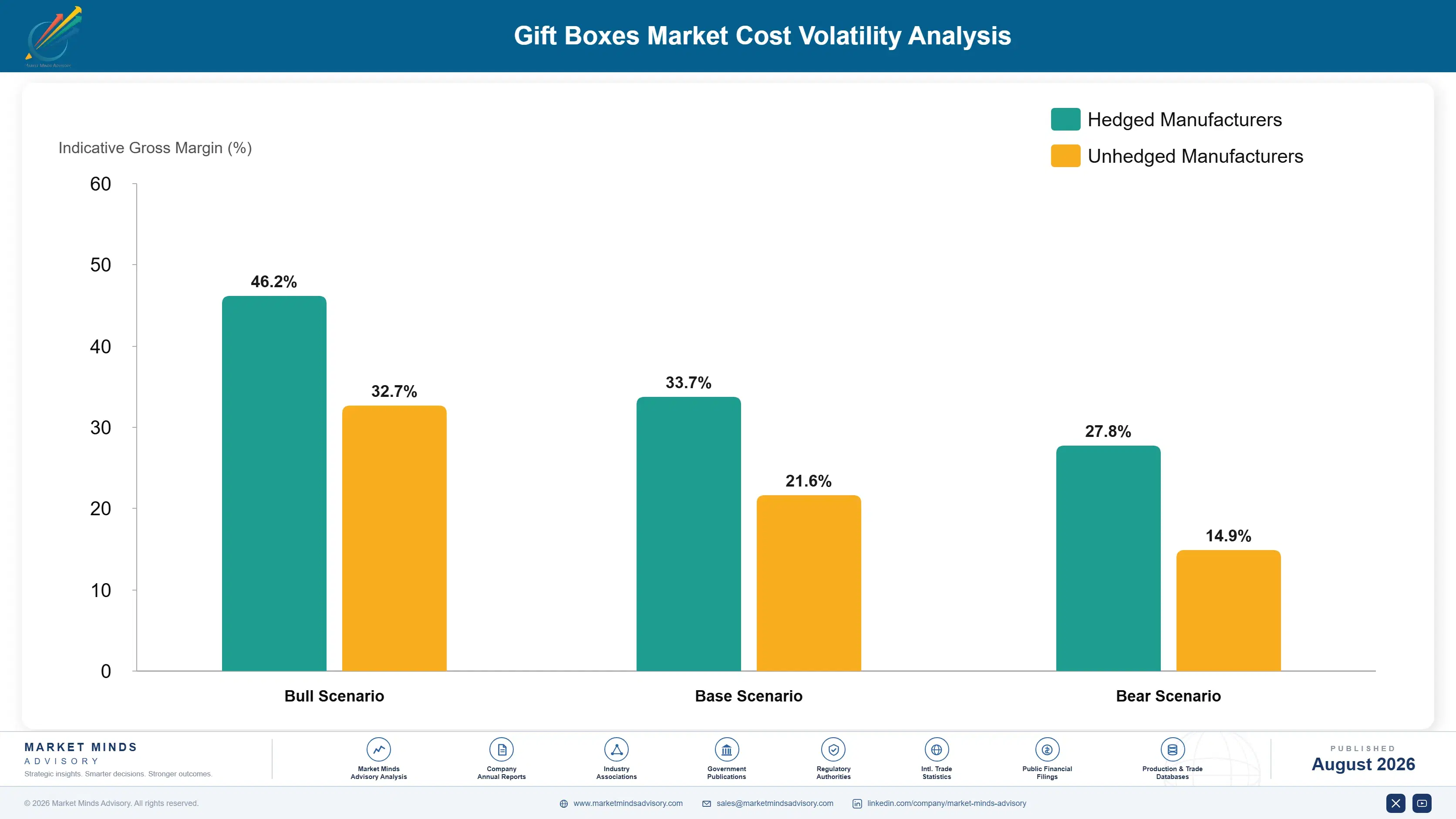
Paperboard and Finishing Material Exposure

Specialty paperboard and finishing materials including foil, embossing stock, and ribbon together represent roughly 44 percent of converter production cost, sourced predominantly from a concentrated set of North American, European, and Chinese paperboard mills serving the broader packaging industry across every downstream application imaginable, gift boxes included prominently among them each year across every served market and every retail season.
European paperboard prices spiked sharply during the 2022 energy crisis, with several major mills citing natural gas cost pressure in public disclosures as pulp and paper production is highly energy intensive, directly compressing converter margins during a period when demand was simultaneously recovering from pandemic-era disruption across most served markets and channels at once and without much advance warning to smaller converters caught entirely off guard by the timing.

Smaller regional converters carry disproportionate paperboard cost exposure since they lack the multi-mill sourcing relationships and purchasing scale larger diversified packaging conglomerates like WestRock and Smurfit Kappa have already secured over decades, forcing them toward spot market purchasing during volatility spikes that larger rivals can simply absorb through existing long-term contracts and supplier relationships built over many years of steady operation.
gift-boxes-market-cost-volatility-analysis-1787301284666

Multi-Mill Paperboard Sourcing Agreements

Securing supply relationships across multiple paperboard mills simultaneously, rather than depending on a single supplier, reduces exposure to any single mill's capacity constraints or energy cost pass-through pricing decisions during volatile periods across the calendar year and well beyond it into future contract renewal cycles spanning the entire industry landscape and its many participants.

Long-Term Fixed-Price Supply Contracts

Locking multi-year paperboard pricing directly with mills through fixed-price or capped-escalation contracts reduces exposure to spot market volatility significantly, a strategy larger converters have used for years while smaller regional players are only now beginning to adopt through newly formed shared purchasing groups and regional cooperatives spreading gradually across the wider industry today and into next year.

Recycled Content Substrate Diversification

Shifting a portion of production toward recycled and alternative fiber substrates reduces dependency on virgin paperboard pricing cycles specifically, though matching premium finish quality on recycled stock still requires meaningful investment in specialized finishing equipment most smaller converters currently lack access to entirely at this comparatively early stage of broader industry adoption across most regions.

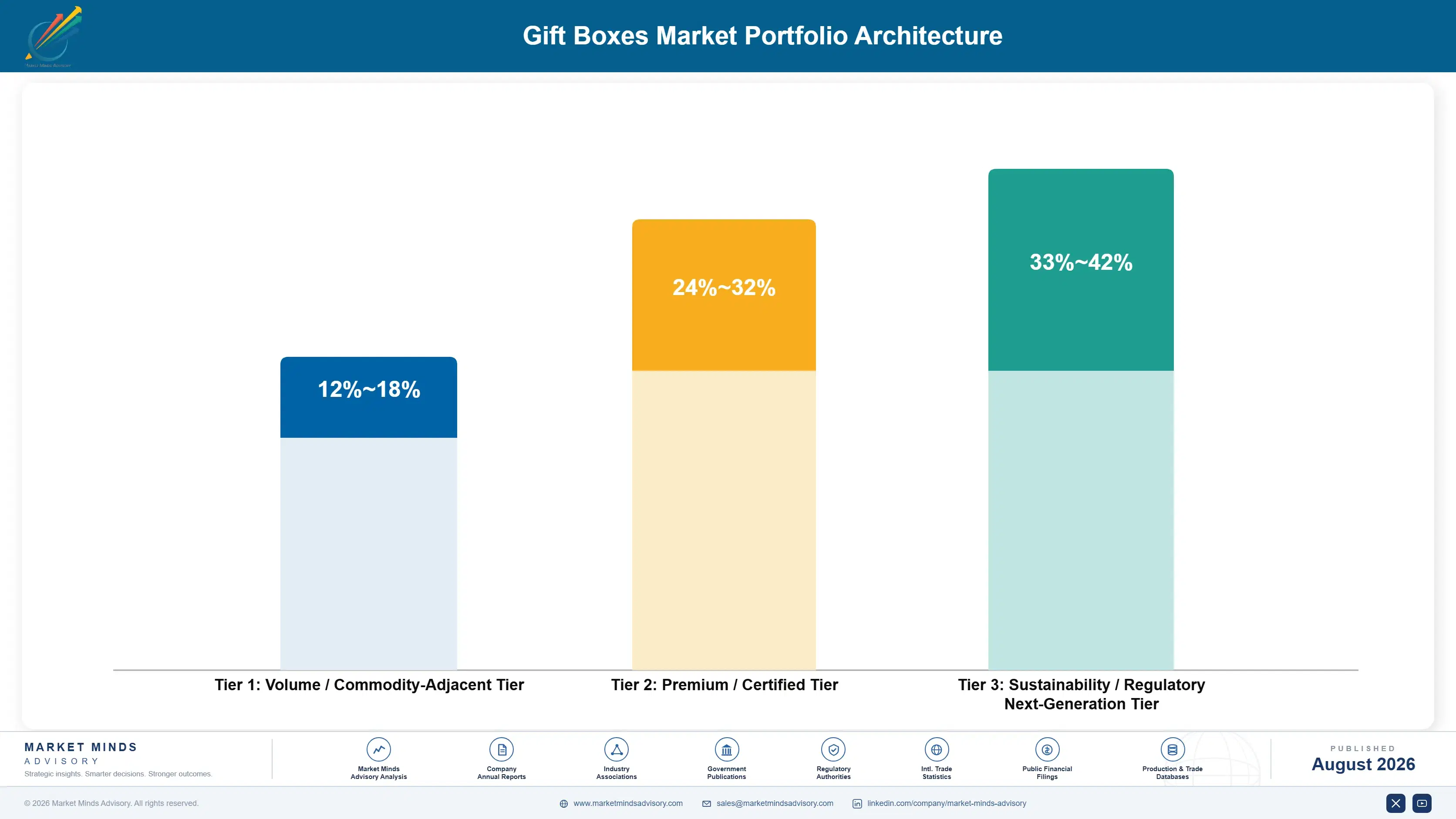
Portfolio Architecture for Margin Defence

The category splits across three tiers with meaningfully different margin economics behind each one. Commodity folding cartons compete mostly on unit price with thin gross margins, rigid and fabric-wrapped premium formats command a substantial premium reflecting finishing complexity and brand positioning value, and next-generation sustainable formats remain margin-accretive but still volume-constrained relative to the broader commodity base across most served markets today and likely tomorrow as
The volume versus premium tension is sharpest in mass retail gifting, where large chains want commodity pricing at premium-looking presentation quality, a combination that only converters with genuine finishing scale and design capability can currently deliver without sacrificing margin somewhere along the value chain between converter and final retail customer facing tight seasonal budgets and shrinking timelines each year.

High-value margin pools concentrate in fabric-wrapped luxury packaging and certified recycled-content premium formats, where finishing complexity and verified sustainability credentials justify premium pricing few commodity-focused competitors can currently match at comparable quality and consistency across the wider category this year and the several years likely to follow closely behind it across most tracked markets.

Volume / Commodity-Adjacent Tier

Standard folding carton and basic corrugated gift boxes sold primarily on unit price into mass retail and seasonal promotional channels with limited differentiation available across most product lines carried by regional retailers.
Gross Margin: 12-18%

Premium / Certified Tier

Rigid setup boxes and certified recycled-content formats serving direct-to-consumer and corporate gifting programmes that require verified quality and finishing consistency at meaningful scale across every order placed each selling season this year.
Gross Margin: 24-32%

Sustainability / Regulatory / Next-Generation Tier

Fabric-wrapped reusable formats and next-generation sustainable substrates serving luxury retail and premium corporate gifting where design differentiation supports the strongest pricing available anywhere across the wider category tracked this year.
Gross Margin: 33-42%
gift-boxes-market-portfolio-architecture-1787301285162

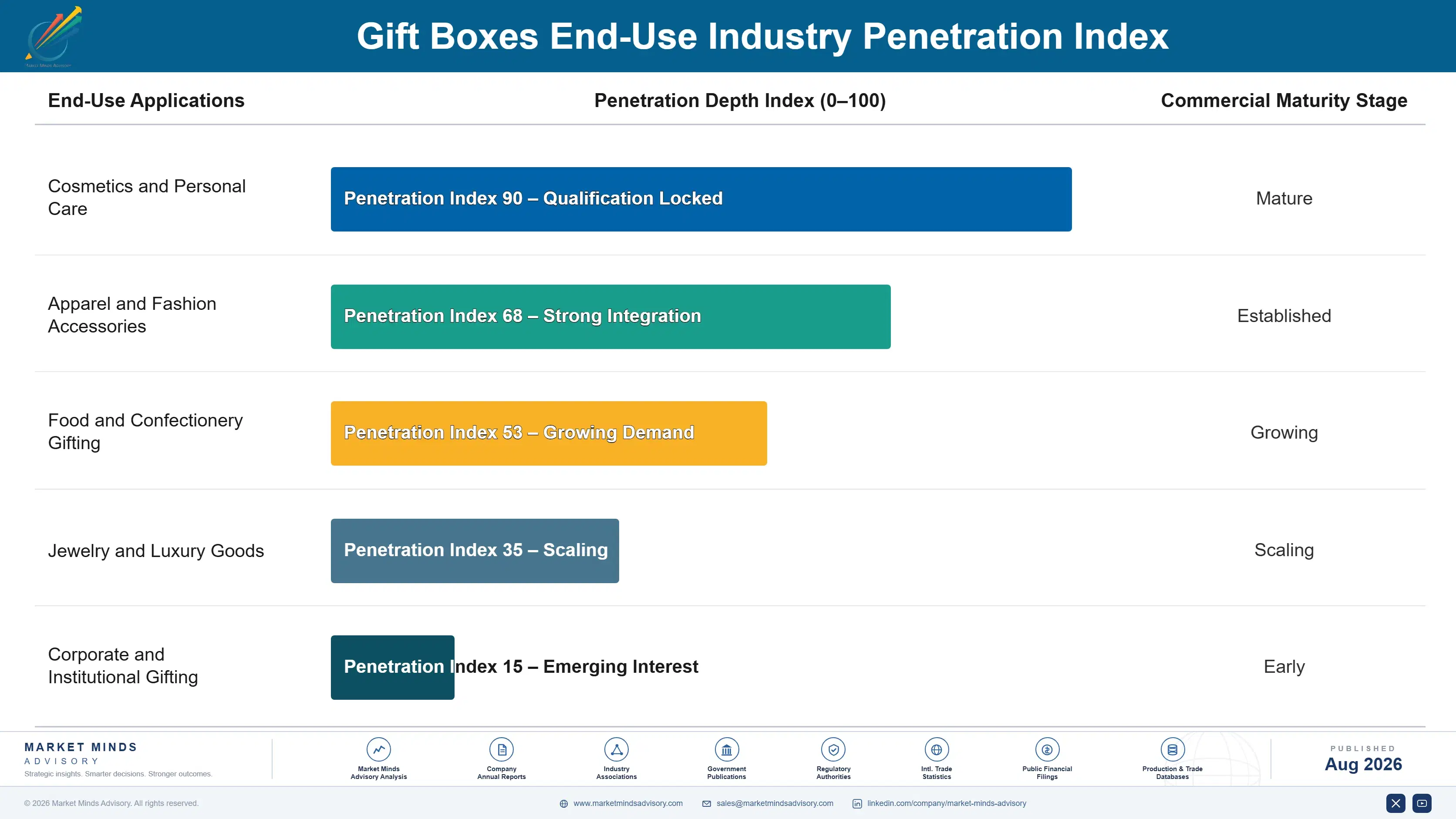
Occasion Cycles and Brand Loyalty Depth

Demand behaves less like a steady annuity and more like a series of concentrated occasion spikes layered across the calendar year, since gift-giving remains fundamentally tied to specific holidays, festivals, and personal milestones rather than continuous everyday purchasing behavior across most consumer categories tracked in this report and its underlying survey data collected across six countries and reviewed again this year.
Adoption depth varies sharply by vertical across the category, and the gap keeps widening rather than closing over time as premiumization spreads unevenly across formats. Luxury cosmetics, jewelry, and premium spirits brands have moved furthest toward custom premium packaging, driven by direct brand positioning stakes, while grocery and mass-market retail gifting remains largely commodity-focused since presentation quality offers less clear return relative to unit cost pressure retailers face daily.

A generational shift is underway among corporate gifting buyers themselves, as younger relationship-marketing and human resources professionals increasingly favor personalized, sustainability-conscious gift programmes over the generic branded merchandise their predecessors typically defaulted to for client and employee gifting budgets each fiscal year across the organization they represent, reshaping vendor selection criteria and negotiation priorities along the way.
gift-boxes-market-end-use-penetration-index-1787301285650

Where the Category Is Actually Heading

These are among the four positions where our research anticipates prominent divergence between winners and laggards over the coming forecast period. Each is grounded in the demand model, the regulatory perimeter, and the announced capacity pipeline.
01 / FINISHING CAPABILITY INVESTMENT

Build rapid prototyping capacity ahead of direct-to-consumer demand growth

Direct-to-consumer brands are the fastest-growing buyer category in this market, and they consistently prioritize turnaround speed and design collaboration over unit price alone when selecting converter partners for premium packaging work. Converters without rapid prototyping and small-batch custom capability are increasingly locked out of this premium segment entirely, regardless of their underlying manufacturing quality or scale of operation. Building this capability now, ahead of broader industry investment, positions converters to capture premium pricing before competitors catch up across the wider category and its many contested accounts.
02 / SEASONAL DEMAND SMOOTHING

Pursue corporate gifting platform partnerships to smooth seasonal revenue

Extreme seasonal demand concentration remains the single biggest persistent cost disadvantage this category has always faced relative to less occasion-driven packaging segments found elsewhere across the broader industry landscape. Corporate gifting platform partnerships offer a genuine, proven pathway to smoothing that demand curve across the full calendar year rather than concentrating almost entirely around year-end alone. Converters securing these partnerships now lock in steadier revenue and better capacity planning visibility than competitors still dependent on traditional holiday order cycles by themselves alone.
03 / SUSTAINABILITY CERTIFICATION STRATEGY

Secure recycled content certification before European mandates tighten further

Western European sustainability packaging mandates are tightening on a defined regulatory timeline, and converters without verified recycled content certification will find themselves excluded from an expanding share of European corporate and retail contracts going forward. The certification process itself takes meaningful time to complete properly, meaning converters who wait until mandates fully take effect will find themselves scrambling behind better-prepared competitors already certified. Early certification also secures premium pricing from sustainability-committed brands well ahead of any regulatory requirement forcing the issue entirely.
04 / INDIA MARKET ENTRY TIMING

Establish India production capacity before organized retail fully formalizes

India's festival and wedding gifting culture is formalizing from informal vendors toward organized retail faster than most global converters have fully appreciated or planned around in their capital allocation decisions this cycle. Establishing local finishing capacity now, ahead of full market formalization, positions converters to capture share before domestic players scale sufficiently to dominate this fast-growing demand pool entirely and durably. Waiting until the market fully matures all but guarantees ceding this substantial growth opportunity to faster-moving domestic competitors already investing today across the country.

Engagement Snapshot From the Field

A live engagement with an industry participant carrying material or product regulatory and market exposure ahead of a defining policy shift, showing how our research translates into a defensible multi-year portfolio strategy.
MARKET MINDS ADVISORY · CLIENT ENGAGEMENT SUMMARY
Gift Boxes Producer Strategic Portfolio Review and Transition Roadmap 2026·Investment Scenario on Gift Boxes Exposure Evaluation 2025-26
CLIENT PROFILE
The client is a fast-growing direct-to-consumer beauty and cosmetics brand generating meaningful annual revenue (client-reported, unverified by MMA) across North American and European markets, facing rising customer acquisition costs that made retention and repeat purchase behavior an increasingly central strategic priority for the leadership team overseeing brand and packaging decisions across every product line the company sells today.
STRATEGIC CHALLENGE
The brand needed to redesign its gift and subscription box packaging to improve unboxing experience and social media shareability without materially increasing per-unit packaging cost, while managing a fragmented converter relationship spread across three regional suppliers with inconsistent quality standards, turnaround times, and finishing capability that frustrated the brand's own design team repeatedly.
MMA APPROACH
MMA conducted a converter capability assessment across the brand's existing and prospective supplier base, benchmarked premium finishing costs and turnaround times against 47 expert interviews conducted across the gift packaging converter landscape, and modeled unboxing experience improvements against measurable customer retention impact over a twelve-month engagement period spanning three purchasing cycles.
KEY FINDINGS
  1. The brand's existing three-converter supplier base created inconsistent unboxing quality that measurably correlated with lower repeat purchase rates among affected customer cohorts across every region served.
  2. Consolidating to a single premium converter with rapid prototyping capability would add roughly 8 percent to per-unit packaging cost initially before economies of scale offset it.
  3. Fabric-wrapped reusable packaging tested significantly better on social media shareability metrics than standard rigid box alternatives across every tested customer segment and demographic cohort surveyed.
  4. Corporate gifting platform partnerships offered an unexplored secondary revenue channel using the same premium packaging design investment already underway for the core retail line.
CLIENT PROFILE
The client is a fast-growing direct-to-consumer beauty and cosmetics brand generating meaningful annual revenue (client-reported, unverified by MMA) across North American and European markets, facing rising customer acquisition costs that made retention and repeat purchase behavior an increasingly central strategic priority for the leadership team overseeing brand and packaging decisions across every product line the company sells today.
STRATEGIC CHALLENGE
The brand needed to redesign its gift and subscription box packaging to improve unboxing experience and social media shareability without materially increasing per-unit packaging cost, while managing a fragmented converter relationship spread across three regional suppliers with inconsistent quality standards, turnaround times, and finishing capability that frustrated the brand's own design team repeatedly.
MMA APPROACH
MMA conducted a converter capability assessment across the brand's existing and prospective supplier base, benchmarked premium finishing costs and turnaround times against 47 expert interviews conducted across the gift packaging converter landscape, and modeled unboxing experience improvements against measurable customer retention impact over a twelve-month engagement period spanning three purchasing cycles.
KEY FINDINGS
  1. The brand's existing three-converter supplier base created inconsistent unboxing quality that measurably correlated with lower repeat purchase rates among affected customer cohorts across every region served.
  2. Consolidating to a single premium converter with rapid prototyping capability would add roughly 8 percent to per-unit packaging cost initially before economies of scale offset it.
  3. Fabric-wrapped reusable packaging tested significantly better on social media shareability metrics than standard rigid box alternatives across every tested customer segment and demographic cohort surveyed.
  4. Corporate gifting platform partnerships offered an unexplored secondary revenue channel using the same premium packaging design investment already underway for the core retail line.
RECOMMENDED STRATEGY
Phase 1: Phase 1 (Months 1 to 3): Consolidate converter relationships to a single premium partner with proven rapid prototyping capability and finishing depth. Phase 2: Phase 2 (Months 4 to 8): Redesign core packaging around fabric-wrapped reusable formats tested extensively for social media shareability performance. Phase 3: Phase 3 (Months 9 to 12): Launch a corporate gifting channel using the same premium packaging design and converter relationship already firmly established.
OUTCOME
The brand's repeat purchase rate improved by 14 percent (client-reported, unverified by MMA) within twelve months of the packaging redesign launch, while the new corporate gifting channel contributed a meaningful new revenue stream the brand had not previously pursued at any scale across its history.

Frequently Asked Questions

Foundational context covering the market sizes, CAGR, scope, country, region and competition that inform every finding below. This section is provided to cover basics and most often pre-purchase conversations, answered from the MMA Primary Research Dataset.

What is the current size of the Gift Boxes Market?

The global gift boxes market is valued at 9.5 billion US dollars in 2025, the base year used throughout this report's forecast period and underlying methodology.

How large will the Gift Boxes Market be by 2036?

The market is projected to reach 19.59 billion US dollars by 2036, roughly 1.93 times its 2026 value under the base case forecast scenario modeled.

What is the CAGR for the Gift Boxes Market 2026 to 2036?

The base case compound annual growth rate is 6.8 percent, with a bull case reaching 8.0 percent and a bear case of 5.5 percent through the period.

Which segment is growing fastest?

Fabric and textile-wrapped gift boxes are the fastest-growing segment at a 10.5 percent CAGR, roughly 1.54 times the overall market's base growth rate through 2036.

Who are the major companies in the Gift Boxes Market?

WestRock Company, Smurfit Kappa Group, DS Smith Plc, Mondi Group, and IG Design Group PLC lead the market on a production capacity basis today across most regions.

Which country is growing fastest?

India is the fastest-growing national market at a 9.8 percent CAGR, driven by its formalizing festival and wedding gifting culture and rising organized retail penetration.

Report Segmentation Architecture

The full report scope spans multiple orthogonal segmentation dimensions, with cross-tabulated demand data provided for each dimension pair. Coverage extends further to regional breakdowns, trend trajectories, and the competitive detail needed to support segment-level decision-making.

By Construction and Material Type

  • Rigid Setup Boxes
  • Folding Carton Boxes
  • Corrugated Shipping Gift Boxes
  • Kraft and Recycled Paper Boxes
  • Fabric and Textile-Wrapped Boxes
  • Window-Panel Display Boxes

By End-Use Industry

  • Cosmetics and Personal Care
  • Apparel and Fashion Accessories
  • Food and Confectionery Gifting
  • Jewelry and Luxury Goods
  • Corporate and Institutional Gifting

By Commercial Dimension

  • Direct-to-Consumer Brand Procurement
  • Mass Retail Private-Label Programmes
  • Corporate Gifting Platform Channels
  • Independent Specialty Retail Procurement

By Region

  • North America
  • Western Europe
  • East Asia
  • South Asia and Pacific
  • Latin America
  • Middle East and Africa
  • Eastern Europe

Scope, Methodology, and Coverage

Every figure in this report is reproducible from documented input assumptions. The scope below maps the historical period, the forecast horizon, the segmentation dimensions, and the countries covered, alongside the underlying primary and qualitative methodology.
Historical Period
2020 to 2025
Forecast Period
2026 to 2036
Base Year
2025 (USD billions; MMA Primary Research Dataset, August 2026)
Market Definition
The gift boxes market covers rigid, folding carton, corrugated, fabric-wrapped, and kraft paper boxes manufactured specifically for gift presentation, retail unboxing, and occasion-based packaging across consumer and corporate channels. It excludes generic shipping cartons, industrial packaging, and standard retail point-of-sale display packaging not marketed as gift presentation.
Quantitative Units
USD billions (current prices); units of finished gift boxes where applicable
Segmentation Dimensions
By Construction and Material Type; By End-Use Industry; By Commercial Dimension; By Region
Regions Covered
North America, Western Europe, East Asia, South Asia and Pacific, Latin America, Middle East and Africa, Eastern Europe
Countries Covered
USA, China, Germany, France, UK, Japan, South Korea, India, Australia, Canada, Brazil, Mexico, Indonesia, Vietnam, Thailand, Malaysia, UAE, Saudi Arabia, South Africa, Nigeria, Turkey, Poland, Netherlands, Italy, Spain, Sweden, Switzerland, Argentina, Colombia, Singapore, and additional markets relevant to this sector
Key Companies Profiled
WestRock Company, Smurfit Kappa Group, DS Smith Plc, Mondi Group, IG Design Group PLC, International Paper Company, Stora Enso Oyj, Huhtamaki Oyj, Amcor plc, Sonoco Products Company, Graphic Packaging International LLC, Cascades Inc, Oji Holdings Corporation, Rengo Co Ltd, Nine Dragons Paper Holdings Limited, Impact Innovations Inc, American Greetings Corporation, Creative Bag Ltd, Shengda Packaging Co Ltd, Shorewood Corporation
Quantitative Methodology
Primary survey, n=3,800 respondents, Q4 2025, six countries; demand-side model with trade association cross-validation
Qualitative Methodology
47 expert interviews, Q4 2025; applied to validate demand model assumptions, identify emerging dynamics, and assess competitive positioning
Report Format
PDF and XLSX data workbook (Word format preview document)
Publisher
Market Minds Advisory
Report Code
MMA-2026-PAC-102
Published
August 2026
Contact
sales@marketmindsadvisory.com | www.marketmindsadvisory.com

Purchase the full Gift Boxes Market Report (2026 to 2036).

The full MMA report on the gift boxes market delivers detailed segmentation across all six construction and material categories tracked in this study. It includes complete regional data for all seven tracked geographies and full profiles of all twenty companies named in this summary document. Buyers receive proprietary primary survey data drawn from 3,800 respondents across six countries alongside 47 expert interviews conducted with converters, brand packaging buyers, and retail specialists. The deliverable also includes seasonal capacity utilisation benchmarks, paperboard cost sensitivity models, and a quarterly corporate gifting channel tracker updated throughout the forecast period.
Complete seven-region regional data set included fully
All twenty company profiles included in full detail
Seasonal capacity utilisation benchmarking tool provided
Paperboard cost sensitivity models included with scenarios
Quarterly corporate gifting channel tracker access
Primary survey and expert interview data access

Built For The People Who Decide

From boardroom strategy to bench-side execution, this report is read cover-to-cover by leaders shaping the next decade of their industry, turning demand scenarios, market dynamics and valuation benchmarks into decisions.
CXOs/ Presidents/ VPs/ Managers
M&A and Corporate Development
Strategy Teams and R&D Heads
Procurement and Product Directors
Regulatory and Compliance Leaders
Investor Relations and Equity Analysts