
Market Minds Advisory
Fire Retardant Fabrics Market

Fire Retardant Fabrics Market: The Wearer Cannot Tell When Protection Has Gone

A treated garment stops protecting after roughly fifty industrial washes and looks exactly the same afterwards, which is the uncomfortable fact underneath every purchasing decision in this market. Almost nobody measures it.

Lead Analyst

Bilal Shaikh

Published

August 2026

Make Smarter Decisions with Customized Research Insights

Request a free sample report and evaluate market opportunities, growth trends, and competitive dynamics relevant to your business needs.

2025 MARKET VALUE$4.8BMarket Size 2025
2036 FORECAST VALUE$9.6BBase Case , 2026 to 2036
CAGR 2026 TO 20366.5 %Bull 7.7% / Bear 5.3%
INCREMENTAL OPPORTUNITY$4.5BNet 10- year value creation
EXPANSION MULTIPLE1.88x2036 value over 2026 base
Strategic Levers
M&A Pipeline
Regional Outlook
Country Rankings
Competitive Intelligence
Segmental Deep-dive
Call-Us : 91 93563 13602

Executive Snapshot and Market Trajectory

Treated fire retardant fabric loses meaningful protection after roughly 50 industrial washes and gives the wearer no indication that it has. Inherent fibres protect for the garment's life. That difference is the central commercial argument in this market and almost nobody tracks it in the field.
Growth runs at 6.5% and specialty fibres lead it. High-performance fabrics grow at 9.75%, exactly 1.50 times the market rate, pulled by arc flash and multi-hazard requirements that single-protection constructions cannot satisfy. East Asia holds 31%, above band, because Chinese and Indian mills produce most of the world's protective fabric and regional industrial workforces consume it. Certification tests the finished fabric rather than the fibre in it.
Concentration is moderate at 44% across the top five measured on protective fabric value supplied, and fibre access rather than weaving capability holds it. Certification runs around 38,000 dollars per fabric construction per standard, which quietly limits how many constructions any mill can afford to offer at all. Programmes replace garments on roughly three year cycles and rarely revisit the specification. Winning the specification is worth far more than winning any order.
Market Definition
This market covers woven and knitted fabrics supplied with flame resistant performance for protective apparel, transportation, and furnishing applications, spanning aramid and para-aramid fabrics, modacrylic and blended inherent fabrics, flame retardant treated cotton and cellulosic fabrics, flame retardant viscose and regenerated cellulosic fabrics, and specialty high-performance fabrics. Protective fibres sold as staple or filament, finished garments and personal protective equipment, flame retardant chemical additives sold separately, non-woven fire barriers, and rigid fire protection materials fall outside scope.
Base Year Value
$4.8B in 2025 (MMA Primary Research Dataset, August 2026)
Forecast Period
2026 to 2036, eleven discrete annual values
CAGR
6.5% base case. Bull 7.7%. Bear 5.3%.
Fastest Growth Segment
Specialty High-Performance Fabrics: 9.8% CAGR
Fastest Growth Country
India: 9.4% CAGR
Fastest Growth Region
South Asia and Pacific: 8.6% CAGR
Largest Region
East Asia: 31% of 2025 global value
Market Leaders
DuPont, Teijin Aramid, TenCate Protective Fabrics, Milliken, Lenzing. Source: MMA Analysis based on company annual reports.
Primary Survey
n=3,800 procurement and R&D decision-makers, Q4 2025, six countries
Methodology
Demand-side build-up, cross-validated against public data, 47 expert interviews

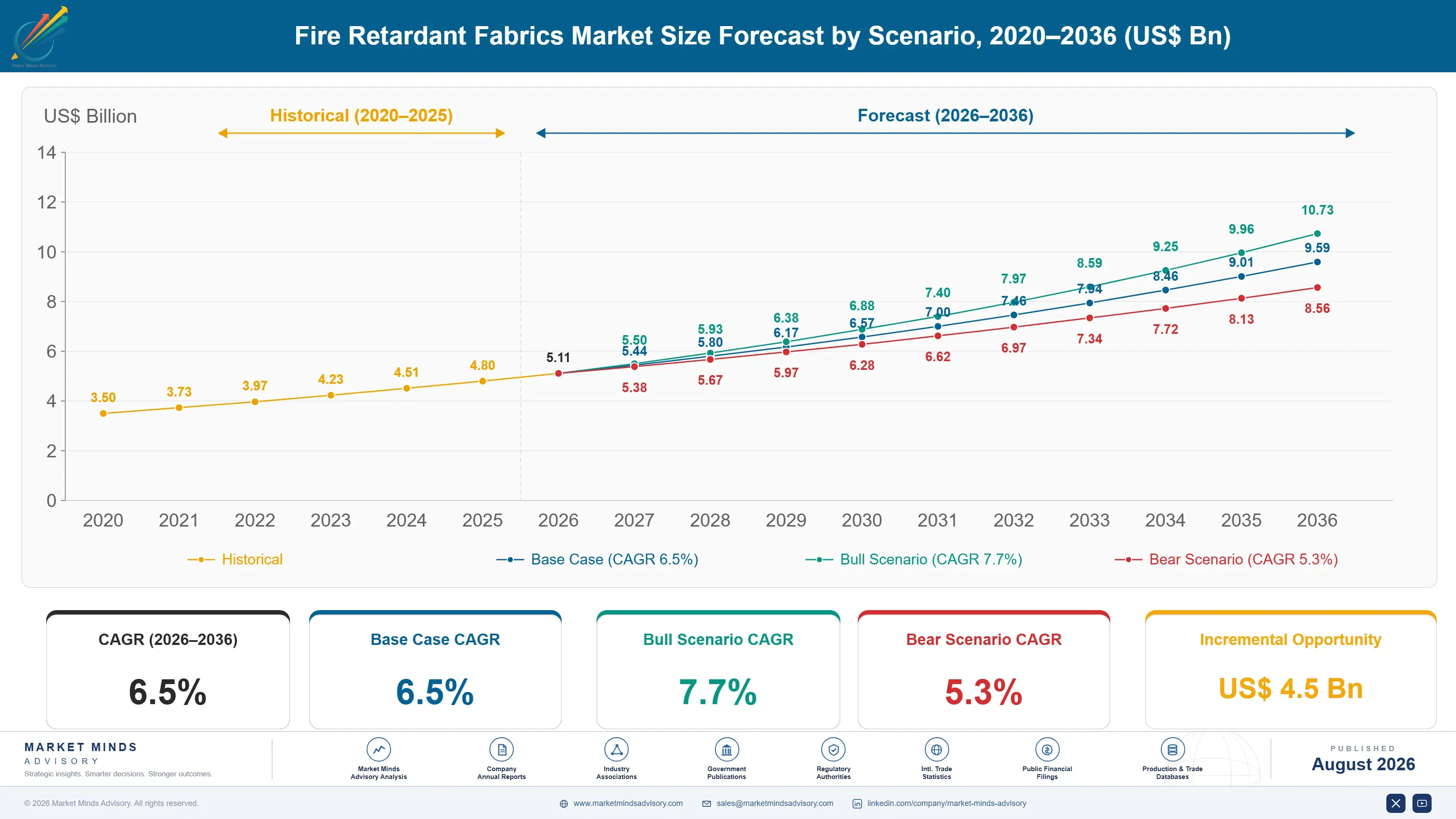
Fire Retardant Fabrics Market Forecast Scenarios

fire-retardant-fabrics-market-size-forecast-scenario-1787302710560
The 2020 to 2025 period ran at 5.4% and industrial activity explained most of the shape. Oil and gas workwear volumes fell sharply through 2020 as field activity stopped, recovered from 2022, and never quite regained the pre-pandemic workforce numbers that had supported them. Utility and electrical protection demand grew steadily throughout, entirely insulated from that cycle by regulation rather than by activity.
Three mechanisms carry the 6.5% base case. Electrical arc flash protection is the largest, since grid investment expands the workforce required to build and maintain it and arc rating is mandatory rather than discretionary. Multi-hazard requirements are the second, at 9.75%, where a single garment must resist flame, arc, and chemical exposure. And Asian industrial safety enforcement is the third, tightening from a low base. Transportation and furnishing fire performance sits beneath all three at steadier rates.
The 7.7% bull case rests on industrial safety enforcement across Asian manufacturing accelerating faster than currently scheduled, which would convert a large untreated workforce into a regulated one. The 5.3% bear case is treated cotton holding share on price in cost-sensitive markets, since the wash life problem is invisible to buyers who have never measured it.

Protection Nobody Can See Expiring

The uncomfortable fact in this industry is that protection expires invisibly. Flame retardant treatment applied to cotton degrades through industrial laundering and loses meaningful performance after roughly 50 washes, while the garment looks, feels, and fits exactly as it did on day one. Inherent fibres carry protection in the polymer itself and keep it until the fabric physically wears out.
TOP FIVE CONCENTRATION44%Moderate, held through protective fibre access and certification depth
INHERENT SHARE OF VALUE63%Of fabric value from fibres protective for the garment life
TREATED FABRIC WASH LIFE50 washesAfter which industrial laundering degrades applied protection quite meaningfully
CERTIFICATION TEST COST38,000Per fabric construction against one single protective performance standard
GARMENT REPLACEMENT CYCLE3 yearsAcross regulated industrial protective clothing programmes in most sectors
FIBRE SHARE OF COST58%Of finished fabric cost from the protective fibre alone
That distinction shapes the whole value structure. Inherent fabrics account for around 63% of market value on considerably less than that share of metres, because buyers who have understood the wash life problem pay for it. Buyers who have not compare price per metre and select treated cotton, which is a rational decision given the information they actually have in front of them.
Certification does the rest of the work. Testing a fabric construction against a single protective standard costs around 38,000 dollars, and a mill serving several standards across several weights carries that cost many times over. Concentration at 44% follows from that as much as from fibre access, since a small mill simply cannot afford a broad certified range. Withdrawing certification on constructions nobody orders is uncomfortable and usually correct.
"We have tested garments pulled off working crews at ninety washes that would not pass their original standard. Nobody in that plant knew. The garment looked fine, and nothing in the programme was checking."
Director, Technical Textiles and Protective Materials Practice · MMA Chemicals a

Market Trends

Multi-Hazard Requirements Push Toward Specialty Constructions

Workers facing flame, electric arc, and chemical splash within a single job increasingly need one garment covering all three rather than layered single-hazard clothing, and specialty high-performance fabrics grow at 9.75% against 6.5% for the market. Blending fibres to satisfy several standards at once is genuinely difficult, since properties that improve one performance measure frequently degrade another. Certification cost multiplies across every standard the construction must satisfy. Volumes are small against aramid and modacrylic while pricing sits far above both. That combination is unusual in technical textiles. Few mills can reach it.
Market Impact: Inherent fabrics hold 63% of value
Wash Life Auditing Enters Protective Clothing Programmes

A small but growing number of large industrial employers now test garments pulled from working crews rather than trusting the original certification, and results across treated cotton programmes have prompted several to move to inherent fabrics entirely. Treated protection degrades after roughly 50 industrial washes with no visible change. That auditing practice is the single most effective commercial argument inherent fibre producers have ever had. Employers who ran those audits moved programmes without any supplier persuasion being required at all. Evidence did what argument never had. Very few suppliers fund the testing.
Market Impact: Garments replace every 3 years

Market Opportunities and Growth Drivers

Grid Investment Expands The Arc-Rated Workforce

Transmission and distribution construction across every major economy requires linemen, substation technicians, and contractors whose clothing must carry arc ratings that are mandatory rather than discretionary. That workforce grows with grid capital spending, which IEA reporting has tracked rising for several consecutive years. Arc protection is also the application where treated fabrics perform worst relative to inherent ones, which pulls the mix upward as the volume grows. Grid workforce numbers are visible years ahead through committed transmission programmes. Mills that track them quote before the enquiry arrives. Most do not track them at all.
Market Impact: Certification costs 38,000 per cons

Replacement Cycles Make Demand Genuinely Recurring

Regulated protective clothing programmes replace garments on roughly three year cycles regardless of wear, which converts a fabric sale into a repeating requirement tied to headcount rather than to any capital decision. Employers rarely revisit the fabric specification between cycles, so a mill qualified into a programme ships against it for years. Winning the specification matters considerably more than winning any individual order. The specification decision is taken by safety and procurement functions together, frequently years ahead. Mills selling to garment makers never see it happen. That distance costs them the programme.
Market Impact: Protection degrades by 50 washes

Market Restraints and Challenges

Certification Cost Limits How Many Constructions A Mill Offers

Testing one fabric construction against one protective standard costs around 38,000 dollars, and the root cause is that certification tests the finished fabric rather than the fibre, so every weight, weave, and blend requires its own programme. Commercial impact is that small mills carry narrow certified ranges and lose work they could physically produce. Mitigation runs through platform constructions certified across several standards, shared testing with fibre suppliers, and declining to chase every specification variant. Withdrawing certification on low volume constructions is uncomfortable and it is usually the right call. Recertification budget gets consumed by fabrics nobody orders.
Market Impact: Specialty fabrics grow at 9.75%

Price Comparison Ignores The Wash Life Difference

Treated cotton costs materially less per metre than inherent fabric and the root cause of the confusion is that protection degrades invisibly, so a purchasing comparison based on price and appearance reaches the wrong answer honestly. Commercial impact is that treated fabric holds share in cost-sensitive markets on economics that do not survive examination. Mitigation runs through garment audit programmes, total cost per protected year modelling, and employer education that suppliers rarely fund adequately. Employers who tested garments from their own crews moved programmes immediately afterwards. Nothing else has shifted those accounts. Very few suppliers will pay for the audits.
Market Impact: Treated protection fades near 50 wa
3 additional market trends, 4 additional growth drivers, and 2 additional restraints and challenges are covered in the full report. Contact sales@marketmindsadvisory.com to access the complete intelligence.

Segment CAGR and Growth Architecture

Segmentation follows the fibre system carrying the protection, because that determines whether performance is inherent or applied, how it survives laundering, what standards the fabric can reach, and the cost per metre. End-use industry and garment type both cut across every fibre system rather than separating them cleanly. Fibre decides whether protection survives laundering. Nothing else does.
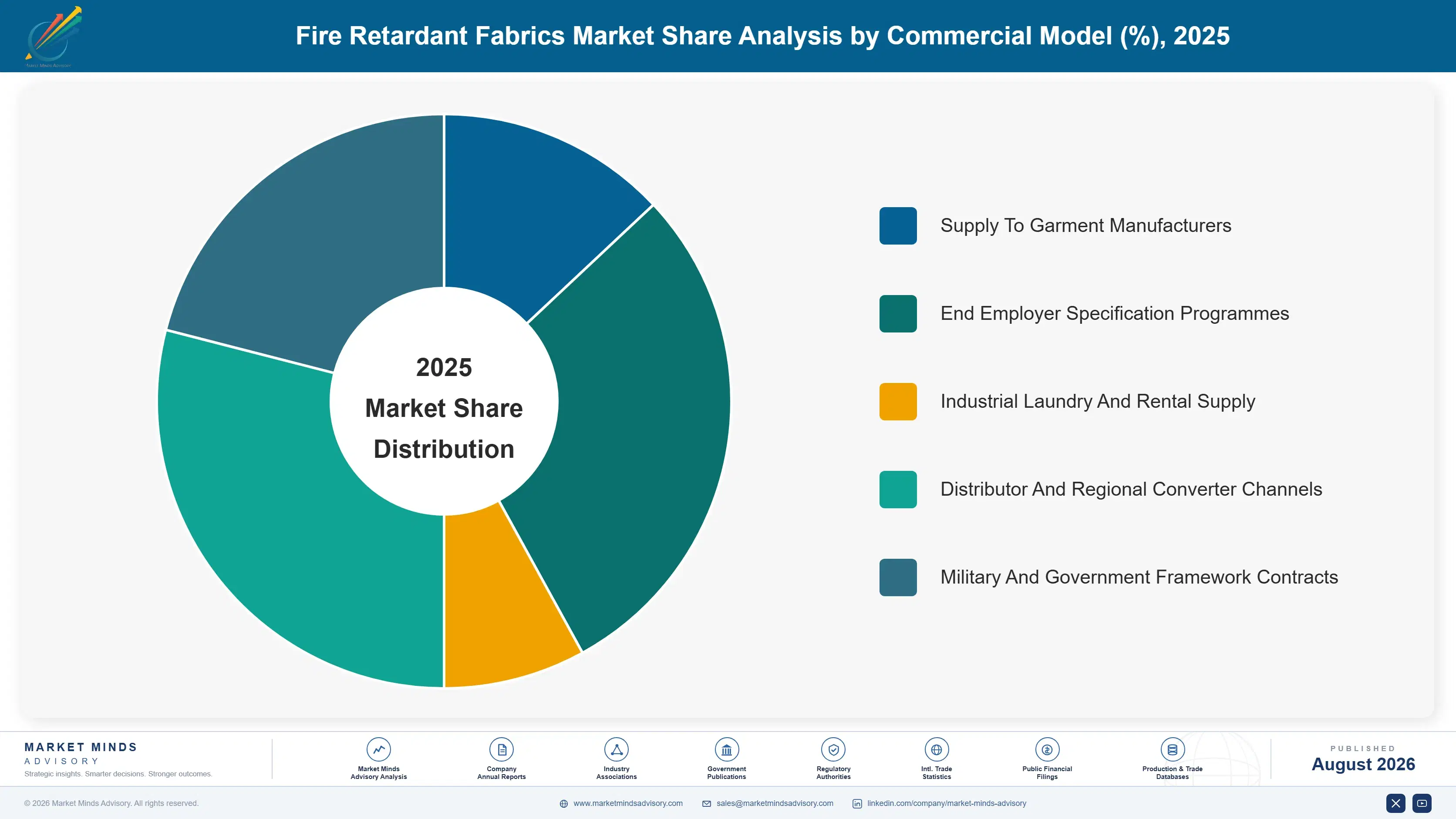
fire-retardant-fabrics-market-market-share-analysis-1787302711092

Specialty High-Performance Fabrics

The fastest fibre system at 9.75%, exactly 1.50 times the market rate, covering polybenzimidazole, melamine, oxidised carbon, and engineered blends used where flame, arc, and chemical hazards occur together. Blending to satisfy several standards at once is genuinely difficult, because properties improving one measure frequently degrade another and certification cost multiplies across every standard involved. Volumes are small against aramid and modacrylic, and pricing sits far above both, which makes this the best margin available anywhere in protective fabric. Layering separate single-hazard garments is intolerable in heat, and workers defeat clothing they cannot wear. That makes the blend a safety question rather than a comfort one. Comfort becomes a safety property here.
CAGR 9.8%

Aramid And Para-Aramid Fabrics

Second fastest at 8.2%, the established inherent system for firefighter turnout gear, arc-rated electrical work, and military applications where protection must last the garment's life. Fibre supply is concentrated among very few producers globally, which shapes the competitive structure of the fabric market above it more than weaving capability ever does. Cost per metre is high and total cost per protected year compares favourably against treated cotton once laundering degradation is counted, which most buyers have never actually calculated. Chinese producers have added para-aramid capacity that is now breaking a supply concentration held for decades. Mills that depended on limited sources have alternatives. Fibre position confers less advantage than it did.
CAGR 8.2%
Full segment breakdown across 5 segments available in the complete report.

Regional Architecture and Country Demand Map

East Asia leads at 31%, above band, because Chinese and Indian mills produce most of the world's protective fabric while regional industrial workforces consume it. North America follows on regulation. India grows fastest. Two regional shares sit outside their framework bands. Mill capacity and regulatory intensity explain both.

East Asia

Thirty-one percent, above the framework band, and justified because Chinese and Indian mills weave most of the world's protective fabric while Chinese industrial workforces in petrochemicals, metals, and utilities consume it at volumes no other region approaches. Domestic aramid and modacrylic fibre production has grown substantially and now supplies mills that once imported everything. Safety enforcement is tightening from a low base rather than being newly introduced. Growth at 7.4% runs above the market rate on enforcement and workforce scale together. Treated cotton holds far more share here than in North America, since wash life auditing is essentially unknown across the region. Price per metre decides most orders. Auditing is essentially unknown.
Share: 31% | CAGR: 7.4% (2026 to 2036)

North America

Twenty-seven percent, and regulation rather than workforce size explains the value share, since arc flash and flame resistant clothing requirements here are the most prescriptive anywhere and inherent fabrics carry a correspondingly high proportion of the mix. Utility, oil and gas, and chemical employers run structured protective clothing programmes with three year replacement cycles. Garment audit practice began here and remains most advanced. Growth at 6.0% sits near the market rate on grid workforce expansion. Certification cost is carried more easily by larger mills here, which has narrowed the field of suppliers able to offer a broad certified range at all. Small mills serve niches instead. Programme work goes to the broad ranges.
Share: 27% | CAGR: 6.0% (2026 to 2036)
Regional intelligence for 5 additional markets available in the complete report: Western Europe, South Asia and Pacific, Middle East and Africa, Latin America, Eastern Europe. Contact sales@marketmindsadvisory.com.
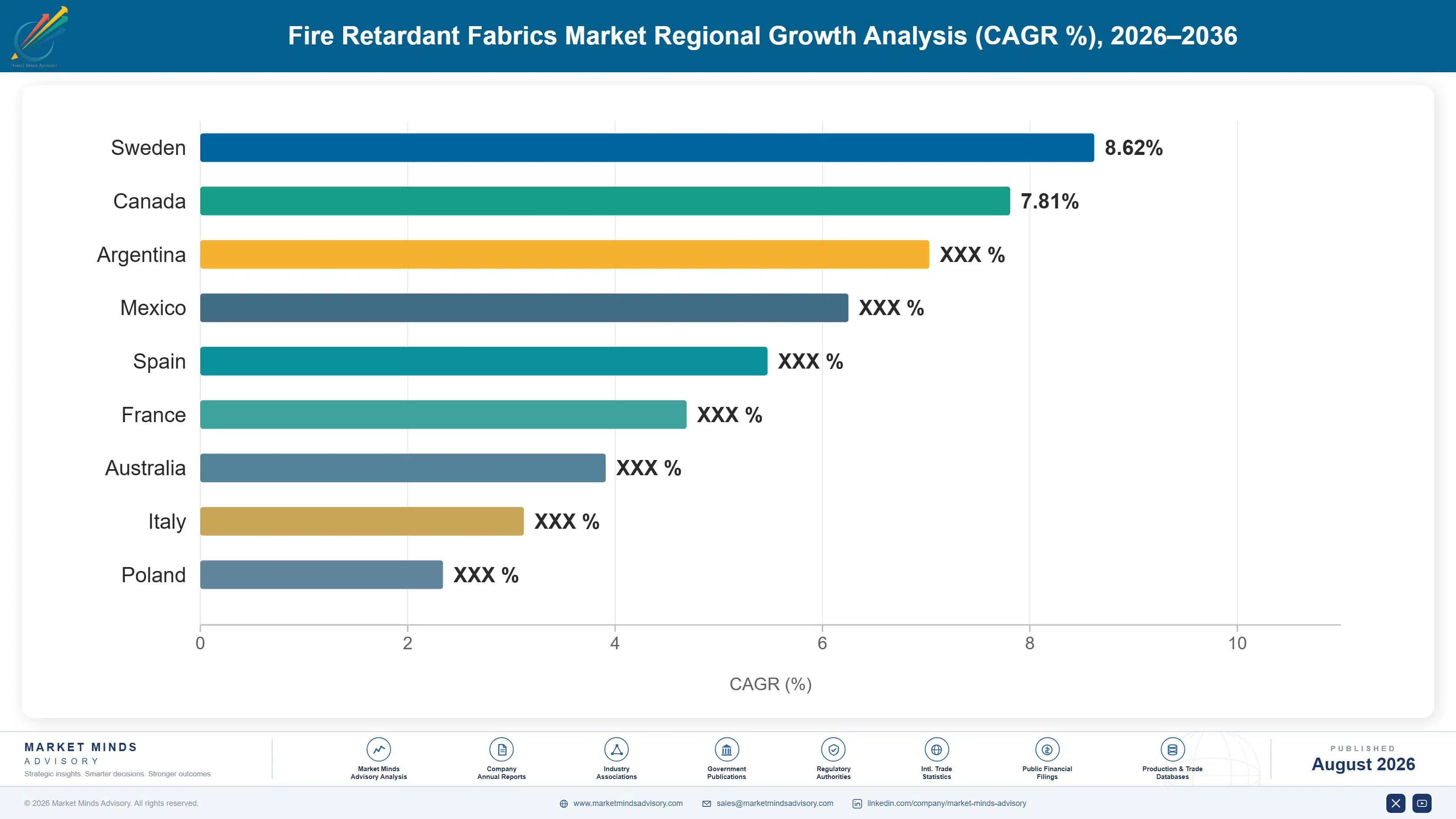
fire-retardant-fabrics-market-country-cagr-analysis-1787302711608

Wash Life, Certification And Specification

Inherent fabrics hold 63% of value, treated protection fades near 50 washes, certification costs 38,000 dollars per construction, and specialty fabrics grow at 9.75%. Value comes from wash life evidence, from certified platform breadth, and from winning specifications rather than orders. Weaving capability decides very little of it. Fibre access and evidence decide most of it.

Fund Garment Audits Rather Than Arguing Specification

Treated protection degrades after roughly 50 industrial washes with no visible change, and buyers comparing price per metre reach the wrong conclusion honestly because nothing in their programme measures it. Testing garments pulled from a customer's own working crews produces evidence no technical argument matches. Inherent fibre producers who fund those audits convert accounts that years of specification advocacy never moved at all. Inherent fabrics already hold 63% of market value on considerably less than that share of metres. Audit evidence is what moves the rest. Nobody else will fund it.
Market Impact: Protection fades away after roughly

Certify Platform Constructions Across Multiple Standards

Testing one construction against one standard costs around 38,000 dollars, and a mill chasing every specification variant carries that cost many times over for volumes that rarely repay it. Designing a smaller number of platform constructions that satisfy several standards at once spreads the certification investment across far more addressable work. Mills that never rationalised their certified range are funding tests for fabrics nobody orders. Mills that never rationalised are funding recertification for constructions that sell nothing at all. Standards revise periodically and the bill arrives anyway. The range should be a decision.
Market Impact: Certification costs 38,000 per sing

Win The Programme Specification, Not The Order

Regulated protective clothing programmes replace garments on roughly three year cycles and rarely revisit the fabric specification between them, so a mill written into a programme ships against headcount for years without further selling. The specification decision is taken by safety and procurement functions together, often years before any volume. Mills selling to garment makers rather than to end employers are one step removed from where it is decided. Programmes replace on roughly 3 year cycles and the specification is rarely reopened between them. One decision produces years of shipments. Very few mills are present when it is taken.
Market Impact: Programmes replace all their garmen

Build Multi-Hazard Blending Capability Deliberately Now

Specialty high-performance fabrics grow at 9.75% against 6.5% for the market because single-hazard constructions cannot serve workers facing flame, arc, and chemical exposure together. Blending to satisfy several standards at once is genuinely difficult, since properties improving one measure degrade another. Mills that solved that balance hold the best margin available in protective fabric, and the field of competitors there is considerably narrower than in aramid. Certification cost multiplies across every standard the construction has to satisfy simultaneously. That deters most mills from attempting it. The narrow field is exactly the point.
Market Impact: Specialty fabrics are now growing a

Who Controls the Margin Pool

Concentration is moderate at 44% across the top five measured on protective fabric value supplied, and protective fibre access rather than weaving capability holds it there. Aramid and specialty fibre production sits with very few producers globally, which shapes the fabric market above it more than any mill's loom capacity does. The leader to challenger gap is widest in specialty multi-hazard constructions and narrowest in treated cotton, where anybody with a finishing range
Competitive activity runs on three fronts. Certified construction breadth is the first, since testing cost limits how many standards and weights a mill can afford to offer at all. Programme specification position is the second, where three year replacement cycles turn one decision into years of shipments. And multi-hazard blending capability is the third, which is where growth and margin both sit.

Pressure arrives from two directions. Chinese aramid and modacrylic fibre producers have broken a supply concentration that shaped this market for decades. And treated cotton keeps holding share on price wherever wash life goes unmeasured. Rankings shift on specification wins rather than on capacity. Neither pressure reaches multi-hazard specialty constructions, where blending difficulty and stacked certification cost restrict the field to very few mills.
fire-retardant-fabrics-market-company-positioning-matrix-1787302712127

Competitive Moat and Risk Dimensions

DUPONT

Moat: Fibre position and certification depth

Protective fibre production alongside fabric and brand positions gives control of a supply chain that mills without fibre access depend on entirely. Certified construction breadth across many standards and weights was built through testing investment that a smaller participant cannot replicate. End employer specification relationships convert both into programme positions lasting years.
DUPONT

Risk: Chinese fibre supply concentration breaking

Chinese aramid and modacrylic producers have added capacity that ends a fibre supply concentration which shaped this market for decades, and mills that once depended on limited sources now have alternatives. Fibre position confers less advantage as that supply broadens. Certification and specification depth remain, and they are not the same barrier.
TEIJIN ARAMID

Moat: Para-aramid capability and application depth

Para-aramid production capability sits with a very small number of producers worldwide and requires process knowledge that capital alone does not buy at any scale. Application development work with garment makers and end employers converts fibre supply into specified positions. Both advantages compound with each programme qualified rather than with volume produced.
TEIJIN ARAMID

Risk: Limited exposure to treated volume

Treated cotton and cellulosic fabrics carry substantial metres in cost-sensitive markets where wash life goes unmeasured, and an inherent-weighted position participates in none of that volume. Those markets are also where industrial workforces are growing fastest. Converting them requires audit evidence that somebody has to fund and very few do.

Players Tracked

Prominent Players

DuPont
Teijin Aramid
TenCate Protective Fabrics
Milliken
Lenzing

Other Key Players

Kaneka
Toyobo
Huvis
Yantai Tayho Advanced Materials
Glen Raven
Klopman International
Carrington Textiles
Marina Textil
Arvind Limited
PBI Performance Products
Schoeller Textil
Sioen Industries
W. L. Gore and Associates
Kolon Industries
Hyosung Advanced Materials

Recent Developments

FEBRUARY 2025

Employer moves programme to inherent fabric after garment audit

A large utility employer converted its protective clothing programme from treated cotton to inherent fabric after testing garments pulled from working crews showed several failing their original standard well before scheduled replacement. The decision followed internal audit evidence rather than any regulatory change or supplier initiative.
Signal: Garment auditing moves accounts that years
MAY 2025

Mill rationalises certified range to fund platform constructions

A protective fabric mill withdrew certification on several low volume constructions and redirected the testing budget toward platform fabrics certified against multiple standards simultaneously. The change was an internal commercial decision rather than any regulatory action, quality issue, or customer requirement. Several standards were covered simultaneously.
Signal: Certification cost is now forcing mills to
AUGUST 2025

Chinese producer commissions additional para-aramid fibre capacity

A Chinese advanced materials producer brought further para-aramid fibre capacity online, adding to a supply base that had been concentrated among very few producers globally for decades. The expansion was organic capacity investment rather than any acquisition, licensing arrangement, or partnership with an established producer.
Signal: A fibre supply concentration that shaped t

Fibre, Finishing and Certification

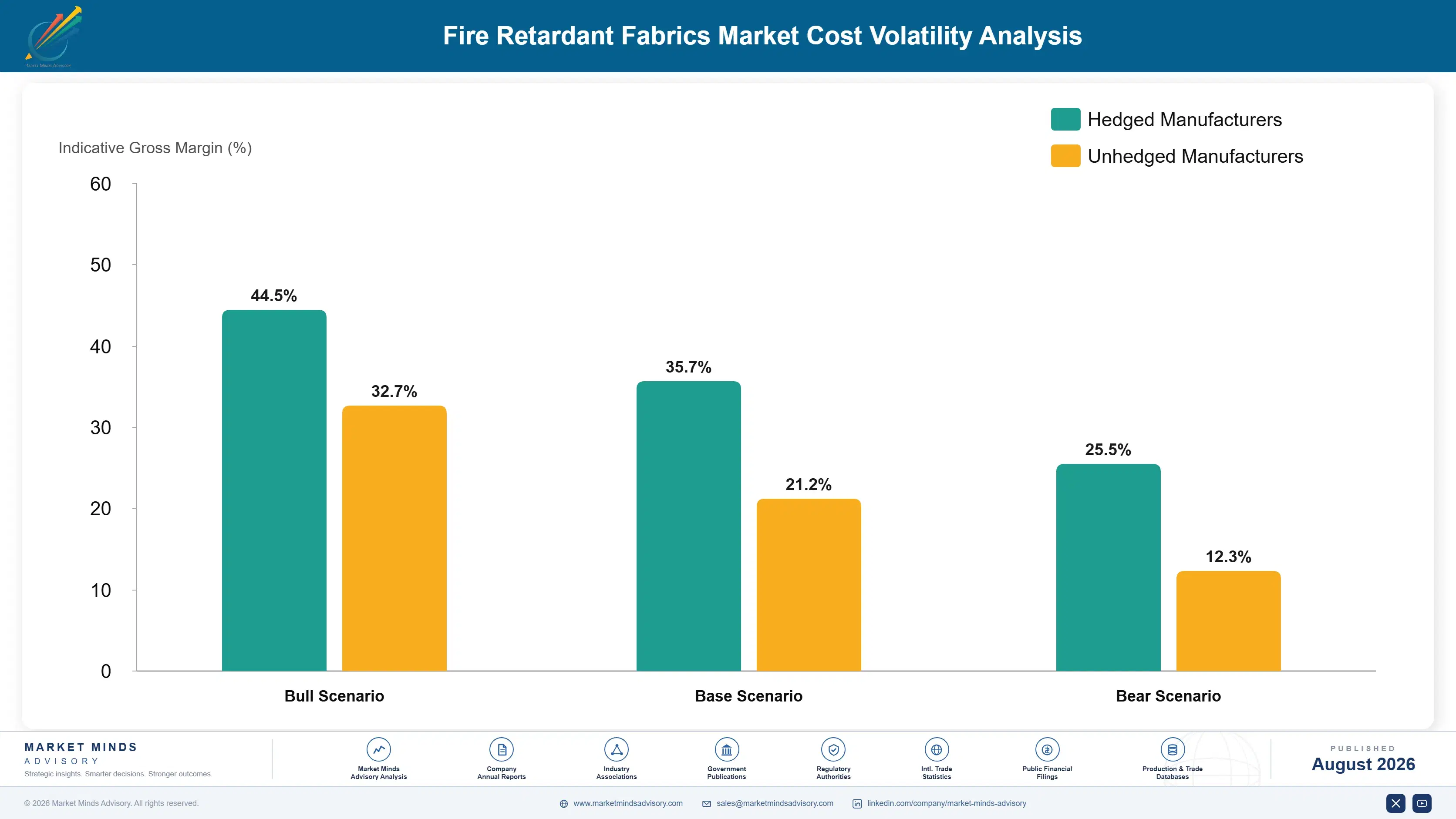
Fabric cost divides between protective fibre at roughly 58%, spinning, weaving, and knitting conversion near 17%, dyeing and finishing around 12%, certification amortisation about 6%, and packaging, freight, quality control, and overhead the balance. Fibre dominates so heavily that mill efficiency matters far less than fibre access, which is why the competitive structure of this market is set one step upstream of the looms.
Para-aramid and modacrylic fibre pricing both rose through 2022 as energy and precursor costs tightened, and several advanced materials producers disclosed input cost pressure in filings covering that year, with IEA data tracking the underlying energy movement. Flame retardant finishing chemistry moved separately. Pass-through into protective clothing programmes was slow, since those contracts typically run across a three year replacement cycle. Programme contracts absorb almost none of that movement.

The competitive disadvantage mechanism runs through fibre access rather than through weaving efficiency. Conversion costs are broadly comparable across competent mills, while protective fibre supply has historically sat with very few producers and access terms differed materially between fabric makers. Mills without secured fibre positions carried both price exposure and allocation risk, and Chinese capacity additions are only now beginning to change that arithmetic.
fire-retardant-fabrics-market-cost-volatility-analysis-1787302712321

Secure protective fibre supply on multi-year contracted terms

Protective fibre carries roughly 58% of fabric cost and has historically come from very few producers, which left mills exposed on both price and allocation during any tightness. Multi-year contracted positions change that materially. Chinese capacity additions are broadening the supply base for the first time in decades, which makes this the right moment to renegotiate rather than

Rationalise the certified range toward platform constructions

Certification amortisation carries about 6% of fabric cost and testing runs around 38,000 dollars per construction per standard, which is a heavy burden on constructions that sell in small volumes. Platform fabrics certified against several standards at once spread that investment across far more addressable work. Withdrawing certification on low volume constructions is uncomfortable and frequently the right decision.

Index programme contracts to published fibre cost movement

Protective clothing programmes typically run across three year replacement cycles while fibre costs move on shorter energy and precursor cycles, which leaves the mill carrying the mismatch entirely. Indexation clauses referenced to published data shift that to employers better able to absorb it. Buyers resist indexation and accept it more readily at programme renewal than during a cycle.

Portfolio Architecture for Margin Defence

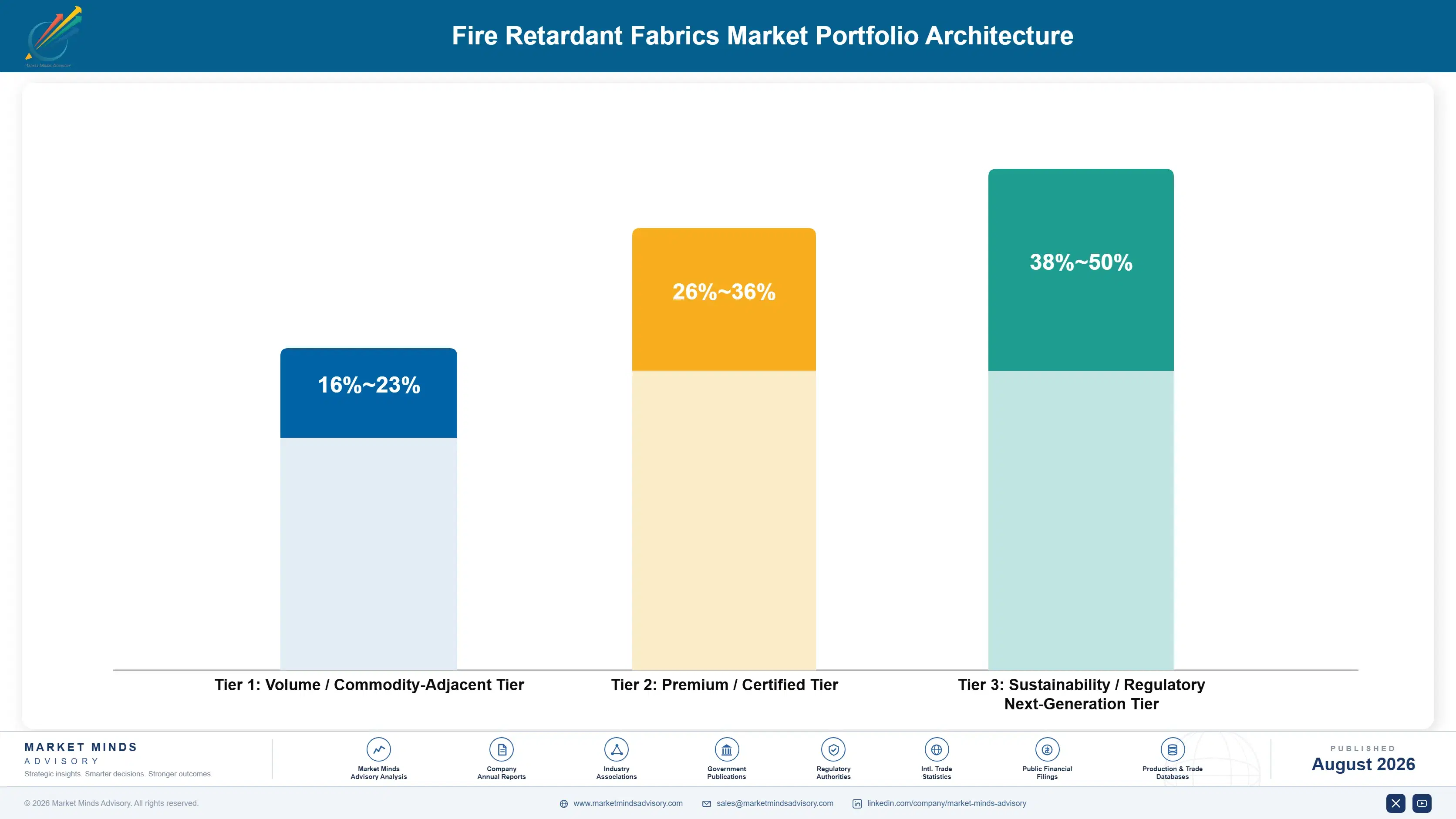
Three tiers describe this business and the spread follows how the protection is carried rather than by which fibre. Treated cotton and cellulosic fabrics sit at the bottom, where finishing capability is widely held and competition is on price per metre. Modacrylic blends and standard aramid constructions occupy the middle. Specialty multi-hazard fabrics sit at the top, where blending difficulty and certification cost both restrict participation.
The tension is that treated fabric carries substantial metres in exactly the markets where industrial workforces grow fastest, and it does so on a price comparison that ignores wash life entirely. A mill weighted there is selling into a position that audit evidence will eventually undermine. One weighted toward inherent fabric holds the better argument and participates least in the volume growth.

High-value pools concentrate where a single garment must do several jobs. Multi-hazard specialty constructions are the clearest case, since layering separate single-hazard garments is intolerable in heat and the blending required to avoid it is genuinely difficult for anybody to achieve. Arc-rated utility fabric is the second such pool, since the requirement is mandatory rather than discretionary anywhere. Neither pool is decided on price per metre.

Volume / Commodity-Adjacent Tier

Flame retardant treated cotton and cellulosic fabrics where finishing capability is widely held and price per metre decides most orders. Wash life degradation is invisible and largely unmeasured by buyers.
Gross Margin: 16-23%

Premium / Certified Tier

Modacrylic blends and standard aramid constructions carrying inherent protection for the garment's life. Certification breadth and programme specification positions differentiate mills here far more than weaving does. Arc rating is where treated fabrics perform worst.
Gross Margin: 26-36%

Sustainability / Regulatory / Next-Generation Tier

Specialty multi-hazard constructions using polybenzimidazole, melamine, and engineered blends satisfying several standards simultaneously. Best margin available and the narrowest competitive field anywhere here. Stacked certification cost deters most entrants, and blending difficulty deters the rest entirely.
Gross Margin: 38-50%
fire-retardant-fabrics-market-portfolio-architecture-1787302712822

Programmes, Cycles and Standards

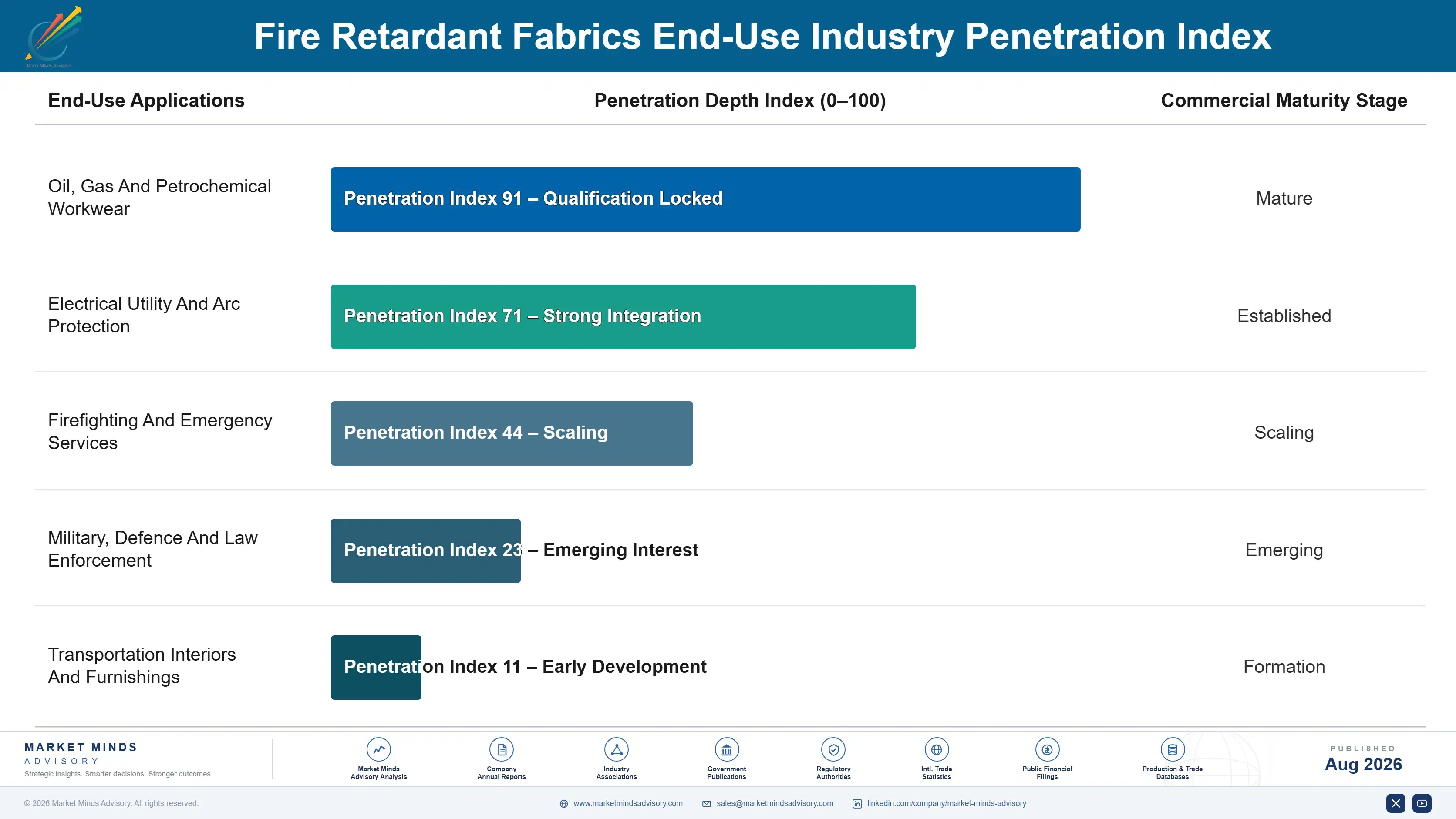
Demand arrives through protective clothing programmes rather than through fabric purchasing, which puts the decision with a safety function and a procurement function together, often years before any volume ships. Once specified, fabric ships against employer headcount on roughly three year replacement cycles with almost no further commercial activity. Winning the programme is worth many times more than winning any individual garment order ever is.
Stickiness runs through specification inertia rather than through satisfaction. Employers rarely revisit a fabric specification between replacement cycles, because doing so reopens a safety decision that somebody signed off and nobody wants to reopen without cause. Transportation and furnishing fabrics stick similarly through vehicle programme life. Cost-sensitive treated cotton supply sticks least and is retendered routinely on price. Reopening a signed safety decision needs a genuine reason.

Buyer profiles shifted as auditing practice spread and multi-hazard requirements grew. The earlier buyer was a procurement manager comparing certified fabrics on price per metre against a single standard. The current conversation increasingly involves a safety function reviewing garment audit evidence, or an operations lead balancing heat tolerance against protection because workers defeat clothing they cannot wear.
fire-retardant-fabrics-market-end-use-penetration-index-1787302713308

What We Would Tell a Board

These are among the four positions where our research anticipates prominent divergence between winners and laggards over the coming forecast period. Each is grounded in the demand model, the regulatory perimeter, and the announced capacity pipeline.
01 / WASH LIFE EVIDENCE FUNDING

Audit their garments, do not argue specification

Treated protection degrades after roughly 50 industrial washes with absolutely no visible change at all to the garment itself, and buyers comparing price per metre reach the wrong conclusion entirely honestly given what they can see. Testing garments pulled from a customer's own working crews produces evidence that no technical argument, datasheet comparison, or specification advocacy has ever managed to match. Producers who fund those audits convert accounts that years of patient specification advocacy had never managed to move at all.
02 / CERTIFIED RANGE RATIONALISATION

Stop certifying fabrics that nobody actually orders

Testing a single fabric construction against a single protective standard costs around 38,000 dollars, and a mill chasing every specification variant carries that cost many times over against volumes that rarely repay any of it. Designing a smaller number of platform constructions that satisfy several standards simultaneously spreads that testing investment across considerably more addressable work than any narrow range achieves. Withdrawing certification on low volume constructions is uncomfortable internally, and it is very nearly always the correct commercial decision to take anyway.
03 / PROGRAMME SPECIFICATION ACCESS

Sell to the employer, not to the garment maker

Regulated protective clothing programmes replace garments on roughly three year cycles and very rarely revisit the fabric specification at all in between, so a mill written into a programme ships against employer headcount for years afterwards. That decision is taken by a safety function and a procurement function together, frequently years before any volume ships at all. Mills selling only to garment makers sit one full step removed from where that decision actually gets taken, and they rarely see it happening.
04 / MULTI-HAZARD CAPABILITY BUILDING

One garment doing three jobs is where margin is

Specialty high-performance fabrics grow at 9.75% against 6.5% for the wider market, because workers facing flame, arc, and chemical exposure together simply cannot layer separate single-hazard garments in any real heat. Blending fibres to satisfy several standards at once is genuinely difficult, since the properties improving any one performance measure consistently degrade at least one of the others. Mills that have genuinely solved that balance hold both the narrowest competitive field and the best margin available anywhere in protective fabric today.

Engagement Snapshot From the Field

A live engagement with an industry participant carrying material or product regulatory and market exposure ahead of a defining policy shift, showing how our research translates into a defensible multi-year portfolio strategy.
MARKET MINDS ADVISORY · CLIENT ENGAGEMENT SUMMARY
Fire Retardant Fabrics Producer Strategic Portfolio Review and Transition Roadmap 2026·Investment Scenario on Fire Retardant Fabrics Exposure Evaluation 2025-26
CLIENT PROFILE
A protective fabric mill with approximately 165 million dollars in annual revenue (client-reported, unverified by MMA), weaving treated cotton and modacrylic blend fabrics for garment makers across three regions. Certified constructions numbered more than forty, inherent fabric represented a minority of volume, and the mill had no direct relationships with the employers specifying its fabric.
STRATEGIC CHALLENGE
Margin had declined for three consecutive years against flat volume, and the board wanted to understand whether the cause was price competition, an unprofitable certified range, or a position in the wrong part of the market entirely. Certification cost had never been allocated to individual constructions at any point. It had been spread evenly.
MMA APPROACH
We allocated certification cost to individual constructions and compared it against the volume each generated. Programme specification decisions were traced back from garment makers to the employers making them. Wash life audit evidence was reviewed across comparable programmes, and multi-hazard blending requirements were scoped against the mill's existing capability. Direct employer relationships were then mapped by programme.
KEY FINDINGS
  1. More than half the certified constructions had generated no volume in two years while continuing to consume recertification budget as standards were periodically revised.
  2. Every specification decision the mill served had been taken by an end employer it had never met, with the garment maker acting purely as a converter in between.
  3. Wash life audit evidence at two comparable employers had moved both programmes to inherent fabric, and neither had been approached by the client at any point.
  4. Multi-hazard blending was reachable with the mill's existing looms but required blending and finishing development the client had never attempted. Looms were never the constraint.
CLIENT PROFILE
A protective fabric mill with approximately 165 million dollars in annual revenue (client-reported, unverified by MMA), weaving treated cotton and modacrylic blend fabrics for garment makers across three regions. Certified constructions numbered more than forty, inherent fabric represented a minority of volume, and the mill had no direct relationships with the employers specifying its fabric.
STRATEGIC CHALLENGE
Margin had declined for three consecutive years against flat volume, and the board wanted to understand whether the cause was price competition, an unprofitable certified range, or a position in the wrong part of the market entirely. Certification cost had never been allocated to individual constructions at any point. It had been spread evenly.
MMA APPROACH
We allocated certification cost to individual constructions and compared it against the volume each generated. Programme specification decisions were traced back from garment makers to the employers making them. Wash life audit evidence was reviewed across comparable programmes, and multi-hazard blending requirements were scoped against the mill's existing capability. Direct employer relationships were then mapped by programme.
KEY FINDINGS
  1. More than half the certified constructions had generated no volume in two years while continuing to consume recertification budget as standards were periodically revised.
  2. Every specification decision the mill served had been taken by an end employer it had never met, with the garment maker acting purely as a converter in between.
  3. Wash life audit evidence at two comparable employers had moved both programmes to inherent fabric, and neither had been approached by the client at any point.
  4. Multi-hazard blending was reachable with the mill's existing looms but required blending and finishing development the client had never attempted. Looms were never the constraint.
RECOMMENDED STRATEGY
Phase 1: Phase 1 (months one to eight): withdraw certification on constructions with no volume and redirect the budget toward platform fabrics. Phase 2: Phase 2 (months eight to twenty-four): build direct specification relationships with the twelve largest end employers currently served indirectly. Bypass the converter where possible. Phase 3: Phase 3 (months twenty-four to forty-two): develop multi-hazard blending capability targeting the arc and chemical combination first. Target the arc and chemical combination first.
OUTCOME
Eighteen certifications were withdrawn within two quarters, releasing budget that funded three platform constructions. Direct contact was established with seven end employers, and two moved specification work to the mill within a year (client-reported, unverified by MMA). Certification spend per construction became a standing management metric.

Frequently Asked Questions

Foundational context covering the market sizes, CAGR, scope, country, region and competition that inform every finding below. This section is provided to cover basics and most often pre-purchase conversations, answered from the MMA Primary Research Dataset.

What is the current size of the Fire Retardant Fabrics Market?

The market is valued at USD 4.8 billion in 2025, rising to USD 5.11 billion in 2026. Scope covers woven and knitted flame resistant fabrics, not protective fibres sold separately, finished garments, or flame retardant chemical additives.

How large will the Fire Retardant Fabrics Market be by 2036?

MMA forecasts USD 9.59 billion by 2036, an increase of USD 4.48 billion over the 2026 base. That represents an expansion multiple of 1.88 times across the forecast period.

What is the CAGR for the Fire Retardant Fabrics Market 2026 to 2036?

The base case CAGR is 6.5%, with a bull case of 7.7% and a bear case of 5.3%. The historical rate from 2020 to 2025 was 5.4%, depressed by oil and gas workforce reductions.

Which segment is growing fastest?

Specialty high-performance fabrics at 9.75%, exactly 1.50 times the market rate. Workers facing flame, arc, and chemical exposure together cannot layer separate single-hazard garments in heat.

Who are the major companies in the Fire Retardant Fabrics Market?

DuPont, Teijin Aramid, TenCate Protective Fabrics, Milliken, and Lenzing lead on protective fabric value supplied. The top five hold 44%, held there by fibre access rather than weaving capability.

Which country is growing fastest?

India at 9.4%, where refinery, petrochemical, and utility employers are adopting protective clothing programmes that were previously informal or absent. Indian mills have built inherent fabric capability alongside.

Report Segmentation Architecture

The full report scope spans multiple orthogonal segmentation dimensions, with cross-tabulated demand data provided for each dimension pair. Coverage extends further to regional breakdowns, trend trajectories, and the competitive detail needed to support segment-level decision-making.

By Protective Fibre System

  • Aramid And Para-Aramid Fabrics
  • Modacrylic And Blended Inherent Fabrics
  • Flame Retardant Treated Cotton And Cellulosic Fabrics
  • Flame Retardant Viscose And Regenerated Cellulosic Fabrics
  • Specialty High-Performance Fabrics

By End-Use Industry

  • Oil, Gas And Petrochemical Workwear
  • Electrical Utility And Arc Protection
  • Firefighting And Emergency Services
  • Military, Defence And Law Enforcement
  • Transportation Interiors And Furnishings

By Commercial Model

  • Supply To Garment Manufacturers
  • End Employer Specification Programmes
  • Industrial Laundry And Rental Supply
  • Distributor And Regional Converter Channels
  • Military And Government Framework Contracts

By Region

  • East Asia
  • North America
  • Western Europe
  • South Asia and Pacific
  • Middle East and Africa
  • Latin America
  • Eastern Europe

Scope, Methodology, and Coverage

Every figure in this report is reproducible from documented input assumptions. The scope below maps the historical period, the forecast horizon, the segmentation dimensions, and the countries covered, alongside the underlying primary and qualitative methodology.
Historical Period
2020 to 2025
Forecast Period
2026 to 2036
Base Year
2025 (USD billions; MMA Primary Research Dataset, August 2026)
Market Definition
This market comprises woven and knitted fabrics supplied with flame resistant performance for protective apparel, transportation interior, and furnishing applications, measured at mill revenue across garment manufacturer, employer specification, industrial laundry, distribution, and government framework channels. Coverage spans aramid and para-aramid fabrics, modacrylic and blended inherent fabrics, flame retardant treated cotton and cellulosic fabrics, flame retardant viscose and regenerated cellulosic fabrics, and specialty high-performance fabrics including polybenzimidazole, melamine, and engineered multi-hazard blends. Protective fibres sold as staple, tow or filament, finished garments and personal protective equipment, flame retardant chemical additives and finishing formulations sold independently, non-woven fire barriers and battings, thermal liners sold separately, rigid fire protection materials and boards, and testing and certification services fall outside scope.
Quantitative Units
USD billions (current prices); fabric metres supplied by fibre system; price per metre by construction; certified constructions held per mill
Segmentation Dimensions
By Protective Fibre System; By End-Use Industry; By Commercial Model; By Region
Regions Covered
East Asia, North America, Western Europe, South Asia and Pacific, Middle East and Africa, Latin America, Eastern Europe
Countries Covered
China, Japan, South Korea, Taiwan, India, Vietnam, Indonesia, Bangladesh, Australia, United States, Canada, Mexico, Germany, France, United Kingdom, Italy, Spain, Netherlands, Brazil, Colombia, Saudi Arabia, United Arab Emirates, Qatar, South Africa, Poland, Czechia, Romania, and additional markets relevant to this sector
Key Companies Profiled
DuPont, Teijin Aramid, TenCate Protective Fabrics, Milliken, Lenzing, Kaneka, Toyobo, Huvis, Yantai Tayho Advanced Materials, Glen Raven, Klopman International, Carrington Textiles, Marina Textil, Arvind Limited, PBI Performance Products, Schoeller Textil, Sioen Industries, W. L. Gore and Associates, Kolon Industries, Hyosung Advanced Materials
Quantitative Methodology
Primary survey, n=3,800 respondents, Q4 2025, six countries; demand-side model with trade association cross-validation
Qualitative Methodology
47 expert interviews, Q4 2025; applied to validate demand model assumptions, identify emerging dynamics, and assess competitive positioning
Report Format
PDF and XLSX data workbook (Word format preview document)
Publisher
Market Minds Advisory
Report Code
MMA-2026-CHM-903
Published
August 2026
Contact
sales@marketmindsadvisory.com | www.marketmindsadvisory.com

Purchase the full Fire Retardant Fabrics Market Report (2026 to 2036).

The full report sizes fire retardant fabrics across five fibre systems, five end-use industries, five commercial models, and seven regions, with inherent and treated protection assessed separately on wash life and total cost per protected year. Certification cost is allocated by construction and standard, since it determines how broad a range any mill can economically offer. Programme specification decision points are traced from garment makers back to end employers. Competitive profiling covers twenty participants on protective fabric value, and multi-hazard blending capability is assessed separately from single-standard production.
Inherent and treated protection assessed separately on laundering wash life
Certification cost allocated by construction and by protective standard
Programme specification decision points traced back to end employers
Multi-hazard blending capability assessed separately from single-standard production
Protective fibre supply concentration tracked against new regional capacity
Total cost per protected year modelled against price per metre

Built For The People Who Decide

From boardroom strategy to bench-side execution, this report is read cover-to-cover by leaders shaping the next decade of their industry, turning demand scenarios, market dynamics and valuation benchmarks into decisions.
CXOs/ Presidents/ VPs/ Managers
M&A and Corporate Development
Strategy Teams and R&D Heads
Procurement and Product Directors
Regulatory and Compliance Leaders
Investor Relations and Equity Analysts