
Market Minds Advisory
Film Capacitors Market

Film Capacitors Market: The Constraint Sits Upstream of Everyone in the Industry

Every energy density claim in this industry rests on thin-gauge dielectric film that only about seven producers worldwide can actually make, and the capacitor manufacturers control none of that capacity.

Lead Analyst

David Horsley

Published

August 2026

Make Smarter Decisions with Customized Research Insights

Request a free sample report and evaluate market opportunities, growth trends, and competitive dynamics relevant to your business needs.

2025 MARKET VALUE$3.9BMarket Size 2025
2036 FORECAST VALUE$9.7BBase Case , 2026 to 2036
CAGR 2026 TO 20368.6 %Bull 9.8% / Bear 7.4%
INCREMENTAL OPPORTUNITY$5.4BNet 10- year value creation
EXPANSION MULTIPLE2.28x2036 value over 2026 base
Strategic Levers
M&A Pipeline
Regional Outlook
Country Rankings
Competitive Intelligence
Segmental Deep-dive
Call-Us : 91 93563 13602

Executive Snapshot and Market Trajectory

Around seven producers worldwide make capacitor-grade dielectric film, and only about 18% of that capacity reaches the sub-three micron gauges every energy density improvement depends on. Capacitor manufacturers sit downstream of a supply base considerably narrower than their own industry, and they know it perfectly well.
Growth runs at 8.6% and traction applications lead it. DC-link capacitors for traction and inverters grow at 12.9%, exactly 1.50 times the market rate, because self-healing behaviour and long life matter more in a vehicle drivetrain than in almost anything else. East Asia holds the largest share at 32%, on Chinese capacitor and film production together. High-temperature specialty dielectrics follow at 10.6% as inverters run hotter.
Concentration reaches 44% across the top five measured on capacitor volume shipped weighted by capacitance and voltage rating, with film suppliers assessed on the capacitor volume their film enables. Polypropylene loses its properties above roughly 105 degrees, which is becoming a real constraint as silicon carbide inverters run hotter. Ceramic capacitor makers keep advancing into applications where film has held on reliability alone. Chinese producers supply general purpose volume at costs nobody else approaches.
Market Definition
This market covers film dielectric capacitors used in power electronics, industrial, and electronic applications, spanning DC-link capacitors for traction and inverters, high-temperature film capacitors using specialty dielectrics, alternating current filter and power factor correction capacitors, snubber and pulse capacitors, and general purpose signal and interference suppression capacitors. Electrolytic and ceramic capacitors, supercapacitors and electrochemical energy storage, capacitor-grade film sold for non-capacitor uses, and complete power electronic assemblies fall outside scope.
Base Year Value
$3.9B in 2025 (MMA Primary Research Dataset, August 2026)
Forecast Period
2026 to 2036, eleven discrete annual values
CAGR
8.6% base case. Bull 9.8%. Bear 7.4%.
Fastest Growth Segment
DC-Link Capacitors for Traction and Inverters: 12.9% CAGR
Fastest Growth Country
India: 11.4% CAGR
Fastest Growth Region
South Asia and Pacific: 10.6% CAGR
Largest Region
East Asia: 32% of 2025 global value
Market Leaders
TDK, Vishay Intertechnology, Panasonic, KEMET, Nichicon. Source: MMA Analysis based on company annual reports.
Primary Survey
n=3,800 procurement and R&D decision-makers, Q4 2025, six countries
Methodology
Demand-side build-up, cross-validated against public data, 47 expert interviews

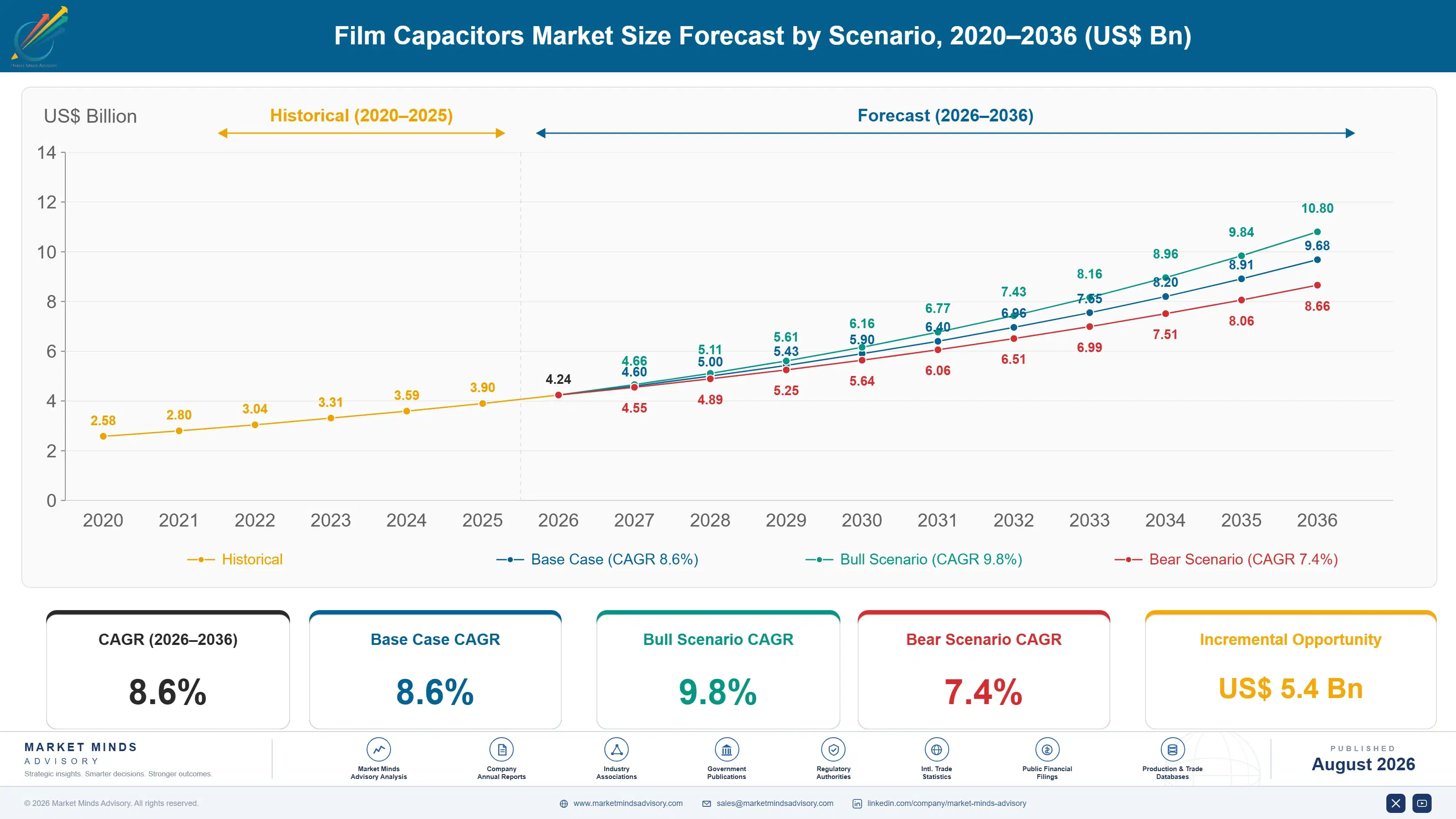
Film Capacitors Market Forecast Scenarios

film-capacitors-market-size-forecast-scenario-1787302701585
The 2020 to 2025 period ran at 7.2% and electric vehicle production rather than general electronics carried it. DC-link demand from traction inverters grew faster than any other application throughout, while consumer and general industrial volumes moved with the wider component cycle. Thin-gauge film availability tightened through 2022 and constrained several capacitor manufacturers independently of their own capacity.
Three mechanisms carry the 8.6% base case. Electric vehicle and charging infrastructure is the largest, since every traction inverter and every fast charger carries substantial DC-link capacitance. Renewable inverter demand is the second, where solar and wind converters need the same self-healing reliability. And silicon carbide adoption is the third, which raises operating temperatures and pushes specification toward higher-cost dielectrics. None of the three depends on general electronics demand recovering at all.
The 9.8% bull case rests on thin-gauge film capacity expanding ahead of demand, which would remove the constraint that currently caps how fast energy density improves across the whole industry. The 7.4% bear case is electric vehicle production slowing combined with ceramic capacitor substitution advancing in applications where film has held on reliability rather than on cost.

Seven Companies Set the Ceiling

A metallised film capacitor is a remarkable component in one specific way: when the dielectric fails at a point, the metallisation around that point vaporises and isolates the fault, and the capacitor keeps working. Around 94% of dielectric faults clear that way without any failure at all. That behaviour, rather than cost or size, is why film holds positions that ceramic and electrolytic alternatives keep attacking.
CAPACITOR GRADE FILM PRODUCERS7Able to make the dielectric this whole industry depends on
FILM SHARE OF COGS41%Concentrating cost in a supply base narrower than the manufacturers
THIN GAUGE CAPACITY SHARE18%Of film capacity able to produce sub-three micron dielectric gauges
POLYPROPYLENE TEMPERATURE CEILING105 degreesAbove which the standard dielectric begins losing its properties
SELF-HEALING FAULT RECOVERY94%Of dielectric faults cleared without any capacitor failure occurring
TOP FIVE CONCENTRATION44%Moderate across capacitor manufacturers and their film suppliers
The constraint sits upstream. Capacitor-grade biaxially oriented polypropylene requires thickness uniformity and purity that roughly seven producers worldwide can achieve, and only about 18% of that capacity reaches the sub-three micron gauges every energy density improvement depends on. Film carries around 41% of capacitor cost of goods sold, so manufacturers are exposed to a supply base narrower than their own industry and considerably less inclined to expand.
Temperature is the other ceiling. Polypropylene begins losing its properties above roughly 105 degrees, which was comfortable for decades and is becoming awkward as silicon carbide traction inverters run hotter and closer to the capacitor. Specialty dielectrics handle it at several times the cost, and the industry is currently deciding whether that is a niche or the direction of travel.
"We modelled a capacity expansion for a client and the whole plan died on film supply. They could build the winding lines in eighteen months. The film they needed had a three-year queue in front of it."
Principal, Electronic Components and Power Electronics Practice · MMA Technology

Market Trends

Traction Inverters Pull Film Into Automotive Volume

Every battery electric drivetrain carries substantial DC-link capacitance, and film wins that position over electrolytic alternatives on self-healing behaviour, ripple current capability, and a service life that matches the vehicle rather than needing replacement. DC-link capacitors grow at 12.9% against 8.6% for the market. Automotive qualification is demanding and slow, which makes those positions unusually durable once won and effectively closed to newcomers meanwhile. Thin-gauge film supply rather than manufacturing capacity is what limits how fast anybody expands into it. Charging infrastructure adds further capacitance demand per vehicle on the road. Both streams grow together.
Market Impact: Self-healing clears 94% of faults
Silicon Carbide Pushes Past The Polypropylene Ceiling

Wide bandgap devices switch faster and run hotter, and inverter designs built around them place capacitors in thermal environments that exceed the roughly 105 degrees where polypropylene begins degrading. Specialty dielectrics including polyphenylene sulphide handle it at several times the material cost. High-temperature film capacitors grow at 10.6%, and the industry is still deciding whether this is a niche requirement or where mainstream traction design is heading. Inverter designers are already relocating capacitors away from the hottest region rather than accepting derating. Manufacturers are hedging by qualifying both dielectrics rather than committing to either.
Market Impact: Film carries 41% of costs

Market Opportunities and Growth Drivers

Renewable Inverters Need The Same Reliability Argument

Solar and wind converters operate unattended for two decades in environments nobody visits often, and a capacitor that clears its own faults rather than failing is worth a considerable premium in that context. Around 94% of dielectric faults self-heal without failure, which is the reason film holds these positions against cheaper alternatives. Installation growth across every region continues expanding this demand independently of the automotive cycle entirely. A field replacement on a wind turbine nacelle or a desert solar site costs far more than the component. Reliability rather than price decides these specifications every time.
Market Impact: Only 18% reaches thin gauges

Charging Infrastructure Multiplies Capacitance Per Vehicle

Fast charging equipment carries substantial DC-link capacitance of its own, so each vehicle on the road generates capacitor demand at the charger as well as in the drivetrain. High power charging in particular uses converter topologies with heavy film content and demanding ripple requirements. That relationship is frequently missed in demand modelling that counts vehicles alone, and it makes charging build-out a distinct and material driver. High power charging uses converter topologies with heavy film content and demanding ripple requirements. Demand modelling that counts vehicles alone misses that relationship entirely.
Market Impact: Ceiling reaches 105 degrees

Market Restraints and Challenges

Thin Gauge Film Capacity Caps The Whole Industry

Roughly seven producers worldwide make capacitor-grade film and only about 18% of that capacity reaches sub-three micron gauges, and the root cause is that thickness uniformity at those dimensions is genuinely difficult rather than merely capital intensive. Commercial impact is capacitor manufacturers unable to expand beyond what film supply permits regardless of their own investment. Mitigation runs through long-term film agreements, qualification of multiple suppliers, and design approaches that reduce dependence on the thinnest gauges. Allocation follows relationship length and volume commitment rather than either order size or price offered.
Market Impact: DC-link growing at 12.9%

Temperature Ceiling Limits Silicon Carbide Designs

Polypropylene degrades above roughly 105 degrees, and the root cause is polymer chemistry rather than any manufacturing limitation that investment could resolve. Commercial impact is inverter designers derating, adding cooling, or relocating capacitors away from where the power stage wants them. Mitigation runs through specialty dielectrics at several times the material cost, improved thermal design, and hybrid arrangements that combine dielectrics matched to different regions of the same converter. Specialty dielectrics answer it at several times the material cost of polypropylene. Whether that becomes mainstream traction specification or stays a niche is genuinely unresolved.
Market Impact: Ceiling sits at 105 degrees
3 additional market trends, 4 additional growth drivers, and 2 additional restraints and challenges are covered in the full report. Contact sales@marketmindsadvisory.com to access the complete intelligence.

Segment CAGR and Growth Architecture

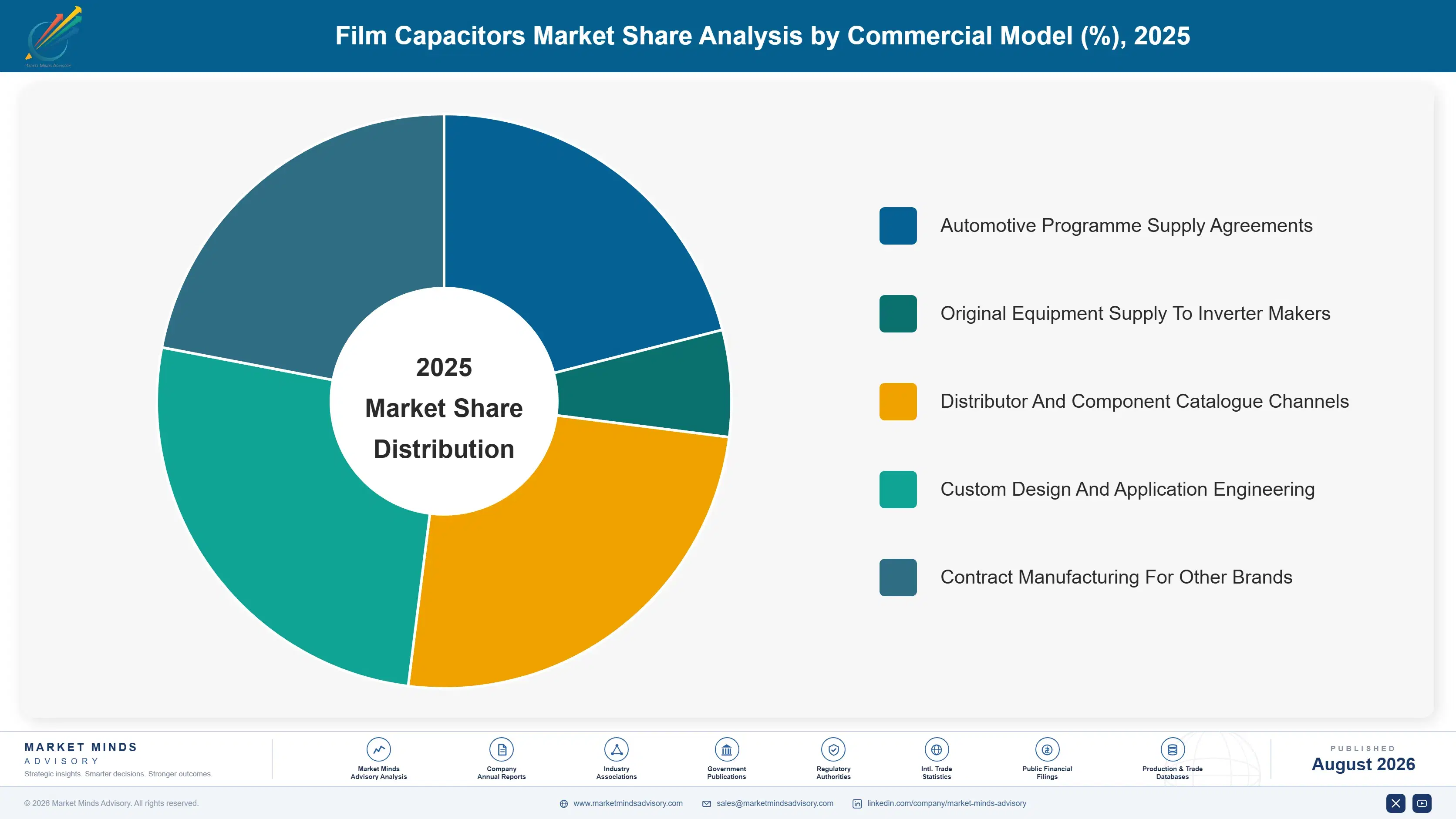
Segmentation follows circuit function and dielectric requirement, because those determine construction, thermal specification, qualification pathway, and which competing capacitor technology each application actually chooses between. Voltage rating and physical format both cut across every function rather than separating them, which makes either a weaker primary dimension here. Dielectric requirement decides which competing technology actually wins.
film-capacitors-market-market-share-analysis-1787302702534

DC-Link Capacitors For Traction And Inverters

The fastest function at 12.9%, exactly 1.50 times the market rate, and the one where film's self-healing behaviour matters most commercially. A traction inverter capacitor must survive the vehicle rather than being replaced, handle severe ripple current, and fail gracefully rather than catastrophically, which is exactly what metallised film does and electrolytic alternatives do not. Automotive qualification takes several years and then closes the position to newcomers once it has been won. Thin-gauge film supply rather than manufacturing capacity is the binding constraint on how fast anybody expands into it. Charging infrastructure carries substantial DC-link content of its own alongside the vehicle drivetrain. Demand modelling counting vehicles alone consistently understates the total requirement.
CAGR 12.9%

High-Temperature Film Capacitors

Second fastest at 10.6%, using polyphenylene sulphide and other specialty dielectrics where operating temperature exceeds the roughly 105 degrees at which polypropylene begins degrading. Silicon carbide inverters running hotter and more compact are what created this requirement, and the material cost is several times conventional film. Whether this stays a niche or becomes mainstream traction specification is genuinely unresolved, and manufacturers are hedging by qualifying both dielectrics rather than committing to either one exclusively. Inverter designers are already relocating capacitors away from the hottest region rather than accepting a derating. Thermal design and dielectric selection are being decided together rather than sequentially now. Qualification nonetheless runs on automotive timelines regardless of any urgency.
CAGR 10.6%
Full segment breakdown across 5 segments available in the complete report.

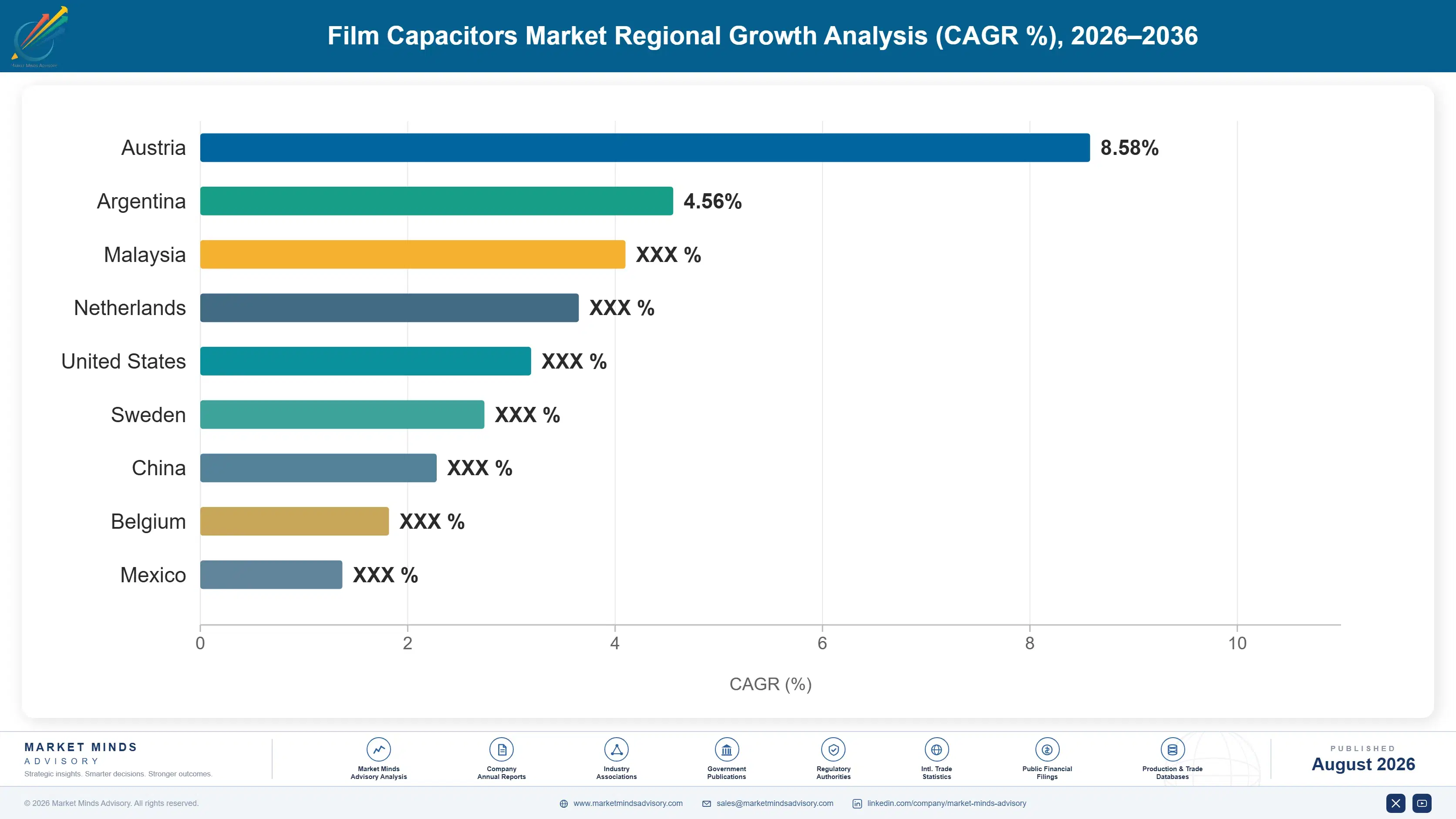
Regional Architecture and Country Demand Map

East Asia leads at 32% on Chinese capacitor manufacturing combined with the dielectric film production that supplies it. Western Europe follows on industrial and power applications, ahead of North America. South Asia and Pacific grows fastest. Dielectric film production concentration shapes every regional position here.

East Asia

Thirty-two percent, outside the framework band, and justified because Chinese capacitor manufacturing and the dielectric film production feeding it are both concentrated here to a degree no other component category matches. Chinese producers supply film capacitors globally at costs nobody else approaches, and several of the roughly seven capacitor-grade film producers worldwide operate in the region. Japanese specialty dielectric capability holds the high-temperature positions. Growth at 9.6% runs above the market rate on domestic electric vehicle and inverter production together. The share sits outside band because film and capacitor production are concentrated together to a degree no other component category matches. Domestic inverter manufacturing consumes a substantial part of that output directly.
Share: 32% | CAGR: 9.6% (2026 to 2036)

Western Europe

Industrial and power applications rather than automotive volume carry this 21%. German, Italian, and Nordic manufacturers hold strong positions in alternating current filter, power factor correction, and industrial pulse capacitors where reliability requirements are demanding and volumes are modest. European automotive DC-link demand is served substantially by Asian supply. Specialty dielectric development capability is genuine here. Growth at 7.0% is the slowest of any region, reflecting mature industrial demand rather than any weakness in technical position. Manufacturers here compete on specification depth rather than on any cost position at all. Automotive DC-link volume served from the region is smaller than its engineering reputation implies. Film supply relationships are long established.
Share: 21% | CAGR: 7.0% (2026 to 2036)
Regional intelligence for 5 additional markets available in the complete report: North America, South Asia and Pacific, Latin America, Middle East and Africa, Eastern Europe. Contact sales@marketmindsadvisory.com.
film-capacitors-market-country-cagr-analysis-1787302703425

Securing Film Before Building Capacity

Roughly seven producers make capacitor-grade film, only 18% of that capacity reaches thin gauges, film is 41% of cost of goods sold, and polypropylene ceilings at 105 degrees. Value comes from contracting film early, from automotive qualification, and from hedging dielectric choice. The whole industry ceiling is set by decisions taken outside it entirely.

Contract Film Supply Before Committing Winding Capacity

Roughly seven producers worldwide make capacitor-grade film and only about 18% of that capacity reaches sub-three micron gauges, so a capacity expansion plan without a film agreement behind it is an expansion that will not run. Winding lines take eighteen months to install and thin-gauge film queues run considerably longer than that. Long-term agreements cost commitment against uncertain demand and are the only route to expansion that actually delivers volume. Allocation follows relationship length and volume commitment rather than order size or price offered. Purchasing scale helps considerably less here than manufacturers expect.
Market Impact: Only 18% of film capacity reaches t

Pursue Automotive Qualification Despite The Timeline

Traction inverter DC-link positions take years to qualify and then hold for a vehicle programme life, growing at 12.9% against 8.6% for the market meanwhile. That barrier works both ways: it excludes newcomers from positions already won and it excludes an incumbent from programmes it did not pursue early enough. Manufacturers treating automotive qualification as too slow to justify are declining the fastest growing application in the entire market. Qualification typically completes long after a capacity decision has already been taken. Sequencing those two things correctly is what separates a working expansion from a stranded one.
Market Impact: DC-link applications are now growin

Qualify Both Dielectrics Rather Than Choosing One

Polypropylene degrades above roughly 105 degrees while silicon carbide inverters run hotter, and whether specialty dielectrics become mainstream traction specification or stay a niche is genuinely unresolved. Qualifying polyphenylene sulphide alongside polypropylene costs development effort and removes the risk of being on the wrong side of that question. Manufacturers committing exclusively to either dielectric are making a bet that the physics has not yet settled for them. Inverter thermal design and dielectric selection are increasingly being decided together rather than sequentially. A manufacturer offering only one dielectric is excluded from half those conversations.
Market Impact: Polypropylene ceilings at roughly 1

Design To Reduce Dependence On The Thinnest Gauges

Energy density improvements have come almost entirely from thinner film, and that route is approaching physical limits while sitting on 18% of an already narrow capacity base. Segmented metallisation patterns, improved winding tension control, and better end-spray connection all raise usable energy density without demanding thinner dielectric. Manufacturers pursuing those routes reduce their exposure to a supply constraint that nobody downstream can solve for them. Film carries roughly 41% of cost of goods sold, so the exposure is commercial as well as physical. Thinner dielectric also narrows the dielectric strength margin considerably.
Market Impact: Film carries 41% of the cost of goo

Who Controls the Margin Pool

Concentration reaches 44% across the top five measured on capacitor volume shipped weighted by capacitance and voltage rating, with film suppliers assessed on the capacitor volume their dielectric enables so the basis stays consistent. Two barriers hold it: automotive and industrial qualification taking years, and access to thin-gauge film that roughly seven producers control. The leader to challenger gap is wide in traction applications and narrow in general purpose volume.
Competitive activity runs on three fronts. Film supply security is the first and the least visible from outside, since it determines what a manufacturer can actually build rather than what it can design. Automotive qualification depth is the second, which decides access to the fastest growing application entirely. And specialty dielectric capability is the third, currently a hedge rather than a settled requirement.

Pressure arrives from two directions. Ceramic capacitor makers keep advancing into applications where film held on reliability rather than cost. And Chinese manufacturers supply general purpose film capacitors at costs nobody else approaches. Both pressures land hardest on general purpose volume rather than on qualified traction positions. Film access protects the top of the range regardless.

Rankings shift on automotive programme awards rather than product launches.
film-capacitors-market-company-positioning-matrix-1787302704369

Competitive Moat and Risk Dimensions

TDK

Moat: Automotive qualification and film access

Holding qualified DC-link positions across multiple vehicle programmes gives access to the fastest growing application in this market, and those qualifications take years that a competitor cannot compress. Long-standing dielectric film relationships then determine what volume can actually be built against those awards. Neither position is available to a manufacturer arriving now, whatever its engineering capability.
TDK

Risk: Film supply outside its control

Roughly seven producers worldwide make capacitor-grade film and only about 18% of that capacity reaches thin gauges, so growth is bounded by a supplier decision rather than by any internal investment choice. Automotive qualification wins the programme and film supply determines whether it can be served. That dependency does not resolve through scale or relationship alone.
VISHAY INTERTECHNOLOGY

Moat: Breadth across capacitor technologies

Supplying film alongside ceramic, tantalum, and electrolytic capacitors lets one company answer a whole design rather than advocate a single technology, which matters when a power electronics engineer is choosing between them on genuine trade-offs. That breadth also means a substitution away from film within a design is not necessarily a lost sale for the group.
VISHAY INTERTECHNOLOGY

Risk: Breadth dilutes film specialisation

Competitors concentrating entirely on film dielectric development advance faster on thin-gauge handling, segmented metallisation, and specialty dielectric qualification than a broad portfolio can sustain across every technology. Depth in the fastest growing application requires focus that breadth works against by design. The trade becomes sharper as traction requirements tighten.

Players Tracked

Prominent Players

TDK
Vishay Intertechnology
Panasonic
KEMET
Nichicon

Other Key Players

Nissin Electric
Electronicon Kondensatoren
ICAR
Cornell Dubilier
Jianghai Capacitor
Xiamen Faratronic
Aihua Group
WIMA
Rubycon
Illinois Capacitor
Toray Industries
Bollore Group
Steiner Film
Shanghai Yongming
Hitachi AIC

Recent Developments

FEBRUARY 2025

Capacitor maker signs multi-year thin gauge film agreement

A film capacitor manufacturer contracted multi-year supply of sub-three micron dielectric film ahead of a planned capacity expansion, committing volume before winding equipment had been ordered. The agreement was a long-term supply contract rather than any joint venture, acquisition, or equity investment in the film producer.
Signal: Winding capacity without film supply behin
MAY 2025

Inverter designer relocates capacitors away from power stage

A traction inverter developer redesigned its power module layout to move DC-link capacitors away from the hottest region, after thermal modelling showed polypropylene operating beyond its stable temperature range. The change was an internal engineering decision rather than any supplier arrangement, dispute, or specification agreement.
Signal: The temperature ceiling is already reshapi
SEPTEMBER 2025

Manufacturer qualifies specialty dielectric alongside polypropylene

A capacitor manufacturer completed qualification of a polyphenylene sulphide dielectric alongside its existing polypropylene range, hedging against uncertainty about where mainstream traction specification will settle. The qualification was internal development work rather than any acquisition, joint venture, or licensing arrangement with a film producer. Both dielectrics remain in the range.
Signal: Nobody knows yet whether high temperature

Dielectric Film, Metallisation and Winding

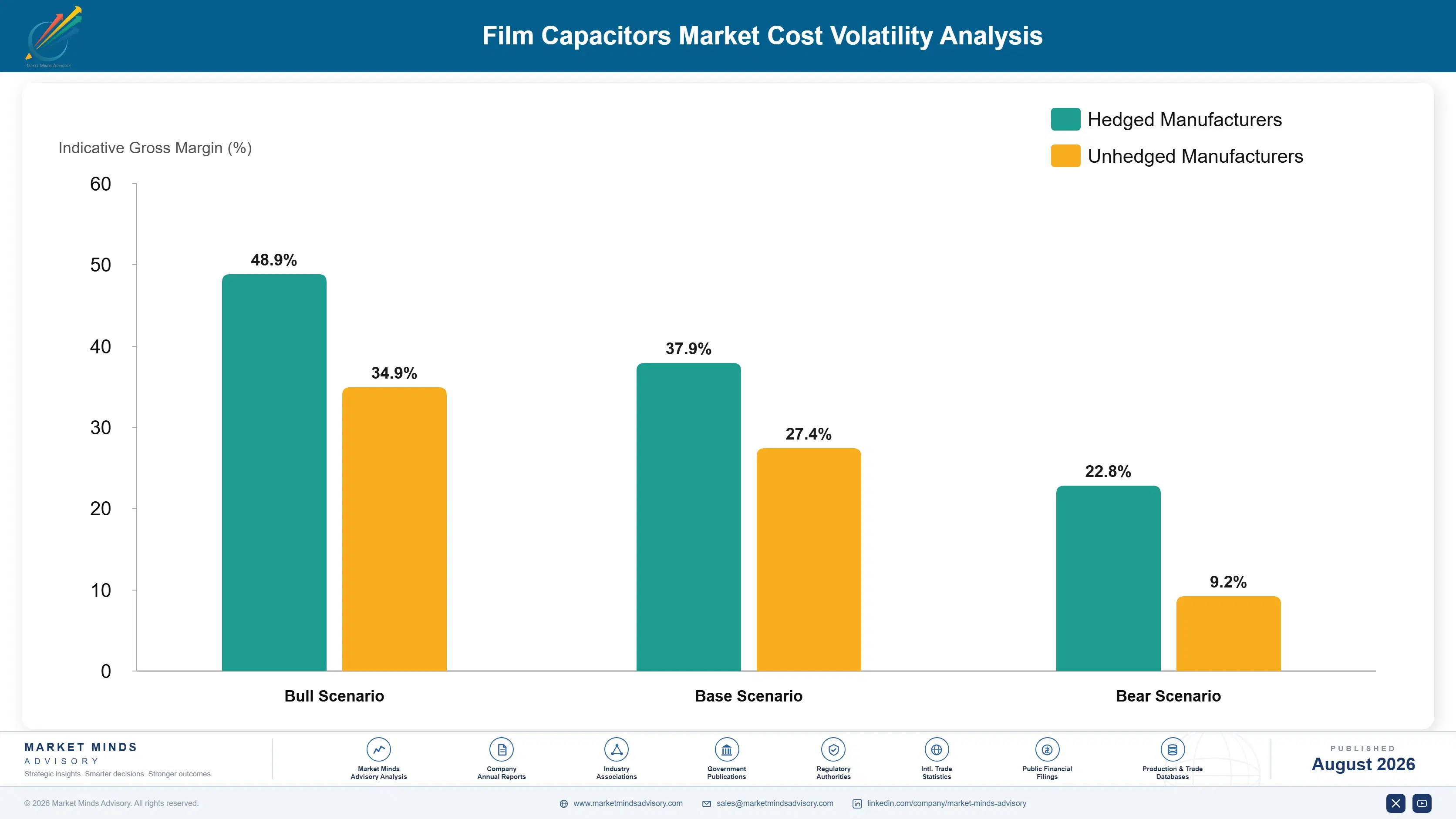
Dielectric film carries roughly 41% of cost of goods sold, sourced from a small group of producers with capacitor-grade capability, and thin gauges command a premium over standard thicknesses that reflects scarcity rather than production cost. Metallisation, including zinc and aluminium deposition, adds about 14%, winding and assembly labour near 17%, encapsulation and housings around 12%, and testing and overhead the balance.
Capacitor-grade film supply tightened sharply through 2022 as electric vehicle demand accelerated faster than film capacity, and several capacitor manufacturers disclosed material constraints and extended lead times in annual filings covering that period. Availability has improved without becoming comfortable, and thin-gauge material in particular remains allocated rather than freely purchased across most of the industry. Thin-gauge material remains allocated rather than freely purchased. Lead times have not returned to prior levels.

The competitive disadvantage mechanism runs through film access rather than through any other input. Metallisation, winding, and assembly cost broadly the same for competent manufacturers anywhere, while a producer without a long-term film agreement cannot build what it has sold regardless of its own capacity. Purchasing scale helps less than expected, since allocation follows relationship length and volume commitment rather than order size alone.
film-capacitors-market-cost-volatility-analysis-1787302704663

Contract film on long-term volume commitments not spot purchase

Roughly seven producers worldwide make capacitor-grade film, and thin-gauge material is allocated rather than freely traded across most of the industry. Long-term agreements with volume commitment secure supply in a way purchasing scale alone does not, since allocation follows relationship length rather than order size. The commitment carries genuine risk against uncertain demand and there is no alternative route.

Improve energy density without demanding thinner dielectric

Segmented metallisation patterns, winding tension control, and end-spray connection quality all raise usable energy density without requiring the sub-three micron gauges that only about 18% of film capacity can produce. Those routes take engineering effort rather than supply agreements. Manufacturers pursuing them reduce exposure to a constraint that nobody downstream of the film producers can resolve independently.

Qualify multiple film producers for each dielectric grade

Dielectric film carries roughly 41% of cost of goods sold and a single-source position transfers complete exposure to one producer's allocation and investment decisions. Qualifying alternatives costs testing and requalification work with customers rather than capital. Manufacturers who did that before 2022 held production through a shortage that stopped competitors who had relied on one relationship.

Portfolio Architecture for Margin Defence

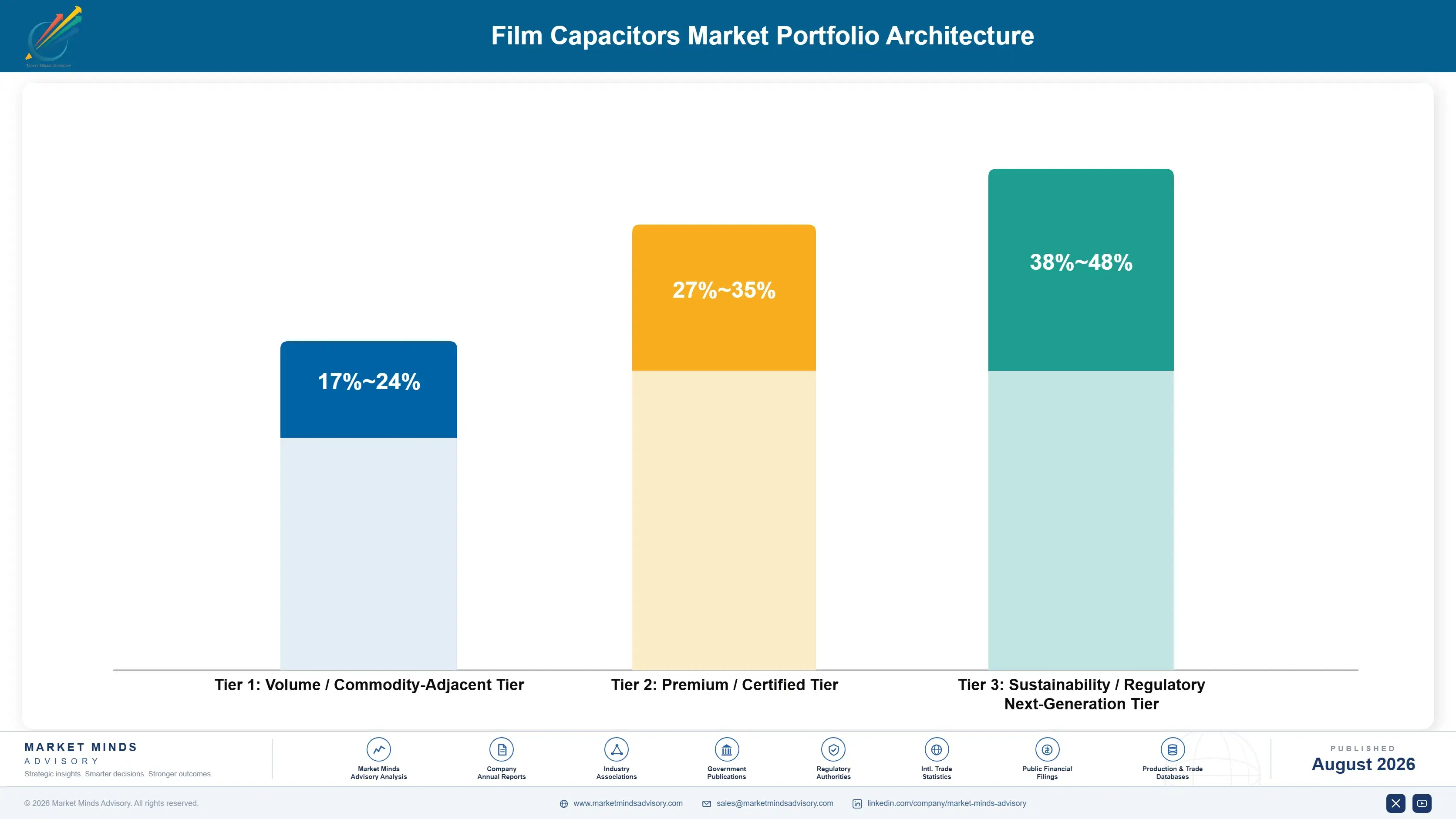
Three tiers describe this business and the spread follows qualification difficulty rather than physical size. General purpose signal and suppression capacitors sit at the bottom, competing on price where Chinese manufacturing sets terms nobody else reaches. Industrial filter and power factor correction units occupy the middle. Traction DC-link and high-temperature specialty dielectric capacitors sit at the top, where qualification and film access both apply.
The tension is that the tier carrying the growth is bounded by film supply rather than by demand or by manufacturing capacity. A manufacturer winning traction programmes it cannot supply has a worse problem than one that lost them. Meanwhile general purpose volume funds the fixed cost base and competes against Chinese pricing directly. Almost every participant is managing both constraints simultaneously and neither comfortably.

High-value pools concentrate where failure behaviour matters more than cost. Traction inverters and renewable converters both value self-healing at roughly 94% fault clearance because the alternative is a field replacement in an inaccessible location. High-temperature specialty dielectrics pool value similarly, since the alternative is redesigning an inverter around a thermal limitation. Both pools sit behind qualification barriers newcomers cannot compress.

Volume / Commodity-Adjacent Tier

General purpose signal, interference suppression, and consumer film capacitors competing on price where Chinese manufacturing sets terms nobody else approaches. Volume funds fixed cost and margin is thin throughout the tier.
Gross Margin: 17-24%

Premium / Certified Tier

Industrial filter, power factor correction, and snubber capacitors where reliability requirements are demanding and volumes are modest. European and Japanese manufacturers hold strong positions here on specification depth rather than cost.
Gross Margin: 27-35%

Sustainability / Regulatory / Next-Generation Tier

Traction DC-link and high-temperature specialty dielectric capacitors where automotive qualification and thin-gauge film access both apply. Best margin by a clear distance, and growth is bounded by film supply rather than by demand.
Gross Margin: 38-48%
film-capacitors-market-portfolio-architecture-1787302705523

Programmes, Qualification and Supply

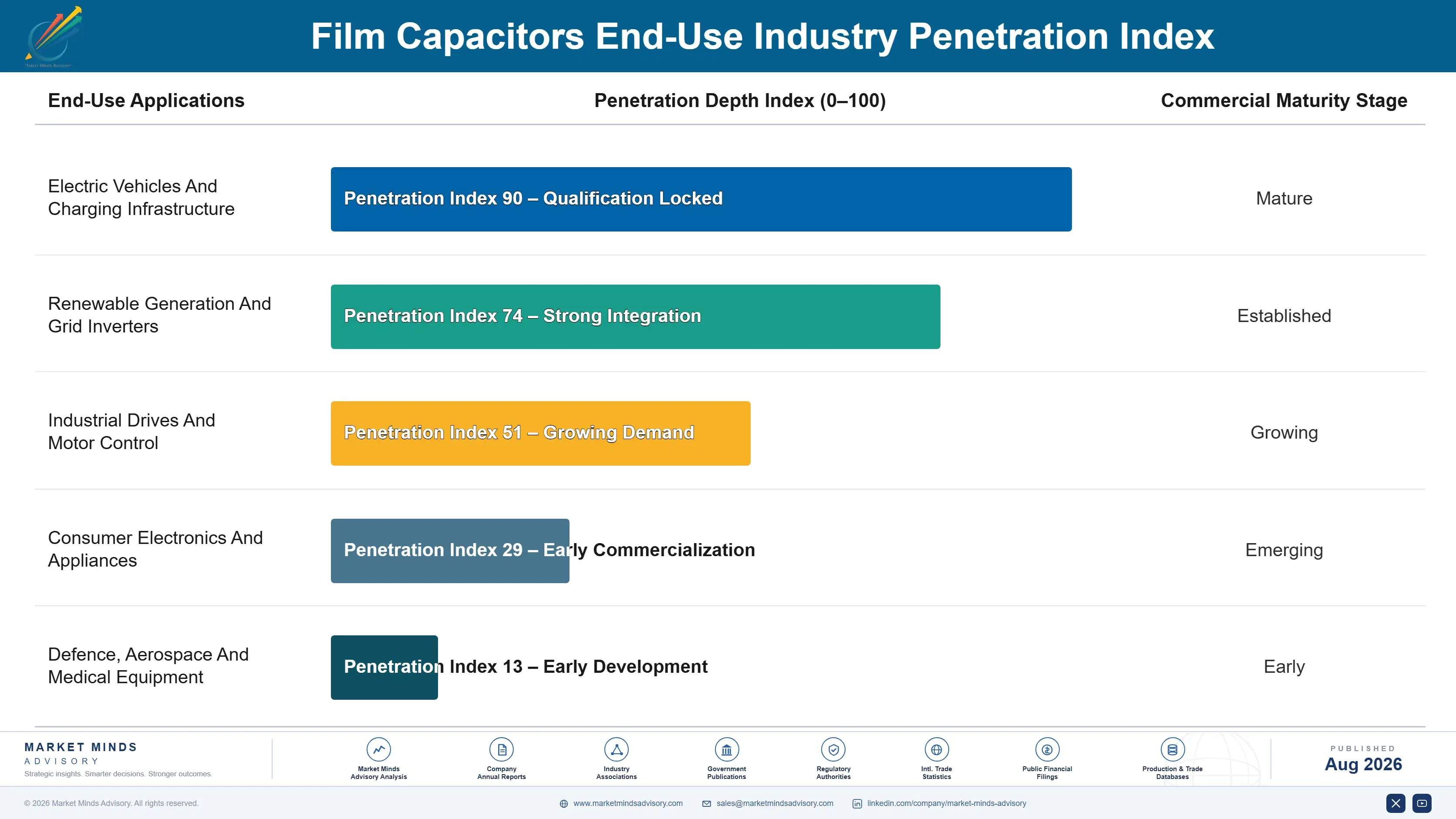
Demand arrives against production schedules once a part is qualified, which makes revenue predictable across a programme life and static in between. A DC-link capacitor qualified into a vehicle platform ships against build rates for years without further commercial activity, and the design was frozen long before any of that volume appeared. Industrial and renewable applications behave similarly on longer and less rigid cycles.
Stickiness runs through qualification rather than through relationship or pricing. Replacing a qualified automotive capacitor means repeating validation, thermal cycling, and production part approval, which no customer undertakes for a modest saving on a component representing a small share of inverter cost. General purpose and consumer capacitors stick hardly at all and are retendered routinely on price and availability alone.

Buyer profiles shifted as power electronics moved from industrial into automotive volume. The earlier buyer was an industrial design engineer selecting from a catalogue against a datasheet. The current one is increasingly an automotive power electronics team that qualifies a single part for a decade and asks about film supply security before committing to it. Those teams ask about film supply security before they commit to any part at all.
film-capacitors-market-end-use-penetration-index-1787302706358

What We Would Tell a Board

These are among the four positions where our research anticipates prominent divergence between winners and laggards over the coming forecast period. Each is grounded in the demand model, the regulatory perimeter, and the announced capacity pipeline.
01 / FILM SUPPLY SECURITY

Contract the film before you order the winders

Roughly seven producers worldwide make capacitor-grade dielectric film, and only about 18% of that capacity reaches the sub-three micron gauges that every energy density improvement in this industry actually depends upon. Winding lines can be installed within about eighteen months, while thin-gauge film queues run considerably longer than that in practice. Long-term film supply agreements carry genuine commitment risk against uncertain future demand, and they nonetheless remain the only route to a capacity expansion that will actually run at all.
02 / AUTOMOTIVE QUALIFICATION COMMITMENT

The slow barrier protects whoever gets through it

Traction inverter DC-link positions take years to qualify and then hold for an entire vehicle programme life, while growing at 12.9% against 8.6% for the wider market throughout that whole period. That qualification barrier works in both directions at once: it excludes newcomers from positions already won, and it equally excludes an incumbent from programmes it never pursued early enough. Manufacturers treating automotive qualification as too slow to justify are effectively declining the fastest growing application anywhere in this whole market.
03 / DIELECTRIC HEDGING STRATEGY

Nobody knows where the temperature question settles

Polypropylene begins degrading above roughly 105 degrees, while silicon carbide inverters now run hotter and considerably more compact than the designs this dielectric was ever comfortable in. Whether specialty dielectrics become mainstream traction specification or remain a narrow niche requirement remains a genuinely unresolved question right across the industry today. Qualifying polyphenylene sulphide alongside conventional polypropylene costs development effort, and it removes the risk of being caught on the wrong side of a question that the physics has not yet settled.
04 / DENSITY WITHOUT THINNER FILM

Stop solving energy density with the scarcest input

Energy density gains have come almost entirely from thinner dielectric, and that route is now approaching physical limits while depending on the 18% of an already narrow capacity base that is controlled by others. Segmented metallisation patterns, winding tension control, and end-spray connection quality all raise usable energy density without demanding any thinner film at all. Manufacturers who pursue those engineering routes reduce their own exposure to a constraint that nobody downstream of the film producers can ever resolve independently.

Engagement Snapshot From the Field

A live engagement with an industry participant carrying material or product regulatory and market exposure ahead of a defining policy shift, showing how our research translates into a defensible multi-year portfolio strategy.
MARKET MINDS ADVISORY · CLIENT ENGAGEMENT SUMMARY
Film Capacitors Producer Strategic Portfolio Review and Transition Roadmap 2026·Investment Scenario on Film Capacitors Exposure Evaluation 2025-26
CLIENT PROFILE
A film capacitor manufacturer with approximately 220 million dollars in annual revenue (client-reported, unverified by MMA), producing general purpose, industrial, and early-stage DC-link capacitors across two plants. Automotive qualification work had begun on one programme, general purpose margin was declining against Asian competition, and management had proposed a substantial winding capacity expansion. Film supply agreements covered existing production only.
STRATEGIC CHALLENGE
The board approved the expansion in principle and asked for verification that the resulting output could actually be supplied and sold. Management had modelled demand and equipment cost thoroughly, and had not examined whether the dielectric film needed to run those lines would be obtainable. Film availability had not been examined at all.
MMA APPROACH
We mapped capacitor-grade film supply globally by producer, grade, and available capacity, separating standard from sub-three micron gauges. The client's existing film agreements were reviewed against the expansion requirement. Automotive qualification timelines were benchmarked against competitors already holding programmes, and general purpose cost position was compared with Asian manufacturers. Allocation practice was assessed directly.
KEY FINDINGS
  1. The expansion required thin-gauge film volumes exceeding what the client's existing agreements covered, and uncommitted capacity across all producers was substantially smaller than the shortfall.
  2. Thin-gauge material was allocated rather than freely traded, and allocation followed relationship length and volume commitment rather than order size or price offered.
  3. The single automotive qualification underway would not complete before the expanded capacity came online, leaving the volume without its intended destination. Timing had not been sequenced.
  4. General purpose cost position sat well behind Asian competitors, and the expansion would have added capacity into exactly that contest. No plausible reduction closed it.
CLIENT PROFILE
A film capacitor manufacturer with approximately 220 million dollars in annual revenue (client-reported, unverified by MMA), producing general purpose, industrial, and early-stage DC-link capacitors across two plants. Automotive qualification work had begun on one programme, general purpose margin was declining against Asian competition, and management had proposed a substantial winding capacity expansion. Film supply agreements covered existing production only.
STRATEGIC CHALLENGE
The board approved the expansion in principle and asked for verification that the resulting output could actually be supplied and sold. Management had modelled demand and equipment cost thoroughly, and had not examined whether the dielectric film needed to run those lines would be obtainable. Film availability had not been examined at all.
MMA APPROACH
We mapped capacitor-grade film supply globally by producer, grade, and available capacity, separating standard from sub-three micron gauges. The client's existing film agreements were reviewed against the expansion requirement. Automotive qualification timelines were benchmarked against competitors already holding programmes, and general purpose cost position was compared with Asian manufacturers. Allocation practice was assessed directly.
KEY FINDINGS
  1. The expansion required thin-gauge film volumes exceeding what the client's existing agreements covered, and uncommitted capacity across all producers was substantially smaller than the shortfall.
  2. Thin-gauge material was allocated rather than freely traded, and allocation followed relationship length and volume commitment rather than order size or price offered.
  3. The single automotive qualification underway would not complete before the expanded capacity came online, leaving the volume without its intended destination. Timing had not been sequenced.
  4. General purpose cost position sat well behind Asian competitors, and the expansion would have added capacity into exactly that contest. No plausible reduction closed it.
RECOMMENDED STRATEGY
Phase 1: Phase 1 (months one to twelve): defer the expansion, negotiate long-term thin-gauge film agreements with at least two qualified producers. Phase 2: Phase 2 (months twelve to thirty): accelerate automotive qualification across additional programmes and begin specialty dielectric qualification alongside. across additional customers. Phase 3: Phase 3 (months thirty to forty-eight): size capacity expansion against contracted film supply and qualified programme volume together. rather than equipment lead times.
OUTCOME
The expansion was deferred. Film agreements were secured with two producers within three quarters, a second automotive qualification began, and capacity planning was rebuilt around contracted dielectric supply rather than around equipment lead times (client-reported, unverified by MMA). General purpose capacity was left unchanged. Margin held through the period.

Frequently Asked Questions

Foundational context covering the market sizes, CAGR, scope, country, region and competition that inform every finding below. This section is provided to cover basics and most often pre-purchase conversations, answered from the MMA Primary Research Dataset.

What is the current size of the Film Capacitors Market?

The market is valued at USD 3.9 billion in 2025, rising to USD 4.24 billion in 2026. Scope covers film dielectric capacitors across power electronics and industrial applications, not electrolytic, ceramic, or supercapacitor technologies.

How large will the Film Capacitors Market be by 2036?

MMA forecasts USD 9.68 billion by 2036, an increase of USD 5.44 billion over the 2026 base. That represents an expansion multiple of 2.28 times across the forecast period.

What is the CAGR for the Film Capacitors Market 2026 to 2036?

The base case CAGR is 8.6%, with a bull case of 9.8% and a bear case of 7.4%. The historical rate from 2020 to 2025 was 7.2%, carried by electric vehicle production rather than general electronics.

Which segment is growing fastest?

DC-link capacitors for traction and inverters at 12.9%, exactly 1.50 times the market rate. Self-healing behaviour and a service life matching the vehicle are what win those positions over electrolytic alternatives.

Who are the major companies in the Film Capacitors Market?

TDK, Vishay Intertechnology, Panasonic, KEMET, and Nichicon lead on capacitor volume weighted by capacitance and voltage rating. The top five hold 44%, with film suppliers assessed on the capacitor volume their dielectric enables.

Which country is growing fastest?

India at 11.4%, where electronics manufacturing and renewable inverter production are scaling simultaneously. Domestic solar inverter assembly has grown quickly under local content requirements, pulling capacitor demand directly.

Report Segmentation Architecture

The full report scope spans multiple orthogonal segmentation dimensions, with cross-tabulated demand data provided for each dimension pair. Coverage extends further to regional breakdowns, trend trajectories, and the competitive detail needed to support segment-level decision-making.

By Circuit Function And Dielectric

  • DC-Link Capacitors For Traction And Inverters
  • High-Temperature Specialty Dielectric Capacitors
  • Alternating Current Filter And Power Factor Correction
  • Snubber And Pulse Discharge Capacitors
  • General Purpose Signal And Interference Suppression

By End-Use Industry

  • Electric Vehicles And Charging Infrastructure
  • Renewable Generation And Grid Inverters
  • Industrial Drives And Motor Control
  • Consumer Electronics And Appliances
  • Defence, Aerospace And Medical Equipment

By Commercial Model

  • Automotive Programme Supply Agreements
  • Original Equipment Supply To Inverter Makers
  • Distributor And Component Catalogue Channels
  • Custom Design And Application Engineering
  • Contract Manufacturing For Other Brands

By Region

  • East Asia
  • Western Europe
  • North America
  • South Asia and Pacific
  • Latin America
  • Middle East and Africa
  • Eastern Europe

Scope, Methodology, and Coverage

Every figure in this report is reproducible from documented input assumptions. The scope below maps the historical period, the forecast horizon, the segmentation dimensions, and the countries covered, alongside the underlying primary and qualitative methodology.
Historical Period
2020 to 2025
Forecast Period
2026 to 2036
Base Year
2025 (USD billions; MMA Primary Research Dataset, August 2026)
Market Definition
This market comprises capacitors using a polymer film dielectric, whether metallised or foil construction, supplied into power electronics, industrial, automotive, and general electronic applications, measured at manufacturer revenue across original equipment, programme, and distribution channels. Coverage spans DC-link capacitors for traction and inverter applications, high-temperature capacitors using specialty dielectrics including polyphenylene sulphide, alternating current filter and power factor correction capacitors, snubber and pulse discharge capacitors, and general purpose signal and interference suppression capacitors. Aluminium and tantalum electrolytic capacitors, ceramic capacitors of every class, supercapacitors and electrochemical storage devices, capacitor-grade film sold into non-capacitor applications, and complete power electronic assemblies and inverters fall outside scope.
Quantitative Units
USD billions (current prices); capacitor volume weighted by capacitance and voltage rating; dielectric film consumed by gauge; qualified automotive programme count
Segmentation Dimensions
By Circuit Function And Dielectric; By End-Use Industry; By Commercial Model; By Region
Regions Covered
East Asia, Western Europe, North America, South Asia and Pacific, Latin America, Middle East and Africa, Eastern Europe
Countries Covered
China, Japan, South Korea, Taiwan, Germany, Italy, France, Finland, United Kingdom, United States, Canada, Mexico, India, Thailand, Vietnam, Australia, Brazil, Argentina, Saudi Arabia, United Arab Emirates, South Africa, Poland, Czechia, Hungary, and additional markets relevant to this sector
Key Companies Profiled
TDK, Vishay Intertechnology, Panasonic, KEMET, Nichicon, Nissin Electric, Electronicon Kondensatoren, ICAR, Cornell Dubilier, Jianghai Capacitor, Xiamen Faratronic, Aihua Group, WIMA, Rubycon, Illinois Capacitor, Toray Industries, Bollore Group, Steiner Film, Shanghai Yongming, Hitachi AIC
Quantitative Methodology
Primary survey, n=3,800 respondents, Q4 2025, six countries; demand-side model with trade association cross-validation
Qualitative Methodology
47 expert interviews, Q4 2025; applied to validate demand model assumptions, identify emerging dynamics, and assess competitive positioning
Report Format
PDF and XLSX data workbook (Word format preview document)
Publisher
Market Minds Advisory
Report Code
MMA-2026-TEC-714
Published
August 2026
Contact
sales@marketmindsadvisory.com | www.marketmindsadvisory.com

Purchase the full Film Capacitors Market Report (2026 to 2036).

The full report sizes film capacitors across five circuit functions, five end-use industries, five commercial models, and seven regions, with dielectric film supply mapped by producer, grade, and available capacity throughout. Thin-gauge availability is quantified separately, since that constraint rather than demand or manufacturing capacity caps expansion across the whole industry. Automotive qualification positions are tracked by programme and manufacturer. Competitive profiling covers twenty companies on capacitor volume weighted by capacitance and voltage rating, specialty dielectric adoption is assessed against inverter thermal design trends, and charging infrastructure demand is modelled separately.
Dielectric film supply mapped by producer, grade, and capacity
Thin-gauge availability quantified separately from total film capacity
Automotive qualification positions tracked by programme and manufacturer
Specialty dielectric adoption assessed against inverter thermal design trends
Self-healing performance compared against electrolytic and ceramic alternatives
Charging infrastructure capacitance demand modelled separately from vehicle content

Built For The People Who Decide

From boardroom strategy to bench-side execution, this report is read cover-to-cover by leaders shaping the next decade of their industry, turning demand scenarios, market dynamics and valuation benchmarks into decisions.
CXOs/ Presidents/ VPs/ Managers
M&A and Corporate Development
Strategy Teams and R&D Heads
Procurement and Product Directors
Regulatory and Compliance Leaders
Investor Relations and Equity Analysts