
Market Minds Advisory
Embedded AI Market

Embedded AI Market: Embedded AI: The Model Has To Fit In The Power Budget Or It Does Not Ship

A commercial reading of on-device intelligence, where milliwatts rather than accuracy decide what ships, the toolchain locks the customer harder than the silicon, and inference has moved out of the data centre for good.

Lead Analyst

Victor Gallo

Published

August 2026

Make Smarter Decisions with Customized Research Insights

Request a free sample report and evaluate market opportunities, growth trends, and competitive dynamics relevant to your business needs.

2025 MARKET VALUE$12.4BMarket Size 2025
2036 FORECAST VALUE$65.3BBase Case , 2026 to 2036
CAGR 2026 TO 203616.3 %Bull 17.6% / Bear 15.0%
INCREMENTAL OPPORTUNITY$50.9BNet 10- year value creation
EXPANSION MULTIPLE4.53x2036 value over 2026 base
Strategic Levers
M&A Pipeline
Regional Outlook
Country Rankings
Competitive Intelligence
Segmental Deep-dive
Call-Us : 91 93563 13602

Executive Snapshot and Market Trajectory.

A model that runs beautifully in a data centre is worthless in a battery-powered sensor. Embedded AI is an exercise in fitting inference inside a power and memory budget that was set by the product engineer years earlier, and accuracy is usually what gets sacrificed first to make it fit.
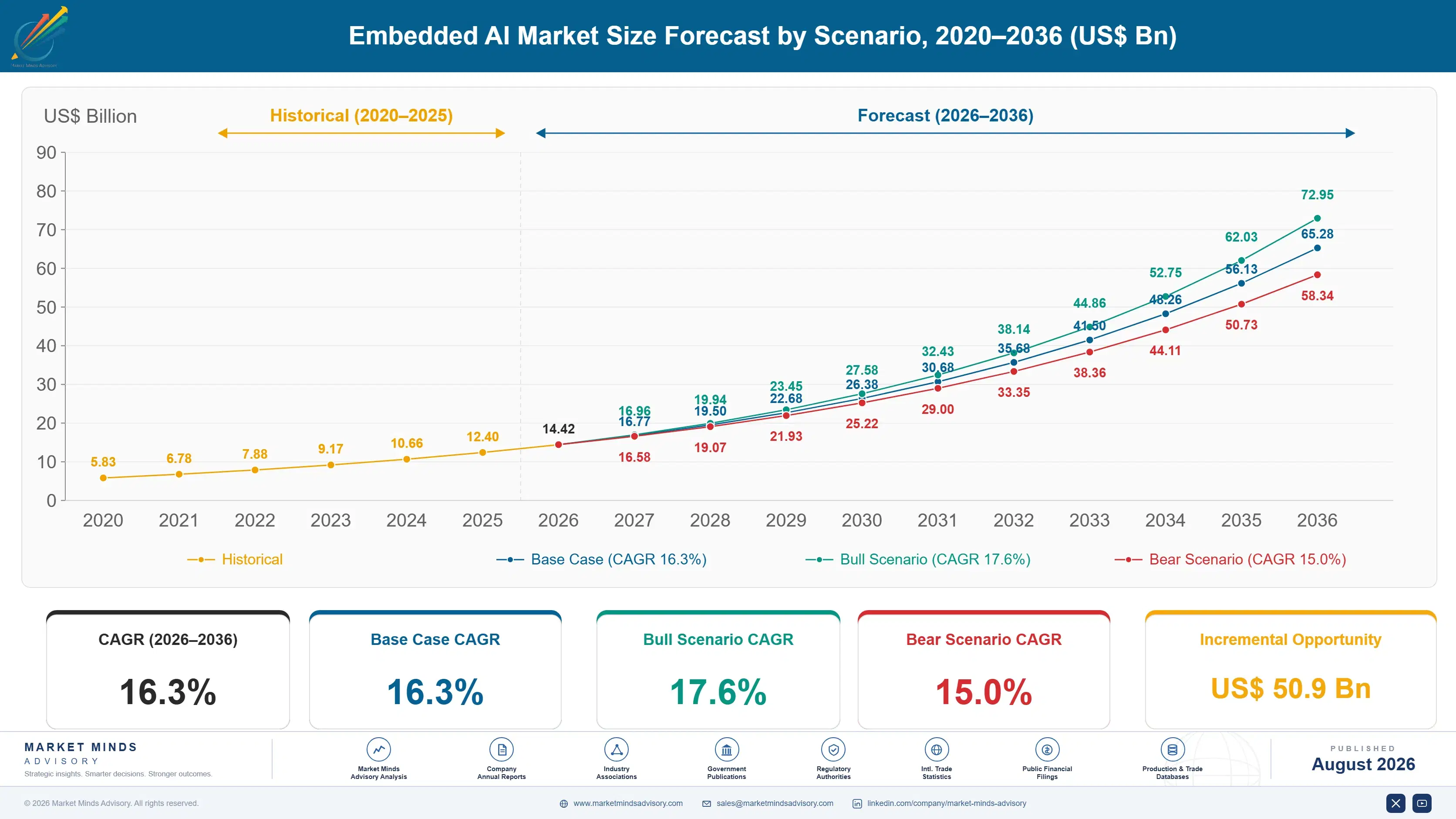
The market stands at USD 12.4 billion in 2025 and reaches USD 65.28 billion by 2036 at a 16.3% CAGR. Development toolchains and model optimisation software grow fastest at 23.1%, about 1.42 times the overall rate, because compressing a model to fit is harder than running it. East Asia holds 30% of value on device manufacturing volume, while India posts the quickest national growth at 22.4% on embedded design and optimisation services.
Concentration is moderate, with the top five holding roughly 45% of embedded inference silicon and software revenue and a crowded field of specialists beneath. Two forces are now reshaping the field. Latency, privacy, and connectivity cost are pushing inference out of the cloud and onto the device permanently, and the toolchain rather than the processor has become what actually locks a customer to a vendor.
Market Definition
The embedded AI market covers hardware and software that execute machine learning inference on devices rather than in data centres, spanning dedicated edge inference accelerators and neural processing units, microcontrollers with integrated inference capability, embedded inference software runtimes, development toolchains and model optimisation software, and embedded AI design and integration services. Data centre training and inference hardware, cloud machine learning platforms, general-purpose processors without inference acceleration, the sensors supplying input data, and finished devices themselves are excluded.
Base Year Value
$12.4B in 2025 (MMA Primary Research Dataset, August 2026)
Forecast Period
2026 to 2036, eleven discrete annual values
CAGR
16.3% base case. Bull 17.6%. Bear 15.0%.
Fastest Growth Segment
Development Toolchains and Model Optimisation Software: 23.1% CAGR
Fastest Growth Country
India: 22.4% CAGR
Fastest Growth Region
South Asia and Pacific: 18.4% CAGR
Largest Region
East Asia: 30% of 2025 global value
Market Leaders
NVIDIA, Qualcomm, STMicroelectronics, NXP Semiconductors, Ambarella. Source: MMA Analysis based on company annual reports.
Primary Survey
n=3,800 procurement and R&D decision-makers, Q4 2025, six countries
Methodology
Demand-side build-up, cross-validated against public data, 47 expert interviews

Embedded AI Market Forecast Scenarios

embedded-ai-market-size-forecast-scenario-1787324527985
Growth from 2020 to 2025 compounded near 14.8%, and the period changed what the category meant. Early edge inference was mostly vision on dedicated accelerators in cameras and industrial equipment. Transformer models then arrived and everyone assumed the cloud would take everything back. Instead, quantisation and pruning improved fast enough that useful models began fitting into microcontroller-class devices, which expanded the addressable hardware base enormously.
Three mechanisms carry the base case to 16.3%. First, latency and connectivity economics: a device that must round-trip to a server cannot respond in real time and pays for bandwidth forever, which fails both technically and commercially at scale. Second, privacy regulation, since data that never leaves the device removes an entire category of compliance exposure. Third, model compression, as quantisation and distillation keep pulling capable models into smaller power envelopes each year.
The bull case at 17.6% assumes compression techniques keep advancing and language model inference reaches microcontroller-class hardware in useful form. The bear case at 15.0% assumes device makers default to cloud inference wherever connectivity permits, model sizes grow faster than compression improves, and toolchain fragmentation continues making embedded deployment expensive enough that most projects never leave prototype.

Why Milliwatts Decide What Actually Ships

Three forces set demand. Latency provides the hardest requirement, because a device controlling a machine cannot wait for a server round trip whatever the connection quality. Connectivity cost provides the second, since streaming sensor data continuously is expensive forever while inference on device is paid for once. And privacy provides the third, as data that never leaves the hardware removes compliance exposure that legal teams increasingly refuse to accept.
MARKET CONCENTRATIONCR5: 45%Moderately consolidated across silicon vendors and software specialists
TYPICAL POWER ENVELOPE1 mW to 15 WRange within which embedded inference must operate on device
MODEL COMPRESSION RATIO4 to 30 timesSize reduction achieved through quantisation and pruning techniques
DESIGN CYCLE LENGTH12 to 30 monthsPeriod from silicon selection to volume device production
SOFTWARE REVENUE SHAREAbout 27%Toolchains and runtimes within total category vendor revenue
PROTOTYPE CONVERSION RATEAbout 22%Embedded projects reaching volume production after initial trial
The commercial character rests on the toolchain rather than the chip. Porting a model to embedded hardware means quantising it, validating accuracy loss, optimising for the specific accelerator, and rebuilding the deployment pipeline, which takes months of engineering per platform. Once done, nobody repeats it voluntarily. That is why vendors compete on developer experience and framework support far more than on inference throughput, and why silicon benchmarks persuade almost nobody.
The next decade turns on two things. Whether compression advances fast enough to bring genuinely capable language models into microcontroller power envelopes, which would multiply the addressable device base rather than merely growing it. And whether toolchain fragmentation resolves, since roughly 22% of embedded projects reach production and integration difficulty rather than silicon capability explains most of the attrition.
"Every vendor benchmarks operations per second per watt and every customer asks whether their existing model will compile without a rewrite. Those are different questions, and the second one decides the design win. The silicon has been good enough for years, the tooling mostly has not."
Director, Edge Computing and Semiconductor Practice · MMA Technology / Edge Inte

Market Trends

Compression Pulls Capable Models Into Tiny Power Budgets

Quantisation to eight-bit and increasingly four-bit integers, structured pruning, and knowledge distillation together shrink models by 4 to 30 times with accuracy loss that many applications tolerate comfortably. That progression has moved useful vision, audio, and anomaly detection models from application processors into microcontroller-class devices measured in milliwatts. The commercial effect is an addressable hardware base expanding by orders of magnitude rather than percentages, since microcontrollers ship in volumes dedicated accelerators never will. Compression tooling has consequently become more commercially valuable than the inference hardware it targets. Volume arrives where nobody expected it.
Market Impact: Connectivity exceeds hardware withi
Toolchain Lock Replaces Silicon Lock Entirely

Porting a model to a specific accelerator consumes months of engineering in quantisation, validation, and pipeline work that nobody repeats for the sake of marginally better silicon. That effort, rather than the processor architecture, is what holds a customer across product generations. Vendors have responded by investing far more in software development kits, framework compatibility, and model zoos than in raw inference performance. A chip that runs the customer's existing model without a rewrite beats a faster chip that requires one, which reverses how this industry competed for two decades.
Market Impact: Rules cover over 140 jurisdictions

Market Opportunities and Growth Drivers

Connectivity Cost Makes Cloud Inference Uneconomic At Scale

A single camera streaming video to a server for analysis consumes bandwidth continuously and pays for it every month of the device's life. Multiply that across a deployment of thousands and the connectivity bill exceeds the hardware cost within a year or two. On-device inference converts that recurring operating expense into a one-time silicon cost, which is an argument finance functions grasp immediately. The same arithmetic applies to industrial sensors, retail analytics, and agricultural monitoring, all of which deploy in numbers that make continuous streaming genuinely unaffordable. Finance functions grasp that arithmetic immediately.
Market Impact: Only 22% reach production

Privacy Regulation Rewards Data That Never Leaves

European data protection rules, sector-specific health and biometric requirements, and increasingly national data residency laws all impose obligations that attach the moment personal data crosses a network boundary. Inference performed entirely on device sidesteps that category of exposure rather than managing it. Legal and compliance teams have consequently become advocates for embedded processing in applications involving cameras, microphones, or health sensors. That is an unusual position for a technical architecture decision, and it moves the choice above engineering to functions with different priorities and budgets. Budget follows the compliance owner rather than engineering.
Market Impact: Revalidation costs 6 months

Market Restraints and Challenges

Most Embedded Projects Never Reach Volume Production

Roughly 22% of embedded machine learning projects convert from prototype into shipping product, and the attrition is overwhelmingly about integration rather than model performance. The root cause is that a demonstration on a development board proves nothing about power draw, thermal behaviour, memory constraints, and update mechanisms in a real enclosure. Commercially this wastes enormous engineering effort and makes buyers cautious about the next project. Vendors mitigate through reference designs matching real product constraints, pre-validated modules, deployment tooling, and application engineering support that carries projects through the difficult phase. Attrition is predictable and mostly avoidable.
Market Impact: Compression reaches 30 times reduct

Toolchain Fragmentation Multiplies Engineering Per Platform

Every accelerator family carries its own compiler, quantisation behaviour, operator support, and debugging tools, so a model validated on one platform must be revalidated entirely on another. The root cause is that vendors differentiated through proprietary tooling when silicon performance converged. Commercially this makes multi-sourcing prohibitively expensive and traps device makers with whichever vendor they chose first. Standardisation efforts around common intermediate representations and runtime interfaces are progressing, and several vendors now support open formats deliberately to win customers away from more locked competitors. Multi-sourcing has become prohibitively expensive as a result.
Market Impact: Porting consumes 12 months engineer
4 additional market trends, 3 additional growth drivers, and 2 additional restraints and challenges are covered in the full report. Contact sales@marketmindsadvisory.com to access the complete intelligence.

Segment CAGR and Growth Architecture

Segmentation follows technology layer, a single stack logic running from inference silicon through runtimes to development tooling and services. Each layer carries its own margin structure, competitive field, and switching cost, so commercial position tracks the layer rather than the device category served. End-use industry and delivery model appear separately within the framework as distinct dimensions.
embedded-ai-market-market-share-analysis-1787324528525

Development Toolchains and Model Optimisation Software

Development toolchains and model optimisation software grow fastest at 23.1%, about 1.42 times the overall 16.3% rate, because compressing a model to fit a power envelope is genuinely harder than executing it once compressed. The layer covers quantisation and pruning tools, compilers targeting specific accelerators, model zoos, profiling and debugging environments, and the deployment pipelines that push updates to fielded devices. Switching cost lives here rather than in the silicon, since months of porting work is what actually holds a customer across product generations. Margins are software margins and capital intensity is negligible. Open format support has become a competitive weapon, with challengers offering portability specifically to prise customers away from more locked incumbents.
CAGR 23.1%

Microcontrollers With Integrated Inference

Microcontrollers with integrated inference capability grow at 19.4%, the second-fastest layer, and they matter commercially because microcontrollers ship in volumes that dedicated accelerators will never approach. Adding a small neural processing block to an existing microcontroller family costs modest die area and brings inference into products where a separate accelerator could never be justified on cost or power. Applications concentrate in anomaly detection, keyword spotting, predictive maintenance, and simple vision at milliwatt power levels. STMicroelectronics, NXP, and Infineon all compete here from established microcontroller franchises, which is a considerable advantage since the customer relationship, toolchain, and design-in process already exist and need no rebuilding. The design-in relationship already exists and costs nothing further.
CAGR 19.4%
Full segment breakdown across 5 segments available in the complete report.

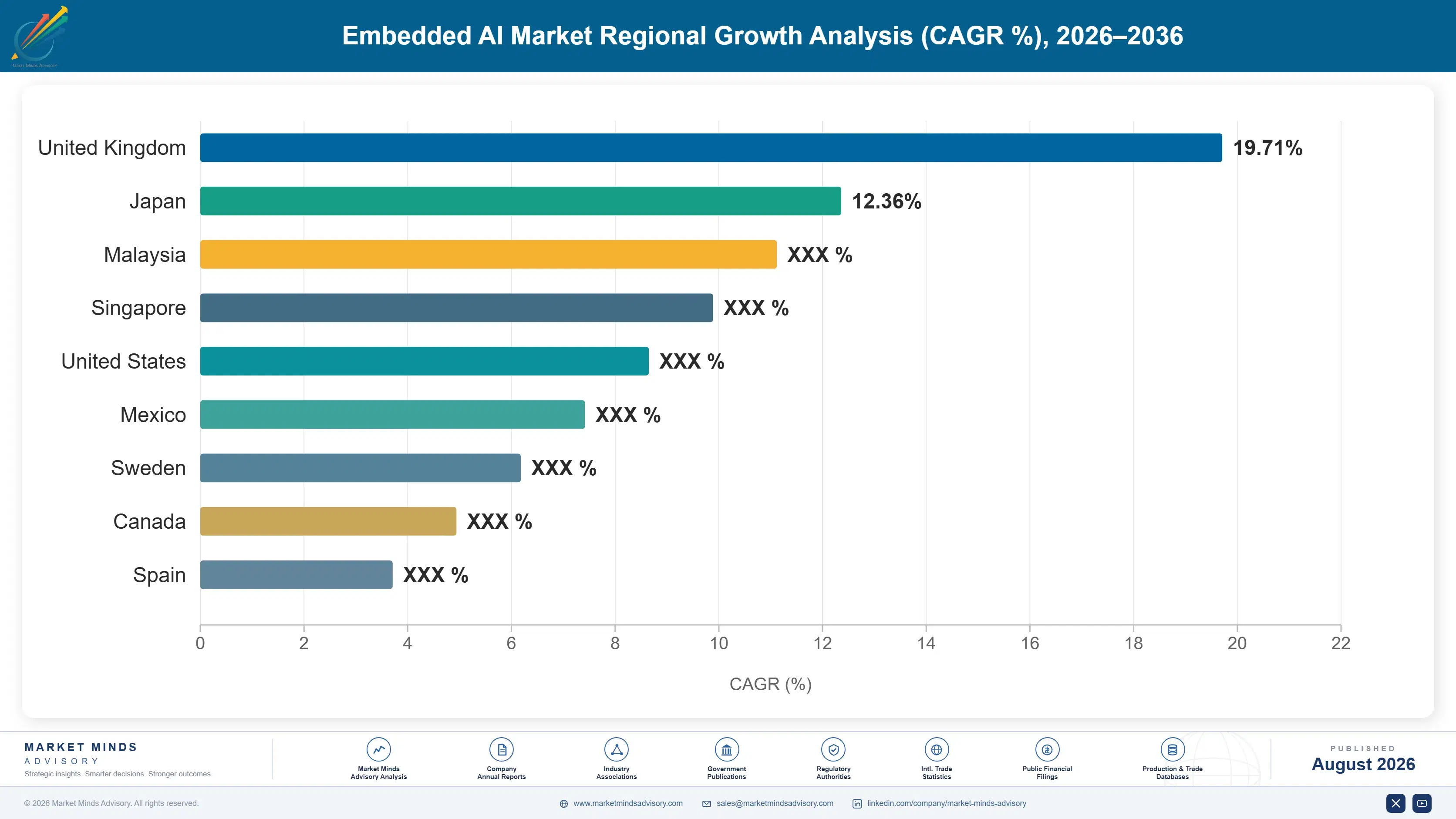
Regional Architecture and Country Demand Map

Device manufacturing volume and design activity together set this distribution rather than software development location. East Asia leads because devices are built there, while North America holds a value share reflecting silicon design and high-value applications more than unit shipments. Where software is written explains almost nothing here.

North America

North America holds 29% of value on silicon design and high-value applications rather than on manufacturing volume. NVIDIA, Qualcomm, and Ambarella all design here, and the automotive, defence, medical device, and industrial applications concentrated in the region carry unit prices consumer electronics never approaches. Venture funding for embedded intelligence startups remains deeper than anywhere else, which sustains a specialist layer beneath the incumbents. Privacy regulation is patchier than in Europe but state-level biometric laws have real teeth in Illinois and Texas. Growth of 16.8% reflects automotive and industrial adoption alongside a defence sector that increasingly specifies on-device processing for operational reasons. Defence procurement now specifies on-device processing for operational reasons.
Share: 29% | CAGR: 16.8% (2026 to 2036)

Western Europe

Regulation and industrial applications define this market together. Western Europe holds 21% of value, with data protection rules making on-device processing a compliance advantage rather than merely an architecture choice, and the artificial intelligence act adding obligations that vary by application risk classification. Industrial automation, automotive, and medical device manufacturers provide the demand, and STMicroelectronics, NXP, and Infineon all design microcontroller families here with integrated inference. Manufacturing volume is modest, so value reflects design and high-value application content. Growth of 14.9% is the slowest of the seven, reflecting weak industrial production and regulatory complexity that lengthens product development considerably. Compliance advantage rather than raw performance drives most adoption decisions here.
Share: 21% | CAGR: 14.9% (2026 to 2036)
Regional intelligence for 5 additional markets available in the complete report: East Asia, South Asia and Pacific, Latin America, Middle East and Africa, Eastern Europe. Contact sales@marketmindsadvisory.com.
embedded-ai-market-country-cagr-analysis-1787324529036

Where Embedded AI Vendors Actually Hold Customers

Benchmarking operations per second per watt against competitors is a conversation customers stopped caring about years ago. The four moves below reach the things that actually decide design wins: toolchain compatibility, reference designs that survive a real enclosure, application engineering through the difficult phase, and the microcontroller volumes that dedicated accelerators will never reach.

Compete On Toolchain Rather Than Inference Throughput

Porting a model to a new accelerator consumes months of quantisation, validation, and pipeline engineering that nobody repeats for marginally better silicon, which makes the toolchain the actual switching cost. A chip running the customer's existing model without a rewrite beats a faster chip requiring one, every time. Vendors should fund software development kits, framework compatibility, and model zoos ahead of raw performance, because benchmark superiority persuades almost nobody while a working compile persuades immediately. Design cycles run 12 to 30 months, so a lost socket stays lost for a product generation.
Market Impact: Porting consumes up to 12 months of

Ship Reference Designs Matching Real Product Constraints

Only about 22% of embedded projects reach volume production, and the attrition is integration rather than model performance, since a development board proves nothing about power draw, thermal behaviour, and memory limits inside a real enclosure. Reference designs built to realistic product constraints, with validated power figures and update mechanisms, convert prototypes that would otherwise die. Vendors treating reference designs as marketing collateral rather than engineering deliverables lose those projects and never learn why. A validated power figure inside a real enclosure is worth more than any benchmark sheet ever printed.
Market Impact: Only 22% of embedded projects reach

Fund Application Engineering Through The Difficult Phase

The point where an embedded project fails is predictable: model accuracy degrades under quantisation, power exceeds budget, and the schedule slips while somebody debugs a compiler. Vendors placing application engineers alongside customers through that phase convert projects that competitors lose, and the resulting design win holds for a product generation of 12 to 30 months at minimum. Headcount cost is real but trivial against the volume a converted design carries. Most vendors under-resource this and then wonder why their pipeline never closes. Pipeline that never closes is usually a resourcing failure.
Market Impact: Design cycles run 12 to 30 months m

Push Inference Into Established Microcontroller Volumes

Dedicated accelerators address a device population measured in millions while microcontrollers ship in billions, and compression advances of 4 to 30 times have brought useful models within milliwatt envelopes. Adding a small inference block to an established microcontroller family costs modest die area and reaches customers who already use the toolchain and design-in process. Silicon vendors with existing microcontroller franchises hold an advantage here that pure accelerator specialists cannot replicate, because the relationship and tooling already exist. Pure accelerator specialists cannot replicate that position. The relationship is the asset. Volume follows the franchise rather than the specification.
Market Impact: Compression achieves 4 to 30 times

Who Controls the Margin Pool

Concentration is moderate: the top five hold roughly 45% of embedded inference silicon and software revenue, with semiconductor groups, accelerator specialists, and software vendors competing from different positions. The gap between leaders and challengers is one of toolchain maturity and design-in reach rather than inference performance, which has been adequate for years. All participants here are assessed on one basis, revenue from embedded inference hardware, software, and integration servic
Competition runs along four lines. First, toolchain and framework support, since a model that compiles without rewriting wins the socket. Second, design-in reach through existing microcontroller and processor relationships. Third, application engineering capacity, which decides how many prototypes reach production. Fourth, power efficiency at the envelope a product targets, which matters far more than peak throughput.

Pressure is building from two directions. Chinese domestic designers have advanced quickly under export controls that made substitution a national priority rather than a commercial choice. Meanwhile open format and runtime standardisation is eroding the toolchain lock that incumbents depend on, with several challengers offering portability deliberately as a competitive weapon. Rankings should favour vendors with mature tooling and microcontroller franchises over those competing on performance alone.
embedded-ai-market-company-positioning-matrix-1787324529570

Competitive Moat and Risk Dimensions

NVIDIA

Moat: Toolchain continuity from cloud

NVIDIA offers developers a path from data centre training to edge deployment within one software environment, which removes the discontinuity forcing revalidation on competing platforms. Its Jetson family covers robotics, industrial vision, and autonomous applications where compute demand justifies the power budget. Developer familiarity from years of cloud work transfers directly and costs competitors enormously to replicate.
NVIDIA

Risk: Power envelope and cost position

The portfolio addresses higher power envelopes than most embedded applications permit, leaving milliwatt-class microcontroller opportunities largely to others. Unit costs sit well above microcontroller vendors for products where price sensitivity is extreme. Attention and capital are also concentrated on data centre business that dwarfs embedded revenue, which limits how aggressively the edge portfolio is developed against focused competitors.
STMICROELECTRONICS

Moat: Microcontroller franchise and design-in

STMicroelectronics reaches embedded developers through a microcontroller franchise already designed into an enormous installed base of industrial, automotive, and consumer products. Adding inference capability to those families means customers adopt it without changing toolchain, supplier, or design process, which removes almost every barrier. Free development tooling and a large community lower trial cost to nearly nothing for a new project.
STMICROELECTRONICS

Risk: Inference performance ceiling

Microcontroller-class inference addresses simpler workloads and cannot serve applications needing sustained higher performance, which caps the addressable content per device. Competition from other established microcontroller vendors adding comparable capability is direct and immediate. Chinese domestic suppliers also compete aggressively on price in exactly the volume consumer and industrial segments where the franchise advantage would otherwise apply most strongly.

Players Tracked

Prominent Players

NVIDIA
Qualcomm
STMicroelectronics
NXP Semiconductors
Ambarella

Other Key Players

Infineon Technologies
Texas Instruments
Renesas Electronics
Synaptics
Hailo
Kneron
Horizon Robotics
SiMa.ai
Edge Impulse
Arm
Silicon Labs
Analog Devices
Axelera AI
BrainChip
Nota AI

Recent Developments

AUGUST 2024

European artificial intelligence act enters into force

The regulation establishing risk-based obligations for artificial intelligence took effect, with requirements phased across subsequent years by risk classification. This was European legislation entering force rather than any commercial transaction, and it created compliance obligations that vary by how a deployed model is used rather than by where it runs.
Signal: Risk classification by application means e
FEBRUARY 2025

Open runtime format adoption widens across embedded silicon vendors

Additional embedded silicon vendors committed to supporting common model interchange formats and runtime interfaces, allowing developers to target multiple accelerators without rebuilding deployment pipelines entirely. This was an industry standardisation development rather than any transaction, and it directly addressed the porting cost that locks customers to a single platform.
Signal: Portability is being offered as a competit
NOVEMBER 2024

Chinese domestic edge inference designers expand product families

Chinese designers including Horizon Robotics broadened embedded inference product ranges targeting automotive and industrial applications, supported by policy prioritising domestic semiconductor substitution under continuing export controls. This was organic product expansion rather than acquisition, and it deepened domestic alternatives to internationally designed inference silicon. Domestic toolchain maturity improved alongside.
Signal: Export controls converted substitution fro

Silicon Design, Foundry, Software Engineering, Support

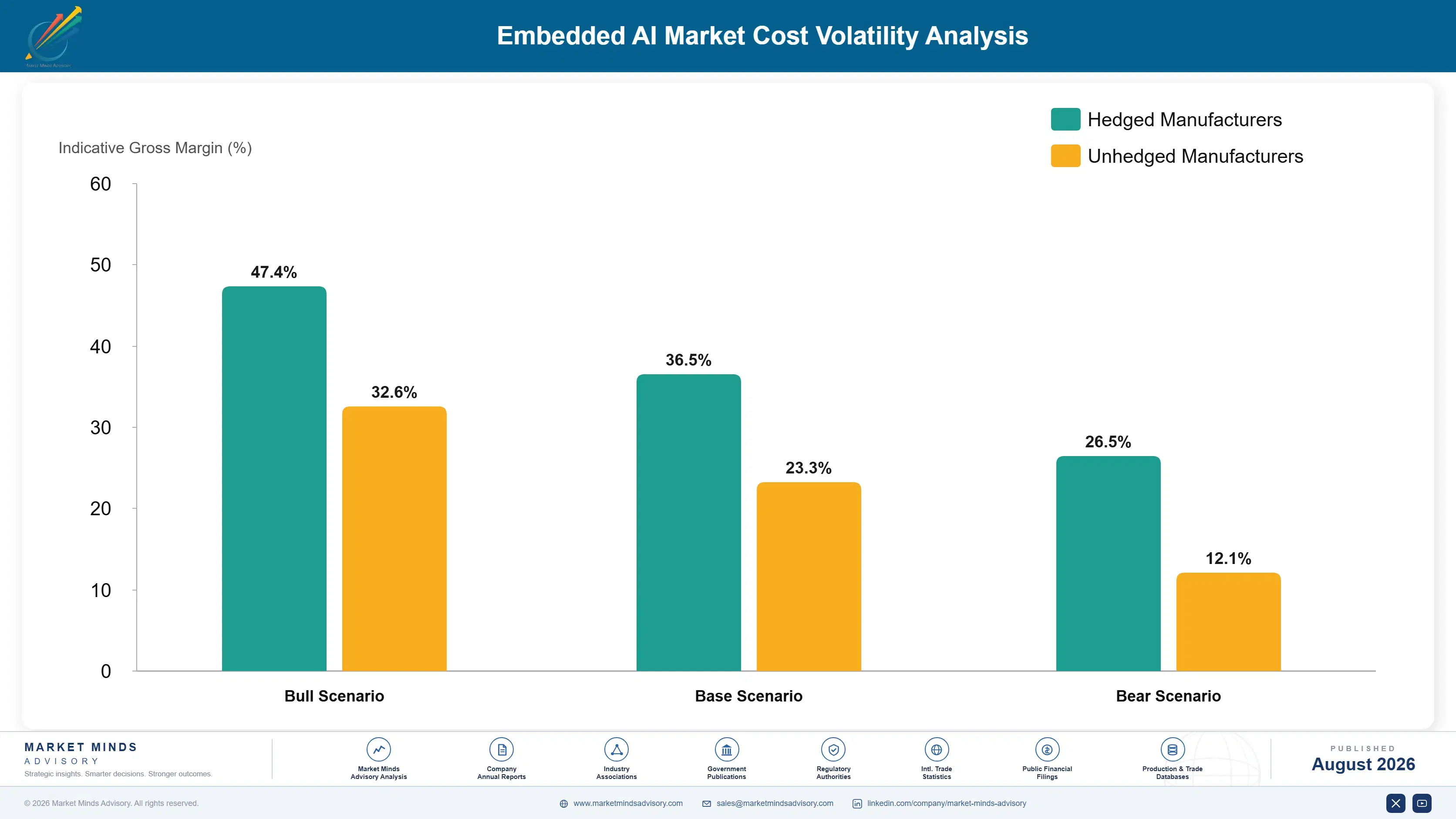
Engineering rather than manufacturing dominates the cost base. Silicon design, verification, and mask sets account for roughly 31% of cost amortised across product volume, which is why unit economics depend on shipment scale. Software engineering for toolchains, runtimes, and model libraries takes 24% to 30%. Foundry wafer cost adds 18% to 24% depending on process node, and application engineering support a further 12% to 17%.
Mask set and design costs at advanced nodes have risen faster than anything else in this market. Moving to leading-edge nodes multiplies non-recurring engineering cost substantially and embedded volumes rarely justify it, which is why most inference silicon stays on older nodes. The 2021 foundry allocation crisis compounded it, with lead times extending past a year on mature nodes. NXP and STMicroelectronics both disclosed capacity constraint effects across 2022 reporting.

Exposure separates by volume and node choice rather than by company size. A vendor shipping microcontroller volumes amortises design cost across billions of units and can justify custom silicon. One addressing accelerator markets spreads the same cost across millions and must price accordingly or license cores. That explains why microcontroller incumbents entered inference comfortably while several well-funded specialists struggled to reach sustainable unit economics.
embedded-ai-market-cost-volatility-analysis-1787324529766

Stay on mature process nodes wherever power permits

Advanced node mask sets multiply non-recurring engineering cost beyond what embedded volumes justify, and inference workloads at milliwatt envelopes rarely need leading-edge geometry. Designing for mature nodes preserves margin and shortens supply chains that advanced capacity keeps constrained. The trade-off is power efficiency at the top of the range, which matters for higher-performance accelerators and very little for microcontroller parts.

License inference cores rather than designing them internally

Building a neural processing block from nothing consumes design headcount better spent on toolchain and application support, where customers actually decide. Licensed cores from established providers arrive verified, with tooling attached, and shorten time to market considerably. The cost is per-unit royalty and reduced differentiation, both acceptable when the competitive contest happens in software rather than silicon anyway.

Reuse toolchain investment across the whole product family

Software engineering is nearly a third of cost, and a toolchain built for one accelerator delivers nothing to the next unless architecture is shared. Designing a consistent programming model across the product range converts that spend into a family-wide asset rather than a per-product cost. The discipline required is resisting architecture divergence, which product teams resist consistently.

Portfolio Architecture for Margin Defence

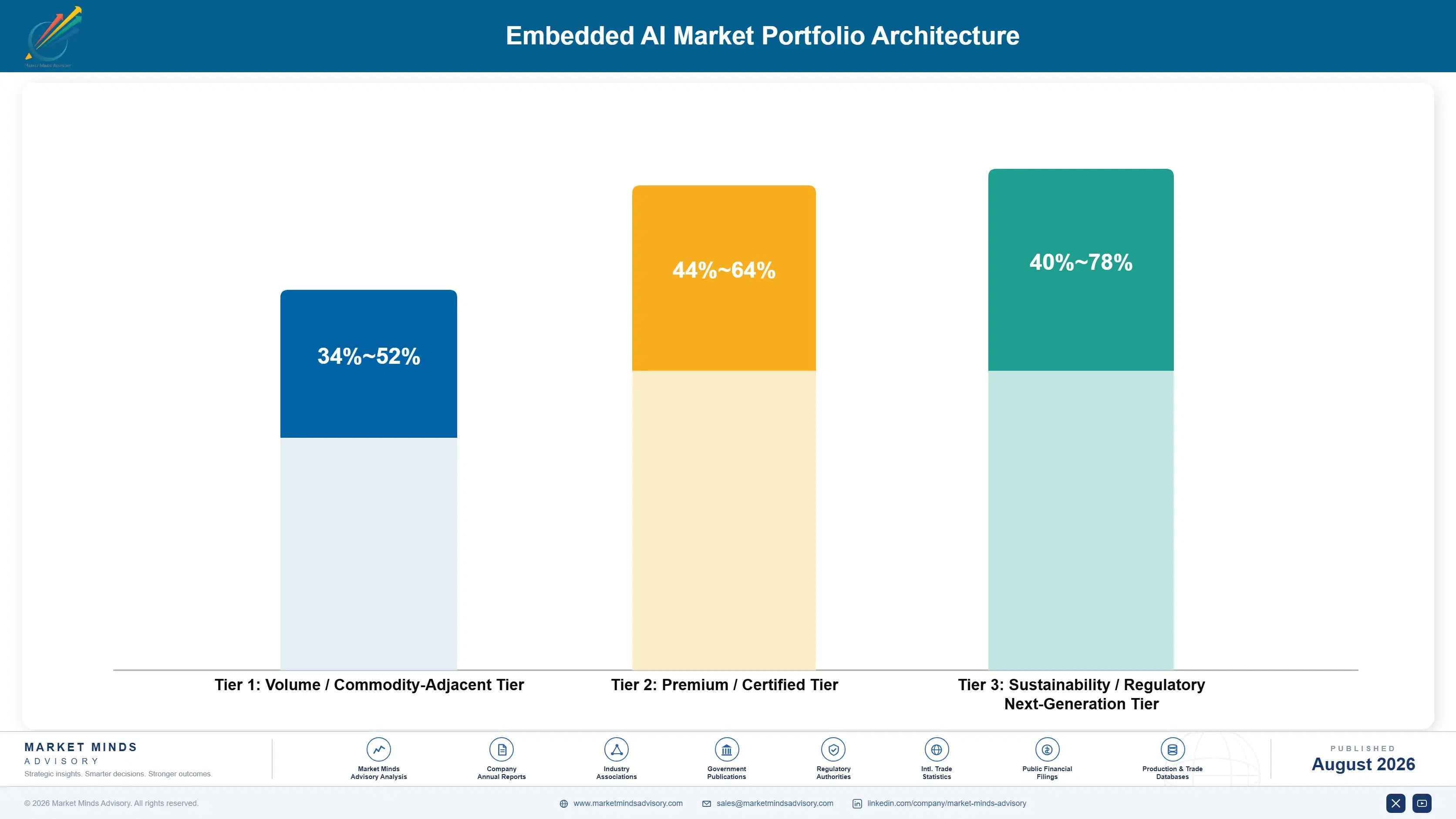
The portfolio splits into three tiers with sharply different economics. Standard inference-capable microcontrollers form the volume tier, competing on price and toolchain familiarity with margin set by shipment scale and node choice. Dedicated accelerators and automotive-qualified parts earn considerably more because performance requirements and qualification both narrow the field. Toolchains, optimisation software, and application services sit differently again, priced against engineering saved
The tension runs between silicon that ships in volume and software that holds the customer. Hardware appears on the bill of materials, generates the revenue that funds everything, and establishes the design-in relationship. Yet the toolchain prevents the next design going elsewhere while generating little direct revenue. Vendors handling this well fund software far beyond what its own revenue line justifies, because the silicon franchise depends entirely on it.

High-value pools concentrate where qualification or capability limits competition: automotive-qualified inference parts with functional safety certification, accelerators for sustained high-throughput industrial vision, optimisation software solving compression problems customers cannot, and application engineering carrying projects into production. All four escape the unit price comparison. Standard microcontroller inference blocks sit at the other end, competing on price against every microcontroller vendor adding the same capability.

Volume / Commodity-Adjacent Tier

Inference-capable microcontrollers and entry-level edge processors sold on price and toolchain familiarity. The range is wide because shipment volume and process node choice determine unit economics more than any design advantage a vendor holds.
Gross Margin: 34-52%

Premium / Certified Tier

Dedicated inference accelerators, automotive-qualified parts with functional safety certification, and high-throughput industrial vision processors. The range is wide because automotive qualification prices firmly while accelerator competition on performance alone compresses margin quickly.
Gross Margin: 44-64%

Sustainability / Regulatory / Next-Generation Tier

Model optimisation software, deployment and update tooling, on-device learning capability, and application engineering services. The range is wide because optimisation software earns software margins while application engineering scales with headcount and caps returns.
Gross Margin: 40-78%
embedded-ai-market-portfolio-architecture-1787324530278

High-value Sub-segments and Strategic Watch-out

Development Toolchains and Model Optimisation Software

High value and high growth at 23.1%, the fastest layer, because compressing a model to fit is harder than executing it afterwards. Switching cost lives entirely here, which makes it the position that actually holds customers across product generations rather than the silicon. Open formats are eroding that lock steadily.
Gross Margin: 62-78%

Microcontrollers With Integrated Inference

High volume with strong growth at 19.4%, reaching device populations that dedicated accelerators will never approach at any price. Established microcontroller vendors hold a real advantage since the toolchain, relationship, and design-in process already exist and need no rebuilding. Die area cost is modest against the reach gained.
Gross Margin: 36-54%

Edge Inference Accelerators

The value core by revenue, growing at 15.2% across robotics, industrial vision, automotive, and higher-performance edge applications. Performance has been adequate for years, so competition has moved to tooling, which several well-funded specialists discovered far too late. Several well-funded specialists have never recovered from that.
Gross Margin: 44-64%

Embedded Inference Software Runtimes

The strategic watch-out, growing at 14.4% and increasingly given away free to support silicon sales rather than sold on its own merits. Open format standardisation is commoditising the layer, which removes a differentiator vendors had relied on for years. Giving it away supports silicon rather than earning alone.
Gross Margin: 40-66%

How Design Wins Actually Convert

Demand commits at design-in and ships for the product generation that follows. A device maker selecting inference silicon commits toolchain, firmware, and validation effort measured in months, then ships that design for 12 to 30 months and frequently longer. Changing supplier mid-generation is effectively impossible. That makes the design-in pipeline the only thing worth managing, and it explains why early application engineering converts more revenue than any promotion afterwards.
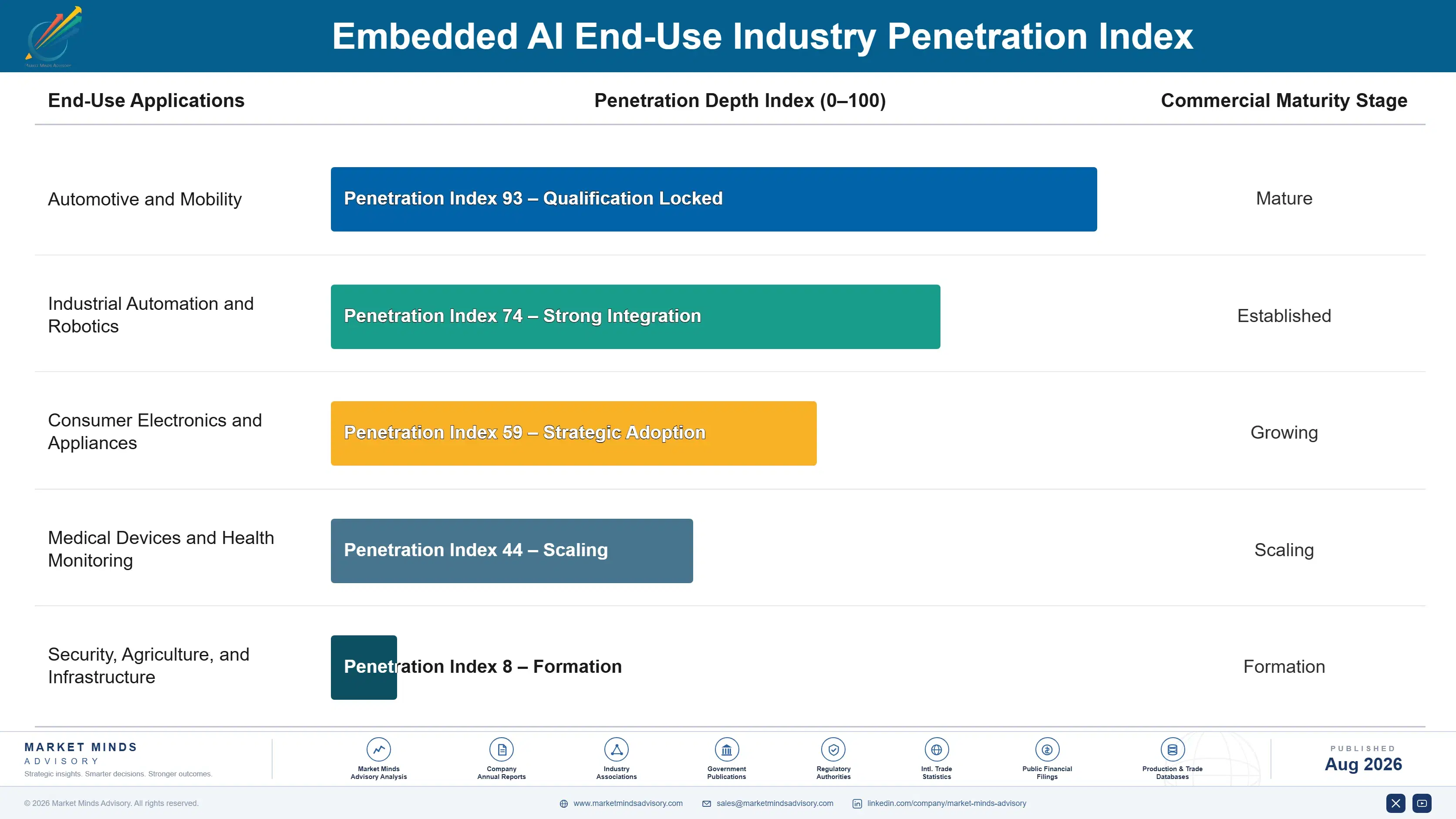
Stickiness varies sharply by application. Automotive sticks hardest, since functional safety qualification and validation make any change a programme-level decision rather than a purchasing one. Industrial equipment sticks through long product lifecycles and certification. Medical devices stick through regulatory submission content. Consumer electronics sticks least, refreshing annually and switching whenever a competitor offers better cost or capability at the same integration effort.

Buyer profiles have moved from embedded firmware engineers evaluating datasheets toward machine learning teams who arrive with an existing model and ask whether it will run. That is a completely different question, and vendors whose answer requires a rewrite lose before any technical evaluation begins. Younger development teams also expect the tooling experience they know from cloud frameworks, which most embedded vendors still do not provide adequately.
embedded-ai-market-end-use-penetration-index-1787324530771

Our Call On Embedded AI

These are among the four positions where our research anticipates prominent divergence between winners and laggards over the coming forecast period. Each is grounded in the demand model, the regulatory perimeter, and the announced capacity pipeline.
01 / TOOLCHAIN HOLDS CUSTOMERS

Software switching cost decides sockets, not silicon speed

Porting a model to a new accelerator consumes months of quantisation, validation, and pipeline engineering that nobody repeats for marginally better hardware, which makes the tooling the real switching cost in this entire market. A chip that compiles the customer's existing model without a rewrite beats a faster chip requiring one every single time. Vendors should fund software development kits and framework compatibility ahead of raw inference performance, because benchmark superiority persuades almost nobody once an actual technical evaluation begins in earnest.
02 / INTEGRATION KILLS PROJECTS

Prototypes die in enclosures, not in accuracy testing

Only about 22% of embedded machine learning projects reach volume production, and the attrition is overwhelmingly integration rather than model performance, since a development board proves nothing about power, thermal behaviour, or memory inside a real product enclosure. Reference designs built to realistic constraints and application engineers placed alongside customers through the difficult phase convert projects competitors lose. Vendors treating reference designs as marketing collateral rather than engineering deliverables never learn why their pipeline consistently fails to close at all.
03 / MICROCONTROLLERS CARRY VOLUME

Compression moved inference into billions of shipping devices

Quantisation, pruning, and distillation now shrink models by 4 to 30 times, which has brought useful vision, audio, and anomaly detection into microcontroller-class parts measured in single milliwatts. That expands the addressable device base by orders of magnitude rather than percentages, since microcontrollers ship in volumes that dedicated accelerators will never approach. Vendors with established microcontroller franchises should add inference blocks aggressively, because the toolchain, relationship, and design-in process already exist and cost the vendor nothing further to reach or rebuild.
04 / BUYERS CHANGED ENTIRELY

Machine learning teams now ask a different question

Evaluation has moved from embedded firmware engineers reading datasheets toward machine learning teams arriving with an already trained model and asking whether it will run without modification. That question decides the outcome before any technical comparison begins, and a vendor whose answer requires a rewrite has already lost the socket. Silicon vendors should measure themselves on how many customer models compile unmodified on first attempt, because that single figure predicts design wins better than any performance benchmark currently available anywhere.

Engagement Snapshot From the Field

A live engagement with an industry participant carrying material or product regulatory and market exposure ahead of a defining policy shift, showing how our research translates into a defensible multi-year portfolio strategy.
MARKET MINDS ADVISORY · CLIENT ENGAGEMENT SUMMARY
Embedded AI Producer Strategic Portfolio Review and Transition Roadmap 2026·Investment Scenario on Embedded AI Exposure Evaluation 2025-26
CLIENT PROFILE
An industrial equipment manufacturer with roughly 40,000 connected machines in the field engaged MMA after three internal embedded machine learning projects failed to reach production. The client reported cumulative development spend near USD 18 million across those projects, and connectivity costs for cloud inference approaching USD 4 million annually across the installed base (client-reported, unverified by MMA).
STRATEGIC CHALLENGE
Engineering blamed silicon performance for the failures and wanted to switch accelerator vendors, which would have restarted the porting work that consumed most of the previous budget. Nobody had examined where the projects actually stalled. Meanwhile connectivity costs were rising with every machine deployed, and the cloud inference architecture the company had defaulted to was becoming the largest line in its service cost base.
MMA APPROACH
MMA reconstructed each failed project to identify the specific stage where it stopped, which internal post-mortems had never done consistently. We assessed candidate silicon on toolchain compatibility with the client's existing models rather than on inference benchmarks. We then modelled on-device inference against cloud architecture across the installed base, including connectivity, latency, and the data residency exposure legal had flagged separately.
KEY FINDINGS
  1. All three projects stalled at integration rather than model accuracy, failing on power budget and memory constraints inside the actual enclosure (client-reported, unverified by MMA).
  2. Switching accelerator vendors would have restarted roughly nine months of porting work without addressing the constraint that had actually killed the projects.
  3. Two of the client's existing models compiled unmodified on an inference-capable microcontroller already used elsewhere in the product range, with no porting work.
  4. On-device inference removed roughly 78% of the projected connectivity cost across the entire installed base within three years (client-reported, unverified by MMA).
CLIENT PROFILE
An industrial equipment manufacturer with roughly 40,000 connected machines in the field engaged MMA after three internal embedded machine learning projects failed to reach production. The client reported cumulative development spend near USD 18 million across those projects, and connectivity costs for cloud inference approaching USD 4 million annually across the installed base (client-reported, unverified by MMA).
STRATEGIC CHALLENGE
Engineering blamed silicon performance for the failures and wanted to switch accelerator vendors, which would have restarted the porting work that consumed most of the previous budget. Nobody had examined where the projects actually stalled. Meanwhile connectivity costs were rising with every machine deployed, and the cloud inference architecture the company had defaulted to was becoming the largest line in its service cost base.
MMA APPROACH
MMA reconstructed each failed project to identify the specific stage where it stopped, which internal post-mortems had never done consistently. We assessed candidate silicon on toolchain compatibility with the client's existing models rather than on inference benchmarks. We then modelled on-device inference against cloud architecture across the installed base, including connectivity, latency, and the data residency exposure legal had flagged separately.
KEY FINDINGS
  1. All three projects stalled at integration rather than model accuracy, failing on power budget and memory constraints inside the actual enclosure (client-reported, unverified by MMA).
  2. Switching accelerator vendors would have restarted roughly nine months of porting work without addressing the constraint that had actually killed the projects.
  3. Two of the client's existing models compiled unmodified on an inference-capable microcontroller already used elsewhere in the product range, with no porting work.
  4. On-device inference removed roughly 78% of the projected connectivity cost across the entire installed base within three years (client-reported, unverified by MMA).
RECOMMENDED STRATEGY
Phase 1: Phase 1 (0 to 7 months): Stop the vendor switch and rebuild reference designs against real enclosure power, thermal, and memory constraints. Phase 2: Phase 2 (7 to 20 months): Deploy inference on the microcontroller family already designed in, using models that compile without modification. Phase 3: Phase 3 (20 to 34 months): Migrate the installed base from cloud to on-device inference and retire the connectivity contracts progressively.
OUTCOME
The client shipped its first embedded inference product within a year using silicon already in the design, rather than the accelerator switch engineering had proposed. Connectivity costs began falling as machines migrated, and the data residency exposure that legal had raised separately was resolved without any architectural work beyond the migration itself (client-reported, unverified by MMA).

Frequently Asked Questions

Foundational context covering the market sizes, CAGR, scope, country, region and competition that inform every finding below. This section is provided to cover basics and most often pre-purchase conversations, answered from the MMA Primary Research Dataset.

What is the current size of the Embedded AI Market?

The global embedded AI market is valued at USD 12.4 billion in 2025, covering edge inference accelerators, inference-capable microcontrollers, embedded runtimes, optimisation toolchains, and integration services. Data centre training and inference systems are excluded.

How large will the Embedded AI Market be by 2036?

The market is forecast to reach USD 65.28 billion by 2036 in the base case, about 4.53 times the 2026 level. That represents incremental value of roughly USD 50.86 billion across the decade.

What is the CAGR for the Embedded AI Market 2026 to 2036?

The market grows at a 16.3% CAGR in the base case, with bull and bear scenarios at 17.6% and 15.0%. The spread turns mainly on compression progress and whether toolchain fragmentation resolves.

Which segment is growing fastest?

Development toolchains and model optimisation software grow fastest at 23.1%, about 1.42 times the overall rate, because compressing a model to fit is harder than executing it. Inference-capable microcontrollers follow at 19.4%.

Who are the major companies in the Embedded AI Market?

Leading participants include NVIDIA, Qualcomm, STMicroelectronics, NXP Semiconductors, and Ambarella. Concentration is moderate, with the top five holding roughly 45% of embedded inference silicon and software revenue.

Which country is growing fastest?

India grows fastest at a 22.4% CAGR, as embedded engineering services firms take on the model optimisation and integration work device makers elsewhere outsource. China follows on manufacturing and domestic silicon substitution.

Report Segmentation Architecture

The full report scope spans multiple orthogonal segmentation dimensions, with cross-tabulated demand data provided for each dimension pair. Coverage extends further to regional breakdowns, trend trajectories, and the competitive detail needed to support segment-level decision-making.

By Technology Layer

  • Edge Inference Accelerators
  • Microcontrollers With Integrated Inference
  • Embedded Inference Software Runtimes
  • Development Toolchains and Model Optimisation Software
  • Design and Integration Services

By End-Use Industry

  • Automotive and Mobility
  • Industrial Automation and Robotics
  • Consumer Electronics and Appliances
  • Medical Devices and Health Monitoring
  • Security, Agriculture, and Infrastructure

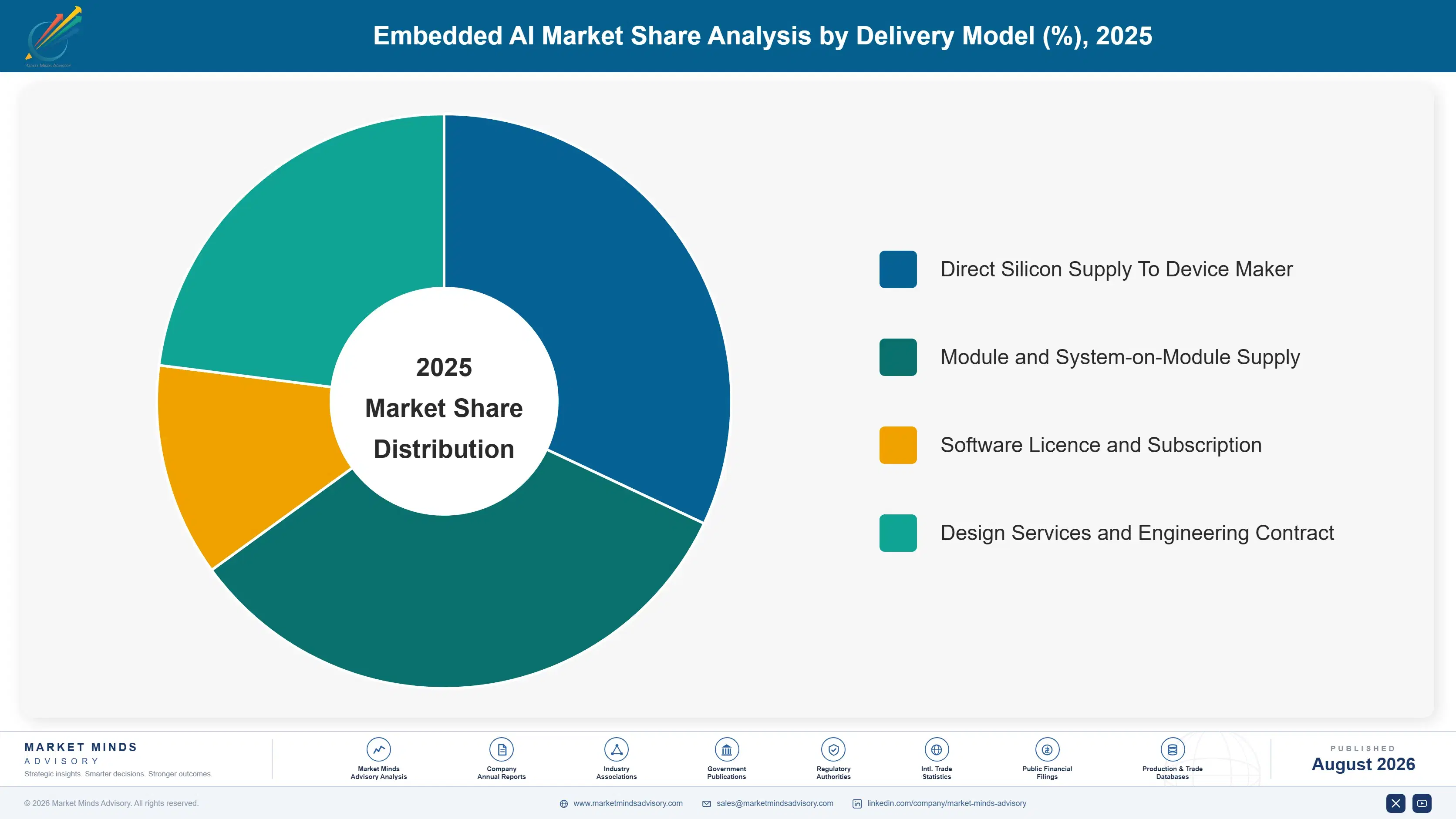
By Delivery Model

  • Direct Silicon Supply To Device Maker
  • Module and System-on-Module Supply
  • Software Licence and Subscription
  • Design Services and Engineering Contract

By Region

  • North America
  • Western Europe
  • East Asia
  • South Asia and Pacific
  • Latin America
  • Middle East and Africa
  • Eastern Europe

Scope, Methodology, and Coverage

Every figure in this report is reproducible from documented input assumptions. The scope below maps the historical period, the forecast horizon, the segmentation dimensions, and the countries covered, alongside the underlying primary and qualitative methodology.
Historical Period
2020 to 2025
Forecast Period
2026 to 2036
Base Year
2025 (USD billions; MMA Primary Research Dataset, August 2026)
Market Definition
The embedded AI market comprises hardware and software that execute machine learning inference locally on devices rather than in centralised data centres, valued at vendor revenue from silicon, software licensing, and associated engineering services. It spans dedicated edge inference accelerators and neural processing units, microcontrollers and application processors with integrated inference acceleration, embedded inference software runtimes, development toolchains and model optimisation software including quantisation and pruning tools, and embedded design and integration services. Data centre training and inference hardware and systems, cloud machine learning platforms and services, general-purpose processors carrying no inference acceleration, the sensors and cameras supplying input data, network connectivity services, and the finished devices or vehicles in which embedded inference is deployed are excluded.
Quantitative Units
USD billions (current prices); inference-capable device shipments in millions of units where applicable
Segmentation Dimensions
By Technology Layer; By End-Use Industry; By Delivery Model; By Region
Regions Covered
North America, Western Europe, East Asia, South Asia and Pacific, Latin America, Middle East and Africa, Eastern Europe
Countries Covered
USA, China, Germany, France, UK, Japan, South Korea, India, Australia, Canada, Brazil, Mexico, Indonesia, Vietnam, Thailand, Malaysia, UAE, Saudi Arabia, South Africa, Nigeria, Turkey, Poland, Netherlands, Italy, Spain, Sweden, Switzerland, Argentina, Colombia, Singapore, and additional markets relevant to this sector
Key Companies Profiled
NVIDIA, Qualcomm, STMicroelectronics, NXP Semiconductors, Ambarella, Infineon Technologies, Texas Instruments, Renesas Electronics, Synaptics, Hailo, Kneron, Horizon Robotics, SiMa.ai, Edge Impulse, Arm, Silicon Labs, Analog Devices, Axelera AI, BrainChip, Nota AI
Quantitative Methodology
Primary survey, n=3,800 respondents, Q4 2025, six countries; demand-side model with trade association cross-validation
Qualitative Methodology
47 expert interviews, Q4 2025; applied to validate demand model assumptions, identify emerging dynamics, and assess competitive positioning
Report Format
PDF and XLSX data workbook (Word format preview document)
Publisher
Market Minds Advisory
Report Code
MMA-2026-TEC-211
Published
August 2026
Contact
sales@marketmindsadvisory.com | www.marketmindsadvisory.com

Purchase the full Embedded AI Market Report (2026 to 2036).

The full MMA Embedded AI report sizes the market across five technology layers, five end-use industries, four delivery models, and seven regions through 2036. It profiles 20 participants on a consistent basis of embedded inference hardware, software, and service revenue, scoring each on toolchain maturity, design-in reach, application engineering capacity, and power efficiency at target envelopes. Scenario models quantify how model compression, privacy regulation, and toolchain standardisation move both device volume and achievable margin by layer. The report also includes prototype-to-production conversion analysis by application, toolchain compatibility benchmarking across silicon families, connectivity cost comparison against on-device inference, and design-in pipeline assessment for silicon vendors and device makers.
Five-layer and four-model market sizing to 2036
Twenty-participant benchmark on embedded inference hardware and software revenue
Prototype-to-production conversion analysis by application and constraint
Toolchain compatibility benchmarking across major silicon families
Connectivity cost comparison against on-device inference by deployment scale
Design-in pipeline assessment across automotive, industrial, and consumer segments

Built For The People Who Decide

From boardroom strategy to bench-side execution, this report is read cover-to-cover by leaders shaping the next decade of their industry, turning demand scenarios, market dynamics and valuation benchmarks into decisions.
CXOs/ Presidents/ VPs/ Managers
M&A and Corporate Development
Strategy Teams and R&D Heads
Procurement and Product Directors
Regulatory and Compliance Leaders
Investor Relations and Equity Analysts