
Market Minds Advisory
Electric Passenger Car MRO Market

Electric Passenger Car MRO Market: Electric Passenger Car MRO: Certification Barriers, Battery Repairability, and a Service Pool That Shrinks Per Vehicle

Each electric car needs about a third less maintenance than the vehicle it replaced, and most of what remains stays inside franchised networks because independents cannot access the diagnostics. Certification is the wall.

Lead Analyst

David Horsley

Published

August 2026

Make Smarter Decisions with Customized Research Insights

Request a free sample report and evaluate market opportunities, growth trends, and competitive dynamics relevant to your business needs.

2025 MARKET VALUE$19.6BMarket Size 2025
2036 FORECAST VALUE$94.7BBase Case , 2026 to 2036
CAGR 2026 TO 203615.4 %Bull 16.7% / Bear 14.2%
INCREMENTAL OPPORTUNITY$72.1BNet 10- year value creation
EXPANSION MULTIPLE4.19x2036 value over 2026 base
Strategic Levers
M&A Pipeline
Regional Outlook
Country Rankings
Competitive Intelligence
Segmental Deep-dive
Call-Us : 91 93563 13602

Executive Snapshot and Market Trajectory.

Every electric car on the road generates about a third less service spend than the combustion vehicle it replaced. The parc is growing fast enough to hide that arithmetic for now, and the independent workshops watching it arrive understand exactly what it means for them. Parc growth hides that.
Commercial power sits with whoever holds diagnostic access and high-voltage certification rather than with anyone able to change a tyre. Battery diagnostics and repair grow fastest at 24.6%, roughly 1.60 times the market, from a base constrained by manufacturers withholding module-level service information. East Asia holds 30% of global value on the world's largest electric vehicle population by a wide margin. Access decides everything.
Concentration is extremely low at roughly 16% for the top five, since vehicle servicing is inherently local everywhere. Franchised dealers retain 61% of work, well above their combustion share, because certification and data access keep independents out. Only 23% of failed battery packs are repaired rather than replaced entirely. Manufacturers withholding module-level service information rather than any technical obstacle is what makes a repairable fault into a total loss on an otherwise sound car.
Market Definition
The market comprises maintenance, repair, and overhaul services for battery electric and plug-in hybrid passenger cars, covering scheduled servicing and inspection, tyres brakes and chassis repair, high-voltage battery diagnostics and repair, power electronics and e-axle repair, collision repair under high-voltage procedures, and software calibration and connected services. Value is measured at service provider level including parts and labour. Commercial vehicle and bus servicing, charging infrastructure maintenance, battery manufacturing and second-life processing, vehicle insurance, and roadside assistance subscriptions fall outside scope.
Base Year Value
$19.6B in 2025 (MMA Primary Research Dataset, August 2026)
Forecast Period
2026 to 2036, eleven discrete annual values
CAGR
15.4% base case. Bull 16.7%. Bear 14.2%.
Fastest Growth Segment
High-Voltage Battery Diagnostics and Repair: 24.6% CAGR
Fastest Growth Country
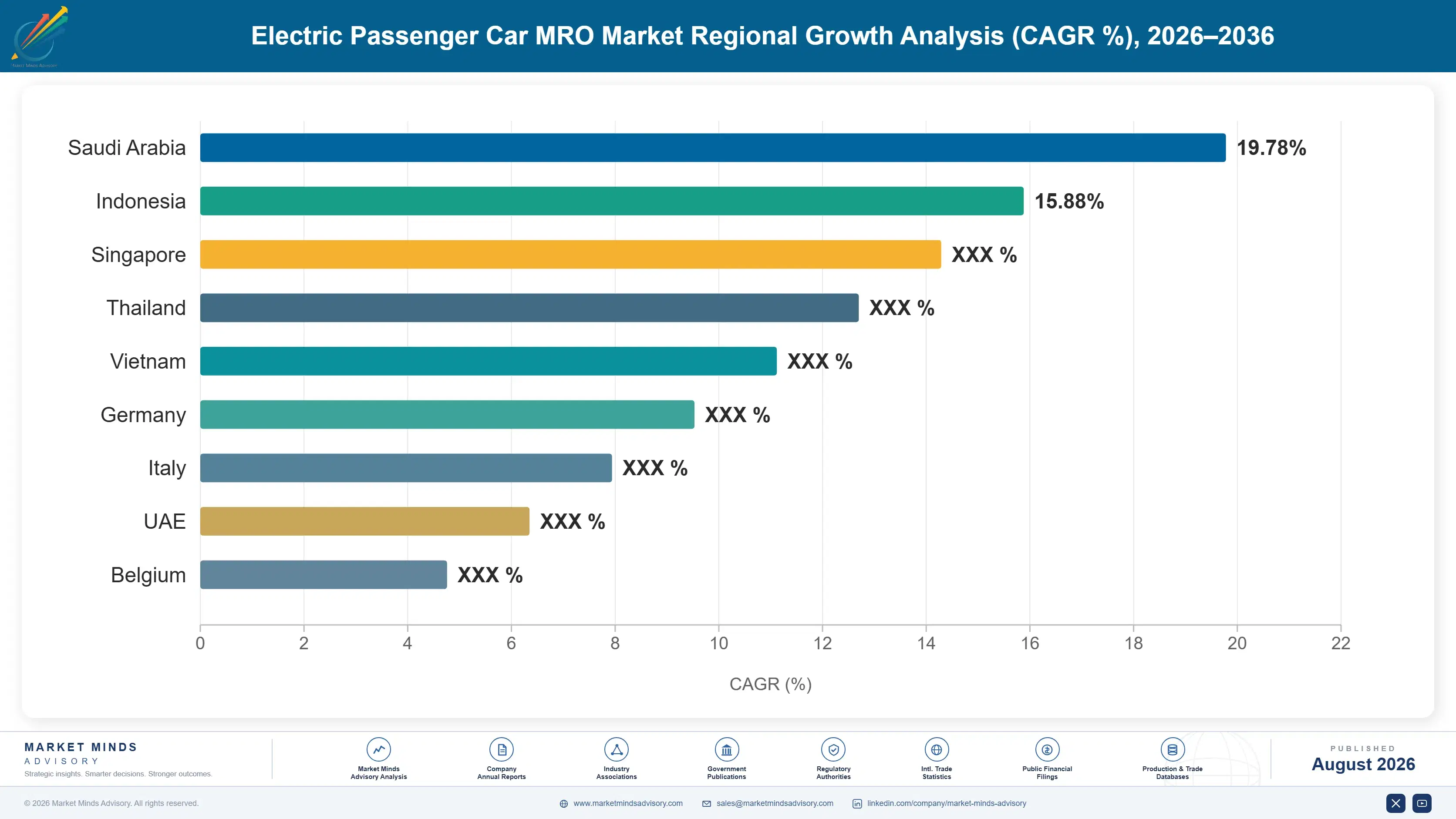
India: 19.2% CAGR
Fastest Growth Region
South Asia and Pacific: 17.6% CAGR
Largest Region
East Asia: 30% of 2025 global value
Market Leaders
Tesla Service, BYD Service Network, Bosch Car Service, Kwik Fit Group, and Belron lead on electric vehicle service revenue. Source: company annual reports and MMA Analysis, July 2026.
Primary Survey
n=3,800 procurement and R&D decision-makers, Q4 2025, six countries
Methodology
Demand-side build-up, cross-validated against public data, 47 expert interviews

Electric Passenger Car MRO Market Forecast Scenarios

electric-passenger-car-mro-market-size-forecast-scenario-1787549375866
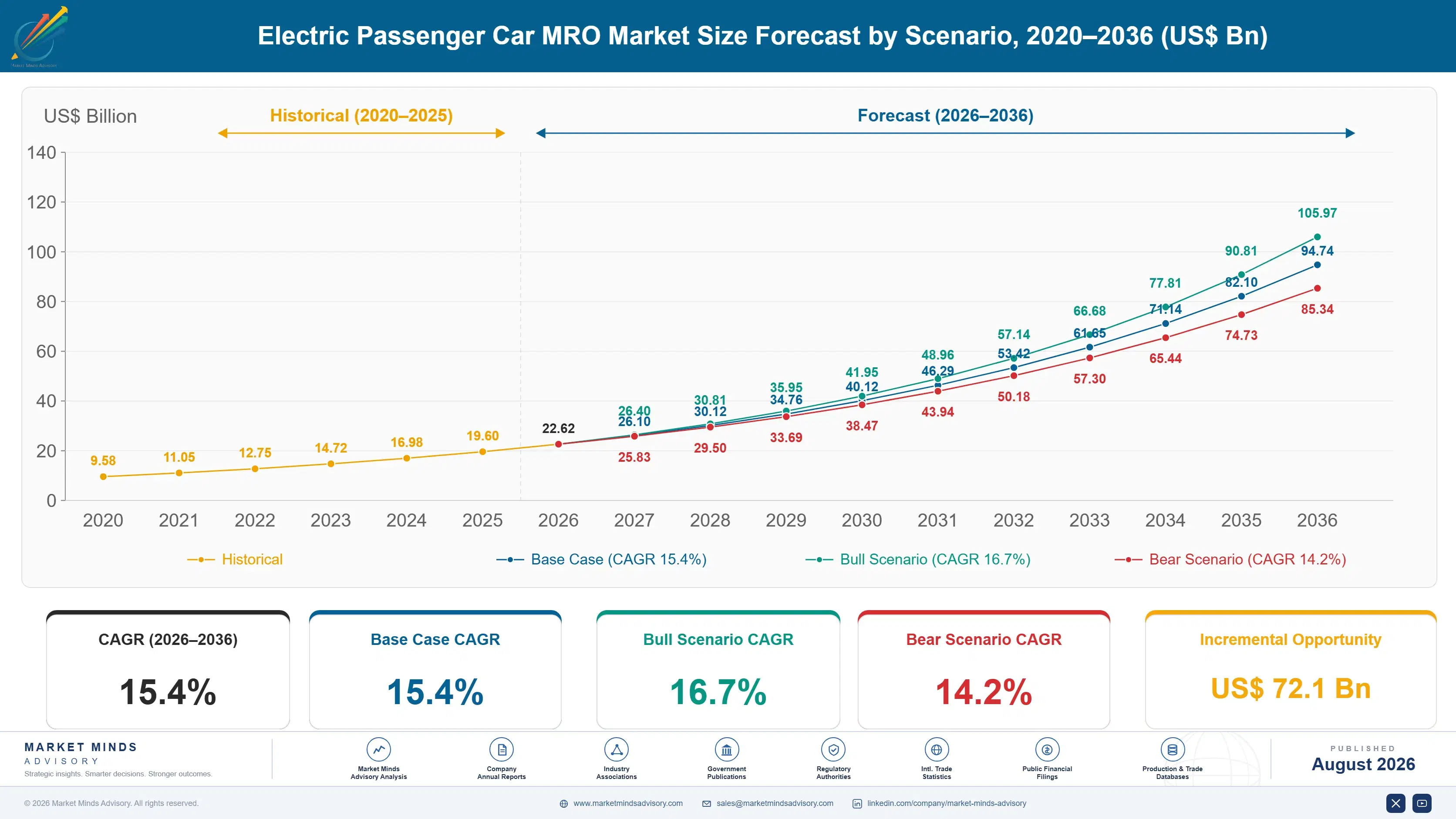
Between 2020 and 2025 the electric parc grew far faster than the service capability to look after it. Vehicles were sold into markets where almost no technician held high-voltage certification, dealer networks absorbed the work by default, and independents largely watched. Battery failures were rare enough that the repair question stayed theoretical. The 14.0% historical growth reflects parc expansion outrunning both service demand per vehicle and available workshops.
The 15.4% base case rests on three mechanisms. The electric parc keeps compounding as vehicles sold in recent years age into their higher-maintenance years, and a five-year-old electric car needs considerably more attention than a new one. Battery diagnostics and repair grow as the first large cohorts reach the age where degradation and failures actually occur. And right-to-repair rules are beginning to force diagnostic data access that would open work to independents.
The 16.7% bull case assumes data access legislation opens the independent channel and battery repair becomes routine at module level. The 14.2% bear case reflects manufacturers tightening diagnostic access further, over-the-air updates removing workshop visits entirely, and battery reliability proving better than expected across ageing cohorts. Regulatory outcomes decide more of this than technology does.

Less Work Per Car, Locked Behind a Certificate

Three things set the commercial shape of this market. Reduced work content comes first, because removing oil changes, exhausts, spark plugs, and timing belts takes about a third of the spend out of every vehicle permanently. Certification comes second, since high-voltage work requires qualified technicians, insulated tooling, and controlled working areas that most independent workshops have not funded. Data access comes third and decides who can diagnose anything at all.
TOP-FIVE CONCENTRATION16%Share of global service revenue held by leading network operators
ANNUAL SERVICE SPENDUSD 312 per vehicleAverage maintenance and repair outlay across an electric parc
MAINTENANCE COST GAP34%Reduction versus comparable combustion vehicle annual service spend
DEALER CHANNEL SHARE61%Portion of work retained within franchised dealer networks
BATTERY PACK REPAIR RATE23%Share of failed packs repaired rather than wholly replaced
TECHNICIAN CERTIFICATION COSTUSD 6,400Typical cost of qualifying one technician for high-voltage work
The channel consequence is stark. Franchised dealers hold 61% of electric vehicle service work against a much lower share of combustion servicing, and the difference is not customer preference. It is that an independent workshop without diagnostic access, certified technicians, and manufacturer service information physically cannot perform much of the work regardless of what a customer would prefer.
Battery repairability is the largest unresolved question. Only 23% of failed packs are repaired at module level, with the rest replaced whole at costs that frequently exceed the vehicle's residual value and drive insurance write-offs. Manufacturers withholding module-level service data and parts is the cause rather than any technical obstacle, and right-to-repair legislation is moving directly at it.
"Independent workshops keep asking when the electric work will arrive, and the honest answer is that a good deal of it never will. What arrives is a third less spend, behind a certification wall, needing a diagnostic subscription the manufacturer prices to discourage. The ones investing anyway are the ones who will still exist in ten years."
Practice Director, Automotive Aftermarket and Vehicle Services · MMA Automotive Aftermarket and Services Practice · August 2026

Market Trends

Right to Repair Legislation Targets Diagnostic Data Access

European and American rules requiring manufacturers to provide independent repairers with diagnostic data, service information, and security credentials on fair terms are advancing, and electric vehicles are where the stakes are highest because so little can be done without them. Manufacturers currently retain 61% of service work partly through access restrictions rather than through customer choice. Opening that access would move meaningful volume toward independents who have already invested in certification. The legislation is contested, implementation timetables keep slipping, and workshops planning around a firm date have repeatedly been disappointed by the pace.
Market Impact: Spend falls 34% per vehicle
Ageing Electric Cohorts Bring Real Battery Work Forward

Battery failures in vehicles under five years old are rare, which allowed the industry to defer the repairability question entirely. The large cohorts sold from 2019 onward are now reaching ages where degradation, module imbalance, thermal system faults, and coolant issues genuinely occur. Battery diagnostics and repair grow at 24.6% as a direct result. What determines whether that work is repair or replacement is manufacturer willingness to release module-level information and parts, and only 23% of failed packs are currently repaired rather than replaced whole at enormous cost. Manufacturer willingness decides the rest.
Market Impact: Chassis work grows at 13.2%

Market Opportunities and Growth Drivers

Parc Compounding Outruns the Reduction Per Vehicle

Each electric car generates roughly 34% less service spend than the combustion vehicle it replaced, and the number of them on the road is growing fast enough that total demand still expands sharply. A parc doubling every few years overwhelms a one third reduction in spend per unit without difficulty. The arithmetic reverses eventually, once electric penetration matures and the parc stabilises, but that point sits well beyond this forecast period in every major market. Service providers positioned for volume growth now are positioned correctly for at least a decade.
Market Impact: Certification costs $6,400 each

Tyre and Chassis Work Grows Against the General Decline

Electric cars are heavier than equivalent combustion vehicles and deliver torque instantly, which wears tyres considerably faster and loads suspension components harder. Tyre replacement intervals shorten by a meaningful margin, and chassis and bushing work increases with the additional mass. This is one of very few categories where electrification increases rather than reduces workshop content, and it requires no high-voltage certification whatsoever to perform. Independent workshops and fast-fit chains excluded from powertrain work can compete here on equal terms, which makes it their most defensible position. It is their most defensible remaining position.
Market Impact: Only 23% of packs repaired

Market Restraints and Challenges

High-Voltage Certification Excludes Most Independent Workshops

Working on a system carrying several hundred volts requires qualified technicians, insulated tooling, isolation procedures, and a controlled working area, and qualifying one technician costs around USD 6,400 before any workshop investment. The root cause is genuine safety necessity rather than manufacturer obstruction. Small independent workshops serving a handful of electric vehicles annually cannot justify that outlay, which concentrates work in dealer networks and larger chains. Mitigation runs through shared regional high-voltage facilities, referral arrangements, and progressive certification that lets a workshop perform isolation without full repair capability. Shared facilities are the practical answer.
Market Impact: Dealers hold 61% of work

Whole Pack Replacement Drives Uneconomic Repair Decisions

Only 23% of failed battery packs are repaired at module level, with the remainder replaced entirely at costs that regularly exceed the vehicle's residual value and trigger insurance write-offs on otherwise sound cars. The root cause is commercial rather than technical: manufacturers withhold module-level service information, diagnostic detail, and replacement parts. That makes a repairable fault into a total loss. Independent specialists and some manufacturers are developing module-level repair capability, and right-to-repair legislation aims directly at the information barrier that currently prevents it. The information barrier rather than the technology is what legislation targets.
Market Impact: Battery work grows at 24.6%
4 additional market trends, 3 additional growth drivers, and 2 additional restraints and challenges are covered in the full report. Contact sales@marketmindsadvisory.com to access the complete intelligence.

Segment CAGR and Growth Architecture

Segmentation follows service category, because category determines whether high-voltage certification is required, whether manufacturer data access is needed, which channel can perform the work, and how the value pool is changing. Six categories cover commercial supply, and the boundary between work requiring certification and work that does not is the commercially decisive one throughout.
electric-passenger-car-mro-market-market-share-analysis-1787549376398

High-Voltage Battery Diagnostics and Repair

The fastest-growing category at 24.6%, roughly 1.60 times the market, and the one where value is most artificially constrained. Ageing cohorts sold from 2019 onward are reaching the point where degradation, module imbalance, and thermal system faults genuinely occur, which brings work forward that the industry had comfortably deferred. Only 23% of failed packs are repaired at module level, with the rest replaced whole at costs frequently exceeding residual value. The constraint is manufacturer willingness to release module-level information and parts rather than any technical difficulty, and right-to-repair legislation is aimed squarely at exactly that barrier. Insurers facing write-off claims on repairable packs are pushing hardest for that access, since the alternative costs them far more than any repair would.
CAGR 24.6%

Software, Calibration and Connected Services

Second fastest at 21.8%, covering advanced driver assistance calibration after any windscreen or suspension work, module coding after component replacement, and diagnostic subscription services that workshops must buy to function at all. Calibration in particular grows because assistance systems appear on almost every electric vehicle and require recalibration after work that never previously touched them. Over-the-air updates reduce some workshop visits while adding others, since a software change can alter thermal or charging behaviour that then needs verification. Manufacturers capture much of the connected service value directly, which leaves workshops performing the physical calibration without the recurring revenue attached. Physical calibration work stays with the workshop while recurring connected revenue accrues to the manufacturer instead.
CAGR 21.8%
Full segment breakdown across 6 segments available in the complete report.

Regional Architecture and Country Demand Map

Regional shares follow electric vehicle parc size and age rather than new sales, since service demand comes from vehicles already on the road. Channel structure and data access rules then determine who performs the work within each market. Parc age matters more than parc size for the work actually generated.

North America

Direct manufacturer service models pioneered here have shaped expectations across the whole market, with mobile service and appointment scheduling through applications now common rather than novel. Tesla's service network operates entirely outside the franchised dealer structure that governs every other brand, which creates a channel pattern no other region shares. Independent workshops have invested in high-voltage certification more readily than in Europe, partly because right-to-repair activism has kept data access in public debate. Insurance write-offs from battery damage have become a visible issue affecting premiums measurably. Growth of 16.1% reflects a large and rapidly ageing parc rather than any expansion in work performed per vehicle. Mobile service has changed owner expectations considerably.
Share: 24% | CAGR: 16.1% (2026 to 2036)

Western Europe

The most developed regulatory environment for repair access anywhere, with block exemption rules and right-to-repair provisions giving independents stronger legal footing than they hold elsewhere, though electric vehicles have tested those frameworks in ways they were not designed for. Norwegian, Dutch, and German parcs are the oldest and therefore generate the most genuine battery and thermal system work. Independent workshop networks are dense and have invested unevenly in certification, with larger chains moving faster than single-site operators. Insurance write-off rates on damaged packs have prompted regulatory attention. Growth of 13.9% is the slowest in the report because the parc here matured earliest and per-vehicle spend is falling. Certification investment has been uneven among independents.
Share: 22% | CAGR: 13.9% (2026 to 2036)
Regional intelligence for 5 additional markets available in the complete report: East Asia, South Asia and Pacific, Latin America, Middle East and Africa, Eastern Europe. Contact sales@marketmindsadvisory.com.
electric-passenger-car-mro-market-country-cagr-analysis-1787549376913

Four Moves That Change the Economics

Advantage here comes from certification investment, data access, and category selection rather than from workshop equipment, which most operators already hold. Four moves are worth capital and management attention across the forecast period, and one of them is about choosing which work to pursue rather than how to perform it. Timing matters more than the amount invested.

Certify technicians before the parc arrives locally

Qualifying a technician for high-voltage work costs around USD 6,400 plus tooling and workspace investment, and workshops waiting for local electric volume to justify it find dealers have already taken the customers by then. Early certification captures owners at their first out-of-warranty service and keeps them, since drivers rarely re-tender a workshop relationship that works. Certified independents typically capture 3 to 5 times the electric work of uncertified competitors in the same catchment. The investment is modest against a customer relationship measured in a decade of servicing. Waiting costs the relationship rather than only the work.
Market Impact: Captures 3 to 5 times more electric work

Build module-level battery repair capability deliberately

Only 23% of failed packs are repaired rather than replaced whole, and whole replacement frequently exceeds residual value and writes off otherwise sound cars. Specialists who developed module-level diagnosis and repair are performing work that manufacturers decline to offer, at prices far below replacement and margins well above conventional servicing. Insurers actively seek them out because the alternative is a total loss claim. Capability requires investment in diagnostics, training, and pack handling infrastructure, and right-to-repair progress will widen the addressable work considerably. Right-to-repair progress widens the addressable work considerably. Insurers seek that capability actively.
Market Impact: Addresses the 77% of packs currently replaced whole

Concentrate on work requiring no high-voltage access

Tyres, brakes, suspension, glass, and bodywork require no certification and no manufacturer data, and electric vehicles need more tyre and chassis work than combustion equivalents because of weight and instant torque. Chassis categories grow at 13.2% against a market where powertrain work is shrinking per vehicle. Workshops without the scale to justify certification can compete here on completely equal terms with dealers, which is their most defensible position. It requires accepting a narrower service offer rather than pretending to full capability that cannot be delivered. Customers discover overstated capability quickly and remember it.
Market Impact: Chassis categories are now growing at 13.2% annually

Subscribe to diagnostic access and price it through

Manufacturer diagnostic subscriptions cost independents real money and are frequently priced to discourage, which leads many workshops to avoid electric work rather than to charge for the access properly. Passing subscription cost through as a diagnostic charge, as dealers effectively do, makes the economics work at volumes that look unviable when the cost is absorbed. Workshops pricing this correctly recover 8 to 15% more on electric jobs than those treating access as overhead. Right-to-repair rules should reduce the cost over time without removing it entirely. Access cost should never sit silently inside an hourly rate.
Market Impact: Recovers 8 to 15% more on each job

Who Controls the Margin Pool

Concentration is extremely low at roughly 16% for the top five, which reflects an industry where service is inherently local and nobody serves customers beyond driving distance. Tesla and BYD service networks are the largest single operators because both sell and service directly rather than through franchised dealers. Bosch Car Service, Kwik Fit, and Belron represent the organised independent and specialist chains competing across many brands and markets.
Competitive activity runs on three fronts. Certification coverage is the first and determines what work a site can legally perform at all. Diagnostic data access is the second and decides whether a fault can even be identified. Physical convenience is the third, and it matters more than either to customers who will not drive past three workshops to reach a fourth. None of the three rewards national scale particularly.

Pressure is building from two directions. Manufacturer direct service models bypass the franchised structure that independents historically fed from. And battery repair specialists are emerging as a distinct category that neither dealers nor general workshops currently serve properly. Both developments favour operators who invested in capability rather than those waiting for the market to declare itself.
electric-passenger-car-mro-market-company-positioning-matrix-1787549377439

Competitive Moat and Risk Dimensions

TESLA SERVICE

Moat: Direct model and diagnostic control

Owning the sales relationship, the vehicle software, and the service network together lets Tesla diagnose remotely, dispatch mobile technicians, and schedule work without any intermediary, which no franchised structure can replicate. Complete diagnostic control also means independent repair happens largely on Tesla's terms rather than the workshop's, across the whole installed base.
TESLA SERVICE

Risk: Capacity against parc growth

A directly owned network must expand physically as the parc grows, and service capacity has repeatedly lagged vehicle deliveries, producing waiting times that damage owner satisfaction measurably. Franchised competitors add capacity through independent capital rather than their own, which lets them scale service coverage faster than a directly owned model can fund it.
BOSCH CAR SERVICE

Moat: Independent network with technical depth

A branded network of independent workshops supported by diagnostic equipment, training, and technical information gives Bosch scale and consistency that single-site independents cannot achieve alone. Certification and equipment programmes delivered across the network make high-voltage capability affordable to members who could never justify it individually.
BOSCH CAR SERVICE

Risk: Dependence on manufacturer data access

The network's ability to service electric vehicles rests on obtaining diagnostic data and service information from manufacturers who have every commercial reason to restrict it, and right-to-repair outcomes remain genuinely uncertain. Members investing in certification on the expectation of open access face real risk if implementation continues slipping as it has done repeatedly.

Players Tracked

Prominent Players

Tesla Service
BYD Service Network
Bosch Car Service
Kwik Fit Group
Belron

Other Key Players

ATU Auto-Teile-Unger
Norauto
Feu Vert
Halfords Autocentres
Midas
Monro
Pep Boys
Mavis Tire
Driven Brands
NIO Power Service
Xpeng Service
Emil Frey Group
Inchcape
Pendragon
LKQ Corporation

Recent Developments

FEBRUARY 2025

Independent specialist launches module-level battery repair

A specialist workshop network began offering module-level battery pack repair for several vehicle brands, diagnosing and replacing individual modules rather than whole packs. Insurers referred work directly, since the alternative on many claims had been writing off entirely sound vehicles at considerable cost. Volumes grew quickly.
Signal: Insurers are now driving battery repair capability, because write-offs on repairable packs are becoming genuinely unaffordable
JUNE 2025

Regulator advances diagnostic data access requirements

A regulatory proposal requiring manufacturers to provide independent repairers with electric vehicle diagnostic data and security credentials on reasonable commercial terms moved forward, with implementation timing left partly open. Manufacturer associations contested both the scope and the proposed timetable in consultation responses. Timetables remain uncertain.
Signal: Data access rules keep advancing and keep slipping, which makes workshop investment timing genuinely very difficult
SEPTEMBER 2025

Fast-fit chain expands electric-compatible service offer

A tyre and fast-fit network extended its electric vehicle offer across tyres, brakes, suspension, and glass, deliberately excluding any work requiring high-voltage isolation. The positioning acknowledged that certification economics do not work at single-site volumes while capturing the categories that are genuinely growing. Marketing said so plainly.
Signal: Choosing not to pursue high-voltage work is becoming a legitimate strategy rather than an admission of weakness

What Sets the Cost Base

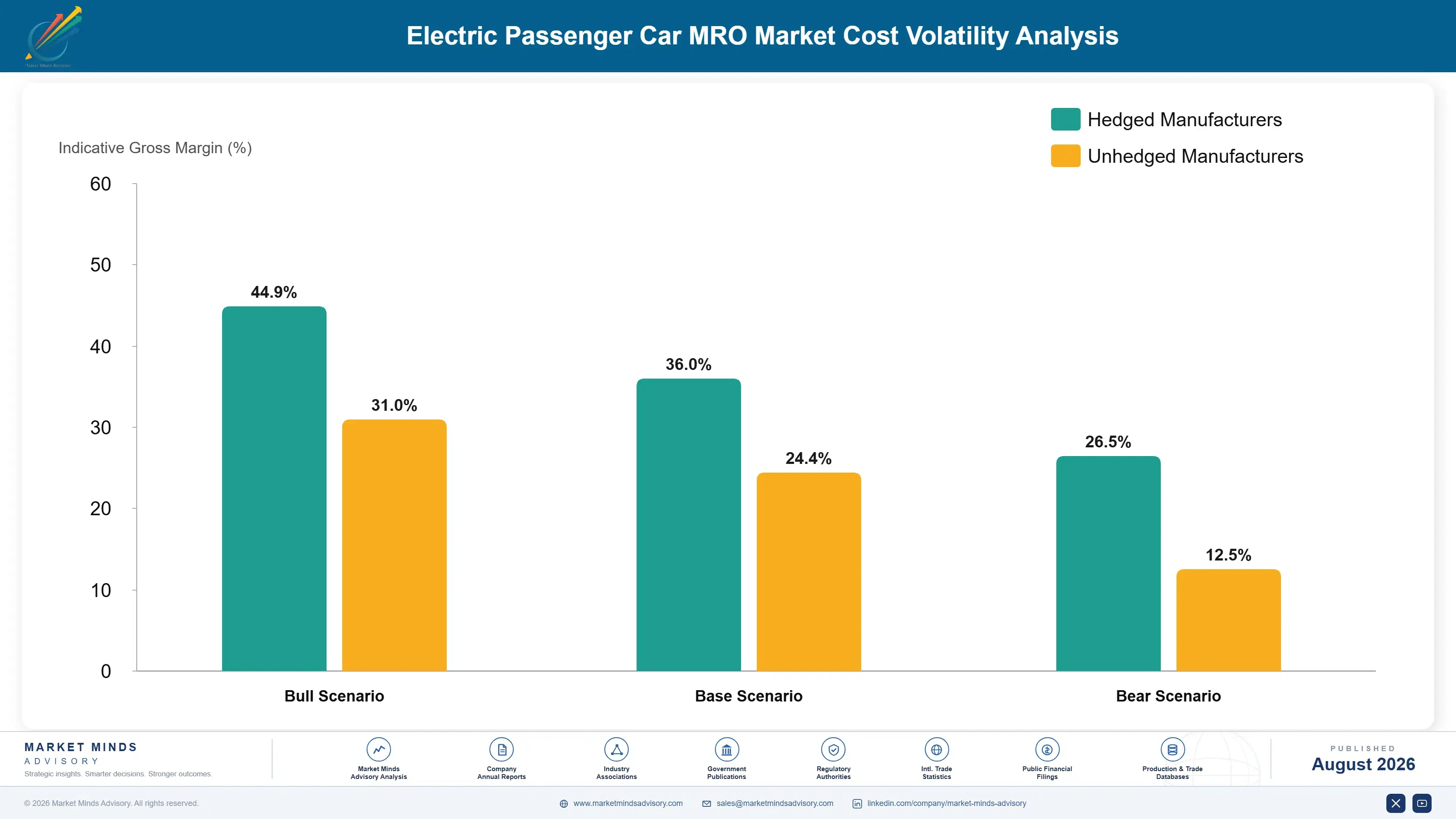
Technician labour dominates at roughly 44% of service delivery cost, and certified high-voltage technicians command premiums over general mechanics that reflect genuine scarcity. Replacement parts contribute 31%, with battery modules and power electronics far more expensive than the combustion components they replace when they are available at all. Diagnostic subscriptions, tooling, and software licences take 9%. Premises, insurance, and compliance absorb the balance.
Technician wage inflation ran well ahead of general labour costs through 2022 and 2023 as electric certification created scarcity in an already tight trade. Parts pricing for battery modules and power electronics remained high throughout, since manufacturers control supply and face limited competition. Bosch and LKQ both referenced labour availability and parts cost pressures across their reporting for those years. Diagnostic subscription costs rose as manufacturers repriced access, which several workshop networks contested publicly.

Exposure divides on certification investment and network membership rather than on scale. Workshops holding certification carry higher labour cost and access the work, while those without carry neither and are progressively excluded. Network members access diagnostic subscriptions and training at rates single-site operators cannot obtain independently, which widens the gap between organised and unorganised independents each year.
electric-passenger-car-mro-market-cost-volatility-analysis-1787549377634

Share high-voltage facilities across workshop groups

Certification and workspace investment is difficult to justify at single-site electric volumes, and a shared regional facility serving several workshops spreads it across enough work to pay. Vehicles requiring high-voltage isolation move to the equipped site while routine work stays local. Coordination and transport add friction, and both cost less than forgoing the work or funding idle capability.

Join a branded network for diagnostic access rates

Manufacturer diagnostic subscriptions and training are priced very differently for networks than for single sites, and the difference frequently exceeds any franchise fee involved. Network membership also brings technical support that single operators lack entirely when a fault is unfamiliar. Loss of pricing independence is the trade-off, and it matters less than access to the work.

Train existing technicians rather than recruiting certified ones

Certified high-voltage technicians are scarce and command wage premiums that reflect it, while training an existing experienced mechanic costs around USD 6,400 and takes weeks rather than months of recruitment. Retention also improves, since a technician whose employer funded certification is measurably less likely to leave. The constraint is workshop capacity while the technician trains, which smaller sites feel acutely.

Portfolio Architecture for Margin Defence

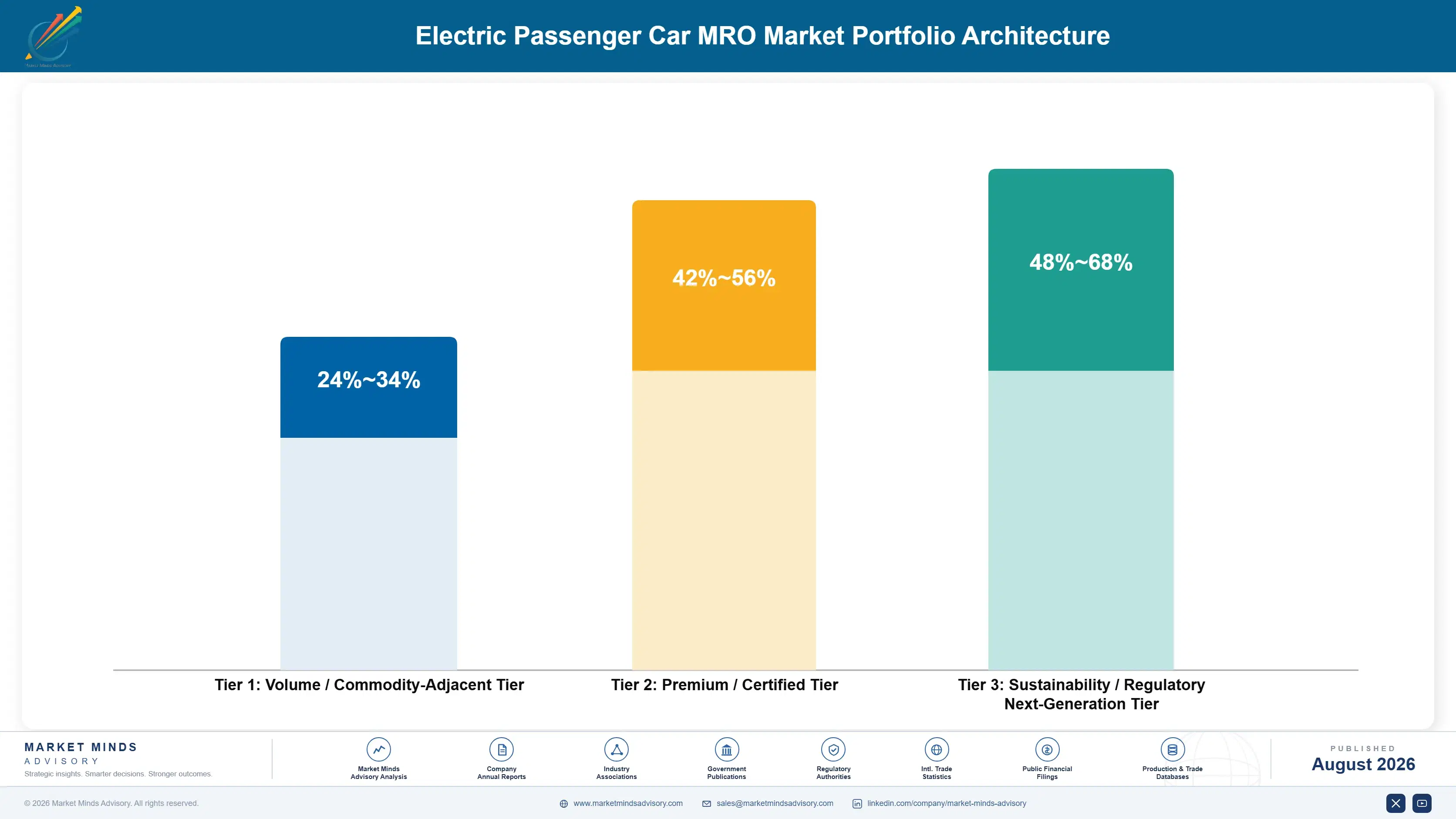
Margin follows access rather than volume in this market. Tyres, brakes, and chassis work earn conventional aftermarket returns, because any workshop can perform them and customers compare prices freely across a high street. Battery diagnostics, module repair, and high-voltage system work earn considerably more, since certification and data access limit the field and customers facing a whole pack replacement quotation will pay well for an alternative.
The volume and premium tension shows in certification economics rather than in bay utilisation. High-voltage capability requires investment that single-site electric volumes rarely justify today, so workshops take routine chassis work to stay busy while the growing powertrain work goes elsewhere. That gap widens every year the investment is deferred, and catching up later means competing against workshops holding established customer relationships.

High-value pools concentrate in three places: module-level battery repair where whole replacement is the alternative, calibration and coding work that follows almost any repair, and certified high-voltage servicing for out-of-warranty vehicles. Each is defended by certification, data access, or capability rather than by price. Price competition arrives in each only when a competitor funds certification, secures data access, or builds pack handling capability, none of which happens inside a year.

Volume / Commodity-Adjacent Tier

Tyres, brakes, suspension, glass, and routine inspection requiring no high-voltage certification. Competes on price and convenience against every workshop in the catchment. The range reflects large differences in parts buying and site utilisation.
Gross Margin: 24%-34%

Premium / Certified Tier

High-voltage servicing, power electronics repair, and calibration work requiring certified technicians and manufacturer data access. The customer has few alternatives locally, and dealers set the reference price rather than other independents.
Gross Margin: 42%-56%

Sustainability / Regulatory / Next-Generation Tier

Module-level battery repair, pack refurbishment, and second-life assessment work avoiding whole replacement entirely. Insurers and owners facing write-off pay well for alternatives. The range is wide because pricing against replacement varies enormously.
Gross Margin: 48%-68%
electric-passenger-car-mro-market-portfolio-architecture-1787549378132

High-value Sub-segments and Strategic Watch-out

Module-Level Battery Repair

Only 23% of failed packs are repaired, and whole replacement often exceeds residual value and writes off sound cars. Insurers actively seek alternatives. Right-to-repair progress will widen the addressable work considerably over the forecast period. Insurer relationships are the route to volume. Approach them directly.
Gross Margin: 50%-68%

Certified High-Voltage Servicing

Certification and data access limit the field locally, which is why dealers hold 61% of work and set the reference price. Independents who invested early capture several times the electric volume of those who waited. Certification timing decides the catchment permanently. Move before competitors. Act early.
Gross Margin: 44%-58%

Calibration and Coding Services

Assistance system recalibration follows almost any windscreen, suspension, or body work on modern vehicles, and module coding follows component replacement. Growing at 21.8% and requiring equipment rather than high-voltage certification to perform. Equipment investment rather than certification is required. Buy the equipment. Straightforward payback. Invest here.
Gross Margin: 40%-54%

Tyres, Brakes and Chassis Work

The one category electrification grows, since weight and instant torque wear tyres faster and load suspension harder. Requires no certification at all, which makes it the defensible position for workshops without high-voltage capability. Compete here on equal terms with dealers. Defend it properly. No certificate needed.
Gross Margin: 26%-36%

How Demand Actually Reaches Providers

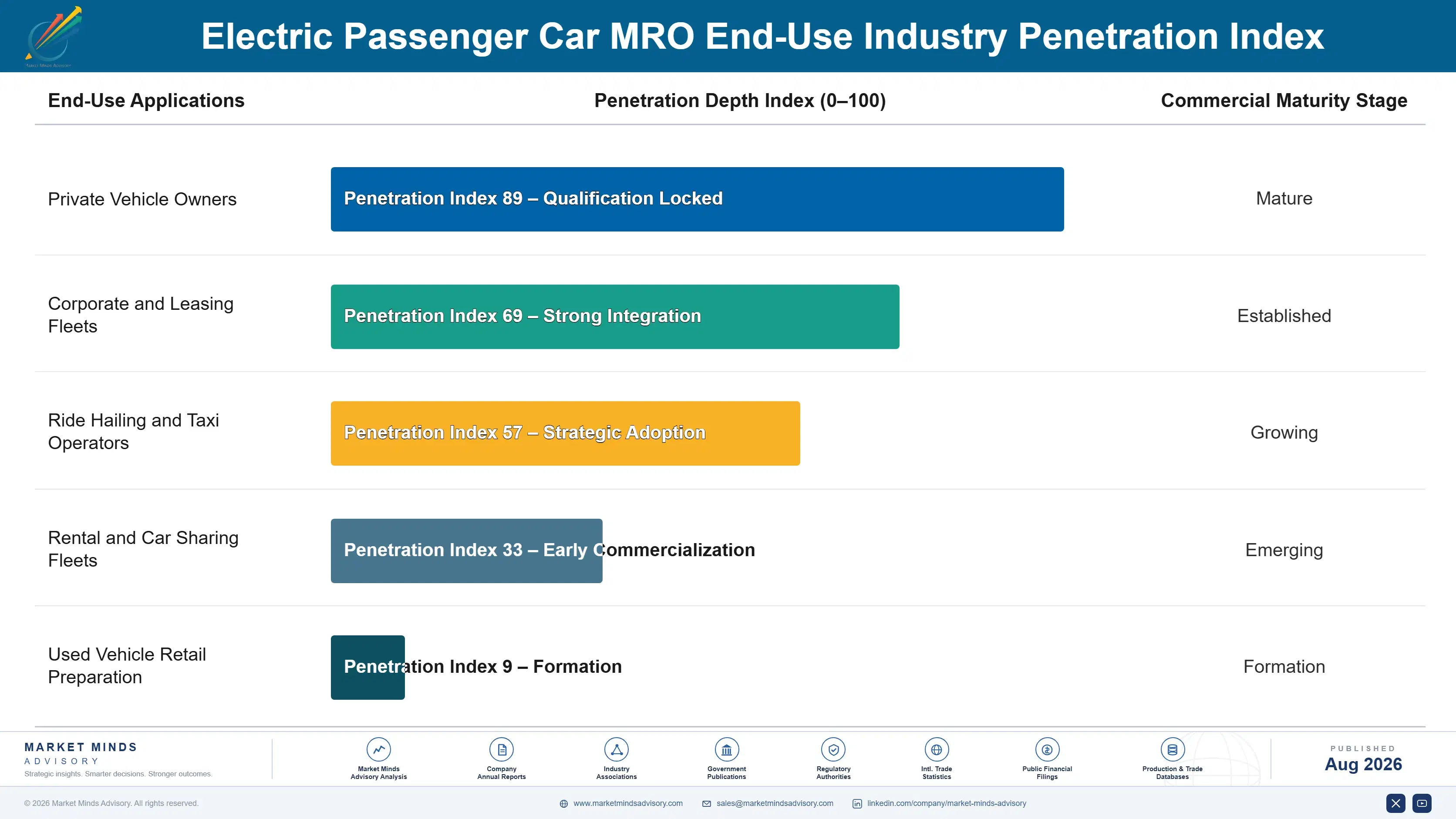
The annuity here is the customer relationship rather than the vehicle. A driver who has a workshop they trust returns for years and brings their next car with them, which makes the first out-of-warranty service the moment when a decade of revenue is won or lost. Electric vehicles reduce visit frequency, since scheduled servicing is lighter, and that gives each retained relationship more value while making acquisition harder. Warranty periods keep vehicles inside dealer networks for the first several years regardless.
Adoption depth varies sharply by owner type. Fleet and leasing operators contract servicing centrally and buy on cost per vehicle per year, which makes them large accounts and hard negotiators. Private owners inside warranty use dealers by default. Private owners outside warranty are the genuinely contested group and choose on convenience, trust, and price. Used electric buyers, often the second or third owner, are the most price-sensitive of all.

The buyer has shifted toward insurers on battery-related work specifically. An insurer facing a write-off decision chooses the repairer, not the owner. That reverses the usual relationship entirely, since a workshop marketing to owners is addressing the wrong buyer for the most valuable work available in this market.
electric-passenger-car-mro-market-end-use-penetration-index-1787549378619

Where the Money Sits

These are among the four positions where our research anticipates prominent divergence between winners and laggards over the coming forecast period. Each is grounded in the demand model, the regulatory perimeter, and the announced capacity pipeline.
01 / EARLY CERTIFICATION INVESTMENT

Certify before the volume arrives, or lose the customers

Qualifying a technician for high-voltage work costs around USD 6,400 plus tooling, and workshops waiting for local electric volume to justify that spend find dealers have already captured the owners by the time they move. The first out-of-warranty service is when a decade of servicing relationships is decided, and drivers rarely re-tender a workshop that works for them. Certified independents capture 3 to 5 times the electric work of uncertified competitors in the same catchment area, which makes the timing more important than the amount.
02 / BATTERY REPAIR CAPABILITY

Repair modules, because replacement writes off sound cars

Only 23% of failed packs are repaired rather than replaced whole, and whole replacement frequently exceeds residual value and turns a repairable fault into an insurance total loss on an otherwise sound vehicle. Specialists offering module-level diagnosis and repair are performing work manufacturers decline to do, at prices far below replacement and margins well above conventional servicing. Insurers seek them out actively because the alternative claim is far more expensive, which makes the customer acquisition considerably easier than in general repair.
03 / CATEGORY SELECTION DISCIPLINE

Own the work that needs no certificate at all

Tyres, brakes, suspension, glass, and bodywork require no high-voltage certification or manufacturer data, and electric vehicles need more of that work than combustion equivalents because of additional weight and instant torque delivery. Those categories grow at 13.2% while powertrain work shrinks per vehicle, and any workshop competes for them on entirely equal terms with dealers. Accepting a narrower service offer honestly beats pretending to a full capability, which customers discover quickly and then remember for a very long time afterwards.
04 / DIAGNOSTIC ACCESS PRICING

Charge for the subscription instead of absorbing it

Manufacturer diagnostic subscriptions cost real money and are frequently priced to discourage independent repair, which leads many workshops to avoid electric work altogether rather than to recover the cost properly. Passing it through as a diagnostic charge, exactly as dealers effectively do, makes the economics work at volumes that look unviable when the cost is treated as overhead. Workshops pricing this correctly recover 8 to 15% more per electric job than those absorbing access cost silently into their hourly rate.

Engagement Snapshot From the Field

A live engagement with an industry participant carrying material or product regulatory and market exposure ahead of a defining policy shift, showing how our research translates into a defensible multi-year portfolio strategy.
MARKET MINDS ADVISORY · CLIENT ENGAGEMENT SUMMARY
Electric Passenger Car MRO Producer Strategic Portfolio Review and Transition Roadmap 2026·Investment Scenario on Electric Passenger Car MRO Exposure Evaluation 2025-26
CLIENT PROFILE
A European independent workshop group operating fourteen sites across two countries, servicing combustion and hybrid vehicles with revenue near EUR 41 million (client-reported, unverified by MMA). Two sites held high-voltage certification, diagnostic subscription costs were absorbed into the hourly rate, and no site offered battery diagnostics beyond reading fault codes. Electric volumes were rising steadily.
STRATEGIC CHALLENGE
Electric vehicles in the group's catchments were passing out of warranty in growing numbers and going to dealers rather than to the client's sites, while combustion service volume declined steadily. Insurers had begun asking about battery repair capability the group did not have. Management needed to know what to invest in and at which sites.
MMA APPROACH
MMA mapped electric parc age and density by catchment against site capability, modelled certification and shared facility economics, and sized the insurer-referred battery repair opportunity regionally. Forty-seven expert interviews with owners, insurers, dealer service managers, and technicians established how out-of-warranty owners actually choose a workshop. Choice behaviour proved decisive. Patterns were consistent.
KEY FINDINGS
  1. Electric owners chose a workshop at first out-of-warranty service and then returned for years, which meant catchments were being decided permanently while the group waited for volumes to justify investment.
  2. Certification at every site was uneconomic, while a shared high-voltage facility serving five sites within reasonable transport distance paid back inside two years on projected volumes.
  3. Absorbing diagnostic subscription cost into the hourly rate had made electric jobs appear unprofitable, when charging the access separately would have made the same work comfortably viable.
  4. Two regional insurers were actively seeking module-level battery repair capability and had no supplier within a considerable distance of the group's operating territory at all.
CLIENT PROFILE
A European independent workshop group operating fourteen sites across two countries, servicing combustion and hybrid vehicles with revenue near EUR 41 million (client-reported, unverified by MMA). Two sites held high-voltage certification, diagnostic subscription costs were absorbed into the hourly rate, and no site offered battery diagnostics beyond reading fault codes. Electric volumes were rising steadily.
STRATEGIC CHALLENGE
Electric vehicles in the group's catchments were passing out of warranty in growing numbers and going to dealers rather than to the client's sites, while combustion service volume declined steadily. Insurers had begun asking about battery repair capability the group did not have. Management needed to know what to invest in and at which sites.
MMA APPROACH
MMA mapped electric parc age and density by catchment against site capability, modelled certification and shared facility economics, and sized the insurer-referred battery repair opportunity regionally. Forty-seven expert interviews with owners, insurers, dealer service managers, and technicians established how out-of-warranty owners actually choose a workshop. Choice behaviour proved decisive. Patterns were consistent.
KEY FINDINGS
  1. Electric owners chose a workshop at first out-of-warranty service and then returned for years, which meant catchments were being decided permanently while the group waited for volumes to justify investment.
  2. Certification at every site was uneconomic, while a shared high-voltage facility serving five sites within reasonable transport distance paid back inside two years on projected volumes.
  3. Absorbing diagnostic subscription cost into the hourly rate had made electric jobs appear unprofitable, when charging the access separately would have made the same work comfortably viable.
  4. Two regional insurers were actively seeking module-level battery repair capability and had no supplier within a considerable distance of the group's operating territory at all.
RECOMMENDED STRATEGY
Phase 1: Phase one: establish a shared high-voltage facility serving the five highest electric density catchments, transporting vehicles rather than certifying every site individually. Phase 2: Phase two: reprice electric work with diagnostic access charged separately, correcting economics that had made viable jobs appear unprofitable across the whole group. Phase 3: Phase three: build module-level battery repair capability at the shared facility and approach the regional insurers already seeking exactly that service.
OUTCOME
The client commissioned the shared facility within nine months and repriced electric work immediately. Electric vehicle revenue grew from 6% to 21% of the total across two years, insurer-referred battery work began in the second year, and blended gross margin improved 4.4 percentage points (client-reported, unverified by MMA).

Frequently Asked Questions

Foundational context covering the market sizes, CAGR, scope, country, region and competition that inform every finding below. This section is provided to cover basics and most often pre-purchase conversations, answered from the MMA Primary Research Dataset.

What is the current size of the Electric Passenger Car MRO Market?

The market was valued at USD 19.6 billion in 2025, rising to an estimated USD 22.62 billion in 2026. East Asia holds the largest regional share at 30% of global value.

How large will the Electric Passenger Car MRO Market be by 2036?

MMA forecasts USD 94.72 billion by 2036 under the base case, an expansion multiple of 4.19 times the 2026 value. That represents USD 72.10 billion of incremental value across the forecast period.

What is the CAGR for the Electric Passenger Car MRO Market 2026 to 2036?

The base case CAGR is 15.4%, with a bull case of 16.7% and a bear case of 14.2%. The spread reflects uncertainty over data access legislation and battery reliability across ageing cohorts.

Which segment is growing fastest?

High-voltage battery diagnostics and repair grow fastest at 24.6%, roughly 1.60 times the market rate. Software, calibration and connected services follow at 21.8% on assistance system requirements.

Who are the major companies in the Electric Passenger Car MRO Market?

Tesla Service, BYD Service Network, Bosch Car Service, Kwik Fit Group, and Belron lead on electric service revenue. The top five hold only 16%, since vehicle servicing is inherently local.

Which country is growing fastest?

India grows fastest at 19.2%, driven by a young and rapidly expanding electric passenger car parc. Independent high-voltage capability is very limited, concentrating work in manufacturer networks.

Report Segmentation Architecture

The full report scope spans multiple orthogonal segmentation dimensions, with cross-tabulated demand data provided for each dimension pair. Coverage extends further to regional breakdowns, trend trajectories, and the competitive detail needed to support segment-level decision-making.

By Service Category

  • Scheduled Servicing and Inspection
  • Tyres, Brakes and Chassis Repair
  • High-Voltage Battery Diagnostics and Repair
  • Power Electronics and E-Axle Repair
  • Collision Repair with High-Voltage Procedures
  • Software, Calibration and Connected Services

By End-Use Industry

  • Private Vehicle Owners
  • Corporate and Leasing Fleets
  • Ride Hailing and Taxi Operators
  • Rental and Car Sharing Fleets
  • Used Vehicle Retail Preparation

By Sales Model

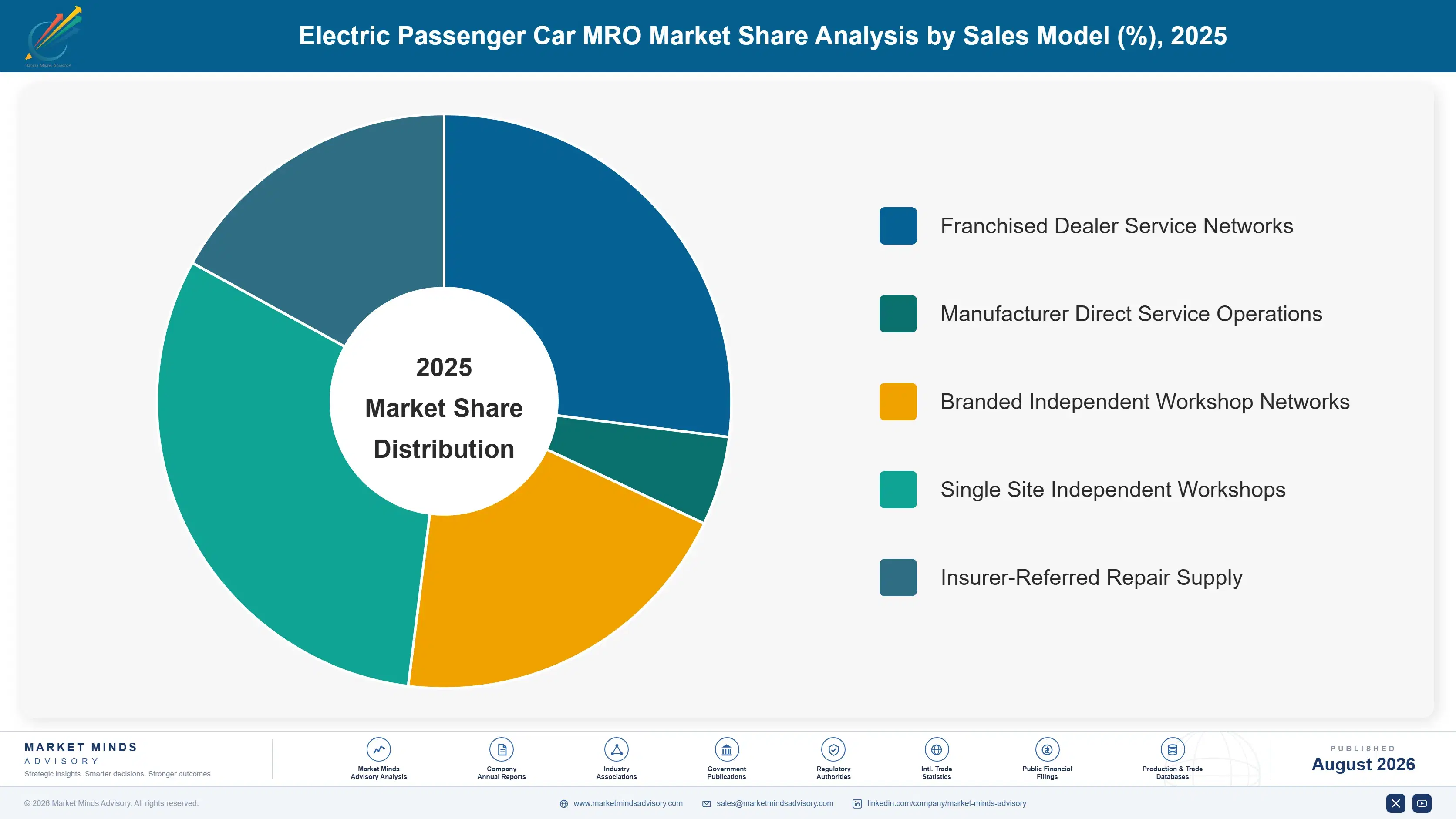
  • Franchised Dealer Service Networks
  • Manufacturer Direct Service Operations
  • Branded Independent Workshop Networks
  • Single Site Independent Workshops
  • Insurer-Referred Repair Supply

By Region

  • North America
  • Western Europe
  • East Asia
  • South Asia and Pacific
  • Latin America
  • Middle East and Africa
  • Eastern Europe

Scope, Methodology, and Coverage

Every figure in this report is reproducible from documented input assumptions. The scope below maps the historical period, the forecast horizon, the segmentation dimensions, and the countries covered, alongside the underlying primary and qualitative methodology.
Historical Period
2020 to 2025
Forecast Period
2026 to 2036
Base Year
2025 (USD billions; MMA Primary Research Dataset, August 2026)
Market Definition
The market comprises maintenance, repair, and overhaul services for battery electric and plug-in hybrid passenger cars, covering scheduled servicing and inspection, tyres brakes and chassis repair, high-voltage battery diagnostics and repair, power electronics and e-axle repair, collision repair performed under high-voltage safety procedures, and software calibration and connected services. Value is measured at service provider level and includes both parts and labour. Commercial vehicle bus and two-wheeler servicing, charging infrastructure maintenance, battery cell manufacturing and second-life repurposing, vehicle insurance products, and roadside assistance subscriptions fall outside scope.
Quantitative Units
USD billions (current prices); service events performed annually; USD spend per vehicle per year by parc age
Segmentation Dimensions
By Service Category; By End-Use Industry; By Sales Model; By Region
Regions Covered
North America, Western Europe, East Asia, South Asia and Pacific, Latin America, Middle East and Africa, Eastern Europe
Countries Covered
United States, Canada, Mexico, Germany, France, United Kingdom, Netherlands, Norway, Sweden, Italy, Spain, Belgium, Poland, Czechia, Baltic States, China, Japan, South Korea, India, Australia, Thailand, Indonesia, Brazil, Chile, Colombia, United Arab Emirates, Saudi Arabia, South Africa
Key Companies Profiled
Tesla Service, BYD Service Network, Bosch Car Service, Kwik Fit Group, Belron, ATU Auto-Teile-Unger, Norauto, Feu Vert, Halfords Autocentres, Midas, Monro, Pep Boys, Mavis Tire, Driven Brands, NIO Power Service, Xpeng Service, Emil Frey Group, Inchcape, Pendragon, LKQ Corporation
Quantitative Methodology
Primary survey, n=3,800 respondents, Q4 2025, six countries; demand-side model with trade association cross-validation
Qualitative Methodology
47 expert interviews, Q4 2025; applied to validate demand model assumptions, identify emerging dynamics, and assess competitive positioning
Report Format
PDF and XLSX data workbook (Word format preview document)
Publisher
Market Minds Advisory
Report Code
MMA-2026-AUT-197
Published
August 2026
Contact
sales@marketmindsadvisory.com | www.marketmindsadvisory.com

Purchase the full Electric Passenger Car MRO Market Report (2026 to 2036).

The full report sizes electric passenger car service demand across six categories, five owner types, and seven regions with 2026 to 2036 forecasts under base, bull, and bear cases. It models spend per vehicle by parc age, since a five-year-old electric car generates very different work from a new one. Competitive profiles cover twenty operators assessed consistently on electric service revenue, certification coverage, and data access position. Cost analysis traces technician labour, parts, and diagnostic subscription exposure by workshop type. Commercial guidance addresses certification timing, battery repair capability, category selection, and diagnostic access pricing.
Six service categories sized separately by region
Spend per vehicle modelled against parc age curves
Dealer and independent channel shares tracked by category
Battery repair versus replacement economics quantified for insurers
High-voltage certification costs assessed against workshop volumes
Right-to-repair implementation timelines mapped by jurisdiction

Built For The People Who Decide

From boardroom strategy to bench-side execution, this report is read cover-to-cover by leaders shaping the next decade of their industry, turning demand scenarios, market dynamics and valuation benchmarks into decisions.
CXOs/ Presidents/ VPs/ Managers
M&A and Corporate Development
Strategy Teams and R&D Heads
Procurement and Product Directors
Regulatory and Compliance Leaders
Investor Relations and Equity Analysts