
Market Minds Advisory
Cohesive Packaging Solutions Market

Cohesive Packaging Solutions Market: E-Commerce Scale Meets Recyclability Scrutiny

E-commerce returns and reverse logistics are pushing retailers toward resealable cohesive packaging faster than recyclers can adapt sorting lines built for single-material film, leaving recyclability credentials as the real friction point in sustainable packaging commitments.

Lead Analyst

Bilal Shaikh

Published

August 2026

Make Smarter Decisions with Customized Research Insights

Request a free sample report and evaluate market opportunities, growth trends, and competitive dynamics relevant to your business needs.

2025 MARKET VALUE$4.2BMarket Size 2025
2036 FORECAST VALUE$8.8BBase Case , 2026 to 2036
CAGR 2026 TO 20366.9 %Bull 8.2% / Bear 5.6%
INCREMENTAL OPPORTUNITY$4.3BNet 10- year value creation
EXPANSION MULTIPLE1.95x2036 value over 2026 base
Strategic Levers
M&A Pipeline
Regional Outlook
Country Rankings
Competitive Intelligence
Segmental Deep-dive
Call-Us : 91 93563 13602

Executive Snapshot and Market Trajectory

Cohesive packaging, self-sealing bags, envelopes, and mailers that bond only to themselves without separate adhesive strips, is riding e-commerce's relentless shipping volume growth into a mainstream logistics standard, even as brand owners increasingly scrutinize whether the coating compromises recyclability claims they face growing pressure to substantiate.
Cohesive retail and e-commerce packaging grows fastest at 10.8%, roughly 1.57 times the overall rate, as online retailers standardize on resealable mailers that support easy returns without damaging the original packaging. East Asia holds the largest regional share at 30%, anchored by China's dominant poly film and packaging manufacturing base, while India's e-commerce logistics boom makes it the fastest-growing single country worldwide by a considerable margin across every tracked application.
Competitive intensity centers on roughly half the market held by five suppliers, with Sealed Air and Intertape Polymer Group leading through mailer manufacturing scale and tape and adhesive technology depth respectively. Recyclability pressure compounds the picture, since cohesive coatings complicate the single-stream sorting infrastructure many municipalities have built around uncoated film recovery, forcing suppliers to defend the format's resealing convenience against a mounting sustainability credibility challenge across every major retail and logistics channel worldwide today.
Market Definition
The cohesive packaging solutions market covers self-sealing packaging formats, bags, envelopes, mailers, tapes, and pouches, that close using a cohesive coating bonding only to itself rather than a separate pressure-sensitive adhesive strip. It excludes conventional adhesive-sealed packaging, heat-sealed formats without cohesive closure technology, and unrelated protective packaging such as foam or bubble wrap sold without integrated cohesive sealing.
Base Year Value
$4.2B in 2025 (MMA Primary Research Dataset, August 2026)
Forecast Period
2026 to 2036, eleven discrete annual values
CAGR
6.9% base case. Bull 8.2%. Bear 5.6%.
Fastest Growth Segment
Cohesive Retail and E-Commerce Packaging: 10.8% CAGR
Fastest Growth Country
India: 13.5% CAGR
Fastest Growth Region
South Asia and Pacific: 8.9% CAGR
Largest Region
East Asia: 30% of 2025 global value
Market Leaders
Sealed Air, Intertape Polymer Group, Storopack, RAJA Group, Macfarlane Group. Source: MMA Analysis based on company annual reports.
Primary Survey
n=3,800 procurement and R&D decision-makers, Q4 2025, six countries
Methodology
Demand-side build-up, cross-validated against public data, 47 expert interviews

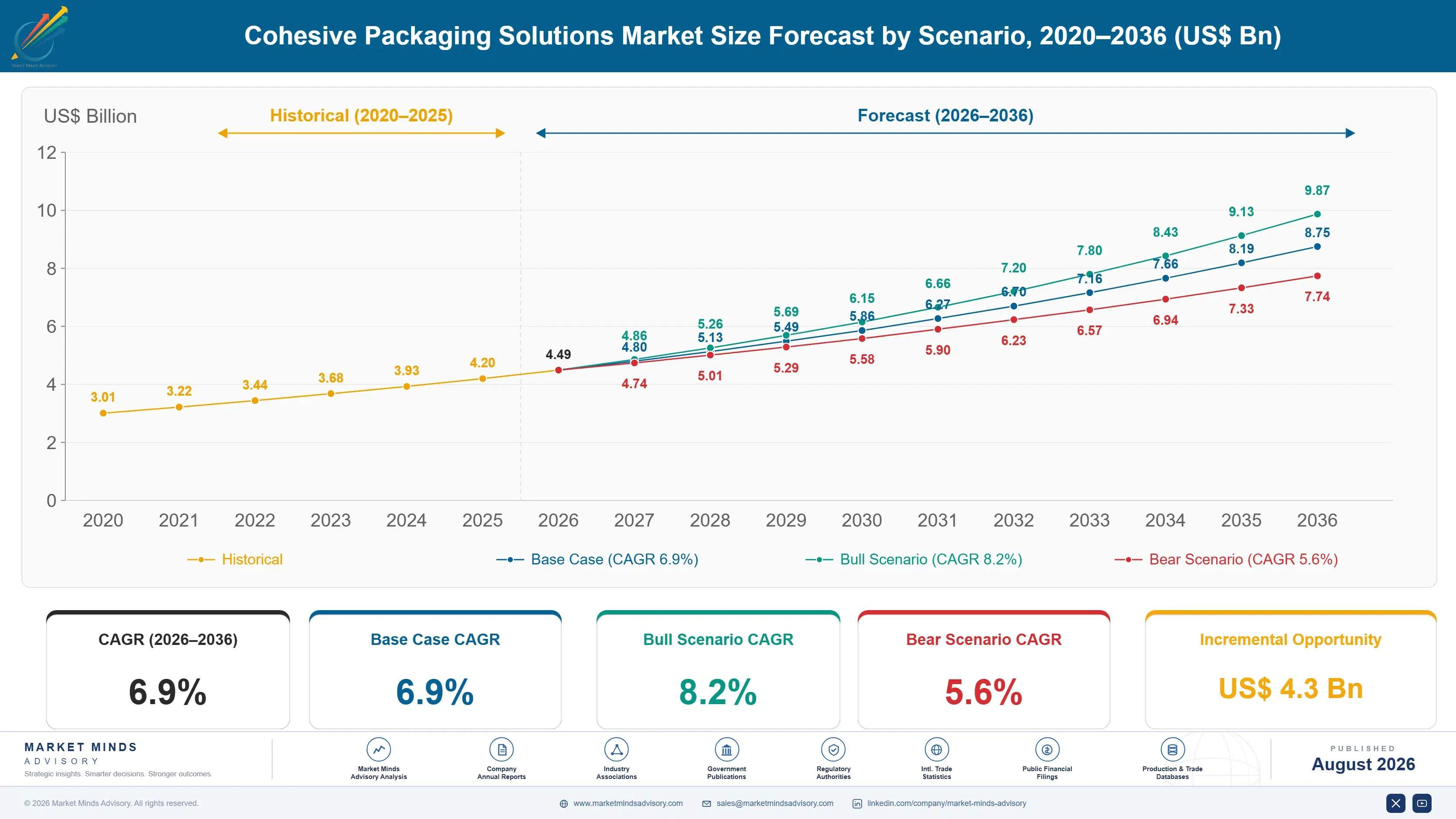
Cohesive Packaging Solutions Market Forecast Scenarios

cohesive-packaging-solutions-market-size-forecast-scenario-1787301384209
Between 2020 and 2025 the market grew at roughly 5.9% annually, accelerating sharply as pandemic-era e-commerce volume growth pulled resealable mailer and shipping bag demand well beyond pre-pandemic packaging industry trends. Reverse logistics and returns processing added a second demand wave, as retailers increasingly specified cohesive closures specifically to let customers reseal packages for return shipment without needing separate tape or materials.
The base case carries the market to 6.9% annual growth through three mechanisms. First, e-commerce shipping volume keeps expanding across both mature and emerging markets, converting online retail growth directly into guaranteed cohesive packaging demand. Second, returns and reverse logistics programs increasingly specify resealable cohesive closures as a standard feature rather than a premium option. Third, courier and logistics providers are standardizing packaging specifications across their networks, pulling smaller regional shippers toward the same cohesive formats larger e-commerce platforms already require.
The bull case, 8.2%, assumes continued e-commerce volume growth across Southeast Asia, Latin America, and Africa pulls forward cohesive packaging adoption faster than currently planned. The bear case, 5.6%, assumes recyclability regulation targeting coated film packaging accelerates faster than reformulation technology can keep pace, pushing some brand owners back toward simpler uncoated or heat-sealed alternatives.

E-Commerce Scale Meets Recyclability Scrutiny

Three forces converge on this market simultaneously. E-commerce shipping volume keeps expanding across both mature and emerging markets, converting online retail growth directly into guaranteed cohesive packaging demand regardless of underlying cost competitiveness. Returns and reverse logistics programs keep specifying resealable closures as standard practice rather than a premium feature. And recyclability regulation keeps tightening around coated film packaging, pushing suppliers toward refor
MARKET CONCENTRATIONCR5: 44%Top five suppliers control under half global shipment volume
AVERAGE UNIT COST PREMIUM8% to 20% vs standardPremium varies sharply by format and closure technology type
TOP PRODUCING COUNTRYChina: 28% of outputPoly film and packaging manufacturing scale anchors most production
CAPACITY UTILIZATION73%Converting lines run moderately below typical industry benchmarks
FILM COST SHARE41% of COGSPolymer film and cohesive coating dominate total production cost
RESEAL CYCLE RELIABILITY2 to 3 usesCohesive bond strength still degrades faster than adhesive alternatives
Commercially, this market behaves like a converting and coatings business layered onto e-commerce logistics infrastructure. Suppliers compete on coating consistency, reseal reliability, and film recyclability as much as on price, since large e-commerce platforms increasingly specify tight technical tolerances that generic packaging cannot reliably meet. That technical specification depth, more than brand recognition, increasingly separates competitive suppliers from smaller regional converters.
Over the next decade expect continued consolidation among smaller converters unable to fund recyclable coating reformulation investment across every major market. Retail and e-commerce applications will keep taking share from traditional courier bags as return-friendly packaging becomes standard practice worldwide. And recyclability technology investment, more than raw manufacturing scale, will increasingly determine which suppliers retain large e-commerce platform contracts over the coming years.
"Every online retailer wants a bag customers can reseal and send back without a fight. Nobody wants to explain to a regulator why that bag can't be recycled."
Director, Packaging and Logistics Materials Practice · MMA Packaging Practice

Market Trends

E-Commerce Platforms Standardize Resealable Packaging Specs

Major e-commerce platforms and logistics providers increasingly specify resealable cohesive closures as a default packaging requirement across their fulfillment networks, rather than leaving format choice to individual sellers or regional distribution centers. This standardization push simplifies returns processing for both platforms and customers, since a resealable bag lets a customer send an item back without locating separate tape or a replacement box entirely. Smaller sellers and regional fulfillment operations increasingly adopt platform-specified cohesive formats simply to remain compliant with marketplace packaging requirements, converting platform policy directly into guaranteed converter demand across thousands of participating sellers worldwide.
Market Impact: Tracks e-commerce parcel growth abo
Recyclable Cohesive Coating Technology Gains Ground

Packaging chemists have developed new cohesive coating formulations designed to remain compatible with standard polyethylene film recycling streams, addressing a longstanding recyclability gap that older coating chemistry created for municipal sorting facilities. Several major suppliers have begun certifying reformulated cohesive mailers and bags under recognized recyclability standards, letting brand owners substantiate claims that regulatory scrutiny increasingly demands rather than accepting undocumented assertions. This reformulation trend is reshaping competitive positioning, since suppliers who complete certification early can win platform contracts that increasingly specify documented recyclability as a baseline requirement rather than a differentiator manufacturers could previously treat as optional.
Market Impact: Lifts return completion rates 15%

Market Opportunities and Growth Drivers

Global E-Commerce Shipping Volume Keeps Expanding

Global e-commerce parcel volume keeps growing across both mature markets and rapidly digitizing emerging economies, and each shipped parcel requires protective and often resealable packaging that cohesive formats increasingly supply by default. Growth in this base shipping volume converts directly into cohesive packaging demand independent of any single retailer's growth trajectory, since the format has become a category-wide default specification rather than a differentiated premium choice. India, Southeast Asia, and parts of Africa are adding parcel volume at a pace considerably faster than mature markets, expanding the addressable base well beyond traditional developed-market concentration.
Market Impact: Cuts effective recyclability rates

Returns Processing Requires Resealable Packaging Formats

Retailers increasingly design packaging around the return journey rather than the outbound shipment alone, since a growing share of online purchases eventually get returned and retailers need that return process simple enough that customers actually complete it rather than abandoning items. Cohesive closures let a customer reseal the original package for return shipment without needing tape, a second box, or a trip to a shipping counter for supplies, improving the return completion rate retailers track closely as a satisfaction and cost metric. This returns-focused design consideration is becoming standard across major retail categories well beyond its original apparel origins.
Market Impact: Limits reseal cycles to 3 uses

Market Restraints and Challenges

Cohesive Coatings Complicate Standard Recycling Streams

Many cohesive coating formulations remain incompatible with standard polyethylene film recycling streams, requiring specialized processing that most municipal material recovery facilities do not currently provide across mature and emerging recycling markets alike. The root cause is chemistry: older cohesive coating formulations were developed for sealing performance rather than recyclability compatibility, and reformulating without sacrificing reseal strength requires genuine research investment most smaller converters cannot easily fund. The commercial impact falls hardest on brand owners with sustainability claims, since cohesive packaging routed to conventional streams can contaminate otherwise recyclable film. Some suppliers are developing certified recyclable formulations to close it.
Market Impact: Adds compliance demand across 500K-

Reseal Bond Strength Degrades After Repeated Use

Cohesive closures generally maintain reliable bond strength for only two to three reseal cycles before adhesion performance degrades, limiting the format's usefulness for packaging intended for multiple reuse occasions rather than a single ship-and-return cycle. The root cause is mechanical: cohesive bonding relies on matching coating surfaces re-engaging cleanly, and repeated flexing and dust contamination progressively reduces how completely those surfaces can re-bond with each subsequent use. The commercial impact limits cohesive packaging's addressable use cases to primarily single-return scenarios rather than genuinely reusable applications retailers increasingly want. Some manufacturers are developing higher-performance coating chemistry to extend reseal cycle count.
Market Impact: Cuts recyclability gap by roughly 3
3 additional market trends, 2 additional growth drivers, and 4 additional restraints and challenges are covered in the full report. Contact sales@marketmindsadvisory.com to access the complete intelligence.

Segment CAGR and Growth Architecture

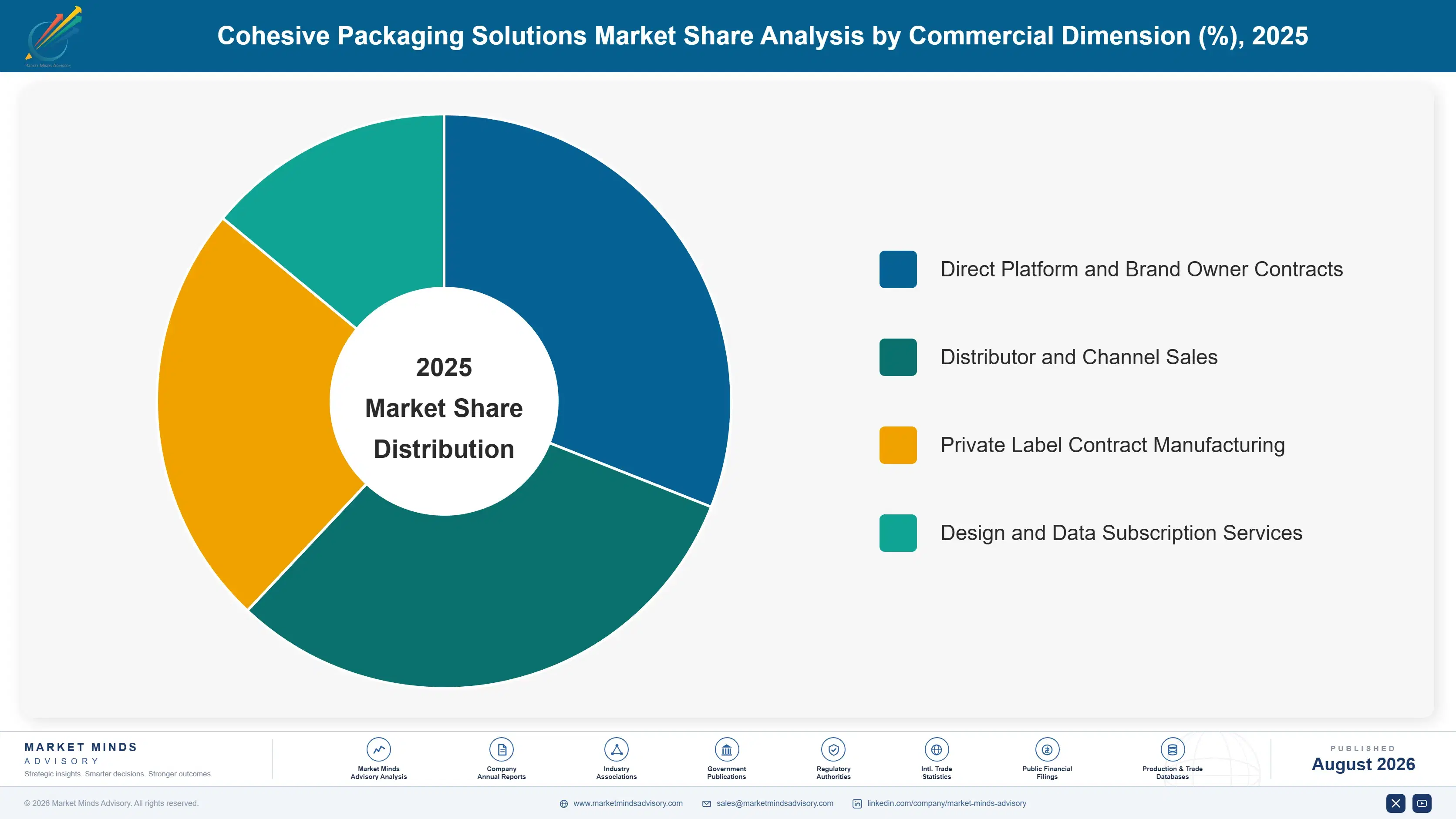
Segmentation follows product format, the single classification logic that determines closure mechanism and primary end-use application. Poly mailers, sealed envelopes, security tapes, courier bags, retail and e-commerce packaging, and tamper-evident pouches each demand distinct film gauge and coating specifications, so commercial position tracks packaging format rather than industry vertical or brand ownership across every producing region.
cohesive-packaging-solutions-market-market-share-analysis-1787301384743

Cohesive Retail and E-Commerce Packaging

Cohesive retail and e-commerce packaging grows fastest at 10.8%, roughly 1.57 times the overall market rate, as online retailers standardize on resealable mailers and bags that support easy customer returns without requiring separate tape or replacement packaging materials. These formats use cohesive coating strips that bond only to themselves, letting a package be opened and resealed cleanly for return shipment while preserving branding and barcode information printed on the original packaging. Sealed Air and Intertape Polymer Group lead this segment's branded converting capacity, while regional Asian manufacturers increasingly supply private-label cohesive mailers directly to e-commerce platforms and logistics providers. Falling film costs and expanding converting capacity are broadening this segment's addressable base beyond premium apparel and electronics.
CAGR 10.8%

Cohesive Tamper-Evident Pouches

Cohesive tamper-evident pouches grow second-fastest at 9.6%, about 1.39 times the overall rate, as pharmaceutical, cannabis, and high-value retail categories increasingly specify pouches that show visible evidence of opening while still offering cohesive reseal convenience for legitimate repeated access during dispensing or fulfillment. These pouches combine tamper-evident visual indicators with cohesive closure technology, satisfying both security and convenience requirements that neither standalone tamper tape nor simple cohesive bags can deliver independently. RAJA Group and several specialty pouch converters lead this segment's technical development, competing on tamper-evidence reliability and regulatory documentation as much as on raw material cost. Growing cannabis legalization and pharmaceutical compliance requirements across multiple markets continue expanding this segment's addressable base considerably faster than general retail packaging categories.
CAGR 9.6%
Full segment breakdown across 6 segments available in the complete report.

Regional Architecture and Country Demand Map

East Asia leads on value at 30% of the global total, anchored by China's poly film manufacturing base. North America follows on established e-commerce demand. South Asia and Pacific posts strong growth on India's e-commerce boom, while Western Europe, Latin America, the Middle East, and Eastern Europe complete the distribution.

North America

Established e-commerce logistics infrastructure, more than any single regulatory mandate, explains why North America holds 24% of global value, with major platforms and third-party logistics providers standardizing cohesive packaging specifications across their fulfillment networks. The United States hosts the region's largest converter and brand owner base, including Sealed Air and Intertape Polymer Group's core American manufacturing and distribution operations serving both platform and private-label demand. Canada's comparable e-commerce logistics growth adds incremental demand beyond American volume specifically. Recyclability regulation at the state level is pushing faster reformulation adoption here than in less regulated markets. Growth of 6.2% reflects steady e-commerce demand more than any single regulatory catalyst alone across most national markets.
Share: 24% | CAGR: 6.2% (2026 to 2036)

Western Europe

Germany and the United Kingdom anchor this region's demand, both hosting substantial e-commerce logistics infrastructure and stringent packaging recyclability regulation that pushes converters toward certified recyclable cohesive formulations specifically. RAJA Group and Macfarlane Group both run significant European converting and distribution operations, giving the region genuine technical depth in recyclable coating development beyond pure consumption volume. The region's 19% share, near the lower half of its typical band, reflects mature e-commerce logistics penetration relative to a comparatively smaller overall population base than North America or East Asia. Growth of 5.3%, the softest pace among the seven regions tracked, reflects this underlying market maturity rather than weakening demand across the region's largest markets.
Share: 19% | CAGR: 5.3% (2026 to 2036)
Regional intelligence for 5 additional markets available in the complete report: East Asia, South Asia and Pacific, Latin America, Middle East and Africa, Eastern Europe. Contact sales@marketmindsadvisory.com.
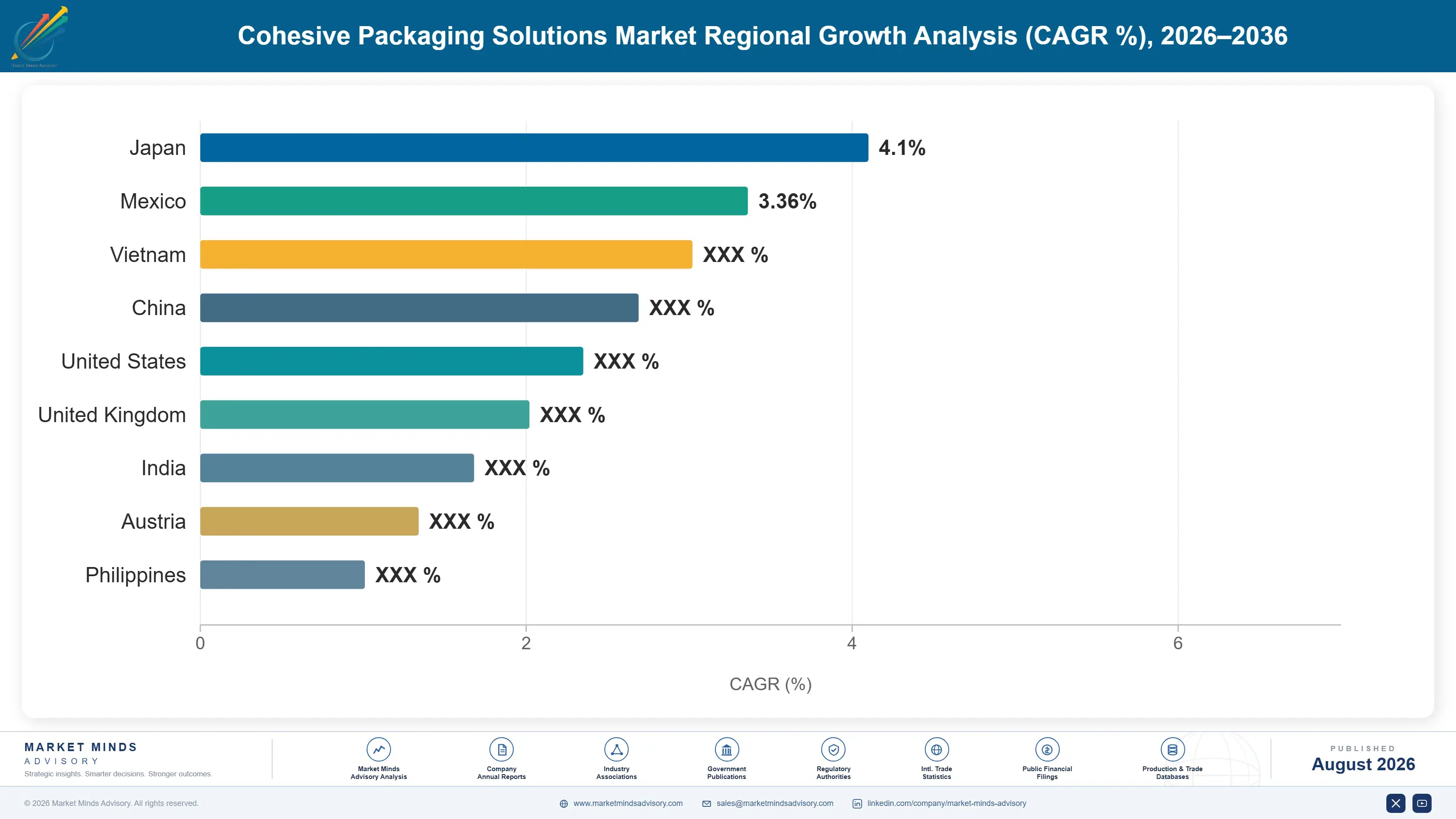
cohesive-packaging-solutions-market-country-cagr-analysis-1787301385249

How Converters Can Defend Cohesive Margin

Margin increasingly depends on coating technology and recyclability certification depth rather than raw converting scale alone, as e-commerce platforms demand documented sustainability performance alongside reliable reseal function. The four levers below target certification, technology, and channel revenue that cohesive packaging suppliers have historically left underexploited, converting a commodity converting sale into a longer, more defensible platform relationship.

Complete Recyclability Certification For Platform Contracts

Suppliers who complete recognized recyclability certification for cohesive formulations ahead of platform mandate deadlines gain access to e-commerce procurement contracts that increasingly require documented certification rather than marketing claims alone. Sealed Air and Intertape Polymer Group both report that certification breadth directly determines which major platform tenders they can even bid for, independent of raw converting price competitiveness. Certification requires meaningful upfront investment in reformulation and testing, often exceeding $1 million per product line, but suppliers who complete it early lock in multi-year platform supply agreements before certification becomes table stakes rather than a genuine differentiator.
Market Impact: Wins multi-year platform contracts

Offer Custom Branded Packaging Design Services

Converters increasingly offer custom print design, branding, and structural packaging services alongside standard cohesive material supply, capturing margin that pure commodity converters selling generic film leave entirely on the table. Brand owners pay 15% to 25% more for packaging bundled with design and print services than for equivalent unbundled generic material purchased separately from a low-cost regional supplier. This premium reflects genuine value: brand owners need packaging that reinforces brand identity through unboxing experience, not just functional sealing performance, particularly as unboxing content increasingly shapes social media marketing strategy. Converters building this capability in-house capture meaningfully more margin.
Market Impact: Commands 15% to 25% premium on bran

Sell Returns Analytics And Packaging Optimization Data

Every return processed through a cohesive package generates data on return reasons, packaging condition, and reseal reliability that has real value to retailers optimizing packaging specifications and reducing return processing costs. Suppliers running their own returns tracking platforms can offer analytics subscriptions layered on top of physical packaging sales, a revenue stream several adjacent logistics technology categories have already built successfully. This data-driven positioning captures 10% to 20% incremental revenue beyond commodity material pricing, since retailers increasingly value packaging partners who can demonstrably improve return completion rates rather than suppliers who simply ship film on schedule without insight into performance.
Market Impact: Generates 10% to 20% recurring subs

Build Regional Converting Capacity Near Demand Centers

Import tariffs and shipping cost on cohesive packaging manufactured outside the destination market have risen enough that regional converting capacity, closer to major e-commerce fulfillment centers, increasingly beats import economics even at somewhat higher local production cost. Suppliers building converting capacity in India, Southeast Asia, and parts of Latin America, rather than relying entirely on Chinese-manufactured imports, cut landed cost by roughly 15% while also shortening lead times that matter increasingly to platforms managing seasonal demand swings around major shopping events. This shift requires meaningful upfront capital, but suppliers who move early capture share from competitors dependent on longer chains.
Market Impact: Cuts landed packaging costs by roug

Who Controls the Margin Pool

Five suppliers control just under half of global shipment volume, a fragmented picture spanning film converters, coating chemists, and logistics manufacturers. Sealed Air and Intertape Polymer Group both lead on scale, though Sealed Air leads mailer converting while Intertape Polymer Group leads tape, occupying different points in the value chain. Shipment volume, the basis used throughout this assessment, favors suppliers with broader certified range.
Competitive activity currently runs across three dimensions. Suppliers race to complete recyclability certification before rivals lock in platform contracts requiring documented compliance. Custom design and branding services have become a genuine differentiator, as brand owners increasingly prefer suppliers who extend value beyond generic film supply. Chinese converters are winning export orders in markets that once belonged primarily to Western manufacturers.

Pressure is building from two directions that could reshuffle rankings within the decade. Indian and Southeast Asian regional converters, absent from the key player list, are scaling capacity to serve compressed timelines closer to demand. Specialty coating companies, technically outside this market but competing for the same recyclable formulation contracts, are proving chemistry innovation can command premium pricing commodity converters struggle to match, forcing established players to decide whether to build coating capability or deepen partnerships.
cohesive-packaging-solutions-market-company-positioning-matrix-1787301385765

Competitive Moat and Risk Dimensions

SEALED AIR CORPORATION

Moat: Broadest E-Commerce Mailer Portfolio

Sealed Air holds one of the broadest cohesive mailer and bag portfolios of any converter, spanning standard shipping formats, branded design services, and recyclable-certified product lines built on decades of packaging materials expertise. That breadth lets it bid on multi-format e-commerce platform contracts that narrower specialty converters cannot match on technical depth alone.
SEALED AIR CORPORATION

Risk: Exposure To Film Commodity Pricing

Sealed Air's scale means a large share of production cost tracks global polyethylene film and resin commodity pricing, which has proven volatile in recent years and compresses margin whenever input costs spike faster than contracted platform pricing can adjust to offset it across major markets.
INTERTAPE POLYMER GROUP INC.

Moat: Deep Tape And Adhesive Technology

Intertape Polymer Group holds decades of tape and adhesive formulation expertise that newer mailer-focused entrants cannot easily replicate, built on extensive industrial and logistics packaging application knowledge across security and tamper-evident product categories specifically and broadly across every served customer segment and geographic market it currently operates within.
INTERTAPE POLYMER GROUP INC.

Risk: Limited E-Commerce Platform Relationships

Intertape Polymer Group's core strength in tape and adhesive technology leaves it less positioned to capture direct e-commerce platform mailer contracts compared with converters who built dedicated platform relationships and design services capability earlier in the category's development cycle and broader growth trajectory across major regions.

Players Tracked

Prominent Players

Sealed Air Corporation
Intertape Polymer Group Inc.
Storopack Hans Reichenecker GmbH
RAJA Group
Macfarlane Group PLC

Other Key Players

Duck Brand (ShurTech Brands, LLC)
Novolex Holdings LLC
Sonoco Products Company
International Paper Company
Smurfit WestRock plc
Mondi Group
Nefab Group
Polyair Inter Pack Inc.
ProAmpac LLC
Coveris Holdings S.A.
Signode Industrial Group LLC
Berry Global Group, Inc.
Shorr Packaging Corp.
Veritiv Corporation
Uline, Inc.

Recent Developments

FEBRUARY 2025

Sealed Air Launches Certified Recyclable Cohesive Mailer Line

Sealed Air launched a new certified recyclable cohesive mailer product line, aiming to meet growing e-commerce platform demand for documented sustainability compliance across major fulfillment networks. The launch represents an organic product development initiative rather than an acquisition or licensing arrangement with an external technology provider.
Signal: Signals established converters are priorit
JUNE 2025

Intertape Polymer Group Expands Converting Capacity In India

Intertape Polymer Group expanded converting capacity at a facility in India, aiming to meet growing demand from the country's rapidly expanding e-commerce logistics sector. The expansion adds meaningful annual capacity without requiring an entirely new greenfield manufacturing site or additional land acquisition this particular year.
Signal: Signals established global converters are
OCTOBER 2025

RAJA Group Acquires Specialty Tamper-Evident Pouch Manufacturer

RAJA Group completed the acquisition of a small specialty tamper-evident pouch manufacturer, adding pharmaceutical-grade security packaging technology to its existing cohesive product portfolio. The transaction was a full acquisition, not a licensing or minority equity investment arrangement between the two companies involved in this deal.
Signal: Signals established European converters ar

What Actually Drives Cohesive Packaging Cost

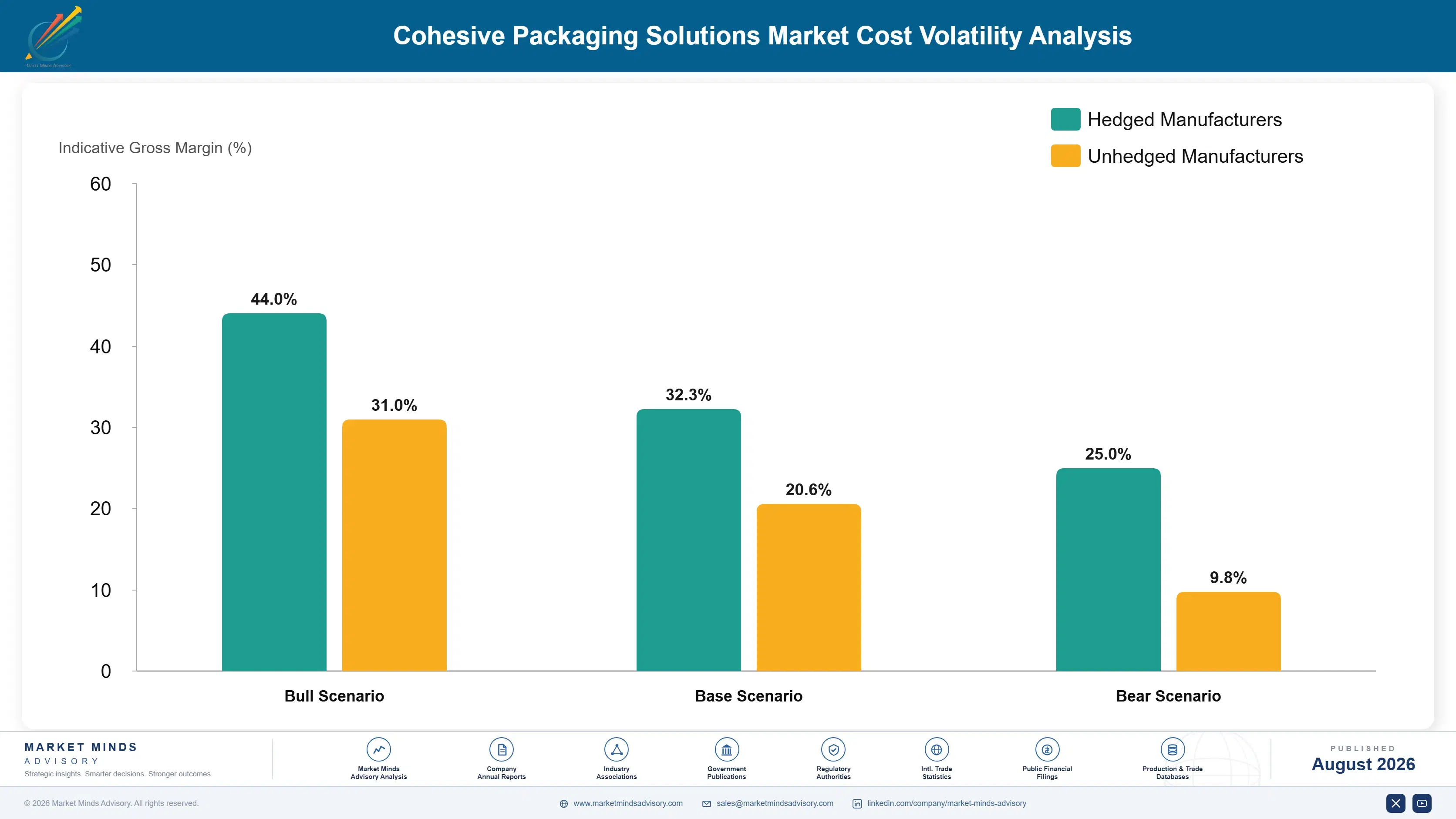
Polyethylene film and cohesive coating chemistry account for roughly 41% of production cost, sourced primarily from petrochemical-derived resin producers and specialty coating chemical manufacturers concentrated in China, the United States, and Germany. Converting and printing costs add another 26%, while packaging, freight, and distribution costs make up most of the remainder across most manufacturing operations.
Polyethylene resin prices spiked sharply in 2021 and 2022 as global petrochemical feedstock costs rose and pandemic-era supply chain disruption constrained available converting capacity across major producing regions simultaneously. Sealed Air's 2022 annual report cited elevated resin costs as a direct pressure on packaging margins that year, and several converters reported similar pressure, pushing some smaller manufacturers toward temporary production cutbacks until resin pricing eased into 2023 and 2024.

Smaller regional converters carry the sharpest exposure, since they lack the purchase volume to negotiate long-term resin supply contracts that Sealed Air and Intertape Polymer Group secure directly with petrochemical producers. Geographic exposure varies too: converters sourcing domestic resin face lower input cost volatility than those dependent on imported film, a gap that widens whenever global resin prices spike against relatively stable domestic feedstock pricing.
cohesive-packaging-solutions-market-cost-volatility-analysis-1787301385960

Lock Multi-Year Resin Supply Agreements Directly

Converters with sufficient purchase volume are negotiating multi-year resin supply agreements directly with petrochemical producers, trading pricing flexibility for guaranteed allocation during industry-wide commodity shortages. This approach favors the largest converters disproportionately, since minimum volume commitments required for favorable terms sit well beyond what smaller regional manufacturers can commit to reliably given typical purchase volumes.

Qualify Multiple Resin Suppliers For Key Materials

Some converters now qualify two or three interchangeable resin suppliers for critical film components rather than depending on a single source, trading some processing consistency for meaningfully improved supply resilience during regional shortages or logistics disruptions affecting any single feedstock origin specifically and directly across every served production facility, converting line, and regional market they currently operate.

Build Regional Converting Capacity Near Demand

Opening converting facilities closer to major e-commerce fulfillment regions, as Intertape Polymer Group has done in India, cuts logistics cost and currency exposure even when core resin still ships from concentrated global production locations, shortening the exposed portion of the supply chain meaningfully overall for regionally integrated converters and their contracted distribution partners across every market.

Portfolio Architecture for Margin Defence

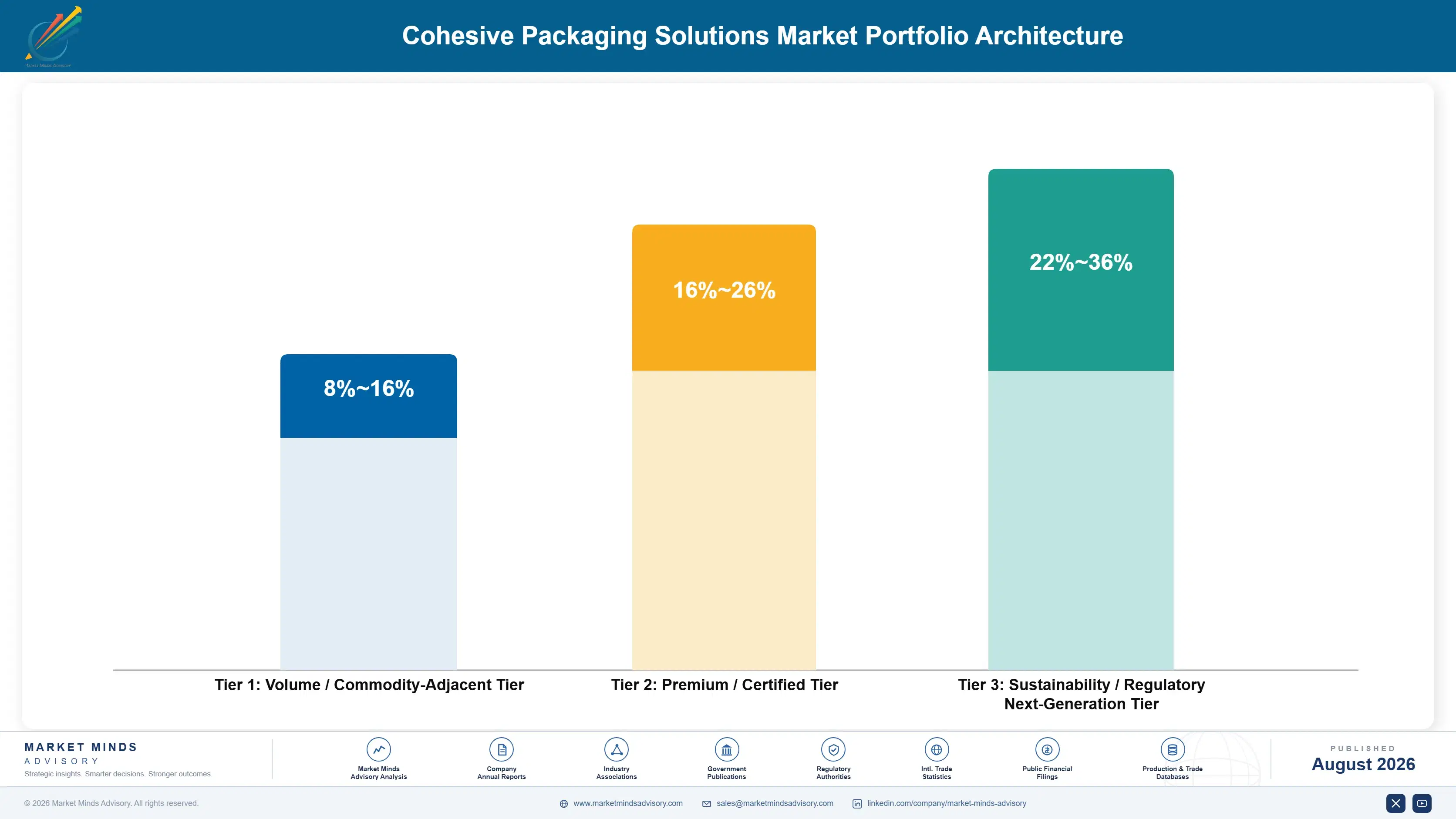
The portfolio splits into three tiers with margin separation. Volume-tier products, standard cohesive mailers and bags sold largely on price into commoditized e-commerce shipping channels, compete hard and earn modestly. Premium certified products, covering tamper-evident pouches and branded design packaging meeting documented specification requirements, earn more because certification and design capability support pricing. Next-generation recyclable-certified and data-bundled solutions occupy t
The tension here is familiar to any converting business riding a commodity film cost base: volume mailer products fund the manufacturing scale and distribution relationships premium products depend on, yet volume growth alone cannot fund the certification and design investment next-generation solutions require. Suppliers leaning too heavily into premium positioning risk losing the manufacturing scale that makes market entry viable in price-sensitive channels, while pure volume players cede that segment.

High-value pools concentrate where recyclability certification, design capability, and platform partnership depth intersect: e-commerce and tamper-evident applications serving brand owners willing to pay for verified performance. That intersection is still a minority of shipment volume globally but expanding quickly, which is why the next-generation tier grows fastest even while representing a modest share of total volume today.

Volume / Commodity-Adjacent Tier

Standard cohesive mailers and bags sold largely on price into commoditized e-commerce shipping channels, competing directly against low-cost regional converters across most mature global markets worldwide today and going forward.
Gross Margin: 8%-16%

Premium / Certified Tier

Tamper-evident pouches and branded design packaging meeting documented specification requirements, sold to brand owners willing to pay for security features and design differentiation across every major producing and consuming market.
Gross Margin: 16%-26%

Sustainability / Regulatory / Next-Generation Tier

Recyclable-certified and data-bundled solutions representing the sustainability and technology frontier, priced at a premium justified by documented compliance and platform partnership value across major regions and producing markets worldwide today.
Gross Margin: 22%-36%
cohesive-packaging-solutions-market-portfolio-architecture-1787301386460

How Cohesive Packaging Demand Actually Commits

Demand here commits through recurring shipping and fulfillment cycles rather than one-time capital purchases. An e-commerce platform or brand owner that specifies cohesive packaging typically signs a multi-year converting supply agreement covering continuous fulfillment center output, since packaging is consumed continuously alongside every shipped order rather than purchased once. That recurring-consumption structure makes this market behave like a logistics consumables annuity once a platform
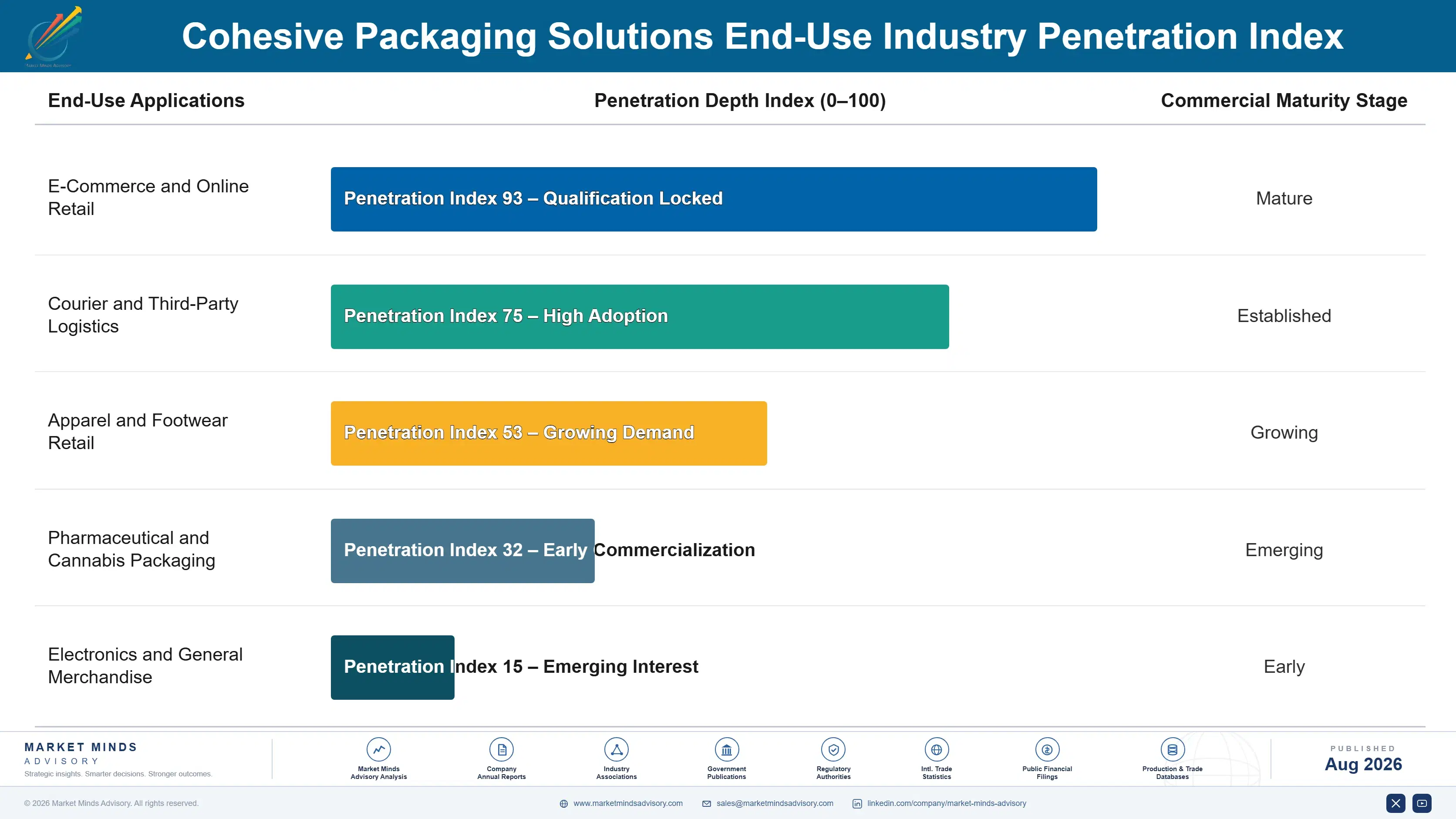
Adoption depth varies sharply by retail category. Apparel and footwear retailers adopt cohesive packaging fastest, since high return rates in these categories make resealable formats an operational necessity rather than a discretionary choice. Electronics and general merchandise retailers adopt more gradually, often driven by platform-wide packaging standardization mandates rather than category-specific return rate pressure. Pharmaceutical and cannabis retailers occupy a distinct position, adopting tamper-evident cohesive formats primarily for regulatory compliance rather than returns convenience specifically.

Younger packaging procurement managers increasingly research coating technology specifications and supplier recyclability certification directly rather than relying entirely on distributor recommendations that previous purchasing generations accepted without independent verification. That shift is pushing suppliers toward more transparent technical documentation and certification data, even though long-term supply contracts remain the actual purchasing mechanism for most platform transactions today.
cohesive-packaging-solutions-market-end-use-penetration-index-1787301386948

Where This Market Rewards Certification

These are among the four positions where our research anticipates prominent divergence between winners and laggards over the coming forecast period. Each is grounded in the demand model, the regulatory perimeter, and the announced capacity pipeline.
01 / RECYCLABILITY CERTIFICATION STRATEGY

Winners will complete certification before platforms mandate it

Raw converting capability alone no longer separates leading suppliers, since most competitors can eventually match a given film specification or coating formulation within a few product cycles. What actually separates winners is the speed of completing documented recyclability certification for major e-commerce platform contracts, because a technically capable converter without certification cannot bid into the fastest-growing segment of this market regardless of underlying product quality. Suppliers building dedicated sustainability and certification capability, rather than treating it as an afterthought, will out-earn technically comparable rivals over the coming decade.
02 / REGIONAL MANUFACTURING FOOTPRINT

Local converting capacity will decide compressed-timeline market access

Trade cost and lead time, not raw manufacturing cost alone, increasingly determine which suppliers can serve fast-growing markets like India where compressed fulfillment timelines leave little room for long-distance import lead times. Suppliers who build regional converting capacity early will capture access that purely import-dependent competitors cannot match, regardless of how competitive their underlying film pricing might otherwise be under normal conditions. Those relying entirely on distant manufacturing will find themselves increasingly unable to serve the fastest-growing compressed-timeline markets within this decade.
03 / DATA SERVICES STRATEGY

Recurring service revenue will matter more than material sales

Suppliers still competing purely on film price per unit are leaving durable revenue on the table that design services and returns analytics already capture successfully for service-forward competitors across major markets. These recurring revenue streams persist between the lumpy converting capacity investment cycles that otherwise define this market's uneven revenue pattern tied to platform contract timing. Companies that build genuine design and data capability early will earn materially more per platform relationship over a decade than those still selling only material.
04 / COATING CHEMISTRY INVESTMENT

Recyclable formulation depth will matter more than film cost

Even where e-commerce demand and platform interest align favorably for a given supplier, growth is capped by the availability of recyclable-certified coating chemistry, a constraint that requires genuine research investment neither smaller converters nor platforms can simply purchase off the shelf. Suppliers who invest early in coating chemistry research and certification will effectively expand their own addressable market ahead of competitors still exposed to certification gaps. This constraint will matter more to realized growth over the next decade than any single trade policy decision alone.

Engagement Snapshot From the Field

A live engagement with an industry participant carrying material or product regulatory and market exposure ahead of a defining policy shift, showing how our research translates into a defensible multi-year portfolio strategy.
MARKET MINDS ADVISORY · CLIENT ENGAGEMENT SUMMARY
Cohesive Packaging Solutions Producer Strategic Portfolio Review and Transition Roadmap 2026·Investment Scenario on Cohesive Packaging Solutions Exposure Evaluation 2025-26
CLIENT PROFILE
A mid-sized e-commerce fashion retailer approached MMA while evaluating whether to standardize on certified recyclable cohesive mailers across its fulfillment network ahead of anticipated marketplace platform sustainability mandates. The retailer reported annual packaging procurement spend near USD 22 million, with roughly 55% of shipping volume still running on non-certified cohesive formats at the time of the engagement (client-reported, unverified by MMA).
STRATEGIC CHALLENGE
Leadership believed standardizing on certified recyclable packaging would meaningfully improve platform compliance standing, but nobody had modeled the cost premium against projected platform mandate timelines, nor assessed whether certified suppliers could actually meet the retailer's seasonal peak volume requirements reliably across the network and its regional distribution centers and fulfillment partners.
MMA APPROACH
MMA benchmarked pricing and capacity across four certified suppliers, modeled cost premium scenarios against anticipated platform mandate timelines, and interviewed operations leads at three comparable retailers on real-world experience transitioning to certified recyclable packaging formats during peak shipping seasons, holiday demand spikes, and major promotional events throughout the full annual retail calendar.
KEY FINDINGS
  1. Certified recyclable packaging carried a meaningful cost premium initially, but the gap narrowed to roughly 6% once volume commitments reached the supplier's preferred contract threshold (client-reported, unverified by MMA).
  2. Two of the four suppliers evaluated could not reliably guarantee peak season volume without meaningful lead time, creating real fulfillment risk during the retailer's highest-revenue quarter.
  3. A phased transition prioritizing the retailer's highest-volume product categories captured most of the anticipated compliance benefit without requiring full network conversion immediately.
  4. Platform mandate timelines were less firm than the retailer's team had assumed, suggesting a measured transition pace carried less competitive risk than initially feared.
CLIENT PROFILE
A mid-sized e-commerce fashion retailer approached MMA while evaluating whether to standardize on certified recyclable cohesive mailers across its fulfillment network ahead of anticipated marketplace platform sustainability mandates. The retailer reported annual packaging procurement spend near USD 22 million, with roughly 55% of shipping volume still running on non-certified cohesive formats at the time of the engagement (client-reported, unverified by MMA).
STRATEGIC CHALLENGE
Leadership believed standardizing on certified recyclable packaging would meaningfully improve platform compliance standing, but nobody had modeled the cost premium against projected platform mandate timelines, nor assessed whether certified suppliers could actually meet the retailer's seasonal peak volume requirements reliably across the network and its regional distribution centers and fulfillment partners.
MMA APPROACH
MMA benchmarked pricing and capacity across four certified suppliers, modeled cost premium scenarios against anticipated platform mandate timelines, and interviewed operations leads at three comparable retailers on real-world experience transitioning to certified recyclable packaging formats during peak shipping seasons, holiday demand spikes, and major promotional events throughout the full annual retail calendar.
KEY FINDINGS
  1. Certified recyclable packaging carried a meaningful cost premium initially, but the gap narrowed to roughly 6% once volume commitments reached the supplier's preferred contract threshold (client-reported, unverified by MMA).
  2. Two of the four suppliers evaluated could not reliably guarantee peak season volume without meaningful lead time, creating real fulfillment risk during the retailer's highest-revenue quarter.
  3. A phased transition prioritizing the retailer's highest-volume product categories captured most of the anticipated compliance benefit without requiring full network conversion immediately.
  4. Platform mandate timelines were less firm than the retailer's team had assumed, suggesting a measured transition pace carried less competitive risk than initially feared.
RECOMMENDED STRATEGY
Phase 1: Phase 1 (0 to 6 months): Transition the highest-volume product categories to certified recyclable cohesive packaging with the two most reliable suppliers. Phase 2: Phase 2 (6 to 18 months): Expand certified packaging coverage across remaining categories, monitoring cost premium and supplier reliability closely. Phase 3: Phase 3 (18 to 36 months): Complete network-wide transition ahead of anticipated platform mandate deadlines, securing early-mover compliance positioning across categories.
OUTCOME
The retailer completed the phased transition on schedule, achieving certified recyclable coverage across its highest-volume categories well ahead of the eventual platform mandate announcement. The retailer reported the phased approach kept the blended cost premium within budget while avoiding the peak season fulfillment risk MMA had flagged with two of the four evaluated suppliers (client-reported, unverified by MMA).

Frequently Asked Questions

Foundational context covering the market sizes, CAGR, scope, country, region and competition that inform every finding below. This section is provided to cover basics and most often pre-purchase conversations, answered from the MMA Primary Research Dataset.

What is the current size of the Cohesive Packaging Solutions Market?

The market stood at USD 4.2 billion in 2025, based on MMA Primary Research Dataset findings. E-commerce shipping volume and returns processing continue driving demand.

How large will the Cohesive Packaging Solutions Market be by 2036?

MMA projects the market will reach USD 8.75 billion by 2036 under the base case scenario, representing roughly 1.95 times the 2026 opening value across the eleven-year forecast period.

What is the CAGR for the Cohesive Packaging Solutions Market 2026 to 2036?

The base case CAGR is 6.9% annually. MMA's bull scenario reaches 8.2% while the bear scenario, reflecting recyclability regulatory pressure, runs closer to 5.6% over the period.

Which segment is growing fastest?

Cohesive retail and e-commerce packaging leads at 10.8% CAGR, roughly 1.57 times the overall market rate, as online retailers standardize on resealable return-friendly formats industry-wide.

Who are the major companies in the Cohesive Packaging Solutions Market?

Sealed Air, Intertape Polymer Group, Storopack, RAJA Group, and Macfarlane Group lead the market, together controlling an estimated 44% of global shipment volume on a consistent basis.

Which country is growing fastest?

India posts the fastest national growth at 13.5% CAGR, driven by its rapidly expanding e-commerce logistics sector and improving last-mile delivery infrastructure nationwide each year.

Report Segmentation Architecture

The full report scope spans multiple orthogonal segmentation dimensions, with cross-tabulated demand data provided for each dimension pair. Coverage extends further to regional breakdowns, trend trajectories, and the competitive detail needed to support segment-level decision-making.

By Product Format

  • Cohesive Poly Mailers and Shipping Bags
  • Cohesive-Sealed Envelopes
  • Cohesive Security Tapes
  • Cohesive Courier and Logistics Bags
  • Cohesive Retail and E-Commerce Packaging
  • Cohesive Tamper-Evident Pouches

By End-Use Industry

  • E-Commerce and Online Retail
  • Courier and Third-Party Logistics
  • Apparel and Footwear Retail
  • Pharmaceutical and Cannabis Packaging
  • Electronics and General Merchandise

By Commercial Dimension

  • Direct Platform and Brand Owner Contracts
  • Distributor and Channel Sales
  • Private Label Contract Manufacturing
  • Design and Data Subscription Services

By Region

  • North America
  • Western Europe
  • East Asia
  • South Asia and Pacific
  • Latin America
  • Middle East and Africa
  • Eastern Europe

Scope, Methodology, and Coverage

Every figure in this report is reproducible from documented input assumptions. The scope below maps the historical period, the forecast horizon, the segmentation dimensions, and the countries covered, alongside the underlying primary and qualitative methodology.
Historical Period
2020 to 2025
Forecast Period
2026 to 2036
Base Year
2025 (USD billions; MMA Primary Research Dataset, August 2026)
Market Definition
The cohesive packaging solutions market covers self-sealing packaging formats, bags, envelopes, mailers, tapes, and pouches, that close using a cohesive coating bonding only to itself rather than a separate pressure-sensitive adhesive strip. It excludes conventional adhesive-sealed packaging, heat-sealed formats without cohesive closure technology, and unrelated protective packaging such as foam or bubble wrap sold without integrated cohesive sealing.
Quantitative Units
USD billions (current prices); unit shipment volume in billions of units where applicable
Segmentation Dimensions
By Product Format; By End-Use Industry; By Commercial Dimension; By Region
Regions Covered
North America, Western Europe, East Asia, South Asia and Pacific, Latin America, Middle East and Africa, Eastern Europe
Countries Covered
USA, China, Germany, France, UK, Japan, South Korea, India, Australia, Canada, Brazil, Mexico, Indonesia, Vietnam, Thailand, Malaysia, UAE, Saudi Arabia, South Africa, Nigeria, Turkey, Poland, Netherlands, Italy, Spain, Sweden, Switzerland, Argentina, Colombia, Singapore, and additional markets relevant to this sector
Key Companies Profiled
Sealed Air Corporation, Intertape Polymer Group Inc., Storopack Hans Reichenecker GmbH, RAJA Group, Macfarlane Group PLC, Duck Brand (ShurTech Brands, LLC), Novolex Holdings LLC, Sonoco Products Company, International Paper Company, Smurfit WestRock plc, Mondi Group, Nefab Group, Polyair Inter Pack Inc., ProAmpac LLC, Coveris Holdings S.A., Signode Industrial Group LLC, Berry Global Group, Inc., Shorr Packaging Corp., Veritiv Corporation, Uline, Inc.
Quantitative Methodology
Primary survey, n=3,800 respondents, Q4 2025, six countries; demand-side model with trade association cross-validation
Qualitative Methodology
47 expert interviews, Q4 2025; applied to validate demand model assumptions, identify emerging dynamics, and assess competitive positioning
Report Format
PDF and XLSX data workbook (Word format preview document)
Publisher
Market Minds Advisory
Report Code
MMA-2026-PAC-141
Published
August 2026
Contact
sales@marketmindsadvisory.com | www.marketmindsadvisory.com

Purchase the full Cohesive Packaging Solutions Market Report (2026 to 2036).

The full MMA Cohesive Packaging Solutions report sizes the market across six product format categories, five end-use verticals, four commercial channels, and seven regions through 2036. It profiles 20 participants on a consistent shipment volume basis, scoring the top five on recyclability certification breadth, manufacturing footprint, and design services capability. Scenario models quantify how e-commerce growth, returns processing standardization, and recyclability regulation move both demand and realizable pricing. The report also includes delivered-cost modelling by product format, a regional e-commerce and regulatory tracker, and a competitive benchmarking tool built for supplier strategy, platform procurement, and investor due diligence teams.
Six-category format segmentation with regional cross-tabulation
E-commerce and regulatory tracker across twelve major markets
Competitive benchmarking on consistent shipment volume basis
Delivered-cost modelling by product format and region
Scenario models for e-commerce growth and recyclability regulation
Coating chemistry and certification analysis by supplier

Built For The People Who Decide

From boardroom strategy to bench-side execution, this report is read cover-to-cover by leaders shaping the next decade of their industry, turning demand scenarios, market dynamics and valuation benchmarks into decisions.
CXOs/ Presidents/ VPs/ Managers
M&A and Corporate Development
Strategy Teams and R&D Heads
Procurement and Product Directors
Regulatory and Compliance Leaders
Investor Relations and Equity Analysts