
Market Minds Advisory
Cable Material Market

Cable Material Market: Qualification Takes Longer Than the Grid Will Wait

Grid operators are ordering cable faster than compounders can qualify the insulation that goes inside it, and a qualification cycle measured in years does not compress because demand arrived several years early.

Lead Analyst

Bilal Shaikh

Published

August 2026

Make Smarter Decisions with Customized Research Insights

Request a free sample report and evaluate market opportunities, growth trends, and competitive dynamics relevant to your business needs.

2025 MARKET VALUE$24.5BMarket Size 2025
2036 FORECAST VALUE$50.5BBase Case , 2026 to 2036
CAGR 2026 TO 20366.8 %Bull 8.0% / Bear 5.6%
INCREMENTAL OPPORTUNITY$24.4BNet 10- year value creation
EXPANSION MULTIPLE1.93x2036 value over 2026 base
Strategic Levers
M&A Pipeline
Regional Outlook
Country Rankings
Competitive Intelligence
Segmental Deep-dive
Call-Us : 91 93563 13602

Executive Snapshot and Market Trajectory

Qualification runs about 18 months for a jacketing compound and several years for high voltage insulation, so grid operators placing cable orders now needed that qualification to have started in 2022. Compounders cannot fix the timing retrospectively, and that mismatch defines the market more than pricing does.
Growth runs at 6.8% and halogen-free flame retardant compounds lead it. Those grow at 10.2%, exactly 1.50 times the market rate, as building codes covering tunnels, rail, and data centres move away from PVC jacketing entirely. East Asia holds 41%, far outside band, because Chinese cable manufacture and the compounding capacity feeding it both concentrate there. Grid investment carries the volume beneath all of it.
Concentration is low at 38% across the top five measured on compound tonnage produced, and regional compounders hold real local positions almost everywhere. High voltage insulation is the exception, where cleanliness control and cable maker qualification narrow the field to a handful of suppliers. Copper pricing moves the cable makers and resin pricing moves their compounders, and those two rarely move together. Compound freight economics keep production regional. Local capacity wins on landed cost.
Market Definition
This market covers polymer compounds formulated and supplied for wire and cable insulation, jacketing, bedding, and shielding, spanning cross-linked polyethylene insulation compounds, PVC insulation and jacketing compounds, halogen-free flame retardant compounds, semiconductive shield compounds, and rubber and thermoplastic elastomer compounds. Base resins sold uncompounded, conductor metals, optical fibre, cable accessories, water-blocking tapes and yarns, and finished wire and cable products fall outside scope.
Base Year Value
$24.5B in 2025 (MMA Primary Research Dataset, August 2026)
Forecast Period
2026 to 2036, eleven discrete annual values
CAGR
6.8% base case. Bull 8.0%. Bear 5.6%.
Fastest Growth Segment
Halogen-Free Flame Retardant Compounds: 10.2% CAGR
Fastest Growth Country
India: 9.4% CAGR
Fastest Growth Region
South Asia and Pacific: 9.0% CAGR
Largest Region
East Asia: 41% of 2025 global value
Market Leaders
Borealis, Dow, LyondellBasell, SABIC, Hanwha Solutions. Source: MMA Analysis based on company annual reports.
Primary Survey
n=3,800 procurement and R&D decision-makers, Q4 2025, six countries
Methodology
Demand-side build-up, cross-validated against public data, 47 expert interviews

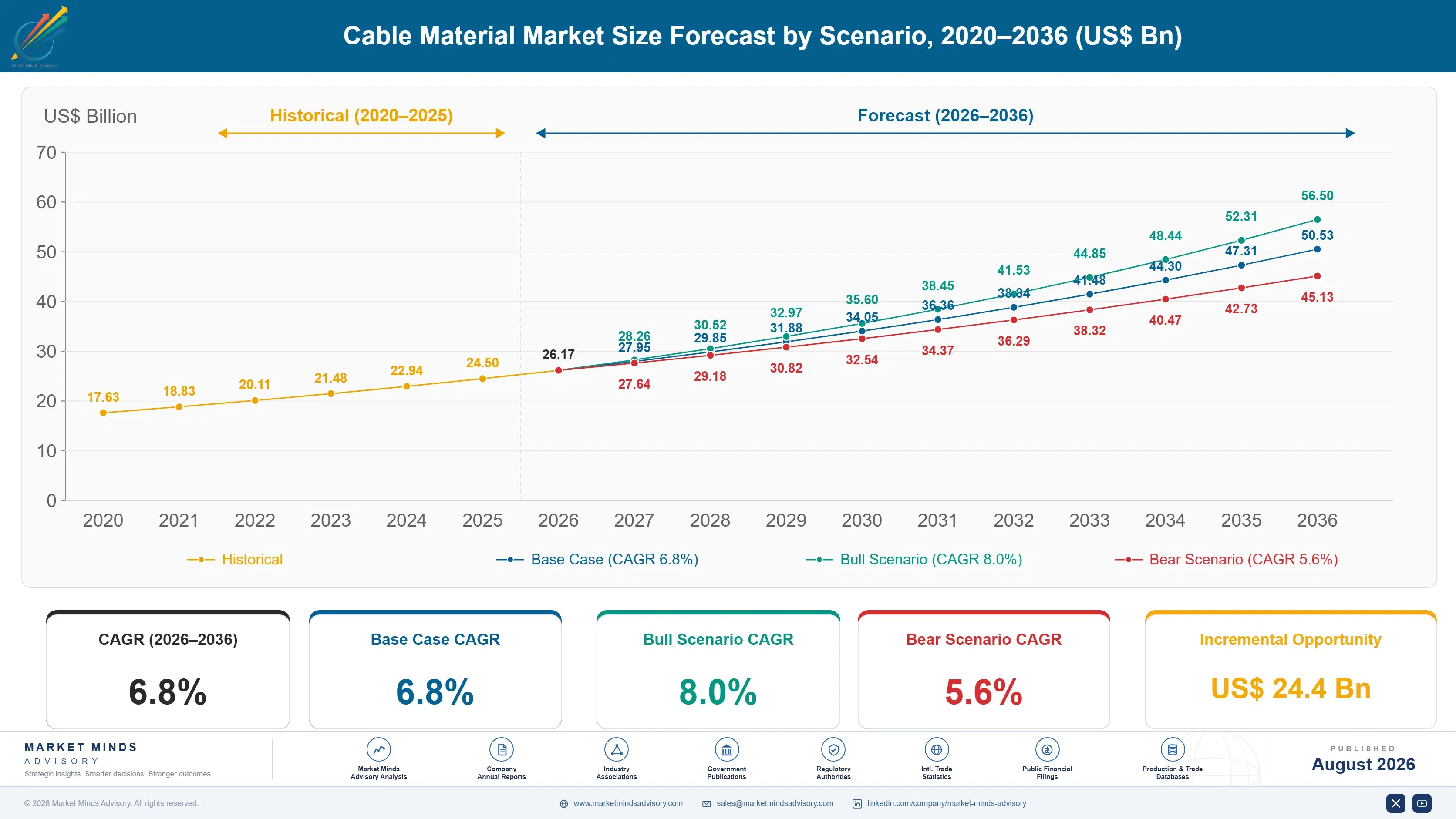
Cable Material Market Forecast Scenarios

cable-material-market-size-forecast-scenario-1787302665297
The 2020 to 2025 period ran at 5.8% and the composition of that growth changed markedly across it. Building wire and construction cable demand moved with regional cycles while grid and interconnector cable demand accelerated from 2022 as transmission investment programmes committed. Halogen-free compounds moved from a code-driven niche in tunnels and rail into mainstream commercial construction across several markets simultaneously.
Three mechanisms carry the 6.8% base case. Transmission and interconnector cable is the largest, since grid investment programmes across every major economy are committed and funded rather than proposed. Data centre power distribution is the second, where halogen-free requirements apply almost universally. And electric vehicle charging infrastructure is the third, adding cable volume with duty and flexibility requirements that ordinary building wire compounds do not meet. None of the three depends on construction cycles.
The 8.0% bull case rests on transmission project schedules holding rather than slipping, which would pull high voltage insulation demand forward into a supply base that cannot expand quickly. The 5.6% bear case is construction cable weakness across two or three large economies at once, since building wire is the volume floor beneath a market whose growth sits elsewhere entirely.

Compound Qualification Governs Everything Here

Cable material is where a cable's service life is actually decided. Conductor metal carries the current and the compound around it determines whether the cable survives 40 years of thermal cycling, moisture ingress, mechanical load, and in some installations fire. That is why cable makers qualify compounds rather than buying them, and why the qualification takes as long as it does.
TOP FIVE CONCENTRATION38%Fragmented, with regional compounders holding real local positions almost everywhere
RESIN SHARE OF COST63%Of compound production cost from base polymer feedstock alone
CABLE QUALIFICATION CYCLE18 monthsTypical duration before a new compound ships in volume
INSULATION CLEANLINESS LIMITUnder 0.1 mmMaximum particle size permitted in high voltage insulation compound
COMPOUND PRICE SPREAD5 timesBetween commodity jacketing and high voltage insulation grades produced
GRID CABLE SERVICE LIFE40 yearsWhich is what the compound itself must actually survive
The market divides sharply on what the compound has to survive. Building wire jacketing is a formulation problem solved decades ago and competes largely on price and delivery, which is why regional compounders hold positions everywhere and concentration sits at just 38%. High voltage insulation is a different business entirely: cleanliness control below 0.1 mm particle size, sustained dielectric performance, and cable maker qualification that narrows the supplier field to a handful.
Cost structure explains much of the behaviour. Base resin carries roughly 63% of compound production cost, so compounders pass polymer pricing through and compete on formulation, consistency, and qualification position rather than on the material itself. Additive packages, particularly flame retardant systems, carry most of the remainder and are where genuine formulation differences live.
"Cable makers do not switch compounds to save money. They switch when their existing supplier fails them, and then they spend a year and a half making sure the replacement will not. Price lists matter far less in this market than anyone selling into it expects."
Director, Polymer Compounds and Electrical Materials Practice · MMA Chemicals an

Market Trends

Halogen-Free Requirements Move Into Mainstream Construction

Building codes covering tunnels, rail, public buildings, and increasingly data centres now specify halogen-free low smoke compounds where PVC jacketing was standard, driven by smoke toxicity in confined evacuation routes. Those compounds grow at 10.2% against 6.8% for the market. Formulating them is harder than PVC because mineral flame retardant loadings above half the compound by weight degrade mechanical properties, and getting both right is where compounders separate from each other. Cable makers rarely revisit the choice once qualified. Switching reopens fire testing. Fire certification is not repeated to save material cost.
Market Impact: Cable must survive 40 years
Transmission Investment Pulls High Voltage Insulation Demand Forward

Committed grid and interconnector programmes across every major economy have created high voltage cable demand that arrived faster than insulation compound qualification cycles can absorb. Cleanliness control below 0.1 mm particle size and cable maker qualification measured in years both limit how quickly supply responds. Cable makers have begun contracting insulation compound volumes years ahead of project award, which had not been normal practice in this market before. Compound supply is now a scheduling input rather than a purchasing decision. Project teams track it directly. Cable makers now treat it as a scheduling constraint.
Market Impact: Halogen-free grades cost 5 times mo

Market Opportunities and Growth Drivers

Grid Investment Is Committed Rather Than Merely Proposed

Transmission and distribution investment programmes across North America, Europe, China, and India are funded and under construction rather than under discussion, and cable is a fixed proportion of that spend. IEA reporting has tracked grid investment rising for several consecutive years. This demand is unusually visible in advance because projects are permitted and scheduled long before cable is ordered, giving compounders a forward view they rarely get elsewhere. Compounders can therefore plan capacity against permitted projects. That visibility is unusual in polymer compounding. Few other end markets offer it. Very few other end markets do.
Market Impact: Qualification takes about 18 months

Data Centre Power Distribution Adds Halogen-Free Volume

Data centre construction adds substantial power distribution cable at densities well above ordinary commercial buildings, and halogen-free low smoke compounds are specified almost universally because of smoke behaviour in enclosed equipment halls. That demand grows with computing capacity rather than with construction cycles, which partially decouples it from the building wire volumes underneath the rest of the market. Specification is tight and switching is uncommon once qualified. Operators increasingly write halogen-free into their own build standards. Code requirements are no longer the only trigger. Private specification does more work now.
Market Impact: Resin is 63% of compound cost

Market Restraints and Challenges

Qualification Cycles Block Fast Supply Response

A jacketing compound takes about 18 months to qualify into a cable maker's process and high voltage insulation takes years, and the root cause is that the cable rather than the compound is what gets type tested, so every change reopens a test programme. Commercial impact is that supply cannot respond quickly to demand that arrives early. Mitigation runs through pre-qualifying second sources before they are needed, standardising formulations across cable makers, and contracting volume ahead of project award. None of those shortens the cycle itself. They only start it earlier.
Market Impact: Halogen-free grades grow at 10.2%

Resin Pricing Passes Through And Compresses Margin

Base resin carries roughly 63% of compound production cost and moves on petrochemical cycles the compounder does not influence, while cable makers negotiate on annual contracts that lag those moves. The root cause is a cost structure dominated by a purchased commodity. Commercial impact is margin compression through rising resin periods. Mitigation runs through indexed contract pricing, formulation flexibility across resin grades, and weighting the portfolio toward additive-heavy compounds where resin share of cost is lower. Purchasing scale helps less than expected here. Resin pricing is broadly transparent to every buyer.
Market Impact: Insulation cleanliness limit under
4 additional market trends, 3 additional growth drivers, and 2 additional restraints and challenges are covered in the full report. Contact sales@marketmindsadvisory.com to access the complete intelligence.

Segment CAGR and Growth Architecture

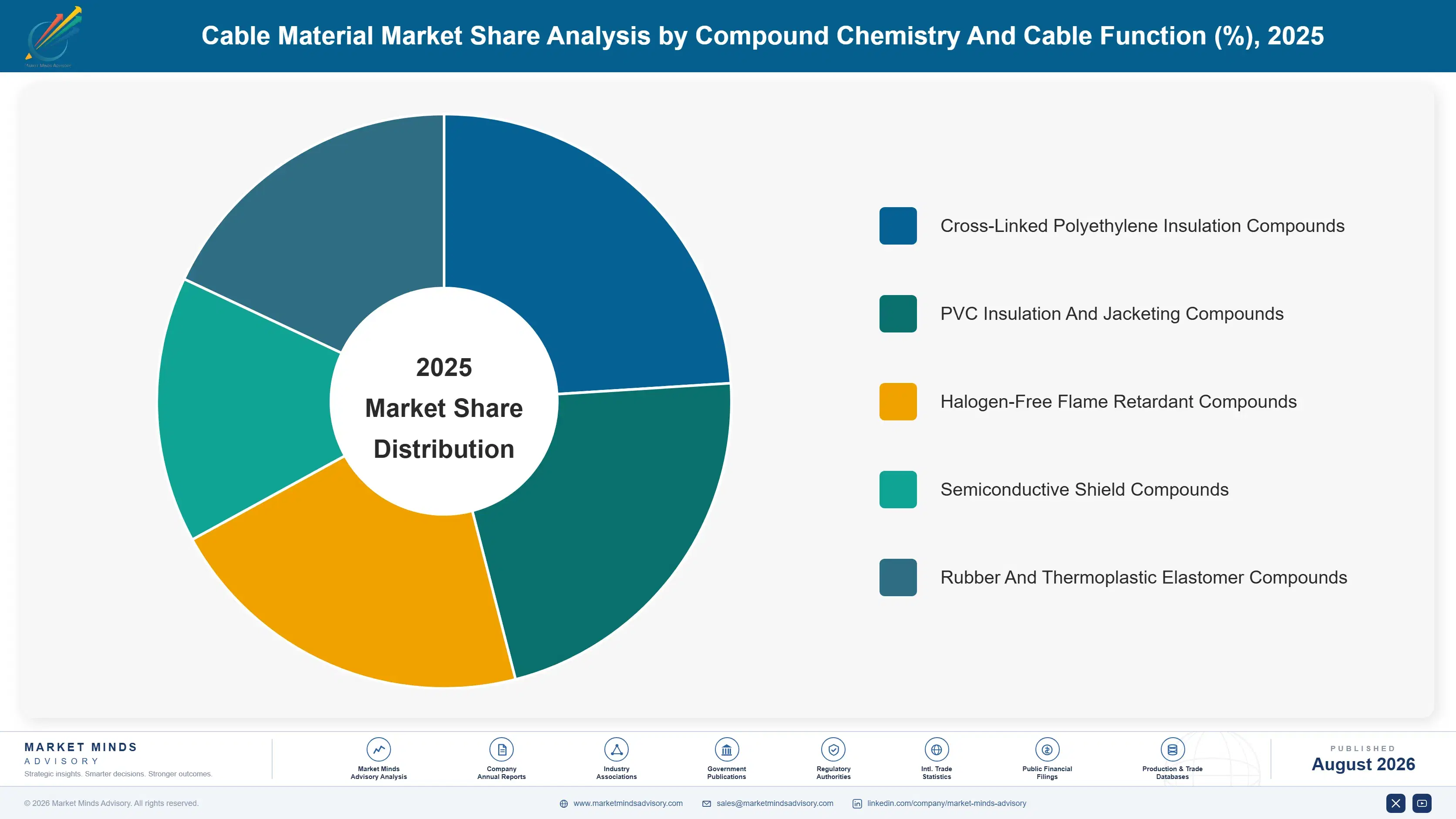
Segmentation follows compound chemistry and the function it performs in the cable, because that determines formulation difficulty, qualification pathway, price per tonne, and which suppliers can credibly compete. Voltage class and cable application both cut across every compound chemistry rather than separating them cleanly, which makes either a weaker primary dimension here. Chemistry is what the cable maker qualifies.
cable-material-market-market-share-analysis-1787302665835

Halogen-Free Flame Retardant Compounds

The fastest compound family at 10.2%, exactly 1.50 times the market rate, pulled by building codes covering tunnels, rail, public buildings, and data centres that specify low smoke behaviour where PVC jacketing was previously standard. Formulation is genuinely difficult: mineral flame retardant loadings above half the compound by weight degrade elongation, tensile strength, and processability together, so the compounder is balancing fire performance against mechanical properties that also have to pass. Pricing runs well above PVC jacketing and the qualification is correspondingly tighter, which keeps competition narrower than the commodity end of this market. Data centre operators have begun writing these compounds into their own build standards. That demand grows with computing capacity.
CAGR 10.2%

Semiconductive Shield Compounds

Second fastest at 8.5%, supplying the conductor and insulation shields that control electrical field distribution in medium and high voltage cable. Carbon black loading, dispersion quality, and surface smoothness determine whether the cable passes type testing at all, and a shield with poor dispersion creates field concentrations that shorten cable life in ways that only appear years later. Volumes per cable are small and the qualification is as demanding as insulation, which makes this a technically defended position rather than a tonnage business at all. Cleanliness and dispersion data are reviewed before commercial terms are ever discussed. Few compounders qualify at this level. Margins reflect that scarcity directly. Volumes stay small and defended.
CAGR 8.5%
Full segment breakdown across 5 segments available in the complete report.

Regional Architecture and Country Demand Map

East Asia leads at 41%, far outside band, because Chinese cable manufacture and the compounding capacity feeding it both concentrate there. North America and Western Europe follow on grid investment. South Asia and Pacific grows fastest. Three regional shares sit outside their framework bands. Cable manufacturing geography explains all three.

East Asia

Forty-one percent, far outside the framework band, and justified because Chinese cable manufacturing capacity alone exceeds the rest of the world combined, with domestic compounding capacity built alongside it rather than importing. Japanese and Korean producers hold the technically demanding end, particularly high voltage insulation and semiconductive shields serving submarine and interconnector cable programmes. Chinese grid investment through the State Grid transmission programme sustains volume that no other single national programme approaches. Growth at 7.6% runs above the market rate on grid and data centre demand together. Regional compounders have moved up from jacketing into insulation grades and now compete on price in applications that were previously closed to them entirely. Qualification remains the limiting step.
Share: 41% | CAGR: 7.6% (2026 to 2036)

North America

Nineteen percent, below the framework band because cable manufacture concentrates in East Asia, and transmission investment rather than construction carries most of the growth here. Grid replacement of conductors installed in the nineteen sixties and seventies is running alongside new interconnection capacity, and both need insulation compound in volumes that arrive faster than qualification allows. Data centre construction adds halogen-free demand at unusual density. Growth at 6.4% sits near the market rate, held there by construction cable weakness offsetting grid strength. Halogen-free adoption follows private data centre build standards as much as it follows building code, which has made specification less predictable than the volume itself. Regional compounding capacity is adequate.
Share: 19% | CAGR: 6.4% (2026 to 2036)
Regional intelligence for 5 additional markets available in the complete report: Western Europe, South Asia and Pacific, Latin America, Middle East and Africa, Eastern Europe. Contact sales@marketmindsadvisory.com.
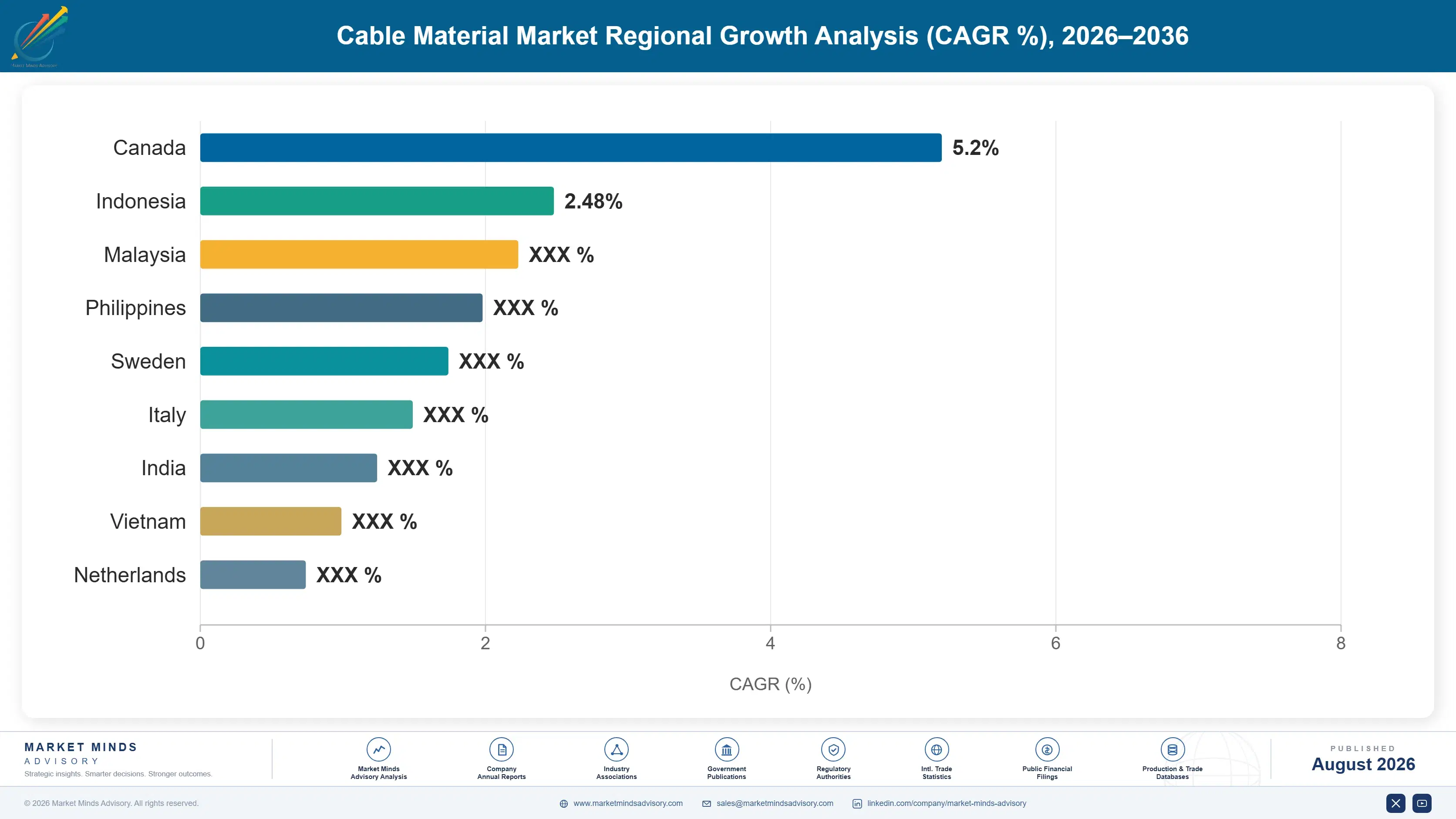
cable-material-market-country-cagr-analysis-1787302666353

Qualification Positions Beat Price Lists

Qualification runs 18 months to several years, resin carries 63% of compound cost, concentration sits at only 38%, and halogen-free compounds grow at 10.2%. Value comes from qualification depth, from formulation capability in additive-heavy grades, and from contract structures that survive resin cycles. Each of those is decided years before revenue appears. All three compound together.

Hold Qualification Positions Rather Than Contest Price

A compound qualified into a cable maker's extrusion process and type test programme cannot be replaced without reopening testing that takes 18 months or more, which no cable maker undertakes to save a few percent on material cost. Compounders competing on price lists are addressing a comparison that rarely decides anything. Those investing in application support during qualification hold positions for the cable product's whole commercial life, and defend them without discounting. Qualification support during the cable design phase costs engineering time and buys years of shipments. Discounting buys nothing comparable.
Market Impact: Qualification alone runs 18 months

Weight The Portfolio Toward Additive-Heavy Formulations

Base resin carries roughly 63% of compound production cost in commodity jacketing grades and considerably less in halogen-free compounds, where mineral flame retardant systems and coupling agents carry more of the value. That shifts margin away from a purchased commodity the compounder cannot influence and toward formulation work it controls. Halogen-free grades grow at 10.2% against 6.8% for the market, so the mix shift and the growth point the same direction. Mix shift also reduces exposure to cable maker integration, which takes the largest commodity volumes first. Two problems ease at once.
Market Impact: Resin drops well below 63% of total

Index Contract Pricing To Resin Movement Explicitly

Resin at 63% of production cost moves on petrochemical cycles while cable maker contracts run annually, and that lag compresses margin through every rising resin period without exception. Indexed pricing shifts the exposure to the party that can actually pass it downstream into cable pricing. Cable makers resist it and accept it when the alternative is supply disruption, and the negotiation goes considerably better during qualification than after volume has started. Purchasing scale is no substitute, since resin pricing is broadly transparent to buyers of every size. Contract structure is the only real lever.
Market Impact: Resin drives roughly 63% of all cos

Pre-Qualify Into Transmission Programmes Before Award

Grid and interconnector projects are permitted and scheduled years before cable is ordered, and cable makers have begun contracting insulation compound volumes ahead of award because qualification cannot compress to fit. A compounder qualified before the tender is a candidate; one qualifying afterwards has already lost roughly 18 months it cannot recover. Visibility into project pipelines is therefore a commercial asset rather than merely useful market intelligence. Transmission projects are permitted and scheduled long before cable is ordered, so the pipeline is visible to anyone who tracks it. Most compounders still do not.
Market Impact: Award to delivery gap exceeds 18 mo

Who Controls the Margin Pool

Concentration is low at 38% across the top five measured on compound tonnage produced, and that number understates how differently the two ends of this market behave. Building wire jacketing is regional, price-led, and served by compounders everywhere. High voltage insulation and semiconductive shields are supplied by a handful of qualified producers globally, and the leader to challenger gap in those grades is far wider than the headline concentration suggests.
Competitive activity runs on three fronts. Qualification position with each cable maker is the first and the most durable, since it holds for a cable product's commercial life. Formulation capability in halogen-free grades is the second, where flame retardant loading and mechanical properties genuinely trade against each other. And regional compounding capacity is the third, because compound freight economics limit how far a tonne travels profitably.

Pressure arrives from two directions. Chinese compounders have moved up from jacketing into insulation grades and compete hard on price. And several large cable makers have brought compounding in-house for their highest volume formulations, taking tonnage out of the merchant market permanently. Rankings shift on qualification wins rather than on capacity.
cable-material-market-company-positioning-matrix-1787302666874

Competitive Moat and Risk Dimensions

BOREALIS

Moat: High voltage insulation qualification depth

Cross-linked polyethylene insulation qualified into submarine, interconnector, and transmission cable programmes across multiple cable makers gives a position that neither capacity nor formulation knowledge replicates quickly. Cleanliness control at the particle sizes those cables demand took years of process development. Every qualification held is a cable product's whole commercial life of shipments.
BOREALIS

Risk: Exposure to transmission project timing

Weighting toward high voltage insulation ties volume to grid and interconnector project schedules that slip routinely and by years rather than quarters. Compounders spread across building wire and industrial cable absorb that through demand that does not move with capital programmes. Depth in the most valuable grades also means depth in the least predictable ones.
DOW

Moat: Formulation breadth across compound families

Positions across insulation, semiconductive shield, and jacketing compounds let a supplier qualify a full cable material package rather than a single component, which cable makers increasingly prefer because it reduces the number of qualification programmes they run. Upstream resin integration also insulates against the resin cost exposure that independent compounders carry fully.
DOW

Risk: Cable makers compounding in-house

Several large cable manufacturers have brought compounding in-house for their highest volume jacketing and bedding formulations, permanently removing tonnage from the merchant market. Integration is most attractive exactly where volumes are largest. That pressure grows as cable makers scale and reaches the technically demanding grades last, but it does reach them.

Players Tracked

Prominent Players

Borealis
Dow
LyondellBasell
SABIC
Hanwha Solutions

Other Key Players

Teknor Apex
Melos
Finproject
Cabot Corporation
AEI Compounds
Alphagary
Avient
Solvay
Evonik
Mitsubishi Chemical
Shin-Etsu Chemical
Kingfa Sci and Tech
Zhejiang Wanma Macromolecular Materials
Jiangsu Dewei Advanced Materials
Shandong Dawn Polymer

Recent Developments

FEBRUARY 2025

Cable maker contracts insulation compound ahead of project award

A transmission cable manufacturer contracted multi-year high voltage insulation compound volumes before the underlying grid project had been awarded, accepting volume risk to secure qualified supply. The arrangement was a long-term supply contract rather than a joint venture, acquisition, or equity investment in the compounder.
Signal: Qualification cycles now run longer than t
MAY 2025

Compounder commissions halogen-free capacity in Southeast Asia

A specialty compounder brought new halogen-free flame retardant compound capacity online in Southeast Asia, serving regional cable makers who had been importing those grades from Europe and Japan at considerable freight cost. The expansion was organic capacity investment rather than any acquisition or partnership arrangement.
Signal: Compound freight economics limit how far a
SEPTEMBER 2025

Cable manufacturer brings jacketing compounding fully in-house

A large cable manufacturer completed the transfer of its highest volume jacketing and bedding compound production into its own facilities, ending merchant purchases of those grades. The move was internal vertical integration rather than an acquisition, joint venture, or supply dispute with its previous compounders.
Signal: Integration takes the largest commodity vo

Resin, Flame Retardants and Freight

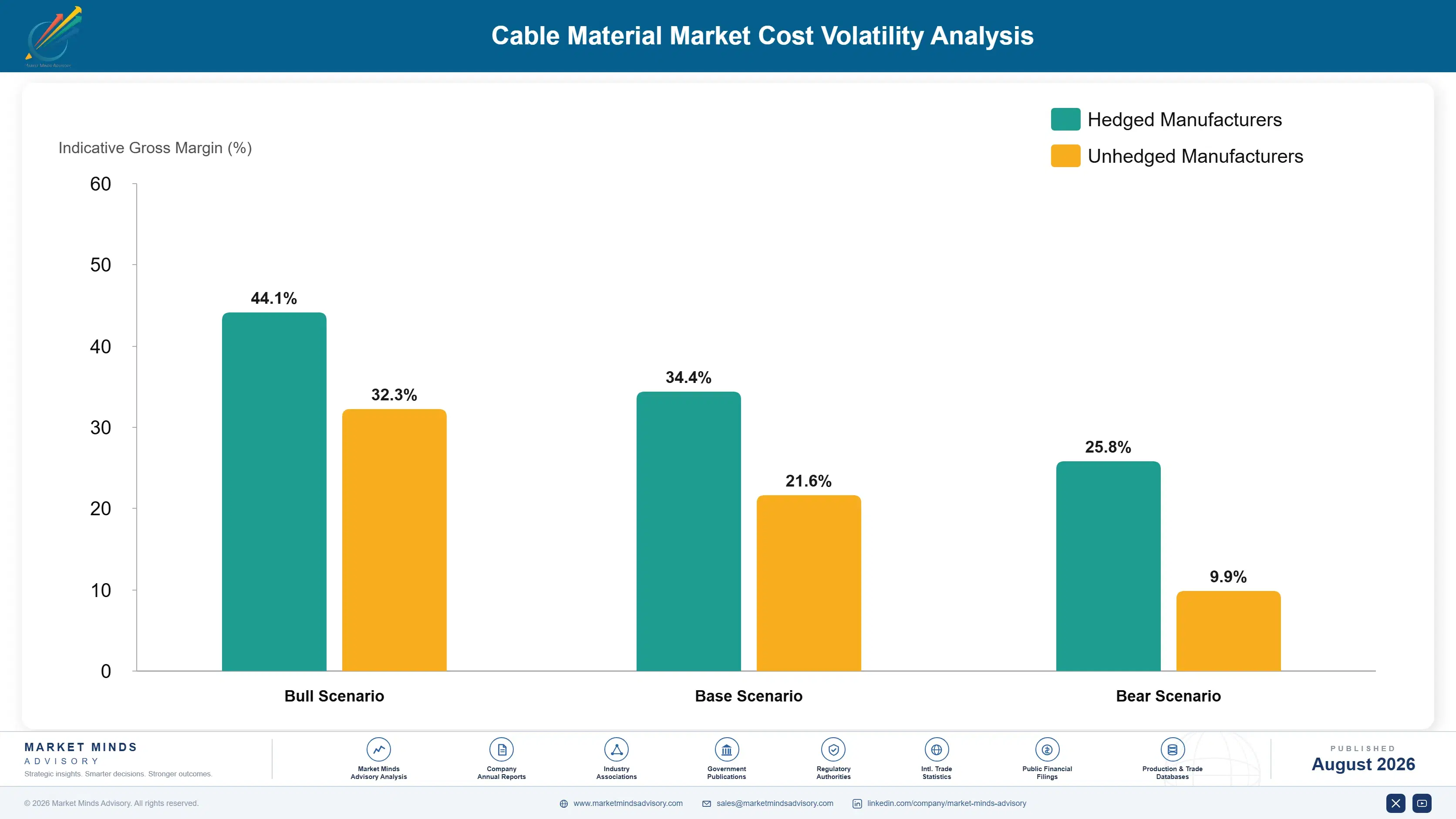
Base resin carries roughly 63% of compound production cost, additive packages including flame retardants, antioxidants, and coupling agents about 21%, compounding energy and extrusion near 7%, packaging and inbound freight around 5%, and quality control, labour, and overhead the balance. Resin dominates and comes from petrochemical producers whose pricing cycles the compounder neither influences nor forecasts reliably.
Polyethylene and PVC resin pricing moved sharply through 2022 as European energy costs pushed cracker economics, and EIA and IEA reporting tracked the underlying feedstock and energy movement across that period. Compounders on annual cable maker contracts absorbed much of it before repricing, and several disclosed margin compression in filings covering that year. Mineral flame retardant pricing moved separately and less violently but in the same direction.

The competitive disadvantage mechanism runs through contract structure rather than through purchasing scale. Resin pricing is broadly transparent and large compounders buy only modestly better than mid-sized ones, while a compounder on fixed annual pricing carries the full cycle and one on indexed terms passes it through. Exposure is worst in commodity jacketing where resin share of cost is highest, and lightest in halogen-free grades where additives carry
cable-material-market-cost-volatility-analysis-1787302667069

Index cable maker contracts to published resin movement

Resin at 63% of production cost moves on cycles the compounder cannot influence, and annual fixed pricing means carrying that exposure alone through every rising period. Indexed terms shift it to the party that can pass it into cable pricing downstream. Cable makers resist indexation and accept it more readily during qualification than after volume has started running.

Formulate across multiple qualified resin grades and suppliers

A compound qualified against a single resin grade from a single producer has no response when that producer reprices or has an outage, and requalifying takes months the cable maker will not wait. Qualifying alternate resin grades into the same compound specification at the outset costs testing work and buys genuine purchasing flexibility later, which is considerably cheaper

Site compounding capacity within regional freight radius

Packaging and inbound freight carry around 5% of compound cost and outbound freight adds more, which limits how far a tonne of compound travels before local capacity wins on landed cost alone. Regional plants also shorten lead times that cable makers increasingly value. That economics explains why concentration sits at 38% rather than consolidating the way upstream resin production has.

Portfolio Architecture for Margin Defence

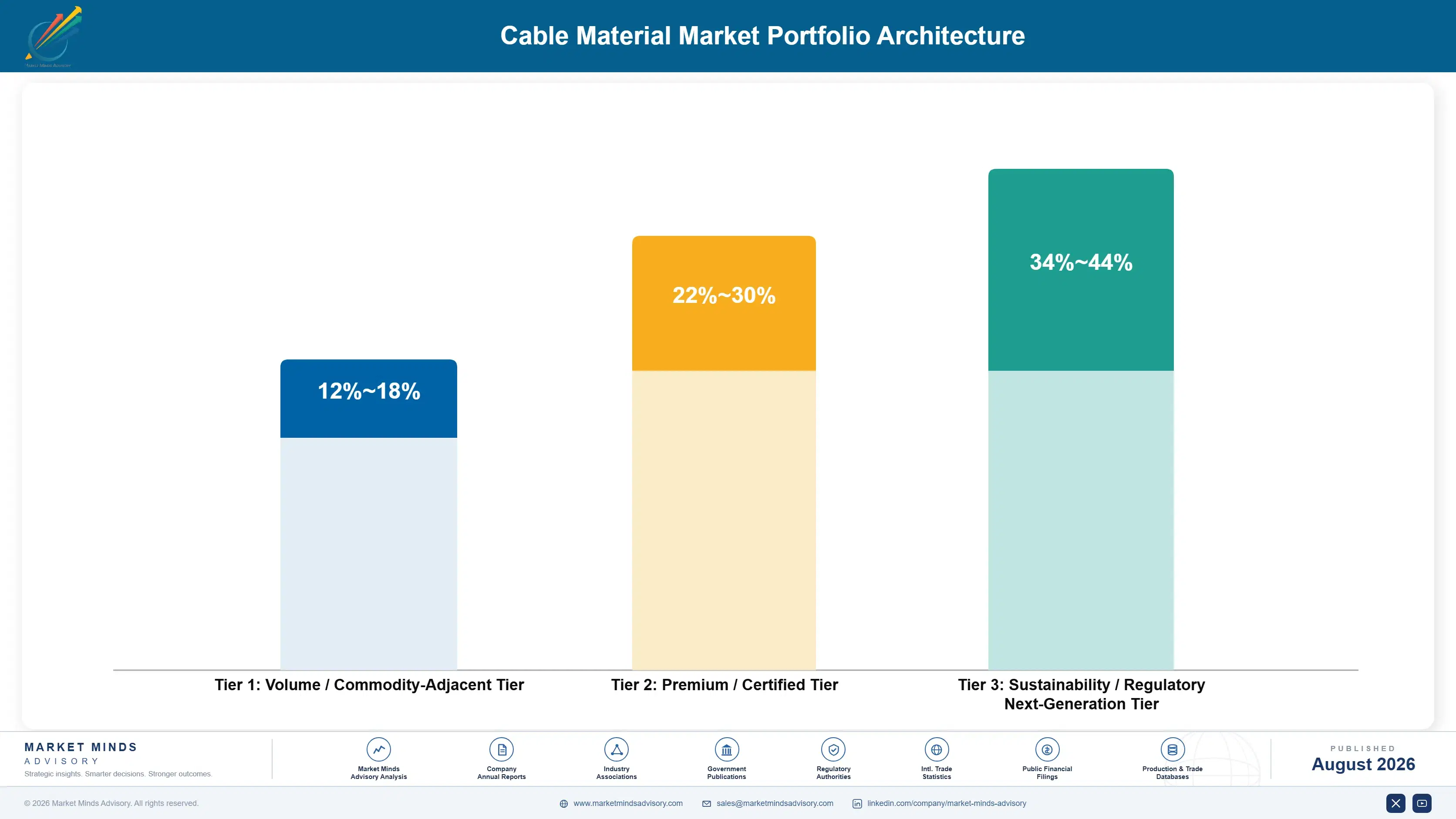
Three tiers describe this business and the spread follows qualification difficulty rather than volume. Building wire jacketing and bedding compounds sit at the bottom, where formulations are settled, regional compounders compete everywhere, and resin carries most of the cost. Halogen-free and industrial grades occupy the middle. High voltage insulation and semiconductive shields sit at the top, where cleanliness control and multi-year qualification both apply and few suppliers qualify.
The tension is that the bottom tier carries the tonnage that keeps compounding lines loaded while contributing the least margin, and it is also the tier cable makers integrate first. A compounder weighted there watches volume leave permanently as customers scale. One weighted toward high voltage insulation carries exposure to transmission project schedules that slip by years, with no building wire demand underneath to smooth it.

High-value pools concentrate where the qualification is hardest to pass. Semiconductive shields are the clearest case, since carbon black dispersion quality determines whether the cable passes type testing at all and volumes per cable are small enough that price sensitivity is genuinely low. Submarine and interconnector insulation is the second such pool, where cleanliness control took years of process development to reach.

Volume / Commodity-Adjacent Tier

Building wire jacketing, bedding, and general PVC compounds where formulations are settled and regional compounders compete on price and delivery. Tonnage keeps lines loaded and cable makers integrate these grades first.
Gross Margin: 12-18%

Premium / Certified Tier

Halogen-free flame retardant, industrial, and flexible rubber compounds where formulation genuinely differentiates and fire testing certification applies. Additive packages carry more of the cost, which reduces resin exposure meaningfully. Qualification is tighter than commodity grades throughout.
Gross Margin: 22-30%

Sustainability / Regulatory / Next-Generation Tier

High voltage insulation, semiconductive shields, and submarine cable grades where cleanliness control and multi-year qualification restrict supply to a handful of producers. Best margin by a clear distance across the whole portfolio.
Gross Margin: 34-44%
cable-material-market-portfolio-architecture-1787302667569

Qualification, Type Tests, Programmes

Demand follows qualification rather than purchasing in almost every grade above commodity jacketing. A compound qualified into a cable maker's extrusion process and type test programme ships against that cable product's production volume for years with no further commercial activity, and the decision that created it was taken during cable development long before any volume existed at all. Purchasing rarely reopens what engineering has already settled.
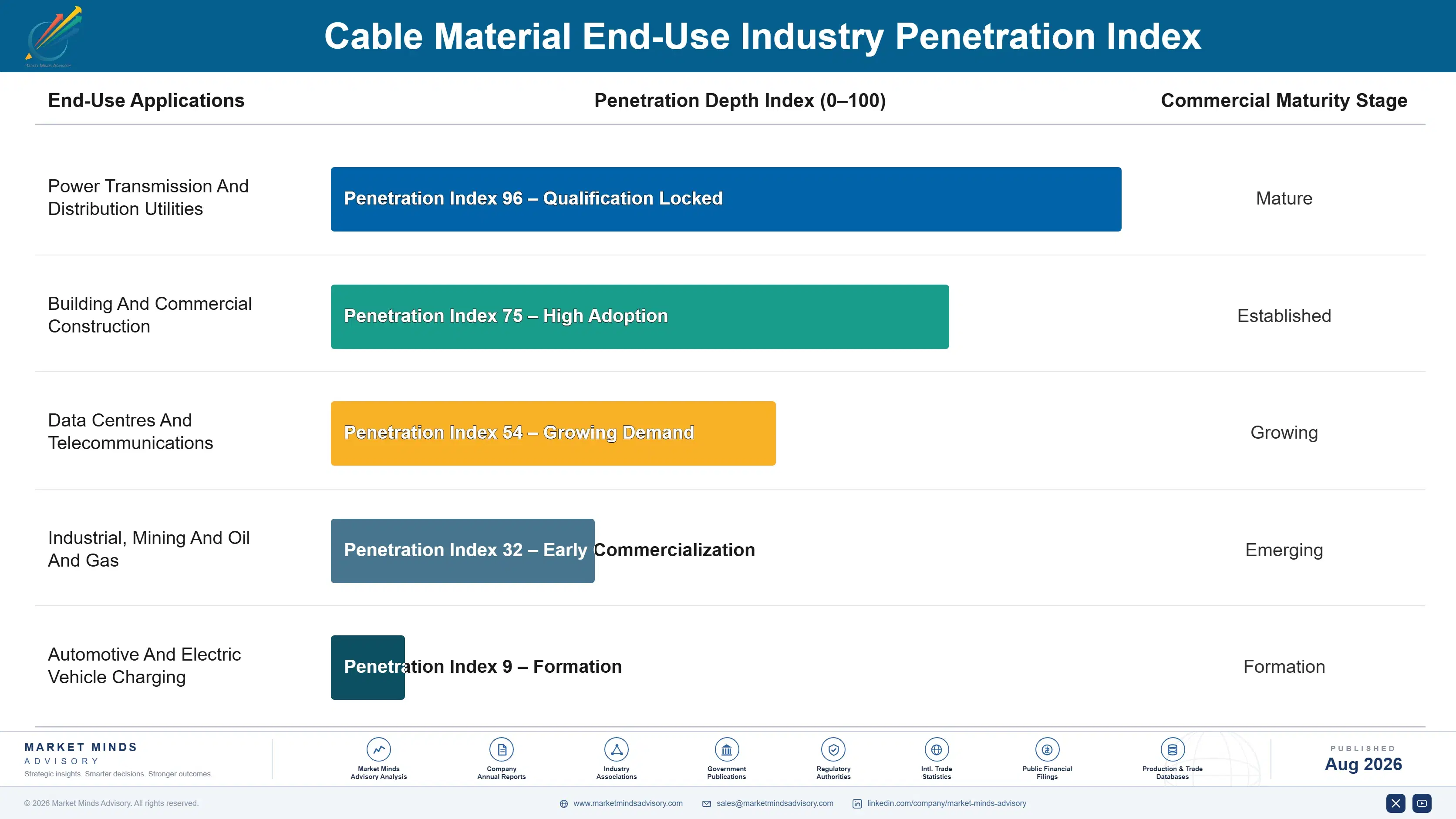
Stickiness varies enormously by grade and by end-use vertical. Transmission and submarine cable qualifications are the firmest, because retesting a high voltage cable design is expensive and slow enough that no cable maker does it for material savings. Industrial, mining, and data centre cable sit in the middle, where certification adds friction. Building wire jacketing sticks hardly at all and is retendered on price most years.

Buyer profiles shifted as halogen-free and high voltage grades grew. The earlier buyer was a cable maker purchasing manager comparing tonnage prices across regional compounders. The current conversation increasingly involves a cable design engineer evaluating flame retardant loading against elongation retention, or an insulation specialist reviewing cleanliness data, before commercial terms are discussed at all.
cable-material-market-end-use-penetration-index-1787302668056

What We Would Tell a Board

These are among the four positions where our research anticipates prominent divergence between winners and laggards over the coming forecast period. Each is grounded in the demand model, the regulatory perimeter, and the announced capacity pipeline.
01 / QUALIFICATION POSITION DEFENCE

Defend qualified positions; do not contest tonnage on price

A compound qualified into a cable maker's extrusion process and type test programme cannot be replaced without reopening testing that runs 18 months or considerably longer, which no cable maker undertakes to save a few percent on material. Compounders competing on price lists are addressing a comparison that rarely decides anything at all. Those investing application engineering support during the qualification programme itself hold positions for the cable product's whole commercial life, and defend them later without any discounting at all.
02 / PORTFOLIO MIX SHIFT

Move weight toward additive-heavy formulations deliberately

Base resin carries roughly 63% of production cost in commodity jacketing and considerably less in halogen-free compounds, where mineral flame retardant systems and coupling agents carry far more of the value created. That shift moves margin away from a purchased commodity nobody in this market influences and toward formulation work the compounder controls. Halogen-free grades also grow at 10.2% against 6.8% for the wider market, so the mix shift and the growth rate point in exactly the same direction for once.
03 / INTEGRATION EXPOSURE MANAGEMENT

Assume your largest volumes will be integrated eventually

Large cable manufacturers have moved jacketing and bedding compounding in-house and the economics favour doing so at exactly the volumes independent compounders rely on for fixed cost absorption across their lines. That tonnage leaves permanently rather than cyclically, and no commercial response of any kind recovers it once the customer's own capacity actually exists and runs. Planning fixed cost coverage around the grades that genuinely resist integration is considerably safer than assuming current tonnage persists, and the resizing is far cheaper done early than under pressure.
04 / RESIN CYCLE CONTRACTING

Index the contract or carry the whole cycle

Resin at 63% of production cost moves on petrochemical cycles while cable maker contracts run annually, and that lag compresses margin through every rising resin period without any exception at all. Purchasing scale helps far less than anybody expects here, because resin pricing is broadly transparent to buyers of every size and large compounders buy only modestly better. Indexed contract terms are the only mechanism that actually works, and they are negotiated far more easily during a qualification programme than after volume has already started running.

Engagement Snapshot From the Field

A live engagement with an industry participant carrying material or product regulatory and market exposure ahead of a defining policy shift, showing how our research translates into a defensible multi-year portfolio strategy.
MARKET MINDS ADVISORY · CLIENT ENGAGEMENT SUMMARY
Cable Material Producer Strategic Portfolio Review and Transition Roadmap 2026·Investment Scenario on Cable Material Exposure Evaluation 2025-26
CLIENT PROFILE
An independent cable compounder with approximately 310 million dollars in annual revenue (client-reported, unverified by MMA), running four regional plants and supplying jacketing, bedding, and halogen-free compounds to cable manufacturers across two continents. High voltage insulation capability was absent, contracts were annual and fixed price, and building wire jacketing carried roughly half of total tonnage shipped.
STRATEGIC CHALLENGE
The board had watched two large customers move jacketing compounding in-house within eighteen months and wanted to know how much further that would go, which grades were genuinely defensible, and whether the plant footprint still matched where defensible volume would sit in five years. Nobody had modelled integration economics customer by customer. Tonnage forecasts assumed current volumes held.
MMA APPROACH
We mapped customer tonnage by grade and assessed integration economics for each cable maker at its current scale. Qualification positions were reviewed for durability and reopening risk. Resin cost exposure was modelled by grade across three price scenarios, and halogen-free and insulation growth was decomposed by application and region. Plant footprint was then tested against defensible mix.
KEY FINDINGS
  1. Roughly 40% of shipped tonnage sat in grades where customer integration economics were already favourable, and two further customers had reached the scale where integration made sense.
  2. Halogen-free grades carried lower resin share of cost and materially better margin, and their qualification positions had never been contested on price in four years.
  3. Fixed annual pricing had cost the client meaningful margin through the 2022 resin cycle, and no contract carried any indexation clause at all.
  4. The plant footprint was sized for jacketing tonnage rather than for the compound mix the client would defensibly hold within five years.
CLIENT PROFILE
An independent cable compounder with approximately 310 million dollars in annual revenue (client-reported, unverified by MMA), running four regional plants and supplying jacketing, bedding, and halogen-free compounds to cable manufacturers across two continents. High voltage insulation capability was absent, contracts were annual and fixed price, and building wire jacketing carried roughly half of total tonnage shipped.
STRATEGIC CHALLENGE
The board had watched two large customers move jacketing compounding in-house within eighteen months and wanted to know how much further that would go, which grades were genuinely defensible, and whether the plant footprint still matched where defensible volume would sit in five years. Nobody had modelled integration economics customer by customer. Tonnage forecasts assumed current volumes held.
MMA APPROACH
We mapped customer tonnage by grade and assessed integration economics for each cable maker at its current scale. Qualification positions were reviewed for durability and reopening risk. Resin cost exposure was modelled by grade across three price scenarios, and halogen-free and insulation growth was decomposed by application and region. Plant footprint was then tested against defensible mix.
KEY FINDINGS
  1. Roughly 40% of shipped tonnage sat in grades where customer integration economics were already favourable, and two further customers had reached the scale where integration made sense.
  2. Halogen-free grades carried lower resin share of cost and materially better margin, and their qualification positions had never been contested on price in four years.
  3. Fixed annual pricing had cost the client meaningful margin through the 2022 resin cycle, and no contract carried any indexation clause at all.
  4. The plant footprint was sized for jacketing tonnage rather than for the compound mix the client would defensibly hold within five years.
RECOMMENDED STRATEGY
Phase 1: Phase 1 (months one to nine): introduce resin indexation into every contract renewal, starting with customers currently in qualification programmes. Phase 2: Phase 2 (months nine to twenty-four): shift capacity and formulation resource toward halogen-free grades, accepting jacketing tonnage decline rather than defending it. Phase 3: Phase 3 (months twenty-four to forty-two): resize the plant footprint against defensible grade mix rather than against historical tonnage throughput.
OUTCOME
Indexation was accepted by four of seven major customers within three quarters, covering roughly half of contracted volume. Halogen-free capacity was expanded at two plants, and a planned jacketing line replacement was cancelled after the tonnage review (client-reported, unverified by MMA). Three further customers were assessed as likely integration candidates within four years.

Frequently Asked Questions

Foundational context covering the market sizes, CAGR, scope, country, region and competition that inform every finding below. This section is provided to cover basics and most often pre-purchase conversations, answered from the MMA Primary Research Dataset.

What is the current size of the Cable Material Market?

The market is valued at USD 24.5 billion in 2025, rising to USD 26.17 billion in 2026. Scope covers compounded cable insulation, jacketing, and shielding materials, not uncompounded resin, conductor metal, or finished cable.

How large will the Cable Material Market be by 2036?

MMA forecasts USD 50.52 billion by 2036, an increase of USD 24.35 billion over the 2026 base. That represents an expansion multiple of 1.93 times across the forecast period.

What is the CAGR for the Cable Material Market 2026 to 2036?

The base case CAGR is 6.8%, with a bull case of 8.0% and a bear case of 5.6%. The historical rate from 2020 to 2025 was 5.8%, held down by construction cable cycles.

Which segment is growing fastest?

Halogen-free flame retardant compounds at 10.2%, exactly 1.50 times the market rate. Building codes covering tunnels, rail, and data centres are moving away from PVC jacketing entirely.

Who are the major companies in the Cable Material Market?

Borealis, Dow, LyondellBasell, SABIC, and Hanwha Solutions lead on compound tonnage produced. The top five hold just 38%, since regional compounders hold real local positions almost everywhere.

Which country is growing fastest?

India at 9.4%, driven by transmission expansion and rural electrification programmes adding distribution cable volume. Domestic compounding has grown alongside, though insulation and shield grades are still largely imported.

Report Segmentation Architecture

The full report scope spans multiple orthogonal segmentation dimensions, with cross-tabulated demand data provided for each dimension pair. Coverage extends further to regional breakdowns, trend trajectories, and the competitive detail needed to support segment-level decision-making.

By Compound Chemistry And Cable Function

  • Cross-Linked Polyethylene Insulation Compounds
  • PVC Insulation And Jacketing Compounds
  • Halogen-Free Flame Retardant Compounds
  • Semiconductive Shield Compounds
  • Rubber And Thermoplastic Elastomer Compounds

By End-Use Industry

  • Power Transmission And Distribution Utilities
  • Building And Commercial Construction
  • Data Centres And Telecommunications
  • Industrial, Mining And Oil And Gas
  • Automotive And Electric Vehicle Charging

By Commercial Model

  • Direct Supply To Qualified Cable Manufacturers
  • Toll Compounding For Resin Producers
  • Distributor And Regional Reseller Channels
  • Co-Development With Cable Design Teams
  • Custom Formulation For Project Specification

By Region

  • East Asia
  • North America
  • Western Europe
  • South Asia and Pacific
  • Latin America
  • Middle East and Africa
  • Eastern Europe

Scope, Methodology, and Coverage

Every figure in this report is reproducible from documented input assumptions. The scope below maps the historical period, the forecast horizon, the segmentation dimensions, and the countries covered, alongside the underlying primary and qualitative methodology.
Historical Period
2020 to 2025
Forecast Period
2026 to 2036
Base Year
2025 (USD billions; MMA Primary Research Dataset, August 2026)
Market Definition
This market comprises polymer compounds formulated for wire and cable insulation, jacketing, bedding, and shielding applications, measured at compounder revenue across direct, toll, distribution, and custom formulation channels. Coverage spans cross-linked polyethylene insulation compounds, PVC insulation and jacketing compounds, halogen-free flame retardant compounds, semiconductive conductor and insulation shield compounds, and rubber and thermoplastic elastomer compounds for flexible and industrial cable. Uncompounded base resins sold as such, conductor copper and aluminium, optical fibre and fibre coatings, water-blocking tapes, yarns and powders, armouring and metallic screens, cable accessories and jointing systems, and finished wire and cable products fall outside scope.
Quantitative Units
USD billions (current prices); compound tonnage produced; price per tonne by compound family; resin share of compound cost
Segmentation Dimensions
By Compound Chemistry And Cable Function; By End-Use Industry; By Commercial Model; By Region
Regions Covered
East Asia, North America, Western Europe, South Asia and Pacific, Latin America, Middle East and Africa, Eastern Europe
Countries Covered
China, Japan, South Korea, Taiwan, United States, Canada, Mexico, Germany, France, United Kingdom, Italy, Spain, India, Vietnam, Thailand, Indonesia, Australia, Brazil, Saudi Arabia, United Arab Emirates, South Africa, Poland, Czechia, and additional markets relevant to this sector
Key Companies Profiled
Borealis, Dow, LyondellBasell, SABIC, Hanwha Solutions, Teknor Apex, Melos, Finproject, Cabot Corporation, AEI Compounds, Alphagary, Avient, Solvay, Evonik, Mitsubishi Chemical, Shin-Etsu Chemical, Kingfa Sci and Tech, Zhejiang Wanma Macromolecular Materials, Jiangsu Dewei Advanced Materials, Shandong Dawn Polymer
Quantitative Methodology
Primary survey, n=3,800 respondents, Q4 2025, six countries; demand-side model with trade association cross-validation
Qualitative Methodology
47 expert interviews, Q4 2025; applied to validate demand model assumptions, identify emerging dynamics, and assess competitive positioning
Report Format
PDF and XLSX data workbook (Word format preview document)
Publisher
Market Minds Advisory
Report Code
MMA-2026-CHM-770
Published
August 2026
Contact
sales@marketmindsadvisory.com | www.marketmindsadvisory.com

Purchase the full Cable Material Market Report (2026 to 2036).

The full report sizes cable material across five compound families, five end-use industries, five commercial models, and seven regions, with qualification cycle length and reopening risk assessed by grade throughout. Cable maker vertical integration economics are modelled by customer scale, since that determines which merchant tonnage is genuinely defensible and which is not. Resin cost exposure is quantified by compound family across price scenarios. Competitive profiling covers twenty compounders on tonnage produced, and halogen-free formulation capability is assessed separately from commodity compounding capacity. Regional demand is built from grid investment schedules rather than from construction activity alone.
Qualification cycle length and reopening risk assessed by grade
Cable maker integration economics modelled by individual customer scale
Resin cost exposure quantified by compound family and scenario
Halogen-free formulation capability assessed separately from commodity compounding
Transmission project pipelines mapped against insulation compound qualification timing
Regional freight radius economics applied to compounding capacity siting

Built For The People Who Decide

From boardroom strategy to bench-side execution, this report is read cover-to-cover by leaders shaping the next decade of their industry, turning demand scenarios, market dynamics and valuation benchmarks into decisions.
CXOs/ Presidents/ VPs/ Managers
M&A and Corporate Development
Strategy Teams and R&D Heads
Procurement and Product Directors
Regulatory and Compliance Leaders
Investor Relations and Equity Analysts