
Market Minds Advisory
Automotive Thermal Management Systems Market

Automotive Thermal Management Systems Market: Automotive Thermal Management: Battery Cooling Becomes The Range Decision

A commercial reading of vehicle thermal systems, where battery cooling now decides usable electric range, cabin heat pumps cut winter losses, and power electronics carry thermal load no combustion platform ever generated.

Lead Analyst

David Horsley

Published

August 2026

Make Smarter Decisions with Customized Research Insights

Request a free sample report and evaluate market opportunities, growth trends, and competitive dynamics relevant to your business needs.

2025 MARKET VALUE$24.6BMarket Size 2025
2036 FORECAST VALUE$66.1BBase Case , 2026 to 2036
CAGR 2026 TO 20369.4 %Bull 10.6% / Bear 8.1%
INCREMENTAL OPPORTUNITY$39.2BNet 10- year value creation
EXPANSION MULTIPLE2.46x2036 value over 2026 base
Strategic Levers
M&A Pipeline
Regional Outlook
Country Rankings
Competitive Intelligence
Segmental Deep-dive
Call-Us : 91 93563 13602

Executive Snapshot and Market Trajectory.

Battery temperature now decides how far an electric vehicle actually drives on a single charge, and that fact alone has turned a commodity cooling loop into a range-defining engineering decision automakers now fund directly rather than leave to a lower-tier supplier.
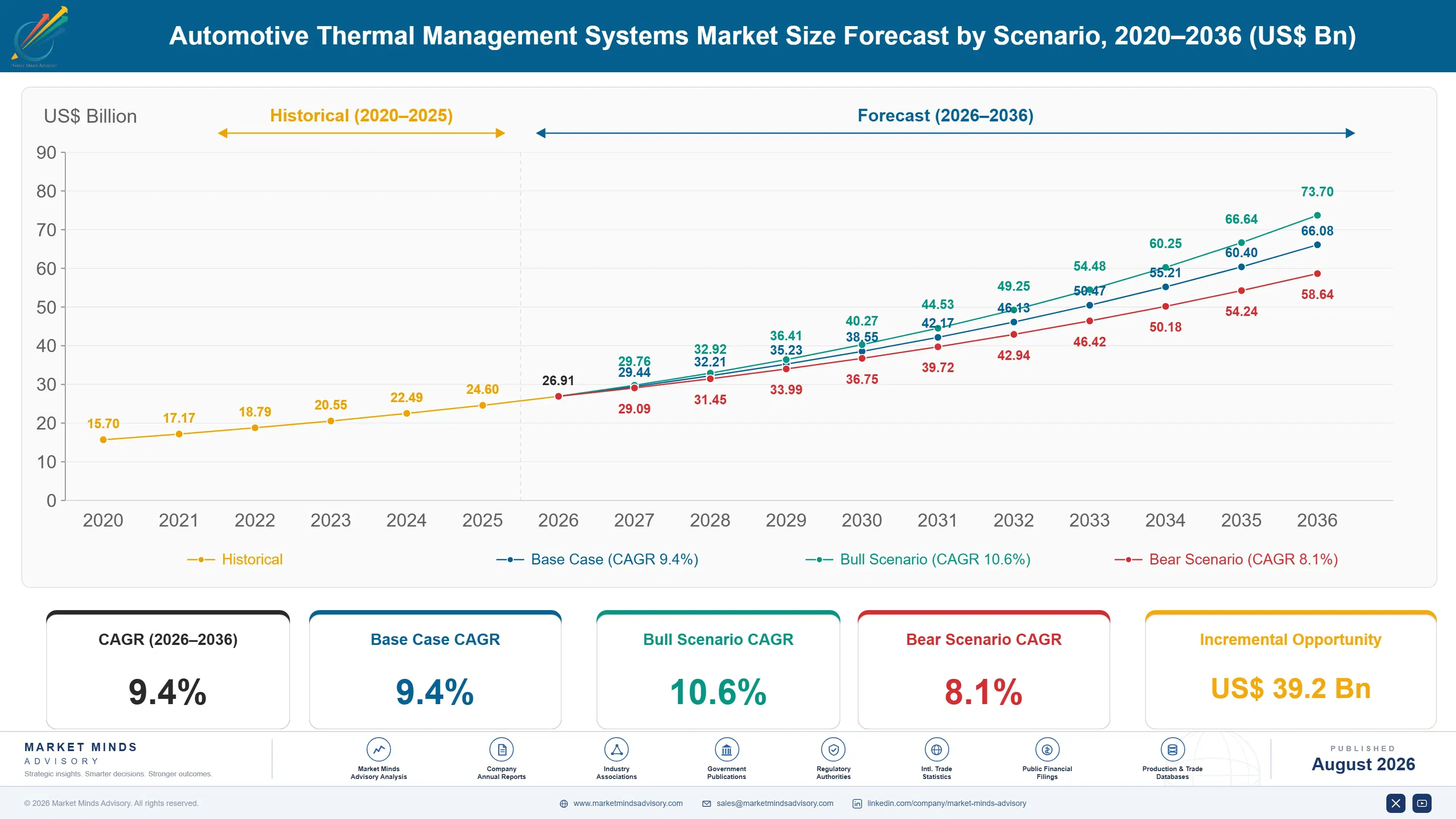
The market stands at USD 24.6 billion in 2025 and reaches USD 66.08 billion by 2036 at a 9.4% CAGR. Battery thermal management systems grow fastest at 17.5%, about 1.86 times the overall rate, as pack density rises and fast charging demands active cooling no combustion platform ever needed. East Asia holds 28% of value on Chinese electric vehicle production scale, while China posts the quickest national growth at 13.2% on battery output volume alone.
Concentration sits at moderate levels, with the top five suppliers holding roughly 44% of revenue against a long tail of regional specialists and battery-cooling entrants that barely existed a decade ago. Two forces reshape the field now. Heat pump adoption spreads fast because it recovers winter range that resistive heating simply burns away, and power electronics cooling has become its own discipline as chargers generate thermal loads no combustion architecture carried.
Market Definition
The automotive thermal management systems market covers engineered systems that regulate temperature across internal combustion, hybrid, and electric vehicle platforms, spanning battery cooling, power electronics and e-motor cooling, cabin HVAC and heat pump systems, engine and powertrain cooling, and transmission cooling. Aftermarket coolant fluids, standalone air conditioning refrigerant sales, and stationary battery thermal systems are excluded.
Base Year Value
$24.6B in 2025 (MMA Primary Research Dataset, August 2026)
Forecast Period
2026 to 2036, eleven discrete annual values
CAGR
9.4% base case. Bull 10.6%. Bear 8.1%.
Fastest Growth Segment
Battery Thermal Management Systems: 17.5% CAGR
Fastest Growth Country
China: 13.2% CAGR
Fastest Growth Region
South Asia and Pacific: 11.4% CAGR
Largest Region
East Asia: 28% of 2025 global value
Market Leaders
Denso Corporation, Hanon Systems, MAHLE GmbH, Valeo, BorgWarner. Source: MMA Analysis based on company annual reports.
Primary Survey
n=3,800 procurement and R&D decision-makers, Q4 2025, six countries
Methodology
Demand-side build-up, cross-validated against public data, 47 expert interviews

Automotive Thermal Management Systems Market Forecast Scenarios

automotive-thermal-management-systems-market-size-forecast-scenario-1787324706279
Growth from 2020 to 2025 compounded near 8.4%, carried almost entirely by accelerating electric vehicle output rather than any meaningful combustion segment recovery at all. Battery cooling demand scaled with every new EV platform launched worldwide, while HVAC and engine cooling volumes tracked conventional vehicle production far more slowly across the same five years of the period.
Three mechanisms carry the base case to 9.4%. First, battery pack density keeps rising, and denser cells reject more heat per litre, so every new platform generation needs a more capable cooling loop than the one it replaces. Second, fast charging adoption spreads, and charging at high current without active thermal control degrades cell life measurably over repeated cycles. Third, heat pump penetration climbs as automakers chase real-world winter range, which resistive cabin heating simply cannot deliver at comparable efficiency.
The bull case at 10.6% assumes heat pump adoption becomes standard across mainstream electric platforms and fast charging networks expand faster than current infrastructure plans suggest across major markets. The bear case at 8.1% assumes electric vehicle production growth slows in key markets and automakers defer thermal system upgrades by tolerating shorter charging cycles and reduced winter range instead.

Why Battery Cooling Now Drives Platform Engineering Budgets

Three converging forces set demand now. Electric vehicle output keeps rising, and every new platform needs a battery cooling loop no combustion architecture ever required. Fast charging networks expand steadily, and current delivered at that rate degrades an unmanaged cell pack quickly enough to worry every warranty department. And cold-climate range anxiety pushes automakers toward heat pumps that recover energy resistive heating wastes outright, a design choice buyers increasingly compare acro
MARKET CONCENTRATIONCR5: 44%Moderately fragmented supply base across global thermal system integrators
AVERAGE SELLING PRICEUSD 380 to 620 per vehicle setBlended thermal system price across combustion and electric platforms
TOP PRODUCING COUNTRY SHAREChina: 34% of global unit outputChinese component manufacturing scale supplying both domestic and export demand
CAPACITY UTILISATION78 to 86%Plant utilisation across battery cooling component production lines
FEEDSTOCK COST SHAREAluminum and refrigerant: 34 to 42%Aluminum extrusion and refrigerant costs dominate component manufacturing expense
REPLACEMENT CYCLE LENGTHVehicle lifetime: 12 to 15 yearsThermal systems rarely replaced outside major collision or warranty repair
The commercial character splits along platform type almost entirely. Combustion and hybrid programmes still buy conventional engine and cabin cooling on long-standing supplier relationships and thin single-digit margins that rarely move. Electric programmes buy integrated thermal architecture instead, bundling battery, cabin, and power electronics cooling into one system sourced from a supplier capable of software-controlled loop management, not merely hardware assembly. That distinction now decides which suppliers win platform-level contracts.
The next decade turns on integration and regulation together. Suppliers that combine battery, HVAC, and power electronics cooling into a single controlled loop capture more content per vehicle than those selling separate components ever could. Refrigerant regulation is forcing a parallel transition toward low global warming potential fluids across every major market at roughly the same pace.
"Everyone talks about the battery pack and forgets the loop around it. A cell chemistry breakthrough is useless if the cooling system cannot hold temperature under fast charging, and that is precisely where several credible platforms have quietly missed their range targets."
Director, Automotive Electrification and Thermal Systems Practice · MMA Automoti

Market Trends

Refrigerant Regulation Forces A Low-GWP Fluid Transition

The European F-Gas Regulation and equivalent programmes in China and several American states are phasing down high global warming potential refrigerants across new vehicle platforms on fixed compliance timelines. R1234yf has become the default replacement for R134a across most passenger platforms, and CO2-based R744 systems are gaining ground in premium and cold-climate applications where heat pump efficiency matters most. The transition forces a parallel redesign of compressors, valves, and heat exchangers rather than a simple fluid swap, and suppliers without qualified low-GWP systems risk exclusion from new platform sourcing decisions entirely across every major regulated market simultaneously.
Market Impact: Content rises 40% versus early EVs
Battery, Cabin, And Power Electronics Cooling Converge Onto One Loop

Automakers increasingly specify a single integrated thermal domain covering battery, cabin HVAC, and power electronics cooling rather than three separately sourced systems, because shared coolant loops and heat pump waste-heat recovery cut both mass and energy consumption meaningfully. Tesla's octovalve architecture demonstrated the commercial case publicly, and several other automakers have since specified comparable integrated valve systems on new platforms. Suppliers that can deliver validated integrated architecture win platform-level sourcing rather than component-level contracts, capturing considerably more content per vehicle than a single-component supplier ever could under the previous sourcing structure.
Market Impact: Fast chargers now exceed 350 kW

Market Opportunities and Growth Drivers

Rising Battery Pack Density Demands Active Cooling Everywhere

Energy density in mass-market battery packs has climbed steadily as cell chemistry and pack engineering both improve, and denser packs reject proportionally more heat per litre of enclosed volume during normal operation. Passive or minimally-active cooling that sufficed on early, lower-density electric platforms cannot hold cells within their safe temperature window under sustained fast charging today. Every mainstream automaker now specifies liquid cooling plates with active pumps and, increasingly, dedicated chillers rather than the simpler designs earlier platforms used. That escalation raises system content and average selling price per vehicle across the entire electric segment worldwide.
Market Impact: Requalification adds 12 to 18 month

Fast Charging Network Expansion Demands Thermal Load Management

Public fast charging networks across North America, Europe, and China have expanded past 350 kilowatt capability at leading sites, and charging at that current without active thermal control degrades cell life measurably within a small number of cycles. Automakers now design battery cooling systems around sustained high-current charging rather than only driving load, since customers judge a vehicle partly on how fast it can actually charge. Charging network operators including Tesla, Ionity, and Electrify America continue adding high-power sites, and every additional site raises the thermal performance bar the next vehicle generation must clear.
Market Impact: Annual cost-down runs 3 to 5%

Market Restraints and Challenges

Refrigerant Transition Raises System Cost And Validation Burden

Switching from established R134a systems to R1234yf or CO2-based R744 architecture requires new compressors, seals, and heat exchangers because the fluids behave differently under pressure and temperature. The root cause is that decades of R134a engineering knowledge do not transfer cleanly, so every supplier must revalidate performance and safety from close to first principles. Commercially this raises development cost and can delay platform launches when qualification runs long. Suppliers are mitigating the burden through shared component platforms across multiple automaker customers and by front-loading CO2 system development for premium platforms where the cost is easier to absorb into pricing.
Market Impact: Compliance covers 90% of new platfo

OEM Cost-Down Programmes Compress Thermal Supplier Margins

Automakers run annual cost-down negotiations across every purchased system, and thermal management has historically been treated as a mature, negotiable commodity category rather than a differentiated one. The root cause is that many buyers have not yet adjusted sourcing practice to reflect how much engineering content integrated electric thermal systems now carry relative to older combustion-era designs. Commercially this squeezes margin precisely as suppliers must fund heat pump and integration development. Suppliers are mitigating exposure by shifting the commercial conversation toward system-level contracts and by pricing software-controlled features separately from the underlying hardware components.
Market Impact: Integrated loops cut mass 15%
4 additional market trends, 3 additional growth drivers, and 2 additional restraints and challenges are covered in the full report. Contact sales@marketmindsadvisory.com to access the complete intelligence.

Segment CAGR and Growth Architecture

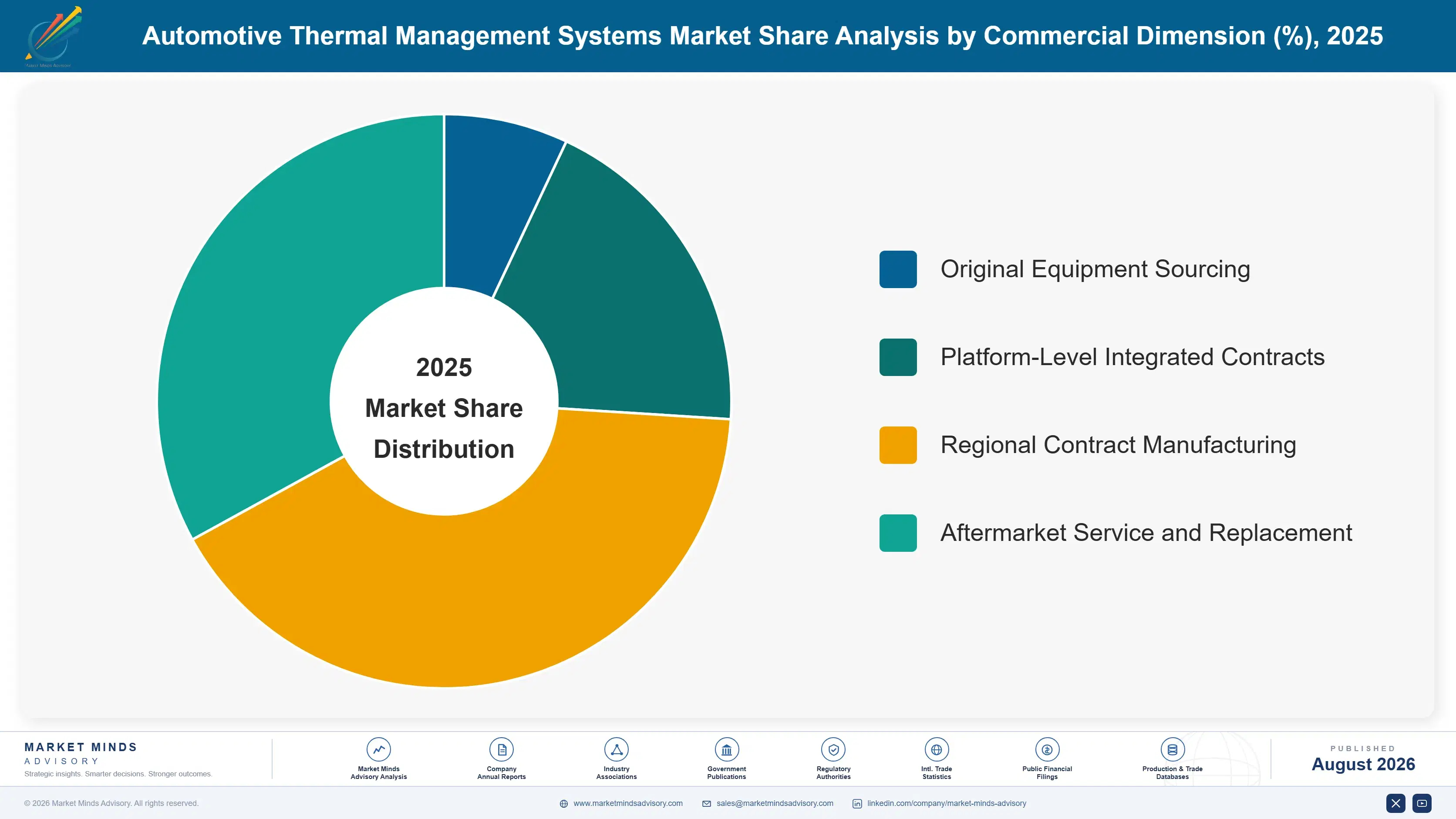
Segmentation follows system technology, a single engineering logic describing what a thermal system cools and how. Each technology carries its own component set, integration complexity, and vehicle-platform relevance, so commercial position tracks the technology rather than the vehicle segment sold into. End-use vehicle type and distribution channel appear separately within the framework as distinct dimensions.
automotive-thermal-management-systems-market-market-share-analysis-1787324706883

Battery Thermal Management Systems

Battery thermal management systems grow fastest at 17.5%, about 1.86 times the overall 9.4% rate, covering liquid cooling plates, immersion cooling under early evaluation, dedicated chillers, and the valves and pumps that circulate coolant through the pack. Rising cell density and fast charging both push cooling requirements well past what early electric platforms specified, and every mainstream automaker now treats battery thermal design as a safety-critical engineering discipline rather than a supporting component. Suppliers with validated high-current thermal performance win platform sourcing years before production starts, since requalifying a battery cooling system mid-programme is far costlier than getting the specification right initially. Denso, Hanon Systems, and MAHLE hold the strongest current positions, though dedicated battery-cooling specialists are entering aggressively.
CAGR 17.5%

Heat Pump and Integrated Thermal Systems

Heat pump and integrated thermal systems grow second-fastest at 15.2%, combining cabin heating, battery preconditioning, and waste-heat recovery into one controlled architecture rather than three separately sourced systems bought independently. Cold-climate range loss from resistive heating alone can exceed 30% of usable range, and heat pumps cut that loss substantially by recovering waste heat from the motor and power electronics instead of generating heat from scratch. Tesla's octovalve architecture proved the commercial case publicly, and several other automakers have since specified comparable integrated valve systems on new platforms. Suppliers able to deliver validated integration win platform-level contracts carrying considerably more content per vehicle than any single-component supplier could ever capture.
CAGR 15.2%
Full segment breakdown across 6 segments available in the complete report.

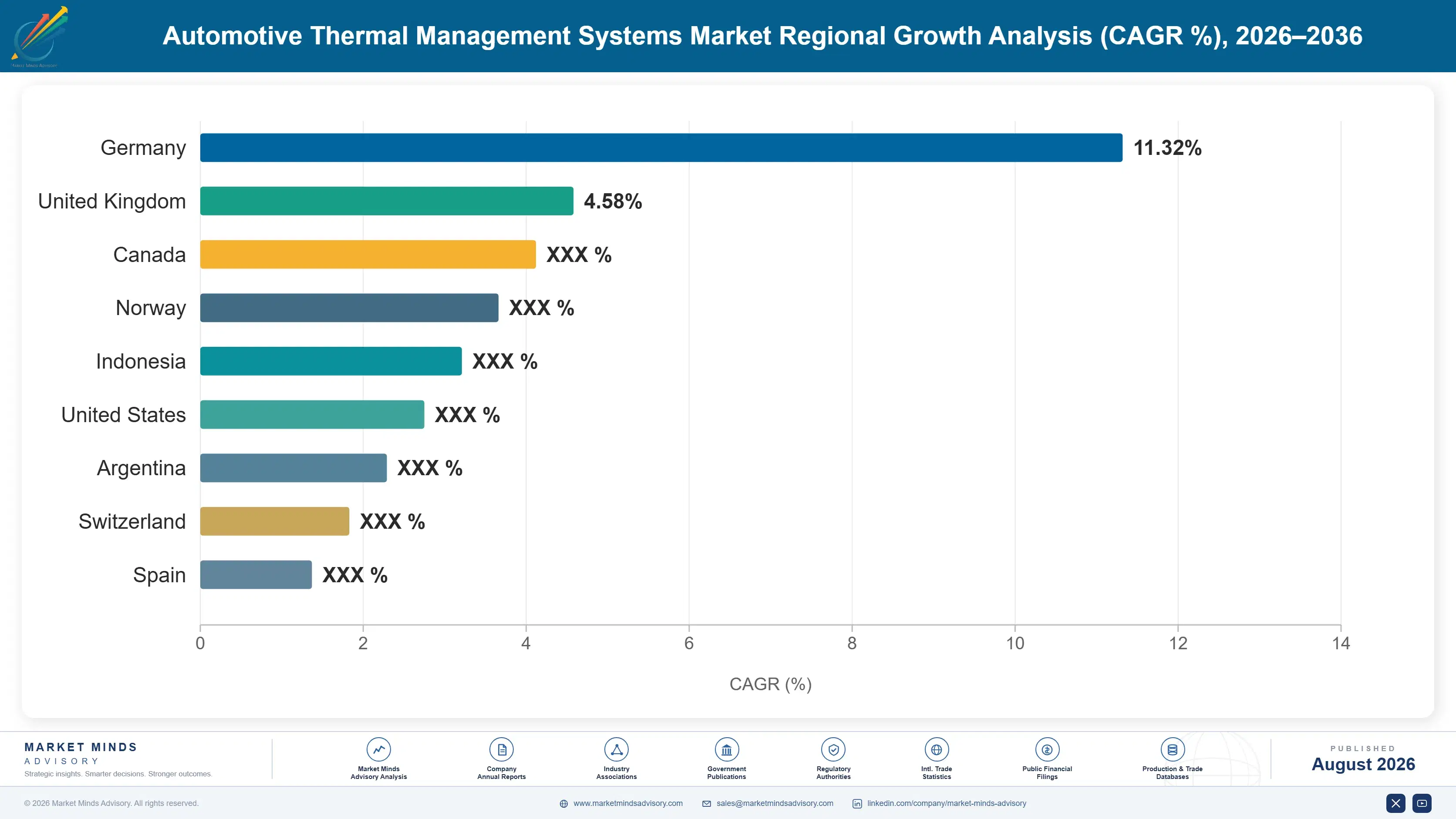
Regional Architecture and Country Demand Map

Electric vehicle production location, not vehicle demand alone, sets this distribution almost entirely across the seven regions tracked here. East Asia and North America lead on manufacturing scale and platform launches, while share elsewhere tracks how quickly each region's assembly base electrifies and how policy shapes local sourcing content.

North America

North America holds 26% of value on domestic electric vehicle assembly scaling fast across new gigafactory-linked plants in the United States, Mexico, and Canada. Inflation Reduction Act sourcing requirements pushed automakers toward regional battery and component supply chains, pulling thermal system production closer to assembly plants than the prior import-heavy pattern allowed. Cold-climate demand across northern states and Canada makes heat pump adoption commercially urgent rather than optional, since resistive-only systems draw visible customer complaints during winter months. Fast charging network build-out under both public funding and private investment continues raising battery cooling performance requirements on every new platform. Growth of 9.6% tracks EV output expansion closely, and regional sourcing rules keep pulling supplier investment inward.
Share: 26% | CAGR: 9.6% (2026 to 2036)

Western Europe

Western Europe holds 22% of value, and the European Union's combustion phase-out timeline has pushed nearly every mainstream automaker to convert flagship platforms to electric architecture first here. F-Gas Regulation compliance deadlines force refrigerant transition earlier than almost anywhere else, and German, French, and Nordic suppliers have built genuine low-GWP system expertise as a result. Premium German automakers specify integrated heat pump architecture as standard rather than optional equipment, setting a technical bar the rest of the industry follows a generation later. Growth of 7.9%, the slowest of the seven regions, reflects a maturing electric vehicle base and a combustion segment declining faster than replacement volume can offset entirely. Regulatory deadlines rather than consumer pull now set the region's pace.
Share: 22% | CAGR: 7.9% (2026 to 2036)
Regional intelligence for 5 additional markets available in the complete report: East Asia, South Asia and Pacific, Latin America, Middle East and Africa, Eastern Europe. Contact sales@marketmindsadvisory.com.
automotive-thermal-management-systems-market-country-cagr-analysis-1787324707401

Where Thermal System Value Actually Concentrates

Selling a thermal component on price alone is a race integrated component manufacturers in China are already winning steadily. The four moves below shift value toward positions a routine cost-down negotiation cannot easily erode: integration depth across the whole vehicle, heat pump content, refrigerant compliance readiness, and software-controlled loop management sold as its own line.

Sell Integrated Domains, Not Individual Components

A supplier delivering a single validated loop covering battery, cabin, and power electronics cooling captures considerably more content per vehicle than one selling a cooling plate or compressor in isolation from everything else. Tesla's octovalve architecture demonstrated roughly 15% mass reduction against a comparable three-system design, and automakers have taken notice of the packaging and cost advantage genuinely available. Suppliers should invest in systems-integration engineering capability now, since platform-level sourcing decisions lock in years before production and a component-only supplier cannot bid for that larger contract once the architecture decision is already made elsewhere.
Market Impact: Integrated loops cut mass roughly 1

Prioritise Heat Pump Content Over Resistive Systems

Heat pumps recover waste heat from the motor and power electronics instead of generating cabin heat from scratch, cutting cold-climate range loss that resistive-only systems can push past 30% of usable range in freezing conditions. That gap is now a marketing and engineering priority automakers fund directly rather than treat as an optional upgrade line. Suppliers with validated heat pump architecture, particularly CO2-based systems performing well in extreme cold, win premium platform contracts that resistive-only competitors simply cannot bid for credibly. Development investment here compounds across every future cold-climate platform launch.
Market Impact: Resistive-only systems lose up to 3

Build Refrigerant Compliance Ahead Of Regulatory Deadlines

F-Gas Regulation and equivalent programmes phase down high global warming potential refrigerants on fixed timelines that do not move for a supplier still validating its low-GWP system. R1234yf and CO2-based R744 both require new compressors, seals, and heat exchangers rather than a simple fluid swap, and qualification can run 12 to 18 months even when the engineering team is fully staffed and funded. Suppliers who complete qualification ahead of deadlines win sourcing from automakers who cannot afford a compliance gap on a launch platform, while late movers get excluded from the shortlist entirely regardless of price competitiveness offered.
Market Impact: Requalification runs 12 to 18 month

Price Software-Controlled Loop Management Separately From Hardware

Modern thermal systems increasingly rely on software that dynamically allocates coolant flow between battery, cabin, and power electronics based on real-time conditions, and that software delivers measurable efficiency gains hardware alone cannot achieve. Treating it as a bundled hardware feature leaves meaningful margin on the table during annual cost-down negotiations that otherwise compress thermal system pricing by 3% to 5% every cycle. Suppliers who price control software and its ongoing update capability as a distinct line item protect margin that a pure hardware negotiation would otherwise erode steadily across the platform's production life.
Market Impact: Annual cost-down pressure runs 3% t

Who Controls the Margin Pool

Concentration sits at moderate levels: the top five hold roughly 44% of revenue, with combustion-era suppliers, battery-cooling entrants, and Chinese manufacturers competing on quite different terms. The gap between leaders and challengers is integration capability rather than manufacturing scale, which is widely distributed. All participants are assessed on one basis, revenue from thermal management systems supplied to original equipment vehicle manufacturers.
Competition runs along three lines. First, integration depth, since suppliers combining battery, cabin, and power electronics cooling into one loop win platform sourcing single-component suppliers cannot bid for at all. Second, refrigerant compliance readiness, where qualified low-GWP systems open doors a slow validation timeline closes entirely. Third, cost competitiveness against Chinese suppliers now credible on price and engineering quality alike.

Pressure is building from two directions. Chinese suppliers including Sanhua have scaled manufacturing capacity fast enough to win export contracts from automakers outside China, not only domestic ones. Meanwhile dedicated battery-cooling specialists with no combustion legacy are winning platform contracts established suppliers once assumed were theirs by default. Rankings should favour companies with genuine integration capability over those still selling components a platform decision can bypass.
automotive-thermal-management-systems-market-company-positioning-matrix-1787324707934

Competitive Moat and Risk Dimensions

DENSO CORPORATION

Moat: Platform-level integration and scale

Denso supplies integrated thermal systems to nearly every major automaker globally, giving it engineering relationships and validated platform experience competitors struggle to replicate quickly. Its scale across combustion, hybrid, and electric platforms lets it amortise refrigerant transition and heat pump development costs across a far larger production base than most rivals can match.
DENSO CORPORATION

Risk: Legacy combustion revenue exposure

A meaningful share of Denso's thermal revenue still comes from combustion-era engine cooling components facing steady decline as electrification advances across every major market. Chinese domestic suppliers now compete aggressively on price for standardised battery cooling components, pressuring margin on the newer business lines Denso needs to replace the declining combustion base.
HANON SYSTEMS

Moat: Battery cooling specialisation depth

Hanon Systems built its business specifically around thermal management rather than as one division among many, giving it deep specialisation in battery and integrated cabin systems that broader industrial suppliers often lack. Close engineering partnerships with Hyundai and other automakers on early electric platforms gave it validated experience competitors are still acquiring.
HANON SYSTEMS

Risk: Customer concentration and scale gap

Hanon Systems carries meaningful revenue concentration with Hyundai and a small number of other anchor customers, leaving it more exposed than diversified rivals to any single automaker's platform decisions or production volume shifts. Its manufacturing scale trails the largest diversified suppliers, limiting cost absorption capacity during aggressive cost-down negotiation cycles.

Players Tracked

Prominent Players

Denso Corporation
Hanon Systems
MAHLE GmbH
Valeo
BorgWarner

Other Key Players

Modine Manufacturing
Sanden Holdings
Vitesco Technologies
Marelli Holdings
Gentherm
Dana Incorporated
Eberspacher Group
Subros Limited
T.RAD Co.
Rheinmetall Automotive
Johnson Electric
Boyd Corporation
Kendrion
Grayson Thermal Systems
Hutchinson SA

Recent Developments

MARCH 2025

Hanon Systems opens dedicated battery cooling plant in Hungary

Hanon Systems opened a new manufacturing facility in Hungary dedicated to battery cooling plates and integrated valve modules, expanding European capacity to serve automakers converting flagship platforms to electric architecture. This was an organic capacity expansion rather than any acquisition or joint venture, adding supply closer to major European plants.
Signal: Regional capacity investment tracks precis
SEPTEMBER 2024

Denso and refrigerant partner accelerate R744 validation

Denso entered a joint development agreement with a specialty refrigerant chemistry partner to accelerate qualification of CO2-based R744 systems for premium and cold-climate electric platforms. This was a joint development agreement rather than an acquisition or equity investment, targeting faster compliance timelines ahead of tightening F-Gas Regulation deadlines.
Signal: Refrigerant qualification timelines are be
JANUARY 2025

Sanhua expands export shipments of thermal modules to Europe

Chinese thermal system manufacturer Sanhua increased export shipments of integrated battery and cabin cooling modules to European automakers qualifying alternative suppliers outside traditional Japanese and German sourcing. This was organic export volume growth rather than any acquisition or merger, reflecting an improved qualification track record.
Signal: Chinese suppliers are increasingly winning

Aluminum, Refrigerant, And Compressor Cost Exposure

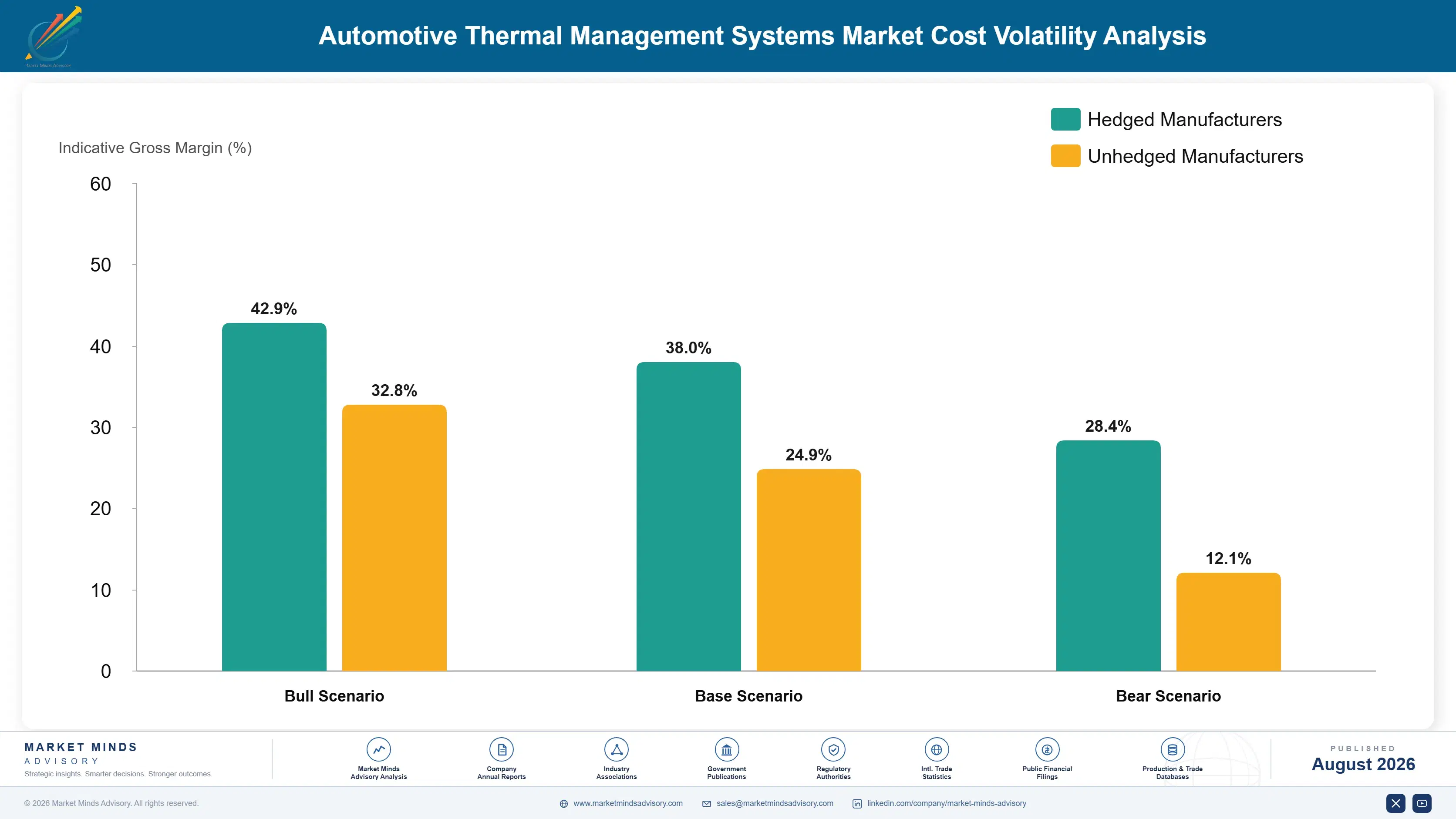
Aluminum extrusion and heat exchanger stock account for roughly 22% to 28% of component cost, sourced mainly from smelters in China, the Gulf, and Canada. Refrigerant, particularly R1234yf and CO2-based R744, adds another 8% to 14% and carries its own supply concentration risk since only a handful of chemical producers hold qualified manufacturing capacity. Compressor and valve electronics make up most of the remainder.
Aluminum prices spiked sharply through 2021 and 2022 as automotive demand recovered from pandemic disruption while smelter capacity remained constrained by energy costs across Europe specifically. The London Metal Exchange recorded aluminum trading above USD 3,200 per tonne at the 2022 peak, well above the prior five-year average, and MAHLE's 2022 annual report cited raw material inflation as a direct margin pressure across its thermal systems division specifically.

Exposure separates sharply by hedging sophistication and customer contract structure. Large diversified suppliers negotiate index-linked pass-through clauses into automaker contracts, shifting volatility onto the buyer over time. Smaller regional suppliers, particularly Chinese domestic entrants competing hard on price, absorb more volatility directly since automakers award them contracts precisely because their quoted pricing appears fixed and predictable across the programme.
automotive-thermal-management-systems-market-cost-volatility-analysis-1787324708139

Negotiate index-linked pass-through clauses into automaker contracts

Fixed-price contracts leave the supplier absorbing every raw material swing alone, which is unsustainable across a multi-year platform production run lasting several years from launch to end of life. Index-linked clauses tied to published aluminum and refrigerant benchmarks shift that risk toward the buyer, who is better positioned to hedge across an entire vehicle programme's purchasing volume and supplier base.

Qualify a second refrigerant chemistry supplier per region

Refrigerant supply concentration among a handful of chemical producers creates genuine single-source risk exactly when compliance deadlines leave no room whatsoever for a supply interruption during a critical launch window. Qualifying a second supplier per major region, even at modestly higher cost, protects production continuity through the refrigerant transition period specifically and beyond it.

Shift aluminum procurement toward long-term smelter contracts

Spot market aluminum purchasing exposed suppliers fully to the 2021 and 2022 price spike with no protection whatsoever against the sudden swing. Long-term smelter supply contracts with defined volume commitments smooth exposure across price cycles and give suppliers planning certainty that spot purchasing simply cannot provide during a genuine market disruption of that scale.

Portfolio Architecture for Margin Defence

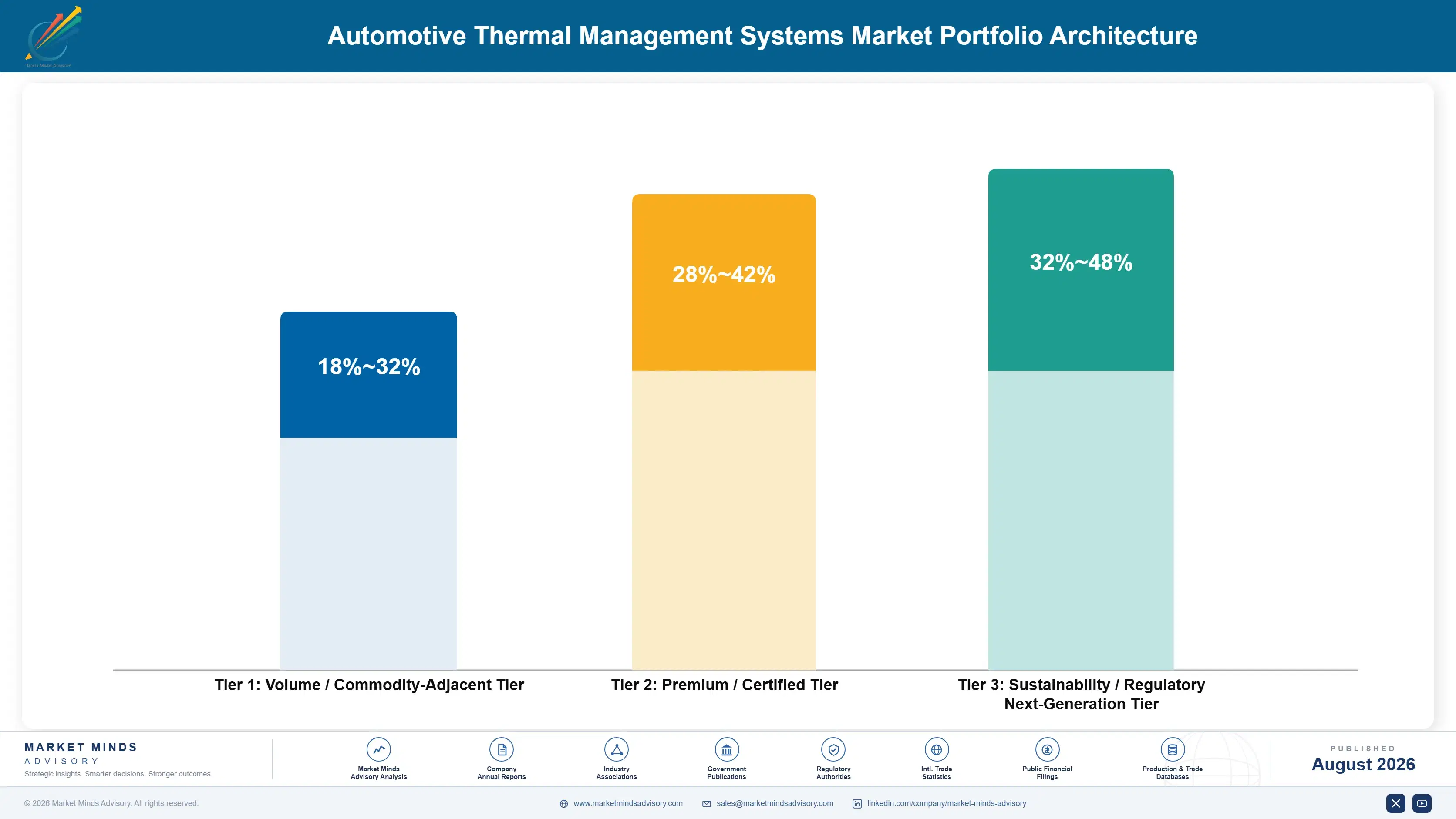
The portfolio splits into three tiers with distinct economics. Conventional engine and HVAC cooling for combustion and hybrid platforms forms the volume tier, priced through annual cost-down cycles that leave thin, closely benchmarked margin across every qualified supplier. Certified battery cooling systems validated for specific electric platforms earn considerably more, since qualification barriers and safety criticality both resist pure price negotiation between buyer and supplier throughout
Tension runs between the combustion base funding today's operations and the electric platform investment that will eventually replace it entirely. A supplier defending combustion volume too aggressively under-invests in the integration and heat pump engineering electric platforms actually demand from every credible bidder now. Yet abandoning combustion revenue too early starves the cash flow that funds the very transition a supplier needs simply to survive the decade ahead.

High-value pools concentrate where qualification barriers or integration complexity limit competition meaningfully: battery thermal systems on premium electric platforms, CO2-based heat pump architecture for cold-climate markets, and software-controlled loop management sold as a distinct capability rather than a bundled extra. Commodity engine cooling for mature combustion platforms sits at the other end, competing purely on manufacturing cost against every qualified regional producer worldwide.

Volume / Commodity-Adjacent Tier

Conventional engine, transmission, and HVAC cooling for combustion and hybrid platforms, priced through annual automaker cost-down negotiation with thin, closely benchmarked margin across every qualified regional supplier competing for the same renewal contract.
Gross Margin: 18-32%

Premium / Certified Tier

Certified battery and power electronics cooling systems validated for specific electric platforms, where qualification barriers and safety criticality both resist pure price negotiation between supplier and automaker buyer across the programme's full production run.
Gross Margin: 28-42%

Sustainability / Regulatory / Next-Generation Tier

Heat pump architecture, CO2-based refrigerant systems, and software-controlled integrated loop management commanding premium pricing on platforms where cold-climate performance and regulatory compliance readiness genuinely differentiate one qualified bidder from another.
Gross Margin: 32-48%
automotive-thermal-management-systems-market-portfolio-architecture-1787324708644

High-value Sub-segments and Strategic Watch-out

Battery Thermal Management Systems

Battery thermal management on premium electric platforms, high-value and fastest-growing at 17.5%, where safety criticality and fast-charging performance both justify premium pricing well above conventional component margins across every qualified programme. Qualification barriers keep new entrants out for years, protecting incumbent margin considerably longer than a typical component category would.
Gross Margin: 30-46%

Heat Pump and Integrated Thermal Systems

Heat pump and integrated systems, high-value with strong growth at 15.2%, as cold-climate range performance becomes a genuine purchase decision factor rather than a secondary comfort feature buyers barely notice at all. Automakers increasingly specify heat pump content as standard equipment on flagship trims rather than an optional upgrade line.
Gross Margin: 28-42%

HVAC and Cabin Climate Systems

Conventional HVAC and cabin climate systems, the volume core across every platform type, growing steadily at 8.1% but priced through routine cost-down cycles that leave limited room for margin expansion over time. Scale and manufacturing efficiency, not differentiation, decide who wins this business consistently across every region.
Gross Margin: 18-28%

Engine and Powertrain Cooling Systems

Engine and powertrain cooling for combustion platforms, the strategic watch-out, growing just 3.2% and steadily shrinking as electrification advances across every major market region. Volume persists mainly where combustion platforms remain in active production, a base that keeps narrowing year over year regardless of regional policy pace.
Gross Margin: 14-24%

How Thermal Content Accumulates Per Platform

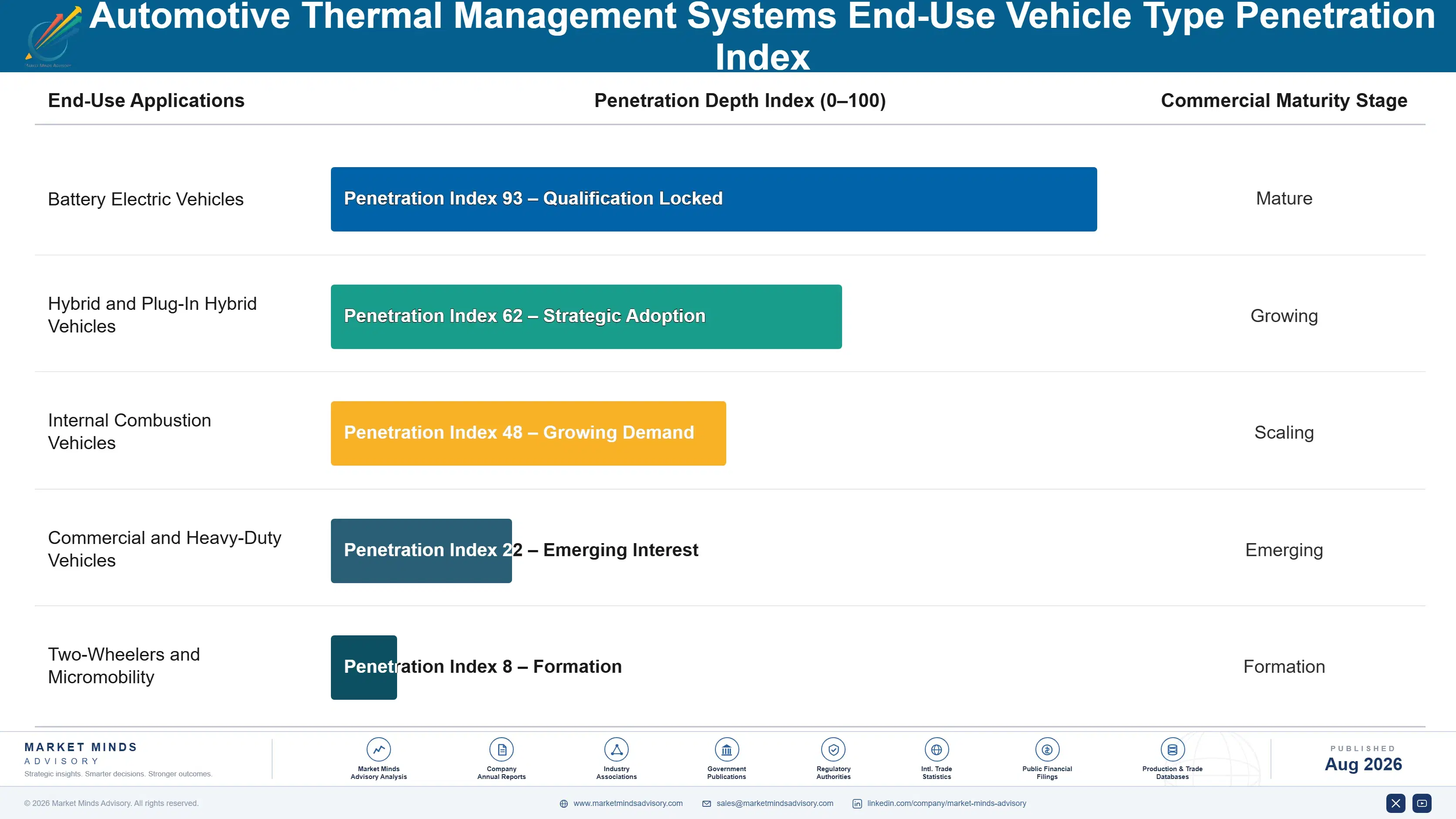
Revenue depends on platform-level design wins rather than repeat transactional sales, and a single sourcing decision locks in years of production volume across an entire vehicle generation before another bid is even possible. A supplier winning integrated thermal architecture on a platform captures that content for the platform's full production life, typically five to seven years, while losing a design win means zero revenue from that programme entirely for its whole run.
Adoption depth varies sharply by vehicle segment. Premium electric platforms adopt full integration, heat pumps, and CO2 refrigerant first, since buyers there both notice and pay for winter range performance directly at purchase. Mainstream electric platforms follow with a meaningful lag as component costs fall enough to justify the upgrade. Combustion and hybrid platforms retain conventional architecture largely unchanged, since the underlying engineering has not shifted meaningfully in decades.

Buyer profiles have shifted from pure component procurement teams toward platform engineering organisations that specify integrated thermal architecture at the vehicle-design stage rather than after major decisions are locked. Younger engineering leadership increasingly treats thermal management as a differentiating system rather than a supporting commodity, favouring suppliers with genuine integration and software capability over pure component manufacturers on price.
automotive-thermal-management-systems-market-end-use-penetration-index-1787324709142

Our Read On Vehicle Thermal Systems

These are among the four positions where our research anticipates prominent divergence between winners and laggards over the coming forecast period. Each is grounded in the demand model, the regulatory perimeter, and the announced capacity pipeline.
01 / INTEGRATION WINS SOURCING

Single-loop architecture beats separately sourced components

Suppliers combining battery, cabin, and power electronics cooling into one validated loop win platform-level sourcing decisions that a single-component bid simply cannot compete for anymore in this category. Tesla's octovalve architecture proved the commercial case publicly, cutting system mass by roughly 15% against a comparable three-system design that most rivals were still selling at the time. Suppliers should invest in systems-integration engineering now, because architecture decisions lock in years before production and a component-only bidder never gets a second chance at that contract.
02 / HEAT PUMPS TURN STANDARD

Resistive-only cabin heating is losing every winter comparison

Cold-climate range loss from resistive heating alone can exceed 30% of usable range, a gap customers now notice and compare directly across competing electric models before ever signing a purchase order. Heat pumps recover waste heat from the motor and power electronics instead of generating it from nothing, and automakers increasingly specify them as standard equipment rather than an optional upgrade line. Suppliers without validated heat pump architecture should expect exclusion from premium and cold-climate platform shortlists within a few product cycles.
03 / REFRIGERANT DEADLINES ARE FIXED

Compliance timing now decides who gets shortlisted at all

F-Gas Regulation and equivalent programmes phase down high global warming potential refrigerants on fixed timelines that do not move for a supplier still validating its low-GWP system after the deadline passes. Requalification runs 12 to 18 months even when fully staffed, and automakers cannot risk a compliance gap on a launch platform under any circumstances. Suppliers should complete qualification well ahead of deadlines, since late movers get excluded from sourcing shortlists entirely regardless of price competitiveness offered elsewhere in the bid.
04 / CHINESE SUPPLIERS COMPETE CREDIBLY

Price advantage alone no longer explains Chinese export wins

Chinese suppliers including Sanhua have scaled manufacturing capacity fast enough to win export qualification from European and other automakers evaluating credible alternatives to traditional Japanese and German sourcing relationships that once dominated the category entirely. That shift reflects improving engineering quality and a validated track record, not merely lower unit pricing as it did a decade earlier in the category's history. Established suppliers should treat this as a genuine competitive threat requiring real technical differentiation, not a pricing problem discounting alone can solve credibly.

Engagement Snapshot From the Field

A live engagement with an industry participant carrying material or product regulatory and market exposure ahead of a defining policy shift, showing how our research translates into a defensible multi-year portfolio strategy.
MARKET MINDS ADVISORY · CLIENT ENGAGEMENT SUMMARY
Automotive Thermal Management Systems Producer Strategic Portfolio Review and Transition Roadmap 2026·Investment Scenario on Automotive Thermal Management Systems Exposure Evaluation 2025-26
CLIENT PROFILE
A tier-one automotive component supplier with an established combustion cooling business engaged MMA as its largest automaker customer began sourcing decisions for a new electric platform generation. The client reported thermal systems revenue near USD 640 million, with roughly 78% still tied to combustion and hybrid programmes facing gradual decline, and no validated battery cooling product in its current portfolio (client-reported, unverified by MMA).
STRATEGIC CHALLENGE
Engineering leadership had proposed a conventional component-level bid for the new platform's battery cooling business, competing on unit price against both established rivals and newer battery-cooling specialists. Commercial leadership worried the bid would lose regardless of price, since the automaker's request explicitly asked for integrated architecture spanning battery, cabin, and power electronics cooling together as one contract.
MMA APPROACH
MMA benchmarked the client's engineering capability against integration requirements the automaker's request actually specified, rather than against the component-level bid leadership had already drafted internally. We modelled revenue and margin outcomes under both a component-only bid and a full integrated-architecture bid requiring a software-controlled valve system the client did not yet have validated in-house.
KEY FINDINGS
  1. A component-only bid carried an estimated 15% win probability against two established rivals already offering fully integrated architecture on directly comparable electric platforms nearing production.
  2. Developing validated integrated architecture internally required roughly fourteen months and USD 22 million in dedicated engineering investment across valve, control software, and testing (client-reported, unverified by MMA).
  3. Winning the integrated contract would roughly triple thermal systems revenue per vehicle against the client's existing component-level pricing structure on comparable combustion platforms today.
  4. Two rival bidders lacked CO2-based refrigerant qualification, an emerging automaker requirement the client could plausibly deliver faster given its existing chemistry engineering capability in-house.
CLIENT PROFILE
A tier-one automotive component supplier with an established combustion cooling business engaged MMA as its largest automaker customer began sourcing decisions for a new electric platform generation. The client reported thermal systems revenue near USD 640 million, with roughly 78% still tied to combustion and hybrid programmes facing gradual decline, and no validated battery cooling product in its current portfolio (client-reported, unverified by MMA).
STRATEGIC CHALLENGE
Engineering leadership had proposed a conventional component-level bid for the new platform's battery cooling business, competing on unit price against both established rivals and newer battery-cooling specialists. Commercial leadership worried the bid would lose regardless of price, since the automaker's request explicitly asked for integrated architecture spanning battery, cabin, and power electronics cooling together as one contract.
MMA APPROACH
MMA benchmarked the client's engineering capability against integration requirements the automaker's request actually specified, rather than against the component-level bid leadership had already drafted internally. We modelled revenue and margin outcomes under both a component-only bid and a full integrated-architecture bid requiring a software-controlled valve system the client did not yet have validated in-house.
KEY FINDINGS
  1. A component-only bid carried an estimated 15% win probability against two established rivals already offering fully integrated architecture on directly comparable electric platforms nearing production.
  2. Developing validated integrated architecture internally required roughly fourteen months and USD 22 million in dedicated engineering investment across valve, control software, and testing (client-reported, unverified by MMA).
  3. Winning the integrated contract would roughly triple thermal systems revenue per vehicle against the client's existing component-level pricing structure on comparable combustion platforms today.
  4. Two rival bidders lacked CO2-based refrigerant qualification, an emerging automaker requirement the client could plausibly deliver faster given its existing chemistry engineering capability in-house.
RECOMMENDED STRATEGY
Phase 1: Phase 1 (0 to 4 months): Redirect the bid toward integrated architecture and begin software-controlled valve system development immediately across the engineering organisation. Phase 2: Phase 2 (4 to 14 months): Complete CO2 refrigerant qualification ahead of both rival bidders to differentiate decisively on compliance readiness and timing. Phase 3: Phase 3 (14 to 20 months): Submit the integrated bid emphasising validated compliance timing rather than competing purely on unit price alone.
OUTCOME
The client redirected its bid toward integrated architecture and won the platform contract, securing thermal systems content the board estimated at roughly triple prior per-vehicle revenue across the programme's production life. CO2 refrigerant qualification, completed ahead of both rival bidders, proved decisive in the automaker's final sourcing decision (client-reported, unverified by MMA).

Frequently Asked Questions

Foundational context covering the market sizes, CAGR, scope, country, region and competition that inform every finding below. This section is provided to cover basics and most often pre-purchase conversations, answered from the MMA Primary Research Dataset.

What is the current size of the Automotive Thermal Management Systems Market?

The global automotive thermal management systems market is valued at USD 24.6 billion in 2025, covering battery, cabin, and power electronics cooling across combustion and electric platforms. Aftermarket coolant sales are excluded from this figure.

How large will the Automotive Thermal Management Systems Market be by 2036?

The market is forecast to reach USD 66.08 billion by 2036 in the base case, about 2.46 times the 2026 level. That represents incremental value of roughly USD 39.17 billion across the decade.

What is the CAGR for the Automotive Thermal Management Systems Market 2026 to 2036?

The market grows at a 9.4% CAGR in the base case, with bull and bear scenarios at 10.6% and 8.1%. The spread turns mainly on heat pump adoption pace and electric vehicle production growth.

Which segment is growing fastest?

Battery thermal management systems grow fastest at 17.5%, about 1.86 times the overall rate, as pack density rises and fast charging demands active cooling. Heat pump and integrated systems follow at 15.2%.

Who are the major companies in the Automotive Thermal Management Systems Market?

Leading companies include Denso Corporation, Hanon Systems, MAHLE GmbH, Valeo, and BorgWarner. Concentration is moderate, with the top five holding roughly 44% of revenue across a fragmented supplier base.

Which country is growing fastest?

China grows fastest at a 13.2% CAGR, as domestic electric vehicle output and battery manufacturing scale pull component production inward. India follows on expanding electric two-wheeler and four-wheeler assembly.

Report Segmentation Architecture

The full report scope spans multiple orthogonal segmentation dimensions, with cross-tabulated demand data provided for each dimension pair. Coverage extends further to regional breakdowns, trend trajectories, and the competitive detail needed to support segment-level decision-making.

By System Technology

  • Battery Thermal Management Systems
  • Heat Pump and Integrated Thermal Systems
  • Power Electronics and E-Motor Cooling
  • HVAC and Cabin Climate Systems
  • Engine and Powertrain Cooling Systems
  • Transmission and Driveline Cooling Systems

By End-Use Vehicle Type

  • Battery Electric Vehicles
  • Hybrid and Plug-In Hybrid Vehicles
  • Internal Combustion Vehicles
  • Commercial and Heavy-Duty Vehicles
  • Two-Wheelers and Micromobility

By Commercial Dimension

  • Original Equipment Sourcing
  • Platform-Level Integrated Contracts
  • Regional Contract Manufacturing
  • Aftermarket Service and Replacement

By Region

  • North America
  • Western Europe
  • East Asia
  • South Asia and Pacific
  • Latin America
  • Middle East and Africa
  • Eastern Europe

Scope, Methodology, and Coverage

Every figure in this report is reproducible from documented input assumptions. The scope below maps the historical period, the forecast horizon, the segmentation dimensions, and the countries covered, alongside the underlying primary and qualitative methodology.
Historical Period
2020 to 2025
Forecast Period
2026 to 2036
Base Year
2025 (USD billions; MMA Primary Research Dataset, August 2026)
Market Definition
The automotive thermal management systems market comprises engineered systems supplied to original equipment vehicle manufacturers that regulate temperature across battery packs, cabin climate, power electronics, e-motors, engines, and transmissions, valued at manufacturer net revenue. It spans battery cooling plates and chillers, heat pump and integrated valve architecture, power electronics and e-motor cooling, cabin HVAC systems, engine and powertrain cooling, and transmission cooling across combustion, hybrid, and electric platforms. Aftermarket coolant fluid sales, standalone refrigerant sales, and stationary battery thermal systems sold outside vehicle platforms are excluded.
Quantitative Units
USD billions (current prices); unit shipments where applicable
Segmentation Dimensions
By System Technology; By End-Use Vehicle Type; By Commercial Dimension; By Region
Regions Covered
North America, Western Europe, East Asia, South Asia and Pacific, Latin America, Middle East and Africa, Eastern Europe
Countries Covered
USA, China, Germany, France, UK, Japan, South Korea, India, Australia, Canada, Brazil, Mexico, Indonesia, Vietnam, Thailand, Malaysia, UAE, Saudi Arabia, South Africa, Nigeria, Turkey, Poland, Netherlands, Italy, Spain, Sweden, Switzerland, Argentina, Colombia, Singapore, and additional markets relevant to this sector
Key Companies Profiled
Denso Corporation, Hanon Systems, MAHLE GmbH, Valeo, BorgWarner, Modine Manufacturing, Sanden Holdings, Vitesco Technologies, Marelli Holdings, Gentherm, Dana Incorporated, Eberspacher Group, Subros Limited, T.RAD Co., Rheinmetall Automotive, Johnson Electric, Boyd Corporation, Kendrion, Grayson Thermal Systems, Hutchinson SA
Quantitative Methodology
Primary survey, n=3,800 respondents, Q4 2025, six countries; demand-side model with trade association cross-validation
Qualitative Methodology
47 expert interviews, Q4 2025; applied to validate demand model assumptions, identify emerging dynamics, and assess competitive positioning
Report Format
PDF and XLSX data workbook (Word format preview document)
Publisher
Market Minds Advisory
Report Code
MMA-2026-AUT-101
Published
August 2026
Contact
sales@marketmindsadvisory.com | www.marketmindsadvisory.com

Purchase the full Automotive Thermal Management Systems Market Report (2026 to 2036).

The full MMA Automotive Thermal Management Systems report sizes the market across six system technologies, five vehicle types, four commercial dimensions, and seven regions through 2036. It profiles 20 companies on a consistent revenue basis, scoring each on integration capability, refrigerant compliance readiness, and heat pump engineering depth. Scenario models quantify how electric vehicle production growth, fast charging network expansion, and refrigerant regulation timing move platform-level sourcing outcomes by supplier. The report also includes aluminum and refrigerant cost benchmarking, platform design-win analysis by vehicle segment, and regional manufacturing capacity assessment for commercial and engineering strategy teams.
Six-technology and four-channel market sizing to 2036
Twenty-company benchmark on consistent thermal revenue basis
Refrigerant compliance timeline tracking across major regulated markets
Platform design-win analysis by vehicle segment and region
Aluminum and refrigerant cost benchmarking against volatility events
Regional manufacturing capacity assessment for sourcing strategy teams

Built For The People Who Decide

From boardroom strategy to bench-side execution, this report is read cover-to-cover by leaders shaping the next decade of their industry, turning demand scenarios, market dynamics and valuation benchmarks into decisions.
CXOs/ Presidents/ VPs/ Managers
M&A and Corporate Development
Strategy Teams and R&D Heads
Procurement and Product Directors
Regulatory and Compliance Leaders
Investor Relations and Equity Analysts