
Market Minds Advisory
Automotive Smart Antenna Market

Automotive Smart Antenna Market: Automotive Smart Antenna Market. V2X Mandate Rollout and Multi-Band Integration

Automakers are consolidating five separate antenna functions into a single shark-fin module just as V2X connectivity mandates force a hardware refresh cycle, rewarding suppliers who mastered multi-band radio-frequency integration ahead of the broader industry transition.

Lead Analyst

David Horsley

Published

August 2026

Make Smarter Decisions with Customized Research Insights

Request a free sample report and evaluate market opportunities, growth trends, and competitive dynamics relevant to your business needs.

2025 MARKET VALUE$6.8BMarket Size 2025
2036 FORECAST VALUE$20.2BBase Case , 2026 to 2036
CAGR 2026 TO 203610.4 %Bull 11.8% / Bear 9.0%
INCREMENTAL OPPORTUNITY$12.7BNet 10- year value creation
EXPANSION MULTIPLE2.69x2036 value over 2026 base
Strategic Levers
M&A Pipeline
Regional Outlook
Country Rankings
Competitive Intelligence
Segmental Deep-dive
Call-Us : 91 93563 13602

Executive Snapshot and Market Trajectory.

V2X connectivity mandates are forcing automakers to replace single-function antenna hardware with integrated multi-band modules faster than most component roadmaps anticipated, compressing a planned decade-long transition into roughly half that span across major vehicle markets, a shift reshaping supplier engineering priorities and platform investment decisions.
5G and V2X connectivity antennas are pulling category growth fastest, as automakers integrate vehicle-to-everything communication into mainstream platforms ahead of regulatory deadlines. East Asia leads global demand on China's aggressive connected-vehicle mandate rollout and domestic antenna manufacturing base, while North America and Western Europe follow on established telematics platform adoption, with South Asia and Pacific expanding fastest as regional automakers introduce connectivity hardware across mid-tier vehicle segments previously limited to basic radio reception nationwide.
Competitive intensity concentrates among a mix of established radio-frequency specialists and telecom-adjacent component entrants, creating a meaningful leader-challenger gap shaped by radio-frequency engineering depth rather than manufacturing scale alone. Regulatory pressure around V2X standardization is intensifying across Europe and Asia, while specialty ceramic and radio-frequency chip cost volatility forces suppliers to defend margin through vertical integration and long-term semiconductor supply agreements spanning nearly every major OEM account worldwide.
Market Definition
The automotive smart antenna market covers integrated exterior and roof-mounted antenna hardware for vehicle communication, navigation, and broadcast reception, including shark-fin multi-band modules, 5G and V2X connectivity antennas, GNSS and GPS antennas, satellite radio antennas, and telematics control unit integrated antennas. It excludes infrastructure-side roadside communication units and non-automotive consumer electronics antennas.
Base Year Value
$6.8B in 2025 (MMA Primary Research Dataset, August 2026)
Forecast Period
2026 to 2036, eleven discrete annual values
CAGR
10.4% base case. Bull 11.8%. Bear 9.0%.
Fastest Growth Segment
5G and V2X Connectivity Antennas: 14.1% CAGR
Fastest Growth Country
China: 12.9% CAGR
Fastest Growth Region
South Asia and Pacific: 12.6% CAGR
Largest Region
East Asia: 30% of 2025 global value
Market Leaders
Laird Connectivity, Molex, TE Connectivity, Continental, Harada Industry. Source: MMA Analysis based on company annual reports.
Primary Survey
n=3,800 procurement and R&D decision-makers, Q4 2025, six countries
Methodology
Demand-side build-up, cross-validated against public data, 47 expert interviews

Automotive Smart Antenna Market Forecast Scenarios

automotive-smart-antenna-market-trends-size-forecast-scenario-1787466029285
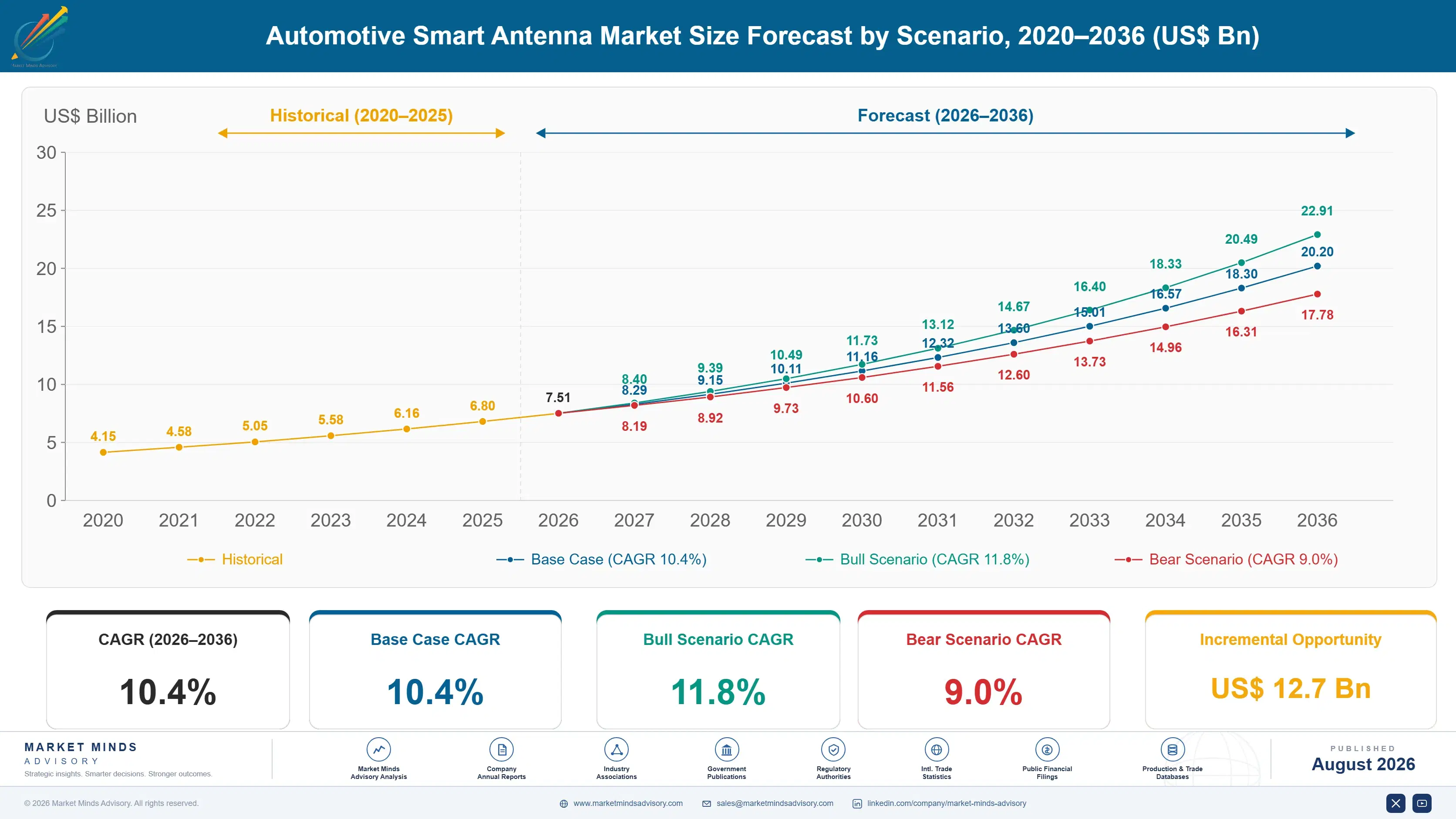
Between 2020 and 2025 the market grew at an estimated 9.2% historical CAGR, slowed early by pandemic-era vehicle production disruption and 2021 radio-frequency chip shortages tied to broader semiconductor supply chain volatility, before V2X mandate rollout and expanding East Asian vehicle production restored faster momentum through 2024 into 2025, a recovery pattern shared with other connectivity component categories.
The base case assumes 10.4% CAGR through 2036, driven by three mechanisms: continued substitution of single-function antenna hardware with integrated multi-band modules across North American and European vehicle platforms preparing for V2X mandates, rapid vehicle production expansion across China and India pulling connectivity hardware into mid-tier segments, and rising OEM demand for telematics-integrated antenna systems that simplify vehicle wiring architecture and reduce assembly complexity considerably, a dynamic playing out across nearly every major producing region.
The bull case, at 11.8%, hinges on faster V2X mandate enforcement across major Asian and North American vehicle markets currently still finalizing implementation timelines. The bear case, at 9.0%, reflects a scenario where radio-frequency chip cost volatility persists, forcing automakers to defer premium connectivity upgrades and slowing supplier revenue growth across mid-sized regional antenna houses unable to absorb sustained component cost pressure.

Multi-Band Integration and V2X Hardware Economics

Automotive smart antenna demand now converges around three forces: multi-band integration that favors consolidated hardware over discrete single-function antennas, vehicle production expansion across East Asia and South Asia pulling connectivity hardware into mid-tier platforms, and radio-frequency chip cost volatility that shapes pricing and supply continuity for every downstream automaker regardless of platform or region served. Suppliers that can guarantee multi-band radio-frequency performance and V2X certification at scale are capturing platform contracts fastest, while unstandardized commodity-grade suppliers face growing OEM disqualification risk.
CR5 CONCENTRATION52%top five suppliers hold meaningful but contestable category share
AVERAGE SELLING PRICEUSD 38/antenna unitmulti-band modules command materially higher blended pricing than single-function
TOP PRODUCING COUNTRY SHAREChina, 25%leads global antenna module manufacturing on connectivity mandate scale
CAPACITY UTILISATION74%reflects steady demand from expanding multi-band integration platform programs
TRADE INTENSITY41%cross-border module trade supports multinational vehicle assembly supply chains
FEEDSTOCK COST SHARE46%radio-frequency chips and specialty ceramic inputs dominate component cost
Commercially, the category behaves less like a passive hardware component and more like a systems integration service. Buyers pay for radio-frequency tuning, electromagnetic interference isolation, and connectivity certification support alongside the hardware itself, which is why leading suppliers embed radio-frequency engineering specialists directly inside major OEM telematics development programs across every major regional account.
Over the next decade, multi-band radio-frequency engineering, V2X protocol certification, and continued vehicle production expansion across emerging Asian and Latin American markets will determine which suppliers can defend margin as chip cost volatility squeezes producers already absorbing platform development expense, rewarding suppliers with diversified chip sourcing and radio-frequency engineering depth across every major regional connectivity program worldwide.
"A shark-fin used to hide one antenna. Now it hides five, and the supplier who can make all five play nicely together without interference wins the platform contract."
Director, Automotive Connectivity Hardware Practice · MMA Automotive Connectivity Hardware Practice · August 2026

Market Trends

Multi-Band Shark-Fin Modules Replace Discrete Antenna Hardware

Automakers have accelerated consolidation of GNSS, cellular, V2X, satellite radio, and Wi-Fi antenna functions into single shark-fin modules since 2023, as vehicle design teams push to reduce roof-mounted hardware footprint and simplify wiring architecture. More than a dozen major automakers introduced consolidated multi-band modules on volume-segment platforms since 2023, each requiring dedicated electromagnetic interference isolation testing before engineering teams commit to full-scale trim rollout. Suppliers offering pre-validated, platform-ready multi-band modules are capturing integration contracts fastest, while suppliers still limited to discrete single-function antennas face growing exclusion from platform requests for proposal entirely.
Market Impact: Shifts 29% of platform award volume
V2X Connectivity Mandates Force a Hardware Refresh Cycle

Regulators across major vehicle markets have begun mandating vehicle-to-everything communication capability on new platforms since 2024, forcing automakers to specify dedicated V2X antenna hardware on programs that previously relied on cellular connectivity alone for basic telematics functions. More than fifteen major platform programs added V2X-capable antenna hardware since 2024, pulling demand toward suppliers with dedicated V2X protocol certification capability rather than standard cellular antenna catalogs alone. This mandate-driven refresh is reshaping supplier selection criteria, favoring companies that pair protocol certification depth with manufacturing scale over those competing purely on unit cost.
Market Impact: Cuts wiring cost 22 percent

Market Opportunities and Growth Drivers

V2X Protocol Certification Requirements Tighten Across Major Markets

Regulators across Europe and Asia have introduced stricter V2X protocol certification requirements since 2024, with several major markets now mandating documented interoperability testing on new platform connectivity systems before market approval. This has compressed supplier qualification timelines from an industry-typical 14 months to under 7 for antenna suppliers seeking to retain platform volume ahead of program launch deadlines. Suppliers unable to meet accelerated qualification windows have lost platform volume to competitors carrying pre-validated V2X-certified systems, reshaping which antenna houses win platform award cycles across mainstream vehicle categories nationwide and internationally.
Market Impact: Raises input cost 19 to 28%

Multi-Band Consolidation Reduces Vehicle Wiring Complexity

Consolidating five discrete antenna functions into a single multi-band module has cut roof-mounted wiring harness complexity substantially, pulling automakers toward suppliers offering integrated systems even at a per-unit price premium over discrete hardware alternatives. Suppliers report wiring harness cost reductions of roughly 22% on platforms adopting consolidated multi-band modules since 2023, a shift that has pulled adoption down into compact and entry-level vehicle segments across China and India specifically. This consolidation trend is reshaping supplier volume economics, rewarding manufacturers with radio-frequency integration expertise over smaller regional houses still assembling discrete antenna components.
Market Impact: Adds 6 to 9-month delays

Market Restraints and Challenges

Radio-Frequency Chip and Specialty Ceramic Cost Volatility

Radio-frequency chips and specialty ceramic substrate inputs together represent the majority of antenna module manufacturing cost, and prices for both have swung sharply since 2021 amid broader semiconductor market disruption and competing consumer electronics demand for comparable chip production capacity. The root cause: antenna suppliers sit downstream of globally traded semiconductor markets with limited forward pricing visibility, leaving manufacturing cost exposed to macro shocks. This volatility compresses margin for suppliers on fixed-price multi-year OEM contracts unable to pass through sudden cost spikes. Some suppliers mitigate the exposure through vertical integration into chip design and diversified ceramic sourcing.
Market Impact: Adds 1.2 billion USD multi-band volume

Electromagnetic Interference Complexity Slows Multi-Band Development

Consolidating multiple radio functions into a single housing creates real engineering friction, since closely packed antenna elements generate electromagnetic interference that can degrade signal quality across all integrated functions simultaneously, a problem rooted in the fundamental physics of radio-frequency proximity within confined housing space. This creates genuine commercial friction for suppliers whose development timelines stretch well beyond initial engineering estimates as interference issues surface late in validation testing. Suppliers are mitigating the exposure through advanced simulation software and modular shielding architectures, though fully eliminating interference risk across every band combination remains difficult even for the most experienced radio-frequency engineering teams.
Market Impact: Adds 15 major V2X platform programs
3 additional market trends, 3 additional growth drivers, and 4 additional restraints and challenges are covered in the full report. Contact sales@marketmindsadvisory.com to access the complete intelligence.

Segment CAGR and Growth Architecture

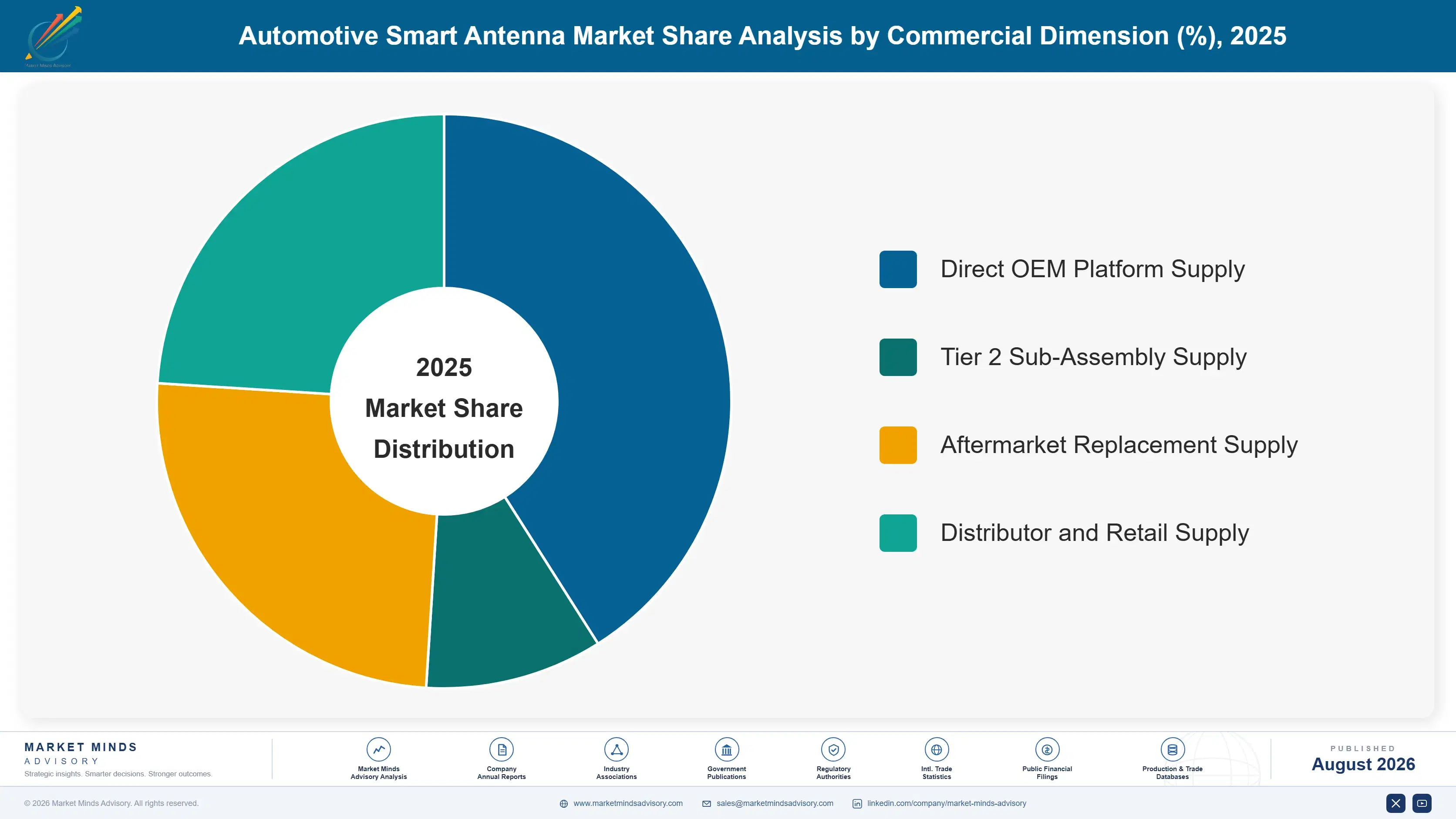
Segmentation follows antenna function and connectivity technology, the classification automakers and suppliers both use for procurement and radio-frequency qualification, spanning shark-fin multi-band modules, 5G and V2X antennas, GNSS antennas, satellite radio antennas, telematics integrated antennas, and aftermarket accessories across six categories shaping manufacturing specification requirements, rather than mixing product and application logic within a single hierarchy.
automotive-smart-antenna-market-trends-market-share-analysis-1787466029842

5G and V2X Connectivity Antennas

5G and V2X connectivity antennas represent the fastest-growing segment as automakers integrate vehicle-to-everything communication ahead of regulatory mandates spreading across major vehicle markets through the forecast period. Engineering complexity is substantial, since radio-frequency tuning varies meaningfully across vehicle geometry, band allocation, and regional spectrum regulatory requirements, requiring suppliers to maintain extensive radio-frequency design and certification capability tailored to individual OEM platform specifications. Suppliers with dedicated V2X protocol certification labs are capturing disproportionate platform contract share, commanding average selling prices well above standard cellular antennas. Demand concentrates among East Asian and North American platforms first, with adoption spreading rapidly into European and mid-tier Asian vehicle segments across nearly every major producing region worldwide.
CAGR 14.1%

Telematics Control Unit Integrated Antennas

Telematics control unit integrated antennas are expanding rapidly as automakers seek to simplify vehicle architecture by combining antenna hardware directly with telematics processing modules rather than routing separate cabling to a standalone control unit elsewhere in the vehicle. This segment overlaps functionally with multi-band shark-fin modules in connectivity function but is defined specifically by its physical and electronic integration with the telematics processor rather than antenna consolidation alone, since buyers select suppliers on measurable integration depth rather than radio-frequency performance alone. Suppliers with dedicated systems integration capability have captured contracts fastest, giving early movers a multi-year advantage. Growth is fastest in China and North America, where telematics platform investment concentrates most heavily.
CAGR 12.6%
Full segment breakdown across 6 segments available in the complete report.

Regional Architecture and Country Demand Map

East Asia leads global consumption on China's aggressive connected-vehicle mandate rollout and domestic antenna manufacturing base, followed by North America and Western Europe on established telematics platform adoption, with South Asia and Pacific expanding fastest as regional automakers add connectivity hardware across every mid-tier segment nationwide.

North America

United States vehicle manufacturers drive the bulk of regional demand, with major automakers standardizing multi-band connectivity modules on volume trims ahead of anticipated federal V2X coordination requirements expected to phase in over the coming years. Canada's smaller but steadily growing antenna component sector mirrors United States platform trends closely, with a modest adoption lag behind flagship automakers. Tier 1 suppliers account for a rising share of platform integration activity as automakers push supplier scorecards down through their supply chains, compressing qualification timelines and rewarding suppliers carrying pre-validated multi-band systems over those still dependent on discrete antenna architecture. Fleet and commercial vehicle sourcing has lagged passenger platform adoption given tighter cost sensitivity across that buyer segment nationwide.
Share: 23% | CAGR: 9.8% (2026 to 2036)

Western Europe

Germany and France anchor regional demand through well-established automotive connectivity sectors that pioneered early V2X pilot programs years before most global markets, giving regional suppliers deep radio-frequency engineering expertise other markets are only now developing. The United Kingdom's automotive sector continues expanding premium connectivity programs targeting telematics-conscious automakers willing to pay for documented interoperability performance. Nordic markets show disproportionate demand for satellite-integrated systems tied to sparse cellular network coverage across remote driving regions. Supplier qualification cycles in the region run longer than in North America given stricter European Union spectrum and interoperability certification requirements for novel connectivity claims, favoring established suppliers with deep regulatory affairs experience across every major national market.
Share: 19% | CAGR: 8.7% (2026 to 2036)
Regional intelligence for 5 additional markets available in the complete report: East Asia, South Asia and Pacific, Latin America, Middle East and Africa, Eastern Europe. Contact sales@marketmindsadvisory.com.
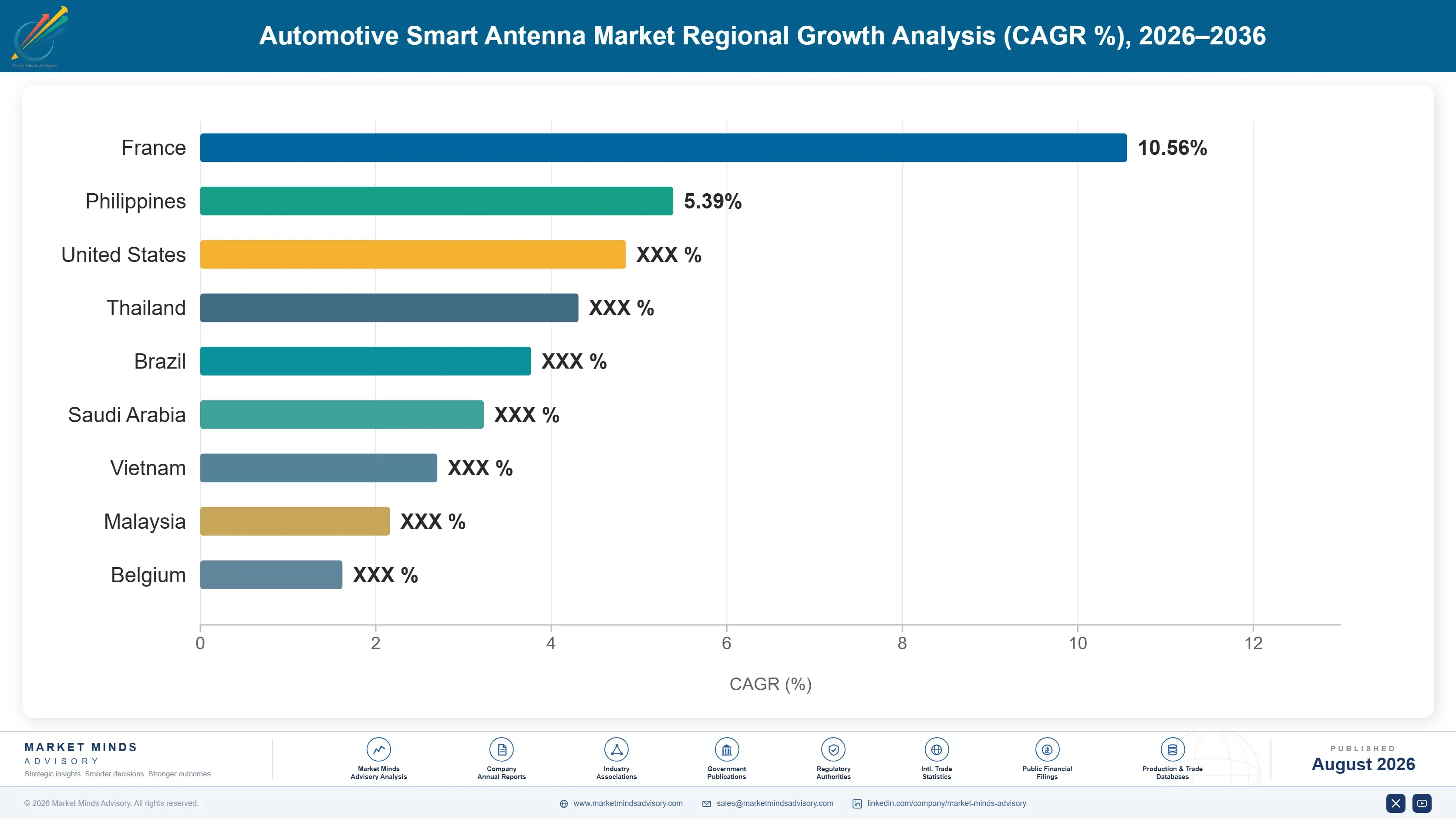
automotive-smart-antenna-market-trends-country-cagr-analysis-1787466030406

Where Antenna Suppliers Can Defend Platform Margin

Suppliers are shifting from selling discrete antenna hardware to selling connectivity integration outcomes, bundling V2X protocol certification, electromagnetic interference isolation testing, and regulatory documentation into contracts that command materially higher margin than standard component supply alone, a transition rewarding radio-frequency engineering depth over raw production scale across every major OEM account and platform category worldwide.

V2X Protocol Certification as a Bundled Service

Suppliers that package dedicated V2X protocol certification alongside component supply are capturing 19 to 27% higher account-level margin than those selling commodity hardware alone, since automakers increasingly outsource interoperability compliance work rather than build internal certification labs. This shift favors suppliers with dedicated testing capability over smaller regional producers lacking certification infrastructure. Laird Connectivity and Molex have both expanded dedicated automotive V2X certification centers since 2023 specifically to capture this bundled service revenue, positioning certification capacity as a qualification prerequisite for major OEM connectivity accounts industry-wide and across every regional platform category.
Market Impact: Lifts account-level margin by 19 to 27 percent

Pre-Validated Multi-Band Conversion Kits for Volume Trims

Offering pre-validated drop-in multi-band replacement modules for common discrete antenna applications lets suppliers compress OEM qualification timelines from 14 months to under 7, directly winning platform contracts ahead of competitors still completing individual interference testing. This lever works because automaker scorecards now penalize slow conversion, making speed to qualification a commercial differentiator rather than simply a technical one. Suppliers offering these kits report contract win rates roughly double those quoting custom development from scratch, since automakers facing compressed launch deadlines prioritize proven systems over bespoke development regardless of marginal performance differences observed.
Market Impact: Roughly doubles conversion contract win rate to 47%

Vertical Integration Into Radio-Frequency Chip Design

Suppliers developing in-house radio-frequency chip design capability are winning premium platform contracts from automakers seeking supply security amid semiconductor volatility, capturing account-level pricing 17 to 25% above suppliers dependent entirely on external chip sourcing. This approach requires meaningful research investment in chip design and fabrication partnerships that most smaller regional suppliers cannot easily fund, concentrating adoption among the largest, best-capitalized antenna houses currently operating in the category. Early movers report contract renewal rates meaningfully higher than suppliers still relying entirely on external chip procurement across every major platform account and region.
Market Impact: Commands a 17 to 25 percent integration premium

Regional Manufacturing Co-Location Near Vehicle Hubs

Establishing production capacity directly adjacent to major vehicle assembly clusters in Guangdong, Sao Paulo, or the American Midwest cuts logistics lead time from roughly 3 weeks to 2 days, a decisive advantage for automakers running just-in-time production schedules that cannot absorb import delays. Suppliers with co-located capacity also reduce exposure to the ocean freight volatility that disrupted antenna component supply chains repeatedly between 2021 and 2023. This lever requires meaningful capital investment, which is why it remains concentrated among the five largest global suppliers rather than mid-sized regional players still serving customers through centralized export.
Market Impact: Cuts lead time from 3 weeks to 2 days

Who Controls the Margin Pool

The top five suppliers hold an estimated 52% combined share on a revenue basis, a moderately concentrated market that leaves meaningful room for challenger growth compared to more consolidated automotive component categories. The gap between established leaders and mid-sized regional challengers is real but narrower than in other Tier 1 categories, since radio-frequency engineering capability, unlike heavy manufacturing infrastructure, can be built faster with the right specialized talent.
Current competitive activity centers on three dimensions: racing to expand multi-band integration capability ahead of rising mainstream demand, building vertical integration into radio-frequency chip design to secure supply, and establishing regional production capacity closer to East Asian vehicle manufacturing clusters to compress lead times against import-dependent competitors, a race shaping which suppliers win multi-year platform agreements.

Pressure is building from Asian and telecom-adjacent technology entrants developing novel software-defined antenna systems that could let smaller, more focused suppliers challenge established players on connectivity performance without matching their decades of accumulated OEM radio-frequency relationships. Regional suppliers are also gaining share in domestic platform contracts where local spectrum knowledge and cost efficiency matter more than global brand reputation, eroding the advantage multinational suppliers once held on technical scale alone.
automotive-smart-antenna-market-trends-company-positioning-matrix-1787466030933

Competitive Moat and Risk Dimensions

LAIRD CONNECTIVITY

Moat: Deep multi-band certification expertise

Laird's decades of radio-frequency engineering experience across cellular, GNSS, and satellite bands gives it multi-band integration and V2X certification advantages that newer entrants cannot replicate quickly, letting it command premium pricing on consolidated modules at engineering depth regional suppliers cannot consistently match at comparable scale.
LAIRD CONNECTIVITY

Risk: Slower Asian platform expansion

Laird's concentrated Western OEM focus creates organizational inertia that slows its response to fast-moving Chinese and broader Asian connectivity mandate trends, leaving openings for more Asian-focused competitors to capture premium accounts before Laird fully commits regional expansion resources at the scale its more globally focused rivals already have across the region.
MOLEX

Moat: Broad connector and interconnect scale

Molex's established position across broader automotive connector and interconnect categories gives it manufacturing scale and OEM relationship depth that pure-play antenna specialists cannot easily replicate, letting it bundle antenna supply alongside broader wiring harness contracts that smaller competitors cannot offer at comparable commercial scope across most major platform categories.
MOLEX

Risk: Diluted radio-frequency specialization focus

Molex's broad interconnect portfolio means radio-frequency antenna engineering competes internally for research investment against other product lines, a constraint that periodically slows its response to fast-moving V2X protocol changes relative to competitors with narrower, more focused antenna-only engineering mandates and dedicated resourcing across every major account.

Players Tracked

Prominent Players

Laird Connectivity
Molex
TE Connectivity
Continental
Harada Industry

Other Key Players

Yokowo
Kathrein Automotive
Calearo Antenne
Amphenol
PCTEL
Hirschmann Car Communication
Ficosa International
Antaira Technologies
Panasonic Automotive
Denso
Airgain
Taoglas
Ace Technologies
Hyundai Mobis
Shenzhen Jiuzhou Antenna

Recent Developments

APRIL 2025

Laird Connectivity Expands V2X Certification Center in Germany

Laird Connectivity opened a dedicated V2X protocol certification and interoperability testing center in Germany, adding capacity to serve growing European platform demand ahead of anticipated regional connectivity mandates, with the facility reaching full operational testing capacity during late 2025 across multiple newly commissioned test bays.
Signal: Signals suppliers prioritizing dedicated regional certification infrastructure ahead of anticipated regulatory mandate timelines across Europe nationwide.
OCTOBER 2024

TE Connectivity Acquires Radio-Frequency Chip Design Startup

TE Connectivity acquired a specialty radio-frequency chip design startup to build in-house semiconductor capability, reducing dependency on external chip suppliers amid ongoing semiconductor market volatility that had disrupted antenna production schedules across several major platform programs since 2021, prompting a broader strategic sourcing rethink across the industry.
Signal: Indicates established antenna suppliers pursuing vertical integration into chip design to secure supply amid persistent volatility.
JANUARY 2026

Molex Signs Long-Term Supply Agreement With Ceramic Substrate Producer

Molex signed a multi-year supply agreement with a specialty ceramic substrate producer, locking in volume and partially insulating input pricing from spot market volatility tied to broader semiconductor and rare-earth material disruption affecting the antenna component supply chain across several major global production regions today.
Signal: Indicates suppliers favoring long-term supply agreements over spot purchasing to stabilize input cost exposure across multi-year contracts.

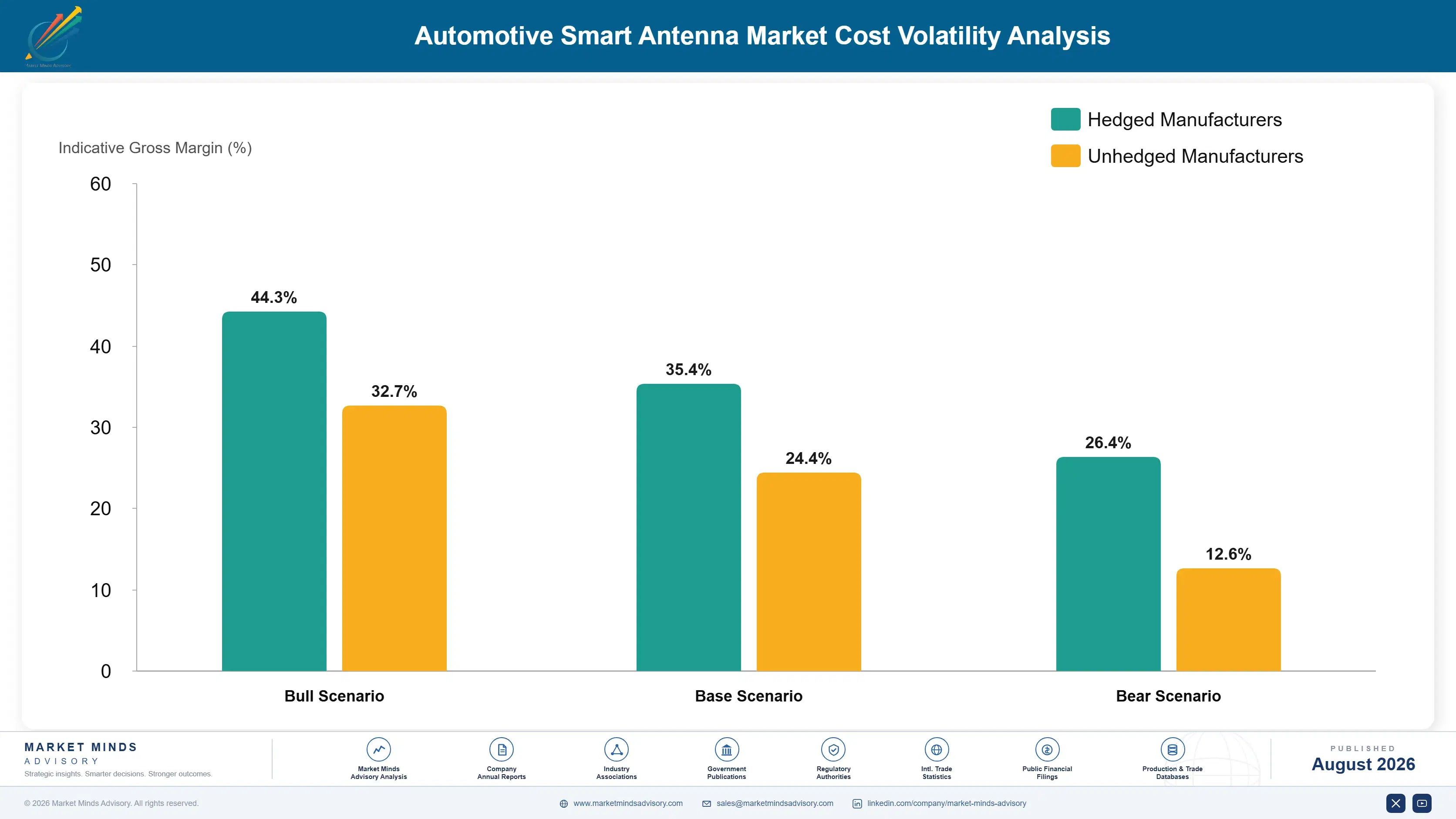
Radio-Frequency Chip and Ceramic Exposure

Radio-frequency chips and specialty ceramic substrate inputs together represent roughly 46% of cost of goods sold for a typical antenna module, with radio-frequency chips alone accounting for close to a quarter of total input cost given their role as the primary signal processing component across most multi-band systems, a cost structure that leaves smaller processors particularly exposed to semiconductor price swings.
Radio-frequency chip prices rose an estimated 23% between 2021 and 2022 following broader semiconductor market disruption tied to pandemic-era production constraints and competing consumer electronics demand for comparable chip fabrication capacity, according to trade data tracked through the United States Census Bureau and corroborated by supplier annual report commentary on input cost pressure during the period, with several suppliers citing the disruption explicitly in investor communications as a material margin headwind across Asian and European facilities.

Larger suppliers with diversified chip and ceramic sourcing across multiple regions absorb volatility more effectively than smaller regional formulators dependent on single-origin supply contracts. This creates a lasting cost disadvantage for smaller players during disruption periods, pushing some toward increased use of alternative ceramic formulations despite the technical reformulation work those alternatives require across affected production lines.
automotive-smart-antenna-market-trends-cost-volatility-analysis-1787466031130

Multi-Origin Chip and Ceramic Sourcing Diversification

Suppliers are qualifying chip and ceramic origins across North America, Europe, and Asia alongside traditional supply relationships, reducing single-region concentration risk even though full substitution remains limited by material quality consistency requirements, a process several major suppliers accelerated significantly following the 2021 to 2022 semiconductor disruption that first exposed the category's sourcing vulnerability clearly to major buyers worldwide.

In-House Chip Design and Fabrication Partnerships

Several antenna suppliers are investing in in-house radio-frequency chip design capability paired with dedicated fabrication partnerships, offering long-term supply stability and reduced disruption risk once production scales, though current in-house chip programs remain meaningfully more expensive than established external sourcing at present commercial volumes, a gap expected to narrow steadily as production scales toward full commercial output.

Long-Term Supply Contracts With Chip Producers

Several suppliers have signed multi-year supply agreements directly with semiconductor and ceramic producers, locking in volume and partially insulating pricing from spot market volatility during acute disruption periods tied to fabrication capacity shocks or competing consumer electronics demand shifts, giving contracted suppliers materially more predictable input costs than competitors relying on spot purchasing alone.

Portfolio Architecture for Margin Defence

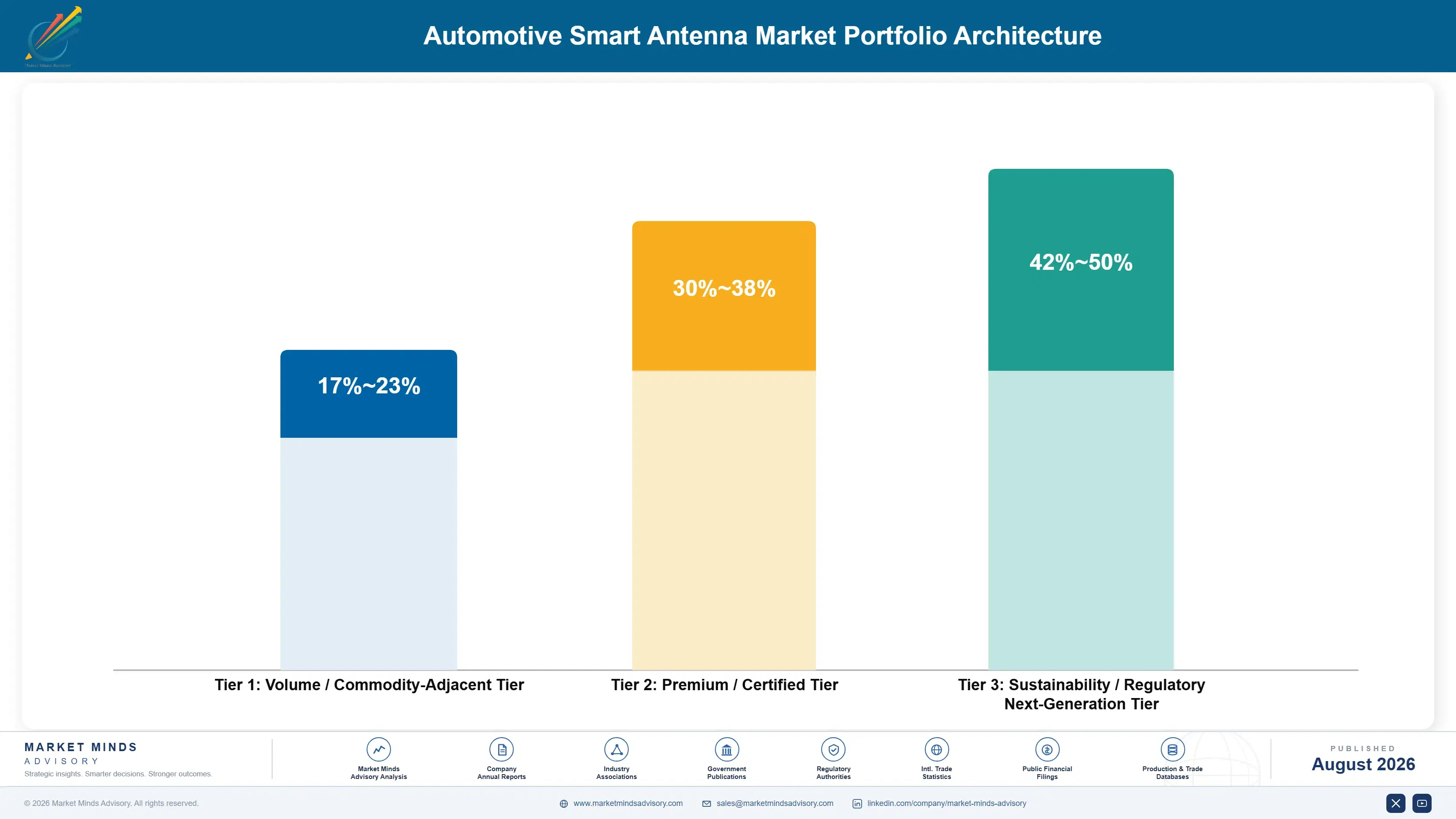
The portfolio splits across three tiers with materially different margin economics: volume-grade single-function antenna hardware carrying thin margins under intense price competition, certified multi-band and V2X-capable modules commanding a meaningful premium, and next-generation software-defined and telematics-integrated systems capturing the highest margins currently available in the category, a spread wide enough that engineering investment strategy now matters more to supplier profitability than raw production volume. Suppliers increasingly treat tier positioning as a deliberate strategic choice tied to radio-frequency engineering capability, particularly for suppliers serving connectivity-focused premium accounts.
The volume versus premium tension is acute right now because automakers increasingly favor multi-band and V2X-capable systems, compressing the addressable market for single-function antenna hardware faster than suppliers can shift capacity toward higher-value alternatives, leaving some producers holding underutilized legacy production lines across several major manufacturing regions.

High-value margin pools concentrate specifically in software-defined antenna systems for adaptive band allocation and telematics-integrated modules carrying multi-platform certification, both of which command premium pricing tied to engineering complexity and application depth rather than raw material cost alone, rewarding suppliers that invested early in multi-band technology over those competing purely on scale.

Volume / Commodity-Adjacent Tier

Standard single-function antenna hardware sold primarily on price into mainstream automotive applications, facing intense competitive pressure from multi-band alternatives and carrying thin, increasingly squeezed margins as automakers shift toward certified, integrated alternatives.
Gross Margin: 17%-23%

Premium / Certified Tier

Multi-band and V2X-capable modules commanding premium pricing tied to documentation, regulatory compliance support, and validated interoperability performance across demanding platform integration scenarios that commodity systems cannot reliably match at comparable manufacturing scale.
Gross Margin: 30%-38%

Sustainability / Regulatory / Next-Generation Tier

Software-defined and telematics-integrated antenna systems serving premium connectivity-sensitive applications at the highest technical complexity, commanding premium pricing tied to application engineering few competitors currently possess at meaningful commercial scale today.
Gross Margin: 42%-50%
automotive-smart-antenna-market-trends-portfolio-architecture-1787466031699

High-value Sub-segments and Strategic Watch-out

Software-Defined Antenna Systems

Highest-value, fastest-growing segment driven by adaptive band allocation demand, commanding premium pricing on control software and calibration technology competitors cannot easily replicate, since building comparable expertise typically requires several more years of dedicated research investment across multiple global OEM platform programs and connectivity categories worldwide.
Gross Margin: 44%-52%

Telematics-Integrated Antenna Modules

High-value segment growing steadily as automakers extend architecture simplification into connectivity hardware, with margin supported by systems integration depth and software-controlled configuration rather than raw technical complexity alone, favoring suppliers with strong integration engineering capability across multiple regional platform categories and vehicle segments worldwide today.
Gross Margin: 36%-44%

Standard Multi-Band Shark-Fin Modules

Volume core of the category, serving mainstream automotive applications with stable but thin margins under sustained price competition among suppliers, where manufacturing scale and cost efficiency matter more than engineering sophistication for winning large-volume contracts across mature and rapidly expanding export markets today worldwide and beyond.
Gross Margin: 20%-26%

Discrete Single-Function Antenna Hardware

Strategic watch-out segment facing steady, accelerating decline as multi-band consolidation and V2X mandates both favor integrated alternatives, leaving suppliers reliant on this tier exposed to shrinking addressable volume and thinning margin over time as automakers complete their platform conversion programs across every major regulatory jurisdiction.
Gross Margin: 13%-19%

Platform Contracts and Certification Loyalty

Automotive smart antenna demand behaves like an annuity once a supplier wins a platform slot, since automakers rarely re-qualify connectivity hardware mid-platform lifecycle given the cost and risk of interference and protocol revalidation, giving incumbent suppliers multi-year revenue visibility on won accounts, a dynamic that rewards early platform wins disproportionately relative to their first-year contribution. Renewal cycles typically span four to six years, and suppliers who lose a slot rarely regain it quickly across any major platform category.
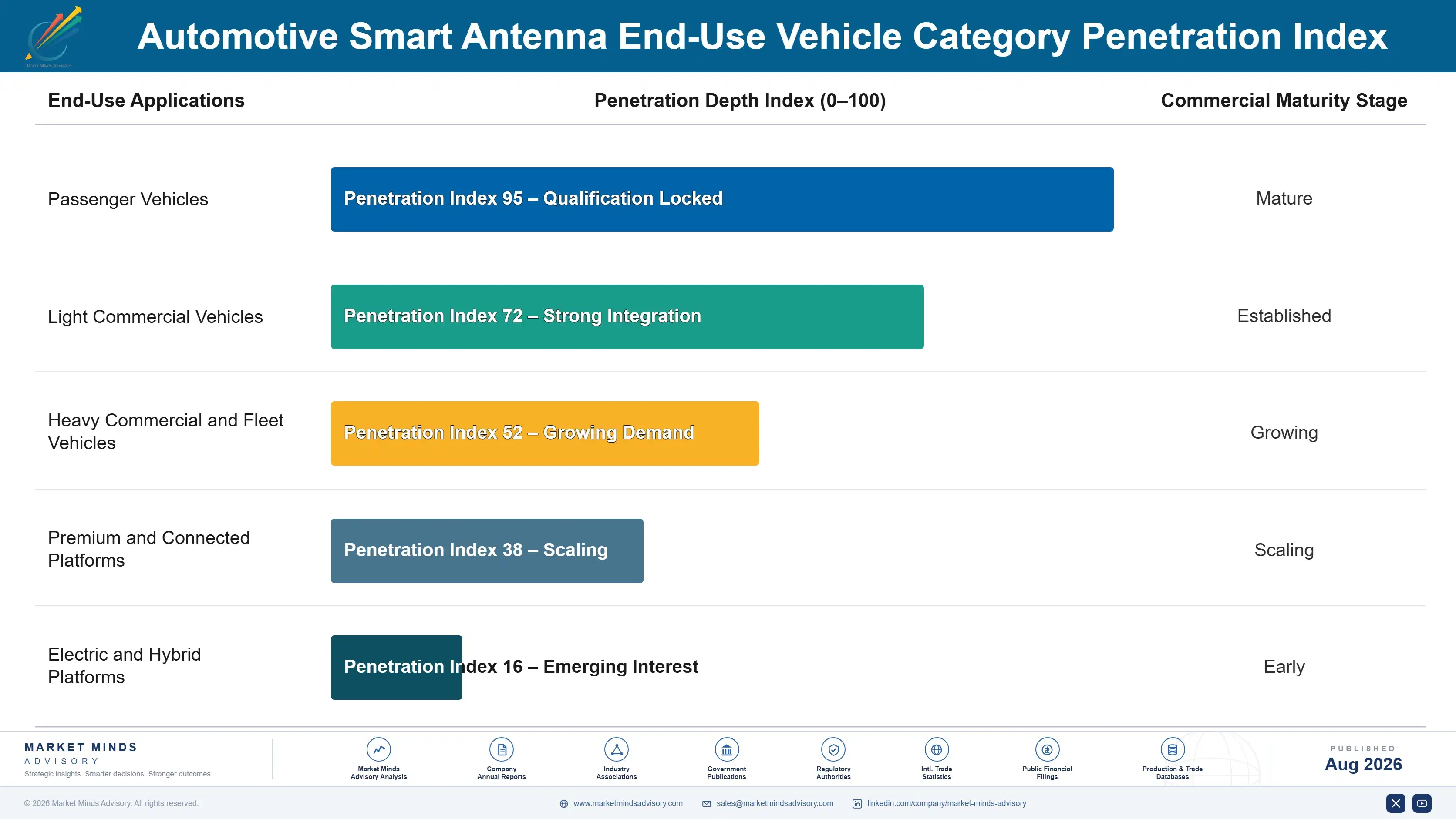
Adoption depth varies sharply by end-use vertical: established North American and European premium platforms show the deepest, most entrenched supplier relationships given decades-long radio-frequency engineering collaboration, while emerging Chinese and Indian mid-tier platform categories remain more contestable as automakers actively experiment with new antenna suppliers during early platform development phases, when switching costs remain low and connectivity specifications have not yet been finalized across the broader category.

A generational shift in buyer profiles is underway as younger platform connectivity teams, increasingly focused on software-defined configuration and over-the-air update capability, prioritize protocol certification depth and rapid integration testing over the decades-long supplier relationships and discrete component catalogs that defined procurement at legacy automotive companies still relying on outdated antenna architectures.
automotive-smart-antenna-market-trends-end-use-penetration-index-1787466032245

Priorities for Automotive Antenna Suppliers

These are among the four positions where our research anticipates prominent divergence between winners and laggards over the coming forecast period. Each is grounded in the demand model, the regulatory perimeter, and the announced capacity pipeline.
01 / MULTI-BAND INTEGRATION PRIORITY

Accelerate multi-band certification capability ahead of mandates

Suppliers still relying primarily on discrete single-function antenna portfolios face a shrinking addressable market as OEM connectivity demands and V2X mandate trends tighten simultaneously across major automotive categories nationwide and internationally. The window to pre-validate multi-band alternatives against existing interference benchmarks is narrowing quickly as faster-moving competitors capture platform contracts ahead of suppliers still completing internal testing cycles. Suppliers that delay risk losing multi-year platform relationships to faster-moving rivals carrying pre-validated multi-band portfolios into every renewal negotiation across every major OEM account.
02 / CHIP SOURCING DIVERSIFICATION STRATEGY

Reduce semiconductor concentration risk across regions

Single-region chip dependency has produced repeated price shocks tied to semiconductor market volatility over the past several years, directly compressing margins for suppliers without diversified sourcing across North America, Europe, and Asia. Qualifying multiple chip origins reduces exposure meaningfully, though full substitution requires reformulation validation since material performance differs across input types. Suppliers that fail to diversify remain persistently vulnerable to the next chip disruption event affecting their primary supply base without a diversified strategy already in place across every major facility.
03 / V2X CERTIFICATION INVESTMENT

Build protocol certification capability ahead of mainstream adoption

Software-defined and telematics-integrated antenna systems represent the fastest-growing and highest-margin segments, but require certification infrastructure and interference validation that most commodity-focused suppliers currently lack entirely, particularly around multi-band integration work. Building this capability now positions suppliers to capture premium platform accounts before the segment fully matures and margins inevitably compress under intensifying competitive pressure from new entrants entering the category. Late entrants will face steeper technical catch-up costs, arriving after early movers have already locked in accounts that matter most.
04 / REGIONAL CAPACITY PLACEMENT

Prioritize East Asian and South Asian production co-location

Regional manufacturing scale in China and rapid growth in India and Southeast Asia make co-located production increasingly decisive for lead time performance and overall cost competitiveness. Suppliers still serving these markets through centralized export face a growing cost and speed disadvantage against regionally established competitors already operating co-located capacity closer to major vehicle manufacturing clusters. Capital committed to regional capacity now compounds advantage steadily as vehicle production volume continues expanding across the region through the forecast period and well beyond it.

Engagement Snapshot From the Field

A live engagement with an industry participant carrying material or product regulatory and market exposure ahead of a defining policy shift, showing how our research translates into a defensible multi-year portfolio strategy.
MARKET MINDS ADVISORY · CLIENT ENGAGEMENT SUMMARY
Automotive Smart Antenna Producer Strategic Portfolio Review and Transition Roadmap 2026·Investment Scenario on Automotive Smart Antenna Exposure Evaluation 2025-26
CLIENT PROFILE
The client is a mid-sized regional automaker developing a next-generation connected platform program supplying several major North American and European dealer networks, with reported annual platform volume exceeding 300,000 units (client-reported, unverified by MMA) across two assembly facilities prior to engaging MMA for multi-band antenna conversion strategy support ahead of a compressed regulatory compliance deadline.
STRATEGIC CHALLENGE
Facing emerging V2X mandate requirements with a sixteen-month compliance deadline, the client's existing single-function antenna supplier had not yet validated multi-band replacement systems, risking loss of several major platform contracts representing a significant share of total production volume if conversion could not be completed on schedule and validated through independent interference testing.
MMA APPROACH
MMA conducted a supplier capability assessment across five candidate antenna suppliers, benchmarking multi-band conversion timelines, interference testing throughput, and regional production capacity, then facilitated a structured qualification process that compressed the client's typical supplier evaluation timeline substantially against historical qualification cycles, drawing on MMA's primary survey and expert interview data throughout.
KEY FINDINGS
  1. Only two of five evaluated suppliers had pre-validated multi-band systems ready for immediate interference testing, sharply narrowing the client's viable supplier options from the outset.
  2. Switching to a pre-validated multi-band system reduced projected qualification timeline from an estimated fourteen months to under eight months across affected facilities.
  3. Chip sourcing diversification among finalist suppliers correlated strongly with the pricing stability commitments the client required for multi-year contract terms across every affected facility.
  4. Bundled protocol certification and regulatory documentation services materially reduced the client's internal quality assurance burden during the entire conversion transition period across every affected facility.
CLIENT PROFILE
The client is a mid-sized regional automaker developing a next-generation connected platform program supplying several major North American and European dealer networks, with reported annual platform volume exceeding 300,000 units (client-reported, unverified by MMA) across two assembly facilities prior to engaging MMA for multi-band antenna conversion strategy support ahead of a compressed regulatory compliance deadline.
STRATEGIC CHALLENGE
Facing emerging V2X mandate requirements with a sixteen-month compliance deadline, the client's existing single-function antenna supplier had not yet validated multi-band replacement systems, risking loss of several major platform contracts representing a significant share of total production volume if conversion could not be completed on schedule and validated through independent interference testing.
MMA APPROACH
MMA conducted a supplier capability assessment across five candidate antenna suppliers, benchmarking multi-band conversion timelines, interference testing throughput, and regional production capacity, then facilitated a structured qualification process that compressed the client's typical supplier evaluation timeline substantially against historical qualification cycles, drawing on MMA's primary survey and expert interview data throughout.
KEY FINDINGS
  1. Only two of five evaluated suppliers had pre-validated multi-band systems ready for immediate interference testing, sharply narrowing the client's viable supplier options from the outset.
  2. Switching to a pre-validated multi-band system reduced projected qualification timeline from an estimated fourteen months to under eight months across affected facilities.
  3. Chip sourcing diversification among finalist suppliers correlated strongly with the pricing stability commitments the client required for multi-year contract terms across every affected facility.
  4. Bundled protocol certification and regulatory documentation services materially reduced the client's internal quality assurance burden during the entire conversion transition period across every affected facility.
RECOMMENDED STRATEGY
Phase 1: Phase 1 (Months 1 to 3): Complete supplier capability benchmarking and shortlist finalists based on multi-band conversion readiness and sourcing diversification. Phase 2: Phase 2 (Months 4 to 8): Run parallel interference testing and durability validation against existing regulatory specification benchmarks for finalist systems. Phase 3: Phase 3 (Months 9 to 12): Execute phased platform conversion and finalize long-term supply agreement with selected conversion partner across all facilities.
OUTCOME
The client completed multi-band conversion across all affected platform product lines within the regulatory compliance deadline, retaining contracts reported to represent a majority of the client's total platform volume (client-reported, unverified by MMA), while establishing a diversified two-supplier sourcing structure reducing future disruption risk across its full portfolio.

Frequently Asked Questions

Foundational context covering the market sizes, CAGR, scope, country, region and competition that inform every finding below. This section is provided to cover basics and most often pre-purchase conversations, answered from the MMA Primary Research Dataset.

What is the current size of the Automotive Smart Antenna Market?

The global automotive smart antenna market is valued at approximately USD 6.8 billion in 2025. This figure covers shark-fin multi-band modules, V2X antennas, GNSS antennas, satellite radio antennas, and telematics integrated antennas.

How large will the Automotive Smart Antenna Market be by 2036?

The market is projected to reach approximately USD 20.19 billion by 2036 under the base case scenario. This reflects sustained multi-band conversion and V2X mandate rollout across East Asia.

What is the CAGR for the Automotive Smart Antenna Market 2026 to 2036?

The base case CAGR is 10.4% across the 2026 to 2036 forecast period, reflecting strong conversion momentum. Bull and bear scenarios range from 9.0% to 11.8% depending on semiconductor price stability.

Which segment is growing fastest?

5G and V2X connectivity antennas are the fastest-growing segment at a 14.1% CAGR. This reflects rapid integration of vehicle-to-everything communication ahead of regulatory deadlines worldwide.

Who are the major companies in the Automotive Smart Antenna Market?

Leading suppliers include Laird Connectivity, Molex, TE Connectivity, Continental, and Harada Industry. These five companies hold an estimated 52% combined market share on a revenue basis.

Which country is growing fastest?

China leads growth at an estimated 12.9% CAGR, driven by its aggressive connected-vehicle mandate rollout and domestic antenna manufacturing base. Rising V2X platform adoption is the primary growth engine.

Report Segmentation Architecture

The full report scope spans multiple orthogonal segmentation dimensions, with cross-tabulated demand data provided for each dimension pair. Coverage extends further to regional breakdowns, trend trajectories, and the competitive detail needed to support segment-level decision-making.

By Antenna Function and Technology

  • Shark-Fin Multi-Band Modules
  • 5G and V2X Connectivity Antennas
  • GNSS and GPS Antennas
  • Satellite Radio Antennas
  • Telematics Control Unit Integrated Antennas
  • Aftermarket Antenna Accessories

By End-Use Vehicle Category

  • Passenger Vehicles
  • Light Commercial Vehicles
  • Heavy Commercial and Fleet Vehicles
  • Premium and Connected Platforms
  • Electric and Hybrid Platforms

By Commercial Dimension

  • Direct OEM Platform Supply
  • Tier 2 Sub-Assembly Supply
  • Aftermarket Replacement Supply
  • Distributor and Retail Supply

By Region

  • North America
  • Western Europe
  • East Asia
  • South Asia and Pacific
  • Latin America
  • Middle East and Africa
  • Eastern Europe

Scope, Methodology, and Coverage

Every figure in this report is reproducible from documented input assumptions. The scope below maps the historical period, the forecast horizon, the segmentation dimensions, and the countries covered, alongside the underlying primary and qualitative methodology.
Historical Period
2020 to 2025
Forecast Period
2026 to 2036
Base Year
2025 (USD billions; MMA Primary Research Dataset, August 2026)
Market Definition
This report covers integrated exterior and roof-mounted antenna hardware for vehicle communication, navigation, and broadcast reception, including shark-fin multi-band modules, 5G and V2X connectivity antennas, GNSS and GPS antennas, satellite radio antennas, and telematics control unit integrated antennas. It excludes infrastructure-side roadside communication units and non-automotive consumer electronics antennas.
Quantitative Units
USD billions (current prices); unit volume for select segment analysis
Segmentation Dimensions
By Antenna Function and Technology; By End-Use Vehicle Category; By Commercial Dimension; By Region
Regions Covered
North America, Western Europe, East Asia, South Asia and Pacific, Latin America, Middle East and Africa, Eastern Europe
Countries Covered
USA, China, Germany, France, UK, Japan, South Korea, India, Australia, Canada, Brazil, Mexico, Indonesia, Vietnam, Thailand, Malaysia, UAE, Saudi Arabia, South Africa, Nigeria, Turkey, Poland, Netherlands, Italy, Spain, Sweden, Switzerland, Argentina, Colombia, Singapore, and additional markets relevant to this sector
Key Companies Profiled
Laird Connectivity, Molex, TE Connectivity, Continental, Harada Industry, Yokowo, Kathrein Automotive, Calearo Antenne, Amphenol, PCTEL, Hirschmann Car Communication, Ficosa International, Antaira Technologies, Panasonic Automotive, Denso, Airgain, Taoglas, Ace Technologies, Hyundai Mobis, Shenzhen Jiuzhou Antenna
Quantitative Methodology
Primary survey, n=3,800 respondents, Q4 2025, six countries; demand-side model with trade association cross-validation
Qualitative Methodology
47 expert interviews, Q4 2025; applied to validate demand model assumptions, identify emerging dynamics, and assess competitive positioning
Report Format
PDF and XLSX data workbook (Word format preview document)
Publisher
Market Minds Advisory
Report Code
MMA-2026-AUT-104
Published
August 2026
Contact
sales@marketmindsadvisory.com | www.marketmindsadvisory.com

Purchase the full Automotive Smart Antenna Market Report (2026 to 2036).

The full report delivers a complete quantitative and qualitative assessment of the global automotive smart antenna market across all six technology segments and seven regions. It includes detailed supplier profiles covering radio-frequency engineering capability, production capacity, and regulatory positioning for the twenty companies profiled. Analysts provide scenario-adjusted forecasts through 2036 alongside input cost sensitivity modeling tied to semiconductor price volatility. Buyers receive access to underlying primary survey and expert interview data supporting all quantitative claims, along with a V2X mandate rollout tracker across major markets.
Segment-level forecasts through 2036 across all six categories
Seven-region demand, pricing, and CAGR breakdown tables
Twenty-company competitive profiling with moat and risk analysis
Radio-frequency chip and ceramic supply risk assessment and mitigation pathways
V2X mandate rollout tracker across major regulatory jurisdictions
Quarterly market update subscription option for ongoing monitoring

Built For The People Who Decide

From boardroom strategy to bench-side execution, this report is read cover-to-cover by leaders shaping the next decade of their industry, turning demand scenarios, market dynamics and valuation benchmarks into decisions.
CXOs/ Presidents/ VPs/ Managers
M&A and Corporate Development
Strategy Teams and R&D Heads
Procurement and Product Directors
Regulatory and Compliance Leaders
Investor Relations and Equity Analysts