
Market Minds Advisory
Automotive Light Bars Market

Automotive Light Bars Market: Automotive Light Bars Market: Dual-Row LED Output Redraws Supplier Advantage.

Dual-row LED light bar adoption is pulling off-road and work truck buyers away from single-row designs faster than manufacturers expected, rewarding suppliers with thermal management and optics engineering depth over housing assembly scale.

Lead Analyst

David Horsley

Published

August 2026

Make Smarter Decisions with Customized Research Insights

Request a free sample report and evaluate market opportunities, growth trends, and competitive dynamics relevant to your business needs.

2025 MARKET VALUE$1.9BMarket Size 2025
2036 FORECAST VALUE$4.9BBase Case , 2026 to 2036
CAGR 2026 TO 20368.9 %Bull 10.1% / Bear 7.7%
INCREMENTAL OPPORTUNITY$2.8BNet 10- year value creation
EXPANSION MULTIPLE2.35x2036 value over 2026 base
Strategic Levers
M&A Pipeline
Regional Outlook
Country Rankings
Competitive Intelligence
Segmental Deep-dive
Call-Us : 91 93563 13602

Executive Snapshot and Market Trajectory.

Automotive light bar demand is shifting decisively toward dual-row LED designs, as off-road enthusiasts and work truck fleets replace single-row units with higher-output configurations that deliver substantially greater beam distance and coverage across a widening range of vehicle applications each year and beyond.
Demand concentrates in three areas: single-row LED bars supplying cost-sensitive mainstream off-road and truck applications, dual-row LED bars supplying performance-focused off-road and work vehicle buyers, and emergency warning light bars supplying regulatory-driven public safety fleet requirements across most jurisdictions worldwide. North America anchors global demand given the country's entrenched off-road and pickup truck customization culture, holding the largest regional share tracked in this report by a wide margin.
Competition remains fragmented among a mix of established off-road specialists and emergency lighting manufacturers, led by Rigid Industries and KC HiLiTES, both of which maintain years of optics and thermal management engineering depth built through direct aftermarket and fleet distribution relationships spanning multiple regions and enthusiast communities worldwide. Documented lumen output reliability and heat dissipation performance, not housing cost alone, increasingly decide which suppliers retain loyal buyers over the long term across successive cycles.
Market Definition
This market covers automotive LED and legacy light bars, including single-row, dual-row, and curved off-road lighting units, plus emergency and warning light bars, sold to aftermarket installers, fleet operators, and original equipment automakers for passenger, commercial, and off-road vehicle applications. It excludes standalone headlamp assemblies, interior cabin lighting, and non-automotive industrial floodlights.
Base Year Value
$1.9B in 2025 (MMA Primary Research Dataset, August 2026)
Forecast Period
2026 to 2036, eleven discrete annual values
CAGR
8.9% base case. Bull 10.1%. Bear 7.7%.
Fastest Growth Segment
Dual-Row LED Light Bars: 11.4% CAGR
Fastest Growth Country
United States: 10.9% CAGR
Fastest Growth Region
South Asia and Pacific: 11.0% CAGR
Largest Region
North America: 32% of 2025 global value
Market Leaders
Rigid Industries LLC, KC HiLiTES, Inc., Baja Designs, Hella GmbH & Co. KGaA, Truck-Lite Co., LLC. Source: MMA Analysis based on company disclosures.
Primary Survey
n=3,800 procurement and R&D decision-makers, Q4 2025, six countries
Methodology
Demand-side build-up, cross-validated against public data, 47 expert interviews

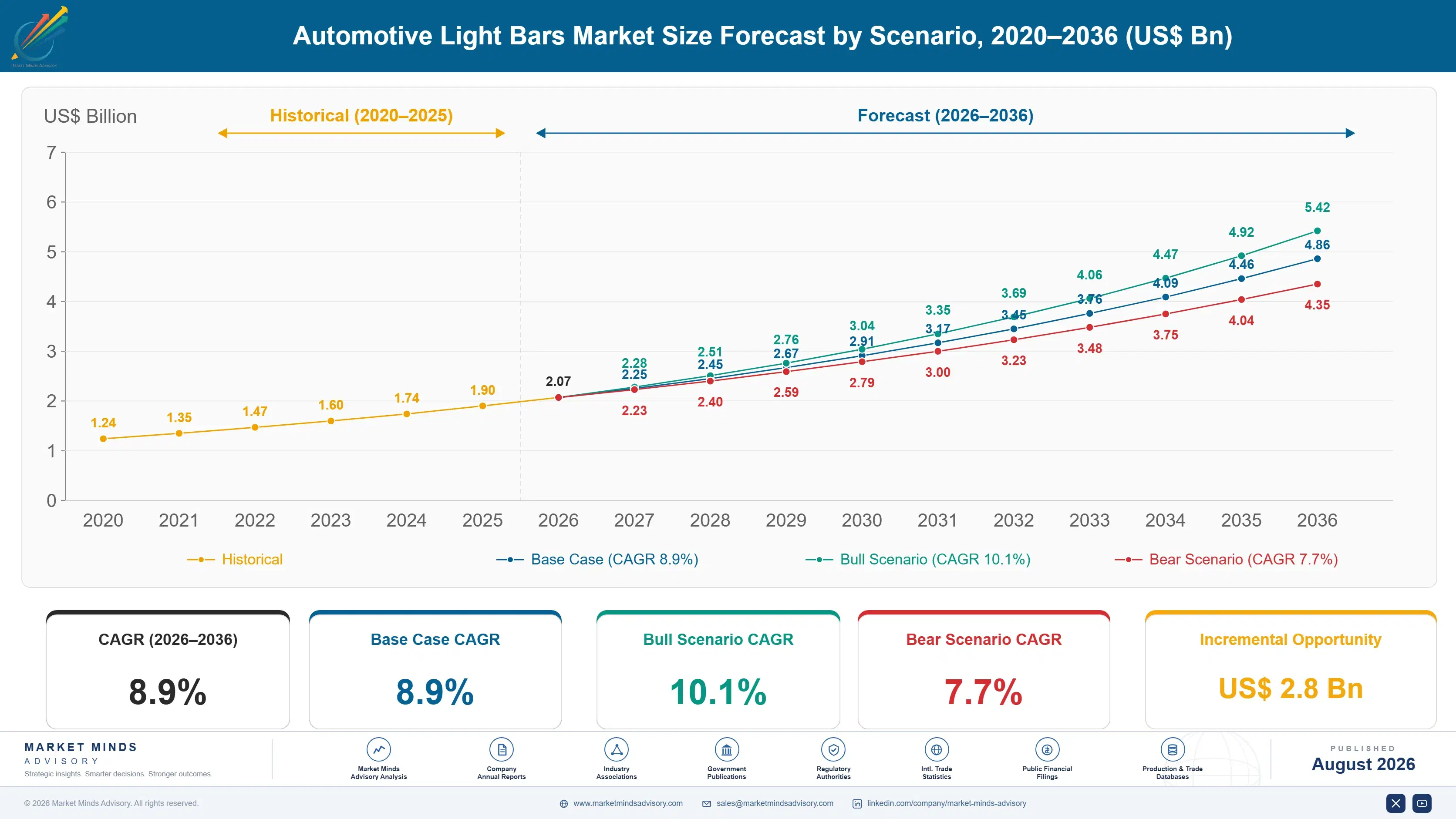
Automotive Light Bars Market Forecast Scenarios

automotive-light-bars-market-size-forecast-scenario-1787315362821
Automotive light bar demand grew steadily through 2020 to 2025 as off-road recreational vehicle sales and pickup truck customization spending recovered from pandemic-related disruption while LED technology adoption accelerated across the category. The market grew at an estimated 8.1% historical CAGR across the period, with dual-row LED volume outpacing single-row demand consistently from 2023 onward as buyers sought greater beam output.
The base case assumes 8.9% CAGR through 2036, driven by three mechanisms operating together. First, off-road enthusiasts and work truck fleets are increasingly specifying dual-row LED bars supporting substantially greater beam distance and coverage than single-row designs can achieve. Second, manufacturers are expanding thermal management engineering capacity to support sustained high-output LED operation without premature failure. Third, tightening emergency vehicle visibility regulations continue to mandate more sophisticated warning light bar architecture across nearly every public safety fleet purchase made globally.
The bull case (10.1% CAGR) assumes faster-than-expected off-road recreational vehicle sales growth pulls dual-row LED adoption forward ahead of current manufacturer capacity planning assumptions. The bear case (7.7% CAGR) reflects the risk that discretionary aftermarket accessory spending decelerates during broader economic softness, tempering demand across a market still closely tied to consumer recreational vehicle purchasing power.

Thermal Management and Optics Now Separate Suppliers

Automotive light bar economics increasingly separate along thermal management reliability rather than housing assembly scale alone, since serious off-road and fleet buyers pay premium pricing for units with proven sustained output performance that budget competitors cannot credibly offer over extended service life. This gap has widened noticeably since 2022 as buyers grew more sophisticated about lumen degradation and warranty claims across the category.
CR5 CONCENTRATION38%share held by the top five light bar manufacturers globally
AVERAGE SELLING PRICE$65-420/unitrange spanning single-row bars to premium dual-row systems
TOP PRODUCING COUNTRY SHAREUSA, 27%share of global light bar production value currently held
CAPACITY UTILIZATION68%average operating rate across qualified light bar assembly facilities
TRADE INTENSITY36%of finished light bar volume crossing borders before reaching buyers
FEEDSTOCK COST SHARE31% of COGSLED chip and aluminum housing components combined together
Casual consumers and serious off-road or fleet buyers behave very differently as purchasers in this market today and across most regions. Casual consumers negotiate primarily on price and visual styling given occasional-use expectations, while serious off-road enthusiasts and fleet operators require extensive durability and thermal testing documentation that few budget manufacturers can support without dedicated engineering investment spanning multiple product generations.
Over the next decade, two forces will determine winners. Continued single-row demand will keep expanding addressable entry-level buyer volume across cost-sensitive applications worldwide and across regions, while dual-row adoption adds a second, performance-driven growth vector rewarding manufacturers with strong thermal documentation ahead of assembly-only competitors lacking comparable optics engineering expertise and validation infrastructure built over years of sustained investment and testing.
"A cheap light bar looks identical to a good one in the store. It is only after six months on a washboard trail that the difference between real thermal engineering and a painted aluminum shell becomes obvious."
Director, Automotive Aftermarket Lighting and Accessories Practice · MMA Automot

Market Trends

Dual-Row LED Adoption Accelerates Across Off-Road Segments

Off-road enthusiasts and work truck fleets are increasingly specifying dual-row LED bars supporting substantially greater beam distance and coverage than single-row designs can achieve, replacing conventional single-row units that cannot match dual-row output in demanding low-visibility conditions. This demand has grown fastest among serious overlanding and desert racing segments, where beam performance directly affects safety and competitive advantage that enthusiasts actively research before purchasing. Several major manufacturers have expanded dedicated thermal engineering capacity to serve this growing demand, recognizing that once a buyer experiences reliable dual-row performance, switching back to single-row designs becomes unlikely given the meaningful output difference.
Market Impact: Adds 5 percent recreational vehicle
Curved Light Bar Designs Gain Wraparound Coverage Demand

Manufacturers continue introducing curved light bar designs that follow vehicle grille and roof contours more closely, delivering wider peripheral coverage than straight bars while improving aesthetic integration with modern truck and SUV body styling across a widening range of vehicle applications and markets today. This demand has grown as buyers increasingly prioritize factory-integrated appearance alongside raw lumen output when selecting light bar products for daily-driven vehicles. Suppliers serving this demand typically maintain close relationships with truck accessory retailers built over years of consistent product development and design collaboration and testing.
Market Impact: Adds 4 percent fleet safety demand

Market Opportunities and Growth Drivers

Off-Road Recreational Vehicle Sales Sustain Baseline Demand

Continued growth in off-road recreational vehicle ownership, including trucks, SUVs, and dedicated off-road platforms, sustains steady baseline demand for light bar accessories, as owners routinely add auxiliary lighting as a first customization purchase across nearly every ownership segment, demographic, income bracket, and world region today and going forward. This demand has remained remarkably resilient given the enduring popularity of overlanding and off-road recreation across multiple consumer generations and income brackets. Suppliers serving this demand typically maintain long-standing relationships with truck accessory retailers built over years of consistent product availability and marketing support.
Market Impact: Adds 12 percent component cost vola

Fleet Safety Standards Sustain Emergency Light Bar Demand

Continued tightening of public safety and commercial fleet visibility standards sustains steady demand growth for emergency and warning light bars, as fleet operators increasingly equip vehicles with certified warning systems meeting evolving state and municipal regulatory requirements across nearly every jurisdiction worldwide today. This demand has grown as fleet operators standardize warning light specifications across their full vehicle rosters rather than treating it as an optional safety feature reserved for select vehicles. Suppliers serving this demand typically maintain long-standing relationships with fleet procurement teams and municipal safety departments across regions.
Market Impact: Adds 8 percent counterfeit market e

Market Restraints and Challenges

LED Chip and Aluminum Housing Volatility Compresses Margins

LED chip and aluminum housing material prices have shown meaningful volatility tied to broader semiconductor and metals commodity cycles and growing cross-category demand from the wider consumer electronics and automotive sector competing for the same limited component supply across regions. This volatility disproportionately affects smaller manufacturers with limited purchasing scale, since these inputs represent a substantial share of total production cost that cannot easily be offset through manufacturing efficiency improvements alone. Suppliers are addressing this through longer-term component supply agreements and, where feasible, direct material sourcing relationships that bypass distributor markups entirely across their networks.
Market Impact: Adds 10% dual-row segment volume

Counterfeit Products Undermine Brand Trust and Pricing

Counterfeit and gray-market light bar products continue proliferating across online marketplaces, undermining consumer trust in lumen output claims and creating pricing pressure that established manufacturers must navigate carefully to protect brand reputation and premium positioning across their product lines, distribution channels, and regions worldwide. This restraint disproportionately affects smaller regional manufacturers lacking the brand recognition and marketplace enforcement resources that established leaders can deploy against counterfeit sellers. Manufacturers are addressing this through authorized dealer certification programs and marketplace takedown enforcement that spread compliance cost across their broader distribution networks over time.
Market Impact: Adds 6% curved design segment deman
3 additional market trends, 4 additional growth drivers, and 3 additional restraints and challenges are covered in the full report. Contact sales@marketmindsadvisory.com to access the complete intelligence.

Segment CAGR and Growth Architecture

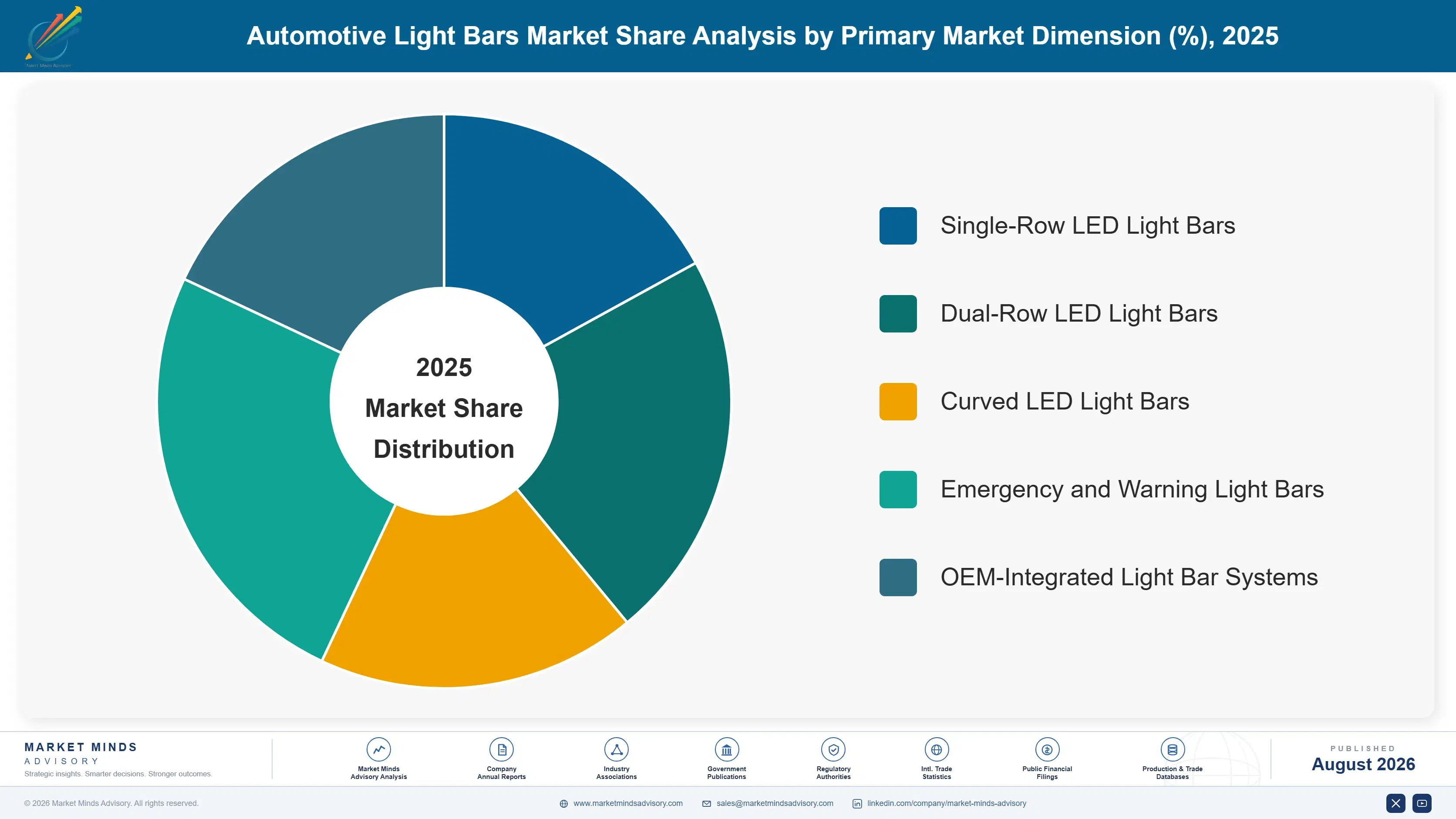
MMA segments this market by light bar design architecture, the classification manufacturers and buyers use when specifying light bars for a given vehicle application across brands, regions, and industries worldwide today and beyond. This lens separates single-row, dual-row, and curved formats by underlying optics design rather than end-use application alone across every buyer segment.
automotive-light-bars-market-market-share-analysis-1787315363685

Dual-Row LED Light Bars

Dual-row LED light bars is the fastest-growing segment by a wide margin, expanding directly alongside serious off-road and work truck buyer growth as enthusiasts seek maximum beam distance and coverage that single-row designs cannot match in demanding low-visibility conditions. This segment commands the highest pricing in the entire market, reflecting the thermal management and optics engineering investment required to substantiate sustained output reliability credibly to increasingly sophisticated buyers across regions. Rigid Industries and KC HiLiTES hold strong positions in this segment given established thermal engineering expertise and testing infrastructure built over years of product development. Growth here concentrates disproportionately among overlanding, desert racing, and work truck fleet buyers where beam performance matters most to overall vehicle capability.
CAGR 11.4%

Curved LED Light Bars

Curved LED light bar demand is expanding faster than the broader straight-bar base, driven by growing buyer preference for wraparound coverage and factory-integrated aesthetic styling across premium truck and SUV vehicle applications seeking design differentiation and visual appeal. This segment requires close collaboration between manufacturers and vehicle-specific mounting bracket suppliers during product design, since curvature and mounting integration vary meaningfully across different vehicle grille and roof configurations available today across markets. Baja Designs and Hella maintain meaningful positions in this segment given established styling and mounting integration expertise built over years of collaborative work. Growth here tracks broader vehicle customization aesthetic trends rather than short-term commodity price swings affecting standard straight-bar competitors and suppliers.
CAGR 10.2%
Full segment breakdown across 6 segments available in the complete report.

Regional Architecture and Country Demand Map

North America dominates automotive light bar demand given the country's entrenched off-road and pickup truck customization culture, with East Asia and Western Europe following behind through growing manufacturing capability, rapidly rising recreational vehicle ownership, and expanding fleet safety equipment adoption across most global markets today.

North America

United States off-road recreational vehicle ownership and pickup truck customization culture, concentrated across the country's largest rural and suburban markets, anchors North American light bar demand alongside substantial fleet safety equipment purchasing volume each year. Rigid Industries and KC HiLiTES maintain extensive domestic production and distribution capacity serving retailers and fleet operators directly from established regional facilities built over decades of accumulated brand trust and engineering expertise. Canada contributes smaller but steady demand tied to its own off-road recreational vehicle market, largely mirroring broader United States consumption patterns and trends. This demand base reflects the region's deeply entrenched truck customization culture, and continued dual-row adoption sustains steady growth through the forecast period across multiple buyer segments and vehicle types nationwide.
Share: 32% | CAGR: 9.5% (2026 to 2036)

East Asia

China's massive LED component manufacturing base, combined with growing domestic off-road and pickup truck ownership, anchors East Asian light bar demand alongside substantial export production capability built over the past decade of sustained investment and expertise. Chinese manufacturers have scaled domestic light bar production aggressively to serve growing global demand alongside expanding domestic recreational vehicle ownership across major metropolitan and rural markets alike. Japan and South Korea contribute meaningful demand and engineering expertise through established automotive lighting suppliers serving both domestic and export vehicle markets efficiently and reliably. Continued Chinese manufacturing investment and rising domestic recreational vehicle adoption keep this region's growth rate among the fastest globally through the entire forecast period ahead.
Share: 23% | CAGR: 10.0% (2026 to 2036)
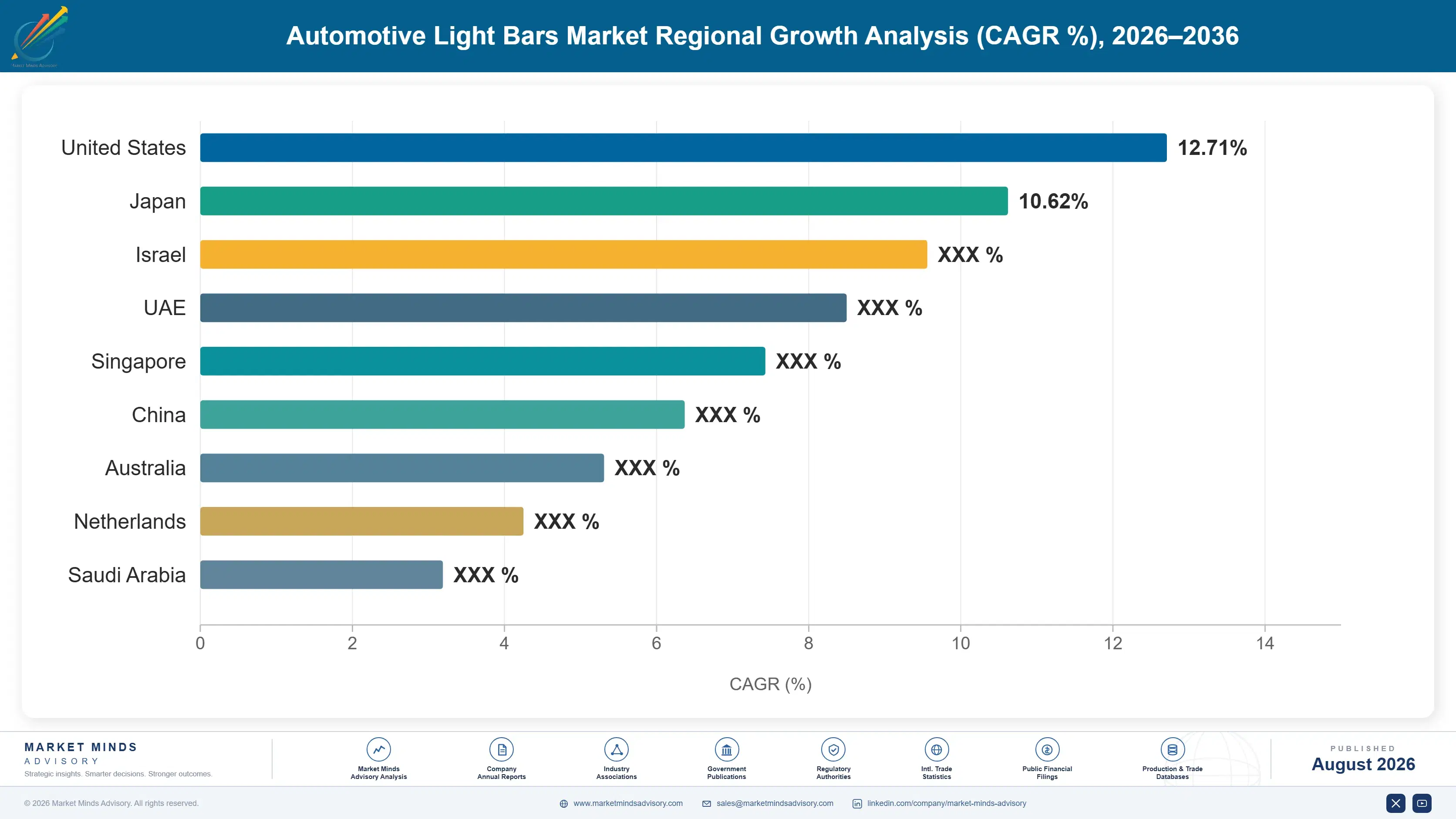
Regional intelligence for 5 additional markets available in the complete report: Western Europe, South Asia and Pacific, Latin America, Middle East and Africa, Eastern Europe. Contact sales@marketmindsadvisory.com.
automotive-light-bars-market-country-cagr-analysis-1787315364579

Where Light Bar Manufacturers Can Expand Margins

Manufacturers create outsized value not from standard single-row bar volume alone but from thermal engineering depth, sustained output reliability documentation, and long-term fleet and retailer contracts built over years of engineering investment and testing. The levers below identify where margin expands fastest, moving beyond commodity assembly supply toward validated dual-row performance and durable brand loyalty.

Thermal Engineering Certification Commands Strong Premium

Manufacturers that achieve and document verified sustained output performance capture meaningfully higher realized pricing than standard single-row bars, often 2.8 to 4.1 times the price per unit for equivalent lumen coverage, because serious buyers pay for the documented thermal reliability this certification provides over conventional undocumented alternatives sold at lower price points. This documentation requires sustained engineering investment spanning multiple product generations and testing cycles, but manufacturers that achieve it gain access to the highest-margin segment of the entire market well ahead of competitors still selling undocumented output claims to increasingly skeptical enthusiast buyers.
Market Impact: Adds 520 to 690 basis points gross

Deep Warranty Reliability Deepens Brand Loyalty

Manufacturers that develop deep warranty and reliability testing capability capture repeat-purchase advantages that budget-only competitors cannot easily replicate once a buyer experiences reliable long-term performance across multiple vehicle ownership cycles, product generations, and enthusiast communities going forward and beyond current market expectations and standards. This capability requires sustained testing investment across multiple product generations and years of accumulated warranty claims data and expertise, but manufacturers achieving strong reliability reputations typically retain 78% or more of repeat buyers through successive vehicle purchase cycles, converting testing investment into recurring, low-churn revenue streams reliably.
Market Impact: Retains over 78 percent of loyal re

Securing Long-Term Fleet Procurement Supply Agreements

Manufacturers that secure multi-year supply agreements tied to specific fleet operators and municipal safety departments gain revenue visibility spanning multiple procurement cycles, typically 4 to 6 years, since fleet operators rarely switch warning light suppliers mid-cycle given the certification and inventory standardization risk involved in changing systems mid-contract without strong cause. This contract security requires proven component consistency and delivery reliability across sustained performance periods and multiple procurement generations spanning many years, but manufacturers achieving fleet-level qualification convert commodity volume into durable, multi-year revenue relationships that smaller transactional sellers simply cannot match or replicate.
Market Impact: Secures 4 to 6 years of contract re

Building Direct LED Chip Supplier Partnership Access

Manufacturers that develop direct sourcing partnerships with LED chip and semiconductor manufacturers capture cost and consistency advantages that distributor-dependent competitors cannot easily replicate once a manufacturer secures preferred access to limited high-quality processing capacity across their broader supply networks, regions, and manufacturing facilities worldwide and beyond. This partnership model requires sustained relationship investment across multiple supply cycles and years of accumulated collaboration and trust, but manufacturers achieving strong supplier integration typically secure 3 to 5 year supply relationships spanning successive production cycles that transactional buyers cannot access without comparable long-term investment.
Market Impact: Secures 3 to 5 years of supply acce

Who Controls the Margin Pool

CR5 stands at 38%, reflecting a fragmented market shaped by relatively modest barriers to entry in basic single-row assembly, though thermal engineering and brand trust barriers favor established specialists over generic budget manufacturers in the dual-row segment. The gap between the top five and smaller suppliers is widest in documented dual-row output performance, where testing validation barriers protect leaders far more than in standard single-row supply. This gap is widening steadily over
Competition currently plays out across three dimensions: thermal engineering certification races among leaders serving serious off-road and fleet buyers, warranty reliability investment among manufacturers building brand loyalty, and single-row capacity expansion among a broader group of budget-focused competitors. Smaller regional manufacturers compete primarily on price and basic assembly quality rather than thermal engineering depth or established brand recognition.

Emerging pressure comes from two directions. Chinese direct-to-consumer brands are investing in thermal engineering capability to reduce reliance on established Western brand premiums, though testing validation depth remains a gap relative to established leaders with decades of experience. Continued marketplace consolidation could also reorder competitive rankings if remaining retailers concentrate purchasing further, favoring manufacturers with the deepest existing distribution relationships over newer entrants lacking comparable track records.
automotive-light-bars-market-company-positioning-matrix-1787315365445

Competitive Moat and Risk Dimensions

RIGID INDUSTRIES LLC

Moat: Deepest Thermal Engineering Heritage

Rigid Industries operates the deepest thermal management and optics engineering heritage in the industry, having supplied serious off-road enthusiasts for over a decade across multiple product generations and regions, giving it certification credibility and buyer trust that newer entrants cannot easily replicate without comparable years.
RIGID INDUSTRIES LLC

Risk: Heavy Off-Road Segment Concentration

Rigid Industries' revenue base remains closely tied to serious off-road enthusiast demand, leaving it more exposed than diversified competitors to shifts in recreational vehicle spending or off-road participation trends that periodically affect category demand and revenue stability across its core customer base, regions, and product lines.
KC HILITES, INC.

Moat: Broadest Legacy Brand Recognition Depth

KC HiLiTES operates one of the broadest legacy brand recognition portfolios among independent manufacturers, giving it distribution advantages and retailer trust that newer entrants cannot match, built over many decades of established off-road community relationships spanning multiple vehicle segments, regions, product categories, and enthusiast networks.
KC HILITES, INC.

Risk: Limited Scale Versus Largest Rivals

KC HiLiTES' smaller overall scale relative to the largest global manufacturers limits its ability to absorb thermal engineering and certification investment as easily as better-capitalized rivals, potentially constraining its competitive position in the fastest-growing dual-row segment over the coming years, product cycles, and market shifts.

Players Tracked

Prominent Players

Rigid Industries LLC
KC HiLiTES, Inc.
Baja Designs
Hella GmbH & Co. KGaA
Truck-Lite Co., LLC

Other Key Players

Whelen Engineering Company, Inc.
Federal Signal Corporation
ECCO Safety Group
SoundOff Signal, Inc.
Vision X Lighting
Nilight
Auxbeam Lighting
ams OSRAM AG
Wurton LED Lighting Co., Ltd.
Grote Industries, Inc.
Peterson Manufacturing Company
J.W. Speaker Corporation
Valeo SA
Koito Manufacturing Co., Ltd.
Stanley Electric Co., Ltd.

Recent Developments

FEBRUARY 2025

Rigid Industries Expands Dual-Row Production Capacity

Rigid Industries announced completion of a dual-row LED production capacity expansion at its United States facility, adding qualified capacity to serve growing off-road enthusiast demand across multiple product lines and regions. The expansion follows several years of thermal engineering investment supporting sustained output documentation and testing.
Signal: Confirms leading manufacturers are dedicat
JUNE 2025

KC HiLiTES and a Major Retailer Sign Distribution Agreement

KC HiLiTES signed a multi-year distribution agreement with a major truck accessory retailer covering exclusive dual-row product placement across the retailer's national store network scheduled for the coming years. The agreement secures forward volume for KC HiLiTES at negotiated pricing tied to the retailer's inventory planning schedule.
Signal: Signals manufacturers are increasingly sec
OCTOBER 2025

Baja Designs Expands Thermal Testing Capability

Baja Designs announced completion of expanded thermal simulation and durability testing capacity at its manufacturing facility, adding qualified capability to serve growing enthusiast demand for validated dual-row performance across multiple export markets and regions. The expansion follows sustained investment tracking tightening consumer expectations and requirements over time.
Signal: Signals manufacturers are scaling thermal

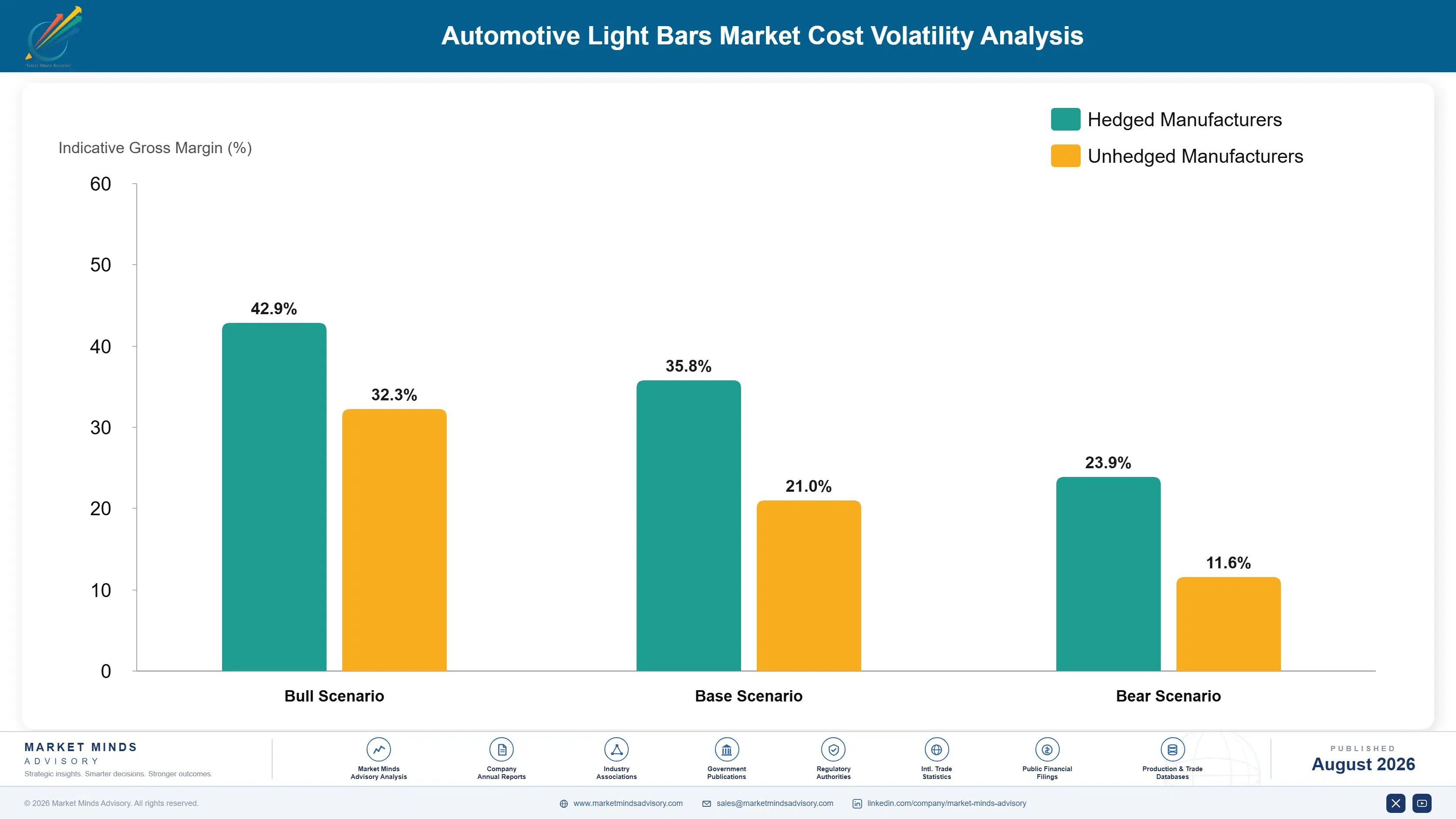
LED Chip and Aluminum Housing Material Exposure

LED chip and aluminum housing components together account for roughly 31% of cost of goods sold across light bar production, with pricing tied to broader semiconductor and metals commodity cycles rather than automotive-specific dynamics alone. Manufacturers relying on spot-market component purchases face greater price exposure than those with long-term supplier agreements in place. Multi-year fixed agreements help maintain predictable margins across successive production planning cycles.
LED chip prices rose sharply during 2021 and 2022, documented in company annual reports across the consumer electronics and automotive lighting sector, as global semiconductor supply chain disruption tightened available high-output chip components faster than downstream demand could adjust. Several manufacturers reported compressed margins and delayed shipments during this period, since retail pricing could not be adjusted quickly enough to reflect rising component cost. Manufacturers absorbed the largest share of this pressure.

This exposure disadvantages smaller manufacturers without long-term chip supply agreements relative to larger, better-capitalized competitors who hedge exposure through diversified sourcing and, in some cases, direct semiconductor manufacturer partnerships built over years. Manufacturers without secured supply face meaningfully greater difficulty maintaining consistent margins during periods of component volatility, particularly smaller regional manufacturers lacking comparable purchasing scale and negotiating leverage with upstream chip producers.
automotive-light-bars-market-cost-volatility-analysis-1787315365761

Long-Term LED Chip Supply Contracts

Manufacturers are locking in multi-year LED chip and aluminum supply contracts at fixed or formula-based pricing, trading some upside flexibility for predictable production costs across successive planning cycles and budget years ahead. This approach has become considerably more common since 2021 as manufacturers sought greater cost predictability across volatile pricing periods worldwide and beyond.

Direct Semiconductor Partnership Investment

Several larger manufacturers are investing in direct partnerships with semiconductor chip manufacturers, directly reducing exposure to merchant market pricing volatility and unpredictable spot purchasing conditions across most regions worldwide today and beyond. This approach requires sustained relationship investment but delivers a durable cost advantage once partnerships mature over successive production cycles and years of collaboration.

Diversified Geographic Sourcing Strategies

Manufacturers are diversifying component sourcing across multiple geographic supplier regions, reducing overall exposure to any single region's supply chain disruption or localized volatility events and unexpected shortages of critical components. This diversification has become standard practice among the largest manufacturers pursuing consistent year-round supply availability and predictable production planning across their global manufacturing networks and facilities.

Portfolio Architecture for Margin Defence

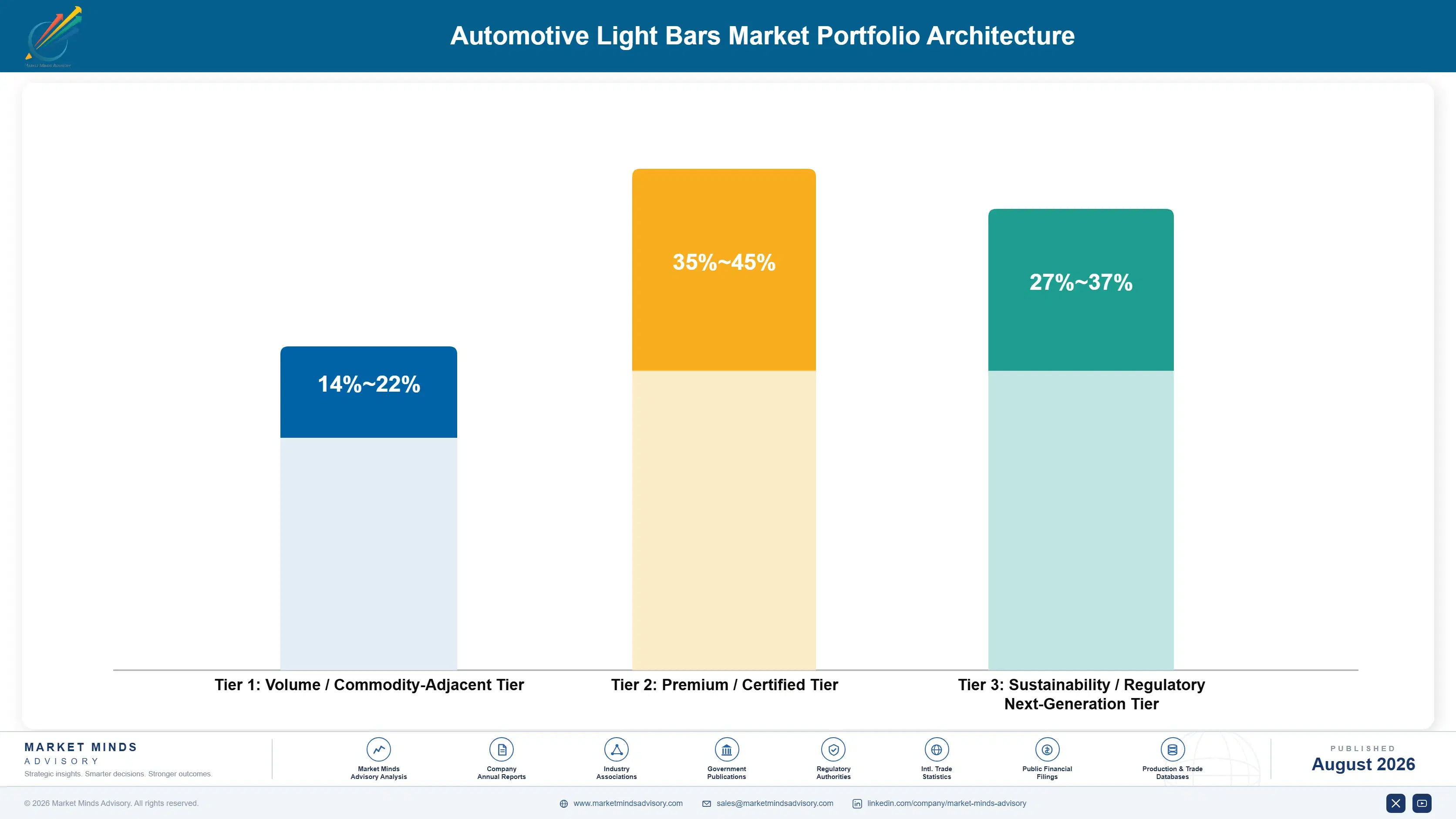
MMA organizes this market into three tiers by thermal engineering depth and margin profile. The volume tier covers standard single-row bars sold into cost-sensitive mainstream applications, competing primarily on price and basic assembly quality. The premium tier covers documented dual-row and curved systems commanding higher margins through thermal certification and brand loyalty barriers. The sustainability tier captures next-generation energy-efficient and recyclable housing systems still sca
Volume tier manufacturers compete on price and delivery consistency with moderate margins, while premium tier manufacturers protect pricing power through thermal documentation and brand loyalty barriers that keep new entrants out for years at a time. This creates real tension inside diversified manufacturers, since capital allocated to sustaining standard assembly capacity competes directly with capital needed to fund thermal engineering research infrastructure, and most large manufacturers now favor the latter given superior long-term returns.

The highest-value pools concentrate in documented dual-row systems for serious off-road and fleet buyers and long-term retail agreements, where certification barriers and brand loyalty combine to support the strongest pricing power in the entire market. Next-generation energy-efficient systems are emerging as a further high-value position as consumer sustainability expectations accelerate industry-wide.

Volume / Commodity-Adjacent Tier

Standard single-row bars sold into cost-sensitive mainstream applications, competing primarily on price and basic assembly quality across most regional retail channels, distribution programs, and online marketplaces worldwide today and every year.
Gross Margin: 14-22%

Premium / Certified Tier

Documented dual-row and curved systems commanding higher margins through thermal certification and durable brand loyalty built over years of sustained engineering investment and testing across product generations and buyer segments worldwide.
Gross Margin: 35-45%

Sustainability / Regulatory / Next-Generation Tier

Energy-efficient and recyclable housing systems positioned ahead of rising sustainability expectations among consumers pursuing improved efficiency and environmental compliance across their purchasing decisions and long-term ownership preferences and habits over time.
Gross Margin: 27-37%
automotive-light-bars-market-portfolio-architecture-1787315366563

High-value Sub-segments and Strategic Watch-out

Documented Dual-Row Systems for Serious Off-Road Buyers

This segment combines the strongest thermal certification barriers in the market with steady growth tied to continued serious off-road buyer adoption across most major recreational vehicle categories worldwide. Manufacturers with established testing documentation hold a durable advantage new entrants rarely overcome quickly given infrastructure costs and years of validation data.

Long-Term Fleet Procurement Agreements

Fleet procurement programs support steady demand growth largely independent of broader commodity chip cycles, with established qualification providing meaningful competitive protection against new entrants seeking entry into these long-term relationships and contracts across the industry today. Suppliers with existing positions retain pricing power across cycles.

Standard Single-Row Mainstream Supply

The largest volume base by unit count, this segment covers standard-grade single-row bars sold into mainstream applications, where competition is driven mostly by price and delivery reliability rather than thermal engineering depth or certification investment among manufacturers involved in the industry today and going forward.

Chinese Direct-to-Consumer Brand Expansion

Chinese direct-to-consumer brands are expanding thermal engineering capability to serve growing global demand, a trajectory worth monitoring closely by manufacturers still dependent primarily on established Western brand premiums and testing infrastructure alone across their networks, distribution channels, marketplaces, and regional partnerships worldwide today and going forward.

Buyer Loyalty Durability by Vehicle Segment

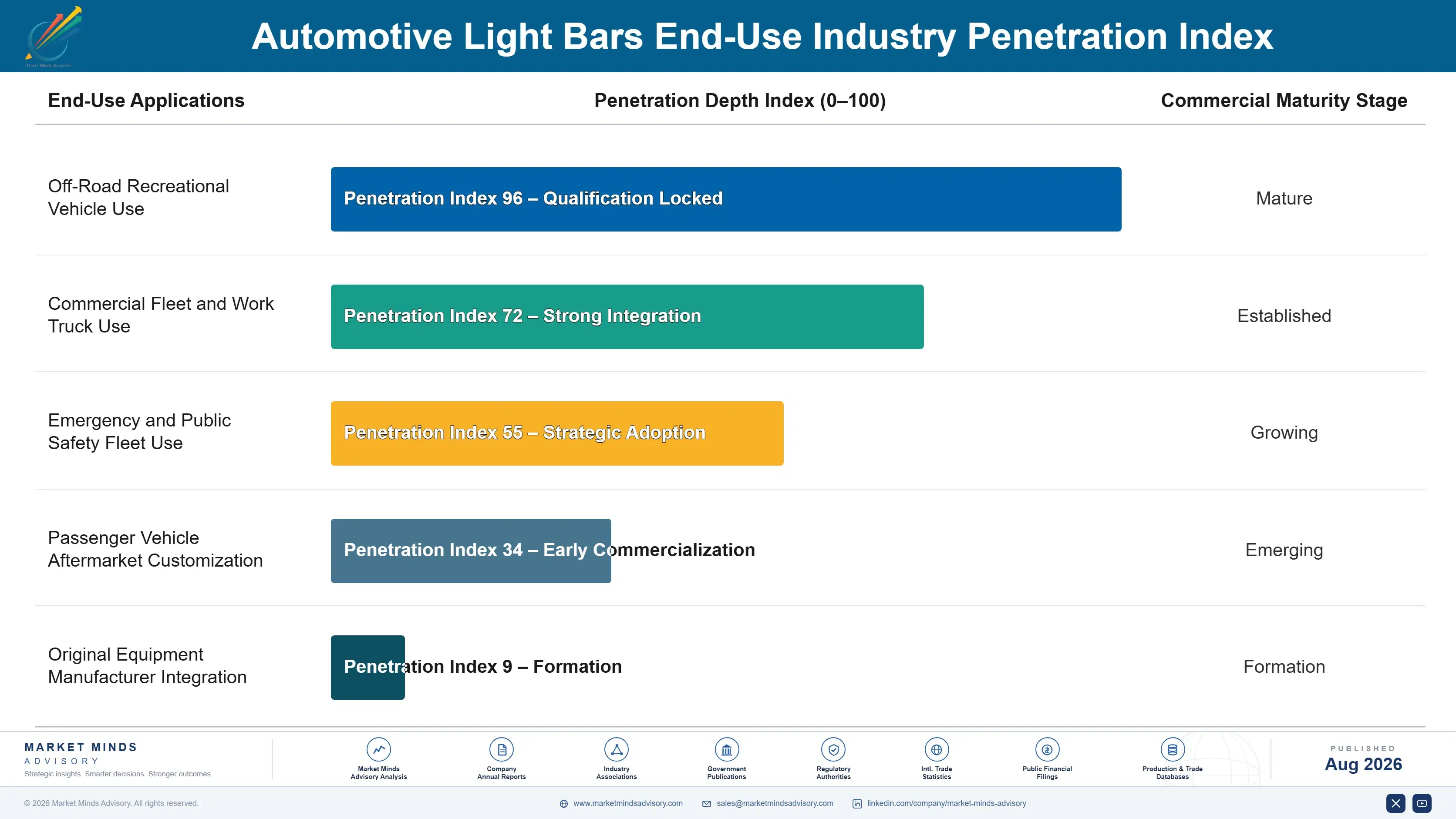
Once a buyer experiences reliable dual-row performance across a full ownership cycle, that brand preference typically persists for subsequent vehicle purchases, since switching to an unproven budget manufacturer requires accepting meaningful thermal reliability risk that most repeat buyers avoid without strong cause. This creates durable, low-churn revenue characteristics for established brands, distinct from the more transactional nature of first-time budget purchases.
Adoption depth varies sharply by end use. Serious off-road enthusiasts and fleet operators show the deepest stickiness, since switching light bar suppliers requires accepting unproven thermal reliability risk that most avoid absorbing without strong cause given prior experience. Casual consumer buyers show similarly moderate stickiness tied to brand recognition and retail availability across purchase cycles. First-time budget buyers show the least stickiness of the three, since these purchases occur more transactionally on standard commodity specifications.

Buyer profiles are shifting as enthusiast communities increasingly weigh thermal reliability and warranty documentation, not just upfront price, as explicit criteria following recent periods of counterfeit product disruption across online marketplaces. Younger enthusiast buyers increasingly favor manufacturers with credible testing validation over pure budget sourcing, a consideration that has grown more prominent following recent quality disruption episodes across multiple retail channels.
automotive-light-bars-market-end-use-penetration-index-1787315367395

Where MMA Sees the Opportunity

These are among the four positions where our research anticipates prominent divergence between winners and laggards over the coming forecast period. Each is grounded in the demand model, the regulatory perimeter, and the announced capacity pipeline.
01 / THERMAL ENGINEERING INVESTMENT

Build Thermal Certification Ahead of Dual-Row Demand

Documented dual-row systems command the strongest pricing power in the entire market, and manufacturers that invest in thermal certification now position themselves well ahead of continued serious off-road buyer adoption through 2036. This capability requires sustained engineering investment across multiple product generations spanning several thermal technologies. Waiting until dual-row demand is obviously dominant risks ceding this documentation advantage to manufacturers who invested earlier and already hold enthusiast trust spanning multiple product cycles and years of accumulated engineering credibility built through consistent performance.
02 / WARRANTY RELIABILITY INVESTMENT

Build Warranty Testing to Deepen Buyer Loyalty

Deep warranty reliability testing capability provides the most direct path to winning long-term buyer loyalty in a market where enthusiast communities increasingly value validated durability over conventional undifferentiated budget products sold on price alone. Manufacturers that invest in testing infrastructure now position themselves well ahead of competitors still selling purely as transactional commodity vendors lacking comparable data. This capability requires substantial testing investment, but manufacturers that achieve deep reliability capability convert investment into recurring, low-churn revenue that smaller competitors cannot easily replicate without comparable years behind them.
03 / FLEET CONTRACT DEVELOPMENT

Secure Long-Term Fleet Procurement Contracts Early

Fleet operators rarely switch warning light suppliers mid-cycle, and manufacturers that secure fleet positions with programs currently expanding gain revenue visibility spanning years of future procurement cycles across multiple municipal and commercial customers. This positioning requires proven component consistency and delivery reliability relative to competing suppliers over sustained periods. Manufacturers that achieve it convert commodity volume into the most durable revenue relationships available in this market, and waiting until programs are already committed risks missing this opportunity entirely, ceding it to competitors that moved earlier.
04 / LED CHIP PARTNERSHIP DEVELOPMENT

Build Chip Partnerships for Durable Supply Access

Direct LED chip sourcing partnership development represents an underappreciated growth opportunity in a market where most manufacturers still compete primarily on distributor-sourced components rather than direct semiconductor manufacturer relationships built over time. Manufacturers that build early partnerships with chip suppliers capture value beyond standard component pricing through recurring, multi-cycle supply relationships spanning successive production runs. This collaboration requires sustained relationship investment, but manufacturers achieving strong supplier integration secure more stable access that pure spot-market buyers cannot match without comparable years of investment behind it.

Engagement Snapshot From the Field

A live engagement with an industry participant carrying material or product regulatory and market exposure ahead of a defining policy shift, showing how our research translates into a defensible multi-year portfolio strategy.
MARKET MINDS ADVISORY · CLIENT ENGAGEMENT SUMMARY
Automotive Light Bars Producer Strategic Portfolio Review and Transition Roadmap 2026·Investment Scenario on Automotive Light Bars Exposure Evaluation 2025-26
CLIENT PROFILE
The client is a mid-sized off-road lighting manufacturer generating substantial annual revenue from a portfolio of single-row and dual-row LED light bar products distributed through independent retailers and online marketplaces across North America. The company was evaluating whether to invest in expanded dual-row thermal engineering capability ahead of anticipated enthusiast demand growth across its core customer base.
STRATEGIC CHALLENGE
The client needed to decide whether to invest approximately $2.8 million (client-reported, unverified by MMA) in expanding its dual-row thermal engineering and testing infrastructure, or continue relying on its existing single-row product engineering capability given uncertain return relative to current competitive positioning and near-term consumer demand signals across its markets.
MMA APPROACH
MMA's advisory team conducted primary interviews with off-road retailers and enthusiast communities about dual-row purchasing intentions, and analyzed comparable manufacturer engineering investment programs to assess realistic competitive positioning and financial impact across multiple planning horizons. The analysis weighed engineering investment against projected premium pricing and long-term brand loyalty benefit across the client's customer relationships.
KEY FINDINGS
  1. Interview data indicated that two major retail chains planned to prioritize documented dual-row thermal certification for upcoming shelf space allocation decisions within the next year.
  2. Comparable manufacturer engineering investment programs typically required 12 to 18 months from capability launch to first documented retail placement and generated revenue.
  3. Retailer procurement teams indicated meaningful willingness to expand shelf space for manufacturers with documented thermal validation capability over undocumented budget rivals lacking data.
  4. Manufacturers that invested in thermal engineering capability ahead of competitors reported stronger retail placement outcomes than peers who retained undocumented product claims during the same period.
CLIENT PROFILE
The client is a mid-sized off-road lighting manufacturer generating substantial annual revenue from a portfolio of single-row and dual-row LED light bar products distributed through independent retailers and online marketplaces across North America. The company was evaluating whether to invest in expanded dual-row thermal engineering capability ahead of anticipated enthusiast demand growth across its core customer base.
STRATEGIC CHALLENGE
The client needed to decide whether to invest approximately $2.8 million (client-reported, unverified by MMA) in expanding its dual-row thermal engineering and testing infrastructure, or continue relying on its existing single-row product engineering capability given uncertain return relative to current competitive positioning and near-term consumer demand signals across its markets.
MMA APPROACH
MMA's advisory team conducted primary interviews with off-road retailers and enthusiast communities about dual-row purchasing intentions, and analyzed comparable manufacturer engineering investment programs to assess realistic competitive positioning and financial impact across multiple planning horizons. The analysis weighed engineering investment against projected premium pricing and long-term brand loyalty benefit across the client's customer relationships.
KEY FINDINGS
  1. Interview data indicated that two major retail chains planned to prioritize documented dual-row thermal certification for upcoming shelf space allocation decisions within the next year.
  2. Comparable manufacturer engineering investment programs typically required 12 to 18 months from capability launch to first documented retail placement and generated revenue.
  3. Retailer procurement teams indicated meaningful willingness to expand shelf space for manufacturers with documented thermal validation capability over undocumented budget rivals lacking data.
  4. Manufacturers that invested in thermal engineering capability ahead of competitors reported stronger retail placement outcomes than peers who retained undocumented product claims during the same period.
RECOMMENDED STRATEGY
Phase 1: Phase 1 (Months 1-5): Establish thermal engineering team and begin durability testing infrastructure development across the entire single-row product line. Phase 2: Phase 2 (Months 6-13): Complete thermal validation and pursue retailer certification across priority distribution accounts identified earlier in the process. Phase 3: Phase 3 (Months 14-17): Execute retail launch support and expand certified capacity, monitoring consumer demand signals closely throughout this period.
OUTCOME
The client completed its thermal engineering capability expansion within fifteen months and secured expanded shelf placement with two major retail chains shortly after completion. The client reported that early thermal investment strengthened its competitive positioning relative to undocumented budget competitors across its broader retail network.

Frequently Asked Questions

Foundational context covering the market sizes, CAGR, scope, country, region and competition that inform every finding below. This section is provided to cover basics and most often pre-purchase conversations, answered from the MMA Primary Research Dataset.

What is the current size of the Automotive Light Bars Market?

The Automotive Light Bars Market was valued at $1.9 billion in 2025. MMA projects it will reach $2.07 billion in 2026 as dual-row LED adoption continues expanding across off-road and fleet segments.

How large will the Automotive Light Bars Market be by 2036?

MMA forecasts the market will reach $4.86 billion by 2036, up from $2.07 billion in 2026. That represents a 2.35 times expansion over the ten-year forecast window.

What is the CAGR for the Automotive Light Bars Market 2026 to 2036?

The market is projected to grow at an 8.9% CAGR between 2026 and 2036. MMA's bull and bear scenarios range from 10.1% to 7.7% depending on recreational vehicle spending pace.

Which segment is growing fastest?

Dual-Row LED Light Bars is the fastest-growing segment, expanding at an 11.4% CAGR, roughly 1.28 times the overall market rate as serious off-road buyer demand accelerates.

Who are the major companies in the Automotive Light Bars Market?

Rigid Industries, KC HiLiTES, Baja Designs, Hella, and Truck-Lite lead the market, together holding an estimated 38% of global production capacity and industry revenue overall.

Which country is growing fastest?

The United States is the fastest-growing country market, expanding at an estimated 10.9% CAGR as off-road recreational culture and dual-row adoption both continue rapid expansion.

Report Segmentation Architecture

The full report scope spans multiple orthogonal segmentation dimensions, with cross-tabulated demand data provided for each dimension pair. Coverage extends further to regional breakdowns, trend trajectories, and the competitive detail needed to support segment-level decision-making.

By Primary Market Dimension

  • Single-Row LED Light Bars
  • Dual-Row LED Light Bars
  • Curved LED Light Bars
  • Emergency and Warning Light Bars
  • OEM-Integrated Light Bar Systems

By End-Use Industry

  • Off-Road Recreational Vehicle Use
  • Commercial Fleet and Work Truck Use
  • Emergency and Public Safety Fleet Use
  • Passenger Vehicle Aftermarket Customization
  • Original Equipment Manufacturer Integration

By Commercial Dimension

  • Aftermarket Retail Distribution
  • Fleet and Municipal Procurement
  • Original Equipment Manufacturer Supply

By Region

  • North America
  • East Asia
  • Western Europe
  • South Asia and Pacific
  • Latin America
  • Middle East and Africa
  • Eastern Europe

Scope, Methodology, and Coverage

Every figure in this report is reproducible from documented input assumptions. The scope below maps the historical period, the forecast horizon, the segmentation dimensions, and the countries covered, alongside the underlying primary and qualitative methodology.
Historical Period
2020 to 2025
Forecast Period
2026 to 2036
Base Year
2025 (USD billions; MMA Primary Research Dataset, August 2026)
Market Definition
This report covers automotive LED and legacy light bars, including single-row, dual-row, and curved off-road lighting units, plus emergency and warning light bars, sold to aftermarket installers, fleet operators, and original equipment automakers for passenger, commercial, and off-road vehicle applications. It excludes standalone headlamp assemblies, interior cabin lighting, and non-automotive industrial floodlights.
Quantitative Units
USD billions (current prices); units shipped where applicable
Segmentation Dimensions
By Light Bar Design Architecture; By End-Use Industry; By Commercial Dimension; By Region
Regions Covered
North America, East Asia, Western Europe, South Asia and Pacific, Latin America, Middle East and Africa, Eastern Europe
Countries Covered
USA, Canada, China, Japan, South Korea, Germany, France, UK, Australia, India, Vietnam, Thailand, Brazil, Mexico, Argentina, Colombia, UAE, Saudi Arabia, South Africa, Poland, Czech Republic, and additional markets relevant to this sector
Key Companies Profiled
Rigid Industries LLC, KC HiLiTES, Inc., Baja Designs, Hella GmbH & Co. KGaA, Truck-Lite Co., LLC, Whelen Engineering Company, Inc., Federal Signal Corporation, ECCO Safety Group, SoundOff Signal, Inc., Vision X Lighting, Nilight, Auxbeam Lighting, ams OSRAM AG, Wurton LED Lighting Co., Ltd., Grote Industries, Inc., Peterson Manufacturing Company, J.W. Speaker Corporation, Valeo SA, Koito Manufacturing Co., Ltd., Stanley Electric Co., Ltd.
Quantitative Methodology
Primary survey, n=3,800 respondents, Q4 2025, six countries; demand-side model with trade association cross-validation
Qualitative Methodology
47 expert interviews, Q4 2025; applied to validate demand model assumptions, identify emerging dynamics, and assess competitive positioning
Report Format
PDF and XLSX data workbook (Word format preview document)
Publisher
Market Minds Advisory
Report Code
MMA-2026-AUT-159
Published
August 2026
Contact
sales@marketmindsadvisory.com | www.marketmindsadvisory.com

Purchase the full Automotive Light Bars Market Report (2026 to 2036).

The full Automotive Light Bars Market report delivers ten-year forecasts across all seven regions, six design architecture segments, and the full competitive landscape of twenty profiled manufacturers. It includes detailed analysis of thermal certification economics, warranty reliability strategies, and demand drivers spanning aftermarket, fleet procurement, and original equipment applications. Buyers receive segment-level margin benchmarking across the volume, premium, and sustainability tiers identified in this summary. The report also includes primary survey data from 3,800 respondents and 47 expert interviews conducted in the fourth quarter of 2025, supporting every demand and pricing assumption in the forecast.
Ten-year regional and segment-level forecast models
Competitive profiles covering twenty light bar manufacturers
Thermal certification economics and pricing analysis
Warranty reliability and brand loyalty mapping
Portfolio margin benchmarking across three commercial tiers
Primary survey and expert interview data appendix

Built For The People Who Decide

From boardroom strategy to bench-side execution, this report is read cover-to-cover by leaders shaping the next decade of their industry, turning demand scenarios, market dynamics and valuation benchmarks into decisions.
CXOs/ Presidents/ VPs/ Managers
M&A and Corporate Development
Strategy Teams and R&D Heads
Procurement and Product Directors
Regulatory and Compliance Leaders
Investor Relations and Equity Analysts