
Market Minds Advisory
Automotive Brake System Market

Automotive Brake System Market: Automotive Brake Systems: Electric Cars Barely Use The Brakes

A commercial reading of vehicle braking, where regenerative capture removes most of the friction work an electric car ever needs, and the parts business built on wear has to find another reason to exist.

Lead Analyst

David Horsley

Published

August 2026

Make Smarter Decisions with Customized Research Insights

Request a free sample report and evaluate market opportunities, growth trends, and competitive dynamics relevant to your business needs.

2025 MARKET VALUE$27.8BMarket Size 2025
2036 FORECAST VALUE$55.0BBase Case , 2026 to 2036
CAGR 2026 TO 20366.4 %Bull 7.6% / Bear 5.2%
INCREMENTAL OPPORTUNITY$25.4BNet 10- year value creation
EXPANSION MULTIPLE1.86x2036 value over 2026 base
Strategic Levers
M&A Pipeline
Regional Outlook
Country Rankings
Competitive Intelligence
Segmental Deep-dive
Call-Us : 91 93563 13602

Executive Snapshot and Market Trajectory.

An electric car recovers most of its deceleration energy through the motor, which means the friction brakes do a fraction of the work they used to. Pads last longer, discs corrode from disuse, and the aftermarket built on replacement intervals cannot price its way out of it.
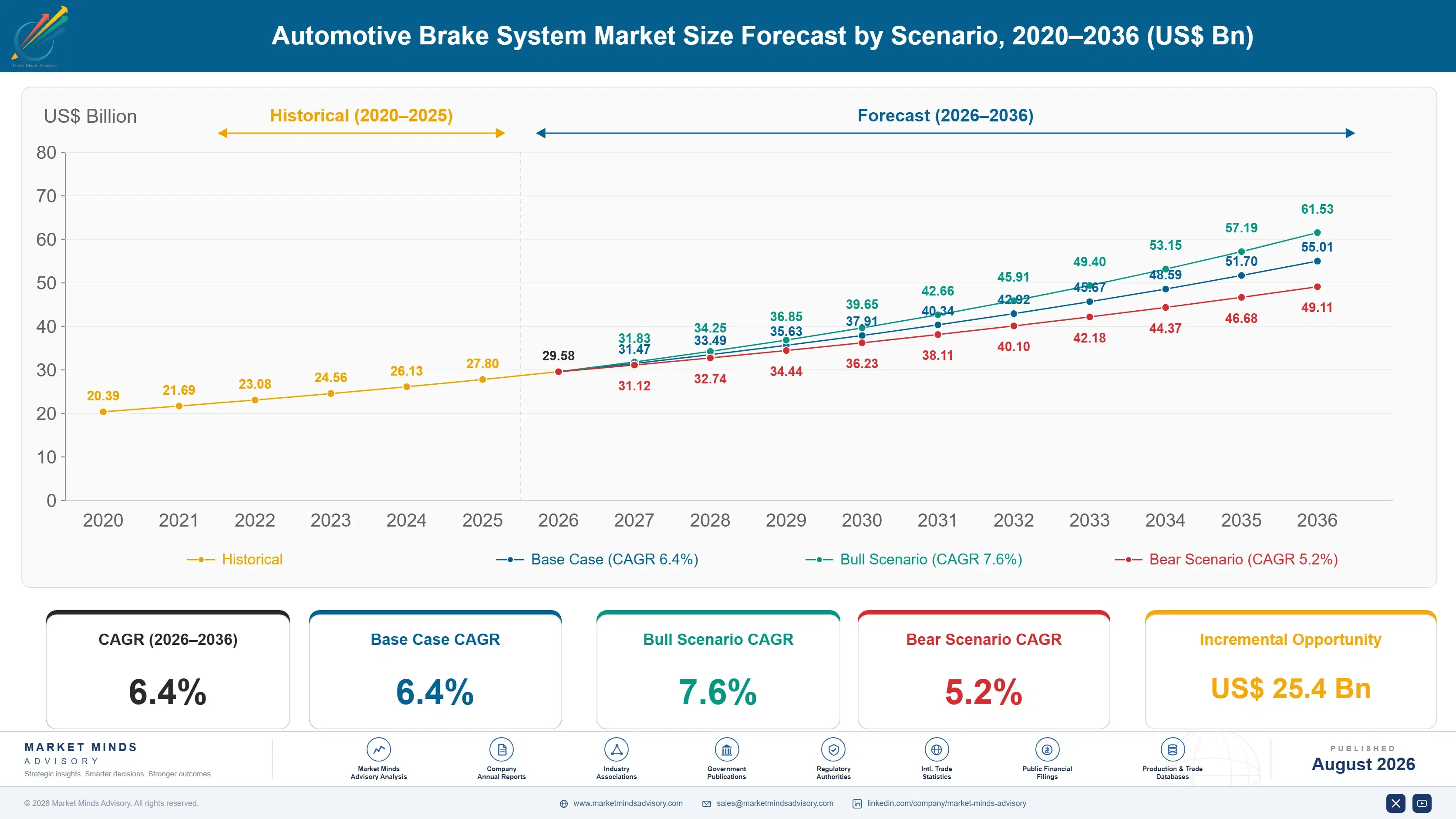
The market stands at USD 27.8 billion in 2025 and reaches USD 55.01 billion by 2036 at a 6.4% CAGR. Brake-by-wire and electromechanical actuation grow fastest at 16.4%, about 2.56 times the overall rate, as vehicle architectures remove the hydraulic column entirely. East Asia holds 30% of value on vehicle production volume, while India posts the quickest national growth at 10.2%. Content per vehicle rises as duty cycles fall.
Concentration is high, with the top five holding roughly 44% of brake system revenue because safety validation and platform integration both favour incumbents heavily. Two forces pull in different directions. Regulated safety content keeps rising as autonomous features demand redundant actuation, while regenerative braking removes friction duty cycles and the wear-parts revenue that funded much of the industry for a century. Content growth and volume erosion are arriving together on exactly the same platforms.
Market Definition
The automotive brake system market covers components and assemblies that decelerate a road vehicle through friction or electromechanical actuation, spanning friction materials, brake discs and drums, hydraulic actuation and boosters, electronic control units and stability systems, and brake-by-wire and electromechanical actuation. Tyres, wheel bearings and suspension components, complete chassis modules sold as a system, brake fluid and lubricants sold as chemical products, regenerative motor and inverter hardware, and vehicle service and repair labour are excluded.
Base Year Value
$27.8B in 2025 (MMA Primary Research Dataset, August 2026)
Forecast Period
2026 to 2036, eleven discrete annual values
CAGR
6.4% base case. Bull 7.6%. Bear 5.2%.
Fastest Growth Segment
Brake-by-Wire and Electromechanical Actuation: 16.4% CAGR
Fastest Growth Country
India: 10.2% CAGR
Fastest Growth Region
South Asia and Pacific: 8.6% CAGR
Largest Region
East Asia: 30% of 2025 global value
Market Leaders
Bosch, Continental, ZF Friedrichshafen, Brembo, Aisin. Source: MMA Analysis based on company annual reports.
Primary Survey
n=3,800 procurement and R&D decision-makers, Q4 2025, six countries
Methodology
Demand-side build-up, cross-validated against public data, 47 expert interviews

Automotive Brake System Market Forecast Scenarios

automotive-brake-system-market-size-forecast-scenario-1787331975742
Growth from 2020 to 2025 compounded near 5.3%, and production disruption rather than any change in braking shaped the period. Semiconductor shortages cut vehicle output through 2021 and 2022, which hit original equipment volume while the aftermarket held steady on an ageing parked fleet. Electric vehicle share meanwhile rose fast enough that friction wear rates began falling in the newest cohort of vehicles.
Three mechanisms carry the base case to 6.4%. First, safety content escalation, where automated driving features require redundant actuation and electronic control that add value per vehicle regardless of unit volume. Second, brake-by-wire adoption, which replaces hydraulic hardware with electromechanical actuators at considerably higher content. Third, vehicle production recovery in emerging markets, where unit growth still exists and friction duty cycles remain conventional because electrification is slower. Content rather than units carries it.
The bull case at 7.6% assumes automated driving redundancy requirements arrive on schedule and brake-by-wire penetrates faster than platform cycles suggest. The bear case at 5.2% assumes regenerative braking cuts friction replacement demand harder than expected, aftermarket volumes fall as the electric parked fleet grows, and vehicle production stays flat across mature markets while price pressure from Chinese suppliers continues to intensify.

Content Per Vehicle Rises As Duty Cycles Fall

Demand rests on three foundations. Vehicle production provides the unit base, since every vehicle needs brakes and that has not changed in a century. Safety regulation provides the content growth, because automated driving features require redundant actuation and electronic control that add several hundred dollars per vehicle. And electrification provides the offsetting drag, since regenerative capture cuts friction wear by 60% to 80% and the aftermarket depends on that wear.
MARKET CONCENTRATIONCR5: 44%Concentrated because safety validation and platform integration favour incumbents
FRICTION WEAR REDUCTION60% to 80%Lower pad consumption on a regenerating electric vehicle
CONTENT PER VEHICLEUSD 320 to 900Brake system value across conventional and automated platforms
AFTERMARKET REVENUE SHAREAbout 38%Replacement parts against original equipment in supplier revenue
PLATFORM VALIDATION TIMELINE3 to 5 yearsSafety qualification period before a system reaches production
PAD REPLACEMENT INTERVAL30 to 90 thousandKilometres between friction replacements across different drivetrain types
Commercially the two trends move in opposite directions and roughly cancel on revenue while transforming its composition. Content per vehicle runs from about USD 320 on a conventional platform to USD 900 where redundant actuation is fitted, so original equipment value rises. Aftermarket at 38% of supplier revenue is where the damage lands, because a pad that lasts three times longer is a replacement that never happens.
The next decade turns on brake-by-wire penetration and what happens to discs. Removing the hydraulic column raises content substantially and grows at 16.4%, but validation takes three to five years and platform cycles govern the pace. Meanwhile electric vehicles corrode discs from disuse rather than wearing them out, which changes the failure mode and creates a replacement reason nobody designed for.
"Every brake supplier presentation now leads with content per vehicle, and the reason is that nobody wants to open with what regeneration did to pad volumes. Both numbers are real. Only one of them was in anybody's plan five years ago."
Director, Automotive Chassis and Safety Systems Practice · MMA Automotive / Chas

Market Trends

Regenerative Capture Removes Most Friction Duty Cycles

An electric vehicle recovers deceleration energy through the motor and calls on friction brakes only for hard stops and low-speed holding, which cuts pad consumption by 60% to 80% against a comparable combustion vehicle. Replacement intervals stretch from thirty thousand kilometres toward ninety thousand and beyond. The commercial consequence lands squarely on the aftermarket, which is roughly 38% of supplier revenue and was built entirely on predictable wear. Discs now corrode from disuse rather than wearing thin, which is a different failure mode with a different replacement trigger. Nobody designed a business around corrosion.
Market Impact: Segment grows at 16.4% yearly
Automated Driving Requires Redundant Brake Actuation

A vehicle expected to stop itself without a driver needs a braking path that survives single-point failure, which means two independent actuation systems rather than one hydraulic circuit with a vacuum booster. That requirement raises content per vehicle from roughly USD 320 toward USD 900 and pulls electronic control, software validation, and functional safety engineering into what used to be a mechanical business. Validation takes three to five years per platform. Suppliers without functional safety capability are being designed out rather than outbid. Mechanical suppliers are losing this segment on capability alone.
Market Impact: India parc grows 8% yearly

Market Opportunities and Growth Drivers

Brake-By-Wire Removes Hydraulics And Raises Content

Replacing the hydraulic column with electromechanical actuators at each corner eliminates fluid, lines, master cylinder, and booster, and it lets pedal feel be tuned in software rather than in hardware. Content per vehicle rises substantially and the segment grows at 16.4% against a market at 6.4%. Packaging freedom matters to vehicle architects who want the front compartment for other things. Adoption follows platform cycles rather than any customer demand, since nobody buys a car for its brake actuation, which makes the timing predictable and slow. Model cycles rather than demand set the timing.
Market Impact: Aftermarket is 38% of revenue

Emerging Market Production Retains Conventional Duty Cycles

Vehicle output in India, Southeast Asia, and much of Latin America is still overwhelmingly combustion or mild hybrid, which means friction brakes carry the full deceleration load and wear on conventional intervals. That preserves the replacement volume mature markets are losing and it grows with vehicle parc rather than shrinking with it. Two-wheeler and light commercial demand adds further friction volume at lower content. This is where the wear-parts business still behaves the way the industry's historical planning assumptions expected. Historical planning assumptions still hold in these markets, which is now unusual.
Market Impact: Validation runs 3 to 5 years

Market Restraints and Challenges

Aftermarket Volume Falls As The Electric Parc Grows

Replacement parts are roughly 38% of supplier revenue and depend on wear that regenerative braking largely eliminates, so every electric vehicle entering the parked fleet removes future demand. The root cause is physics rather than competition: energy recovered through the motor is energy not converted to heat in a friction pad. Commercially this erodes the highest-margin revenue in the industry. Suppliers mitigate by targeting corrosion-driven disc replacement, moving into electronic module service, and expanding in markets where combustion vehicles still dominate. Physics rather than any competitor is the one removing this revenue.
Market Impact: Pad wear falls 60% to 80%

Functional Safety Validation Excludes Smaller Suppliers

Automated braking systems require hazard analysis, redundancy architecture, software validation, and documentation to automotive functional safety standards, and platform qualification runs three to five years before a single unit ships. The root cause is that a brake failure on an autonomous vehicle has no driver to recover it. Commercially this excludes suppliers without systems engineering capability from the growth segments entirely. Participants mitigate through partnerships with control system specialists, acquiring software capability, and concentrating on friction and foundation components instead. Foundation friction and castings are where excluded suppliers end up competing.
Market Impact: Content rises toward USD 900
4 additional market trends, 3 additional growth drivers, and 2 additional restraints and challenges are covered in the full report. Contact sales@marketmindsadvisory.com to access the complete intelligence.

Segment CAGR and Growth Architecture

Segmentation follows brake system component group, a single classification describing the functional element within the braking system. Each group carries its own manufacturing base, validation burden, wear behaviour, and aftermarket attachment, so economics track the component rather than the vehicle it is fitted to. End-use vehicle type and sales channel appear separately within the framework as their own distinct dimensions.
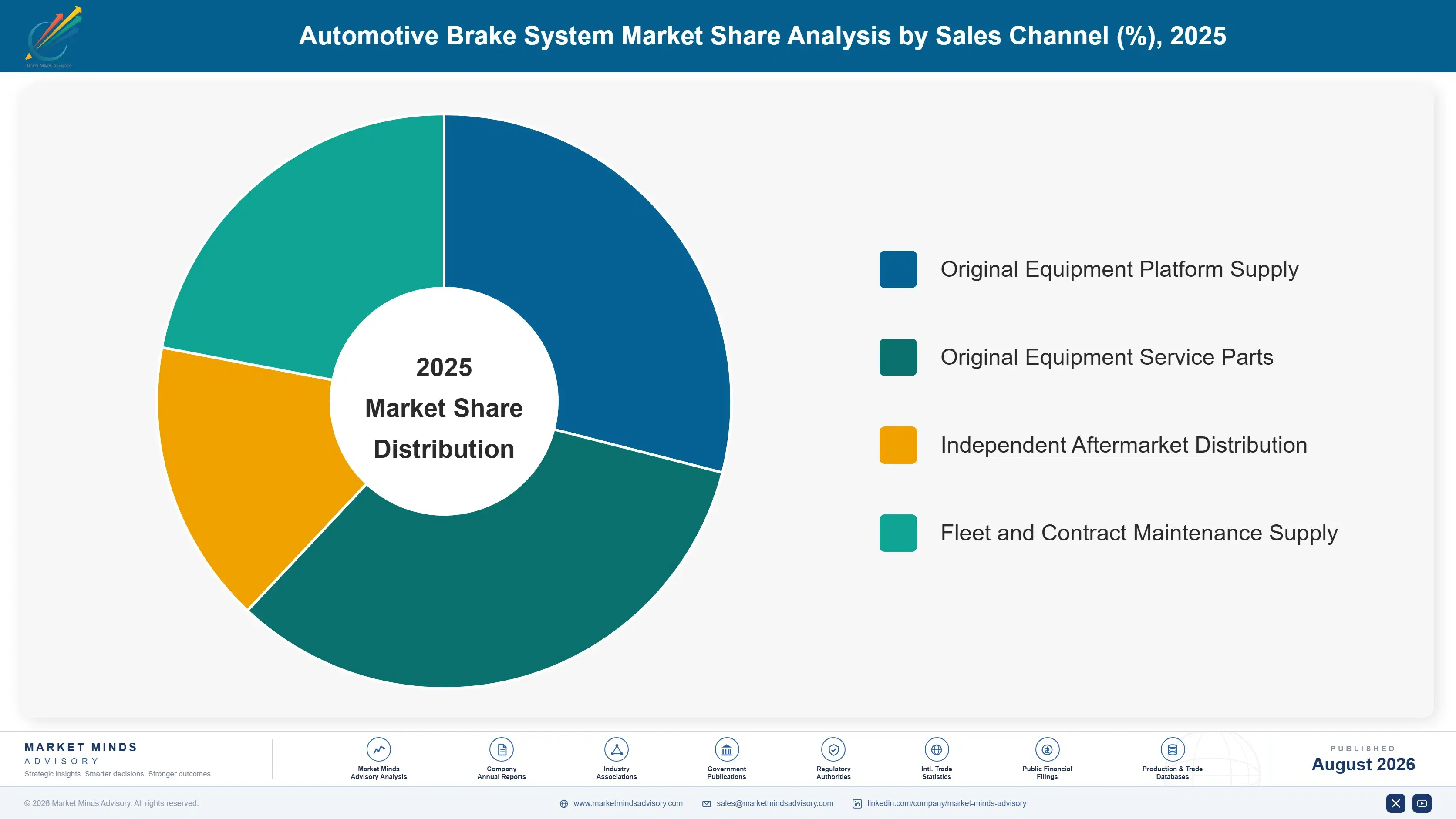
automotive-brake-system-market-market-share-analysis-1787331976274

Brake-by-Wire and Electromechanical Actuation

Brake-by-wire and electromechanical actuation grow fastest at 16.4%, about 2.56 times the overall 6.4% rate, and vehicle architecture rather than braking performance drives it. Removing the hydraulic column eliminates fluid, lines, master cylinder, and booster while letting pedal feel be tuned in software, which appeals to architects who want the front compartment for other things. Automated driving redundancy requirements make it close to mandatory on higher automation levels. Content per vehicle rises substantially and functional safety engineering becomes the qualifying capability. Validation takes three to five years per platform, so adoption follows model cycles rather than any customer pull. Nobody buys a vehicle for its brake actuation, which makes adoption predictable.
CAGR 16.4%

Electronic Control Units and Stability Systems

Electronic control units and stability systems grow at 7.6%, the second-fastest group, on regulated content that keeps expanding rather than on any volume growth. Antilock braking and stability control are mandatory across most markets, and automatic emergency braking mandates have extended electronic content into vehicles that would previously have carried none. Each new intervention function adds sensing, software, and validation rather than hardware mass. Aftermarket attachment is weak because these units rarely fail and are seldom replaced, which makes the segment original equipment dependent in a way friction components never were. Software validation is the real barrier here. Regulated content escalation rather than any unit volume growth carries this whole segment.
CAGR 7.6%
Full segment breakdown across 5 segments available in the complete report.

Regional Architecture and Country Demand Map

Vehicle production and electrification pace together set this distribution rather than vehicle parc alone. East Asia leads on output volume, while South Asia and Pacific grows quickest because unit production is still rising and friction duty cycles remain conventional throughout. Electrification pace decides where wear revenue survives.

North America

North America holds 24% of value on light truck and sport utility production where vehicle mass makes brake content higher than the passenger car average anywhere else. Automatic emergency braking requirements have raised electronic content across the fleet, and automated driving development concentrates here alongside the redundant actuation it demands. The aftermarket is unusually large and profitable because the parked fleet is old, distances travelled are long, and independent repair is well established. Electrification is advancing fast enough that friction replacement volumes are already softening in the newest cohort. Growth of 5.8% reflects content escalation against that aftermarket erosion. Corrosion complaints on electric platforms are already appearing in warranty data here.
Share: 24% | CAGR: 5.8% (2026 to 2036)

Western Europe

Regulation and electrification move faster here than anywhere and both cut in the same direction. Western Europe holds 23% of value, with brake particulate emission rules now regulating what pads may shed as well as how vehicles stop, which forces friction material reformulation across the industry. Electric vehicle share is high enough that regenerative braking is measurably reducing pad consumption across the fleet. German suppliers dominate the electronic and brake-by-wire end while Italian specialists hold performance friction and calipers. Growth of 5.0% is the slowest of the seven regions, reflecting flat output and a shrinking friction replacement base. Reformulation cost lands on suppliers while the wear volume funding it disappears.
Share: 23% | CAGR: 5.0% (2026 to 2036)
Regional intelligence for 5 additional markets available in the complete report: East Asia, South Asia and Pacific, Latin America, Middle East and Africa, Eastern Europe. Contact sales@marketmindsadvisory.com.
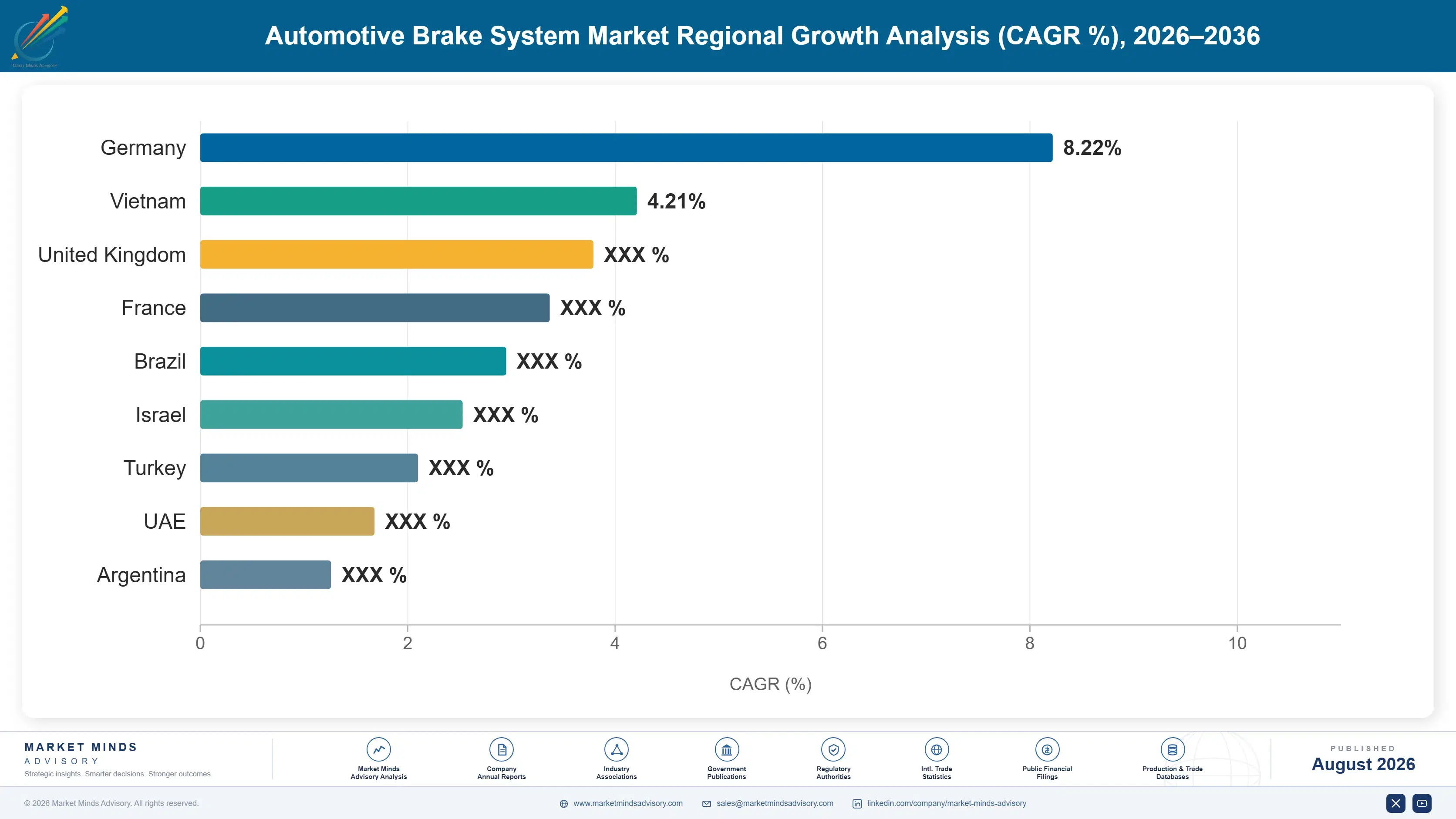
automotive-brake-system-market-country-cagr-analysis-1787331976778

Where Brake Suppliers Actually Defend Earnings

Selling friction on replacement intervals is a business regenerative braking is quietly dismantling. The four moves below reach earnings that survive it: functional safety capability, corrosion-driven disc replacement, particulate-compliant friction, and design-stage position on platforms that decide content years ahead of production. None of them is a price argument, and all four take years to build.

Build Functional Safety Capability Or Lose The Growth

Automated braking demands hazard analysis, redundancy architecture, and software validation to automotive functional safety standards, and platform qualification runs 3 to 5 years before anything ships. Suppliers without that systems engineering capability are being designed out of brake-by-wire and electronic control entirely rather than outbid on price. Those two segments carry all the content growth, at up to USD 900 per vehicle against roughly USD 320 conventional. Acquiring or partnering for the capability costs real money and takes years, and there is no cheaper route to it. There is no cheaper route into the growth.
Market Impact: Content can reach USD 900 per vehic

Chase Corrosion Replacement Rather Than Wear Replacement

Electric vehicles barely wear their discs and corrode them instead, because friction surfaces that never get hot enough to shed rust degrade from disuse. That is a different failure mode with a different replacement trigger, and it is the one aftermarket reason electrification creates rather than destroys. Coated discs, corrosion-resistant alloys, and drum brakes on rear axles all address it. Suppliers still forecasting aftermarket volume from historical wear curves are modelling a mechanism that has largely stopped operating in the newest fleet. Wear falls 60% to 80% and corrosion does not.
Market Impact: Friction wear falls 60% to 80% on e

Reformulate Friction Ahead Of Particulate Regulation

European rules now regulate what a brake pad sheds as well as how it stops, which turns friction chemistry into a compliance question rather than a performance one. Reformulation requires revalidation of noise, fade, and wear behaviour across every affected platform, which takes years and cannot be rushed. Suppliers qualified on compliant formulations when a manufacturer requalifies capture the platform, and those arriving later quote against a specification already written. Regulation of this kind spreads between jurisdictions faster than product development cycles allow. Only 3 of a typical 11 formulation families adjust without redevelopment.
Market Impact: European rules now regulate 2 non-e

Win The Platform At Design, Not At Sourcing

Brake content is fixed during vehicle architecture decisions taken 3 to 5 years before production, and by the time a sourcing package is issued the system concept, packaging, and redundancy approach are already set. A supplier engaged with the vehicle architect shapes what is possible and is qualified by default. One engaged at sourcing responds to a specification built around a competitor's capability. This matters far more now that brake-by-wire packaging decisions interact with everything else in the front of the vehicle. Overturning a settled architecture decision is close to impossible.
Market Impact: Architecture decisions precede prod

Who Controls the Margin Pool

Concentration is high: the top five hold roughly 44% of brake system revenue, because safety validation, platform integration, and functional safety capability all favour incumbents heavily. The gap between leaders and challengers is systems engineering rather than friction chemistry or casting quality, both of which are widely held. All participants here are assessed on one basis, revenue from brake system components and assemblies, excluding tyres, suspension, brake fluid as a chemical, and ve
Competition runs along four lines. First, functional safety capability, since automated braking cannot be supplied without it. Second, design-stage access to vehicle architects, who fix content years before sourcing. Third, particulate-compliant friction formulation, now a regulatory requirement rather than a performance claim. Fourth, aftermarket distribution reach, which still carries the margin even as its volume base erodes.

Pressure is building from two directions. Chinese suppliers have moved from foundation components into electronic control and brake-by-wire faster than expected, at costs Western suppliers struggle to match. Meanwhile regenerative braking is eroding the aftermarket that funded incumbent development budgets. Rankings should favour suppliers with functional safety capability and corrosion-focused aftermarket positions over those defending friction replacement volume alone.
automotive-brake-system-market-company-positioning-matrix-1787331977296

Competitive Moat and Risk Dimensions

BOSCH

Moat: Systems engineering and platform breadth

Bosch holds functional safety and software capability across braking, steering, and driver assistance that very few suppliers can match, which matters when automated braking is a systems problem rather than a component one. Its design-stage relationships with vehicle architects fix content years before sourcing packages appear. Breadth across electronic control, actuation, and foundation brakes lets it supply a complete system.
BOSCH

Risk: Aftermarket erosion and Chinese cost

A substantial aftermarket business depends on friction replacement that regenerative braking is measurably reducing across electrifying fleets. Chinese suppliers now compete credibly on electronic control at costs that European engineering overheads cannot approach. Breadth across many automotive systems also means brake investment competes internally against steering, assistance, and powertrain programmes for the same development capacity.
BREMBO

Moat: Performance friction and brand position

Brembo holds a genuine brand position in performance braking that reaches both vehicle manufacturers and end consumers, which is rare in a component business and supports pricing accordingly. Caliper and disc engineering depth serves premium and motorsport applications where specification rather than cost decides. Its move into sensor-equipped and software-enabled braking addresses the electronic shift from a credible engineering base.
BREMBO

Risk: Premium exposure and electrification

Revenue concentrates in premium and performance vehicles where volumes are small and cyclical, and where electrification reduces friction duty cycles just as sharply as elsewhere. Functional safety and software scale are thinner than the largest systems suppliers hold, which limits access to full brake-by-wire packages. Aftermarket exposure also sits in the segment most affected by regenerative wear reduction.

Players Tracked

Prominent Players

Bosch
Continental
ZF Friedrichshafen
Brembo
Aisin

Other Key Players

Akebono Brake Industry
Hitachi Astemo
HL Mando
Knorr-Bremse
Tenneco
TMD Friction
Nisshinbo Holdings
Sumitomo Electric Industries
Endurance Technologies
Brakes India
Fras-le
EBC Brakes
ITT Friction Technologies
SBS Friction
Rane Brake Lining

Recent Developments

JANUARY 2025

European brake particulate limits enter phased application

Vehicle emission rules covering brake and tyre particulate began phased application, regulating what friction material may shed rather than only how a vehicle stops. This was European regulation taking effect rather than a commercial transaction, and it obliged friction suppliers to reformulate and revalidate across affected platforms on fixed timetables.
Signal: Friction chemistry became a compliance que
AUGUST 2024

Brake-by-wire programmes reach series production commitments

Several vehicle manufacturers committed electromechanical brake actuation to production platforms, removing hydraulic columns in favour of software-tuned pedal feel and packaging freedom. These were platform sourcing decisions rather than acquisitions, and each locks a supplier in for the model cycle after three to five years of validation.
Signal: Platform sourcing on brake-by-wire fixes s
APRIL 2024

Chinese suppliers qualify electronic brake systems with global manufacturers

Chinese brake suppliers completed qualification on electronic stability and control systems for vehicle manufacturers outside China, moving beyond the foundation components they had historically supplied. These were qualification milestones rather than corporate transactions, and they extended cost pressure into segments incumbents had treated as protected.
Signal: Cost competition arriving in electronic co

Iron Castings, Friction Compounds, Electronics, Aluminium

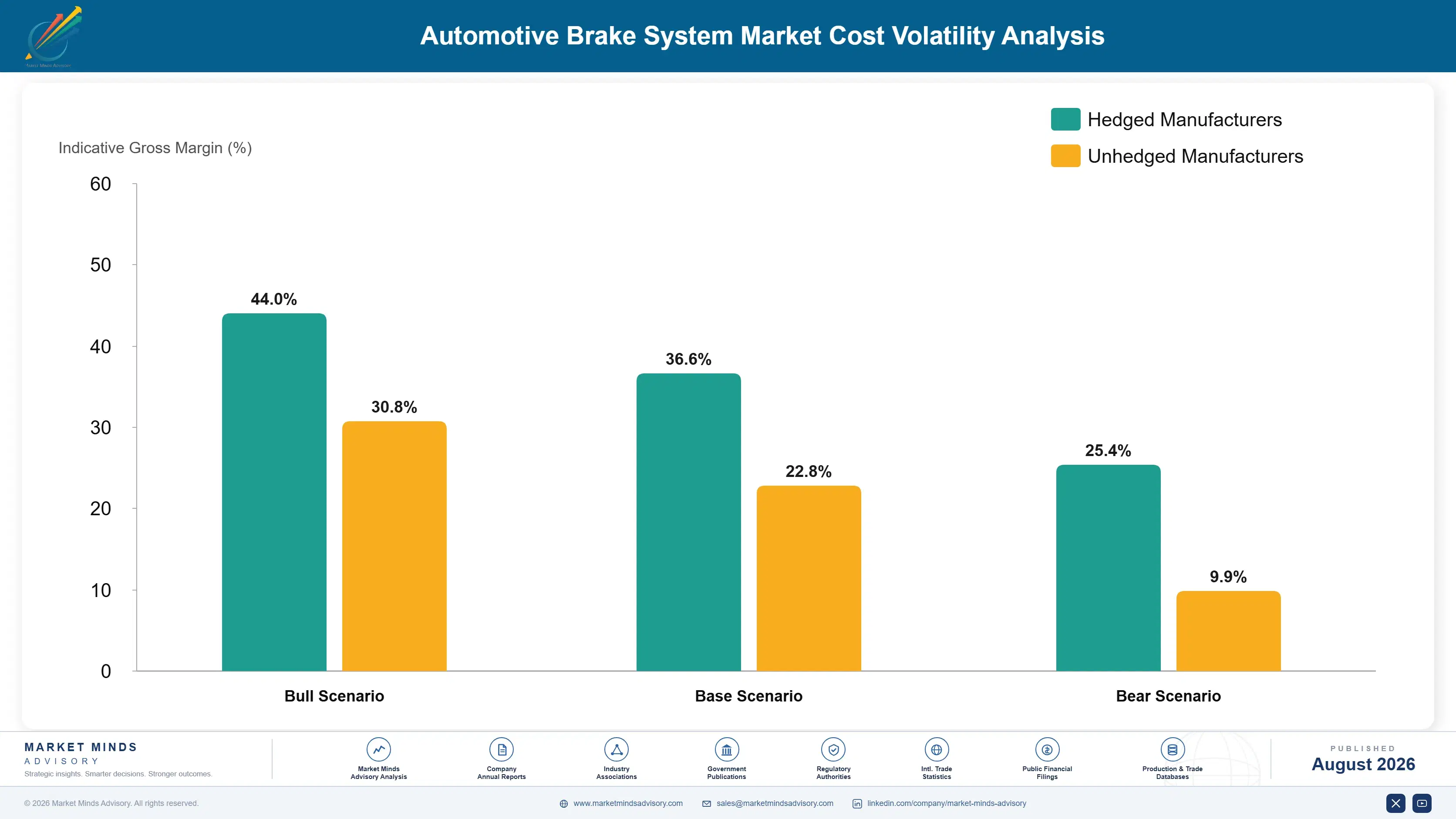
Materials and purchased electronics divide this cost sheet between the mechanical and electronic halves of the business. Grey iron castings for discs and drums run 26% to 36% of foundation component cost, sourced from foundries whose capacity has contracted across Europe and America. Friction compounds including steel fibre, copper substitutes, and binders add 18% to 26%. Semiconductors and sensors dominate electronic module cost at 40% to 55%.
Foundry closures and steel pricing tightened casting supply through 2021 and 2022 while the semiconductor shortage simultaneously constrained electronic module output, so both halves of the business were short at once. Continental and ZF Friedrichshafen both disclosed material and supply chain cost pressure across those reporting periods. European energy costs then compounded the casting problem, with IEA analysis recording industrial gas at several times prior-year levels.

Exposure separates by vertical integration and content mix rather than by scale. A supplier casting its own discs controls cost and lead time on the heaviest input, while one buying castings carries a shrinking supplier base's pricing. Content mix matters more, since a supplier weighted toward electronic modules carries semiconductor exposure while one weighted toward friction carries copper substitution and particulate compliance cost instead.
automotive-brake-system-market-cost-volatility-analysis-1787331977491

Secure foundry capacity for disc and drum castings

Grey iron casting capacity has contracted across Europe and North America while demand has not, which makes lead time rather than price the binding constraint whenever the market tightens. Long-term agreements cost commitment and occasionally leave volume unused. They also mean production continues when competitors quote extended deliveries, which wins platform work that no pricing argument reaches during a shortage.

Qualify copper-free friction formulations ahead of mandate

Copper restrictions in friction material are already law in parts of North America and particulate rules now reach Europe, so reformulation is a matter of timing rather than choice. Qualifying compliant compounds requires revalidating noise, fade, and wear across affected platforms, which takes years. Doing it before a manufacturer requalifies captures the platform rather than responding to somebody else's specification.

Dual-source semiconductors across every control module

Semiconductors and sensors are up to 55% of electronic module cost and the 2021 shortage demonstrated that allocation rather than price decides who can build. Qualifying alternative devices costs validation time and functional safety re-documentation, which is why so many suppliers deferred it. Single-sourced control silicon in a safety-critical module is a production risk rather than a purchasing preference.

Portfolio Architecture for Margin Defence

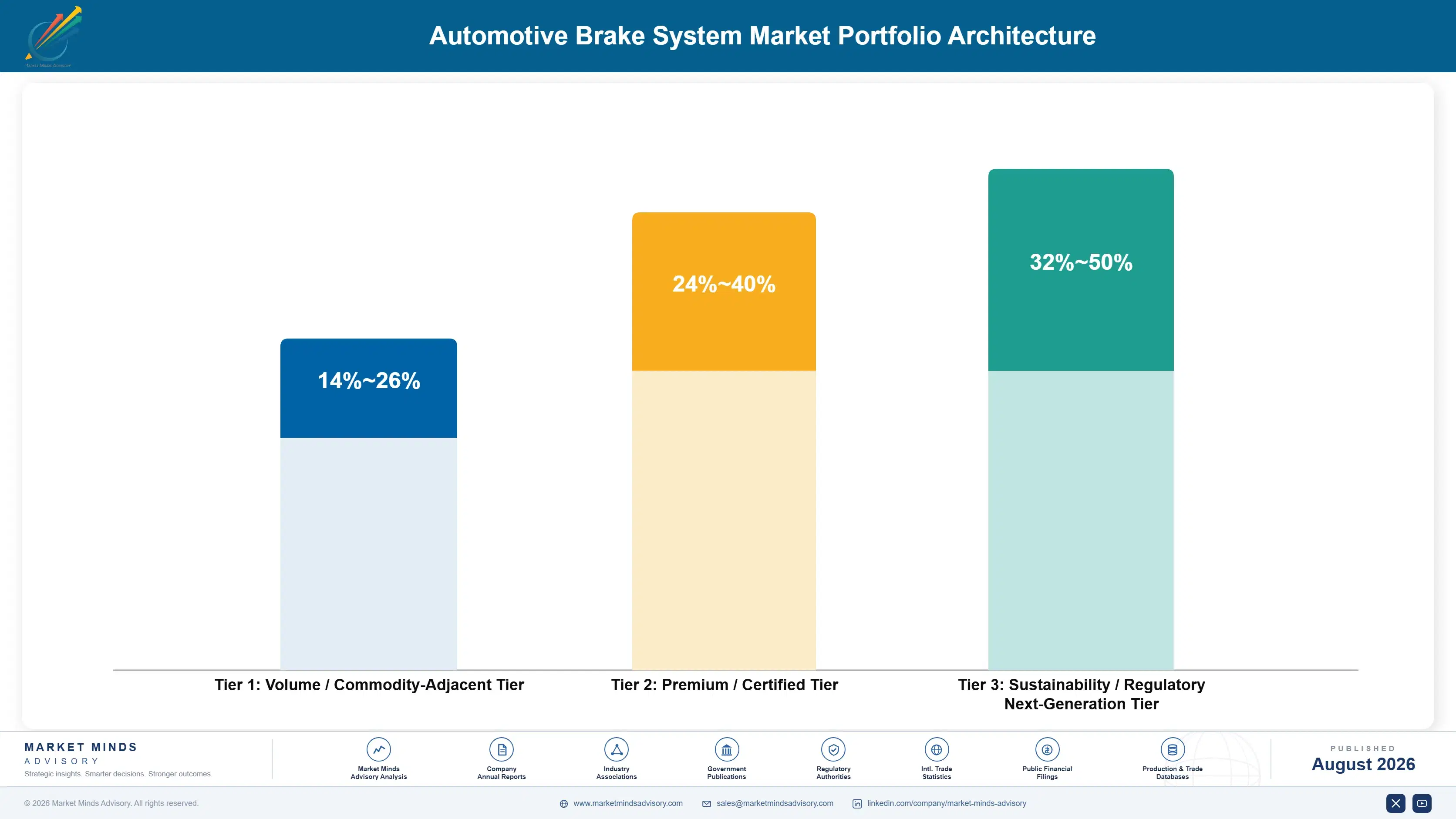
The portfolio splits into three tiers with different economics. Foundation friction and castings form the volume tier, where casting cost and friction chemistry are widely held and price decides most awards. Electronic control units and premium calipers earn more because validation and specification narrow the field considerably. Brake-by-wire actuation and particulate-compliant friction price against capability and regulation rather than against a competing quotation.
The tension runs between foundation volume that fills the plant and electronic content that earns the return. Discs, drums, and standard friction keep foundry commitments and assembly lines loaded, cover fixed cost, and hold the platform relationships through which electronic work arrives. Yet they compete against Chinese and Indian suppliers on cost that Western plants cannot reach. Suppliers handling this well accept thin foundation margin while directing engineering toward functional safety capability.

High-value pools concentrate where validation or regulation limits competition: brake-by-wire actuation requiring functional safety documentation, electronic control with automated driving redundancy, particulate-compliant friction qualified ahead of mandate, and corrosion-resistant discs for electric platforms. All four escape the cost-per-part comparison. Standard grey iron discs sit at the other end, where a dozen foundries meet the drawing and the sourcing package sets the price every cycle.

Volume / Commodity-Adjacent Tier

Grey iron discs and drums, standard friction pads, and hydraulic hardware sold on cost per part. The range is wide because foundry integration and regional energy cost separate suppliers enormously at identical quoted prices.
Gross Margin: 14-26%

Premium / Certified Tier

Electronic stability and control modules, performance calipers, and premium friction with brand position. The range is wide because software validation depth varies sharply and premium brand pricing is available to very few suppliers.
Gross Margin: 24-40%

Sustainability / Regulatory / Next-Generation Tier

Brake-by-wire actuation, redundant systems for automated driving, particulate-compliant friction, and corrosion-resistant discs. The range is wide because functional safety capability is scarce while newer actuation still carries unrecovered development cost.
Gross Margin: 32-50%
automotive-brake-system-market-portfolio-architecture-1787331977986

High-value Sub-segments and Strategic Watch-out

Brake-by-Wire and Electromechanical Actuation

High value and high growth at 16.4%, the fastest group, on architecture freedom and automated driving redundancy rather than braking performance. Functional safety capability is the qualifying condition, and validation of three to five years means platform sourcing decides a model generation. Capability rather than price decides it.
Gross Margin: 32-50%

Electronic Control Units and Stability Systems

High value with strong growth at 7.6% on regulated content that keeps expanding through new intervention functions. Aftermarket attachment is weak because these units rarely fail, which makes the segment far more dependent on original equipment than friction ever was. Original equipment dependence is the real weakness.
Gross Margin: 24-40%

Friction Materials

The volume core by a wide margin, growing at 5.8% and squeezed between regenerative wear reduction and particulate reformulation cost. Aftermarket margin here funded the industry for a century and the wear mechanism behind it is quietly disappearing from newer fleets. A century of aftermarket margin is unwinding.
Gross Margin: 18-32%

Brake Discs and Drums

The strategic watch-out, growing at 5.2% with a failure mode shifting from wear to corrosion on electric platforms. Casting cost dominates, foundry capacity has contracted, and coated or corrosion-resistant variants are the only route to any pricing differentiation. Coated variants are the only real differentiation available here.
Gross Margin: 14-26%

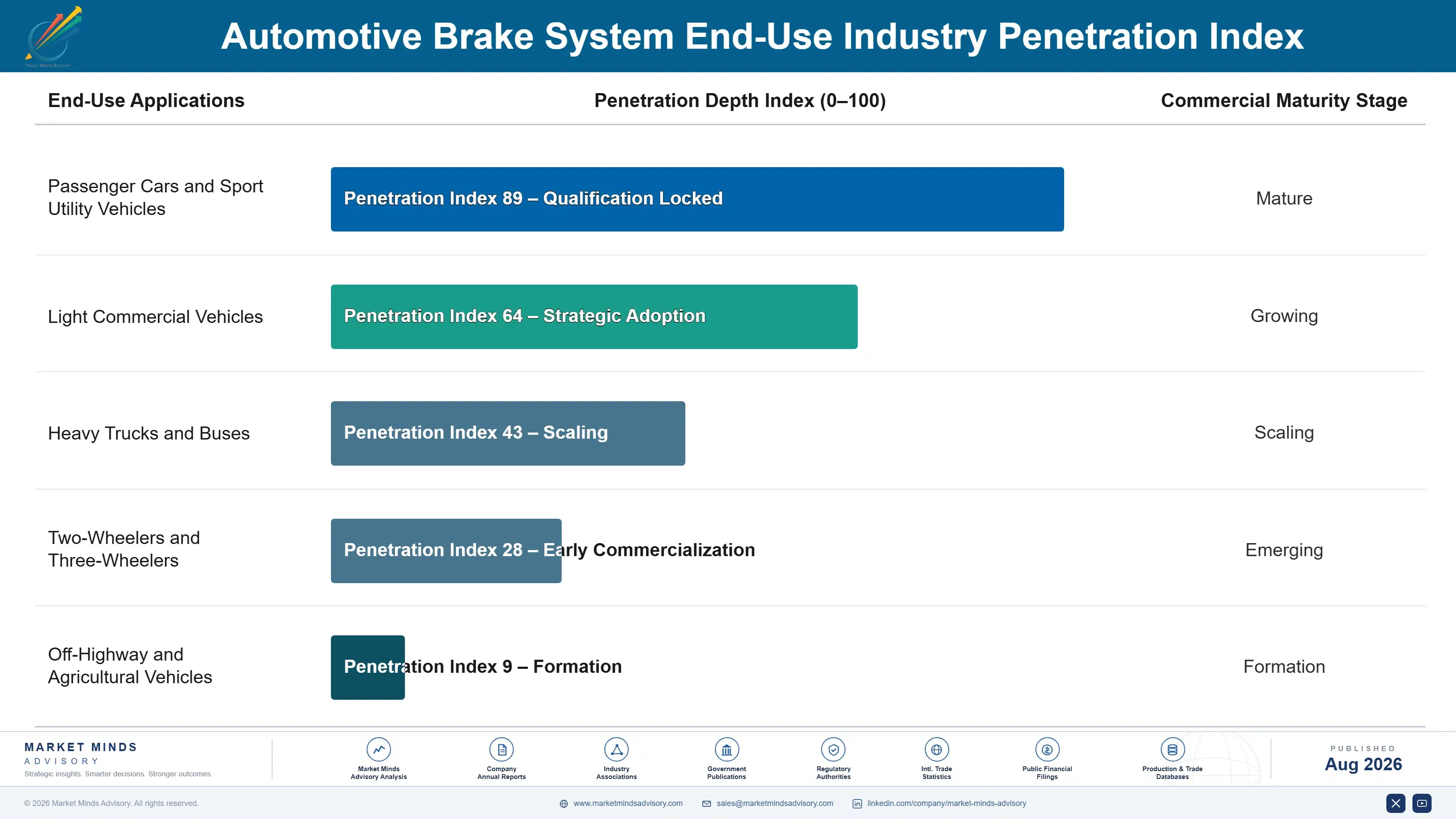
How Brake Platform Positions Hold

Demand commits at platform sourcing and repeats for the model generation. A brake system validated into a platform has passed functional safety assessment, durability testing, noise tuning, and homologation, and nobody reopens that inside a model cycle without a supply failure. That protects incumbents almost completely for seven to ten years. The genuine competitive moments are a new platform architecture, a regulatory change invalidating a specification, and any facelift reopening content.
Stickiness varies by validation depth and safety criticality. Brake-by-wire sticks hardest, since requalifying an actuation system means repeating the entire functional safety case. Electronic control modules stick nearly as firmly through software validation and calibration. Premium calipers stick through brand specification. Standard friction sticks least in the aftermarket, where a dozen brands meet the same drawing and distributors switch on margin and availability rather than performance.

Buyer profiles have moved from purchasing teams comparing part prices toward vehicle architects, functional safety engineers, and regulatory affairs functions holding decisive input. Particulate rules brought regulatory affairs into a friction conversation for the first time. That change rewards suppliers bringing safety documentation, compliant formulations, and design-stage engineering, and penalises those still presenting cost-per-part comparisons to a buyer who no longer decides.
automotive-brake-system-market-end-use-penetration-index-1787331978474

Our Call On Brake Systems

These are among the four positions where our research anticipates prominent divergence between winners and laggards over the coming forecast period. Each is grounded in the demand model, the regulatory perimeter, and the announced capacity pipeline.
01 / FUNCTIONAL SAFETY CAPABILITY

Suppliers without it are being designed out entirely

Automated braking requires hazard analysis, redundancy architecture, and software validation to automotive functional safety standards, with platform qualification running three to five years before anything actually ships. Brake-by-wire and electronic control carry all the content growth in this market, from roughly USD 320 per vehicle conventional to as much as USD 900 with redundant actuation. Suppliers lacking that systems engineering capability are not losing on price, they are being excluded from the sourcing list entirely before pricing is ever discussed.
02 / CORROSION NOT WEAR

Model the failure mode that actually still operates

Regenerative braking cuts friction wear by 60% to 80% on electric vehicles, which means aftermarket forecasts built on historical wear curves are modelling a mechanism that has largely stopped operating in the newest fleet at all. Discs now corrode from disuse rather than wearing thin, and that is the single replacement reason electrification creates instead of destroying. Coated discs, corrosion-resistant alloys, and rear drum brakes all address that directly, and almost nobody in the industry is positioning aftermarket strategy around it yet.
03 / PARTICULATE COMPLIANCE TIMING

Reformulate before the manufacturer requalifies the platform

European rules now regulate what a brake pad sheds as well as how it stops, which converts friction chemistry from a performance argument into a compliance requirement with fixed dates attached. Reformulation demands revalidation of noise, fade, and wear behaviour across every affected platform, which takes several years and cannot be compressed at all. Suppliers holding compliant formulations when a manufacturer requalifies capture the platform outright, while those arriving afterwards simply quote against a specification that somebody else has already written.
04 / ARCHITECTURE STAGE ACCESS

Content is fixed years before any sourcing package

Brake content, packaging, and redundancy approach are decided during vehicle architecture work three to five years ahead of production, so by the time any sourcing package arrives the system concept is already settled. A supplier engaged early with the vehicle architect shapes what becomes possible and is qualified by default when the programme ramps. One engaged at sourcing is responding to a specification built around a competitor's capability, which brake-by-wire packaging decisions now make harder to overturn than ever before.

Engagement Snapshot From the Field

A live engagement with an industry participant carrying material or product regulatory and market exposure ahead of a defining policy shift, showing how our research translates into a defensible multi-year portfolio strategy.
MARKET MINDS ADVISORY · CLIENT ENGAGEMENT SUMMARY
Automotive Brake System Producer Strategic Portfolio Review and Transition Roadmap 2026·Investment Scenario on Automotive Brake System Exposure Evaluation 2025-26
CLIENT PROFILE
A friction material manufacturer with roughly USD 740 million in annual revenue engaged MMA after aftermarket pad volumes fell for a second consecutive year in its European markets. The client reported about 71% of revenue from replacement friction, no product position for electric platforms, and a sales team still forecasting from historical wear curves (client-reported, unverified by MMA).
STRATEGIC CHALLENGE
Management could not establish whether the volume decline was market share loss, distributor destocking, or genuine wear reduction from electrification. Particulate regulation was separately demanding reformulation the business had not funded. The board needed to know which of those two problems was existential before committing the capital either would require.
MMA APPROACH
MMA separated volume decline by vehicle cohort rather than by distributor account, which the client had never done. We measured pad consumption per vehicle across drivetrain types using warranty and replacement data rather than accepting the historical wear assumption. We then assessed which of the client's formulations could reach particulate compliance without complete redevelopment, since that determined the size of the reformulation problem.
KEY FINDINGS
  1. Volume decline concentrated almost entirely in cohorts with high electric share, which meant wear reduction rather than share loss explained roughly 78% of it (client-reported, unverified by MMA).
  2. Pad consumption on regenerating electric vehicles ran 68% below comparable combustion equivalents, close to the upper end of published estimates across the sampled fleet.
  3. Only three of eleven formulation families could reach particulate compliance through adjustment, and the remainder needed redevelopment the business had not budgeted.
  4. Disc corrosion complaints on electric platforms were rising in the client's own warranty data, which nobody internally had connected to a product opportunity.
CLIENT PROFILE
A friction material manufacturer with roughly USD 740 million in annual revenue engaged MMA after aftermarket pad volumes fell for a second consecutive year in its European markets. The client reported about 71% of revenue from replacement friction, no product position for electric platforms, and a sales team still forecasting from historical wear curves (client-reported, unverified by MMA).
STRATEGIC CHALLENGE
Management could not establish whether the volume decline was market share loss, distributor destocking, or genuine wear reduction from electrification. Particulate regulation was separately demanding reformulation the business had not funded. The board needed to know which of those two problems was existential before committing the capital either would require.
MMA APPROACH
MMA separated volume decline by vehicle cohort rather than by distributor account, which the client had never done. We measured pad consumption per vehicle across drivetrain types using warranty and replacement data rather than accepting the historical wear assumption. We then assessed which of the client's formulations could reach particulate compliance without complete redevelopment, since that determined the size of the reformulation problem.
KEY FINDINGS
  1. Volume decline concentrated almost entirely in cohorts with high electric share, which meant wear reduction rather than share loss explained roughly 78% of it (client-reported, unverified by MMA).
  2. Pad consumption on regenerating electric vehicles ran 68% below comparable combustion equivalents, close to the upper end of published estimates across the sampled fleet.
  3. Only three of eleven formulation families could reach particulate compliance through adjustment, and the remainder needed redevelopment the business had not budgeted.
  4. Disc corrosion complaints on electric platforms were rising in the client's own warranty data, which nobody internally had connected to a product opportunity.
RECOMMENDED STRATEGY
Phase 1: Phase 1 (0 to 6 months): Reforecast aftermarket volume by drivetrain cohort and stop planning from historical wear curves entirely. Phase 2: Phase 2 (6 to 20 months): Fund particulate reformulation on the three adjustable families first and exit the formulations requiring full redevelopment. Phase 3: Phase 3 (20 to 32 months): Enter corrosion-resistant disc and low-drag friction products aimed specifically at electric platform failure modes.
OUTCOME
The client stopped defending a volume forecast that was never achievable and rebased planning on cohort data, which changed capital allocation immediately. Reformulating three families rather than eleven brought compliance cost inside budget, and the corrosion-focused product line reached first customer trials within thirty months (client-reported, unverified by MMA).

Frequently Asked Questions

Foundational context covering the market sizes, CAGR, scope, country, region and competition that inform every finding below. This section is provided to cover basics and most often pre-purchase conversations, answered from the MMA Primary Research Dataset.

What is the current size of the Automotive Brake System Market?

The global automotive brake system market is valued at USD 27.8 billion in 2025, covering friction materials, discs and drums, hydraulic actuation, electronic control, and brake-by-wire. Tyres, suspension, and service labour are excluded.

How large will the Automotive Brake System Market be by 2036?

The market is forecast to reach USD 55.01 billion by 2036 in the base case, about 1.86 times the 2026 level. That represents incremental value of roughly USD 25.43 billion across the decade.

What is the CAGR for the Automotive Brake System Market 2026 to 2036?

The market grows at a 6.4% CAGR in the base case, with bull and bear scenarios at 7.6% and 5.2%. The spread turns mainly on brake-by-wire adoption and aftermarket erosion from regeneration.

Which segment is growing fastest?

Brake-by-wire and electromechanical actuation grow fastest at 16.4%, about 2.56 times the overall rate, as hydraulic columns are removed. Electronic control and stability systems follow at 7.6%.

Who are the major companies in the Automotive Brake System Market?

Leading suppliers include Bosch, Continental, ZF Friedrichshafen, Brembo, and Aisin. Concentration is high, with the top five holding roughly 44% of brake system revenue across original equipment and aftermarket.

Which country is growing fastest?

India grows fastest at a 10.2% CAGR, as vehicle output rises and antilock braking mandates widen across categories. China and Indonesia follow on production volume and electronic content.

Report Segmentation Architecture

The full report scope spans multiple orthogonal segmentation dimensions, with cross-tabulated demand data provided for each dimension pair. Coverage extends further to regional breakdowns, trend trajectories, and the competitive detail needed to support segment-level decision-making.

By Brake System Component Group

  • Friction Materials
  • Brake Discs and Drums
  • Hydraulic Actuation and Boosters
  • Electronic Control Units and Stability Systems
  • Brake-by-Wire and Electromechanical Actuation

By End-Use Industry

  • Passenger Cars and Sport Utility Vehicles
  • Light Commercial Vehicles
  • Heavy Trucks and Buses
  • Two-Wheelers and Three-Wheelers
  • Off-Highway and Agricultural Vehicles

By Sales Channel

  • Original Equipment Platform Supply
  • Original Equipment Service Parts
  • Independent Aftermarket Distribution
  • Fleet and Contract Maintenance Supply

By Region

  • North America
  • Western Europe
  • East Asia
  • South Asia and Pacific
  • Latin America
  • Middle East and Africa
  • Eastern Europe

Scope, Methodology, and Coverage

Every figure in this report is reproducible from documented input assumptions. The scope below maps the historical period, the forecast horizon, the segmentation dimensions, and the countries covered, alongside the underlying primary and qualitative methodology.
Historical Period
2020 to 2025
Forecast Period
2026 to 2036
Base Year
2025 (USD billions; MMA Primary Research Dataset, August 2026)
Market Definition
The automotive brake system market comprises the manufacture and sale of components and assemblies that decelerate a road vehicle through friction or electromechanical actuation, valued at manufacturer selling prices to vehicle manufacturers, service networks, and aftermarket distributors. It spans friction materials including pads, linings and shoes, brake discs and drums, hydraulic actuation, master cylinders and boosters, electronic control units and stability systems including antilock and automatic emergency braking, and brake-by-wire and electromechanical actuation, together with the calibration, validation, and functional safety documentation supplied with them. Tyres, wheels and wheel bearings, suspension and steering components, complete chassis modules sold as an integrated system, brake fluid, lubricants and cleaning chemicals sold as chemical products, regenerative motor, inverter and battery hardware, retarders and engine braking systems, and vehicle service, inspection and repair labour are excluded.
Quantitative Units
USD billions (current prices); volume in million vehicle sets and content per vehicle in USD
Segmentation Dimensions
By Brake System Component Group; By End-Use Industry; By Sales Channel; By Region
Regions Covered
North America, Western Europe, East Asia, South Asia and Pacific, Latin America, Middle East and Africa, Eastern Europe
Countries Covered
China, USA, Japan, Germany, India, South Korea, Mexico, Spain, Brazil, France, Czech Republic, Slovakia, Poland, Romania, UK, Italy, Turkey, Thailand, Indonesia, Vietnam, Malaysia, Canada, Argentina, South Africa, Morocco, UAE, Saudi Arabia, Australia, Sweden, Netherlands, and additional markets relevant to this sector
Key Companies Profiled
Bosch, Continental, ZF Friedrichshafen, Brembo, Aisin, Akebono Brake Industry, Hitachi Astemo, HL Mando, Knorr-Bremse, Tenneco, TMD Friction, Nisshinbo Holdings, Sumitomo Electric Industries, Endurance Technologies, Brakes India, Fras-le, EBC Brakes, ITT Friction Technologies, SBS Friction, Rane Brake Lining
Quantitative Methodology
Primary survey, n=3,800 respondents, Q4 2025, six countries; demand-side model with trade association cross-validation
Qualitative Methodology
47 expert interviews, Q4 2025; applied to validate demand model assumptions, identify emerging dynamics, and assess competitive positioning
Report Format
PDF and XLSX data workbook (Word format preview document)
Publisher
Market Minds Advisory
Report Code
MMA-2026-AUT-358
Published
August 2026
Contact
sales@marketmindsadvisory.com | www.marketmindsadvisory.com

Purchase the full Automotive Brake System Market Report (2026 to 2036).

The full MMA Automotive Brake System report sizes the market across five component groups, five vehicle categories, four sales channels, and seven regions through 2036. It profiles 20 suppliers on a consistent basis of brake system component and assembly revenue, scoring each on functional safety capability, design-stage platform access, particulate-compliant friction position, and aftermarket distribution reach. Scenario models quantify how regenerative wear reduction, brake-by-wire adoption, and particulate regulation move both volume and achievable margin by component group. The report also includes friction consumption benchmarking by drivetrain type, content per vehicle decomposition across automation levels, aftermarket erosion modelling by vehicle cohort, and particulate compliance readiness mapping across suppliers.
Five-component and four-channel market sizing to 2036
Twenty-supplier benchmark on brake system component revenue
Friction consumption benchmarking by drivetrain and duty cycle
Content per vehicle decomposition across automation levels
Aftermarket erosion modelling by vehicle cohort and region
Particulate compliance readiness mapping across friction suppliers

Built For The People Who Decide

From boardroom strategy to bench-side execution, this report is read cover-to-cover by leaders shaping the next decade of their industry, turning demand scenarios, market dynamics and valuation benchmarks into decisions.
CXOs/ Presidents/ VPs/ Managers
M&A and Corporate Development
Strategy Teams and R&D Heads
Procurement and Product Directors
Regulatory and Compliance Leaders
Investor Relations and Equity Analysts