
Market Minds Advisory
Automotive Air Conditioning System Compressor Market

Automotive Air Conditioning System Compressor Market: Automotive AC Compressors: The Electric Transition Redraws Supplier Rankings

A commercial reading of automotive AC compressors, where EV production pulls electric scroll compressor demand forward, heat pump adoption expands each unit's functional scope, and refrigerant transition rules complicate design standardization globally.

Lead Analyst

David Horsley

Published

August 2026

Make Smarter Decisions with Customized Research Insights

Request a free sample report and evaluate market opportunities, growth trends, and competitive dynamics relevant to your business needs.

2025 MARKET VALUE$7.4BMarket Size 2025
2036 FORECAST VALUE$13.2BBase Case , 2026 to 2036
CAGR 2026 TO 20365.4 %Bull 6.6% / Bear 4.1%
INCREMENTAL OPPORTUNITY$5.4BNet 10- year value creation
EXPANSION MULTIPLE1.69x2036 value over 2026 base
Strategic Levers
M&A Pipeline
Regional Outlook
Country Rankings
Competitive Intelligence
Segmental Deep-dive
Call-Us : 91 93563 13602

Executive Snapshot and Market Trajectory.

An electric vehicle has no spinning engine belt to drive its compressor, so the entire mechanical assumption behind a century of automotive air conditioning design simply stops applying, and suppliers who built their business on that assumption are now relearning the category from a blank sheet.
The market stands at USD 7.4 billion in 2025 and reaches USD 13.2 billion by 2036 at a 5.4% CAGR. Electric scroll compressors for EVs and hybrids grow fastest at 11.5%, about 2.13 times the overall rate, pulled forward by rising EV production mandates across major automotive markets. East Asia holds 30% of value given China's vehicle production scale, while China posts the fastest national growth at 8.5% on EV adoption momentum.
Concentration sits at a substantial 58% among the top five, led by Denso's OEM integration depth and Hanon Systems' thermal management leadership built over decades of platform relationships and engineering trust. Two forces reshape the field now. Electric scroll compressors are displacing belt-driven systems as EV production climbs steadily, and heat pump adoption is expanding each compressor's functional scope into reversible cabin heating that extends driving range.
Market Definition
The automotive air conditioning system compressor market covers mechanical and electric compressors that circulate refrigerant for vehicle cabin cooling and, in electric and hybrid vehicles, reversible heat pump heating, sold to original equipment manufacturers and the aftermarket. Standalone HVAC control units, condensers, and evaporators sold separately from the compressor are excluded.
Base Year Value
$7.4B in 2025 (MMA Primary Research Dataset, August 2026)
Forecast Period
2026 to 2036, eleven discrete annual values
CAGR
5.4% base case. Bull 6.6%. Bear 4.1%.
Fastest Growth Segment
Electric Scroll Compressors for EVs and Hybrids: 11.5% CAGR
Fastest Growth Country
China: 8.5% CAGR
Fastest Growth Region
South Asia and Pacific: 7.4% CAGR
Largest Region
East Asia: 30% of 2025 global value
Market Leaders
Denso, Hanon Systems, Sanden Corporation, MAHLE, Valeo. Source: MMA Analysis based on company annual reports and industry association data.
Primary Survey
n=3,800 procurement and R&D decision-makers, Q4 2025, six countries
Methodology
Demand-side build-up, cross-validated against public data, 47 expert interviews

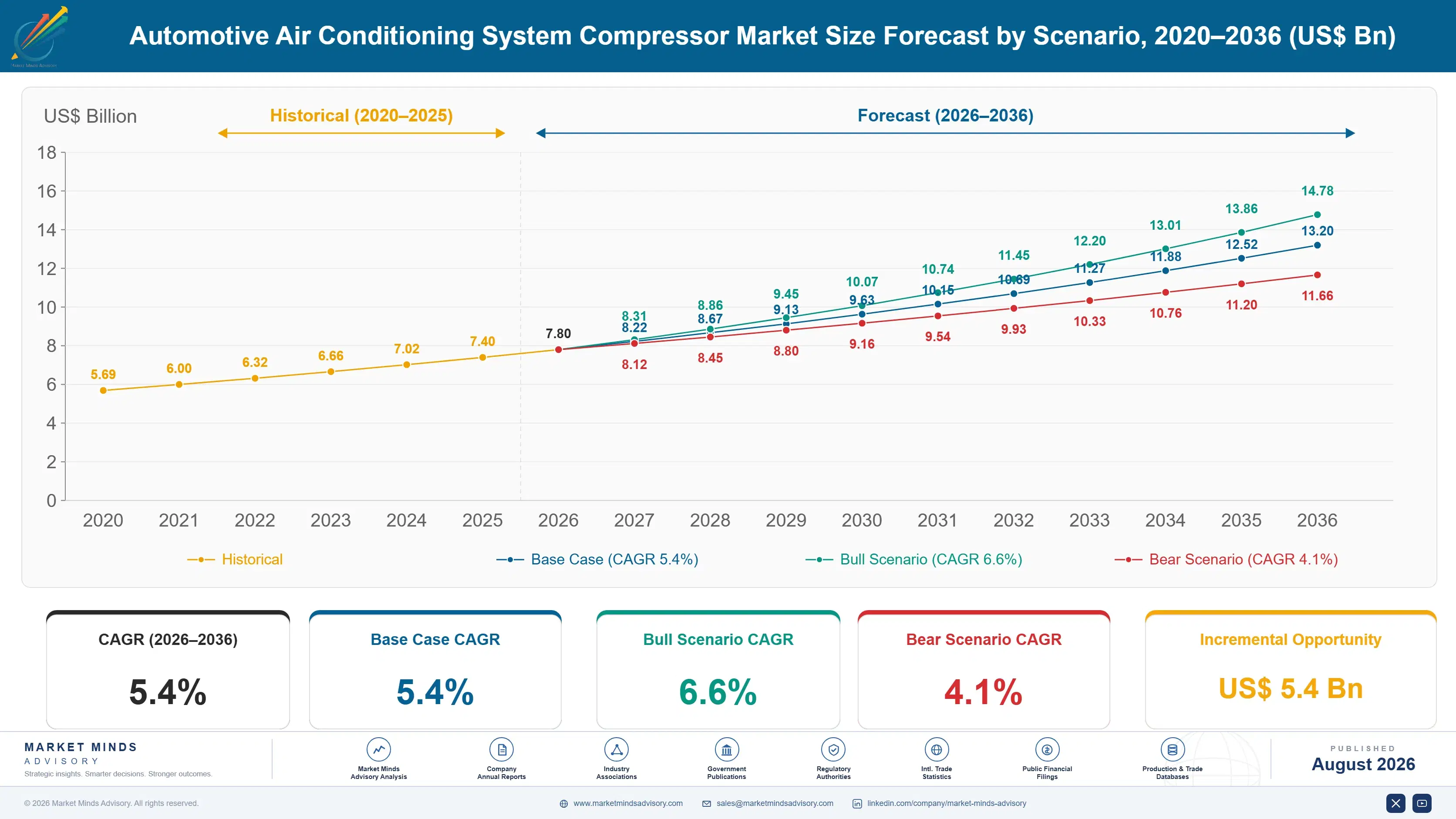
Automotive Air Conditioning System Compressor Market Forecast Scenarios

automotive-air-conditioning-system-compressor-mark-size-forecast-scenario-1787325473235
Growth from 2020 to 2025 compounded near 4.6%, reflecting steady global vehicle production recovery following pandemic-era disruption before accelerating gradually from 2023 onward as EV and hybrid production volume expanded considerably across major automotive markets and manufacturing regions tracked closely by industry analysts throughout that period, alongside gradually tightening emissions and refrigerant transition regulation in several jurisdictions.
Three mechanisms carry the base case to 5.4%. First, rising EV and hybrid production, which mandates electric compressor adoption independent of engine belt drive systems across nearly every new electrified vehicle platform. Second, heat pump system adoption, which expands compressor functional scope from pure cooling into reversible cabin heating that meaningfully extends EV driving range. Third, refrigerant transition regulation, which is driving compressor redesign cycles across most major vehicle manufacturing regions globally.
The bull case at 6.6% assumes EV and hybrid production accelerates faster than current manufacturer roadmaps suggest and heat pump adoption spreads more quickly across mainstream vehicle segments beyond premium models. The bear case at 4.1% assumes high electric compressor cost continues slowing conversion in entry-level vehicles and fragmented refrigerant transition rules keep complicating design standardization across regions.

Why the Engine Belt No Longer Runs the Compressor

Three forces set demand. Global vehicle production volume provides the steadiest layer, since every internal combustion, hybrid, and electric vehicle produced requires a compressor at first fit regardless of powertrain type. EV and hybrid production growth adds a fast-growing second layer, requiring electric scroll compressors that differ fundamentally from belt-driven mechanical designs. Heat pump system adoption adds a third layer, expanding compressor functional scope and average selling pric
MARKET CONCENTRATIONCR5: 58%Substantially concentrated behind established OEM thermal management leaders
AVERAGE SELLING PRICEUSD 55 to 320 per unitVaries considerably by compressor technology and vehicle platform tier
TOP PRODUCING REGIONEast Asia: 30% of global valueReflects concentrated vehicle production scale across the region
ELECTRIC COMPRESSOR PENETRATIONRoughly 28% of new unitsRising steadily alongside global EV and hybrid production share
REPLACEMENT CYCLE LENGTH8 to 12 years typicalReflects durable mechanical components with periodic seal servicing
TRADE INTENSITYAbout 35% of units exportedTracks cross-border OEM supply chains spanning multiple manufacturing regions
The commercial character rewards OEM integration depth and platform-specific engineering over price competition alone in most premium segments. An automaker choosing a compressor supplier weighs multi-year platform integration history and field reliability as heavily as unit price, since a compressor failure during warranty triggers a recall cost far exceeding any price difference between suppliers. Denso's integration depth and Hanon Systems' thermal management leadership give both a trust advantage newer entrants must earn.
The next decade turns on two things. Whether electric scroll compressor conversion accelerates quickly enough to match EV production growth across mainstream, not just premium, vehicle segments. And whether established mechanical compressor specialists can retool engineering and manufacturing capability fast enough to avoid ceding the electric compressor category entirely to newer, electronics-focused competitors.
"The compressor used to be the boring part of the car. Now it decides whether the cabin heater eats into your driving range, and that single fact has turned it into a genuine engineering battleground."
Director, Automotive Thermal Management Practice · MMA Automotive / Thermal Mana

Market Trends

Electric Scroll Compressors Displace Belt-Driven Systems

Electric vehicles have no continuously running engine belt to drive a conventional compressor, forcing a fundamental redesign toward electric scroll compressors powered directly by the vehicle's high-voltage battery system regardless of engine operation status. Electric compressor penetration has reached roughly 28 percent of new units, a share that has risen steadily as EV and hybrid production expands across nearly every major automotive market tracked. Denso and Hanon Systems have both invested heavily in electric compressor manufacturing capacity to meet this transition directly. Mechanical compressor specialists without electric motor and power electronics capability increasingly cannot compete for new electrified platform awards.
Market Impact: EV share passed 20% globally
Heat Pump Adoption Expands Compressor Functional Scope

Electric vehicles increasingly use the compressor reversibly within a heat pump system to warm the cabin using ambient heat rather than resistive electric heating, meaningfully extending driving range in cold weather conditions where cabin heating previously consumed considerable battery energy. This capability requires compressors engineered for reversible refrigerant flow and a broader operating temperature range than conventional cooling-only designs required historically. Toyota Industries Corporation and Sanden Corporation have both expanded reversible compressor product lines considerably in response to rising heat pump specification. Manufacturers without reversible compressor engineering increasingly lose specification on premium EV platforms specifically.
Market Impact: Heat pump uptake rose 18%

Market Opportunities and Growth Drivers

Rising EV Production Mandates Electric Compressor Adoption

Global EV and hybrid production has expanded to represent a meaningfully larger share of total vehicle output across major automotive markets, directly mandating electric compressor adoption since these platforms have no engine belt available to drive a conventional mechanical compressor at all. Chinese, European, and North American EV production mandates and emissions regulations continue pushing automakers toward electrified platforms requiring this fundamentally different compressor architecture. Every automaker launching a new EV platform must source an electric compressor regardless of prior manufacturing history. This driver continues strengthening as EV production share expands further across most major vehicle manufacturing regions.
Market Impact: Units cost USD 55-320

Heat Pump Systems Expand Compressor Functional Scope

Automakers increasingly specify heat pump systems on EV platforms to extend cold-weather driving range, a capability that relies directly on compressors engineered for reversible refrigerant flow rather than cooling-only operation as conventional designs required previously. Heat pump adoption has grown considerably across premium EV platforms and is beginning to spread into mainstream vehicle segments as component costs decline gradually. This expands average selling price per compressor considerably compared with cooling-only units sold into conventional internal combustion vehicle platforms historically. This driver continues strengthening as EV range competition intensifies across nearly every major automaker's product roadmap currently.
Market Impact: Design variants add 20% engineering

Market Restraints and Challenges

High Electric Compressor Cost Slows Entry-Level Conversion

Electric scroll compressors cost meaningfully more than conventional belt-driven mechanical units, a premium that remains genuinely difficult to justify on entry-level and budget vehicle platforms where automakers face intense cost pressure across the entire bill of materials. The root cause is the added complexity of integrated brushless motor and power electronics components that conventional mechanical compressors never required, keeping unit manufacturing cost elevated across the category. Commercially this concentrates electric compressor adoption among premium and mid-range EV platforms, leaving budget electrified vehicles underserved. Manufacturers are responding with localized component sourcing and simplified power electronics designs targeting entry-level platforms.
Market Impact: Electric units reach 28% share

Refrigerant Rules Complicate Global Design Standardization Efforts

Global refrigerant transition regulation varies considerably across major markets, with the European Union, United States, and China pursuing somewhat different timelines and preferred chemistries including R1234yf and R744, complicating a single global compressor design standard suppliers could otherwise manufacture at greater scale. The root cause is fragmented national policy that has not converged around a single transition pathway most manufacturers could plan around confidently. Commercially this forces suppliers to maintain multiple design variants rather than one global platform, raising cost considerably. Manufacturers are responding with modular platforms accommodating multiple refrigerant types with minimal redesign.
Market Impact: Range gains reach 15%
3 additional market trends, 4 additional growth drivers, and 3 additional restraints and challenges are covered in the full report. Contact sales@marketmindsadvisory.com to access the complete intelligence.

Segment CAGR and Growth Architecture

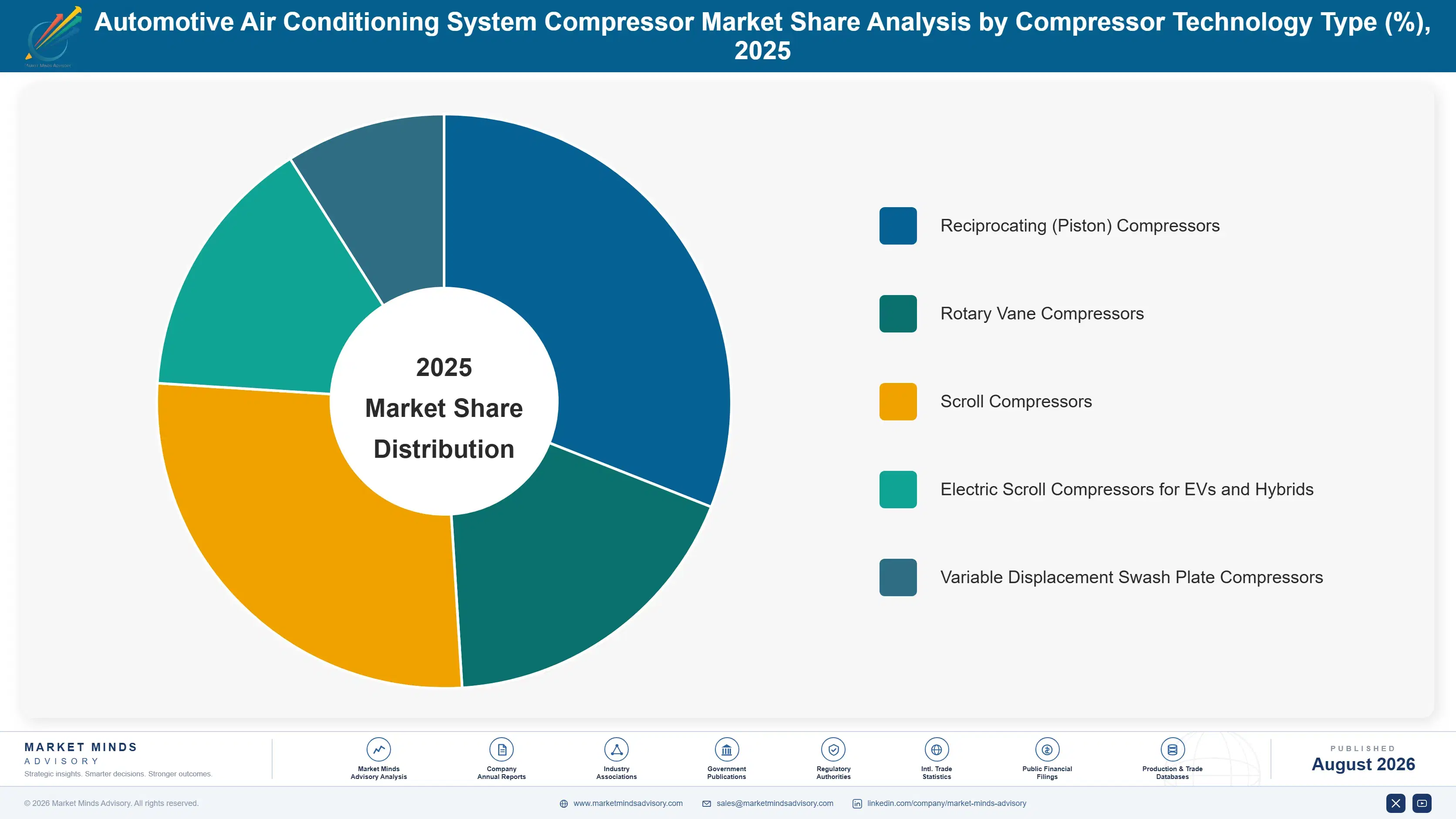
Segmentation follows compressor mechanism and drive technology, a single product logic describing how each unit compresses and circulates refrigerant across the vehicle's full cabin cooling and heating loop. Each technology carries distinct manufacturing requirements and vehicle platform compatibility, so commercial position tracks technology rather than end vehicle type, which appears separately within the framework below.
automotive-air-conditioning-system-compressor-mark-market-share-analysis-1787325473804

Electric Scroll Compressors for EVs and Hybrids

Electric scroll compressors for EVs and hybrids grow fastest at 11.5%, about 2.13 times the overall 5.4% rate, pulled forward by rising EV and hybrid production mandates across nearly every major automotive market tracked currently. This category requires integrated brushless motor and power electronics engineering that conventional mechanical compressor manufacturers never previously needed, a technical distinction that favours suppliers with genuine electric drivetrain expertise over mechanical specialists retrofitting electric motors onto legacy designs. Denso and Hanon Systems have both invested heavily in electric compressor manufacturing capacity to meet this accelerating transition directly. Heat pump-compatible reversible variants add a further premium layer within this already fast-growing category specifically. Demand continues outpacing manufacturing capacity in several major EV-producing regions currently.
CAGR 11.5%

Variable Displacement Swash Plate Compressors

Variable displacement swash plate compressors grow at 7.0%, the second-fastest technology, as automakers increasingly specify these units on hybrid and higher-efficiency internal combustion platforms where variable output improves fuel economy compared with fixed displacement alternatives. This category benefits from tightening fuel efficiency regulation, since variable displacement allows the compressor to reduce engine load precisely when full cooling capacity is not required during a given driving cycle. MAHLE and Sanden both maintain meaningful positions here given established relationships with automakers transitioning fleets toward hybrid powertrains gradually and steadily. Hybrid vehicle production growth adds a further layer of demand alongside conventional efficiency-driven internal combustion platform adoption specifically across most major manufacturing regions and markets tracked.
CAGR 7.0%
Full segment breakdown across 5 segments available in the complete report.

Regional Architecture and Country Demand Map

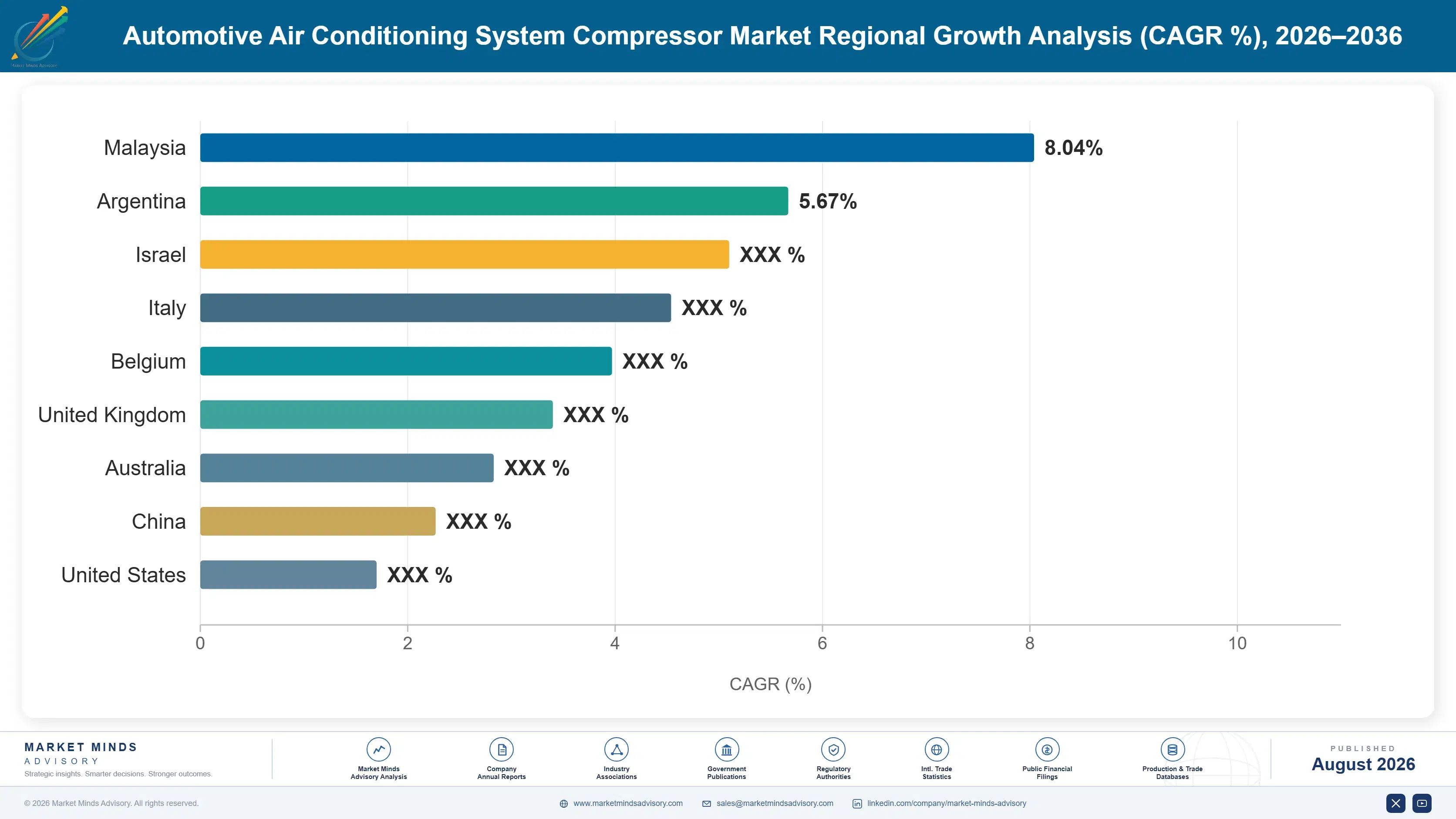
Vehicle production scale and EV adoption pace together set this distribution, since compressor demand tracks where vehicles are physically manufactured and assembled worldwide today. East Asia dominates on production concentration, while South Asia and Pacific posts the fastest regional growth of all seven regions tracked.

North America

United States vehicle production scale and growing EV manufacturing investment anchor North American demand more than any other single factor. North America holds 28% of value, with domestic automakers and their supplier networks increasingly localizing electric compressor manufacturing to support new EV assembly plants across several states. Canadian and Mexican vehicle production, tightly integrated into North American supply chains, adds substantial secondary volume across the region's manufacturing footprint. Heat pump specification has grown considerably on domestically produced EV platforms given cold-weather range extension demand across northern states and provinces. Growth of 5.0% reflects mature market dynamics tempered by continued electric compressor conversion across new EV platforms. Aftermarket replacement demand remains substantial given the region's large existing vehicle fleet.
Share: 28% | CAGR: 5.0% (2026 to 2036)

Western Europe

Stringent emissions regulation and established EV manufacturing capacity together define this market above any other single factor. Western Europe holds 20% of value, with German, French, and British automakers driving substantial electric compressor demand as European Union emissions targets accelerate fleet electrification across nearly every major manufacturer's product lineup. Refrigerant transition regulation runs considerably stricter here than in most other regions, pushing suppliers toward earlier compressor redesign cycles. Heat pump adoption is particularly strong across the region given cold climate conditions across much of Northern and Central Europe. Growth of 3.9%, the slowest of the seven, reflects mature vehicle production tempered by declining output in several major markets. Scandinavian markets lead in per-vehicle heat pump specification given strong EV adoption.
Share: 20% | CAGR: 3.9% (2026 to 2036)
Regional intelligence for 5 additional markets available in the complete report: East Asia, South Asia and Pacific, Latin America, Middle East and Africa, Eastern Europe. Contact sales@marketmindsadvisory.com.
automotive-air-conditioning-system-compressor-mark-country-cagr-analysis-1787325474325

Where Compressor Manufacturer Margin Concentrates

Competing purely on unit price per compressor concentrates margin in exactly the mechanical segment where cost-focused suppliers undercut established manufacturers easily and repeatedly. The four moves below shift value toward positions engineering depth and platform relationships genuinely protect: electric compressor engineering capability, heat pump reversible design expertise, OEM platform integration depth, and multi-refrigerant modular design.

Build Genuine Electric Compressor Engineering Capability

Electric compressor penetration has reached roughly 28 percent of new units, a share that has risen steadily as EV and hybrid production expands across nearly every major automotive market tracked currently and continues to grow each quarter worldwide. Manufacturers with genuine electric motor and power electronics engineering capability capture specification that mechanical compressor specialists retrofitting electric drivetrains increasingly cannot match reliably or quickly enough anymore. Building this capability requires sustained investment in power electronics and brushless motor design beyond conventional mechanical compressor engineering expertise entirely, a multi-year commitment most smaller competitors avoid.
Market Impact: Electric units now reach roughly 28

Develop Heat Pump Reversible Design Expertise

Automakers increasingly specify heat pump systems on EV platforms to extend cold-weather driving range, and heat pump adoption has grown roughly 18 percent since 2023 as component costs decline and range competition intensifies across most major automaker product roadmaps worldwide right now and going forward. Manufacturers with reversible compressor engineering expertise capture premium specification on EV platforms that cooling-only competitors increasingly cannot access at comparable margin or scale. This capability requires sustained thermal engineering investment in reversible refrigerant flow design that conventional cooling-only compressor manufacturers historically never needed to develop or maintain.
Market Impact: Heat pump adoption grew roughly 18%

Deepen OEM Platform Integration Relationships Now

Automakers increasingly default to suppliers with multi-year platform integration history, since a compressor failure during warranty triggers a recall cost far exceeding any price difference between competing suppliers under consideration for a given platform award. Manufacturers investing in deep, long-term OEM engineering relationships capture platform specification that transactional, price-focused competitors struggle to displace even with meaningfully lower unit costs offered upfront during initial negotiations. This relationship depth compounds over successive vehicle generations, spanning roughly 10 to 15 years each, as trusted suppliers default to repeat platform awards across an automaker's broader model lineup.
Market Impact: Platform relationships span roughly

Engineer Multi-Refrigerant Modular Compressor Platforms Now

Global refrigerant transition regulation varies considerably across major markets, forcing suppliers to maintain multiple compressor design variants that raise engineering and manufacturing cost by roughly 20 percent compared with a single global platform most manufacturers would prefer to build at greater scale. Manufacturers engineering modular platforms that accommodate multiple refrigerant types with minimal redesign capture cost advantages that competitors maintaining fully separate designs for each region cannot match easily. This modular engineering investment, sustained across product generations, increasingly determines which suppliers can serve global automaker platforms most cost-effectively over time.
Market Impact: Modular platforms cut costs by roug

Who Controls the Margin Pool

Concentration sits at a substantial 58% among the top five, led by Denso's OEM integration depth and Hanon Systems' thermal management leadership built over decades of automaker platform relationships. The gap between leaders and challengers is electric compressor engineering depth and platform integration history rather than raw price, which cost-focused competitors undercut easily in commodity mechanical categories. All participants are assessed on global compressor unit shipment volume as dis
Competition runs along four lines. First, electric compressor engineering capability, increasingly the fastest-growing purchase consideration as EV production expands. Second, heat pump reversible design expertise that commands premium specification on EV platforms. Third, OEM platform integration depth built across successive vehicle generations. Fourth, multi-refrigerant modular design that manages regulatory fragmentation cost-effectively across regions.

Pressure is building from two directions. Chinese manufacturers including Shanghai Highly have built substantial manufacturing scale and are converting cost advantages into meaningful share gains in price-sensitive domestic and export markets. Meanwhile established leaders continue defending position through sustained electric compressor and heat pump engineering investment that smaller competitors struggle to match. Rankings should favour manufacturers combining engineering depth with genuine OEM platform relationships over price alone.
automotive-air-conditioning-system-compressor-mark-company-positioning-matrix-1787325474843

Competitive Moat and Risk Dimensions

DENSO

Moat: OEM integration depth

Denso maintains the deepest OEM platform integration relationships in the category, built over decades of Toyota Group and broader automaker partnerships spanning both mechanical and electric compressor technology. Its scale supports sustained research investment across power electronics and reversible heat pump engineering simultaneously. Vertical integration with its broader automotive components portfolio provides considerable cross-selling advantage.
DENSO

Risk: Chinese manufacturers scaling quickly

Chinese manufacturers now offer comparable electric compressor specifications at meaningfully lower prices, eroding the premium Denso has historically commanded in cost-sensitive emerging vehicle platforms specifically. Its scale advantages matter less as electric compressor technology commoditizes faster than mechanical compressors did previously. Newer, more agile competitors are moving quickly on next-generation power electronics integration currently.
HANON SYSTEMS

Moat: Thermal management system leadership

Hanon Systems built its position around integrated thermal management systems rather than standalone compressors, giving it broader platform specification access spanning cabin comfort and battery cooling simultaneously. Its heat pump engineering expertise, developed across multiple EV platform generations, positions it strongly for this fastest-growing category specifically. Established relationships with Korean and expanding global automaker customers provide considerable specification advantage.
HANON SYSTEMS

Risk: Narrower scale than diversified rivals

Hanon Systems' thermal management focus, while valuable, gives it less financial scale than more diversified competitors like Denso to absorb sustained research investment across multiple technology generations simultaneously. Geographic concentration in Korean automaker relationships exposes it to platform award concentration risk in that specific customer base. Chinese competitors are increasingly challenging its position in cost-sensitive EV platform segments specifically.

Players Tracked

Prominent Players

Denso
Hanon Systems
Sanden Corporation
MAHLE
Valeo

Other Key Players

Subros
BITZER
Panasonic
Toyota Industries Corporation
Marelli
Sanhua Automotive
Modine Manufacturing
Eberspächer
Johnson Electric
Nidec
Gentherm
Hitachi Astemo
Aisin Corporation
Mitsubishi Heavy Industries Thermal Systems
Shanghai Highly

Recent Developments

MARCH 2025

Denso expands electric compressor manufacturing capacity

Denso expanded manufacturing capacity for its electric scroll compressor product line to meet rising demand from EV platform launches across multiple automaker customers globally and regionally each quarter. This was an organic capacity expansion rather than any acquisition, reflecting confidence in sustained EV production growth.
Signal: Established mechanical compressor leaders
OCTOBER 2024

Hanon Systems signs multi-year supply agreement for heat pump systems

Hanon Systems signed a multi-year supply agreement with a major European automaker to provide reversible heat pump compressor systems across an expanding EV platform lineup through the end of the decade. This was a supply agreement rather than a joint venture, securing volume without shared ownership or new capital investment.
Signal: Thermal management suppliers are locking i
JANUARY 2025

Shanghai Highly acquires power electronics engineering firm

Shanghai Highly acquired a specialist power electronics engineering firm to strengthen its electric compressor motor control capability for both domestic Chinese and export automaker customers. This was an acquisition rather than a joint venture, adding proprietary engineering talent directly into its existing product development organization.
Signal: Chinese manufacturers are buying power ele

Copper Windings and Power Electronics

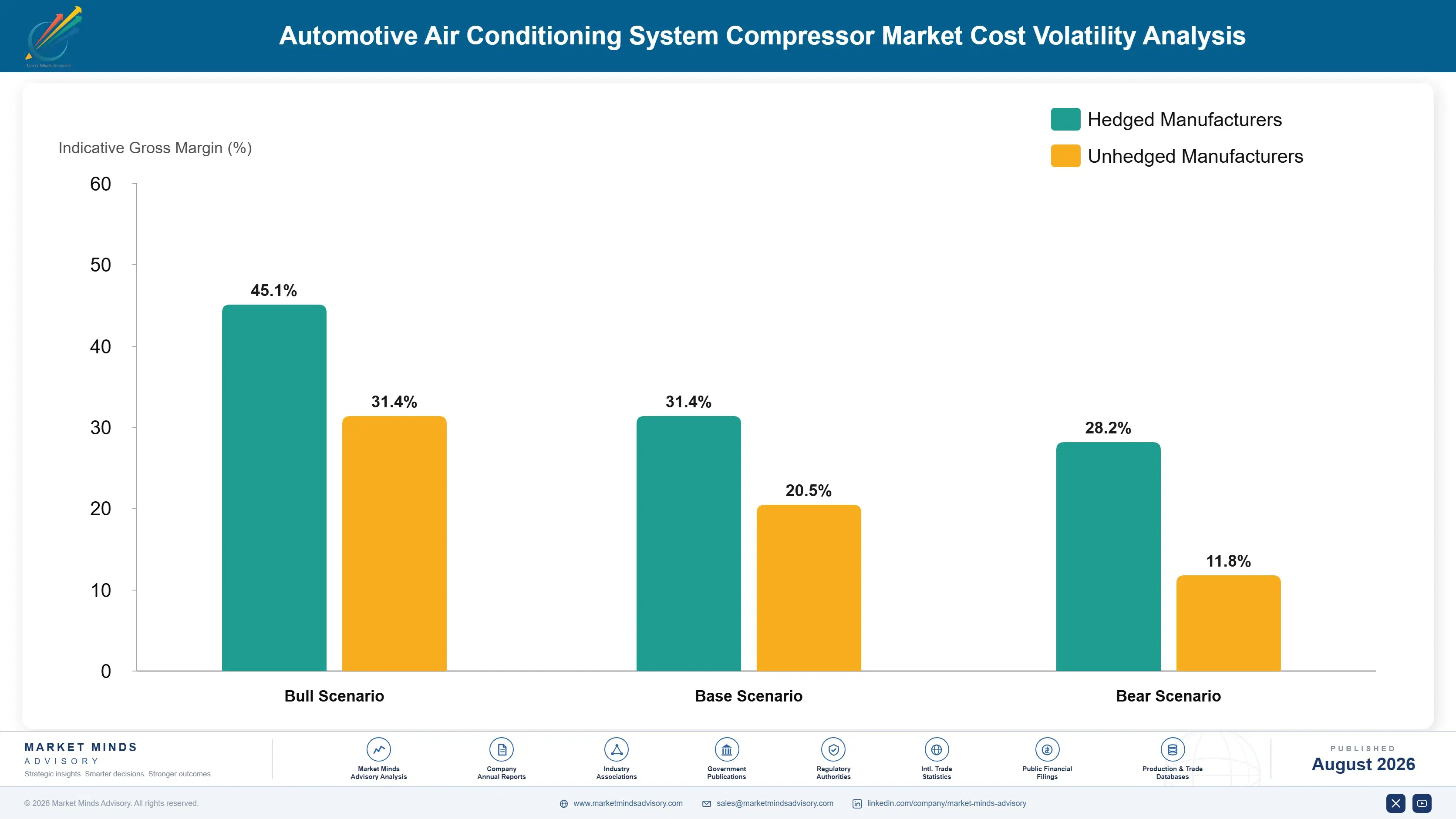
Copper windings, aluminum housings, and power electronics components together account for 45% to 58% of cost of goods sold, reflecting the added electronics content electric compressors carry compared with conventional mechanical units built in earlier vehicle generations. These components are sourced predominantly from specialty electronics and metal suppliers in East Asia and Western Europe directly and reliably.
Copper prices rose sharply through 2021 and 2022 amid broader commodity market volatility, with several compressor manufacturers disclosing meaningfully higher input costs during that period, per IEA and company annual report commentary on the same commodity cycle. Several manufacturers passed through a portion of this cost increase to automaker customers with a lag of several quarters given multi-year fixed-price platform contracts already in place. Prices have since moderated, though they remain above pre-2021 levels for several key input categories specifically.

Exposure separates clearly by compressor technology and procurement contract structure. Electric compressor manufacturers face considerably higher copper and power electronics exposure than mechanical compressor specialists, given the added winding and semiconductor content electric units require. Larger manufacturers with hedged metal procurement contracts absorbed less disruption than smaller competitors purchasing copper on the spot market during the tightest volatility periods specifically.
automotive-air-conditioning-system-compressor-mark-cost-volatility-analysis-1787325475039

Hedge copper procurement through long-term contracts

Spot-market copper purchasing exposed several manufacturers to meaningful cost spikes during the 2021 and 2022 volatility period specifically and repeatedly across the industry. Longer-term hedged procurement contracts reduce this exposure considerably across future commodity price cycles ahead for most manufacturers. The trade-off is reduced flexibility to benefit from price declines when copper markets soften unexpectedly later.

Diversify power electronics supplier base

Electric compressor manufacturers dependent on single-source power electronics suppliers faced meaningful disruption risk during recent semiconductor supply tightness across the broader industry and its supply chain. Qualifying multiple power electronics suppliers reduces this concentration risk considerably over time and across future cycles. This requires additional qualification and automotive testing cost that smaller manufacturers sometimes cannot justify economically.

Pass through costs via indexed platform contracts

Multi-year OEM platform supply agreements increasingly include indexed pricing clauses tied to underlying copper and semiconductor costs, reducing the margin compression manufacturers previously absorbed during volatility periods entirely and predictably. This shifts commodity price risk more transparently onto the broader automotive supply chain rather than concentrating it entirely on compressor manufacturers alone or their smaller suppliers.

Portfolio Architecture for Margin Defence

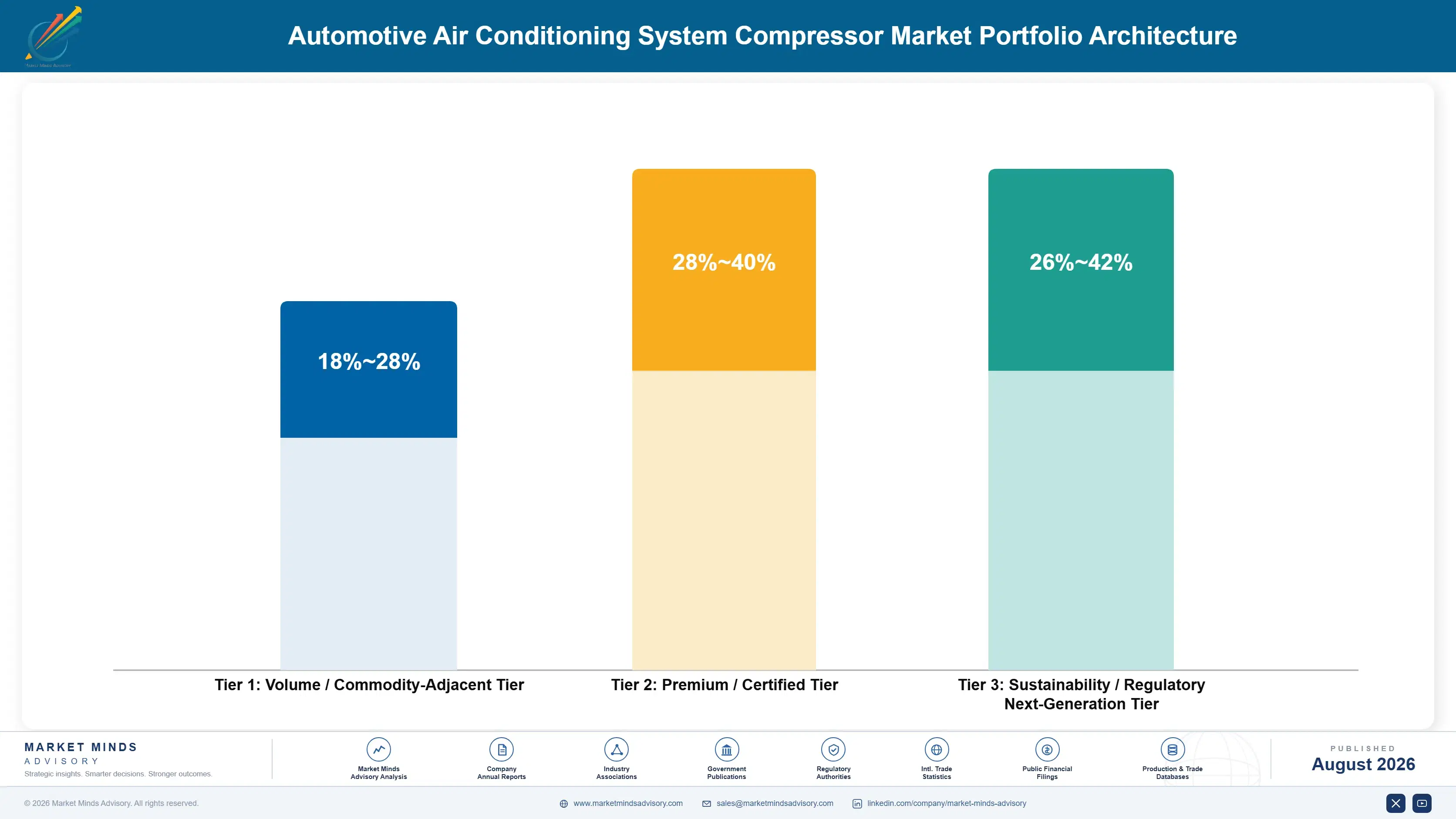
The portfolio splits into three tiers with distinct economics. Standard mechanical fixed displacement compressors form the volume tier, competing increasingly on price against cost-focused manufacturers with margin set by component cost and production efficiency. Electric scroll and reversible heat pump compressors earn considerably more since power electronics depth and thermal engineering breadth deter competitors lacking comparable technical investment. Platform integration services and modul
The tension runs between standard mechanical compressor revenue that funds the business today and electric compressor engineering investment that positions it for the next decade of EV-driven demand. A manufacturer defending mechanical compressor volume too aggressively against cost-focused competition cedes the highest-margin segments to competitors investing there directly. Companies managing this well use mechanical compressor cash flow to fund electric drivetrain engineering rather than treating them as competing priorities.

High-value pools concentrate where power electronics depth, thermal engineering breadth, or OEM platform relationships limit competition: electric scroll compressors, reversible heat pump systems, and multi-refrigerant modular platforms. Standard mechanical compressors sold without differentiated capability sit at the other end, competing almost entirely on price against every cost-focused manufacturer serving conventional internal combustion vehicle platforms.

Volume / Commodity-Adjacent Tier

Standard mechanical fixed displacement compressors competing increasingly on price against cost-focused manufacturers, with margin set overwhelmingly by component cost and production efficiency across most conventional categories tracked and monitored closely.
Gross Margin: 18-28%

Premium / Certified Tier

Electric scroll and variable displacement compressors supporting meaningfully stronger margin than standard mechanical production, reflecting genuine power electronics and engineering differentiation earned across multiple platform generations and validation testing cycles.
Gross Margin: 28-40%

Sustainability / Regulatory / Next-Generation Tier

Reversible heat pump systems, multi-refrigerant modular platforms, and battery thermal management integration designs developed ahead of tightening refrigerant regulation across multiple jurisdictions currently under active regulatory review and ongoing revision.
Gross Margin: 26-42%
automotive-air-conditioning-system-compressor-mark-portfolio-architecture-1787325475536

High-value Sub-segments and Strategic Watch-out

Electric Scroll Compressors for EVs and Hybrids

High value and high growth at 11.5%, the fastest category in the market, driven by rising EV and hybrid production mandates that require electric compressors across nearly every major automotive market and manufacturer product lineup currently expanding rapidly worldwide, a genuine and sustained platform-level shift.
Gross Margin: 28-40%

Variable Displacement Swash Plate Compressors

High value with strong growth at 7.0%, the second-fastest category, driven by tightening fuel efficiency regulation favouring variable output over fixed displacement designs across hybrid and higher-efficiency internal combustion vehicle platforms currently in production worldwide today across most established global manufacturers, suppliers, and assembly plants.
Gross Margin: 28-40%

Scroll Compressors

The volume core by revenue, growing near 5.0% as this remains a well-established mechanical technology across nearly every conventional vehicle platform tracked currently worldwide, though growth has moderated meaningfully as electric conversion accelerates steadily across the broader global industry and its supplier base over time.
Gross Margin: 18-28%

Reciprocating (Piston) Compressors

The strategic watch-out, growing near 2.5% and facing steady decline as automakers phase out legacy mechanical designs in favour of scroll and electric alternatives across nearly every new vehicle platform currently under development globally and regionally across most manufacturers, suppliers, and their broader supply networks.
Gross Margin: 18-28%

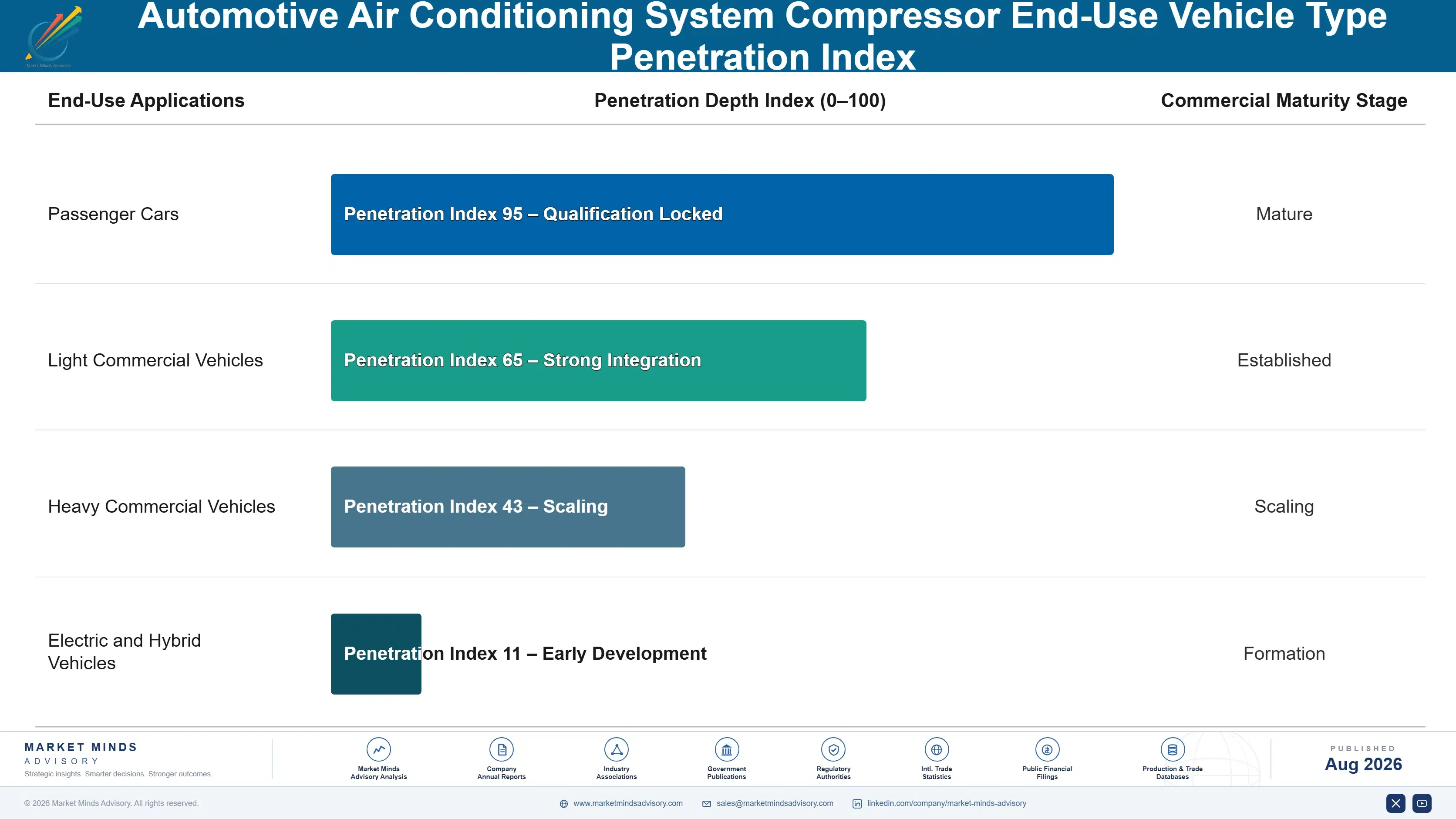
How Platform Awards Lock In Revenue

Revenue depends on OEM platform award cycles and multi-generation specification loyalty, and a manufacturer's default status on a vehicle platform generates years of guaranteed volume across that platform's full production run. Switching suppliers mid-platform requires costly requalification and validation testing, a barrier that deters displacement even when a competitor offers marginally better pricing after initial award.
Adoption depth varies sharply by technology. Electric compressor buyers commit hardest, given the engineering integration complexity and power electronics interdependence with the broader vehicle's high-voltage system once specified. Variable displacement buyers sit in the middle, balancing supplier relationships against periodic competitive retendering during platform refreshes. Standard mechanical compressor buyers switch most readily, since specification differentiation between qualified manufacturers remains genuinely minimal.

Buyer profiles have shifted from purchasing engineers evaluating unit cost alone toward platform engineering teams weighing power electronics integration, thermal performance, and multi-generation reliability together. Heat pump adoption has introduced a new buyer consideration around range extension value that conventional cooling-only economics never required previously. Younger vehicle engineering teams also weigh software and diagnostic integration more heavily than predecessors did, favouring suppliers with genuinely connected compressor control systems.
automotive-air-conditioning-system-compressor-mark-end-use-penetration-index-1787325476028

Our Call on Automotive AC Compressors

These are among the four positions where our research anticipates prominent divergence between winners and laggards over the coming forecast period. Each is grounded in the demand model, the regulatory perimeter, and the announced capacity pipeline.
01 / ELECTRIC COMPRESSOR SHIFT

EV production now dictates engineering priority

Electric compressor penetration has reached roughly 28 percent of new units, a share that has risen steadily as EV and hybrid production expands across nearly every major automotive market tracked currently and continues growing each quarter globally and steadily. Manufacturers with genuine electric motor and power electronics engineering capability capture specification that mechanical compressor specialists retrofitting electric drivetrains increasingly cannot match reliably. Companies should build electric capability now, since this technical requirement increasingly gates access to the fastest-growing vehicle platform category available.
02 / HEAT PUMP ENGINEERING

Range extension value rewards reversible design

Automakers increasingly specify heat pump systems on EV platforms to extend cold-weather driving range, and heat pump adoption has grown roughly 18 percent since 2023 as component costs decline and range competition intensifies across most major automaker roadmaps globally and steadily. Manufacturers with reversible compressor engineering expertise capture premium specification on EV platforms that cooling-only competitors increasingly cannot access at comparable margin or scale. Companies should develop this expertise deliberately, since it increasingly determines specification on premium electrified platforms worldwide.
03 / PLATFORM INTEGRATION DEPTH

Multi-generation trust decides platform awards

Automakers increasingly default to suppliers with multi-year platform integration history, since a compressor failure during warranty triggers a recall cost far exceeding any price difference between competing suppliers under serious consideration for a given award. Manufacturers investing in deep, long-term OEM engineering relationships capture platform specification that transactional, price-focused competitors struggle to displace even with lower upfront costs offered during negotiations. Companies should prioritise platform relationships as a strategic asset, not a transactional bidding exercise repeated each cycle without genuine engineering investment.
04 / REFRIGERANT DESIGN MODULARITY

Modular platforms manage regulatory fragmentation

Global refrigerant transition regulation varies considerably across major markets, forcing suppliers to maintain multiple compressor design variants that raise engineering and manufacturing cost by roughly 20 percent compared with a single global platform most manufacturers would prefer to build. Manufacturers engineering modular platforms that accommodate multiple refrigerant types with minimal redesign capture cost advantages that competitors maintaining fully separate regional designs cannot match easily or quickly. Companies should invest in modular engineering now, since regulatory fragmentation shows no sign of converging soon across major markets.

Engagement Snapshot From the Field

A live engagement with an industry participant carrying material or product regulatory and market exposure ahead of a defining policy shift, showing how our research translates into a defensible multi-year portfolio strategy.
MARKET MINDS ADVISORY · CLIENT ENGAGEMENT SUMMARY
Automotive Air Conditioning System Compressor Producer Strategic Portfolio Review and Transition Roadmap 2026·Investment Scenario on Automotive Air Conditioning System Compressor Exposure Evaluation 2025-26
CLIENT PROFILE
A mid-tier automotive component supplier generating the majority of its revenue from mechanical compressor sales to conventional internal combustion vehicle platforms engaged MMA ahead of a decision on whether and how quickly to invest in electric compressor engineering capability. The client reported growing pressure from automaker customers requesting electric compressor quotes it currently could not fulfil (client-reported, unverified by MMA).
STRATEGIC CHALLENGE
Leadership faced a choice between a rapid, capital-intensive push into electric compressor engineering or a slower, more measured transition that risked ceding early EV platform awards to faster-moving competitors. The board worried that moving too aggressively could strain balance sheet capacity, while moving too slowly could permanently exclude the company from the fastest-growing segment of its market.
MMA APPROACH
MMA benchmarked electric compressor engineering investment requirements against the client's existing balance sheet capacity and mechanical compressor cash flow generation over a five-year horizon. We assessed which of the client's existing automaker relationships were most likely to award early electric compressor platform business given historical loyalty patterns. We then modelled phased investment scenarios balancing electric compressor capability development against continued mechanical compressor customer service commitments.
KEY FINDINGS
  1. Two of the client's five largest existing automaker customers had already begun sourcing electric compressors from competitors, representing an estimated 15 percent revenue risk over five years.
  2. A phased investment approach could fund electric compressor engineering primarily through existing mechanical compressor cash flow without requiring significant new external capital.
  3. Early electric compressor platform awards typically required at least eighteen months of validated engineering track record before an automaker would commit significant volume.
  4. Partnering with a power electronics specialist for initial electric compressor programmes reduced time to market by roughly 40 percent compared with fully in-house development.
CLIENT PROFILE
A mid-tier automotive component supplier generating the majority of its revenue from mechanical compressor sales to conventional internal combustion vehicle platforms engaged MMA ahead of a decision on whether and how quickly to invest in electric compressor engineering capability. The client reported growing pressure from automaker customers requesting electric compressor quotes it currently could not fulfil (client-reported, unverified by MMA).
STRATEGIC CHALLENGE
Leadership faced a choice between a rapid, capital-intensive push into electric compressor engineering or a slower, more measured transition that risked ceding early EV platform awards to faster-moving competitors. The board worried that moving too aggressively could strain balance sheet capacity, while moving too slowly could permanently exclude the company from the fastest-growing segment of its market.
MMA APPROACH
MMA benchmarked electric compressor engineering investment requirements against the client's existing balance sheet capacity and mechanical compressor cash flow generation over a five-year horizon. We assessed which of the client's existing automaker relationships were most likely to award early electric compressor platform business given historical loyalty patterns. We then modelled phased investment scenarios balancing electric compressor capability development against continued mechanical compressor customer service commitments.
KEY FINDINGS
  1. Two of the client's five largest existing automaker customers had already begun sourcing electric compressors from competitors, representing an estimated 15 percent revenue risk over five years.
  2. A phased investment approach could fund electric compressor engineering primarily through existing mechanical compressor cash flow without requiring significant new external capital.
  3. Early electric compressor platform awards typically required at least eighteen months of validated engineering track record before an automaker would commit significant volume.
  4. Partnering with a power electronics specialist for initial electric compressor programmes reduced time to market by roughly 40 percent compared with fully in-house development.
RECOMMENDED STRATEGY
Phase 1: Phase 1 (0 to 6 months): Partner with a power electronics specialist to accelerate electric compressor engineering capability development quickly. Phase 2: Phase 2 (6 to 18 months): Pursue early electric compressor platform validation with the client's most loyal existing automaker customers. Phase 3: Phase 3 (18 to 36 months): Scale electric compressor manufacturing capacity based on validated platform award volume secured earlier on.
OUTCOME
The client partnered with a power electronics specialist and secured its first electric compressor platform validation within fourteen months, ahead of its original eighteen-month internal target set earlier. Existing mechanical compressor customer relationships were maintained throughout the transition without measurable service disruption (client-reported, unverified by MMA).

Frequently Asked Questions

Foundational context covering the market sizes, CAGR, scope, country, region and competition that inform every finding below. This section is provided to cover basics and most often pre-purchase conversations, answered from the MMA Primary Research Dataset.

What is the current size of the Automotive Air Conditioning System Compressor Market?

The global automotive AC compressor market is valued at USD 7.4 billion in 2025, covering mechanical and electric compressors for vehicle cabin cooling and EV heat pump heating. Condensers and evaporators sold separately are excluded.

How large will the Automotive Air Conditioning System Compressor Market be by 2036?

The market is forecast to reach USD 13.2 billion by 2036 in the base case, about 1.69 times the 2026 level. That represents incremental value of roughly USD 5.4 billion across the decade.

What is the CAGR for the Automotive Air Conditioning System Compressor Market 2026 to 2036?

The market grows at a 5.4% CAGR in the base case, with bull and bear scenarios at 6.6% and 4.1%. The spread turns mainly on EV production pace and heat pump adoption speed.

Which segment is growing fastest?

Electric scroll compressors for EVs and hybrids grow fastest at 11.5%, about 2.13 times the overall rate, pulled forward by rising EV production mandates. Variable displacement swash plate compressors follow at 7.0%.

Who are the major companies in the Automotive Air Conditioning System Compressor Market?

Leading companies include Denso, Hanon Systems, Sanden Corporation, MAHLE, and Valeo. Concentration sits at a substantial 58%, led by Denso's OEM integration depth across most platforms.

Which country is growing fastest?

China grows fastest at an 8.5% CAGR, driven by EV adoption momentum and expanding domestic vehicle production nationwide. India follows on rising manufacturing policy support and investment.

Report Segmentation Architecture

The full report scope spans multiple orthogonal segmentation dimensions, with cross-tabulated demand data provided for each dimension pair. Coverage extends further to regional breakdowns, trend trajectories, and the competitive detail needed to support segment-level decision-making.

By Compressor Technology Type

  • Reciprocating (Piston) Compressors
  • Rotary Vane Compressors
  • Scroll Compressors
  • Electric Scroll Compressors for EVs and Hybrids
  • Variable Displacement Swash Plate Compressors

By End-Use Vehicle Type

  • Passenger Cars
  • Light Commercial Vehicles
  • Heavy Commercial Vehicles
  • Electric and Hybrid Vehicles

By Commercial Dimension

  • Original Equipment Manufacturer Supply
  • Aftermarket Replacement Supply
  • Platform Co-Development Agreements
  • Tier 2 Component Supply Contracts

By Region

  • North America
  • Western Europe
  • East Asia
  • South Asia and Pacific
  • Latin America
  • Middle East and Africa
  • Eastern Europe

Scope, Methodology, and Coverage

Every figure in this report is reproducible from documented input assumptions. The scope below maps the historical period, the forecast horizon, the segmentation dimensions, and the countries covered, alongside the underlying primary and qualitative methodology.
Historical Period
2020 to 2025
Forecast Period
2026 to 2036
Base Year
2025 (USD billions; MMA Primary Research Dataset, August 2026)
Market Definition
The automotive air conditioning system compressor market comprises mechanical and electric compressors that circulate refrigerant for vehicle cabin cooling and, in electric and hybrid vehicles, reversible heat pump heating, valued at manufacturer revenue for original equipment and aftermarket units. Standalone HVAC control units, condensers, and evaporators sold separately from the compressor are excluded from this scope.
Quantitative Units
USD billions (current prices); unit shipment volume by compressor technology where applicable
Segmentation Dimensions
By Compressor Technology Type; By End-Use Vehicle Type; By Commercial Dimension; By Region
Regions Covered
North America, Western Europe, East Asia, South Asia and Pacific, Latin America, Middle East and Africa, Eastern Europe
Countries Covered
China, Japan, South Korea, USA, Canada, Mexico, Germany, France, UK, Italy, Spain, India, Australia, Vietnam, Indonesia, Brazil, Argentina, Saudi Arabia, UAE, Turkey, South Africa, Nigeria, Poland, Czech Republic, Slovakia, Romania, Thailand, Philippines, Sweden, Netherlands, and additional markets relevant to this sector
Key Companies Profiled
Denso, Hanon Systems, Sanden Corporation, MAHLE, Valeo, Subros, BITZER, Panasonic, Toyota Industries Corporation, Marelli, Sanhua Automotive, Modine Manufacturing, Eberspächer, Johnson Electric, Nidec, Gentherm, Hitachi Astemo, Aisin Corporation, Mitsubishi Heavy Industries Thermal Systems, Shanghai Highly
Quantitative Methodology
Primary survey, n=3,800 respondents, Q4 2025, six countries; demand-side model with trade association cross-validation
Qualitative Methodology
47 expert interviews, Q4 2025; applied to validate demand model assumptions, identify emerging dynamics, and assess competitive positioning
Report Format
PDF and XLSX data workbook (Word format preview document)
Publisher
Market Minds Advisory
Report Code
MMA-2026-AUT-205
Published
August 2026
Contact
sales@marketmindsadvisory.com | www.marketmindsadvisory.com

Purchase the full Automotive Air Conditioning System Compressor Market Report (2026 to 2036).

The full MMA Automotive AC Compressor report sizes the market across five compressor technology types, four vehicle categories, four commercial channels, and seven regions through 2036. It profiles 20 companies on a consistent unit shipment volume basis, scoring each on electric compressor engineering capability, heat pump reversible design expertise, OEM platform integration depth, and multi-refrigerant modular design. Scenario models quantify how EV production, heat pump adoption, and refrigerant regulation trends move both unit demand and achievable margin by technology. The report also includes OEM platform award mapping and refrigerant regulation tracking for manufacturer and investor strategy teams.
Five-technology and four-channel market sizing to 2036
Twenty-company benchmark on unit shipment volume basis
Electric compressor engineering competitive positioning analysis
Heat pump reversible design capability benchmarking review
Refrigerant regulation and modular platform tracking
OEM platform award and multi-generation loyalty analysis

Built For The People Who Decide

From boardroom strategy to bench-side execution, this report is read cover-to-cover by leaders shaping the next decade of their industry, turning demand scenarios, market dynamics and valuation benchmarks into decisions.
CXOs/ Presidents/ VPs/ Managers
M&A and Corporate Development
Strategy Teams and R&D Heads
Procurement and Product Directors
Regulatory and Compliance Leaders
Investor Relations and Equity Analysts