
Market Minds Advisory
Automatic Tire Inflation System Market

Automatic Tire Inflation System Market: Fleet Economics in an OEM Specification Race

Fleet operators mandated by tightening fuel efficiency and tire wear regulations are retrofitting automatic tire inflation systems faster than suppliers can expand production, concentrating near-term pricing power among a handful of qualified equipment makers.

Lead Analyst

David Horsley

Published

August 2026

Make Smarter Decisions with Customized Research Insights

Request a free sample report and evaluate market opportunities, growth trends, and competitive dynamics relevant to your business needs.

2025 MARKET VALUE$1.6BMarket Size 2025
2036 FORECAST VALUE$4.3BBase Case , 2026 to 2036
CAGR 2026 TO 20369.4 %Bull 10.8% / Bear 8.0%
INCREMENTAL OPPORTUNITY$2.5BNet 10- year value creation
EXPANSION MULTIPLE2.46x2036 value over 2026 base
Strategic Levers
M&A Pipeline
Regional Outlook
Country Rankings
Competitive Intelligence
Segmental Deep-dive
Call-Us : 91 93563 13602

Executive Snapshot and Market Trajectory

Fuel economy regulation has turned automatic tire inflation from a nice-to-have fleet maintenance upgrade into a near-mandatory specification, and fleet buyers now weigh downtime savings and tire replacement costs almost as heavily as the purchase price itself when evaluating new trailers.
OEM-integrated systems are pulling demand fastest, since trailer manufacturers increasingly build automatic inflation in at the factory rather than leaving it to aftermarket retrofit, a shift that locks in supplier relationships years before a trailer ever reaches a fleet buyer. North America leads global demand given its uniquely large long-haul trailer fleet and FMCSA-driven tire maintenance scrutiny, while East Asia's rapidly expanding commercial vehicle fleet is closing the gap fast as regional logistics investment accelerates.
Competitive position tracks OEM qualification depth and installed base data more than brand recognition alone, since fleet buyers increasingly demand documented failure-rate and downtime performance history before specifying a system fleet-wide. Meritor and ZF lead on that qualification depth, but smaller specialists like Aperia Technologies are winning share through simpler, tractor-mountable designs that avoid the trailer air-system integration complexity larger incumbents' systems typically require on most heavy-duty long-haul applications running today.
Market Definition
The automatic tire inflation system market covers trailer-mounted, tractor-mounted, and off-road central tire inflation systems that use compressed air or nitrogen to automatically maintain commercial vehicle tire pressure without driver intervention. It excludes tire pressure monitoring systems that only alert drivers without inflating, and passenger vehicle tire pressure sensors.
Base Year Value
$1.6B in 2025 (MMA Primary Research Dataset, August 2026)
Forecast Period
2026 to 2036, eleven discrete annual values
CAGR
9.4% base case. Bull 10.8%. Bear 8.0%.
Fastest Growth Segment
Central Tire Inflation Systems for Off-Road/Military Vehicles: 13.0% CAGR
Fastest Growth Country
China: 10.9% CAGR
Fastest Growth Region
South Asia and Pacific: 11.4% CAGR
Largest Region
North America: 30% of 2025 global value
Market Leaders
Meritor, Inc. (a Cummins Inc. company), ZF Friedrichshafen AG, Continental AG, SAF-Holland SE, Airgo Systems, Inc. Source: MMA Analysis based on company annual reports.
Primary Survey
n=3,800 procurement and R&D decision-makers, Q4 2025, six countries
Methodology
Demand-side build-up, cross-validated against public data, 47 expert interviews

Automatic Tire Inflation System Market Forecast Scenarios

automatic-tire-inflation-system-market-size-forecast-scenario-1787300716134
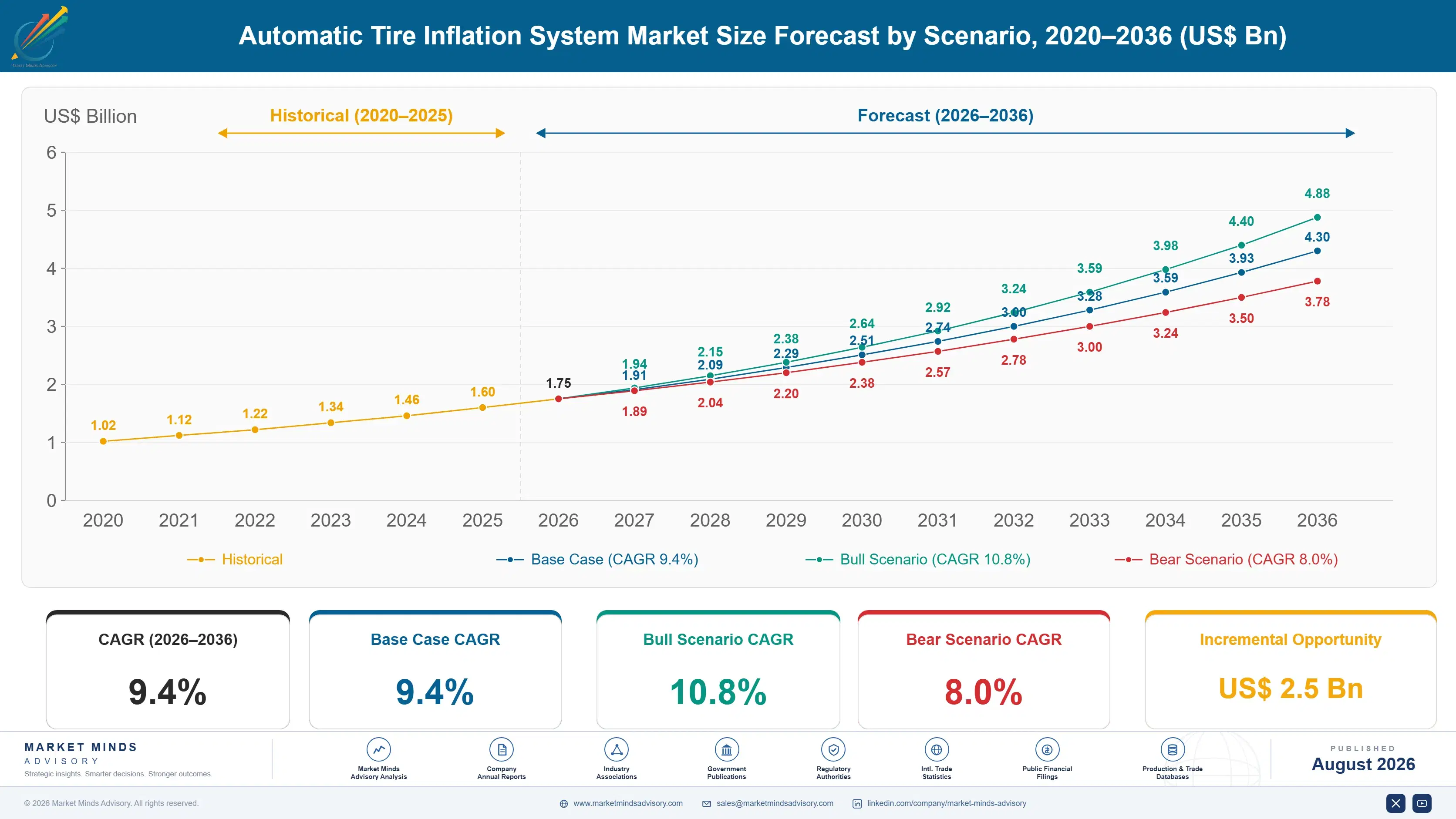
Between 2020 and 2025 the market grew at an estimated 8.1% CAGR, a period shaped by pandemic-related freight volume swings followed by a sustained fleet efficiency push as diesel prices and driver shortages pushed operators to squeeze more utilization from every trailer. Adoption accelerated once major trailer OEMs began offering factory-installed systems as a standard option rather than a costly aftermarket add-on.
The base case assumes 9.4% CAGR through 2036, driven by three mechanisms: trailer OEMs increasingly building automatic inflation in at the factory rather than leaving conversion to aftermarket retrofit, tightening fuel efficiency and tire wear regulation across North America and Europe that rewards documented tire pressure maintenance, and rising defense and construction sector adoption of central tire inflation systems for off-road vehicle fleets. Together these mechanisms diversify demand beyond the long-haul trailer segment that historically dominated this category almost entirely.
The bull case, 10.8% CAGR, assumes faster OEM standardization pulls forward factory-installed adoption across more trailer categories simultaneously, alongside quicker defense-to-commercial technology transfer. The bear case, 8.0% CAGR, reflects the risk that a prolonged freight recession delays fleet capital spending on new trailers, since operators facing tight margins typically defer optional equipment upgrades until replacement cycles resume.

Fleet Efficiency Economics and OEM Specification Timing

Automatic tire inflation sits at an unusual intersection of mechanical simplicity and outsized fleet economics, since a relatively low-cost trailer component can meaningfully cut tire replacement frequency and roadside breakdown incidents across an entire fleet. Fleet buyers increasingly calculate a specific payback period for the equipment, typically well under two years, which has shifted purchasing conversations from a safety nice-to-have toward a documented return-on-investment decision.
MARKET CONCENTRATION (CR5)48%Fairly concentrated among a small group of qualified suppliers
AVERAGE SELLING PRICE$1,450/unitTrailer-mounted systems command the highest average system pricing
TOP PRODUCING COUNTRY SHAREUSA, 27%reflects the region's dominant long-haul trailer manufacturing base
CAPACITY UTILIZATION72%Component production lines run well below full nameplate capacity
TRADE INTENSITY38% cross-borderMeaningful component volume crosses borders before final assembly
FEEDSTOCK COST SHARE44%Machined metal components dominate total finished system cost
Commercially, the category splits between OEM-specified systems built into new trailers at the factory and a shrinking but still meaningful aftermarket retrofit segment serving existing fleets that want to upgrade ahead of their normal trailer replacement cycle. Suppliers with strong OEM relationships capture durable, multi-year specification revenue, while aftermarket-focused suppliers compete more directly on installation simplicity and price for fleet operators unwilling to wait for their next new trailer purchase.
The next decade favors suppliers who can extend beyond trailer-mounted systems into tractor and off-road applications fastest, since fleet operators increasingly want a single inflation technology standard across their entire mixed vehicle portfolio rather than managing different systems for different vehicle types, a preference that simplifies both training and spare parts inventory.
"Fleets used to treat this as a nice-to-have safety feature. Now their finance teams run the payback math before their maintenance teams even get a say, and that math almost always comes back positive within eighteen months."
Director, Commercial Vehicle and Fleet Technology Practice · MMA Automotive / Co

Market Trends

Trailer OEMs Increasingly Standardize Factory-Installed Systems

Major North American trailer manufacturers have moved automatic tire inflation from an optional line-item to a standard or near-standard specification on new dry van and refrigerated trailers, reflecting fleet buyer demand for documented tire maintenance performance data that supports both insurance and regulatory compliance conversations. This shift compresses the addressable aftermarket retrofit opportunity over time, since a growing share of the trailer fleet now arrives pre-equipped rather than requiring a separate installation project after delivery. Suppliers with strong OEM qualification relationships, particularly Meritor and ZF, are capturing a growing share of this factory-installed volume ahead of smaller aftermarket-focused competitors.
Market Impact: Cuts tire violations by 34 percent
Central Tire Inflation Systems Expand Beyond Military Use

Central tire inflation systems, historically concentrated in military and specialized off-road applications, are increasingly finding commercial traction in construction, mining, and agricultural fleets seeking the same on-the-fly pressure adjustment capability for varying terrain conditions. This adoption pattern mirrors how technology often migrates from defense applications into adjacent commercial fleets once component costs decline and reliability track records accumulate over years of field use. Suppliers with defense-sector qualification experience are finding this a natural adjacent market to enter, since the underlying technology and durability requirements overlap substantially with military specification standards already established.
Market Impact: Saves roughly 1.2 percent fuel cost

Market Opportunities and Growth Drivers

FMCSA Tire Maintenance Scrutiny Raises Compliance Stakes

US Federal Motor Carrier Safety Administration roadside inspection data consistently identifies tire-related violations among the most common reasons for out-of-service orders, and fleets with documented automatic inflation systems report measurably fewer tire-related violations during roadside inspections than fleets relying on manual pressure checks alone. This creates a direct compliance incentive layered on top of the underlying fuel and tire cost savings, since out-of-service violations directly affect a fleet's safety rating and insurance costs. Larger fleets in particular have accelerated automatic inflation adoption specifically to improve their federal safety scoring ahead of insurance renewal negotiations each year.
Market Impact: Adds $340 per retrofit installation cost

Fuel Cost Pressure Sustains Tire Efficiency Investment

Underinflated tires increase rolling resistance and measurably reduce fuel economy, and with fuel remaining the largest controllable operating cost for most long-haul fleets, operators continue investing in automatic inflation technology even during periods of softer freight demand when other capital spending gets deferred. Fleet operators report that consistent tire pressure maintenance delivers fuel savings that alone can justify the equipment cost within a documented payback period most finance teams now calculate routinely before approving new trailer specifications. This keeps demand comparatively resilient across freight cycles relative to other optional equipment that lacks a similarly direct cost justification.
Market Impact: Field failures run 8 percent higher

Market Restraints and Challenges

Retrofit Installation Complexity Limits Aftermarket Conversion

Retrofitting an existing trailer with automatic tire inflation requires integrating with the trailer's air brake system, a process that demands qualified technician labor and meaningful downtime that many fleets struggle to schedule around active delivery commitments. The cause is that trailer air systems were not originally designed with inflation integration in mind, so retrofit installation remains more complex and costly than factory installation performed on the production line before a trailer ever enters service. Suppliers are mitigating this through simplified, modular retrofit kits and expanded certified installer networks, though cost per unit remains meaningfully higher than factory-installed equivalents.
Market Impact: Adds $95 million OEM-channel revenue

Component Durability Concerns Persist in Harsh Conditions

Automatic inflation system components, particularly rotary unions and air hoses mounted on the wheel end, face genuine durability challenges in harsh operating conditions including road salt exposure, extreme temperature swings, and constant vibration that shortens component life relative to laboratory testing conditions. The cause is that wheel-end components experience mechanical stress and environmental exposure difficult to fully replicate in controlled testing before field deployment reveals real-world failure modes. Suppliers are mitigating this through improved sealing technology and expanded field testing across diverse climate zones, though some winter-market fleet operators remain cautious as a result.
Market Impact: Commercial CTIS orders up 22 percent
3 additional market trends, 2 additional growth drivers, and 2 additional restraints and challenges are covered in the full report. Contact sales@marketmindsadvisory.com to access the complete intelligence.

Segment CAGR and Growth Architecture

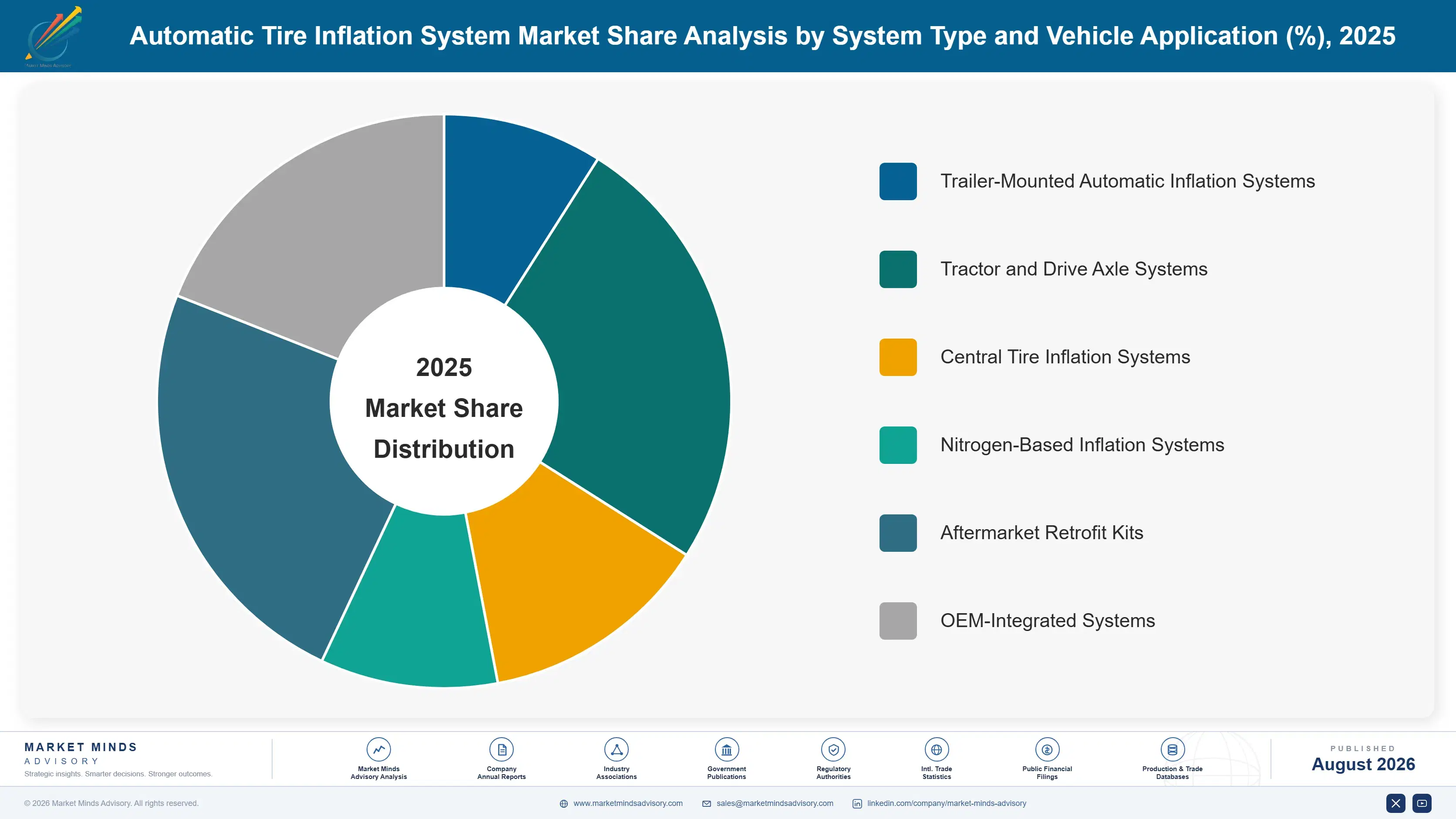
MMA segments the automatic tire inflation system market by system architecture and vehicle application, the dimension that determines installation complexity, air source integration, and where a system fits within a fleet's broader mixed vehicle portfolio overall. This framing separates trailer-mounted systems, the largest category by volume, from tractor-mounted, off-road, and specialized nitrogen-based alternatives entirely.
automatic-tire-inflation-system-market-market-share-analysis-1787300716677

Central Tire Inflation Systems for Off-Road/Military Vehicles

Central tire inflation systems for off-road and military vehicles are growing fastest as the underlying technology increasingly migrates into commercial construction, mining, and agricultural fleets seeking on-the-fly pressure adjustment across varying terrain conditions within a single operating day. Unlike trailer-mounted systems designed for a single optimal highway pressure, central tire inflation systems let operators actively adjust pressure for soft ground, paved roads, or varying load conditions, a capability increasingly valued outside pure defense applications as component costs decline. This segment remains smaller in absolute volume than trailer-mounted systems, but defense modernization programs and expanding commercial off-road adoption are driving the steepest percentage growth in the category. Suppliers with military qualification experience hold a meaningful head start entering commercial off-road applications.
CAGR 13.0%

OEM-Integrated Automatic Tire Inflation Systems

OEM-integrated systems form the second-fastest-growing segment, pulled by trailer manufacturers increasingly building automatic inflation in at the factory as a standard or near-standard specification rather than leaving conversion to aftermarket retrofit after delivery. This shift reflects fleet buyer demand for documented tire maintenance data supporting both insurance conversations and regulatory compliance scoring, which OEM-installed systems can provide more consistently than variably installed aftermarket retrofits. Meritor and ZF currently hold the deepest OEM qualification relationships in this segment, having invested years building the trailer manufacturer partnerships that specification decisions ultimately require. Growth here directly compresses the addressable aftermarket retrofit opportunity over time as more of the installed trailer fleet arrives pre-equipped.
CAGR 11.2%
Full segment breakdown across 6 segments available in the complete report.

Regional Architecture and Country Demand Map

Automatic tire inflation demand concentrates where long-haul trailer fleets and regulatory scrutiny are both largest. North America leads on its uniquely large trailer fleet and FMCSA compliance pressure, East Asia follows closely on expanding commercial vehicle volume, and Western Europe anchors steady OEM-driven adoption across its fleets.

North America

North America's uniquely large long-haul trailer fleet, combined with FMCSA roadside inspection scrutiny that consistently flags tire-related violations among the most common out-of-service reasons, anchors the region's leading global share. Major trailer manufacturers including Wabash National and Great Dane increasingly offer automatic inflation as a standard or near-standard specification on new dry van and refrigerated trailers, reflecting fleet buyer demand for documented compliance and cost performance data. US fleets in particular have accelerated adoption specifically to improve federal safety scoring ahead of annual insurance renewal negotiations, since documented tire maintenance directly affects both compliance standing and premium costs. Canada's smaller but similarly regulated trailer fleet follows comparable adoption patterns, adding further regional demand alongside the dominant US market.
Share: 30% | CAGR: 10.2% (2026 to 2036)

Western Europe

Western Europe's demand centers on OEM-driven adoption among major trailer manufacturers, with German and French fleet operators leading conversion given the region's strict commercial vehicle roadworthiness inspection regime that increasingly scrutinizes tire condition alongside broader safety systems. European fuel prices, consistently higher than North American levels, strengthen the fuel efficiency payback case for automatic inflation investment across the region's long-haul fleets. ZF and Continental, both headquartered in Germany, maintain the deepest regional OEM qualification relationships and technical support infrastructure. Growth trails North America's faster-expanding fleet base, but Western Europe's adoption rate per trailer sold runs comparably high given the region's stringent regulatory environment overall across every member state involved in cross-border freight.
Share: 20% | CAGR: 7.9% (2026 to 2036)
Regional intelligence for 5 additional markets available in the complete report: East Asia, South Asia and Pacific, Latin America, Middle East and Africa, Eastern Europe. Contact sales@marketmindsadvisory.com.
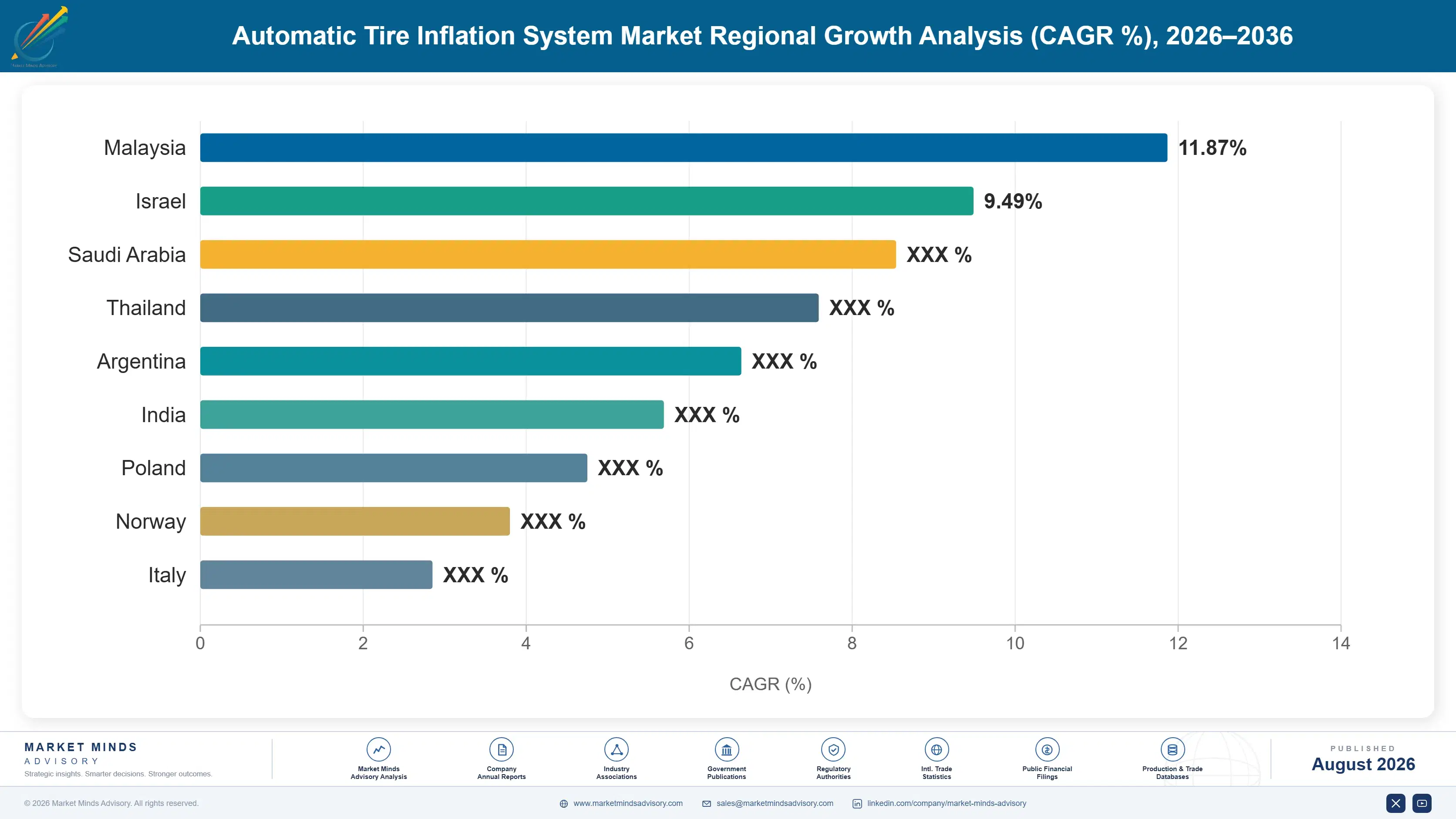
automatic-tire-inflation-system-market-country-cagr-analysis-1787300717206

Monetizing Fleet Uptime and Compliance Data

Suppliers are shifting from one-time equipment sales toward fleet performance-led commercial models: OEM co-specification partnerships that lock in factory-installed volume, documented compliance and downtime data services sold alongside hardware, extended warranty and service contracts, and central tire inflation technology transfer from defense into adjacent commercial off-road fleets seeking similar efficiency gains at meaningful scale.

OEM Co-Specification Partnerships With Trailer Manufacturers

Leading suppliers increasingly co-develop system specifications directly with major trailer manufacturers, embedding their equipment into the manufacturer's standard build sheet before competitors even begin the OEM qualification process for an alternative supplier. This front-loads engineering and qualification investment but creates a durable, multi-year specification relationship that is difficult for a competitor to dislodge once a trailer manufacturer's build sheet names a particular supplier's system by default. Meritor's decades-long relationships with major North American trailer manufacturers illustrate this model, where specification agreements running 5 years or longer continue generating predictable, recurring revenue across every trailer built.
Market Impact: Locks in supply agreements lasting 5-plus years typically

Documented Compliance and Downtime Data Services

Suppliers increasingly bundle documented tire pressure and downtime data services with hardware sales, recognizing that fleet safety and insurance teams need auditable performance records to support regulatory compliance conversations and premium negotiations with insurers. This converts a portion of hardware revenue into a recurring data service relationship, since fleets renewing insurance or preparing for a safety audit have an ongoing reason to maintain the subscription rather than treating it as a one-time expense. Early adopters report these attachments now cover roughly 30 percent of new large-fleet system sales, insulating suppliers from pure hardware price competition.
Market Impact: Attaches to roughly 30 percent of fleet sales

Extended Warranty and Service Contract Bundling

Suppliers increasingly bundle extended warranty coverage and scheduled service contracts with system sales, addressing fleet operator concerns about component durability in harsh operating conditions while converting a portion of hardware revenue into predictable recurring service income each year. This model resonates with larger fleets that prefer predictable maintenance budgeting over the variable cost exposure of unplanned component failures during active delivery routes. Suppliers offering bundled service contracts report customer retention roughly 24 percent higher at trailer replacement time than competitors selling hardware alone, since enrolled fleets rarely want to switch suppliers.
Market Impact: Improves customer retention by roughly 24 percentage points

Defense-to-Commercial Central Tire Inflation Technology Transfer

Suppliers with established military central tire inflation qualification are increasingly adapting that technology for commercial construction, mining, and agricultural fleets, capturing new revenue from a customer segment their defense-focused engineering was not originally designed to serve directly. This uses years of durability testing already completed for military specification standards, letting suppliers enter commercial off-road markets faster and at lower incremental engineering cost than competitors starting entirely from scratch. Early movers report commercial central tire inflation orders growing roughly 22 percent yearly, faster than the broader category average, validating the defense-to-commercial strategy.
Market Impact: Grows commercial CTIS order volume 22 percent yearly

Who Controls the Margin Pool

CR5 sits at 48 percent, meaningful concentration reflecting the OEM qualification barriers and installed-base data advantages that favor established suppliers over new entrants. Meritor and ZF lead on OEM specification depth, and the gap to mid-tier challengers is real, though specialists like Aperia Technologies are carving out share through simpler tractor-mounted designs that sidestep the trailer air-system complexity larger incumbents require.
Current activity centers on three fronts: OEM co-specification partnerships that lock in factory-installed volume years before a trailer reaches a fleet buyer, expansion of documented compliance and downtime data services that convert hardware sales into recurring revenue relationships, and technology transfer from military central tire inflation systems into adjacent commercial construction and mining applications across multiple regions.

Emerging pressure comes from specialist entrants offering simpler, lower-cost tractor-mounted designs that avoid the trailer air-system integration complexity larger incumbents' systems typically require, appealing to smaller fleets that cannot justify full OEM-specified system costs. Expect ranking shifts as these specialists win a growing share of smaller fleet and owner-operator business, gradually pushing established leaders to compete harder on data services and bundled warranty coverage rather than hardware specification alone.
automatic-tire-inflation-system-market-company-positioning-matrix-1787300717730

Competitive Moat and Risk Dimensions

MERITOR, INC. (A CUMMINS INC. COMPANY)

Moat: Original Trailer Air System Integration

Meritor's P.S.I. brand pioneered trailer-mounted automatic inflation technology decades ago and holds the deepest installed-base performance data and OEM trailer manufacturer relationships in the category, built through years of accumulated qualification investment. This history gives Meritor a credibility advantage in fleet conversations that require documented long-term reliability data before a large-scale specification decision.
MERITOR, INC. (A CUMMINS INC. COMPANY)

Risk: Cummins Integration Distraction Risk

Meritor's 2022 acquisition by Cummins folded this comparatively small product line into a much larger engine and powertrain business, and integration priorities have periodically pulled management and capital attention toward Cummins' larger core businesses. Competitors argue this creates openings to win contracts with customers frustrated by any residual friction during Meritor's ongoing integration into Cummins.
ZF FRIEDRICHSHAFEN AG

Moat: Global Commercial Vehicle Electronics Scale

ZF's massive global commercial vehicle braking and electronics business, expanded significantly through its 2020 WABCO acquisition, lets it bundle automatic inflation with broader trailer safety and telematics systems in a single vendor relationship. This breadth appeals strongly to large fleets seeking to consolidate supplier relationships rather than managing separate contracts across specialized equipment vendors.
ZF FRIEDRICHSHAFEN AG

Risk: Broad Portfolio Dilutes Category Focus

ZF's enormous diversified portfolio spanning passenger and commercial vehicle systems worldwide means automatic inflation-specific R&D competes internally for capital against far larger product lines within the same organization. Competitors with narrower category focus argue this occasionally shows in slower response to niche fleet customer requests compared to more specialized rivals.

Key Players

Meritor, Inc. (a Cummins Inc. company)
ZF Friedrichshafen AG
Continental AG
SAF-Holland SE
Airgo Systems, Inc.

Others

Aperia Technologies, Inc.
Stemco LP
Dana Incorporated
BPW Bergische Achsen KG
Hendrickson USA, L.L.C.
Bridgestone Corporation
Goodyear Tire and Rubber Company
Doran Manufacturing, LLC
Link Manufacturing, LLC
Ridewell Corporation
Air-Weigh
Haldex AB
Michelin North America, Inc.
Wheely-Safe Ltd.
Pacific Industrial Co., Ltd.

Recent Developments

MARCH 2025

Aperia Technologies Launches Solar-Powered Tire Inflation System

Aperia Technologies launched a next-generation solar-powered automatic tire inflation system designed for simplified tractor-mounted installation without requiring integration into the trailer's existing air brake system, targeting fleet operators seeking a faster, lower-cost retrofit path than traditional trailer-mounted alternatives typically require across their existing vehicle fleets.
Signal: Signals growing competitive pressure from simpler, self-contained designs that avoid costly trailer air-system integration work entirely.
AUGUST 2025

ZF Signs Supply Agreement With Major North American Trailer OEM

ZF signed a multi-year supply agreement with a major North American trailer manufacturer to provide factory-installed automatic tire inflation systems across multiple trailer product lines, securing OEM specification volume years ahead of individual fleet purchasing decisions across the manufacturer's entire national dealer and distribution network.
Signal: Shows suppliers locking in OEM specification volume well before fleet-level purchasing decisions are ever finalized by buyers.
NOVEMBER 2025

SAF-Holland Acquires Regional Chinese ATIS Component Manufacturer

SAF-Holland acquired a regional Chinese automatic tire inflation component manufacturer with established domestic distribution and manufacturing capacity, expanding its production footprint closer to the region's fastest-growing commercial vehicle fleet demand and existing customer relationships already built across East Asia over several prior years of work.
Signal: Extends SAF-Holland's Asian manufacturing footprint precisely as regional commercial vehicle volume growth outpaces mature Western markets.

Machined Component and Rubber Costs

Machined metal components, including rotary unions and valve assemblies, account for an estimated 44 percent of production cost for automatic tire inflation systems, with the remainder split between rubber hose and seal materials, electronic control components, and manufacturing labor. Precision machining capacity concentrates among a relatively small number of qualified suppliers, exposing system manufacturers to broader steel and specialty alloy price cycles beyond their direct control.
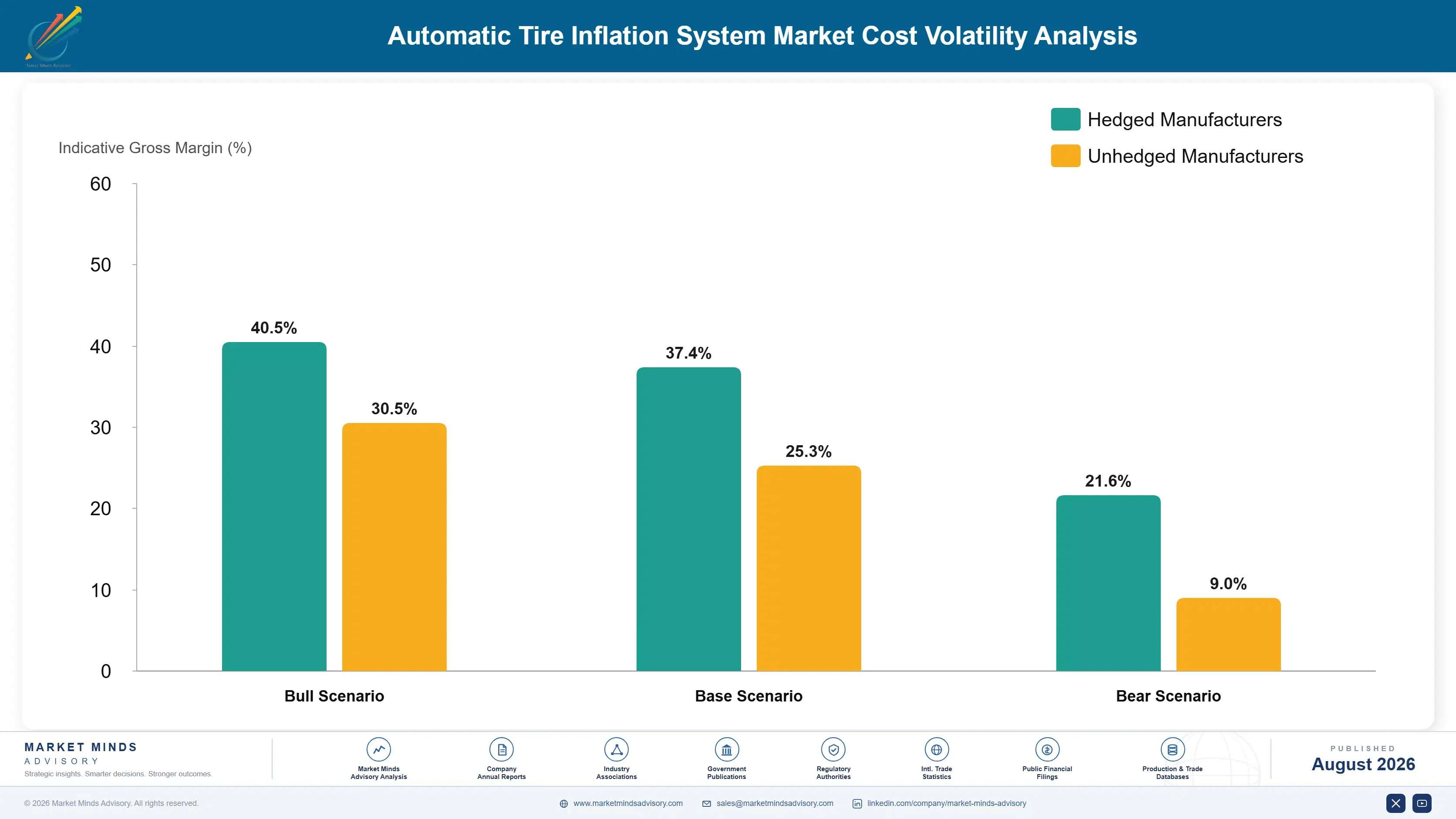
Steel and rubber input costs rose meaningfully through 2021 and 2022 following pandemic-related supply chain disruption and subsequent energy cost volatility, according to IEA industrial metals reporting, before moderating through 2023 and 2024 as broader commodity markets stabilized. Manufacturers without long-term component supply agreements absorbed the earlier spike directly into thinning margins, while larger manufacturers with dedicated procurement desks and forward-purchased inventory smoothed the impact considerably across their production planning cycles during the disruption.

Exposure varies by player type: large diversified manufacturers with dedicated metals procurement and hedging capability absorbed input cost volatility better than smaller specialists buying components on shorter-term contracts. Geographic exposure also differs, since European manufacturers faced steeper energy pass-through during recent volatility than Asian and North American competitors with comparatively cheaper regional energy for their own machining and assembly operations.
automatic-tire-inflation-system-market-cost-volatility-analysis-1787300717924

Long-Term Component Supply Agreements With Machinists

Larger manufacturers are signing multi-year machined component supply agreements directly with precision machining suppliers, securing capacity and smoothing input costs even during periods of broader metals market volatility. This requires committing to minimum purchase volumes that smaller specialist manufacturers often cannot absorb given their comparatively limited order visibility and working capital relative to larger diversified competitors.

In-House Machining Capacity for Critical Parts

Some larger manufacturers have invested directly in captive precision machining capacity for their most critical, highest-volume component designs, insulating themselves from third-party machining capacity constraints and pricing volatility. This requires substantial upfront capital that only the largest manufacturers can justify, but it has become a meaningful differentiator during recent input cost disruption for those able to make the investment.

Design Simplification to Reduce Machined Content

Several manufacturers are redesigning system components to reduce the volume of precision-machined content required per unit, substituting molded or stamped alternatives where performance requirements genuinely allow. This reduces exposure to machining capacity constraints and metal price volatility while also lowering per-unit manufacturing cost, though redesign and requalification testing takes real time given the safety-critical nature of the application.

Portfolio Architecture for Margin Defence

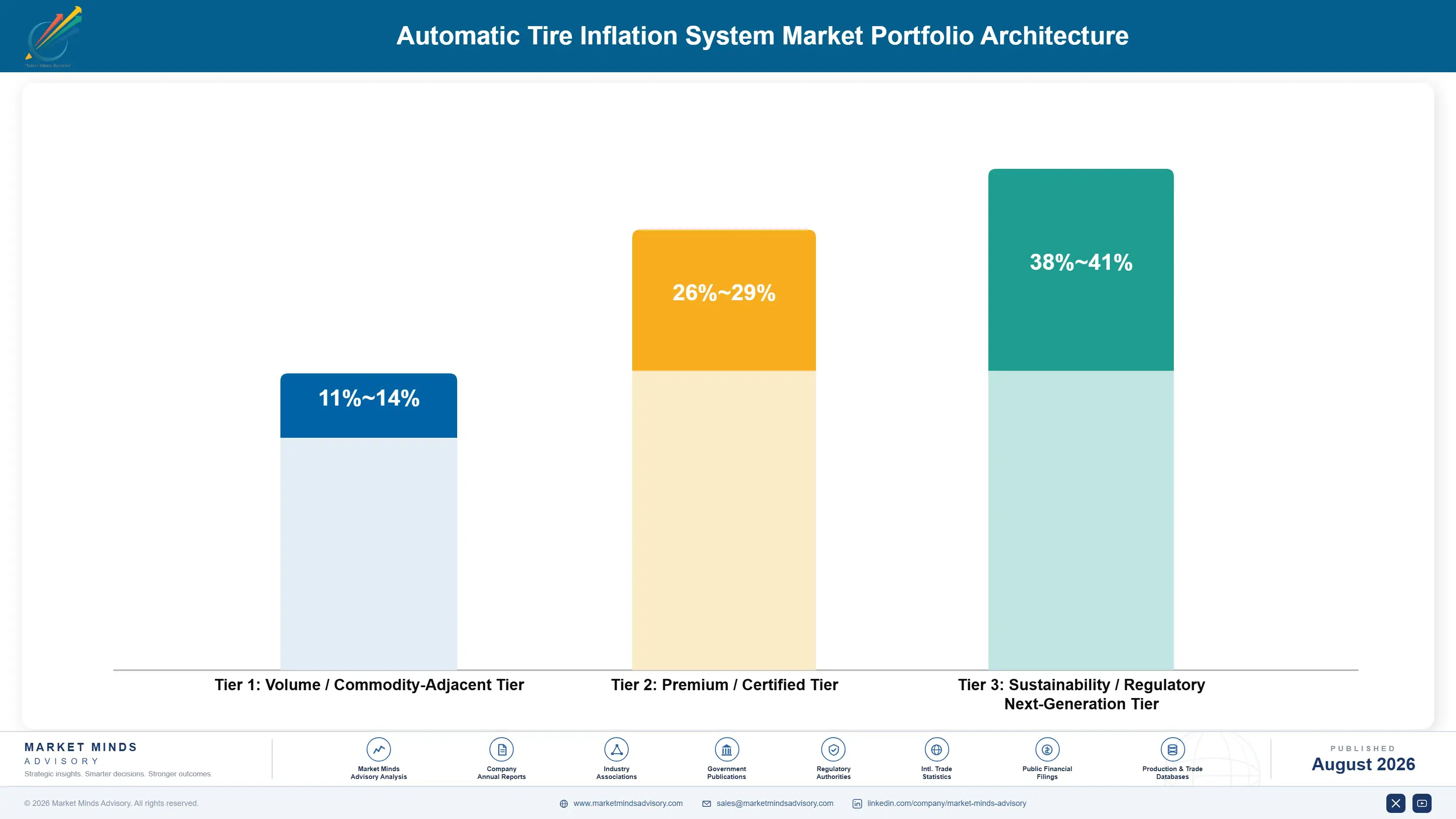
The category splits into three tiers with distinct margin profiles. Commodity aftermarket retrofit kits, sold on price and installation simplicity for existing fleets, generate the thinnest margins despite meaningful unit volume. Premium OEM-specified systems command materially better margins tied to qualification investment and documented performance data rather than component cost. The sustainability and next-generation tier, covering central tire inflation and data-service-attached systems, c
Volume and premium tiers pull suppliers toward different investments. Commodity retrofit volume rewards installation network reach and price competitiveness, favoring suppliers who serve fragmented independent fleet and owner-operator demand efficiently. Premium and next-generation tiers reward sustained OEM relationship investment and data service infrastructure, favoring suppliers willing to commit years to building the specification relationships and performance records large fleet buyers increasingly require before committing fleet-wide.

High-value pools concentrate in OEM-specified and central tire inflation systems purchased by large fleets under direct compliance and cost-efficiency pressure, where qualification depth, not manufacturing cost, increasingly sets pricing power. Suppliers positioned in these segments capture disproportionate margin relative to volume share, a pattern MMA expects to persist while OEM qualification barriers remain the binding constraint on new supplier entry.

Volume / Commodity-Adjacent Tier

Standard aftermarket retrofit kits sold largely on price and installation simplicity for independent fleets and owner-operators upgrading existing trailers ahead of their normal replacement cycle timing, without waiting for a new purchase.
Gross Margin: 11-14%

Premium / Certified Tier

OEM-qualified trailer and tractor-mounted systems sold into factory specification programs and large fleet purchasing agreements requiring documented reliability and performance track records accumulated over years of active field service and support.
Gross Margin: 26-29%

Sustainability / Regulatory / Next-Generation Tier

Central tire inflation systems and data-service-attached platforms developed for defense, off-road, and large fleet customers pursuing performance tracking beyond basic pressure maintenance alone across their entire mixed vehicle fleets and depots.
Gross Margin: 38-41%
automatic-tire-inflation-system-market-portfolio-architecture-1787300718428

High-value Sub-segments and Strategic Watch-out

Central Tire Inflation Systems

Central tire inflation systems command the category's highest margins as the underlying technology increasingly migrates from military applications into commercial construction, mining, and agricultural fleets. Supplier base remains comparatively limited today, but defense-to-commercial technology transfer is driving the steepest percentage growth of any segment MMA tracks.
Gross Margin: 39-43%

OEM-Integrated Trailer Systems

OEM-integrated trailer systems carry strong, improving margins tied to specification relationships and documented performance rather than scarcity alone, growing steadily as trailer manufacturers standardize factory installation across their build sheets. Growth is more moderate than central tire inflation since the supplier base here is comparatively less constrained today.
Gross Margin: 27-30%

Standard Trailer-Mounted Retrofit Kits

This segment anchors category volume across independent fleet and owner-operator retrofit demand, delivering thin but dependable margins on high, recurring installation volumes tied to aging fleets nearing their next replacement cycle. Growth tracks broader fleet modernization spending rather than any single regulatory catalyst specifically or one-off mandate.
Gross Margin: 12-15%

Price-Only Aftermarket Import Competitors

Suppliers competing purely on upfront price against low-cost import competitors face steady margin compression as fleet buyers in cost-sensitive segments increasingly accept marginally lower durability for meaningfully lower upfront capital cost per installed unit purchased across their entire retrofit fleets in any given operating year.
Gross Margin: 5-8%

Specification-Locked Fleet Relationships

Once a supplier wins a trailer OEM's factory specification or a fleet's standing purchasing agreement, the relationship typically extends across years of new trailer builds and replacement parts, since fleet operators strongly prefer continuity with proven equipment and established performance data over an unfamiliar system. This gives suppliers who win the initial specification durable, multi-year revenue difficult for competitors to dislodge without a genuine price or performance advantage.
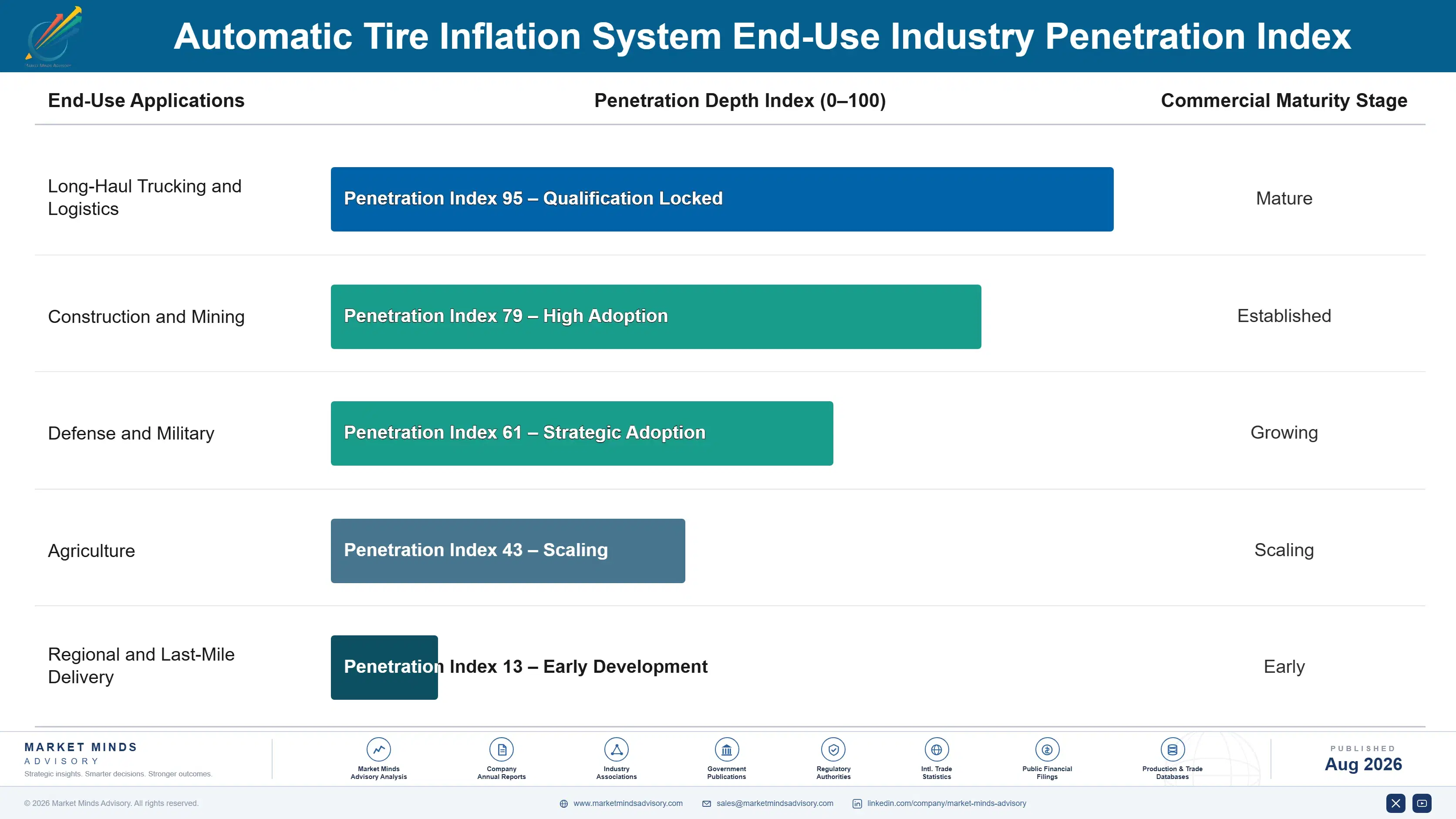
Adoption depth varies by end-use vertical. Large long-haul trailer fleets have moved fastest toward automatic inflation, since their scale justifies the documented compliance and fuel savings case most directly. Smaller regional fleets and owner-operators adopt more selectively, often prioritizing upfront cost over the multi-year payback case, since their lower annual mileage stretches out the timeline before fuel and tire savings fully offset the initial investment.

Buyer profiles are shifting generationally as fleet safety and compliance teams, increasingly staffed by professionals hired for regulatory and insurance expertise, gain real influence over specification decisions maintenance teams previously controlled largely on operational grounds. This opens real doors for suppliers who can demonstrate strong documented compliance and downtime data, even against incumbents with deep legacy maintenance relationships that carry comparatively less weight with these newer decision-makers.
automatic-tire-inflation-system-market-end-use-penetration-index-1787300718918

Where OEM Specification Pays Off

These are among the four positions where our research anticipates prominent divergence between winners and laggards over the coming forecast period. Each is grounded in the demand model, the regulatory perimeter, and the announced capacity pipeline.
01 / OEM SPECIFICATION INVESTMENT

Win the factory build sheet before competitors even try

Trailer OEMs are increasingly standardizing automatic inflation as a factory specification rather than leaving conversion to aftermarket retrofit, and suppliers who win a manufacturer's build sheet capture years of predictable, recurring revenue across every trailer built under that standing relationship. Meritor and ZF currently hold the deepest OEM qualification relationships, drawing on decades of accumulated performance data that newer entrants cannot easily replicate on short notice. MMA expects suppliers who delay serious OEM specification investment now to find themselves increasingly locked out of the fastest-growing, highest-margin channel in this category.
02 / DATA SERVICE ATTACHMENT

Bundle compliance data services before hardware margins compress further

Fleet safety and insurance teams increasingly need auditable tire maintenance performance data to support both regulatory compliance and premium negotiations, creating a genuine service revenue opportunity layered on top of hardware sales many suppliers have not yet fully captured. Suppliers who bundle documented compliance and downtime data services report meaningfully stronger customer retention and less exposure to pure hardware price competition than those selling equipment alone. MMA views data service attachment as one of the most underexploited revenue opportunities available to suppliers today.
03 / CENTRAL TIRE INFLATION EXPANSION

Commercial off-road demand will outgrow the defense-only ceiling fast

Central tire inflation technology, historically concentrated in military applications, is increasingly finding commercial traction in construction, mining, and agricultural fleets seeking on-the-fly pressure adjustment across varying terrain conditions within a single working day. Suppliers with established military qualification experience hold a meaningful head start entering these adjacent commercial off-road applications, since much of the underlying durability and reliability testing already satisfies comparable commercial requirements. MMA expects commercial central tire inflation demand to grow meaningfully faster than the broader category average as component costs continue declining industry-wide.
04 / COMPLIANCE-DRIVEN FLEET ADOPTION

Regulatory scrutiny will keep pulling fleets toward documented systems

Roadside inspection data consistently identifies tire-related violations among the most common reasons for out-of-service orders, giving fleets a direct compliance incentive to adopt automatic inflation on top of the underlying fuel and tire savings case already in place. Larger fleets are accelerating adoption to improve federal safety scoring ahead of insurance renewal negotiations, since documented tire maintenance directly affects both compliance standing and negotiated premium costs. MMA expects this pathway to keep pulling smaller fleets toward inflation even where the economic case alone might not fully justify it.

Engagement Snapshot From the Field

A live engagement with an industry participant carrying material or product regulatory and market exposure ahead of a defining policy shift, showing how our research translates into a defensible multi-year portfolio strategy.
MARKET MINDS ADVISORY · CLIENT ENGAGEMENT SUMMARY
Automatic Tire Inflation System Producer Strategic Portfolio Review and Transition Roadmap 2026·Investment Scenario on Automatic Tire Inflation System Exposure Evaluation 2025-26
CLIENT PROFILE
The client is a North American long-haul trucking company operating several thousand trailers across a national delivery network, with annual fleet capital expenditure in the tens of millions of dollars (client-reported, unverified by MMA). The company had historically relied on manual tire pressure checks during routine maintenance stops, resulting in inconsistent pressure maintenance and a persistently elevated rate of tire-related roadside incidents across its fleet.
STRATEGIC CHALLENGE
Facing rising tire replacement costs and a growing number of tire-related out-of-service violations affecting its federal safety rating, the client needed to evaluate whether fleet-wide automatic tire inflation investment would deliver sufficient payback to justify the significant upfront capital commitment across several thousand trailers within a reasonable, board-approved timeframe acceptable to its finance committee.
MMA APPROACH
MMA conducted a comparative total cost of ownership analysis across three leading suppliers, benchmarking documented fuel savings, tire life extension, and violation reduction data from comparable fleet deployments. The engagement produced a phased fleet-wide rollout plan sequencing trailers by replacement cycle timing, prioritizing the oldest trailers first to capture the largest near-term maintenance cost reduction before extending to newer fleet segments.
KEY FINDINGS
  1. Fuel savings alone delivered a payback period under two years across the benchmarked fleet segments, before accounting for any tire life extension or violation reduction benefits.
  2. Tire-related roadside violations declined measurably faster on trailers equipped with automatic inflation than on trailers still relying on manual pressure check maintenance schedules.
  3. Supplier data service offerings varied significantly in documentation quality, directly affecting how usable the resulting compliance data proved during insurance renewal negotiations.
  4. Sequencing rollout by trailer replacement cycle allowed the maintenance team to build genuine installation expertise before scaling to the full national fleet.
CLIENT PROFILE
The client is a North American long-haul trucking company operating several thousand trailers across a national delivery network, with annual fleet capital expenditure in the tens of millions of dollars (client-reported, unverified by MMA). The company had historically relied on manual tire pressure checks during routine maintenance stops, resulting in inconsistent pressure maintenance and a persistently elevated rate of tire-related roadside incidents across its fleet.
STRATEGIC CHALLENGE
Facing rising tire replacement costs and a growing number of tire-related out-of-service violations affecting its federal safety rating, the client needed to evaluate whether fleet-wide automatic tire inflation investment would deliver sufficient payback to justify the significant upfront capital commitment across several thousand trailers within a reasonable, board-approved timeframe acceptable to its finance committee.
MMA APPROACH
MMA conducted a comparative total cost of ownership analysis across three leading suppliers, benchmarking documented fuel savings, tire life extension, and violation reduction data from comparable fleet deployments. The engagement produced a phased fleet-wide rollout plan sequencing trailers by replacement cycle timing, prioritizing the oldest trailers first to capture the largest near-term maintenance cost reduction before extending to newer fleet segments.
KEY FINDINGS
  1. Fuel savings alone delivered a payback period under two years across the benchmarked fleet segments, before accounting for any tire life extension or violation reduction benefits.
  2. Tire-related roadside violations declined measurably faster on trailers equipped with automatic inflation than on trailers still relying on manual pressure check maintenance schedules.
  3. Supplier data service offerings varied significantly in documentation quality, directly affecting how usable the resulting compliance data proved during insurance renewal negotiations.
  4. Sequencing rollout by trailer replacement cycle allowed the maintenance team to build genuine installation expertise before scaling to the full national fleet.
RECOMMENDED STRATEGY
Phase 1: Phase 1 (Months 1-2): Benchmark three leading suppliers on documented fuel savings, tire life extension, and violation reduction data from comparable fleet deployments. Phase 2: Phase 2 (Months 3-8): Roll out automatic inflation systems to the oldest trailer segment first, capturing the largest near-term maintenance cost reduction. Phase 3: Phase 3 (Months 9-14): Extend rollout across the remaining fleet, finalizing data service integration ahead of the next insurance renewal cycle.
OUTCOME
The client completed fleet-wide rollout across its oldest 60 percent of trailers within fourteen months, ahead of its original board-approved timeline (client-reported, unverified by MMA). Tire-related roadside violations reportedly declined by roughly 30 percent across equipped trailers, contributing to a measurably improved federal safety rating within the first year (client-reported, unverified by MMA).

Frequently Asked Questions

Foundational context covering the market sizes, CAGR, scope, country, region and competition that inform every finding below. This section is provided to cover basics and most often pre-purchase conversations, answered from the MMA Primary Research Dataset.

What is the current size of the Automatic Tire Inflation System Market?

The global automatic tire inflation system market is valued at $1.6 billion in 2025. It is forecast to reach $1.75 billion in 2026 as fleet adoption accelerates.

How large will the Automatic Tire Inflation System Market be by 2036?

MMA forecasts the market will reach $4.30 billion by 2036, more than double its 2026 value. OEM specification growth and central tire inflation adoption both drive that expansion.

What is the CAGR for the Automatic Tire Inflation System Market 2026 to 2036?

The base case CAGR is 9.4 percent across the 2026 to 2036 forecast period. Bull and bear scenarios range from 8.0 to 10.8 percent depending on freight conditions.

Which segment is growing fastest?

Central tire inflation systems for off-road and military vehicles are growing fastest at a 13.0 percent CAGR. That is roughly 1.38 times the overall market growth rate.

Who are the major companies in the Automatic Tire Inflation System Market?

Leading suppliers include Meritor, ZF, Continental, SAF-Holland, and Airgo Systems, spanning OEM and aftermarket channels. Together they hold an estimated 48 percent of a fairly concentrated global market.

Which country is growing fastest?

China is the fastest-growing major market, expanding at an estimated 10.9 percent CAGR overall. Growth is driven by expanding commercial vehicle fleets and logistics professionalization.

Report Segmentation Architecture

The full report scope spans multiple orthogonal segmentation dimensions, with cross-tabulated demand data provided for each dimension pair. Coverage extends further to regional breakdowns, trend trajectories, and the competitive detail needed to support segment-level decision-making.

By System Type and Vehicle Application

  • Trailer-Mounted Automatic Inflation Systems
  • Tractor and Drive Axle Systems
  • Central Tire Inflation Systems
  • Nitrogen-Based Inflation Systems
  • Aftermarket Retrofit Kits
  • OEM-Integrated Systems

By End-Use Industry

  • Long-Haul Trucking and Logistics
  • Construction and Mining
  • Defense and Military
  • Agriculture
  • Regional and Last-Mile Delivery

By Commercial Dimension

  • OEM Factory Specification
  • Aftermarket Retrofit Installation
  • Fleet Direct Purchasing Agreements
  • Independent Dealer Distribution

By Region

  • North America
  • Western Europe
  • East Asia
  • South Asia and Pacific
  • Latin America
  • Middle East and Africa
  • Eastern Europe

Scope, Methodology, and Coverage

Every figure in this report is reproducible from documented input assumptions. The scope below maps the historical period, the forecast horizon, the segmentation dimensions, and the countries covered, alongside the underlying primary and qualitative methodology.
Historical Period
2020 to 2025
Forecast Period
2026 to 2036
Base Year
2025 (USD billions; MMA Primary Research Dataset, August 2026)
Market Definition
This report defines the automatic tire inflation system market as trailer-mounted, tractor-mounted, and central tire inflation systems that automatically maintain commercial vehicle tire pressure using compressed air or nitrogen without driver intervention. It excludes tire pressure monitoring systems that only alert drivers without inflating, and passenger vehicle tire pressure sensors.
Quantitative Units
USD billions (current prices); installed system units where applicable
Segmentation Dimensions
By System Type and Vehicle Application; By End-Use Industry; By Commercial Dimension; By Region
Regions Covered
North America, Western Europe, East Asia, South Asia and Pacific, Latin America, Middle East and Africa, Eastern Europe
Countries Covered
USA, China, Germany, France, UK, Japan, South Korea, India, Australia, Canada, Brazil, Mexico, Indonesia, Vietnam, Thailand, Malaysia, UAE, Saudi Arabia, South Africa, Nigeria, Turkey, Poland, Netherlands, Italy, Spain, Sweden, Switzerland, Argentina, Colombia, Singapore, and additional markets relevant to this sector
Key Companies Profiled
Meritor, Inc. (a Cummins Inc. company), ZF Friedrichshafen AG, Continental AG, SAF-Holland SE, Airgo Systems, Inc., Aperia Technologies, Inc., Stemco LP, Dana Incorporated, BPW Bergische Achsen KG, Hendrickson USA, L.L.C., Bridgestone Corporation, Goodyear Tire and Rubber Company, Doran Manufacturing, LLC, Link Manufacturing, LLC, Ridewell Corporation, Air-Weigh, Haldex AB, Michelin North America, Inc., Wheely-Safe Ltd., Pacific Industrial Co., Ltd.
Quantitative Methodology
Primary survey, n=3,800 respondents, Q4 2025, six countries; demand-side model with trade association cross-validation
Qualitative Methodology
47 expert interviews, Q4 2025; applied to validate demand model assumptions, identify emerging dynamics, and assess competitive positioning
Report Format
PDF and XLSX data workbook (Word format preview document)
Publisher
Market Minds Advisory
Report Code
MMA-2026-AUT-105
Published
August 2026
Contact
sales@marketmindsadvisory.com | www.marketmindsadvisory.com

Purchase the full Automatic Tire Inflation System Market Report (2026 to 2036).

The full report provides a comprehensive assessment of the global automatic tire inflation system market, including detailed sizing and ten-year forecasts across all seven regions and six system type segments. It profiles twenty leading suppliers, benchmarking OEM qualification depth, data service capability, and manufacturing footprint across the five largest players in particular. The analysis includes primary research drawn from MMA's Q4 2025 survey of 3,800 fleet operator and OEM respondents across six countries and 47 expert interviews with fleet maintenance and procurement leaders. Regional sections cover regulatory drivers, component sourcing risk, and competitive dynamics specific to each market, supported by a standalone input cost and mitigation framework.
Ten-year market sizing and growth forecasts
Profiles of twenty leading system suppliers
Regional regulatory driver and demand analysis
Machined component sourcing risk and mitigation framework
Primary survey data from 3,800 industry respondents
Forty-seven expert interviews with fleet procurement leaders

Built For The People Who Decide

From boardroom strategy to bench-side execution, this report is read cover-to-cover by leaders shaping the next decade of their industry, turning demand scenarios, market dynamics and valuation benchmarks into decisions.
CXOs/ Presidents/ VPs/ Managers
M&A and Corporate Development
Strategy Teams and R&D Heads
Procurement and Product Directors
Regulatory and Compliance Leaders
Investor Relations and Equity Analysts