
Market Minds Advisory
Asphalt Pavers Market

Asphalt Pavers Market: The Screed Is the Machine, Smoothness Money, and Electrification Limits

Road authorities pay contractors a bonus for a smooth surface and fine them for a rough one, which turns the screed on the back of a paver into a profit centre.

Lead Analyst

David Horsley

Published

August 2026

Make Smarter Decisions with Customized Research Insights

Request a free sample report and evaluate market opportunities, growth trends, and competitive dynamics relevant to your business needs.

2025 MARKET VALUE$2.0BMarket Size 2025
2036 FORECAST VALUE$3.3BBase Case , 2026 to 2036
CAGR 2026 TO 20364.6 %Bull 5.8% / Bear 3.4%
INCREMENTAL OPPORTUNITY$1.2BNet 10- year value creation
EXPANSION MULTIPLE1.57x2036 value over 2026 base
Strategic Levers
M&A Pipeline
Regional Outlook
Country Rankings
Competitive Intelligence
Segmental Deep-dive
Call-Us : 91 93563 13602

Executive Snapshot and Market Trajectory

Ride quality incentive clauses pay a contractor a bonus of around 4% of contract value for a smooth mat and penalise a rough one with deductions. That converts screed capability directly into contractor profit, which is a rare and unusually powerful argument in capital equipment purchasing.
Paving control and thermal monitoring systems compound at 6.9%, a full 1.50x the market rate, because road authorities increasingly write thermal profiling and automatic levelling into contract specifications rather than leaving them to the contractor. East Asia holds the largest share at 30%, since China paves more road than any other country and Sany and XCMG supply the great majority of that demand domestically.
Concentration is moderate at 63%, and the screed rather than the tractor carries roughly 34% of machine value and nearly all of the paving quality delivered. Machines run for around 12 years and a deep used market absorbs them afterwards, which makes new unit demand considerably lumpier than road spending alone suggests. Demand itself comes from public road budgets set politically, so machine orders follow programme announcements with a lag of a year or more.
Market Definition
This market covers self-propelled asphalt paving machines and directly associated systems, spanning tracked highway class pavers, wheeled highway class pavers, compact and mini pavers, screeds and screed systems, material transfer vehicles, and paving control and thermal monitoring systems, measured at manufacturer revenue. Asphalt production plants, milling machines, compaction rollers, concrete paving equipment, haul trucks, and aftermarket parts or service revenue are excluded.
Base Year Value
$2.0B in 2025 (MMA Primary Research Dataset, August 2026)
Forecast Period
2026 to 2036, eleven discrete annual values
CAGR
4.6% base case. Bull 5.8%. Bear 3.4%.
Fastest Growth Segment
Paving Control and Thermal Monitoring Systems: 6.9% CAGR
Fastest Growth Country
India: 8.6% CAGR
Fastest Growth Region
South Asia and Pacific: 6.8% CAGR
Largest Region
East Asia: 30% of 2025 global value
Market Leaders
Wirtgen Group, Caterpillar, Volvo Construction Equipment, Fayat Group, and Sany. Source: MMA Primary Research Dataset, July 2026.
Primary Survey
n=3,800 procurement and R&D decision-makers, Q4 2025, six countries
Methodology
Demand-side build-up, cross-validated against public data, 47 expert interviews

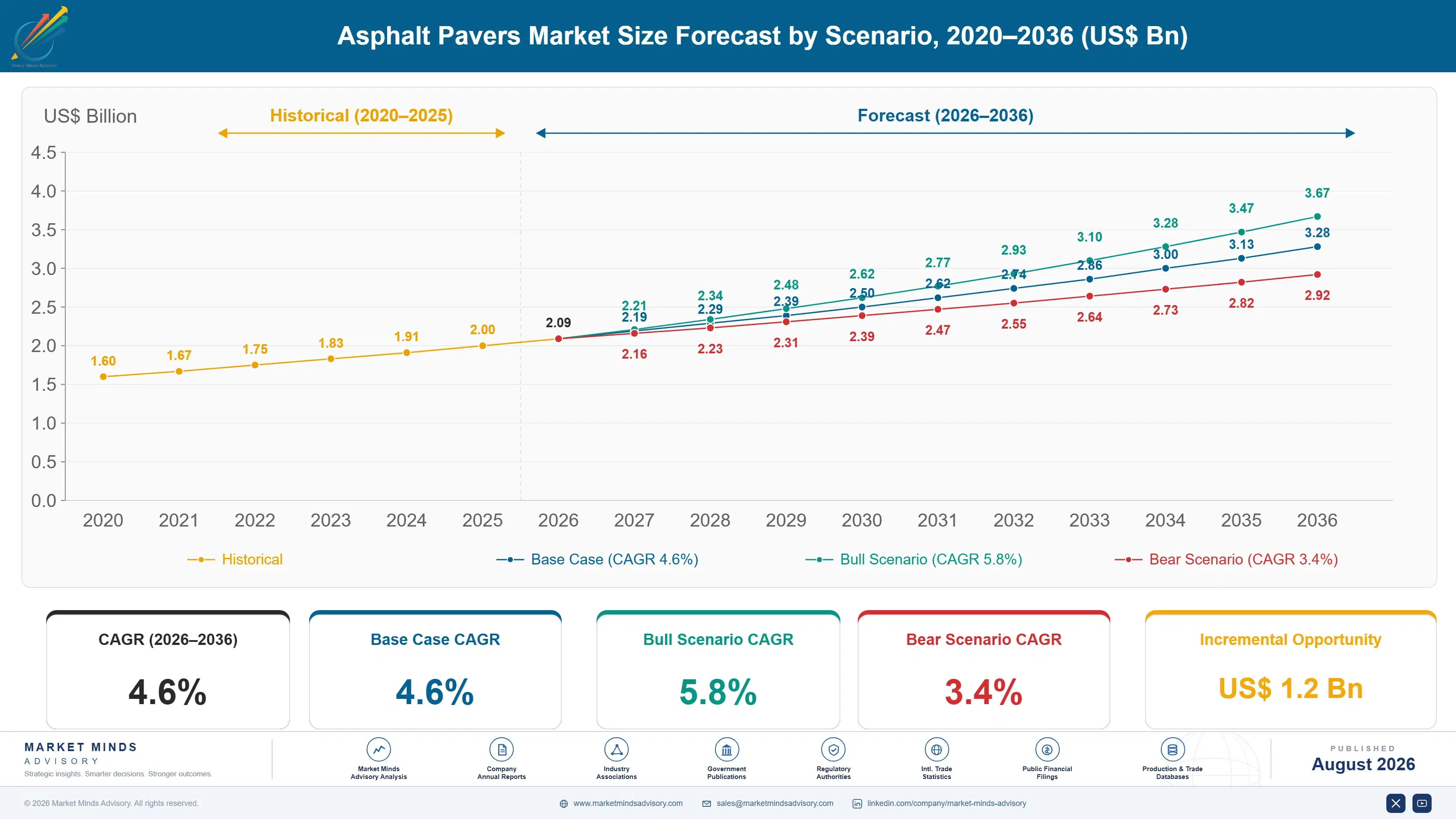
Asphalt Pavers Market Forecast Scenarios

asphalt-pavers-market-size-forecast-scenario-1787305653732
Growth ran near 3.8% from 2020 to 2025 on infrastructure funding cycles rather than on anything the industry controlled. Major public programmes across the United States, European Union and India committed road spending that reached machine orders a year or more later. Supply chain disruption then constrained deliveries at exactly the point demand peaked, and order books extended well beyond normal lead times.
Base case growth of 4.6% rests on three mechanisms. Ride quality specification keeps tightening, which pulls automatic levelling, thermal profiling and material transfer equipment into contracts that previously left them optional. Indian and Southeast Asian highway programmes continue expanding at a pace developed markets cannot match. And recycled asphalt content rising in mix designs changes material handling requirements enough to influence machine specification directly. None depends on the others arriving first.
The bull case at 5.8% assumes infrastructure funding renews rather than lapsing as current programmes complete, since this market has no demand of its own beyond what public budgets create. The bear case at 3.4% is the reverse: programmes conclude without replacement, contractors defer replacement against machines that run for twelve years, and a deep used equipment market absorbs demand that would otherwise reach manufacturers.

Asphalt Paving: Screeds, Specifications and Budgets

The tractor pulls, but the screed does the work. Everything a road authority measures about a finished surface, its smoothness, density, thickness consistency and freedom from segregation, is set by the screed, not by the engine in front. The screed and its heating, tamping, vibration and automatic levelling systems account for roughly 34% of machine value and nearly all the paving quality a contractor is paid for.
TOP FIVE CONCENTRATION63%Concentrated among established road equipment groups and Chinese volume manufacturers
SCREED SHARE OF VALUE34%Share of machine value represented by screed and systems
SMOOTHNESS BONUS RATE4%Typical incentive payment on contract value for achieving ride quality
MACHINE SERVICE LIFE12 yearsAverage working life before a contractor replaces a paver
ANNUAL UNIT SHIPMENTS18,500 unitsAsphalt pavers shipped worldwide across all machine classes annually
USED EQUIPMENT SHARE41%Machine transactions involving used rather than newly manufactured equipment
That matters commercially because ride quality now carries money. Road authorities across North America and much of Europe write incentive clauses paying a bonus of around 4% of contract value for surfaces meeting smoothness thresholds, and penalties for those that fail. A paver capable of consistently earning that bonus pays for a substantial part of itself, an unusually direct argument in capital equipment.
Demand itself comes from nowhere the industry influences. Road construction is funded by public budgets set through political processes, and machine orders follow programme announcements with a lag of a year or more. Machines then run for around 12 years and a used market absorbing 41% of transactions extends their working life further. New unit demand is consequently lumpier and less predictable than road spending statistics alone would suggest.
"Contractors do not buy pavers, they buy smoothness bonuses. Show a paving crew that a screed will keep them inside the ride quality spec on a difficult job and the machine sells itself. Show them horsepower and they will ask about the price."
Principal Analyst, Road Construction Equipment and Infrastructure Practice · MMA

Market Trends

Road authorities write monitoring technology into contract specifications

Thermal profiling bars mounted on the paver detect temperature segregation in the mat as it is laid, and automatic levelling systems hold grade and slope against a reference. Both were optional contractor investments and are increasingly written into contract specification by road authorities, which converts a discretionary purchase into a requirement. The segment compounds at 6.9%. Specification-driven demand is considerably more reliable than demand resting on a contractor's own productivity calculation. Retrofit onto existing machines is straightforward, which broadens the addressable base well beyond new equipment sales and shortens the sales cycle materially.
Market Impact: India compounding at 8.6% annually
Screed capability converts directly into contractor bonus payments

Incentive clauses paying around 4% of contract value for meeting ride quality thresholds mean a screed that holds specification on difficult work earns money rather than merely spreading asphalt. Automatic levelling, consistent heating and tamping performance all feed that outcome directly. Contractors increasingly evaluate pavers on demonstrated smoothness results from comparable jobs rather than on machine specification sheets, which favours manufacturers who can produce that evidence credibly. Manufacturers able to produce that evidence reach a purchase conversation about earnings, while those presenting specification sheets reach one about price, which is a considerably worse position.
Market Impact: Recycled content exceeding 30%

Market Opportunities and Growth Drivers

Asian highway programmes outpace every developed market

India compounds at 8.6% on a national highway construction programme that is the largest road building effort anywhere by length, and Southeast Asian corridor projects add further volume. Chinese paving activity remains enormous even as the growth rate moderates from its peak. Roughly 18,500 pavers ship worldwide annually and an increasing proportion go to these markets, supplied largely by domestic manufacturers whose pricing international suppliers cannot approach in public tender. Ride quality specification across those markets remains well behind North American practice, which limits what advanced screed capability can command in price.
Market Impact: Screed heating drawing 60 kilowatts

Recycled asphalt content changes machine specification requirements

Mix designs incorporating higher proportions of reclaimed asphalt pavement behave differently in the hopper and through the augers, and warm mix technologies lay at lower temperatures that narrow the compaction window. Both push contractors toward material transfer vehicles that remix and buffer the load and toward thermal monitoring that catches segregation early. Sustainability policy therefore reaches machine specification through material science rather than through any emissions requirement on the equipment itself. Material transfer vehicles and thermal monitoring both gain from that shift, and neither addresses an emissions requirement placed on the equipment itself.
Market Impact: Used trades covering 41% of transac

Market Restraints and Challenges

Screed heating makes full electrification genuinely difficult

A paver screed must be heated to keep asphalt from adhering, and that draws power on a scale that battery packs struggle to sustain across a full working shift alongside traction and vibration loads. The root cause is thermodynamic rather than any battery development timeline. Commercial impact is that electrification has reached compact and urban machines while highway class pavers remain diesel. Participants are pursuing hybrid architectures, gas screed heating with electric traction and plug-in support on urban work. Hybrid arrangements running the screed from an engine while the tractor drives electrically are the realistic near-term answer.
Market Impact: Compounding at 6.9% each year

Long machine life and used markets defer new equipment demand

Highway class pavers run for around 12 years and frequently longer after rebuild, and used transactions account for 41% of machine movements, which means a contractor facing an uncertain order book simply keeps the machine another season. The root cause is durable engineering combined with cyclical revenue. Commercial impact is new unit demand considerably lumpier than road spending suggests. Manufacturers respond with rental fleets, certified used programmes and screed retrofits that upgrade an existing machine. That is a considerably wider addressable base than annual new machine shipments alone would suggest, and it reaches contractors who have no replacement plans.
Market Impact: Bonuses reaching 4% of contract
3 additional market trends, 4 additional growth drivers, and 2 additional restraints and challenges are covered in the full report. Contact sales@marketmindsadvisory.com to access the complete intelligence.

Segment CAGR and Growth Architecture

Segmentation follows machine and system class, because class determines the paving width and application, the capital cost, the customer type and whether the purchase is a machine or a capability added to one. Six classes cover asphalt paving equipment supply without overlap. Job type and mix design cut across every class and are treated here as use attributes.
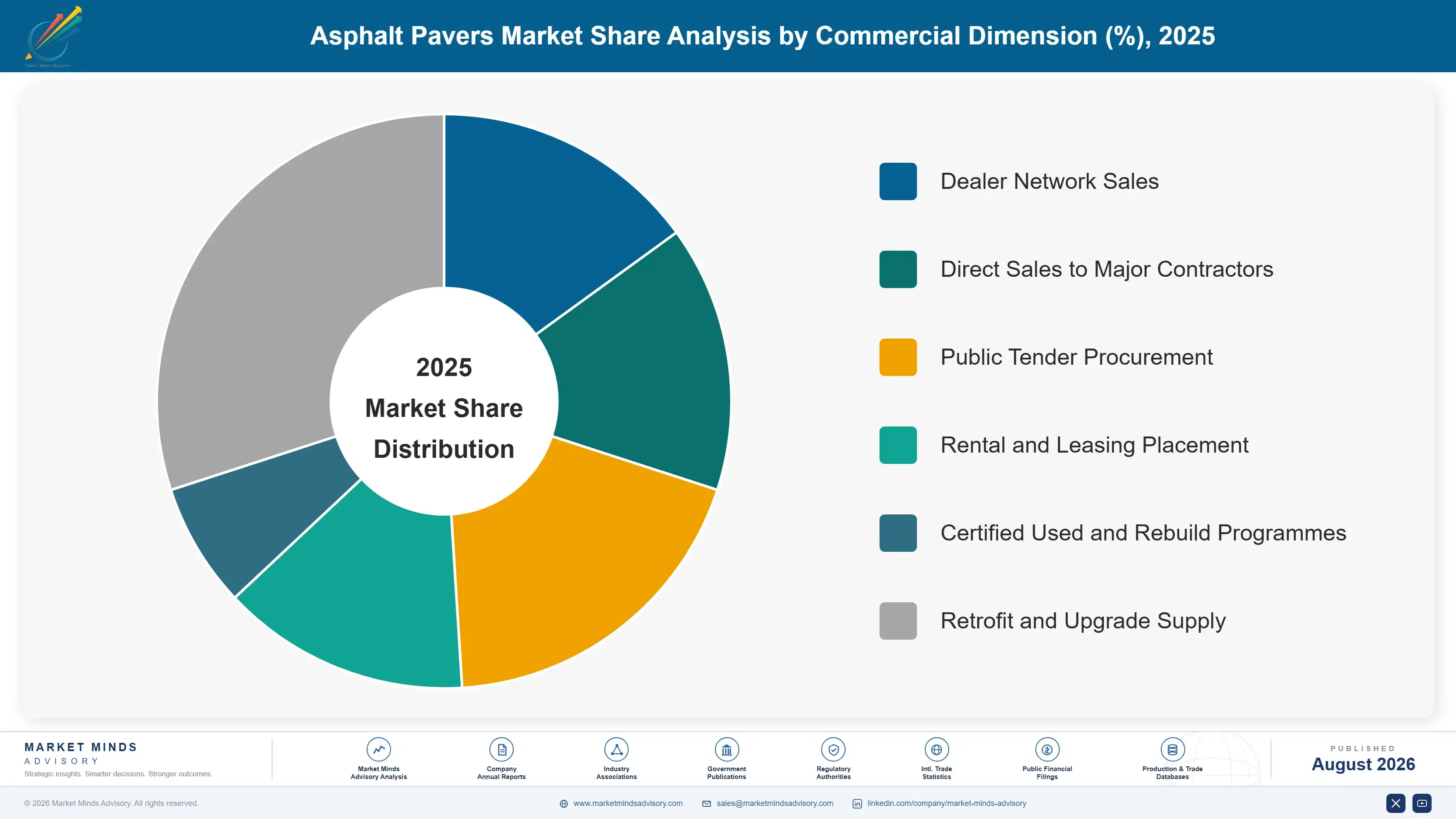
asphalt-pavers-market-market-share-analysis-1787305654642

Paving Control and Thermal Monitoring Systems

Growing at 6.9%, a full 1.50x the market rate, paving control and monitoring systems cover automatic grade and slope levelling, paver-mounted infrared bars that detect thermal segregation across the mat in real time, and the data logging that documents compliance afterwards. Road authorities increasingly write these into contract specification rather than leaving them as optional contractor investment, which converts a discretionary purchase into a requirement. Retrofit onto existing machines is straightforward, which broadens the addressable base considerably beyond new machine sales and shortens the sales cycle. Engaging the authorities who write specifications is therefore worth more than engaging contractors, since the specification decides what a contractor must own beforehand. Contractors follow.
CAGR 6.9%

Material Transfer Vehicles

Material transfer vehicles grow at 6.0% by receiving asphalt from haul trucks, remixing it and delivering it into the paver hopper without the truck ever touching the machine. That removes the bump a truck causes when it contacts the paver and eliminates thermal and aggregate segregation that develops in transit, both of which show up directly in ride quality measurement. High-value contracts increasingly specify their use. Rising recycled asphalt content strengthens the argument further, since those mixes segregate more readily during haulage than conventional ones. Removing the truck bump also eliminates a defect that shows directly in ride quality measurement, which connects the machine to bonus payments contractors can count.
CAGR 6.0%
Full segment breakdown across 6 segments available in the complete report.

Regional Architecture and Country Demand Map

Regional value follows public road budgets and the political cycles behind them rather than economic activity, which makes this market unusually dependent on decisions taken well outside the industry. Construction activity statistics predict this market considerably less well than infrastructure legislation does. Order timing follows legislation.

East Asia

East Asia holds the largest share at 30% because China paves more road than any other country and its domestic manufacturers supply the great majority of that demand. Sany and XCMG have taken very substantial share at prices international suppliers cannot approach in public tender, and both now export across Asia, Africa and Latin America. Japanese manufacturers including Sumitomo and Sakai hold strong positions in their home market and in higher specification work. Ride quality incentive contracting is less developed across the region than in North America. Advanced screed capability commands correspondingly less premium across the region than it does in North America. Domestic manufacturers hold nearly all of that volume, and imported machines reach only specialised applications.
Share: 30% | CAGR: 5.6% (2026 to 2036)

North America

Twenty-five per cent of value, growing at 4.0%. Ride quality incentive contracting is furthest advanced anywhere, with state authorities paying bonuses around 4% of contract value for smoothness and imposing penalties for failure, which makes screed capability a direct profit consideration for contractors. Thermal profiling and intelligent compaction requirements increasingly appear in specifications. Dealer network depth matters enormously in a market where machine downtime stops a paving crew entirely, and that favours manufacturers with the widest service coverage. Machines run for around twelve years here as elsewhere, and a used market absorbing a large share of transactions extends fleet life further still. Specification-led selling works better here than anywhere else in the world.
Share: 25% | CAGR: 4.0% (2026 to 2036)
Regional intelligence for 5 additional markets available in the complete report: Western Europe, South Asia and Pacific, Latin America, Middle East and Africa, Eastern Europe. Contact sales@marketmindsadvisory.com.
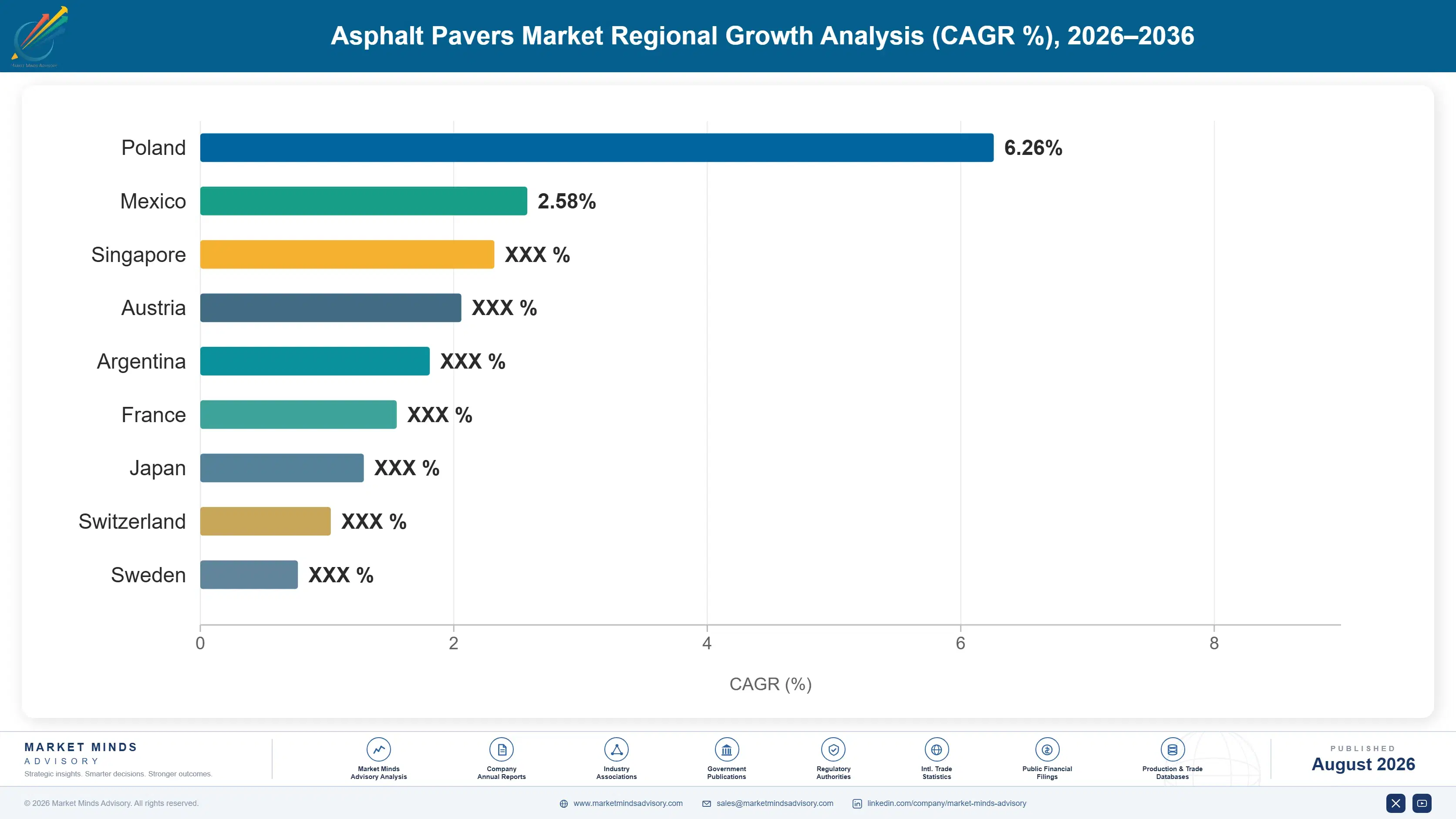
asphalt-pavers-market-country-cagr-analysis-1787305655517

Where Paving Equipment Margin Concentrates

Machines run for twelve years, a deep used market absorbs them afterwards and demand comes from public budgets nobody in the industry influences. Margin therefore depends on the screed, on what road authorities specify, and on capability that can be retrofitted rather than replaced. Very little of the demand is under anyone's influence. Specification is.

Sell the bonus, not the machine

Ride quality incentive clauses pay around 4% of contract value for surfaces meeting smoothness thresholds and penalise those that fail, which means screed capability translates into contractor profit directly rather than through any productivity argument. Contractors increasingly evaluate pavers on demonstrated smoothness results from comparable jobs rather than specification sheets. Manufacturers able to produce that evidence credibly reach a purchase conversation about earnings, and those selling horsepower reach one about price. Several contractors keep their own bonus records by machine. That evidence takes two paving seasons to accumulate and cannot be bought, which makes it a defensible position once established.
Market Impact: Bonus payments worth roughly 4% of

Follow what road authorities write into specifications

Thermal profiling, automatic levelling and material transfer requirements have moved from optional contractor investment into contract specification across an expanding set of authorities, which converts a discretionary purchase into a requirement nobody negotiates. Control and monitoring systems compound at 6.9% on exactly that shift. Engaging with specifying authorities is therefore worth more than engaging with contractors, because the specification decides what the contractor must own before any purchasing conversation begins. No manufacturer surveyed had a programme addressing that audience. The authorities writing those documents are a small, identifiable and reachable audience of perhaps 200 agencies globally.
Market Impact: Specified control systems compoundi

Build retrofit revenue against a twelve year replacement cycle

Highway class pavers run for around 12 years and used transactions account for 41% of machine movements, so a contractor under order book pressure keeps the machine rather than replacing it. Screed upgrades, control system retrofits and thermal monitoring additions reach that installed base without requiring a capital decision at all. Manufacturers whose revenue depends entirely on new machine sales are exposed to a replacement cycle their customers control completely. Retrofits also require no capital approval from the contractor. It also creates a revenue line that does not wait for a 12 year replacement cycle to turn over.
Market Impact: Reaches installed fleets running 12

Electrify where the screed load actually permits it

Screed heating draws around 60 kilowatts to keep asphalt from adhering, which battery packs cannot sustain across a full shift alongside traction and vibration on highway class machines. Compact and urban pavers with shorter shifts and smaller screeds are genuinely electrifiable now. Manufacturers promising full-size electric machines on current battery technology are making a claim thermodynamics does not support, and contractors who have tested them know it. Shorter shifts and smaller screeds make compact machines genuinely viable. Overpromising here costs credibility that takes years to rebuild with contractors who test machines properly.
Market Impact: Screed heating alone draws roughly

Who Controls the Margin Pool

Concentration is moderate at 63% across the top five, measured on annual revenue from asphalt paving machines and directly associated systems, the single basis applied throughout this analysis. Wirtgen Group and Caterpillar lead through different strengths, the first on screed engineering that set the technical standard the industry follows, the second on dealer network depth across a contractor's whole equipment fleet rather than paving alone.
Competition runs on three dimensions that matter to different buyers. Screed and paving quality competition decides high specification work where ride quality bonuses are at stake and contractors can measure the difference. Dealer service competition decides everything else, because a paver down on a job stops an entire crew and a whole day's production. Price competition decides public tenders across Asia, Latin America and Eastern Europe.

Pressure builds from two directions. Chinese manufacturers hold very large domestic share and now export aggressively into markets where public tender weighs delivered price above paving capability. Separately, road authorities specifying monitoring and control technology shift value toward systems rather than machines. Rankings shift most where a manufacturer converts specification requirements into retrofit revenue across an installed base it did not originally supply.
asphalt-pavers-market-company-positioning-matrix-1787305656455

Competitive Moat and Risk Dimensions

WIRTGEN GROUP

Moat: Screed engineering technical leadership

German screed engineering set the technical reference the wider industry works against, and that position translates directly into ride quality outcomes that earn contractors bonus payments on incentive contracts. Paving quality evidence from comparable jobs is what high specification customers actually evaluate, and a long record of it is considerably harder to assemble than any machine specification.
WIRTGEN GROUP

Risk: Chinese tender price competition

Public tenders across Asia, Latin America and Eastern Europe weigh delivered price heavily against paving capability, and Chinese manufacturers compete at levels German engineering cost cannot approach. Ride quality specification is far less developed in those markets, which removes the argument that justifies the premium. Long machine life defers replacement across the installed base.
CATERPILLAR

Moat: Dealer network and fleet breadth

A dealer network with unmatched service coverage matters enormously in an application where a machine down on a job halts an entire paving crew for a day, and that response capability frequently outweighs specification differences in a contractor's purchase decision. Breadth across the whole construction fleet supports package purchasing and financing that paving specialists cannot offer.
CATERPILLAR

Risk: Screed specification differentiation

High specification paving work is decided on ride quality outcomes where dedicated screed engineering carries genuine advantage, and dealer coverage does not answer that argument. Chinese competition presses hardest in exactly the price-driven tenders where service networks matter least. Monitoring and control systems are shifting value away from the machine itself.

Players Tracked

Prominent Players

Wirtgen Group
Caterpillar
Volvo Construction Equipment
Fayat Group
Sany

Other Key Players

XCMG
Sumitomo Construction Machinery
Ammann
Astec Industries
LeeBoy
Terex
Zoomlion
Shantui
Sakai Heavy Industries
Weiler
Mauldin Paving Products
Hanta Machinery
Tiantuo Heavy Industry
Gencor Industries
Wacker Neuson

Recent Developments

MARCH 2025

Road authorities extend thermal profiling into standard contract specification

State and national road authorities across North America and parts of Europe widened requirements for paver-mounted thermal profiling and intelligent compaction documentation, an organic specification development converting optional contractor investment into a contractual obligation. Contractors had to acquire the capability regardless of their own view.
Signal: Specification writers, not contractors, no
AUGUST 2025

Higher recycled content mixes push material transfer vehicle adoption

Mix designs incorporating higher reclaimed asphalt proportions spread across public paving contracts, an organic material development that increased segregation risk during haulage and pushed contractors toward remixing material transfer equipment. Warm mix laying temperatures narrowed the compaction window further. Material transfer equipment moved from optional to necessary as a result.
Signal: Sustainability policy reaches machine spec
JANUARY 2026

Chinese paver exports extend across African and Latin American tenders

Chinese asphalt paver manufacturers widened export distribution into African and Latin American public tender markets through organic commercial expansion, offering adequate paving capability at delivered prices established suppliers could not profitably match. Ride quality specification in those markets remains limited. Price rather than paving capability decides those contests.
Signal: Where ride quality goes unspecified, super

Steel, Powertrain and Electronics Exposure

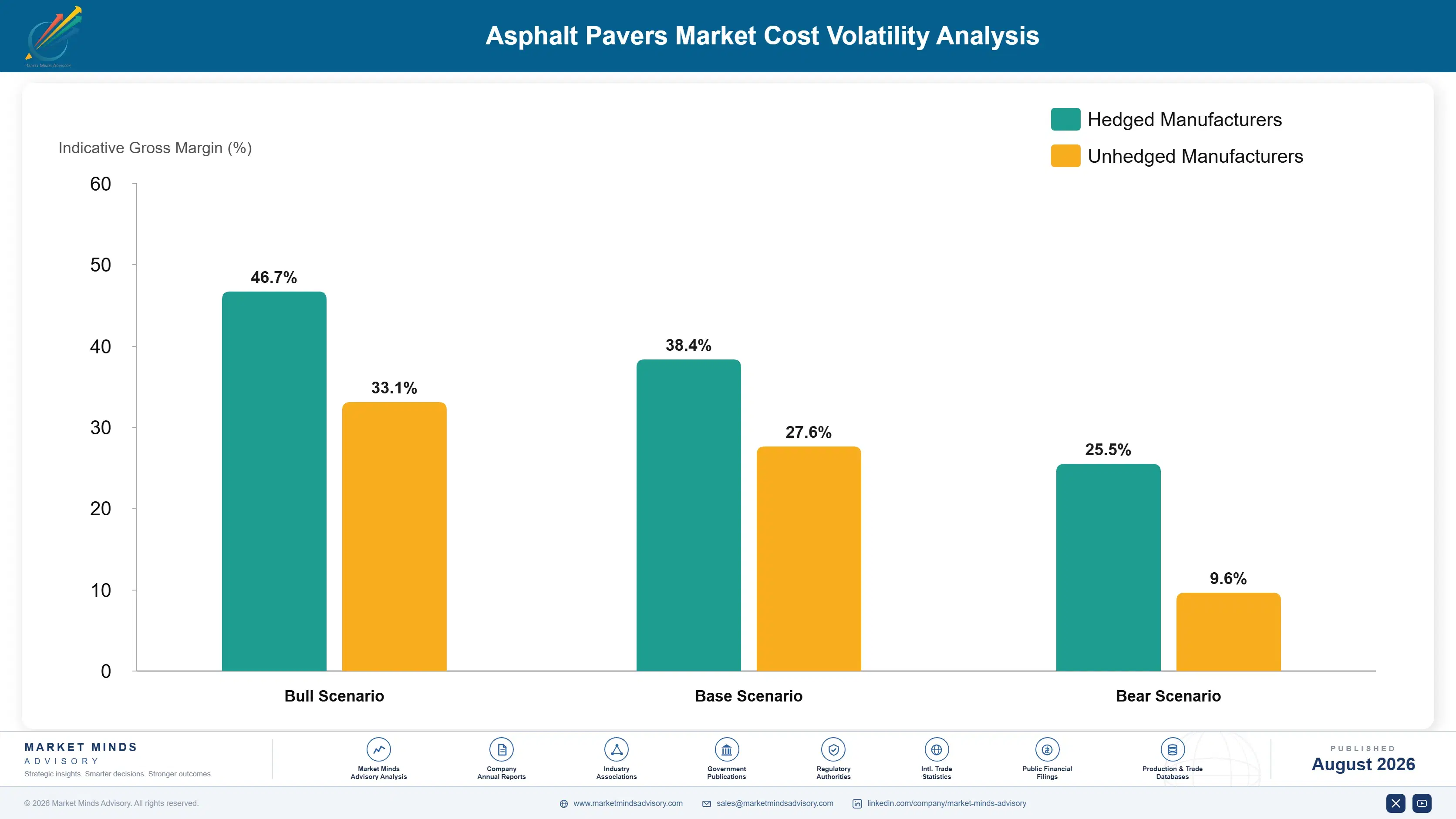
This is a heavy fabrication business with sophisticated systems attached. Structural steel, castings and fabricated components account for roughly 33% of machine cost of goods, with diesel powertrain and hydraulic systems adding a further 26% from a concentrated group of engine and component suppliers. Screed heating elements, control systems and sensors carry disproportionate cost relative to weight, with thermal profiling hardware dearest of all.
Steel pricing rose sharply through 2021 and 2022 and manufacturers passed increases through with a lag that compressed margins meaningfully during the interval, while semiconductor allocation constrained control system availability for machines that could not ship without them. Manufacturer annual reports across the period documented both effects alongside extended order books. Non-road engine emissions compliance also added cost across successive regulatory stages without any customer-visible performance benefit.

Exposure varies most by manufacturing location and vertical integration. Producers manufacturing in Europe carry steel, labour and emissions compliance costs that Chinese manufacturers do not face at comparable levels, which decides tender outcomes wherever delivered price weighs above paving capability. Manufacturers producing their own screeds control the component carrying most of the machine's differentiation, while those buying them surrender both margin and the technical position that justifies premium pricing.
asphalt-pavers-market-cost-volatility-analysis-1787305656769

Integrate screed manufacture rather than sourcing it externally

The screed carries roughly 34% of machine value and nearly all of the paving quality that earns contractors bonus payments, so buying it finished surrenders both margin and the differentiation that justifies premium pricing. Internal manufacture also permits the heating, tamping and levelling refinements that produce measurably better ride quality outcomes. Vertical integration here genuinely decides competitive position.

Hedge steel exposure across the long order book

Structural steel and castings represent roughly a third of machine cost and order books frequently extend more than a year, which leaves manufacturers quoting today against material they will buy considerably later. Forward purchasing and index-linked pricing clauses transfer part of that movement rather than absorbing all of it. Manufacturers quoting fixed prices through recent steel volatility learned this expensively.

Design control systems around available electronic components

Semiconductor allocation constrained control system availability during recent disruption, and a paver cannot ship without the electronics that increasingly define its specification. Architectures accommodating several component options let manufacturers substitute without redesign or recertification. The engineering overhead is modest at design stage and considerable afterwards, as several manufacturers found when allocation tightened suddenly. Recertification is the slower part.

Portfolio Architecture for Margin Defence

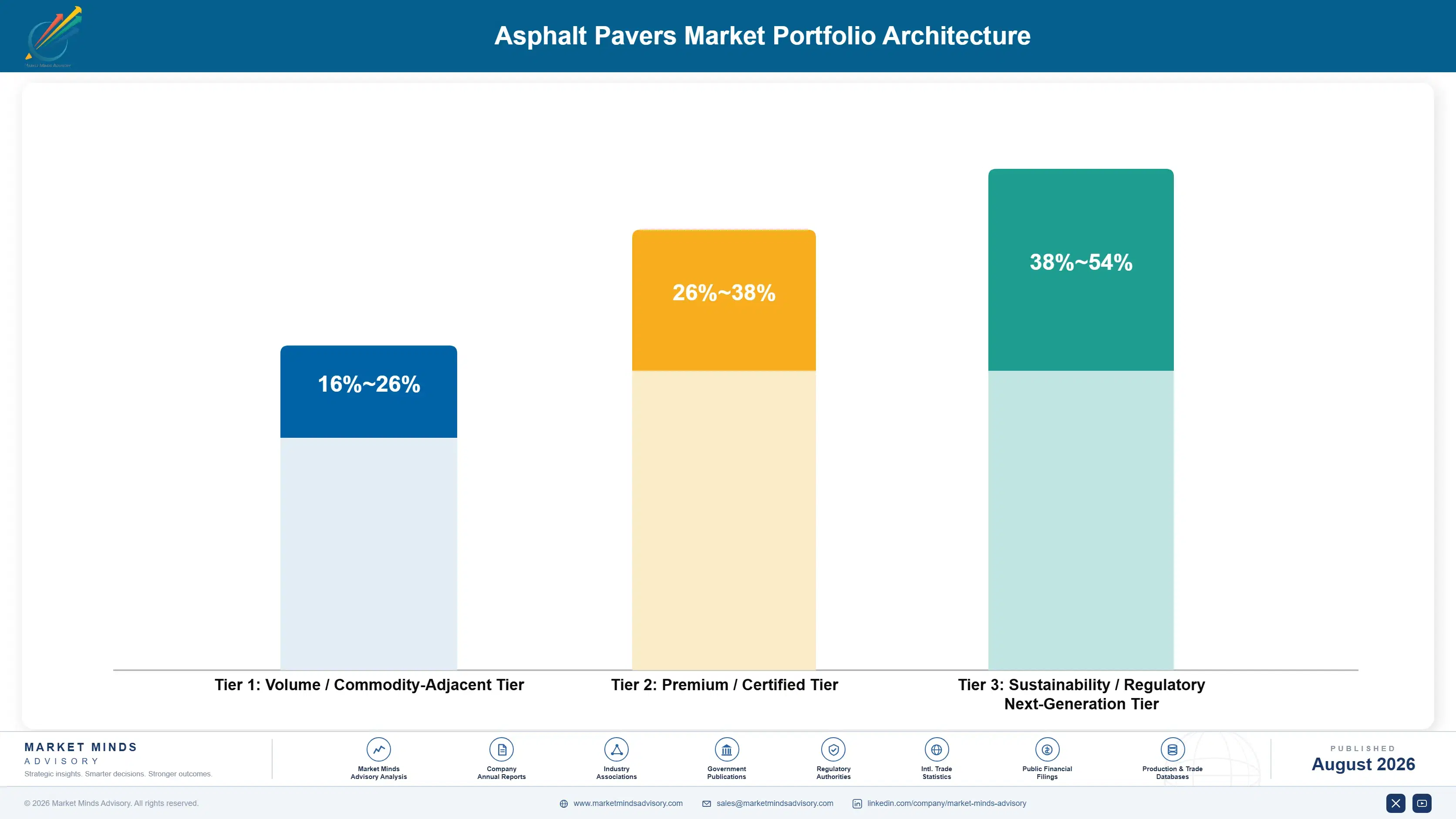
Margin architecture separates on whether the customer can measure a difference. Base machines sold into public tenders where delivered price decides earn very little, and Chinese manufacturers set the achievable level in those markets. Machines specified for high ride quality work earn considerably better, because the screed produces an outcome the contractor is paid for. Control and monitoring systems earn best, carrying software content against modest hardware cost.
The volume against premium tension runs along specification regime rather than product tier. Markets writing ride quality incentives and thermal monitoring into contracts support premium machines and system attachment. Markets awarding on delivered price treat a paver as a machine that spreads asphalt, and no engineering argument reaches the evaluation. The same product therefore competes on entirely different grounds depending on who wrote the contract.

High-value pools concentrate around the screed and around retrofit. Advanced screeds, control and thermal monitoring systems, material transfer vehicles and upgrades reaching an existing fleet all command pricing that base machines do not. Standard tractors sold on delivered price, whatever the badge, compete against manufacturers with cost structures Western producers cannot approach, and that pressure grows as Chinese export reach extends.

Volume / Commodity-Adjacent Tier

Base tracked and wheeled pavers sold through public tender where delivered price decides the award, and where Chinese manufacturers set the achievable price level across Asia, Africa and Latin America.
Gross Margin: 16-26%

Premium / Certified Tier

High specification machines with advanced screeds sold into ride quality incentive work, protected by demonstrated smoothness outcomes that contractors can measure and that specification sheets cannot replicate. Contractors measure the difference directly.
Gross Margin: 26-38%

Sustainability / Regulatory / Next-Generation Tier

Paving control, thermal monitoring and material transfer systems specified by road authorities, commanding premium on software content against modest hardware cost and reaching installed fleets through retrofit. Retrofit extends reach beyond new machines.
Gross Margin: 38-54%
asphalt-pavers-market-portfolio-architecture-1787305657573

Budget Cycles and Fleet Replacement Timing

Demand originates entirely outside the industry. Public road budgets set through political processes determine how much paving happens, contractors bid the resulting work, and machine orders follow programme announcements with a lag of a year or more. Roughly 18,500 pavers ship annually and that figure moves with infrastructure legislation rather than with construction economics, making forecasting largely an exercise in reading government funding commitments.
Replacement behaviour then adds a second layer of unpredictability. Machines run for around 12 years and considerably longer after rebuild, used transactions account for 41% of movements, and a contractor with an uncertain order book simply defers. Fleet replacement therefore clusters when contractors have visibility of committed work, which means orders arrive in waves rather than at the steady rate that road spending statistics would imply.

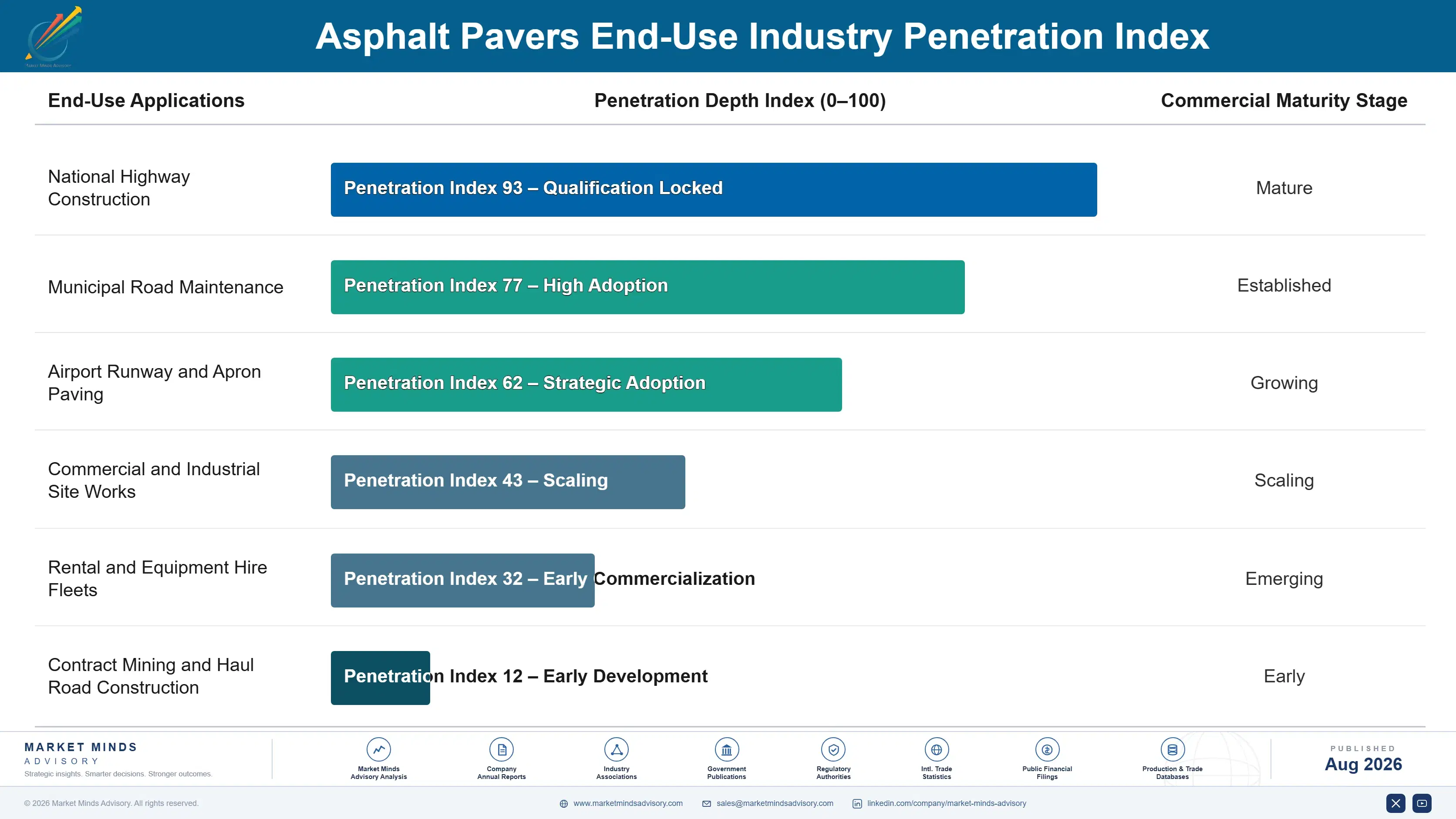
Purchasing profiles are narrower than most capital equipment markets. Paving contractors are the buyers, and in most countries a modest number of them perform the majority of highway work. Road authorities influence the decision decisively through specification without ever purchasing a machine. Rental and used dealers form a third channel that shapes residual values, and those values enter the original purchase calculation more directly than in most equipment categories.
asphalt-pavers-market-end-use-penetration-index-1787305658397

Where Paving Equipment Strategy Lands

These are among the four positions where our research anticipates prominent divergence between winners and laggards over the coming forecast period. Each is grounded in the demand model, the regulatory perimeter, and the announced capacity pipeline.
01 / BONUS ARGUMENT SELLING

Contractors buy smoothness money, not machinery

Ride quality incentive clauses pay contractors a bonus of around 4% of contract value for surfaces meeting smoothness thresholds, and impose financial penalties on contractors whose surfaces fail to reach the same thresholds. That converts screed capability directly into contractor profit rather than into any abstract productivity claim requiring a spreadsheet to demonstrate. Manufacturers producing credible smoothness evidence from genuinely comparable jobs reach a purchase conversation about earnings per job, while those presenting horsepower and specification sheets reach one about price instead.
02 / SPECIFICATION WRITER FOCUS

Authorities decide what contractors must own

Thermal profiling, automatic levelling and material transfer requirements have all moved from optional contractor investment into written contract specification across a steadily expanding group of national road authorities, and control systems compound at 6.9% annually on precisely that shift alone. A specification decides what a contractor must own well before any purchasing conversation with a manufacturer begins at all. Engaging directly with the authorities who write those documents is therefore worth considerably more commercially than engaging the contractors who eventually buy the equipment.
03 / RETROFIT REVENUE BUILDING

The fleet outlives every replacement forecast

Highway class pavers run for around 12 years and frequently much longer after rebuild, while used transactions account for 41% of all machine movements, so a contractor under order book pressure simply keeps the existing machine for another paving season. Screed upgrades, control system retrofits and thermal monitoring additions reach that entire installed base without requiring any new capital equipment decision. Manufacturers whose revenue depends solely on new machine sales remain exposed to a replacement cycle that their own customers control entirely.
04 / ELECTRIFICATION HONESTY DISCIPLINE

Thermodynamics does not care about the roadmap

A paver screed must be heated continuously to stop asphalt adhering, drawing around 60 kilowatts alongside traction and vibration loads that a battery pack cannot sustain across a full working shift on a highway class machine. Compact and urban pavers with shorter working shifts and smaller screeds are genuinely electrifiable today, and several models already are. Manufacturers promising full-size electric machines on current battery technology are making a claim that contractors who have actually tested them already know to be unsupported.

Engagement Snapshot From the Field

A live engagement with an industry participant carrying material or product regulatory and market exposure ahead of a defining policy shift, showing how our research translates into a defensible multi-year portfolio strategy.
MARKET MINDS ADVISORY · CLIENT ENGAGEMENT SUMMARY
Asphalt Pavers Producer Strategic Portfolio Review and Transition Roadmap 2026·Investment Scenario on Asphalt Pavers Exposure Evaluation 2025-26
CLIENT PROFILE
A road construction equipment manufacturer with a tracked and wheeled paver range, externally sourced screeds and no control or thermal monitoring systems of its own. Annual paving equipment revenue was approximately USD 190 million (client-reported, unverified by MMA), concentrated in European and Latin American tender markets where delivered price decided a growing proportion of awards.
STRATEGIC CHALLENGE
Chinese manufacturers had taken tender share on delivered price across Latin America while road authorities in the client's European markets increasingly specified monitoring technology the client did not supply, leaving it excluded from premium work and undercut in price work simultaneously. The board needed to decide whether to integrate screed manufacture, develop control systems, or compete on manufacturing cost.
MMA APPROACH
MMA conducted 47 expert interviews spanning paving contractors, road authority specification engineers, equipment dealers, rental fleet managers, screed manufacturers and quality assurance inspectors across six countries. A quantitative survey of 3,800 respondents established machine selection criteria, replacement timing, retrofit appetite and specification awareness. We then modelled revenue and margin outcomes under screed integration, systems development and cost competition strategies.
KEY FINDINGS
  1. Contractors in five of six markets evaluated pavers on demonstrated smoothness results from comparable jobs rather than on specification sheets, and several kept their own bonus records.
  2. Road authority specification engineers determined which technologies contractors had to own, and no manufacturer surveyed had a programme addressing that audience specifically at all.
  3. Contractors reported retrofitting control and monitoring systems onto existing machines readily, since it required no capital approval and reached fleets averaging well over a decade old.
  4. Public tenders in price-driven markets scored paving capability minimally, and Chinese machines won awards that specification-led selling could not realistically contest. That is a pricing contest rather than a capability one.
CLIENT PROFILE
A road construction equipment manufacturer with a tracked and wheeled paver range, externally sourced screeds and no control or thermal monitoring systems of its own. Annual paving equipment revenue was approximately USD 190 million (client-reported, unverified by MMA), concentrated in European and Latin American tender markets where delivered price decided a growing proportion of awards.
STRATEGIC CHALLENGE
Chinese manufacturers had taken tender share on delivered price across Latin America while road authorities in the client's European markets increasingly specified monitoring technology the client did not supply, leaving it excluded from premium work and undercut in price work simultaneously. The board needed to decide whether to integrate screed manufacture, develop control systems, or compete on manufacturing cost.
MMA APPROACH
MMA conducted 47 expert interviews spanning paving contractors, road authority specification engineers, equipment dealers, rental fleet managers, screed manufacturers and quality assurance inspectors across six countries. A quantitative survey of 3,800 respondents established machine selection criteria, replacement timing, retrofit appetite and specification awareness. We then modelled revenue and margin outcomes under screed integration, systems development and cost competition strategies.
KEY FINDINGS
  1. Contractors in five of six markets evaluated pavers on demonstrated smoothness results from comparable jobs rather than on specification sheets, and several kept their own bonus records.
  2. Road authority specification engineers determined which technologies contractors had to own, and no manufacturer surveyed had a programme addressing that audience specifically at all.
  3. Contractors reported retrofitting control and monitoring systems onto existing machines readily, since it required no capital approval and reached fleets averaging well over a decade old.
  4. Public tenders in price-driven markets scored paving capability minimally, and Chinese machines won awards that specification-led selling could not realistically contest. That is a pricing contest rather than a capability one.
RECOMMENDED STRATEGY
Phase 1: Phase one: acquire screed manufacturing capability, since it carries a third of machine value and nearly all the paving quality that earns contractors bonus payments. Phase 2: Phase two: build a specification engagement programme addressing road authorities directly, because their documents decide what contractors must own before purchasing begins. Phase 3: Phase three: develop retrofit control and monitoring systems reaching installed fleets rather than depending on a replacement cycle contractors control entirely.
OUTCOME
The client acquired a screed manufacturer, established a road authority specification programme and launched a retrofit monitoring system (client-reported, unverified by MMA). Premium machine win rates improved measurably within eighteen months, retrofit revenue reached a meaningful share from fleets the client had never supplied, and two authorities incorporated its monitoring approach into specifications.

Frequently Asked Questions

Foundational context covering the market sizes, CAGR, scope, country, region and competition that inform every finding below. This section is provided to cover basics and most often pre-purchase conversations, answered from the MMA Primary Research Dataset.

What is the current size of the Asphalt Pavers Market?

The global asphalt pavers market was valued at USD 2.0 billion in 2025, spanning tracked, wheeled and compact machines, screeds, material transfer vehicles and control systems. Roughly 18,500 pavers ship worldwide each year.

How large will the Asphalt Pavers Market be by 2036?

MMA forecasts the market at USD 3.28 billion by 2036, expanding 1.57 times from the 2026 base of USD 2.09 billion. That represents roughly USD 1.19 billion of incremental value across the forecast decade.

What is the CAGR for the Asphalt Pavers Market 2026 to 2036?

The base case compound annual growth rate is 4.6%, with a bull case of 5.8% and a bear case of 3.4%. The bull case assumes infrastructure funding renews rather than lapsing as current programmes complete.

Which segment is growing fastest?

Paving control and thermal monitoring systems grow at 6.9%, a full 1.50x the overall market rate. Road authorities increasingly write them into contract specification rather than leaving them as optional contractor investment.

Who are the major companies in the Asphalt Pavers Market?

Wirtgen Group, Caterpillar, Volvo Construction Equipment, Fayat Group and Sany together hold 63% of revenue. Wirtgen leads on screed engineering while Caterpillar leads on dealer network depth.

Which country is growing fastest?

India grows fastest at 8.6%, on a national highway programme representing the largest road building effort anywhere by length. East Asia is the largest region at 30% of value on Chinese paving volume.

Report Segmentation Architecture

The full report scope spans multiple orthogonal segmentation dimensions, with cross-tabulated demand data provided for each dimension pair. Coverage extends further to regional breakdowns, trend trajectories, and the competitive detail needed to support segment-level decision-making.

By Machine and System Class

  • Tracked Highway Class Pavers
  • Wheeled Highway Class Pavers
  • Compact and Mini Pavers
  • Screeds and Screed Systems
  • Material Transfer Vehicles
  • Paving Control and Thermal Monitoring Systems

By End-Use Industry

  • National Highway Construction
  • Municipal Road Maintenance
  • Airport Runway and Apron Paving
  • Commercial and Industrial Site Works
  • Rental and Equipment Hire Fleets
  • Contract Mining and Haul Road Construction

By Commercial Dimension

  • Dealer Network Sales
  • Direct Sales to Major Contractors
  • Public Tender Procurement
  • Rental and Leasing Placement
  • Certified Used and Rebuild Programmes
  • Retrofit and Upgrade Supply

By Region

  • East Asia
  • North America
  • Western Europe
  • South Asia and Pacific
  • Latin America
  • Middle East and Africa
  • Eastern Europe

Scope, Methodology, and Coverage

Every figure in this report is reproducible from documented input assumptions. The scope below maps the historical period, the forecast horizon, the segmentation dimensions, and the countries covered, alongside the underlying primary and qualitative methodology.
Historical Period
2020 to 2025
Forecast Period
2026 to 2036
Base Year
2025 (USD billions; MMA Primary Research Dataset, August 2026)
Market Definition
This market comprises self-propelled asphalt paving machines and directly associated systems, measured at manufacturer revenue across dealer network sales, direct sales to major contractors, public tender procurement, rental and leasing placement, certified used and rebuild programmes, and retrofit or upgrade supply. Coverage spans tracked and wheeled highway class pavers, compact and mini pavers used in municipal and site work, screeds and screed systems including extendable, tamping and vibratory configurations sold with machines or separately, material transfer vehicles providing remixing and buffering between haul truck and paver, and paving control systems covering automatic grade and slope levelling, paver-mounted thermal profiling and compliance data logging. Asphalt production and mixing plants, cold planers and milling machines, compaction rollers and intelligent compaction systems fitted to them, concrete paving and slipform equipment, haul trucks and material haulage vehicles, and aftermarket parts, wear components or service revenue fall outside scope.
Quantitative Units
USD millions (current prices); units shipped by machine class; installed fleet size; average selling price by class; machine service life; used transaction share; retrofit installations
Segmentation Dimensions
By Machine and System Class; By End-Use Industry; By Commercial Dimension; By Region
Regions Covered
East Asia, North America, Western Europe, South Asia and Pacific, Latin America, Middle East and Africa, Eastern Europe
Countries Covered
China, Japan, South Korea, Taiwan, United States, Canada, Mexico, Germany, France, United Kingdom, Italy, Spain, Netherlands, Sweden, Austria, India, Australia, Indonesia, Vietnam, Philippines, Thailand, Brazil, Argentina, Colombia, Chile, Saudi Arabia, United Arab Emirates, Egypt, South Africa, Poland, Romania, Czechia, Turkey, and additional markets relevant to road construction analysis
Key Companies Profiled
Wirtgen Group, Caterpillar, Volvo Construction Equipment, Fayat Group, Sany, XCMG, Sumitomo Construction Machinery, Ammann, Astec Industries, LeeBoy, Terex, Zoomlion, Shantui, Sakai Heavy Industries, Weiler, Mauldin Paving Products, Hanta Machinery, Tiantuo Heavy Industry, Gencor Industries, Wacker Neuson
Quantitative Methodology
Primary survey, n=3,800 respondents, Q4 2025, six countries; demand-side model with trade association cross-validation
Qualitative Methodology
47 expert interviews, Q4 2025; applied to validate demand model assumptions, identify emerging dynamics, and assess competitive positioning
Report Format
PDF and XLSX data workbook (Word format preview document)
Publisher
Market Minds Advisory
Report Code
MMA-2026-CON-416
Published
August 2026
Contact
sales@marketmindsadvisory.com | www.marketmindsadvisory.com

Purchase the full Asphalt Pavers Market Report (2026 to 2036).

The full MMA report treats the screed and the specification as the two things that actually determine value in this category, quantifying how ride quality incentives convert paving capability into contractor profit. It sizes six machine and system classes and seven regions to 2036, modelling units shipped, installed fleet, pricing by class, service life, used transaction share and retrofit installations separately. Competitive assessment covers twenty manufacturers on one consistent revenue basis. Cost exposure is traced through steel, powertrain and electronics inputs. Four commercial levers and a strategic verdict close the report, grounded in 47 expert interviews and a 3,800-respondent survey.
Six machine and system classes sized separately through 2036
Ride quality specification regimes mapped across every covered market
Retrofit opportunity quantified against installed fleet age
Twenty manufacturers assessed on one consistent revenue basis
Public infrastructure funding cycles modelled against order timing
Anonymised client engagement with tested strategic recommendations

Built For The People Who Decide

From boardroom strategy to bench-side execution, this report is read cover-to-cover by leaders shaping the next decade of their industry, turning demand scenarios, market dynamics and valuation benchmarks into decisions.
CXOs/ Presidents/ VPs/ Managers
M&A and Corporate Development
Strategy Teams and R&D Heads
Procurement and Product Directors
Regulatory and Compliance Leaders
Investor Relations and Equity Analysts