
Market Minds Advisory
Agentic AI Market

Agentic AI Market: Agentic AI: From Chatbot Answers to Autonomous Task Completion

A commercial reading of agentic AI, where autonomous agents replace single-turn chatbot deployments, enterprises demand audit trails before trusting agents with real system access, and North American foundation model concentration sets the pace.

Lead Analyst

Victor Gallo

Published

August 2026

Make Smarter Decisions with Customized Research Insights

Request a free sample report and evaluate market opportunities, growth trends, and competitive dynamics relevant to your business needs.

2025 MARKET VALUE$7.8BMarket Size 2025
2036 FORECAST VALUE$47.3BBase Case , 2026 to 2036
CAGR 2026 TO 203617.8 %Bull 19.1% / Bear 16.4%
INCREMENTAL OPPORTUNITY$38.1BNet 10- year value creation
EXPANSION MULTIPLE5.15x2036 value over 2026 base
Strategic Levers
M&A Pipeline
Regional Outlook
Country Rankings
Competitive Intelligence
Segmental Deep-dive
Call-Us : 91 93563 13602

Executive Snapshot and Market Trajectory.

Enterprises stopped asking chatbots questions and started giving agents actual work to finish, and that shift from answering to doing is what actually defines this category commercially and separates real production deployments from mere demonstrations entirely across nearly every function tracked across the enterprise, not just isolated pilot projects.
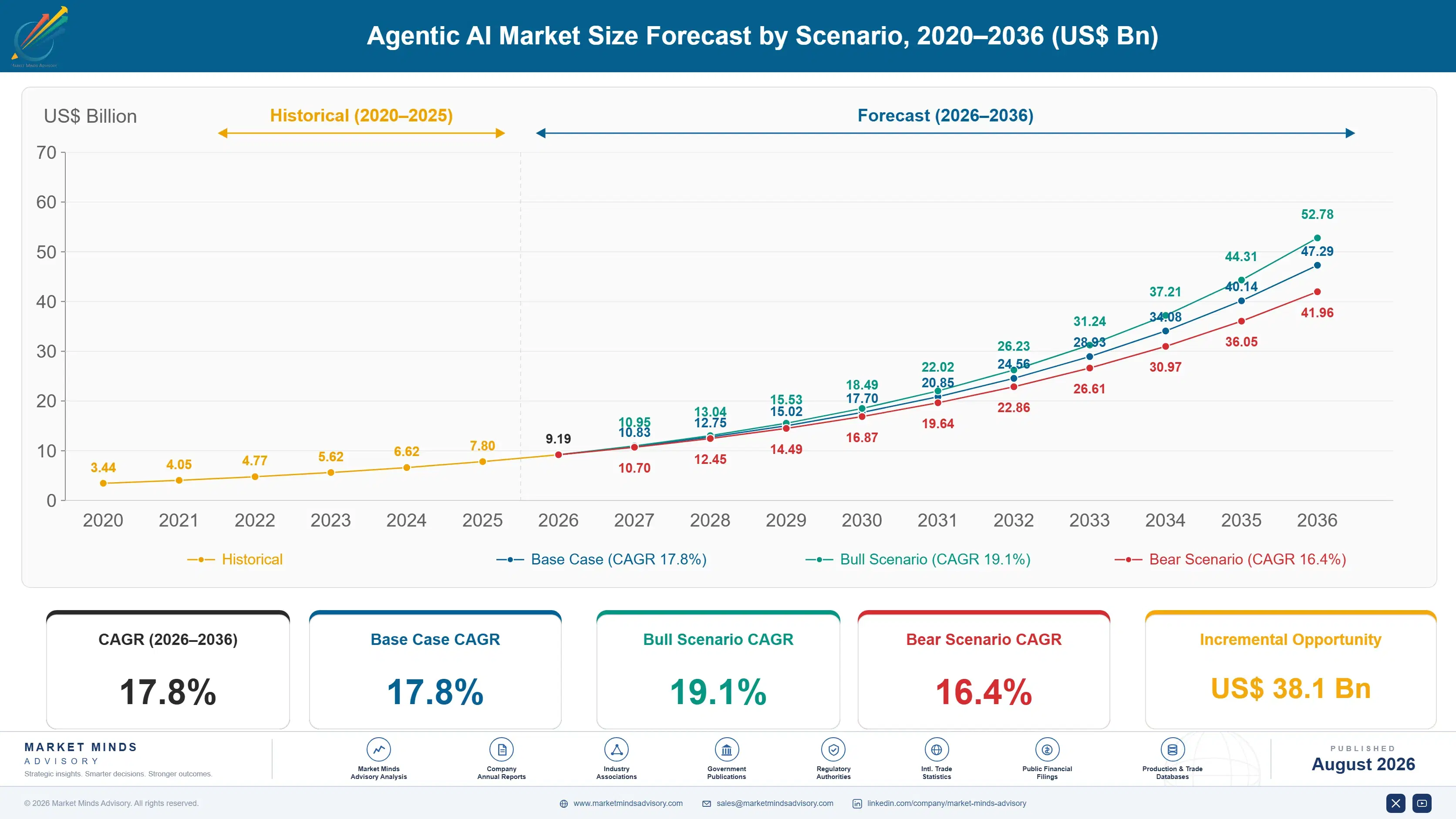
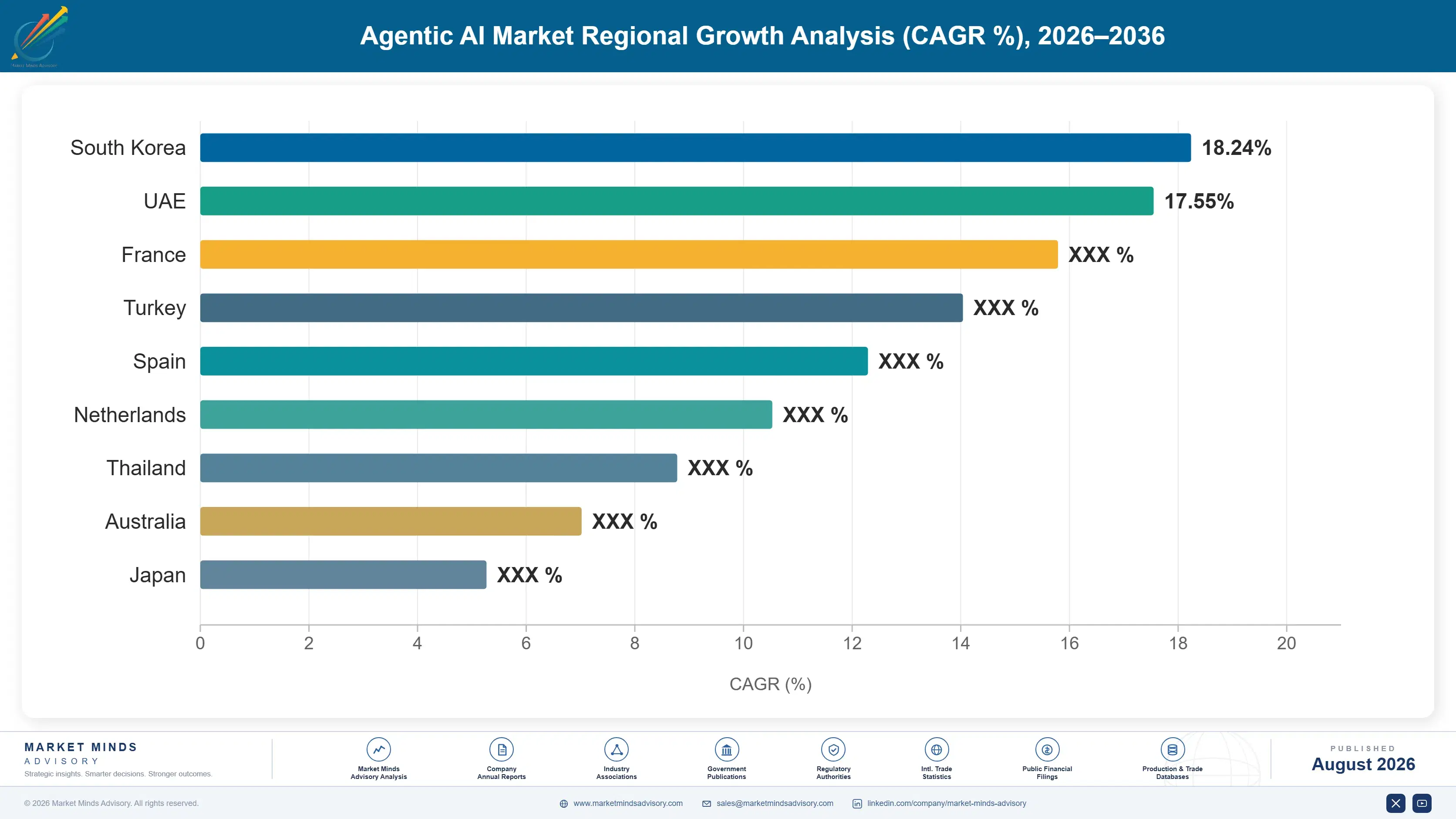
The market stands at USD 7.8 billion in 2025 and reaches USD 47.28 billion by 2036 at a 17.8% CAGR. Autonomous task execution agents grow fastest at 22.0%, about 1.24 times the overall rate, as enterprises move from pilot chatbots to agents that complete multi-step work with genuine system access. North America holds 42% of value on foundation model concentration, while India posts the quickest national growth at 21.5% on enterprise IT services adoption.
Concentration is moderate to high, with the top five holding roughly 52% of platform and agent software revenue against a rapidly growing field of specialist challengers. Two forces reshape the field now. Agent observability is becoming mandatory as deployments scale beyond pilot projects into systems that take real actions, and multi-agent architectures are replacing single-agent chatbot deployments across nearly every serious enterprise implementation.
Market Definition
The agentic AI market covers software platforms and tools that enable AI agents to autonomously plan, execute, and complete multi-step tasks with minimal human intervention, including orchestration platforms, task execution agents, multi-agent coordination frameworks, and observability and governance tools. Underlying foundation model training and inference infrastructure, general-purpose chatbot interfaces without autonomous task execution, and traditional robotic process automation without AI reasoning are excluded.
Base Year Value
$7.8B in 2025 (MMA Primary Research Dataset, August 2026)
Forecast Period
2026 to 2036, eleven discrete annual values
CAGR
17.8% base case. Bull 19.1%. Bear 16.4%.
Fastest Growth Segment
Autonomous Task Execution Agents: 22.0% CAGR
Fastest Growth Country
India: 21.5% CAGR
Fastest Growth Region
South Asia and Pacific: 19.8% CAGR
Largest Region
North America: 42% of 2025 global value
Market Leaders
Microsoft, OpenAI, Google, Salesforce, UiPath. Source: MMA Analysis based on company annual reports and product disclosures.
Primary Survey
n=3,800 procurement and R&D decision-makers, Q4 2025, six countries
Methodology
Demand-side build-up, cross-validated against public data, 47 expert interviews

Agentic AI Market Forecast Scenarios

agentic-ai-market-size-forecast-scenario-1787325433408
Growth from 2020 to 2025 compounded near 16.6% from a near-zero base, as early conversational AI deployments gradually gained the reasoning and tool-use capability required for genuine autonomous task completion, accelerating sharply from 2023 onward once foundation models reached reliability thresholds enterprises found commercially acceptable for production deployment at meaningful scale across most industries and geographies worldwide and consistently.
Three mechanisms carry the base case to 17.8%. First, enterprise automation backlogs, where knowledge work tasks accumulated faster than human staffing could address them across most large organisations. Second, foundation model reasoning improvements, which increasingly enable reliable multi-step task completion that earlier generation models could not sustain consistently at scale. Third, agent observability maturity, which gives enterprises the audit trail confidence required before granting agents genuine system access at meaningful scale.
The bull case at 19.1% assumes foundation model reliability improves faster than current benchmarks suggest and enterprise risk tolerance for autonomous action broadens considerably across regulated industries. The bear case at 16.4% assumes reliability and hallucination risk continue limiting high-stakes deployment, and enterprise data security concerns slow agent adoption beyond low-risk pilot use cases specifically.

Why Enterprises Now Demand an Audit Trail, Not Just an Answer

Three forces set demand. Enterprise automation backlogs provide the steadiest layer, since knowledge work tasks have accumulated faster than human staffing could reasonably address. Foundation model reasoning improvements add a fast-growing layer, as models increasingly sustain the multi-step planning and tool use that genuine task completion requires. Regulatory and governance requirements add a third layer entirely independent of raw capability, since enterprises increasingly require audit tra
MARKET CONCENTRATIONCR5: 52%Moderately consolidated among major cloud and software platform vendors
TYPICAL DEPLOYMENT COSTUSD 50,000 to 2 millionSpans single-workflow pilots through enterprise-wide agent deployments broadly
TOP CONSUMING REGIONNorth America: 42% of global valueReflects concentrated foundation model development and enterprise adoption
TASK COMPLETION RELIABILITYAbout 78 to 88% typicalRemains the binding constraint on high-stakes deployment expansion currently
MULTI-AGENT DEPLOYMENT SHARERoughly 46% of new projectsRising steadily as single-agent chatbot architectures prove insufficient
HUMAN OVERSIGHT REQUIREMENTAbout 65% of deploymentsReflects continued enterprise caution around fully autonomous operation
The commercial character rewards reliability and governance depth over raw capability demonstrations. An agent platform that enterprises can audit, constrain, and trust with real system access wins deployment budget that a more capable but opaque competitor loses regardless of benchmark performance. Multi-agent architectures increasingly replace single-agent chatbot deployments, since complex enterprise workflows rarely fit within what one agent can reliably plan and execute end to end.
The next decade turns on two things. Whether foundation model reliability improves fast enough to expand agent deployment into genuinely high-stakes decisions that enterprises currently reserve for human judgement entirely. And whether observability and governance tooling matures enough that enterprises can deploy agents with real system access at scale without the compliance risk that currently constrains broader rollout.
"Every vendor demo shows an agent doing something impressive once. What enterprises actually buy is the boring part: proof that it did the right thing, a log of why, and a way to stop it before it does the wrong one. That's the entire category right now."
Director, Enterprise AI and Automation Practice · MMA Technology / Artificial In

Market Trends

Agent Observability Becomes Mandatory as Deployments Scale

Enterprises moving agents from pilot projects into production systems with real system access increasingly require detailed audit trails documenting every action an agent takes and the reasoning behind it, a requirement that barely existed as a formal product category previously. This matters because a single ungoverned agent action against production systems can create liability and operational risk that dwarfs any efficiency gain the deployment was meant to capture. LangChain and several specialist vendors have expanded monitoring tooling considerably in response. Vendors without credible observability increasingly fail enterprise procurement evaluation regardless of capability otherwise demonstrated.
Market Impact: Backlogs cut 30% with agent deploym
Multi-Agent Systems Replace Single-Agent Chatbot Deployments

Enterprises increasingly deploy coordinated teams of specialised agents rather than a single general-purpose chatbot, since complex workflows spanning research, drafting, review, and execution rarely fit within what one agent can reliably plan and complete end to end reliably. Multi-agent deployment now represents roughly 46 percent of new enterprise projects, a share that has risen considerably as architects learned that decomposing tasks across specialised agents improves reliability meaningfully over monolithic designs used previously. Microsoft and Salesforce have both restructured agent platform roadmaps specifically around multi-agent orchestration. Coordination tooling now commands premium positioning within the platform stack.
Market Impact: Reliability reaches 78% to 88% typi

Market Opportunities and Growth Drivers

Enterprise Automation Backlogs Push Agentic AI Adoption

Knowledge work tasks including research synthesis, document drafting, customer service resolution, and data reconciliation have accumulated faster than enterprise staffing levels could reasonably address, creating a backlog that traditional automation tools lacking AI reasoning could never resolve effectively at scale. Agentic AI addresses precisely this gap, since it can plan and execute multi-step knowledge work that rule-based automation was never designed to handle reliably. Major enterprise software vendors have disclosed substantial customer demand tied to this backlog across finance and customer service functions. This driver shows little sign of moderating, since knowledge work volume keeps growing faster than hiring.
Market Impact: Excursion risk limits 22% of shipme

Foundation Model Reasoning Improvements Enable Task Completion

Foundation models have improved considerably in multi-step reasoning, tool use, and error correction, capabilities that earlier generation models lacked and that genuine autonomous task completion absolutely requires beyond simple question answering. Task completion reliability now reaches roughly 78 to 88 percent on well-defined workflows, a level that has crossed the threshold many enterprises consider commercially acceptable for production deployment with appropriate human oversight. OpenAI, Google, and Anthropic have all disclosed substantial reasoning capability improvements across recent model releases specifically targeting agentic use cases. This driver continues advancing rapidly as foundation model providers compete directly on agentic task performance benchmarks.
Market Impact: Reviews add 8 to 12 weeks

Market Restraints and Challenges

Reliability and Hallucination Risk Limits High-Stakes Deployment

Foundation models underlying agentic systems still produce incorrect outputs and flawed reasoning at rates that make fully autonomous deployment commercially unacceptable for high-stakes decisions including financial transactions and legal commitments specifically. The root cause is that current model architectures do not guarantee factual accuracy or reasoning correctness, a limitation incremental capability improvement has narrowed but not eliminated across any model available today. Commercially this confines deployment to lower-stakes workflows or requires human oversight that reduces the efficiency gain sought. Vendors respond with confidence scoring and human-in-the-loop checkpoints limiting potential damage.
Market Impact: Governance spend reaches 15% of bud

Enterprise Data Security Concerns Slow Agent Deployment

Agents require broad access to enterprise systems and data to complete meaningful tasks, creating security exposure that many enterprise security teams remain reluctant to grant beyond narrowly scoped pilot deployments specifically. The root cause is that agent access control tooling remains considerably less mature than decades of enterprise identity and access management infrastructure built for human users. Commercially this slows deployment timelines and limits the scope of tasks enterprises will delegate to agents even where capability exists reliably. Vendors respond with granular permission scoping and dedicated agent identity management systems.
Market Impact: Multi-agent share reaches 46% of pr
3 additional market trends, 4 additional growth drivers, and 3 additional restraints and challenges are covered in the full report. Contact sales@marketmindsadvisory.com to access the complete intelligence.

Segment CAGR and Growth Architecture

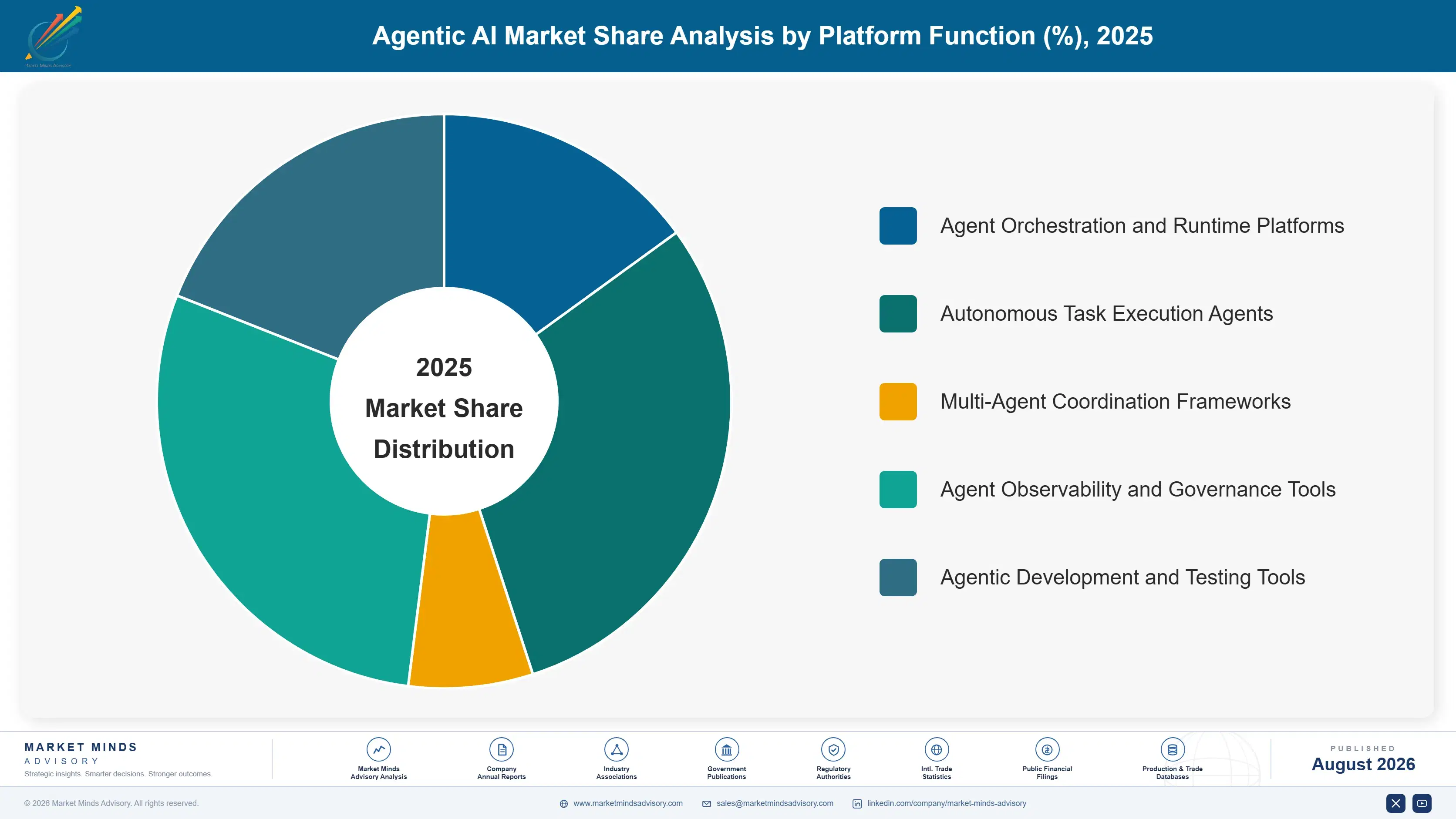
Segmentation follows platform function, a single technical logic describing the specific role each tool plays within the broader agentic AI stack rather than the industry it ultimately serves overall. Each function carries distinct technical maturity and adoption timelines, so commercial position tracks function rather than end-use industry, which appears separately within the framework below.
agentic-ai-market-market-share-analysis-1787325433942

Autonomous Task Execution Agents

Autonomous task execution agents grow fastest at 22.0%, about 1.24 times the overall 17.8% rate, as enterprises move from pilot chatbots toward agents that complete genuine multi-step work including coding, customer service resolution, and research synthesis with real system access. This category represents the actual working agents enterprises deploy against specific business functions, distinct from the underlying orchestration and governance infrastructure that supports them across the platform. Cognition Labs and Sierra have both built strong positions in specific vertical categories including software engineering and customer service respectively. Adoption concentrates initially in well-defined, lower-risk workflows where task boundaries are clear and manageable. Enterprises increasingly measure these agents against human completion benchmarks directly and rigorously.
CAGR 22.0%

Agent Observability and Governance Tools

Agent observability and governance tools grow at 20.0%, the second-fastest category, as enterprises moving agents into production increasingly require detailed audit trails and control mechanisms that barely existed as a distinct product category when agentic AI first emerged commercially. This category addresses the compliance and risk management gap that determines whether an enterprise grants an agent genuine system access or confines it to sandboxed pilot use indefinitely. LangChain and several specialist governance vendors have expanded monitoring capability considerably in response to sustained enterprise demand. Vendors without credible observability integration increasingly fail procurement evaluation regardless of the underlying agent capability otherwise demonstrated. Governance tooling increasingly determines deployment scope more than raw agent capability alone.
CAGR 20.0%
Full segment breakdown across 5 segments available in the complete report.

Regional Architecture and Country Demand Map

Foundation model development concentration, not enterprise headcount, sets this distribution most directly and consistently across nearly every region tracked. North America holds a share well above its standard band given that concentration, while South Asia and Pacific posts the fastest growth as enterprise IT services adoption expands rapidly.

North America

This region holds a materially larger share than its standard regional band would suggest, and the reason is straightforward: nearly every major foundation model developer and agentic platform vendor is headquartered here, concentrating both supply and early enterprise adoption in one place. North America holds 42% of value, anchored by Microsoft, OpenAI, Google, and Salesforce, all of whom develop and deploy agentic platforms from domestic operations serving global customers directly. Enterprise adoption also runs deepest here, given proximity to vendor product teams and comfort with early-stage technology risk. Growth of 17.5% reflects both continued platform investment and expanding enterprise deployment scope across regulated and unregulated industries alike. Governance and observability requirements increasingly shape procurement decisions across major enterprise accounts specifically.
Share: 42% | CAGR: 17.5% (2026 to 2036)

Western Europe

Regulatory caution and data governance requirements define this market above any other single factor. Western Europe holds 18% of value, with German, French, and British enterprises adopting agentic AI more deliberately than North American counterparts given stricter data protection and algorithmic accountability requirements across the region. SAP and several regional software vendors have built agentic capability specifically designed around European Union regulatory compliance requirements. Enterprise adoption concentrates in lower-risk workflows initially, with regulated industries including banking and healthcare moving more cautiously than the broader market pace. Growth of 16.2%, the slowest of the seven, reflects that regulatory caution directly. Data residency requirements increasingly shape which vendors can compete effectively for major enterprise contracts here.
Share: 18% | CAGR: 16.2% (2026 to 2036)
Regional intelligence for 5 additional markets available in the complete report: East Asia, South Asia and Pacific, Latin America, Middle East and Africa, Eastern Europe. Contact sales@marketmindsadvisory.com.
agentic-ai-market-country-cagr-analysis-1787325434456

Where Agentic AI Vendor Margin Concentrates Now

Competing purely on raw model capability concentrates margin in exactly the segment foundation model providers commoditise fastest across nearly every market and geography and vertical examined closely today. The four moves below shift value toward positions reliability and governance depth genuinely protect: observability tooling, multi-agent orchestration, vertical task specialisation, and enterprise security integration. today.

Build Observability Tooling Into the Core Platform

Agent observability and governance tools grow at 20.0% against a 17.8% overall market as enterprises moving agents into production increasingly require audit trails that barely existed as a formal product category when agentic AI first emerged commercially at scale across most industries. Vendors treating observability as a native platform capability rather than a third-party add-on win procurement evaluations that vendors without it increasingly lose entirely and completely regardless of underlying capability. Building this capability requires sustained software investment beyond the underlying agent capability itself, favouring vendors with genuine engineering scale over smaller competitors lacking comparable resources.
Market Impact: Governance tooling grows at 20.0% e

Invest in Multi-Agent Orchestration Capability Now

Multi-agent deployment now represents roughly 46 percent of new enterprise projects, a share that has risen considerably as architects learned that decomposing complex workflows across specialised agents improves reliability meaningfully over monolithic single-agent designs used previously and less successfully. Vendors with genuine orchestration and coordination capability capture enterprise contracts that single-agent competitors increasingly cannot serve at comparable reliability or scale across comparable deployments. This capability requires sustained investment in coordination protocols and failure handling that single-agent platforms never needed to develop at all previously in their history at all previously.
Market Impact: Multi-agent share now reaches 46% o

Specialise in Vertical Task Categories Deeply

Autonomous task execution agents grow at 22.0% as enterprises increasingly favour agents built specifically for well-defined vertical tasks including software engineering, customer service, and research synthesis over general-purpose platforms attempting to serve every possible use case simultaneously and less reliably. Vendors achieving deep vertical specialisation capture task completion reliability rates of 78 to 88 percent that general-purpose competitors struggle to match consistently across the same specific workflows examined closely. This specialisation depth becomes a durable moat once established, since replicating years of vertical-specific tuning requires sustained engineering investment competitors cannot easily shortcut quickly.
Market Impact: Reliability reaches 78% to 88% in n

Deepen Enterprise Security and Access Integration

Enterprise security concerns add 8 to 12 weeks to typical deployment timelines specifically because agent access control tooling remains considerably less mature than decades of identity management infrastructure built for human users across most enterprise environments today. Vendors building granular permission scoping and dedicated agent identity management directly into their platforms win security team approval that competitors offering only broad access grants increasingly struggle to obtain quickly. This integration depth compounds over time as security certification becomes a genuine differentiator enterprises specifically reference during vendor evaluation and renewal decisions made later.
Market Impact: Security reviews add 8 to 12 weeks

Who Controls the Margin Pool

Concentration is moderate to high: the top five hold roughly 52% of platform and agent software revenue, with major vendors extending enterprise relationships into agentic capability alongside a growing field of challengers. The gap between leaders and challengers is enterprise distribution and governance depth rather than raw model capability. All participants here are assessed on global agentic AI platform and software revenue as disclosed in company segment reporting, held consistently throug
Competition runs along four lines. First, observability and governance tooling depth, increasingly the strongest signal enterprises evaluate during procurement. Second, multi-agent orchestration capability that complex enterprise workflows genuinely require. Third, vertical task specialisation reliability across specific well-defined use cases. Fourth, enterprise security and access integration that determines deployment scope more than raw capability alone.

Pressure is building from two directions. Specialist vertical agent developers including Cognition Labs and Sierra are capturing share in specific task categories where deep domain credibility matters more than broad platform breadth. Meanwhile major cloud vendors are bundling agentic capability into existing enterprise software relationships, pressuring standalone platform vendors lacking comparable distribution reach. Rankings should favour vendors combining governance depth with genuine vertical reliability over those competing on raw model capability alone.
agentic-ai-market-company-positioning-matrix-1787325434978

Competitive Moat and Risk Dimensions

MICROSOFT

Moat: Enterprise distribution and integration depth

Microsoft distributes agentic capability directly through its existing enterprise software relationships spanning productivity, cloud infrastructure, and business applications simultaneously. Its Copilot and Azure AI Agent platforms benefit from deep integration with enterprise identity and security infrastructure that competitors must build from scratch. Decades of enterprise procurement relationships support rapid agentic capability adoption across existing customer accounts.
MICROSOFT

Risk: Platform complexity and reliability scrutiny

Microsoft's broad agentic platform ambitions span many product lines simultaneously, spreading engineering and governance investment across more surface area than more focused competitors must manage. Reliability failures on such a widely deployed platform carry outsized reputational consequences relative to smaller specialist vendors. Foundation model dependency on OpenAI introduces a strategic relationship risk that vertically integrated competitors do not face.
OPENAI

Moat: Foundation model capability leadership

OpenAI maintains leading foundation model reasoning and tool-use capability that underpins much of the broader agentic AI market, including many competitors' own agent platforms built atop its models. Its direct enterprise product offerings benefit from being first to market with genuinely capable reasoning models. Brand recognition built through consumer and developer adoption provides default consideration in most agentic platform evaluations.
OPENAI

Risk: Governance maturity and enterprise trust

OpenAI's enterprise governance and observability tooling remains less mature than specialists purpose-built for that specific requirement, a gap competitors are actively exploiting in procurement evaluations. Intensifying competition from Google and Anthropic narrows any durable capability advantage considerably faster than in prior model generations. Regulatory scrutiny of foundation model development broadly affects OpenAI more directly than smaller, less visible competitors.

Players Tracked

Prominent Players

Microsoft
OpenAI
Google
Salesforce
UiPath

Other Key Players

Anthropic
Amazon Web Services
IBM
ServiceNow
Cognition Labs
LangChain
CrewAI
Writer
Glean
Sierra
Cresta
Moveworks
C3.ai
Automation Anywhere
Workday

Recent Developments

MARCH 2025

Salesforce expands Agentforce platform with multi-agent orchestration capability

Salesforce announced expanded multi-agent orchestration capability within its Agentforce platform, enabling coordinated teams of specialised agents to handle complex customer service and sales workflows across enterprise accounts. This was a product launch rather than any acquisition, targeting the fastest-growing multi-agent deployment category directly and considerably.
Signal: Major enterprise software vendors are rest
OCTOBER 2024

UiPath completes acquisition of agentic observability specialist

UiPath completed the acquisition of an agentic AI observability and governance specialist to strengthen its automation platform's audit trail and compliance capability for enterprise customers. This was a genuine acquisition of software assets and engineering talent rather than a joint venture, integrating governance capability directly in-house.
Signal: Owning observability technology rather tha
JANUARY 2025

Cognition Labs signs enterprise partnership with major technology consultancy

Cognition Labs signed a distribution and delivery partnership with a major technology consultancy to extend its autonomous software engineering agent into enterprise client engagements broadly across multiple industries. This was a distribution partnership rather than an acquisition, extending Cognition Labs' enterprise reach without direct sales investment.
Signal: Vertical agent specialists increasingly bo

Compute Infrastructure, Model Access, and Engineering Talent

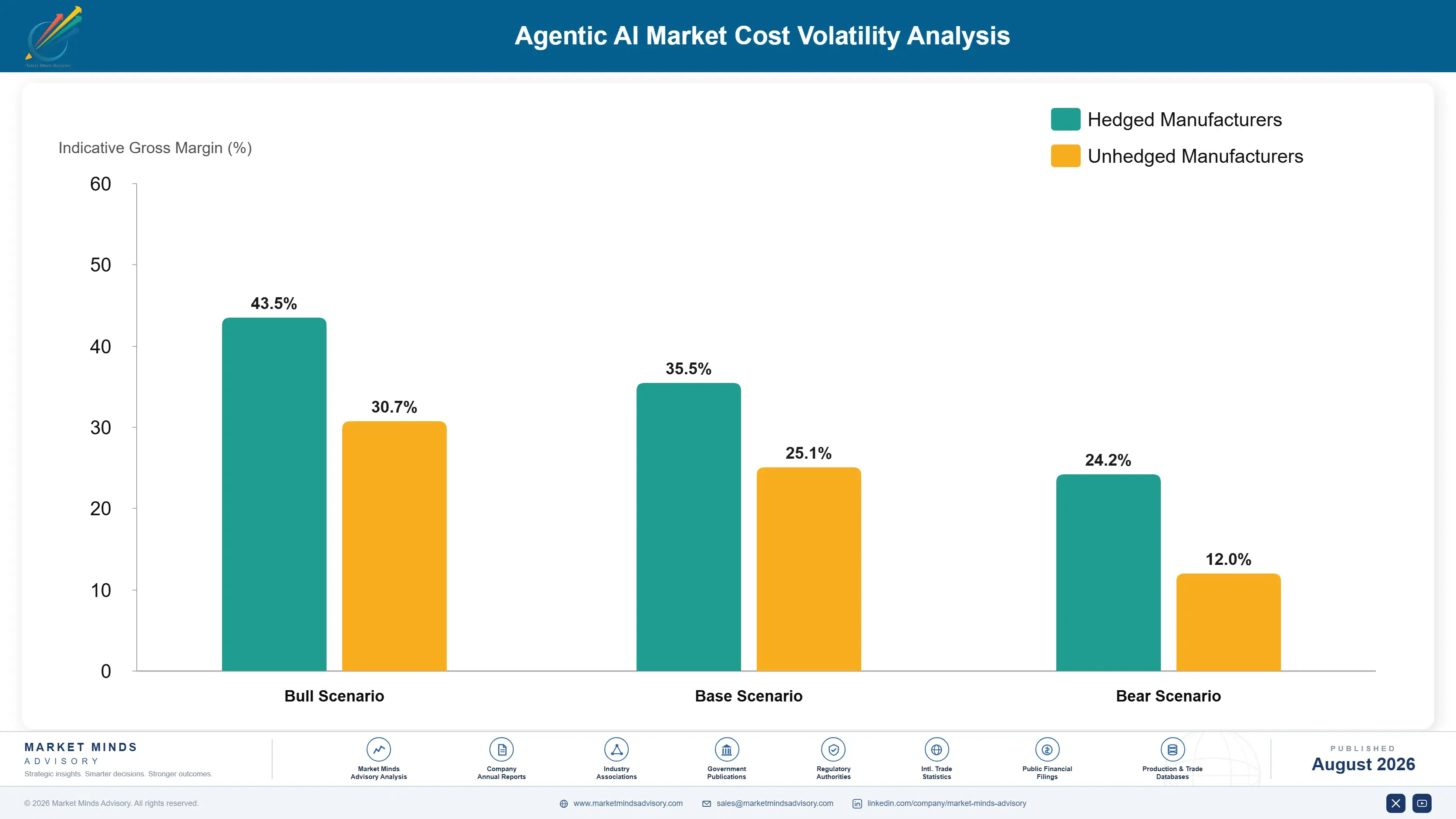
Foundation model inference compute and API access costs account for 42% to 58% of cost of goods sold for agentic AI platform vendors, varying based on task complexity and provider dependency. Engineering talent for orchestration and integration development adds a further 20% to 30%, while infrastructure and hosting make up the remainder. This cost structure differs from traditional enterprise software, where compute historically represented a smaller expense share.
Foundation model API pricing fell considerably through 2023 and 2024 as competition among major providers intensified, per industry pricing disclosures, even as model capability improved simultaneously. Several agentic AI vendors disclosed meaningful margin improvement specifically tied to this pricing decline in annual reports covering the period. Compute costs for the most capable frontier models remain substantial, however, and vendors report continued price sensitivity on high-volume production deployments specifically.

Exposure separates clearly by foundation model dependency and engineering scale. Vendors building on proprietary foundation models avoid direct API cost exposure but bear substantial internal compute and training cost instead. Vendors dependent on third-party model providers face pricing and availability risk that vertically integrated competitors do not, though they benefit from not bearing model development cost themselves directly.
agentic-ai-market-cost-volatility-analysis-1787325435172

Diversify foundation model provider relationships broadly

Single-provider foundation model dependence exposed several vendors to pricing and availability risk during recent provider-specific outages and pricing changes. Qualifying multiple foundation model providers for critical agent functions reduces this concentration risk considerably across future disruption cycles. The trade-off is additional integration and testing cost that smaller vendors sometimes cannot justify economically at current volume.

Optimise task routing to control compute cost directly

Routing simpler tasks to smaller, less expensive models while reserving frontier model capability for genuinely complex reasoning reduces overall compute cost considerably without sacrificing task completion reliability meaningfully. Building this routing intelligence requires sustained engineering investment that smaller vendors sometimes cannot justify economically. This benefit compounds as deployment volume grows relative to fixed engineering investment.

Invest in observability software to offset compute pressure

Compute cost pressure compresses margin regardless of vendor scale, while observability and governance software capability, once developed, carries meaningfully higher margin and genuine differentiation value over time and cycles. Software investment shifts vendor economics away from pure compute-dependent competition entirely. Vendors treating governance software as secondary consistently underperform those building it as a core differentiator.

Portfolio Architecture for Margin Defence

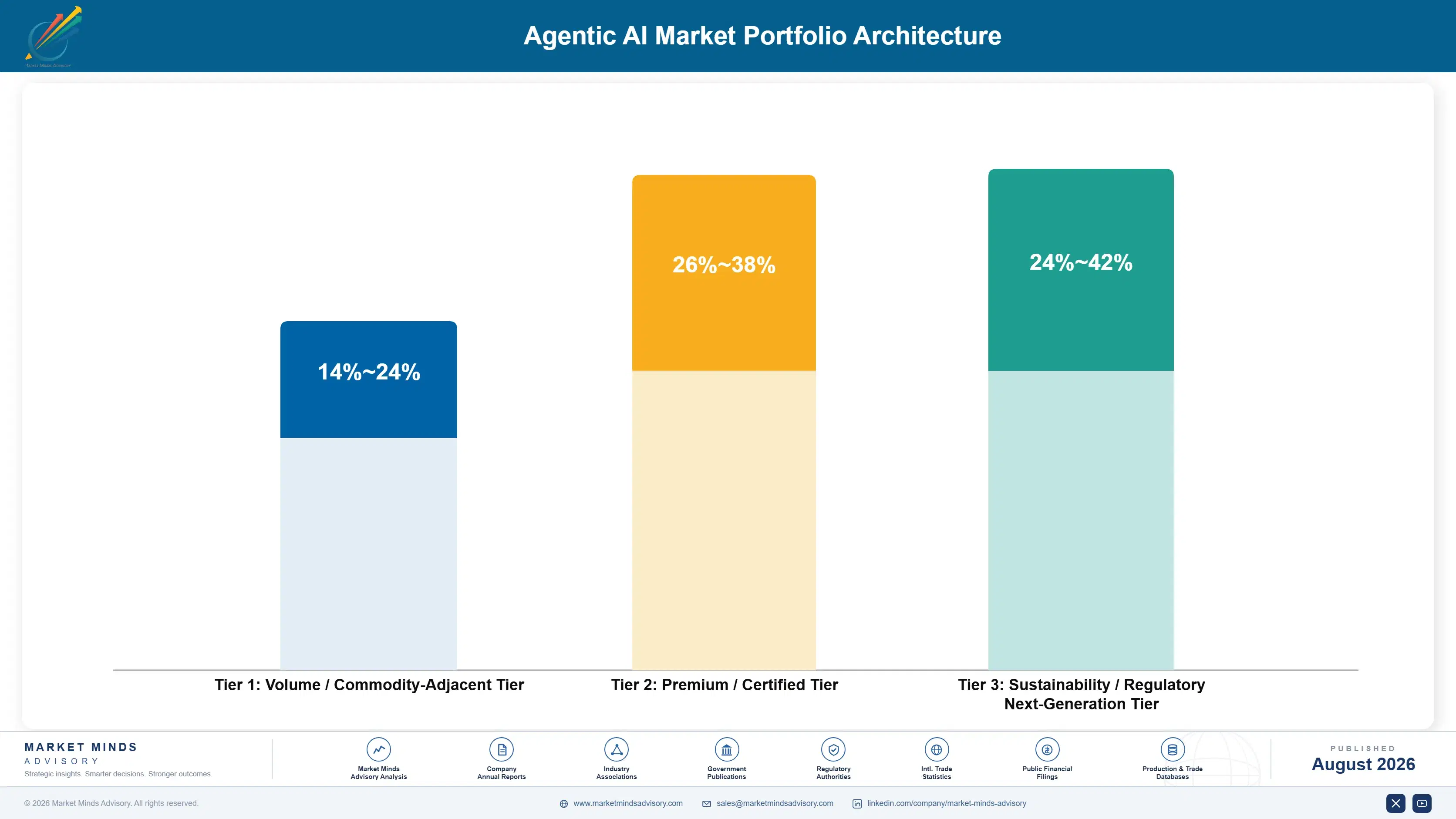
The portfolio splits into three tiers with distinct economics. General-purpose chatbot interfaces form the volume tier, competing on price with margin compressed by commoditisation. Vertical task execution agents and integrated observability platforms earn considerably more since domain specialisation and governance depth deter competitors lacking comparable technical investment. Multi-agent orchestration platforms and enterprise security-integrated systems sit differently again, priced against
The tension runs between general-purpose platform revenue that funds the business today and vertical specialisation and governance investment that positions it for the next decade. A vendor competing purely on general-purpose capability against foundation model commoditisation cedes the highest-margin vertical and governance segments to competitors investing there directly. Companies managing this well use general-purpose platform cash flow to fund vertical specialisation and observability investment rather than treating them as competing priorities.

High-value pools concentrate where domain specialisation, governance depth, or orchestration complexity limit competition: vertical task agents with proven reliability records, observability platforms meeting enterprise compliance requirements, and multi-agent orchestration serving genuinely complex workflows. General-purpose chatbot interfaces without differentiated capability sit at the other end, competing almost entirely on price against every credible foundation model provider and reseller.

Volume / Commodity-Adjacent Tier

General-purpose chatbot interfaces and basic single-agent automation tools competing mainly on price, increasingly commoditised as foundation model access spreads across more platform resellers each year worldwide and consistently. and across most product categories tracked.
Gross Margin: 14-24%

Premium / Certified Tier

Vertical task execution agents and integrated observability platforms meeting enterprise compliance requirements, supporting meaningfully stronger margin than general-purpose chatbot interfaces across most deployments and reference installations tracked currently. and reference deployments tracked currently worldwide.
Gross Margin: 26-38%

Sustainability / Regulatory / Next-Generation Tier

Multi-agent orchestration platforms, enterprise security-integrated agent identity systems, and emerging autonomous decision-making systems developed ahead of tightening AI governance regulation across major enterprise markets worldwide. across most major enterprise markets globally.
Gross Margin: 24-42%
agentic-ai-market-portfolio-architecture-1787325435667

High-value Sub-segments and Strategic Watch-out

Autonomous Task Execution Agents

High value and high growth at 22.0%, the fastest category in the market, driven by enterprises moving from pilot chatbots to agents completing genuine multi-step work reliably across well-defined tasks worldwide. Vertical specialisation increasingly determines vendor selection outcomes. Reference reliability increasingly determines vendor selection. outcomes.
Gross Margin: 26-38%

Agent Observability and Governance Tools

High value with strong growth at 20.0%, second-fastest category, driven by enterprise compliance requirements that barely existed as a formal category previously. Vendors without integration increasingly fail procurement evaluation entirely regardless of underlying agent capability offered. Governance depth increasingly shapes procurement outcomes directly. today. Certification matters.
Gross Margin: 26-38%

Agent Orchestration and Runtime Platforms

The volume core by revenue, growing near 16.0% as this remains the foundational infrastructure layer underlying nearly every agentic AI deployment tracked currently worldwide across enterprise and developer use cases broadly and consistently. Foundational infrastructure investment continues expanding steadily worldwide. today already. Growth remains steady.
Gross Margin: 14-24%

Agentic Development and Testing Tools

The strategic watch-out, growing near 15.0% and facing commoditisation pressure as foundation model providers increasingly bundle basic development tooling directly into their core platform offerings at no additional cost whatsoever. Differentiation increasingly depends on vertical integration depth. considerably over time. Pricing pressure persists. across regions.
Gross Margin: 14-24%

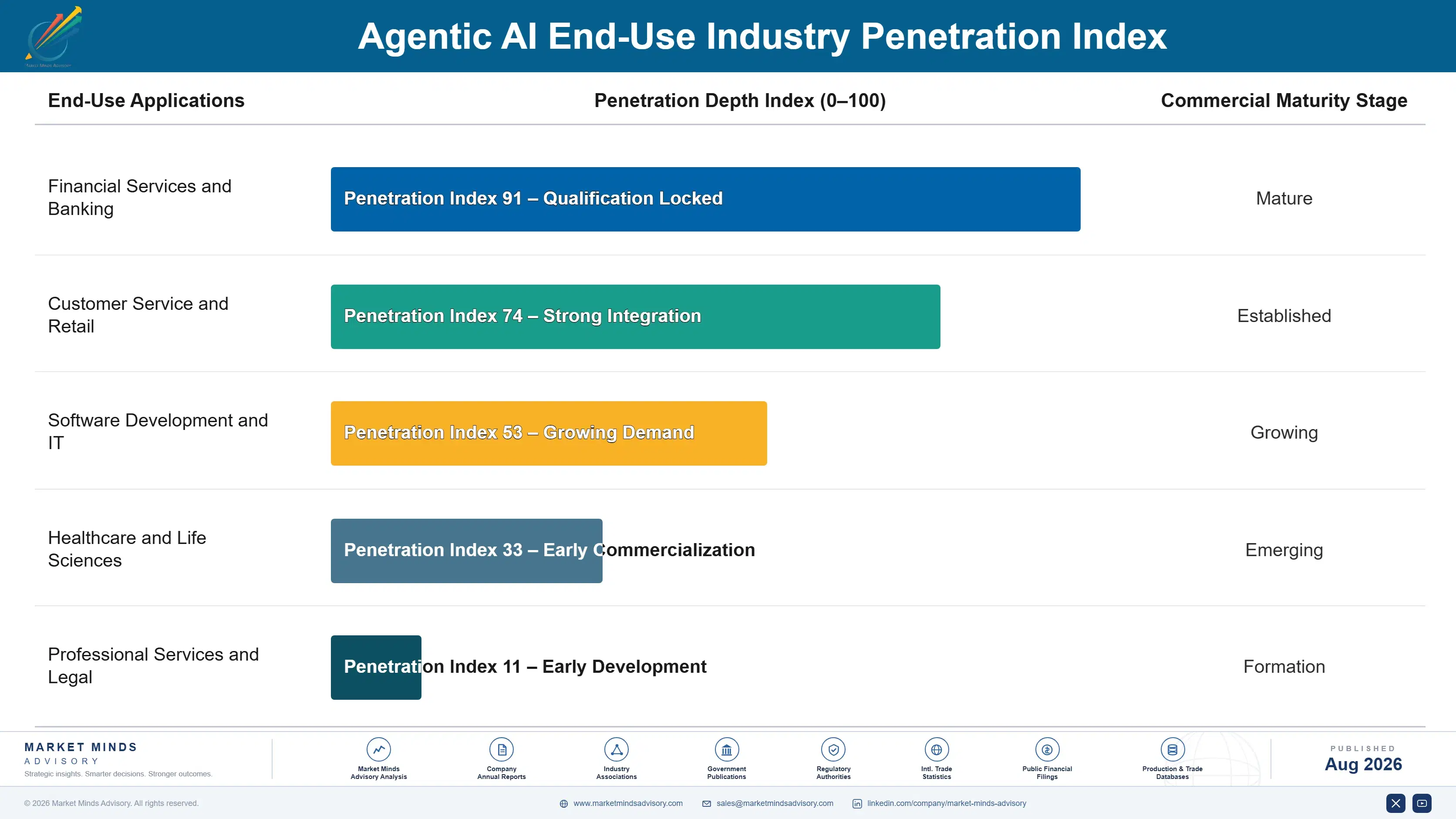
How Trust Locks In Platform Revenue

Revenue depends on enterprise trust built through demonstrated reliability, and a vendor's proven track record at one major enterprise generates years of expanded deployment scope well beyond the initial use case. Enterprises weigh observability and governance depth as heavily as raw capability, since an ungoverned agent action carries consequences dwarfing the platform cost. Losing a flagship enterprise relationship costs a vendor more than losing any single new deal.
Adoption depth varies sharply by task category. Regulated financial and healthcare workflows commit hardest to governance-proven platforms, since compliance requirements and switching costs both deter displacement once a vendor proves reliable. Customer service and research workflows sit in the middle, valuing capability improvements over pure platform loyalty. Simple content generation tasks switch most readily, since differentiation between qualified general-purpose platforms remains genuinely minimal across comparable use cases.

Buyer profiles have shifted from individual department heads experimenting with chatbots toward enterprise architecture and risk committees evaluating governance, security, and total deployment scope together. Chief information security officers increasingly hold veto power over agent deployment decisions business leaders once controlled alone. Younger technology leaders also weigh orchestration flexibility and observability integration more heavily than predecessors did, favouring genuinely open platforms.
agentic-ai-market-end-use-penetration-index-1787325436153

Our Call on Agentic AI

These are among the four positions where our research anticipates prominent divergence between winners and laggards over the coming forecast period. Each is grounded in the demand model, the regulatory perimeter, and the announced capacity pipeline.
01 / GOVERNANCE NOW GATES TRUST

Audit trails decide enterprise deployment scope

Agent observability and governance tools grow at 20.0% against a 17.8% overall market as enterprises moving agents into production increasingly require audit trails that barely existed as a formal product category when agentic AI first emerged commercially at scale. Vendors treating observability as a native platform capability rather than a third-party add-on increasingly win evaluations that competitors without it lose entirely. Companies should build governance capability now, since enterprise trust compounds into expanded deployment scope that undifferentiated competitors cannot easily replicate.
02 / MULTI-AGENT DESIGN WINS

Coordinated agents beat single monolithic systems

Multi-agent deployment now represents roughly 46 percent of new enterprise projects, a share that has risen considerably as architects learned that decomposing complex workflows across specialised agents improves reliability meaningfully over monolithic single-agent designs used previously and considerably less effectively overall. Vendors with genuine orchestration and coordination capability capture enterprise contracts that single-agent competitors increasingly cannot serve at comparable reliability or scale. Companies should invest in coordination protocols now, since this architectural advantage compounds as workflow complexity increases across enterprise deployments everywhere.
03 / VERTICAL DEPTH BEATS BREADTH

Specialised agents outperform general platforms

Autonomous task execution agents grow at 22.0% as enterprises increasingly favour agents built specifically for well-defined vertical tasks over general-purpose platforms attempting to serve every possible use case simultaneously and considerably less reliably overall. Vendors achieving deep vertical specialisation capture task completion reliability rates that general-purpose competitors struggle to match consistently across the same specific workflows examined closely. Companies should prioritise vertical depth over platform breadth, since specialisation reliability increasingly determines which vendors survive procurement evaluation entirely across most industries examined.
04 / SECURITY INTEGRATION SETS PACE

Access control maturity determines deployment speed

Enterprise security concerns add 8 to 12 weeks to typical deployment timelines specifically because agent access control tooling remains considerably less mature than decades of identity management infrastructure built for human users across enterprise environments generally. Vendors building granular permission scoping directly into their platforms win security team approval that competitors offering only broad access grants increasingly struggle to obtain quickly. Companies should invest in dedicated agent identity management now, since security certification increasingly determines deployment timeline and ultimate contract scope.

Engagement Snapshot From the Field

A live engagement with an industry participant carrying material or product regulatory and market exposure ahead of a defining policy shift, showing how our research translates into a defensible multi-year portfolio strategy.
MARKET MINDS ADVISORY · CLIENT ENGAGEMENT SUMMARY
Agentic AI Producer Strategic Portfolio Review and Transition Roadmap 2026·Investment Scenario on Agentic AI Exposure Evaluation 2025-26
CLIENT PROFILE
A regional financial services firm with roughly 3,200 employees engaged MMA ahead of a planned enterprise-wide agentic AI deployment across customer service and back-office operations spanning multiple departments. The client reported existing chatbot deployment limited to simple frequently asked question responses, with no autonomous task execution capability in production (client-reported, unverified by MMA). across departments.
STRATEGIC CHALLENGE
Leadership wanted to expand beyond basic chatbot capability into genuine task automation but faced internal disagreement between business units eager for rapid deployment and a security team concerned about agent access to core banking systems. The board worried moving too fast could create compliance exposure, while moving too slowly would cede advantage to competitors already piloting similar capability. Budget constraints required prioritising workflows.
MMA APPROACH
MMA benchmarked available agentic platforms against the client's specific regulatory and security requirements within financial services broadly. We assessed workflow candidates by automation potential weighted against security and compliance risk exposure. We then modelled a phased deployment plan sequencing lower-risk workflows ahead of higher-value but more sensitive applications. and thoroughly.
KEY FINDINGS
  1. Customer service inquiry triage showed the strongest near-term automation potential with genuinely manageable security exposure given limited system access requirements involved specifically.
  2. Back-office reconciliation workflows offered the highest efficiency gain but required security architecture investment the client had not yet budgeted for adequately at all.
  3. The security team's core concerns centred on audit trail completeness rather than agent capability itself, pointing toward a governance-first vendor selection process.
  4. Phasing deployment by risk level rather than by business unit priority reduced projected security review time by roughly 40% against the original all-at-once plan discussed initially.
CLIENT PROFILE
A regional financial services firm with roughly 3,200 employees engaged MMA ahead of a planned enterprise-wide agentic AI deployment across customer service and back-office operations spanning multiple departments. The client reported existing chatbot deployment limited to simple frequently asked question responses, with no autonomous task execution capability in production (client-reported, unverified by MMA). across departments.
STRATEGIC CHALLENGE
Leadership wanted to expand beyond basic chatbot capability into genuine task automation but faced internal disagreement between business units eager for rapid deployment and a security team concerned about agent access to core banking systems. The board worried moving too fast could create compliance exposure, while moving too slowly would cede advantage to competitors already piloting similar capability. Budget constraints required prioritising workflows.
MMA APPROACH
MMA benchmarked available agentic platforms against the client's specific regulatory and security requirements within financial services broadly. We assessed workflow candidates by automation potential weighted against security and compliance risk exposure. We then modelled a phased deployment plan sequencing lower-risk workflows ahead of higher-value but more sensitive applications. and thoroughly.
KEY FINDINGS
  1. Customer service inquiry triage showed the strongest near-term automation potential with genuinely manageable security exposure given limited system access requirements involved specifically.
  2. Back-office reconciliation workflows offered the highest efficiency gain but required security architecture investment the client had not yet budgeted for adequately at all.
  3. The security team's core concerns centred on audit trail completeness rather than agent capability itself, pointing toward a governance-first vendor selection process.
  4. Phasing deployment by risk level rather than by business unit priority reduced projected security review time by roughly 40% against the original all-at-once plan discussed initially.
RECOMMENDED STRATEGY
Phase 1: Phase 1 (0 to 4 months): Deploy customer service triage agents with governance-proven observability tooling as the initial enterprise pilot programme. Phase 2: Phase 2 (4 to 10 months): Extend into back-office reconciliation once security architecture investment is complete and fully validated and approved. Phase 3: Phase 3 (10 to 18 months): Expand deployment scope enterprise-wide based on validated reliability and governance track record achieved during piloting.
OUTCOME
The client deployed customer service triage agents on the recommended timeline and used the governance track record built during that phase to secure security team approval for back-office expansion. The phased approach resolved the internal disagreement between business units and security by giving both a shared evidence base (client-reported, unverified by MMA).

Frequently Asked Questions

Foundational context covering the market sizes, CAGR, scope, country, region and competition that inform every finding below. This section is provided to cover basics and most often pre-purchase conversations, answered from the MMA Primary Research Dataset.

What is the current size of the Agentic AI Market?

The global agentic AI market is valued at USD 7.8 billion in 2025, covering orchestration platforms, task execution agents, and governance tools. Underlying foundation model infrastructure and basic chatbots are excluded.

How large will the Agentic AI Market be by 2036?

The market is forecast to reach USD 47.28 billion by 2036 in the base case, about 5.15 times the 2026 level. That represents incremental value of roughly USD 38.09 billion across the decade.

What is the CAGR for the Agentic AI Market 2026 to 2036?

The market grows at a 17.8% CAGR in the base case, with bull and bear scenarios at 19.1% and 16.4%. The spread turns mainly on foundation model reliability and enterprise risk tolerance.

Which segment is growing fastest?

Autonomous task execution agents grow fastest at 22.0%, about 1.24 times the overall rate, as enterprises deploy agents for genuine work. Agent observability and governance tools follow at 20.0%.

Who are the major companies in the Agentic AI Market?

Leading companies include Microsoft, OpenAI, Google, Salesforce, and UiPath. Concentration is moderate to high, with the top five holding roughly 52% of platform and agent software revenue.

Which country is growing fastest?

India grows fastest at a 21.5% CAGR, driven by enterprise IT services firms integrating agentic AI into client delivery. Southeast Asian markets follow on similar adoption patterns.

Report Segmentation Architecture

The full report scope spans multiple orthogonal segmentation dimensions, with cross-tabulated demand data provided for each dimension pair. Coverage extends further to regional breakdowns, trend trajectories, and the competitive detail needed to support segment-level decision-making.

By Platform Function

  • Agent Orchestration and Runtime Platforms
  • Autonomous Task Execution Agents
  • Multi-Agent Coordination Frameworks
  • Agent Observability and Governance Tools
  • Agentic Development and Testing Tools

By End-Use Industry

  • Financial Services and Banking
  • Customer Service and Retail
  • Software Development and IT
  • Healthcare and Life Sciences
  • Professional Services and Legal

By Commercial Dimension

  • Direct Enterprise Software Purchase
  • Cloud Platform Subscription Model
  • Systems Integrator Deployment Channel
  • Managed Service Provider Delivery

By Region

  • North America
  • Western Europe
  • East Asia
  • South Asia and Pacific
  • Latin America
  • Middle East and Africa
  • Eastern Europe

Scope, Methodology, and Coverage

Every figure in this report is reproducible from documented input assumptions. The scope below maps the historical period, the forecast horizon, the segmentation dimensions, and the countries covered, alongside the underlying primary and qualitative methodology.
Historical Period
2020 to 2025
Forecast Period
2026 to 2036
Base Year
2025 (USD billions; MMA Primary Research Dataset, August 2026)
Market Definition
The agentic AI market comprises software platforms and tools enabling AI agents to autonomously plan, execute, and complete multi-step tasks with minimal human intervention, valued at vendor revenue for platform licensing and subscription services. It spans agent orchestration and runtime platforms, autonomous task execution agents, multi-agent coordination frameworks, agent observability and governance tools, and agentic development and testing tools. Underlying foundation model training and inference infrastructure sold as raw compute capacity, general-purpose chatbot interfaces without autonomous task execution capability, and traditional rule-based robotic process automation without AI reasoning are excluded.
Quantitative Units
USD billions (current prices); active deployment and seat counts where applicable
Segmentation Dimensions
By Platform Function; By End-Use Industry; By Commercial Dimension; By Region
Regions Covered
North America, Western Europe, East Asia, South Asia and Pacific, Latin America, Middle East and Africa, Eastern Europe
Countries Covered
USA, China, Germany, France, UK, Japan, South Korea, India, Australia, Canada, Brazil, Mexico, Indonesia, Vietnam, Thailand, Malaysia, UAE, Saudi Arabia, South Africa, Nigeria, Turkey, Poland, Netherlands, Italy, Spain, Sweden, Switzerland, Argentina, Colombia, Singapore, and additional markets relevant to this sector
Key Companies Profiled
Microsoft, OpenAI, Google, Salesforce, UiPath, Anthropic, Amazon Web Services, IBM, ServiceNow, Cognition Labs, LangChain, CrewAI, Writer, Glean, Sierra, Cresta, Moveworks, C3.ai, Automation Anywhere, Workday
Quantitative Methodology
Primary survey, n=3,800 respondents, Q4 2025, six countries; demand-side model with trade association cross-validation
Qualitative Methodology
47 expert interviews, Q4 2025; applied to validate demand model assumptions, identify emerging dynamics, and assess competitive positioning
Report Format
PDF and XLSX data workbook (Word format preview document)
Publisher
Market Minds Advisory
Report Code
MMA-2026-TEC-201
Published
August 2026
Contact
sales@marketmindsadvisory.com | www.marketmindsadvisory.com

Purchase the full Agentic AI Market Report (2026 to 2036).

The full MMA Agentic AI report sizes the market across five platform functions, five end-use industries, four commercial channels, and seven regions through 2036. It profiles 20 companies on a consistent platform and software revenue basis, scoring each on observability depth, multi-agent orchestration capability, vertical task reliability, and enterprise security integration. Scenario models quantify how foundation model reasoning improvements, enterprise automation backlogs, and governance maturity move both deployment scope and achievable margin by platform function. The report also includes task completion reliability benchmarking, governance and compliance tracking, and vertical agent competitive analysis for vendor and enterprise strategy teams.
Five-function and four-channel market sizing to 2036
Twenty-company benchmark on platform revenue basis
Task completion reliability benchmarking by vertical category
Agent observability and governance maturity tracking
Multi-agent orchestration competitive positioning analysis and tracking
Enterprise security and access integration benchmarking

Built For The People Who Decide

From boardroom strategy to bench-side execution, this report is read cover-to-cover by leaders shaping the next decade of their industry, turning demand scenarios, market dynamics and valuation benchmarks into decisions.
CXOs/ Presidents/ VPs/ Managers
M&A and Corporate Development
Strategy Teams and R&D Heads
Procurement and Product Directors
Regulatory and Compliance Leaders
Investor Relations and Equity Analysts